• Donate
  • Our Purpose
  • Contact Us
Executive Magazine
  • ISSUES
    • Current Issue
    • Past issues
  • BUSINESS
  • ECONOMICS & POLICY
  • OPINION
  • SPECIAL REPORTS
  • EXECUTIVE TALKS
  • MOVEMENTS
    • Change the image
    • Cannes lions
    • Transparency & accountability
    • ECONOMIC ROADMAP
    • Say No to Corruption
    • The Lebanon media development initiative
    • LPSN Policy Asks
    • Advocating the preservation of deposits
  • JOIN US
    • Join our movement
    • Attend our events
    • Receive updates
    • Connect with us
  • DONATE
The Buzz

Business briefing: 5 Aug 2013

by Executive Staff August 5, 2013
written by Executive Staff

Economics and Politics

Lebanon's finance minister Mohammad Safadi has denied claims that payments to public sector workers will be delayed in August, saying the government will soon authorize $794 million of extra spending in an “urgent” decree.

More from The Daily Star


Elsewhere in Lebanon a second Turkish power ship is reportedly set to arrive in Lebanon today, despite an ongoing dispute with the government.

More from The Daily Star


Syrian traders who price goods in foreign currency will face up to 10 years in jail, the government announced Sunday in a move aimed at stemming the increasing dollarization of an economy crippled by two years of civil war.

More from Reuters


Companies and Business

Income at UAE energy giant Dana Gas ell by almost half during the second quarter after lost production in the Kurdish region of Iraq and difficulties collecting debts from Egypt.

More from The National

The computer security firm Kaspersky Lab is expecting growth of 21 per cent by the end of this year across the Middle East and North Africa (Mena) Region.

More from The National


Saudi Arabia plans to spend about $800 million acquiring land in Riyadh to build the capital’s first metro rail system.

More from Reuters

Saudi Electricity Co (SEC) signed a contract with South Korea's Hyundai Heavy Industries Co Ltd (HHI) to build a $3.4bn power plant in Shuqaiq.

More from Reuters


August 5, 2013 0 comments
0 FacebookTwitterPinterestEmail
Economics & Policy

Preserving the family home

by Maya Sioufi August 3, 2013
written by Maya Sioufi

There is a new family running Khoury Home. Since 2011, Lebanon’s largest household appliance and electronic retailer has been suffering financially in the face of rapidly changing economic conditions. As of this past January Romen Mathieu, managing director of the EuroMena private equity funds of London-based financial institution Capital Trust Group, stepped in as chief executive to turn the company around.

“It was a rescue operation,” says Tony Khoury, as he explains why he and his brothers agreed at the end of last year to sell the company they founded from scratch for $30 million. “A rescue operation for my brothers and me, for the new investors, for our partner, for the banks, for the suppliers and most importantly for the employees,” he says.

At lunch in Dbayeh, Tony looks refreshed and energetic as he reflects on his laborious years sweating and grinding away to take the company from a small showroom with just four employees in Lebanon’s Elissar neighborhood, near Antelias, in 1998 to its peak in 2010 with around 800 employees and sales of $110 million — 15 percent of the home appliance industry’s annual sales of $718 million. “We are the mother of the boy,” a common Arabic phrase he proudly repeats several times during lunch as he shares with Executive the history of the company he feels so strongly attached to but that is now run by a private equity firm.

How it all started

Tony’s father did not believe in his son’s ambition initially. Running a consumer electronic wholesale business, his father was wary of venturing into the retail operation, but Tony was persistent. The second of three brothers — each of whom had an equal stake in Khoury Home — Tony was the only one without an academic degree: he says he was not bright enough, but he had vision. Insistent on turning their Elissar warehouse into a showroom despite his father’s criticism of the idea, his ambition drove him further after electronics company Khattar opened a store in the area.

“I went crazy when Khattar opened,” he says. So his older brother Georges convinced their father to let him try it out. The showroom quickly turned into a cash cow from the first year of operation. “I told Georges, ‘I can’t believe it. I want a showroom.’ That’s it,” recalls Tony. That’s when Moussa Farhan, a family friend with significant retail experience, gave him the idea to go to Beirut.

While the Elissar showroom may seem like the starting point for Khoury Home’s success story, Tony sees the year 2000 as the real beginning. That was the year they opened the Dora flagship store. Crossing the Dora bridge with his brother Georges, he pointed at the room and said, “I want that store”. Georges told him to forget about it; they couldn’t afford it and “even Mama said ‘You want to be next to [electronic retailer] Kettaneh? He is a mountain, he will swallow you.’”

The company is one of Lebanon's best-known brands


One year later, Tony secured the Dora store, 700 square meters then, and started hiring. One of the first employees on board was Ameen Barbar who, 13 years later, is now Khoury Home’s commercial manager. “I was trained by Tony Khoury, an expert on sales, on the products, on the perfect way to run the business. I gained a lot from him,” says Barbar.

Tony was involved with the nitty-gritty of the business, from setting the pricing, training employees and selling to customers, to working on the advertising and expanding the business. He even worked from the hospital bed while battling blood cancer. His relentless efforts seemed to have paid off, when the showroom in Dora was expanded by 2,500 square meters in 2002 — a welcome sign of the company’s success.

Farhan, the family friend who had originally pushed him toward Beirut, eventually bought a 40 percent stake in the company for “about $250,000” on the tails of the company’s growing success, Tony says. Did the Khourys need the money, since the company was bringing in revenues then? “No, but he is a mountain by our side in case something happens,” Tony explains. From the start, Tony was willing to allow a more experienced investor to join him in his endeavor to take the company forward.

The company has seen its sales shrink as economic conditions have worsened


As Tony enjoyed the taste of success, his appetite for it grew, and he became more aggressive on the market. With his advertising partner, Fido, he worked on branding and strategy: “Khoury Home, ma bisakir wala yom” a rhyming tagline that means ‘Khoury Home does not close a single day’. He placed advertisements in Al Diyar newspaper: “fridge + freezer + oven = free microwave” and his ad expenses reached up to 3.6 percent of sales, compared to an industry average of 2 to 3 percent. The Khourys’ ambition to expand abroad led the company to study the Syrian market, securing a location there and planning to open its first store in 2011, the year the country took its first steps toward civil war.

Mounting challenges

In addition to the crisis in Syria and a deteriorating Lebanese economy, Khoury Home experienced tougher competition in 2011. Opening several stores next door to Khoury Home’s outlets, Hokayem Brothers began eating into the market share of Lebanon’s largest household appliances and consumer electronics retailer. Hokayem Brothers was selling products at cost or at a loss.

To eliminate the competition, the Khourys decided to absorb Hokayem in March 2011 at an initial price tag of $24 million: $14 million for the merchandise and equipment and $10 million for the goodwill. The valuation of the competitor was based on figures provided by Hokayem with 2010 revenues of $50 million, an amount that turned out to be highly overstated.

The acquisition became more expensive and much messier when a second set of $10 million bonds appeared in the market. According to anonymous sources, BLC, the bank facilitating the transaction, had requested that the Khourys sign another set of $10 million bonds as the first set were “badly written”. So the Khourys signed the second set, but the first were never destroyed. After months of deliberation, a settlement worth $7 million, according to Billy Hokayem, was reached putting the matter to rest. BLC’s general manager Raoul Nehme refused to comment on this issue, citing banking secrecy.


“If you check the boxes on the don’t do’ list when acquiring a company, the Khoury family would score A-plus,” says current Khoury Home chief executive Mathieu, who remains astonished until today about the hasty acquisition and its minimal three page contract. As for the bonds story and the final price paid, Mathieu only knows the market rumors. He met Hokayem for a five-minute coffee one day and asked him about the price paid for the company. “He said the price the Khourys told you [$24 million] is correct” and when Mathieu then asked why he claimed that the price is much higher, Hokayem replied “I have my personal reasons”. Mathieu left it at that. “Nobody knows what happened; only Georges and Tony Khoury can tell you”, says Ramzi Ackawi, Khoury Home’s longtime auditor. “We don’t want to talk about it,” says Tony. “Even if it was our mistake, we are the mother of the boy.”

While the issue surrounding the price paid for Hokayem remains obscured, one thing that the different stakeholders interviewed agree on is that on a long term basis, the acquisition was a great step for Khoury Home, as it eliminated its strongest competitor. “Thank you Khourys for buying Hokayem” says Mathieu. But for the short term, it was a complete wreck, one that the EuroMena team plunged into in November 2011, unaware at that time of the extent of the mess they were about to place their hands on.

And Euromena steps in

From the launch of Capital Trust’s $100 million EuroMena Fund II in 2009, Mathieu had set his sights on Khoury Home. As the Fund was looking to invest up to $15 million in each private equity participation, or ticket, opportunities in Lebanon were scarce, and Lebanon’s leading consumer electronic and household appliance retailer looked appealing. The Khourys were reluctant to sell a stake back then, but Mathieu persisted. It wasn’t until 2011, soon after the acquisition of Hokayem, that the Khourys decided it was time to bring in new blood. “I thought they didn’t need capital at that time. It appeared later on they needed capital badly and they didn’t say,” says Mathieu.

In September 2011, Khoury Home was valued at $70 million; its 30 percent stake in Astrum, the company that holds the Samsung license in Syria with its assembly factory in Jordan, was valued at $4 million, bringing the total value to $74 million. EuroMena invested $13.5 million for a 16 percent stake, $6 million of which went to increasing the capital of the company, with the rest going to the Khoury brothers. With a 2011 net profit forecast of $7.7 million for the combined group — Khoury Home and Hokayem — the valuation equated to nine times the expected earnings versus an international industry average of 12 to 13 times. EuroMena was aiming for a much lower valuation, closer to $60 million, so to hedge against the hefty price tag, Mathieu requested a put option: the right to sell EuroMena’s stake at $21 million in four years time if an agreed upon level of profits was not generated annually.

To guarantee the minority rights of EuroMena’s investors, he also put in place a solid shareholder agreement with representations and warranties, ensuring that the sellers are providing a true account of all information. With such a contract in hand, EuroMena would be able to mitigate risk in case of a significant financial loss. With the deal signed, Mathieu finally invested in the flourishing company he had set his sight on more than two years ago.

The turning point

A month after closing the investment in Khoury Home, the second set of bonds started to emerge in the market. As the bonds were held on the personal account of the Khoury family, Mathieu was unconcerned. EuroMena was shielded but he didn’t “want a plane without a pilot” he says. By December 2011, turbulence between the Khourys and the Hokayems on the bonds and the exaggerated financial statements was mounting daily.

Mathieu was fuming when he first heard, on February 24, 2012, that the company would be reporting a loss for the previous year instead of the expected profit figure of nearly $8 million. “Either you are not aware and you are discovering, like me, that you are making a loss, which is unjustifiable — or you are aware and making yourself unaware in front of me, in which case Romen Mathieu will be your enemy from now on — or there is an excel error and your finance team needs to go home,” Mathieu recalls saying, as he looks back at that dreadful shareholder meeting.

Mathieu has tried to get Khoury Home back on track


That’s when Mathieu decided to fight for control of the steering wheel — or as much control as as he could get as a minority shareholder. He pushed for an external director, and the Khoury family did not resist. In fact, they too saw the urgent need for new managers and hired Cesar Chalhoub — one of their suppliers at Lebanon’s Information Technology Group — as chief operating officer in February 2012.

“I was kind of a COO without the full authorities of a COO,” explains Chalhoub. Joining a family business from an institutional company was not a smooth ride, and he faced difficulties with “the corporate governance of managing a business of this size with over 700 employees” he says.

When the losses for 2011 were announced in March 2012 at $1.3 million, the EuroMena team increased their stake in Khoury Home. Through the clauses within their contract, they increased their stake by 5 percent in June 2012 to 21 percent without paying an additional dollar. This meant that along with Farhan, the previous minority investors now held 51 percent of the company; the Khourys no longer had a controlling stake. The exit sign was not too far away.

Venturing too far

There is no doubt that the Khoury’s reputation in the retail business is a solid one. Speaking to their employees, suppliers, accountants, bankers and lawyers, one can sense the respect and admiration that the brothers have earned throughout the years. “Tony Khoury treats his employees as if they are his own children,” says Caroline Khoury, the company’s human resources manager. “I’ve always had an excellent relationship with the Khoury family” says Eddy Cherfan, CEO of Cherfan Tawil Company, the distributors of Samsung and Khoury Home’s largest supplier.

So what went wrong? Why are the Khourys out of Khoury Home? As the Khourys expanded in Lebanon, their appetite for risk grew voraciously. With the Hokayem acquisition, they also started venturing into the real estate business.

“This is the problem of most families. When they start to succeed, they get greedy and they think whatever they do will be as successful as their other businesses,” says Ackawi, Khoury Home’s auditor.

“The Khoury family had a vision that Lebanon would continuously grow and nothing bad would happen,” adds Barbar, Khoury Home’s commercial manager. “They invested a lot in huge showrooms, furniture, etc. while the country went into an economic crisis.”


A glimpse at their debt picture reveals a clear red flag: it went up to $32 million in 2011 from $15 million in 2010. The Khourys had become too ambitious, and they started to lose control of their empire.

With the company recording a loss in 2011, the family needed capital to fund their new real estate operations. So in 2012, they turned to Khoury Home and took personal loans. According to Mathieu, the Khourys owed up to $7 million to their various real estate businesses, an insignificant sum relative to the value of their property. Revenues dropped from a peak of $110 million in 2010 to a low of $96 million in 2012, just a 13 percent fall, but the company also owed money to suppliers, bankers, advertising agencies, etcetera. Its net cash position was in the red by $4 million at the end of 2011. “Instead of selling a land or asking the banks for an extension, they wanted to wait for the real estate to go up again, and so they took money from Khoury Home,” says Mathieu.

EuroMena was not happy. Khoury Home’s actions were proof of poor corporate governance practices, a wrongdoing Mathieu would not look past. “What you are doing is not acceptable. I would advise you to take a lawyer,” said Mathieu in a warning to the elder brother and company chairman Georges Khoury, in July 2012.

Not too long after that threat, the Khoury brothers, along with Farhan, and Mathieu started the mediation process. Discussions kicked off with Roger Dib, founder of the Near East Consulting Group, which specializes in corporate governance, and with auditor Ackawi to find a solution.

With the Khourys and Farhan sharing ownership across the entire group, reaching a consensus proved to be a Herculean task. “Their group is like the intestines of a pig: one company owns a part in another, one company is indebted from another and invested on account of another, etc.,” says Mathieu.

Still, a formula was reached in September 2012, the year the company lost $5.8 million. The agreement, closed in December 2012, valued Khoury Home at $56 million, down 24 percent from its $74 million valuation a year earlier. Farhan paid $30 million to the Khourys to acquire an additional 40 percent stake in Khoury Home as well as their share in the real estate businesses— making their total exit worth $37.5 million. The family’s remaining 9 percent was given to EuroMena at no additional cost in exchange for their approval of the deal and dropping their put option. Over and above, Farhan reimbursed Khoury Home the $5 million that was withdrawn by the family during 2012.

Farhan, who did not want to be interviewed for this report, also requested that Mathieu become CEO of the company. Mathieu agreed on one condition: that Farhan would place 30 percent of his share — leaving him with a 40 percent stake — into EuroMena’s holding company, therefore granting the holding direct ownership in 60 percent of Khoury Home, a majority stake.

“We are in a Maronite marriage Moussa and I; I respect him for giving us the keys of the house,” says Mathieu. Farhan’s goal is to sell 40 percent of his ownership to strategic investors by mid-2014 via private placement, in order to reinforce the shareholder structure. The Khourys are bound by a non-compete clause, legally forbidding them from venturing into this industry for the next ten years.

Changing of the guard

“We miss them,” says Barbar who has deep admiration for Tony Khoury, the man he says “taught him everything he knows today”. But the new investors have created “a family spirit” in the company.

“Of course when the new owners took over we were scared, but the fear was quickly controlled by the new management,” says Zeina Tawaji, a niece of the Khoury brothers. She still works at Khoury Home as the commercial team’s executive assistant.

Mathieu began his reign over Khoury Home in January 2013, as the new CEO. With his helmet on and his sleeves rolled up, he rides his motorbike back and forth between the offices of EuroMena — where he remains fund manager of investments worth $170 million — and the Dora headquarters of Khoury Home. With no industry expertise, Mathieu reached out to Thierry Falque Pierrotin, former CEO of London-based multinational electronic retailer Darty, and asked him to become an advisor to Khoury Home. Visiting Lebanon every six weeks since February, Falque Pierrotin has been advising the top and middle managers on how to run a retail operation. Over a coffee in Beirut, he explains how the main challenge for the company now is to change the culture and increase the speed. “The company’s culture has to evolve from a family-owned one to one where you formalize more the processes, you put more time into all the subjects and more speed and you are in a position to measure your success; for me it’s about speed” he says. As for the board of directors, Mathieu has brought on Roger Dib as well as Charles Hajj, a former managing partner at consulting firm Booz&Co.

Falque Pierrotin’s advice is being taken seriously, and the new management is in the process of implementing a rigorous restructuring plan. After Chalhoub put his hands on the inventory, the net cash position went back in the black, standing at $8 million at the end of 2012 and allowing Khoury Home to pay back its suppliers this year.

A deal was negotiated with Lebanon’s International Advertising Association saving Khoury Home $450,000 on the hefty advertisement payment of $2.3 million owed by the company to its former agency, Fido. “I wanted to absolutely do this. If media is against you, it’s a disaster” says Mathieu. The advertising budget, handled now by M&C Saatchi, was streamlined from $4.2 million in 2011 to $3 million in 2012 to $1.7 million today.

Headcount has dropped from 800 in 2011 to 620 in June 2013, with an aim to reach 590 by the end of the year as temporary employment contracts are terminated. Stores are being eliminated: three have been shut down this year, and the total now stands at nine, down from a peak of 13 in 2011. The combined footprint of the stores is 12,000 square meters, down from 18,000 in 2011.

And Chalhoub has addressed the inventory surplus. Inventory had reached a staggering $38 million by the end of 2011. “They were buying without awareness; it was pure craziness,” says Mathieu. By the end of 2012, it had dropped to $19 million and is targeted to fall another $2 million by the end of 2013.

Moving forward

As of April, Khoury Home’s EBITDA, a key earnings figure, was positive for the first time in two years, and the new managers forecast profits of $2 million for the year.

They are enthusiastic about a five-year contract signed in June with Lebanese retailer BHV, to feature one another’s products in their stores. It is part of Khoury’s strategy to optimize space. “I admire the professionalism of the Abshis [owners of BHV],” says Mathieu as he explains how the deal was signed within two months. “I congratulated Romen on the BHV deal; it’s a great move,” says Tony who still gives advice to Mathieu whenever he is asked for it. Khoury Home intends on expanding into markets beyond Lebanon alongside BHV and might change its name for these ventures; for Lebanon though, Khoury Home’s name will not change.

Mathieu aims to cover areas in Lebanon still untapped by Khoury Home such as the south and the Bekaa, beginning in 2014. As for Syria, he will be looking to expand there when the war settles. Khoury Home still owns a 30 percent stake in the Samsung franchise in Syria. He also has his sights on Egypt and Palestine. He has already met the head of Sbitany Home, Khoury’s counterpart in Palestine, to discuss potential synergies.

For now, the focus is on growth in Lebanon, where Khoury Home commands the largest share, 14 percent, of the country’s household appliances and consumer electronics market. The ultimate goal of EuroMena is to divest its stake – ideally by 2018 – and repay its investors two- to three-fold.

Was it in Mathieu’s mandate to become CEO of Khoury Home? After all, EuroMena is not a buy-out fund, but as fund manager, Mathieu has the authority to own the company and take control if need be to prevent an investment from being a flop and dragging down the entire EuroMena fund. Eventually, Mathieu will have to move on as well. As the manager of two funds totaling $170 million and soon a third fund which he is raising up to $200 million for by the end of the year, Mathieu has other priorities to return to. “My objective at Khoury Home is to empower the managers,” he says. With the leadership of Chalhoub, the services of Falque Pierrotin and a solid board of directors, Mathieu’s main role now is to oversee the implementation of the reorganization plan.

Lessons learned

For EuroMena and Mathieu, due diligence will never be the same after their investment in Khoury Home. For future investments in companies that have just completed an acquisition, due diligence will be conducted on both companies as if they are being bought individually. EuroMena will also scrutinize managements’  abilities to reign over newly formed companies, prior to completing the investment.

But at the end of the day, EuroMena’s investors’ rights were protected. Through a solid shareholder agreement with clauses mitigating risk, EuroMena was able to turn the situation around and take over control. Had it not been for such a rigorous contract, the investors might have lost some of their capital and Khoury Home might have not been saved.

For a prominent, family-run business to hand the keys over to a private equity fund is quite an unusual development in this region. Tony Khoury was right to bring in new blood to save Khoury Home. Partnering with strategic and professional investors propels family-owned businesses to implement solid corporate governance standards — from internal controls to a succession plan — and ensure their continuous growth and success. After all, some of the largest companies today, such as the United States’ Wal-Mart, Korea’s Samsung and India’s Tata Group, are family run businesses.

Tony Khoury may not have a degree, but he is a very bright man, who has established one of Lebanon’s most successful companies, one he continued to toil over even while battling cancer. While he and his brothers might have grown too ambitious and failed to adapt to changing economic circumstances, they were sharp enough to let go in order to save the company and its employees — not an easy decision to make. He again makes the comparison to the woman who, under King Solomon, gave up her son to another woman, rather than see him split in half.

“We are the mother of the boy,” he says.


August 3, 2013 0 comments
0 FacebookTwitterPinterestEmail
Economics & PolicyLuxury

The need of luxury

by Thomas Schellen August 2, 2013
written by Thomas Schellen

In life and in luxury, everything is a matter of definition. Take the Chinese luxury market. While the core capitalist markets of North America and Europe have been the centers of conspicuous consumption in the past few years, Chinese shoppers in the mainland, Hong Kong, Macau and Taiwan constitute the main new demand engine for luxury. It is a priceless irony of our time that the Chinese, whose country is constitutionally defined as a “socialist state under the people’s democratic dictatorship led by the working class”, in 2012 spent $35.9 billion on largely European-branded luxury goods.

Luxury has been around for as long as mankind. From every epoch, we find a heritage of items made from the most precious contemporarily available materials, with the best possible quality and artisanship. These items were often void of practical use or luxuriously crafted for purposes of representation or ritual. 

Of course, what represents exclusivity in one era may eventually become an everyday item. The car, the television set and the cellphone were each transmuted rapidly from items of luxury to basics of daily mass use. But even then there are always luxury cars, TVs and consumer gadgets that find their lucrative niches with prices and features that reach far beyond the technically necessary. 

Given its pervasiveness, one can define luxury outright as a universal human need, and specifically an intangible need that is totally real even though it is not a necessity of physical sustenance. Moreover, as the desire for luxury finds two main expressions: items of opulence and extravagant experiences, this deep-seated need even seems to have elements corresponding to two existential modes of “having” and “being”. 

While any luxury market passes cyclically through high and low phases, the resilience of the luxury economy is often thrown into sharp relief when the wider economy experiences times of distress. Touring the Lebanese market for prime luxury possessions such as the $10,000 suit, the $45,000 television set or the $192,000 bed of all beds, Executive heard time and again that the vendors of these luxury items are not panicking about their present or future turnovers. 

In the Lebanese market for ultra-pricy vehicles and leisure craft Executive witnessed troughs in demand that appear to indicate the negative impact that hard economic pressure and depressed spending have on the most aspiring and affluent consumers. Yet, ownership of the ultimate status symbols like supercars and yachts is such an unfading element of the “having” mode that dealers of these luxuries say they too are staying comfortably afloat. 

As every economist in town is sounding the alarm over dismal inbound Arab tourism, it is heartening to find that outbound luxury travel is a story of good demand. In the context of Beirut’s messed-up urbanity and the depressing perceptions of our current economy, an escape into luxury must be a particularly inviting way to preserve one’s sanity as a high-end consumer.  

Personal luxury is a way to put oneself visibly apart from others but also from one’s own past. A luxury good or experience marks an aspiring person’s arrival to a higher state of wealth. As millions move up socioeconomically in emerging countries, markets for such self-affirmations are growing from the “affordable luxury” bracket to very small markets for smart, passion investments.   

In the mosaic of the wider economy, the luxury segment is an economic booster offering average folks attractive employment opportunities. Luxury markets also open doors for creative talent from designers to exceptional artists. 

Luxury has its drawbacks in its extreme vulnerability to avarice, however. It is habitually entwined with addictions to money and power, and thus remains an intricate challenge to integrate wealth and luxury into a virtuous spiral of happiness. According to recent studies, increasing wealth and its gains translate into higher amounts of momentary happiness. Not entirely a surprise. But the studies also showed happier people give more and people who spend more on others than themselves tend to become both more productive and happier. 

This, then, ties in with timeless truth: it is more blessed to give than to receive. 

August 2, 2013 0 comments
0 FacebookTwitterPinterestEmail
Comment

Full of bluster

by Nicholas Blanford August 2, 2013
written by Nicholas Blanford

The European Union decision to blacklist not all of Hezbollah but only the Shiite organization’s “military wing” last month was a mid-way solution intended to convey displeasure toward the Lebanese group and mollify Israel and the United States while not going so far as to jeopardize EU interests in Lebanon.

Distinguishing between different “wings” of Hezbollah was a display of diplomatic finesse first conjured up by the United Kingdom in the wake of the September 11, 2001 attacks in New York and Washington, DC. While the US and Israel were the only countries at the time (but later joined by The Netherlands) to proscribe Hezbollah in its entirety, London chose originally to list Hezbollah’s purported “External Security Organization”. There is no ESO, per se, but it was a useful moniker to cover the party’s alleged less savory activities beyond the more legitimate theater of direct Hezbollah-Israel confrontations in Lebanon. In 2008, the UK expanded the proscription to include Hezbollah’s “military wing”, a formula that has now been adopted by the EU.

The EU clearly sought to find a diplomatic compromise that would allow all 28 EU member states to agree to take action on Hezbollah. Prior to the vote, the EU had delivered a swipe at Israel by banning any dealings with commercial entities based in the Israeli-occupied West Bank. The EU decision on Hezbollah helped redress the balance. The EU decision was supposed to be in response to allegations that Hezbollah was involved in acts of terrorism in Europe, in particular the suicide bomb attack against a bus of Israeli tourists in Bulgaria last year in which five Israelis and the bus driver were killed. Bulgaria announced in February it had “well-grounded” evidence to support the accusation that Hezbollah was involved. However, Hezbollah survived several subsequent EU debates on blacklisting the organization. In fact, it seems that the tipping point that compelled even the doubters to sign off on proscribing Hezbollah’s “military wing” was the party’s unprecedented and declared military intervention in Syria. 

It is one thing for Hezbollah to be a resistance force against Israel’s illegal occupation of Lebanese territory, it is quite another, in the eyes of the EU, to see Hezbollah as a “regional army fighting regional wars”, as Paul Salem, director of the Carnegie Endowment’s Middle East Center, put it.

Inevitably, the EU’s cautious approach satisfied neither side. Israel, while generally welcoming the decision, argued that it should have covered the entire organization. Hezbollah, meanwhile, accused the EU of yielding to US and Israeli dictates. So what are the consequences of the EU decision? For Hezbollah, the impact will be negligible. First of all, it is not known if Hezbollah has any assets in Europe that are at risk of being frozen. Hezbollah’s principal areas of commercial activity are the less scrutinized countries of Africa and Latin America, rather than the more tightly regulated environment of Europe. Furthermore, Hezbollah has far greater concerns at present – such as the war in Syria and worsening Sunni-Shia relations at home. And it is unclear how the EU can enforce such a decision. How does one differentiate between assets belonging to the “military wing” as opposed to the “political” or “social-welfare” wings? 

How are EU customs officials supposed to decide if a suspected Hezbollah member arriving at Charles de Gaulle airport, for example, is a fighter in the “military wing” or a doctor or an engineer with Jihad al-Bina, Hezbollah’s “construction wing”? It is not as if their role is stamped into their passports. The EU could draw up a list of known names associated with Hezbollah’s military activities. But there are very few such names floating in the public domain, and for the most part no one knows what they look like (The mug shot of Mustapha Badreddine, one of four Hezbollah members indicted for the assassination of former Prime Minister Rafik Hariri, dates from the early 1980s). Furthermore, senior Hezbollah military and security figures adopt pseudonyms and travel on fake passports and IDs.

Those European contributors to UNIFIL will be bracing themselves now for a possible backlash in south Lebanon. Security reportedly has already been tightened throughout the UNIFIL zone. Hezbollah will not take action against UNIFIL directly. But UNIFIL may witness an increase in the number of altercations with aggrieved local Hezbollah supporters as they patrol through southern villages.


Nicholas Blanford is the Beirut-based correspondent for The Christian Science Monitor and The Times of London

August 2, 2013 0 comments
0 FacebookTwitterPinterestEmail
The Buzz

Business briefing: 2 Aug 2013

by Executive Staff August 2, 2013
written by Executive Staff

Economics and Business

Turkey’s economy is showing signs of slowing, with the weakest manufacturing data in a year bolstering speculation it will miss its year-end growth target.

More from The Daily Star


The Egyptian central bank unexpectedly lowered its main overnight interest rate by 50 basis points at a monetary policy committee meeting on Thursday.

More from Reuters


Companies and Business

The World Bank Group is set to fund a $6.4 million project to boost Lebanon’s mobile Internet systems and help create employment opportunities, especially among youth and women.

More from The Daily Star


Saudi Shares did not react significantly to the stock exchange’s announcement that it had appointed a new chief executive.

More from Reuters


Abu Dhabi’s bourse climbed to a new 58-month high Thursday, backed by a bullish outlook on banks.

More from The Daily Star


Middle East airlines recorded a year-on-year growth of 12.1 per cent in passenger demand during the month of June owing to the rising demand for new routes to emerging markets in Asia and Africa.

More from Gulf Business


Abu Dhabi’s Etihad Airways has received final regulatory approval to acquire a 49 percent stake in Serbian airline JAT Airways and has unveiled a $200m plan to revitalise and rebrand the ailing state-owned carrier as Air Serbia.

More from Arabian Business

August 2, 2013 0 comments
0 FacebookTwitterPinterestEmail
Editorial

Foundations for accountability

by Yasser Akkaoui August 1, 2013
written by Yasser Akkaoui

In my 13 years of publishing Executive, we have never put a story of a corporate transaction on the front cover. Oftentimes, we just assume the worst for those who, either deliberately or not, keep their books closed and mouths shut. They provoke our minds to run wild with ideas of fraud, cooking the books, backdoor dealings and bribery — business malpractices that must be at play. “What are they hiding?”, we ask.

Whether or not any of the above presumptions are true, they create a general distrust in Lebanon’s corporate world. Investors, both domestic and foreign, have grown wary and are looking elsewhere. Coupled with a crisis next door in Syria that keeps us up at night, Lebanon’s economy and its constituents are becoming exhausted.

But what if we implemented transparency and accountability into standard business practice — a willingness to disclose earnings and figures for the public to ingest?

The story of Khoury Home provides one such example. The directors of Euromena, the private equity fund that took over ownership of one of Lebanon’s prominent retailers gave us a rare opportunity to dive deep into the anatomy of their acquisition.

Through the Khourys, their employees and Euromena directors, we were able to piece together a case study of the challenges and successes that Khoury Home has faced in its evolution.

Such an exercise is not to chastise owners and shareholders for their errors — rather it allows us to examine and analyze the dos and don’ts, as well as the role corporate governance can play in family-owned firms. The Khourys suffered several setbacks in the last two years leading up to the Euromena takeover, and their decision to exit and hand the reins to a private equity fund may have saved Khoury Home.

Those that have something to hide will remain condemned to their opacity, but by examining case studies such as Khoury Home, we hope to imbed a new element that corporate Lebanon has been lacking for a long time: trust.

August 1, 2013 0 comments
0 FacebookTwitterPinterestEmail
The Buzz

Business briefing: 1 Aug 2013

by Executive Staff August 1, 2013
written by Executive Staff

Economics and Policy

Cyprus is making good progress in meeting the conditions of its multibillion-euro bailout, but the high level of uncertainty over its economic outlook means that authorities must remain vigilant, the country’s international creditors have said.

More from Associated Press


Egypt’s state gas company EGAS will cut back on the amount of gas it supplies to factories to keep electricity plants running instead during the peak summer months.

More from Reuters


Lebanon's Caretaker Finance Minister Mohammad Safadi has denied reports that he sounded the alarm over a lack of liquidity at the Treasury.

More from The Daily Star


The Eid Al Fitr paid holiday for private sector employees in the UAE will likely be August 8-9, if Ramadan is 29 days this year.

More from Arabian Business


More than 5.5 million tourists visited Dubai in the first half of 2013, an 11.1 percent year-on-year increase.

More from Arabian Business

Companies and Business

The UAE's largest port company DP World has announced that challenging market conditions meant the amount of goods shipped through its ports fell 5.8 per cent during the first six months of the year.

More from The National


Wijaya Karya (Wika), the Indonesian government controlled construction company, has drawn up plans for a seven-tower hotel complex in Makkah, Saudi Arabia worth an estimated $1.1bn.

More from Arabian Business


August 1, 2013 0 comments
1 FacebookTwitterPinterestEmail
The Buzz

A badly set stage

by Harriet Fitch Little July 31, 2013
written by Harriet Fitch Little

Director and producer Jacques Maroun references a hackneyed phrase to sum up the state of the performing arts in Lebanon: “People like to say that ‘In theater, you can’t make a living, but you can make a killing,’” he says. “Unfortunately in Lebanon you can do neither.”

Maroun’s indictment will come as a surprise to many. His 2012 production, ‘Reasons To Be Pretty’, was generally regarded as a box office hit. It ran for three months at Al Madina Theatre, during which time it attracted over 11,000 visitors, pulled in by an all-star cast including Lebanese golden girl Nadine Labaki. Despite a packed house and an extended run, Maroun reveals that the play only just succeeded in breaking even. And even this, he insists, was a welcome relief. Due to a shortfall in sponsorship, his company, The Actors Workshop, had contributed much of the budget directly.

If a big budget production with popular appeal views closing its accounts as a triumph, where does that leave the rest of theater in Lebanon? According to Junaid Sarieddeen from performance collective Zoukak Theatre, the only productions which make money locally are those that talk to an audience’s “animalistic instincts” — frothy drama about sex and power. He cites the vaudevillian shows compered by comedian and TV personality Georges Khabbaz, which run for months on end at his Chateau Trianon Theatre as one example. A similar format, combining dinner and drinks deals with entertainment shows, is to be found in many of Beirut’s biggest hotels, or in the city’s plushest new performance venue Playrooms, which opened last year with the ‘set menu and stand-up’ formula as its bread and butter.


A non-profit mentality

Putting these shows and the occasional blockbuster spectacular at Casino du Liban to one side, what is left? The impression conveyed by those most closely involved in Lebanese theater is of a landscape where financial resources are so sparse that notions of profit have almost lost their salience. Instead, theaters are driven by two things: a desire to generate audiences and the wish to provide a platform for directors who might otherwise emigrate.

Abdo Nawar is in charge of programming at The Sunflower Theatre. Alongside Al Madina, Babel and Monnot theaters, his Tayyouneh-based space makes up a key part of the backbone of the city’s performing arts scene. “We know it’s a choice to go against the market, but it’s a choice that most artists make. We see it as part of our mandate,” he explains. Rather than approaching ‘serious’ theater as a for-profit venture, The Sunflower believes its role to be the nurturing of creative talent. As a result, it chooses to indirectly produce the majority of the plays it hosts. That means that while they don’t intervene artistically, the theater provides technical assistance and doesn’t charge for the use of the space. In exchange it takes 30 percent of ticket revenues. The partnership is often the only thing that makes staging a play possible for hard-up directors, but the returns are often dismal. Nawar says on many occasions the theater’s cut amounts to a meager $200 for a four-night run, a sum that hardly covers the electricity overheads.

The lack of focus on profit is exemplified in other aspects of the theater’s business model. It vetoes performances with overly long runs or those whose only concern is to make money. And when it comes to ticket pricing, the theater takes as its reference point how much it believes students are able to pay, currently estimated at $10. If ticket prices increased, Nawar believes he would lose his audience. He estimates that a meager seven percent of his overheads and staffing costs are currently covered by ticket sales.


Public funding privation

That ticket sales are so resolutely failing to cover the cost of production might lead one to presume that Nawar is being unduly benevolent in keeping ticket costs so low. However, he is keen to point out a fact which he knows shocks the uninitiated: tiny ticket revenues are the international norm. When Nawar was working with a dance company in Canada, he says the fact they were covering four percent of costs via ticketing was greeted as a major success.

Nawar believes that in areas of the world where investment in the arts is strong, such as Canada, it is often the case that 100 percent of a theater’s running costs are covered by government subsidies. In Lebanon the figure stands at an unyielding zero. Although he believes that the Ministry of Culture does have a modest budget for performances, he suspects they prefer to spend it on larger projects, such as the summer’s major festival.

Without government subsidies The Sunflower must depend for its survival on a series of bursaries provided by international NGOs or Beirut’s foreign cultural institutes. Funding is generally tied to specific productions, and although Nawar accepts it is the only option, it does involve relinquishing some control over output. Support coming from the French Institute means the theater often finds itself playing host to visiting performances from France with which they have little involvement. On some occasions the exertion required to secure funding outweighs the anticipated returns. Nawar admits there are some funds that The Sunflower now eschews because the paperwork is too taxing.

At Monnot Theatre, Ziad Halwani has chosen to wipe his hands of the search for private sponsorship. “When you enter this game it will be very hard to maintain your objectives, because you have to run after money,” he explains. “And you have to dwell with other organizations that are searching for money as well. I don’t think this is the proper way to do it.”

Monnot’s unwillingness to court sponsorship means that it has entirely given up producing plays, even in the limited way set out by The Sunflower Theatre. Instead it rents the space for a flat rate of $500 per night — or less if the producer can perform on weeknights. Halwani says he feels unable to charge more, despite the fact the price hasn’t increased in the last ten years. “Some people would take it, but then I’d end up with only the kind of shows that can bring money — the comedy, the easy things.”

Of all the theaters, Monnot is in perhaps the most financially privileged position. St. Joseph University underwrites its running costs and it pays no rent on its premises, which belong to the Jesuit Fathers. But even with low costs, no in-house plays and cutting down to a skeleton staff, when Halwani writes up the balance sheet at the end of the year, the money brought in by the theater never makes up what the university has paid out on salaries, electricity and technical maintenance.

The exigencies of funding have a direct effect on Lebanon’s theatrical landscape before plays even reach the stage. Zoukak Theatre is one of Beirut’s most ambitious performance companies. Its work generally falls into two categories: ‘art for art’s sake’ and work directly involving marginalized communities such as Palestinian refugees. Due to international NGOs disproportionately funding the latter, Zoukak has oriented itself more towards community-based work. During their big performances, for which they have hired venues including Monnot Theatre rather than using their small studio in Adlieh, Sarieddeen estimates only ten percent of their costs were covered by ticket sales. With this in mind, it is not hard to see why sponsorship considerations play such a formative role.

Bending to the will of private sponsors is the only option in a country where public financing does not exists. Nor does the government provide tax breaks for those involved in the performing arts. By virtue of its structure as a cooperative, The Sunflower should be exempt from paying electricity and from municipal tax according to the law. “We go with the paper which says this, and the minister shows us another piece of paper saying we should pay. Who knows which is right?” asks Nawar with resignation.

Nawar believes that the unwillingness to invest in theater is a short-sighted decision on the state’s part. “The economic argument for funding theater has been proven; it’s not a secret,” he points out. Mark Rubinstein, president of the Society of London Theatre, noted in April 2013 that in Britain, where state funding of theater remains high, the VAT revenues from West End shows alone surpass the value of state theater subsidies handed out each year.

Within the stage community, the suggestion that the Lebanese are less interested in serious theater than their international contemporaries gains little traction. “There is no problem of audience in Lebanon,” insists Sarieddeen, but adds that “unless there is funding, this kind of theater will always struggle.” Nawar agrees: “In any country you go to it is the same, naturally. Comedies and musicals are where you make your money. The difference is, in those countries, the theater that exists has its costs covered by state subsidies.”

July 31, 2013 2 comments
0 FacebookTwitterPinterestEmail
The Buzz

Business briefing: 31 July 2013

by Executive Staff July 31, 2013
written by Executive Staff

Economics & Policy

Iraqi and Syrian visitors are helping Lebanon's hotels weather a harsh tourist season.

More from the Daily Star


Dubai may need to intervene in its real estate market to avoid a bubble, the IMF warned.

More from Gulf Business


Iraq is on track for its first decline in annual oil output in three years.

More from the National


Iran has extended Syria a $3.6 billion oil credit line.

More from the Daily Star


A sliding Egyptian pound has boosted the country's non-oil exports by double digit rates.

More from the Daily Star


Companies & Business

Port operator DP World reported a 5.7 percent decline in consolidated container volume during H1 2013.

More from Arabian Business

July 31, 2013 0 comments
0 FacebookTwitterPinterestEmail
Business

Visualizing Impact, seeing the future

by Philip Issa July 30, 2013
written by Philip Issa

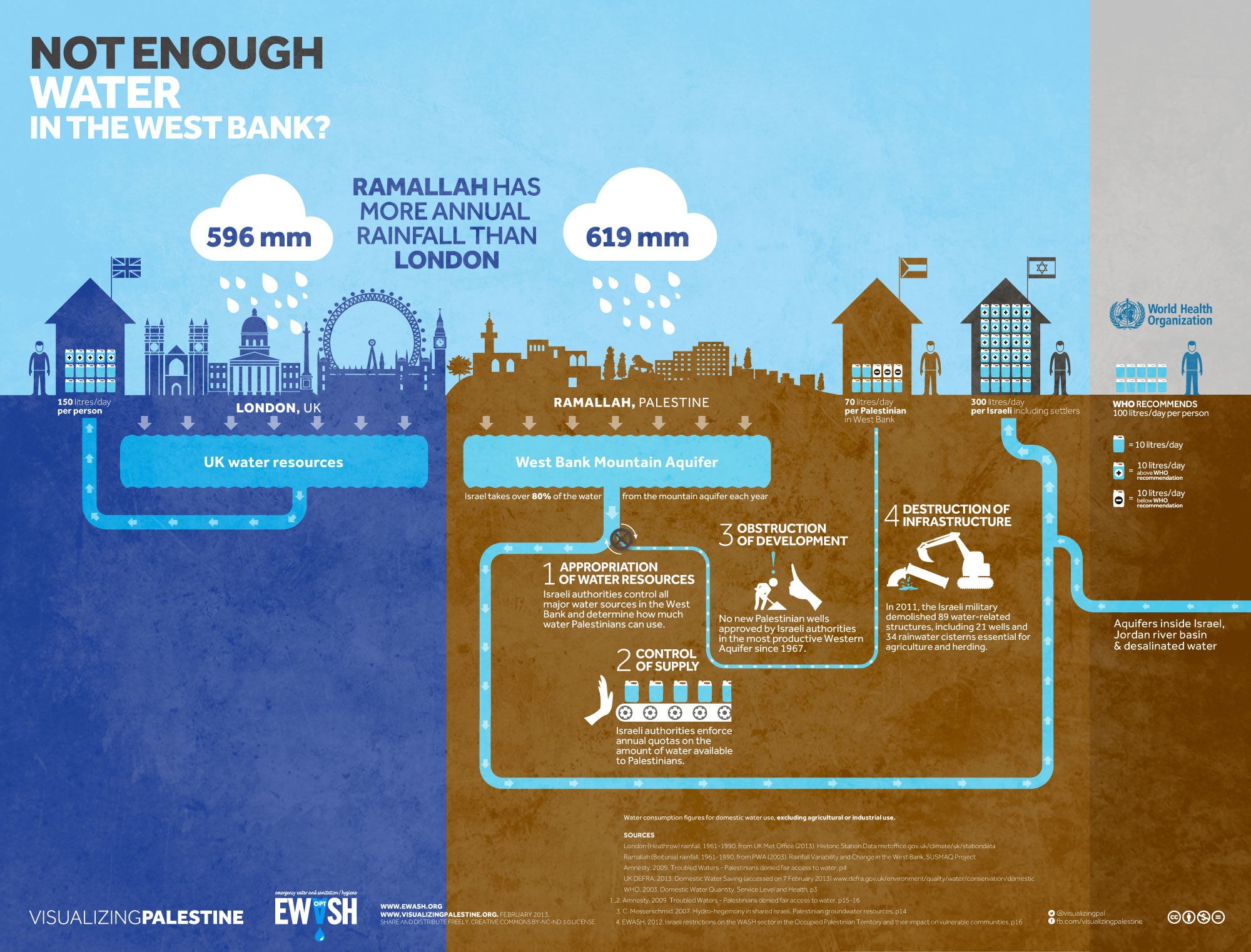
Even seasoned Palestine watchers might be surprised to learn that Ramallah receives slightly more annual rainfall than gray London. But Israeli authority over groundwater access and distribution across the West Bank has resulted in an incongruous statistic: the average Palestinian in the occupied territory can access only 70 liters per day, 30 short of the World Health Organization’s recommendation and less than half used by the typical Londoner. Israelis enjoy 300 liters per person per day.

It is one of the many ugly realities of the Israeli occupation that Visualizing Palestine (VP), a non-profit body, has highlighted through its arresting and meticulously researched infographics.

The organization is now gearing up to make “design for social justice” — as it describes its raison d’être — into a sustainable enterprise. Given the substantial attention that its graphics have attracted over the past two years, VP's ambitious plans may serve not only to sustain the organization, but also provide an example for other design outfits to follow.


Talent, money and visions

Founded in Ramallah in 2011, VP now calls Beirut home. It has published 16 infographics, which have been disseminated globally in nine languages through prominent media outlets such as the Huffington Post and Al Jazeera English.

According to co-founder Joumana al-Jabri, since 2012 the organization has received at least $115,000 in funding to date from its founders, private donors, the Arab Fund for Arts and Culture, and other organizations.

But making the group financially sustainable in the long run is another task entirely. So this summer, it embarked on transforming itself from a civil society project into a larger venture called Visualizing Impact (VI). The new outfit, of which VP will be a part, plans to leverage its media and technology capabilities to present facts about social and political struggles worldwide — not just those in Palestine. It will exist as two legal entities, both sharing the same name: a non-profit corporation, which will carry out the advocacy work; and a for-profit business, which will capitalize on the team’s capabilities to draw revenue for the advocacy arm.

Jabri describes the transformation as “phase two” of the VP project, having completing two years of successful non-profit work. VI, Jabri says, will pull revenue streams from commissions for its work, licensing its name and its technology platforms, and collaborating with artists and industrial designers to sell physical representations of its graphics.

The West Bank water allocation infographic, described above, was the first one that Visualising designed on a commission. The Emergency Water and Sanitation-Hygiene Group (EWASH), a coordination agency dedicated to improving sanitation conditions in the Occupied Palestinian Territories (OPT) and whose members include OXFAM and various UN agencies, paid $2,200 of the graphic’s $4,800 development cost and took responsibility for its release.

EWASH debuted the poster to great media attention on World Water Day 2013 and printed 8,000 copies for free distribution. They purposefully delivered one to Richard Falk, the UN Special Rapporteur on Human Rights in the OPT, says Jabri. “That’s a key reflection of how our work can be used — that an organization that has an area focus can use it as a communication tool with…agents of change,” she says.

That VI was only able to charge less than half of the graphic’s development cost, though, reflects the meagerness of this revenue stream. “There’s an education process. Maybe next time, EWASH will cover the full cost, but it took time to show them that we are a research, storyteller, design, and communication team. So until potential clients actually see that, they are not going to pay more,” Jabri says. VI has signed contracts for four commissioned graphics to date.

But even if VI succeeds in securing commissions for the full costs of its graphics, Jabri still sees the need for additional revenue. “The commission model would cover our expenses, but they would make us run [on a just-in-time production model]. What we want are bigger amounts to allow us to innovate, work on technologies and test working with artists,” she says.

There are potential margins to be found in the corporate world, Jabri recognizes. “There are [two] companies that have approached us — not related to Palestine at all — that have expressed interest to use our process.… [For example,] for us to work with their internal team and use visualizations as a tool to filter some of the innovations they come up with.”

Jabri did not detail the ethical principles that would govern VI’s business dealings, but such deals would be carried out by the for-profit arm of VI. This would shield the outfit from accusations of mission drift and unfair competitive advantage. Jabri says the profits from the business side of VI will be directed to the non-profit side.


Multiplying revenue streams

VI’s new name underscores not just an expanding geographical scope, but also a broader range of topics and collaborators. In addition to offering services to the business world, the organization is exploring the establishment of new, socially relevant ‘Visualizing’ organizations — Visualizing Women or Visualizing Bangladesh, for instance.

“Whether [people outside of VI] form their own [Visualizing] teams or whether they recruit us to build from within our team is something we’re still [discussing],” Jabri says.

But content and brand recognition are not the group’s only ambitions. VI has also built up technology platforms that its business side hopes to license to other media and design studios, securing another source of income. VI’s translation platform, which the outfit has already used to circulate its own graphics, allows designers to crowd-source translations of their works without losing control of the layout.

The business is also planning to roll out a design-specific crowd-funding platform that will connect clients (such as political activists) to designers and financiers. It aims to license this platform to groups such as the Arab Fund for Arts and Culture.


Chartered waters

“Phase two” of the VP/VI project, then, will be a major transformation for the team of 13, led by Jabri and fellow co-founder Ramzi Jaber. As a first step toward sustainability, Jabri says, 70 percent of the new work that VI will begin in the coming months will have to secure a project-specific source of funding beforehand. The remaining 30 percent will come from various non-commission sources of revenue. Jabri notes that while VP/VI is moving away from accepting donations, its non-profit arm might still apply for and accept grants.

The social entrepreneurs have given themselves a fair amount of time to migrate to their new identity. Jabri tells Executive that the transition to the VI business model is scheduled to be practically complete by April 2014, with the goal of realizing operational sustainability by autumn of that year. In the meantime, though, VI is preparing to launch a crowd-funding campaign, via internationally leading funding platform Kickstarter, to raise $60,000 to help finance immediate expenses for its VP component during this transition period.

Beirut will remain the base for production, although VI is in the process of registering in California as a 501(c)(3) non-profit. The registration “means we can open up to a wider support network,” Jabri says, and notes that even potential Gulf sponsors have expressed preference to do business with an American, rather than a Lebanese or Palestinian, registered organization.

Jabri furthermore anticipates that the proliferation of 'Visualizing' topics will attract American attention to VI’s graphics. “[It will help us] reach an audience that’s important to us,” she says.

In the coming six months alone, VI plans to publish ten infographics, including a reflection on Nelson Mandela’s record. “[It will] speak about an aspect of history that is not spoken about much: Mandela as seen as [both] a peacemaker and as a terrorist, [highlighting] the duality throughout his life,” Jabri says. Carrying an implicit parallel to legacies of Palestinian leaders, this graphic will tacitly tie together VP’s original subject, Occupied Palestine, to its future direction, social justice worldwide.


This article has been updated to clarify VI's and VP's legal structures and funding, and to correct a miscount in the number of languages in which VP has published infographics. VP's visualizations have appeared in nine, not eight, languages: Arabic, English, French, Spanish, Chinese, German, Korean, Polish and Finnish.

July 30, 2013 0 comments
0 FacebookTwitterPinterestEmail
  • 1
  • …
  • 243
  • 244
  • 245
  • 246
  • 247
  • …
  • 695

Latest Cover

About us

Since its first edition emerged on the newsstands in 1999, Executive Magazine has been dedicated to providing its readers with the most up-to-date local and regional business news. Executive is a monthly business magazine that offers readers in-depth analyses on the Lebanese world of commerce, covering all the major sectors – from banking, finance, and insurance to technology, tourism, hospitality, media, and retail.

  • Donate
  • Our Purpose
  • Contact Us

Sign up for our newsletter

    • Facebook
    • Twitter
    • Instagram
    • Linkedin
    • Youtube
    Executive Magazine
    • ISSUES
      • Current Issue
      • Past issues
    • BUSINESS
    • ECONOMICS & POLICY
    • OPINION
    • SPECIAL REPORTS
    • EXECUTIVE TALKS
    • MOVEMENTS
      • Change the image
      • Cannes lions
      • Transparency & accountability
      • ECONOMIC ROADMAP
      • Say No to Corruption
      • The Lebanon media development initiative
      • LPSN Policy Asks
      • Advocating the preservation of deposits
    • JOIN US
      • Join our movement
      • Attend our events
      • Receive updates
      • Connect with us
    • DONATE