• Donate
  • Our Purpose
  • Contact Us
Executive Magazine
  • ISSUES
    • Current Issue
    • Past issues
  • BUSINESS
  • ECONOMICS & POLICY
  • OPINION
  • SPECIAL REPORTS
  • EXECUTIVE TALKS
  • MOVEMENTS
    • Change the image
    • Cannes lions
    • Transparency & accountability
    • ECONOMIC ROADMAP
    • Say No to Corruption
    • The Lebanon media development initiative
    • LPSN Policy Asks
    • Advocating the preservation of deposits
  • JOIN US
    • Join our movement
    • Attend our events
    • Receive updates
    • Connect with us
  • DONATE
The Buzz

Running the Code Marathon

by Joe Dyke & Joe Dyke March 20, 2013
written by Joe Dyke & Joe Dyke

It was not until the can-can came on that Firas finally lost it. The tall, bearded man rushed to the sound system, cranked it up to full volume, raised his hands and wiggled his body – somewhere between a dabke and the Harlem Shake, but definitely nothing like the can-can. The moves failed to illicit much of a response; the half dozen men around him briefly looked up before returning to their computer screens. But that was 2:00 am on Sunday morning — hour 34 — and a lot had already happened by then.


Developing developers

Hackathons — where developers are given a finite amount of time to design and build a particular product — are relatively common in the West. But this is not Silicon Valley or London, but Beirut. While Lebanon’s Internet is among the slowest in the world, the last two years have seen rapid improvements, and a development community is, well, developing.

For this event, created, and initiated by Lebanon’s leading telecoms operator Touch, the crème de la crème of the country’s developers turned up at AltCity, an alternative space for techies in the Hamra district.

The basic principle is simple: teams are given 48 hours to create a workable model of a mobile app using Touch’s new Touch Cloud, which provides simple back-end services for app development. The winning team receives $1,000 cash, a Samsung smartphone for each member and an assortment of other prizes that help the team further develop their app.

While it is a competition, teams are encouraged to collaborate, especially when it comes to figuring out how to use the unfamiliar back-end. Experts from Touch and other organizations such as the Cisco Entrepreneur Institute and the Ministry of Telecoms, who sponsored the event, were available all weekend to give advice to the participants.

Executive decided to check out the scene and see if the competitors and their apps were up to the task.


Friday 6:00pm – Hour 0

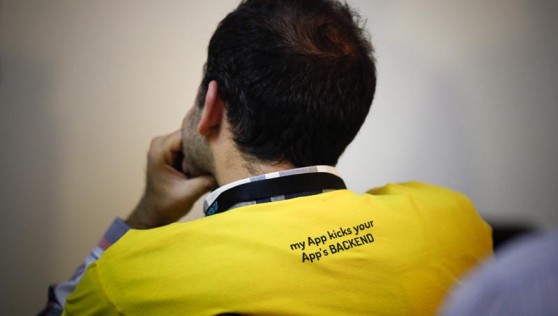
60 people are squeezed into a small room, chatting. In front of them, 17 are lined up in branded white t-shirts supplied by the competition staff, like a bad television commercial. Each waits for their chance in the pulpit, with 60 seconds to explain why their app can solve Lebanese technology needs of the 21st century.

After the last one announces his pitch, the frantic process of forming alliances begins. Theoretically, each team should have at least a designer, developer and businessperson, though a number merge the roles.

At the end of the night, the participants are given a crash course into how to use the new Touch Cloud. While it is a race, the first night starts with more a canter than a sprint and Altcity is closed, giving the impression that we would have to wait until morning to see some real action.


Saturday, 10:02 am — Hour 16

If there is a sense of urgency, a sunny morning seems to have dampened it somewhat. On arrival, around 20 of the 60-odd participants are spread out over the room. In the next hour, a few dozen wander in, grab a coffee, make idle chitchat and consider starting work.

One sign, however, that being an ‘early bird’ is worthwhile is found at the breakfast table. The tasty doughnuts and fresh manaeesh are long gone, with the latecomers faced with a choice between fruit or nothing. Many go hungry.

In a corner, Firas Wazneh and Hassan Kanj are plugging numbers onto their computer and setting up a business model for their MenaVersity app. It aims to provide an online connection between teachers and students, as well as offering video courses in Arabic in “everything.”

While they may be a team of two, they are planning on tapping the expertise of their extended families. “For now, we are going to count on our connections, our friends who are willing to record for free,” Firas says.

Other teams are less organized. Aida, a developer, and one of the few women participating in the event, is working with two teams, but mainly because one has not yet shown up. She is currently helping out the Bala 3aj2a team, designing an app that seeks to solve Beirut’s traffic congestion through car-pooling, but is visibly frustrated that her other team are late. The temptation to ask whether they are stuck in traffic is resisted.


Saturday 19:20 – Hour 25

“Ah, you need to put a slash,” Majed Traboulsi snaps at Mohamed el-Amine as they stare at near endless lines of code. “Then it will work, I reckon,” the longhaired developer adds.

The two men have sequestered themselves, capturing a room off the main space in which they are plotting their path to victory. Outside, a buzz has steadily been growing about their app and their isolation only intensifies the rumors, with rivals increasingly worried they are competing against the new Facebook.

Inside, the two are relaxed about their favorites tag. Their app — La2ta, meaning ‘bargain’ – already looks smooth. It has the same basic principles as GroupOn and other social buying websites but with several differentiating factors. Most importantly, while readers can ‘grab’ coupons for free, it is only by going to the store or restaurant that they can claim them. There are a finite number of ‘La2tas’ and when someone uses that coupon in-store the number online automatically ticks down one closer to zero, thus encouraging buyers to rush to claim their deal.

“It’s the thing that makes us different really,” Traboulsi says. “You can be walking past a shop and then your phone will give you a push notification reminding you that you have a voucher there and there are only a few deals left.”

All of the apps have to be designed using Touch’s new backend-as-a-service system. This, for non-developers, will mean little. But the unique benefit, for the Lebanese market at least, is that these apps could allow user billing, meaning, for example, that you could pay for your food online and it would be charged to your phone bill. This circumvents one of the major issues in online payment, that customers are unwilling to enter their credit card details to sites they don’t trust. The La2ta team are hoping their plans to implement the billing system will tip the balance with the judges.

In the general hall, Ayssar Arida is at the other end of the organized scale. In the initial round he found no developers for his proposal, which involves making users move the phone in the air in a certain pattern before being able to read a message. But he has not allowed himself to be defeated and is attempting desperately to teach himself mobile app development in 48 hours. “I don’t know if I will have anything to show tomorrow, honestly,” he admits.


Sunday 1:48am – Hour 31

The room is sparse, with a hardy gang of some dozen remaining. Like Darwin in reverse, developers squat in varying stages of decay. One stares blankly at a screen, another slumps on beanbags, while a third has passed out on a vaguely flat surface.

Firas has long since stopped being productive but can’t bring himself to give up and go home. His sleep-deprived mind has lost some of its linearity; in response to one question about MenaVersity he pontificates about developing an app to record the sound of a gun and know exactly what type of weapon is being used. “Useful in Beirut,” he jokes. Then, in a flash, he is gone — off to the sound system to crank up the can-can, shortly followed by Leanne Rhymes.

“That’s it, we are locked in,” an excitable AltCity staff member shouts shortly after 2 am. No one bats an eyelid; they have long since consigned themselves to a sleepless night.


Sunday, 11:26 am — Hour 41

Angst and stress have settled nicely between the now cluttered tables, as teams frantically try to meet the deadline. “I tried calling my partner, but he didn’t answer. I don’t know where he is,” says a member of one team designing an app aimed at the Lebanese Red Cross. While the app supplies a “panic button” to shorten the response time for emergencies, it sounds like he has already pressed his.

Other teams are applying the finishing touches. La2ta are nearly finished with their demo and are beginning work on the presentation. “Some things, such as getting the user back from Touch’s payment page to the app, were really difficult, we had to stay up all night to figure that out,” says Majed, trying to hide his exhaustion with a smile.


Sunday, 4:45 – Hour 47

Entering from the street outside, the room has taken on a unique aroma born of a combination of unwashed bodies and energy drinks. Perhaps in a back room the event organizers are discussing whether white was the correct color for the t-shirts, as many have taken on a yellowish hue.

Some competitors, including both La2ta and MenaVersity, are ready to go, enjoying a few minutes of downtime before the deadline. Others, such as Ayssar, are still huddled over their computers.  “Are you ready?” Executive asks. He shrugs in a way that doesn’t invite further questions.


Sunday, 5:00 – Hour 48

There is no big countdown, no bell, no presenter announcing: “ladies and gentlemen, please put down your computers.” In a style many Lebanese will recognize all too well, the five o’clock deadline ends up being a bit more like five fifteen, which then drags on to around five thirty. For those, like Ayssar, who are still adding the final touches, the tardiness could hardly be more welcome.

Eventually the six judges, including representatives from Apstrata, Touch, AltCity and the Ministry of Telecoms, are introduced and the teams begin to present their ideas to be picked apart. Both MenaVersity and La2ta give good presentations, tightening the race between the two.


Sunday, 19:50 – Hour 50

The six judges, and an unidentified child, retire to behind a glass wall to debate their decision. Nervous contestants mull around the food table, eating and drinking their way around the fruit.


Sunday 21:10 – Hour 51

The judges return and the results begin. Three honorable mentions are handed out, then the Bala 3aj2a team are awarded third place. Silence descends.

“The winning team has a team member called Mohamed,” the presenter says jokingly, knowing that it doesn’t rule out many of the remaining teams. “And the winning team also has a member called Majed,” he announces, bringing the La2ta team to their feet. MenaVersity have to settle for second.

“We were confident but there were some other teams with really good ideas,” an ecstatic Majed says. The app, they hope, will be ready in a few months. “We want to improve our skills on mobile, we cannot count only on web applications. We are going to take it to the next level, we are going to think big,” Mohamed adds. Even for those not recognized, the experience has been valuable. “I made something basically in a day, and it’s a good idea,” Ayssar says.

Lebanon’s mobile application sector is still in its infancy and many ideas will be tried in the coming years. Many, as is so common in the technology sector, will fail. Yet the space for these developers to grow is important and will help hungry young coders like the La2ta team to stand out from the pack.

The La2ta team Mohamed el-Amine and Majed Traboulsi

March 20, 2013 0 comments
0 FacebookTwitterPinterestEmail
The Buzz

Morning briefing: 20 Mar 2013

by Executive Staff March 20, 2013
written by Executive Staff

Economics and Policy

Brent crude rose toward $108 a barrel on Wednesday, recovering from a three-month low hit in the previous session, on hopes that a deal to bail out Cyprus could be reached although the uncertainty kept a lid on prices.

More from Reuters


Gold held steady on Wednesday, close to a three-week high as Cyprus's rejection of bailout terms triggered worries about a default and underpinned safe haven demand in gold.

More from Reuters


Lebanon’s long-awaited new salary scale draft law will be tied to an increase in working hours of civil servants and a tax hike on luxury goods, State Minister Marwan Kheiireddine has said.

More from The Daily Star


Depositors will rush to withdraw their money from Lebanese and foreign banks operating in Cyprus unless the EU abandons its demand to tax all deposits in the island, bankers have said.

More from The Daily Star


Rising oil trade between Iraqi Kurdistan and Turkey threatens to split Iraq in two, a senior Iraqi official said, as the autonomous region ignores Baghdad's threats of tough action against what it terms illegal exports.

More from Reuters


Business and Companies

Saudi Arabia’s attempts to reform its expatriate-heavy labor market have put more than 600,000 locals into jobs at private companies, a senior official said on Tuesday, a sharp increase over previous rates.

More from Reuters


The Middle Eastern owner of Leeds United has signalled that it is in talks to sell the former English Premier League soccer club it bought only in December.

More from Gulf Business

March 20, 2013 0 comments
0 FacebookTwitterPinterestEmail
Economics & PolicyLebanon's oil and gas

Avoiding a regional war over hydrocarbons

by Georges Pierre Sassine March 19, 2013
written by Georges Pierre Sassine

Lebanon’s progress to cultivate wealth from its offshore oil and gas resources has left us with more questions than answers. While the country will not extract any resources for at least five years, the agreements being negotiated in the next 12 months will determine whether Lebanon gets a good deal or not.

Over the course of five days, seven leading thinkers will discuss different aspects of the resources — from avoiding environmental destruction to how to spend the new wealth — each with the aim of helping provoke awareness about what is going on in this crucial period.

For our second segment, Georges Pierre Sassine discusses the how to avoid conflict in the region over the resources.

See also: Lebanon's Petroleum Administration makes a positive start


Lebanon is making progress in developing its oil and gas resources. Offshore seismic surveys are completed, the Petroleum Administration is finally formed and the licensing round for oil companies to bid on offshore exploration has been launched.

The Lebanese government is rightly focusing on developing petroleum resources in its direct waters. However, Lebanon has yet to fully demarcate its maritime borders with Cyprus, Syria and Israel. Petroleum discovered in contested areas could prevent Lebanon from extracting parts of its resources and risk to pose a serious security threat.

The focus so far has been on the border dispute with Israel. Traditional resolution strategies of maritime border disputes are not easily applicable to the Lebanese-Israeli case.

Direct negotiations between the two countries or joint development agreements – where Israel and Lebanon cooperate to access hydrocarbons instead of dividing the territory – are not applicable. The countries are at war and will not negotiate face to face.

Another option is to resolve the dispute through formal legal proceedings. The International Court of Justice, the International Tribunal for the Law of the Sea and the Permanent Court of Arbitration are all different platforms that could resolve the dispute.

However, Israel has not signed or ratified the United Nations Convention on the Law of the Sea (UNCLOS), which means that Lebanon cannot force Israel to court. Lebanon could pursue an international media and diplomatic campaign to get Israel to sign the UNCLOS, enabling Beirut to bring Tel Aviv before a binding judicial tribunal or panel of arbitrators. But this remains a challenging path to undertake given that Lebanon does not acknowledge the existence of the state of Israel, and political resistance is to be expected as part of Lebanese public opinion perceives international courts to be biased towards Israel.

Searching for a settlement

As such, the most realistic proposal may be for some kind of indirectly negotiated settlement, though any such process will be lengthy and complex.

As exploration in the Eastern Mediterranean continues it is not unlikely that a new oil and gas field will be found in disputed Lebanese-Israeli waters while at the same time extending into Cypriot waters. Cyprus is divided into two main parts: the Republic of Cyprus – a member state of the European Union – and the Turkish controlled area in the north. This is likely to pull both the European Union and Turkey into the fray.

Lebanon could then find itself in a scenario where instead of dealing only with Israel it is drawn into a multi-stakeholder dispute directly involving Cyprus, Turkey, the EU and probably the United States as a broker.

Such a scenario has been studied by Harvard Professor, Meghan O’Sullivan, and several students from Harvard University and the Massachusetts Institute of Technology (MIT) in a Geopolitics of Energy competition. In looking for ways to avoid a conflict, two broadly different approaches have been suggested.

The first is the ‘politics before economics’ pathway, which suggests that a complete political resolution of conflicts between Lebanon and Israel on one hand, and Turkey and Cyprus on the other hand need to be resolved before the gas can be developed. The development of eastern Mediterranean gas would be included in a comprehensive regional peace initiative. Until then, petroleum resources in disputed areas would remain untapped and conflict avoided. However, immediate prospects for such a regional agreement are slim at best.

The second proposal suggests the development of disputed oil and gas fields while waiting for a final political resolution of territorial disputes. In this case, Lebanon and Israel as well as Cyprus and Turkey would agree to disagree. Each side would hold on to its claims but agree to a third party developing disputed oil resources until big political issues are resolved. Revenues could be split or frozen in foreign accounts and by the time a political resolution of disputed areas is reached revenues would then be distributed according to each country’s respective share.

Such a model has its challenges as well but nevertheless has been proven viable. In the 1940s Saudi Arabia and Kuwait both claimed a 5,770 square kilometer area along their borders and as such created a neutral zone. They shared equal rights to oil concessions until they reached an agreement to formally divide the territory in the mid-1960s. Australia and East Timor provide a similar case in 2003 as they postponed the settlement of their boundaries for 50 years and pursued the development of common resources under agreed guidelines.  

There is no doubt that potential oil and gas resources in contested waters provide serious risks to Lebanon. While the current unspoken agreement seems to be that both Lebanon and Israel will not explore in the conflict area, Lebanese remain nervous that Israel would decide to unilaterally develop these fields and provoke retaliation from the Lebanese Armed Forces or Hezbollah. Any option to avoid this issue will prove complex. This is why as the Lebanese government accelerates the exploitation of undisputed areas it should in parallel devote time and resources to manage risks on its maritime borders. A team of legal, diplomatic, military and political experts should plan and prepare for Lebanon to successfully defend its rights, develop its entitled resources and avoid conflict.


Georges Pierre Sassine holds a master’s degree in public policy from Harvard University’s John F. Kennedy School of Government. He writes about Lebanon’s public policy issues at www.georgessassine.com

 
March 19, 2013 0 comments
0 FacebookTwitterPinterestEmail
The Buzz

Morning briefing: 19 Mar 2013

by Executive Staff March 19, 2013
written by Executive Staff

Economics and policy

Foreign Direct Investment in Lebanon fell by 68 percent in 2012, down to $1.1 billion from $3.5 billion in 2011.

More from The Daily Star


Syrian rebels have told Lebanese truck drivers that the Masnaa crossing to Syria would remain closed indefinitely, the head of Lebanon’s Farmers’ Association has said.

More from The Daily Star


Saudi Arabia, the world’s largest oil exporter, will start drilling for shale gas this year, the Gulf state’s Oil Minister has said.

More from Arabian Business


Arab banks operating in Cyprus may abandon the island if the government does not revoke a proposal to impose taxes on depositors, the head of the World Union of Arab Bankers warned Monday.

More from The Daily Star


Companies and Business

Investment Corporation of Dubai (ICD)  has launched a syndication of $2 billion conventional and Islamic financing facilities to refinance a $2 billion loan due to mature in August.

More from Reuters


Contractor Drake & Scull International has been awarded contracts worth AED369m (US$100.46m) for the construction of three projects in Saudi Arabia and the United Arab Emirates.

More from Reuters


Collapsed carrier Bahrain Air has failed to honor around 22,000 customer tickets as a result of its closure.

More from Arabian Business


Abu Dhabi government-owned Al Hilal Bank plans to issue a debut Islamic bond worth $500 million in the third quarter of this year to fund growth and diversify its balance sheet.

More from Gulf Business

March 19, 2013 0 comments
0 FacebookTwitterPinterestEmail
Society

Not just your grandpa’s car

by Yasser Akkaoui March 19, 2013
written by Yasser Akkaoui

Being a lifelong fan of the European models of compact sports cars, I did not expect to be impressed by the Cadillac ATS, Cadillac’s latest luxury sports sedan. However, the ATS is giving the big boys such as the BMW 3 series or the Audi A4 a run for their money.

Cadillac is known for sensible classics such as the XTS, which attracted the older generation still fond of big cars. With the lightweight, compact ATS, they are going after a new market of young businessmen who are looking for the luxury that Cadillac offers, with the nimbleness and speed that they can now find in the ATS.

The aerodynamic and lightweight design gives the ATS’ exterior its own character and sets it aside from the competition. Its interior is classic Cadillac, luxurious and comfortable, with the technology to back it up. The Cadillac User Experience (CUE) is the interior’s highlight. The CUE is a built in entertainment system which allows you to link your smart phone to the car’s front screen. In this way, all my contacts are available to me through the futuristic front screen and I can ignore my phone while in the car.

The ATS was tested and developed on the road in the famed journey from Germany’s Nürburgring through Monaco to YAS Island, Abu Dhabi in seriously demanding road conditions. Lebanon’s roads are notoriously unforgiving and so the ultimate test of its performance was over Beirut’s potholes. Driving it through the streets of the capital, or the curves of the mountain roads, I found the ATS to be a quick, smooth and supple ride.

The ATS’ innovative ‘Safety Alert Seat’ is also a welcome feature when navigating the infamously chaotic Lebanese traffic. An advanced warning system comprising radars, cameras and ultrasonic sensors sends pulses through the drivers seat, warning of a variety of potential hazards. 

In terms of performance and design, the ATS is offering no less than what other cars in its class are. In terms of pricing, it has them beat by 15 to 20 percent. In the Lebanese market, the ATS is priced at $48,000 (VAT excluded) and comes with four years free servicing. Cadillac expects to sell seven to eight ATS models per month, a target they may very well reach.

March 19, 2013 0 comments
0 FacebookTwitterPinterestEmail
Economics & PolicyLebanese in advertising

MENA Cristal’s Christian Cappe talks revolution

by Maya Sioufi March 18, 2013
written by Maya Sioufi

I am coming home,” said Austrian skydiver Felix Baumgartner right before jumping off a balloon capsule 39 kilometers above Earth, setting a new world record. Sponsored by energy drink company Red Bull, the stunt, which took place in October of last year, was streamed live by 8 million people. It marks a new era in advertising communication. Several months later, the organizers of the eighth edition of the MENA Cristal Festival invited Felix to attend its event at the InterContinental Mzaar hotel in Faraya, from February 5 to 7. Headed by Christian Cappe, the MENA Cristal Festival brings international recognition to the advertising industry in the region through awards decided upon by juries of international professionals. Executive, present in snowy Faraya, sat with Cappe to discuss why Felix was invited, his thoughts on the evolution of the advertising industry and why MENA Cristal was held again in Lebanon.

Why did MENA Cristal decide to invite Felix to the event this year?

They say Felix did the jump. It is not just the jump. It’s the first and biggest operation of brand content done in the world because behind Baumgartner is Red Bull and behind Red Bull is video online, YouTube and the new era of communication. It is in a context of global evolution.

In your opinion, what are the best types of advertising creations?

The most importing thing is [for the creation] to touch a local target and if it is recognized internationally then that is fantastic. The recognition through festivals is done to stimulate the creation. When we are creative, we want to show our work; we want it to be recognized.

Which advertising format is going to dominate going forward?

We are in the post-digital [era] now. All communications now are through mobile. There is a multiplicity of screens, and when you search the Internet on a smartphone for information, you go directly to the information. We are no longer passive like when we read the newspaper. So for a brand to be seen, it has to be in the content either through an article or at the origin of the article, the origin of the game, the origin of the event etcetera. That’s the big evolution. The client becoming mobile, we get to the problem of managing the data. This is going to be the big challenge: associating the creation with the means of distribution.

How have revolutions in the Arab world affected the advertising industry?

It is complicated to speak of countries that are in a real crisis. Syria has no real economy and Egypt is very problematic. Today [the industry] needs to go to the countries that are moving, like Saudi Arabia and Dubai.

How financially viable is the MENA Cristal budget?

I think it won’t be possible to organize this event if MENA Cristal was the only festival that we organize. Now, we organize events all year long in this field so that we can support the industry through the events.

Why is the MENA Cristal Festival held in Lebanon and not in other countries in the region?

The Lebanese talent, hub and brilliance has to be known. [Cristal Festival] people ask to be part of the staff organizing the MENA Cristal because of the enthusiasm, entrepreneurship attitude, culture and elegance of the Lebanese. It’s quite specific to Lebanon.

Perhaps the event could be bigger in Abu Dhabi or Doha but the concept is to put together, in the same place, people that are happy to not go back to the office and have an exchange [of ideas] and so on. To organize an event [which celebrates] cultural creativity in the country that provides the most important [number] of creative people in the Middle East is quite logical. I know Saudi Arabia is the biggest country in economic terms and that the hub for many companies is in Dubai but where is the talent coming from? From Lebanon. Plus there is only one ski resort in the region that we can attend!

March 18, 2013 0 comments
0 FacebookTwitterPinterestEmail
Economics & PolicyLebanon's oil and gas

A positive start for Lebanon’s Petroleum Administration

by Mona Sukkarieh March 18, 2013
written by Mona Sukkarieh

Lebanon’s progress to cultivate wealth from its offshore oil and gas resources has left us with more questions than answers about the process. While the country will not extract any resources for at least five years, the agreements being negotiated in the next 12 months will determine whether Lebanon gets a good deal or not.

Over the course of five days, seven leading thinkers will discuss different aspects of the resources — from avoiding environmental destruction to a potential war with Israel — each with the aim of helping provoke awareness about what is going on in this crucial period.

For our first segment, Mona Sukkarieh discusses the Petroleum Administration — the six-member body that is tasked with negotiating with international oil companies – and finds some reasons to be positive.


Lebanon’s Petroleum Administration (PA) will play a fundamental role in the country’s oil and gas sector in the coming years as it is tasked with setting the regulation and framework of licensing rounds and negotiating a good deal with international petroleum companies.

It was expected to be established in the first quarter of 2012, but was finally formed in November, with political bickering and a lack of consensus among government parties and factions the main reasons for the delay. But, despite the political meddling that accompanied the formation of the PA and negative predictions of many, initial indications are that it is proving to be a professional and productive body.

Shaky start

After months of delay, the formation of the PA occurred at a time when the legitimacy of Prime Minister Najib Mikati’s government was under pressure following the assassination of Intelligence chief Wissam al-Hassan in Beirut in October. Calls for speeding up the formation of the Administration coincided with demands for a cabinet reshuffle and were supported by an intensive media strategy.

At the beginning of November 2012, Lebanese media started reporting extensively on the vast potential for oil and gas reserves in Lebanon. On November 3, 2012, Lebanese daily Assafir quoted Parliament Speaker Nabih Berri as saying Lebanese reserves exceeded previous expectations and surpassed those of other countries in the region, including Israel. On the same day, Energy and Water Minister Gebran Bassil declared roughly the same on LBC’s evening news but was careful to add that it was impossible to confirm the quantity of oil and gas before drilling. On November 5, 2012, Assafir published three separate news items quoting Prime Minister Mikati, Sayyed Hashem Safieddin, head of Hezbollah’s executive council, and former minister and current Amal Movement MP Yassine Jaber, all calling for a rapid formation of the Petroleum Administration. And two days later, the government approved the nomination of the regulatory body’s members. The appointment was not on the cabinet meeting’s agenda that day but was hastily introduced by Bassil during the meeting, without providing fellow cabinet members with the bios and CVs of the six candidates.

The sudden interest in and the rapid formation of the board contrasted with months of unexplained postponement. This suggests that the government was keen on wrapping up the issue ahead of a potential cabinet reshuffle. Lebanese politicians are aware that, in order to get a share of the pie, they must be in office and previous experiences with lucrative sectors – telecommunications for example – serve as reminders that large-scale foreign investments require local facilitators in government who are subsequently well rewarded, both financially and politically.

Moreover the composition of the Petroleum Administration’s board reflects, to a large extent, the composition of the government that appointed it, including the regrettable absence of women. The six members were selected on a confessional basis and, although downplayed by the government and the Energy Minister, on the basis of their political affiliations. Regardless of their backgrounds, which seem relevant to the positions they have obtained, and regardless of their skills, which remain to be demonstrated, they represent the political factions that proposed, backed and approved their nomination. Therefore, the criteria that tipped the balance in their favor was unfair to other candidates who may have had the suitable skills but not the required sect nor the correct political backing.

Having said that, in a country that has long been run on a sectarian basis, the fact that this criteria was taken into account when selecting the six members may give them additional legitimacy in the eyes of their fellow citizens. It has, so far, shielded them from the usual attacks that haunt public servants who do not enjoy a “sectarian legitimacy,” allowing them to focus on their mission.

Positive signs

Since the appointment of the PA’s board members, the Ministry of Energy and Water has more or less been able to meet the self-imposed deadlines, particularly in preparation of the country’s first licensing round. The pre-qualification round was launched on February 15, 2013, and the Petroleum Administration chose to impose an intelligent set of legal, financial, technical, and environmental requirements that will attract, as operators, the most experienced companies.

To their credit, the board members have so far shown a commendable discipline, not only in their relations with the media, but on a broader level. Lebanese public institutions that fail normally do so due to personal ambitions and narrow political considerations. We have yet to see inapt behavior – such as unnecessary media exposure or irrelevant side meetings with political or religious leaders – from any of the board members. This bodes well as these kinds of actions are usually seen as inevitable steps for those seeking personal promotions. Internal cohesion, and a certain commitment to their mission have so far prevailed. This may be a modest measure of success but the Petroleum Administration is only five months old, and not transparent enough yet to allow an exact evaluation.

Ways forward

As such the regulatory body would benefit from a more transparent process. The first step in that regard would be to set up an official website to present (i) the Petroleum Administration (including all related regulations, publications and activities); (ii) the Petroleum Administration board and employees (including bios and salaries); (iii) the Lebanese petroleum sector (including all related regulations, updates on licensing rounds, ongoing seismic studies, maps etc.). In addition, the absence of women among the board members could be compensated for by building a more inclusive team around them.

The appointment of the Petroleum Administration’s board was highly significant: It was the first major milestone since the adoption of the hydrocarbon resources law. While the lack of transparency and political maneuvering that characterized the selection process did not augur well for the country’s oil and gas sector, the little we have seen so far suggests that our initial pessimism may have been misplaced.


Mona E. Sukkarieh is co-founder of Middle East Strategic Perspectives, where she manages the “Lebanon – Oil & Gas Updates” section.

March 18, 2013 0 comments
0 FacebookTwitterPinterestEmail
Comment

Ahmadinejad’s burning bridges

by Gareth Smith March 18, 2013
written by Gareth Smith

Nowruz, or new year, makes much of March in Iran a joyful celebration of renewal, and Mahmoud Ahmadinejad is feeling the rising sap. The president was welcomed back from a visit to Egypt last month by chanting supporters waving banners saying “Viva spring”.The president’s opponents, however, were quick to smell a rat. Eagerly awaiting the end of Ahmadinejad’s second term, they sensed the president was launching a campaign in favor of one of his allies for the presidential poll scheduled for June 14.

Chief suspect is Esfandiar Rahim Mashaei, and indeed the presidential aide emerged alongside Ahmadinejad to accept the adulation at the airport as the pair returned from an Islamic summit. While Mashaei reportedly regards ‘viva spring’ as a reference to the awaited return of the 12 Shia Imams, in occultation since the year 873 AD (Gregorian), many in Tehran see only an election slogan.

Ahmadinejad is constitutionally ineligible for a third consecutive term but he appears determined not to leave office sheepishly. A political outsider who came from relative obscurity to win the 2005 election, he has since been at loggerheads with Parliament and has alienated many previous allies in the conservative camp. From the time Ahmadinejad challenged supreme leader Ayatollah Ali Khamenei’s authority in 2010 and 2011, his critics have labeled him and his entourage a “deviant current”. When Ayatollah Mohammad Taqi Mesbah-Yazdi said he was “more than 90 percent certain” that Ahmadinejad had “been put under a spell” — the ayatollah did not know if it was “hypnotism or relations with yogis” — few doubted that the magician            was Mashaei.

The open clash with Khamenei in 2011 — when the ayatollah reinstated the intelligence minister after Ahmadinejad forced his resignation — was one the president was bound to lose. After all, supporters of Iran’s Islamic system know its main pillar is velayat-e faqih, which by definition gives the leader pre-eminence.

That should have been the end of the story. But, remarkably, Ahmadinejad has kept going. And in doing so, a number of things have happened that are unprecedented in the Islamic Republic.

Prior to his Egypt trip, the president had a noisy spat in Parliament with the speaker Ali Larijani, where each openly accused the other of ill-doing. The row, as Parliament prepared to dismiss Ahmadinejad’s labor minister, was widely aired on Iranian news websites. This was pure theater as the president aired a recording allegedly showing Larijani’s brother, Fazel, offering political favors to Saeed Mortazavi, head of the Social Security Organization, to smooth deals in the petrochemical and other sectors. Nor was that the end of it: less than two weeks later, the website Tabnak aired footage said to be Ahmadinejad’s followers shouting down a speech by Larijani in Qom. And this all happened despite January’s warning from Khamenei that it would be “treason” for anyone to take their “differences to the public” in the run-up to June’s election.

As an outsider, Ahmadinejad feels looked down upon by a network of established families active in business, politics and religion. Larijani is part of an ‘insider’ family — himself the son and son-in-law of ayatollahs. One of Larijani’s other brothers, Sadegh, heads the judiciary and is resented by Ahmadinejad after the arrest of two allies: a press advisor imprisoned in September for six months, and Mortazavi, who was jailed for two days in early February. It all adds up to a springtime headache for Khamenei, already facing a challenge in managing June’s poll, which comes four years after mass unrest followed Ahmadinejad’s disputed 2009 re-election. A high turnout and the election of a moderate conservative would be a fillip for Khamenei in the face of tightening US-led sanctions — ostensibly over Iran’s nuclear program — that have halved oil exports in a year. 

Help could be at hand in that the Guardian Council, the constitutional watchdog, may well bar Mashaei from running in June. But speculation is rife in Tehran that Ahmadinejad has further information on ‘insider’ corruption that he acquired during his seven years in office.  

That could be extremely embarrassing for Khamenei and his hopes for the poll, which in turn prompts further speculation in Tehran.  What might Ahmadinejad want in return for going quietly into the night? Or would he gain more satisfaction — and cement his place in history — by settling some scores?


Gareth Smyth has reported from around the Middle East for nearly two decades and is the former Financial Times correspondent in Tehran

March 18, 2013 0 comments
0 FacebookTwitterPinterestEmail
The Buzz

Morning briefing: 18 Mar 2013

by Executive Staff March 18, 2013
written by Executive Staff

Economics and policy

Lebanon’s government and public sector unions may be moving closer towards a deal to end the two-week long strike in the country.

More from The Daily Star


Brent crude dropped more than $1 to below $109 a barrel on Monday in its steepest fall in nearly three weeks as the dollar strengthened after an unusual bailout proposal for Cyprus threatened to trigger fresh turmoil in the euro zone.

More from Reuters


Egypt and the International Monetary Fund made very good progress in talks on Sunday, an IMF official said, after meeting with government officials seeking a $4.8bn IMF loan to help relieve a currency and budget crisis.

More from Reuters


The leaders of Yemen's political, tribal and religious groups are set to begin six months of talks today aiming at healing a divided country and ensuring the survival of the republic's institutions.

More from The National


Business and companies


Lebanese bank employees kick-started protests over the weekend with a sit-in in Tripoli to demand the renewal of an expired collective labor agreement that for decades had governed work relations in Lebanon’s vital banking sector.

More from The Daily Star


Libya has halted a tender to manage the country’s monopoly telecoms operator, the chief executive of United Arab Emirates’ Etisalat said on Sunday.

More from Gulf Business


Qatar’s spending on the 2022 World Cup will go up to $115bn between now and 2022, according to a new study by Standard Chartered.

More from Arabian Business


Saudi Arabia is facing a housing crisis and requires 350 million square meters of new accommodation to meet its burgeoning demand, an economic forum in Jeddah has been told.

More from Arabian Business


The National Bank of Abu Dhabi (NBAD) has retained its title as the safest bank in the Middle East, according to Global Finance magazine.

More from Arabian Business


March 18, 2013 0 comments
0 FacebookTwitterPinterestEmail
Real estate

World Bank to support Lebanese entrepreneurs…

by Executive Editors March 16, 2013
written by Executive Editors

To support Lebanon’s small and medium-sized enterprises (SMEs), the World Bank has extended a $30 million, 17-year soft loan to Kafalat, the government-sponsored loan guarantee company. With this loan, Kafalat will be responsible for setting up a fund to support financing of SMEs, as Khater Abi Habib, chairman of Kafalat, mentioned in an exclusive Q&A with Executive back in November. In addition to providing bank loan guarantees, Kafalat will now also be granting up to $25 million in equity capital to SMEs as well as up to $2.5 million for entrepreneurs working on new ideas. To qualify for financing from this fund, the entrepreneurs would need to have secured funding from a private sector investor such as angel investors or venture capital firms. The remaining $2.5 million are destined for management expenses as well as training and marketing activities. 

…and the European Union too

Also looking to support the country’s SMEs and entrepreneurs is the Beirut and Mount Lebanon Chamber of Commerce, Industry and Agriculture with the launch of the FARO Lebanon fund. Initiated by the French government with an aim at increasing innovation and cooperation among entrepreneurs in the Mediterranean region, France established the first FARO fund in May 2010 with a budget of $1.3 million. Providing grants of up to $26,000 to finance the feasibility study of a project, the fund covers a maximum of 50 percent of the cost of the study. Lebanon’s FARO fund is based on the same principles. With a total budget of $500,000, which will be increased gradually, and with another $1.3 million pledged from the European Union for this year, the fund will grant up to $20,000 per project. To be eligible for financing, Lebanon’s entrepreneurs and SMEs must have an innovative product, service or business model, as well as a partner from a European or Mediterranean country.

1929 Palestinian banknote up for auction

A 1929 Palestine £100 banknote is estimated to collect between $110,000 and $160,000 at Spink’s World Banknotes auction, to be held in London on April 10 and 11. Founded in 1666, Spink is the world’s leading collectables auction house with a focus on stamps, coins, banknotes, medals, bonds and shares, autographs, books and fine wines. On the note there is the White Tower at Ramla, as well as signatures of several former members of the Palestine Currency Board: Sir Percy Ezechiel, Sir John Caulcutt and Roland Vanables. On its reverse, the note features the Tower of David and the Citadel of Jerusalem.

HSBC bans Syrian, Sudanese and Iranian accounts

British banking giant HSBC is closing accounts of clients from Syria, Sudan, Iran and other countries that faced significant European Union or American sanctions. The ban, due to take effect on March 20, was announced to clients at the beginning of February. While HSBC declined to specify which nationalities would be seeing their accounts closed down, it did state that nationals from countries in which the bank has branches are unaffected. Also, clients that have an “advance” account (minimum balance of $27,000) or “premium” account (minimum balance of $95,000) would not face a ban. According to a statement by HSBC, the ban is a result of the need to apply “enhanced oversight on any customer with connections to sanctioned countries.” The statement adds, “where we are unable to maintain sufficiently detailed information about such a customer through a relationship-managed account, we are having to discontinue that relationship.” HSBC, with operations in 14 countries in the Middle East and North Africa region, was compelled to pay a penalty of $1.92 billion in December 2012 to United States authorities to settle money-laundering charges.

Lebanese company awarded world’s best app

Lebanon-based Dermandar Panorama, founded by Elie-Grégoire Khoury and Elias Fadel Khoury, was awarded the best application at the United Nations’ World Summit Award for mobile content (WSA-mobile), held in Abu Dhabi last month. The Lebanese company, established in September 2010, developed an online platform allowing users to create 360-degree panoramic pictures taken through the application, available on mobile devices. It was considered the “easiest-to-use panoramic picture app” by the Wall Street Journal and featured in Executive’s list of top 20 entrepreneurs in November 2012. By February, the application was downloaded six million times. Berytech owns 35 percent of the company and Georges Harik, a former Google employee, owns another 5 percent. WSA-mobile is a global event held on a biennial basis, allowing mobile app producers from around the world to present their innovation to high-ranking industry leaders.

Nasdaq Dubai eyeing equity markets for SMEs

Nasdaq Dubai Stock Exchange, with $29 billion in market capitalization, is eyeing an equity market for small and medium size enterprises (SMEs) for this year, the first of its kind in the Middle East. After reducing the minimum market capitalization requirement from $50 million to $10 million in June 2012, the United Arab Emirates regulator has made it easier for SMEs to list on an exchange, and it would seem that Nasdaq Dubai is looking to build on that momentum. The exchange has established an advisory group of professionals with banking, accounting and legal backgrounds tasked with preparing a proposal for the establishment of an equity market for SMEs. According to Hamed Ali, the chief executive of Nasdaq Dubai, “high quality SMEs are vital to the expansion of the UAE’s economy, but many are starved of the capital they need to grow. An initial public offering on Nasdaq Dubai will enable them to raise the funds they need.” The exchange has estimated that more than 72,000 SMEs in Dubai contribute to more than 40 per cent of the emirate’s economy, a market it plans to attract for listings. The market will, however, also cater “for any company that does business in the region”, added Ali.

March 16, 2013 0 comments
0 FacebookTwitterPinterestEmail
  • 1
  • …
  • 273
  • 274
  • 275
  • 276
  • 277
  • …
  • 695

Latest Cover

About us

Since its first edition emerged on the newsstands in 1999, Executive Magazine has been dedicated to providing its readers with the most up-to-date local and regional business news. Executive is a monthly business magazine that offers readers in-depth analyses on the Lebanese world of commerce, covering all the major sectors – from banking, finance, and insurance to technology, tourism, hospitality, media, and retail.

  • Donate
  • Our Purpose
  • Contact Us

Sign up for our newsletter

    • Facebook
    • Twitter
    • Instagram
    • Linkedin
    • Youtube
    Executive Magazine
    • ISSUES
      • Current Issue
      • Past issues
    • BUSINESS
    • ECONOMICS & POLICY
    • OPINION
    • SPECIAL REPORTS
    • EXECUTIVE TALKS
    • MOVEMENTS
      • Change the image
      • Cannes lions
      • Transparency & accountability
      • ECONOMIC ROADMAP
      • Say No to Corruption
      • The Lebanon media development initiative
      • LPSN Policy Asks
      • Advocating the preservation of deposits
    • JOIN US
      • Join our movement
      • Attend our events
      • Receive updates
      • Connect with us
    • DONATE