• Donate
  • Our Purpose
  • Contact Us
Executive Magazine
  • ISSUES
    • Current Issue
    • Past issues
  • BUSINESS
  • ECONOMICS & POLICY
  • OPINION
  • SPECIAL REPORTS
  • EXECUTIVE TALKS
  • MOVEMENTS
    • Change the image
    • Cannes lions
    • Transparency & accountability
    • ECONOMIC ROADMAP
    • Say No to Corruption
    • The Lebanon media development initiative
    • LPSN Policy Asks
    • Advocating the preservation of deposits
  • JOIN US
    • Join our movement
    • Attend our events
    • Receive updates
    • Connect with us
  • DONATE
Comment

China moves for Iraq’s black stuff

by Riad Al-Khouri March 1, 2013
written by Riad Al-Khouri

Since the American engagement in Iraq was downsized, other countries have continued to gain higher profiles there, and Iraq’s economic allegiances — and its resources — are being wooed by powers whose interests are in competition with those of the United States. Nothing demonstrates this change more dramatically than the state-owned China National Petroleum Corp (CNPC) acquisition of US oil giant ExxonMobil’s position in the West Qurna Phase 1 oilfield for $50 billion, one of the largest such energy deals ever made.

Beijing had become a big player in Iraq’s oil sector even before this transaction was announced in early February. CNPC, at the beginning of 2013, was jointly operating three fields producing 1.4 million barrels per day (b/d), more than half the country’s output. However, acquiring the new stake means that CNPC alone will soon account for 50 percent of Iraq’s crude production.

Beijing’s takeover of the Exxon concession came after a dispute between the Iraqi central government in Baghdad and the US oil company over its attempt to operate in both Kurdistan and the rest of Iraq. Already involved in the south of the country, Exxon was the first big oil company to sign an agreement with the autonomous Kurdistan Regional Government in Erbil, even after Baghdad had told the US giant that it couldn’t work with the Kurds and with the rest of Iraq at the same time.

See also: Beijing's Saudi Gamble

Gasoline prices across the Middle East

Beijing’s success in Iraq is partly based on its lower costs, with Chinese managers and engineers typically earning only 25 percent of the salaries paid by Western companies. Since Baghdad is giving foreign operators as little as a couple of dollars per barrel of crude produced, some Western firms like Chevron and Exxon are turning to the Kurds, who offer more lucrative production-sharing agreements.

Iraq’s output of crude is set to rise to more than 8 million b/d by 2030, 80 percent of which may go to China. To facilitate exporting Iraqi oil, the Chinese are engaged in various forms of infrastructure development, including pipelines. Regarding the latter, the China Petroleum Pipeline Company is reported to be favored to win a $650 million contract to build a pipeline linking Iraq’s southern oil fields to coastal storage depots. This new line with a wider diameter pipe will replace the existing outdated one, easing transport constriction and expanding oil export capacity. The new pipeline should be operational in early 2014, facilitating a planned increase in output in the targeted area from the current 230,000 b/d to around 400,000 b/d.

Nor are the Chinese the only Far Eastern players coming up in Iraq: the South Koreans are also busy with infrastructure and other work in the country. Among many other projects, South Korea is constructing a housing mega-complex of 100,000 units. And LS Industrial Systems, a leading South Korean manufacturer of electric components, won a $67 million contract to build a power distribution control center for the Iraqi government. Under the deal with Iraq’s Ministry of Electricity, the company will also later construct seven distribution control centers across the country. With this contract, LS Industrial has logged more than $106 million of new business in Iraq during the first few weeks of 2013.
Look for more such Far Eastern dynamism in Iraq this year and beyond, as the Chinese and others continue stepping into the Iraqi market with even greater force. On one level, this will be a purely economic phenomenon, simply meaning that more business is being done between Iraq and East Asia. The implications in geostrategic terms, however, could be even bigger, going beyond Iraq’s borders to impact other parts of the region.

With Washington continuing to lose its appetite for involvement in the Middle East, a stronger Chinese position in the region could, for example, affect Syria and Iran, helping both to face Western pressure. Whatever the outcome of such a complex mix of business and politics in Iraq and regionally might be, the coming year is likely to be one of even greater flux than the one just past.


Riad el-Khouri is an economist and a principal at Development Equtiy Associates Inc, Washington DC

March 1, 2013 0 comments
0 FacebookTwitterPinterestEmail
Economics & Policy

A month of strikes

by Sam Tarling February 28, 2013
written by Sam Tarling
Lebanese teachers and public sector workers march through Beirut on February 27 to protest delays in the parliament approving a cabinet-backed wage increase. The march was part of an ongoing open-ended strike which has seen daily demonstrations by public sector employees across the country for a month – beginning on February 19 [Photo: Sam Tarling/Executive]
Marchers at the February 27 protest, where organizers estimated that at least 20,000 people attended [Photo: Sam Tarling/Executive]
Charles Khoury, an art teacher from St Joseph's school in Aintoura, holds a sign in a made-up language as he claims the government "clearly doesn't understand Arabic. How come I am a teacher and I can’t afford to send my children to university?" he asks. "We're protesting for our pride, it's the least of our rights" [Photo: Sam Tarling/Executive]
A security official talks to a protester. The Lebanese authorities have largely permitted the protests without interference [Photo: Sam Tarling/Executive]
Lebanese teachers demonstrate near the presidential palace in Baabda on March 5 [Photo: Sam Tarling/Executive]
Protests continued outside Beirut Port on March 14 [Photo: Sam Tarling/Executive]
Bemused travelers work their way around the crowds as public sector workers demonstrate outside Beirut's Rafiq Hariri International Airport on March 15 [Photo: Sam Tarling/Executive]
A speaker at the airport rally encourages the crowd to force the government to honor their promises [Photo: Sam Tarling/Executive]
February 28, 2013 0 comments
0 FacebookTwitterPinterestEmail
Society

Ditching popcorn for sushi

by Nabila Rahhal February 28, 2013
written by Nabila Rahhal

Butter soaked popcorn, dark packed theaters and noisy teenagers kicking the back of your seat are the thoughts on many people’s minds when it comes to the cinema experience. It’s little wonder that the older one gets, the more appealing the idea of watching movies at a home theater gets. But Beirut’s cinema owners are trying to provide a more refined and attractive movie watching experience — at least for those who can afford it.

Recently, cinema operators including Grand Cinemas and Cinemall have adopted the concept of VIP theaters to provide a more deluxe experience for the wealthier — and so inclined — film goers. For $30, you get a large seat, an alcoholic drink and something to eat (caviar and smoked salmon canapés in Grand Cinemas, nachos and popcorn in Cinemall). Yet you are essentially queuing in the same lines and having to visit the same over-crowded theater lobby as all the rest of the customers. Many, indeed, have concluded that they are somehow being cheated out of their money.

But Empire cinema in the Sodeco area of Beirut seems to have eliminated some of the problems faced by VIP theaters by creating a luxury cinema venue, and not merely a luxury theater.

Planning to open its doors in mid March, the Empire Premiere venue will have a lobby similar to that of a hotel, equipped with comfortable sofas, a book library, and a wine bar. Customers will have the option of the usual concession stand, which will offer gourmet popcorn featuring a flavor of the week, as well as the the option of something more exquisite catered by Le Sushi Bar — Japanese dishes will be especially prepared in a way that’s suitable to watching in a cinema.

The six theaters themselves, which once housed 180 seats each, will now have only 30 seats each in order to create a more comfortable homelike setting. Each lazy boy seat comes with a side table and lamp as well as a blanket and pillow for the attendee’s comfort. Films will play every half hour so there is no need to worry about the time when planning to catch a movie. The whole experience will cost $20 a ticket, food and beverages excluded.

Gino Haddad, owner of Empire Theaters, believes the Premiere project could only be profitable in the Sodeco theater and attributes this primarily to the catchment area it is in: in proximity to Downtown, Ashrafieh and Hazmieh, the venue is ideally placed to attract Haddad’s targeted customers who are in the upper class aged from 30 to 60 years old.

Haddad says he first got the idea to create such a venue when his team’s research showed that cinemas in general are losing clients between the ages of 30 and 60 who are disenchanted with the whole “cinema in malls” experience currently dominated by teenagers. Despite the increasing numbers of cinema outlets — in some cases within months of each other — it appeared there were no venues that catered to that age group. Besides, according to Haddad, since Empire is in the process of constructing a fourteen-screen project in Downtown Beirut, it was important that they create a different concept in the Sodeco outlet, so as not to cannibalize themselves.

With renovations costing $1.5 million, the Sodeco theater targets upper class professionals who would appreciate such a venue, and those under 18 years of age will not be permitted. Empire looks to make profits in ways other than individual ticket sales. Theaters can be rented for corporate events and private showings for live broadcast events, making the venue even more attractive — especially during football season. Revenues through luxury advertising will be another moneymaker  as it would create a niche market for advertisers, gathering their potential clients in one place — Aishti and Lotus have already confirmed their interest.  

In the era of DVDs and home theaters, cinema operators have to be creative in coming up with experiences to compete with the comfort of one’s homes. With Empire Sodeco, Haddad believes his plan provides his audience with exactly that experience.

February 28, 2013 0 comments
0 FacebookTwitterPinterestEmail
The Buzz

Morning briefing: 28 Feb 2013

by Executive Staff February 28, 2013
written by Executive Staff

Economics

Lebanon’s transportation unions put on hold Wednesday a strike scheduled for Thursday after the prime minister promised to take action on soaring fuel prices and make adjustments on new traffic law.

More from The Daily Star


Egypt's government deficit rose by more than a third in the seven months to the end of January from the same period a year earlier, state media reported on Wednesday.

More from Reuters


Iran gave an upbeat assessment of two days of nuclear talks with world powers that ended on Wednesday, but Western officials said Tehran must start taking concrete steps to ease mounting concerns about its atomic activity.

More from Reuters


The Lebanese Cabinet has extended the contracts with mobile operators Alfa and touch until the end of June and authorized the telecommunications minister to prepare for a new tender.

More from The Daily Star


Companies

First Gulf Bank, the UAE's second-largest lender by market value, expects its loan book to grow by 10 percent this year, driven by higher demand from consumers and government bodies.

More from Reuters


The Kuwaiti mobile operator Wataniya Telecom is expecting revenues from data to grow to 25 per cent of total sales by the end of this year.

More from The National


An Iraqi Airways plane landed in Kuwait City on Wednesday for the first time since Iraq's invasion of the emirate in August 1990, after a commercial dispute was resolved.

More from AFP


Barcelona soccer star Lionel Messi has become a global brand ambassador for Ooredoo, the Qatari telecoms operator formerly known as Qtel.

More from Gulf Business


Dubai’s Arabtec slumps to a six-week low after the contractor announced it aims to raise $1.8 billion through a rights issue and a convertible bond.

More from Reuters


And finally…

Consumers in the GCC are spending $2m a day eating at fast food giant McDonald’s, as the company experiences record growth in the region.

More from Arabian Business

February 28, 2013 0 comments
0 FacebookTwitterPinterestEmail
Finance

MENA stock tips 2013

by Maya Sioufi February 28, 2013
written by Maya Sioufi

Global markets that began to rally in mid-November in anticipation of a resolution to the United States’ “fiscal cliff” are now making investors edgy, with major economies still shaky. This month, Executive sits again with Georges Abboud, head of private banking at BlomInvest, and Amer Khan, fund manager at Dubai-based Shuaa Asset Management, for their top investment recommendations.

Georges Abboud

Should we invest in the markets now? “It is hard because markets went up so quickly,” says Abboud. Still, he would add exposure to the US due to the deleveraging of the financial sector in the past couple of years, the recovery in US real estate and industrial sectors, and the low energy production costs there due to the use of shale gas (which faces heavy opposition in Europe). He is more cautious about Europe, especially with the euro trading at its current levels (the euro dollar rate was at 1.34 as Executive went to print). He recommends starting to place shorts on the euro and adding shorts if it strengthens further to reach 1.40 to the dollar.
 

Major concern in these markets? “Sovereign debt”, says Abboud. “If you have a sovereign debt problem, you have problems with banks that can’t sustain the debt.”

Thoughts on Middle East and North Africa markets? Consistent with previous recommendations to Executive, Abboud still has an appetite for exposure to Saudi Arabia due to the kingdom’s solid fundamentals. He would also invest in Lebanese equities with a strong preference for Blom Bank — the bank he works for — due to its cheap valuation and solid dividend yield standing at 5 percent.

Top investment tips? At the end of last year, Abboud recommended to Executive readers to short the yen; own Google, Total, General Motors and Nissan for US large cap companies; LinkedIn in the US and Groupe Eurotunnel in Europe for smaller companies; and Blom and Solidere for Lebanese equities. These recommendations generated an average return of 24 percent, assuming the investments were equally distributed. Going forward, he recommends keeping Google, adding LinkedIn and General Motors on any correction, and building exposure to German automotive company Daimler AG.

Amer Khan

Thoughts on global markets? Khan expects 2013 and 2014 to be good for equities on a global level given the solid economic data coming out of the US and China. “Two of the largest economies will end up with a solid year and they will pull the world along,” says Khan. As for Europe, he believes it is in nobody’s interest to have a large fallout — be it a Greek exit or a breakup of the currency — and “when push comes to shove, Europe tends to come together and think outside the box,” he adds.

Expect more flows into MENA equities? With not much left in the bond market as yields are at multi-decade lows, “equities are the natural place to invest,” says Khan. He is positive about the valuation of equities in the region and the solid fundamentals of companies with strong balance sheets that operate in economies with no fiscal issues and offering attractive dividend yields. He expects investors to eventually look at the fundamentals and deploy further capital into this asset class.

Favorite countries in the region? For 2013, his top three equity markets to invest in are Saudi Arabia and Qatar, due to their commitments to high levels of government spending, and the United Arab Emirates for the attractive valuation of its stock market.

MENA equity market most likely to surprise on the upside? “If the Egyptian government gets its act together, it could probably be the biggest surprise”, says Khan. He also highlights Amman as another market, which investors have been shying away from recently. “If regional markets were to rally, inevitably people will be looking for laggards and Amman might be it.”

Top sectors in the region? He recommends investing in the UAE banking sector given the banks’ solid capitalization, the valuation discount relative to their regional peers and the attractive dividend yield. He also recommends investing in consumer plays in Saudi Arabia through buying stocks in consumer staples and consumer discretionary sectors, given the government’s spending commitment. He also likes real estate in Saudi Arabia given the country’s housing shortage but would play this theme via the banking sector as real estate companies are low on disclosure.

Top three stocks? Union National Bank in the UAE, electronic retailer eXtra in Saudi Arabia and Qatar National Bank.

February 28, 2013 0 comments
0 FacebookTwitterPinterestEmail
The Buzz

Morning briefing: 27 Feb 2013

by Executive Staff February 27, 2013
written by Executive Staff

Economics

Gold traded flat on Wednesday, perching near a 1-1/2-week high hit in the previous session as the US Federal Reserve reassured investors of its commitment to loose monetary policy, burnishing bullion's appeal as a hedge against inflation.

More from Reuters


Lebanese civil servants and teachers will march on Wednesday toward the government’s headquarters in Beirut to increase pressure on the Cabinet to refer a wage hike draft bill to Parliament.

More from The Daily Star


The Institute of International Finance estimated that Lebanon’s GDP growth fell to 0.8 percent in 2012, down from 1.8 percent in 2011, saying the decline highlighted the need for a stable political environment and structural reform.

More from The Daily Star


Companies

Lebanon's energy ministry has signed a $348 million contract with a Danish-German consortium to build new power plants in Jiyyeh and Zouk.

More from The Daily Star


Qatar’s sovereign wealth fund has hired UBS to advise on a possible $3 billion investment in Russian state-owned bank VTB.

More from Reuters


The Abu Dhabi stock exchange is looking to list some of the emirate’s large private companies to help boost liquidity on the bourse and ensure its benchmark index better reflects the economy, its chief executive has said.

More from Gulf Business


Lebanese property developer Solidere expects to report lower profits for 2012, its general manager said, describing the company’s share price as “severely undervalued” because of political instability and Syria’s civil war.

More from Reuters


Dubai's Emirates Airline, the largest customer for Airbus's A380 superjumbo, is confident in the safety of the aircraft, Sheikh Ahmed bin Saeed Al Maktoum, chairman and CEO of the carrier said.

More from Arabian Business


Marriott plans to open a further 49 hotels across the Middle East and Africa region during the next five years.

More from Gulf Business


Goldman Sachs has raised net profit estimates for Air Arabia, the region’s fast growing low cost carrier, in fiscal 2013-14 on improving earning margins driven by lower costs and increase capacity.

February 27, 2013 0 comments
0 FacebookTwitterPinterestEmail
Real Estate

Signs of a UAE stock surge

by Thomas Schellen February 27, 2013
written by Thomas Schellen

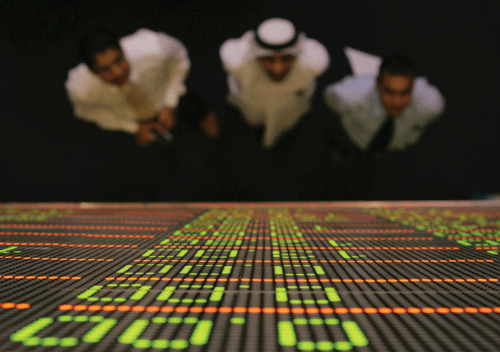
The twin exchanges of the United Arab Emirates — Dubai Financial Market (DFM) and Abu Dhabi Exchange (ADX) — have had a positive start to 2013, particularly when compared to overall emerging markets trends.

From the opening on January 2 until close on February 25, the MSCI Emerging Markets Index (MXEF) — the world’s most prominent emerging markets index — retreated by around 2 percent. In contrast the UAE benchmark indices soared in the same period: the ADX added 14.2 percent and the DFM’s rise was just a decimal short of 20 percent.

Juxtaposed with the troubles in emerging markets, which analysts saw linked to weaker prospects for exports to the United States and European Union, the gains of both ADX and DFM make the UAE equity markets look their strongest in years.

Riding the real estate

The most exciting stocks to watch in the UAE over the period were the big names in real estate. In Abu Dhabi, the slowly progressing merger project of developers Aldar and Sorouh boosted shares of both companies. From the time that their boards recommended the merger in January, up until the companies had to postpone extraordinary general meetings (EGM) of shareholders on February 21 because of insufficient stock representation, Aldar gained 4.1 percent and Sorouch 9.4 percent, according to Reuters.

Favorable votes in the shareholder assemblies are needed for approving the merger but there is high confidence that the second round of voting on March 3 — when only a 50 percent representation of stock is required for a quorum — will yield the shareholder approval. 

In Dubai, the first two months of 2013 marked the resurgence of the King Kong of regional real estate stocks: Emaar Properties. The company, the developer of Burj Khalifa and arguably the region’s best-known real estate company, surged in both value and volume of trade. Between December 26 and February 25, the stock gained an astounding 43 percent and closed at its highest since those days of encroaching darkness in November 2008.

Some investors cashed out on Emaar stock when the company announced on February 26 that it will not increase its dividend payment. From a daily markets performance, this meant a snag of -2.84 percent for the company, just as other property leaders Aldar and Sorouh dropped a few days earlier in wake of their postponed EGMs. However, those kinks in the paths of the three biggest names in UAE real estate pale when gauged against the enthusiasm that these real estate stocks have attracted in the year to date.

Emaar was quite instrumental in sparking new interest in the UAE real estate equities. The company’s glowing sales reports, and stories of newly extreme demand from property buyers in the last quarter of 2012, contributed a major thread to the narrative that Dubai real estate is recouping its state as an economic driver.

Warning signs

While UAE watchers will be happy to see strong growth, the concurrent surge of real estate stocks and UAE indices also carries a warning message. While the past four years have been characterized by growth in tourism, retail and some industrial activities, real estate stocks seem to be the lead ingredient that makes the stock indexes fly.

The fact that the spike in the indexes coincided with property increases shows that the UAE economy is anything but de-coupled from its property market. Whether that linkage is a great thing in what it says about the perception of the UAE economy, remains a matter of perspective.

But the focus on notoriously unpredictable real estate market leaves the UAE’s stock markets prone to surges. Smart investors should be wary of this.

February 27, 2013 0 comments
0 FacebookTwitterPinterestEmail
Business

From the tree to the table

by Sam Tarling February 26, 2013
written by Sam Tarling
IXSIR wine is produced in the fields surrounding Seigniorial House in the hills above the northern Lebanese city of Batroun [Photo: Sam Tarling/Executive]
The house dates back to the 17th century and is located amid beautiful scenery [Photo: Sam Tarling/Executive]
Visitors can discover 20 grape varieties in the company's vineyard [Photo: Sam Tarling/Executive]
As you enter the building, a spiral staircase takes you down to where the wine is fermented [Photo: Sam Tarling/Executive]
The grapes are put in fermentation tanks, gradually transforming into wine over a month [Photo: Sam Tarling/Executive]
After the fermentation is complete, the wine is aged for many months in oak barrels to gain smoothness [Photo: Sam Tarling/Executive]
In the barrels a small amount evaporates, with wine experts dubbing this the "Angels' Share" [Photo: Sam Tarling/Executive]
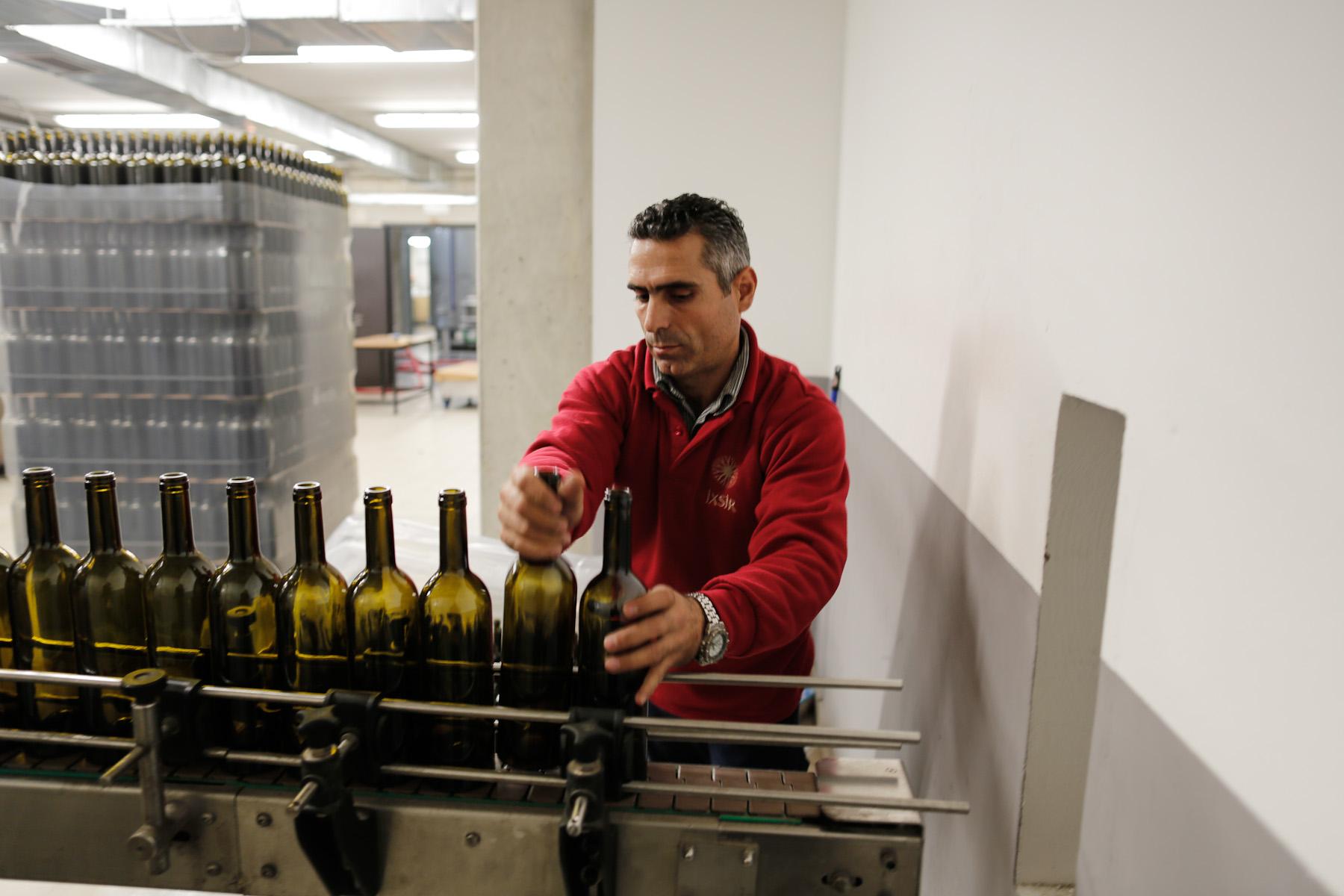
After a long wait, the wine is finally ready to be bottled [Photo: Sam Tarling/Executive]
The bottling process begins one to two years after the grapes have been harvested [Photo: Sam Tarling/Executive]
But this is not the end of the journey as filled bottles can be stored in metallic cages for years before being sold to customers [Photo: Sam Tarling/Executive]
IXSIR corks of different wine ranges [Photo: Sam Tarling/Executive]


Photoblog explaining how wine is made at one of Lebanon’s top vineyards, IXSIR.
February 26, 2013 0 comments
0 FacebookTwitterPinterestEmail
Comment

The death of national policy making

by Zak Brophy February 26, 2013
written by Zak Brophy

Let’s be honest about it: policy politics in Lebanon was already all but non-existent. Whether politicians had the desire or the wherewithal to deliver policies that addressed fundamental issues — such as the nation’s corroded infrastructure and bloated public debt — was never of much importance. Loyalty to the major confessional leaders, their parties and their interests has always been the factor of consequence come polling day.

But when the joint parliamentary committees last week adopted the proposed Orthodox Law, they may have stolen the last breath from the lungs of national Lebanese policy-making. The law, if passed in parliament, will mean that voters can only vote for candidates from within their sect. To its proponents the Orthodox Law protects the ability of Lebanon’s many smaller communities to choose their own representatives, rather than having the votes of the larger sects determine the outcome of the vote. For its detractors, however, this law further ingrains sectarianism into, even enforces it upon, the social and political fabric of the nation.

But stepping out from beyond the lenses of identity politics we should ask what could the law mean in the day-to-day life for all Lebanese. The reality is that most problems within the country and the solutions that they require are the same regardless of one’s sect. Scant work opportunities, infrequent electricity and spiraling costs of living are afflictions similarly endured whether Muslim, Christian, Druze or Atheist.

A recent study by the Lebanese Center for Policy Studies for the Arab Barometer Project found that the needs, concerns and preferences of most Lebanese citizens do not differ significantly by sect. Indeed, citizens were more likely to have shared views based on their economic or social standing rather than their sect. Perhaps the most telling finding was that 91 percent of interviewees disagreed with the statement that, “political leaders are concerned with the needs of ordinary citizens.”

For more than half a year teachers and public sector workers, regardless of their sectarian affiliation, have been protesting for government to implement the wage scale increase it agreed to last fall but has yet to find a way to finance. The resolution to this bind is admittedly no easy fix, but the manner in which it has been tossed like a hot potato between politicians is reflective of the malaise in addressing society’s many pending issues.

Sit the same politicians down and task them with debating how they will manage the elections and there is no such inertia. There has been a frenetic flurry of sittings and press conferences as they jostle to maintain their respective power bases.

Lebanon’s political establishment is already dominated by zero-sum calculations that stump meaningful and much needed reform. Locking the discourse into identity politics threatens to further distance the debate from issues that are of importance to all of Lebanon.

Many of the critical issues facing the country require not only mature, long-term planning, but also compromise from opposing parties. Constructive bargaining is already in short supply in Lebanese politics but the passing of the Orthodox Law threatens to further entrench leaders in obstructionist stances. With politicians confined to representing the interests of the “street” within their sect, rival players within the same sect will be able to label concessions in the national policy making process as a betrayal against the community, leading to a hardening of isolationist posturing.     

Regional and local representation within parliament could well be another victim if this law is voted into action. While a Shia in the Bekaa and a Shia in Beirut will be voting for the same MPs, the issues facing the two voters can hardly be considered the same because they share the same confessional branding.

A silver lining?

The Orthodox Law could, however, present some unintended openings for prospective political players who wish to challenge the established status quo. While the proposed legislation would lock voters into casting their ballot within their own sect, it would also see Lebanon become a single electoral district under a proportional representation (PR) system.  

The PR element of this system opens the door for smaller parties or fringe personalities to get voted into office. Were an alliance of aspiring political players to form across the sectarian divides united by a clearly defined vision for the country and presenting a basket of actual policies, they may be able to win a block of seats and shake some life into the moribund parliament. This, however, could yet prove an over-optimistic hope.

The inherent feelings of insecurity and mutual-distrust felt amongst Lebanon’s sectarian groupings are derived from the nation’s violent past, unstable present and uncertain future. In this context the drive for the Orthodox Law can be understood.

But the problems of the country cannot be solved from a sectarian perspective. It is only by building a shared body politic harnessing and addressing the whole country’s shared interests that Lebanon can ensure tomorrow’s security. That will involve putting the policy back into politics.

February 26, 2013 0 comments
0 FacebookTwitterPinterestEmail
The Buzz

Morning briefing: 26 Feb 2013

by Executive Staff February 26, 2013
written by Executive Staff

Economics

After months of political wrangling, passage of Iraq's $118 billion budget still hangs on the semi-autonomous Kurdistan region's insistence that the government allocate $3.5 billion to pay oil companies working the Kurdish oil patch.

More from Iraq Oil Report


Egypt’s government has outlined an economic plan to win International Monetary Fund loans, with steps to narrow the budget deficit toned down to avoid inciting further unrest.

More from Bloomberg


An open-ended strike by Lebanese civil servants and teachers is picking up steam as it enters its second week, with the country’s Catholic schools deciding to close Tuesday in solidarity with the protest.

More from The Daily Star


Companies

Solidere, Lebanon’s largest property developer expects to spend as much as $200 million on real estate projects in the country this year even as civil war in neighboring Syria threatens to slow construction work.

More from Bloomberg


Dubai’s flagship investment vehicle is in talks with banks to launch its first Islamic bond, three sources with knowledge of the matter said, tapping improved sentiment towards the emirate in a bid to diversify its funding sources.

More from Gulf Business


Cement deliveries in Lebanon have fallen, an indication that the economy is weakening.

More from The Daily Star


Consumer spending on food in the GCC is expected to reach $106 billion in the next five years, according to a new report by management consultancy AT Kearney.

More from Gulf Business


Shares in Emaar Properties are likely to open lower after the developer announced 2012 dividends that came in below expectations.

More from Reuters


Qatar Telecom (Qtel) will change its brand name to Ooredoo, the company said in a statement, bringing in the change across it operations in the Middle East, Africa and Asia over the next two years.

More from Reuters


Workers across MENA are so unhappy in their jobs that they wish to leave immediately, according to a new poll by online job site, Bayt.com.

More from Arabian Business

February 26, 2013 0 comments
0 FacebookTwitterPinterestEmail
  • 1
  • …
  • 279
  • 280
  • 281
  • 282
  • 283
  • …
  • 695

Latest Cover

About us

Since its first edition emerged on the newsstands in 1999, Executive Magazine has been dedicated to providing its readers with the most up-to-date local and regional business news. Executive is a monthly business magazine that offers readers in-depth analyses on the Lebanese world of commerce, covering all the major sectors – from banking, finance, and insurance to technology, tourism, hospitality, media, and retail.

  • Donate
  • Our Purpose
  • Contact Us

Sign up for our newsletter

    • Facebook
    • Twitter
    • Instagram
    • Linkedin
    • Youtube
    Executive Magazine
    • ISSUES
      • Current Issue
      • Past issues
    • BUSINESS
    • ECONOMICS & POLICY
    • OPINION
    • SPECIAL REPORTS
    • EXECUTIVE TALKS
    • MOVEMENTS
      • Change the image
      • Cannes lions
      • Transparency & accountability
      • ECONOMIC ROADMAP
      • Say No to Corruption
      • The Lebanon media development initiative
      • LPSN Policy Asks
      • Advocating the preservation of deposits
    • JOIN US
      • Join our movement
      • Attend our events
      • Receive updates
      • Connect with us
    • DONATE