• Donate
  • Our Purpose
  • Contact Us
Executive Magazine
  • ISSUES
    • Current Issue
    • Past issues
  • BUSINESS
  • ECONOMICS & POLICY
  • OPINION
  • SPECIAL REPORTS
  • EXECUTIVE TALKS
  • MOVEMENTS
    • Change the image
    • Cannes lions
    • Transparency & accountability
    • ECONOMIC ROADMAP
    • Say No to Corruption
    • The Lebanon media development initiative
    • LPSN Policy Asks
    • Advocating the preservation of deposits
  • JOIN US
    • Join our movement
    • Attend our events
    • Receive updates
    • Connect with us
  • DONATE
Society

How to rebrand your company

by Joe Ayoub February 19, 2013
written by Joe Ayoub

We live in a region where it is safe to say that the majority of well-established companies and family businesses tend to be resistant to change. Yet, as businesses wake up to the need to realign strategy with evolving markets and market trends, and as branding becomes recognized for its power to increase revenue, change is increasingly on the agenda.

Change from within

There is a simple truth universally acknowledged among branding experts that any change made to a brand will almost always end up bringing about internal organizational changes as well. This is particularly true when a change in brand strategy or a repositioning of a brand takes place. If we take some examples from the global marketplace, we can refer to Nike, which two years ago announced plans to implement a full range of management and organizational adjustments. These plans went hand in hand with the brand’s strategy to move its global strategy away from a product-driven company toward being a consumer-focused group. Or, in the United Kingdom, when Barclays Bank decided to reshape its services around the customer — the end result entailed changes not only to the products offered but also to the delivery of service, training of staff  and so on.

The point is that today a brand is no longer purely a symbol that acts as a reassurance or sign of good quality for the customer; today a brand is a holistic entity that ties its external customer offerings with how it organizes itself internally. Therefore any change made on the ‘outside’ (in how the brand interacts with customers) will almost always necessitate change on the inside.

Resistance is futile

Even if this restructuring is not apparent at the time change is initiated, it will soon become so. As a company conducts business in line with the new strategy, little by little it will realize which aspects of the organization no longer work and which need some adjustment. This is not something that can be resisted. Even if a company chooses not to restructure internally to reflect its new positioning, the reverberations will make themselves felt, building momentum until the business is struck by a metaphorical tsunami.

I would like to note here that almost all of Brandcell’s clients with whom we have worked on their brand strategy are today facing the need to rethink their organization.

That is not to say that repositioning or changing strategy poses a risk; quite the contrary. When a brand effects change of its own accord, it is a positive thing to be embraced. For it to succeed, however, this new direction needs to engage all elements of the company. Employees need to be involved in and engaged with the change, so that it can be reflected in their future behavior. It is essential for businesses to be aware of this need, to take things gradually and account for them at a certain point. They need to consider their internal managerial changes in terms of restructuring and re-engineering, knowing that just as in chess, when you move one piece on the board it has an impact on the greater picture.

Ultimately, a change in brand strategy signals a desire to adapt to the customers’ needs. With this in mind, the goal can’t be reached simply through superficial means, such as redesigning a logo or creating a new tag line. In the end it is about realizing that brands are becoming agents of change for the        companies themselves.

Joe Ayoub is chief executive of Brandcell
February 19, 2013 0 comments
0 FacebookTwitterPinterestEmail
The Buzz

Morning briefing: 18 Feb 2013

by Executive Staff February 18, 2013
written by Executive Staff

Economics

Gold rebounded from a six-month low on Monday as bargain hunters resurfaced and jewellers in China returned to the physical market after the Lunar New Year holiday, but a firm US dollar was likely to limit the upside.

More from Reuters


A union of public workers in Lebanon will go ahead with an open-ended strike commencing on Tuesday after the government amended a previously agreed draft salary scale in an attempt to assuage private sector concerns over its impact.

More from The Daily Star


Companies

The first of two Turkish power boats which are supposed to ease Lebanon’s energy woes arrived in the country’s waters on Sunday.

More from The Daily Star


Jordan's Arab Potash Company, one of the world's largest producers of potash, said 2012 net profit fell by more than a third as costs rose, while falling global demand weighed on output.

More from Arab News


Dubai-based contractor Drake & Scull has said that the civil engineering arm of its international construction business signed a US$122.5m deal in the Western Province of Saudi Arabia.

More from Construction Week


The owner of Lebanon island on Nakheel’s The World development in Dubai has sold it for AED35m (US$9.5m).

More from Arabian Business


Abu Dhabi National Energy Company has discovered oil in a new North Sea field off Scotland.

More from Reuters


Wataniya, Kuwait's number two telecom operator, reported a 26.5 percent fall in fourth-quarter net profit as more customers failed to offset tougher competition at home and foreign exchange losses in Tunisia and Algeria.

More from Reuters


Dubai’s Al Mal Capital is looking to hire up to 20 percent more staff in 2013.

More from Arabian Business

February 18, 2013 0 comments
0 FacebookTwitterPinterestEmail
Comment

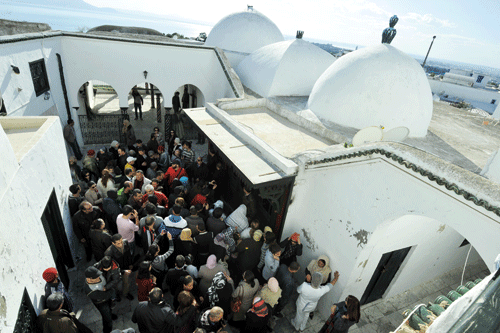
Tunisia’s tourism in need of an Arab Spring break

by Eileen Byrne February 18, 2013
written by Eileen Byrne

In the aftermath of the Tunisian revolution two years ago there was hope that the end of the Ben Ali regime might provide an opportunity for a makeover of the country’s tourism industry. It was time, some said, for Tunisia to move away from its reliance on the ‘cheap-and-cheerful’ package holiday — a  model that dated back to the 1970s, when visitors were cantoned away at beach resorts and had little interaction with locals. The medium-term goal, it was argued, should be to attract more higher-spending visitors to a wider range of holidays and activities, from trips to view desert wildlife to business conferences.

As in other areas of the economy a combination of domestic and international factors is slowing progress. World Bank economists advising the country’s transitional government discovered that banks had lent heavily to financial investors in beach-side hotels who often had little vocation or incentive to grow their businesses along competitive lines. The easy credits often reflected borrowers’ links to Ben Ali’s ruling party, the Constitutional Democratic Rally (RCD), rather than any entrepreneurial skill. Banks knew the courts would not enforce repayment, and today about 33 percent of Tunisian banks’ non-performing loans are related to these beach-side hotels. The phenomenon has received scant coverage in local media, and hotel owners are dragging their feet on a proposal that would see their debts rescheduled and taken off the banks’ books by being transferred to an asset management vehicle.  The result: along the coast from Tabarka in the north to Djerba in the south, by way of Hammamet, Sousse, Monastir and Mahdia, price-cutting by those who benefited from the easy loans intensified amid the drastic falls in visitor numbers following the revolution. Tunisia’s approximately 850 hotels include about 50 that are not commercially viable, and other hotel owners, struggling to pay back normal loans, cannot compete on pricing. Their workers barely get by on low wages.

The Islamist party Nahda had big aspirations for tourism ahead of the October 2011 election. One speaker at its campaign launch was frank, if hardly diplomatic, when he declared: “We are tired of welcoming the poor of Europe!” Experts rattled off ways to woo new kinds of visitors: cultural, desert, sports, Islamic, ecological and medical tourism. Niche tourism for the wealthy, even revolutionary tourism where groups of camera-wearing tourists were already being shepherded past the once-feared Interior Ministry building in Tunis was proposed. Later, savoring its landslide election victory and heading a three-party coalition government, Nahda attempted to reassure a jumpy French media that it would ban neither beer nor bikinis on the beach.

Fast-forward to early 2013 and despite the continuing economic crisis in Europe, visitor numbers, at more than 5.5 million, are recovering. But they are still 14 percent below the levels of 2010, the last year of the Ben Ali regime. Elyes Fakhfakh, a member of the non-religious Ettakatol party and a former manager with French oil company Total, was tourism minister through last year before being appointed finance minister in December as well. His scenario is for steady growth to take visitor numbers to 10 million by 2016, as Tunisia, for the time being, falls back on its existing hotel infrastructure at the classic coastal resorts.

French tourists — still by far the most important national contingent — are nevertheless 28 percent down, compared to falls of 10 percent for German and 6 percent for British visitors. Is the French media’s extensive coverage of Tunisia’s conservative Salafist Islamists a factor in the slow return of the French? Tunisians on Facebook certainly think so. After ‘France 2’ television broadcast on January 17 a documentary entitled “Tunisia under the Salafist Menace”, more than 1,300 Tunisian Facebook users leapt to the defense of their tourism industry, accusing the film-makers of scare-mongering and of sabotaging the 2013 season.

With French planes flying over neighboring Algeria to reach Mali, and Algerian troops’ botched attempt to rescue hostages from Islamist militants at Algeria’s In Amens gas plant, the French-made documentary had touched a nationalist nerve.

Unfortunately events in Mali and Algeria may put a damper on tourism in Tunisia, especially on the “desert tourism” that looked to generate much-needed income in the south. And as for Tunisia’s woefully under-exploited Roman archaeological sites, it seems the dead hand of the old regime needs to be further loosened so that a little fresh air and commercial know-how is let in to generate jobs.
 

Eileen Byrne reports from Tunis for the London-based Guardian and The Sunday Times

February 18, 2013 0 comments
0 FacebookTwitterPinterestEmail
Society

To Infiniti and beyond

by Nadim Mehanna February 18, 2013
written by Nadim Mehanna

The scene at the Millbrook Proving Ground was beginning to feel like something out of a James Bond film. Our cellphones had been confiscated at the edge of the track. The only camera among us now hung from the neck of a single, vetted photographer. Those in attendance were all highly selected, the elite of the automotive world. Of course, when you’re offered a glimpse of the future, certain precautions must be observed. 

The car we had come to see was the Infiniti Emerg-E, Nissan’s bold foray into the world of electrical supercars. Hand assembled, this prototype would never be bought or sold, never enter production. It would afford us our glimpse of the world to come, then disappear, whisked off to a museum showcase to live on forever as the first of its kind. And what a first it was.

Giving ‘green’ a supercar sheen

The Emerg-E is no hybrid. It is 100 percent electric, with a range-extender power train that kicks in only when needed. At the vanguard of an emerging class, it paves the way for a new generation of supercars. The moment has been ripe for some time. Despite the growing popularity of gas-electric hybrids — sales of Honda’s Insight, the Nissan Leaf and the Chevy Volt all remained strong throughout the fall — supercar makers have remained at the outskirts of the revolution, delving into carbon fiber to cut weight but always relying on the basic principals of thermal combustion to give their cars a surge of power. And while a few other makers, like Ferrari and Audi, have dabbled in concepts, none have ever entered the demonstration phase.  In part, it’s a problem of mechanics; for acceleration and sustained speed, there is no substance yet known to man that can compete with liquid fossil fuels. Hydrogen fuel cells remain uneconomical; battery storage capacity has bottlenecked. Yet these limitations have not stopped the commercial segment of electric vehicles from doing a clipping trade, thanks in part to the stubbornly high gas prices of the past decade. 

The more intractable problem, rather, is that supercar makers face a roadblock in terms of branding and image.  The problem, in large part, is that green vehicles are seen as “sensible” — they’re smart rather than sexy, designed to save money on fuel and lighten your carbon footprint. They’re small, urban, economical. In the high school academy of cars, the eco-car is the skinny kid with the coke bottle glasses and the pocket protector. Sure, he can help you with your physics homework, but he’s never going to get a date.


And let’s face it: the people who can shell out $2.5 million for a Bugatti Vitesse are not worried about the cost of gasoline at the pump. They’re looking for speed, for power, for prestige. They’re looking for sex appeal, not sensibility. If a car can embody those qualities and still lighten its load on the planet, great, but first and foremost it has got to meet the basic criteria of the supercar style. 

No compromise — it is still a supercar

Which is exactly why the Emerg-E is such an exciting prospect. Here, at last, is a vehicle that achieves ecological responsibility without compromising the car’s basic charisma. With acceleration of zero to 100 kilometers per hour (km/h)in under four seconds, this eco-car would keep pace in a drag race with any in its segment. 

Power is delivered through its 402 boiler horsepower twin electric motors, one for each of the rear wheels. A third, range-extending engine is also on hand. 

Visually, the Emerg-E would feel at home in a episode of Star Trek. Tapered and sleek, with seamless contours along its 4.5 meter frame, the car is both elegant and edgy in design. It ripples silver, its shell glittering with LED lights. 

Inside, the dashboard flickers with dials and OBD diagnostics. Everything is mapped, everything controlled. 

At the wheel, the supercar experience is emulated, but not duplicated, and you never entirely forget that you are driving the technology of the coming age. Turn it on, and you notice the noise immediately — not the throaty growl of a thermal engine, but something higher-pitched, a drone, a whine. It’s much quieter than a gas-fired engine, but something about it still makes your hair stand on end. It’s the sound of electrons flowing, of a charge rushing along copper wire.

Depress the accelerator, and the car flies. The acceleration is amazing; in  a regular car, you would need a V8 engine to achieve this kind of pull. In the time it takes to draw two breaths, the car has reached 100 kmh. 

After that, the magic flickers. The car has no gear box, meaning it tops out at 141 kmh. The engine is spinning like a table saw, singing like a Valkyrie hitting a high note. There are a few odd sounds from beneath the hood — nothing disturbing, but this is, of course, a prototype, and there are still a few kinks to iron out. In terms of performance the experience is flawless, as the car takes curves easily, its grip and steering never faltering. 

The way of the future? 

And all of this with zero emissions. The Emerg-E emits no more than 55 grams of carbon dioxide per kilometer over a 300 mile range, and can cruise for 30 miles without ever engaging its thermal drive train. 

That this should be the direction of all automobiles, supercar and sedan alike, seems now increasingly inevitable. Whether a decade or a century from now, there will come a day when the pumps creak to a halt, when the oil fields run dry and the last thermal engine chugs to a rusting halt. Perhaps ecological consciousness and the specter of climate change will bring that day sooner rather than later. But when that day comes, the automotive sector will already be well along the road to adaptation. 

Rest assured, Nissan’s visionary concept will not be a momentary aberration. Experiments with liquid hydrogen and even roof-mounted solar panels have failed to produce viable vehicles in any meaningful sense. Only electric cars and gas-electric hybrids have made the gains needed to compete with  traditional thermal combustion. 

In time, and probably not a long time either, we will see the other supercar makers launching demonstrable prototypes of their own, driving standards even higher. But for the moment, at least, Infiniti can bask in its momentary limelight, the sole occupant of a class unto itself. 

February 18, 2013 0 comments
0 FacebookTwitterPinterestEmail
Economics & Policy

Is Bahrain’s economy stabilizing?

by Benjamin Redd February 18, 2013
written by Benjamin Redd

Two years ago last week, thousands of protesters took to the streets in the tiny island kingdom of Bahrain in the wave of pro-democracy uprisings sweeping the region.

The government cracked down brutally — including using illegal tactics according to the independent commission set up to investigate the events. The result was more protests met by more repression.

The economic effects of the political crisis have been devastating but there are signs that things are finally improving.

Click here or on the chart below to see our interactive guide to the Bahraini economy and uprising.


February 18, 2013 0 comments
0 FacebookTwitterPinterestEmail
Real estate

Homegrown demand tops in 2012

by Executive Editors February 16, 2013
written by Executive Editors

Property transactions registered with the Lebanese government in 2012 reached a value of $9.2 billion representing a 3.8 percent annual increase, according to official statistics cited by Bank Audi’s Lebanon Weekly Monitor in January. The 2012 rise in property transaction values was juxtaposed with a 9.9 percent annual decline in the number of property transactions when compared with 2011. One year earlier, from 2011 to 2012, numbers and values of property transactions had both been in decline, by 11 percent and 6.7 percent respectively. Property sales to non-Lebanese in 2012 showed the lowest number of transactions since 2006, according to the data shown by the Lebanon Weekly Monitor. With property demand coming mainly from Lebanese citizens, Arab buyers were described in the report as “still somewhat hesitant” to purchase properties in the Lebanese market, which Bank Audi correlated with the travel advisories that some Gulf Cooperation Council countries issued last year against visiting Lebanon. According to the statistics, the annual number of property sales to non-Lebanese peaked at 2,300 transactions in 2009 and has fallen by a total of 40 percent over the past three years.

B.D.L. stimulus for home finance

Banque du Liban (BDL),  Lebanon’s central bank, has allocated $817.2 million of a $1.46 billion financial stimulus package to the housing sector, according to a January 14 BDL circular cited by Byblos Bank’s “Lebanon This Week” report. The central bank’s lending pool will be dispersed on a first-come, first-served basis and will be accessible to commercial banks at a fixed interest rate of 1 percent per year. Commercial banks can draw advances equal to between 60 and 100 percent of the value of new housing loans they provide, significantly lowering their cost. Banks that tap into the central bank stimulus facility will have to abide by BDL-mandated interest rates when extending loans in different categories ranging from housing finance to loans for productive sectors and projects in research and development.  According to the Byblos Bank report, a ceiling has been set of LL800 million ($530,700) per individual housing loan issued under the stimulus program, and housing loan takers must not employ other financial facilities in acquiring a residence when benefiting from the program. Commercial lenders have to stay below a ceiling of $63 million (per bank and semester) when extending housing loans in the first and second half of 2013. A financial stimulus package for the Lebanese economy was announced by BDL Governor Riad Salameh on the sidelines of a Lebanon investment day in London last November. According to the funding allocations which BDL has now announced, 56 percent of the $1.46 billion package will go to housing finance versus 14 percent to productive sectors and 1 percent to research and development projects. The total number of loan categories in the stimulus      package is seven.

Getting more real, bit by bit

It was party time for Lebanon’s newest professional order last month as an organization of real estate intermediaries celebrated its elevation to a recognized syndicate. The Real Estate Association of Lebanon (REAL) was formed with the aim of becoming a syndicate with the authority to set standards for membership and distinguish certified members from unregulated operators in the sector. Executive reported on the syndicate’s expected formation last October when the organization’s status upgrade was nearing completion. When the official approvals and signatures of governmental entities were completed after some delay, REAL started 2013 with a celebration dinner during which REAL President Massaad Fares was not short in expressing his personal satisfaction. According to a press statement, he said, “Since the establishment of REAL, the thought of creating a syndicate for the realtors in Lebanon has been a main aim of mine. It is a proud moment for me today to celebrate this achievement after a long struggle.”  According to its website and earlier remarks by its secretary general, Walid Moussa, to Executive, REAL aims to have more than of 200 members within two years. The organization’s online membership list in late January showed 30 member companies. The new syndicate will emphasize compliance of real estate intermediaries with its code of ethics and has prepared an education program for which REAL currently seeks to generate funding. The program will be offered in collaboration with the American University of Beirut. Some market participants told Executive that they expect the syndicate to take some time to reach efficacy.

Shot across the bow of property speculation

New regulations that would impose stricter limits on mortgage borrowing by nationals and expatriate residents of the United Arab Emirates are not going to be introduced until the third or fourth quarter of 2013, and banks are still offering home finance for high percentages of property values to all qualifying  potential buyers. This is the situation after a tumultuous period in the wake of a UAE central bank notice to banks at the end of 2012 that outlined financing limits of 50 percent of first homes’ values for expatriates and 70 percent for nationals. According to a UAE central bank notice published on January 22 via the country’s official news agency, WAM, banks and finance companies should present their comments on the maximum loan-to-value (LTV) ratios for mortgages in the UAE to the central bank by January 31. WAM said the new notice acknowledged that views of banks on percentages specified in the previous notice were “diverse” and the central bank “considers it appropriate to seek the opinion of all banks and finance companies on the main components of the regulations that the central bank intends to issue soon.” Neither the December 30 nor the January 22 notice were accessible on the central bank’s English-language website, making it a matter of interpretation if the new notice was an about-face or correcting a misunderstanding. According to The National, banks in late January were continuing to offer home finance with up to 85 percent LTV ratios. 

Waterfront dig awarded

Beirut’s Waterfront City, the suburban luxury development that was first seeded back in Lebanon’s civil war days by land filling of the sea in the Dbayeh area directly north of the Lebanese capital, is entering the first phase of construction this spring. According to statements released by Waterfront City and ACC-Matta, the latter company was awarded a $225 million contract for the first phase of construction. The entire project, whose future phases are meant to include a shopping mall, hotels, offices and more residential buildings, was designed by San Francisco-based SB-Architects which said on its website that the first phase was set to entail 112 residential units and 5,680 square meters (sqm) of space for retail and restaurants. Waterfront City is developed in a partnership of Lebanese Joseph Khoury et Fils and Majid Al Futtaim (MAF) Properties, a division in the United Arab Emirates-based MAF Holding. According to MAF Properties, Phase 1 was enlarged from 132,700 sqm built-up area to 193,000 sqm and now represents about 17.5 percent of Waterfront City’s total anticipated BUA. The city will envelop an area of 250,000 sqm when completed and is expected to be realized at an investment in the range of $2 billion. ACC-Matta, which is a joint venture of Lebanon-based construction companies Matta & Associes and Arabian Construction Company, said it won the contract for building the project’s enlarged first phase in “an extensive and thorough evaluation and selection process, which involved seven construction companies.” MAF Properties confirmed that this was competitive tender. According to ACC-Matta, work on the enlarged phase “is due to begin in the first quarter of 2013 and is scheduled to last almost three years.” Handover of the phase is expected to commence in early 2015. 

Birthing a giant

Even with a consenting and eager family backing the enterprise, the birth of a new real estate giant in Abu Dhabi has not been a simple procedure; however, the emergence of Aldar Sorouh Properties now appears nigh. The boards of real estate development companies Aldar Properties and Sorouh Properties announced in a joint statement on January 21 that the board of each company unanimously approved a planned merger which is to create a company with more than AED 47 billion ($12.8 billion) in assets and one of the region’s largest land banks. The new company will concentrate on real estate development in Abu Dhabi, where its two predecessors have been associated with a wide range of the emirate’s most ambitious property developments — including some severe loss-incurrence.

February 16, 2013 0 comments
0 FacebookTwitterPinterestEmail
Economics & Policy

MEA’s new wings

by Executive Editors February 16, 2013
written by Executive Editors

Middle East Airlines (MEA) has finalized an agreement to purchase 10 new planes worth $1 billion from Airbus. The national carrier is purchasing five A321neo and five A320neo aircraft, which are slated to enter service in 2015 and will primarily phase out older planes in the fleet, which currently include four A330-200s, four A321s and 10 A320s. The new aircraft are more efficient than their predecessors and the company says they will save them up to 15 percent on fuel costs annually, or around 1.4 million liters of fuel. With more than 1,600 firm orders since its launch in 2010, the A320neo family has proven to be the fastest-ever selling commercial aircraft program. Although MEA is a private entity, it is 99 percent owned by Banque du Liban, Lebanon’s central bank. In September 2012 its exclusive rights as the only domestic commercial passenger carrier were extended for another 12 years. The final agreement for the planes follows signing of a the memorandum of understanding in June 2012. 

Telecoms industry restructuring

Lebanon’s Ministry of Tele- communications unveiled a plan to restructure the mobile phone sector, which would merge the mobile network infrastructure of the existing state-owned operators Touch and Alfa Telecom into a single platform and then license three to five private firms to operate as Mobile Virtual Network Operators (MVNOs) that offer retail services to customers. The single network infrastructure will remain under the ownership of the government, with the possibility of floating 3 percent on the stock market. Touch and Alfa Telecom posted total revenues of about $1.6 billion in 2011, of which $1.4 billion was directly transferred to the government; this amount, along with revenue from the state-owned incumbent operator in the fixed-line and Internet markets, accounted for about 40 percent of public revenues in 2011. A report by Business Monitor International concluded that the proposals would likely meet the government’s revenue targets but would be unlikely to stimulate innovation or raise the usage of telecom services in the country. Among the main reservations raised were that the new structure would do little to encourage investment and increase competition at the network operator level.

holes in state’s social safety net

More than three quarters of the Lebanese population consider their government to be ineffective in providing social protection and nine out of 10 support subsidy reform, according to a report by the consulting and opinion polling firm Gallup. Despite the poor show of faith in their government, 83 percent of survey respondents said the government has the most responsibility to help the poor in the country. The survey showed that 84 percent of respondents feel that social safety net programs should target the poor in the country, while 16 percent would prefer them to focus on specific target groups such as widows, orphans or the disabled. Just under seven-tenths of those questioned were in favor of cash-based social safety net programs, while the remainder prefer programs based on the distribution of goods and services. The study was commissioned by the World Bank as part of its assessment of social safety nets and subsidy programs in the Middle East and North Africa region.

EDL’s burden ever-heavier

The drain on the public purse of the state-owned electricity utility, Électricité du Liban (EDL), increased by 62 percent in the first eight months of 2012 compared to the same period in 2011. Payments to the Kuwait Petroleum Corporation (KPC) and to Algerian energy conglomerate Sonatrach — which provide EDL its fuel — totaled $1.39 billion, or 96.5 percent of the transfers, while the remaining 3.5 percent went toward servicing EDL’s debt. A primary reason for the hike in payments to Sonatrach and KPC was due to a significant rise in international oil prices, which were on average 33 percent higher than over the corresponding period in 2011. Government transfers to the dysfunctional EDL account for roughly one quarter of primary expenditures and are the third largest expenditure item, after servicing the national debt and paying public sector salaries and wages. Industrial disputes between the workforce and the management continue to plague EDL, with this round of protests focusing on cuts in bonuses and allowances proposed in the 2013 EDL budget in mid-January. The EDL employees union postponed their strikes due to the severe damage wrecked upon the country’s electricity infrastructure during harsh storms in January, but threatened further industrial action.

LEbanon officially mediocre

Lebanon came in just ahead of the middle of the pack in a global ranking on economic freedom. The index compiled by The Heritage Foundation and The Wall Street Journal is based on 10 broad factors of economic freedom: business freedom, trade freedom, fiscal freedom, government spending, monetary freedom, investment freedom, financial freedom, property rights, freedom from corruption and labor freedom. Out of 177 countries Lebanon came in 91st place, and was ninth out of 15 Arab countries. A slight fall in economic freedom was reported compared to last year’s score, mainly due to a decline in property rights, business freedom and labor freedom. The report also noted that Lebanon’s judiciary is weak and vulnerable to political interference and, especially in commercial cases, trials can drag on for years. Lebanon scored relatively well on fiscal freedom (27th) and financial freedom (40th) but came in much further down the rankings in business freedom (142nd) and property rights (141st).

more storm relief

Heavy storms across the country claimed at least five lives and extensive damage to infrastructure and buildings. The government came under fire for failed infrastructure developments and corruption in the planning process, which critics say compounded the flooding and hindered the emergency response (see comment page 24). Illegal construction on flood plains and badly maintained sewage systems were blamed in several areas for exacerbating the extent and speed of the flooding. The Minister of Public Works and Transport Ghazi Aridi criticized illegal construction and also blamed a lack of political will in passing the budget and allowing certain infrastructure developments. However, both building permits and construction regulation fall under the Directorate General of Urban Planning, which answers to Aridi’s own ministry. After several days of being under attack for a poor response to the crisis, the cabinet approved $2 million in additional spending for the Higher Relief Council.

February 16, 2013 0 comments
0 FacebookTwitterPinterestEmail
Banking & Finance

SME loans drop reflects poor economic situation

by Executive Editors February 16, 2013
written by Executive Editors

Loans provided to Lebanese small and medium enterprises (SMEs) by Kafalat, the government-sponsored loan guarantee company, dropped by 16 percent in 2012 to $138 million, down from $165 million. No suprise amid the domestic and regional political instability, such a drop is a clear indicator of an ailing economy. The number of loans guaranteed totaled 1,025, down from 1,272 a year earlier. However, the average loan size increased to around $134,000, from $130,000 in 2011. Businesses from Mount Lebanon snagged 41 percent of the total, followed by South Lebanon with 22 percent. As for sectors, 39 percent of loans were given to agricultural businesses, the industrial sector received 38 percent, tourism 17 percent and handicraft 4 percent. Specialized technologies accounted for 1 percent of the SME loans.

BDL extends $1.46 billion in credit facilities to local banks

Banque du Liban (BDL), Lebanon’s central bank, is extending financial facilities to local banks against guarantees. A circular issued by BDL in January stated that the interest rate on these facilities, amounting to $1.46 billion, will be fixed at an annual interest rate of 1 percent, to be paid monthly. Banks can borrow from BDL between 15 percent and 60 percent of loans extended to productive sectors, 60 percent of non-housing loans in domestic currency, 100 percent of loans given for higher education, 150 percent of domestic currency loans for research and development, 150 percent of credit to finance investment projects in Lebanon and between 30 and 150 percent of loans to finance environmentally friendly projects. As for housing loans, banks can borrow between 60 and 100 percent of extended loans as long as a single housing loan does not exceed $530,700 and with a maximum of $63 million worth of housing loans per semester in 2013. BDL allocated $817 million to the housing sector followed by environmentally friendly projects at $294 million, productive sectors at $206 million, non-housing loans at $80 million and education at $33 million. Research and development and investment projects were allocated $15 million each.

Lebanon’s commercial bank assets reach $150 billion

Assets held by Lebanon’s commercial banks reached $150 billion as of the end of November 2012, a 7 percent increase on the end of 2011. Private sector deposits grew by 6 percent on the end of 2011 and accounted for $123 billion, 82 percent of the total assets. Some $80 billion of the deposits were held in foreign currency, an increase by 4 percent on the end of 2011. Domestic currency deposits were up 11 percent at $44 billion. Non-resident deposits accounted for $23 billion, a 9 percent growth on the end of 2011. Loans to the private sector reached $43 billion as of the end of last November, a 9 percent increase on the end of 2011, while claims on the public sector totaled $31 billion, a 5 percent increase. The capital base of the banking sector stood at $12 billion as of November, up 15 percent in a year.

A haven for dirty dough

An estimated $21 billion of illicit financial flows entered Lebanon between 2001 and 2010, making the country the 30th largest recipient of illegal money among the 143 countries surveyed by Global Financial Integrity, a Washington based non-profit organization which aims to curtail the cross border flow of contraband cash. China took the top spot with $2.7 trillion. Two countries from the Middle East feature in the top ten recipients of illegal flows: Saudi Arabia ranked third with $210 billion and the United Arab Emirates ranked 10th with $107 billion. The report concluded that in the past decade developing countries lost on average $586 billion per year in illegal outflows, accounting for a cumulative $5.8 trillion. The Middle East and North Africa region saw the highest growth of illicit flows in the past decade, growing by 26 percent. Sub Saharan Africa followed, growing by 24 percent and Asia at 8 percent. As for the total amount of illegal flows, the bulk, 60 percent, occurred in Asia with China. The MENA region accounted for 10 percent of all illicit flows.

Bank Audi launches operations in Turkey

Bank Audi officially launched last month Odeabank, its fully owned Turkish subsidiary and the first foreign bank to be granted an operating license by Turkey in 15 years. The license was obtained in September 2012.  Within the first two months of operations, Odeabank opened six branches, drew in over 1,500 customers, raised deposits totaling more than $1.4 billion and assets amounting to $2 billion. Samir Hanna, Bank Audi Group chief executive, said that “Turkey was a right investment decision and that it will be one of the locomotive countries in the growth of Audi Saradar Group.” For 2013, the bank is aiming to develop 32 branches and reach a headcount of 1,000 employees. “Our aim is to grow in the domestic market and to contribute to the growth of the business volume between Turkey and the Middle East, with all the advantages this entails,” said Hüseyin Özkaya, Odeabank’s general manager.

Bill Gates Group invests $1 billion in Orascom Construction Industries

American business tycoon and philanthropist Bill Gates, known for co-founding Microsoft, is leading a group of American investors deploying $1 billion in Egypt’s Orascom Construction Industries (OCI), a fertilizer and construction company that is the country’s biggest publicly-traded company. The transaction consists of a transfer of all the Egyptian listed stock of OCI as well as its global depositary receipts (GDR) to an Amsterdam-based unit to be listed on the NYSE Euronext Amsterdam by the middle of February. The share exchange has attracted more than $2 billion in commitments from investors. OCI is relocating its head offices to Amsterdam from Cairo. According to Egyptian billionaire and chief executive of OCI Nassef Sawiris, the listing in Amsterdam will help the company lower its borrowing costs. The Sawiris family and Dubai-based private equity firm Abraaj Group, which together own the bulk of the shares in OCI, already gave in their GDRs for exchange.

B.D.L. demands the establishment of compliance departments

Lebanon’s commercial banks and financial institutions have been given until September to create independent compliance departments.  Banque du Liban (BDL), Lebanon’s central bank, has mandated that the departments must comprise a Legal Compliance Unit and an Anti Money-Laundering/Combating the Financing of Terrorism (AML/CFL) unit. The AML/ CFL unit is responsible for verifying the implementation of the critical measures to combat money laundering of terrorism financing. The responsibilities of the compliance unit extend to the operations of the Lebanese banking sector and their subsidiaries, both domestically and overseas.

The UAE transfers $1 billion to Jordan

To assist Jordan in financing development and infrastructure projects, the United Arab Emirates has transferred $1 billion to the country’s central bank. This follows a $250 million transfer to Jordan’s central bank in December. The $1.25 billion deposited so far is separate from the $1.25 billion allocated by the UAE to Jordan as part of the $5 billion over a five-year period agreed on by the Gulf Cooperation Council in 2011. The UAE and Jordan agreed on a framework to regulate the $1.25 billion grant, which will be transferred through the Abu Dhabi Fund for Development (ADFD). According to Jordan’s planning minister Jafar Hassan, the grant will allow the country to undertake several capital projects that would stimulate the kingdom’s economy and attract investments. ADFD Director General Mohammed Saif al-Suwaidi said that the $1.25 billion grant would be deployed on infrastructure projects and housing schemes.

February 16, 2013 0 comments
0 FacebookTwitterPinterestEmail
Business

Lebanon’s newest online startups

by Maya Sioufi February 15, 2013
written by Maya Sioufi

As Lebanon’s entrepreneurial spirit continues to gather momentum despite the country’s dire economic conditions, several young and hungry entrepreneurs have rolled up their sleeves and set up shop online. Executive spoke to three new Lebanese online startups: a party supplier and two search engines, one for banking products and one for local fashion items. Facing several obstacles, from weak infrastructure to unfair customs, rendering their endeavor more challenging than it may have been in more developed markets, these new startups are still determined to make it.

Hide & Seek          

Founder: Karen Zaatari and Fafi Merhi

Product: Party supplies

Market targeted: Worldwide

Total cost so far: $110,000

Projected revenues in 2013: $110,000 (worst case scenario)

Biggest challenge: Customs authorities 


Meet Hyoo. This idiosyncratic chameleon is the mascot of Hide & Seek, an online provider of party supplies founded by two 27-year-old friends Karen Zaatari and Fafi Merhi. The idea to launch the startup came at a Halloween party in 2010 that the two friends were attending and for which they struggled to find funky costumes. From there, the idea to source costumes from several countries grew to include supplies for bachelorette parties — let’s keep that hush hush though — and original gadgets for parties, kitchens and offices. 


Initially wanting to open a retail store to offer their products, their plans were held back due to the unstable political situation in Lebanon, as well as their studies that brought them to the conclusion that money for the extra-high rental cost of a retail store would be better utilized if deployed on the website. 


Items ordered online can be shipped worldwide using Aramex’s courier services. In Lebanon, a flat $3 delivery fee is applied, or the items can be picked up from the startup’s office in Saifi for no fee. For payments, given that “some people are skeptical about paying online, we catered to this large community and that’s why we decided to accept cash on delivery,” says Merhi. Paying online or with a card on delivery is also available. Hide & Seek’s products are on display at three stores in Lebanon — Belly Button, Label Queen and Cookie Dough — with an aim to be in more stores in the near future.  


The startup goes beyond just supplying party items; it provides targeted presentations for themed events. Let’s say you want to plan a “superhero party” for your brother. Hide & Seek will send you a customized presentation at no cost which would feature the different products you can buy from their online store for such a themed event.  


Sourcing from China, the United States and the United Kingdom, Hide & Seek does not have exclusive agreements with the brands they supply, as they want to keep offering new brands to their clients. With a total value of $110,000 including stock held in two warehouses in Hazmieh and Qoreitem, the startup has been entirely self-funded thus far, with each founder providing 50 percent. For 2013, the founders aim to generate an average of $300 a day, which will allow them to break even this year.  


Two big plans are on their agenda for the long term. “We see Hide & Seek as a home, a place you enter which will have our online operations, our office, a display room, the storage, everything,” says Merhi. Their second and longer-term plan is to store all the merchandise in the Jebel Ali Free Zone in the United Arab Emirates in order to avoid high taxes.  


The biggest challenge? “Customs,” says Zaatari. “Every day the [customs officer] gives us a different calculation and interpretation of the products depending on how he categorizes them and on his mood that day.” Zaatari says this corrupt approach encourages “people who bring stuff in their bags at the airport and walk in; it makes it cheaper for you to get a [plane] ticket and go that way." 


Despite this inconvenience, Zaatari and Merhi are sticking to their home base with the goal of selling their products worldwide. “We had an order from Paris today,” says Merhi with excitement, an order which gives them motivation that, despite the country’s numerous challenges, they can still make it in Lebanon.


Bnooki


Founder: Elie Bou Jaoude 

Product: Search engine for banking products 

Market targeted: Lebanon

Total cost so far: $200,000

Projected revenues in 2013: Not disclosed

Biggest challenge: Trust in transparency

If you need a car loan or a mortgage in Lebanon, you will either have to look on bank websites or call each bank to see which one offers you the best terms. Search engine Bnooki — Arabic for banks — aims at bringing this time-consuming exercise to an end by providing a platform to compare consumer and business banking products of all the country’s banks. 


“If you want to go and visit the website of each bank, probably you won’t find the information, and if it’s there, you’ll spend the whole day on the sites. This is one factor that drove me to this idea,” says Bnooki founder Elie Bou Jaoude. Working as an investment manager for Lebanese incubator Berytech’s fund, Bou Jaoude began developing his idea and partnered with French company Ebizproduction for their knowledge in content management system technology. 


Eventually a team of six, working out of Berytech offices, was formed and started proactively contacting all the local banks in Lebanon on a monthly basis to update a database of product offerings. Bnooki also gives banks access to the website to update their offerings. The search engine also shows when the last update was made and by whom — the bank or Bnooki. 


Consumers can shop for banking products including but not limited to current accounts, savings accounts, home loans and car loans. Businesses can shop for products such as Kafalat loans, small and medium enterprise loans and venture capital funds. By clicking on a particular banking product, Bnooki links to the bank’s site and if the bank does not offer online services, there are options to send the bank a question or callback request.  


The information, whether collected by Bnooki or provided by the bank, is included at no fee. Revenues are raised through three different avenues:  advertising, fees for leads — every time an application form is submitted or a call is requested — and through the sale of information reports. Bou Jaoude did not disclose the revenues raised or his expectations for this year as he is in the process of raising funds.  


Having invested $200,000 so far in the startup, partly through a Kafalat loan and partly in equity (the exact breakdown was not disclosed), Bou Jaoude is now seeking capital to pursue the expansion of Bnooki and intends to raise equity in the next two quarters from a venture capital firm.  


The biggest challenge he faced when setting up his product was to convince banks that other banks would be transparent, provide complete information and allow such a product to be on the market. “We hired a very senior research team [and] working together with our team, we got all the information of the banks in Lebanon. It was a huge job, from mystery shopping, to checking online, to going to bank X, meeting retail and marketing managers, giving them back-end access to go online and check if everything is correct before we publish,” says Bou Jaoude. 


For now, his focus is on expanding the distribution by providing Bnooki applications on smartphones and making the platform available in Arabic. In the next two to three years, Bou Jaoude has bigger goals as he plans on taking this venture to most countries in the Middle East and “possibly outside the Arab world; we want to be the reference. Whenever you want something from banks, you think Bnooki.com,” he says.


Raghunter


Founders: Serene Abbas, Narina Najm and Jad Sarout

Product: Search engine for fashion items in Lebanon 

Market targeted: Lebanon

Total cost so far: $35,000

Projected revenues in 2013: Not determined

Biggest challenge: Setting up a pricing strategy

The migration from physically shopping to ordering products online has yet to really catch on in Lebanon, but Raghunter.com offers a smart way to virtually enhance real shopping. 


Let’s say you’ve just finished work and on your way home you want to pick up a hot dress for a night out. By checking Raghunter.com before hitting the streets, this usually daunting undertaking can be planned with military precision from the comfort of your office. Launched by Serene Abbas (28), Narina Najm (29) and Jad Sarout (31), this online startup aims to provide Lebanese consumers — both male and female — with a search engine that shows them which items are available and where.  


After undertaking in-depth qualitative market research, including extensive interviews with consumers, buyers and shop owners, the founders saw an opportunity. “Fashion retailers know they have to be online today but they can’t afford it and social media is not enough as they can’t just dump things online,” says Abbas. The need to be online combined with Lebanese consumer skepticism to spending via the web inspired the creation of Raghunter. In essence the website will be the online marketing partner for retail stores. 


“Our main target is working people who are busy and value their time off. Shopping on weekends is stressful for them so we saw an opportunity to show them what is in the market before they go shopping,” says Abbas.  

With 40 stores now providing items to list on Raghunter’s site, the founders have their hands full. Raghunter’s team collects the items from the stores, takes them to their offices in Ain El Mreisseh, photographs them, returns the items and completes heavy data entry and tagging. The tags allow an optimization search whereby consumers can look up by category, store, color, material and area.   


For now, Raghunter is offering stores a six-month free trial. The trial period is expected to allow the startup to optimize their search engine and eventually come up with a pricing strategy. With no revenue generation yet and no direct advertisement planned on the site, the founders aim to make revenues by charging retail stores for traffic generated through the site and for top spots on the platform “à la Google”.  


The founders have deployed $35,000 so far in their endeavor, yet are now in need of more capital and are looking to secure a $200,000 innovative Kafalat loan guarantee. Being a search engine, direct sales on their site are not available but, “if there is enough demand for that, eventually we will consider it but that’s a whole different business model,” says Najm. “If you can buy online, we would become diluted because everyone is doing that; our uniqueness is that we are allowing you to see and discover,” adds Abbas.  


In the next two to three years, the founders’ target is to have Raghunter cover other countries in the Middle East such as Saudi Arabia and the United Arab Emirates. For now, they need to find a way to monetize their search engine. Until then, Lebanese shoppers have to wait to see what funky items are on sale around Beirut.


February 15, 2013 0 comments
0 FacebookTwitterPinterestEmail
The Buzz

Morning briefing: 15 Feb 2013

by Executive Staff February 15, 2013
written by Executive Staff

Lebanon will launch a tender to run its two state-owned mobile phone operators, currently managed by Kuwait’s Zain and Egypt’s OTMT, as part of a plan to revamp the telecoms sector, a senior government adviser said.

More from Reuters


The Middle East’s freshwater reserves are drying up, according to a new study.

More from Arabian Business


Slight profit-taking pushed most Middle Eastern markets lower Thursday as investors failed to find a positive catalyst to advance prices that seem stretched.

More from Reuters


Demand for gold fell last year for the first time since 2009 as Asians bought less jewellery and Western investment dipped, the World Gold Council said in a report bears saw as new evidence the 12-year rally may be topping out.

More from Reuters


Egypt's pound weakened to a record low against the dollar in interbank trade after a foreign currency sale on Thursday, but trading volumes were low as authorities reduced the flow of dollars into the market.

More from Reuters


Qatar's sovereign wealth fund is in advanced talks with Russia's second-largest bank VTB about injecting between US$3bn and US$3.5bn into the banking giant, the Telegraph reported.

More from Arabian Business


High oil prices helped Oman post a budget surplus of OMR3.22 billion ($8.4 billion) in 2012, a turnaround from a deficit of OMR113.2 million in 2011, data from the finance ministry showed on Thursday.

More from Gulf Business


Companies

Some of Egypt’s most powerful pre-revolution figures are being lured back to the country in an attempt to kickstart growth.

More from Bloomberg


Egypt's aviation minister says the hiring of President Mohammed Morsi's son to a highly-paid government job was justified, dismissing accusations of nepotism.

More from The National


Etihad Airways, the national airline of the United Arab Emirates, has increased its flights to the Northern city of Lahore from seven to 11 a week offering passengers more convenient travel options.

More from Khaleej Times


Saudi-owned Egyptian airline Nile Air has announced it is to expand its reach in the Gulf by launching flights to Kuwait.

More from Arabian Business


February 15, 2013 0 comments
0 FacebookTwitterPinterestEmail
  • 1
  • …
  • 281
  • 282
  • 283
  • 284
  • 285
  • …
  • 695

Latest Cover

About us

Since its first edition emerged on the newsstands in 1999, Executive Magazine has been dedicated to providing its readers with the most up-to-date local and regional business news. Executive is a monthly business magazine that offers readers in-depth analyses on the Lebanese world of commerce, covering all the major sectors – from banking, finance, and insurance to technology, tourism, hospitality, media, and retail.

  • Donate
  • Our Purpose
  • Contact Us

Sign up for our newsletter

    • Facebook
    • Twitter
    • Instagram
    • Linkedin
    • Youtube
    Executive Magazine
    • ISSUES
      • Current Issue
      • Past issues
    • BUSINESS
    • ECONOMICS & POLICY
    • OPINION
    • SPECIAL REPORTS
    • EXECUTIVE TALKS
    • MOVEMENTS
      • Change the image
      • Cannes lions
      • Transparency & accountability
      • ECONOMIC ROADMAP
      • Say No to Corruption
      • The Lebanon media development initiative
      • LPSN Policy Asks
      • Advocating the preservation of deposits
    • JOIN US
      • Join our movement
      • Attend our events
      • Receive updates
      • Connect with us
    • DONATE