• Donate
  • Our Purpose
  • Contact Us
Executive Magazine
  • ISSUES
    • Current Issue
    • Past issues
  • BUSINESS
  • ECONOMICS & POLICY
  • OPINION
  • SPECIAL REPORTS
  • EXECUTIVE TALKS
  • MOVEMENTS
    • Change the image
    • Cannes lions
    • Transparency & accountability
    • ECONOMIC ROADMAP
    • Say No to Corruption
    • The Lebanon media development initiative
    • LPSN Policy Asks
    • Advocating the preservation of deposits
  • JOIN US
    • Join our movement
    • Attend our events
    • Receive updates
    • Connect with us
  • DONATE
The Buzz

Morning briefing:11 Feb 2013

by Executive Staff February 11, 2013
written by Executive Staff

Economics

Saudi Arabia may allow foreigners to invest directly in stocks in the next year, said John Burbank, founder of the $3.7 billion hedge fund Passport Capital LLC.

More from Bloomberg


Lebanon’s advertising spending outpaced GDP growth by increasing 4.5 percent in 2012, with online advertising posting 29 percent growth, ArabAd magazine reported in its annual survey.

More from The Daily Star


Egyptian consumer prices last month posted the biggest increase in more than two years after the pound weakened to a record and foreign reserves slid.

More from Bloomberg


Japan has offered to help Saudi Arabia build nuclear power stations to free up more oil for exports, Kyodo news agency reported on Sunday, but a visiting Japanese minister said he was not seeking a supply increase now.

More from Reuters


Salaries in the oil and gas sector soared across the Middle East last year, with Saudia Arabia, Bahrain, Oman and the United Arab Emirates recording some of the largest increases globally, according to an annual survey.

More from Arabian Business


Companies

Occupancy at Beirut’s top-end hotels fell to 54 percent in 2012, compared to 58 percent in 2011, according to the Ernst & Young Middle East hotel benchmark survey.

More from The Daily Star


Dubai’s Emaar Properties surged to a four-year high on Sunday as upbeat research reports from international banks bolstered demand from local and foreign investors, while oil price gains helped lift most Middle East markets.

More from Reuters


Akbar Al Baker, CEO of Qatar Airways, has been appointed as non-executive director on the board Heathrow Airport Holdings.

More from Arabian Business


Bank Muscat, Oman’s largest lender, expects its credit growth to be around 14-15 per cent this year, driven by high government spending and higher wages for local citizens, local media quoted its chief operating officer as saying.

More from Reuters


Credit Suisse’s top investment banker for Qatar has resigned, three banking sources said, in a move that comes as the Swiss bank tries to bolster operations in the Gulf state, home to its second-largest shareholder.

More from Reuters


February 11, 2013 0 comments
0 FacebookTwitterPinterestEmail
Economics & Policy

Powerless in a pipe dream

by Zak Brophy February 11, 2013
written by Zak Brophy

The oft-touted promise of great gas wealth under the sea floor off Lebanon’s coast has recently compelled the nation’s eyes toward the western horizon. There is a slowly growing sense of inevitability building around Lebanon’s potential hydrocarbon windfall, which was further accelerated by the appointment of the board for the Petroleum Administration in late 2012.  In the coming year Lebanon intends to open a tender round for the exploration and production agreements that will legally enable International Oil Companies (IOCs) to tap into the ocean floor in search of oil and gas. But this industry is a game of patience, and assuming there are commercially viable finds down there, no chips will likely be cashed for around seven to 10 years.
A sober assessment of how the country might benefit from access to this newfound resource requires a refocusing on the foundations that need to be laid. Even while teams of engineers are busy searching for hidden riches in the years to come, there is a gargantuan task back on shore, which may grab fewer headlines but is certainly no less important.

The challenge will be to implement major infrastructure developments that will enable Lebanon to wean itself off expensive fuel oil and diesel, and shift towards cheaper and cleaner natural gas, whether the explorations at sea prove successful or not.

See also: A beginner's guide to Lebanon's oil and gas

Governing our oil

“We need the natural gas now. The power plants need it now, the industry, the businesses. We cannot wait,” explains Saad Merhej, general manager of B.B. Energy, a global energy trading company with its management headquarters in Beirut. His sentiments reflect those of Neemat Frem, president of the Lebanese Association of Industrialists, who said in a 2012 interview with Executive that the benefits for Lebanese industries of shifting energy supply toward gas could “not be overstated”.


Clearly a better deal

Lebanon has long courted a policy of moving towards a greater reliance on gas but virtually no progress has been made. The primary motivation for such a shift is simply cheaper fuel and lower operation and maintenance costs, as Lebanon currently uses an expensive combination of heavy fuel oil and diesel to feed its electrical powerplants. The price of natural gas ranges from between $300 to $500 per ton, making it around a third cheaper than the price of heavy fuel oil (HFO), which is typically around $700 per ton and considerably cheaper than diesel, which trades for around $1,100 to $1,200 per ton. The gap in prices is only expected to increase in the future as crude prices rise with global economic growth.

The inefficient and expensive production of power in Lebanon is the third largest drain on the public coffers, after debt servicing and public sector wages. From January to August 2012 the total fuel bill for the national power utility, Électricité du Liban (EDL), was $1.45 billion, of which the Ministry of Finance covered 96 percent. Even if Lebanon has to import its gas, this burden on the state’s finances would be significantly reduced, and if offshore drilling proves successful then the fuel bill could potentially be self-financed altogether.

The savings on fuel costs are the easy sell but there are other benefits too. Natural gas has a burning capacity of 11,464 kilocalorie per kilogram (Kcal/kg), which is higher than fuel oil or gas oil, at 10,035 Kcal/kg and 10,350 Kcal/kg, respectively. This means more energy per unit, or essentially more bang for your buck. Natural gas turbines also have a longer life span and lower maintenance costs than other fuels, reducing long-term overheads. Finally, while burning natural gas contributes to greenhouse gas emissions and can’t be compared to carbon-free energy sources, it is nonetheless cleaner and more efficient than other hydrocarbon fuels such as diesel and HFO, and therefore has a lower environmental impact.

Previous pipe dreams

Although Lebanon has a long history of trying to move towards a greater reliance on gas, the fruits have been pitiful. “Politics, greed and discord are at the heart of our failures,” says Chafic Abi Said, who formerly held posts as director of studies at EDL and advisor to the Ministry of Energy and Water (MoEW).

The first major step towards bringing gas into Lebanon’s energy mix date back to the mid 1990s, when two combined-cycle turbines were bought for power plants at Beddawi in the north and Zahrani in the south. The turbines were meant to run on natural gas, but the policy makers had put the cart before the horse and once the turbines were operational, they found themselves without a secure and regular supply of gas. Consequently, light modifications were made to the turbines and they were converted to using more expensive and dirtier gas oil.

A number of pipe plans and import schemes for Lebanon were discussed but none of them made it off the ground in those early years. The Egyptians had planned to build a pipeline through the Mediterranean to Turkey and then into Europe, to which Lebanon hoped to establish a connection. However, the pipe was rerouted overland through Jordan and the Lebanese dreams were dashed.
In December 2001 the government signed a 20-year deal with Syria to import some 1.5 billion cubic meters per year of natural gas, at a price that was roughly two-thirds the existing cost of fuel imports for power production.

By 2005 a pipeline with a capacity of 3 million cubic meters per day was built connecting Syria’s gas infrastructure to the Beddawi plant in northern Lebanon and it finally seemed the gas tap could be turned on.

However, Syria reneged on the deal and — according to Abi Said, who had been party to the negotiations — blamed technical problems and then gave a “hazy answer”. In light of the assassination of former Prime Minister Rafiq Hariri and the subsequent withdrawal of Syrian troops from Lebanon many argue this was as much, if not more, politically motivated as it was technical. 

It was not until 2009 that natural gas entered into Lebanon’s energy mix when the 1,200 km Arab Gas Pipeline, linking Egypt’s natural gas facilities to Jordan, Israel, Syria and Lebanon, started supplying the region. It was a short-lived affair. The flow of gas was subject to frequent disruptions, first over pay disputes and then due to a series of explosions targeting Egyptian gas infrastructure in the Sinai. The last delivery of Egyptian gas to Lebanon was made in November 2010.

More recently plans have come to the fore to build a $10 billion pipeline through Iraq and Syria to enable the supply of Iranian gas to Lebanon’s power plants. Iran currently consumes almost all of the approximately 600 million cubic meters of gas it produces daily, but is hoping to double its production to export some 250 million cubic meters of gas per day in 2015 by developing a massive offshore gas field that it shares with Qatar. The odds, however, are stacked against this particular proposal being realized in full and the gas making it to Lebanon. In the first instance, it is hard to imagine the proposed pipeline making it past the Iraqi-Syrian border while the civil war next door burns unabated. What is more, even if the pipeline were to be completed, Iran’s influence in Lebanon is such a politically divisive topic that domestic opposition to a reliance on Iran for fuel security would surely be fierce.


L.N.G. Aborted

Lebanon’s ambitions to bring gas by overland pipelines to alleviate the burden of its decrepit power sector have clearly floundered, but an alternative plan is still very much on the table. “Liquid Natural Gas (LNG) is my preferred option, even if it is a bit more expensive,” explains Abi Said. “It gives you a strategic edge because you don’t rely on politics and you don’t rely on anybody.”  In 2010 the incumbent Minister of Energy and Water, Gebran Bassil, unveiled a policy paper for the electricity sector in which gas, and specifically LNG, feature prominently. With characteristic grandeur and unfettered optimism, his team’s strategy envisages a diversification of the fuel supply that will see gas increasing from zero percent of the fuel mix today to two-thirds by 2030, as well as an increase in the share of renewable energies to 12 percent.

While the ambitions are commendable, the means by which this minister hopes to achieve them are essentially old policies rehashed. The same questions over why projects that have resurfaced for nearly 20 years have not succeeded are still as relevant today.  “During the previous administration in 2006 we signed a memorandum of understanding (MOU) with the ministry including all the contractual agreements, such as cost, supply, location… Unfortunately politics got in the way,” says B.B. Energy’s Merhej. The company agreed to build a floating regasification storage unit (FRSU), which would have been able to receive and store LNG before turning it back into gas for delivery to the power plan at Zahrani. With a change of government came a reshuffling of the ministerial deck and the deal was scrapped. “We could have had it built by now and we would have saved hundreds of millions of dollars for the country,” laments Merhej.

This aborted attempt to open Lebanon up to the global LNG market is one of many such debacles.  Between 1996 and 1998 preliminary efforts were made to market LNG in Lebanon, most notably through a joint consortium of energy companies, consisting of France’s Elf, Italy’s Ansaldo and the United State’s Kellogg, yet the deal never came to fruition. Then in 2000, the Kellogg Brown & Root company completed a study on the installation of a terminal in Salaata, northern Lebanon, on EDL-owned land, where LNG would be imported, stored and regasified. Again, the proposal never made it beyond EDL or the MoEW.  In the following years other LNG proposals were pursued, including the B.B. Energy FRSU plant, but none saw the light of day.

A broken record

The current plans for the power sector outlined in the 2010 policy paper have revived many of these major infrastructure proposals that have been often debated and never realized. The two most important of these are an FRSU and a coastal gas pipeline to connect all of the power stations from Beddawi, north of Tripoli, to Tyre in the south.

“The pipeline is the backbone for the Lebanese coastal gas supply to the different power plants and eventually out to industrial and residential and commercial areas,” explains Zaher Sleiman, advisor to Minister Bassil. The ministry announced in December 2010 that it was ready to launch the gas pipeline tender, but a lack of foresight over how the government was going to pay the projected $450 million (LL675 billion) price tag precluded that from happening. “Due to the financial difficulties that the Lebanese government is facing, we have not been able to finance such a project,” concedes Sleiman.
If the minister’s plans for a significant gasification of Lebanon’s power sector — which involves building or converting all the power stations to make them gas compatible  and developing a gas pipe network to industrial, commercial and transport hubs — are to be realized, the coastal pipeline is essential. In April last year the Council of Ministers, Lebanon’s cabinet, agreed on a three-year program law that would enable the private sector to participate in the financing of the project. “Although this law has passed the Council of Ministers it still needs to be ratified in the Parliament, so unfortunately we are still not able to launch the project,” says Sleiman.

The other major component of the onshore gas strategy is the FRSU at Beddawi power plant, which would be the portal for LNG to enter into the Lebanese network. The ministry has been working with the consultancy firm Potten & Partners to devise an import strategy and Sleiman says that requests for proposals will be sent to pre-qualified companies in the first quarter of this year.

Show me the money

If, and it is a very big ‘if’, these infrastructure projects are actually realized then Lebanon will have the framework on which to build the functioning and well-supplied gas infrastructure that has eluded policy makers and technocrats for many years. However, many of the reasons for previous failures still exist today, which does little to inspire confidence. “This kind of infrastructure requires billions of dollars of investment over a number of years. There is no way the government can deliver this. They need to bring in private investment and enterprise,” says B.B. Energy’s Merhej.

Many industrialists and investors share these frustrations, having witnessed successive ministers at the helm of the energy sector flirt with the idea of greater involvement from private enterprise but never follow through.

In 2002, Law 462 was adopted with the intention of modernizing the electricity sector so that the government would set policy and strategy, the private sector would implement that strategy where possible and an independent regulator would oversee the private sector. However, more than a decade later private enterprise remains begrudgingly fenced out while the government oversees the continued demise of the country’s power sector; meanwhile, installed capacity almost stagnated from 2000 to 2009, increasing marginally from around 2,292 megawatts (MW) to 2,313 MW, amounting to an average growth rate of 0.25 percent during this period. Over the same period the average growth in net electricity consumption was in excess of 5 percent.

“[Law] 462 has been resisted by the ministers and the high officials within the MoEW because they say it removes part of their prerogatives,” explains Abi Said. Under the current arrangement, extensive power falls under the minister, giving him great influence, over areas such as the awarding of contracts and offers of employment.

Reforms that may in some way alter or weaken this grip, whether through establishing independent regulatory bodies or handing greater power to private enterprise, have been largely resisted. “They pay lip service to [greater private sector participation] but in reality they want the minister himself to decide to which company they outsource a particular function,” says Ziad Hayek, secretary general of the Higher Council for Privatization. “They don’t want to have an actual partnership with the private sector. They want to give the private sector some kind of modified version of a management contract or an outsourcing contract."

Beyond sector specific reforms, the passing of the public-private partnership (PPP) law would go a long way to enabling private capital and expertise to advance the gas infrastructure. “The problem is financing for the projects,” says the ministry’s Sleiman. “We need to approve the PPP. If you don’t have the money then let the private sector share in the investment and the profits of the project.”

The law, however, has ground to a halt in Parliament, effectively barring Lebanon’s banks from putting their vast wealth to work in the majority of infrastructure projects.

“What are the banks financing? Cars and flats, that’s what,” says Merhej. “I want them to finance industrial and infrastructure projects.”

It is not only cash, but also lack of continuity, that threatens the ministry’s ambitious plans.

“Every minister brings with him a team of advisors, neglecting the permanent employees, and then he prepares a plan for the electricity,” explains Abi Said. “The government stays for a couple of years and then they go before they can implement anything because they need the approval of the Council of Ministers or the Parliament. The new minister comes and starts afresh.”

The fate of B.B. Energy’s agreement with the ministry to develop an FRSU is a case in point and we see several years down the line that the ministry, under a new minister, is courting companies once again. One cannot help but wonder if the 2010 plan for the electricity sector is destined for a similar fate.

“We will be lucky if the minister comes from the same political side as his predecessor,” says Sleiman. “He can help him continue with the plan, as we saw in the telecommunications sector, and this is what we hope will happen here in the MoEW.”

Bad omens

The minister’s designs to develop the electricity sector, including the realization of an expansive onshore gas infrastructure, are comprehensive and ambitious. What is more, he clearly has some very talented and diligent workhorses pushing the policy forward.

But if the cabinet ministers and their political masters continue their resistance to meaningful participation of the private sector in infrastructure projects then the same problems that beset previous plans threaten to strike again. The government clearly does not have the financial wherewithal or political unity to deliver on its grand schemes. Partisans of one political party may keep hold of the reins at the ministry for one or two terms, but can they expect to see this through to 2030?
“The more you bring politics into infrastructure the more dysfunctional it becomes,” reasons Merhej. Unfortunately, resistance to the PPP legislation and the creation of regulatory bodies or commissions independent of the executive branch seems as strong as ever. That spells less cash, less transparency and less longevity for even the best laid plans.       


February 11, 2013 0 comments
0 FacebookTwitterPinterestEmail
The Buzz

Morning briefing: 8 Feb 2013

by Executive Staff February 8, 2013
written by Executive Staff

Economics

Iran, which fell two places to become India’s fourth-largest crude supplier last year, may lose $2.5 billion of revenue as global sanctions prompt the South Asian nation to reduce purchases.

More from Reuters


Foreign buyers helped Egypt’s index recover some of the previous session’s losses that had been sparked by the country’s foreign reserves slumping to critical levels, while Gulf markets were mixed in uneventful trading ahead of the weekend.

More from Reuters


The International Monetary Fund offered to provide assistance to Syrian refugees in Lebanon during Finance Minister Mohammad Safadi’s visit to Washington last week.

More from The Daily Star


Oman's government will limit the number of foreign workers and sharply raise the minimum wage for locals in a drive to increase employment of Omani citizens, state news agency ONA reported.

More from Reuters


Companies

HSBC will close the accounts of some Syrian nationals in the Middle East and North Africa, the bank said on Thursday, after heavy compliance costs made it unprofitable to deal with them.

More from Reuters


Profits at  Abu Dhabi Islamic Bank topped $207.9 million last year as it targeted growing its expatriate customer base.

More from The National


Lebanon’s Ministry of Telecommunications (MoT) will open a new branch in Jdeideh for Call Center International (CCI), the global outsourcing call center.

More from Business News Lebanon

February 8, 2013 0 comments
0 FacebookTwitterPinterestEmail
Business

Skydiving, awards and the future of advertising

by Maya Sioufi February 8, 2013
written by Maya Sioufi

After three days of high impact conferences, an epic storm and lots of snow, the eighth MENA Cristal Festival came to an end on Thursday. The festival, launched in 2005 by the organizers of the Cristal Festival Europe, recognizes the best advertising creations from different media as selected by juries of international and regional advertising professionals. But it also acts as a forum for advertising executives to share ideas, debate approaches and ponder the future of the industry.

Among the biggest attractions was the star guest. Having previously hosted former Soviet Union chief Mikhail Gorbachev and Wikipedia founder Jimmy Wales, the awards have a record of high-profile figures. This year the keynote speaker was Felix Baumgartner, the Austrian skydiver and BASE jumper who set the world record for skydiving an estimated 39 kilometers and breaking the sound barrier in October last year.

What, you might ask, does an athlete – albeit an incredibly brave one – have to do with advertising? Well while the event may have broken records and been a true representation of a human’s physical capacity, it was also an advertising spectacular – having been sponsored by Red Bull and streamed live on the internet.

“They say Felix did the jump, but its not just the jump; it’s the first and biggest operation of brand content ever done in the world because behind Felix is Red Bull and behind that is online video, YouTube, the new era of communication,” says Christian Cappe, director of the Cristal Festivals in an interview with Executive.

With a “Born to Fly” tattoo on this right arm, Felix described how it felt to free fall and break the speed of sound, how he signed death papers before going off for his endeavor, how his parents felt about his ambitions and what his future projects are. The Austrian also suggested his days of crazy stunts may be coming to an end as he plans on pursuing his dreams of becoming a helicopter pilot.

While Baumgartner took the headlines, there were also awards handed out to the Middle East’s advertising agencies and media companies during ceremonies held over two nights. Numerous awards were given in 13 categories, with FP7/RUH & Initiative, KSA, JWT Beirut and Impact BBDO Beirut among the winners. For advertising firms, Leo Burnett Beirut took the ad agency of the year award while JWT Beirut took ad network of the year.

Several senior executives in the advertising industry in the MENA region also gave speeches to a packed auditorium during the festival. CEO of Impact BBDO – one of the Middle East’s leading advertising agencies – Dani Richa compared his communication needs to his 13 year old daughter’s needs and suggested they are the same – from corresponding with friends to sharing photos to texting and calling yet only the means have changed.

Farid Chehab, Leo Burnett’s Beirut chairman, also held a highly anticipated presentation. Entitled “10 ways for 1 million returns”, Chehab presented 10 insights he claimed pertain to how people operate – from “people love to follow” to “people love to fight” – recommending that brands engage with people based on these insights.

Several other senior executives presented during the festival from the BBC’s Tom Bowman to Souheil Soueid, Google’s head of agencies MENA. An engaging panel discussion comprised of Roy Haddad, executive director of WPP MENA, Yasser Akkaoui, this magazine's chief editor, Michel Bou Abboud, general manager of Air France KLM Lebanon and Ahmad Nassef, Vice President and Managing Director of Yahoo Middle East and Africa debated the challenges for agencies and publishers aiming to create more engaging online advertising.

As the festival comes to an end and the sun comes up, advertising executives leave the mountains – some might be hitting the slopes ahead of another year of hard work in a challenging and evolving advertising industry.

In our March issue, Executive will be featuring a special report on Lebanese in the advertising industry.

February 8, 2013 0 comments
0 FacebookTwitterPinterestEmail
Economics & Policy

The UAE’s top places to work 2013

by Thomas Schellen February 7, 2013
written by Thomas Schellen

The ranks have swelled. The list of great places to work (GPTW) in the United Arab Emirates (UAE) has grown by 50 percent this year, but the familiar faces are still all there. Now 15 strong, the companies most successful in building high-trust cultures with their employees in the UAE are once again led by information technology colossus Microsoft, with runner-up Marriott International, the global hospitality industry’s family business.

All of 2012’s 10 best companies are still recognized as great places and five new entrants have boosted the ranks, comprising the first appearance by a government agency and four local debuts by well-known multinationals. By spread of activity, information and communications technology is the strongest category, chased by logistics providers and fast moving consumer goods manufacturers.

For the full interactive list of the best places to work click here or on the table below

“It is consistency of the value proposition that we have for people to work here,” says Microsoft Gulf General Manager Samer Abu Ltaif, when Executive asks him about the secret behind the persistent showing of the company in the top of the UAE list. He is quick to add, however, that there is a “whole mix of things” that went into the source code for Microsoft’s employee engagement.

Making the grade

It could hardly be otherwise, given that the methodology employed by the Great Places To Work Institute is complex. It entails a survey of employee inputs on five clusters of issues and an evaluation of the corresponding management culture in the organization.

Measuring employees’ perceptions of the organization’s credibility, respect, fairness, pride and camaraderie, the survey goes by the name of Trust Index and contributes two thirds to an organization’s evaluation by GPTW. The score is then completed in the “culture audit” discussion with management. But as David Robert, the chief executive of GPTW Middle East tells Executive, he and his team will not even review the culture audit information if the Trust Index score of an organization is below 70.

The good grades start at 80, Robert says. “The organizations that are below 80 on their trust survey and get on the list do so primarily because their culture audit is very strong.”  

What that means is that a company will not be likely to reach the coveted status of great place to work if it scores less than 80 percent of affirmative employee responses to questions/statements such as “people care about each other here” (camaraderie category), “people here are treated fairly regardless of their nationality” (fairness) and “management is competent at running the business” (credibility).

A question of questions

There are 58 questions in all that comprise the survey used in the GPTW evaluations wherever the Institute is active around the world. According to the scores in the 2013 Trust Index, the averages for all five categories have been diluted to some degree by the expansion of the GPTW list from 10 to 15 organizations. However, when viewing only the top 10, scores are very stable and fluctuations within categories are quite balanced with an upward tendency for the overall average.

On the somewhat touchy point of whether the methodology, which originates from a journalistic research endeavor in the United States in the mid 1980s, is universally valid and fully in step with current realities, Robert counters, “Our methodology is based on three core relationships in the workplace, and although these relationships may look different and manifest themselves differently in different countries, it is still the same relationship when you pull away some of that cultural stuff.  Our methodology has worked for us for many years and has stood up in 45-plus countries.”

The view gets support from Noor Shawwa, a Dubai and Beirut-based business blogger with experience of managing research teams and a background in teaching management and entrepreneurship in Canada. “There are basics in managing people that I believe have applied for hundreds of years and will never change. Also, things like the importance of a transparent environment will never change,” he says.

Adding a caveat that ranking methodologies are generally afflicted by a tendency to undervalue or over-stress what companies do well — similar to some widely used educational scoring systems — Shawwa affirms that he sees lists such as GPTW as “applicable in the Middle East and applicable for showing gaps that exist in the Middle East.”

Mohammed Khalifa al-Hadari, Deputy CEO for Organizational & Supporting Services at the UAE Securities and Commodities Authority (SCA) — the public sector organization that acceded to the GPTW list this year — said “credibility” was the trust category he considers most meaningful to invest in and that the GPTW process allowed SCA management to gain insights into “numerous important things to focus on in the future to enhance our working environment and employee incentive and capacity building policies.”

In the case of Microsoft, the multiple factors that Abu Ltaif referred to as influences in their performance as an uber-great workplace in the UAE were the economic role that the company plays, the familial corporate environment, the employees’ freedom to realize their potentials, the company never being complacent with its achievements and the social responsibility that it assumes. And if the complexity of this ecosystem might obscure what the role of a decision maker in the UAE’s current top workplace is all about, Abu Ltaif sums it up in saying, “as general manager of Microsoft Gulf I am chartered to be, like, the chief people officer.”


February 7, 2013 0 comments
0 FacebookTwitterPinterestEmail
The Buzz

Morning briefing: 7 Feb 2013

by Executive Staff February 7, 2013
written by Executive Staff

Economics

The European Union will consider adding Lebanon's Hezbollah movement to its list of terrorist organisations after it was implicated in a bombing in Bulgaria last year, an EU foreign affairs spokeswoman has said.

More from Reuters


Morocco continues to meet the criteria for a precautionary credit line, approved last year under a two year agreement for US$6.2bn, the International Monetary Fund (IMF) said. 

More from Arabian Business


A European Union court has ruled that the EU should lift sanctions it imposed on one of Iran's largest banks, the second such judgment that could complicate Western efforts to increase pressure on the Islamic Republic.

More from Arabian Business


As Lebanon’s teachers and civil servants prepare for an open-ended strike starting February 19, several sides have called on the government to implement a controversial law that bans public sector strikes.

More from The Daily Star


Egypt’s central bank sold fewer dollars to banks on Wednesday than in a previous auction and the pound gained for the second time in three days as authorities battle to halt a slide of its currency into crisis.

More from Reuters


Companies

UAE executives can expect to see a 5 percent rise in starting salaries this year, with those in the financial services sector forecast to enjoy the biggest boost in their pay packets, according to a survey by recruitment specialist Robert Half.

More from Arabian Business


Kuwait’s Jazeera Airways Group reported net profit for 4Q2012 soared 93 percent, compared to the same period in 2011, and the company is planning to capitalise on this growth by adding two new aircraft to its fleet this year.

More from Arabian Business


Abu Dhabi National Energy Co, better known as Taqa, posted its second-successive drop in full-year net profit on Wednesday as charges against its business in the North Sea and lower gas prices in North America affected its earnings.

More from Khaleej Times


February 7, 2013 0 comments
0 FacebookTwitterPinterestEmail
Real Estate

A new way to finance luxury real estate

by Thomas Schellen February 7, 2013
written by Thomas Schellen

When times are challenging and it is not enough to call a development “unique” or “best ever” to see apartments, duplexes and villas “fly off the shelves like hot cakes” in the speak of silly marketing metaphors, one needs innovative ideas in order to sell out a development with the speed that makes competitors green with envy. 

FFA Real Estate, the property development arm of Beirut-based FFA Private Bank, has recently achieved just that; it found takers for four villas and 15 other residential units in a $42 million, small luxury project in the coastal town of Amcheet north of Byblos. Nineteen out of 25 total units in the project were sold within just six weeks in the fourth quarter of last year, according to Mireille Korab, head of sales and marketing at FFA Real Estate. 

This performance was a feat in a time of indecision among property buyers, she says, noting that when the project idea came up in discussions people were incredulous and asked who these days would pay serious money for a luxurious villa on the beach. The skeptics were proven otherwise by the project because, “it all depends on how you offer it,” Korab enthuses. “If you offer it asking, ‘do you want a house by the beach for $3.5 million?’, people will say ‘no, why the hell would I want [to do] that?’ But if you offer it the other way around, like we have done, and created the hype around it, it was pretty interesting.”

In technical terms, “the other way round” meant that FFA Real Estate solicited clients with an offer to buy a property in Amcheet and invest in the project company at the same time. Buying a house, they were also issued shares in the Amcheet Bay Company, which owns the project. The approach thus was circular instead of the usual bi-directional mode where a developer on the financing side approaches investors with an opportunity to invest and achieve a financial return, and on the marketing side offers housing units to buyers under off-plan or buy-what-you-see sales models.  

According to Korab, shares in Amcheet Bay Company could not be bought except through association with a home purchase. As she describes it, the buyer-investors participate in the risk of this company and its theoretical losses or likely gains from selling the remaining units. 

Mood or money?

The idea was so appealing to Korab that she herself has become one of the buyer-investors in the project and so she is a shareholder in the project that she markets in her role at FFA Real Estate. When asked by Executive about the structure of the Amcheet Bay Company, she declines to reveal its capital or the name of the chairman of the board. 

“The mean success feature is not the numbers,” Korab claims, but the achievement of devising an innovative way to sell this project. She considers this an existential art for the property development business in Lebanon instead of copy-and-paste marketing solutions that she distances herself from. Korab emphasizes, “real estate is a very emotional industry. If you deal with it in any other way, I don’t think you will be very successful.” In this sense, FFA Real Estate sold the Amcheet Bay project as “mood, experience and added value — the experience is what we really sold.”

Whether mood and experience or expectation of rising home values drove the buyer-investors in Amcheet Bay, the take-up on the project appears fast when seen against a new development brand owned by Beirut-based property company BREI.  

Proximus, a brand of BREI, is focused on coastal properties and has broken ground on its first project in Fidar, a community about as far south of Byblos as Amcheet is north of the ancient port city.  

According to BREI sales manager Layal Chahine, the development will comprise three residential buildings with units of 50 to 125 square meters (sqm) that are positioned in the $100,000 to $250,000 price range. During a pre-launch phase that started in June 2011 and ended last December, 40 percent of these units were sold, Chahine tells Executive, but says she does not have information on the mechanism that was used in financing the project.    

As a business narrative, the method and success of Amcheet Bay’s marketing effort and return on investment for its owners deserves to be noted as a corporate success. In the larger story on the cultural landscape of Lebanon, one has to cast the question on its success wider because seafront real estate is a particularly divisive element of the national property annals. 

A cursed coast

Coastal developments are a consistent and profitable line of property business in Lebanon, much to the chagrin of environmental conservationists and people aching for a walk along what is by law a public domain, not to be restricted by private interests. With more than one third of Lebanon’s coastline consumed by urban, industrial and non-touristic commercial usage, less than 140 kilometers of seafront see agricultural, recreational and touristic usage or are, in the rarest of cases, simply free from intense human exploitation. 

Lebanon’s coastal urbanization began in ancient times, yet the 20th century was especially unkind to the country’s beaches. The civil war between 1975 and 1990 saw a wholesale destruction of coastal spaces with the recorded erection of some 1,269 illegal structures. The past 20 years have seen the Lebanese state lift barely a finger to address the situation. 

Even the post-war years did not alleviate the defacement of the coast. In the late 1990s this Executive journalist was sitting dumbfounded on a tiny, rocky stretch of beach in Maameltein, just after interviewing a beaming engineer who wanted to stamp a resort on this piece of coast, which he cheerfully described as the last stretch of nature along all Jounieh Bay. 

More recently, the exploitation of the coast for commercial gain has had many twists and turns, from the ramming of the first boardwalk into the ground on the Damour seafront to the warped saga of the Dbayeh mixed-use project that today has the name Waterfront City.  In the sum of my exposures, only very few coastal developments of the past 15 years appear to have fulfilled their eager promises of sustainability and wider benefit to the communities.  

Today’s developers building near the coast but on private plots and in compliance with the zoning and construction “rules” that are currently in force on municipal and national levels, are presumably more sensitive to the need for keeping alive what remains of nature. 

Korab, describing the seashore abutted by the Amcheet Bay development as “virgin beach with small pebbles and clear sea”, emphasizes that public access to the beach cannot be restricted and that the buyer-investors in Amcheet Bay ­­— who are all friends of one another — and their neighbors are prone to the sort of communal identity that wants to maintain the pristine aspects of their surroundings.

With the little that is still there and with the dreadful mix of under-funding, incompetence and corruption fatally marring prospects of any public-sector-driven restoration of the coast, one can at least hope private, small-scale residential projects (Amcheet Bay comprises about 7,500 sqm of built-up area) with a vested interest in preserving something of nature may yet represent the least-reproachable development use of private land near the seafront.    

In its essentials, the innovation behind the Amcheet Bay buyer-investor modality was actually a return to a very traditional partnership concept, Korab confirms. “It was the old idea of having a piece of land and bringing in partners who bring in money and build their apartments. You always have to go back to the roots.” The development still has two villas and four other units that will be marketed under a commercial off-plan scheme.

February 7, 2013 0 comments
0 FacebookTwitterPinterestEmail
Comment

Beijing’s Saudi gamble

by Paul Cochrane February 7, 2013
written by Paul Cochrane

It is one of those economic oddities that Saudi Arabia, regularly the world’s top oil producer, does not set the price for the oil it sells. While potentially wielding great influence over global supplies of oil through ramping up or decreasing production, the kingdom limits itself to operating within the Organization of Petroleum Exporting Countries’ (OPEC) quota system; Saudi Arabia is a price taker, not maker, using OPEC’s Secretariat Crude Oil Basket Daily Price — a reference basket weighing crude from all 12 OPEC member countries — and a market-related base price to sell its oil.

So when a delegation from the Shanghai Futures Exchange (SFE) showed up in Riyadh over the new year to petition the Saudis to sell their crude via the Chinese marketplace, it came as a bit of a surprise. The kingdom has long indicated it is in no mood to directly market its oil, let alone through one single market. 

What the SFE’s initiative showed, and here is where there is no surprise, is China’s increasing importance on the global oil markets. Indeed, it is the number two consumer of crude at 11.4 percent of global consumption, according to British Petroleum figures. But just as Riyadh has little direct say on market prices, neither does Beijing, which is frustrating the rising superpower as it is forced to make purchases through the dominant futures markets — Brent in London and West Texas Intermediate (WTI) in New York ­— to offset spikes in domestic demand not covered by long-term contracts with producer countries. 

The Shanghai benchmark, which is slated to start this year, could give the Chinese pricing influence in the oil futures markets. However, Saudi Arabia would be key to making the SFE a success, not only because of its contribution to China’s imports, but as the dominant member of OPEC. 

If Riyadh were on board, other Middle East and North African (MENA) oil producers would presumably follow, and with the International Energy Agency (IEA) forecasting that within a decade 90 percent of the region’s oil will be destined for Asia, the SFE could dislodge the global prominence of Brent and WTI.  

With China being Saudi Arabia’s third largest petrochemicals customer after the United States and Japan, forward-thinking policy makers in Riyadh were undoubtedly weighing the merits of the Shanghai option. The two countries’ state-owned oil companies are also in a $10 billion joint venture to build a 400,000 barrels-per-day refinery on the kingdom’s Red Sea coast. 

The gambit was certainly a clever move by Beijing to try and tie-up the Saudis, but given Riyadh’s past tumultuous experiences with oil pricing policies, Saudi Arabia is not likely to be easily shanghaied. 

Options that are worth considering by Riyadh would be exposure to multiple futures markets, or directly selling Saudi oil, like a government bond, through auction. Deciding on either of these options may prove inevitable as non-OPEC production ramps up — and at cheaper prices — while OPEC output has already dropped to 40 percent of global production. 

Riyadh, though, has not even opted to sell on the Middle East’s sole pricing benchmark, the Dubai Mercantile Exchange (DME), which in 2007 set up the Oman Crude Oil Futures Contract to market Dubai and Omani oil. An estimated 40 percent of the DME’s contracts are bound for China. 

With China and other Asian economies demanding increasing amounts of oil, and demand dropping elsewhere, the Saudis will be keen to keep Beijing happy, but will almost certainly carefully sidestep the Shanghai proposal, at least for the time being. 

Currently neither the kingdom nor anywhere else in the Middle East and North Africa is in the mood for any further radical changes, be it oil pricing or the socio-political status quo. Messing with oil prices that could affect revenues is not on the table — even if going directly to the markets could be a boon in the long run. 

For now it is business as usual and stability is the name of the game. Chinese brokers, however, will be banking on the rising global clout of Asian consumers for the SFE to secure a spot in the futures markets. 


Paul Cochrane is the Middle East correspondent for International News Services

February 7, 2013 0 comments
0 FacebookTwitterPinterestEmail
Comment

America’s killing machines

by Farea al-Muslimi February 6, 2013
written by Farea al-Muslimi

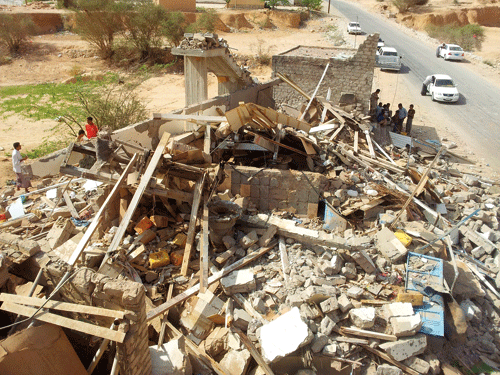
Yemen is not just a land of many problems — its sky has problems too. The receding annual rainfall from the clouds above has made way for another precipitant: missiles from remote-controlled American aircraft. The United States has been flying armed drones over Yemen since 2002, targeting Al Qaeda in the Arabian Peninsula (AQAP) and recently these strikes have increased dramatically. The Obama administration has authorized more airstrikes and drone attacks in the past two years than Bush did during his eight years in office. Far too often civilians are paying the price. In 2012 alone, US missiles killed at least 185 Yemenis in as many as 90 strikes.

Among the tactical changes of the Obama administration has been its “signature drones” policy, by which drone operators can engage targets based solely on “suspicious behavior” observed through telescopic cameras far above, rather than on hard intelligence gathered on the ground. In a country where, in remote areas, people carry guns like people in the West carry iPhones, this policy makes almost everyone a “legitimate target”. Consequently, the tragedies have increased.

US drones have killed hundreds of Yemeni men, women and children with no connection to AQAP, aid workers and even prominent leaders working at the behest of the US government in rural Yemen. American embassy cables released by Wikileaks revealed how former President Ali Abdullah Saleh had secretly offered the US political cover for the drone program, telling former Central Command General David Petraeus, “We’ll continue saying the bombs are ours, not yours.”

His successor, the current president, Abdu Rabu Mansour Hadi, has been far less discrete, publicly endorsing drone operations in late September on a visit to Washington praising their accuracy and technological advancement. Former opposition leaders, who once lambasted Saleh for allowing US drones to violate Yemen’s sovereign skies, have remained silent. Facing growing public outrage over the drone strikes, these leaders, especially from the Islah Muslim brotherhood in Yemen, are also pressuring their supporters to remain quiet as well.

President Hadi’s support for the drones has made him a darling of the US — the American ambassador said in a press conference that the US’ relationship with Hadi was even stronger than it was with Saleh and that America would be happy if he ran in the presidential elections again in 2014 — but to the average Yemeni, it makes their first freely elected president in decades look like an American puppet. Remember, a main catalyst for the uprising that overthrew Saleh was that he was accountable to Washington rather than his own people. Local opponents to Hadi are thus amassing a political, legal and moral war chest against the president.

Importantly, neither the Yemeni nor the American government has paid any type of compensation to the innocent victims of drone strikes, while AQAP has an extensive record of compensating the families of civilians inadvertently harmed during its operations. Indeed, AQAP has become an outlet for Yemenis bent on revenge after losing relatives to American missiles, making the drone program a crucial tool of AQAP’s recent recruitment drive, contrary to the loud denials of American security experts. It must be said that these “experts” rarely have a clue what is happening in Yemen given that they almost never travel beyond the perimeter of their five-star hotels in the capital, Sanaa. Were they to, they would see how many Yemenis recoil at even the words “American military” and how strong a patriarchal position Al Qaeda has built out of the drone program. It has learned that its war with America is a war of mistakes — the fewer you make, the more you win and drones are simply far more prone to mistakes than AQAP.  

In America, drones are a fascinating technology in a videogame war where US soldiers neither put themselves at risk nor feel the blood on their hands of those they kill. This has made American policy makers arrogant and overbearing when it comes to even discussing drones, an attitude that history will not treat kindly. Like the McNamara policy in Vietnam of counting enemy corpses as a metric of success, the US drone policy in Yemen will embody America’s moral erosion in our times.
 

Farea al-Muslimi is Executive’s Yemen correspondent
 

February 6, 2013 0 comments
0 FacebookTwitterPinterestEmail
The Buzz

Morning briefing: 6 Feb 2013

by Executive Staff February 6, 2013
written by Executive Staff

Economics

Lebanon needs to rethink its economic model after decades of setbacks that have affected its socio-economic stability, an International Labor Organization official said Tuesday.

More from The Daily Star


New signs of distress in Egypt's economy emerged Tuesday with the disclosure that foreign currency reserves – already at critically low levels – fell nearly 10 percent in just the last month as political turmoil flared anew on the streets.

More from Associated Press


The long frosty relations between Egypt and Iran entered a slow thaw yesterday after Mahmoud Ahmadinejad became the first Iranian president to visit Egypt since the 1979 revolution.

More from The National


Projects worth a combined $6.8bn (AED25bn) will boost solar power in the Middle East, claims the chairman of the inaugural Solar Middle East Conference, which opens in Dubai on 17 February.

More from Arabian Business


Saudi Arabia’s economy will more than treble to US$3 trillion by 2050, making it the 18th largest economy in the world, according to analyst PricewaterhouseCoopers.

More from Arabian Business


Companies

Microsoft, Marriott hotels and FedEx Express have again been rated the best companies to work for in the United Arab Emirates.

More from Executive Magazine


SANAD, a German fund for small and medium enterprises in the MENA region signed Tuesday a $20 million loan facility with Bank Audi aimed at expanding lending to small businesses in Lebanon.

More from The Daily Star


Banks in the United Arab Emirates will this year aim to repay capital placed with them at the height of the global financial crisis, with some turning to the bond market to avoid servicing expensive debt and risking a sudden “capital cliff” later on.

More from Reuters


Siemens has been awarded a $38 million contract by Qatar Steel to build a high-voltage substation at Qatar’s industrial city of Mesaieed, the German engineering conglomerate said on Tuesday.

More from Gulf Business


February 6, 2013 0 comments
0 FacebookTwitterPinterestEmail
  • 1
  • …
  • 283
  • 284
  • 285
  • 286
  • 287
  • …
  • 695

Latest Cover

About us

Since its first edition emerged on the newsstands in 1999, Executive Magazine has been dedicated to providing its readers with the most up-to-date local and regional business news. Executive is a monthly business magazine that offers readers in-depth analyses on the Lebanese world of commerce, covering all the major sectors – from banking, finance, and insurance to technology, tourism, hospitality, media, and retail.

  • Donate
  • Our Purpose
  • Contact Us

Sign up for our newsletter

    • Facebook
    • Twitter
    • Instagram
    • Linkedin
    • Youtube
    Executive Magazine
    • ISSUES
      • Current Issue
      • Past issues
    • BUSINESS
    • ECONOMICS & POLICY
    • OPINION
    • SPECIAL REPORTS
    • EXECUTIVE TALKS
    • MOVEMENTS
      • Change the image
      • Cannes lions
      • Transparency & accountability
      • ECONOMIC ROADMAP
      • Say No to Corruption
      • The Lebanon media development initiative
      • LPSN Policy Asks
      • Advocating the preservation of deposits
    • JOIN US
      • Join our movement
      • Attend our events
      • Receive updates
      • Connect with us
    • DONATE