• Donate
  • Our Purpose
  • Contact Us
Executive Magazine
  • ISSUES
    • Current Issue
    • Past issues
  • BUSINESS
  • ECONOMICS & POLICY
  • OPINION
  • SPECIAL REPORTS
  • EXECUTIVE TALKS
  • MOVEMENTS
    • Change the image
    • Cannes lions
    • Transparency & accountability
    • ECONOMIC ROADMAP
    • Say No to Corruption
    • The Lebanon media development initiative
    • LPSN Policy Asks
    • Advocating the preservation of deposits
  • JOIN US
    • Join our movement
    • Attend our events
    • Receive updates
    • Connect with us
  • DONATE
Finance

Behind SGBL’s capital raise

by Maya Sioufi January 3, 2013
written by Maya Sioufi

Several Lebanese banks, from Bank Audi to Bank of Beirut to Fransabank, raised capital last year through the issuance of preferred shares — stocks with dividends but without voting rights — and beefed up their total capital ratios. Last month, Société Générale de Banque au Liban (SGBL) became the latest Lebanese bank to issue $125 million of non-convertible preferred shares — an increase from the initial plan to issue $100 million, following oversubscription to the shares — at a 7 percent yield, redeemable after five years.

SGBL went a step further in strengthening its equity as it also raised its common equity capital by $200 million, bringing the total capital increase to $325 million. Of this $200 million common equity increase, half came from the issuance of common shares to the bank’s existing shareholders and the other half came from retained earnings, which totaled $115 million in 2012, meaning that the bulk of the profits were recapitalized. SGBL’s equity now stands at $810 million, a significant 40 percent increase from its equity prior to the capital increase.

Why now?

SGBL’s deputy general manager Georges Saghbini says the decision to raise capital was an internal one. “The motive is to consolidate the balance sheet of the bank, to contribute further in financing the Lebanese economy and to abide by [the upcoming] Basel III rules,” he says. The third Basel accord is a global regulatory framework imposing strict rules on capital adequacy for banks worldwide, to be implemented gradually starting in January 2013 and ending 2018. The Basel accords were developed in response to the financial crisis, which brought several international banks to their knees begging for government bailouts.

Higher standards

Saghbini expects that by the end of 2012, the total capital ratio of SGBL will have exceeded 10 percent, as per Banque du Liban (BDL), Lebanon’s central bank, Governor Riad Salameh’s expectations for the sector. Basel III requires banks to hold, by the end of 2018, a 7 percent common equity ratio, 8.5 percent tier 1 ratio and 10.5 percent total capital ratio. Salameh has implemented stricter rules on Lebanese banks than their international peers, demanding 8 percent common equity, 10 percent core tier 1 ratio and 12 percent total capital ratio by the end of 2015, three years ahead of international banks’ deadline. “Given our projected results and the capitalization of the results, [the ratios] should be easily reached without having to raise [additional] capital,” adds Saghbini.

While Nadim Kabbara, head of research at FFA Private Bank, is comfortable with the current equity levels of the Lebanese banking sector, he warns that “[the Lebanese banks] say they don’t have to raise additional capital to meet the requirements by 2015, but 2015 is a while from now so who knows what will happen by then.”

The stricter timeline for the implementation of Basel III accords by Lebanese banks puts pressure on the sector’s margins while the country’s internal economic situation is under stress. “Because of Lebanon’s large public debt and lots of political and security issues, [meeting the requirements ahead of schedule] will send a signal [to the international community] that we are taking additional risks into consideration and we are adopting higher standards,” says Marwan Mikhael, head of research at Blom Bank. Kabbara agrees, as he believes that “ultimately all of them (the Lebanese banks, BDL and the ministry of finance) realize that it’s in their best interest that confidence in the Lebanese banking sector remains high despite everything else that is happening in the region.”
 

January 3, 2013 0 comments
0 FacebookTwitterPinterestEmail
Economics & Policy

Salary increases alone not enough

by Georges Pierre Sassine January 3, 2013
written by Georges Pierre Sassine


The government’s proposed wage scale hike has hit a dead-end as the debate rages over how the salary increases will be funded, whether by raising taxes or other channels. However, this is not the right question to ask. The fundamental question is: How do we improve the quality of life for Lebanese citizens? 

Salary increases will not be enough to improve our purchasing power. If a public sector employee’s pay packet increases, so too will the prices of essentials from food to rent — the net improvement in living standards will be minimal. The government must focus not only on increasing income but also managing the spiraling costs of living. Yet, a solution is within the government’s reach. It will require a combination of policy initiatives that fundamentally alter the supply-demand balance within the market, increase competition and control inflation. 

For example, food prices in Lebanon have risen by more than 66 percent in the past six years and are expected to escalate further. Rising food prices are partly driven by the country’s high exposure to international food prices, as Lebanon imports more than 80 percent of the food it consumes. Part of the solution is then to reduce Lebanon’s exposure to international food markets and expand domestic agricultural production. Specific measures include incentivizing banks and the private sector to invest in Lebanon’s agriculture sector, making a strategic shift from low-profit traditional agricultural practices to more economical and less water-intensive products, and promoting bilateral and regional trade agreements to improve the competitiveness of Lebanon’s agricultural sector. 

Gasoline prices have also almost doubled in the past six years. About 22 percent of the price of gasoline is due to government taxes. These fees can be reduced if alternative sources to the treasury are ensured. Sixty-seven percent of the price of gasoline reflects the price of purchasing fuels on international markets. The government cannot control international fuel prices but it could adopt a clear public strategy of how and when to purchase so as to minimize price increases and volatility. Other measures also include reducing oil consumption by encouraging more efficient cars and fuel standards, and by developing a more efficient transport system. 

Housing and real estate prices have risen drastically in recent years, making it unaffordable for many Lebanese to live in Beirut and other large cities. Currently, 45 percent of houses in Beirut are leased under the old rent law, which is causing a shortage of land available for real estate development. The reform of the rent law in a gradual and fair way that protects lower income families could alleviate land shortages and add about 2 million cubic meters of new properties suitable for development. This would likely stabilize and decrease housing prices in the medium term.

Domestic and foreign investments have also been inflating residential and construction prices in Lebanon. The relative stability of Lebanon’s economy after the 2008 global financial crisis drove a flow of capital to lower-risk and longer-term investments in Lebanon’s real estate. This makes the regulation of real estate transaction revenues a necessity, including the revision of real estate taxes. 

Much of this investment has come from the well-lined pockets of the Gulf. One way to maintain foreign investment and control its inflationary impacts involves modifying foreign ownership laws. Following the system adopted by England, foreign ownership can be modified from a “property ownership” system to a “lease ownership system”; or by restructuring registration fees,     which distinguishes between Lebanese and foreigners.

Beirut has become one of the most expensive cities in the world, and the purchasing power of Lebanese citizens declined by about 40 percent since 2005. Debating salary increases will not suffice. The Lebanese government should develop a comprehensive vision to improve the quality of life of its citizens, including a revision of agriculture, energy, real estate and    tax policies.                       


Georges Pierre Sassine holds a master's degree in public policy from Harvard University's John F. Kennedy School of Government. He writes about Lebanon's public policy issues at www.georgessassine.com

January 3, 2013 0 comments
0 FacebookTwitterPinterestEmail
Comment

At the mercy of charity

by Moe Ali Nayel January 2, 2013
written by Moe Ali Nayel

In a corner of Hamra Street amid the daily hustle and bustle, motorists and passersby may not notice this family of four — a single mother, two girls and a boy. Um Ahmed, in her late twenties, dressed in a blue veil and a burgundy coat, sits on the sidewalk and simply waits while her three young children play around her.

“We arrived in Lebanon three months ago from the suburbs of Aleppo,” she says. “My husband remained in Syria to protect our house but told me it was best if I take the kids and flee to Lebanon. ‘There’, he said, ‘are many organizations that are taking care of Syrian refugees’, but here I am, as you see, on the street waiting for the good hearted people to offer us anything.”

Try handing her money, however, and she will not accept. Instead, Um Ahmed asks for help finding a job, one that allows her to keep her children with her.
“We are not beggars, we are refugees — harsh circumstances have brought us to this humiliation,” she says. “My husband used to work at a texile factory in the industrial city, but it closed as soon as war arrived in the area. We were told the owner had frozen his business until the war ends; we lost our only source of income. We are a respected family — we own a house in Syria and we’ll return to it once my husband tells us it’s safe. We decided to come to Lebanon because we speak the same language, we are neighbors and we didn’t want to be living in tents in Turkey.”

As it is, the four of them live just up from Hamra Street in the Aisha Bakar area, sharing a one-bedroom apartment with her sister-in-law and her two children.

“We registered with the United Nations [UN High Commission for Refugees] but they didn’t tell us what to do after taking our information. The only aid we receive is a portion of food, and hygiene products, distributed twice per month from a Lebanese organization,” she says. “This is not how we imagined it would be before we dragged our children to Lebanon — we were told once we arrived humanitarian organizations would house us, feed us and wouldn’t make us feel any different. Your country is too expensive for us.”

Innocently, Hiba, Um Ahmed’s six-year-old daughter, asks me: “Amo [Mr.], are you going to give us money?”

“Shame on you Hiba,” yells Um Ahmed.

See also: Interactive map of Syrian refugees

On a walk down Hamra Street, passing by the cafes, banks, bars and hotels, if you listen closely you will hear Syrian businessmen murmuring about their enterprises back home while they sip tea, or as they wait in line at the counter of a currency exchanger. They too, like Um Ahmed, are in stasis in Lebanon. 

Until this past summer Aleppo was the industrial hub of Syria, with hundreds of factories providing jobs for tens of thousands of laborers from the city’s outskirts. Since the summer, war has engulfed Aleppo and the factories have almost all been shuttered or destroyed, leaving these people without a job, families without an income and, like Um Ahmed, many have become refugees living at the mercy of charity, waiting to return to their homes, their lives and their livelihoods.

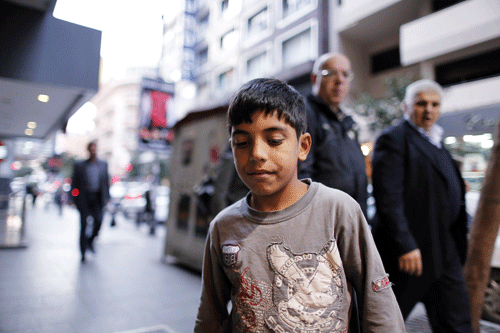
Two years ago while I was sipping an espresso on a Hamra sidewalk café, I met Khodor. Back then Khodor was six years old. He approached me selling lottery tickets, and since that time I regularly see him at the same spot pushing his wares. Khodor is from Manbij, a city not far away from Aleppo. His father had lost his job in Aleppo and decided to move with Khodor to Lebanon for work, providing an income for the family they left behind. Last month I saw Khodor again, this time with his six-year-old brother and 10-year-old cousin, both begging with a few lottery cards as a cover from the police. Khodor said his whole family and his uncles have all moved to Lebanon.

“There were bombs falling around our neighborhood in Aleppo, my father worried for our family so he brought them to Lebanon,” he said. “We found a shack next to the Cola area where we all sleep.”

And such is the life of many a poor Syrian in Hamra: marginalized, living on crumbs and humiliation, awaiting the end of the conflict so they can return home.

MOE ALI NAYEL is a freelance journalist based in Beirut

January 2, 2013 0 comments
0 FacebookTwitterPinterestEmail
Finance

Q&A – Johannes Jooste

by Maya Sioufi January 2, 2013
written by Maya Sioufi

Four years after the start of the financial crisis and the global economy is still struggling with anemic growth. The European sovereign debt crisis continues, America’s economy is being shaken by a ‘fiscal cliff’ and emerging markets, led by China, saw a slowdown in economic growth. For a forecast going into 2013, Executive sat with Johannes Jooste, head of strategy for Europe, Middle East and Africa at Merrill Lynch Wealth Management, while he visited Beirut in December. 

The global economy came under pressure in 2012; what is your global gross domestic product growth forecast for 2013?

We are slightly higher than 2012, which was worse than we thought. 2013 is going to be marginally better but that doesn’t make it particularly attractive. So the number comes out somewhere in the region of 1.3 percent for 2012, and 1.5 percent for 2013. We think that the breakdown is going to be pretty bad from the point of view of Europe, where we have got a recession for the first half, [with GDP] down 0.4 percent compared to about flat for the same period last year. So we are looking for Europe to be something of a challenge — two consecutive years of recession in Europe driven by the failure of France and Germany to decouple from the peripheral [countries]. 

How do you expect the fiscal cliff to impact the US economy? 

The worst case is [for the fiscal cliff to wipe out] 4.6 percent of GDP, something like $700 billion. The best case is something like a percent off, maybe 1.3, less than 2 percent. There are two questions — one is the size of the hit and the other is over what period does it hit the economy. And it is potentially less of a problem if they can manage to smooth it out — even if there is a hit. But it is significant and it is going to be something that plays on markets as we go into January.

Our base case is something of a fudge, a compromise that is not one that leads to a long-term solution. In the long run there is the entitlement problem and the budget constraints in the US, which aren’t really going to be solved by just a short-term interim ‘deal with it later’ type of solution. The best case is they do grab hold of it properly and deal with all the entitlements and do what they have to do, but we don’t really see that as something that is going to happen [in the near term].

In what regions do you expect to see the most solid economic growth in 2013? 

From a purely growth perspective, emerging markets is the place to be, and particularly Asia. China remains the driver and we think it has bottomed and the rest of the region will follow suit. With the US the one potential positive joker in the pack is how strong the housing market might prove to be; it surprised us [positively] this year. If that keeps going we will probably be wrong with [our GDP growth forecast of] 1.5 percent and it could come up closer to 2 percent. That is a potential swing factor.

Obviously there are swing factors on the other side, the fiscal cliff. For Europe to surprise us on the upside, they really are going to have to make haste with their program which at the moment we don’t see [happening].  

So you don’t believe 2013 will see a long-term solution to the European crisis?

No, a long-term solution will not appear in 2013. We see progress towards it; we don’t think they have incentives to go backwards, we think they understand — to the extent that you can guess what politicians think — the seriousness of the situation. 

Given your economic forecasts for 2013, what asset classes and what regions do you favor from an investment perspective?

The main theme is to avoid government bonds of developed countries such as Germany, France, the UK and the US. If you are going to stay within fixed income, go for the high risk: we prefer high yield to high grade and we prefer emerging market debt. If you are taking a long-term view, anything more than a year out to five to 10 years, we think the outlook for equities is distinctly favorable relative to fixed income. We would suggest using the weakness of the equity market [through] themes such as following the emerging market block for growth. We think European stocks are cheap. So we are probably going to end up being somewhat light on US equities. 

How about your economic forecasts for the Middle East?

It is even less straightforward to predict anything there. There is an unfortunate coincidence between the incidents in the Middle East and the global risk aversion going on. If investors are skittish already, the last thing they need is something in the oil-producing regions to make them even more nervous. And that is what is happening. Where there has been even a semblance of domestic stability such as in the Gulf countries, property markets are stabilizing and domestic demand is okay. The problem is more external demand. Foreign investors are very much taking a wait and see approach to the ‘Arab Spring’ countries. It has been about two years that net flows into equity markets have been effectively flat.

What are your expectations for the oil prices and how will that affect the region?

We think the oil price is well supported thanks to emerging-market demand. We are loath to give a specific level but we certainly don’t think it will come down from its current level by this time next year. You have got net exporters where it does help a huge amount, in the GCC for example. But there are a couple of countries, and Lebanon is possibly one of them, where that could be a bit of a squeeze. If there is a squeeze and it goes up quickly then that is globally a very bad thing. We are looking for more of a benign [rise].

Will it be another tough year for Lebanon?

For a few countries out there I think the dynamic is not dissimilar [to Lebanon’s] budgets and terms of trade issues. Lebanon is one of those [countries] that will face these issues, especially in the first half [of 2013] given the element of European dependence. ‘Arab Spring’ countries are not totally dissimilar given the proximity and the trade links to Europe. Lebanon has a short-term cyclical problem, Europe has a long-term structural problem. Cycles you can cope with easily whereas the long-term structure is a big deal. 

January 2, 2013 0 comments
0 FacebookTwitterPinterestEmail
Economics & Policy

Government’s failing grade

by Nabila Rahhal January 2, 2013
written by Nabila Rahhal

Since the beginning of the academic year, public school teachers, and many from private schools too, have abandoned their classes on an almost weekly basis and taken to the streets. The reason? They are demanding that the Council of Ministers, Lebanon’s cabinet, stop stalling and honor its promise to refer the new salary scale draft law to the parliament. At first glance this dispute may seem straightforward — in reality, the wide array of interests and possible impacts at play make for a class in politics and economic algebra all on their own.  

Principles of protest

Teachers striking for better wages has become a near annual occurrence in Lebanon, and, mainly due to their unified and organized front, their protests have met with some limited success. However, with the relentlessly rising cost of living eroding away these gains, it is never too long before the teachers head back to the streets. 

“Do you know that a teacher working full time for 20 years ends up, by law, with a basic salary of only $1,333 [per month]?!” said May Hamadeh, a private school teacher at a protest in October. “Many schools of course do pay you more than that, but when the law itself does not respect the teaching profession, it makes us teachers feel angry and reflects on our teaching and students.”

In September, with public school teachers threatening to leave students’ official examinations uncorrected, the cabinet agreed to a draft law approving a new and improved salary scale for all public sector employees, including public school teachers; private school teachers are also affected as their salaries are built on a similar pay scale. Since then, however, the cabinet has delayed referring the draft law to the parliament. The teachers have continued to take their anger to the streets and it is the students who have been caught in the middle — though teacher’s unions have promised they will make up for time lost striking. “I like it when we don’t have school because I get to sleep in but I don’t want to start coming on Saturdays or during vacations to make up for the lessons lost while our teachers were off,” says Rabih, a fourth grader at one of Ras Beirut’s public schools. “It’s not my fault… so why should I pay the price?"

See also: Lebanon's latest strike misses the point

A class in ineptitude

The cabinet’s reason to delay implementing the salary hike is that they simply don’t have the money to pay for the estimated $1.5 billion annual increase in wages for the 180,000 public sector employees affected by the law. “We cannot pay the salary increases all at once and we cannot approve the salary scale draft and send it to Parliament without revenues,” said Prime Minister Najib Mikati in a recent press conference at the Grand Serail. “The teacher unions are demanding that the draft be sent to Parliament without ensuring revenues and new taxes which is not realistic.”  

Government proposals for raising funds include increasing taxes on luxury items and customer deposits at banks, and to perhaps pay the wage increases in increments of four to five years; the government insists it will not raise taxes in a manner that will affect limited income families. 

The teachers’ unions have rejected the installments proposal, as it was not part of the agreement they had reached during meetings with the ministerial committees. The union insists that the government can pay the increases if they just cut down on excess spending, fought corruption and improved tax collection, especially from the Beirut Port. However, the central bank and private-sector economic associations have warned the government of the negative impact adopting this law would have on Lebanon’s already struggling economy. By adopting such a costly and contentious law without having thought through how it would be funded, the cabinet has caught itself between a rock and a hard place, with no escape in sight. 

Private vs public school impacts

Many private school directors have been watching this battle apprehensively, fearing the impact such a law would have on their schools’ budgets. “There are around 15 big private schools in the country that will not be affected by this law because they already have a high number of students, and because they cater to a caliber of parents who will not notice if their child’s tuition goes up a little bit more than usual,” notes Maurice Dabaghi, principal of Marjeyoun National college, explaining that even though the law will not impact all private schools equally, the government is acting as if it would. “Consideration should be given to the community the school is serving, as salaries and conditions in Beirut differ from those in remote areas of the country,” continues Dabaghi. 

Those big schools aside, the majority of privately owned schools in the country do indeed cater to students of middle income families who might be tempted to change schools should tuitions spike up significantly. “This year, I removed my eldest child from a private school here [in Marjeyoun] and enrolled him in the public school because we can’t afford the tuition for all three of my children — if tuitions increase again next year, I will have to put all my children in the public school,” complained Maha, one of the many indignant parents wondering what they might have to do with their children if the law passes. Knowing that tuition is a major consideration for many parents when picking a school for their child, this law has the potential to create an unhealthy situation where schools lower their tuition fees to compete with other schools, at the expense of quality education.      

How children will suffer

“The impact on schools can be measured by the ratio of students to teachers in each class,” explains Paul Owiess, principal of the National Evangelical School in Kfershima. “If a school has more than 40 students in each class, which some schools do, then the teacher’s salary can easily be paid from these students’ tuition. However, if you are a school that cares about the quality of education you are providing, [by having] no more than 20 students in each class, then this law will negatively impact you.”  

Those schools that don’t want to increase tuition might consider other ways of cutting costs, such as firing their longest serving — and therefore most highly paid — staff, but this might leave them vulnerable to lawsuits by those teachers. Instead, Owiess says that between a choice of two candidates, schools might start choosing the one with less years of service due to her lower salary rights, though the other might be better qualified. An equally undesirable way of cutting costs to help fund the increased salaries is halting all extracurricular activities, and only teaching core topics. 

As the fate of the law is kicked around from pillar to post it creates a pervading sense of insecurity for both school administrations and the teachers. It is of course the education of the students that suffers the most. The cabinet has made a mess of the whole process by trying to bungle through an ill-considered law. That cannot be changed, but it means they must now work with all the involved parties to find a solution so teachers and management can get on with the business of educating Lebanon’s youth. 

January 2, 2013 0 comments
0 FacebookTwitterPinterestEmail
Editorial

A better Lebanon

by Yasser Akkaoui January 1, 2013
written by Yasser Akkaoui

With many bitter moments from 2012 still lingering in our minds, it is time for sober reflection and realistic objectives to guide us in making resolutions for the New Year. While we want ‘realistic’ targets for 2013, it is hard not to feel that we are stumbling out of the starting gate.

For many of us, while we still love our country, it simply doesn’t seem to make sense any more. Since 2006 there has been a steady erosion in the belief that things can or will get better. When people believe that the quality of life in the place they live will only get worse — that their country will not offer them the opportunity to fulfill their goals any time soon — they inevitably leave in search of greener pastures.

It will not be easy, but what we really need to see in 2013 is some form of progress in Lebanon. It would be folly to demand the entirety of our politics and society to be reordered in the next 12 months, but give us something. Electricity all day long, water in our tanks throughout the year, Internet we can stream whole videos over, streams, beaches and nature areas unlittered with garbage — just give us something in Lebanon we can point to and say “this is better today than it was yesterday.”

Even if it is a long-term plan — such as a railway along the coast to alleviate rush-hour traffic, or a blueprint to remove the mountains of garbage blowing stench throughout our streets and into our living rooms — as long as there is implementation of a sensible, rational and achievable plan, then we have something to look forward to.

One good thing about the state of this country is there is no lack of opportunity for our policy makers to improve the situation — just do something. Perhaps there might even be politicians that step forward in the elections this year that offer us a choice of policy platforms, rather than the option of choosing our representatives based on their allegiance to Saudi Arabia, Iran or otherwise.

To extend the trends of 2012 into 2013 and maintain the status quo is to regress further. A message to our government for the New Year: give us reason to believe a better Lebanon is possible.

January 1, 2013 0 comments
0 FacebookTwitterPinterestEmail
Real Estate

Constructing the high life

by Sam Tarling January 1, 2013
written by Sam Tarling
In the shadow of Beirut's most famous building - the Rafik Hariri Mosque - the foundations for the high-rise, high-cost Plus Towers are being laid [Photo: Executive/Sam Tarling]
Executive was given exclusive access to explore the huge building site that will eventually become some of the country's most sought-after real estate [Photo: Executive/Sam Tarling]
A foreman and a laborer discuss the work. The site will eventually host two towers, both with a mixture of commercial and residential properties [Photo: Executive/Sam Tarling]
[Photo: Executive/Sam Tarling]
[Photo: Executive/Sam Tarling]
[Photo: Executive/Sam Tarling]
[Photo: Executive/Sam Tarling]
[Photo: Executive/Sam Tarling]
[Photo: Executive/Sam Tarling]
It is due to be completed in 2014, though the company would not say at what time during the year. Photo: Executive/Sam Tarling]

In the shadow of Beirut’s most famous building – the Rafik Hariri Mosque – the foundations for the high-rise, high-cost Plus Towers are being laid


January 1, 2013 0 comments
0 FacebookTwitterPinterestEmail
Comment

Adapting to democracy

by Eileen Byrne December 31, 2012
written by Eileen Byrne

Tunisia’s coalition government, its first to emerge from free and fair elections, has been on a steep learning curve through its first year in office. In the October 2011 vote for a constituent assembly, the Islamists of the Nahda (‘Renaissance’) party reaped the gains of their unflinching opposition to the deposed regime of Zine al-Abidine Ben Ali, but the credit this brought them is wearing thin as economic recovery lags. In the parliamentary and presidential elections planned for 2013, Nahda will struggle to repeat its resounding success of last year.

The party has had to adapt rapidly to operating in a democracy, and the Tunisian media, much of which remains in the same hands as before the revolution, has been eager to jump on its mistakes. One such mistake was Nahda leader Rachid Ghannouchi’s failure to put enough clear blue sky between his party and the extreme conservatism of certain radical Salafist preachers. 

Salafists have emerged as key drivers in a change in the climate for freedom of expression that troubles many non-religious Tunisians. On three occasions, starting with marches against a screening of the film Persepolis just before the 2011 election, Salafist activists were able to swing a surprisingly broad swathe of public opinion behind their stance that Islam was under attack and needed to be defended. Salafist preacher Abou Iyadh, leader of Tunisia’s own Ansar Ash-Sharia group, has attempted to exercise leverage outside party politics. Other Salafists have formed parties to present candidates in next year’s elections. Nahda hopes the elections will reveal that their true level of support is less than some media coverage has suggested. 

A turning point came in September, when a demonstration headed by Salafists degenerated into chaos and arson at the United States embassy, with four demonstrators killed. The damage inflicted on relations with the US was considerable but not irreparable. Washington is a leading backer of the project for a democratic and prosperous Tunisia; the Obama administration is betting that Tunisia can prove a success story to inspire other Arab countries. With Europe — Tunisia’s main export market and source of job-generating investment — wracked by crisis, outside financial aid will continue to be key to underpinning stability through 2013.

Nahda politicians have pledged a tightening of security, emphasizing that this will not be at the expense of fair trials and civil liberties for all Tunisians, including Salafists. Guaranteeing those rights will not be easy, with the country’s security services and judicial system still in upheaval, having been the main instruments of repression under Ben Ali. Two young men, who were detained after September’s demonstration at the US embassy, died in November after a two-month hungerstrike protesting their innocence and demanding to be set free.

Constituent assembly members have honed their political skills in the same parliamentary chamber once occupied by Ben Ali’s yes-men. The Islamist party has shown a willingness to compromise over the draft constitution, accepting a system in which a directly elected president will have certain executive powers. Nahda would have preferred executive powers concentrated in the office of prime minister.

The mooted June 30 date for the 2013 election may slip toward the autumn, as a new electoral commission is put in place to supervise a closely-fought vote. Nahda will seek to hold together its fragile alliance with the center-left Congress for the Republic and the Ettakatol party, which reassures both domestic and international audiences. Its main challenger will be a new party, Nida Tounes (‘Tunisian Call’), headed by last year’s interim prime minister, the 86-year-old Beji Caid Sebsi. Claiming to have “technocratic” expertise, Nida Tounes will seek to build an anti-Islamist bloc that includes figures who worked with Ben Ali but who are regarded as having avoided major corruption scandals. Chronic unemployment in the western and southern regions will, through next year, weigh heavily on the hopes and dreams of the younger generation. The grumble that “nothing has changed” will still be heard. 

Whatever government is in power will struggle to keep a lid on tensions, especially when these are stoked by political opponents. Both old and new political elites have, however, repeatedly deployed the language of “consensus-building” to bring the country back from the brink. The much-heralded process of transitional justice, addressing rights abuses of past decades, will proceed cautiously, and there may still be a certain lack of clarity on prosecutions for corruption.

Eileen Byrne reports from Tunis for the London-based Guardian and The Sunday Times


December 31, 2012 0 comments
0 FacebookTwitterPinterestEmail
Insurance

Walid Genadry

by Thomas Schellen December 25, 2012
written by Thomas Schellen

The task of insurance sector supervision in Lebanon is the domain of the Insurance Control Commission, a body attached to the Ministry of Economy and Trade. The ICC team is headed by Walid Genadry. In a chat with Executive, he spoke about some of his experiences and ambitions for the sector.

  • Has Lebanon seen major developments in insurance supervision in 2012?

If something has moved, it is subtle. It is background work and 2012 was a year that was rather dull for the insurance sector in Lebanon. We are a small team in insurance supervision and what I see is that the rate of controls has increased markedly. There have been competence developments and people are in high gear on a number of issues despite the impediments on the legal side.

  • How do you measure the performance and development of the ICC team?

It is the understanding and the speed at which they do things. I have signed between 200 and 250 letters back to the sector since we received the annual reports from companies in May/June. These letters were based on the findings of the team and constituted an unprecedented number of messages where we either asked companies to correct an inadequate financial situation, to correct statements in their financial reporting or, because from our analysis we could not be sure of the viability of their information, asked them to send us the proper information.

  • Can you specify issues that rank high on your agenda for 2013?

We are trying to nail down the issue of compulsory car insurance. It is about time that something gets done. The solution is partly technical and partly related to regulating market conduct. This part needs the help of the politicians.

  • Does your plan pertain to compulsory insurance of material damages?

No, to the present compulsory [insurance], which covers bodily injury. To my mind we must not introduce the material damages compulsory car insurance if the existing problems on the level of liability for bodily injuries are not solved.

  • What problems are we talking about? Issues related to the amounts of indemnities that were awarded?

You had several problems. Policies were not sold at the official price which led to cash underwriting and a monopoly of some [providers] and there were and are problems with lack of payment of claims. At some point there was cheating on the official vignettes with people escaping from taxation and reserving.

  • Doesn’t the new traffic safety law imply that mandatory coverage of motorists for material damages will be introduced?

Hopefully the new traffic safety law will help move things forward. It has a measure on compulsory insurance for material damages. This will not be automatic because the introduction of this compulsory line remains under the authority of the Ministry of Economy and Trade. But the new law will increase the pressure for this to be applied. So if we make sure that the problems with the present compulsory car insurance are solved, it will be easier to expand it to coverage of material damages.

You mentioned the data provided by insurance companies to the ICC. Has the quality of their financial reporting improved over the years?

It has been improving if I look at the last 10 years but we still spend a non-negligible amount of time and energy correcting what we receive. It is sad that companies still make mistakes on information they should be masters in.

  • But isn’t it true that it can be to their own detriment if companies do not know their financial data perfectly?

That is right, because a number of those errors are not intentional. In principle the data we need is the same data that the general manager of the company needs. We detect problems in their financials and that is not supposed to happen. Our objective is not to correct data. It is just to see if a company is healthy or not. If it is healthy, we leave it alone. But the general manager needs to know whether the company is healthy or not in order to steer it. So it is surprising that we still have a level of data quality that can be improved.

  • Last year the Arab Forum of Insurance Regulatory Commissions (AFIRC) met in Beirut to discuss greater collaboration. Has much happened since the 2011 meet?

AFIRC is a gathering of supervisors. We are working seriously but at the pace that we are capable of taking. We have a strategy that was developed in collaboration with [consulting firm] Booz & Co and it proposed about 18 initiatives. We had a quite intensive discussion for a year and a half and finally decided that we could not go as quickly as the strategy wanted. We have selected about one third of those initiatives for the next five years.

  • That means six initiatives? What are they focused on?

We are working on three long-term ones and three short-term ones. The direction that we are taking includes things like training of supervisors and self-assessment of supervisory authorities.  We also have a metrics project with the assistance of [professional services and accounting firm] PricewaterhouseCoopers where we are trying to put regional statistics together. We have had a training certificate developed by the Bahrain Institute of Banking and Finance.

  • How much demand from countries in the Middle East and North Africa region is there for competency building in insurance supervision?

We need a lot of competency building of supervisors in the MENA region. What I see is that you have a catch-22 problem in the sense that the more you need, the less you can absorb. Development takes time. Anything related to education and competence development is a slow process at best.

When you train a supervisor, you may not be in the optimal context. You may not be independent or have an independent budget. You don’t have mentors and you have difficulty  absorbing knowledge because you have to do your work on top of it. For a smart person it takes a lot of time to start mastering [supervision]: understanding, sniffing and catching mistakes. That is our role. If the referee doesn’t catch mistakes, he has a problem. So yes, we need a lot of training, and no, we are not advancing as quickly as we want but this is partly structural, and probably the lot of most developing jurisdictions.

  • Would your work be easier if the ICC was a standalone entity and not attached to a ministry?

Ideally, yes, and I insist on ideally because who gives you the independence? In order for independence, which is desirable, to be effective, it is first necessary that the politicians accept the idea sincerely. If they don’t, it is a worse solution than being attached to a ministry. When the minister respects you, he is in a position of defending you so that you can do your work.

  • Where do you position yourself as a person in carrying out your role as supervisor of the sector and leader of the ICC; are you an eternal optimist, a worrier, a motivator or a detached analyst?

I would say I am pragmatically passionate. Concretely, I believe in what I am doing.

  • So you don’t worry every night about the future of Lebanese insurance?

There is a cause to worry every night, but I do accept that reality has its place.

You said that perhaps the greatest compliment people gave you was in saying that you have done a lot with what legal tools you have at your disposal as supervisor. What is your message in that?

That people agree to the need for a new law. Some of the work you do goes by power of common sense and a certain moral authority. But moral authority has its limits and you need the power of the law. Let me put it in a very concrete way: I cannot in any way influence the implementation of governance. There is 0.000 percent possibility to introduce anything related to corporate governance with the present law, not even in an indirect way. I can do some improvements to market conduct because I am supposed to protect policy holders and even then it is not enough, but I can in no way establish a modern solvency system.

December 25, 2012 0 comments
0 FacebookTwitterPinterestEmail
Editorial

Hope, despite ourselves

by Yasser Akkaoui December 25, 2012
written by Yasser Akkaoui

The Lebanese were not shy to give voice to their discontent in 2012.

The grievances underlying these manifestations of public discontent were clear: declining purchasing power, the decrepit state of the country’s infrastructure and public institutions, and the seemingly inherent instability and criminality in the country.

Teachers and public sector workers chanted in the streets demanding a proper living wage, taxi and bus drivers blocked roads and major intersections decrying the cost of fuel, while protests struck both ends of the electricity network with customers outraged at the frequent blackouts and workers storming Électricité du Liban offices demanding fair pay and labor rights. Then there were the burning tires, the kidnappings, the protests against kidnappings, retaliatory kidnappings, and farmers and their families blocking the security services from eradicating cannabis crops.    

And that’s all aside from recurring armed clashes in Tripoli, along the borders and elsewhere; a brutal assassination; a sinking economy and soaring inflation; refugees flooding in from a civil war next door; a decimated  tourism season with its wide impact across business sectors, and increased international pressure on Lebanese banks from the United States, among a litany of other crises. In tandem, our entire political class — both government and opposition — utterly lost whatever moral authority to lead they had left, showing themselves corrupt to the core and inelastic to change.

Had we a crystal ball in January and known all this was in the pipe for the 12 months that were to come, we might have thrown up our hands and booked tickets abroad while writing Lebanon’s last will and testament.

And yet, here we still are. Lebanon persists. Lebanon survives. Because that is what the Lebanese do. And how? Because despite ourselves, despite the pain and the complaints, hope lives in our DNA. Even while businesses were closing this year, others were opening; the entrepreneurial space grew like at no other time in recent memory; developers continued to build around the country, not to sell tomorrow, but the day after — the better day they all say they see coming.

Next year will obviously have its challenges, but avenues are opening for potential progress — the new Capital Markets Authority, the public-private partnership law, maybe even a railroad up the coast.

And then there are the elections. Will the Lebanese finally give voice to their discontent at the ballot box? I’d like to be optimistic.  

December 25, 2012 0 comments
0 FacebookTwitterPinterestEmail
  • 1
  • …
  • 290
  • 291
  • 292
  • 293
  • 294
  • …
  • 683

Latest Cover

About us

Since its first edition emerged on the newsstands in 1999, Executive Magazine has been dedicated to providing its readers with the most up-to-date local and regional business news. Executive is a monthly business magazine that offers readers in-depth analyses on the Lebanese world of commerce, covering all the major sectors – from banking, finance, and insurance to technology, tourism, hospitality, media, and retail.

  • Donate
  • Our Purpose
  • Contact Us

Sign up for our newsletter

    • Facebook
    • Twitter
    • Instagram
    • Linkedin
    • Youtube
    Executive Magazine
    • ISSUES
      • Current Issue
      • Past issues
    • BUSINESS
    • ECONOMICS & POLICY
    • OPINION
    • SPECIAL REPORTS
    • EXECUTIVE TALKS
    • MOVEMENTS
      • Change the image
      • Cannes lions
      • Transparency & accountability
      • ECONOMIC ROADMAP
      • Say No to Corruption
      • The Lebanon media development initiative
      • LPSN Policy Asks
      • Advocating the preservation of deposits
    • JOIN US
      • Join our movement
      • Attend our events
      • Receive updates
      • Connect with us
    • DONATE