• Donate
  • Our Purpose
  • Contact Us
Executive Magazine
  • ISSUES
    • Current Issue
    • Past issues
  • BUSINESS
  • ECONOMICS & POLICY
  • OPINION
  • SPECIAL REPORTS
  • EXECUTIVE TALKS
  • MOVEMENTS
    • Change the image
    • Cannes lions
    • Transparency & accountability
    • ECONOMIC ROADMAP
    • Say No to Corruption
    • The Lebanon media development initiative
    • LPSN Policy Asks
    • Advocating the preservation of deposits
  • JOIN US
    • Join our movement
    • Attend our events
    • Receive updates
    • Connect with us
  • DONATE
Finance

Behind SGBL’s capital raise

by Maya Sioufi January 3, 2013
written by Maya Sioufi

Several Lebanese banks, from Bank Audi to Bank of Beirut to Fransabank, raised capital last year through the issuance of preferred shares — stocks with dividends but without voting rights — and beefed up their total capital ratios. Last month, Société Générale de Banque au Liban (SGBL) became the latest Lebanese bank to issue $125 million of non-convertible preferred shares — an increase from the initial plan to issue $100 million, following oversubscription to the shares — at a 7 percent yield, redeemable after five years.

SGBL went a step further in strengthening its equity as it also raised its common equity capital by $200 million, bringing the total capital increase to $325 million. Of this $200 million common equity increase, half came from the issuance of common shares to the bank’s existing shareholders and the other half came from retained earnings, which totaled $115 million in 2012, meaning that the bulk of the profits were recapitalized. SGBL’s equity now stands at $810 million, a significant 40 percent increase from its equity prior to the capital increase.

Why now?

SGBL’s deputy general manager Georges Saghbini says the decision to raise capital was an internal one. “The motive is to consolidate the balance sheet of the bank, to contribute further in financing the Lebanese economy and to abide by [the upcoming] Basel III rules,” he says. The third Basel accord is a global regulatory framework imposing strict rules on capital adequacy for banks worldwide, to be implemented gradually starting in January 2013 and ending 2018. The Basel accords were developed in response to the financial crisis, which brought several international banks to their knees begging for government bailouts.

Higher standards

Saghbini expects that by the end of 2012, the total capital ratio of SGBL will have exceeded 10 percent, as per Banque du Liban (BDL), Lebanon’s central bank, Governor Riad Salameh’s expectations for the sector. Basel III requires banks to hold, by the end of 2018, a 7 percent common equity ratio, 8.5 percent tier 1 ratio and 10.5 percent total capital ratio. Salameh has implemented stricter rules on Lebanese banks than their international peers, demanding 8 percent common equity, 10 percent core tier 1 ratio and 12 percent total capital ratio by the end of 2015, three years ahead of international banks’ deadline. “Given our projected results and the capitalization of the results, [the ratios] should be easily reached without having to raise [additional] capital,” adds Saghbini.

While Nadim Kabbara, head of research at FFA Private Bank, is comfortable with the current equity levels of the Lebanese banking sector, he warns that “[the Lebanese banks] say they don’t have to raise additional capital to meet the requirements by 2015, but 2015 is a while from now so who knows what will happen by then.”

The stricter timeline for the implementation of Basel III accords by Lebanese banks puts pressure on the sector’s margins while the country’s internal economic situation is under stress. “Because of Lebanon’s large public debt and lots of political and security issues, [meeting the requirements ahead of schedule] will send a signal [to the international community] that we are taking additional risks into consideration and we are adopting higher standards,” says Marwan Mikhael, head of research at Blom Bank. Kabbara agrees, as he believes that “ultimately all of them (the Lebanese banks, BDL and the ministry of finance) realize that it’s in their best interest that confidence in the Lebanese banking sector remains high despite everything else that is happening in the region.”
 

January 3, 2013 0 comments
0 FacebookTwitterPinterestEmail
Economics & Policy

Salary increases alone not enough

by Georges Pierre Sassine January 3, 2013
written by Georges Pierre Sassine


The government’s proposed wage scale hike has hit a dead-end as the debate rages over how the salary increases will be funded, whether by raising taxes or other channels. However, this is not the right question to ask. The fundamental question is: How do we improve the quality of life for Lebanese citizens? 

Salary increases will not be enough to improve our purchasing power. If a public sector employee’s pay packet increases, so too will the prices of essentials from food to rent — the net improvement in living standards will be minimal. The government must focus not only on increasing income but also managing the spiraling costs of living. Yet, a solution is within the government’s reach. It will require a combination of policy initiatives that fundamentally alter the supply-demand balance within the market, increase competition and control inflation. 

For example, food prices in Lebanon have risen by more than 66 percent in the past six years and are expected to escalate further. Rising food prices are partly driven by the country’s high exposure to international food prices, as Lebanon imports more than 80 percent of the food it consumes. Part of the solution is then to reduce Lebanon’s exposure to international food markets and expand domestic agricultural production. Specific measures include incentivizing banks and the private sector to invest in Lebanon’s agriculture sector, making a strategic shift from low-profit traditional agricultural practices to more economical and less water-intensive products, and promoting bilateral and regional trade agreements to improve the competitiveness of Lebanon’s agricultural sector. 

Gasoline prices have also almost doubled in the past six years. About 22 percent of the price of gasoline is due to government taxes. These fees can be reduced if alternative sources to the treasury are ensured. Sixty-seven percent of the price of gasoline reflects the price of purchasing fuels on international markets. The government cannot control international fuel prices but it could adopt a clear public strategy of how and when to purchase so as to minimize price increases and volatility. Other measures also include reducing oil consumption by encouraging more efficient cars and fuel standards, and by developing a more efficient transport system. 

Housing and real estate prices have risen drastically in recent years, making it unaffordable for many Lebanese to live in Beirut and other large cities. Currently, 45 percent of houses in Beirut are leased under the old rent law, which is causing a shortage of land available for real estate development. The reform of the rent law in a gradual and fair way that protects lower income families could alleviate land shortages and add about 2 million cubic meters of new properties suitable for development. This would likely stabilize and decrease housing prices in the medium term.

Domestic and foreign investments have also been inflating residential and construction prices in Lebanon. The relative stability of Lebanon’s economy after the 2008 global financial crisis drove a flow of capital to lower-risk and longer-term investments in Lebanon’s real estate. This makes the regulation of real estate transaction revenues a necessity, including the revision of real estate taxes. 

Much of this investment has come from the well-lined pockets of the Gulf. One way to maintain foreign investment and control its inflationary impacts involves modifying foreign ownership laws. Following the system adopted by England, foreign ownership can be modified from a “property ownership” system to a “lease ownership system”; or by restructuring registration fees,     which distinguishes between Lebanese and foreigners.

Beirut has become one of the most expensive cities in the world, and the purchasing power of Lebanese citizens declined by about 40 percent since 2005. Debating salary increases will not suffice. The Lebanese government should develop a comprehensive vision to improve the quality of life of its citizens, including a revision of agriculture, energy, real estate and    tax policies.                       


Georges Pierre Sassine holds a master's degree in public policy from Harvard University's John F. Kennedy School of Government. He writes about Lebanon's public policy issues at www.georgessassine.com

January 3, 2013 0 comments
0 FacebookTwitterPinterestEmail
Business

More space to work

by Maya Sioufi January 3, 2013
written by Maya Sioufi

Say you are an entrepreneur and you need a space to work, but want to avoid hassles such as finding a usable Internet provider, ensuring uninterrupted electricity, and the like, while you also want a place to share thoughts and insight with other entrepreneurs — where should you go? Well, the options have been growing recently, and Executive investigates a few of the spaces on the menu.  

I’m on Cloud 5

The most recent addition comes from the abundant stock of vacant space held by Solidere, Lebanon’s mammoth real estate developer. Right smack in the middle of downtown, close to Star Square, Solidere is offering a 500 square meters (sqm) space, dubbed Cloud 5 — as it is located on the fifth floor — which is intended to fit up to 60 entrepreneurs from the Information, Communication and Technology (ICT) sector. At a rental cost of $300 a month, an entrepreneur renting in Cloud 5 gets access to 24/7 security — it is Solidere after all — and to unlimited fiber optic Internet. 

“The whole of Solidere is wired with redundancies so if something happens to one wire, it switches to another,” says Richard Azoury, director of business development at Solidere. This attractive value proposition has lured a number of entrepreneurs jumping on board. Wamda, a platform for entrepreneurs in the Middle East and North Africa region, is moving its offices to Cloud 5 this month by renting space for up to nine people. Vinelab, a digital entertainment startup, has hired space for five entrepreneurs and aims to add another seven within six months. The third startup on board is Procomix, a Lebanese startup that assists businesses in their Information Technology decisions. 

Cloud 5’s aim is to become the venue not just for Lebanese entrepreneurs but for regional ones too. Management is currently in talks with Amman-based business accelerator Oasis500 and Cairo-based accelerator Flat6Labs to have their startups take up space in Beirut’s downtown. Cloud 5 is not positioning itself to compete with the accelerators and incubators, but rather aims to build on their efforts and provide their graduated startups with a location to work out of efficiently. “Whatever [Beirut-based accelerator] Seeqnce needs to be here, we will help them get and whatever Oasis500 needs, we will help them get,” adds Azoury. “We want them to bring their startups here. That’s the ultimate plan. They are the ones who are in this business, we are in the real estate business.”

He says that eventually Cloud 5 plans to extend its services and provide, by the middle of 2013, an auditorium for everything from ‘boot camps’ to investor days, located on the 300 sqm fourth floor, as well as a public café for entrepreneurs to mingle and share thoughts and ideas. 

AltCity

A café, boot camps, investor days, big spaces, mingling and sharing ideas — these things are all on AltCity’s agenda too. Having set up shop in Hamra in the summer of 2011, AltCity was closed for renovation for several months before it started hosting activities and making noise in the entrepreneurial world last year. 

With a 600 sqm space with an industrial feel, it currently has capacity for just 11 entrepreneurs — and was at full capacity as last year ended — but once work on the space is completed, slated to be in a couple of months, it could host up to 50 entrepreneurs. The center targets different sectors whereas its neighbor accelerator Seeqnce, located a few blocks away, focuses specifically on mobile and web sectors. 

For $250 per month, an entrepreneur can rent a desk, get access to unlimited Internet — albeit not fiber optic — and other perks, such as discounts to AltCity events, which include weekly brunches, workshops and less formal fish and chips pub quizzes. 

AltCity is not relying solely on rental fees for revenues, with several events organized last year, many more on its agenda for the upcoming year and a café to be launched this month. “We are thinking of an energetic, viable and engaging space for when things are good, and for when they are difficult in Lebanon,” says David Nabti, the “mayor” of AltCity, also known as its ‘chief entrepreneur and organizer’. 

Increasing revenues has moved up on their priority list after an attempt to raise $25,000 through crowd funding failed and a Kafalat-guaranteed loan was put on hold by the banks, following the bombing in Ashrafieh in October 2012. It was a loan of a “modest amount”, says Nabti, but banks were reluctant as they put on hold all funding related to restaurants and cafes. “We tried to explain [that the café] is just part of our revenue stream but they are hesitant; the concept is new to Lebanon.”  With banks still hesitant, Beirut-based private equity firm Middle East Venture Partners (MEVP) is supporting the space and has put in “some funds” says Nabti. While the relationship is still informal for now, MEVP “might invest [in AltCity startups] a few years down the road,” adds Nabti. 

Nabti does not consider that the space is in competition with Seeqnce or any other entrepreneurial space. “We want to engage Seeqnce and Berytech in doing stuff here; one of our core beliefs is around ‘coopetition’ [cooperative competition],” he says. “We need three Seeqnces, three AltCities, three MEVPs, three Berytech funds… we need more of this stuff.” 

Beirut Digital District

Also available to entrepreneurs is the Beirut Digital District, an ambitious project located in Bachoura near Martyr Square, which was launched in September 2012 with entrepreneurs expected to start moving into the fiber-optic wired and 4G-enabled district this month. “What could we do to create jobs in Lebanon? That’s how the idea to launch the district started,” says Karim Kobeissi, a lawyer, adviser to the Minister of Telecommunications and a leading figure behind the project. 

The Ministry of Telecommunications, the Lebanese incubator Berytech and property developer Zein Real Estate (ZRE) run the project jointly. The ministry — which will not be deploying “a single penny” according to Kobeissi — is guaranteeing the fiber optic infrastructure and promoting the district. ZRE has been mandated by the ministry to develop the area, made up of several land plots and totaling around 15,000 sqms. “We have an understanding with ZRE that it will build by December 2016 around 40,000 to 45,000 sqms of built up area,” says Kobeissi. At an expected cost of $800 to $1,000 per sqm, Kobeissi expects that the project will cost ZRE a maximum of $40 million and that it will host around 4,000 workers by 2016. 

So far, two buildings have been built. One, of 2,200 sqms, will be hosting, as of January 2013, two Lebanese companies: The telecommunications operator Touch, and a web and graphic design firm Cleartag, as well as two major Chinese telecommunication corporations, Huawei and ZTE. “It is the role of the Ministry of Telecommunications to attract these companies to come,” adds Kobeissi.Another building of 2,500 sqms is entirely rented out under a 10-year contract to Berytech, which will be moving in this month. Berytech has committed to eventually rent 10,000 sqms in the BDD. 

At a rental cost of $200 per sqm per year, a total of 10 sqms would cost just under $170 per month, cheaper than both AltCity and Cloud 5’s rental fee per entrepreneur. Focused on the ICT sectors, Berytech and ZRE will be deciding jointly which startups can work out of the space, which will eventually include additional facilities such as coffee shops, conferences and gardens. 

More choices for entrepreneurs

The basket of options of where to work out of is getting wider and more varied for startups and entrepreneurs in Lebanon; a welcome and healthy competition for startups. What these spaces have in common is that they are all looking to cover entrepreneurs’ basic needs and alleviate some of the core challenges of startups, allowing them to focus on their product      and service. 

As Nabti points out: “Every minute or hour spent on worrying about decent electricity or the Internet, on registering your business or stuck in traffic is an hour not spent on developing your product and is lowering your competitiveness.” 

January 3, 2013 1 comment
0 FacebookTwitterPinterestEmail
The Buzz

Morning briefing: 3 Jan 2012

by Executive Staff January 3, 2013
written by Executive Staff

Economics

Fitch Rating agency says an expansionary 2013 budget based on a conservative oil price will support another year of healthy economic growth for Saudi Arabia.

More from AME Info


Public expenditure in Dubai is set to increase by 7.8 percent in 2013 as the emirate's ruler HH Sheikh Mohammed bin Rashid Al Maktoum approved a budget worth $9.3bn.

More from Construction Week


Lebanon has imposed a temporary ban on the import of cattle from the Brazilian state of Parana over fears of mad cow disease.

More from The Daily Star


Companies

Abu Dhabi-based Etihad Airways is in the final stages of buying a stake in India’s Jet Airways, a senior Indian government source has said.

More from Gulf Business


Dubai’s Emirates Integrated Telecommunications Co, or du, has signed a $100 million financing deal with Standard Chartered to shore up liquidity.

More from Reuters


Dubai Duty Free announced on Wednesday that its full-year sales for 2012 totalled AED5.9bn ($1.6bn), a 10 percent increase on the previous year.

More from Arabian Business


Dubai Electricity and Water Authority (DEWA) has awarded a AED167m ($45.4m) contract for a project to supply and extend the emirate's water transmission network.

More from Arabian Business

January 3, 2013 0 comments
0 FacebookTwitterPinterestEmail
Comment

Lebanese killing Lebanese in Syria

by Nicholas Blanford January 3, 2013
written by Nicholas Blanford

Lebanon is presented with the most serious challenges it has faced in the past decade. The economy is struggling, the internal security situation is deteriorating and the country’s neighbors pose real threats. In these circumstances the very fact that the country continues to operate can be seen as a success. And amidst everything, there are opportunities — not just in newfound offshore oil and gas but also within the country’s ingenious population.

As we head into 2013, what can be done to help the country unite, to overcome its challenges and ultimately to grow? Over the course of this week, eight influential figures will address seven important topics, each suggesting one proposal to help the country move forward. In this first article, former Labor Minister Charbel Nahas argues that the country’s economy needs fundamental reform.

The latest bout of violence in Tripoli in mid-November once again refocused attention on the beleaguered city, in particular the flashpoint combat zones of the Alawite-populated Jabal Mohsen and the surrounding Sunni areas of Bab Al Tabbaneh, Qobbe and Badawi. The fighting this time around was among the most intense yet seen according to combatants on both sides.

The frequency of fighting between the Alawite and Sunni communities in Tripoli has turned the city in the eyes of many into the number one flashpoint in the country. Indeed, the fighting in Tripoli is a tragedy for those living there, but crucially it does not spread to other areas. The clashes in Tripoli are invariably contained to one area, centered on Jabal Mohsen. That may not be a comfort for the residents but it dampens the threat the Tripoli fighting poses to the rest of the country. However, there is another latent flashpoint that has the potential to ignite a chain reaction of fighting that could sweep across much of the country.

The northern Bekaa currently faces a bizarre and risky situation. The western flank of the northern Bekaa, centered in Hermel, is Shia-populated and an area of strong support for Hezbollah. The eastern flank from Arsal to Masharih Al Qaa has a large Sunni population and is a bedrock of support for the armed opposition in Syria. Indeed, not a small number of residents from the area have joined the Free Syrian Army (FSA) and are fighting inside Syria.

Between August and October, there was heavy fighting just across the border in the villages and hamlets around the town of Qusayr. These villages are populated by a mix of Syrian Alawites, Sunnis and Christians, as well as Lebanese Shias and Sunnis. In other words, Lebanese Shia members of Hezbollah (and a few allied fighters from the Bekaa’s Shia tribes) were fighting Lebanese Sunnis serving with the FSA. When both sides withdraw to their respective areas on the Lebanese side of the border, they eye each other warily — if for now peacefully — across an expanse of uninhabited flat stony ground some six kilometers wide.

Both sides appear to understand the implications of allowing the fighting in Syria to spread into the northern Bekaa. Masharih Al Qaa, a mainly Sunni area of arable fields and orchards studded with small farms, includes a mosque on the side of the main road that has been transformed into a Hezbollah command post, replete with yellow party flags and a picture of assassinated Hezbollah commander Imad Mughniyah. Although the mosque is in an area dominated by FSA militants and supporters, no one has attacked it. The FSA militants say they realize such a step would trigger a conflict in the northern Bekaa. By the same token, Hezbollah supporters in Hermel say they will not pursue FSA fighters hiding out in Masharih Al Qaa or Arsal because they acknowledge such a step would trigger a civil war.

Yet the standoff is inherently unstable and prone to miscalculation by one side, especially if clashes just across the border intensify. The pocket of territory across the border is strategically significant in the context of the war in Syria. It abuts the critical highway that links Damascus to Tartous on the Mediterranean coast, a potential escape route for the Assad regime if it can no longer hold the capital and chooses to retreat to the Alawite mountains between Tartous and Latakia. For the Syrian opposition, control over the Qusayr district allows the free flow of weapons and militants from Lebanon to the Sunni-populated belt stretching north from Homs to Idlib and Aleppo. There have been reports that the Jabhat Al Nusra Islamist front is making its way toward the Qusayr pocket and the area west of Damascus, bringing it closer to Hezbollah and potentially aggravating a fraught situation even further.

As well, the Shia and Sunni communities in the Bekaa are relatively heavily militarized. The Shias have Hezbollah, but many Sunnis in the Bekaa, especially from the villages of the central Bekaa, such as Majdal Anjar, have gained combat experience not just in Syria but earlier in Iraq and are a fiercer breed than their co-religionists in the coastal cities.

Given the demographics of the valley, it is easy to see how an incident in the northern Bekaa could quickly spread southwards engulfing the overlapping Sunni and Shia communities.

The fighting in Tripoli catches the attention and headlines, but it is the northern Bekaa that should bear closer attention.

Nicholas Blanford is the Beirut-based correspondent for The Christian Science Monitor and The Times of London

January 3, 2013 0 comments
0 FacebookTwitterPinterestEmail
Comment

At the mercy of charity

by Moe Ali Nayel January 2, 2013
written by Moe Ali Nayel

In a corner of Hamra Street amid the daily hustle and bustle, motorists and passersby may not notice this family of four — a single mother, two girls and a boy. Um Ahmed, in her late twenties, dressed in a blue veil and a burgundy coat, sits on the sidewalk and simply waits while her three young children play around her.

“We arrived in Lebanon three months ago from the suburbs of Aleppo,” she says. “My husband remained in Syria to protect our house but told me it was best if I take the kids and flee to Lebanon. ‘There’, he said, ‘are many organizations that are taking care of Syrian refugees’, but here I am, as you see, on the street waiting for the good hearted people to offer us anything.”

Try handing her money, however, and she will not accept. Instead, Um Ahmed asks for help finding a job, one that allows her to keep her children with her.
“We are not beggars, we are refugees — harsh circumstances have brought us to this humiliation,” she says. “My husband used to work at a texile factory in the industrial city, but it closed as soon as war arrived in the area. We were told the owner had frozen his business until the war ends; we lost our only source of income. We are a respected family — we own a house in Syria and we’ll return to it once my husband tells us it’s safe. We decided to come to Lebanon because we speak the same language, we are neighbors and we didn’t want to be living in tents in Turkey.”

As it is, the four of them live just up from Hamra Street in the Aisha Bakar area, sharing a one-bedroom apartment with her sister-in-law and her two children.

“We registered with the United Nations [UN High Commission for Refugees] but they didn’t tell us what to do after taking our information. The only aid we receive is a portion of food, and hygiene products, distributed twice per month from a Lebanese organization,” she says. “This is not how we imagined it would be before we dragged our children to Lebanon — we were told once we arrived humanitarian organizations would house us, feed us and wouldn’t make us feel any different. Your country is too expensive for us.”

Innocently, Hiba, Um Ahmed’s six-year-old daughter, asks me: “Amo [Mr.], are you going to give us money?”

“Shame on you Hiba,” yells Um Ahmed.

See also: Interactive map of Syrian refugees

On a walk down Hamra Street, passing by the cafes, banks, bars and hotels, if you listen closely you will hear Syrian businessmen murmuring about their enterprises back home while they sip tea, or as they wait in line at the counter of a currency exchanger. They too, like Um Ahmed, are in stasis in Lebanon. 

Until this past summer Aleppo was the industrial hub of Syria, with hundreds of factories providing jobs for tens of thousands of laborers from the city’s outskirts. Since the summer, war has engulfed Aleppo and the factories have almost all been shuttered or destroyed, leaving these people without a job, families without an income and, like Um Ahmed, many have become refugees living at the mercy of charity, waiting to return to their homes, their lives and their livelihoods.

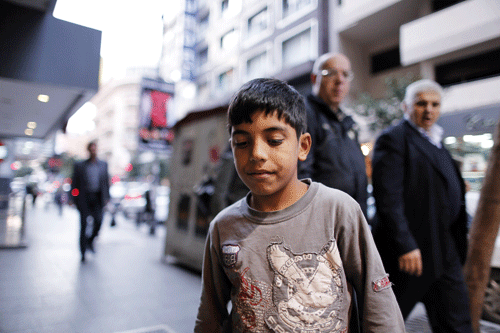
Two years ago while I was sipping an espresso on a Hamra sidewalk café, I met Khodor. Back then Khodor was six years old. He approached me selling lottery tickets, and since that time I regularly see him at the same spot pushing his wares. Khodor is from Manbij, a city not far away from Aleppo. His father had lost his job in Aleppo and decided to move with Khodor to Lebanon for work, providing an income for the family they left behind. Last month I saw Khodor again, this time with his six-year-old brother and 10-year-old cousin, both begging with a few lottery cards as a cover from the police. Khodor said his whole family and his uncles have all moved to Lebanon.

“There were bombs falling around our neighborhood in Aleppo, my father worried for our family so he brought them to Lebanon,” he said. “We found a shack next to the Cola area where we all sleep.”

And such is the life of many a poor Syrian in Hamra: marginalized, living on crumbs and humiliation, awaiting the end of the conflict so they can return home.

MOE ALI NAYEL is a freelance journalist based in Beirut

January 2, 2013 0 comments
0 FacebookTwitterPinterestEmail
Finance

Q&A – Johannes Jooste

by Maya Sioufi January 2, 2013
written by Maya Sioufi

Four years after the start of the financial crisis and the global economy is still struggling with anemic growth. The European sovereign debt crisis continues, America’s economy is being shaken by a ‘fiscal cliff’ and emerging markets, led by China, saw a slowdown in economic growth. For a forecast going into 2013, Executive sat with Johannes Jooste, head of strategy for Europe, Middle East and Africa at Merrill Lynch Wealth Management, while he visited Beirut in December. 

The global economy came under pressure in 2012; what is your global gross domestic product growth forecast for 2013?

We are slightly higher than 2012, which was worse than we thought. 2013 is going to be marginally better but that doesn’t make it particularly attractive. So the number comes out somewhere in the region of 1.3 percent for 2012, and 1.5 percent for 2013. We think that the breakdown is going to be pretty bad from the point of view of Europe, where we have got a recession for the first half, [with GDP] down 0.4 percent compared to about flat for the same period last year. So we are looking for Europe to be something of a challenge — two consecutive years of recession in Europe driven by the failure of France and Germany to decouple from the peripheral [countries]. 

How do you expect the fiscal cliff to impact the US economy? 

The worst case is [for the fiscal cliff to wipe out] 4.6 percent of GDP, something like $700 billion. The best case is something like a percent off, maybe 1.3, less than 2 percent. There are two questions — one is the size of the hit and the other is over what period does it hit the economy. And it is potentially less of a problem if they can manage to smooth it out — even if there is a hit. But it is significant and it is going to be something that plays on markets as we go into January.

Our base case is something of a fudge, a compromise that is not one that leads to a long-term solution. In the long run there is the entitlement problem and the budget constraints in the US, which aren’t really going to be solved by just a short-term interim ‘deal with it later’ type of solution. The best case is they do grab hold of it properly and deal with all the entitlements and do what they have to do, but we don’t really see that as something that is going to happen [in the near term].

In what regions do you expect to see the most solid economic growth in 2013? 

From a purely growth perspective, emerging markets is the place to be, and particularly Asia. China remains the driver and we think it has bottomed and the rest of the region will follow suit. With the US the one potential positive joker in the pack is how strong the housing market might prove to be; it surprised us [positively] this year. If that keeps going we will probably be wrong with [our GDP growth forecast of] 1.5 percent and it could come up closer to 2 percent. That is a potential swing factor.

Obviously there are swing factors on the other side, the fiscal cliff. For Europe to surprise us on the upside, they really are going to have to make haste with their program which at the moment we don’t see [happening].  

So you don’t believe 2013 will see a long-term solution to the European crisis?

No, a long-term solution will not appear in 2013. We see progress towards it; we don’t think they have incentives to go backwards, we think they understand — to the extent that you can guess what politicians think — the seriousness of the situation. 

Given your economic forecasts for 2013, what asset classes and what regions do you favor from an investment perspective?

The main theme is to avoid government bonds of developed countries such as Germany, France, the UK and the US. If you are going to stay within fixed income, go for the high risk: we prefer high yield to high grade and we prefer emerging market debt. If you are taking a long-term view, anything more than a year out to five to 10 years, we think the outlook for equities is distinctly favorable relative to fixed income. We would suggest using the weakness of the equity market [through] themes such as following the emerging market block for growth. We think European stocks are cheap. So we are probably going to end up being somewhat light on US equities. 

How about your economic forecasts for the Middle East?

It is even less straightforward to predict anything there. There is an unfortunate coincidence between the incidents in the Middle East and the global risk aversion going on. If investors are skittish already, the last thing they need is something in the oil-producing regions to make them even more nervous. And that is what is happening. Where there has been even a semblance of domestic stability such as in the Gulf countries, property markets are stabilizing and domestic demand is okay. The problem is more external demand. Foreign investors are very much taking a wait and see approach to the ‘Arab Spring’ countries. It has been about two years that net flows into equity markets have been effectively flat.

What are your expectations for the oil prices and how will that affect the region?

We think the oil price is well supported thanks to emerging-market demand. We are loath to give a specific level but we certainly don’t think it will come down from its current level by this time next year. You have got net exporters where it does help a huge amount, in the GCC for example. But there are a couple of countries, and Lebanon is possibly one of them, where that could be a bit of a squeeze. If there is a squeeze and it goes up quickly then that is globally a very bad thing. We are looking for more of a benign [rise].

Will it be another tough year for Lebanon?

For a few countries out there I think the dynamic is not dissimilar [to Lebanon’s] budgets and terms of trade issues. Lebanon is one of those [countries] that will face these issues, especially in the first half [of 2013] given the element of European dependence. ‘Arab Spring’ countries are not totally dissimilar given the proximity and the trade links to Europe. Lebanon has a short-term cyclical problem, Europe has a long-term structural problem. Cycles you can cope with easily whereas the long-term structure is a big deal. 

January 2, 2013 0 comments
0 FacebookTwitterPinterestEmail
Economics & Policy

Government’s failing grade

by Nabila Rahhal January 2, 2013
written by Nabila Rahhal

Since the beginning of the academic year, public school teachers, and many from private schools too, have abandoned their classes on an almost weekly basis and taken to the streets. The reason? They are demanding that the Council of Ministers, Lebanon’s cabinet, stop stalling and honor its promise to refer the new salary scale draft law to the parliament. At first glance this dispute may seem straightforward — in reality, the wide array of interests and possible impacts at play make for a class in politics and economic algebra all on their own.  

Principles of protest

Teachers striking for better wages has become a near annual occurrence in Lebanon, and, mainly due to their unified and organized front, their protests have met with some limited success. However, with the relentlessly rising cost of living eroding away these gains, it is never too long before the teachers head back to the streets. 

“Do you know that a teacher working full time for 20 years ends up, by law, with a basic salary of only $1,333 [per month]?!” said May Hamadeh, a private school teacher at a protest in October. “Many schools of course do pay you more than that, but when the law itself does not respect the teaching profession, it makes us teachers feel angry and reflects on our teaching and students.”

In September, with public school teachers threatening to leave students’ official examinations uncorrected, the cabinet agreed to a draft law approving a new and improved salary scale for all public sector employees, including public school teachers; private school teachers are also affected as their salaries are built on a similar pay scale. Since then, however, the cabinet has delayed referring the draft law to the parliament. The teachers have continued to take their anger to the streets and it is the students who have been caught in the middle — though teacher’s unions have promised they will make up for time lost striking. “I like it when we don’t have school because I get to sleep in but I don’t want to start coming on Saturdays or during vacations to make up for the lessons lost while our teachers were off,” says Rabih, a fourth grader at one of Ras Beirut’s public schools. “It’s not my fault… so why should I pay the price?"

See also: Lebanon's latest strike misses the point

A class in ineptitude

The cabinet’s reason to delay implementing the salary hike is that they simply don’t have the money to pay for the estimated $1.5 billion annual increase in wages for the 180,000 public sector employees affected by the law. “We cannot pay the salary increases all at once and we cannot approve the salary scale draft and send it to Parliament without revenues,” said Prime Minister Najib Mikati in a recent press conference at the Grand Serail. “The teacher unions are demanding that the draft be sent to Parliament without ensuring revenues and new taxes which is not realistic.”  

Government proposals for raising funds include increasing taxes on luxury items and customer deposits at banks, and to perhaps pay the wage increases in increments of four to five years; the government insists it will not raise taxes in a manner that will affect limited income families. 

The teachers’ unions have rejected the installments proposal, as it was not part of the agreement they had reached during meetings with the ministerial committees. The union insists that the government can pay the increases if they just cut down on excess spending, fought corruption and improved tax collection, especially from the Beirut Port. However, the central bank and private-sector economic associations have warned the government of the negative impact adopting this law would have on Lebanon’s already struggling economy. By adopting such a costly and contentious law without having thought through how it would be funded, the cabinet has caught itself between a rock and a hard place, with no escape in sight. 

Private vs public school impacts

Many private school directors have been watching this battle apprehensively, fearing the impact such a law would have on their schools’ budgets. “There are around 15 big private schools in the country that will not be affected by this law because they already have a high number of students, and because they cater to a caliber of parents who will not notice if their child’s tuition goes up a little bit more than usual,” notes Maurice Dabaghi, principal of Marjeyoun National college, explaining that even though the law will not impact all private schools equally, the government is acting as if it would. “Consideration should be given to the community the school is serving, as salaries and conditions in Beirut differ from those in remote areas of the country,” continues Dabaghi. 

Those big schools aside, the majority of privately owned schools in the country do indeed cater to students of middle income families who might be tempted to change schools should tuitions spike up significantly. “This year, I removed my eldest child from a private school here [in Marjeyoun] and enrolled him in the public school because we can’t afford the tuition for all three of my children — if tuitions increase again next year, I will have to put all my children in the public school,” complained Maha, one of the many indignant parents wondering what they might have to do with their children if the law passes. Knowing that tuition is a major consideration for many parents when picking a school for their child, this law has the potential to create an unhealthy situation where schools lower their tuition fees to compete with other schools, at the expense of quality education.      

How children will suffer

“The impact on schools can be measured by the ratio of students to teachers in each class,” explains Paul Owiess, principal of the National Evangelical School in Kfershima. “If a school has more than 40 students in each class, which some schools do, then the teacher’s salary can easily be paid from these students’ tuition. However, if you are a school that cares about the quality of education you are providing, [by having] no more than 20 students in each class, then this law will negatively impact you.”  

Those schools that don’t want to increase tuition might consider other ways of cutting costs, such as firing their longest serving — and therefore most highly paid — staff, but this might leave them vulnerable to lawsuits by those teachers. Instead, Owiess says that between a choice of two candidates, schools might start choosing the one with less years of service due to her lower salary rights, though the other might be better qualified. An equally undesirable way of cutting costs to help fund the increased salaries is halting all extracurricular activities, and only teaching core topics. 

As the fate of the law is kicked around from pillar to post it creates a pervading sense of insecurity for both school administrations and the teachers. It is of course the education of the students that suffers the most. The cabinet has made a mess of the whole process by trying to bungle through an ill-considered law. That cannot be changed, but it means they must now work with all the involved parties to find a solution so teachers and management can get on with the business of educating Lebanon’s youth. 

January 2, 2013 0 comments
0 FacebookTwitterPinterestEmail
Editorial

A better Lebanon

by Yasser Akkaoui January 1, 2013
written by Yasser Akkaoui

With many bitter moments from 2012 still lingering in our minds, it is time for sober reflection and realistic objectives to guide us in making resolutions for the New Year. While we want ‘realistic’ targets for 2013, it is hard not to feel that we are stumbling out of the starting gate.

For many of us, while we still love our country, it simply doesn’t seem to make sense any more. Since 2006 there has been a steady erosion in the belief that things can or will get better. When people believe that the quality of life in the place they live will only get worse — that their country will not offer them the opportunity to fulfill their goals any time soon — they inevitably leave in search of greener pastures.

It will not be easy, but what we really need to see in 2013 is some form of progress in Lebanon. It would be folly to demand the entirety of our politics and society to be reordered in the next 12 months, but give us something. Electricity all day long, water in our tanks throughout the year, Internet we can stream whole videos over, streams, beaches and nature areas unlittered with garbage — just give us something in Lebanon we can point to and say “this is better today than it was yesterday.”

Even if it is a long-term plan — such as a railway along the coast to alleviate rush-hour traffic, or a blueprint to remove the mountains of garbage blowing stench throughout our streets and into our living rooms — as long as there is implementation of a sensible, rational and achievable plan, then we have something to look forward to.

One good thing about the state of this country is there is no lack of opportunity for our policy makers to improve the situation — just do something. Perhaps there might even be politicians that step forward in the elections this year that offer us a choice of policy platforms, rather than the option of choosing our representatives based on their allegiance to Saudi Arabia, Iran or otherwise.

To extend the trends of 2012 into 2013 and maintain the status quo is to regress further. A message to our government for the New Year: give us reason to believe a better Lebanon is possible.

January 1, 2013 0 comments
0 FacebookTwitterPinterestEmail
Real Estate

Constructing the high life

by Sam Tarling January 1, 2013
written by Sam Tarling
In the shadow of Beirut's most famous building - the Rafik Hariri Mosque - the foundations for the high-rise, high-cost Plus Towers are being laid [Photo: Executive/Sam Tarling]
Executive was given exclusive access to explore the huge building site that will eventually become some of the country's most sought-after real estate [Photo: Executive/Sam Tarling]
A foreman and a laborer discuss the work. The site will eventually host two towers, both with a mixture of commercial and residential properties [Photo: Executive/Sam Tarling]
[Photo: Executive/Sam Tarling]
[Photo: Executive/Sam Tarling]
[Photo: Executive/Sam Tarling]
[Photo: Executive/Sam Tarling]
[Photo: Executive/Sam Tarling]
[Photo: Executive/Sam Tarling]
It is due to be completed in 2014, though the company would not say at what time during the year. Photo: Executive/Sam Tarling]

In the shadow of Beirut’s most famous building – the Rafik Hariri Mosque – the foundations for the high-rise, high-cost Plus Towers are being laid


January 1, 2013 0 comments
0 FacebookTwitterPinterestEmail
  • 1
  • …
  • 292
  • 293
  • 294
  • 295
  • 296
  • …
  • 707

Latest Cover

About us

Since its first edition emerged on the newsstands in 1999, Executive Magazine has been dedicated to providing its readers with the most up-to-date local and regional business news. Executive is a monthly business magazine that offers readers in-depth analyses on the Lebanese world of commerce, covering all the major sectors – from banking, finance, and insurance to technology, tourism, hospitality, media, and retail.

  • Donate
  • Our Purpose
  • Contact Us

Sign up for our newsletter

    • Facebook
    • Twitter
    • Instagram
    • Linkedin
    • Youtube
    Executive Magazine
    • ISSUES
      • Current Issue
      • Past issues
    • BUSINESS
    • ECONOMICS & POLICY
    • OPINION
    • SPECIAL REPORTS
    • EXECUTIVE TALKS
    • MOVEMENTS
      • Change the image
      • Cannes lions
      • Transparency & accountability
      • ECONOMIC ROADMAP
      • Say No to Corruption
      • The Lebanon media development initiative
      • LPSN Policy Asks
      • Advocating the preservation of deposits
    • JOIN US
      • Join our movement
      • Attend our events
      • Receive updates
      • Connect with us
    • DONATE