• Donate
  • Our Purpose
  • Contact Us
Executive Magazine
  • ISSUES
    • Current Issue
    • Past issues
  • BUSINESS
  • ECONOMICS & POLICY
  • OPINION
  • SPECIAL REPORTS
  • EXECUTIVE TALKS
  • MOVEMENTS
    • Change the image
    • Cannes lions
    • Transparency & accountability
    • ECONOMIC ROADMAP
    • Say No to Corruption
    • The Lebanon media development initiative
    • LPSN Policy Asks
    • Advocating the preservation of deposits
  • JOIN US
    • Join our movement
    • Attend our events
    • Receive updates
    • Connect with us
  • DONATE
The Buzz

Morning briefing: 3 Dec 2012

by Executive Staff December 3, 2012
written by Executive Staff

OPEC member Qatar will ask firms to tender for a 1,800 megawatt (MW) solar energy plant in 2014 costing between $10-20 billion as the world’s highest per capita greenhouse gas emitter seeks to increase its renewable energy production.

More from Gulf Business


Saudi Arabia's General Commission for Tourism and Antiquities has imposed a ban on smoking at all tourism facilities.

More from AME Info


South Sudan could restart oil exports through Sudan by the end of the year after successful talks between both countries on border security, a top Southern official said on Sunday.

More from The Daily Star


Israel has stopped payment of $120 million in tax revenue to the Palestinians, as the government of prime minister Benjamin Netanyahu punished them further for their successful UN statehood bid.

More from The National


Companies

Germany’s Merck Serono said it would team up with an Abu Dhabi firm to produce medicines for the domestic and regional markets, the first multinational of its kind to make branded products in the United Arab Emirates.

More from Gulf Business


Etihad Etisalat (Mobily) has said Saudi Arabia's stock market regulator has approved a 10 percent bonus share.

More from AME Info


Saudi mining firm Maaden signed deals worth 977 million Saudi riyals ($260 million) with US firms Fluor Corp and Bechtel to help develop an industrial city in the country's north, it said. 

More from Arabian Business


The Board of Zain Group has appointed Scott Gegenheimer as its new Chief Executive Officer. Gegenheimer replaces Nabeel Bin Salamah, who announced in October that he would not be renewing his contract.
 

More from AME Info


December 3, 2012 0 comments
0 FacebookTwitterPinterestEmail
Real Estate

Building regardless

by Thomas Schellen December 3, 2012
written by Thomas Schellen

Screech! Honk! And a few polite words. That is what it takes for the 40-ton dump truck on a busy intersection at noontime in the middle of Beirut’s Ashrafieh district to make cars give him enough space to squeeze a left turn onto the district artery, Independence Avenue. Neither the narrow side street from which the trucker emerged with a load of sand and rock, nor the main street, is suited for heavy vehicles. But a fleet of his colleagues will repeat the exercise every 20 or 30 minutes throughout the day, and not only on this one sunny November day. They are hauling excavated soil from a massive construction site on the southern slope of the Ashrafieh hill over the course of several weeks, so that the foundations for another multi-story apartment block can soon be poured.

The project where these lorries are loaded is not the only hyperactive property excavation in Ashrafieh in the fourth quarter of 2012, not by a long shot. Other earth removal motorcades are operating on other sites all throughout the busy district. Construction is ongoing along the district’s perimeter, at its very center and highest point, and on many of the narrow streets in between.

Projects are digging deeper and building higher than ever before, with residential towers reaching 20, 30 and even more than 40 floors into the urban sky. Around the 600-meter-short Omar Haimari Street, which marks the district’s highest stretch, just 40 steps away from Independence Ave, three massive developments are under way, including the 43-story Sky Gate, which, at only half its final height as November ended, was already visibly redefining the Ashrafieh skyline. It, and what is slated to be the even taller SAMA Tower that is reaching toward its 195-meter target height just west down Independence Avenue, are but two of a tide of projects altering the Beirut cityscape, and the fabric of suburban areas and the countryside around the capital, in profound and unprecedented ways.

The numbers don’t tally

At the changeover from 2012 to 2013, Ashrafieh is only one of many hotspots of construction activity; other hardcore development areas are the central district managed by urban renewal company Solidere, and parts of the ring road around the Beirut Municipality territory where some trash lands spotted with ugly commercial structures have been discovered by developers. Outside of the capital and immediate suburbia, residential clusters in the Metn region and leisure areas higher up the mountainous surrounds are flush with projects.   
What makes this fin-de-2012 image of high-gear development activity a puzzling picture is that it is being splashed across the small Lebanese canvas at a time when all indicators on real estate are, at face value, negative.

According to indicators compiled in the Bank Audi third-quarter economic report on Lebanon, cement deliveries, the number of real estate sales transactions and issuances of building permits were all down in the first three quarters of 2012. Property sales fell 9.2 percent for the nine-month period from a year ago, and contracted by an even higher 11.4 percent when comparing just the third quarter of 2012 with the same period in 2011.

The eight-month figures on cement deliveries were down to 3.4 million tons in 2012 from 3.7 million tons in 2011, and in square meters (sqm) worth of construction permits, issuance contracted to 10.7 million sqm 2012 from 12.4 million sqm in the first nine months of 2011. This constitutes drops of 7.9 percent on cement and 14.3 percent on licensed floor space. When factoring in the drop in property transaction numbers, the trio of real estate sector indicators shows, at least in theory, downturns on completed, ongoing and planned projects.

The caveat here is that these numbers are likely not entirely accurate. Property registrations are often delayed for purposes of tax avoidance and building permits don’t always translate into the same actual built-up area. Even cement figures have been suspected to be muddied by grey exports.

However, while developers and intermediaries in the real estate industry almost uniformly say that the situation must not be called a crisis, developers tell Executive that the slowdown in their activity in 2012 is real and the outlook for 2013 is muted.

Sales developments for the real estate projects of MENA Capital (which focused traditionally on the high end of the luxury market in prime areas of Beirut and whose largest project is Sky Gate) were negative in 2012 and 2011, confides Nabil Sawabini, the company’s chief executive. “The cumulative value of sales has been declining in the past two years; we sold more in 2010 than in [each of] 2011 and 12,” he says. Nonetheless, units in Sky Gate are about two-thirds sold, he adds.

Georges Chehwane, chief executive of developer Plus Properties, and of communications media and real estate conglomerate Plus Group, says regional uncertainty contributes to the slowdown, but adds that, “the main part is the large number of units that [have been] in the market since 2009, as there is a gap between the yearly demand and the yearly offer of supply. This is the main problem today in addition to the political situation in which people are not buying.”

The current real estate market confronts investors with a state of uncertainty, says Houssam Batal, chief executive of developer Prime Projects. “It is not very clear to say where [the market] will go. There is a feeling that there will be an oversupply in many product types. The main thing that is affecting the market right now is the political situation and instability, and the grey outlook related to Syria and to domestic issues that we have. The investors are worried about the dangers of bigger problems to come.”

Sadly for buyers, this does not mean that property bargains are going to abound next year.

“Demand has decreased, the economy is in a difficult situation and the future is somewhat blurred but prices for apartments and real estate, especially in prime areas, have remained stable and have increased in some cases. It is a weird economic picture,” says Ziad Maalouf, chief executive of Capstone Investment Group, a financial firm whose activities include real estate development.
Zardman, a developer that is fairly fresh in the market and claims to have seen moderate sales growth in 2011 and 2012 against market trends, also sees prices as moving sideways. “We have two sides to our business, addressing the middle class in the Metn region and the higher end market in Ashrafieh,” Makram Zard, the general manager of Zardman, tells Executive. “The Metn region was extremely good this year. Ashrafieh is doing well. I don’t think… that prices are dropping but sales are not quite as good as last year.”

Less for more

Maalouf’s and Zard’s assessment of unwavering prices fits with what other developers say, and statistics show that the cumulative value of property sales in Lebanon this year, despite the contraction in transaction volume, was up from last year. Correspondingly, the average value per transaction is the indicator that in 2012 showed the most pronounced gain for the year-to-date.

At $6.3 billion, the total value of the nine-month tally of registered property transactions was up 4.8 percent, but the average value per transaction increased 15.4 percent year-on-year to $120,000 from $104,000 for the January to September period, according to government figures cited by Bank Audi in mid-November.

The trend of price inelasticity is long-term. Although demand for real estate had been slowing since late 2010, expectations for lower prices harbored by property seekers had been disappointed even back then, according to Maalouf. “I have heard of a lot of people since 2009 and 2008 who had been delaying the purchase of an apartment in the hope of buying the same apartment later at a lower price. But this has not happened,” he explains.

At the junction of 2012 and 2013, the real estate market in Lebanon is a buyer’s market in terms of choice and options in up-market locations as long as a buyer has cash-stuffed pockets or a high and growing income. In terms of pricing, it is not a buyer’s market at all.

The market for the most important development resource, land, is also not a buyer’s dream. To the contrary, developers are faced with a very hard seller’s market, Maalouf adds. “Land prices have actually increased, despite everything. The weird thing is that expectations of land owners do not reflect realities. This is a catch for developers,” he explains. “On one hand you have buyers who see the prices for real estate as high and on the other hand you have land owners who have unrealistic expectations.”


Why so buoyant?

The reasons why even the oversupply of Lebanese properties does not generate much downward pressures on prices in the market for residential units are complicated.

One key factor is financial. Many developers in Lebanon self-finance, and the absence of funding pressure allows the economic self-interest of many developers to keep focused on achieving the maximal rate of return that they fixated about when embarking on their project. Developers in this category typically wait out the market if bid prices are below their expectation and can do so because they have no lending officers breathing down their necks.

Development activity may even be a one-off business for many and they base their profit modeling on building cost and land pricing, often adding in an upward revaluation of the plot during the development process — a reevaluation that, according to Zardman’s Zard, can be far higher than the amount that the interest component in a land financing agreement would represent.

Applying standard models where project companies are financed by equity from investors and by debt, or source revenues via off-plan sales, makes the developers more sensitive to market trends. This leads to more client-responsive pricing behavior and also supports rational adjustments of development activity, such as switching to more moderate unit sizes. According to Zard, developers like him — whose land value calculation in unit sales prices is based on land cost at purchase plus regular interest — transfer land value gains early on to the customer. “This is one of the reasons why our sales have been excellent when compared with the market,” he claims.   

Oft-quoted rationalizations why property prices in Lebanon would not follow cyclical patterns that are familiar from other markets are the high density of the population, the small surface territory of the nation (167th among 249 countries and territories in the world by land size), and the even smaller size of land accessible for development. According to Chehwane, roughly half of the national territory is off limits for property development because of terrain conditions, agricultural usage and ownership by religious orders.

Weighing in on the demand side of the equation are not only the young families living in the country but also the outsized theoretical buyer pool of the so-called Lebanese diaspora, which comprises millions of Lebanon-born and descendent citizens of countries in South and North America, Oceania, Europe and Africa. The second notable source of external demand is from Gulf buyers. “The Lebanese market for real estate is very dependent on Lebanese living outside the country and also on foreigners,” says MENA Capital’s Sawabini.

Brand it, baby

Younger Lebanese who have acquired sufficient means to buy an apartment in the high-priced Ashrafieh market, by laboring as expatriate managers in Dubai or Riyadh, may be less attached than earlier generations to traditional ties of kin in their residential choices but they also display strong patterns of selectivity in property buying. It is the location and the “prestigious address” that matters greatly to them, according to Zard.

This means that developers are paying increasing attention to building a reputation and brand identity for their pricey towers.

Branding a project and defending this brand against copycatting is also crucial in differentiating a project, says Ayad Nasser, owner and chief executive of developer Loft Investments. “In Lebanon, 99 percent of the projects look the same,” says Nasser. “The entire market is focused on the 99 percent of the population [who buy those types of properties]. I am not marketing to a percentage. I am marketing to people who have that drive to live in a different project.”

The differentiation of his projects is not by location but by concept and design, services and quality, he claims, and in that space “it is very important to have a brand today. ”

Counting urbanity

But before discussing the future potentials of some branding or non-branding concepts on Lebanese real estate, or musing on the ironies of cement blocks bearing names such as ‘pretty house’ or ‘xyz gardens’, some much more elementary points call for clarification. Such as, how many floors of concrete are being cast presently in areas like Downtown Beirut or Ashrafieh? How many and what sizes of units are going to drop into the Lebanese market in 2013?
Prime Projects’ Batal, a university-trained professional in real estate, answers the question on the incoming supply by saying, “There are data reports suggesting that supply is broadening versus demand but I don’t know if these reports are reliable and accurate,” adding that he has no numbers on how many projects were going up in Ashrafieh in November 2012.

He is not alone. Loft Investments’ Nasser, who says his track record of delivery includes 270 apartments since he started out with a single suburban unit in 1994, is not convinced by market research or price comparisons. “I never consult statistics; I never do a marketing plan, nothing. We just feel it. I am very confident about my clientele. I have in my portfolio different clients who became friends and I know that 10 percent of those people will be my clients, so while I am buying the land [for a new project], I call them,” he says.

Nasser admits that he does not even know the asking prices in developments going up next to his projects, but he affirms on the other hand that Lebanon’s developers “need to assess the market and the government needs to put some rules.”

Both market assessment and better rules are points that Plus Properties’ Chehwane sees as paramount necessities. He is one of the players pushing actively for realizing a professional association of developers, which he envisions to have as its core activity the compilation and publication of sector data.

Chehwane adds that there are no statistics on the real property development situation in key areas such as Ashrafieh. When asked what he believes to be the number of projects and units under development in this very district, he answers , “100 projects, at least. I believe [Ashrafieh has] around 3,000 units today under construction.”

It is futile to query either public officials or private developers for an accurate number on buildings under construction in Beirut today. So to garner at least some idea of the actual number, Executive reverted to good ol’ fashioned journalism — a pad, a pen and pounding the pavement in a random part of Ashrafieh.

Within less than ten minutes walk on one trajectory only, ascending from the Hospital Dieu area toward Sioufi Gardens, Executive found six residential projects in progress, of which one looked ready for handover (14 stories), two 12-story ones were in advanced stages of construction and should be ready for occupancy in 2013, one was a six-story shell that was frozen and the two largest sites were in the excavation phase. One of these two will have 28 stories with 43 flats of 320 to 540 sqm. The other will comprise office, commercial and residential units in two towers of eight and 11 floors.

Next was a check of the cobweb of narrow passages and bumpy streets between this project site and Alfred Naccache Street. This little quarter revealed another five projects and one plot that looked ready for the start of excavation. The largest site here was an apartment complex nearing completion with four segments ranging from 13 to 20 stories. On the eastside of Alfred Naccache Street, three more new multi-story buildings added to the ongoing development tally of this southeastern corner of Ashrafieh, in an area fully coverable on foot within 15 minutes. 

Expanding the random walk of Ashrafieh to a wider grid, Chehwane’s estimation of at least 100 ongoing projects doesn’t actually look far off the mark; if anything, it is an underestimation.

Bigger fish to fry

One has to note here that getting better data is a strategic need for developers; however, it is not an existential problem for the property makers. Their concerns and hopes lie elsewhere. The most important factor influencing Lebanese real estate now is Syria, says Capstone’s Maalouf. “If there is regime change in Syria tomorrow, I think this will have very positive spillovers on the market here. I foresee a boom [under such circumstances] simply because the confidence in the Lebanese real estate sector is going to be regained.”

For his part, Chehwane sees only temporary worries in the current oversupply with units. “The moment that we will have a positive atmosphere and positive situation, 50 percent of the stock that is available in the market will be sold. We need one year like 2006 before the war or 2008 before the crisis, and you will have a very good situation,” he enthuses.

From another, more public perspective, development takes on a different angle. Only reviewing the last five years, the cumulative square meter figure for building permits issued between January and August of each year comes to 39.85 million sqm. That is an addition of roughly 10 square meters per resident of Lebanon in a very short time, in a country that already feels stuffed with concrete buildings.   

Despite developers chiming the marketable tune that land is scarce and unaffordable for them, it can be predicted that another tide of private real estate growth will happen, quite likely within a decade at most when considering the activity cycles of the past 10 years.

Factor that in and it becomes over-evident how urgently the Beirut metro area and the country as a whole need to achieve some crucial changes of behavior: Lebanon needs planning. It needs development norms and standards that are sustainable and applied universally. It needs infrastructure, namely infrastructure that is adequate and steers growth in directions that make sense for the future. Public and private property represent the spine and skeleton of Lebanon’s future living quality. The spine has to be straightened out.
 

December 3, 2012 0 comments
0 FacebookTwitterPinterestEmail
Comment

Entering subsistence

by Jihad Yazigi December 3, 2012
written by Jihad Yazigi

One of the main questions surrounding the Syrian uprising at the beginning of 2012 was if and when an economic collapse would occur. As the year draws to a close, the question has instead become whether one can still talk of “a” Syrian economy as such.

What remains of the country’s formal economy has seriously deteriorated throughout the year. Business activity significantly contracted and although the government has released no estimates, gross domestic product is believed to have fallen by at least 25 percent in the first nine months of 2012.  Disintegrating distribution and supply networks, a government increase in energy prices and a hike in the cost of imported items all combined to gradually increase the inflation rate; the consumer price index was up by 40 percent on an annual basis by August.

The Syrian pound, after having resisted all forms of pressure relatively well in 2011, lost ground. From a rate of 60 to the dollar at the beginning of the year, the exchange rate fell to over 80 pounds by mid-November 2012.

An important development has been the expansion of the violence to Aleppo during the summer, a city that had largely remained outside the popular uprising until then. Aleppo is Syria’s largest city by population, but also the country’s main manufacturing hub as well as a major trading and distribution center for agricultural products. The unrest in the city led, among other things, to the closure of its industrial city with some 600 factories suspending production.

However, while observers continue to monitor most formal indicators — such as inflation and the currency rates — as a means to measure investor sentiments, in practice most of the country’s economy now falls outside these numbers.

The expansion of violence and the varying degrees of state control over large sways of Syria have profoundly transformed its economy to the extent that one can now talk of a war economy, the creation of new business networks and the development of various new forms of trade, including smuggling, looting and kidnapping.

Some areas of the country are still firmly under state control and as such continue to be provided by regular government services — these include the provinces of Latakia, Tartous and Suweida as well as the central parts of Damascus. In these parts of the country the supply of products continues at relatively normal levels, although prices have skyrocketed.

Other areas have little left of the state, such as the rural parts of Aleppo, Idlib, Hama, Homs and Daraa. Meanwhile, the cities of Aleppo and Der-ez-Zour are under constant bombardment and have almost no business activity to speak of, while the northeast of the country is growing increasingly autonomous in the management of its day-to-day affairs. Looting is common in areas where inhabitants have fled; smuggling to and from neighboring countries has exploded as the government’s control over its borders weakened, customs tariffs increased and formal international banking transactions are at a standstill; kidnapping for ransom is widespread.

As the autumn pushed on, the government finally began to express more openly its concerns for the near future. In a well-publicized statement, the deputy prime minister in charge of economic affairs, Qadri Jamil, said in September that in the absence of a political solution to the crisis gripping the country, the economy was heading towards “a stroke” by the end of the year. Jamil was forced to retract his statement a few days later, but the damage was done. 

Meanwhile, in early October, the Minister of Agriculture Subhi al-Abdallah encouraged his fellow citizens to “grow whatever they could grow and raise whatever animal or chicken they could raise.” Abdallah’s words echoed a prevailing sentiment in Syria: slowly but surely, the economy was moving towards subsistence mode. 

The depth of distress in the economy, reflected in these statements, points to the major challenges ahead for Syria’s future decision makers. Syria may manage to rebuild relatively quickly its physical infrastructure, but it will require a very significant redefinition of economic policy, an overhaul of existing business and trade ties and a formalization of much of its economic activity before the country truly recovers from the devastation it is facing.


Jihad Yazigi is editor-in-chief of The Syria Report


December 3, 2012 0 comments
0 FacebookTwitterPinterestEmail
Comment

No end to injustice

by Ahmed Moor December 3, 2012
written by Ahmed Moor

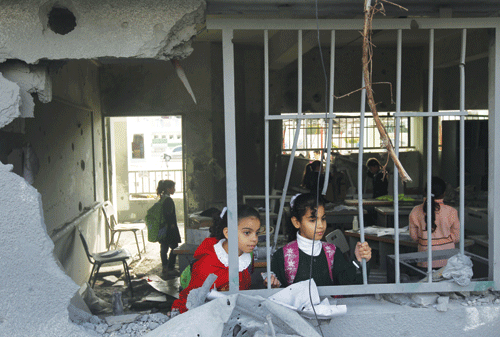
For the Palestinians the passage of time offers little reprieve. While their circumstances have changed this past year, they have only changed for the worse. Israel has systematically worked to isolate them and hem them into smaller spaces. Governments worldwide seem prepared to accept their continued deprivation and Israel’s steroidal apartheid. The latest salvo between Palestinians in the Gaza Strip and Israel ended with more than 150 dead Palestinians, the majority of whom were civilians, and five Israelis killed. The conflict is deepening. 

Some analysts continue to insist that there is a two-state blueprint that is workable for the Palestinians and Israelis. In fact, reality has moved sharply away from any such accommodation. The settlements in the West Bank and around Jerusalem have altered the ‘reality on the ground’ in irreversible ways. Jerusalem is being ethnically cleansed. Palestine has been colonized into nothing. That’s the reality.

At this stage it is worth evaluating what the overall Israeli policy in Jerusalem and the West Bank appears to be. While decision-making in Israel appears to be driven by short-term considerations, there is a long-term outlook, and it is becoming more evident daily. Nir Barkat, the Jewish Israeli mayor of West Jerusalem, has been very effective at restricting the growth of Palestinian neighborhoods in occupied East Jerusalem. In some cases, public works projects are cynically announced with the object of forestalling Palestinian development. For instance, a large tract of private Palestinian land near the neighborhood of Silwan has recently been designated as “state property”. The Jerusalem municipality has declared that a park will be constructed on the site, a claim that some observers regard as a pretext for continued Israeli colonization of East Jerusalem. 

In Jerusalem, Palestinian life is so circumscribed that many of the city’s indigenous residents are forced to live elsewhere. The lack of development in Palestinian neighborhoods along with the refusal to grant building permits work to drive the Judaization of the city. 

Processes in the West Bank follow the dominant Jerusalem strategy. More than 60 percent of that occupied territory, the Oslo process’s “Areas B and C”, is off-limits to Palestinians. They are not granted building permits in their rural villages — a policy that forces many people into the Palestinian Authority (PA) administered “Area A”. In other words, a West Bank version of ‘bantustanization’ — the apartheid-era South African policy dividing up the territory of black inhabitants — is developing with few impediments. 

Essentially then, the Israeli strategy is to Judaize Jerusalem through ethnic cleansing while doing the same to Areas B and C of the West Bank. The “Gaza solution” — isolating Palestinians in shrinking cantons — is being adapted to the particular geography of the other Palestinian territories.

Historically, the PA leadership has demonstrated its profound impotence in the face of persistent Israeli apartheid and occupation. But that may be changing.

President Mahmoud Abbas’ decision to seek a status upgrade at the United Nations on November 29 is the most concrete challenge the PA has posed to the Israelis in years. In fact, the move poses a serious threat to the Israeli leadership because it could provide the Palestinians with access to international adjudicatory bodies. In particular, the International Criminal Court could be called upon to intervene in cases where sufficient evidence of Israeli crimes exists. Analysts have speculated that the Israeli decision to attack Gaza in November is linked in part to the Palestinian Authority’s decision to petition the United Nations for upgraded status. The Israeli elections in January and the fact that the other three Knesset elections this past decade were all preceded by massive military operations against Palestinian areas provides additional context for understanding the extent of the airstrikes. 

The context of the attacks in Gaza — indeed, the broader context of what’s happening to the Palestinians — has changed. The Middle East is no longer ruled by programmable autocrats. Egypt and Turkey in particular may produce a ceasefire in the short term and a change in European policy — if not American policy — in the long term. Egypt and Turkey succeeded in enhancing their diplomatic clout after brokering a ceasefire between Hamas fighters and the Israeli government; that trend is likely a sustainable one.

It is far too early to know what the different constellation of powers in the Middle East means for the Palestinians in the long term. As for the short term, the safest assumption is that 2013 will bring no real change; apartheid and arbitrary war are the twin governors of the Palestinian territories. The Palestinians will continue to suffer into the near future.  


Ahmed Moor is a master of public policy candidate at the Harvard University Kennedy School of Government

December 3, 2012 0 comments
0 FacebookTwitterPinterestEmail
Comment

One pharaoh for another

by Dalia Rabie December 3, 2012
written by Dalia Rabie

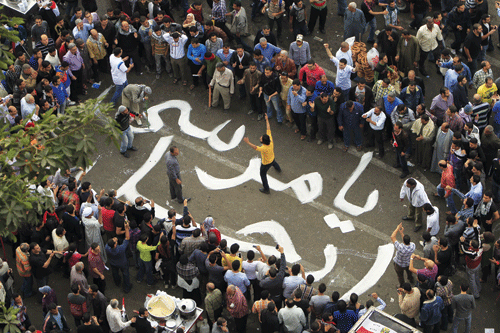
It seemed to many that President Mohammed Morsi was paving the way for his own dictatorship at the end of November when he issued a game-changing constitutional declaration radically expanding his authority, and further deepening the divide in an already polarized society. 

The seven-article declaration effectively immunized all presidential decisions from formal oversight, whether parliamentary or judicial. Following the declaration, Muslim Brotherhood offices around the country were ransacked and thousands flocked to Tahrir Square denouncing the move, while others rallied at the presidential palace in support of Morsi. As Executive went to print, both Morsi supporters in the Muslim Brotherhood and opposition figures were rallying Egyptians to the streets for mass protests.

What Morsi’s detractors see is a power grab, with articles in the declaration ominously reminiscent of deposed President Hosni Mubarak’s notorious emergency law under which arbitrary arrests were common on the pretense of protecting national security. Morsi supporters say his declaration is a necessary measure to protect the revolution and preserve national stability. 

Either way, it caps off a year beset by turmoil. The unrest of 2011 continued straight into 2012 when, on February 1, fans of the Al Masry football club attacked fans of the rival Al Ahly club in Port Said Stadium, killing 74 and injuring thousands. Accusations abounded that the security services had been complicit in the massacre. Anger amplified towards the then de-facto rulers of the country, the Supreme Council of the Armed Forces (SCAF), triggering a vicious cycle of public protests and violent repression, which resulted in at least 11 further deaths. 

The country then shifted attention to the first free election for a head of state since the end of Mubarak’s 30-year autocratic rule. The Presidential Elections Committee, however, disqualified some of the most prominent candidates mid-campaign, spurring another round of protests that left at least 10 dead when Salafi candidate Hazem Salah Abu Ismail was barred from running.

SCAF then weighed in, dissolving parliament — based on a Supreme Constitutional Court ruling that the 2011 parliamentary elections were unconstitutional — and then issuing a constitutional declaration broadening its powers and stripping the president’s office of much of its executive authority, only hours before the preliminary election results were announced. Somewhere in the middle of all this, Mubarak ‘awoke’ from a questionable coma to begin serving a life sentence in prison. All this, on top of an ailing economy, lax security and widening fractures between the country’s different factions. 

Sadly, hopes of seeing old regime elements purged from Egypt’s different institutions after Morsi took the presidential oath were short-lived. While among his first orders of business was to replace Hussein Tantawi, head of the armed forces, and the chief of staff, Sami Anan, as well as to cancel SCAF’s constitutional declaration, these ‘bold moves’ were seen by many as the outcome of closed-door deals guaranteeing SCAF’s ‘safe exit’.

Morsi has since faced a series of domestic crises — the most painful of which was a bus crash south of Cairo that took the lives of 49 schoolchildren in early November — to which he was generally seen to have reacted poorly, and he has largely failed to live up to the ambitious 100-day program he set for himself. 

Even some of the most basic human rights and standards of transparency, which were expected to take hold after the revolution and set the new Egypt apart from its predecessor, still seem out of reach. Human rights groups criticize the current government’s unwillingness to abandon repressive tools and guarantee citizen rights in the draft constitution. A report prepared by El Nadim Center for the Rehabilitation of Victims of Violence, assessing Morsi’s first 100-days in office, says that arbitrary arrests, torture and ill-treatment of citizens continued unabated. 

Morsi’s recent declaration, however, does reopen investigations into the crimes against protesters last year. This, on top of foreign policy successes — most notably helping to broker the ceasefire which ended Israel’s recent assault on Gaza — are among the new president’s few shining achievements in the eyes of Egyptians. Thus, with the second anniversary of the January 25 Revolution approaching, many wonder whether the shadow of another pharaoh looms over Egypt. With little positive change materializing on the ground, the same chants will likely echo through Tahrir Square in future months, with people still demanding “bread, freedom and social justice.”


Dalia Rabie is a Cairo-based journalist


December 3, 2012 0 comments
0 FacebookTwitterPinterestEmail
Economics & Policy

Powering the grid

by Georges Pierre Sassine December 3, 2012
written by Georges Pierre Sassine

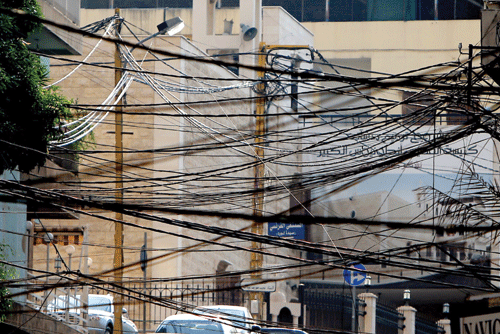
Rolling blackouts have become a symbol of the political crisis affecting the Lebanese government. According to the World Bank, Lebanese citizens incur on average 220 interruptions of electricity per year, which is the worst performance in the Middle East.

Today, electricity production stands at around 1,500 megawatts (MW) while demand exceeds 2,400MW at peak times, resulting in rationing cuts from between 3 to 20 hours a day, depending on where you are in Lebanon. Although the government signed a $360 million deal to lease electricity-generating barges from a Turkish company in July, which is expected to generate 270 MW, this will mainly offset losses as restoration works are carried out on existing power plants. 

Building a few facilities to bolster generation capacity should not be too challenging, knowing that China builds plants at the rate of one per month. Instead the problem lies in the sector’s governing system: Lebanon’s electricity sector is dominated by the state-owned Électricité du Liban (EDL), which has thus far proven inept in addressing the country’s energy shortfall. 

Moving forward, solutions to Lebanon’s electricity crisis are constrained by a limited government budget, a heavily subsidized electricity sector, low collection of electricity bills, an ageing infrastructure, human resources challenges and various interest groups resisting change.

Politicians are discussing various options, including different models of privatization and even the decentralization of Lebanon’s power generation. The fundamental debate drills down to two key questions. The first is a choice of regulation versus deregulation, which addresses the degree of government involvement in Lebanon’s electricity sector. The second is whether electricity generation should be centralized or decentralized.

These choices are in line with the debates occurring today in the global energy system. As such Lebanese policymakers can learn from the successes of others and adapt them to local conditions.

Regulation versus deregulation

The electricity sector’s restructuring has featured on the Lebanese government’s agenda since 1998 when a revised electricity law emphasizing privatization was first proposed. Following that an electricity decree was passed by parliament in 2002, more than 60 consultant reports were prepared, and the Council of Ministers, Lebanon’s cabinet, adopted different policies in 2002, 2006 and 2010. But very little progress was made on implementing any of these initiatives due to disagreements across the political spectrum around privatization. Some believe that utilities are the business of the government, while others argue for different forms of private sector involvement — spanning from full privatization to various models of public-private partnerships.

The truth is that in Lebanon some form of private sector participation is inevitable. More than 20 percent of the country’s electricity needs are already covered by private generation. Due to crippling public debt, the Lebanese government cannot single-handedly provide the required investment to reform the sector. Complicating matters, any plans to directly privatize EDL would be difficult to implement in the short to medium term, as private investors would be reluctant to invest before operational and managerial capacities are improved.

As Lebanese policymakers continue their deliberations, they seem to be drawing little from other countries’ experiences. The fact is that the electricity industry in many countries has seen a movement from heavy state involvement towards a greater reliance on market processes. The main rationale being that competitive markets raise investments, improve efficiencies and lower electricity prices.

However, the evidence on the success of electricity reform is mixed. In countries such as the UK, Australia and Chile, liberalization reduced electricity prices by as much as 35 percent. Yet, deregulation caused, for example, Sweden’s electricity prices to spike to one of the highest in Europe. The key lesson is that deregulation’s success depends on proper design and implementation of competition laws. Getting market structure right at the opening of new power markets is crucial for the success of any electricity reform; this requires a deep understanding of sophisticated regulation and market dynamics in order to be effective.

Thus, as Lebanese policymakers consider various options for private sector involvement they need to understand the requirements to properly design and implement such a transition. Failure could lead to deteriorating electricity provision and higher prices.

Centralization versus decentralization

Another proposal put forward by Lebanese politicians suggests a decentralized electricity sector. The Ministry of Energy and Water would cede control to regions or municipalities. Supporters of such an initiative believe it will help tackle corruption, reduce political bickering and improve governance. However, this raises political sensitivities as some fear that regional electricity production could lead to political decentralization and, in a worst-case scenario, to the countries’ undeclared partition.

In a centrally planned system, electricity is produced at large generation facilities, transmitted and distributed to millions of consumers over large geographic areas. It achieves economies of scale, and has been successful in providing consumers with a continuous and reliable flow of electricity. However, today the trend is reversing. Priorities have shifted, and the conditions that created centralized systems no longer hold true.

Renewables and distributed technologies emerged and are becoming more cost competitive, while policymakers’ concerns are increasingly focused on climate change and energy security challenges. This has driven energy planners in the EU and other nations to consider the transition from centralized to decentralized energy systems.

However, decentralized energy systems do not come without their challenges. Technical and engineering challenges abound when integrating large shares of distributed generation into the grid, and could adversely impact the protection and safety of the electric network.

Scoping the map, degrees of decentralization vary from country to country. Brazil has a strong centralized electricity system, whereas Canada’s is decentralized. India and Australia are currently transitioning from a decentralized to centralized structure. There is no unanimity on a universal model. Each provides different benefits and challenges, and needs to be assessed within the local context. In Lebanon, however, the motivation behind decentralization remains solely political and fails to account for technical, economic, environmental and energy security dimensions.

In its current form, Lebanon’s electricity sector already has some components of a hybrid centralized and decentralized model. EDL provides only 75 percent of the country’s electricity needs through six large, centrally controlled power plants; the rest is supplied through a network of small-scale backup generators. The only loophole is that these private generators are technically illegal and as such are not integrated into a wider regulated system.

A pragmatic approach would entail the Lebanese government leveraging the existing infrastructure of private generators across the country and adopting a policy of cooperation and coordination in the medium term, recognizing its inability to fully cover Lebanon’s electricity needs overnight.

In the longer run, a hybrid system combining the best attributes of both the centralized and decentralized structures is possible. It is a matter of finding the appropriate mix that best suits Lebanon and the political will to implement it.
In conclusion, some form of private sector participation in Lebanon’s electricity sector is inevitable under government oversight. But the success of public-private partnerships will be heavily linked to the design and implementation of competition laws. This is particularly pertinent in Lebanon considering existing draft anti-trust and competition laws have been left unimplemented for years on government shelves.

A realistic approach would also require the government to synchronize and leverage existing private generators.

This is a stopgap solution until the most suitable mix of central and decentralized structure for Lebanon is agreed upon. However, this proposal and any other attempt to reform Lebanon’s electricity sector can only be meaningful in the presence of strong political will.
 
Georges Pierre Sassine is an energy policy expert and holds a master's degree in public policy from Harvard University's John F. Kennedy School of Government. He writes about Lebanon's public policy issues at www.georgesassine.com

December 3, 2012 0 comments
0 FacebookTwitterPinterestEmail
Finance

The uncomfortable gaze of Uncle Sam

by Maya Sioufi December 3, 2012
written by Maya Sioufi

Lebanese banks had their fair share of challenges to deal with in 2012 : a stagnant economy; the ongoing turmoil in neighboring Syria; increased scrutiny from the United States; increased regulatory requirements; America’s upcoming Foreign Account Tax Compliance Act (FATCA); the anti-Iranian lobby urging foreign institutions to drop their holdings of Lebanese debt; cyber attacks on Lebanese bank accounts, and the list goes on.

These challenges have not left the sector unscathed. Deposits and assets of the sector, while still up in 2012, are growing nowhere near the rates enjoyed a few years ago. End-of-year profits are expected to drop in 2012 with several general managers expecting falls at double-digit rates.

The big nasty

First and foremost on bankers’ list of concerns is the ongoing unrest in Syria and its spillover into Lebanon and its economy. There are currently seven Lebanese banks present in Syria with total assets standing at $5.2 billion as of the end of June 2012, though this amounts to a meager 3 percent of Lebanese banks’ balance sheets. Profits generated from these Syrian affiliates stood at $30 million for the first six months of the year, just below 4 percent of the total sector profits. To stay on the safe side, banks allocated $293 million in collective provisions — held against unidentified losses on a portfolio of loans — in the first nine months of 2012, after allocating $232 million in 2011. “Our profits in Syria are allocated as provisions; there are no contributions from Syria to our earnings,” says Freddie Baz, chief financial officer of Bank Audi.

But the impact of Syria’s ongoing chaos on Lebanese banks goes beyond their presence inside Syria. With international sanctions placed on Syria, US regulators have kept a close eye on Lebanese banks to ensure they don’t become a funnel for Syrian cash. Officials from the US treasury have visited Lebanon on numerous occasions in 2012: US Deputy Secretary of the Treasury Neal Wolin met with Lebanese government officials in September and David Cohen, the Treasury’s under secretary for terrorism and financial intelligence, warned banks back in May to be extra cautious when dealing with Syrian transactions, saying, “We want to be as careful as possible that the regime, its cronies and its allies that may be trying to shield their assets might not be able to do so.”

Several experts Executive spoke to said they believe that the international scrutiny imposed on the banks is excessive. “I believe the business of banking is changing dramatically; we investigate deposits rigorously as if in a police state,” says Anwar Jammal, chairman of Jammal Trust Bank. “A lot of US and European banks have made far bigger mistakes and gotten away with a slap on the wrist, keeping in mind that to err is only human.”

He adds that his bank has just finished implementing a new anti-money-laundering software program that makes the 17 different ways of spelling the name ‘Mohammad’ into one word. “If you spell it in one way or one of the 17 different ways, it will tell you it is ‘Mohammad’,” explains Jammal.

“There was an accident or two in Lebanon but the scrutiny is exaggerated,” says Rami el-Nemr, chairman of First National Bank.  “There were lots of rumors; it became the talk of the town. I think it was not fair for the banks.”

FATCA fears

For a segment of the Lebanese population, this scrutiny is bound to get personal. The upcoming FATCA requires all foreign institutions to disclose the holdings of their clients with a US nationality, or face paying hefty penalties; this has already led several local banks to lose business. “We have already lost some clients but we have to deal with FATCA and Lebanese banks have to deal with it too,” says Jean Riachi, chairman of FFA Private Bank. The total number of Lebanese Americans with accounts in Lebanon is hard to come by, but several chairmen of Lebanese banks say it is a small percentage of total accounts — “definitely single digit,” according to Saad Azhari, chairman of Blom Bank.

A sigh of relief came in October when the implementation of FATCA was delayed by a year, until January 2014, giving foreign banks additional time to set up the software and teams necessary to comply. And comply they must. With two thirds of the sector’s balance sheet in dollar deposits, “the US rule is ‘my dollar, my rule’; you want to deal with the US dollar, you have to abide by my rule,” says Bank Audi’s Baz.

Online exposure

The compliance department is not the only one receiving more bank resources. The information technology (IT) department has seen its budget buffed up in order to deal with a different type of threat: a cyber one. In August, a cyber virus dubbed ‘Gauss’ attacked bank accounts in the Middle East. Kaspersky Lab, a Moscow-based IT security vendor, discovered the virus and claimed it began operating in September 2011, attacking some 2,500 machines in the Middle East, of which 1,600 were in Lebanon. “It is a lot more destructive than war,” says Jammal. “It has the ability to wreck havoc around the world. It mushrooms and it is something that is very serious and we take it very seriously.”
It’s been a rough ride for banks in 2012 with challenges continuing to pile up. The prospects for 2013 don’t look much rosier with the Syrian horizon still unclear, and with “a lot more open issues in the region; if I had to hierarchize what does not make me sleep at night, it’s the Israeli threats on Iran which can generate a hell of a lot of problems everywhere,” says Baz.

The banks, having survived Lebanon’s history marked with strife and unrest, are accustomed to dealing with challenges, and know how and when to reinforce the fortress.

“Given the resilience of the Lebanese people, the banking sector will come through ok, inshallah,” says Pik Yee Foong, chief executive of Standard Chartered Bank Lebanon. 

December 3, 2012 0 comments
0 FacebookTwitterPinterestEmail
Comment

The Islamic divide

by Moe Ali Nayel December 3, 2012
written by Moe Ali Nayel


It has been a year of dreaming dangerously for some Lebanese Sunnis who see the perpetually impending downfall of Syrian President Bashar al-Assad as an opportunity to reassert their historical dominance over the country’s Shia.

February’s escalation of the long-running feud between pro-Assad Alawites and anti-Assad Sunnis in Tripoli set a polarizing tone for 2012; tensions spilled south with anti-Hezbollah Salafis protesting in Saida. This came almost concurrently with former Prime Minister Saad Hariri’s self-imposed exile from Lebanon. Hariri, leader of the country’s largest Sunni political party, the Future Movement, first announced his departure was for personal safety; later he tweeted that he was busy managing his overseas businesses.

Hariri’s departure left a vacuum and a new Sunni personality soon emerged: Sheikh Ahmad al-Assir, whose posters have been slowly replacing Hariri’s in Sunni strongholds across Lebanon. A Salafist preacher, Assir first garnered widespread media coverage in March by staging a rally in Downtown Beirut, giving him a national platform for his extremist, anti-Shia sectarian rhetoric — a stark contrast to Hariri’s more ‘moderate’ line.

Militant Sunni anger then erupted again on May 20, when Sheikh Ahmad Abdel Wahed, a prominent anti-Assad Sunni cleric, was shot dead after an altercation at a Lebanese army checkpoint in North Lebanon. That night masked gunmen in Beirut’s Sunni enclave of Tariq El Jdeideh opened fire on Lebanese Army soldiers, and clashes elsewhere in the country, spurred by enraged Sunni partisans, left two people dead and 18 wounded. 

Two days later, a Syrian opposition group kidnapped 11 Lebanese Shia pilgrims in Aleppo. Family members and friends protested in Beirut’s streets, with widespread retaliatory attacks reported against predominantly Sunni Syrian laborers. 

Assir’s vitriolic attacks against Lebanon’s two most prominent Shia leaders — Hezbollah Secretary General Sayyed Hassan Nasrallah and Amal leader Nabil Berri — on Al Jadeed TV provoked Shia thugs to assault the station’s offices on June 25. After burning tires out front and firing shots at the building, they were arrested, setting off protests in Shia neighborhoods. 

In August the Free Syrian Army posted a video of a beaten Hassan Salim al-Meqdad, who they had captured in Damascus and accused of being a Hezbollah member working for the Assad regime. In response, the Meqdad clan began a wave of kidnappings targeting Syrians in Lebanon, specifically Sunnis. 

The Syrian conflict’s impact on sectarian identity in Lebanon is profound. Many Lebanese Sunnis view the revolt, especially since it became an armed conflict, as the uprising of their Syrian brethren against an oppressive Alawite regime allied with Shia interests. On the other side, many Lebanese Shia see the Syrian conflict as a foreign-backed conspiracy and, should Assad fall, they worry about being regionally isolated in a sea of Sunni vengeance. The Saudi, Qatari and Kuwaiti funding that has poured in to the Syrian opposition since it took up weapons has only entrenched these sectarian characterizations.

When Sunni intelligence chief Wissam al-Hassan was assassinated in a car bomb in Beirut on October 19, sectarian animosities hit fever pitch across Lebanon. Angry Sunni protesters accused Hezbollah and Syria of the killing, demonstrators attempted to rush the Grand Serail (the administrative headquarters of the Lebanese cabinet), road blocks isolated Beirut from the rest of the country, masked Sunni gunmen manned checkpoints and demanded identification cards to identify Shia motorists, while belligerents in Tariq El Jdeideh fired rounds toward Shia neighborhoods in Beirut’s southern suburbs. 

This aggression saw little response from the Shia side, however — a show of remarkable restraint that may have saved the country from a slide back into civil war.

In November, clashes erupted again in Saida, when Assir issued an ultimatum to Hezbollah to take down posters commemorating the Shia holiday of Ashoura. Attempting to follow through on the threat, Assir and supporters confronted Hezbollah members in the neighborhood of Ta’amir; the ensuing clashes left three dead. In response to the incident, Hezbollah’s Nasrallah called for patience and restraint, urging Sunnis and Shia to remain vigilant of sectarian incitement, while Assir announced the formation of an armed “resistance brigade” in Saida, then later reneged.

Thus, 2012 nears a close with the gulf between Lebanon’s Shia and Sunni communities only widening. This hate between communities has been stoked by the likes of Assir, who has ridden its wave to take himself from obscurity to prominence. Unfortunately, this terrible tide shows no sign of receding as we move into 2013.

Moe Ali Nayel is a freelance journalist based in Beirut

December 3, 2012 0 comments
0 FacebookTwitterPinterestEmail
Economics & Policy

A cold, harsh year

by Zak Brophy December 3, 2012
written by Zak Brophy

It was never going to be an easy year for Lebanon. The economy entered 2012 with the International Monetary Fund pegging growth at only 1.5 percent for the previous year, war and economic crisis flanked the country, and among the only indicators rising in the face of falling growth was inflation.

Now as the year draws to a close and we survey the prospect for 2013 there is little reason to cheer; the economy is most likely slumped in stagflation, Syria boils more violently than ever and Lebanon’s politicians have effectively squashed hopes of meaningful reform and leadership from parliament.
One event that was lauded as a success was the cabinet’s passing of a new budget. Admittedly, in most countries this is considered a bare minimum the citizens can expect from their elected leaders, but in Lebanon is has become something of an exceptional occurrence.

Since the political crisis that descended in 2006, the government has not passed a budget and as such the nation is suspended in a state of “continual illegality”, according to legal attorney and lecturer in constitutional law, Wassim Manssouri. Of course this government and its predecessors haven’t stopped spending, far from it, but rather they have racked up more than $20 billion (over LL30 trillion) in extra-budgetary expenses.

When the cabinet actually managed to agree on a budget there was a fair amount of backslapping and self-congratulation. However, the felicitations were premature and unjustified. The budget had been sheared of any of the meaningful reforms or progressive initiatives that had been included in a previous draft, and what is more, although the cabinet agreed on the budget and passed it on to Parliament, it has since been stuck in the legislative mud.

Debating and agreeing upon a fiscal plan for the nation is not a priority, it would seem. For those among us that actually want to analyze the details, as that is surely where the devil lies, the budget is too vague and opaque. “The structure of the budget does not have the transparency we need in order to see how the budget for each sector is outlined,” explains Yahya Hakim, member of the Lebanese Transparency Association. “Even in the commissions they don’t discuss the individual chapters of the budget and the deputies have no clue how it is prepared.”

The ludicrous failings of Lebanon’s lawmakers to enact a budget for more than six years leaves little room for hope that they will enact the comprehensive reforms that the economy actually needs. “We need to go through a complete administrative and financial reform,” argues Hakim. “If we don’t we will never get anywhere and we will continue to just turn in circles.”

The last real effort to enact such reforms was under the leadership of President Fouad Chehab from 1958 to 1964, which bought him into conflict with the traditional feudal, confessional and clan-based politicians. These same forces have ensured that while some politicians may pay lip service to such reforms, they never see the light of day.

“In Lebanon structural reforms would harm narrow political interests and on top of that, politicians view reforms as a zero-sum game,” explains Nassib Ghobril, head of economic research at Byblos Bank. “If a politician implements reforms then he can score points against his opponent or even his nominal ally so they will do what they can to put barriers in his way.”

And so it is that the public administration remains a hemorrhaging body, rife with clientelism that inefficiently manages a crippled and antiquated national infrastructure.    

Paying the public

The changes to the public-sector pay scale, agreed by the cabinet in September, has perhaps been the defining economic debate within Lebanon in 2012. It is also a fine example of how an issue of critical economic importance to the nation can be reduced to the ignominious status of a political football.

Under the proposed scale, ‘category one’ employees will receive a hike of LL2.9 million ($1,933), with monthy scaled increases of LL1.7 million ($1,133) for ‘category two’ employees, LL940,000 ($626) for ‘category three’ employees and LL210,000 ($140) for the state’s lowest-level clerks. In addition to this, public high school teachers, the main advocates behind the new scale, will receive around LL1 million ($667) in raises, while public elementary school teachers will receive LL789,000 ($526).

While the government reached a consensus on the pay scale it did so without reconciling how they would actually pay for it, and herein lies the foil that has scuppered the implementation of the policy. The specter of tax increases to fund the multi-billion dollar increase in expenditures has drawn cries of impending economic catastrophe from the private sector, and the government has tussled between different proposals without offering anything suitable.

“There are other sources such as fighting tax evasion and improving tax collection, which by my conservative estimates could raise an additional $1 billion in revenues,” argues Ghobril. “Then of course, long overdue reforms reducing waste and inefficiency could go a long way to cutting the government’s expenditures.”

The need to increase the purchasing power of Lebanon’s low-income households is a necessity in the face of high inflation, which is both internally and externally driven; while there are currently no reliable or comprehensive official statistics to precisely gauge inflation in Lebanon, FFA Private Bank reported that the country’s consumer price index rose 11.1 percent in October year-on-year. Rising prices for nearly all tradable goods are imported, as Lebanon is such a small player on the global stage, both in terms of consumption and production. However for any non-tradable goods or services the spiraling costs can to a large degree be explained by a structural imbalance in the economy.

Lebanon enjoys huge inflows of capital, such as remittances from expatriate Lebanese and oil money from the Gulf, which, along with easy credit from the banks, boost the local money supply. It is these large inflows of capital that drive up prices for anything that is non-tradable on international markets, such as real estate or a meal at your favorite restaurant. This phenomenon is further compounded by Lebanon’s ruinous disregard for its productive sectors.


Neighbor from hell

Throughout 2012 the shadows cast by the Syrian crisis across Lebanon have only grown more menacing. So much so that it could perhaps be considered a success that the nation has, in the main, stayed aloft from the violence ripping its neighbor apart. However, while violence has been confined to sporadic and localized clashes or targeted assassinations the economy has taken a battering, with no sectors passing unscathed. 

Tourism spending in the third quarter of 2012 was down 24 percent on the same period in 2011 and deposit growth in the banking sector has been on a downward trend recently; growth of 7.6 percent annually in August 2012 is off from an annual increase of 10 percent in August 2011 and pales compared 18 percent in 2010.

In many regards the effects on the economy from the turmoil in Syria are beyond the control of Lebanon’s business leaders and politicians, but nonetheless there has been a woeful lack of leadership. Stepping back from the picture it also makes sense for Lebanon to have prepared itself for any disturbances and shocks to its economy when times were good. Had Lebanon made hay while the sun was shining then it would not be so vulnerable to the current instability.

“We live in a rough neighborhood that is in one way or another unstable and has been for decades,” explains Ghobril. “We had opportunity in 2008 to put up buffers and increase our strength and to improve the immunity of the economy.”

Indeed, those were very different days in 2008. The Doha Accords had reinstated security in the country, Lebanon’s banking sector emerged as a safe haven from the global financial crisis attracting a huge inflow of capital, the central bank increased its foreign currency reserves to unprecedented levels, growth rates were comparable to China and global interest rates were near zero.

Had Lebanon reduced its public finance vulnerabilities, cut public expenditure and the borrowing needs of the government, improved tax collection and implemented reforms then, the nation’s house would have been standing on much stronger foundations now. However, content to persevere with a dysfunctional status quo the government missed the boat. “They did absolutely nothing,” says Ghobril.  

Looking at this missed window of opportunity through the lens of Lebanon’s public debt burden, which is the third highest in the world when viewed as a proportion of gross domestic product,  is particularly illuminating. The public debt to GDP ratio dropped from 180 percent in 2006 to 135 percent by the end of 2010. While this was a welcome move in the right direction, it was on account of bullish growth in the nation’s economy as opposed to any effort to reduce the borrowing needs of the government.

Now it is a very different scenario. Lebanon’s real GDP growth throughout 2012 has struggled along between zero and 2 percent and the government is still spending well beyond its means; the total fiscal balance registered a deficit of LL1,708 billion ($1.13 billion) in the first half of 2012 compared to a lower deficit of LL1,304 billion ($865 million) over the same period in 2011. What’s more, the gross public debt increased by LL2,436 billion ($1.62 billion) in the first half of 2012 to reach LL83,313 billion ($55.28 billion) against LL80,887 billion ($53.67 billion) at the end of 2011.

The global investment bank JP Morgan observes that bank deposit growth is likely to remain below the 5 to 6 percent necessary to finance both the private and public sectors this year. The central bank will therefore likely have to intervene with its large stock of foreign exchange reserves — hardly a sustainable long-term solution. As Charles Arbid, president of the Lebanese Franchise Association, states, “This current system is not working anymore. We need the support of politicians and everyone needs to be involved. We need to work and produce more and spend less. We need to move away from a culture of debt.”

But alas, it is likely to be a long wait before any of the necessary policy changes or reforms are implemented. It is going to be a bleak winter for Lebanon’s economy. With the elected leaders locked in a battle of attrition, the nation’s business owners, workers and traders are going to have to navigate the treacherous landscape of 2013 alone. 

December 3, 2012 0 comments
0 FacebookTwitterPinterestEmail
Comment

A bitter pill to swallow

by Gareth Smith December 1, 2012
written by Gareth Smith

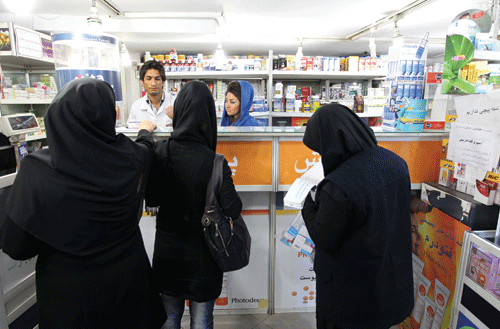
The death last month of Manouchehr Esmaili-Liousi, a 15-year-old boy suffering from hemophilia, has been reported in the Iranian media as the first fatality caused by the latest financial sanctions imposed by the United States and European Union.

While sanctions do not directly target Iranian pharmacies or the wider medical sector, 75 percent of the medicines for treating hemophilia are made in the US and the EU, and supplies have dropped by two-thirds. Drugs are also in short supply for patients suffering from cancer and multiple sclerosis.

The problem is that Iran’s central bank, the only official channel for transferring money abroad, is a major target of sanctions. Many international private banks are increasingly loath to handle transactions or accounts in any way linked to Iran, given the risk of attracting attention from the US Treasury Department.

Without a doubt, 2012 has seen an unprecedented tightening of the noose around Iran. US and EU measures against third-party buyers have halved Iran’s crude oil exports to between 1.1 million and 1.3 million barrels per day, undermining government revenues and helping send the rial into a decline that has seen its international value halved in a year. What’s more, the US congress is intent on legislation that would further reduce President Barack Obama’s room for maneuver in loosening sanctions as a quid pro quo in any negotiations. 

The military stand-off, especially in the Persian Gulf, has become an accepted day-to-day reality. Iran’s shooting at a US surveillance drone early in November reflects a trend that saw 2012 begin with extensive Iranian naval exercises in the Persian Gulf and threats from senior officials — including the first vice-president, Mohammed Reza Rahimi — to close the Strait of Hormuz if there were any move against Iran’s oil exports.

Talks between Iran and the permanent members of the UN Security Council plus Germany, which were revived in May after a lapse of over a year, failed to get beyond generalities. Real progress will not be made through such an unwieldy structure, and it is significant that Sergey Ryabkov, Russia’s deputy foreign minister and point-man on Iran, made it clear last month for the first time that Moscow accepts the need for direct contact between Washington and Tehran.

Reports that senior US and Iranian officials met quietly in Qatar in October may indicate the two sides accept this. The word in Washington is that a window of opportunity has opened with the re-election of Obama as president and will last until preparations begin for the Iranian new year, Nowruz, a festival that closes down the country for several days before March 21. 

The window may close then because when Iran goes back to work after Nowruz, politics will be dominated by the presidential election scheduled for June 14, when voters choose a successor to Mahmoud Ahmadinejad on the expiry of his maximum second term. But the window could then re-open, especially if, as widely expected, the new president has a better relationship with the rahbar (‘leader’), Ayatollah Ali Khamenei, and a clearer unity of purpose replaces the current rivalries between the foreign ministry, the president’s office and the leader’s office. 

Loud whispers in Washington refer to a ‘more for more’ process in which the US would seek verifiable nuclear curbs from Iran in exchange for US concessions, including sanctions relief. But where the US bottom line lies — would Iran have to ship out all its 20 percent-enriched uranium? — is unclear, and considerable political opposition exists on both sides to any kind of deal. 

Another problem for US would-be peacemakers is the perception abroad that the Islamic Republic is vulnerable and even in danger of collapse. Despite sanctions, this is far from true. June’s presidential election will probably have a higher turnout than the 65 percent in the March 2012 parliamentary elections and will no doubt be hailed by the authorities as a victory over the scheming foreigners.

In fact, it may be that tighter sanctions, in ‘heating up’ politics, were partly responsible for March’s turnout being comfortably higher than parliamentary elections in 2004 and 2008, when it barely reached 50 percent. 

Continuing coverage of Iranians dying for lack of medicines may help the authorities to motivate voters. With the US claiming ‘success’ with the sanctions and the Iranian leadership ‘victory’ in its defiance, 2013 is unlikely to make either side any keener on compromise.

Gareth Smyth has reported from around the Middle East for nearly two decades and is the former Financial Times correspondent in Tehran

December 1, 2012 0 comments
0 FacebookTwitterPinterestEmail
  • 1
  • …
  • 298
  • 299
  • 300
  • 301
  • 302
  • …
  • 707

Latest Cover

About us

Since its first edition emerged on the newsstands in 1999, Executive Magazine has been dedicated to providing its readers with the most up-to-date local and regional business news. Executive is a monthly business magazine that offers readers in-depth analyses on the Lebanese world of commerce, covering all the major sectors – from banking, finance, and insurance to technology, tourism, hospitality, media, and retail.

  • Donate
  • Our Purpose
  • Contact Us

Sign up for our newsletter

    • Facebook
    • Twitter
    • Instagram
    • Linkedin
    • Youtube
    Executive Magazine
    • ISSUES
      • Current Issue
      • Past issues
    • BUSINESS
    • ECONOMICS & POLICY
    • OPINION
    • SPECIAL REPORTS
    • EXECUTIVE TALKS
    • MOVEMENTS
      • Change the image
      • Cannes lions
      • Transparency & accountability
      • ECONOMIC ROADMAP
      • Say No to Corruption
      • The Lebanon media development initiative
      • LPSN Policy Asks
      • Advocating the preservation of deposits
    • JOIN US
      • Join our movement
      • Attend our events
      • Receive updates
      • Connect with us
    • DONATE