• Donate
  • Our Purpose
  • Contact Us
Executive Magazine
  • ISSUES
    • Current Issue
    • Past issues
  • BUSINESS
  • ECONOMICS & POLICY
  • OPINION
  • SPECIAL REPORTS
  • EXECUTIVE TALKS
  • MOVEMENTS
    • Change the image
    • Cannes lions
    • Transparency & accountability
    • ECONOMIC ROADMAP
    • Say No to Corruption
    • The Lebanon media development initiative
    • LPSN Policy Asks
    • Advocating the preservation of deposits
  • JOIN US
    • Join our movement
    • Attend our events
    • Receive updates
    • Connect with us
  • DONATE
The Buzz

Morning briefing: 28 Nov 2012

by Executive Staff November 28, 2012
written by Executive Staff

Economics

Brent crude steadied at over US$110 per barrel on Wednesday, not far from a one-week low hit in the previous session, as investors nervously eyed talks to head off a looming fiscal disaster in the United States, the world's top oil consumer.

More from Reuters


Gold traded flat on Wednesday, after falling for two consecutive sessions, as the euphoria over a Greek debt deal fizzled out and investors shifted their focus to US negotiations to avert a looming fiscal disaster in the world's largest economy.

More from Arabian Business


The UAE economy is strong and is registering high growth rates in economic and social sectors, according to the country’s central bank governor, Sultan bin Nasser Al Suwaidi.

More from Gulf Business


Officials in the UAE are reviewing a draft commercial law that will allow 100 percent foreign ownership of some companies, Bloomberg reported, citing the undersecretary of the Abu Dhabi Department of Economic Development.

More from Arabian Business


Companies

Lebanon’s biggest bank, Bank Audi, will launch operations in Iraq next year and rival Byblos Bank is to enter the Libyan market as both contend with a flagging domestic economy

More from The Daily Star


Morocco would rather pursue a strategic partnership for Royal Air Maroc (RAM), with an airline from one of the Gulf states or beyond, than sell a stake in its flag carrier, government ministers has said.

More from Gulf Business


International Petroleum Investment Co (IPIC), the investment vehicle owned by the Abu Dhabi government, will price a $2.9 billion dual-currency bond, at tighter guidance than earlier indicated, due to strong demand.

More from Gulf Business


Ahli Bank, Qatar's seventh-largest listed bank, said on Wednesday that its strategic partner, Bahrain's Ahli United Bank, would sell nearly all its stake in the lender.

More from Arabian Business

November 28, 2012 0 comments
0 FacebookTwitterPinterestEmail
The Buzz

Morning briefing: 27 Nov 2012

by Executive Staff November 27, 2012
written by Executive Staff

Economics

Brent crude rose above $111 per barrel on Tuesday as optimism coursed through financial markets after Greece's international lenders reached a deal on a new debt target, although worries about a looming US fiscal crisis kept a lid on gains.

More from Reuters


Gold traded in a tight range above $1,748 an ounce on Tuesday, as traders moved to the sidelines after initially pushing up bullion by almost US$3 following a deal among Greece's international lenders to cut the country's long-term debt.

More from Reuters


Dubai’s economy expanded 4.1 per cent from a year earlier in the first half of this year, official data showed on Monday, indicating the Gulf’s main trade and financial hub is holding up well in a weak global environment.

More from Gulf Business


Qatar's sovereign wealth fund sold the last of the warrants it owns in Barclays on Monday, notching up a gain of more than £1.7bn ($2.7bn) from the controversial fundraising deal it struck with the bank four years ago.

More from Arabian Business


A large-scale public sector strike is expected across Lebanon on Tuesday organized by the Union Coordination Committee in protest against the government’s delay in finalizing the pay hike. 

More from The Daily Star


Companies

US private equity firm TPG has acquired truck and trailer parts distributor FleetPride from Bahrain's alternative asset manager Investcorp for over US$1bn, Investcorp said in a statement on Tuesday.

More from Arabian Business


Phase one of Dubai’s newly approved AED10bn (US2.7bn) entertainment and leisure development, which will include five theme parks based on movies and characters from Hollywood and Bollywood movies, will be completed in 2014, it has been confirmed.

More from Arabian Business


A quarter of the UAE hotel projects in the pipeline have been put on hold, while 54 per cent will be developed, according to a new study by property consultants Christie and Co.

More from Gulf Business


Dubai Group, part of the ruler of Dubai's personal empire, has cut half its staff of about 30 people as part of cost-cutting measures in its $10 billion restructuring, three sources told Reuters on Monday.

More from Arabian Business


A consortium including Samsung Engineering and Shanghai Electric have won an SR11.3bn ($3bn) deal to build a water desalination plant on the Red Sea coast of Saudi Arabia.

More from Arabian Business

November 27, 2012 0 comments
0 FacebookTwitterPinterestEmail
Economics & Policy

Aleppo: death from the skies

by Sam Tarling November 26, 2012
written by Sam Tarling
A woman holds her daughter as a Syrian air force jet bombs the streets surrounding her house in Aleppo’s Ahayderieh neighborhood [Executive/Sam Tarling]
The body of a child is carried from the rubble of a destroyed building after an aerial bombardment in Aleppo’s Ahayderieh neighborhood [Executive/Sam Tarling]
Residents load the body of a woman killed in an airstrike into a van as a government warplane circles overhead. In the background Free Syrian Army fighters fire futilely at the aircraft [Executive/Sam Tarling]
A man films a jet as it passes overhead shortly after it bombed a nearby house [Executive/Sam Tarling]
A Syrian air force jet drops a bomb on Aleppo. Moving across the skies unchallenged, the jets can strike at will anywhere in the city, with devastating effect [Executive/Sam Tarling]
Smoke rises as a rocket explodes on the eastern outskirts of Aleppo [Executive/Sam Tarling]
Civilians of Aleppo are watching their city being torn apart [Executive/Sam Tarling]
Two men inspect the damage after another Syrian air force attack on a residential apartment complex [Executive/Sam Tarling]
The debris of homes blown into the streets make some areas of Aleppo nearly impassable [Executive/Sam Tarling]
Queuing for bread at bakeries like this one in Aleppo can mean risking one’s life, as they have recently become targets for the Syrian air force [Executive/Sam Tarling]
Once a thriving hub for small business, heavy fighting between government troops and the rebels in Aleppo has destroy thousands of livelihoods [Executive/Sam Tarling]
One of the thousands of workshops blown apart in fighting between rebel fighters and regime soldiers [Executive/Sam Tarling]
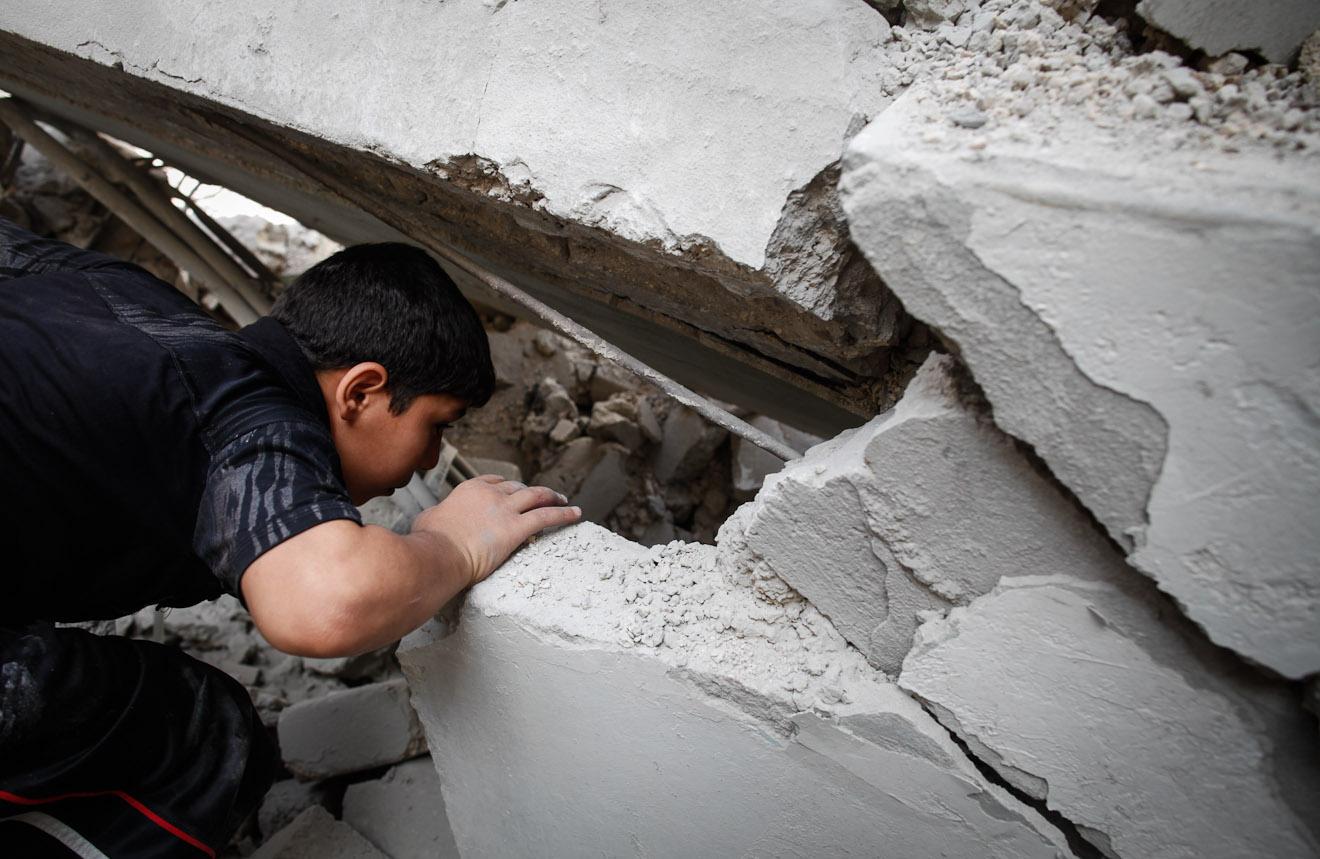
Civilians are by far paying the heaviest toll in fighting between opposition and government forces in Aleppo. This single air strike in the Tariq Al Bab neighborhood destroyed six homes.
A boy takes a closer look at damaged caused when six houses were destroyed by an aerial bombardment Aleppo’s Tariq Al Bab neighborhood [Executive/Sam Tarling]
A so-called “barrel bomb” dropped from either a plane or helicopter fell through the top floors of this building and exploded on the ground floor, destroying the building and blowing out the walls in six surrounding homes in Aleppo’s Tariq Al Bab neighborhood [Executive/Sam Tarling]
A man weeps after returning to the site where his aunt, uncle, and five nieces and nephews were killed when an airstrike destroyed six homes in Aleppo’s Tariq Al Bab neighborhood [Executive/Sam Tarling]
On a bad day, the sheer volume of casualties causes hospitals to run out of space for the dead. Here, the body of a civilian who was killed by a sniper is left on the floor as doctors treat other patients who they still have a hope of saving, at the Dar a Shafaa hospital in Aleppo’s Tariq Al Bab neighborhood [Executive/Sam Tarling]
As the death toll of the conflict climbs, fresh graves are becoming ever more numerous in cemeteries around Aleppo [Executive/Sam Tarling]

Photoblog from the front lines of Syria’s biggest city

November 26, 2012 0 comments
0 FacebookTwitterPinterestEmail
Business

Scaling the heights

by Sam Tarling November 26, 2012
written by Sam Tarling
05:39 Five hours from now, the three rolled up 15 by 15 meters banners that will cover a sizable chunk of Lebanon's City Mall. But for now they are in a corner in the Beirut office of PrintWorks [Photo: Sam Tarling/Executive]
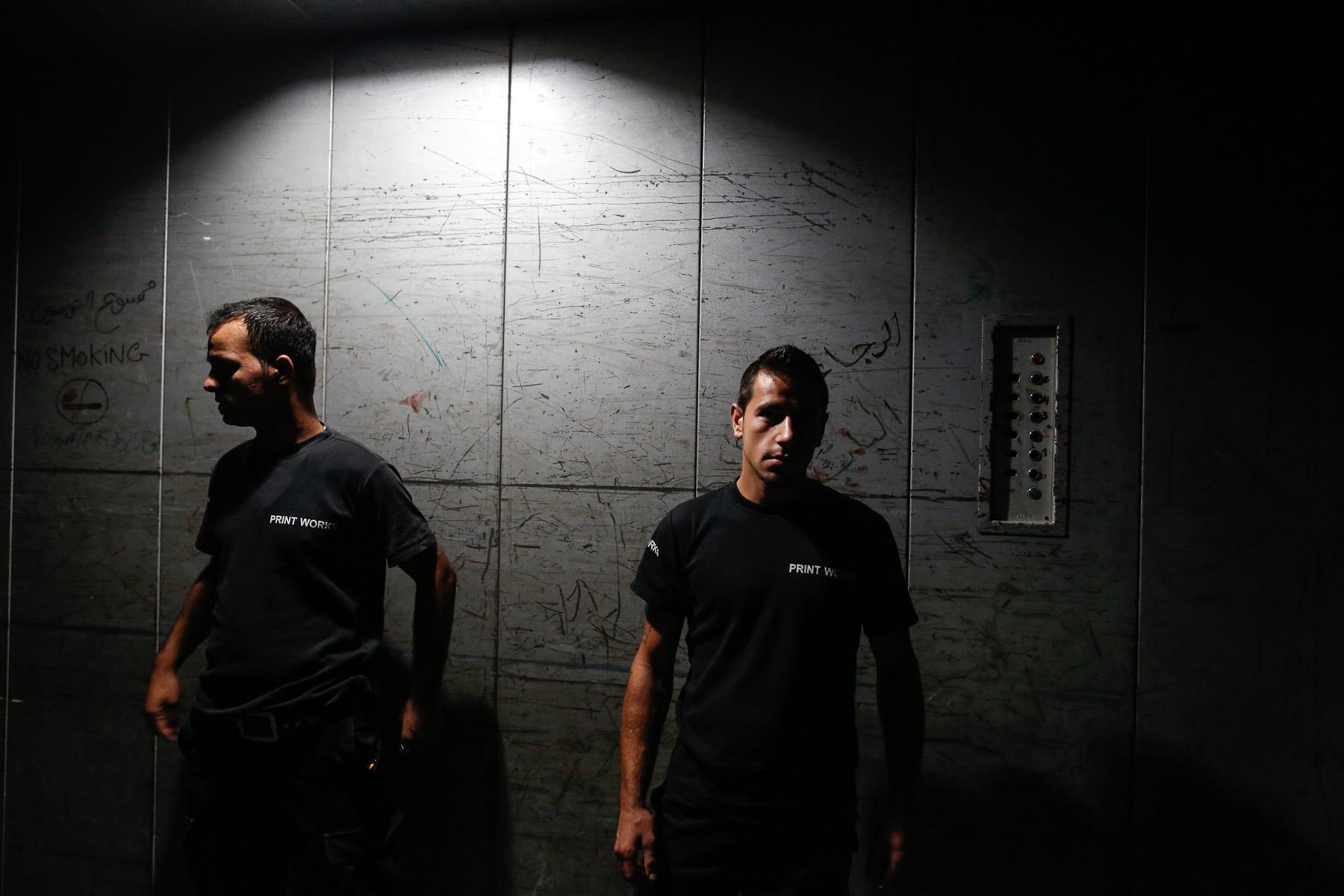
05:43 The day starts with a tough job as the installation team heave the banners to a service elevator [Photo: Sam Tarling/Executive]
05:48 From there they are taken up the elevator. The men know that they are on a tight deadline as the banners must be up before the mall opens at 10. [Photo: Sam Tarling/Executive]
06:02 As the first ladder goes up, the team have just fours hours to transform the outside of the building [Photo: Sam Tarling/Executive]
06:22 A banner is tied with rope ready to be hauled up to the narrow gantry that runs beneath where it will be hung [Photo: Sam Tarling/Executive]
06:25 The men quickly haul up the heavy banner to a ledge. The lack of space leaves little room for error [Photo: Sam Tarling/Executive]
06:30 With equally generous helpings of bravery and skill, an installation team member scales the wall of the mall using nothing but the edge of the banner installation and a series of centimeter-wide protrusions on an air duct. [Photo: Sam Tarling/Executive]
06:59 With three hours until the deadline, the team haul the first banner into position. [Photo: Sam Tarling/Executive]
07:34 Things then go quickly and within 40 minutes all three banners are hung. Now the team have to secure them to the rooftop [Photo: Sam Tarling/Executive]
08:01 Using abseiling equipment, the men smooth out creases in the banners by twisting lengths of wire to pull the edges tight. [Photo: Sam Tarling/Executive]
08:42 A team member surveys his handiwork after pulling the edges of the banner. [Photo: Sam Tarling/Executive]
08:51 As the team work on the last corner of the last banner, a heavy wind springs up. It takes the entire weight of a man to stop the banner from billowing out of control. Fearing a storm, the team push hard to finish the job [Photo: Sam Tarling/Executive]
09:42 The team have beaten the clock by 15 minutes. The banner is up and they even have time to check their work [Photo: Sam Tarling/Executive]

Photogblog on the process of changing a giant billboard

November 26, 2012 0 comments
0 FacebookTwitterPinterestEmail
The Buzz

Morning briefing: 26 Nov 2012

by Executive Staff November 26, 2012
written by Executive Staff

Economics

Brent crude held above US$111 a barrel on Monday as hopes Greece can avoid a near-term bankruptcy brightened the outlook for oil demand from Europe, while violent protests in Egypt reignited supply concerns.

More from Arabian Business


Egypt’s main stock index fell nearly 10 percent on Monday as fresh clashes over President Mohammed Morsi’s proposed constitutional changes consumed central Cairo.

More from the Los Angeles Times


The Gulf region, which has large numbers of migrant workers, continues to see "robust growth" in remittance flows when compared to Western Europe, a new World Bank report has said.

More from Arabian Business


Companies

Qatar Holding LLC has cashed in on its remaining warrants in Britain’s Barclays Plc, a move that still leaves the sovereign wealth fund as the bank’s top shareholder while their relationship faces legal scrutiny.

More from Gulf Business


UAE-based Network International has gained a foothold in India by taking control of TimesofMoney, a digital payment firm, in a move that it hopes will help it to earn a slice of the lucrative remittances market.

More from The National
 

And finally…

Almost 37,000 motorists were caught talking on their mobile phones while driving during the first 10 months of this year, Dubai Police said.

More from The National

November 26, 2012 0 comments
0 FacebookTwitterPinterestEmail
The Buzz

Morning briefing: 23 Nov 2012

by Executive Staff November 23, 2012
written by Executive Staff

Economics

Oil prices fell on Friday as a cease-fire agreement between Israel and Hamas that stopped weeklong fighting in the Gaza Strip continued to hold.

More from The Daily Star


An IMF agreement for a loan to Egypt provides stability, confidence and international support for fiscal consolidation and structural reform. the body has said.

More from AME Info


Companies

One of India's largest listed real estate developers has announced the launch of its first overseas office in the UAE. Indiabulls Real Estate Ltd, which has delivered 3.3 million sq ft developed space valued at $1.75bn in the last four year, has set up in Dubai's Karama area.

More from Arabian Business


Dana Gas, in talks to restructure a $920m Islamic bond, is offering bondholders cash and an average 8 percent coupon on two new sukuks to replace the existing one, two sources said.

More from Arabian Business


Citadel Capital has agreed with Qatari investors to import liquefied natural gas (LNG) into Egypt from mid-2013, the Egyptian private equity firm has said.

More from Arabian Business


Politics

The Egyptian president Mohammed Morsi has sacked the prosecutor general, ordered a retrial of Mubarak officials and placed himself above judicial oversight, in moves condemned by campaigners.

More from The National


Guy Fawkes masks have been banned from National Day celebrations in the UAE amid fears that people could wear them to symbolise opposition to the state.

More from The National


On the first anniversary of the Bahrain Independent Commission of Inquiry (BICI), Bahrain's government has issued a forceful defence of progress made towards reform.

More from The National

November 23, 2012 0 comments
0 FacebookTwitterPinterestEmail
The Buzz

Israel vs. Gaza: Goliath vs. David

by Benjamin Redd November 23, 2012
written by Benjamin Redd

A glance at coverage of the current war between Israel and Gaza would lead one to believe that each combatant brings powerful forces to bear against the other. Yet the reality is that Israel’s military and economic dominance over Gaza is so huge that it is less a battle of equal forces than a military superpower taking on a statelet — a Goliath and David match-up.
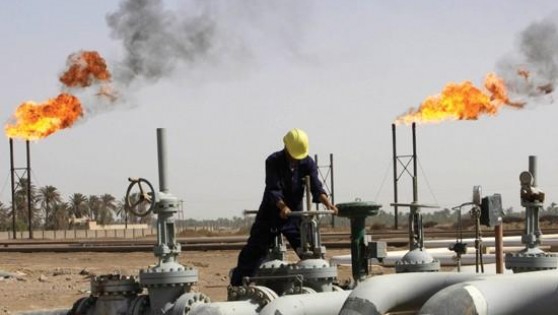
Click here or on the picture below to see our interactive guide to the two foes different strengths.

November 23, 2012 0 comments
0 FacebookTwitterPinterestEmail
The Buzz

Morning briefing: 22 Nov 2012

by Executive Staff November 22, 2012
written by Executive Staff

Economics

Brent crude hovered near $111 as the Chinese economy showed further signs of recovery, bolstering the outlook for oil demand, although the upside was limited as a ceasefire in the Gaza Strip eased concerns over supply.

More from Arabian Business


The presence of US aircraft carriers in the Gulf region will decrease from two to one for around two months, after a warship that was due to deploy to the area is to undergo unexpected repairs.

More from Gulf Business


Companies

Dana Gas has agreed with the governments of Sharjah and Ajman to develop a gas field off the two emirates’ coasts with production expected to start in the first half of 2014, the company said on Thursday.

More from Gulf Business


Saudi Arabia's Rafal Real Estate Development Company said this week that after an 18-month build period its Burj Rafal project remains on track to be completed in eight months.

More from Arabian Business


The board of directors of Casino du Liban – Lebanon’s only state-run casino – has decided to give 250 contractual employees full-time employment starting in 2015, following two weeks of protests and sit-ins.

More from The Daily Star

The board of directors of Casino du Liban has decided to give 250 contractual employees full-time employment starting in 2015, following two weeks of protests and sit-ins

Read more: http://www.dailystar.com.lb/Business/Lebanon/2012/Nov-22/195883-casino-du-liban-reaches-deal-with-contract-workers.ashx#ixzz2CwUS98h2
(The Daily Star :: Lebanon News :: http://www.dailystar.com.lb)

The board of directors of Casino du Liban has decided to give 250 contractual employees full-time employment starting in 2015, following two weeks of protests and sit-ins

Read more: http://www.dailystar.com.lb/Business/Lebanon/2012/Nov-22/195883-casino-du-liban-reaches-deal-with-contract-workers.ashx#ixzz2CwUS98h2
(The Daily Star :: Lebanon News :: http://www.dailystar.com.lb)


Politics

A ceasefire between Israel and the Hamas movement that runs the Gaza Strip appeared to be holding on Thursday.

More from the BBC

November 22, 2012 0 comments
0 FacebookTwitterPinterestEmail
Comment

Gassing up against Uncle Sam

by Sami Halabi November 22, 2012
written by Sami Halabi

Amidst the fog of war in Syria, the clamor of sanctions and the threat of conflict in Iran, some transnational business deals in the region have slipped quietly. That was certainly the case in July 2011 when the Western press largely ignored the announcement by Syria, Iran and Iraq that they were to build a gas pipeline to transport Iranian natural gas from the South Pars Field in the Persian Gulf through Baghdad to Damascus.

At the time the saber rattling over the Iranian nuclear program was in full swing and protests in Syria were turning to armed conflict. Many, as a result, thought that the project would prove to be stillborn. But the announcement on Monday that Iran has already commenced building the first stage of the project — running from Kuhdasht in western Iran to Baghdad — has come as a wake up call to many, even though several of the original objectives of the scheme may never be met.

The project proposes a 110 million-cubic-meter-per-day (mcm/day) pipeline that originates in Kuhdasht and traverses some 1,500 kilometers end-to-end. The pipeline is tipped to cost some $10 billion in total, and the initial agreement sees guaranteed stock purchases of some 25 mcm/day by both Iraq and Syria. The first phase, costing $3 billion, will see a 225-kilometer pipeline come to Iraq (apparently through Baghdad) to supply its power plants. Rates and payment structures of the project have not been made public and the entire project is supposed to be completed by mid-2013.

The likelihood at this stage that the pipeline will ever reach Syria is small. Building a pipeline is a serious construction effort and the route needs to be secured — something the Assad regime will have a hard time doing in the midst of a civil war.

What is more likely is that the gas reaches Iraq and stays there. For starters, Iraq desperately needs the natural gas imports. The country’s estimated natural gas consumption is rapidly increasing and has grown almost a third this year — from 1,084 kilotons of oil equivalent (ktoe) to 1,423 ktoe — and is forecast to rise by a further 18 percent next year, according to the Economist Intelligence Unit. Of that consumption much will go to electricity generation, predominately in gas-powered electricity projects that are currently in development. Already two 1,750-megawatt power plants have been contracted out and are tipped for completion in 2013, and another tender was launched for a 1,500-megawatt project in May.

Thus, Iraq needs gas, and quickly. And as the United States continues to draw down its resources and influence in the country this pipeline project would tie Baghdad ever closer to Tehran. Depending on the type and efficiency of the plants and networks, the pipeline could cover much if not all of Iraq’s projected demand for gas, especially if the pipe never reaches Syria.  

There is a litany of possible complications, however, from simply securing the pipeline route through a still volatile Iraq, to the contradicting alliances and animosities between the US, Iraq and Iran. How exactly will it play out with the Americans attempting to enlist allies — among them Iraq — to tighten the sanctions noose on Iran and squeeze its energy export revenues at the same time that Iraq is entering a billion-dollar energy deal with Tehran? Interesting times await indeed.

Baghdad is becoming well practiced at playing multi-faced international diplomacy, however, having thus far maintained both its alliance with Washington and helping to prop up the regime of President Bashar al-Assad in Damascus while Washington backs the opposition seeking Assad’s removal. But the discovery by the Financial Times last month that Iraq has agreed to export 60,000 tones of fuel oil for power generation and industry to Syria suggests Baghdad remains willing to help the Assad government stay afloat. 

Whether Iraq will be able to continue playing on so many sides remains to be seen. What is clear, however, is that a pipeline project that was quickly dismissed last year as a public relations stunt could turn into one of the most sensitive and controversial geo-political issues in tomorrow’s Middle East.


Sami Halabi is a master of public policy candidate at the University of Edinburgh and formerly managing editor of Executive

November 22, 2012 0 comments
0 FacebookTwitterPinterestEmail
Comment

The Kurdish triangle

by Riad Al-Khouri November 21, 2012
written by Riad Al-Khouri

Almost 20 months into the Syrian crisis, a heady mixture of Arab, Turkish, and Kurdish nationalisms are adding another level of complexity to confusion. Consider the following emerging triangular strategic relations between Turkey and the region’s Kurds. The Turkish government loves the folks in Iraq’s autonomous Kurdistan province, but hates some of their kin in northern Syria; even while Iraqi and Syrian Kurds draw closer.

See also: Could a Syrian Kurdistan work?

One arm of this triangle was formed by Turkey’s emergence as an economic partner of Iraq’s Kurdish region, in hydrocarbons and many other sectors. Iraqi Kurdistan is now the Turks’ eighth-biggest export destination. Meeting people in the public and private sectors on my visits to the regional capital of Erbil this year confirmed the ubiquity of Turkish business there. Of course, all this benefits both Turks and Kurds.

By contrast, Ankara’s relations with Kurds in northern Syria, another side of the triangle, are tense. The presence on the Syrian-Turkish border of the Kurdistan Workers Party (known by its Kurdish-language initials PKK) led to warnings by Turkey in July that it would act in northern Syria against any threatening groups. That was prompted by the pullout of Syrian troops from Kurdish regions, viewed by Ankara as emboldening Kurds in Syria to hit Turkey in retaliation for its anti-Damascus stance. Previously, the Syrian government had kept the PKK quiet, but the Turks now face enclaves in northern Syria under the control of Kurds supporting autonomy inside Turkey.

Then there’s the base of the triangle, linking Syria’s Kurds and Erbil’s Kurdistan Regional Government (KRG). In this respect, a major player in Syria is the Democratic Union Party (known by its Kurdish initials PYD) the dominant Kurd faction in the country and a close ally of the PKK. While relations between the KRG and PYD have often been hostile, over the summer the latter put aside its differences with the former and joined the KRG-backed Kurdish National Council coalition, made up of 15 Kurdish Syrian groups seeking Kurdish autonomy in Syria. Meanwhile, the head of the KRG, Massoud Barzani, has admitted that some Syrian Kurds have been receiving basic military training in Iraqi Kurdistan. The Turks, for their part, rely on the KRG to send diplomatic messages to the PYD and its friends. (A major example of the use of such channels was Turkish Foreign Minister Davutoglu’s visit to Erbil this summer to reiterate threats against Syria’s Kurds.)

The recent de facto Kurdish semi-autonomy in parts of northern Syria shows interesting parallels with the autonomous KRG-led province of Iraq. Yet, the dispersed state of Syria’s Kurds, scattered among Arab and other ethnicities in a band hundreds of kilometers wide, makes creation of a separate, large, and geographically contiguous Kurdish Syrian province problematic; even if it were to emerge from the convulsions of war, any “Syrian Kurdistan” would not likely enjoy common borders with KRG territory as presently constituted.

However, the recent history of the region has shown that the improbable can quickly become likely, and even inevitable. Under an optimistic scenario for Kurdish nationalists — and a nightmare for Ankara or Baghdad — territory in southeast Turkey and northwest Iraq could, in a geopolitical upheaval, become fair game for Kurds demanding expansion of their autonomous or semi-autonomous areas in Iraq and Syria, or even calling for a sovereign state.  

Talk of an independent Kurdistan has long perturbed Iraq, Syria, and Turkey (not to mention Iran), with Kurdish statehood — or merely expanded autonomy — having immense regional ramifications. Linguistically and culturally distinct from neighbors, there are estimates as high as 36 million Kurds living in the four countries. In many ways, 2012 is turning out to be good for many Kurds, with rich businessmen in Erbil becoming richer, and peasants in northern Syria getting a taste of semi-autonomus freedom. Yet, the Kurds’ future may not be tranquil: as Turkey’s Kurds step up separatist campaigns, and northern Syrian areas face intensified fighting, events in Kurdish zones could heat up and radically alter the region’s geopolitical landscape.  


Riad al-Khouri is an economist and a principal at Development Equity Associates

November 21, 2012 0 comments
0 FacebookTwitterPinterestEmail
  • 1
  • …
  • 299
  • 300
  • 301
  • 302
  • 303
  • …
  • 696

Latest Cover

About us

Since its first edition emerged on the newsstands in 1999, Executive Magazine has been dedicated to providing its readers with the most up-to-date local and regional business news. Executive is a monthly business magazine that offers readers in-depth analyses on the Lebanese world of commerce, covering all the major sectors – from banking, finance, and insurance to technology, tourism, hospitality, media, and retail.

  • Donate
  • Our Purpose
  • Contact Us

Sign up for our newsletter

    • Facebook
    • Twitter
    • Instagram
    • Linkedin
    • Youtube
    Executive Magazine
    • ISSUES
      • Current Issue
      • Past issues
    • BUSINESS
    • ECONOMICS & POLICY
    • OPINION
    • SPECIAL REPORTS
    • EXECUTIVE TALKS
    • MOVEMENTS
      • Change the image
      • Cannes lions
      • Transparency & accountability
      • ECONOMIC ROADMAP
      • Say No to Corruption
      • The Lebanon media development initiative
      • LPSN Policy Asks
      • Advocating the preservation of deposits
    • JOIN US
      • Join our movement
      • Attend our events
      • Receive updates
      • Connect with us
    • DONATE