• Donate
  • Our Purpose
  • Contact Us
Executive Magazine
  • ISSUES
    • Current Issue
    • Past issues
  • BUSINESS
  • ECONOMICS & POLICY
  • OPINION
  • SPECIAL REPORTS
  • EXECUTIVE TALKS
  • MOVEMENTS
    • Change the image
    • Cannes lions
    • Transparency & accountability
    • ECONOMIC ROADMAP
    • Say No to Corruption
    • The Lebanon media development initiative
    • LPSN Policy Asks
    • Advocating the preservation of deposits
  • JOIN US
    • Join our movement
    • Attend our events
    • Receive updates
    • Connect with us
  • DONATE
Editorial

Rotten to the core

by Yasser Akkaoui November 13, 2012
written by Yasser Akkaoui

The bombing near Sassine Square on October 19 that tore apart a neighborhood and hundreds of lives, homes and businesses was a deliberate, savage crime perpetrated by those seeking to destroy stability in Lebanon. The response to this horrific event by members of the country’s March 14 and March 8 political coalitions was cowardly, self serving, and in many cases also deliberately intended to sow sectarian strife.

That our politicians would so immediately manipulate the tragedy, pain and suffering of others to fit their own agenda is as clear a sign as there can be that they are rotten to the core.

There is a conspiracy in Lebanon, and they are all a part of it.

Politicians on all sides, during the previous reign of March 14 and the current March 8 administration, set new definitions for the abuse of authority, seeking self-enrichment, power and the furthering of divisive agendas at the nation’s expense.

This country needs new leaders, and there are few better places to look for this new breed than among Lebanon’s entrepreneurs — young people who are inspired, aware and motivated, whose commitment to Lebanon has them trying to build their businesses at home despite the failures of the system and the sins of our leaders and, recognizing these obstacles and the odds against them, they have still managed to push forward their ideas and see them realized.

And that is why, with all that has happened this past month, we at Executive have chosen now to celebrate this country’s entrepreneurs — they are our hope for a better future.        

November 13, 2012 0 comments
0 FacebookTwitterPinterestEmail
The Buzz

Morning briefing: 13 Nov 2012

by Executive Staff November 13, 2012
written by Executive Staff

Economics

Gold slipped in thin trade on Tuesday after the euro dropped to a two-month low against the US dollar and uncertainty about another tranche of financial aid for Greece to help pay off its debt kept investors cautious.

More from Reuters


Brent crude slipped below US$109 on Tuesday, declining for a second day on worries about demand growth in a well-supplied market, as the United States and the European Union grapple with their financial woes.

More from Reuters


Employees in the Middle East can expect a 6 percent salary increase in 2013. Salaries in Egypt are expected to see the biggest growth, predicted to rise 9.5 percent.

More from AME Info


Consumer confidence in Lebanon hit a record low in the first half of 2012 following deterioration in economic performance and spillovers from the Syrian conflict, according to the Byblos Bank/AUB Consumer Confidence Index published Monday.

More from The Daily Star


Companies

Shares in Dubai-listed Air Arabia have risen to a seven-month high after the carrier posted quarterly earnings that beat analysts' estimates.

More from Arabian Business


Boeing and Qatar Airways have celebrated the delivery of the airline's first Boeing 787 Dreamliner. The airplane, the first of 30 787s ordered by the Doha-based airline, is also the first to be delivered to an airline in the Middle East.

More from AME Info


ExxonMobil has told Iraq's top oil official that the company is actively seeking to sell its stake in the super-giant West Qurna 1 oil field. In a recent meeting with Deputy Prime Minister for Energy Hussain al-Shahristani, an Exxon executive said the company "wishes to withdraw from the West Qurna field," according to Shahristani's spokesman Faisal Abdullah.

More from Iraq Oil Report

November 13, 2012 0 comments
0 FacebookTwitterPinterestEmail
Society

Laid to rest

by Sam Tarling November 12, 2012
written by Sam Tarling

A casket is carried at the funeral of two supporters of Salafi Sheikh Ahmed al-Assir on November 12, 2012. The pair were killed along with a bystander during clashes with Hezbollah in the city of Sidon the previous day over the removal of posters commemorating the Shia festival of Ashura.
Relatives mourn over the coffins inside Sidon’s Martyrs’ Mosque [Photo: Executive/Sam Tarling]
An armed supporter of Assir stands guard outside the Mosque [Photo: Executive/Sam Tarling]
The body of one of the men is carried to the street to be taken to be buried [Photo: Executive/Sam Tarling]
The dead men were carried by hand for over three kilometers to the burial site beside the Hariri Mosque on Sidon’s northern fringe [Photo: Executive/Sam Tarling]
Assir and singer Fadel Shaker were flanked by armed guards during the procession [Photo: Executive/Sam Tarling]
Nervous of snipers, one of Assir's bodyguards scans the rooftops [Photo: Executive/Sam Tarling]
Assir (c) himself led the march, with his supporters chanting slogans denouncing Hezbollah and Amal leader Nabih Berri [Photo: Executive/Sam Tarling]
At the roundabout facing the Hariri Mosque, the first body was laid to rest [Photo: Executive/Sam Tarling]
People wept as the bodies were placed into the ground [Photo: Executive/Sam Tarling]
The second body was held above a crush of mourners as it was passed to the grave site [Photo: Executive/Sam Tarling]

In early November 2012, two Salafis were killed in clashes with Hezbollah in the city of Sidon the previous day over the removal of posters commemorating the Shia festival of Ashura. On the 12th of the month, leading Salafis took to the streets for their funeral.

November 12, 2012 0 comments
0 FacebookTwitterPinterestEmail
The Buzz

Morning briefing: 12 Nov 2012

by Executive Staff November 12, 2012
written by Executive Staff

The global oil market is in a good shape and Saudi Arabia is happy with the current oil price, Saudi Oil Minister Ali al-Naimi said on Sunday, expressing satisfaction over a Gulf Arab effort which kept prices in check.

More from Arabian Business


The UAE economy is showing impressive resilience with Dubai recording a steady improvement from a negative to two per cent growth in 2011 and a projected 3.4 per cent growth in 2012 and even a higher growth rate in 2013, the International Monetary Fund, or IMF, said on Sunday.

More from Khaleej Times


Elsewhere, the UAE's Minister of Economy Sultan bin Saeed Al Mansouri expects up to four per cent economic growth in 2012.

More from Khaleej Times


Kuwait's market is expected to see limited impact from Sunday's demonstrations, which were carried out under tight security, but weakness in global markets is likely to weigh on Gulf sentiment.

More from Arabian Business


The Middle East tourism market lagged behind other parts of the world in the first eight months of this year. According to new figures released by United Nations World Tourism Organisation, the region saw a one percent fall in tourist numbers between January and August.

More from Arabian Business


Companies

Dubai-based Emirates Airline posted a net profit of $464m for the first six months of its current fiscal year ending September 30, a rise of 104% compared to the same period a year ago.

More from AME Info


Politics

The Palestinian Authority will submit a bid to the United Nations General Assembly for non-state membership this month, president Mahmoud Abbas said yesterday.

More from The National


Israel is "prepared to escalate" its response to a flare-up of violence along its border with the Gaza Strip, Israeli Prime Minister Benjamin Netanyahu warned today.

More from The National

November 12, 2012 0 comments
0 FacebookTwitterPinterestEmail
The Buzz

Morning briefing: 9 Nov 2012

by Executive Staff November 9, 2012
written by Executive Staff

Economics

Brent crude futures steadied above $107 on Friday and were poised to end the week with a marginal gain, their first in four, but prices are likely to remain under pressure as the outlook for the global economy, and fuel demand, remains weak.

More from Arabian Business


Lebanese Energy and Water Minister Gebran Bassil said Thursday he expects companies to be invited to start bidding for oil and gas excavation licenses before the end of this year, should everything go according to plan.

“The executive decrees concerning oil and gas exploration are supposed to be issued soon. We should have done this work before, but as they say ‘it’s better late than never,’” Bassil said.

More from The Daily Star


Royal Dutch Shell, RWE and TransGlobe Energy have won concessions in Egypt’s first licensing round since the 2011 revolution in a sign that international oil firms are undeterred by a payment backlog of billions of dollars.

More from The Daily Star


Air traffic management and safety are key priorities for Middle East aviation officials as the region looks to build on its rapid growth over the past decade, Tony Tyler, director general and CEO of the International Air Transport Association (IATA), has said.

More from Arabian Business


The former governor of Iraq's central bank who was removed from his job amid allegations of financial impropriety has vowed to clear his name.

More from The National


Iran has frozen the import of more than 2,000 products deemed "luxury goods" to address a shortage of foreign currency caused by Western sanctions, media reports said Thursday quoting trade officials.

More from The Daily Star


Companies

Abu Dhabi's Aabar Investments, the top shareholder in Italian bank UniCredit, has lost its chief financial officer and another top executive, sources familiar with the matter said.

More from Arabian Business


The search for the UAE’s most outstanding businesses, entrepreneurs and business leaders has finally ended with the announcement of the winners of the inaugural Gulf Capital SMEinfo Awards.

More from Khaleej Times


Middle Eastern buyers piled into London’s luxury home market in October as they shielded their wealth from political turmoil back home, including the Syrian civil war.

More from The Daily Star


Qatar National Bank (QNB) Group announced that it has successfully issued a $1 billion bond under its Euro Medium Term Note (EMTN) Program in the international capital markets.

More from Gulf Business


November 9, 2012 0 comments
0 FacebookTwitterPinterestEmail
Economics & Policy

A slippery second step

by Joe Dyke November 9, 2012
written by Joe Dyke

And as if from nowhere, there was a breakthrough.

Ten months after the Council of Ministers, Lebanon’s cabinet, demanded the establishment of a Petroleum Administration (PA), and nine months after the Energy Minister promised to do so, on Wednesday the six-member body was finally established. Many of those watching from the sidelines were beginning to abandon hope that a deal would ever be struck.

As the year has gone on, Lebanon’s inability to form the crucial committee — which will negotiate with international oil companies and eventually issue licenses for drilling — has allowed its neighbors Israel and Cyprus to pull further ahead in the rush to explore offshore oil and gas. Now, finally, the country can take the next steps in its bid to tap the huge potential wealth off its coast.

Pulling the wool over everyone’s eyes

Yet while having a committee is undoubtedly better than not, there are many questions to be asked about the one that emerged, foremost among which is the speed at which the decision was made. Wednesday's cabinet meeting focused on the current standoff with unions over wages, but with a few minutes remaining the PA was brought up. Reports allege that it was confirmed with little debate.

Member of Parliament Ghazi Youssef, an energy expert from the opposition Future Movement, said the eventual decision was pushed through too fast for proper regulation, and even charged that Prime Minister Najib Mikati was not given time to scrutinize the six-member list.

“I think the process is flawed, the minister (of Energy Gebran Bassil) wanted to push it through without any oversight,” he said. “I have heard that even the prime minister was not given the list of nominees before having to make the decision.”

The appointments are for six years, during which time Lebanon could begin to reap the benefits of its offshore resources. The body will play a crucial role in getting the best deal for Lebanon for its offshore gas, which Roudi Baroudi, an independent energy consultant and Secretary General of the World Energy Council’s (WEC) Lebanon Member Committee, has estimated could be worth up to $100 million per day.

And yet there are already concerns whether the six men selected are up to the job. Baroudi said that while he welcomed the PA he was concerned that the members were too inexperienced in the field. “You can see that of the people on the list, not all of them have anything to do with oil and gas. I have heard the names and some of them are very young,” he said.

Wissam Zahabi, head of Economic and Financial Affairs on the committee, is well respected but, in his early forties, has relatively little experience in the kind of deal making that will be required in the coming year, while other members have less than a decade in the industry.

“Members of a committee of this nature have to have 25 years experience or more to be able to negotiate with the heads of International Oil Companies (IOCs) like Shell and get a good deal,” Baroudi added.

Sectarianism strikes again

Part of the issue is Lebanon’s sectarian system, which demands that senior positions are shared out on the basis of religious affiliation. Of the six members, there are three Christians (Greek Catholic, Maronite, and Greek Orthodox) and three Muslims (Sunni, Shiite and Druze).

Then there is the inevitable political wrangling as politicians seek influence over the multi-billion dollar industry. Parliamentary speaker Nabih Berri is alleged to have orchestrated the deal that finally broke the stalemate, but all major political groupings will seek influence over the related deals.

This process, as Dany Haddad from the Lebanese Transparency Association points out, can lead to the square pegs being jammed into round holes.

“I don’t believe that there was an opening online for them to submit their CV and then be judged on their merits. It is not selected on merit, it is selected on denomination,” he said. “The entire procedure should be changed — there must be an authority that elects those people, they should be selected by experts, not politicians.”

Others are less concerned. Mohammed Qabbani, head of parliament's Public Works, Transport, Energy and Water Committee, said the decision was to be welcomed.

“I think it is a positive step towards taking the executive path concerning oil and gas exploration,” he said. “Until now we have been talking about laws and degrees on paper, now this is the first executive step which will lead to the start of giving licenses.”

Qabbani denied that there had not been sufficient scrutiny of the process, saying each member had been selected from a three-person shortlist. “The names have been known for some time; there are no surprises in there.”

Whatever the merits of the committee, they will have to hit the ground running, as the next year will be pivotal. If the proposed schedule is kept in the next two to three months, the PA will finalize the decrees to be issued by the government. After that IOCs will be given six months to prepare and present their cases. This will be followed by four months of negotiation, culminating, theoretically, in agreements in around a year’s time.

In this period, the potential for infighting between Lebanon’s notoriously bickering politicians is huge. Indeed, international energy giants seeking to negotiate a better deal may find it in their interests to play rival political groupings off against each other.

Baroudi stressed that the two main political groupings — the opposition March 14 and the ruling March 8 — must seek unity or else the country would end up negotiating a bad deal. “The most important thing is a complete understanding between March 14 and 8 and then the second most important thing is the rule of law,” he said. “I hope this is not a political football because this could help all Lebanese across the country.”


Who’s on the Petroleum Administration?

Executive Magazine asked the Ministry of Energy for full CVs of the members, but as of time of publication had not received any such documents.

Wissam Chbat

Born: 1973

Religion: Maronite

Years of experience: 15

Role: Head of Geology and Geophysics

Previous employer: Petroleum Adviser to the Minister of Energy.

Bio: Been heavily involved in the bidding process after being appointed an advisor by Energy Minister Gebran Bassil. Well-known and respected in the field, though close to the minister.


Gaby Daaboul

Born: 1968

Religion: Greek Orthodox

Years of experience: 18

Role: Head of Strategic Planning

Previous employer: Legal advisor at Safadi Foundation

Bio: Closely linked to the Minister of Finance Mohammed Safadi, he has been heavily involved with the development of Lebanon’s offshore oil and gas. Has received training in Norway on the project.


Nasser Hoteit

Born: 1959

Religion: Shiite

Years of experience: 29

Role: Head of Technical and Engineering

Previous employer: Total oil company

Bio: Previously a well-respected expert with the global energy giant Total, Hoteit is not believed to have been heavily involved in the search for offshore resources until now.


Asim Abu Ibrahim

Born: 1976

Religion: Druze

Years of experience: 13

Role: Head of quality control, health, safety and the environment 

Previous employer: Abou Ibrahim Riad Trading Est.

Bio: Ibrahim is less well-known in energy circles and, having completed his studies in 2001, is younger than other members of the board. He previously work for Bureau Veritas – which produces diversified solutions for major oil companies.


Walid Nasser

Religion: Greek Catholic

Role: Head of Strategic Planning section

Previous employer: UNDP

Bio: Like other board members, Nasser is under the age of 40 but is well-respected due to his experience with the United Nations.


Wissam al-Zahabi   

Born: 1970    

Religion: Sunni

Years of experience: 17

Role: Head of Economic and Financial Affairs

Previous employer: Policy Specialist at UNDP and energy adviser at the presidency of the Council of Ministers.

Bio: Like Wissam Chbat, Zahabi is well-known in the Lebanese energy sector. He advised the previous Prime Minister Saad Hariri and was kept on by his successor Najib Mikati.

November 9, 2012 0 comments
0 FacebookTwitterPinterestEmail
The Buzz

Morning briefing: 8 Nov 2012

by Executive Staff November 8, 2012
written by Executive Staff

Economics

A new Turkish state oil and gas company is negotiating with Iraq's semi-autonomous Kurdistan region to take stakes in several exploration blocks – a development that would signal dramatic headway for the Kurds in their quest for oil sector autonomy.

More from Iraq Oil Report


But elsewhere the central Iraqi government in Baghdad is struggling to find buyers for all its 2013 oil output on term contracts, industry sources said, as foreign refiners complain of high prices and variable quality from the world's fastest growing crude exporter.

More from Reuters


Brent crude fell nearly 4 per cent on Wednesday as problems facing the economies of the United States and Europe darkened investor sentiment a day after the re-election of U.S. President Barack Obama.

More from Gulf Business


Qatar is looking to buy US$9.9bn worth of missiles and defence equipment from the US, Pentagon officials announced, just days after it placed an order for US$6.5bn worth of missile-defence systems.

More from Arabian Business
 

Bahrain's government plans to cut its budget spending by almost 6 percent in 2013 as it seeks to curb its deficit, a draft budget released by the finance ministry shows.

More from Arabian Business


Companies

Emirates Airline would order at least 100 Boeing 777 wide-body jets if the Chicago-based manufacturer upgraded the design of the aircraft, the Dubai-based carrier’s president has said.

More from Gulf Business


November 8, 2012 0 comments
0 FacebookTwitterPinterestEmail
Economics & PolicyLuxury in the Gulf

Damas: The golden boys

by Thomas Schellen November 7, 2012
written by Thomas Schellen

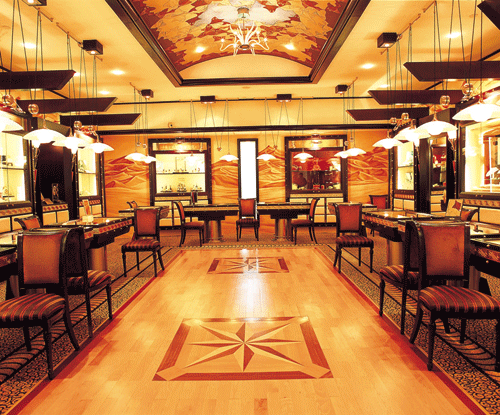
Damas is the leading jewelry chain in the United Arab Emirates and a luxury venture that claims to have a 17 percent share of the domestic market. The roots of its founding family in the precious business go back more than a century. Today the company is owned by regional investors. Fortified with a recent business restructuring and a clear strategy of concentration on its core market, namely the Gulf Cooperation Council countries, it is positioning itself for growth, specifically in Saudi Arabia, but also seeks to further expand its standing in the UAE, chief executive Anan Fakhreddin told Executive.

“When the restructuring started two years ago, we put the first priority on our core markets. Our core markets definition today is the GCC. These are the markets where Damas started and where we have a very strong understanding of consumer trends and preferences,” Fakhreddin said. 

Organizational and marketing initiatives in the recent past included new partnerships with international jewelry brands, investments in quality assurance, including collaboration with UAE authorities for training customs officers on purity of gold, and the hiring of a Bollywood celebrity for a marketing campaign for the Diwali Hindu festival. The festival, which this year falls in November, is a huge jewelry buying occasion for the Asian customer segment in the UAE and stores can get so crowded with customers that one can hardly move, explained a Damas spokesperson.  

The outcome of the 2012 business year for Damas is going to be determined to a large part by the last two months of the year, Fakhreddin said, due to the role of the Diwali and overall contribution of the year-end holiday season to sales. 

So far, so normal. But the corporate narrative of this jewelry house in 2012 is more than some lore of doing business in gold and precious stones. It is a cautionary tale that a corporate centenarian can make a pretty bundle of mistakes, that mature individual age and folly are not mutually exclusive, and most importantly, the most recent chapter of its story is that a turnaround is possible at over 100 years old. 

A Shaky start

About five years ago, the successful family group Damas, which since 2005 included a minority stake holding by two regional private-equity players, was preparing for its future. At the time, a business prophecy was making the rounds among the family-owned enterprises in the Gulf region. This prophecy, with many good success stories and references from developed economies, said that the future was for  them to become listed companies. 

The UAE stock markets were not even 10 years old for the Dubai and Abu Dhabi bourses and the youngest, then known as Dubai International Financial Exchange (DIFX), was still in its diapers, full of promise. Many who appeared as wise consultants advised the business families of Dubai and anywhere in the Arab region that it would be a boon for the national economy and a far-sighted decision for any large and ambitious family enterprise to undertake an initial public offering.  

The Abdullahs (Tawfique, Tawhid, and Tamjid), three brothers whose grandfather had laid the foundations for the Damas Group, decided to go for an IPO. The company picked the highly-touted DIFX (today Nasdaq Dubai) and embarked on its flotation. Smack in the middle of 2008. 

What happened then lends itself to the perception that no financial thriller writer could have imagined a worse time and place for any company to go public than June/July 2008 on the DIFX. Damas announced that its IPO successfully raised $270 million by floating 28 percent of its capital at $1 a share, valuing the enterprise at close to $970 million. It did not announce that one of the Abdullahs — Tawhid, who was chief executive of Damas — had done a circular investment pact with several investment companies in Dubai, including a unit of Dubai Holding, by which he lent them cash used to buy 100 million shares in the IPO. In 2009, the loan was reportedly converted into an investment that seems to imply that Damas had effectively bought itself and all it got out of it was a huge, non-performing loan, according to a report in Abu Dhabi-based newspaper, The National.    

Moreover, the Abdullah brothers had run Damas with a piggy bank approach, taking out cash and borrowing gold at will and with no control, to the tune of hundreds of millions of dollars. The feudal approach to corporate governance might have perhaps been manageable in better times, but with the global economic crisis, the burst of the Dubai economic bubble and many soured investment gambles by the Abdullahs, it all came out. The Abdullahs were obligated to resign and banned by the financial authority from managerial roles, for 10 years, at any company based at the Dubai International Financial Center (DIFC).

Left behind was an orphaned company with hundreds of scattered stores (in a July 2008 Reuters news item on the Damas IPO it said the company operations entailed 438 stores in 18 countries) and a big financial problem.  Deals were struck and a formula for repayment of their obligations to creditors including Damas was agreed upon with the Abdullahs. As often with grim fairy tales, many gaps in the narrative of this corporate crash were left for interested readers to fill with their own assumptions. 

The turnaround of Damas entailed a restructuring under Fakhreddin’s captaincy that commenced in 2010 and a buyout by regional investors in  the spring of last year. The new parents, Mannai Corporation of Doha, Qatar, and EFG Hermes, the Egyptian investment bank, paid 45 cents on the dollar for each share in Damas and took control of 85 percent in the company, according to stock market reports. 

Mannai Corp, owning a 66 percent controlling stake in Damas, says on its website that it is Qatar’s largest trade and services conglomerate; it is affiliated with the ruling al Thani family. The other 15 percent in Damas remained with the Abdullahs.      

Future expansion

Fakhreddin said he could not discuss the owners’ plans for the jewelry company but told Executive that “they have been investing in terms of assets, resources, and support and are investing very generously on the brand. The Damas brand will see a lot of growth in the coming years because of this takeover and the level of attention and support that we are getting from the new owners.” 

Importantly, the new shareholders’ investment decision was long-term, he said. “It is not a turnaround project where you buy something, fix it, and sell it.”

Besides sorting out the financial obligations of the mismanaged enterprise, the restructuring of Damas entailed structural changes of operations that had been convoluted with less-than-strategic investment decisions and movements into new markets. The GCC was always the center of Damas’ retailing strength but this was “unfortunately sometimes overlooked” and the weeding of overseas operations was needed, Fakhreddin said. “Today we follow the strategy that makes sure that investments are placed in core markets. Until we are satisfied with penetration levels in those markets, I don’t think we will look at expansions in any other markets.”

In line with this business plan, Damas appears to be not aggressively approaching the market in India where it has a joint venture (JV) managed by the JV partner. It has bought out its partner in Saudi Arabia, on the other hand, and is planning to attack this market vigorously. According to Fakhreddin the past 18 months since the full acquisition in Saudi Arabia saw growth but the main task achieved was refocusing the organization on serving the high-end and middle-class luxury segments. 

The Damas chief executive expects the “real success story” will commence in 2013 when the expansion plan of stores in Saudi Arabia kicks off. The company understands well the currently very fragmented Saudi jewelry market because of many similarities to the Arab segment in the Dubai and Abu Dhabi markets. Fakhreddin said, “Potential for market share in Saudi, one of the top jewelry markets in the world, is still open for growth.”  

Performance of Damas in financial terms has been stable in the past three years on the side of gross revenues. As the company de-listed from Nasdaq Dubai this summer (and is switching its financial year to the calendar year in 2012), Fakhreddin said that the company has more or less completed the restructuring and has only “to sort out files in some non-core markets where we have business relationships that we want to realign.”

That should be achieved in the first quarter of 2013, he added, and then they want to grow much more than in the past four or five years, in which things had been “a little static because of the global recession and our issues. We are planning lots of improvement in terms of brand, [the] look and feel of the shops, [and] customer service. Much of that will be tackled in 2013.”

November 7, 2012 0 comments
0 FacebookTwitterPinterestEmail
Economics & PolicyLuxury in the Gulf

Illusions of grandeur

by Nicole Walter November 7, 2012
written by Nicole Walter

To make it as luxury real estate in the Gulf region these days, a development must have more than a funky name and a public relations consultant. Nurai, a residential island just off Abu Dhabi’s coast, is one example of a successful luxury real estate development in United Arab Emirates. Launched back in 2008, the project boasts of waterfront living in privacy, “stunning designs” and “attention to detail”. 


Zaya, the developer of Nurai, had identified a gap in the ultra high-end real estate market and the project proved resilient in the economic crisis of the following years. With buyers sticking with their commitments to the million-dollar properties on Nurai, Zaya co-founder and chief executive Nadia Zaal attests to the viability of catering to the narrow market segment of luxury real estate targeting high net-worth individuals. 


“It is the only segment where demand across the world continues to outstrip supply, which reinforces our belief that this segment has great potential,” she tells Executive. “Ultimately, it’s all about creating the right product for the right people in the right location.”


Adapting to the downturn


While prices haven’t fluctuated too much, Zaya decided to reduce the number of homes after the crisis hit quite early in the construction phase. “We realized it was far better to reduce the size and finish the project,” says Zaal. Commencing handover of residences this month, the developer made efforts to ensure that residents will be receiving value-added — the idea being that luxury real estate will remain in demand if the development package really contains what is said on the box. 


As the Dubai real estate crisis recedes, sales in the market tier slightly below the ultra-high end have recently hinted at growing demand for other types of high-end property. When Emaar Properties received an overwhelming response to its launch of The Address The BLVD, it cited the one-day sell out of the project’s serviced apartments in Downtown Dubai as evidence for pent-up demand for luxury residential projects.


However, what works for Emaar in the most attractive corner of Dubai might not be right for every player. “Emaar is able to benefit from its strong brand reputation and the quality of the existing Downtown project. This does not mean that there is strong demand for other projects in Dubai,” says Craig Plumb, head of research for the Middle East and North Africa at international real estate services firm Jones Lang LaSalle (JLL), cautioning developers might be wrong in rushing into risks in this segment. 


Compared with the idea of putting cookie-cutter residential units up in the middle or even lower-middle range of the market, the grand image and high valuations of luxury real estate may be tempting, but developers have to be careful of assessing demand and market potentials. 


“I think the depth of demand for the luxury sector is very thin, and the risks are therefore higher, there is also much greater competition in this sector of the market in Dubai,” alerts Plumb. His advice for developers thinking to enter the luxury segment is to instead target the much larger and far less crowded middle markets in most of the region. 


Bouncing back


But where does luxury start in real estate today? For the UAE, pre-crisis price trends in the high-end of the market are reasserting themselves this autumn, suggesting luxury properties carry price tags between AED 5 million to AED 6 million ($1.36 million to $1.64 million) for penthouse apartments and villas, and move up to more than AED 80 million ($21.8 million) for ultra-luxury mansions.


While margins on many other luxury goods, from handbags to cars, are often higher than for mid-range products of the same type, developing luxury real estate is not the most rewarding of property market activities when measured in return on investments (ROI). The ROI on a luxury villa or apartment right now is 3 to 5 percent, whereas mid-range property provides 4 to 8 percent, says David Terry, luxury sales manager at Luxhabitat, a UAE brokerage dedicated to properties valued above $1.36 million. 


As the best returns are generated in the mid-range, this is reflected in the profiles of his clients, he points out: “There are investors in luxury property but not that many; we mainly have end-users buying.” 


Luxhabitat launched two of Emaar’s buildings, which the company says it sold off in an hour. Off-plan luxury developments, which had been marginalized in the immediate post-crisis period, are no longer frowned upon by buyers. “There are quite a lot of sales in off-plan developments,” Terry comments, but adds that he thinks  launching new luxury developments would not be wise at this time.


Despite recent success in Dubai and Abu Dhabi on selling what was already on the drawing board, new announcements of luxury projects have recently indeed been scarce not only in the UAE but the Gulf Cooperation Council (GCC). Well-known names are emphasizing presence, though. In Oman the $3.5 billion The Wave luxury residential and hotel development is selling its first waterfront apartments, and in Qatar two new luxury residential towers are expected on The Pearl Qatar (TPQ). 


TPQ master developer United Development Company (UDC) tells Executive that price rates were generally stable over the past six months. The numbers for transactions and inquiries have picked up and the prices for luxury properties in Qatar are expected to go the same way. Wealthy property buyers in this country, with the world’s top nominal per capita gross domestic product, now have domestic choices where the market remains on a learning curve.  “More than ever, understanding the issues impacting the real estate market for luxury and mid-market developments will be critical to investors’ success in the next few years ahead and that will also have an impact on the profit and risk margins,” says TPQ’s director of corporate communications, Roger W. Dagher.  


Costs of building big


Qatar, perhaps not coincidentally at all, is the most expensive country in the Middle East when it comes to construction costs, sitting 16th out of 53 ranked countries in the 2012 International Construction Costs Report by London-based consultancy EC Harris, and was cited by the firm as example for a country where costs are likely to rise. 


The willingness of Gulf-based developers to go luxury could be impacted by an upward spiraling of construction expenses, not only in Qatar itself but there are spillover fears in the UAE, already ranked 17th for construction costs. The concern is that demand in Saudi Arabia (ranked 25th) and Qatar could lead to unbalanced price escalation in the UAE construction sector, due to under-capacity.


Cost hikes are a major risk factor in building luxury properties, given that developers have to manage built-in costs that are higher than in other market segments. “Developing luxury real estate is fundamentally different than developing low to mid-income real estate,” says Zaya’s Zaal. “There are many factors that differentiate the cost. Firstly, even though the raw material cost for concrete and steel are the same, the design of the structure plays a big role in varying construction cost.”


A few feet more in ceiling height may not sound like promising the moon, but larger spaces, more glazing, complex building technology and more advanced mechanical, electrical and plumbing (MEP) elements, along with top interior finishes and fit-out and creation of an exclusive community, all add to the bills that have already been front-loaded with costs for a land plot in premium location.  


Despite issues of thin demand and increasing financial risks, there are of course the development diehards and the visionaries of the UAE who see creation of both ultimate and affordable luxury properties as their calling and say their time is now. 


Colossal visionaries


Abu Dhabi’s Tourism Development Investment Co (TDIC) is a company that fits this bill. “It’s the right time to launch residential projects, especially luxury products, as we are pleased to see healthy signs of recovery in the property market,” says Ahmed al-Fahim, executive director of marketing, communications, sales and leasing at TDIC. 


Responsible for the Saadiyat Island project, designed to become the UAE’s heart of culture with one new museum per year in the next few years, TDIC has sought competitive advantage in creating a prestigious address. To do so and keep luxury flowing into the Abu Dhabi market, Fahim is enthusiastic about the branding of TDIC’s high-end residences and hospitality products with names such as St. Regis, Monte Carlo and Anantara.


In Dubai, perhaps most notable new luxury projects are the two Meydan Group developments announced last month at Cityscape Global. These are the Meydan Tower on Sheikh Zayed, a luxury high rise whose exact dimensions will yet be determined, and Hadaeq Sheikh Mohammed Bin Rashid, a serene garden community in Meydan City, a development centering around the Meydan Racecourse, which is known as brainchild of Sheikh Mohammed bin Rashid al-Maktoum. Both projects, and another new residential community in Meydan City, announced by India-based Sobha Group, will make for very posh living some years from now. 


Also bearing a message of luxury to this year’s Cityscape Global was Falconcity’s try for a revival of its bigger scheme, the various world monuments, includes a $1 billion Taj Mahal complete with hotel. A new infrastructure expected to see additional luxury property plans being floated was last month’s approval of the AED 1.5 billion ($408 million) extension of the Business Bay Canal by the Dubai government. When it is completed after its scheduled two years of construction, the new urban waterway aims to attract high-end residential and hospitality projects. 


Although the new pipeline of luxury developments in the UAE is just taking shape at this stage, aspirational property buyers of today and tomorrow can be assured of one thing: there will always be a supply of new high-end abodes in the dream cities of the Gulf. 


November 7, 2012 0 comments
0 FacebookTwitterPinterestEmail
Economics & PolicyLuxury in the Gulf

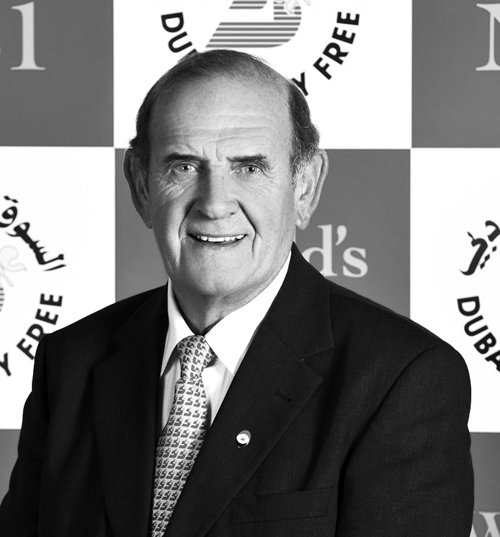
Q&A: Colm McLoughlin – Dubai Duty Free chief

by Nicole Walter November 7, 2012
written by Nicole Walter


Business at Dubai Duty Free (DDF) improved again in the first half of 2012 as the aviation world’s single-location uber-retailer reported 11 percent growth in sales from a year earlier. With the same man — Colm McLoughlin, executive vice chairman of DDF — at the helm in since the first day of operations and a corporate narrative approaching legend status, Executive wanted to find out what the venture is up to now. Guess what? More expansions. 


Dubai Duty Free has an impressive track record of growth since its inception in 1983. What results do you expect to achieve this year?

In our first full year of business, our sales reached $20 million, which was good. Last year on our anniversary day in December, the daily sales reached $24 million, which is a good indication of how far we have come as an operation. We expect our sales for this year to reach $1.6 billion.

Our staffing levels have obviously grown dramatically over the years and we now have 5,000 employees, including 47 of the original 100 staff that we recruited back in 1983. As myself and George Horan, my deputy and president of Dubai Duty Free, are among those 47, I think that we have done an okay job so far.


Have you ever felt concerned that the good times may not last?

I have always been confident that we would continue to grow and do well. Our turnover has doubled six times since operations began and will double again by around 2018. We have had great support from the Government of Dubai and in particular from H.H. Sheikh Ahmed bin Saeed Al Maktoum, president of Dubai Civil Aviation Authority and chairman of Dubai Duty Free. The challenge, and it is a good challenge to have, is to continue to grow our business and ensure that we retain our position as one of the top duty free retailers in the world in terms of our retail offer and our turnover.


In this respect what are the next steps that you plan to implement? You are already the world’s top duty free operator, are you aiming for further accolades?

It is important for us to retain our position as one of the top duty free operations in the world both in terms of turnover and our retail operation. It is also important to us to retain our role as a ‘Superbrand’ and we will continue to invest in our marketing strategy for this. In terms of our retail operation, we have great plans in place for expansion over the coming months. The opening of Concourse A in the first quarter of 2013 will provide us with an additional 8,000 square meters (sqm) of retail space, bringing our total retail offer to 26,000 sqm. The new concourse will be dedicated to the Emirates A380 fleet. So, we are busy with getting our retail area fitted out and are finalizing our product categories for that as well as recruiting an additional 1,300 staff in readiness for the opening.

We have also extended automation within our Distribution Centre from 70 percent automation to 90 percent. This will ensure that from a logistics point of view we are well equipped to receive and issue merchandise across all terminals.


Chinese travelers are said to be avid spenders on luxury and Russia has been another large source of demand for products at DDF. Are these the customer groups and their interest in luxury where you focus your attention?

Dubai International Airport is a major hub and therefore the mix of nationalities using the airport is huge and it is important that we cater to all groups. The Chinese and Russian travelers are important to us of course, particularly in the luxury goods category, but passengers from the Indian subcontinent and the Middle East are also among our top spenders. It is also important for us to cater to different budgets, we sell over 900,000 kilograms [kg] of nuts for example and over 1 million kg of Nido powdered milk every year, so we have to cater to that customer in exactly the same way as we would a customer purchasing a high-end luxury product.


On your 28th anniversary last December you managed to achieve those $24 million in sales that you mentioned earlier; what record do you expect to hit this year?

The $24 million was a great achievement; it means that we sold $1 million dollars worth of goods every hour. We have anecdotal evidence that passengers chose to fly on December 20th in order to avail of the discount and that is fantastic. We would hope to increase last year’s figure by around 10 percent but we will have to see on the day.


DDF has substantial commitments to sports sponsorship, of which horse racing is a personal favorite. So taking this example, how much does your horse racing sponsorship contribute to your overall success and what value can you put on your image and brand development? Are you planning new sponsorship deals?

Our overall sponsorship program includes horse racing, tennis, golf, rugby, powerboat racing and basketball, among others and is a key factor in our marketing drive. We began our sponsorship of sporting events back in the mid 1980s so were probably one of the early pioneers of sports marketing. Our aim continues to be building up our brand awareness, drive footfall to our retail operation and raise the profile of Dubai as a leading sports and leisure destination.

The Dubai Duty Free Tennis Championships is certainly the biggest event that we sponsor and we actually own the two tournaments on the ATP and WTA tours. The fortnight of tennis results in $325.67 million worth of TV exposure for the event, with $170 million of that focused on the DDF brand. So that is a big investment, which has very clear returns as far as we are concerned.

Horse racing is also a great way for us to fly the flag and our sponsorship of the Dubai World Cup here at Meydan is one of the highlights of our racing calendar. We have worked hard to also build up exposure for our other sponsorships including the Dubai Duty Free Irish Derby held in June in Ireland. This year the print media coverage was extensive and the estimated value was around 1.6 million euros ($2.1 million) alone.

We are constantly approached to look at new sponsorship offers, but we cannot be everywhere and we have to turn things down in order to consolidate our existing sponsorships.


For a retailer and a duty free specialist at that, it seemed a bit unusual that you last year created a new division to manage hospitality operations located deep within the land-side of the customs barrier and expand these operations through the Jumeirah Creekside Hotel. What drove these decisions and are you hedging plans for more properties?

The Jumeirah Creekside, which opened in July, is a fantastic addition to our Leisure Division, which includes The Irish Village, the Century Village, the Aviation Club and the Dubai Tennis Stadium. The 5-star hotel is located within the same complex in Garhoud which of course is also close to the airport.

It made sense for us to look at building a hotel that would be the official hotel for many of our events, including the Dubai Duty Free Tennis Championships. We have no immediate plans for another property.


Perfume, liquor and gold are on your list of top-selling products. Are there products that you feel need working on and what are you doing about it? What percentage of overall sales would you like them to contribute?

There have been significant increases across all major categories including perfumes, liquor and gold. With the new concourse opening next year, we will have the chance to increase our categories and add new brands, which we have been unable to do as a result of space constraints. We think that the fashion and luxury product range can be enhanced and this is being looked at in relation to Concourse A.

November 7, 2012 0 comments
0 FacebookTwitterPinterestEmail
  • 1
  • …
  • 301
  • 302
  • 303
  • 304
  • 305
  • …
  • 696

Latest Cover

About us

Since its first edition emerged on the newsstands in 1999, Executive Magazine has been dedicated to providing its readers with the most up-to-date local and regional business news. Executive is a monthly business magazine that offers readers in-depth analyses on the Lebanese world of commerce, covering all the major sectors – from banking, finance, and insurance to technology, tourism, hospitality, media, and retail.

  • Donate
  • Our Purpose
  • Contact Us

Sign up for our newsletter

    • Facebook
    • Twitter
    • Instagram
    • Linkedin
    • Youtube
    Executive Magazine
    • ISSUES
      • Current Issue
      • Past issues
    • BUSINESS
    • ECONOMICS & POLICY
    • OPINION
    • SPECIAL REPORTS
    • EXECUTIVE TALKS
    • MOVEMENTS
      • Change the image
      • Cannes lions
      • Transparency & accountability
      • ECONOMIC ROADMAP
      • Say No to Corruption
      • The Lebanon media development initiative
      • LPSN Policy Asks
      • Advocating the preservation of deposits
    • JOIN US
      • Join our movement
      • Attend our events
      • Receive updates
      • Connect with us
    • DONATE