• Donate
  • Our Purpose
  • Contact Us
Executive Magazine
  • ISSUES
    • Current Issue
    • Past issues
  • BUSINESS
  • ECONOMICS & POLICY
  • OPINION
  • SPECIAL REPORTS
  • EXECUTIVE TALKS
  • MOVEMENTS
    • Change the image
    • Cannes lions
    • Transparency & accountability
    • ECONOMIC ROADMAP
    • Say No to Corruption
    • The Lebanon media development initiative
    • LPSN Policy Asks
    • Advocating the preservation of deposits
  • JOIN US
    • Join our movement
    • Attend our events
    • Receive updates
    • Connect with us
  • DONATE
Last Word

Smiling through our pain

by Sami Halabi November 1, 2012
written by Sami Halabi

An economy that can serve the interests of all our people requires confidence. The necessary conditions for that economic confidence are both security and straight talk from those who are entrusted to protect our nation’s growth. That is why it is so damaging that no one called out the president or the prime minister for inflating Lebanon’s economic progress to the public and international community last month.

According to our Prime Minister Najib Mikati’s office, “estimated results” for last year’s economic growth have come to 5 percent and growth in the first quarter of this year increased by “leaps and bounds”. If that makes you think that one of his speechwriters has a substance abuse problem, you are not alone. No one — from the international financial institutions, to local academics, or even the humble journalists who monitor our economy — thinks growth last year exceeded 1.5 percent, not to mention those who believe the economy has been contracting since the third quarter of 2011.

Not to be outdone, at a United Nations conference last month President Michel Sleiman heralded the achievements of the agricultural sector, claiming it now makes up 6.5 percent of the economy while it had previously made up 5 percent. Of course, he neglected to mention that value added in the sector fell in 2010. There are no national accounts for 2011 and certainly not for 2012.

The relatively productive agriculture minister, Hussein Hajj Hassan, who flanked the president at the conference last month also trumpeted his ministry’s development platform for the sector, issued in 2009. A paper was issued in 2009 that contains a laundry list of issues facing the sector, followed by bullet points and badly drawn Microsoft Word Tables stuffed with the keywords governments love to use: “enhance” this, “develop” that, “reduce costs”, “create jobs”. Naturally, the only real targets in the document are those aimed at increasing staff (read: patronage) within the ministry. Since then none of the laws he proposed have passed parliament and the strategy ends next year anyway.

Instead of trumpeting overly rosy figures and touting their outstanding visions, perhaps some more humility would befit a political class that has not managed to have a census in more than 80 years, or even knows what the country’s gross domestic product, employment or inflation rates really are. The statistical, administrative and monitoring frameworks needed to accurately calculate these things are still some way off. In the meantime, there are real indicators that can be monitored in a much easier fashion to appraise the government.
Take, for instance, another half-nation of around five million hard-nosed people with limited government ability to make decisions: Scotland. In a surprisingly successful effort to reform government, the Scots have come up with a system that, on the surface, reads very much like the agriculture ministry’s ‘strategy’. Their ‘National Performance Framework’ starts with a purpose (basically ‘increasing sustainable economic growth’), drills down into five purposes of equally loose language: ‘safer & stronger’, ‘healthier’, ‘smarter’, ‘greener’, ‘wealthier & fairer’. Each category then has indicators (such as improved levels of educational attainment) and measurement criteria (such as gaps in student performance between Scotland and countries from the Organization for Economic Cooperation and Development), with progress reports posted online and updated regularly. The government doesn’t meet all of its targets, in fact they maintain the status quo much of the time, but people believe them when they succeed and listen to them when they explain why they fail. This approach to governance was a contributing factor to ruling Scottish National Party winning an outright majority in 2011 in an electoral system that was designed not to allow that to happen.

Lebanese politicians should take heed: honesty and transparency in governance builds confidence — from international institutions and partners, from the business community, and from those who are supposed to be paramount in all this, the Lebanese. When our economy is suffering, smiling to us and telling us everything is fine will not make it easier to pay rent or get a decent job. Rather, what is needed is an honest appraisal of where things are failing and what is lacking — at least then we will know where to begin to fix things.

Sami Halabi is a Masters of Public Policy candidate at the University of Edinburgh and former managing editor of Executive


November 1, 2012 0 comments
0 FacebookTwitterPinterestEmail
Society

Presidential beyond words

by Line Tabet, Zeina Loutfi & Ramsay G. Najjar November 1, 2012
written by Line Tabet, Zeina Loutfi & Ramsay G. Najjar

“Obama’s weaknesses on full display in debate”; “Obama admits debate performance a flop”; “In debate style and body language, Romney trumps Obama”.

These have been the sort of remarks making headlines since the first of the three United States presidential debates in the run-up to the vote between Democratic incumbent, President Barack Obama, and Republican candidate Governor Mitt Romney. As expected, the debate has been extensively analyzed in the hopes of predicting who might become the next American president. What was especially striking about the media coverage this time was the excessive attention given to the candidates’ physical language, across both serious and comedic media, which seems to have played a major role in their proclamation of the first debate’s winner.

While the analysis of body language might seem trivial to many, becoming the preferred subject of comedy and spoof shows, some studies have shown that only 7 percent of communication is conveyed through actual words, whereas 93 percent is nonverbal communication. The most telling and over-used example of this is the first American televised presidential debate: The 1960 Richard Nixon versus John F. Kennedy debate. It has become a popular reference that Nixon, the accomplished politician, failed to impress in the face of a young and novice candidate, mainly because he refused to wear makeup.  

Whether the above percentages are accurate or whether we agree or not with the analysis of the Nixon debate, one cannot discount the importance of body language in a public or media setting, whereby posture, facial expressions, hand gestures, voice and dress code have become key components to be taken into account, alongside messaging and content. Trying to predict the winner of the American elections through body language is no doubt a fortune telling assignment. However, given that the whole world is closely watching this event, and that all eyes are riveted on American media screens, we cannot but stop and examine the presidential and vice-presidential debates to illustrate the basics of body language and extract key takeaways, as well as some ‘Dos’ and ‘Don’ts’. Furthermore, keeping in mind that the victor of the elections may well be known by the time you read this article, it is worthwhile exploring whether all this hype about the two candidates’ nonverbal performance had any real value.

Posture: the manifestation of confidence

The reason some viewers may have confused Obama’s first presidential debate with that of a daily press briefing is because of his perceived “defeatist” attitude and posture. His body language communicated stress and anxiety: leaning on one foot, tilting his head to the side and slouching his shoulders. He came across as unsure of himself, lacking energy and outright bored. On the other hand, Romney seemed calm, projecting passion and motivation, whereby his overall posture was straight and upright, conveying confidence and poise, all of which translated into positive energy.  

Facial Expressions: telling it all at a glance

A month prior to election day with polls providing all kinds of forecasts as to voter intentions, candidates need to speak to voters and rally them, be they supporters or opponents, and especially the undecided ones they are trying to win over. Therein lies the importance of appearing to address each and every one of them. And what better way to do so than establishing eye contact so as to give every viewer the impression of being spoken to directly. Both Romney and current Vice President Joe Biden played this card successfully, as they stared straight at the camera to address voters, conveying both candor and caring. 

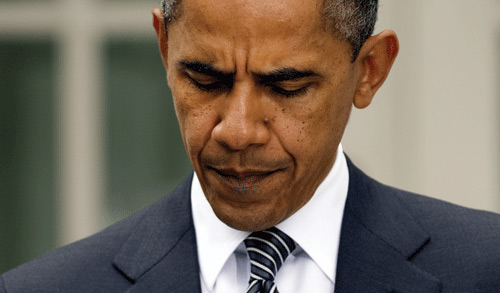
On the other hand, Obama’s genuine smile, one that has become his trademark over the years, looked dull and faded because of the negative energy he exuded. He was often seen pursing his lips, especially when listening to Romney’s arguments. This brings us to one of the main challenges that face incumbents during such debates: to avoid appearing condescending and patronizing or looking at their opponents with disdain and arrogance. A challenge both men failed to meet. 

Hand gestures: adding punch through motion

The art of hand gestures may seem like a secondary element of body language, one that comes naturally and spontaneously. However, it can strongly affect the image of any politician or public figure, either by making them appear tense or agitated or by adding emphasis and impact to their messages. Indeed, those with overly animated hand gestures often distract viewers, as their attention is drawn to the hand rather than the content and messages. As such, the “Golden Rule” when it comes to hand gestures is to avoid excessiveness. When it came to persuading voters with gestures, Romney outdid Obama in the first debate. Indeed, they were in sync with his speech, reaching out to his audience, creating a feeling of openness, and ultimately making some messages more memorable to the audience.

Voice: conveying impactful messages through delivery 

Recent award-winning movies, including The Iron Lady and The King’s Speech, have shown the importance of voice in conveying leadership: Margaret Thatcher in the midst of vocal training, working on the pitch of her voice to project power and authority, and the lessons of King George VI with his speech therapist to cope with his stammer. These have become iconic scenes that support the claim that voice can accentuate leadership attributes and is an effective means to influence and impact the audience. During election time, the debate’s objectives are to inspire people and mobilize them to vote. Hence the importance of one’s voice, as it transforms lexis into impactful messages and memorable sound bites through the appropriate use of pitch, tone, volume, rate and articulation. Varying the tone of voice allows one to convey dynamism and enthusiasm, which are key to emphasizing pivotal ideas.

Whereas Romney was confident in delivering his messages, speaking eloquently and clearly, Obama had a slower delivery, resorting to verbal fillers, and making long pauses. This did not play to his favor, despite succeeding in projecting empathy and compassion when he softened his tone of voice to mention his grandmother in the context of social security and his fight for the American middle class.

Dress code: the clothes that make the man

Red is typically the color of the power tie, a memo that Romney received and understood, with his dark red striped tie popping on screen during the debate, compared to Obama’s royal blue tie which blended in with the purple background and reinforced his sense of fatigue. The specific choice of color is of course not the point here; what is important to remember is that speakers must always choose attire that accentuates their presence and aura. This example confirms that dress code goes beyond style and can actually influence the image of a public figure, clearly helping to make a strong and positive impact.

Everything comes 

in pairs 

Jon Stewart dedicated an episode of his satirical show, “The Daily Show” to the exaggerated hype given to the candidates’ body language after the first debate, with some media going to extremes by counting the number of blinks for each candidate. However, this definitely subsided following the second debate, with the focus shifting toward content, arguments and promises made by each.

With the parliamentary elections in Lebanon, Jordan, Qatar and Egypt “theoretically” around the corner, potential candidates can stand to learn a lot from the US elections’ experience when it comes to polishing their body language in the hope of possibly compensating for the huge gap in their rhetoric, which remains sorely lacking. When it comes to media performance, and as the saying “everything comes in pairs” goes, it boils down to content and physical language, two ingredients that need to complement each other in order to ensure a successful recipe.

November 1, 2012 0 comments
0 FacebookTwitterPinterestEmail
Society

Szechuan in style

by Nabila Rahhal November 1, 2012
written by Nabila Rahhal

Driving down the highway from Antelias into downtown Beirut, one cannot but notice several huge billboards advertising the latest Asian cuisine restaurant, Chenbao — the Chinese word for castle. Curiosity aroused, Executive decided to pay a visit.

Chenbao is the newest conception of the Kazzami group, which brought us the high-end sushi restaurant Osaka and is planning for the opening of the Italian garden restaurant Villagio on Kantari Street, Beirut. Since Chenbao is also promoted as luxurious dining, expectations were high. Situated on the main road in Saifi Village II, with glass panels allowing diners to see the streets outside and be seen themselves by passersby, glamor is projected before you take your first step inside. 

At the entrance, Executive’s party of two is greeted by an Asian hostess wearing a Chinese-style dress, who escorts us to our table and offers us the traditional wet and warm hand towels. The restaurant’s glossy granite flooring and black and gold trimming gives off a subtly luxurious vibe, though the excessive use of dark wood finishing on the walls, perhaps meant to accentuate the Asian feel, lends a somber and somewhat heavy feel to the place. The tables and chairs are placed at such angles so as to allow enough privacy for the diners’ conversations while at the same time allowing them to see most everyone in the spacious setting. The dark wood tables themselves are artfully set with little flowers on the chopsticks holders and upholstered, cream-white chairs prove comfortable for the meal. (An interesting feature of Chenbao, showing particular sensitivity on the owner’s part, is the electric sliding chair attached to the stairs leading to the bathroom — a facility for the disabled, the elderly and those too full to walk down the stairs.)
Menus are provided minutes after we’re seated by another Asian waitress who remains attentive throughout the dining experience, refilling water glasses and removing empty plates almost as soon as the last bite is taken.

sweet and sour
Prepared by the experienced Malaysian chef Eddie Chua, the menu offers traditional Chinese fare, from Szechuan-flavored stir fried meats to rice and noodles, as well as Thai fusion dishes. Matching the high-end image of the restaurant are the prices. A single serving of vegetable noodles costs $11, appetizers are between $20 and $25, and main dishes are as much as $40 if one orders seafood. Upon the waitress’s recommendation, we ordered the wasabi prawns as appetizers, the chicken cashew nuts with vegetables noodles for the main course and finished up with jasmine flavored macaroons — totalling $85 for two, drinks excluded. The artistically arranged dishes of generous portions arrive in perfect sequence, one after the other — the wasabi prawns drizzled in cream sauce offered a unique, harmonious blend between the spicy and sweet adjuncts to the shellfish; the chicken a light and pleasant, if somewhat uninspired, main dish in terms of Chinese cuisine, while the jasmine macaroons were the highlight of the meal, a bouquet of the sweet and the bitter to wrap up the flavor experience.

Having arrived at 9 pm, new customers were still coming in two hours later when we left, keeping the place half full at all times. The clientèle were mainly young professionals, between the ages of 30 and 40, who, according to those who sat around us, were also prompted by the billboard advertisements. 

In the months to come, the tables at Chenbao will likely continue to be filled with inquisitive patrons out to see what all the fuss is about, and while they will certainly not be disappointed by the ambiance and the service, some dishes will have to find a stronger identity to pull their weight in an establishment banking its reputation on high-end and original cuisine.
 

November 1, 2012 0 comments
0 FacebookTwitterPinterestEmail
Comment

Battle of the drones

by Nicholas Blanford November 1, 2012
written by Nicholas Blanford

The unmanned aerial vehicle (UAV), or drone, Hezbollah dispatched to fly over southern Israel in October carried a couple of messages.

First, it was intended to remind Lebanon and Israel that Hezbollah’s main focus remains the confrontation with the Jewish state and not the conflict in Syria. The drone’s flight occurred amid increased reports of Hezbollah’s alleged assistance to the regime of President Bashar al-Assad, including sending fighters to Syria to fight the rebel Free Syrian Army (FSA) and train the regular Syrian army in urban warfare. This assistance would contradict the Lebanese government’s policy of disassociation with the war in Syria, though Hezbollah is not the only Lebanese faction operating there — several hundred Sunni Lebanese have reportedly joined the FSA and there are logistical support networks for the Syrian rebels in parts of the northern Bekaa and Akkar regions of Lebanon.

Still, amid such controversy, Hezbollah appears to have decided to switch attention away from Syria and redirect it toward Israel. It worked, at least in the sense that the drone captured headlines for a few days.

The drone’s flight over southern Israel was also a demonstration of Hezbollah’s evolving technical capabilities. It flew a drone for the first time in Israeli airspace in November 2004. That drone, an Iranian Ababil-T, was launched near Naqoura, crossed undetected into Israel and reached near Haifa during its 18-minute flight before returning to Lebanon. The Israelis never spotted it.

Hezbollah sent a second drone over Israel six months later; it also used them in the 2006 war with one drone shot down off the Israeli coast and another off the Tyre peninsula.

However, the drone that ploughed the skies above southern Israel was far more sophisticated than the Ababil-T, which lacks the range to reach the Negev desert from Lebanon — if indeed that was the origin of the UAV. Although Sayyed Hassan Nasrallah, Hezbollah’s secretary-general, admitted that his group was responsible for the flight and Hezbollah-affiliated Al Manar broadcast graphics indicating part of the flight path, the incident remains dogged by uncertainty. Nasrallah said that the drone was launched from Lebanon but did not pinpoint the precise location. The United Nations Interim Force in Lebanon (UNIFIL) said it did not detect the drone, neither on its ground radars in south Lebanon nor on the shipboard radars of the Maritime Task Force, the naval component of the peacekeeping force. That suggests that the drone was small enough or flying low enough to avoid detection. Alternatively, it never flew from Lebanon in the first place.

The guidance system remains unknown as well. Drones are usually controlled by one of two means: either by an operator using radio or satellite signals to directly steer the UAV on its course or by installing a preprogrammed flight plan. The UAV, if launched from Lebanon, was operating beyond the range of radio control, suggesting it was following an autonomous preprogrammed flight plan or it was being guided by satellite signals. If the latter, that would suggest a whole new level of technological advancement for Hezbollah and Iran.

The Israelis said that they picked up the drone when it was still flying over the Mediterranean but decided to tail it until it crossed over empty terrain before shooting it down. Iran and Hezbollah claimed that the drone in fact slipped into Israeli airspace undetected, thus proving the inadequacy of Israel’s air defense systems. As usual, it is difficult to be certain which version is correct. If Israel really detected the drone over the sea and chose to follow it, that would be a first. Usually, Israel shoots down unauthorized aircraft.

It has been speculated, however, that the Israelis attempted to interfere electronically with the UAV to bring it down safely so that it could be examined. Hezbollah is believed to have done something similar a year ago when an Israeli drone mysteriously vanished over south Lebanon after UNIFIL radars saw it floating to the ground. The Israelis appear to have been not so lucky as their Hezbollah foes. When the Israeli cyber interception failed, the drone was shot down so that at least the debris could be salvaged for inspection.

The unusual incident goes to show that even though the Lebanon-Israel border has remained relatively calm for more than six years, the conflict between Hezbollah and the Jewish state continues to rage on the technological front of cyber-warfare and signals intelligence.


Nicholas Blanford  is the Beirut-based correspondent for The Christian Science Monitor and The Times of London

 
November 1, 2012 0 comments
0 FacebookTwitterPinterestEmail
Comment

Tweeted into shame

by Paul Cochrane November 1, 2012
written by Paul Cochrane

Social media’s role in bringing about progressive change is a hot topic in the Middle East as much as, if not more than, elsewhere given the ongoing debate about its use in the Arab uprisings. On a collective level it is hard to gauge due to the multitude of factors that contribute to people taking to the streets —  mass demonstrations can and of course have happened without any social media — but when it comes to smaller, localized events social media’s power is clear. The online exposure last month of a Middle East Airlines (MEA) employee’s racist remarks toward Asian passengers is a clear case, and one that other companies should take heed of if they don’t want their name or brand dragged through the mud. 

In early October, passengers were waiting in Rafiq Hariri International Airport at a departure gate for a flight to Dubai, including a group of Nepalese women, when a MEA employee got on the public announcement system and said, “Filipino people, stop talking.” The woman told the “Filipinos” to stop talking twice more, giggling as she did so and goaded on by a male colleague. 

The incident outraged fellow passenger Abed Shaheen, who tried unsuccessfully to make a complaint. In the past Shaheen might have told just family, friends and colleagues about the incident, and his complaints would have had minimal if any effect. In our new world of social media, Shaheen wrote about the experience on Facebook and Twitter. The story was quickly shared and within three days 1,600 people had signed a petition on change.org, calling for “MEA to apologize publicly for their staff’s behavior.” 

The media promptly picked up the story as well, initially in Lebanon and then abroad. Under fire, MEA eventually came out to say they had launched an investigation, and the employee was first “disciplined,” then reportedly fired.

While justice has arguably been done, and a strong message sent to MEA staff to think before they speak, MEA’s reputation has been negatively impacted. A scroll through the 200 plus comments following the airline’s apology on its Facebook page shows a great deal of animosity toward MEA: “service sucks,”  “airline crew impolite” and, more worryingly for the carrier in these difficult financial times, is the number of people that wrote they would “vote with their feet” by no longer flying with MEA. Judging from the comments, many Lebanese opt for MEA out of solidarity with the nation’s carrier, despite its invariably higher ticket price. But patriotism only goes so far, and this incident will no doubt lose the airline old as well as potentially new passengers. 

MEA, and subsidiary MEAG that runs the airport, say they have gone beyond “damage control” mode and made effective changes that can be immediately seen; this includes mandating that staff be trained to treat everyone equally and respectfully, as paying customers. Numerous times on flights to the Gulf and East Africa, acquaintances and I have seen African and Asian passengers seated together at the back of the plane away from passengers despite numerous seats being available. This happens too often to be coincidence and the check-in staff, by designating seats in this way, creates segregation. Such a policy is racist, and even more insulting when it occurs on the national airline of the segregated passengers, such as Ethiopian Airlines. This has to change.

Then there is the small boxy room that domestic workers are forced to wait in upon arrival at Beirut airport until their new employers come to collect them, rather than being met like everybody else in the arrivals lounge. It is reminiscent of a prison with inmates awaiting bail. For many of these women, it is the first time out of their country; they are unsure, scared perhaps about what’s next, and they should be treated in a more dignified manner. Both MEA and the airport are, after all, people’s first impressions of the country, no matter where a passenger is from, and customer service should reflect that. 

Ultimately, MEA has now put itself under the spotlight of social media, and activists will be on the lookout for further misdemeanors. It is a useful lesson for MEA to change its policies and better manage employee behavior, as well as for other companies to realize the power of social media to hold them to account.


Paul Cochrane is the Middle East correspondent for International News Services


November 1, 2012 0 comments
0 FacebookTwitterPinterestEmail
Comment

An offer they can’t refuse

by Farea al-Muslimi November 1, 2012
written by Farea al-Muslimi


In gangster movies, a classic scene is for a mafia boss to greet someone warmly with his right hand, then wink to one of his bodyguards on the side and say “kill him”. Minus the cinematography, this is how many Yemenis perceive the international community’s role in the transition of their country today. 

Earlier this year, Yemenis generally welcomed the role of the international community — via the Gulf Cooperation Council (GCC) sponsored deal that saw former President Ali Abdullah Saleh exit power and thereby avert an imminent civil war — because they thought it paralleled their national interest. Since then, however, the realization has come for many that the international community’s commitment to Yemen’s interests, unity, democratic development and prosperity does not extend beyond press releases; rather, foreign powers now seem to be paralyzing progress and hijacking Yemen’s nation building. 

Publicly, Western countries, the GCC and others have voiced much hope — as have Yemenis — in the country’s National Dialogue conference, which is meant to bring together representatives from all of Yemen’s various groups and factions to come up with a road map for the country’s future. To this end the international community has provided political and technical support, mainly through United Nations agencies, to prepare for the conference (previously scheduled for mid-November, but now postponed to a later date). However, other actions (and inactions) by foreign powers are at the same time sabotaging this attempt at national reconciliation.  

Powerful local stakeholders — including former President Saleh himself, the influential Ahmar tribe, and others — remain able to hinder the country’s transition in order to preserve their own power, and while the United Nations Security Council (UNSC) has threatened them with sanctions, none have been forthcoming. In fact, member countries of the UNSC continue to actively deal with these sorts of local players. The GCC-sponsored agreement this year also succeeded, in large part, because it went out of its way to address the concerns of powerful local players, rather than the concerns of average Yemenis; this had the effect of empowering these divisive groups with local clout that they will be able to exercise at the upcoming national dialogue. 

One of the Yemeni revolution’s core goals was the restructuring of the military, which became a key article in the GCC deal. The United States has taken a lead role in this task, but in such a way that the Yemeni military is looking more like an extension of the US army in Yemen. This is both because of an intense American public relations campaign, as well as the Yemeni military’s facilitation of un-manned American drone strikes and US and British special operations in parts of Yemen under the guise of ‘counter-terrorism’. 

Whatever the military justification, American drone strikes have killed hundreds of civilians and injured many more. Yemen’s new president, Abdu Rabbu Mansour Hadi, rather than condemn the strikes has in fact endorsed them, marring his legitimacy amongst Yemenis and making him look like an American puppet. That he reports to the ‘international community’ that brought him to power, rather than his citizenry, is a definite problem. Hadi remains, however, generally favored among the population relative to possible alternatives; his presidency, along with the appointment of Morocco’s Jamal Benomar, a former human rights campaigner, as UN envoy to Yemen, constitute the most positive initiatives of the international community to date.  

US support for the “Public Committees”, or civilian militias, in South Yemen, is also dangerously shortsighted. While America’s aim is to enlist local help in the battle against Al Qaeda in the Arabian Peninsula, supporting powerful non-state actors and armies implicitly undermines the state, especially in South Yemen where there is a fervent secessionist movement that will turn that same support against the central government. 

South Yemen is also now a battleground in a wider geopolitical struggle. The frequency of sectarian clashes — mainly between Houthi groups and the Islah (or Muslim Brotherhood) — have been on the upswing as Iran and Saudi Arabia escalate their proxy war through local tribal and political groups, each offering cash, support and media backing.

With all this foreign money flowing in, one has to wonder why humanitarian aid organizations in Yemen are still suffering a funding crisis, reporting that cumulatively they have less than 50 percent of the cash they need to run their operations; this leaves, among other things, 10 million Yemenis going to bed hungry every night.

There is little wonder why then, when the international community comes with its hand extended, Yemen braces for the wink. 


Farea al-Muslimi is a Yemeni activist and writer for Almasdar

November 1, 2012 0 comments
0 FacebookTwitterPinterestEmail
Economics & Policy

Everyone’s watching the dollar

by Natacha Tannous November 1, 2012
written by Natacha Tannous


United States currency policy concerns almost everyone: the Chinese, who hold some $876 billion in US treasury bills; the Middle East and North Africa, where nearly every nation’s currency is pegged to the dollar; and financial markets the world over. But only one of these concerned parties from around the globe is actually responsible for setting US currency policy: The US Federal Reserve (Fed).

Lately there has been speculation in global markets that a hike in the Fed funds rate is imminent — talk from which the Fed itself is remaining aloof. 

“The Federal Reserve Bank extended the low borrowing costs period after looking at the state of the economy and the [9.7 percent] unemployment rate,” said the chairman of the Federal Reserve Bank of Chicago, Charles Evans, to Executive at the 2010 Summit on Financial Literacy & Education in Chicago, Illinois, hosted by Visa.

Fed funds rate and inflation

Given the prevailing winds the economy is weathering, rates are likely to remain in the zero to 0.25 percent range — a world of zero interest-rate policy or “ZIRP” in Fed-speak — which the US has been in since December 2008.

Inflation, an appealing tool but no solution
Because it would lead to a higher nominal GDP while keeping the same level of debt, inflation can actually help temper the urgency of America’s debt-to-GDP ratio, likely to “balloon to more than 100 percent of GDP” by the end of 2020, as Fed chief Ben Bernanke told the US Congress’ Joint Economic Committee. But even if it were desirable to inflate in the short-term, such a policy would also harm the economy down the road. After monetizing the debt, returning to an acceptable level of inflation is not easy and might initiate a problematic economic spiral with downside risks of escalating the debt when the central bank raises interest rates (increasing debt interest payments), while slowing GDP growth.

“There isn’t much inflationary pressure [with inflation at 2.3 percent], hence we can afford that monetary policy,” indicated Evans. “However, if economic conditions change quickly, we will respond appropriately.”

The last time inflation was a major concern to the US economy was in the early 1980s; the Keynesian model, which predicted alarming inflation resulting from such a low Fed funds rate, is not in use today because demand has not yet rebounded, as the US moved from a consumer society to a savings one after the global economic crisis.

“Although the Fed added $1.5 trillion…to the economy by freeing up some money to the banks or through large-scale asset purchases, it did not trigger inflation, just as Chairman Ben Bernanke expected, because real estate prices went down, along with the stock market,” explained Yervant Demirjian, managing director and board member of Interaudi Bank in New York.

Inflation therefore remained contained as a result of a fall in prices, low consumption levels and limited economic growth. Nevertheless, markets currently expect an increase in inflationary pressure by September, along with a change in the state of the economy.

Backing the Benjamins 

In the 1980s, the dollar only regained its strength when inflation declined. But today, although it’s a ZIRP world, we have not attained the kind of inflationary pressure that could be bearish for the dollar.

Bearish euro
Various factors weigh on the euro, which reached a one-year low of 1.32 against the dollar on April 23. In addition to a restrictive European fiscal policy, the Greek debacle and its contagion effect on other European countries are also having an adverse effect on the euro. Greece asked the European Central Bank, the European Union and the International Monetary Fund to activate a bail-out as the five-year Greek credit-default swap spread reached a record high of 650 basis points on April 22, increasing borrowing costs and working against Greece’s efforts to reduce its budget deficit. Hence, the euro will probably not gain momentum in the short-term. According to Makram Abboud, managing director at Nomura Holdings in London, the euro even “appears overvalued… considering the macroeconomic situation of some EU members, or to a smaller extent, the European air travel disruption following Iceland’s volcano eruption… the airlines will possibly need a bail-out at a moment where governments are already over-leveraged.” This is in line with Morgan Stanley Research’s estimate of the euro dropping to 1.24 by year’s end, a lower forecast compared to other brokers.

First, the relative strengthening of the dollar stems from the diverse roles of the currency. It is not only a medium of exchange but, most importantly, a reserve currency, a safe haven through US Treasuries, a unit of account for commodities and trades, an anchor for pegging currencies and a carry trade currency (previously limited to the yen), given its low interest rates.

Secondly, economies in 2008 did not want to increase their US dollar exposure, placing a stronger interest in the euro and the British pound as oil prices and commodity prices were peaking. But this tend reversed at the end of 2009, when portfolios had to re-align their investment strategy and currency positions due to lower commodity prices and a more complex correlation between the dollar and oil prices (as opposed to a purely negative correlation). Finally, the US labor market is showing relative growth prospects and improving productivity, thus the overall market sentiment is positive toward the dollar.

GCC rides greenback

From a pure trading perspective within the Gulf Cooperation Council’s dollar-pegged economies, goods imported in currencies other than dollars became more expensive as the dollar weakened in the last five years.

But today, the relatively resurgent greenback – with a 5 percent to 6 percent increase year-to-date against the euro and British pound – translates positively because imports of, for example, European goods and services, as well as workforces, become cheaper. Meanwhile the main GCC exports, oil and gas, are denominated in dollars the world over (except for Iran,) meaning that despite the fact that they will be more expensive for consumers, they will be more expensive everywhere they shop, so there is no loss of competitive advantage.

Where things are not so rosy is in areas with an increasingly diversified economy that have exports paid in a cheaper currency, or non-oil economies such as Dubai. The Emirate will see a decrease in both real estate buyers and tourists whose home currency is not dollars and a stronger dollar will reduce competitiveness.

 Economically, the GCC was growing so fast in 2007 and 2008 that the double-digit growth, along with the increase in commodity prices and the cheap dollar, fueled an “oil bubble” and created uncomfortable levels of inflation. Qatar and the United Arab Emirates even reached consumer price index inflation levels of 15 percent and 12.3 percent respectively in 2008.

“Problems started to occur because the GCC was compelled to follow relatively low Fed funds rates while meanwhile, inflation was skyrocketing,” said Florence Eid, founder and chief executive officer of Arabia Monitor research and advisory firm. “Whereas in 2009, the Gulf entered a deflationary period, today the dollar peg — coupled with current low interest rates — is no longer a drawback for the GCC economy.”

These things are all cyclical of course, and they will change again,” she added. 

However, the relative strengthening of the dollar against the euro has two major economic advantages. It is, first, an effective tool for inflation stabilization in the Gulf area, which, as mentioned above, is extremely important for the state of the economy. Furthermore, it eliminated concerns surrounding the dollar peg.

“GCC countries, with 95 percent of assets in dollars, would have suffered from de-pegging from a weak dollar, running high risks of weakening their own currencies even further,” said Makram Abboud, managing director at Nomura Holdings in London. “Now with a stronger dollar that discussion [of de-pegging] has gone away.”

On the monetary front, the peg to the dollar “implies that, by design, the GCC interbank rates should not diverge,” as stated by an IMF paper on regional financial integration. Consequently, the region responded fast to Fed discount rate cuts as GCC central banks also reduced their borrowing rates, with cuts of 250 basis points in Bahrain and 175 basis points in Saudi Arabia. Such monetary policy is a useful tool to push demand, along with pumping money into local banks, encouraging citizens to borrow again, while governments continued to spend in key areas such as infrastructure.

In Saudi Arabia, the 2010 budget will likely reach $144 billion, and “even though main growth drivers in the Gulf are government expenditures [highly related to the level of oil prices], all things being equal, an appreciation of the US currency will tend to improve local purchasing power, fueling consumer demand and investment with a positive impact on growth” said Michel Cordahi, head of Capital Markets at Gazprombank Invest (MENA).

JP Morgan effective exchange rate indices

Thus, a stronger dollar will, overall, improve economic conditions already facilitated by monetary policies and will directly lead to a rebound in consumption, fostering a positive economic spiral. Such assumptions led the International Monetary Fund to forecast a real gross domestic product growth of 4.5 percent in the MENA region for 2010, doubling 2009 growth.

Some warning signs

However dollar bullish one may be in the short-to-medium term, the situation is perhaps less that of a stronger dollar than a cheaper Euro, all the more since the dollar has weakened against most emerging market currencies in the last six months. Moreover, “with a US deficit worsened by the healthcare bill, a high level of federal debt and a renminbi [yuan] revaluation likely to redirect capital inflows to Asia and cause sells on the USD, the dollar might lose its temporary bullish tone,” forecasts Stefan Teufer, coverage director at Deutsche Bank.

True, Bernanke’s Fed has saved the US economy from a depression, sparing a global financial Armageddon in the world’s interconnected economies, but the GCC should neither be blinded by what may be a short-term resurgence in the greenback, nor neglect monitoring closely their inflationary pressure.

Even if they are committed to the dollar peg, central banks should be cautious when aligning their monetary policies to future Fed hikes, especially for countries that have not reached their desired inflation rates, or if an interest rate hike would risk a relapse into a credit crunch. In the short term, it may be a wise idea to count their lucky stars — or dollars.


November 1, 2012 0 comments
0 FacebookTwitterPinterestEmail
The Buzz

Morning briefing: 1 Nov 2012

by Executive Staff November 1, 2012
written by Executive Staff

Oil and gold

Gold traded flat on Thursday, shrugging off data showing China's economy was perking up, as investors waited on the sidelines of the market for US employment data due on Friday.

More from Arabian Business


Brent crude edged down toward US$108 a barrel on Thursday as investors focused on concerns that storm Sandy's rampage across the US East Coast could reduce fuel demand and shrugged off data pointing to a recovery in China.

More from Arabian Business


Economics

The European Investment Bank and the French Development Agency are interested in funding natural gas pipelines in Lebanon, Finance Minister Mohammad Safadi said on Wednesday following a meeting with European officials.

More from The Daily Star


Iranians can no longer export gold without approval by the central bank, an official was quoted as saying on Wednesday, in a new effort by the government to restrict outflows of wealth.

More from Arabian Business


Companies

Dana Gas shares jumped 4.8 per cent as markets began trading after the company said it had missed a payment deadline for a $920m bond.

The sukuk matured at midnight on Tuesday, but Dana Gas remains in negotiations with creditors.

More from The National


Qatar-based Al Ijarah Holding Co has become the second private company in the country to operate taxis, after Al Million launched its first fleet of 300 taxis earlier in July.

More from AME Info


US-based Emerson has announced it is investing $33m to expand its Middle East and Africa headquarters campus in the Jebel Ali Free Zone in Dubai.

More from Arabian Business

November 1, 2012 0 comments
0 FacebookTwitterPinterestEmail
Comment

A third way

by Moe Ali Nayel November 1, 2012
written by Moe Ali Nayel

Armed thugs attacking demonstrators protesting against the regime was a hallmark of the early months of the Syrian revolution. The thugs were at it again early this fall in the Syrian city of Homs; this time, however, the demonstration was in the opposition stronghold of Wa’ar, and the armed men who roughed up the crowd and yelled at people to go home were Islamist rebel fighters who were provoked by protesters’ chants for a peaceful and secular future for their country. 

“It felt as if our revolution was stolen,” said a friend who was there. In the beginning it was simple enough to say you were against the regime, it was the people against their oppressor — in the suburbs of Damascus, in downtown Homs and elsewhere people were demanding freedom, reforms, an end to corruption and a united Syria for all sects. The Syrian people were the ones who sparked their own peaceful revolution, without any support from the world’s so-called champions of freedom and democracy. Now, however, the intensity of foreign meddling has fragmented the unity around their cause.

Syria has become an arena for a geopolitical battle of global proportions: on the one hand there is the Syrian regime backed by Russia, China and Iran, and on the other hand we have the various insurgent groups being armed, aided and inflated by Saudi Arabia, Qatar, Turkey and Western nations. The Syrian people, by and large, have been forced to choose between supporting the regime or partisans of the revolution. In this game of thrones, those who actually started the revolution, and their message, have been largely swept aside. Some of those supposedly fighting for Syrian freedom also seem to be adopting the same practices as the regime they are trying to topple. 

Ghaith Abdul Ahad recently reported in The Guardian about a young man who was stopped at a checkpoint in Aleppo manned by the Free Syrian Army (FSA). He was taken by the FSA for a torture and interrogation session; when he offered them nothing of value he was taken by “the Islamists” who didn’t allow anyone to see him after. How dissimilar is that to stories one hears of regime practices? Had it been the regular Syrian army who stopped the young man, he would have likely been interrogated and tortured on the spot, and later transferred to the dark cells of the mukhabarat (secret service), where he would vanish. The Guardian story shows revolutionaries, supposedly the fighters for change, mimicking age-old regime practices.

Twenty months into the uprising and Syrian society is splitting in many ways — between the religious and secular; deepening divisions between sects and communities; rich and poor; even men and women. With the raging internal conflict and greater geopolitical battle clearly polarizing the country, the need for the emergence of a khat thaleth, — a ‘third line’ or a ‘third way’ — is paramount, and indeed, these voices do exist. They are people who are trying to awaken the public consciousness and bring the essence of the revolution back to its early stages, when the quest for a better life for all was the hope.

Concerned Syrians — average citizens, activists, artists, journalists and others — are trying to open a window, a space for a third line to grow, though their efforts up to this point have been scattered. An image from an opposition protest, widely circulated on Facebook, sums up the situation; in it there is a placard depicting a man with the Syrian revolutionary flag on his chest being torn to pieces from all directions by hands holding dollar bills; at the top it reads: “Support for loyalty.” The awareness that Syria is being fragmented by external forces is clear. Another sign at a protest last month in the city of Kafr Nabl called for “the support of the revolution to get back on track”, while another stated: “To the opposition: Do not tire yourself, our revolution will produce its own leaders”, as opposed to foreign support choosing who has the power to lead. 

Until now, outside intervention in Syria — from all sides — has amounted to dumping huge amounts of arms into the fray to fuel the bloodshed while outside powers bicker over a political settlement. This situation is reminiscent of Lebanon’s civil war — a war Lebanon has yet to recover from — that left the country with a divided society, a dysfunctional government and ultimately a monopoly on power for local elites backed by foreign powers. Neither this, nor a new regime in old clothes, will justify the sacrifices Syrians have endured, and have yet to endure. A third line must be taken.


Moe Ali Nayel is a freelance journalist based in Beirut

November 1, 2012 0 comments
0 FacebookTwitterPinterestEmail
The Buzz

Morning briefing: 31 Oct 2012

by Executive Staff October 31, 2012
written by Executive Staff

Economics

The prime minister of the United Arab Emirates has announced approval of a 2013 federal budget that is heavy on social spending but without the deficits of the last two years.

More from Arabian Business


The Egyptian government has decided to allow residents of Sinai to own their land in the peninsula, state media has reported. According to Prime Minister Hisham Qandil, applicants need to prove they do not have a second nationality, and confirm that both their parents are Egyptian.

More from AME Info


Iran banned the export of around 50 basic goods, its media said on Tuesday, as the country takes steps to preserve supplies of essential items in the face of tightening Western sanctions. The Islamic Republic is under intense financial pressure from US and European trade restrictions imposed over its disputed nuclear programme.

More from Reuters


Egypt has unveiled plans to set up two industrial zones in Algeria and Ethiopia, in an effort to boost economic ties with African countries. The Ethiopian government said it would grant Egypt one million square meters of land on which to establish an industrial zone.

More from AME Info


Lebanese state electricity company Electricite du Liban has warned against the increasing phenomenon of cable theft, saying in the long run it would affect power rationing in areas where it is on the rise.

More from The Daily Star


Companies

Passenger traffic at Dubai International Airport climbed 12.8 per cent from a year earlier in September, as a larger flow of European travellers offset a drop in traffic on some Middle Eastern routes due to turmoil in countries such as Syria.

More from Gulf Business


Starbucks Coffee has launched a bilingual website for the Middle East and North Africa.

More from AME Info


District cooling firm Tabreed, part-owned by Abu Dhabi state fund Mubadala, reported a 35 percent rise in quarterly net profit on Wednesday, helped by growth in its core chilled water business and lower financing costs.

More from Arabian Business


October 31, 2012 0 comments
0 FacebookTwitterPinterestEmail
  • 1
  • …
  • 304
  • 305
  • 306
  • 307
  • 308
  • …
  • 686

Latest Cover

About us

Since its first edition emerged on the newsstands in 1999, Executive Magazine has been dedicated to providing its readers with the most up-to-date local and regional business news. Executive is a monthly business magazine that offers readers in-depth analyses on the Lebanese world of commerce, covering all the major sectors – from banking, finance, and insurance to technology, tourism, hospitality, media, and retail.

  • Donate
  • Our Purpose
  • Contact Us

Sign up for our newsletter

    • Facebook
    • Twitter
    • Instagram
    • Linkedin
    • Youtube
    Executive Magazine
    • ISSUES
      • Current Issue
      • Past issues
    • BUSINESS
    • ECONOMICS & POLICY
    • OPINION
    • SPECIAL REPORTS
    • EXECUTIVE TALKS
    • MOVEMENTS
      • Change the image
      • Cannes lions
      • Transparency & accountability
      • ECONOMIC ROADMAP
      • Say No to Corruption
      • The Lebanon media development initiative
      • LPSN Policy Asks
      • Advocating the preservation of deposits
    • JOIN US
      • Join our movement
      • Attend our events
      • Receive updates
      • Connect with us
    • DONATE