• Donate
  • Our Purpose
  • Contact Us
Executive Magazine
  • ISSUES
    • Current Issue
    • Past issues
  • BUSINESS
  • ECONOMICS & POLICY
  • OPINION
  • SPECIAL REPORTS
  • EXECUTIVE TALKS
  • MOVEMENTS
    • Change the image
    • Cannes lions
    • Transparency & accountability
    • ECONOMIC ROADMAP
    • Say No to Corruption
    • The Lebanon media development initiative
    • LPSN Policy Asks
    • Advocating the preservation of deposits
  • JOIN US
    • Join our movement
    • Attend our events
    • Receive updates
    • Connect with us
  • DONATE
Last Word

Cairo’s new deal

by Ahmed Moor September 1, 2012
written by Ahmed Moor

The Egyptian-Palestinian relationship has been strained recently, but this trial by fire may forge stronger ties in the medium term.

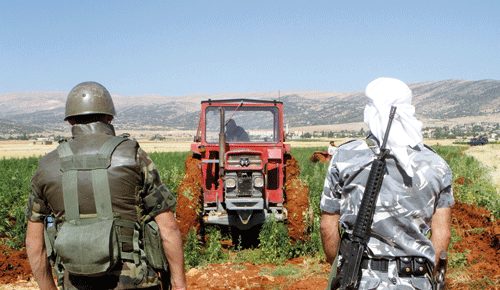
On August 6 gunmen attacked an Egyptian army checkpoint on the Sinai Peninsula border with Israel, just south of Gaza. Sixteen soldiers and an unknown number of assailants died in the initial clash. The surviving assailants dashed across the border where they were promptly killed by the Israeli army. The brutality of the strike — the soldiers were preparing to break their day-long Ramadan fast when they were attacked — shocked both Egyptians and Palestinians.

Swift condemnations came from all sides as the search for additional assailants and their enablers began in the Sinai and among the Palestinians in Gaza. The Egyptians also sealed the Rafah border crossing with the Gaza Strip, casting a pall on previous optimistic signs from the new Egyptian leadership regarding their intention to ease the Gaza siege — yet that may still be in the cards. The Egyptian revolution resulted in the election of the country’s first overtly Islamic leader, Mohammed Morsi, a member of the Muslim Brotherhood. Before he was elected, the Supreme Council of the Armed Forces (SCAF), which had ruled since President Hosni Mubarak was deposed, stripped the role of the presidency of much of its power. The new president faced the choice of either accepting this truncated rule or pivoting to confront the country’s military.  Another precarious relationship the new president had to maneuver was with the Palestinians in Gaza — long on the Muslim Brotherhood’s agenda. Under Mubarak, Egypt had actively maintained the siege of the distressed Strip, but Morsi signaled early on that he was prepared to work with the Hamas-led government — further straining his relationship with SCAF, the principal executors of the Mubarak-era policy.

Among Morsi’s motivating factors may have been the popularity of the Palestinian issue in Egypt. Average Egyptians may not have prescriptions for how to resolve the Palestinian-Israeli conflict, but the moral force of the Palestinians’ claim resonates with the overwhelming majority of Egyptians. While popular opinion was a negligible feature of Cairo’s political landscape pre-January 25, 2011, today it carries much more weight.

The Muslim Brotherhood also has deep institutional ties to Hamas, as Brotherhood members, including Sheikh Ahmad Yassin, founded Hamas. While operationally independent, the two organizations’ foundational affinity has remained. Morsi’s election was loudly celebrated in Gaza — not only because of the expectation that he would ease the siege, but his election was also taken as an affirmation of Hamas’ political legitimacy.

Egypt’s new president met with both Mahmoud Abbas — the head of Fatah and the Palestinian Authority — and Ismail Haniyeh, his Hamas rival. The meetings came after Morsi eased restrictions on travel to the Gaza Strip that have long been in place. 

While it is unclear who perpetrated the attack in the Sinai, Palestinian concern was that the killings would end the relatively friendly treatment they had been receiving from the new government. The president would have to distance himself from any group or policy perceived to have been lenient on security in the enormous and largely vacant Sinai, and at least one figure in the Egyptian government claimed publicly that the assailants had received support from Gaza.

Initially it seemed that the Palestinians’ concerns were justified — the Egyptians closed the Rafah crossing despite comprehensive Hamas cooperation with the Egyptian security forces in the hunt for the groups behind the attacks. But developments quickly gained a new trajectory.

The president used the Sinai attack as a pretext for wresting control of the country from SCAF. He first sacked the chief of intelligence and head of police in Cairo; several days later the president retired both Field Marshall Tantawi, the head of SCAF, and one of his main subordinates from public life. This ouster coincided with the conditional reopening of the border with Gaza. It appears Morsi used the attacks to double down on his first policy instinct vis-à-vis the Palestinians: more cooperation and aid.

The election of a new president in Egypt meant a reconfiguration of the relationship with the Palestinians in Gaza. And when it appeared that Morsi’s agenda would be threatened by an Islamist attack, he recast the episode to yield an unambiguous victory for himself, his party, his agenda and ultimately the Palestinians.


AHMED MOOR is co-editor of “After Zionism: One State for Israel and Palestine” and a Masters in Public Policy candidate at Harvard University’s Kennedy School of Government

September 1, 2012 0 comments
0 FacebookTwitterPinterestEmail
Companies & Strategies

Behind the silver screen

by Nabila Rahhal September 1, 2012
written by Nabila Rahhal

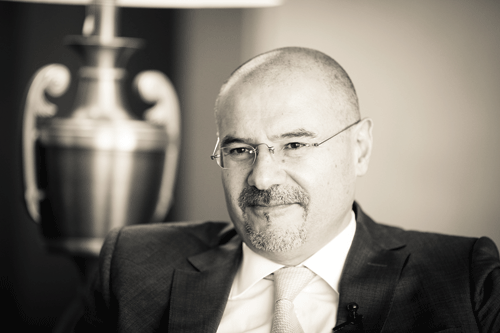
“The movie business is a gambling business,” says Salim Ramia, chief executive of Grand Cinemas. “When you buy a movie for a million dollars before it is even filmed, isn’t that a gamble?”

Indeed, Ramia himself placed big bets by selling his successful company in the United Arab Emirates to start up the same business in Lebanon and the Levant. Yet, he has faith his lucky star will shine through.

Beirut to Dubai and back

Ramia is no stranger to the film business in Lebanon, he had a film distribution office called Phoenix Film Distribution in Hamra during the civil war back in the 1980s. “In 1986, the office was occupied by one of the warring political factions, and it was then that I took the decision to move back to Dubai, as Lebanon was in a state of war and there was no room for professional growth, ” says Ramia.

In 1989, Ramia and an Iranian partner established “Gulf Film” for film distribution. Three years later, they entered the theater operation business and established their first cinema in Dubai. He recalls “Unforgiven” was the first movie he brought to Dubai. “In Dubai back then, the film industry was dominated by Bollywood movies and my partner kept telling me that I was dreaming because I believed American movies could be a success in the UAE, but I wasn’t dreaming and they did succeed,” says Ramia.

Gulf Film’s venture into movie theaters kept expanding and they set up two cinemas in the Hyatt Regency in Dubai in 1994, as well as theaters in Sharjah. “The big boom was in 2000 when we established the first multiplex cinema Al Maria in Abu Dhabi,” says Ramia. “The year 2000 was also when we launched the brand name Grand Cinemas, inspired by the Grand Hyatt Hotel, which faced the Dubai Cineplex.”

“In 2005 we saw the most rapid growth for Grand Cinemas, as we expanded from having 38 screens to having 94 screens” he says. They acquired these screens by buying Century Cinemas in Dubai, an African-owned company that was closing down, and also buying Al Massa cinemas. “It is relatively easy to take over cinemas, as the theaters and employees are already there. You just have to trim the excess and reshape where needed,” explains Ramia. Finally, in 2007, Grand Cinemas opened their last multiplex in Dubai, called the Grand Festival Cineplex, to have a total of 106 screens in the UAE.

After having ventured into the Levant market in 2007, Ramia and his partner took the decision last year to sell the Grand Cinemas operations in the UAE and Qatar. “While the Grand Cinemas name is 100 percent the property of Salim Ramia and Sons, I sold Gulf Films Distribution and all the Grand Cinemas theaters already in operation in the UAE [which were owned by Gulf Films]. I also sold the rights of operation in Qatar, so as not to create any competition with the new owners for whom we are still consultants,” says Ramia. In explaining his decision, Ramia says he has reached his peak in the business, a good time to bank in on his success and relax. “It was easy to sell because of our successful name and also because the cinema business is a lucrative business where you can begin cashing in the next day after operation,” explains Ramia. 

Building the family business

“My business in Lebanon is different because it is a family one. My wife and my children work with me here and I will never sell it.” Ramia’s wife is the general manager during his absence on travels, and his daughter Carly is the marketing manager.

Relaxing, however, does not seem to be in Ramia’s cards: “I have built a successful business in the UAE, and I will do it again here,” he says.

Grand Cinemas’ expansion to Lebanon began in 2007 with a phone call from mall operator ABC Ashrafieh’s management team. They wanted Grand Cinemas to manage their cineplex, which at that time was run by Circuit Empire, so Ramia came to Beirut and “closed the deal”. That year, Ramia and a Lebanese partner of his also bought Concorde Cinema in Verdun and Las Salinas Cinema in Anfeh, North Lebanon. In 2007 Ramia also expanded into Jordan with cinemas in Amman’s City Mall.

Speaking about his start in Lebanon, Ramia says they had to improvise and deal with things as they are since they acquired theaters which were already in operation — albeit theaters that were not doing so well, thus he had to turn them around, revamp them physically and introduce more efficiencies, such as electronic ticketing booths and online services.

Grand Cinemas in ABC Dbayeh Mall was their first “from scratch” cineplex in Lebanon and Ramia says the reviews have been great. Of the Grand Class cinema, Lebanon’s first luxury cinema which includes champagne and caviar canapés as part of the viewing pleasure, Ramia says the 20 seater theater is full for at least two shows per day. “The Lebanese love to show off and so will encourage each other to try out our theater,” says Ramia, adding that while the champagne and caviar are not cheap, they are a marketing gimmick which is working in attracting viewers. 

With its latest cineplex in ABC Dbayeh, and the Grand Cinemas in Saida Mall, Grand Cinemas now has 32 screens in operation in Lebanon — including the country’s first 3D theaters — and plans to open a cineplex in the Landmark on Riad El Solh. The company’s headcount totals 136 employees in Lebanon between management and theater staff.

The movie market

Today Grand Cinemas has 41 percent of the movie market share in Lebanon, Circuit Empire has 46 percent and the rest is distributed among Planete Cinemas and others. Ramia explains that since Circuit Empire owns the largest cineplex in Lebanon in City Mall, which has 2,200 seats, it dominates by sheer numbers — by comparison, ABC Ashrafieh has 1,039 seats. He believes this will change with the introduction of ABC Dbayeh’s theaters, which opened in July (a notoriously slow movie season as would-be customers flock to beaches instead).

After Empire’s Cinema City, the next three theaters topping market share belong to Grand Cinemas (ABC Ashrafieh, Concorde and Saida Mall). While Ramia declined to go into revenue details he did say that three of his theaters were losing money, but added that this is something he can afford, and one has to be a good loser to be a successful businessman. 

In the rest of the Middle East, Grand Cinemas has nine screens in operation in Kuwait and 10 in Jordan with a new partnership for 16 theaters. The company also has a deal for 14 screens in Erbil, which will make for a total of 100 screens for including their Lebanese operations. Comparing his other businesses to Lebanon, Ramia says people in the Gulf go to the movies more. “In Lebanon, they have bars, rooftops and theater as entertainment options. In Kuwait, what else is there to do besides watch a movie and eat out?” says Ramia. He also speaks of censorship, which is much harsher in the Gulf and vetoes nudity, religion and politics. In Lebanon, according to Ramia, censorship is limited to issues of religion.  Besides being a movie theater operator, Ramia still deals with film distribution and says the Lebanese market is now open, where any theater can run any movie, though with a certain percentage paid to the distributor. “Distribution rights to a movie could cost between $100,000 and up to $1.5 million depending on what you are getting. It is a gamble because you are buying a movie based on the script, and on the name of the actors,” he says, adding that to be a successful distributor, you need to have the right contacts.

“In short, the movie business is an entertaining and glamorous one where you get to meet people,” concludes Ramia. “But it is also one with a lot of risks.”

September 1, 2012 0 comments
0 FacebookTwitterPinterestEmail
Comment

An illogical conspiracy

by Moe Ali Nayel September 1, 2012
written by Moe Ali Nayel

It was an apparent fall from grace for Lebanon’s former Minister of Information Michel Samaha, still in his pajamas as he was hauled from bed on August 9 during an early morning raid by heavily armed Internal Security Forces (ISF) personnel. His wife reported that it seemed as if the officers from the ISF’s Information Branch had “come to liberate something.”

Samaha, a close friend and ally of Syrian President Bashar al-Assad, was widely acknowledged to be Assad’s man in Lebanon, and his arrest shook his Lebanese allies in the March 8 coalition as much as it garnered fanfare from his opponents in the March 14 political alliance. Information leaked from the Information Branch indicates Samaha — whose house was reportedly found filled with explosive devices — was plotting to plant bombs in Sunni and Christian areas in Akkar, North Lebanon, under orders from Syrian intelligence chief Ali Mamlouk. The attacks were planned for the following week, during Maronite Patriarch Beshara al-Rahi’s scheduled visit to Christian villages in the area.

Samaha started his political life as a member in the students’ branch of the Kataeb political party, later defecting to the Lebanese Forces under the leadership of Elie Hobeika. Known to have close ties with the French intelligence and a Canadian passport, Samaha was also a renowned intellectual with in-depth knowledge of political theories, and had spent the past five years as a Syrian regime spin doctor, while also advising President Assad on foreign policy.  Shortly after his arrest, Samaha confessed to taking orders from Mamlouk and transporting bombs himself, in his own car, and handing them over to a “secret witness”, who filmed the whole exchange through the lens of a pen-like camera. Lebanese media later exposed this “secret witness” as Milad Kfouri, the head of a security company that provides security services for politicians and businessmen; among his clients is Finance Minister Mohamad Safadi. Kfouri has since disappeared without a trace.

Notably, the Information Branch, which carried out Samaha’s arrest, is headed by Wissam al-Hassan, previously a bodyguard for the late former Prime Minister Rafiq Hariri, with Hassan under the authority of ISF Director General Ashraf Rifi, himself known to have close ties to the Hariri family. As with every public department in Lebanon, the Information Branch operates under the unofficial sectarian quota system, and favors Sunnis from the Hariri camp. Thus, Samaha’s arrest is seen by some to be a blow in the internal war currently under way between the variously aligned security apparatuses in Lebanon now divided over the Syrian situation. Samaha, however, confessed to taking orders from the Syrian regime to plant bombs inside Lebanon and implode the country by pitting Christians against Sunnis: the regional instability Assad has warned about since the beginning of the Syrian uprising seems to be itself crafted in Damascus. Given the evidence and Samaha’s confessions, Hezbollah, Syria’s major ally in Lebanon, has kept quiet on the affair. When Member of Parliament Mohamad Raad, part of Hezbollah’s ‘Loyalty to the Resistance’ parliamentary block, condemned Samaha’s arrest, Hezbollah announced that Raad’s comments reflected his own opinion and not that of the party.

Could the surrender of Samaha — a man of often shifting political allegiances — be seen as another defection high in the ranks of the Syrian regime? The simplicity of the plot and Samaha’s personal involvement in the minutiae of the operation make one wonder what happened to the massive human resources and agents operating on behalf of the Syrian regime in Lebanon. Remember, Samaha’s role with the Syrian regime was always in an advisory and scholarly capacity, but never as mercenary. This whole operation does not fit with Samaha’s historical precedent, expertise or style. The criminal aspects and viciousness assigned to the operation simply seem outside of Samaha’s purview, and his CV would show none of the necessary prerequisites for the job. Why was this intellectual suddenly operating as an undercover bomber?

Government deputy Commissioner to the Military Court Judge Sami Sader has charged Samaha and Mamlouk with conspiracy to commit crimes in Lebanon. The Samaha case is another episode of Lebanese upheaval stemming from political and security developments in Syria. Whether Samaha defected, or was caught red-handed, his arrest diffused a plot that could have had similar results to the 1975 bus shooting in Ain Al Roumani — that sparked the 15-year-long sectarian civil war that we have yet to recover from.


MOE ALI NAYEL is a freelance journalist based in Beirut

September 1, 2012 0 comments
0 FacebookTwitterPinterestEmail
Society

Making them like they used to

by Nabila Rahhal September 1, 2012
written by Nabila Rahhal

What was once a relatively quiet bohemian street parallel to the Mar Mikhael main road has begun bustling in recent months. While artistic types have long visited the art and architectural book shop Paper Cup and the Spanish library here, the increased footfall seems due to a little diner called Frosty Palace, which boasts the best burgers in town. The diner has been a well-kept secret since it opened its doors in February 2012 , but as word of the quality of food spread, customers came to taste what the fuss is all about.

Tell me more, tell me more!

Frosty Palace is originally the name of the diner from the movie “Grease” where Sandy, Danny and the rest of the gang used to enjoy their burgers and shakes. Today, Zalfa Naufal has brought Frosty Palace to Beirut, with three booths and a bar running the length of the place. Frosty Palace is not for those who want “to see and be seen” while enjoying their meal, nor does it pretend to be: its small size sends the message that the focus is on the food itself, and not on catering to extroversion.

To step into the restaurant is to walk back into the American 1950s. No detail is spared to invoke the essence of a classic American diner; even the sugar and straw dispensers are reminiscent of those in the old time eateries. A checkered black and white floor, monochrome photos on stark white walls and icy blue booths all set the mood. The atmosphere is completed by the music, which features old time classics as “It’s Raining on Prom Night” and “Heartbreak Hotel”.

The crystal chandeliers dangling from the ceiling may seem out of theme, but can be considered a quirky charm, and one can tell a woman’s taste is behind the retro yet elegant setting.

Like the original Frosty Palace, burgers, shakes and fries comprise the menu’s signature items. Other offerings, (including vegetarian options) include sandwiches and salads. The chicken salad, a Thai style conception, is well done and the portion is generous. The brunch menu, offered from 11:00 am, sports tantalizing sounding items such as poached eggs and buckwheat pancakes with strawberries.

However, Frosty Palace’s reputation is built between the buns, and one must stay focused. The Frosty Palace Burger arrives alone on a plate, topped with salad leaves, tomatoes and pickles. Additional toppings, such as caramelized onions, cheeses or bacon, come at prices which vary from $0.75 to $2.60. The burger itself does not come cheap, priced at $13.50 without the side orders which usually come with burgers (fries cost $3 extra). It is, however, a delicious gourmet burger, with premium quality Australian meat cooked just right, with that barbecue taste in every bite. The bun is soft, and goes well with the burger, not overwhelming the taste of meat. The thick fries are served with dipping portions of homemade mayonnaise and tomato relish, a fresh alternative from ketchup.

In the tradition of 1950s diners, Executive ordered a shake to wash down the burgers, and again found it to be on the expensive side at $8. While the taste of the homemade strawberry ice cream in the shake was amazingly fresh, the drink could have used extra milk to make it more of a milkshake, and less of a fruit smoothie.

Frosty Palace isn’t easy on the pocket, but for those with the cash to burn it’s worth a visit, serving up a burger the 1950s would be proud of.

September 1, 2012 0 comments
0 FacebookTwitterPinterestEmail
Comment

Vroom a la Libanais

by Thomas Schellen September 1, 2012
written by Thomas Schellen

The concept of fantasy cars is well established on the wide avenues of automotive fiction. Think Transformers. And it has been exceedingly difficult to get these and other octane fairy tales out of my mind this summer because of a prospective car maker called W Motors, author of a new and absolutely presumptuous automotive project, the Lycan hyper car.

Although this $3.4 million car won’t have capacities to shape-shift into a super-robot (it won’t even be able to fly or swim), images of impossible dream cars became inescapable the more I was being told of the vehicle by its inventor and eventual manufacturer, Lebanese entrepreneur Ralph Debbas.

It is perfectly healthy for an entrepreneur to have a strong sense of self-worth and dreaming up a new supercar seems to have come naturally to Debbas, who graduated a couple of years ago from Coventry University in the United Kingdom with a masters degree in automotive design, and whose ambitions loom larger than his entrepreneurial credits. This perhaps excessive confidence plays out in high gear as Debbas claims that what he is creating is a whole line of Arab supercars, emphasis on ‘Arab’.   

However, the Lycan (like most things in W Motors, the name is wolf-themed) will come with German engineering, Austro-Canadian workmanship and Italy-based assemblage plus a hologram derived from a Californian inventor’s work. All very respectable as far as partnerships and the expertise involved, but it sounds more like a mongrel of multi-nationality than a pure breed racer of Arab pedigree.

What makes the car Arab, Debbas counters, is that he did the design and that the company is registered in Lebanon; plus, W Motors will open shop in downtown Dubai later this year. “The showroom and the design center and the virtual assembly line, everything is being done in Dubai.”

The virtual assembly line, however, is not to be confused with the car’s real assembly at a plant in Torino, Italy. The Dubai virtual reality will happen in an office tower where car buyers can peep, high-tech of course, while their vehicles are put together. Such reasoning still seems thin. There is a more important issue, however, than whether this hyper car’s links to Beirut and Dubai are enough to earn the brand the status of first Arab supercar.  

All successful car brands have identities. These identities of manufacturers and whole national automotive industries are tied to their accomplishments in engineering, efficiency, safety, convenience, affordability and so forth. The question then is if this car will make a contribution to the region’s automotive future, and technically will prove to be more than a marketing label and anachronism in a time of global manufacturing cultures. As Debbas admits, the Lycan’s highly-touted hologram, for example, won’t provide positive tech impulses for the mass market.

Debbas put the car’s price point at stratospheric $3.4 million (in Lebanon it would be $5.6 million, after taxes) in a calculated move to attract attention and avoid having to compete with established names in the ultra-high-luxury niche. No other maker asks that much, on top of which W Motors has copied a page from the playbook of off-plan real estate developers and requests buyers put 30 percent down before the assembly crew even starts on the car.

Despite all this playing with pricing to create a market for the car, Debbas naturally says that the exorbitant cost will be fully justified by the car’s engineering and extras, not found in the average Aston Martin One-77 or Bugatti Veyron, such as a door mechanism that costs a million dollars to develop and not one but two holograms (a “W” on the hood pops up before the car is put in motion).

While Debbas downplays some of the conspicuous things about the car — he says the gold armatures are only a very small cost factor and the 1.5 millimeter diamonds in the LED lights will create but a “beautiful glow” and practically no bling at all — it remains the designer’s secret if the car is going to provide value for money even by the insular standards of invidious consumption. 

Aside from leaving questions unanswered that regard his own capital — and how he got up to $15 million in capital financed from family and friends without submitting to the pesky scrutiny of a bank or private equity capitalist — Debbas simply projects promise in response to whatever queries arise. But while waiting for W Motors to deliver its product to market, there is a distinct chance that the characteristics of this “Arab supercar” will be captured by the question: “What goes bling, vroom, vroom, bling, bling, bling?” Answer: A supercar à la Libanaise.


THOMAS SCHELLEN is Executive’s MENA editor

September 1, 2012 0 comments
0 FacebookTwitterPinterestEmail
Society

Many plates at the table

by Nabila Rahhal September 1, 2012
written by Nabila Rahhal

When your meal is served at a wedding or when you grab a canapé at a cocktail reception, you do not often stop to think of what happened behind the scenes to put that food on your fork. Starting the day before the event, the kitchen is abuzz with chefs over their stoves, assistant chefs cutting and arranging food on plates and waiters lining up those plates on trays to be served to guests. Behind the kitchen staff are the various management teams working on the day-to-day operations and ensuring all is running smoothly. With almost 100 catering companies registered in the yellow pages, catering is big business in Lebanon.

Though there are no official figures regarding the industry’s total revenues, some experienced caterers estimate its total value at more than $1 billion annually. “When one considers how many weddings take place in the summer,” says Wael Lazani of Jai Catering, “and multiply it with how many guests are in each and knowing the minimum charge for catering is around $60 per person, then one can begin to get an idea of how big the catering business is in Lebanon”. This also does not count all the other events requiring catering, from store openings, company lunches to home dinners, as well as industrial and institutional catering for company cafeterias. 

The catering business also generates a significant number of jobs as, depending on their size, catering companies can employ between five and 150 people, with additional staff, mainly waiters, hired during high seasons. “A high-end catering company usually handles between four to eight large events per week [meaning between 500 and 2,000 guests] and a few smaller ones such as home catering, cocktails or corporate meetings,” says Roger Zankoun, general manager of operations at Dream Holding, which owns Sofil Catering. Such an operation requires, according to Zankoun, 25 chefs and 20 permanent operations and logistics staff, with extra waiters hired when necessary.

Medi Resto, which Fleur De Lys catering is a part of, has 150 employees divided between administration, the sales team and those who handle and prepare the food, according to Michel Ferneini, chairman of Fleur De Lys Catering. Fleur De Lys had already catered 40 weddings between May and July this year. For his part, Hisham Saad, chief executive of Le Blanc Catering, employs 62 people and handles an average of 12 events per week during the high season.

Competitive cook-off

Catering is not without its challenges, the biggest being competition as companies vie for clients, and sometimes corners get cut. Zankoun speaks of chefs and head waiters who leave the companies they were with to set up their own establishments, sometimes in under-equipped kitchens.

“When a chef with a kitchen designed to cook for around 50 people takes on an event of 200 people to make more money and serve more clients, thereby staying in the competition, he will not be able to maintain control of his output and the food’s hygiene might be sacrificed,” says Zankoun. Indeed, hostess Salma Mrad speaks of the time when, as a sign of support, she ordered salmon fillet from a chef who had recently started his own business. The fish she received stunk from afar. “I had planned it to be the main dish at the dinner I was hosting but when I smelled it, I knew there was no way I could serve it! I learned my lesson though and now only order from established caterers.”

Unlike restaurants in Lebanon, who get their operation licenses from the Ministry of Tourism, catering company licenses in Beirut fall under the jurisdiction of the office of the governor of Beirut and under the Classified  Institutions Department. Inspectors are theoretically being sent to the kitchens of catering companies, but some caterers see this process as sporadic and are asking for more governmental oversight to separate the professional and hygienic companies from the ones who might be skimping on safety standards. However, all catering companies interviewed cited their health and safety certifications from Hazard Analysis and Critical Control Points (HACCP), an international management system regarding food safety, to International Standards Organization (ISO) 22000, a food quality control system.

Food poisoning, however, can and does occur, especially at outdoor weddings where heat and humidity make it easy for food to go bad. At a buffet style wedding catered at an outdoor venue on a hill overlooking Jounieh in July 2009, a third of guests reported cases of food poisoning, some of which led to hospitalization. One of the guests humorously recalls being in the hospital emergency room and seeing people she recognized from the wedding walk in with expressions of pain on their faces.

Precautions some catering companies take to avoid such scenarios include displaying the food a maximum of 15 minutes before it is served and removing it an hour after the guests have visited the buffet. While this means you might not get second helpings, the risk of food spoiling is avoided.

Such precautions are costly. According to signature chef and caterer Hussein Hadid, outdoor weddings are more expensive due to the added cost of the cooled transport trucks and “stoves on the go”, as some of the food is prepared in the venue itself to guarantee freshness.

Michel Khalifat, general manager of Faqra Catering, believes that all measures should be taken in such cases to maintain quality but says a challenge they face is clients who want the same quality of food without the added cost. With basic costs rising (the foods and beverages supplies’ inflation index has risen 7.6 percent from last May according to the Consumer Price Index Report) such expensive extra measures put the squeeze on catering firms. Dream Holding’s Zankoun says they would rather refuse some outdoor weddings, especially those where the venues charge an operations percentage from them, as the cost of their investment is sometimes more than the return.

Hadid says that when wedding caterers stay competitive by lowering charges it necessarily means the quality of their food will suffer as they use the cheaper supplies. But, says Hadid, many couples care more about appearances than food, and so would be willing to cut corners on the catering and spend more on entertainment or display.

“No one will remember what the food was like at my wedding in years to come, but they will remember the superstar I am bringing to sing,” says Hala Baydoun, a bride-to-be planning her wedding for this September. “All I care about, regarding food at my wedding, is that no one gets poisoned.”

The price of a moving restaurant

Catering’s high season is the summer which, aside from the increased weddings, also sees a higher number of luncheons, with many people hosting company in their mountain homes. “Last year saw a trend of inviting out to restaurants rather than hosting at home, but this summer there is a high demand on home catering again,” says Khalifat. Most caterers agree hosting at home costs more than inviting guests to a restaurant (prices start from 65$, according to caterers interviewed). “At home, we are bringing the restaurant to the client which understandably costs more,” says Wissam Zeidan, managing partner of Socrates Catering. “We can even bring chefs for live cooking stations.”

During the winter, caterers generally rely on corporate and charity events, which increase around holidays. Some explore other catering avenues: Faqra Catering, for example, does industrial catering for schools and hospitals which Khalifat says helps them make up for the winter when less weddings and house parties take place.

The political events this summer seem to have affected the catering industry, with Zankoun reporting some 15 weddings being canceled and quoting planners who have told him they have had 50 weddings canceled. Catering companies are also complaining of weddings having shorter guest lists, due to less expats and Arab tourists coming to the country. The government-mandated wage increase has added to caterers’ costs, while Ferneini, of Fleur De Lys Catering, also talks about losing his talents to careers abroad, and indeed Hadid and Zankoun both speak about the difficulty of finding qualified staff and service people in Lebanon. “In a competitive business such as ours, one has to have presentable service people who know how to talk to and attract clients, and it is a challenge to find qualified people or even to train them here,” says Hadid.

While the catering industry undoubtedly faces challenges, by its nature it still retains its lucrative potential and massive market — among the oldest of human customs is to gather around food, and as long as this stays the case, there will always be a business to feed them.

September 1, 2012 0 comments
0 FacebookTwitterPinterestEmail
Finance

A view from the Alps

by Maya Sioufi September 1, 2012
written by Maya Sioufi

Swiss private banks seem to be losing their mojo. Gone are the days where one could open a bank account in Zurich or Geneva and sit back, relax and enjoy the returns. Now you worry your home country will bite into your yields.

Switzerland’s oldest private bank, Wegelin, fell prey to the United States’ tax-evasion squeeze in February; it was charged with helping wealthy Americans hide a whopping $1.2 billion in offshore bank accounts.

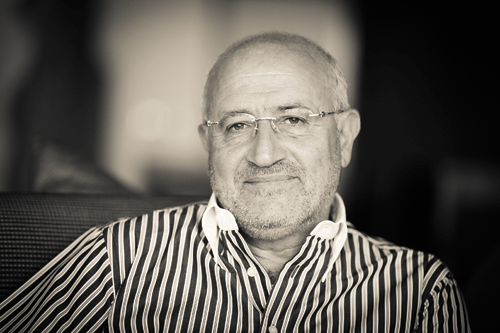
“Wegelin was a very special case,” says Jacques de Saussure, senior partner at Pictet & Cie, the third largest private bank in Switzerland with more than $360 billion of assets, in an interview with Executive. “As a consequence of the recent regulatory changes, undeclared US assets in Swiss banks must be very small, and probably much more limited than in other countries. As a result, Swiss banks are probably much better prepared to deal with FATCA (Foreign Account Tax Compliance Act)”, the US law requiring non-US financial institutions to provide details of their customers with American citizenship.

Washington is not the only cash-strapped capital eyeing Switzerland to raise revenues; other European states are targeting accounts of their high net-worth nationals in Swiss banks too. A tax treaty between Germany and Switzerland aimed at German tax dodgers is scheduled for 2013, with up to €10 billion ($12 billion) at stake for Germany’s coffers according to Der Spiegel. More recently, debt-ridden Greece is looking to sign an agreement with Switzerland to tax Greek citizens’ deposits held in Swiss accounts.

“Holders of foreign bank accounts are easy scapegoats for the troubles of governments with unbalanced public finances,” says Saussure. “Governments certainly grossly overestimate the amounts involved, and should start focusing on other types of assets, in particular real estate; also, and above all, they should review fundamentally their spending and tax systems.”

Looking east

While internationally there is a trend toward greater compliance and transparency, Saussure notes that “unfortunately… we have a lot of hypocrisy from other countries. A paradox to me is that we know of many dictators and politically exposed persons who own real estate in Paris and London, and who checks that? This is rather disturbing.”

As Swiss private banks feel the pinch, they are turning to emerging markets, and the Middle East is on their agenda. “The Middle East is still growing faster than the industrial countries in Europe and America, with the wealth creation this growth implies,” says Saussure. With turmoil shaking several countries in the region, Middle Eastern clients are reducing their exposure to local real estate and diversifying to other markets, “with a specific focus on the United Kingdom and the US as well as Asia, notably Malaysia”.

Investors from the region are more attracted to “the culture of discretion and the respect of private sphere inherent to Swiss private banking” than to the tax component of Swiss banking secrecy, particularly in the Gulf Cooperation Council, which enjoys low level of taxation, says Saussure.

Saussure believes that Swiss banks benefit from their country’s strong fundamentals. As Europe struggles with ballooning public debt issues and as its banks suffocate in sluggish domestic economies, he sees Pictet’s base in balanced-budget Switzerland as a new asset. “Don’t forget that our equity in the bank is essentially kept in Swiss francs. The Swiss franc has appreciated — too much for some and also for us — but one of the benefits is that our equity base, relative to other banks, has increased.”

He expects the private banking business to have to deal with more risk going forward as emerging markets take on a bigger share. “When we deal with investors in emerging countries, they are very frequently entrepreneurs in an early phase of the development. That is the case here in the Middle East and also in Asia.” For the Middle East, he sees additional political risk but he believes that “this is improving quite rapidly.”

As for Lebanon, he advises private bankers in the country, “to do the same as a Swiss banker, which is to make sure that they provide more added value to their clients through safety, security, expertise and quality of service; they have the potential to do that.” Lebanese private bankers, like Swiss bankers, are facing pressure to comply with new transparency and disclosure requirements such as FATCA but, says Saussure, “what is of course more difficult is that they are in a country that does not have the same rating as Switzerland.”

September 1, 2012 0 comments
0 FacebookTwitterPinterestEmail
Society

The limits of speed and sanity

by Nadim Mehanna September 1, 2012
written by Nadim Mehanna

The illuminated diodes blink up at me from their carbon-fiber dashboard encasement. Mileage. Speed. Performance. To one side sits the power gauge, its range like a prophecy carved in fiery letters: an impossible but unwavering 1,200 horsepower. As I take in the sleekness of the interior, the leather so supple it seems almost alive, the words “fastest production roadster in the world” flit through my head. I’m encased in a $2 million torpedo, and the top is down.  Following the success of the 16.4 Super Sport, it didn’t take long for Bugatti to up its ante with a new addition to the Veyron line: an open-top version of the Super that could nevertheless deliver the Grand Sport’s power and speeds.  The novelty alone was enough to set the fan forums buzzing — an open-top car capable of 410 kilometers an hour? The idea was like a gauntlet thrown in the face of physics. Tornadoes produce slower wind speeds. Strap a rocket to just about any other vehicle and set it off at 410 clicks and the air drag alone will, quite literally, rip it to pieces.

So why do it? Why tempt fate?

Why put a man on the moon, or a mechanical rover on the surface of Mars, for that matter? Any enterprise that pushes the bounds of the impossible contains its own implicit motivation, framed in the simple but central counter-question: why not?

Why not indeed, I think, and throw the car into first gear. The gas seems to drop to the floor of its own accord and the car is off, the world melting into indistinguishable streaks around it.

You can try to describe the Vitesse’s performance by such things as its horsepower or revolutions per minute, but personally, I find these stale calculations fall short of the car’s gut-wrenching reality. Going from zero to 100 in the space of a few heartbeats is best described, I think, as a kind of out-of-body experience. It’s as if the pure force of the vehicle’s takeoff has ripped the soul from your body and deposited it, confused and blinking, on the track behind you. It takes several seconds for your brain to catch up with the car, and when it does, it may still fail to comprehend the reality into which it’s been thrown. The world is a blur; the asphalt contracts beneath you like a snapped elastic band.

With this much power thrumming under your right foot, it’d be easy to panic — after all, unless you’re a professional Formula One driver, chances are this is the fastest you’ve ever moved at an elevation of four feet from the ground. But perhaps the most incredible and commendable thing about the Vitesse, once you’ve recovered from the initial G-Force of takeoff, is how straightforward the actual driving is. The gears slip smoothly upward, almost as an afterthought. Take your hands off the wheel and the car maintains a perfect, pencil-straight course forward. Turn it, and the vehicle prescribes neat, unflinching arks, its four-wheel traction solid as a rock. At every stage, the Vitesse seems to be working alongside you.

A device of both power and beauty

As with its performance, the Vitesse’s aesthetic does not overwhelm. Beautiful, to be sure: a number of aerodynamic measures carried over from the Super Sport, such as larger front-end air intakes and bottom air vents stretching sideways into the wheel house, transmit Bugatti’s characteristic mastery. Inside, the two-tone leather seats, carbon fiber console and quilted armrests, enhanced by contrasting stitching, do manage to convey a degree of luxury.

Every aspect of the vehicle is gorgeously worked, from its fine carbon weave to the buffed casements of its xenon headlights. But this is no high-shouldered Rolls Royce, no luxury sedan. There is nothing ostentatious in the design of this car, nothing to announce, to the untrained eye at least, its seven-figure price tag.

To see the car for what it truly is, you have to look below the hood (if there was one). The Vitesse’s Veyron W16 cylinder engine is a work of power and art, transferring nearly all the advantages of the Grand Sport in one neat package. With a maximum torque of 1,500 newton-meters, it boasts a maximum output of a staggering 1,200 horsepower (hp), achieved at 6,400 rotations per minute. Translate these figures into raw power and you’re looking at acceleration of zero to 100 kilometers an hour in just 2.6 seconds.

In the inner workings of the Vitesse, Bugatti seems to be hewing to the old Hot Rodder maxim: “More power, more better.”

Ettore Bugatti’s legacy

The car is purring away beneath me now, the world slipping by to reverberations of carbon fiber and steel. At speeds that would leave other roadsters spinning in the dust, the Vitesse seems only to be hitting its stride, rising smoothly through the instant shifts to well above 300 kilometers an hour. She’s topless and telling me, “Do what you want, I can take it!” The noise of the air rushing overhead is a torrential roar.

When you hear the Vitesse coming at you from a distance, the sound is like a stampede of mechanical bulls, reaching you long before the car actually swerves into view. It’s a darker, moodier sound than that of the original 1,000 hp Veyron engine. The 1,200 hp Vitesse engine employs bigger turbos, meaning less torque at low speeds and an extra jolt of power once it really starts to fly. I’m inside that sound now, and the roar pouring down from the corners of the windscreen is at once exhilarating and comforting. 

I’ve just begun to relax into the car’s velocity when the radio beside me crackles — the signal to turn back. Regretfully, I release the gas pedal and press the brake. The car responds beautifully, relinquishing its speed with a steady, even pull. 

The Vitesse is both beauty and the beast, a machine of aesthetic refinement with a dark side, capable of pushing the boundaries of both speed and sanity. 

It could be months or years before Mercedes or Renault rolls out a car that can top the Vitesse in terms of speed. Until they do, Vitesse will remain the undisputed king of the roadsters — and by all indicators, it measures up to that lofty distinction.


NADIM MEHANNA is an automotive engineer and the pioneer of motoring on Middle Eastern television

September 1, 2012 0 comments
0 FacebookTwitterPinterestEmail
Finance

Your social insecurity

by Maya Sioufi September 1, 2012
written by Maya Sioufi

For paying nearly a quarter of each employee’s monthly salary into the National Social Security Fund (NSSF), one would think that private sector businessmen would be ensuring a nice retirement package and healthcare coverage for those working for them. Why then is it so common for retiree savings to run out at 68, and for hospitals to threaten to deny them services? This Executive investigation dives into the inner workings of Lebanon’s social insecurity.

The money pit

The NSSF, Lebanon’s largest insurance provider, more commonly known as the daman, manages $4.7 billion in private sector contributions and offers coverage for approximately 30 percent of the Lebanese population. Other than end-of-service indemnities, the daman also offers healthcare coverage and family allowance payments.

To deliver these services — or attempt to deliver these services — the law stipulates that the NSSF should receive an amount equal to 23.5 percent of every employee’s monthly salary. This cash is then allocated to the NSSF’s three dedicated funds and entirely invested in Lebanese currency through treasury bills and deposits with local commercial banks. Employers carry the lion’s share of the burden, paying 21.5 percent and employees contribute the remaining 2 percent.

Under the umbrella of the Ministry of Labor, the NSSF is a “black hole” says Nassib Ghobril, chief economist of Byblos bank. Of the three funds run by the NSSF, two have been racking up deficits for the last 10 years. The family allowance fund reported an accumulated deficit of $252 million as of the end of last year.

Employers pay cash equal to 6 percent of each employee’s monthly salary into this fund, up to a salary cap of LL1.5 million ($995), meaning for higher salaries the fund payment is fixed at $60. This stash of money pays $40 to each married employee if the spouse is unemployed and $22 for each child until the age of 18, up to a maximum of five children. This means that if an employee is married with an unemployed spouse and just one child, he receives more from the family allowance fund than his employer pays into it.

“This allows for corruption,” says Ibrahim Muhanna, founder of the actuarial firm i.e. Muhanna. “Let’s say you are my sister and you have three children. I can put you down as an employee; tax and contributions to the funds are paid and you get the benefits for the children.”

The healthcare fund, also known as the ‘sickness and maternity fund’, also runs a deficit that stood at $239 million at the end of last year. The employer contributes to this fund an amount equal to 7 percent of each employee’s monthly salary, with contributions also capped at a salary level of LL1.5 million. Unlike the other two funds, the employee also contributes by paying 2 percent of his monthly salary, up to a cap of LL30,000 ($20).

What the fund does is reimburse employees for 90 percent of their hospitalization costs and 80 percent of medication and examination expenses, though payment delays often exceed several months and involve navigating long queues and a quagmire of bureaucracy.

The catch for healthcare providers is that NSSF also sets the rate private hospitals can charge patients using their coverage for certain services — rates that can remain unchanged for decades. This year private hospitals in Lebanon began threatening to stop taking NSSF patients unless the rate for an overnight hospital stay was raised from $20 to $60, citing the burden of mounting medical costs. In response, the NSSF administration has asked the government to raise the salary cap on contributions to the healthcare fund to LL2.5 million ($1660) — or a maximum payment of LL175,000 ($116). Economic associations in Lebanon, however, have publicly opposed raising the cap, based on fears that this would pass the burden onto the employers in a time when the country’s economic growth is contracting.

Daman deficits!

Given that the contributions to the healthcare and family allowance funds are capped to a fixed salary, they fail to take into account the rising cost of living, the increase in medical costs and the rise in wages. With the cost of healthcare equipment and pharmaceuticals on the rise — the 2012 Towers Watson Global Medical Trends Survey estimated global medical costs would jump 10 percent this year after increasing 10 percent in the past three years — and contributions into the healthcare fund stable, the deficit continues to plunge ever deeper into the red.

“The contributions do not have an automatic adjustment mechanism like in the West — for instance, having the ceiling at three times the average salary so the ceiling grows along with the increase in the average salary,” says Muhanna. “In Lebanon, if you want to change the figures, you need the Parliament to change the law.”

The deficits on these two funds started piling up after the contributions rates were slashed in 2001 under the leadership of former Prime Minister Rafik Hariri, with the aim of reducing labor costs. While the contribution rate to the EOSI remained unchanged, the family allowance fund rate was cut from 15 percent of an employee’s salary to 6 percent, and the sickness and maternity fund rate was cut from 15 percent to 9 percent, amounting to a 40 percent cut in contributions to social security. Mohamad Karaki, director general of the NSSF, blames these rate cuts on the deficits incurred by the two funds and wants to see them increased by at least a few percentage points.

Ghobril disagrees, saying that evasion from NSSF registration is very common. “Just like there are people who evade taxes and you don’t fight tax evasion by raising rates — it will scare away more companies from registering,” he says.

Jihad Rizkallah, lawyer at El Meouchi law firm, says it is “a frequent problem” and common practice in Lebanon for employers to declare lower salaries for their employees in order to decrease their NSSF contributions. “But the employee has the right to claim all amount due; this is of public order,” he says.  “Even if the employer and the employee agree on not registering with the NSSF, the employee can change his mind and his rights are preserved. The employer needs to pay up.”

While Karaki states that more controllers have been hired in the past year — from some 40 to now 100 staff — to stop evasion from contributions to the NSSF, the impact on the figures are yet to be seen.

Abundant insecurity

The only fund that is running a surplus is the end-of-service-indemnity (EOSI) fund catering to retirees [see story page 50]. With an accumulated surplus standing at $5.2 billion as of the end of 2011, the other two funds borrow from the EOSI to stop their bleeding. The lucrative nature of this fund might well be the reason some politicians have said they want to spin it off from the NSSF and have it privatized, which is delaying the discussions in Parliament on implementing reforms to social security, according to Karaki.

The daman’s mission is to provide private sector workers with society’s basic needs from healthcare to family assistance to catering for retirement. With private hospitals threatening to stop coverage, petty family allowances and with savings left depleted within a few years of retirement, it would seem that the nation’s social security fund actually contributes to a feeling of insecurity more than anything else.

September 1, 2012 0 comments
0 FacebookTwitterPinterestEmail
Last Word

Can the cabinet

by Sami Halabi September 1, 2012
written by Sami Halabi

Imagine how Lebanese parliamentarians feel when they are sworn in for the first time. Their hearts must flutter with joy as they take the oath they will likely not keep. After all, who would refuse to be inducted into a club that allows one to get away with doing practically nothing, get paid for it, with benefits, and do so for the rest of one’s life (and in some cases one’s children)?

With no way to appraise the performance, or even the voting record of members of Parliament, the public has little means of knowing what the people they elect are doing. As a result, legislators have the prerogative to fit themselves into one of three categories: those that choose to be active members of this supposed pillar of Lebanon’s government, easily identifiable by the committees they head; a second group simply speaks to the press about anything and everything other than what they theoretically should be doing, producing legislation to fit the times and circumstances. And there is a third group that do not bother turning up for committee meetings or even the general assembly, unless they are called upon to make up the numbers against a vote of no confidence. This final group has the privilege of hosting the so-called zaims (or sectarian leaders) of Lebanon’s broken assembly.

On top of it all stands Speaker Nabih Berri who, for almost 22 years, has used the pedestal of Parliament as the starting point to spread his influence and patronage throughout the institution and, as a result, the state apparatus. One need look no further than the last crisis over Électricité du Liban’s contract workers to see how his power can enter into people’s homes through their light bulbs and the rotting food in the fridge.

And yet people are still bedazzled by how Parliament writes and passes laws that have little to no bearing on reality, while also failing to pass those that do. The laws needed either simply don’t get passed (such as the national budget), get watered down so as to become inapplicable (such as a law protecting women against domestic violence), have no place in a globalized economy (such as the laws regulating electronic transactions) or get shoved in a drawer until Berri feels like bringing them to the floor (like a food safety law or a new traffic law). And even when laws do get passed (such as a law allowing maritime oil and gas exploration, or those concerning telecoms, electricity and water), their implementation is bequeathed to a fractious cabinet and its ministers who run the country like they are playing a perpetual game of musical chairs.

Herein lies the crux of the problem. Because the executive branch is appointed through sectarian horse-trading between eight major parties that can barely agree on anything, it becomes the body of government which is the most prone to collapse and the least able to make decisions. In turn, this has also allowed Parliament to become flippant about drafting laws, writing them up as generalities and relying on cabinet to issue the infamous implementation decrees. Thus, entrusting this non-elected body with the power to apply or not to apply the law results in an arbitrary legal bottleneck to enforcement and drafting of legislation, not to mention the preclusion of citizens from the decision-making process.

So why do we need a cabinet? The short and evident answer is that we don’t. A move to a presidential system that reforms the executive into an administrative body of technocrats would serve the interests of the country infinitely better than it does today. It would even maintain the sectarian “balance” some backward members of society seem intent on keeping through Parliament and the constitutionally mandated senate that has never been formed. But perhaps the most important result of such a move would be that it places accountability back where it should be in a democracy, with those the people elected.


SAMI HALABI is a Masters of Public Policy candidate at the University of Edinburgh and former managing editor of Executive

September 1, 2012 0 comments
0 FacebookTwitterPinterestEmail
  • 1
  • …
  • 318
  • 319
  • 320
  • 321
  • 322
  • …
  • 686

Latest Cover

About us

Since its first edition emerged on the newsstands in 1999, Executive Magazine has been dedicated to providing its readers with the most up-to-date local and regional business news. Executive is a monthly business magazine that offers readers in-depth analyses on the Lebanese world of commerce, covering all the major sectors – from banking, finance, and insurance to technology, tourism, hospitality, media, and retail.

  • Donate
  • Our Purpose
  • Contact Us

Sign up for our newsletter

    • Facebook
    • Twitter
    • Instagram
    • Linkedin
    • Youtube
    Executive Magazine
    • ISSUES
      • Current Issue
      • Past issues
    • BUSINESS
    • ECONOMICS & POLICY
    • OPINION
    • SPECIAL REPORTS
    • EXECUTIVE TALKS
    • MOVEMENTS
      • Change the image
      • Cannes lions
      • Transparency & accountability
      • ECONOMIC ROADMAP
      • Say No to Corruption
      • The Lebanon media development initiative
      • LPSN Policy Asks
      • Advocating the preservation of deposits
    • JOIN US
      • Join our movement
      • Attend our events
      • Receive updates
      • Connect with us
    • DONATE