• Donate
  • Our Purpose
  • Contact Us
Executive Magazine
  • ISSUES
    • Current Issue
    • Past issues
  • BUSINESS
  • ECONOMICS & POLICY
  • OPINION
  • SPECIAL REPORTS
  • EXECUTIVE TALKS
  • MOVEMENTS
    • Change the image
    • Cannes lions
    • Transparency & accountability
    • ECONOMIC ROADMAP
    • Say No to Corruption
    • The Lebanon media development initiative
    • LPSN Policy Asks
    • Advocating the preservation of deposits
  • JOIN US
    • Join our movement
    • Attend our events
    • Receive updates
    • Connect with us
  • DONATE
Comment

The formula to fill football seats

by Thomas Schellen July 3, 2012
written by Thomas Schellen

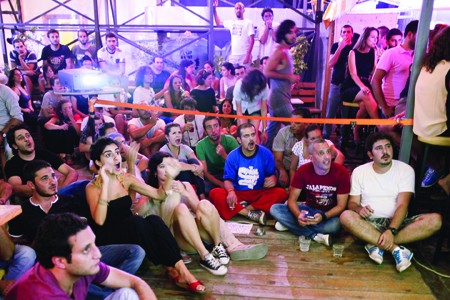
The Lebanese love for football warms my heart. The colors flying from windows, cars and street-corner stands during big tournaments like the Euro 2012 give me an emotional lift. The friendly coexistence of so many football allegiances — from England to Italy, France, Spain, Portugal and my native Germany — displayed this summer has a great pull on me. And what makes it even better is if you sit in a pub in Hamra, or a mall café in Ashrafieh, and fever with the action of your team while on the next table someone roots for the Dutch or Danes with the same enthusiasm. Great fun, happy competition.

But why do the public and private sector in Lebanon get the football economy so wrong?  By football economy, let it not mean the exploitation of the occasion by marketers with buy-this, win-that strategies. I am talking about the primary needs of the fan: A totem (flag, scarf) and a place to watch and eat.

Now, in a small redemption for the Lebanese private sector one has to say that today it is no problem to find a big screen — unlike the days when the over-sized Sports Café in Burj Al Ghazal was about the only place that sported them (and was unhealthily empty except during big games, which is likely why it eventually closed down). The supply of Beiruti venues where you can watch Euro 2012 today ranges from 10-foot screens in comfortable restaurants to a plasma in your nearest pasta joint.

Regrettably, these choices are not all real deals. When I sat with my black-red-gold-wearing son in one cozy restaurant on the day before the Euro opener, the friendly waitress volunteered an invitation to come back for the Euro, “but there is a LL25,000 cover charge.”

Then there was the eatery on the corner near my abode. They had hired a few 24-inch screens and had the place decked out by stringing up little flags. Pity that their stroke of decorative genius was marred by hanging the German flag upside-down, but they showed even greater foolishness when they demanded a minimum bill of LL20,000 per person. Fifty bucks for munching manakeesh while bearing with a case of football culture callowness?

So I stomped my German family fan legion of four up to the rooftop of ABC and hunkered down at a restaurant that had a giant screen, sharp-enough resolution, a fair crowd, and perfectly regular prices. Guess what? At the end of the first win by unserer Nationalmannschaft, or ‘our National Team’ as the Al Jazeera commentator yelled several times, I (expectedly) not only spent more than $50, I also decided to come back for the next two games — and happily consumed more as the German game kept improving.

What’s the moral of this musing? Simply, for you restauateurs, freedom stimulates consumption. Especially at a time when the insane cost-of-living spiral forcibly converts hordes of us average Joes into penny pinchers. Learn from the football economy that fair offers and a good atmosphere open up the most paranoid of pockets.

Now to the Lebanese football public sector economy. If the country ever wants to host a big tournament, it needs to invest now. No, not into refurbishing the stadia built for the Asian Cup finals that somehow happened here in 2000. Invest in the Lebanese team and in the national sports infrastructure of training and developing youngsters — and invest in building a culture of fair competitiveness through sports. It will do wonders for the economy overall.

Lebanon made it to the fourth round of the 2014 World Cup qualifiers, proving that the country has football talents, and the team can still claw farther. And being die schoenste Nebensache der Welt, roughly translated as ‘the nicest unimportant thing in the world’, football is an opportunity to think the unthinkable.

Poland and Ukraine have co-hosted Euro 2012, despite the challenges each of them faced. Half a century before the 2002 World Cup, it was exactly unthinkable for Japan and Korea to ever co-host a dinner party, let alone the world’s greatest spectator event.

It is unthinkable so think: If Lebanon were ever to succeed in co-hosting the World Cup in this century, it will not only make bigger history than even Qatar. It will absolutely need a team that is a result of long-term public sector investment in a competitive culture and great sports. Invest in the National Team today, yallah, government. Because nothing could be more embarrassing than hosting a World Cup and not make it, at least, to the second round.


THOMAS SCHELLEN is Executive’s MENA business editor

July 3, 2012 0 comments
0 FacebookTwitterPinterestEmail
Finance

Iraqi intrigue in Lebanon

by Mohanad Hage Ali July 3, 2012
written by Mohanad Hage Ali

Lebanon’s propensity to host political, media and financial players from around the region and beyond is well know. Its weak government, strict banking secrecy laws, open media landscape and plethora of rival political movements provide a welcome embrace for all and sundry. Among those to have set up shop here recently is an Iraqi outfit with an intriguing network of connections trailing back into the quagmire of Iraq’s troubled contemporary history.

The operations in question are a nascent TV station, Asia TV, and Al Bilad Islamic Bank, which opened a branch in Hamra in recent years. The lynchpin that joins the two enterprises is one Mr. Aras Karim Habib who is the chairman of the TV station and sits on the board of the bank (and was responsible for the opening of its Beirut branch). 


A shady past

Habib was chief intelligence officer for the Iraqi National Congress (INC) — the umbrella organization of opposition groups set up with American assistance after the 1991 Gulf War — as is documented in investigative journalist Aram Roston’s book, “Ahmad Chalabi; The Man Who Pushed America to War.” Roston also outlines how Habib was one of three principals for Boxswood Inc, a company established in the US by Chalabi through which the INC received funding from the American Defense Intelligence Agency.

It didn’t take long for Chalabi and Habib to fall from grace among certain elements of the US establishment after the 2003 invasion of Iraq, with a US intelligence official accusing Habib of passing intelligence to Iran, as was reported by the British daily the Guardian. In 2004 an arrest warrant was issued for Habib relating to his intelligence activities with the INC. Habib was not available for comment despite numerous requests by Executive.

Habib is now living in Beirut, and his connection to the Chalabi family continues; Al Bilad Islamic Bank was incorporated in Iraq in 2006 with Chalabi’s nephew, Issam al-Uzri as chairman. Issam’s son, Hussein al-Uzri, was the former chairman of the government-owned Trade Bank of Iraq (TBI), which was accused of corruption by the Iraqi government in June 2011, leading to the former chairman to flee the country, while his father left his position as chairman of Al Bilad two years ago.

The link between the two banks came to the fore following the award for “deal of the year” given by a trade magazine to Al Bilad in 2008 for being allocated a $100 million letter of credit by TBI. 
Habib set up the Beirut branch for Al Bilad, the bank’s 15th branch and the only one outside of Iraq, in Hamra in December 2010. “Habib was involved directly in establishing the bank in Lebanon and he is the coordinator between Iraq and Lebanon,” says Talal Kaissi, head of the Al Bilad’s Beirut branch.

The bank is set on expanding its operations in Lebanon, according to Kaissi, it has acquired a building in downtown Beirut facing Starco for $32.5 million. The building, which is still under construction, will be the new bank headquarters and the Hamra office will remain as a retail branch.

From banking to television

More recently Habib has ventured into Lebanon’s media mosaic with the establishment of Asia TV, which according to Kaissi “is a private business” of Habib’s (which Executive confirmed banks with Al Bilad). Entifadh Qanbar, Asia TV’s general manager, goes further saying Aras Karim Habib is the chairman of the station and explains, “I run the day to day operations and [Habib] sets the general direction.” Asia TV started broadcasting on March 5 and Qanbar says, “We are a pan-Arab TV station. We cover the Arab, Muslim world with an Iraqi taste. I want English, Persian, Turkish and perhaps Kurdish news broadcasts.”

The station is one of several new media enterprises in Lebanon that endeavour, in the words of Qanbar, “to counter the Gulf invasion in the region.” The coverage of the Arab uprisings, and in particular the Syrian crisis, has severely polarized the journalistic community in the region and the coverage from outlets that enjoy support from the seemingly bottomless pockets of the Gulf, such as Al Arabiya, Al Jazeera, Al Mustaqbal, Asharq Al Awsat, Al Hayat, An Nahar and many more has created a backlash. 

Among those providing an alternative discourse are several new TV stations such as Al Etejah, Al Maseera, Al Mayadeen, Iran’s Press TV and Asia TV. However, with the schisms running throughout the Middle East increasingly characterized by the rivalry between the Sunni monarchies in the Gulf and the Shia theocracy in Iran, charges have been made that these new outlets are nothing more than an Iranian-backed push into the Lebanese media landscape, thus further exacerbating tensions. 

The hand of Tehran?

Aletejah and Asia TV are members of the Tehran-based Islamic Radio and Television Union, Aletejah is connected to an Iraqi military outfit call the Hezbollah Brigades (not linked to the Lebanese militia-cum-political party), Almaseera is connected to the Shia Houthi rebels in Yemen and a recent report on France 24 created waves by bringing into question the independence of Al Mayadeen from the interests of the Iranian and the Syrian regimes. Asia TV’s Qanbar says that his station receives no support from Iran and asserts further, “We have never been told what to say on our station.”

The station’s output is guided by a particular Iraqi vision of the Middle East that is perhaps best encapsulated by one of their flagship shows, Qalb al Aalam, or Heart of the World. The program focuses on the historical, cultural, political and economic relationships between Turkey, Syria, Iraq and Iran. Qanbar expands on the relationship with Iran saying, “We are in the camp of the Iraqi’s. The Iraqi establishment, including Sunnis, Shias and Kurds, now all have good relations with Iran. What’s more, we have a strategic relationship with the United States. That is very disturbing to the countries of the Gulf.”


The ties that bind

The relationship between Habib and Qanbar is a long one and is entwined with their involvement with the INC and Ahmad Chalabi. Qanbar says that, “[Chalabi] is a good friend and I ask him for advice on some issues and he will give me very good advice that I will consider but I will not follow in the steps of Chalabi.” However, Qanbar has served as his long-term spokesman and his personal account on LinkedIn, the professional networking Internet site, lists his current status as “Advisor to Dr. Ahmad Chalabi.”

With the long-standing links between the three men it begs to be asked if Chalabi has any involvement in either the bank or the TV station. The Wall Street Journal recently quoted Chalabi as saying that he is considering joining the editorial board of Asia TV but Qanbar denies he has any role at the station, saying, “We get our funding from Iraq, from a group of businessmen and a group of individuals that want to counter the Gulf invasion of Iraq but Ahmad Chalabi is not one of them.” Furthermore Kaissi at Al Bilad also denies Ahmad Chalabi has any direct involvement in the bank’s affairs.

In any case as the media war in the region intensifies the Iraqi challenge to the “Gulf Invasion” has set up shop in Lebanon and looks set to stay.

July 3, 2012 1 comment
0 FacebookTwitterPinterestEmail
Economics & Policy

Beirut’s secret garden

by Nabila Rahhal July 3, 2012
written by Nabila Rahhal

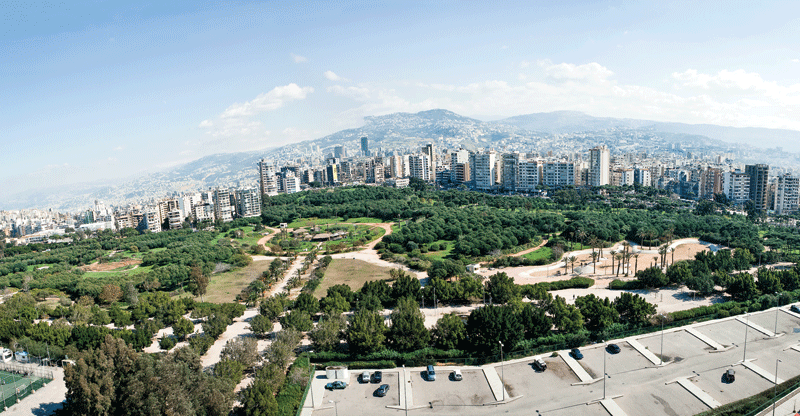
Many older residents of Lebanon’s capital have fond memories of the Horsh Beirut, of childhood games and family picnics in one of the city’s most beautiful parks. The current generation has no such memories. While the Horsh Beirut, also known as Horsh el Snawbar or Horsh El Eid, accounts for some 77 percent of the city’s green space, the municipality has kept it closed to the public for more than two decades; but if a growing number of civil society organizations are successful in their efforts, the gates may soon be open again. 

Among the many victims of the civil war was the Horsh, whose ancient pine trees were burned to cinders during an Israeli assault on the city in 1982. In 1992, the municipality of L’Ile De France, working with the Beirut municipality, funded the restoration of 90 percent of the park at a cost of $191,000, according to Bilal Hamad, president of Beirut Municipality, with the remaining 10 percent picked up by the municipality. Once completed, the municipalities of L’Ile De France and Beirut decided the park would remain shut for 10 years to allow the newly planted pine trees time to grow and mature, says Hamad.

Today — 20 years later — only 10 percent of the Horsh Beirut is open to the public; the remaining 90 percent is closed to all Lebanese citizens less than 35 years old, and even those older than 35 must hold an authorized permit from the municipality to access the park. This classification, says Hamad, is one he inherited from the previous municipality and does not “necessarily agree with.”

Nizar Sayghieh, a lawyer who has worked to reopen the park, says that according to common law, closing a space created for public use is illegal, and people have a right to access the park.

Hamad acknowledges that the park is a public space and that “it shouldn’t be closed.” He claims he wants to give it back to the people of Beirut but says he wants to be confident it will not get ruined by opening it haphazardly. Sayghieh counters that if the safety of the park is the concern, the municipality should use the ample funds it has to hire and train security guards.

Civil society in action

To obtain answers for the delay in reopening of the park, an NGO named Nahnoo organized a debate in February 2011, between Hamad, Nahnoo founding member Mohammad Ayoub, Sayghieh and Eric Bouvard, a representative of the municipality of the L’Ile De France in Beirut.

During the debate, says Ayoub, Hamad asked for a policy paper that would outline how best to manage the opening and maintenance of the park. Provided this was presented, continues Ayoub, Hamad promised that he would open the park by the end of 2012. While Hamad confirmed asking for the policy paper, he said that he didn’t mention a specific date but that he would love to open the park by the end of the year, provided that the necessary arrangements exist.

Nahnoo took up the president of the municipality’s challenge and, two months after the debate, provided him with a detailed policy paper outlining specific solutions to the possible obstacles preventing the park’s opening, such as security issues and fire hazards, says Ayoub.

Hamad praised the quality of the paper, adding that he had sent it to a committee within the municipality that will study it and give recommendations this month. Hamad also sent it to  L’Ile De France representatives for their input and, pending both, he will be calling for “a brainstorming workshop in his office within the next few weeks.”

“The purpose of this workshop is to come up with one final plan to be presented to a private company that will manage, protect and maintain the park,” says Hamad.

When asked if the municipality cannot afford to maintain the park themselves, Hamad said they can but if they could get a company to do it for them, then “why not?”

Questionable outsourcing

This has led others to cry foul, given the ample examples — such as the Beirut Central District — where private management of public land has proved controversial, to say the least.  “Giving the park to a private company could risk turning it into a resort of sorts where its very purpose of being a public and free space will be defeated, just like what is happening with our beaches,” says Sayghieh.

Hamad says this will not be the case as the municipality will retain ultimate authority over the park. He does admit, however, that there might be a nominal entry fee to make the people using it “feel a sense of responsibility.”

Hamad also mentions providing park users with access cards to the park so security catching people misusing the space can seize the cards, and deny violators further entry. He believes that this will be a good way to control those who might intentionally want to destroy the park.

Dima Boulad of Beirut Green Project, a local NGO also working on public green spaces,  says that while rules are certainly needed to protect the park, “We don’t need the rules to be so uptight that people aren’t able to enjoy the park experience anymore.” Boulad gives the example of the newly-opened Zaitunay Bay, which does not allow pets or eating in non-designated areas.

Nahnoo and other civil society organizations remain unsatisfied with the municipality’s evasive techniques and last month organized guerilla picnic protests at major intersections around Beirut, along with 12 other local NGOs also campaigning to the open the park.

Nahnoo’s Ayoub said that he fears the municipality is “coming up with excuses to delay the opening,” and is working with the other NGOs to pressure Hamad to set a clear target date for the opening. Hamad says he believes in the importance of public green spaces and has even launched a campaign, “Beirut is Amazing”  to renovate several public parks, such as Sanayeh Park and the Sioufi Gardens, starting this summer.

According to Hamad, a landscape artist has donated plans for the rehabilitation of Sanayeh, and the retail company Azadea has agreed to donate the needed funds for the project. The municipality is currently asking private donors, companies and NGOs to donate money or resources for the rehabilitation of the Beirut’s main parks and to add greenery to the  streets of Beirut, mainly on road islands and strips dividing the roads.

Notably absent from this campaign is Horsh Beirut. When asked about this, Hamad said that, Horsh Beirut, being the biggest park, requires a separate campaign. He concluded by saying of the Horsh “it is a jewel for the people of Beirut and we want to make sure it stays that way once we open it.”

Yet one wonders how valuable a jewel is when no one can see and appreciate its beauty. Until the park is opened, the children of Beirut will continue to grow up with memories of playing on hard concrete in narrow alleys, while the wide open greens of the Horsh lay in lonely silence.

July 3, 2012 1 comment
0 FacebookTwitterPinterestEmail
Business

The oil importers’ albatross

by Sami Halabi July 3, 2012
written by Sami Halabi

The perception of Lebanon’s oil importing companies as a cartel of money-making executives feeding off the backs of the people is an easy one to buy into, especially in an import-driven economy such as ours. But as any journalist knows, there are at least two sides to every story, if not many more.

“We are always accused of being people that are making fortunes, which is not true,” pleads Dania Nakad, general manager of Wardieh Holdings (Wardieh) — the self-proclaimed largest Lebanese-owned private sector oil company — and the recently appointed vice president of the Association of Petroleum Importing Companies (APIC), the industry’s lobbying body.

“During the war when the country was just a bunch of mafias and there was chaos everywhere you could say that the oil industry was a cartel, because there were two or three importers with control over the few ports,” she says, adding that such is not the case anymore.

Wardieh is probably best known in Lebanon for its gas stations, and the fact that it used to be owned by Exxon-Mobil before the later decided to exit the country. Yet the company does not own most of the stations that brandish their name.

Instead, Wardieh’s main revenues come from the import of petroleum and other oil derivatives ranging from diesel to petrochemicals. It signs supply contracts with gas station owners and finances the underground tankers and station equipment. While this has proved profitable for Wardieh, there have been a few hiccups.

Last year, a Wardieh gas station exploded near Beirut’s Adlieh district killing three and wounding 14 others. Nakad explains that the incident was a result of a panic-stricken owner, looking for his employee, turning on an electricity switch that had been shut off after fumes were detected in a storage area “that should not have been there."

The leaking underground tanker had been identified and subsequently filled with water for safety, but apparently this was not sufficient to prevent the incident. Nakad says that no charges were pressed because it was obvious where the fault was and “a few months later the station was up and running; we are still with them, them with us, but we lost Joseph,” says Nakad, referring to the station’s former owner.

Explosions aside, oil importers also have to take on significant credit with gas stations that pay post-factum while they pay their suppliers and the government in advance. “I have no protection. So what if I have a contract with a station? If he doesn't pay me I can sue him, go to court, spend a million years there and meanwhile he’ll have zeroed in his account and when the court tells him to pay, he’ll say he’s bankrupt, so what have you gained,” says Nakad. “If you want to be really smart you can steal a million dollars tomorrow and just sit in jail for three months! Honestly, this is the case today.”

Closing the pump

At present there are just 12 companies licensed to import oil into Lebanon. More players are not involved due to the large investment needed for storage, transport and infrastructure, coupled with the need for access to land on the seashore suitable for such an operation. 

Wardieh’s total assets, for example, are valued at $100 million, according to Nakad. She describes last year’s turnover as “excellent” and revealed to Executive that the company raked in revenues of “something like $340 million.” That is because oil prices stayed relatively stable throughout 2011. But now that oil prices are dropping again “since April we are witnessing another crash,” similar to that of 2008 when prices plunged from around $147 per barrel to below $50.

But with such revenue-to-asset ratios it’s little wonder that many say oil importers are running a racket. Oil importers have been accused of acting like an oligopoly and fixing prices. These companies bid for petroleum on the international market in groups in order to be able to buy up whole tankers, as opposed to half-tankers or less, thus allowing for better prices. Wardieh currently groups up with Total and IPT to bid for ships in the Lebanese market. Nakad denies that there is price fixing between the three large groups who usually engage in the bidding, but concedes, “In the absence of a government, the absence of a ministry and the absence of a strategy and policy, we do what we can to safeguard our basics.”

“At some stage ministers like to flex their muscles, and that applies to the current and previous ones who say ‘we want to import [gasoline]’. We tell them, ‘please do, we beg you to do it’,” says Nakad. “It would be better for us because then we wouldn't have to have all this expensive equipment, open up letters of credit for millions of dollars, and take the risk in a country where Israel can come tomorrow and bomb our facilities whenever they feel like it. Instead I would just simply go to the [government] refinery every day, as I do today with the gas oil [red diesel], and take my stock and sell it to market.” 

Caught red handed

At present the government only imports ‘red’ diesel — diesel with high parts per million (ppm) of sulfur, at around 500ppm — while the private sector imports ‘green’ diesel, at around 350ppm. Lebanon’s government-owned petroleum refineries have been out of commission since the Civil War, and perhaps that is a boon given the amount of corruption recently uncovered at their existing facilities.

At the beginning of the year, the government offered a one-month subsidy on red diesel, which removed the value added tax for distributors, the savings of which were passed on to end consumer. A report issued earlier this year by the Audit Court, Lebanon’s government spending oversight body, said that during the last days of the subsidy period government-run facilities in Tripoli and Zahrani continued to sell at the subsidized prize, with 101 of 215 licensed distributers of oil products suppling the red diesel on the last day of the subsidy. The distributors then sold the product at non-subsidized prices.

“I told one of the people who bought, ‘tomorrow morning if you are smart you go and take a credit note from all the people you sold to with the higher price because this will not pass and the files will be opened and heads will roll,” says Nakad. “Another calls me and says he made $50,000 [in profits off the deal], I told him go and sell at the lower price because I was sure that their will be a scandal. He thanked me a month later.”

The Audit Court eventually blamed the government, the consumer protection authority and the companies that made millions of dollars of profits but no one has yet been held accountable. “You think the guy at the door or the accountant makes the decision to extend working hours until after midnight,” she asked rhetorically. “When the big ones fall, it's the little ones that take the blame. The issue was cooled off and tucked away, not because there was a guy at the door who made a decision, there were big people behind it and if it gets to the courts they’ll find a scapegoat.” 

No margin for error

Even if things look good for oil companies, margins may not be as lucrative as one is inclined to believe. In 2002, the Lebanese government commissioned the international accounting firm PriceWaterhouseCoopers (PWC) to carry out an assessment of the pricing structure of petroleum in the country. The study suggested a structure whereby the oil importers would make a 5 percent profit margin on the cost of their product. Other elements included in the pricing structure were the government’s excise tax, currently at $2.67 per jerry can (20 liters) of 95-octane gasoline, value added tax (10 percent), insurance, additives and other costs to the consumer.

Since then, however, Nakad says they have had to incur further costs associated with increases in additives, operational expenditure, invested capital and others, such as a war risk premium that was imposed after the 2006 war with Israel, effectively bringing the margin to 3 percent of the cost of product. The three percent figure was also confirmed by another general manager of an oil importing company that spoke on condition of anonymity. “I dare anyone to identify one commercial sector that can do with 3 percent profits. The dikeneh [shopkeeper] next to your house won’t accept a margin of 3 percent,” says Nakad.

Nakad says that APIC commissioned PWC to do another study in 2010 to update the price structure, and the brief was presented to the previous and current Ministers of Energy and Water, who have not responded. That is why gas stations have gone on strike several times since, says Nakad, closing down gasoline supply in the country.

“You think the international names got out of Lebanon because they don't like the country or because of the weather?” she asks. “It’s not rewarding. Put the money in the bank. You get more and it’s secure!” 

A plausible solution for the industry, she says, would be for the government to crack down on the estimated 2,000 unlicensed stations in Lebanon and stop giving out new licenses to stations, which have reached some 5,000 across the nation. “We are not asking for the government to take [the PWC study] and just implement it, but do something in between, make a compromise.”

Nakad admits that if the companies got their way then consumers would bear the brunt of higher prices. “The awkward situation that we are in is that, whatever demand we have, it is going to be reflected on the end users because the government wants to maintain their income from the jerry can,” she says.  “But we are not supposed to be the financier of the cabinet. The government should not rely on gasoline, which is a consumer good, as a source of income because it is places the burden on the backs of the people.”

July 3, 2012 0 comments
0 FacebookTwitterPinterestEmail
Economics & Policy

How prices have hit the moon

by Zak Brophy July 3, 2012
written by Zak Brophy

Fuel is expensive. Food is expensive. Rent is expensive. Everything, it would seem, has become expensive. Over recent years trips to the gas station, the supermarket and the landlord have morphed into a recurring nightmare of increasing prices, draining the pockets of the Lebanese. Add to this the sluggish growth in the economy and people are feeling the squeeze.

“Everything has become so expensive recently it is completely crazy,” says Nayla Otrakji. Although she lives in a comfortable middle-class neighborhood in the Beirut district of Ashrafieh and her husband runs a successful engineering company, the rising cost of living is still felt in the home. “The amount we spend on food has increased so much. I have noticed the highest increase in the prices of dairy products,” she says before adding, “Now I make my own labneh and laban.”

Priced from abroad

While dairy products are largely produced locally, many of the inputs needed to stack a bottle of milk on a supermarket shelf (feed for cows, fuel for transport, and even the cows themselves) come from abroad. Lebanon to a large extent is vulnerable to the vagaries of international markets as it imports over half of what it consumes in any given year, and that is not set to change any time soon. As of February this year the balance of trade — the difference between how much Lebanon buys from and sells to the rest of the world — has reached its highest level in recent memory at a $15.9 billion deficit. That means the country’s reliance on international imports is increasing, making Lebanon more susceptible to rising international prices.

In this context, much of the increases in food and drink prices can be understood. The cost of food commodities on the world markets declined substantially from the 1960s till the early 2000s, but then the tide turned and prices surged from 2006 to mid-2008, turning sharply north once again in 2010. Prices have since held relatively steady, according to the United Nations Food and Agriculture Organization. The receipt received at the end of the weekly shopping in Lebanon reflected these rising trends.

There are two main indices measuring inflation in Lebanon, one from the offi- cial Central Administration of Statistics (CAS) and one from the private Consultation and Research Institute (CRI). Yet while they provide good insight into the trends there are discrepancies between the two and many believe they both understate the rates of change. According to CAS, since its base year of December 2007 until April 2012, prices have risen by just 20 percent. The CRI’s base year is 2004 and its accumulative year-on-year inflation rates suggest prices have risen by 28.1 percent from January 2008 to March 2012.

Rima Turk Ariss, Associate Professor of Finance at the Lebanese American University, has led a two-year-long study into inflation measurement in Lebanon and she says that, “people feel there is a gap between the inflation measurements and the reality of the increase in prices. There is cleavage between the two.”

However, in the case of food, Ariss and her colleagues found that the calculations for food and drinks were pretty close to the mark. So the 132 percent increase in sugar and confectionaries between 2004 and 2011 recorded by the CRI may well explain Mrs Otrakji’s complaints that, “My husband and I, we like dark chocolate. It was LL4,500 [$3] and suddenly it has become around LL6,000 [$4] in less than two years.”


Impact on businesses

Rising prices strike not just the consumers but also the nation’s businesses and enterprises.

“In 2010 I was making a plan in my head that if I bring in $30,000 to $37,000 every month to pay all my expenses, salaries, rent, interest, telecoms and fuel, I would be fine. Now if I make $60,000 every month I won’t make anything,” says Barakat Chalhoub, who runs his own customs clearing company, adding that he worries the spiraling cost of running his business is simply unsustainable.

As well as increasing wages in recent years, Chalhoub has taken on some of the increased living expenses for his staff by giving them additional support. “I have three children but now I make plans as if I have 25 children because I am responsible for my staff,” he says. Recently, he has started to pay LL100,000 ($66) to all his staff for their fuel costs and LL150,000 ($100) for their telecoms.

In the CRI statistics transport costs, which consist of the costs of new cars, gasoline prices, tire prices, certain repairs and price of taxis and public transport, have increased 55 percent from 2004 to 2011. The rising cost of transport is intrinsically linked to global fuel prices and therefore, as with food and beverages, the rate of inflation in this sector is predominantly imported. However, Ariss’ study found that Lebanon’s inflation rates within transport costs were less volatile than global trends in fuel prices. The price of a liter of gasoline in Lebanon is now 95 percent of the average daily income of one person within Lebanon, based on the prices of gasoline between April 2 and April 11 2012 according to research by Byblos Bank.

As well as chipping in for their petrol, Chalhoub also supports his staff with the burden of their telephone bills. The Lebanese penchant for a good chinwag, coupled with the unreasonably high cost of telephone credit means that rarely a day passes without hearing someone complain about their phone bill.

However, this sector is perhaps one of the few areas where prices have actually fallen in re- cent years. According to the CRI, tele-coms prices have?fallen by 23 per-cent from 2004 ?to 2011 and Firas Abi?Nassif, advisor to the Minister? of Telecommunications and Post Nicolas Sehnoui, cites a number of achievements during his tenure, such as long-overdue decreases in Internet prices to subscribers by 80 percent and decreased BlackBerry prices by 40 percent.

Yet, despite all of these welcome advance- ments that often go unnoticed, Lebanon still has comparatively high telecoms rates for what are in many cases substandard services. What is more, the room to push prices down is constrained by Lebanon’s huge public debt of some $53 billion dollars, some 140 percent of Gross Domestic Product (GDP) depending on which statistics are used.

The two major telephone providers, mtc and Alfa, are publicly owned and last year raked in some $2 billion for the government’s piggy bank, pretty much covering the servicing of the country’s debt. Further significant drops in telecoms prices would make a serious dent in the country’s coffers if subscriptions do not increase in tandem.

Paying for a pad

One significant cost that is not factored into the nation’s inflation statistics is the cost of property or rent, but this is perhaps where people are feeling the pinch the most. Business owner Chalhoub complains, “For my office’s rent I pay around $15,000 per year, but when I started five years ago it was around $4,000 to $6,000 per year.”

There is no national real estate index in Lebanon so it is unknown exactly to what degree real estate prices have increased in recent years. However, bemoaning the crippling rise in land, property and rent prices, especially in Beirut, has become something of a national pastime. Karim Makarem, director of real estate advisory company Ramco, calculates, “If you bought a flat in 2005 for $300,000 with a yearly average increase of around 25 percent you could be paying at least 3 times that now.” Rents in Lebanon tend to provide a yield of around 3 percent on the property price, so the significant rise in the latter helps explain the predicament Chalhoub now finds himself in.

The balloon in property prices in Leba- non, especially up until 2010, was par- tially fuelled by optimism after the Syrian withdrawal in 2005. Then followed huge inflows of money after the signing of the Doha Agreement to end the civil conflict in May 2008, and investors seeking safe havens in Lebanon’s real estate after the global financial crisis hit, and property prices crashed in the Gulf and later that same year. However, there is also a structural nuance in the Lebanese economy that can go a long way to explaining the inflationary pressures in real estate and all of the non-productive service sectors.


Lebanon's economic oddity

Lebanon enjoys huge inflows of capital, such as remittances from expatriate Lebanese and oil money from the Gulf which, along with easy credit from the banks, boost the local money supply. As Lebanon is such a small player on the global stage, both in terms of consumption and production, prices for nearly all things tradable are determined externally, as we saw in the case of food and drinks. However, for any non-tradable goods or services these large inflows of capital drive up prices.

“I used to park for LL500 10 years ago and now I pay LL10,000,” says Abi Nassif from the telecoms ministry. “The workers who come to do maintenance at your place used to be cheaper than most places in the world, now, many services are more expensive than New York City.”

Restaurants and bars are another area of non-tradable goods and services where inflation has been pronounced. While filling the fridge has become expensive, it is fair to say going out for dinner has become an overpriced novelty. “It is now very seldom that we go out to restaurants,” says Otrakja. “It is so expensive now. There is nothing below $30 per person. Only recently you could easily go out for less than $20. If we want togo for a meal we will now only take the family perhaps once every two months.”

The implications of this nuance in Leba- non’s economy go beyond having to pay through the roof just to have a plumber fix a leaky pipe or to enjoy a romantic dinner with your loved one. The rising prices for real estate and locally sourced services raise the costs of production, eroding the competitiveness of productive sectors such as manufacturing, technology and agriculture. In 2002, agriculture and industry made up around 17 percent of GDP — 5.7 percent and 11.5 percent, respectively. In 2010, the latest figures available, they made up less than 12 percent collectively. Conversely, trade and services made up around 54 percent in 2002 and in 2010 comprised 61 percent of total GDP.

As sure as night follows day, where money goes people follow. With the huge inflows of capital into the non-tradable goods and services sector this is also where Lebanon’s workforce is being directed. However, Abi Nassif, both an engineer and economist by training with extensive experience in finance, warns, “People are flocking into these very low skilled kinds of jobs in which we can be out competed by cheap foreign labor in any case. So this only adds to unemployment.” Alternatively, scores of talented Lebanese youth flee to economies that offer them real potential from where they send back a chunk of their earnings to the homeland. The vicious cycle is completed once again.

Pricey education

With a state education system that many complain is ill equipped to educate, those who can send their children to a private school do. However, the fees for these centers of learning often amount to several thousand dollars a year per student, and they are also on the up.

“My three children go to one of the best schools in Lebanon, Notre Dame de Jamhour. They recently increased the school fees by $1,000 [on average],” says housewife Nayla Otrakgi. “It has become $4,500 [on average]. When we began it was around $2,000, then $3000, then $3,500 and now $1,000 extra in one go.” The school confirmed to Executive that it had indeed raised fees by “eight to 10 percent” on average this academic year. Another leading private school, International College, increased fees by 9 percent from 2008 to 2009, 7 percent from 2009 to 2010, 8 percent from 2010 to 2011 and 8.9 percent from 2011 to 2012. That is an accumulative increase of 37.2 percent over a four-year period.


Purchasing power

While the rising cost of living in Lebanon is patently clear to everyone in the country, what is less discernible is how this translates into the individuals’ purchasing power. That is to say how the rising prices relate to levels of income. “As for the change in the purchasing power of the consumer, it is not really captured by the inflation rates as they are currently computed,” says economist Ariss.
However, while certain strata of society may be riding above the tide of surging living costs many Lebanese are struggling to keep afloat. Simon Neaime, professor and chair at the American University of Beirut’s Department of Economics, says “We don’t know by how much exactly but purchasing power is decreasing, and it fair to say the middle class is getting wiped out. The middle classes in the 70s and 80s used to be about 60 percent of the population and now I think it is little more than 20 percent of the population.”

It is also uncertain who bears the majority of the burden from rising prices, the consumer or the producer. There is still no producer price index for Lebanon to measure changes in production costs, although CAS say they have the methodology in place but just need a political commitment to collect the data.

Chalhoub complains that while his costs are rising, business is not following suit. “As costs have risen I am struggling to bring in even the same revenues as before,” he says. With the International Monetary Fund predicting growth this year at a modest 3 to 4 percent—an assumption based on “strong domestic policies and an improved regional environment,” neither of which have been forthcoming this year—his qualms are likely shared by many more of Lebanon’s entrepreneurs.

And while it is not exactly clear on whose shoulders the greatest burden of rising costs falls, it is fair to say that no one escapes unscathed. The seemingly inexorable rise in prices, coupled with a frail economy offers no break anytime soon for homeowner or businessman alike.

July 3, 2012 0 comments
0 FacebookTwitterPinterestEmail
Business

Schooled in success

by Sami Halabi July 3, 2012
written by Sami Halabi

There was a time during the civil war when the Lebanese American University (LAU) did not know if it would have enough money to pay its staff at the end of every month, according to its president Joseph Jabbra. That is hardly the case today.

For the past several years the university has been increasing its revenue base by some five to six percent every year (see table) and has not had a deficit for the past eight years, according to Jabbra. According to its president, the university’s assets are valued at $602 million between its Beirut and Byblos campuses.

Since LAU is a non-profit institution it spends exactly what it brings in. Thus in any given year, tuition makes up anywhere from 70 to 80 percent of the university’s revenues. However, unlike many other schools, tuition hikes have tailed behind increases in the university’s turnover (see table). The result is that LAU, traditionally seen as Lebanon’s most expensive university, now actually charges less on average than its main competitor, the American University of Beirut (AUB).

The difference, according to Jabbra, has come from a strategic decision to steer revenue growth away from higher fees and to concentrate on the fundraising element, something the university has had some success with. In 2005 the university set out to raise $40 million in five years. “People said you could not raise any money,” said Jabbra. Over a period of four years LAU had managed to raise some $67.1 million and is now in the “quiet phase” of their next five-year funding spree, which aims to raise another $50 million to support capital spending plans of $240 million over the same period, according to Jabbra. The president’s target for the university’s endowment in the next four years is $500 million. What is also worthy of note is that this increase in revenue comes at a time when the university is also expanding its operations and programs.

Acquiring a medical program

In 2009 the university started its medical program after acquiring the Rizk Hospital, something that took a considerable amount of back and forth between the board and the president’s office.

“When we wanted to establish the medical school the board said ‘you will not have a hospital.’ They didn't want the hospital to become an albatross on the neck of the institution,” said Jabbra. Eventually, he says, the board acquiesced after affiliation agreements with other hospitals fell through and on condition that they would have control over the finances. Jabbra revealed to Executive that the university acquired the hospital, now called University Medical Center-Rizk Hospital, for a previously undisclosed amount of $47.5 million through Medical Care Holding, in which LAU has a controlling stake. He also revealed that the university is planning to put up another $47.5 million to meet its expansion plans for the hospital after it completes a restructuring of the facilities.

“The hospital was controlled by one person and was French-based,” says Jabbra. “First we had to make it controlled by systems, and second, make sure that the doctors, nurses and staff were introduced to English, so taught them free of charge.” Plans include a new radiology center and a new operating theatre.

revenues


Gaining recognition

Another program that has recently reached fruition is having the university accredited by an American education board, something that cost them almost $1.5 million.

“The raison d’etre was not: because AUB has it we have to have it,” he says. “If it makes us a better competitor to AUB then so be it. But you can’t improve unless you have someone telling you what you are doing here is wrong, or what you are doing is absolutely terrific.”    

Even with accreditation now in tow, LAU has not yet reached the research capacity of its main competitor, which claims it produces more research in terms of publications and papers than any other institution in the Arab world. Jabbra acknowledges that LAU has a ways to go but explains the reason behind it is somewhat historical. “For a long time we were a college. The main function of a college was to teach,” he says. LAU changed from a college to a university in 1994 when it started offering graduate degrees. Before that decision LAU was known as the Beirut University College.

To address this the university started to transition its teaching load for assistant professors and above in 2005, from four courses per semester to three courses per semester. “Doing research takes time, training faculty takes time. It costs money as you need to give faculty release time,” Jabbra says.

tuition
Higher education shortfalls

Another area where LAU falls behind its main competitor is number of graduate students they maintain. At present 9.3 percent of LAU’s student body is comprised of graduate students, while AUB’s comes in at 24.4 percent. Jabbra says that he advises most parents to tell their children to get their undergrad in Lebanon and go abroad for a graduate degree. “Not everyone can travel, because it costs a lot of money,” Jabbra says. He also denies that the university is ignoring its graduate program, insisting that it focuses on a selected few areas such as its doctorate program in pharmacy, the only such program outside the United States that is accredited by the Chicago-based Accreditation Council for Pharmacy Education.

LAU’s recent rise has not been without indecent however. In the past several years, two physical altercations caused by political and sectarian tensions have occurred, with the latest in the last academic year as tensions in the country rose over the ongoing unrest in Syria. LAU’s response was to provide counseling to the students instead of showing them the door, and 18 out of 19 students were eventually re-admitted. “It happened again and we did the same thing. We said to the Shia students, we are going to place you with Sunni communities, and we said to the Sunnis we will put you with Shia communities,” Jabbra says. 

Looking ahead

Next year, Jabbra estimates that the university’s budget will hit $138 million, a rise of some 23 percent. That would be more than double the trend in recent years; this ambitious target could well be achieved, as long as Lebanon can coast through the conflict next door.

However, whether he expects incidents on LAU campus to occur with more frequency as the situation in Syria escalates, Jabbra gives an answer that seems to be on the lips of most businesses in Lebanon today: “I don't know.”

July 3, 2012 0 comments
0 FacebookTwitterPinterestEmail
Finance

INSEAD’s Professor Antonio Fatas

by Executive Staff June 26, 2012
written by Executive Staff

Professor Antonio Fatas, the Portuguese Council Chaired Professor of European Studies at the INSEAD business school discusses with Executive how the European sovereign debt crisis

June 26, 2012 0 comments
0 FacebookTwitterPinterestEmail
Finance

INSEAD’s Professor Theo Vermaele

by Executive Staff June 18, 2012
written by Executive Staff

Professor Theo Vermaelen, the Schroders Chaired Professor of International Finance and Asset Management at the INSEAD business school discusses with Executive how the ‘small people’ caused the 2008 financial crises, Facebook’s IPO flop and Lebanon’s conservative stance on derivatives trading on the sidelines of a recent conference titled ‘Challenges of the New World Economy: Are we in a Post Globalization Era?, at the Phoenicia in Beirut.

June 18, 2012 0 comments
0 FacebookTwitterPinterestEmail
Real Estate

Turning Lebanon’s heritage into art

by Zak Brophy June 12, 2012
written by Zak Brophy

A few months ago, Villa Paradiso in Beirut’s Gemayze district was another decaying old building in Lebanon’s capital. Now it has been turned into a vibrant art space

June 12, 2012 0 comments
0 FacebookTwitterPinterestEmail
Finance

Riad Salameh on Syria

by Executive Staff June 11, 2012
written by Executive Staff

Riad Salameh, governor of Bank du Liban, Lebanon’s central bank, discusses the banking sector’s exposure to the crises in Syria

June 11, 2012 0 comments
0 FacebookTwitterPinterestEmail
  • 1
  • …
  • 325
  • 326
  • 327
  • 328
  • 329
  • …
  • 687

Latest Cover

About us

Since its first edition emerged on the newsstands in 1999, Executive Magazine has been dedicated to providing its readers with the most up-to-date local and regional business news. Executive is a monthly business magazine that offers readers in-depth analyses on the Lebanese world of commerce, covering all the major sectors – from banking, finance, and insurance to technology, tourism, hospitality, media, and retail.

  • Donate
  • Our Purpose
  • Contact Us

Sign up for our newsletter

    • Facebook
    • Twitter
    • Instagram
    • Linkedin
    • Youtube
    Executive Magazine
    • ISSUES
      • Current Issue
      • Past issues
    • BUSINESS
    • ECONOMICS & POLICY
    • OPINION
    • SPECIAL REPORTS
    • EXECUTIVE TALKS
    • MOVEMENTS
      • Change the image
      • Cannes lions
      • Transparency & accountability
      • ECONOMIC ROADMAP
      • Say No to Corruption
      • The Lebanon media development initiative
      • LPSN Policy Asks
      • Advocating the preservation of deposits
    • JOIN US
      • Join our movement
      • Attend our events
      • Receive updates
      • Connect with us
    • DONATE