• Donate
  • Our Purpose
  • Contact Us
Executive Magazine
  • ISSUES
    • Current Issue
    • Past issues
  • BUSINESS
  • ECONOMICS & POLICY
  • OPINION
  • SPECIAL REPORTS
  • EXECUTIVE TALKS
  • MOVEMENTS
    • Change the image
    • Cannes lions
    • Transparency & accountability
    • ECONOMIC ROADMAP
    • Say No to Corruption
    • The Lebanon media development initiative
    • LPSN Policy Asks
    • Advocating the preservation of deposits
  • JOIN US
    • Join our movement
    • Attend our events
    • Receive updates
    • Connect with us
  • DONATE
Real Estate

Bumpy road to reality

by Jeff Neumann July 3, 2012
written by Jeff Neumann

In some ways, reality is finally settling in with real estate developers in Lebanon. After years of unprecedented growth, the sector is waking up to the harsh effects of a continuing global financial downturn. Political and humanitarian crises in Lebanon and Syria have had a direct effect on sales and have increased investor wariness. And the ever-shrinking availability of feasible land has compounded an already chronic shortage of it in such a tiny country.

With those factors in mind, two clear trends are emerging this year: a move toward what some developers are calling “affordable” housing — smaller homes in Beirut selling for under $500,000 per unit, by their measure — and the construction of gated communities on the periphery of Beirut.

Along with this, the continued demolition of many of Beirut’s cultural landmarks — from the classic French and Ottoman-style homes and storefronts to neglected ancient ruins — in favor of luxury towers continues at a rapid pace. Legal and political wrangling over the city’s Roman-era Hippodrome downtown is unlikely to reach a resolution anytime soon, while Beirut’s Phoenician port was torn down on June 28.

While the country is without reliable and comprehensive figures for the real estate industry, across the board indicators suggest construction has tailed off. In the first quarter of 2012, the number of construction permits issued across Lebanon was down 3.5 percent over the same time last year, according to figures from the Association of Engineers of Beirut and Tripoli. Also in the first quarter, cement deliveries were down 4.2 percent over 2011. Put simply, it has been a rough year for the sector.

A more affordable future?
While it has become more noticeable now, the rush to build smaller, less expensive residential flats in Beirut is not exactly a new endeavor for some developers. According to Ziad Karkaji, real estate development manager at Premium Projects, his firm was ahead of the curve. “We anticipated demand for small to medium sized apartments two years ago, before many others,” he says. Karkaji points to properties in Ashrafieh where, he says, “we offered apartments starting from 178 square meters (sqm) in a very prime location where other developers were still offering 400 sqm to 800 sqm units.”

A relative newcomer to this segment of the residential property market, Nabil Sawabini, chairman of MENA Capital says, “We started to notice just over a year ago that there was a shift towards medium to smaller-sized apartments, and the shift was principally because the price per square meter went up considerably and people simply could not afford the larger apartments anymore.” After years of catering strictly to the highest-end buyers, MENA Capital is looking to its new Bella Casa — a three-tower residential development — to broaden its portfolio of properties and, in turn, appeal to a bigger segment of potential homeowners.

According to the latest World Bank figures, Lebanon’s gross national income per capita as of 2010 was $8,228, which puts it around the regional average. But it should be noted that “affordable” property, at least in the terms that local developers commonly refer to, pertains to a relatively small portion of society and purchasing power in Lebanon is overwhelmingly skewed towards a small, and richer, segment of society.

Pascale Saad, chief executive of Elie Saad Luxury Apartments (ESLA), says that even though luxury apartments are where developers have traditionally made their largest profits, the reality is that many Lebanese are now looking to spend well under $250,000 on a primary residence. “Once we got to a point where we saw that apartments were not being sold, we had to really take a look at the demands of people,” she says, adding that “if developers do not move in this direction they are not going to be selling.”

And it is not only offering smaller living spaces that will keep the sector afloat during a downturn. Some developers, like Karim Bassil, founder of BREI Real Estate Investment, are looking at any way possible to reduce operating costs and overheads, and with good results. “We have reduced our prices considerably in order to sell, and we have reduced our margins drastically,” he says. “We have done this before other developers and now we are really selling fast.” There seems to be a reticence in the industry to admit the true extent of the problem as Bassil declined to give specific figures relating to falling margins, as did every other developer Executive spoke to for this special report.

However, Bassil says that despite these measures, “It is so difficult to find an opportunity that can fulfill the requirements of the market. I am looking and I can’t find them. People today are asking so much for their properties.”

Going gated 
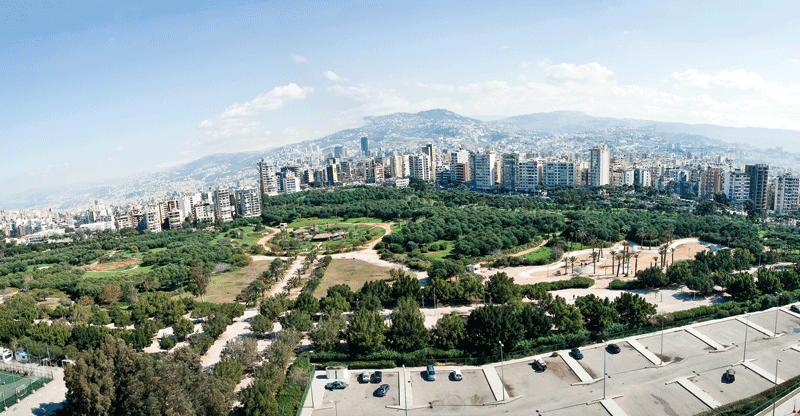
This year has seen a steady stream of announcements for new, self-contained gated communities in areas surrounding Beirut. For MENA Capital it is Bella Casa near the Adlieh roundabout in Beirut. ESLA has also joined in, with its newly announced Boutchay Hills project, which will overlook Beirut. When completed, it will be a massive complex of 51 buildings with 550 apartments ranging from 80 to 300 sqm each, and an additional 7,000 sqm of green public areas for its residents’ communal use.

Demand for gated community living is high, too. In just the first two days of availability, ESLA sold roughly 70 percent of Boutchay Hills.

Gated communities are meant to provide respite from a crowded metropolis, usually with wide-open spaces, self-contained shopping areas and a feeling that one does not need to leave their immediate area for anything if they so choose. The appeal is clear. But is a move toward this kind of living necessarily a good thing? 

In a chapter on the Middle East in the book “Gated Communities: Social Sustainability in Contemporary and Historical Gated Developments”, Samer Bagaeen argues that gated communities are stifling real, urban neighborhoods in many of the region’s cities.

“Gated living is being advertised as offering the very best of city living, which is about connecting with family, friends, and a ‘life you’ve always dreamed about’, offering urban life with all the amenities of a metropolitan center, and the added comfort of security of an exclusive community,” Bagaeen writes. “Although privacy and exclusivity feature prominently in the material advertising of these sites, there is no mention of the older mechanisms, such as kinship and social solidarity, which gave rise to the form of traditional cities historically associated with the Middle East.”

For now at least, a full-blown exodus from urban Beirut has not taken shape. But a combination of marketers preying on people’s security concerns and selling an escape from congested city living,  in addition to exorbitant prices per square meter in Beirut, the future could be a different story.


In search of green
With the apparent sector-wide shift toward both sequestered and sensibly sized living spaces, nearly all developers are starting to push the use of “green” technology — everything from on-site renewable energy sources to waste composting — for their new projects. Most Lebanese developers are late to the “eco-friendly” game and are rushing to cash in on what has been a profitable global enterprise for some time. But Karim Makarem, director at Beirut-based Ramco real estate advisors, is skeptical of some companies’ claims. “There are developers who are genuine and care about the environment, but there are many others who don’t quite understand what it means and they are using the word ‘green’ to encompass a lot of things,” he says. “It is slightly misused as a word. There is very little appetite from end users for green projects which leads one to believe it is more of a [public relations] stunt than a real movement.”   Marwan Youssef, sales manager at Seven Invest, boasts of his company’s new 30-unit “One” community in Ain Saade — where villas sell for between $2 million and $3 million each — and its commitment to environmentally friendly practices, such outfitting homes with solar panels and rain water filters. Nearly half of the site’s original 1,000 or so native pine trees will be cut down during construction, but he says each fallen tree will be replaced by two more. It is an ambitious project that benefits from sitting at the higher-end of the market, making its commitment to eco-friendly standards a tangible and affordable asset.

No longer a Gulf haven
A key component of demand in Lebanon looks to be shying away as the conflict in Syria spills into Lebanon and a steady stream of warnings by governments in the Gulf urging their citizens to stay clear of the country have clearly hurt the tourism industry. These warnings, most notably by the United Arab Emirates, Bahrain and Qatar, may not have a direct effect on potential property buyers, but the overall political climate that spurred these warnings certainly does. A mid-June Bank Audi report on the real estate sector states that property sales to foreigners dropped by 20.3 percent last year, the first year of the Syrian uprising and a year that started off with Lebanon trudging along without a government. Five steady years of foreign property purchasing in Lebanon has finally dried up.

That leaves developers Executive spoke to with one main target market: the Lebanese diaspora, which has always played a huge role in the real estate market, and little seems to be changing.  “Our main target is Lebanese living abroad — people who have saved money for the last 10 years and want to keep a pied-à-terre [foot on the ground] here,” says Youssef of Seven Invest.

Dark days ahead
According to Lebanon’s Real Estate Registry, transactions across the country contracted 6.7 percent in total value last year, whereas in the previous five years annual growth registered at 32 percent on average. The first quarter of this year is looking somewhat better, with the number of transactions up 4.0 percent year-on-year. Like nearly every developer and analyst, researchers at Bank Audi attribute this slump largely to local political disputes and regional instability.

The effect on the sector is clear. As Pierre Bou Jaber, CEO and Partner at Ven Invest Holding says, “I am bearish for the next five years to come, at least.” And some are even more pessimistic about the current state, such as Bassil of BREI Real Estate Investment, who estimates that Lebanon is perhaps in just the second year of a 10-year long slump.

“Today Beirut is so difficult. I may be wrong, but with such an oversupply of flats that will be finished in maybe two years, Beirut is going to have an enormous amount of empty flats,” Bassil says.

On the whole, developers know that the glory days of unchecked growth are over and are adapting accordingly. But in the lean years ahead, those who are the quickest and most adept at change and forecasting trends will stand the best chance of sticking around for the next upswing, whenever that might come.


This article was published as part of a special report in Executive's July 2012 issue

July 3, 2012 0 comments
0 FacebookTwitterPinterestEmail
Real Estate

Rent a mob

by Zak Brophy July 3, 2012
written by Zak Brophy
Under normal circumstances writing about public policy in the real estate sector in Lebanon is akin to writing about the intellectual value of a parliamentary debate — there is just not much of the former to talk about in the later. Currently, however, a new draft law being discussed in the government has the potential to reshape the playing field for tenants, landlords and developers. How far it gets toward implementation is, as always in Lebanon, the major question.
 
The property market until now
Politicians have tended to adopt a decidedly laissez-faire approach to this lucrative corner of the Lebanese economy and policies are somewhat thin. After all, many of the men sitting in parliament have built their own fortunes from bricks and mortar and are wary of government interference.  However, changes are afoot and all is not business as usual.
 
Lebanon is anomalous, in that while land and property prices have climbed steeply skyward over the past couple of decades and luxury apartment blocks have sprouted unrelentingly from the earth, there are tens of thousands of people paying virtually non-existent rents. These somewhat contradictory realities are the consequence of a series of laws stretching back to the end of World War II (as was discussed in detail in Executive’s March issue).
 
As a new world order was being forged out of the rubble of war, Lebanon enacted the ‘old rent law’ to protect tenants from unscrupulous landlords. The legislation stipulated extending the existing contracts, even if against the landlords’ will, at the same rent. This law served its purpose in the short term but as the months turned into years and the years into decades, inflation ravaged the real value of the rents. Tenants were left laughing and landlords were left seething. “For the past over 70 years we have been living under the tyrant rule of rent control,” says Joseph Zoghaib, head of the Association of Landlords in Lebanon.
 
With the end of Lebanon’s notorious fifteen-year civil war in 1991 began the gargantuan mission of rebuilding the nation, and in 1992 rent law 160 was enacted, which went someway to addressing the imbalance between tenants and landlords. The law liberalized the real estate rental markets and allowed landlords to negotiate new contracts, but the legislation only allowed cosmetic adjustments to the amounts paid by tenants on ‘old rents’ — that is, rents from before 1992. As such there are now thousands of tenants enjoying their old rents from before 1992 while others are struggling with soaring prices. As the debate about a grand solution has moved back and forth, the law has been extended no less than a dozen times, and last expired at the end of March this year.  
 
The potential new game
As such, the country’s landlords and residents are currently living in legal limbo, uncertain as to whether the law will be extended once again or if a new piece of legislation, which is currently under consideration, will be passed and realign the perennial quirk of Lebanon’s old rents. A member of parliament (MP) on the Justice and Administration Committee — the body fleshing out the details on the new law before it goes to a vote in parliament — told Executive on condition of anonymity that, “Up until now I really am not sure if there will be an agreement. It could go either way.”
 
While there is near unanimous agreement that the landlords are being done an injustice, the dispute concerns how this can be corrected without throwing tens of thousands of tenants onto the streets. How many people are on old rents is a matter of dispute; Zoghaib claims there are 81,000 of which only 13,000 are poor Lebanese who need support; the parliamentary source claims there are around 150,000 of which up to 50,000 would not manage at market rates and argues, “If there are 50,000 who cannot pay what are you going to do with them? Are you going to send the police to throw them on the street like in America? There will be a kind of revolution in Lebanon.  You simply cannot do that here.”
 
Executive obtained a copy of the draft law as presented to the Justice and Administration Committee and it incorporates a number of measures intended to protect the tenants during the process of the landlord’s property being liberated. The proposal is to have old rents increase over a 6-year period to an amount agreed by the landlord and tenant and overseen by government appointed experts. The landlords will increase rents by 15 percent annually for four years and then 20 percent for the final two years. The tenant also has the right to stay for an additional three years at market rates if they request it at least three months before the end of the six-year period. 
 
There are also clauses relating to the conditions if a landlord wants to buy a tenant out during the six-year period.  If the landlord wants the property for their family they must pay four years rent after four years of rent increases, and if they want to demolish the building they must pay six years rent at the increased rates.  If properties are deemed to be luxurious these amounts will be halved.
 
For low income households there will be a government fund established to assist them with the rents over the nine-year period. What’s more there is a parallel law, which encourages the development of affordable rent-to-own housing.  According to the source within the Justice and Administration the legislation stipulates, “If you make a building and you rent it on a rent-to-own basis over a long period the law will give benefits to you. It gives benefits such as tax breaks and allows developers to build 20 percent higher than what is permitted in the building code, which the developer can do with as he likes.”  
 
The developers’ push
While the landlords have reservations about the law, Zhogeib says, “We have to accept it as it has the liberation clause, which liberates our properties after nine years.” Zhogeib is adamant that the only opposition to the law comes from the “communists”, but in reality the debate is far more complex. 
 
The fact is that the politicians that are preparing the law to put it to the floor in parliament are at loggerheads over who should receive government support and by how much.
 
The unnamed MP says, “There is still conflict over how much a tenant will take from the landlord if he decides to leave in the first year to free it up for a landlord to do as he likes. Should it be six years or nine years [rent]? And also for the poor people who are unable to pay the rent, how do we determine the standard for who the government will support? Is the line households earning LL2 million per month, or LL3 million or LL4 million?”
 
If the politicians fail to reach a consensus on these details within the law in their next session then the old law will have to be extended once again. This is anathema to Zoghaib, who threatens: “We’re starting to make a list of the influential people in parliament and society who are tenants on the old rents and we are going to make a CV of them, on what they rent, where and for how much.  We are going to scandalize them. I don’t care.”
 
A universal benefit that would likely ensue from the passing of this law would be the money earned by landlords that could be put towards the maintenance of buildings — the importance of which was tragically highlighted with the collapse of a neglected old building in the Fassouh area of Beirut that killed 27 people in January. What is more, if landlords are able to start earning market rental rates then there will be more incentive to protect Lebanon’s heritage buildings.
 
Mona el-Hallak, architect and member of the Association for Protecting Natural Sites and Old Buildings (APSAD), says, “Landlords need to be able to make money on these properties if they are going to have an incentive to maintain them and not destroy them.” After years of campaigning for the preservation of Lebanon’s heritage, Hallak is despondent about the management of urban planning and concedes, “I have come to accept anything is better than nothing. Really it is in that desperate a state.”
 
 
Corruption destroying communities
In addition to the years of heritage protection legislation being watered down or just flagrantly abused, Lebanon also has no comprehensive urban planning code.
 
“The Director General of Urban Planning (DGU) should have developed an urban planning strategy for the whole country but they have done nothing,” says Hallak. “They do little jobs here and there but nothing that is applicable.”
 
The DGU did publish a national land use master plan in 2005, but by the admission of a senior employee — who spoke on condition of anonymity to protect his job — “It is schematic and not specific.” Moreover, it is not binding.
 
One only needs to look out of the window to witness the consequent haphazard and incongruous development that is engulfing Lebanon.
 
As to the rules governing the actual construction and development of buildings, Lebanon has a building code. The unnamed employee at the DGU explains, “The building code is written by the DGU in collaboration with certain specific people and the developers have a large influence on this code.” 
 
Referring to the code, examples were given as to how the exploitation rate — the amount of floor space that can be built per square meter of land — has been increased to increase developers profitability.
 
What’s more the code is full of nuances, such as allowing more floor space to be developed if underground parking is made public, but by the admission of the DGU employee this is then just made private and no one checks up on the issue. “There is something wrong in our regulation,” says the DGU employee. “It is so free that there are gaps that the developers can go through and do whatever they want.”
 
One of the most divisive trends in Lebanese real estate is the increasing predominance of high-rise towers shooting up around the city, and especially among heritage clusters. Any building that is more than 50 meters tall needs to get permission from the DGU, but as the DGU employee says: “Why do they always seem to get permission? Well, there are no criteria within the DGU to say when we can build 50 meters, or 100 meters.  At the end of the day these big buildings belong to the nation’s major developers and they are working with political backers.”
 
Due to the absence of any coherent urban planning policy, and with the powerful hand of the development companies and speculators reaching into the institutions and even the laws that govern the sector, there is no holistic approach to development and construction.
 
“The laws have not been outlined in the interest of the community, not after a study of the socio-economic areas, not after a study of the welfare of the communities, but they are a result of the pressure from the landowners and speculators for the maximum coefficient of land use irrespective of the damage it creates to the community,” says Assem Salem, former president of The Order of Architects and Engineers.
 
Shifting the focus back to the suits in parliament, all property owners in Lebanon — whether they are big fish or small fry — will have their eyes on Finance Minister Mohammad Safadi’s proposed budget for 2012, as it contains a proposal for a capital gains tax on all real estate transactions. The plan that has been put forward is a 4 percent tax on the sale of properties purchased before 2009, whereas real estate owned since 2009 would be subject to a 15 percent tax.
 
While the government could certainly use the extra dosh and some argue it will reduce real estate speculation, many industry insiders argue the timing is wrong for such a fiscal policy maneuver.
 
If it was going to be done it should have been a few years ago when the market was strong,” says Karim Makarem, director at Ramco Real Estate Advisors. “Now it is plateauing and needs support. This will not help.”
 
Whether parliament actually passes the law in its draft form or dilutes it into impotence, or passes the budget (which last happened last in 2005), is yet to be seen. And then, even if it is passed, it will have the hurdles of political duplicity and weak institutions to vault before implementation. Given this, the continued chaos amid Lebanon’s urban development likely has some time remaining to play.

This article was published as part of a special report in Executive's July 2012 issue


July 3, 2012 0 comments
0 FacebookTwitterPinterestEmail
Real Estate

The love is gone

by Maya Sioufi July 3, 2012
written by Maya Sioufi

The happy marriage between Mr. Bank and Ms. Real Estate seems to have lost some of its luster of late, becoming more of a relationship that both parties are resigned to accept for the sake of keeping the house — Lebanon — together.

On the surface, if we do the math, there is no need for the couple to seek counseling over the current exposure of Lebanese banks to the real estate sector. Out of the $44 billion which was lent to the private sector by Lebanese banks last year, a total of $13 billion was handed to the real estate sector in the form of housing loans or construction loans — that is around 30 percent of the total private sector loan book of banks and 19 percent of the total loan book. By comparison, the Spanish real estate and housing market, which is under severe pressure, accounts for 54 percent of the total loans of their local banks, forcing the banking sector to ask for a hefty bailout. Demand in Lebanon, according to experts Executive spoke with, is also primarily based on end users as opposed to speculation; given this, the banking sector’s exposure may not be worth rattling about. Of the $6 billion the construction sector added to economy last year, according to Bank Audi estimates, developers received $1 billion from banks and had to fund the rest themselves either through presales of flats or their own capital. “The real estate sector relies on around 80 percent of their own financing so it is not highly leveraged and it is not pressured to sell,” says Marwan Barakat, chief economist at Bank Audi. “That’s why there isn’t much pressure on [housing] prices.”

Omar Shantouf, general manager at FFA Real Estate, concurs: “Developers are not that highly leveraged and they can afford to sit on projects. They might sell one or two apartments at lower prices but they won’t advertise this, there is no such thing as a fire sale in Lebanon.”

As for housing loans, 36 percent of total property sales were funded by loans from the banking sector in 2011, up from 9 percent in 2007, and the remainder was funded by homeowners’ capital according to Bank Audi research. “That’s a moderate level even though it increased in past years,” says Barakat. 

The honeymoon is over

Many heated debates at the dinner table, however, have centered on whether Lebanon’s lady of real estate has gotten a little big for her britches in recent years. Indicators of activity within the real estate sector are starting to paint a gloomier picture. Cement deliveries, an indicator of current construction activity, dropped 4 percent in the first quarter of 2012 after increasing 6 percent in 2011. Construction permits, an indicator of future supply, dropped 4 percent in the first quarter after dropping more than 6 percent in 2011.

Economists and financial experts Executive spoke with played down any concerns: “95 percent of our projects are sold to end users, people buying to live in it and not to speculate,” says Ziad Maalouf, chief executive of Capstone, a private investment firm. “Today, there is no risk of seeing a bubble in the market explode.”  In the construction sector, banks have handed out a total of $7 billion in loans, which represents 16 percent of total lending to the private sector. “The share of the construction sector to total loans is similar to the one of the construction sector to GDP so we didn’t over lend to [real estate]” adds Barakat, given that the share of the construction sector to the country’s gross domestic product stood at 15 percent, according to the 2010 National Accounts of Lebanon, the latest official breakdown of figures for GDP available.

While banks may lend according to the economic logic they devise, they are now faced with developers who are finding it more challenging to offload flats, which a few years ago were selling like hotcakes. “Banks are becoming more selective because of the situation in the real estate market today. They are worried about demand and supply,” says Maalouf.  As banks become pickier, they look for trendier projects. Demand has shifted from large-sized apartments, over 200 square meters, to medium-sized apartments, between 100 and 200 square meters, and from Beirut to the suburbs according to Bank Audi research.  “If you go to the bank and ask for financing for a project with flats of 600 square meters in size, no one gives you a loan. You have to go with the right project and the right sizes,” adds Maalouf.  With land prices still increasing and flat prices in tow — albeit at lower levels than in previous years — homebuyers are finding it more and more difficult to pay for a roof over their heads. “Homebuyers can’t afford to buy houses anymore because the prices of land have gone up in the lift and our income is going up the stairs,” says Antoine Chamoun, general manager at Bank of Beirut Invest. 

Competition on the rise

Homebuyers have also been visiting bankers more regularly in recent years. Housing loans leapt by 33 percent last year — receiving the bulk of the increase in private claims — to reach $6 billion. The central bank had a significant role to play in giving banks incentive to lend their liquidity and in helping the Lebanese folk fund their pads. The central bank’s circular of May 2009 provided an incentive for banks to lend in Lebanese lira by reducing their reserve requirements as long as rates applied to clients are within a certain limit — 40 percent of a one year Lebanese Treasury bill plus 3 percent. “It created a boost in terms of supply and demand,” says Basil Karam, head of retail at BankMed.

“The central bank helped us developers by helping home owners buy flats, helping banks to lend and helping activity in the country,” adds Maalouf. “It is the best thing that happened to the sector.” This has fueled the development of a love-hate relationship between homeowners and bankers. For bankers, it became a lucrative business. Struggling to deploy their excess liquidity — deposits stood at $120 billion, or around three times GDP, in the end of the first quarter — with interest rates globally at record low levels and a dearth of investment opportunities within Lebanon and in the shaken region, extending loans to the housing sector became a thriving business and everyone jumped on the bandwagon. Yet what that also meant was that the central bank indirectly propped up a housing market, where prices were continuously rising and thus impacting the affordability of housing in the country.

“Banks have been under pressure on their interest margins in the past few years because their liquidity is not yielding [returns] anymore both outside and inside Lebanon, so they are having to lend more,” says Barakat. As banks increase their offering for home loans, competition is getting fiercer and along with it, the advertising wings of the banks are becoming more active to lure clients their way. Billboards for home loans seem to be popping up on almost every corner. 

With rates on loans in Lebanese lira being controlled by the central bank, the competition is now on the dollar loans. “Some banks are reaching their allowable limits in extending subsidized loans in Lebanese pounds,” says BankMed’s Karam. “They will have to focus more on dollar-based loans and cut prices to attract more loans. In dollars, there is price competition, big time.” 

Chamoun agrees, saying that, “The competition on loans in Lebanese pounds [subsidized loans with the central bank and with the Public Corporation for Housing] is low because the features of the loan are imposed and there is very little difference among banks on these loans, but on the dollar, banks are putting their own features.”

While there is room to increase lending further to the housing sector, growth is unlikely to be as significant as in previous years given that it was coming off a low base, according to Barakat.  This could lead to continued competition in the sector and “it should be like this and the best offer should win,” adds Chamoun.

Increasing competition would be a welcome respite for homebuyers struggling to keep up with the elevated real estate prices. As for developers who have funded their current projects with low leverage, they are largely sitting on their pile of stock, putting  upcoming projects on hold and staying firm on prices. For developers quick to adapt to the changing dynamics, projects outside Beirut with smaller flat sizes are being developed, and thus those selling homes will likely have to do with transactions that were not as large as they previously enjoyed. 

As BankMed’s Karam points out: “Lebanese will continue to borrow to buy homes but the average ticket size wont be the same.”


This article was published as part of a special report in Executive’s July 2012 issue

July 3, 2012 0 comments
0 FacebookTwitterPinterestEmail
Real Estate

Culture Vultures

by Jeff Neumann July 3, 2012
written by Jeff Neumann

The endless struggle over what constitutes a cultural heritage site and what real estate developers can build over continues to spur heated debates in Lebanon. There are many sites at issue. Beirut’s Ottoman and French colonial-style homes, or at least the ones that survived the civil war and reconstruction efforts, are under constant threat. Several remnants of the area’s ancient past as a center for global commerce and culture are also at risk of being lost in the name of profit.

Land scarcity only heightens property developers’ appetite for demolition of sites that may or may not be under protection. Weak government regulations, mostly holdovers from the French mandate-era, have left countless loopholes open for exploitation.

The onus to protect these sites, by protesting against great odds, has fallen on a loose affiliation of activists, archaeologists and everyday citizens. And in many ways, real estate developers are simply taking advantage of rights set aside for them by previous governments, most notably that of former Prime Minister and real estate mogul Rafiq Hariri, although other governments did their part as well.

An ancient past discarded

One of the most controversial heritage issues of late is the Venus Towers project in downtown Beirut. The original plan calls for three luxury residential towers with the promise of “recapturing the traditional context of Lebanese housing in a new modern style”. After ground was broken what appeared to be an ancient Phoenician-era port was discovered, spanning some 7,000 square meters of prime real estate. The project developer, Venus Real Estate Development Company, says the site’s significance has been overblown. But archaeologists not associated with Venus Real Estate say the alleged port is a cultural heritage site that should have been preserved at all costs.

A fierce public debate over the site ensued, followed by at least five archeological reports, which were submitted last year to then Culture Minister Salim Warde. Last spring, Warde told Executive, “It might be a port, a shipyard, or even a quay, but it is surely something very interesting, and we are seeing how we can work with the owners of the land to save this site.” An official from Venus Real Estate told Executive in late June that the archaeologists and experts contracted by the company had recently finished their assessment and submitted a report to the Minister of Culture Gaby Layoun, and were waiting on a response. “It’s in the minister’s hands now,” the official said.

The next day, Venus Real Estate completely demolished the remnants of the site after gaining approval from Layoun.

Joseph Haddad, founding member and secretary of the Association for the Protection of the Lebanese Heritage, called the action “illegal” and promised to continue with protests. Announcing the decision, Layoun said in a statement, “The entire case involves no proof that points to the presence of a Roman or a Phoenician port and the trenches within the rocks could not have been used as dry docks for ships or their maintenance.” Media reports later stated Layoun had distanced himself from the decision and his office was not avaliable for clarification as Executive went to print. 

A similar dispute has arisen over a Roman-era hippodrome, also in the heart of downtown Beirut. Solidere built luxury homes directly on top of much of the site, one of which is owned by former Prime Minister Saad Hariri. The hippodrome is one of two in Lebanon, out of only five of its kind in the Levant. The second hippodrome in Lebanon is in Sour, and was added to the United Nations Educational, Scientific and Cultural Organization (UNESCO) World Heritage list in 1979, long before the construction craze took hold across the country.

Solidere has proposed moving the remnants of the hippodrome to a site nearby, where a former Roman-era bath was also moved. However, this will do little to appease preservationists. “It is very easy to protect something,” says Jeanine Abdul Massih, professor of archaeology at the Lebanese University, and a proponent of keeping the hippodrome in its original location. “The problem is, it is also very easy to move it.” For its part, the Culture Ministry seems more intent on using the episode to publicly attack Hariri on television than to preserve the site.

Outreach efforts by preservation groups such as the Association for Protecting Natural Sites and Old Buildings in Lebanon (APSAD) have proved moderately successful, at least in attracting awareness. In late May the group held a ‘National Heritage Day’ with assistance from the Ministry of Culture, and with a focus on cultural heritage sites in Sour and Hermel.

Despite its efforts, APSAD says it is up against powerful real estate companies that are tough to counter. “Anything is better than nothing,” says Mona El Hallak, architect and executive committee member of APSAD. “Really it is in that desperate a state. They do everything to make buildings fall apart and then lobby to be able to pull it down.” 

LU’s Massih echoes that sentiment, saying, “We are all used to it. For 25 years we destroyed all of the history. The problem is patrimonial. Maybe the money at stake is too much, I don’t know. There must be something to do because the people cannot enjoy any of these sites.”

Foreign elements

While most preservation efforts are focused on specific buildings and historical sites in Beirut and surrounding areas, the sale of large swaths of land to foreigners across the country is also attracting the ire of activists and citizens. One example is a brewing fight over the sale of some 7,700 square meters of land near the Keserwan village of Dlebta to Saudi Prince Muqrin bin Bdul Aziz, allegedly without consultation with the local municipality. As Executive went to press, repeated attempts to contact the municipality went unanswered. A presidential decree, #7983, approved the sale in April and residents say they only learned of it once an announcement was made in the Official Gazette.

A campaign to revoke the sale has attracted attention, and local residents have mobilized. But some elements involved in protesting the transaction show hints of xenophobia rather than a genuine concern for the land. As it stands, a petition is circulating demanding the revocation of the sale and it appears that this, like other land issues, will not be resolved soon.

Past attempts at historical and cultural preservation have shown mixed results. A senior advisor to Minister Layoun, Michel de Chadarevian, touts the Sour hippodrome as a preservation success story. “The hippodrome in Tyre has been handled with great care and this is something that Lebanese should be proud of,” he says. But that effort was undertaken more than 30 years ago, and nothing approaching the level of UNESCO protection has happened since.


This article was published as part of a special report in Executive's July 2012 issue

July 3, 2012 0 comments
0 FacebookTwitterPinterestEmail
Real Estate

Facing a squeeze

by Jeff Neumann July 3, 2012
written by Jeff Neumann

Reading through our special report, you probably have a good idea of the challenges faced by the real estate sector over the past year. Data shows that demand for residential property is weakening across Lebanon and developers are coping with higher operating costs than before. How they adapt will determine how well they weather what some expect to be a prolonged downturn.

Overall construction costs in Lebanon were up in the first few months of 2012, due in part to the mandatory wage increase approved by the government in March. However, material costs have for the most part stayed at the same levels through the first five months of 2012. For instance, steel in Lebanon has remained at $750 per ton through June; Portland cement cost $102 per ton over the same time period.

permits


Shaving the fat

When asked about what is being done to cut costs, most developers declined to go into detail. The one exception, Karim Bassil, founder of BREI Real Estate Investment, offered a brief insight into his company’s operations. “The main thing is we’re reducing our overhead, we’re reducing our margins. We have already reduced our margins by 50 percent this year,” he says, describing the return generated from new income on a project. “We’re just not making the same kind of money that we were making before,” adds Bassil. “In Lebanon, when you plan something for, let’s say, 30 percent ARR (average rate of return), you end up with 20 percent of 70 percent ARR.”

Cement deliveries are also down this year by 4.2 percent — another obvious indicator of a slowdown in construction. This stings developers even more due to the fact that between 2005 and 2010, average annual deliveries increased by 11.2 percent. As an example of the many factors listed coming to a head, Bassil says that “on one of my projects in Beirut, instead of putting it around 20 percent ARR, we put it at 8 percent. This is because of politics, war and project delays — they all play a role in [reducing ARR].”

Through May, the total number of construction permits issued in Lebanon was down 9.3 percent from May 2011, according to data compiled by InfoPro. Also of note, construction area authorized by permits were down 12.5 percent from the same time last year.

Indeed, times are tight for the sector, forcing developers and contractors to consider all options. As Bassil puts it, “Personally, we’re doing everything to keep our business alive for better days to come.”


construction cost

 
This article was published as part of a special report in Executive's July 2012 issue


July 3, 2012 0 comments
0 FacebookTwitterPinterestEmail
Real Estate

Q&A – Solidere’s Mounir Douaidy

by Maya Sioufi July 3, 2012
written by Maya Sioufi
The company the Lebanese love to hate is Solidere, Lebanon’s largest developer tasked with rebuilding the Beirut Central District (BCD) after the civil war. While many enjoy sipping coffee by the yachts in Zaitunay Bay, Lebanon’s Porto Fino, and walking around in the Souks, still undergoing further expansion, and even jogging by the newly built marina, there are fears the company has gone beyond its mandate and is now competing with, instead of supporting, businesses and developers. For a better understanding of how the BCD operates, Executive sat with Mounir Douaidy, the general manager of Solidere. 
Solidere has signed contracts for several projects on the Waterfront district, among which are KidzMania and The One. These have been criticized as being illegal as they do not seem to be temporary structures as per the law? 

For 10 years, there was only BIEL (Beirut International Exhibition and Leisure center). A few years ago, we looked at one particular area starting from the entrance of BIEL all the way to the sea. We started with the Beirut Exhibition Center and along the same line, there will be The One (a night club owned by Skybar’s Sky management) and KidzMania (indoor theme park for children). These are temporary activities with seven-to eight-year contracts to create movement and attract people. We only receive rental income and have not taken stakes in the projects. Down the line, all these areas will be sold and developed. 

What will the waterfront district look like once permanent structures start being implemented? 

All the buildings on the frontline facing the park and the sea will be 40 meters high. There will be one or two towers there similar to the ones on the Corniche, such as the Four Seasons or the Platinum Tower. Heights on every lot will be different: some with heights of 52 meters, some with 75 meters and others even a little higher. Concentrations of high-rise buildings will be mainly in the central part of the reclaimed area and not the outside edges, which will be composed of low-rise buildings to catch the views. 

In a context of regional turmoil and lack of domestic stability, Solidere’s recently reported 2011 results saw revenues drop by 23 percent year-on-year to $296 million. How is 2012 looking so far?  

Last year, we did not sign a land sale deal until the fourth quarter when we signed four deals for $220 million, which constituted the main part of our revenues. So for 2012, I don’t know yet because we still have six months. All I can tell you is we are on the right track for sales because there is demand.

What changes have you seen in terms of demand? 

The negotiations to materialize a transaction are taking longer than usual. We have also had to break up bigger blocks into smaller units so that it becomes easier to sell these units. Finally, most of the investors looking to acquire land are, more and more, coming from Lebanon as opposed to the region. 

Solidere’s strategy has been to reduce its reliance on land sales by increasing rental income. Where do you stand on this? 

Our rental income, which stood at $50 million in 2011 up from $42 million 2010, is expected to reach $65 million by 2015 after the completion of several projects, namely the remaining component of the Souks with a cinema complex by the end of the year and a department store by 2015. Land sales will continue to be the main source of revenue over the next 10 to 15 years because we still have a significant inventory of land, mainly on the waterfront, valued at $7 billion at today’s prices. 

Given Solidere International (SI)’s exposure to countries in turmoil, where do you stand with your expansion plans outside of Lebanon? 

We were not impacted [by the turmoil] as we had not spent on anything yet because of the financial crisis. All we had to do was to restructure the projects. For example, Al Zorah project in the United Arab Emirates was reduced in size and changed from a mix used development to a touristic project. SI is now concentrating on identifying new markets and we think there are lucrative opportunities in Saudi Arabia where we already started one project for a tower in Jeddah and we have two to three projects in the making in Riyadh. 

Solidere is venturing into the restaurant business. Is this another way to reduce your reliance on land sales?

Any revenue from the restaurant business is immaterial relative to our activities. The whole idea [behind venturing into this line of business] is to allow the creation of outlets and restaurants of a certain caliber that we felt did not exist and would support the overall real estate development activity. We did it with Stay (fine dining restaurant) and Momo’s (Moroccan restaurant and bar). We brought in an operator and created an entity — a cooperation between Solidere and the operator — that would rent out the space and pay us rent. The operator runs the concept and Solidere co-manages with the operator. Solidere is not in hospitality: We don’t know how to do restaurants. We also did this with The Venue, the 1,000 square meter space used for exhibitions.

Your critics say that you are competing with the restaurant business. 

People keep saying Solidere is competing. We created these two ‘unique’ concepts that didn’t exist before so they will not compete with anything else that exists. Our intention is not to expand into this and step into the shoes of people doing this kind of business. We did this to give a push to the area, attract more people and promote cultural and artistic activities, and these restaurants came as part of this objective. If you look at the city center, there are tens of restaurants and outlets that have nothing to do with us. 

Are you also co-managing outlets in Zaitunay Bay? 

No. Zaitunay Bay is a little bit different. It is a joint venture with Stow Waterfront Development. Together we are executing Zaitunay Bay as a project made up of two parts. First is the restaurant part, only for lease, and the other part is a building composed of fully furnished small-to-medium sized apartments, which will be up for sale. 

Doesn’t this divert from Solidere’s strategy of focusing on rental income only?  

All the properties in our real estate portfolio so far were up for lease because the idea was to generate rental income and keep increasing it over the years. For this building, it was agreed with the partners that the apartments would be put up for sale as there would be higher ownership demand given the high prices, and we also wanted to recuperate our investment in the project and keep the restaurant leases to generate rental income. The building will also host a members club like the Automobile et Touring Club du Liban [ATCL] or the Golf Club, which will generate annual income.

Are you considering moving into the sale of apartments going forward? 

Until last year, the decision was not to sell any assets but going forward we are considering to slowly sell some assets. We started selling some of the Saifi apartments that were leased for the past 12 years. We are eventually offloading some of the stock of apartments as we have other apartments in Zokak El Blatt and Wadi Abou Jamil that are leased. Our new projects will come to replace some assets that we are selling. 

So the new projects will only be for lease? 

We recently got the permit to start another 20,000 square meter project in Saifi consisting of three small residential and one office building. We intend to sell the apartments of this project. We will not start offloading a huge quantity of assets. 

With demand moving to smaller sized apartments, aren’t developers having to adapt and provide smaller sized apartments too? 

All the stock on the market came from developments that started a few years ago. Future developers will be looking to smaller sized apartments but this will come after Solidere has finished selling these apartments. 

Wouldn’t the sale of apartments place you in competition with developers? 

We are not doing anything to compete with anybody in the market. We want to support other developers, complement their activities and not go in competition with them. We want developers to do well and become repeat developers. We are doing this on a very small scale and the size of the apartments we have been putting up for sale are small to medium sized, whereas developers have been selling medium- to-large sized apartments, so we are not competing with them.


This article was published as part of a special report in Executive's July 2012 issue

July 3, 2012 0 comments
0 FacebookTwitterPinterestEmail
Finance

INSEAD’s Professor Antonio Fatas

by Executive Staff June 26, 2012
written by Executive Staff

Professor Antonio Fatas, the Portuguese Council Chaired Professor of European Studies at the INSEAD business school discusses with Executive how the European sovereign debt crisis

June 26, 2012 0 comments
0 FacebookTwitterPinterestEmail
Finance

INSEAD’s Professor Theo Vermaele

by Executive Staff June 18, 2012
written by Executive Staff

Professor Theo Vermaelen, the Schroders Chaired Professor of International Finance and Asset Management at the INSEAD business school discusses with Executive how the ‘small people’ caused the 2008 financial crises, Facebook’s IPO flop and Lebanon’s conservative stance on derivatives trading on the sidelines of a recent conference titled ‘Challenges of the New World Economy: Are we in a Post Globalization Era?, at the Phoenicia in Beirut.

June 18, 2012 0 comments
0 FacebookTwitterPinterestEmail
Real Estate

Turning Lebanon’s heritage into art

by Zak Brophy June 12, 2012
written by Zak Brophy

A few months ago, Villa Paradiso in Beirut’s Gemayze district was another decaying old building in Lebanon’s capital. Now it has been turned into a vibrant art space

June 12, 2012 0 comments
0 FacebookTwitterPinterestEmail
Finance

Riad Salameh on Syria

by Executive Staff June 11, 2012
written by Executive Staff

Riad Salameh, governor of Bank du Liban, Lebanon’s central bank, discusses the banking sector’s exposure to the crises in Syria

June 11, 2012 0 comments
0 FacebookTwitterPinterestEmail
  • 1
  • …
  • 325
  • 326
  • 327
  • 328
  • 329
  • …
  • 686

Latest Cover

About us

Since its first edition emerged on the newsstands in 1999, Executive Magazine has been dedicated to providing its readers with the most up-to-date local and regional business news. Executive is a monthly business magazine that offers readers in-depth analyses on the Lebanese world of commerce, covering all the major sectors – from banking, finance, and insurance to technology, tourism, hospitality, media, and retail.

  • Donate
  • Our Purpose
  • Contact Us

Sign up for our newsletter

    • Facebook
    • Twitter
    • Instagram
    • Linkedin
    • Youtube
    Executive Magazine
    • ISSUES
      • Current Issue
      • Past issues
    • BUSINESS
    • ECONOMICS & POLICY
    • OPINION
    • SPECIAL REPORTS
    • EXECUTIVE TALKS
    • MOVEMENTS
      • Change the image
      • Cannes lions
      • Transparency & accountability
      • ECONOMIC ROADMAP
      • Say No to Corruption
      • The Lebanon media development initiative
      • LPSN Policy Asks
      • Advocating the preservation of deposits
    • JOIN US
      • Join our movement
      • Attend our events
      • Receive updates
      • Connect with us
    • DONATE