• Donate
  • Our Purpose
  • Contact Us
Executive Magazine
  • ISSUES
    • Current Issue
    • Past issues
  • BUSINESS
  • ECONOMICS & POLICY
  • OPINION
  • SPECIAL REPORTS
  • EXECUTIVE TALKS
  • MOVEMENTS
    • Change the image
    • Cannes lions
    • Transparency & accountability
    • ECONOMIC ROADMAP
    • Say No to Corruption
    • The Lebanon media development initiative
    • LPSN Policy Asks
    • Advocating the preservation of deposits
  • JOIN US
    • Join our movement
    • Attend our events
    • Receive updates
    • Connect with us
  • DONATE
Economics & PolicyUAE's Best Places to Work

Employers par Excellence

by Thomas Schellen February 3, 2012
written by Thomas Schellen

Everyone deserves a good job. Thus, a challenge is afoot in corporate Arabia and it mandates companies to improve from within: to become a great workplace. For the second time ever, ten companies in the United Arab Emirates are being recognized as the Top Companies to Work For in the UAE. 

The list of these exemplary workplaces has been researched and produced by the UAE arm of the global research and training firm the Great Place to Work Institute (GPTWI) in partnership with Executive.  The ten companies that emerged on top passed the scrutiny of a thorough employee satisfaction survey, called a Trust Index in GPTWI terminology, and a culture audit, or assessment of their corporate behavior. The trust index score, which is based on employee responses to a confidential survey, accounts for two thirds in the ranking of a company.   The 2012 list is led by big business names: FedEx Express followed by Microsoft Gulf, the hospitality group Marriott International in third.  Three homegrown companies also made the list, furniture retailer Total Home Experience (THE) One (5th), online employment market Bayt.com (8th), and the human resources firm Dulsco (9th).

As an annual benchmarking study, the GPTW list is only in its secondary function a ranking exercise and celebration of the best companies in achieving workplace excellence. The list’s primary function is to induce a process of continuous improvement in the value that workplaces provide to their employees and teams, to their owners and shareholders, and ultimately to their communities and societies on national and regional levels. 

“We want every company in the UAE and the GCC [Gulf Cooperation Council] to be a great place to work. Whether we will be able to achieve that in 20 years or 25 years or 100 years, I don’t know. But we are very aggressively going at it,” said Farrukh Kidwai, the chief executive officer of the GPTWI in the UAE. According to Kidwai, the institute has surveyed over 6000 companies and more than three million employees globally and lays claim to being “the world’s largest databank of information when it comes to great places to work.” 

This portfolio of information and insights was originally the work of an American journalist and has grown over the past 27 years to cover 45 countries today. The selection of companies for participation in the GPTWI survey and audit process is based on an approach akin to that of a ratings agency, whereby companies have to agree and actively register to be part of the process. This methodology may not necessarily be representative of the whole landscape of eligible employers, but the track record of the GPTW rankings in the US indicates that firms which enroll in the process early on after GPTWI’s entry into a market have a distinct edge in developing their workplace quality and enhancing their employee satisfaction, thus improving their human capital base with substantial benefits to profitability and bottom lines.  In the UAE the process is still in its infancy; the skew toward Dubai-based ventures suggests that awareness has yet to spread more toward Abu Dhabi and the other emirates. 

Besides recognizing the top 10 places to work in the UAE, the GPTWI published its first specialized list featuring three top companies to work for women and Emiratis just after Executive had completed interviews. The research into best companies for women and Emiratis is to be developed into full lists by GPTWI UAE. The organization is also working on geographic expansion of its presence and coverage to Saudi Arabia, Qatar, and other GCC countries. 

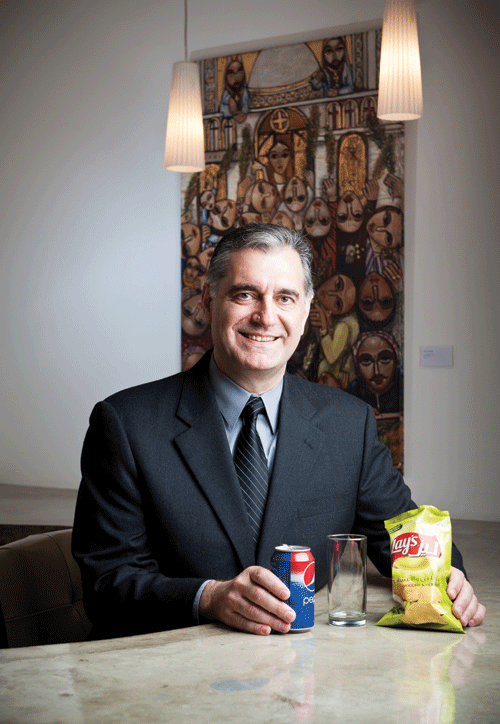
The top companies for women to work in the UAE are General Electric Middle East and North Africa, THE One, and Omnicom Media Group. GE and PepsiCo are the two companies highlighted for their appeal to Emiratis. 

Very notably in the 2012 results, employees have given their organizations substantially improved marks when compared with the average scores which the top ten companies reached in the trust index surveys a year earlier.

Congratulations are in order.

February 3, 2012 0 comments
0 FacebookTwitterPinterestEmail
Economics & PolicyUAE's Best Places to Work

EMC Corporation – Best workplace in the Cloud

by Thomas Schellen February 3, 2012
written by Thomas Schellen

Being cryptic and brief was quite common when naming startup companies in the United States 30 or 40 years ago. When two American engineers created a venture for production of computer memory boards in 1979, they combined their initials and a third letter into EMC Corporation, garnished it with a visual reference to Einstein’s relativity formula and grew it into a specialist information technology (IT) company under a cloak of mild obscurity, known best among true nerds and corporate IT managers.   

Today, the company boasts $20 billion in consolidated revenue with double-digit growth in 2011 driven by demand for its data storage, information management and security and cloud computing products. It has 48,500 employees worldwide and spent 11 percent of last year’s consolidated revenue on research and development, according to results announced last month.    

In 1999, EMC set up its first office in the Middle East in the United Arab Emirates with a tiny team and has grown to about 550 employees in 17 offices around the region, plus 250 to 300 engineers based in Cairo, says Wael el-Nadi, the EMC technology solutions director for Turkey, Emerging Africa and the Middle East. 

Aspects that impressed the Great Place to Work Institute in the EMC culture audit were the company’s initiatives and readiness to exceed legal requirements in developing a caring culture, granting time off for paternity and marriage as well as compassionate leave and extended holiday leaves. 

As Nadi describes it to Executive, the spirit motivating EMC’s care of its employees is one of mutuality. The firm is responsive to people’s requests for time off whenever that is needed and goes beyond the mandates of the UAE labor law in providing extra vacation during the Eid periods and in special situations, because “on the other side of the coin we expect our employees to work harder than the standard.”

The reason why EMC’s Dubai-based organization participated in the 2012 GPTW list process was a sense of obligation to staff.  “We believe we owe this to the employees, because we are a great place to work and we believe it is good to share the success,” Nadi explains. 

Success is perhaps the biggest driver in making the UAE and regional teams proud of what they do and binding them to the company — according to Nadi, the operation is the highest-growth EMC office in percentage terms worldwide. “This by itself makes the office attractive because people join a successful team.”

He cites EMC’s very low employee turnover as indicative of pride and loyalty: “It is part of the ego of a normal individual to be proud of it if you work for a good company.” In corporation-wide internal employee feedback, the regional organization usually gets strong marks on vision and leadership, he adds. “Management is accessible and easy to approach and one can raise any concern and so on; thus we score very high when it comes to leadership and vision. When it comes to rewards, here in this region we know that we are not the highest but also not the lowest.”

In pursuit of its human capital growth plans, EMC has recently set up an undergraduate curriculum with universities in the UAE which the company expects will unleash much potential for local recruitment. This program ties in with an “associate program” that grooms graduates with degrees in disciplines such as computer engineering and business administration for management roles. Leadership training for high-potential employees in a joint program with EMC’s European division is another part of the formula. 

EMC engages in a variety of corporate citizenship activities and has implemented corporate social responsibility programs in Pakistan, Egypt, and the UAE. 

Nadi tells Executive of strong territorial expansion that has been managed from the regional office in Dubai and he is highly confident that the organization based here will increasingly contribute to global results. At present, the regional organization keeps some 4,000 people, including employees and their dependents, in bread and roses. He says, “We consider this our big family and this is a big responsibility. That is why we always say that we have to maintain our success.”

February 3, 2012 0 comments
0 FacebookTwitterPinterestEmail
Economics & PolicyUAE's Best Places to Work

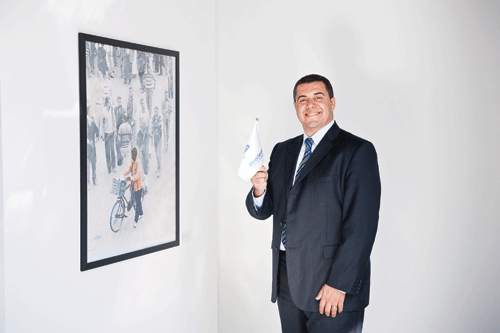
Dulsco – It started on the docks

by Thomas Schellen February 3, 2012
written by Thomas Schellen

Dulsco, the Dubai-based provider of human resources and waste management services, is the largest and oldest local company in the Top Companies to Work for in the United Arab Emirates, and it has succeeded not only to make the Great Places To Work (GPTW) list for the second year running but also improved its standing in the list from 2011. 

Acting behind the scenes as a quasi-invisible human resources back office to a wide range of enterprises, the company provides manpower support to industries that are essential for the UAE’s economic performance, such as transport and logistics and also in sectors that are core to the international attractiveness of the Emirates, such as event organizers and hospitality operators. Its staff profiles range from drivers and machinery operators to clerical workers and recruitment consultants. In the area of waste management, the company provides general and specialized cleaning, collection and related services as well as low-tech and high-tech equipment. 

As a privately held company, it does not publish results and the primary testimonies to its business acumen are its record of 77 years of continuous operations and its staff size of more than 5,300, approximately two thirds of which are part of the Human Resources division. The company has a joint-venture operation for manpower and waste management services in Qatar and dispatches roving staff to safety-tested locations and sites on specific projects and vessels beyond the borders of the Gulf Cooperation Council. Homegrown and without the human capital development processes and resources that a multinational firm or foreign corporate parents can deliver to their UAE units, Dulsco invested itself in the GPTW process from its internal resources.

At the core of any business is the human being. Due to the nature of the company’s activity with many physically demanding work roles and occupations, caring for its employees means for Dulsco to care for the safety and wellbeing of a mainly expatriate, male workforce.  

Incentive to care

“If you don’t invest in your employee, the employee will not care about his work. When, however, you plan a career for him and take care of safety and provide him with help and all that comes with it, you are transparent to him. When everything is clear in this way, he will be motivated to work for such a company,” Dulsco Chairman Abdul Aziz Mohammad Khan Abdulla tells Executive. 

As he conveys the Dulsco story, it becomes evident that the tradition of caring goes back to the company’s formation with stevedoring services. It was years before port facilities were created, and so ships would load and unload at an anchorage. It was also a long time until insurance companies would start offering their services. From those early days on, the company made it a policy that a worker who was injured or unable to work will get paid until he is healthy and able to work again.  

“So when the ports were built and insurance was introduced, we were way ahead of the other companies in providing safety and benefits as part of the corporate work policies,” Abdul Aziz says. 

People before profits

The practice was applied throughout the company’s growth. During the war in Iraq, there were inquiries to send crews to work at an oil loading terminal outside of the war zone with the promise of substantial premiums added to the normal wages, but Dulsco insisted firstly on the security of its employees and did not outsource the workforce. According to Abdul Aziz, “It is not just about money. It is safety first; this is what we believe in and we value human life more than money.” 

In its appraisal, the GPTWI 2012 Culture Audit commends Dulsco for its commitment to communications and active listening to employees. The report highlights the company’s facilities for two-way and down-up communication between employees and management, which include an open-door and ‘open office’ model, plus suggestion boxes in every location and department. 

Other Dulsco assets in being a great place to work for its employees include quality housing, sports facilities and a clinic as well as soft assets like celebratory and entertainment events that are tailored to the hearts of the employee base. “Don’t forget that these people are deprived of being with their families for two years and so you need to create the ‘home-style’ atmosphere, have functions and entertainment,” Abdul Aziz explains and sums the Dulsco culture up in saying, “We run this business as a family business.”

February 3, 2012 0 comments
0 FacebookTwitterPinterestEmail
Economics & PolicyUAE's Best Places to Work

Bayt.com – From the website to the workplace

by Thomas Schellen February 3, 2012
written by Thomas Schellen

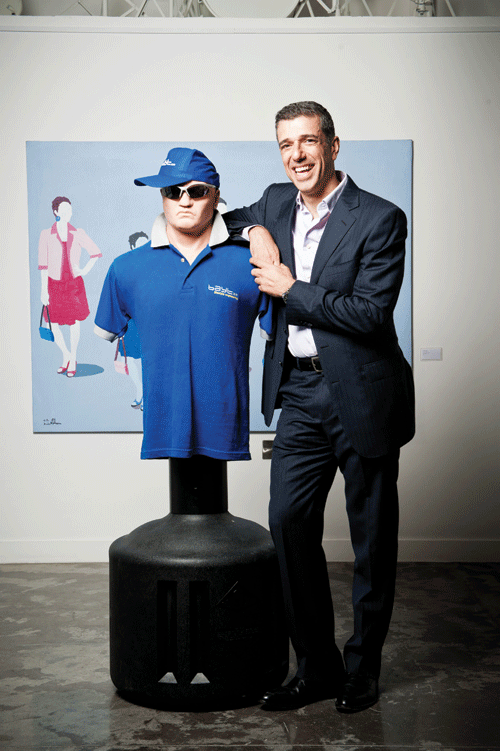
Rooted with one leg in technology and with one leg in services, Bayt.com stands with a well-established reputation as a leading authority in the region on all questions related to jobs. The company’s core activity is the provision of an internet-based marketplace connecting global job seekers and Middle East-based employers. The company has also leveraged its wealth in interaction with job seekers into an auxiliary career services business and into research activities.

Revenue generation at Bayt.com is based on fees that employers pay for posting job offers. But as the company does not collect fees for employment agreements emanating from usage of their site, Bayt.com cannot provide information on the number of contracts reached on the marketplace each year. However, the number of registered users is reported to be above 7 million and growing and the number of organizations that post employment offers is cited as 40,000.

There is money in the employment marketplace for Bayt.com and the firm has reached profitability within a relatively short time from its creation in 1998, according to chief executive Rabea Ataya. Yet it nurtures an approach to profits that differs from most companies. 

Every year Bayt.com sets a profitability target which is kept at a ‘low-level’; any profit exceeding the targeted margin will be reinvested into the team, Ataya tells Executive. “The company is willing to trade off profitability to achieve gains in how recognized, respected, and admired it is. We are far more focused on touching people’s lives than we are on profitability,” he says.

The organization’s employee-centric culture is cited by the Great Place to Work Institute (GPTWI) as an outstanding feature in the culture audit evaluation for the 2012 Best Companies to work for in the UAE list. As an example, GPTWI mentions daily training sessions prepared by team members and shared across the company’s locations. 

Based on the trust-index survey responses of Bayt.com employees and GPTWI’s culture audit, Bayt.com retained the same position in the 2012 and 2011 best companies lists. For Ataya, the repeated success in the GPTW process is “one of those feathers in our cap that we value with the greatest amount of pride,” he beams. 

Every person joining the Bayt.com team is tuned in to the company’s vision, which Ataya says is “about trying to build a Middle Eastern institution that is globally recognized and respected; and the way we hope to build that is by empowering people to lead better lives.”

The participation in the first GPTW process helped the company in understanding areas in which Bayt.com could further develop its strengths in 2011 and remedy weaknesses that it was not previously aware of. 

Gaps between responses by managers and junior employees to some trust index questions showed that while managers were well aware of the organization’s values and focus on maximizing Bayt.com’s role in improving people’s lives while maintaining profitability, employees were not made equally aware of these values and approaches. As one of the results of the GPTW participation, Bayt.com management increased efforts to enhance internal communications and explain these approaches more deeply.  

In other aspects of its employee focus, Bayt.com supports wellness-orientated lifestyles among its team members through initiatives such as providing baskets of fresh fruit in all pantries. Other sponsored activities throughout the year include team sports and lunch sessions in which the company invites speakers to address “topics that relate to improving people’s general lifestyle and quality of living,” Ataya says.

Ataya considers very steep hierarchical structures to be a hinderance to forming creative environments. Based on the realization of how important his sense of freedom while at work is for his own wellbeing, he made it a priority to give people in the organization the chance to replicate the same experience in their own working lives, saying: “The single most important thing that I can impart on the organization is letting people have that freedom.”

Alignment with the culture is a high priority in selecting employees and Ataya is confident that most Bayt.com workers are “seeking to live toward realizing our values. In all relationships with clients and employees and job seekers, we try to leave a positive impact on their lives.”

February 3, 2012 0 comments
0 FacebookTwitterPinterestEmail
Comment

Revolution of the Institutions

by Farea al-Muslimi February 3, 2012
written by Farea al-Muslimi

If you find yourself at the head of a public, or even a private institution in Yemen today, you are most likely having a hard time sleeping, owing to the fact that the nightmare of being kicked out the door by your own employees may be what you wake up to the next morning. As the media spotlight has moved on, Yemenis have been revolting against their officials all around the country in what is being tipped as Thawrat Al Muasasat, or the “Revolution of the Institutions”, better known as the revolution’s second phase. Public servants and private employees of all stripes and colors are rising up against their bosses, demanding they be replaced with “clean ones”. 

Those taking part include military staff in the army and air force, staff at the national air carrier, employees of oil companies, factories, hospitals, universities, unions, radio stations and even middle school students fulfilling the High School dream of ousting their most loathed teachers. Perhaps fittingly, among the institutions experiencing these new rounds of protest is the Central Organization for Control and Auditing, the largest governmental authority in the country intended to fight corruption. The techniques being used include preventing the targeted boss from entering the building, forcing their resignation or pressuring those above them to issue them a pink slip. 

Notable in these new uprisings is the fact that those carrying them out were largely silent before the dismissal of Yemen’s lord of corruption: former President Ali Abdullah Saleh. These movements are organic, unorganized and not driven by any political party. Indeed, deals devised by foreign interests — such as that which the Gulf Cooperation Council concocted to let Saleh off the legal hook — can do nothing to contain these movements or push them in a specific direction, as they did with the first revolution. This time the Yemeni people have shown that their revolution is much more than just a euphoric expression that dissipates once the dictator is no more. 

Little, if anything, would have changed in Yemen if people just replaced a figurehead since the nizam, or system, would have continued to feed its “small-dictators” through the patronage systems and ensured that only those supporting the regime enjoyed ‘public’ services. Yemenis, who have lived with the malediction of Saleh’s business and family ties, know this all too well. 

But as with anything in the country these days, there are voices of dissent. Even though these movements aim to purge the country’s institutions of the very people who maintained the networks of patronage and corruption, some still condemn them because they are contrary to the rule of law, disregarding due legal process, and thus contributing to chaos. One might question, however, the success of these skeptical intellectuals in steering the country away from the course it plotted for the past 33 years, compared to the protest movement which is only entering its second year. 

The more pressing question perhaps is whether people would revolt against their leaders even if those very leaders were from the opposition? The answer is most likely ‘yes’. This new uprising that is spreading in the country against officials will most likely reach any public official in a position of power unless their priorities are centered on three major elements: employees, employees and employees.

The Revolution of the Institutions leads one to the logical deduction that, even though it may not make global headlines, the struggle in Yemen will be long, deep and institutional. Yemenis are all too aware that fear will take them nowhere, nor will the corrupted legal apparatus that acted as a cover for the former regime. This phase of the revolution is only the start of an effort to devise creative means of expressing dissent. By the time Yemenis come up with the next phase, they will have already altered their country’s concept of change.

February 3, 2012 0 comments
0 FacebookTwitterPinterestEmail
Society

Q & A – Lisa Piguet

by Maya Sioufi February 3, 2012
written by Maya Sioufi

The economic crisis has hit, among other things, the pockets of potential Masters of Business Administration (MBA) candidates, many of whom are choosing to postpone their studies or seek alternatives to an MBA program that entails taking a minimum of one year’s leave — a luxury in these testing times. To discuss the challenges business schools are facing, Executive sat with Lisa Piguet, head of MBA Admissions at IMD, a worldwide leading business school based in Switzerland. 

What are the top three concerns of MBA business schools?

One concern is the decline in applications. Looking at GMAT (Graduate Management Admission Test) data, the participants for the age group 18 to 24 years old is growing and the test participants of the older age group is declining. In Europe, MBA admissions at European business schools require previous work experience so the average age of the classes are older and they are seeing a slight decline in applications. The economic situation is definitely a concern and impacts the drop in applications. Another concern is the return on investment. It is expensive to do an MBA and I think people are looking more at that now as a big issue. When they spend $120,000 on an MBA program, they want to know that it will pay off in five years. The third concern is no one knows where the market is going. Everyone is sitting on the fence.

So as it becomes more difficult to fill seats, is competition increasing among business schools? 

Business schools in Europe have increased their class sizes a lot in the past five years because their MBA program is a money making machine. The competition has stiffened because of the declining market conditions and the class sizes increasing so compromises are being made in some places. When I see certain schools accepting people that normally would be declined in the past, I am really shocked. They are doing that to increase their revenues. At IMD, we have not increased our class size since 1995. We kept it at 90 because we felt we cannot mass-produce leaders. The MBA program at IMD is a brand and not a moneymaking machine for us and we rely on executive education for our revenues. 

Are MBA graduates still able to find jobs in a weakening global economy? What changes have you noticed in terms of job placements?

I know a lot of people are afraid now. The United States is really suffering in terms of career placement, with some universities only seeing 50 percent placement. At IMD, as we only take 90 MBAs and we are very selective, our program is niche so our placements results are always really high, even in an economic crisis. What I’ve seen in the 10 years I have been at IMD is a change in how companies recruit. They used to look for “talent positions” in which graduates would be hired into a two year rotational program covering marketing, finance, accounting etc. Now recruiters are moving away from that and looking for actual positions. 

E  What have you witnessed in terms of number of applications since the economic crisis? 

We witnessed a record number of applications in 2009, shortly after the crisis began, but it’s been down since. Most schools worldwide are down on applications right now because people are really concerned and they are staying put. It’s really bad in the US. I have witnessed, though, that the quality of applicants has also changed. It’s as if the candidates who were not so serious about applying went away. At the European Business Shools Meeting, which took place in June in Copenhagen, all the top European business schools were witnessing the same trend. 

Who is paying for the MBA program? Have you seen any change since the economic crisis? What financing facilities does IMD offer? 

The only slight change I have seen is that candidates are more likely to have a ‘Plan B’. The company will not pay for the MBA but the candidate negotiates a deal whereby he can go back if he needs to. I’m always surprised to see a lot of times the MBA [students] come with cash in hand. IMD has a loan program, which lends up to 65,000 Swiss francs ($71,000) — roughly half the tuition fees with living expenses — for the candidates that qualify. No co-signer is needed for the loan and it has to be paid back in four years. We recommend that potential candidates look for scholarships in their respective countries, as it is much better to get a scholarship than a loan. 

What do you teach at IMD when there is a lack of visibility?

The economic crisis had several causes but one of the things I think caused the crisis is people being naïve and managers not being able to react. We are actually changing the program for 2012 and the new program is essentially looking at how you train a manager to react properly in a crisis situation. We are now adding a cyclical learning process whereby candidates do something, put it into practice, reflect on it and then go back and do it again. It is an active learning cycle. At IMD, leadership runs through the entire program; it’s our unique selling proposition. We provide candidates with team coaches and they are given tasks such as going to the Alps in January when it’s freezing and they are filmed completing their tasks and then they debrief with their group. 

Where do IMD graduates end up? 

78 percent of our 2010 graduates ended up working in industry, with the remaining 16 percent in consulting and 6 percent in financial services. This gives IMD a huge advantage during the financial crisis. Most programs in Europe are heavily weighted to the consulting and financial industries. 

What do you have to offer for older business professionals? 

The executive MBA is an option and we also offer in-company programs and open programs which could last one to two weeks. The biggest open program takes place at the end of June, with 500 top executives from around the world coming for one week. We offer different streams such as leadership and strategy and it costs 15,000 Swiss francs ($16,330) for the week. 

How many candidates are from the Middle East (ME)? And how do they fund their studies? 

Only 8 percent of the candidates are from Africa and the Middle East, with the vast majority from Lebanon, but it is a percentage we want to grow. We’d also love to have more women from the ME on the program. ME candidates have predominantly completed their undergraduate degrees in local universities — for Lebanon, it is the American University of Beirut — and often follow it with a master’s degree from a non-local university. For Saudi Arabia and Kuwait, most graduates complete their undergraduate degrees in the US. As for funding, Middle East candidates normally pay for themselves. 

Do you aim on increasing your intake of students from the Middle East? 

Yes, it is one of our huge focuses as it is a growing region. The biggest issue we have is GMAT scores. Some countries have scores of 300.  I still don’t understand the score; so many are educated in the United Kingdom and the US. For example, in Kuwait and Qatar, they receive great education in the US but they have GMAT scores of 350. We can’t take these people. In Saudi Arabia, it is getting better. An MBA is something quite new for them. There are not enough test preparations centers, but awareness is rising and we are trying to build that up in the Middle East and Africa. 

Would you consider doing a partnership in the Middle East similar to what London Business School and New York University have done in the UAE? 

No, we are not considering such a partnership as IMD is just an 11-month program and we already do so many international projects. There are roughly 16 multinationals that pay us 75,000 Swiss francs ($81,636) for our MBA candidates to consult for them. Nespresso, for example, comes every year. The project lasts eight weeks, during which time candidates could be based anywhere in the world. 


Graduate profiles

Tamer Nassar is an IMD graduate from Egypt. He was raised in California and completed his undergraduate degree in political sciences in German at the University of Santa Barbara in California. After graduating, he joined Setcore, his family business in Cairo, operating in textile and oilfield services. After working there for ten years, he felt he needed to be exposed to new ideas. IMD was the only option he considered, as he couldn't leave the family business for more than a year, he wanted to be with candidates to be similar in age (early 30s), and he was interested in IMD’s strong focus on leadership. After obtaining his MBA, he returned to his family business in Egypt where the personal development enjoyed throughout his studies allowed him to improve his management of the company.

Zina Saniora, daughter of Lebanon’s former Prime Minister, is an IMD graduate from Lebanon. She was raised in Lebanon and completed her bachelor of business administration (BBA) degree at the American University of Beirut (AUB). She then worked in corporate banking at Bank Audi in Lebanon for four years before moving to Washington DC to work for the International Finance Cooperation in their financial markets department for another four years. Zina wanted to go back to school and decided to pursue an MBA as it was the most versatile degree and it would not limit her options in the future. She decided on IMD as the average age is higher, the intake is much smaller and it provides candidates with a one-on-one career coach. For Zina, the MBA program was really a personal development program as it taught her how to deal with very conflicting group situations and she says she now knows herself better. After graduation, she completed a nine-month project at the World Economic Forum covering corporate governance for family-owned businesses in Middle East. She then joined a private equity firm in Geneva, which specializes in microfinance companies, where she still works today.

Mohamad Ansari is an IMD graduate from Lebanon. Like Zina, he completed his BBA at the AUB. He then worked in the technology industry in the GCC with Dequota, Reuters and finally Hewlett Packard before deciding to go for an MBA, something he had always wanted to do. For Mohamad, it was just a question of when and where. As he was looking for a program in Europe for its proximity and a short-term program of one year, he applied to both INSEAD and IMD. He settled on IMD for its down-to-earth environment, its rigorous selection process, its higher average age and its smaller intake. Mohamad considers the IMD MBA program one of the key milestones of his life as he says it provided him with a new way of thinking. He says that social responsibility, entrepreneurship and thinking outside of the box became innate to him after IMD. After graduation, he worked at Booz & Co, a consulting firm in the Middle East for four years before going back to his family’s publishing and printing business.

February 3, 2012 0 comments
0 FacebookTwitterPinterestEmail
Comment

Testing optimism

by Edwin Lane February 3, 2012
written by Edwin Lane

When I met Libya’s interim Prime Minister Abdurrahim al-Keib late last year in the plush Tripoli offices once occupied by Muammar Qadhafi’s loyal ministers, he was in an optimistic mood. After spending most of the last four decades in exile, the 61-year-old electrical engineering professor was back in Tripoli, and charged with readying his country for its democratic rebirth.

He was eager for elections to happen as soon as possible. After 42 years of Qadhafi dictatorship, he said, “Libya will respond well to good governance.” But whether he will get the chance to test that claim is doubtful to say the least. The challenge facing Keib and his cabinet of technocrats and former rebel commanders is enormous, and it is difficult to see how Libya can meet its self-imposed timetable for democratic transition. On top of that, there are now serious questions being asked of the authority and credibility of the government itself and the National Transitional Council (NTC) that appointed it. The plans for democratic transition looked ambitious from the outset. Unlike its neighbors Tunisia and Egypt, Libya has no experience of national elections — not even the sham variety used by Hosni Mubarak and Zine el-Abidine Ben Ali to give at least the veneer of legitimacy to their regimes. 

According to a timetable set out by the NTC, the first national vote, to elect a constitution-writing body, must happen before the end of June. That leaves just a few months in which Libya’s democratic institutions — non-existent under Qadhafi rule — must be built completely from scratch. New election laws need to be written, election officials trained and decisions on constituencies and voting structures made.

 After decades in a political vacuum, Libyans themselves also need time to adjust. There is little sign of political parties being formed and little awareness that elections are even planned. Meanwhile the government has its hands full with other concerns. There is growing criticism of the NTC on several fronts, from its lack of transparency to its inability to provide even basic services. In January, protests in Benghazi at the NTC’s perceived shortcomings even saw the resignation of deputy chairman Abdel-Hafidh Ghoga. 

Libya’s problems are numerous. Its recovery from eight months of bloody civil war will require national reconciliation. With assets still frozen and oil production below the pre-war levels, the economy is struggling. There is no functioning judiciary, meaning that thousands of Qadhafi fighters still languish in unofficial prisons dotted around the country, raising concerns of human rights abuses. But the greatest concern of all is security. In January the former Qadhafi stronghold of Bani Walid slipped out of the government’s control when local fighters attacked and expelled NTC-aligned militias. With no functioning army or police force, security is in the hands of dozens of regional militias who have carved up parts of the country and even the capital Tripoli. The country is divided along regional lines, and rival militias frequently clash over control of borders or airports. Keib says national voting can go ahead unless the security situation becomes “very dangerous”; in today’s Libya that likely means elections will take place even if the militias have not laid down their weapons or accepted the authority of the central government. That sounds dangerous in itself. It is uncertain whether militias will attempt to use their power to influence the voting or the constitution writing, and as Khalifa Shakreen, a professor of political science at Tripoli University put it: “We can’t write a constitution with a gun to our heads.”

The authorities are reluctant to delay the democratic transition, with good reasons: First, any delay will leave them open to accusations that they are trying to make a grab for power, as has happened in Egypt. Second, any extended period without a legitimate elected government could create a power vacuum that rival militia leaders may be only too happy to fill.

Those risks are real. But the alternative is to run elections before the country is ready. If that fails it could be a disaster for democracy in Libya before it has even begun. For now, Keib’s strategy is to muddle through, hold the elections on time and hope for the best. That may test his optimism to its limits.

February 3, 2012 0 comments
0 FacebookTwitterPinterestEmail
Comment

Inching toward equality

by Nadya Khalife February 3, 2012
written by Nadya Khalife

Sheikh Khalifa bin Zayed al-Nahyan, president of the United Arab Emirates, made an important move in November for the rights of women in the region. He proposed changing the law that long discriminated against Emirati women married to foreigners by denying them the right to pass on their citizenship to their children. “Children of female citizens married to foreigners should be treated as citizens,” he said.

The president’s proposal signals an important policy shift in a region that has long discriminated blatantly against women. The policy in many countries in the region — Lebanon, Jordan, Syria, Qatar, Oman, Kuwait and Saudi Arabia — flows from fears over race, ethnicity and demographics. Children of Emirati women married to foreign or stateless men remain noncitizens — even if they are born in the UAE and never leave. As in most Arab countries, the UAE’s citizenship laws specify that it is the father’s nationality that determines the child’s, not the mother’s or both parents’. 

The proposed reform in the UAE would make the children concerned eligible for citizenship only when they reach the age of 18. But they would be able to get the better education and health care benefits available for Emirati children earlier. And when they are older and granted citizenship they would be able to enroll in a university and apply for government posts, options now denied to them.

One key issue would be whether the children of Emirati women married to Bidun — the estimated 20,000 to 100,000 people considered stateless who have been historically neglected in the UAE — would qualify. Media reports have said that this measure will probably include their children but the government’s position is not yet clear. On December 14, the UAE set up a committee to compile a list of eligible children who would benefit from this new measure. 

The issue of the Bidun children is critical because only about 12 percent of UAE residents are Emirati nationals, with foreign residents and stateless Bidun making up the rest. The number of Emirati women marrying foreigners also rose 15 percent from 2009 to 2010, from 643 to 737, according to the UAE’s National Bureau of Statistics. 

The lack of citizenship has had a direct impact on children of Emirati women because under the current law, these children do not get the generous state benefits available to citizens under 18, and they often have access only to second-rate education and health care. The UAE offers free primary education to Emirati children. In some emirates, non-citizen children can enroll in public schools at no cost only if they score 90 percent on their entrance exams. Those with resources can attend private schools, but many children of Emirati women, particularly those married to Bidun men, cannot afford the tuition. The net result is that there are children of Emirati women who simply do not attend school. 

Families whose children are not citizens also must pay for routine health care for their children, even basic care such as immunizations, while health care is free for Emirati children with citizenship. Bidun children, because of their stateless status, cannot travel outside the country, which further limits their families’ options.

While the number of children who will benefit from the UAE’s change remains to be seen, Sheikh Nahyan’s pronouncement was a step in the right direction, and he has painted an optimistic picture for Emirati women married to foreign husbands and their children. The hope now is that other Arab countries that discriminate against women and their children this way will follow his lead.  

Every day in our region, women pay the price for discriminatory laws, but the UAE has made the moral choice, and in the long run the UAE will benefit because its children will be healthier and better educated. The progressive leadership it is showing in the region for the rights of women and children will also be recognized around the world. If the UAE, a country deeply worried about its demographics, can make this decision, it is high time that other Arab states follow suit.

February 3, 2012 0 comments
0 FacebookTwitterPinterestEmail
Comment

The tipping point

by Jihad Yazigi February 3, 2012
written by Jihad Yazigi

After months resisting the pressure, the Syrian pound dived in January against the United States dollar and other international currencies, forcing the central bank to announce that it would begin a managed float of its currency in a dramatic departure from a five-decade-old policy of strictly regulating foreign exchange transactions. 

While the American dollar traded at around 60 pounds in black market dealings at the end of December, it quickly rose to 63 pounds in the first days of the year before crossing the 70 pound mark by mid-January. Since the beginning of the popular uprising in March 2011, Syrian analysts have been predicting the collapse of the national currency. However, contrary to the most pessimistic projections, the pound managed to stand its ground for months, falling to only 51 pounds per dollar in August, five months after the beginning of the protests — a decline of roughly 8 percent relative to its pre-crisis level of 47 pounds.

The relative strength of the currency for this extended period of time was a consequence of a number of factors including an aggressive strategy by the central bank, which by August had reportedly spent some $2 billion, or 10 percent of its foreign reserves, to defend its currency. Other factors were sensible policy choices by the bank, including a rise in interest rates and restrictions on the sale of foreign exchange by money traders, as well as a decline in imports resulting from a strong contraction in investment and spending, which partly helped offset the decline in export earnings. Still, the last weeks of 2011 saw a rapid increase in the rate of decline. The combined impact of the general downturn in business, poor economic policy and international sanctions had taken its toll on the currency. Another key factor was likely the beginning of the application of the European Union embargo on oil exports in November. Indeed, oil revenues made up in 2010 some 20 percent of Syria’s total foreign currency earnings and a much larger share of the government’s export revenues. 

One other factor, however, also explains the rapid deterioration witnessed at the beginning of this year. In an interview on Syrian TV early January, Minister of Economy Nidal al-Shaar said that the government’s priority was to “preserve the country’s foreign reserves and not to defend the currency.” These few words alone may have triggered the rush to the greenback.

By declining to go too far in the defense of the currency, Shaar was echoing the advice of many economic analysts: if the international value of the pound must be defended, it must not be done at any cost — i.e. at the expense of the foreign currency assets.

Indeed, Syria’s foreign reserves, painfully accumulated during the country’s short oil boom of the 1990s, will be almost impossible to recover once they are spent, given that Syrian oil fields have been largely depleted, while by selling its foreign assets now the government would be mortgaging the country’s future.

Also, in spite of the serious consequences it will have on the purchasing power of the population, already largely dented by decades of poor growth, the devaluation of the pound can provide new opportunities for Syrian exporters and make local manufacturers better able to compete with imports. Finally, the fall in the value of the currency is a natural consequence of the political stalemate and of the economic crisis faced by the country, and in a certain sense more accurately reflects the real status of the economy.

By deciding to partially float the currency, the central bank may ease the supply of foreign currencies in the market and help reduce pressure on the pound. However, there is little doubt the fall in the value of their currency will have a serious psychological impact on Syrians. Indeed, the majority of them still remember the dark days of the 1980s when a serious economic and foreign currency crisis led, in less than two years, to a precipitous decline in the value of the pound from 3 pounds to 50 pounds per dollar.

The period marked the beginning of the end for Syria’s middle class. Twenty-five years later, the Syrian population is helplessly taking a second hit and wondering how difficult the years ahead will be.

February 3, 2012 0 comments
0 FacebookTwitterPinterestEmail
Society

Lebanon Adrift – A book by Samir Khalaf

by Ellen Hardy February 3, 2012
written by Ellen Hardy

Something strange often happens to first year medical students, confronted by textbooks listing reams of sinister symptoms: they all come down with galloping hypochondria, seeing brain tumors in every headache and consumption in every cough. Something similar might happen to a Beiruti reading “Lebanon Adrift” — though instead of physical ailments, readers will look up from the pages and see, in every poster, traffic jam or flutter of false eyelashes, a society in torment. “Lebanon Adrift” is a wide-ranging diagnosis of Lebanon’s contemporary pathology as a culture of unrestrained excess, narcissism and escapism, indicative of political, moral and social alienation.

Author Samir Khalaf is a distinguished sociologist and professor at the American University of Beirut. “Lebanon Adrift” is a book full of “personal indignation and outrage” — the sum of a lifetime of observation of a land he loves, in which he attempts to theorize those grating features of Lebanon’s social landscape that will be familiar to anyone with more than a passing acquaintance with the country, from pervasive littering and smoking to the gaudy wedding season with its antisocial firework displays. Via a whistle-stop tour of Lebanese history and politics, peppered with social thought from the Frankfurt School to Zygmunt Bauman, Khalaf explores theories of modern consumerism turned to mindless commodification of kitsch and prestige items in the pursuit of social status.

Lebanon’s post-war society, Khalaf suggests, rejects the usual trappings of restraint and sobriety typical for countries recovering from long periods of civil conflict. Rather, the Lebanese, with their history of mercantilism and aptitude for playfulness, have responded to political inaction, social and geographical stratification, unresolved tensions and an uncertain future by unreservedly embracing the numbing attractions of conspicuous consumption. With everything from ‘super nightclubs’ to the latest Porsches, they are replacing creative industry and functional social cohesion with a Durkheimian “social state in which society’s norms can no longer impose effective control over people’s impulses,” resulting in a damaged landscape of environmental degradation, corruption and incivility.

By designating a range of social features as part of Lebanon’s movement from a battleground to a “playground”, where the dark sides of the nation’s Janus-faced liberty, playfulness, enterprise and conviviality are taking over, Khalaf is offering a constructive way of thinking about social malaise. Through consumption, he suggests man gained freedom, “but not the positive sense [of] freedom to mobilize this liberation in creative and purposive forms of participation in the public sphere.”

But like those medical students, the temptation to see everything around one as the manifestation of an illness can obscure other realities. Khalaf proposes the use of “ideal types” to pin down “essential elements” of a social reality as a constructive “tool for analysis”. Yet in his scattergun and often rambling tour of the tribulations of contemporary Lebanon, his “average Lebanese” is invariably hugely wealthy, indolent, monstrously superficial and male. That such people exist is indisputable, but to give them the status of standard-bearer for the modern Lebanese identity is dangerous. There is little attempt to differentiate his central analysis by class, age, gender, religion or geography, and at times his personal outrage reaches the point of parody, decrying Lebanon’s “houses of ill-repute, casinos, gambling parlors, nightclubs, discos, bars, escort bureaus and other abodes of wickedness… Such aberrant features blemish the country’s national character.” Further, by identifying a general and unattractive tendency of the Lebanese for excessiveness and locating so many evils within it, Khalaf neglects a rigorous taking to task of the politicians and lawmakers who are allowing so many damaging transgressions free rein. 

There is much to admire in “Lebanon Adrift”, which also sees possibilities for redemption, making an assessment of non-governmental organizations, architects and political movements that give hope for an active and engaged civil society. Khalaf sees within consumerism possibilities of creativity and resistance. With luck, the debate over Lebanon as a “playground” will act as a spur to action and an encouragement to the “avant-garde and counter-culture” who are sidelined by Khalaf’s “average Lebanese”.

February 3, 2012 0 comments
0 FacebookTwitterPinterestEmail
  • 1
  • …
  • 345
  • 346
  • 347
  • 348
  • 349
  • …
  • 686

Latest Cover

About us

Since its first edition emerged on the newsstands in 1999, Executive Magazine has been dedicated to providing its readers with the most up-to-date local and regional business news. Executive is a monthly business magazine that offers readers in-depth analyses on the Lebanese world of commerce, covering all the major sectors – from banking, finance, and insurance to technology, tourism, hospitality, media, and retail.

  • Donate
  • Our Purpose
  • Contact Us

Sign up for our newsletter

    • Facebook
    • Twitter
    • Instagram
    • Linkedin
    • Youtube
    Executive Magazine
    • ISSUES
      • Current Issue
      • Past issues
    • BUSINESS
    • ECONOMICS & POLICY
    • OPINION
    • SPECIAL REPORTS
    • EXECUTIVE TALKS
    • MOVEMENTS
      • Change the image
      • Cannes lions
      • Transparency & accountability
      • ECONOMIC ROADMAP
      • Say No to Corruption
      • The Lebanon media development initiative
      • LPSN Policy Asks
      • Advocating the preservation of deposits
    • JOIN US
      • Join our movement
      • Attend our events
      • Receive updates
      • Connect with us
    • DONATE