• Donate
  • Our Purpose
  • Contact Us
Executive Magazine
  • ISSUES
    • Current Issue
    • Past issues
  • BUSINESS
  • ECONOMICS & POLICY
  • OPINION
  • SPECIAL REPORTS
  • EXECUTIVE TALKS
  • MOVEMENTS
    • Change the image
    • Cannes lions
    • Transparency & accountability
    • ECONOMIC ROADMAP
    • Say No to Corruption
    • The Lebanon media development initiative
    • LPSN Policy Asks
    • Advocating the preservation of deposits
  • JOIN US
    • Join our movement
    • Attend our events
    • Receive updates
    • Connect with us
  • DONATE
Economics & PolicyUAE's Best Places to Work

Merck Serono – The right medicine for the job

by Thomas Schellen February 3, 2012
written by Thomas Schellen

Merck Serono is a biopharmaceutical manufacturer ba-sed in Geneva, Switzerland. Its parent company, German firm Merck KgaA (Kommanditgesellschaft auf Aktien, a part privately held and part publicly traded company) is not just any pharmaceutical firm. With roots dating to the 17th century in the city of Darmstadt, capital of what was then a political entity called the Landgraviate of Hesse-Darmstadt under the Holy Roman Empire, the German Merck Group lays undisputed claim to being the world’s oldest pharmaceutical and chemical company.  

As the largest division in the Merck Group, Merck Serono was created in 2007 by acquisition. According to its website, it has 17,000 employees worldwide and in 2010 accounted for 5.8 billion euros ($7.7 billion) in the group’s revenues. The company is not to be confused with the US-based Merck & Co, a pharmaceutical firm of the same origins as Merck Group which is active in the Middle East as Merck Sharp & Dohme. 

Merck Serono serves the region with a team of about 270 employees of which about one third are working out of the Dubai office, says Dream Samir, managing director, Middle and Near East of Merck Serono Middle East FZ. The regional office relocated recently to premises in Dubai Healthcare City and is set to expand.

Besides sales and marketing of its medical products in the region, the company is active in clinical trials and also is engaged in major efforts in medical awareness raising, training, education and communication. This involves support programs with physicians and patients and important partnerships with ministries of health.  

The company, which regionally manufactures in Saudi Arabia and Lebanon, is currently ranked the third-fastest growing pharmaceutical firm in the Middle East and North Africa among more than 100 firms, Samir tells Executive. 

The Great Place to Work Institute 2012 Top Companies report lauds the importance which Merck Serono puts on effective communication, mentioning its elected “Employee Council” with proportional representation of all employees. The council is empowered to present and discuss with senior management all issues brought up by employees. 

The 2011 Great Places To Work (GPTW) UAE benchmark report highlighted the company’s practices on employee recognition, communication and celebration of values-based action. 

Samir says the company has high marks on employee engagement, for which he cites the GPTW as well as other third-party surveys. “There is a lot of evidence that employees love their work” and engagement is “something we want to foster even more,” he points out. “The biggest opportunity that we have now is to bring this engagement to a larger group of people, which is obviously our stakeholders.”

As Samir describes it, the corporate environment is a main strength of the company. It is based on awareness of the need to avoid rigid structures and bring out the best in the company’s people by allowing them “to discover themselves, discover their strengths, and then to work with their strengths.” This means accepting that there might not be one single rigid solution for everything and giving people “the freedom to do it in their own way, but of course in a way that does not violate our system.”

Proper management of remuneration issues is required as a hygiene factor but the paycheck “is one of the lowest priorities in being a great place to work,” he says. “Communication and fair treatment is an area that every company needs to work on. If someone feels that he is not treated fairly and doesn’t get fair chances in promotions, nothing else matters. The paycheck will not matter if you feel mistreated.”  

At Merck Serono Middle East, the emphasis on a flexible work environment — supported by absence of steep hierarchies in the organization — ties in with a positive approach to principled competition. Differentiation is important especially for successful people, Samir emphasizes, and making the rules of the game very clear and encouraging staff to compete on performance, on behavior, on innovation and on collaboration, enables success through “a combination of a system that shows the proper balance between competition and collaboration and a management team that lives this.”    

Leadership and example at the head of the organization is the lynchpin in the whole structure. “The CEO not only sets the direction but also walks the talk — all the messages that the CEO sends all the time in his ways of decision making and leadership will always be seen by the employees.”

February 3, 2012 0 comments
0 FacebookTwitterPinterestEmail
Economics & PolicyUAE's Best Places to Work

Employers par Excellence

by Thomas Schellen February 3, 2012
written by Thomas Schellen

Everyone deserves a good job. Thus, a challenge is afoot in corporate Arabia and it mandates companies to improve from within: to become a great workplace. For the second time ever, ten companies in the United Arab Emirates are being recognized as the Top Companies to Work For in the UAE. 

The list of these exemplary workplaces has been researched and produced by the UAE arm of the global research and training firm the Great Place to Work Institute (GPTWI) in partnership with Executive.  The ten companies that emerged on top passed the scrutiny of a thorough employee satisfaction survey, called a Trust Index in GPTWI terminology, and a culture audit, or assessment of their corporate behavior. The trust index score, which is based on employee responses to a confidential survey, accounts for two thirds in the ranking of a company.   The 2012 list is led by big business names: FedEx Express followed by Microsoft Gulf, the hospitality group Marriott International in third.  Three homegrown companies also made the list, furniture retailer Total Home Experience (THE) One (5th), online employment market Bayt.com (8th), and the human resources firm Dulsco (9th).

As an annual benchmarking study, the GPTW list is only in its secondary function a ranking exercise and celebration of the best companies in achieving workplace excellence. The list’s primary function is to induce a process of continuous improvement in the value that workplaces provide to their employees and teams, to their owners and shareholders, and ultimately to their communities and societies on national and regional levels. 

“We want every company in the UAE and the GCC [Gulf Cooperation Council] to be a great place to work. Whether we will be able to achieve that in 20 years or 25 years or 100 years, I don’t know. But we are very aggressively going at it,” said Farrukh Kidwai, the chief executive officer of the GPTWI in the UAE. According to Kidwai, the institute has surveyed over 6000 companies and more than three million employees globally and lays claim to being “the world’s largest databank of information when it comes to great places to work.” 

This portfolio of information and insights was originally the work of an American journalist and has grown over the past 27 years to cover 45 countries today. The selection of companies for participation in the GPTWI survey and audit process is based on an approach akin to that of a ratings agency, whereby companies have to agree and actively register to be part of the process. This methodology may not necessarily be representative of the whole landscape of eligible employers, but the track record of the GPTW rankings in the US indicates that firms which enroll in the process early on after GPTWI’s entry into a market have a distinct edge in developing their workplace quality and enhancing their employee satisfaction, thus improving their human capital base with substantial benefits to profitability and bottom lines.  In the UAE the process is still in its infancy; the skew toward Dubai-based ventures suggests that awareness has yet to spread more toward Abu Dhabi and the other emirates. 

Besides recognizing the top 10 places to work in the UAE, the GPTWI published its first specialized list featuring three top companies to work for women and Emiratis just after Executive had completed interviews. The research into best companies for women and Emiratis is to be developed into full lists by GPTWI UAE. The organization is also working on geographic expansion of its presence and coverage to Saudi Arabia, Qatar, and other GCC countries. 

The top companies for women to work in the UAE are General Electric Middle East and North Africa, THE One, and Omnicom Media Group. GE and PepsiCo are the two companies highlighted for their appeal to Emiratis. 

Very notably in the 2012 results, employees have given their organizations substantially improved marks when compared with the average scores which the top ten companies reached in the trust index surveys a year earlier.

Congratulations are in order.

February 3, 2012 0 comments
0 FacebookTwitterPinterestEmail
Economics & PolicyUAE's Best Places to Work

EMC Corporation – Best workplace in the Cloud

by Thomas Schellen February 3, 2012
written by Thomas Schellen

Being cryptic and brief was quite common when naming startup companies in the United States 30 or 40 years ago. When two American engineers created a venture for production of computer memory boards in 1979, they combined their initials and a third letter into EMC Corporation, garnished it with a visual reference to Einstein’s relativity formula and grew it into a specialist information technology (IT) company under a cloak of mild obscurity, known best among true nerds and corporate IT managers.   

Today, the company boasts $20 billion in consolidated revenue with double-digit growth in 2011 driven by demand for its data storage, information management and security and cloud computing products. It has 48,500 employees worldwide and spent 11 percent of last year’s consolidated revenue on research and development, according to results announced last month.    

In 1999, EMC set up its first office in the Middle East in the United Arab Emirates with a tiny team and has grown to about 550 employees in 17 offices around the region, plus 250 to 300 engineers based in Cairo, says Wael el-Nadi, the EMC technology solutions director for Turkey, Emerging Africa and the Middle East. 

Aspects that impressed the Great Place to Work Institute in the EMC culture audit were the company’s initiatives and readiness to exceed legal requirements in developing a caring culture, granting time off for paternity and marriage as well as compassionate leave and extended holiday leaves. 

As Nadi describes it to Executive, the spirit motivating EMC’s care of its employees is one of mutuality. The firm is responsive to people’s requests for time off whenever that is needed and goes beyond the mandates of the UAE labor law in providing extra vacation during the Eid periods and in special situations, because “on the other side of the coin we expect our employees to work harder than the standard.”

The reason why EMC’s Dubai-based organization participated in the 2012 GPTW list process was a sense of obligation to staff.  “We believe we owe this to the employees, because we are a great place to work and we believe it is good to share the success,” Nadi explains. 

Success is perhaps the biggest driver in making the UAE and regional teams proud of what they do and binding them to the company — according to Nadi, the operation is the highest-growth EMC office in percentage terms worldwide. “This by itself makes the office attractive because people join a successful team.”

He cites EMC’s very low employee turnover as indicative of pride and loyalty: “It is part of the ego of a normal individual to be proud of it if you work for a good company.” In corporation-wide internal employee feedback, the regional organization usually gets strong marks on vision and leadership, he adds. “Management is accessible and easy to approach and one can raise any concern and so on; thus we score very high when it comes to leadership and vision. When it comes to rewards, here in this region we know that we are not the highest but also not the lowest.”

In pursuit of its human capital growth plans, EMC has recently set up an undergraduate curriculum with universities in the UAE which the company expects will unleash much potential for local recruitment. This program ties in with an “associate program” that grooms graduates with degrees in disciplines such as computer engineering and business administration for management roles. Leadership training for high-potential employees in a joint program with EMC’s European division is another part of the formula. 

EMC engages in a variety of corporate citizenship activities and has implemented corporate social responsibility programs in Pakistan, Egypt, and the UAE. 

Nadi tells Executive of strong territorial expansion that has been managed from the regional office in Dubai and he is highly confident that the organization based here will increasingly contribute to global results. At present, the regional organization keeps some 4,000 people, including employees and their dependents, in bread and roses. He says, “We consider this our big family and this is a big responsibility. That is why we always say that we have to maintain our success.”

February 3, 2012 0 comments
0 FacebookTwitterPinterestEmail
Economics & PolicyUAE's Best Places to Work

Dulsco – It started on the docks

by Thomas Schellen February 3, 2012
written by Thomas Schellen

Dulsco, the Dubai-based provider of human resources and waste management services, is the largest and oldest local company in the Top Companies to Work for in the United Arab Emirates, and it has succeeded not only to make the Great Places To Work (GPTW) list for the second year running but also improved its standing in the list from 2011. 

Acting behind the scenes as a quasi-invisible human resources back office to a wide range of enterprises, the company provides manpower support to industries that are essential for the UAE’s economic performance, such as transport and logistics and also in sectors that are core to the international attractiveness of the Emirates, such as event organizers and hospitality operators. Its staff profiles range from drivers and machinery operators to clerical workers and recruitment consultants. In the area of waste management, the company provides general and specialized cleaning, collection and related services as well as low-tech and high-tech equipment. 

As a privately held company, it does not publish results and the primary testimonies to its business acumen are its record of 77 years of continuous operations and its staff size of more than 5,300, approximately two thirds of which are part of the Human Resources division. The company has a joint-venture operation for manpower and waste management services in Qatar and dispatches roving staff to safety-tested locations and sites on specific projects and vessels beyond the borders of the Gulf Cooperation Council. Homegrown and without the human capital development processes and resources that a multinational firm or foreign corporate parents can deliver to their UAE units, Dulsco invested itself in the GPTW process from its internal resources.

At the core of any business is the human being. Due to the nature of the company’s activity with many physically demanding work roles and occupations, caring for its employees means for Dulsco to care for the safety and wellbeing of a mainly expatriate, male workforce.  

Incentive to care

“If you don’t invest in your employee, the employee will not care about his work. When, however, you plan a career for him and take care of safety and provide him with help and all that comes with it, you are transparent to him. When everything is clear in this way, he will be motivated to work for such a company,” Dulsco Chairman Abdul Aziz Mohammad Khan Abdulla tells Executive. 

As he conveys the Dulsco story, it becomes evident that the tradition of caring goes back to the company’s formation with stevedoring services. It was years before port facilities were created, and so ships would load and unload at an anchorage. It was also a long time until insurance companies would start offering their services. From those early days on, the company made it a policy that a worker who was injured or unable to work will get paid until he is healthy and able to work again.  

“So when the ports were built and insurance was introduced, we were way ahead of the other companies in providing safety and benefits as part of the corporate work policies,” Abdul Aziz says. 

People before profits

The practice was applied throughout the company’s growth. During the war in Iraq, there were inquiries to send crews to work at an oil loading terminal outside of the war zone with the promise of substantial premiums added to the normal wages, but Dulsco insisted firstly on the security of its employees and did not outsource the workforce. According to Abdul Aziz, “It is not just about money. It is safety first; this is what we believe in and we value human life more than money.” 

In its appraisal, the GPTWI 2012 Culture Audit commends Dulsco for its commitment to communications and active listening to employees. The report highlights the company’s facilities for two-way and down-up communication between employees and management, which include an open-door and ‘open office’ model, plus suggestion boxes in every location and department. 

Other Dulsco assets in being a great place to work for its employees include quality housing, sports facilities and a clinic as well as soft assets like celebratory and entertainment events that are tailored to the hearts of the employee base. “Don’t forget that these people are deprived of being with their families for two years and so you need to create the ‘home-style’ atmosphere, have functions and entertainment,” Abdul Aziz explains and sums the Dulsco culture up in saying, “We run this business as a family business.”

February 3, 2012 0 comments
0 FacebookTwitterPinterestEmail
Economics & PolicyUAE's Best Places to Work

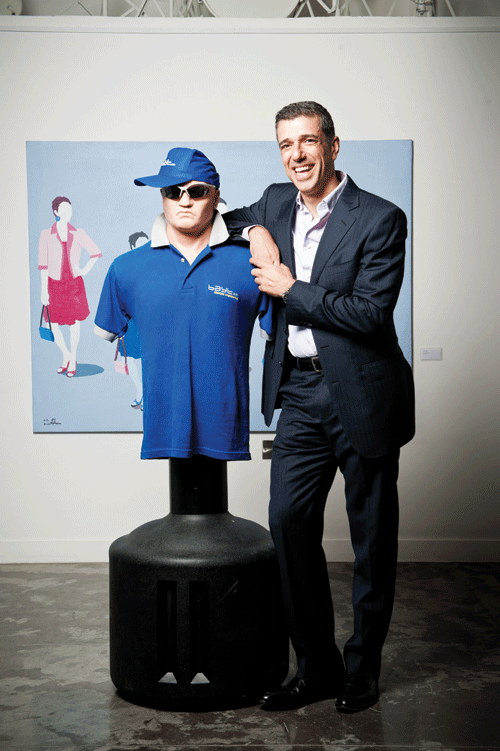
Bayt.com – From the website to the workplace

by Thomas Schellen February 3, 2012
written by Thomas Schellen

Rooted with one leg in technology and with one leg in services, Bayt.com stands with a well-established reputation as a leading authority in the region on all questions related to jobs. The company’s core activity is the provision of an internet-based marketplace connecting global job seekers and Middle East-based employers. The company has also leveraged its wealth in interaction with job seekers into an auxiliary career services business and into research activities.

Revenue generation at Bayt.com is based on fees that employers pay for posting job offers. But as the company does not collect fees for employment agreements emanating from usage of their site, Bayt.com cannot provide information on the number of contracts reached on the marketplace each year. However, the number of registered users is reported to be above 7 million and growing and the number of organizations that post employment offers is cited as 40,000.

There is money in the employment marketplace for Bayt.com and the firm has reached profitability within a relatively short time from its creation in 1998, according to chief executive Rabea Ataya. Yet it nurtures an approach to profits that differs from most companies. 

Every year Bayt.com sets a profitability target which is kept at a ‘low-level’; any profit exceeding the targeted margin will be reinvested into the team, Ataya tells Executive. “The company is willing to trade off profitability to achieve gains in how recognized, respected, and admired it is. We are far more focused on touching people’s lives than we are on profitability,” he says.

The organization’s employee-centric culture is cited by the Great Place to Work Institute (GPTWI) as an outstanding feature in the culture audit evaluation for the 2012 Best Companies to work for in the UAE list. As an example, GPTWI mentions daily training sessions prepared by team members and shared across the company’s locations. 

Based on the trust-index survey responses of Bayt.com employees and GPTWI’s culture audit, Bayt.com retained the same position in the 2012 and 2011 best companies lists. For Ataya, the repeated success in the GPTW process is “one of those feathers in our cap that we value with the greatest amount of pride,” he beams. 

Every person joining the Bayt.com team is tuned in to the company’s vision, which Ataya says is “about trying to build a Middle Eastern institution that is globally recognized and respected; and the way we hope to build that is by empowering people to lead better lives.”

The participation in the first GPTW process helped the company in understanding areas in which Bayt.com could further develop its strengths in 2011 and remedy weaknesses that it was not previously aware of. 

Gaps between responses by managers and junior employees to some trust index questions showed that while managers were well aware of the organization’s values and focus on maximizing Bayt.com’s role in improving people’s lives while maintaining profitability, employees were not made equally aware of these values and approaches. As one of the results of the GPTW participation, Bayt.com management increased efforts to enhance internal communications and explain these approaches more deeply.  

In other aspects of its employee focus, Bayt.com supports wellness-orientated lifestyles among its team members through initiatives such as providing baskets of fresh fruit in all pantries. Other sponsored activities throughout the year include team sports and lunch sessions in which the company invites speakers to address “topics that relate to improving people’s general lifestyle and quality of living,” Ataya says.

Ataya considers very steep hierarchical structures to be a hinderance to forming creative environments. Based on the realization of how important his sense of freedom while at work is for his own wellbeing, he made it a priority to give people in the organization the chance to replicate the same experience in their own working lives, saying: “The single most important thing that I can impart on the organization is letting people have that freedom.”

Alignment with the culture is a high priority in selecting employees and Ataya is confident that most Bayt.com workers are “seeking to live toward realizing our values. In all relationships with clients and employees and job seekers, we try to leave a positive impact on their lives.”

February 3, 2012 0 comments
0 FacebookTwitterPinterestEmail
Society

Another go round

by Nadim Mehanna February 3, 2012
written by Nadim Mehanna

Recent years have seen big brand car manufacturers suffering fits of nostalgia, digging through their archives for earlier success stories deserving of a second life. These highly popular updated classics might well have taken inspiration from Porsche, who has had consistent success for nearly five decades with the famous 911 model, born in Zuffenhausen in 1963. Today, just one year shy of its 50th anniversary, Porsche has launched another all-new 911 Carrera. More distinctive, elegant and powerful than ever, it has also made moves toward environmental friendliness, proving that the marriage between vintage style and contemporary technology is a durable one.

Completely redesigned, the 2012 Carrera is wider, longer and flatter than previous versions, and has an ideal height-to-width ratio that sketches its sportier, more athletic curves. Weight reduction was a priority in its development, with doors, luggage and engine compartment lids made of aluminum, highlighting the Porsche’s ‘Intelligent Performance’, merging high functionality with reduced emissions and better fuel efficiency. It has the world’s first seven-speed manual transmission for a passenger car, with the dual clutch automated-manual Porsche Doppelkupplungsgetriebe gearbox, better known as the PDK, coming as standard.

But the 2012 911 is only the latest in a string of strong historical reissues from various brands, many of which, unlike the 911, have spent time out of production.

With over 21 million vehicles manufactured, the VW Beetle holds the record for the longest production run of a single car. It has weathered the storms of a world war, coal and material shortages, and weak buying power throughout its history – its secret? Good performance in all climatic conditions and on any type of terrain, and a global supply of replacement parts. The Beetle made its comeback in the early 1990s with a modernized design of the classic model that won several awards, such as “Design of the Century Award” from the Industrial Designers of America. 

Another globally recognized car, born in 1959, is the classic Morris Mini-Minor with its 848 cc engine and 4-speed manual gearbox. With its distinctive profile, strong performance and mass-market appeal, Mini quickly developed into an icon that enjoyed worldwide popularity. By March 1965, one million vehicles had been produced. In 1994, BMW Group acquired Mini, and by 2001 the new version was on the roads: larger and heavier, it had shifted from a city car to a compact car but was still true to the iconic design. Very different from the Mini, the Chevrolet Camaro is one of the most popular sport coupés in the automotive industry – muscular, aggressive, powerful and loud. Born in 1967, it was famed for being beautiful, practical and affordable, with a performance that could rival European Gran Turismos. The first Camaro was powered by a 3.2 liter V6 engine that produced 155 horsepower (hp), with the option of a 5.4 liter V8 engine that delivered 275 hp. Production of the classic sport coupe was steady for 36 years until the discontinuation of the fourth generation in 2002. Eight years later, the all-new Chevrolet Camaro made its comeback with a modern design, and more engine power (standard Direct Injection 3.6L V6 engine, 323 hp, SS version’s 6.2L V8 engine, 462 hp).

Finally there was the Dodge Challenger, the quintessential muscle car: bold, stylish, handsome and powerful, with its legendary V8 426 Hemi engine that yielded a mighty 425 hp. But because of rapidly rising insurance premiums and gas shortages, and the oil crisis following the 1973 war in the Middle East, demand for muscle cars decreased and production of the Dodge Challenger ended in 1974. The year 2008, however, saw the Challenger’s comeback. Styled like the original 1970 to 1974 generation, the new muscle car was taller, bulkier, heavier, and packed with luxury features as well as new technologies. Powered by a 6.1 liter 425-hp Hemi V8 engine, it did zero to 100 kilometers per hour in 5.1 seconds. 

Whatever the story behind the model, these remakes allow their manufacturers to tap into a valuable market that spans brand loyalty and adds a contemporary spin, allowing them to sell an updated idea at premium prices. Be it a facelift or something more, the remakes will probably keep on coming for yet another ride.

February 3, 2012 0 comments
0 FacebookTwitterPinterestEmail
Economics & Policy

The dreary dawn of 2012

by Fabio Scacciavillani February 3, 2012
written by Fabio Scacciavillani

More than four years after a wave of delinquencies on subprime mortgages in the United States triggered the gravest financial crisis of modern times, the global economy is still reeling from the fallout, with no end in sight. At the beginning of 2011, hopes of a gradual strengthening of the macroeconomic outlook were nurtured by exceptional policy measures, central bank interest rates in major developed economies being either virtually at zero or slightly above, and the balance sheets of the US Federal Reserve, the European Central Bank (ECB) and the Bank of England expanding massively to flood the banking system with liquidity.

Yet, one after the other, the economies of all major developed countries stalled in early 2011 following disruptions in the global supply chain from the earthquake and tsunami in Japan, the Fed announcing the end of its second round of ‘quantitative easing’ in the US and the jump in energy prices following the Arab uprisings. Even emerging markets, which had been tightening their monetary policies to counter inflationary pressure, suffered the consequences on their growth rates.

Contrary to their rosy expectations, financial market professionals have come to realize that the emergency fiscal and monetary measures had only temporary effects. The rhetoric of the “soft patch” gave way to the reality of an epochal fiscal crisis on both sides of the Atlantic, and Japan. Stock markets wobbled and after weeks of heightened volatility started a declining trend, which is still firmly in place entering 2012. Concerted efforts by policy makers to bring the situation under control, within the framework of the G20, have so far shown only ephemeral results. Deeper cooperation to reach a long-lasting solution has been elusive. 

A growing transatlantic divergence has materialized in recent months and seems to have widened at the turn of the new year. The US economy was gaining traction in the fourth quarter and is entering 2012 on an upbeat note. Gross domestic product growth is expected to be above 2 percent, with monthly private sector job growth having averaged 155,000 over the past five quarters (though some of this has been seasonal and temporary employment). By contrast the Euro area is on the brink of a recession, due to government austerity measures and a credit crunch triggered by anxious banks saddled with suspect sovereign debt and loan provisioning. In the emerging world, Latin America is doing marginally better (for instance Brazil and Colombia), but Eastern Europe is looking very sick, with Hungary in default and mired in a deep political crisis. Asia is somewhere in the middle, but appears to be following more the track of Europe than the Americas; China may be the exception, though economic data there shows progressive weakening, while Japan does seem to have rolled over anew – the much touted ‘reconstruction effort’ recovery is feebler than expected. 

In the Gulf, balanced public finances and sovereign backing of the banking system have so far mitigated much of the impact of the second phase of the Great Recession — indeed, thanks to higher energy prices the net effect has been positive. Governments have maintained a steady course, reiterating the objective of developing a diversified economy and broadening employment for the large young cohorts entering the labor market.  

Looking ahead, the illusion of a quick fix has given way to the awareness that overcoming the Great Recession will probably take several years: the major mature economies need to undergo a painful process to purge their financial system of toxic assets and reduce the unsustainable level of leverage in their banking system. At the same time fiscal excesses have to be reined in. 

Crucially, prospects for 2012 have little to do with economics and a lot to do with politics. In particular the two largest economies, the US and China, will undergo a defining moment almost at the same time. In the US the November presidential and Congressional elections will be the dominant factor driving major fiscal policy decisions. 

In China, presumably in October, the 18th Congress of the Communist Party, held every five years, will pick a new Central Committee that in turn will “elect” a new Politburo of about 25 members. For the first time in 20 years, President Hu Jintao and the Prime Minister Wen Jiabao will not be part of it. And when, in 2013, they retire from active politics, the process will have produced the most radical change of leadership in a decade. Combined with the appointment of a new chief executive in Hong Kong and the presidential elections in Russia, the repercussions for Asia could hardly be more momentous.

Earlier in the year France will hold the presidential elections, which might considerably change the equation in the balance of power within the European Union. A new Socialist president will be less inclined to step in sync with German Chancellor Angela Merkel’s European stewardship. And the EU will indeed be the major focus because of the delicate battle still underway to redefine the governance of the Eurozone and the EU in general. The Latin profligacy will confront German (and Nordic) austerity in a showdown involving the rewriting of the fundamental treaties and the mandate of the ECB. The process will be neither quick nor painless as the dozens of “summits” held so far on the topic demonstrate. 

While the political and electoral dust settles, the prevailing baseline scenario is another year of mild global slowdown, with hopes of a potential positive surprise from the US. Nevertheless, financial markets will remain in high alert mode due to two tail events that, although highly remote, would have such a devastating impact as to push the world economy into a worse recession than 1929. One is the breakup of the euro – which nobody wants but could be set in motion by a snowball effect originating from the default of a major bank – while the other, less talked about, is a collapse of the real estate market in China and/or the explosion of the local government debt, which on the current trajectory is unsustainable. In truth the gravity-defying real estate prices in China have constituted a major concern for years if not decades. But this observation might not be of much comfort: it was also the case for the housing bubble in the developed world before 2007.

February 3, 2012 0 comments
0 FacebookTwitterPinterestEmail
Society

A size of the times

by Michael Karam February 3, 2012
written by Michael Karam

There was a time when a young man was given a watch on his 21st birthday, something half decent and Swiss, and that was, basically, that. He would remove the Timex or Seiko that got him through school, put on his grown-up watch and enter the real world. 

Our man would wear it on all occasions, and if it were not waterproof, he would simply take it off before swimming. It would have been around 34-36mm in diameter. His next watch might be a gift on his 50th birthday, when his wife would have bought him something out of the top drawer – a Patek Philippe Calatrava in white gold, perhaps. 

That was then. Now all bets are off and watches have become very big business. They no longer just tell the time; they can also telegraph who we like to think we are. Just pick up any copy of the International Herald Tribune and you will see just how much ad space is devoted to luxury (and not-so-luxury) timepieces. Indeed, so powerful is the luxury watch advertising dollar that the global broadsheets run annual, or in some cases biannual, supplements charting the latest industry trends. 

The latest figures available, in 2010, show the Swiss watch industry exported 26.1 million finished watches with a value of SF15.1 billion ($15.9 billion), a growth of 20.4 percent and 22.7 percent in exports and revenues, respectively, compared to 2009. Figures for the first half of 2011 should exceed those for the same period in 2010. 

In the meantime, man has become less stuffy, and watches are one of the few accessories that allow him to express himself. When he heads to the beach, today’s chap might consult his collection and choose a watch designed not only to function at depths that would crush a human skull but also deliver just the right dose of bling needed to cavort around the pool bar.  

We no longer feel silly wearing watches designed for fighter pilots, members of the Special Forces or astronauts. Indeed Jaeger LeCoultre, that most sober of Swiss watchmakers, has produced a special edition Master Compressor for both the United States Navy Seals and Chelsea football club, while Omega has been hugely successful in associating its long-serving Seamaster to the James Bond franchise. The message is clear, simple and unambiguous: even if you are an insurance claims adjuster, you can wear a sense of adventure on your wrist. And in this revolution, size suddenly matters. 

What was considered more than acceptable 20 years ago would now be considered weedy. Panerai, the Italian, Swiss-made brand, led the way in the oversized watch segment in the late 1990s. Rolex, who for so long set a 40mm limit on its classic sports watches, have bowed to popular demand with the classic Explorer and Explorer II, which were stubbornly set at 36mm and 40mm, respectively, for decades. In the last two years they have morphed to 39mm and 42mm.  Omega’s Planet Ocean measures in at 45.5mm, while Graham has an SAS watch abandoning all sobriety, which, if you include the lever, has a staggering 60mm diameter. 

Even Jaeger LeCoultre’s Reverso, arguably one of the most famous watches in the world and one designed to be understated, comes in a ‘jumbo’ version, the Grande Reverso 976 (I am reliably assured by salesmen in Beirut that the classic man’s model is now being sold as a ladies’ watch, as is the 34mm Rolex Air King).

Tastes, however, are changing. Like the oak revolution in wine, the size novelty is waning and discerning consumers are eyeing watches that speak more to them than the public. In these uncertain economic times, a bit of taste can do no harm.

February 3, 2012 0 comments
0 FacebookTwitterPinterestEmail
Economics & Policy

A lost cause?

by Youssef Zbib February 3, 2012
written by Youssef Zbib

The talk of labor nationalization in the Gulf Cooperation Council — ‘Saudization’, ‘Emiratization’, ‘Qatarization’, etcetera — has dominated national policies and development plans for the past 20 years. Qatar’s national vision for 2030, for example, explicitly mentions “increased and diversified participation of Qataris in the workforce” as a goal for human development. 

Qataris have not taken to the streets to demand more jobs, but the protests that have shaken Bahrain and sporadically erupted in the Eastern Province of Saudi Arabia were, at least partially, an expression of economic grievances, specifically high rates of unemployment among the youth of both countries. 

To stave off the rumblings of potential uprisings, oil-rich regimes of the GCC have a two-pronged approach: defuse popular resentment by injecting enormous sums of money in the form of benefits and salary increases for the public sector,  while brutally cracking down on dissent. In February 2011, Saudi King Abdullah bin Abdul Aziz ordered $37 billion as cash handouts and benefits, followed by a royal decree to double the monthly salary for all of the kingdom’s public sector employees for the month of March of the same year. More recently, an immense sum of $184 billion was also planned for expenditure in the 2012 budget plan. 

The Kuwaiti government has embarked on a similar spending extravaganza by committing to give every family free food rations until the end of March 2013 in addition to a sum of $3,500, even though Kuwait has not witnessed near the same scale of public outcry as in Bahrain or even Saudi Arabia.  

While it is too early to judge the efficiency of the planned public expenditure in creating jobs in Saudi Arabia, economists have long warned that the ‘munificence’ of GCC rulers will keep their populations reliant on state subsidies and an inflated public sector, making them less likely to seek ‘real’ jobs in the private sector —  an outcome which contradicts the stated aims of labor nationalization policies.

A closer look at these policies reveals that they face many obstacles, and even a certain amount of reluctance on the part of some GCC governments to pursue them.


Doomed by oil 

The windfall created by the oil boom, which lasted from 1973 until the early 1980s, resulted in the creation of a large number of jobs that attracted foreigners who were more skilled than nationals, or simply willing to work for less. A study titled “Local Workers in the GCC countries, assets or liabilities?” published in 2000 estimated that 25 percent of the 20 million migrant workers in the world in the 1980s were located in Gulf countries, while more recently expatriates make up at least 50 percent of the total workforce in the six GCC states, according to the latest national labor statistics (see table). 

This has proven detrimental to the local labor force: as low-cost foreign labor continues to skew the salary scale, it has become more difficult for nationals to find a job in the private sector that meets their expectations, according to Zafiris Tzannatos, senior advisor for the Arab States at the International Labour Organization (ILO) [see story page 54]. 

The public sector, by contrast, is largely staffed by locals, but inflated salaries and flexible working hours have done nothing to change the work culture of Gulf Arabs or prepare them to compete in the private sector job market.  

“People in Kuwait still prefer a job in the public sector because they get paid more, work for shorter hours and can’t get fired,” said Yassine al-Farsi of the Kuwait Trade Union Federation, speaking on the margins of a workshop recently organized by the ILO in Beirut. 

According to a study published by the Brookings Doha Center (BDC) in December 2011, employment in the public sector makes up 83 percent and 85 percent of the total employment of Qatari and Emirati nationals, respectively. The predominance of youth in the public sector is another indication that it continues to be the favorite destination for young job seekers. According to the same study, 60 percent of Emiratis between the ages of 25 and 34 are employed in the public administration and defense sectors, while the same proportion rises to 68 percent for those between the ages of 20 and 24.

The situation is similar in Kuwait, according to a 2010 survey published in 2011 by Silatech, a para-governmental Qatari foundation that aims to promote employment. The report shows 83 percent of the surveyed Kuwaitis preferred working for the government as opposed to the private sector.

Young people’s unwillingness or inability to compete in the private sector contributes to high unemployment rates among young people in the Gulf, according to Tzannatos, who suggested that the public sector cannot absorb such large numbers of new job seekers. Young job seekers may have lukewarm feelings towards the private sector, and the feeling seems mutual among their would-be employers. The problem is also partly due to the fact that the private sector, sensitive to demands of productivity and competitiveness, cannot afford the same incentives as its public counterpart, according to the BDC 2011 report. 


More than a lack of skills  

A highly competitive private sector needs employees with high-level skills that job seeking nationals might not necessarily have, as reported in several employer surveys.    

To accommodate, official nationalization schemes have sought to overhaul educational infrastructure in order to equip job seekers with suitable qualifications for the job market. 

The presence of Western-style education is significant in Qatar and the UAE; both countries host local branches of leading Western institutions of higher education, otherwise known as ‘satellite universities’. Abu Dhabi is home to satellite campuses of the Sorbonne, New York Film Academy and New York University, while Qatar’s Education City and Dubai’s Knowledge Village hold prominent institutions such as branches of Texas A&M and Georgetown University. 

But this endeavor is still flawed, according to the BDC 2011 report, as the majority of graduates plunge into the job market without having a clear understanding of the available job opportunities or the skills they need to acquire. The study advised governments and educational institutions in Qatar and the UAE to “increase young people’s employability, build their soft skills and effectively advise them of their employment rights,” going as far as recommending the introduction of “mandatory” internship programs at the high school and university levels. 

But in certain instances, the limits of nationalization processes might be more a matter of lack of commitment on the part of certain governments than a failure to devise the most suitable practices, as not all GCC governments seem to be pursuing nationalization policies with the same enthusiasm. 

Saudi Arabia seemed to have stepped up its drive to limit the domination of expatriates in the labor market with the introduction of the ‘Nitaqat Plan’ in 2011, whereby firms that fail to ‘Saudize’ their workforce face restrictions on hiring expatriates.

Other governments, however, have adopted approaches that are much more favorable to the private sector. Both Bahrain and Oman have taken the road towards removing obstacles to private investment, both foreign and local, in the hopes that job creation will follow, according to Marc Valeri, a lecturer on the political economy of the Middle East at the University of Exeter. 


A long way to go

“All the GCC governments — except Qatar, and probably also the UAE — face, in one way or another, the same dilemma: the private sector, especially the leading business families, is a key ally of the regimes, and they need their support; the problem is that the [labor] nationalization policies are contradictory to the interests of these business actors,” Valeri adds. Bahrain’s economic vision for the year 2030, as formulated by the kingdom’s Economic Development Board in 2005, makes no mention of limiting the influx of expatriate laborers. Instead, it promises to increase employment among Bahrainis by shifting to “an economy driven by a thriving private sector — where productive enterprises, engaged in high-value-added activities, offer attractive career opportunities to suitably skilled Bahrainis.” 

The fact that expatriates make up 74 percent of Bahrian’s workforce and 54 percent of the total population according to the official census of 2010 —  in addition to the unreported number of naturalized foreigners who work in the ranks of the security and military forces — throws into question the premise that economic diversification is taking place to the benefit of Bahrainis.

The governments of Bahrain and the rest of the GCC still have a long way to go to reform the labor market, while preserving the balance between a productive private sector and their people’s welfare. This raises a legitimate question about the extent to which the benefit of the people figures on the official agenda of labor nationalization.  

“The fact that most cabinet members are involved directly or indirectly in business explains… why the jobs’ nationalization policies cannot be maintained as such in the long term,” says Valeri. “These decision-making people had to avoid questions being asked about the nation’s general interests they are supposed to promote like the Bahrainization or Omanization policies, and the particular interests they have defended as businessmen.” 

February 3, 2012 0 comments
0 FacebookTwitterPinterestEmail
Society

Fostering homegrown flare

by Ellen Hardy February 3, 2012
written by Ellen Hardy

To the untutored eye, the minimalist Starch boutique looks much like any other high fashion store. Its rails are stocked with avant-garde designs from up-and-coming names – accessories by Dina Khalifé, urban fashion from Mira Hayek and designs by Marc Dibeh, previously known for his ‘Love the Bird’ lamp that subtly incorporates a detachable sex toy. But there is a key difference between Starch and the innumerable gleaming multi-brand boutiques mushrooming all over downtown Beirut. Uniquely, Starch stocks exclusively Lebanese designers; what’s more, it is a non-profit foundation dedicated to their advancement. 

Once a year since 2008, Starch has scouted four to six young Lebanese designers and given them a crash course in creating and marketing their collections, which are then sold exclusively at the Starch boutique. Members also participate in international exchanges, such as the recent seminar organized by Starch at the American University of Beirut, ‘London Meets Beirut’, with representatives of the international design magazine Wallpaper*, the London College of Fashion and the global designers platform Not Just a Label. Starch, like an increasing number of artistic foundations, was devised to help Lebanese talent leapfrog over the handicaps of setting up shop in Beirut.

Tala Hajjar co-founded Starch with fashion designer Rabih Kayrouz when they became tired of seeing design graduates struggle to realize their ambitions. Hajjar, who was Kayrouz’s public relations and marketing manager for three years, explains that in fashion college, “You learn how to cut patterns, to design, everything related to the technical side of designing, but never really the business aspect.” This is a global problem, but in Lebanon specifically, “You don’t learn art and design from a young age… so you’re already starting off a few steps behind many other designers worldwide,” she says. The tastes of the local market, too, have a stultifying effect on bright young fashion minds. “You drive down the highway and every billboard left and right is just another bling dress… you make much more money [doing made-to-measure] and your eye has got so used to [it] you will lose your identity and your creativity,” says Hajjar. Finally, financial and visa restrictions on travel mean that Lebanese designers’ influences and experiences are limited and they can be seen as provincial. Even those designers who stick to their guns suffer inequalities in production and delivery, which make multi-brand stores unwilling to take local pieces.

Thus, Starch aims to provide some much-needed business and creative support and an international forum for exchange and networking – an education that has helped launch such success stories as Krikor Jabotian and Lara Khoury. It is a trend reflected in long-established foundations like Ashkal Alwan, the Lebanese Association for Plastic Arts, and brand new ones like The Creative Space, which offers haute couture training to young people from diverse backgrounds. 

The financial potential of homegrown fashion and design is significant, in a time of global crisis for luxury industries, and with sustained foreign interest in Lebanese designers. Whereas people might once have asked, “Why am I paying $300 for a young designer’s top,” says Hajjar, now “people are actually spending this money… everyone’s after that exclusive piece that has a romantic story behind it.” 

For now, it is nonprofits rather than businesses or the government that are investing in Lebanon’s talent pool. Starch’s boutique space is a donation from Solidere, but Hajjar is a solo full-time volunteer and the foundation is not yet officially registered. As of this year, Starch designers will have to invest a percentage of the profit made on their collections back into the foundation. 

Hajjar is now focused on funding to grow her team and find a permanent location, saying: “Now I can go up to anyone with my grant proposal and say this is what we’ve done in the last four years, as opposed to this is what we aspire to do.”

February 3, 2012 0 comments
0 FacebookTwitterPinterestEmail
  • 1
  • …
  • 346
  • 347
  • 348
  • 349
  • 350
  • …
  • 707

Latest Cover

About us

Since its first edition emerged on the newsstands in 1999, Executive Magazine has been dedicated to providing its readers with the most up-to-date local and regional business news. Executive is a monthly business magazine that offers readers in-depth analyses on the Lebanese world of commerce, covering all the major sectors – from banking, finance, and insurance to technology, tourism, hospitality, media, and retail.

  • Donate
  • Our Purpose
  • Contact Us

Sign up for our newsletter

    • Facebook
    • Twitter
    • Instagram
    • Linkedin
    • Youtube
    Executive Magazine
    • ISSUES
      • Current Issue
      • Past issues
    • BUSINESS
    • ECONOMICS & POLICY
    • OPINION
    • SPECIAL REPORTS
    • EXECUTIVE TALKS
    • MOVEMENTS
      • Change the image
      • Cannes lions
      • Transparency & accountability
      • ECONOMIC ROADMAP
      • Say No to Corruption
      • The Lebanon media development initiative
      • LPSN Policy Asks
      • Advocating the preservation of deposits
    • JOIN US
      • Join our movement
      • Attend our events
      • Receive updates
      • Connect with us
    • DONATE