• Donate
  • Our Purpose
  • Contact Us
Executive Magazine
  • ISSUES
    • Current Issue
    • Past issues
  • BUSINESS
  • ECONOMICS & POLICY
  • OPINION
  • SPECIAL REPORTS
  • EXECUTIVE TALKS
  • MOVEMENTS
    • Change the image
    • Cannes lions
    • Transparency & accountability
    • ECONOMIC ROADMAP
    • Say No to Corruption
    • The Lebanon media development initiative
    • LPSN Policy Asks
    • Advocating the preservation of deposits
  • JOIN US
    • Join our movement
    • Attend our events
    • Receive updates
    • Connect with us
  • DONATE
The Buzz

MEA’s dysfunctional family

by Zak Brophy January 3, 2012
written by Zak Brophy

The dismissal last autumn of cancer-stricken Captain Joseph Ayat from the nation’s cedar embossed carrier, Middle East Airlines (MEA), reignited a history of discord that has been simmering at the company for more than a decade. This most recent incarnation of the dispute saw much of the fleet grounded for five days, with shards of acrimony among the workforce embroiling the upper echelons of the political establishment. What ostensibly started as a battle of principles between the pilots and their employer has rapidly escalated into a duel of much greater import regarding the integrity of management, the maturity of the union and where power really lies within MEA.   

The spark for the fire

Captain Ayat had served at MEA for 38 years, but with his license to fly temporarily suspended on October 21 due to his illness, MEA immediately terminated his position. According to the Lebanese Pilots Association (LPA), the manner in which this was done was in flagrant breach of the law, while the management counters that it was both in line with decades of precedent and, if not the letter, at least the spirit of the law.

Fadi Khalil, president of the LPA, says, “We want a sense of security for everyone. They have breached the labor law in this case.” The union argues that when the Director General of the Civil Aviation Authority (DGCAA) issues a temporary loss of license on medical grounds — as was the case for Captain Ayat — the pilot is entitled to a period within which he can carry out further tests and then have the case reviewed by the DGCAA. If this concludes with a final loss of license then the pilot is entitled, under Lebanese labor law, to two and a half months full pay and a further two and a half months half-pay before his employment is terminated.

Khalil claims, “In [Captain Ayat’s] case they didn’t give him time to do his medical checks to see if he could regain his license or not — as soon as they found out he had a medical problem they fired him.” What’s more, they contest that he was not granted the five months sick leave.

Captain Muhammad Aziz, who has been with MEA for 40 years and is advisor to the chairman, Muhammad Hout, argues that it was precedent that dictated when the management ended Captain Ayat’s service with MEA. “For the past 40 or 50 years, whenever a pilot was sick and his license was stopped, his service as a pilot was immediately terminated,” he says. And from a financial perspective he argues the company has paid what is due to Captain Ayat as dictated by the labor law, but that it was not delivered as a set severance agreement.    

See how deep the rabbit hole goes

Khalil argues it is actually this attitude of management that is the crux of the problem, with inflexible bosses the primary cause of labor actions that have struck the company over the past decade. He gripes that “management has had a practice for the past 10 or 11 years where they change things and they don’t tell you. Everything is by force.”

He stresses that the company cannot dictate, on what he considers to be a whim, how much and on what grounds severance payments will be made. “They said [the money] the company has paid is not because of the law but because they are nice… If this applies to Captain Ayat, what happens if another pilot falls ill? Do they want us to come and beg? No, we want them to apply the law.” 

Pressing their case, the LPA soon set about putting in motion the wheels for an industrial action — one that would quickly escalate out of their control. At a meeting of its general assembly on November 25 the LPA voted overwhelmingly in support of delaying by two hours all flights leaving Beirut Airport from 2pm that afternoon to 7pm November 27. When this did not push the management in the desired direction they escalated the action to a full 48-hour strike for all MEA flights leaving Beirut, starting at 10pm November 28.

With planes sitting idle on the runways, passengers seeking service elsewhere and losses racking up by the hour, the management’s ears were pricked. Within the first 24 hours of the strikes the two camps were back at the negotiating table and before the 48 hours were up the management had agreed to renege on their previous decisions regarding Ayat’s severance payments. However, according to the union, Hout insisted that this was pegged on three conditions: First, the pilots would have five days docked from every month’s salary until all losses incurred during the labor actions were recouped; secondly, they would have to promise not to threaten further strikes, and finally they would not present any further demands for benefits and concessions.

“[They] gave me three conditions to apply the labor law — I could not accept,” says Khalil. The union then embarked on an open-ended strike, pushing the altercation into intensified brinkmanship with both sides accusing each other of dirty dealings. In the end it took the intervention from the highest political echelons to bring a cease-fire to the labor war and the strike was ‘indefinitely postponed’ after five days, but not before the company was left with some $4 million in direct losses and the union frayed at the edges.

A soured past

While the emotive case of Captain Joseph Ayat’s dismissal was the kindling that ignited the latest firefight, the roots of the conflict stretch back more than a decade.

A grossly bloated company hemorrhaging losses, MEA was effectively nationalized in 1996 in a purchase by Lebanon’s central bank, Banque Du Liban (BDL), with the airlines’ losses peaking in excess of $86 million the following year. To this day the central bank owns 99.37 percent of MEA shares, though it remains registered as a private company and as such is governed by private company laws. 

Under the direction of BDL Governor Riad Salameh, a new management team was forged in 1998 with the current chairman, Muhammad Hout, at the helm. With the stability and authority that came with Salameh’s steadfast backing, Hout was tasked with devising and enforcing a fierce program of restructuring that won him few friends at the company. It is reported around 1,600 members of the inflated workforce were let go, and for the approximately 1,200 that remained contracts were redrawn and benefits slashed. LPA’s Khalil claims that, in total, around 42 privileges were affected including the pension, leave and loss of license schemes. And so it was that a new era at MEA was born, and with it the pilots’ strikes of 2004, 2008 and 2010 — all of which have led to negotiations in which the pilots have clawed back some of their lost benefits.

In this latest conflagration sparked by Ayad’s dismissal, the union has accused management of pressuring pilots by threatening to punish and even dismiss family members, though management ardently denies this charge. Conversely, the LPA has also been accused of forcing its members into line by threatening to remove union benefits, such as the medical cover offered by the LPA after their pilots’ insurance with MEA expires when they turn 60.

Khalil says that most of the pilots who broke ranks during the strike and flew for the company will be expelled from the union. He justified this saying, “The pilots who broke the strikes prolonged [them]. It gave the management the margin to negotiate for longer and it pushed it further to the point where people almost lost their jobs. There should be a penalty for this.”

He claims 23 of MEA’s 180 pilots took to the air during the strikes, which Aziz calculates kept the airline at around 43 percent capacity. Khalil says leeway is being granted to about half a dozen pilots, however, as the union permitted them to fly due to the pressure they accuse the company of putting on their families.

MEA is only too happy to extend a welcome to any pilots who leave or are expelled from the union, promising, in a circular seen by Executive, “The management of the company agrees to provide all the benefits to a pilot which may be lost in the case of his resignation from the syndicate or from any decision by the syndicate to arbitrarily expel him.”

Some pilots are now saying they don’t want to to fly with their colleagues who crossed the picket line. Furthermore, with the management courting pilots who have either left or will be pushed from the union, Khalil claims there is a battle underway for the loyalty of the pilots. “It is clear now who is with the syndicate and who went to the management,” he says. “It is 160 pilots who have stuck together, against around 20 who went.”

As a parliamentarian for the opposition Future Movement party who mediated with the unions back in 2001 and now serves as chairman of the Middle East Airport Services, Ghazi Youssef has a long-running and intimate relationship with Lebanon’s aviation industry. He eyes the industrial action initiated in late 2011 as a cynical maneuver by the LPA to extract more concessions: “The strike went on taking [Ayad’s case] as an excuse for further demands that they did not get in 2010. So they reopened the file that was meant to be done with. It was used as a pretense.”

Khalil denies this, saying: “In 2004, 2008 and 2010 there were strikes with pilots asking for better pay or rights but in this case the strike is just to support a colleague. It’s a humanitarian case. We don’t want any more money, just job security.” He then concedes, however, that “the trigger was Captain Ayat but it was an accumulation of actions from the management from 2001 to 2011.”

Demands on the table

The union is calling for an airport conditions of service manual, which lays out the rights, privileges, obligations and duties for the pilots. As things stand their employment criteria are scattered between a manual from before 2001 and a series of circulars and agreements since then. Khalil complains that the lack of a single reference means that management can act “on its whims”.

The management style of Hout and his “whims” has been a recurring bone of contention among staff and the unions, but it is something the chairman is unapologetic about. And to his credit, he has turned the company around. From net losses in 1997 of nearly $87 million, he had MEA back in the black by 2002 and by 2010 net profits had soared to $83 million. However, his obdurate and bullheaded style of management has drawn criticism from several quarters, where he is accused of not taking heed of his staff’s interests.

Aware of the censure leveled against him, Hout has been resolute in his role. During the recent strikes he refused to give any one-on-one interviews, but when caught in passing by Executive at the company’s headquarters he said, “We are all one family at MEA but everyone must know that I am the father of the family.”

Nabil Nicolas, a long-time MEA critic and a member of the Free Patriotic Movement (FPM) — party to the current coalition government — claims “the management style at MEA is dictatorial,” and whilst the LPA’s Khalil uses somewhat more diplomatic language, he says “they implement things by force, whether we like it or not.”

But, understanding the nature of management at MEA necessitates more than a personality assessment of Hout and his patriarchal disposition. He is ultimately responsible to, but enjoys the strong backing of, Salameh and the board of directors at the BDL.

“The problem is that Riad gave Muhammad Hout more power than he should have,” says Nicolas. “There is no general manager so Hout is both the chairman and the general manager. Is he supposed to make the decisions, implement the decisions and then hold himself to account?”

As for the board of directors flanking Hout at MEA, there are divergent claims about how informed and involved they are. “The board members rarely meet and don’t know anything. It is a one man show and everybody knows this,” quips Khalil.

Captain Aziz concedes that in the early days of restructuring this rang true, but he now sees the company as having moved from being in a “big war” into a period of “peace-times”. He argues, “[Hout] explicitly asks people to give their honest opinions and he doesn’t want people to just say yes, he thinks these kind of people are useless. Saying he is putting in place ‘yes men’ is one thing but saying he is putting in place people who believe in what he is doing is something else.”

Getting the fleet to fly again

With Hout still enjoying the unwavering support of the central bank, the security apparatus at the airport and significant political parliamentary blocks, he remained characteristically defiant as the labor action pushed on into December 2011. While the union appeared equally unprepared to beat a retreat it was, by Khalil’s admission, “looking for a way out”.

Despite the fact that the settlement for Captain Ayat had been resolved the two sides remained at loggerheads. With the management maintaining that it intended to penalize the strikers for the losses incurred during the strikes, the pilots refused to return to their cockpits. Both Minister of Labor Charbel Nahas and Minister of Public Works and Transport Ghazi Aridi then tried to bring the two sides to the table and broker a deal, with both attempts failing to bridge the impasse.

Further muddying the waters are accusations from the Future Movement’s Youssef that General Michel Aoun’s FPM party has been manipulating the LPA in a turf war with Hout. “There has been quite an underlying war going on between the Aounist movement and Mr Hout and MEA. It has been there for the past three years. Between now and then they [have tried to] take advantage of problems that occur in order to try and dislodge Mr Hout,” he says.

The LPA’s Khalil dismisses the accusations as “ludicrous”. Captain Aziz supports the LPA’s assertion that they are free from nefarious political motivations, but goes on to claim that they have been naïve for thinking a dispute of such considerable national importance could be kept isolated from Lebanon’s notoriously expedient politicians.

“Even if you start with a non-politicized action, it becomes politicized. I told the president of the syndicate before they started, ‘you have to go and see the politicians before you start’,” he says. However, as events unfolded it was the politicians that ultimately came to the union.

Entering the fifth day of the open-ended strike, the management threatened to fire 35 pilots if they refused to return to their posts. As pressure mounted on all sides to find a solution, Khalil was called for an urgent meeting at Aoun’s office. With the meeting ending and Khalil about to leave, Aoun took a message from one of his colleagues and then simply said, “It is over.” According to Khalil the FPM leader promised him, “You stop the strike and I guarantee you will not pay anything. Stop the strike and don’t worry about it.” Reassured by this pledge, the pilots announced they would resume flying as normal on midnight December 3.

So with the planes back in the air, the pilots still in employment and Ayat guaranteed his legally entitled severance package, it appeared the case was closed, but alas, few things are so simple in Lebanon.

With flying resumed as normal Captain Aziz distances the management from Aoun’s guarantee: “According to my knowledge, General Aoun said that he would speak to the company and ensure that the pilots would not be forced to pay for the damages incurred during the strike. But this is his promise. The company is still evaluating this to see [if it will meet it].”

But FPM parliamentarian Nabil Nicolas passes the ball back into the company’s court: “Michel Aoun took this decision based on a promise from Riad Salemeh… We will wait to see if Riad Salemeh honors his promise.”    

Still extracting punishment

As Executive went to print, half of the pilots had received deductions ranging from $300 to $1,500 from their most recent paychecks, according to Khalil. The pilots were not informed on what basis the calculations were made or if it would be a one-off occurrence. Furthermore, the union claims some pilots were still receiving letters threatening dismissal if they take part in further industrial action. While these actions are cause for consternation among the pilots, Khalil assures that this alone will not instigate a return to strikes or other industrial action.

With the fundamental tensions between the pilots and management still unresolved, Minister Aridi has invited the two sides back to the table. The pilots are still demanding a conditions of service manual, while the management remains stuck on “evaluating” the punishment to administer for last year’s strikes. Thus, whether Lebanon’s flag-bearing carrier can keep its fleet aloft is far from assured. As the Future Movement’s Youssef explains, “The embers are still burning and if you fan them the fire will start again.”

January 3, 2012 0 comments
0 FacebookTwitterPinterestEmail
Society

Q&A – Antoine Abi-Heila

by Ellen Hardy January 3, 2012
written by Ellen Hardy

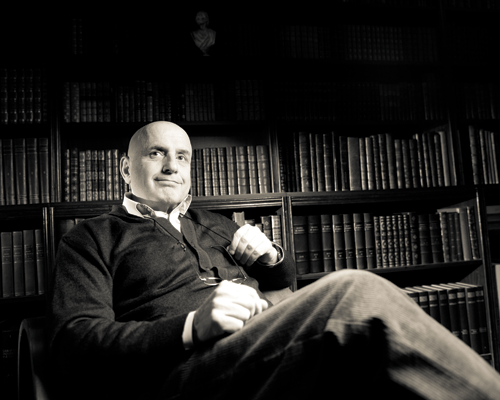
It all started with a 10-franc copy of “Madame Bovary”. Now Antoine Abi-Heila is ensconced at Bibliopolis, his appointment-only Aladdin’s cave of literary treasures in Beirut’s Ashrafieh neighborhood. A dealer, restorer and polymath, he spoke to Executive about his life surrounded by rare and historical tomes.

How did you succumb to the charm of the first edition?

It’s simple. In the 1970s, at the age of 18, I discovered that a contemporary edition of Madame Bovary by Gustave Flaubert was 10 French francs, and a new edition was the same price. So I preferred to buy the nineteenth century edition in a nice leather binding. I discovered [collecting] early. Books… can’t be compared to other antiquities or antiques. [They] concern the spirit, and the spirit is universal and timeless.

So the content is as important as the material value of the edition?

I compare this to — this is a stupid comparison, but anyhow — when a lady is very nice, beautiful and everything. She puts on makeup, she dresses herself elegantly. But when she makes love, she will be nude, so no use for jewels or makeup. The book is the same. The cover, the illustration, the binding are very important to give attraction, but the most important [thing] is the text in itself. I understand people who only want the text, but I don’t want an e-book. I want shelves, and I want to hold the material, to feel it, nice illustrations. This is to look for perfection.

You specialize particularly in ancient Arabic manuscripts. Are these the most popular items on the regional market for antiquarian texts?

Lebanese bibliophiles are in three classes. You have the people who are fanatic about their country and they want everything related to Lebanon, and [those] who want really landmark universal literature. The third category is the Islamic manuscripts and illuminated Qurans. I have discovered that Saudi businessmen, if they want to make a corporate present, can buy a manuscript for 10, 20 or 30,000 dollars. It expresses something as a social ritual. It means I am an intellectual, I am offering you a book and I consider you as an intellectual person.

You’ll soon be publishing your own historical discovery…

‘The Perfumed Garden’ [by Sheikh al-Nafzawi] is an erotic treatise written in early 15th century Tunis, in Arabic. Four hundred years later, in 1850, a young French officer discovered this manuscript and he translated it into French. He didn’t dare put his name on it, he used a pseudonym, ‘Baron R’. Five years ago, I discovered who Baron R was. I bought the original handwritten manuscript draft in Paris, and I found his name in Arabic. I went to the archives of the Defense Ministry in France with a name: General Jean-Baptiste Campenon. In his file I compared his signature, the script and his background. He was really courageous — it took 10 years for him to translate this from Arabic.

Is there anything in your collection that you’ll never sell?

I had a collection that I said I’d keep, but I sold it two weeks ago. This is a scoop for you… They are very important original documents relating to the conflict of 1860 in Lebanon between the Druze and the Maronites. [A French General] came here with instructions to punish the Druze leaders who committed massacres. This is the whole correspondence he had; for example, the petition sent to him by the widows of Deir El Amar.

For this period [there were no] original documents [in the public domain]. So I sold this to FNB bank [as part of the national] patrimony.

Are there any books or documents you still long to get your hands on?

I am particularly attracted to hand-written historical documents. Right now I am looking for [documents by] Stalin and Hirohito, the previous emperor of Japan, to complete [my collection of] all the antagonists of the Second World War. And Bin Laden, if I can find something by him, is important.

January 3, 2012 0 comments
0 FacebookTwitterPinterestEmail
Comment

Schooling Lebanon’s police

by Nicholas Blanford January 3, 2012
written by Nicholas Blanford

How many times have you sat in a traffic snarl at a road junction in Beirut while a policeman who should be coordinating a free flow of vehicles leans against a dysfunctional traffic light, puffing on a cigarette and chatting to his girlfriend on his cell phone? Well, with a little luck that scenario could soon be a thing of the past if the Internal Security Forces (ISF) chooses to properly implement a newly introduced code of conduct. The little blue book, which is now required reading for everyone in the ISF, explains the obligations and ethical standards to be followed by all policemen. Written in English and Arabic, it includes subject headings such as professional duty, honesty and integrity, impartiality and discipline.

The code of conduct emanates from the United Kingdom and arose from a strategic overview of the needs of the ISF, conducted in 2008. Since the departure of the Syrian army from Lebanon in 2005, Western nations have taken an interest in providing assistance to the Lebanese security services. But, according to diplomatic sources, too much emphasis was initially placed on providing equipment and training on an ad hoc basis, often without coordination among donor countries. For example, the United Arab Emirates stepped in to build new police stations around the country, but the design was that of a private house or villa rather than a functional and secure base to receive and handle prisoners, interrogate suspects and conduct police work, according to the sources. How are you supposed to question a suspect if you have to take them upstairs to a bedroom office? The ISF should have been in a position of making requests to donor countries for specific assistance, rather than simply accepting whatever was given to them.

“The ISF leadership needs to tell donors what they need for the coming three years, so that the ISF can receive specific training and support for the priorities it has developed,” said a diplomatic source familiar with the code of conduct initiative. After conducting a private poll on public attitudes toward the ISF, the British embassy decided to sponsor a project drawing up a new code of conduct to address issues of accountability, internal discipline and professionalism. The aim is to provide a bedrock, if you will, on which physical equipment and training can be properly utilized. The ISF apparently took some time to absorb the importance of the code of conduct but have now embraced it, with senior figures indicating they intend to ensure it is followed through.

Among the possible future changes we could see in the ISF will be proper identity cards carried by the police and identity numbers worn on uniforms. At present, if someone is mistreated by a policeman, the person cannot register a proper complaint because the policeman’s identity is unknown. The ISF’s uniforms may also be replaced to decrease the military appearance of the current mottled blue-gray camouflage pattern. The M-16 and AK-47 rifles usually carried by the ISF could be swapped for automatic pistols, with the larger weapons held out of sight for emergencies. The number of women police officers is set to increase as well and there is talk of instituting a ‘bobby on the beat’ system, similar to the old British tradition of assigning a policemen to patrol allocated neighborhoods on foot to develop personal relationships and trust with the local community. 

Still, changing the way the police force operates requires a cultural shift, not just recommendations in a book. The machinery of Lebanon is lubricated by wasta (or connections), a sadly essential commodity that ensures things get done. But there will be no room for wasta to evade paying parking tickets or other illegal indiscretions if the little blue book is followed to the letter. The police will also have to adopt a proper public complaints system and develop a much sharper internal discipline system. There can be no more appeals to one’s zaim [sectarian leader] to escape disciplinary measures.

It is unquestionably a tall challenge. But the architects of the code of conduct program hope that the recommendations of the little blue book will gradually take hold within the ISF.


NICHOLAS BLANFORD is a Beirut-based correspondent for The Christian Science Monitor and The Times of London and author of “Warriors of God: Inside Hezbollah’s Thirty-Year Struggle Against Israel.”

January 3, 2012 0 comments
0 FacebookTwitterPinterestEmail
Society

Red Alert

by Nadim Mehanna January 3, 2012
written by Nadim Mehanna

Somewhere in a scarlet Ferrari factory in downtown Maranello,  Italy, there are some very smug engineers. Every year the luxury sports car brand unveils a raft of gleaming new models, launching technological breakthroughs that demonstrate the continued development of a much-loved marque and opening up yet more purchasing possibilities… And so now to the Ferrari 458 Spider, unveiled in 2011 at the 64th Frankfurt International Motor Show. The mid-rear engine V8 super car is a world first, featuring as it does a cabriolet roof without compromising the performance of a coupé, thanks to a fully retractable aluminum hard top roof and ultra-sophisticated engineering. By pushing the Ferrari frame ever further, the Spider is an invitation to drivers to combine luxurious, carefree lifestyles with some seriously sporty, aggressive driving that soft-top technology cannot support — a disappointment for some who already invested in the straightforward Italia coupé.

Stripping down from coupé to cabriolet in just 14 seconds, the Spider’s roof is 25kg lighter than a traditional soft-top, and is both quieter and more thermally efficient when closed. There has been no compromise on aerodynamics – the roof adds only 45 kg on the coupé and occupies just 99 liters of space, less than a soft-top. Sliding under a dramatic pair of buttresses behind the seats, the roof’s pieces flip 180 degrees and pile on top of each other, leaving plenty of luggage space.

The buttresses also channel air toward the grilles on the engine cover, maximizing the flow to the intakes, the clutch and gearbox oil radiators, as well as protecting driver and passenger if the car rolls over. The roof also brings the driver closer to that famous Ferrari sound, roaring out through 570 horsepower at 9,000 revs per minute (rpm), accelerating up to 320 kilometers an hour (km/h). The rear window can also be fully opened to enjoy the sound in coupé mode, and the same ‘window’ is an adjustable electric wind deflector positioned between the buttresses, ensuring efficient aerodynamics and reducing buffeting, enabling normal conversation even at speeds as high as 200 km/h. 

Under the hood, the Spider has everything in common with the earlier 458 Italia model, and delivers the same performance despite the technological challenges presented by the roof. Though no longer displayed under a glass engine cover due to safety reasons, the Spider is powered by Ferrari’s 2011 International Engine of the Year. Developed by F1 engineers, the naturally-aspirated direct-injection 4.5-liter V8 engine sprints from 0 to 100 km/h in 3.4 seconds and from 0 to 200 km/h in 10.8 seconds. Ferrari also modified the throttle mapping and suspension tuning to accommodate the cabriolet form, and it is only traveling over very poor roads (like Lebanon’s, sadly) that the driver can feel a mild tremble in the chassis and some vibrations through the windscreen pillars.

While the Spider is proving Ferrari’s ability to forge ahead, the brand is also giving clients the opportunity to add some old-world style to their luxury. The new ‘Tailor-made’ program harks back to the glamour of choice offered to clients in the 1950s and 60s. Exclusive personal designers can customize models with a wide range of cloth trims, colors, finishes and technical materials within the Classica, Scuderia and Inedita collections, giving Ferrari fanatics worldwide the chance to put their own mark on a brand that’s staying ahead of the game.

NADIM MEHANNA is an automotive engineer and the pioneer of motoring on Middle Eastern television since 1992

January 3, 2012 0 comments
0 FacebookTwitterPinterestEmail
Comment

Getting Syria back to work

by Jihad Yazigi January 3, 2012
written by Jihad Yazigi

The Syrian government’s admission in early December that the actual rate of unemployment in the country was anywhere between 22 percent and 30 percent testifies to the depth of the social crisis the society has gone through in the last three decades. The new estimates, provided by Radwan Habib, the minister of labor and social affairs, are at least twice the previously acknowledged rate of 11 percent. According to Habib, the new findings are the result of a field survey conducted by his administration. The fact that the range is so wide — from 22 to 30 percent— raises questions on the quality of the survey, but there is little doubt that the new figures are a more accurate reflection of the situation in the job market than the previous data based on the number of people registered with job offices. According to most analysts, the Syrian economy needs to be growing by 7 to 8 percent a year for its unemployment level to stabilize. This very high threshold is a consequence of the rise in productivity and in the size of the workforce, which increases on average by 3.5 percent every year. People entering the job market today were born 20 years ago, when the population growth rate stood at above 3 percent. Meanwhile, female participation in business activity is also on the rise and increases the number of people seeking to enter the job market – currently estimated at around 200,000 per year.

Indeed, since the early 1980s Syria’s gross domestic product (GDP) has almost never been sufficient to accommodate its expanding workforce. Put another way, Syria has witnessed almost 30 consecutive years of unemployment growth. The challenge before the government — the current one or any forthcoming one — is therefore huge: How to create the conditions for the economy to grow fast enough to meet the demand for jobs.

One solution to the problem would be to focus not only on the level of growth but on its quality, on how to attract investment in the sectors of activity that are most labor-intensive and potentially generate the most added value, such as agriculture and manufacturing. 

This new policy would represent a shift from the priorities of recent years, when Syria’s decision-makers focused on trade liberalization and the development of the services industry. Indeed, finance, tourism, trade and transport, in addition to real estate, have been the main engines of growth in the last few years. Although Syria has much to gain from a strengthening of its services sector, the neglect of farming and industry has cost it dearly in terms of employment, and prevented it from building a strong production base. A lot has already been written on the catastrophic performance of the Syrian agricultural sector, which suffered from several consecutive years of drought starting in 2007 and from poor policy-making decisions, including a steep increase in the price of agricultural inputs when farmers were most in need of help. 

The consequence of all this has been to force tens of thousands of farmers from their ancestral lands and to reduce the contribution of the sector from around 25 percent of GDP to 19 percent in less than a decade. Free trade agreements with Turkey and the Arab world, as well as a general reduction in custom tariffs, have also led to an ‘invasion’ of foreign-made products that put countless industrial plants and workshops out of business and consequently thousands of people out of their jobs. The textile sector, one of the most labor-intensive industries, has been particularly hit by the lifting of the ban on garment imports.

The resolution of this predicament is obviously not only an economic or social issue for the government but it is also political. Unsurprisingly, many of the protests taking place across the country since March 2011 are occurring in the areas most hit by poverty and neglect, such as  Daraa, located at the center of an agricultural plateau in the south of the country, and the poverty belt around Damascus.

There must be no illusions. A happy end to the current protest movement, including the establishment of a democratic political system, will not mean an end to Syria’s economic woes. Syrians must recognize the tremendous challenges ahead and adopt a new economic development strategy that puts employment at its center.


JIHAD YAZIGI is editor-in-chief of The Syria Report

* This following sentence was changed from the print edition: "Meanwhile, female participation in business activity is also on the rise and increases the number of people seeking to enter the job market – currently estimated at around 200,000 per year." We regret the error.

January 3, 2012 0 comments
0 FacebookTwitterPinterestEmail
Society

Discovering Armenia’s palate

by Ellen Hardy January 3, 2012
written by Ellen Hardy

For some it is the smoky strips of blood-red basterma hanging in glass windows in Bourj Hammoud and filling the air with leathery, spicy scents, while others have a weakness for muhammara, rich with walnuts and pepper paste. More still grow misty-eyed at the thought of kafta, drenched in wild cherry sauce and strewn with cashew nuts and fried bread.

Most Beirutis with more than a passing interest in what goes on their plate will be able to name a favorite Armenian dish. But although people of Armenian origin have been in Lebanon for centuries, it’s only in the last few years that they have been drawing attention to themselves as restauranteurs.

The bulk of the Armenian diaspora in Lebanon are descendants of families from Cilicia, a region south of the Anatolian plateau, today in eastern Turkey and northern Syria. During the First World War, the Ottoman Turks pursued a campaign of ethnic cleansing that left some 1.5 million Armenians dead and drove tens of thousands into exile in the Levant; the survivors today in Lebanon are a 150,000-strong community known as much for their commercial industry as for their traumatic history. But if there is one way to pique interest in a people, it’s through food.

Aline Kamakian — co-author of the recent cookbook “Armenian Cuisine” and member of the family behind Mayrig restaurant — says that in her youth, going out to eat Armenian dishes would not have occurred to her. “It was everyday food. Traditionally, it’s always been Armenian mothers who cook.” But as second-generation families loosen up and intermarry, women have more time and independence.

Restaurants with an Armenian twist are therefore thriving on the skills of mothers who have time to spare — the kitchens at Mayrig and Seza are staffed by local women, not chefs — and who fill a need for labor-intensive traditional dishes. Madame Seza, who opened her restaurant a year ago, still idolizes the cuisine of her mother, who “did everything at home, and so well, to perfection.” Now, it is her children who have been re-enthused about the cooking of their forebears through the restaurant. “Before they asked for burgers, now they ask for manteh,” she says.

This flourishing of the cuisine in the public domain is also helping connect Armenians with their homeland and educate outsiders about Armenians and their history. As “Armenian Cuisine” demonstrates, with the recipes come memories, and many dishes — hummus with basterma here, pastries from Latakia there — are expressions of long geographical dislocation.

Rich variety and demand support flourishing restaurants across Beirut. There’s a familial welcome and bistro atmosphere at Onno in Bourj Hammoud, boutique design and ladies in lace headscarves at Seza in Mar Mikhael and seu beureg with a side of jazz at Razz’zz in Hamra. Now two of the more long-standing (and pricey) outfits — Mayrig and Al Mayass — are expanding, taking Cilicia’s heritage global. Kamakian is plotting a central kitchen in Europe that will be able to supply branches in Paris and beyond with food as skillfully produced as it is at Mayrig in Beirut, where “everything is handmade, mum’s doing it.” Al Mayass has had a branch in Kuwait since 2008, and is introducing four more outlets in the UAE and New York next year.

And so the cuisine of Cilicia, which tells the story of a country lost and countries gained through smoky meats and spices, is taking on new commercial and cultural significance. “When you’re eating the food and someone is telling you this is Armenian but the name is in Turkish,” says Kamakian, “the first question is, ‘Why? What happened?’ You’re opening a door for a million people to smell, taste, listen to what is Armenia. You’re moving all the senses through a simple dish.”

January 3, 2012 0 comments
0 FacebookTwitterPinterestEmail
Comment

A Salafist surprise

by Jonathan Wright January 3, 2012
written by Jonathan Wright

There’s nothing like free and fair elections for finding out what people really think, and the big surprise of the Egyptian elections, the first since the overthrow of President Hosni Mubarak last February, has been the strong level of public support for the Muslim Salafist movement, the conservatives whose overwhelming priority is to emulate the behavior of the Prophet Muhammad and his seventh century companions.  Ironically, most of the outsiders who predicted the Salafist gains were Islamophobic Americans and Europeans who based their expectations on visceral disdain for the judgment of Egyptian voters, rather than on any knowledge of the country. Those closer to the electoral battlefield, on the other hand, including Egyptian political scientists and pundits, expected the Salafists to win only about 10 percent of the vote.  After the first of three rounds of voting, the Nour Party alone, the most successful of the Salafist groups, had taken more than 24 percent, in second place behind the Muslim Brotherhood but well ahead of any liberal-secular group. The political scientists have some excuses: psephology, the science of elections, is in its infancy in Egypt and the rest of the Middle East, along with the related sciences of opinion polling and market surveying. Besides, in a society where speaking one’s mind in public could be unwise, whatever polling did take place was liable to misrepresent reality. 

Journalists and proto-psephologists have come up with a variety of reasons why the Salafists have proven so unexpectedly popular. One of the most promising lines of enquiry is that the Salafist sympathizers have been there all along, at about the weight suggested in the elections, but they took a tactical decision many years ago not to take part in the political process. Researcher Nathan Field notes that in work he did on television viewing in Egypt in 2008, Salafist stations were clearly drawing higher ratings than any others but no channels existed for this preference to find political expression. 

With the collapse of the old regime, the Salafists made a sudden and concerted switch into political activist mode, taking advantage of new networks to meet and discuss topics such as Muslim orthopraxy in everyday life. Anecdotal evidence from individual Salafist voters corroborates this theory, though some of them have said they cooperated with and voted for the Muslim Brotherhood, for want of a better alternative, in previous elections. Salafist voters have also emphasized their personal acquaintanceship with the candidates they favor, suggesting a well-established social nexus at the local level. Another explanation is that politics in Egypt, as in many developing countries, has always been skewed toward the urban elite to the disadvantage of the rural poor, many of whom are illiterate and disengaged from central government. Under the Mubarak regime, the rural poor could easily be persuaded, bribed, coerced or intimidated into voting for the ruling party, but in 2011, with the field wide open and no guidance from authorities, they turned to those they knew and trusted. At some polling stations in the countryside, whole neighborhoods appeared to be voting for the Nour Party, but without any overt regimentation by the party’s operatives. The Salafists’ opponents and detractors have attributed the success of the Nour Party to large injections of Saudi cash, both to run its campaigns and to finance hand-outs of basic foodstuffs to the poor — a common electoral practice by many candidates. Newspapers say the ruling military council has collected details of all foreign payments that might have helped political parties or candidates, but until they release them it is hard to assess the impact. Field’s research quotes Jamal Khashoggi, a journalist close to the Saudi government, as saying the Saudis are not in the business of encouraging other Islamist alternatives, so it is hard to see what they would gain from financing the Egyptian Salafists. Wikileaks evidence, on the other hand, suggests that the Saudi government has spread its largesse quite widely among Arab politicians, to keep them on its side. 

The sudden switch from political quietism to a new role as the second largest group in parliament has not been a smooth one. Leading members of the Nour Party have sent enough mixed signals in recent weeks to seriously discredit most political movements in ordinary times — especially on alcohol, tourism, the economy and personal freedoms. But the party has struck a chord that no other group has touched, a chord that many did not even know existed.


JONATHAN WRIGHT is managing editor of Arab Media and Society

January 3, 2012 0 comments
0 FacebookTwitterPinterestEmail
Society

Finance for thought

by Paul Cochrane January 3, 2012
written by Paul Cochrane

In the years since the credit crisis erupted in 2007 there has been a steady flurry of economic and financial books published claiming to tackle the root causes of what some have dubbed ‘The New Great Depression’, offer alternatives to the current financial system or provide warnings of the inherent dangers still facing the world economy. With the beginning of a new year that has dark storm clouds still crackling with lightning and thunder over the global economy, Executive has selected four of the most thought-provoking economic books printed in the past year to prime the reader for the challenges ahead.

Debunking Economics

Revised and Expanded Edition: The Naked Emperor Dethroned?

A book by Steve Keen

‘Debunking Economics’ has been a critical and commercial success since it was published in 2001, largely due to Australian economist Steve Keen’s withering critique of the neo-classical economic theories that have dominated policy since the 1970s. His claims are also given more weight by the fact that he predicted the 2008 financial crisis well in advance.

In a newly revised edition, Keen hammers the point home that mainstream economists, as well as central bankers, deserve no credit for the boom years prior to the crash but should shoulder the blame for the crisis and its aftermath. Through a pioneering explanatory statistical model, Keen argues that classical economic thought has little to contribute to what is known as Reality Economics, which is more cause-and-effect than assumption based. He argues that the near hegemonic adoption of a narrow-minded approach to economics in academia, which is then carried into professional life, is at the core of the problem, with those supposed to be implementing a cure still theoretically blinkered, evident in counterproductive solutions such as bailing out the banks and quantitative easing.

Keen’s historical and economic analysis of what went wrong are worth delving into, yet it is his alternatives that will interest the reader mulling options to get us out of the current maelstrom. He proposes radical changes, such as reducing or wiping out private debt through a widespread amnesty and, heretical though it may sound, the temporary nationalization of the American financial system.

It is doubtful whether Keen’s voice will be heard amid the hullabaloo, particularly as the United States enters an election year; as John Maynard Keynes pertinently remarked in 1935: “The difficulty lies, not in the new ideas, but in escaping from the old ones.”

The Quest

Energy, Security and the Remaking of the Modern World

A book by Daniel Yergin

Daniel Yergin is renowned for his Pulitzer Prize-winning ‘The Prize’,  which charted the rise of the world’s insatiable thirst for black gold as far as the first Gulf War in 1990. ‘The Quest’ picks up where he left off and ventures into the “Great Game” for energy following the break-up of the Soviet Union, the emergence of national oil companies from emerging markets like India and China and the dirty world of oil politics in the twenty-first century. He tackles the effects of the United States’ invasions of Afghanistan and Iraq on energy security and assesses the twisted reasons for the oil price spike between 2004 and 2008. As in ‘The Prize’, ‘The Quest’ shows why understanding the geopolitics of energy is essential to comprehending the world today, and where we may be going next. He discusses how new technologies and high oil prices are making previously untappable oil reserves accessible, although at significant environmental cost. Such ramped up output in the US, Canada and Brazil — each to some 3 million barrels per day by 2020 — could well change the ‘oil world order,’ particularly the West’s problematic reliance on the Middle East, he argues. And while Yergin is no believer in the ‘peak oil’ theory — arguably a flaw in his analysis — this does not stop him discussing at length the need for alternative energy sources, and how potentially disruptive technologies could be game changers in global politics and security.

Poor Economics

A Radical Rethinking of the Way to Fight Global Poverty

A book by Abhijit Banerjee and Esther Duflo

‘Poor Economics’ focuses not on Wall Street and the problems of the financial markets — the “1 percent” as the Occupy Wall Street protesters have labeled them — but rather the poorest of the world’s poor; not the three billion people that live on less than $2.50 a day but the billion surviving on less than a buck.

The focus is on how the poor respond to aid strategies, based on empirical research in 49 countries carried out over 15 years. What is radical about their work is that Abhijit Banerjee and Esther Duflo draw their findings from actually listening to and understanding the needs and behavior of the poor. Why, for instance, do people buy a TV and go hungry, or prioritize the education of one child over the rest of their offspring?

Moreover, their research is into what has worked in development economics and what has not: micro-finance is not the cure-all it is championed to be and higher rates of literacy and schooling do not necessarily equate to economic development and prosperity. As the inequality gap widens, addressing global poverty is a pressing issue for governments, development agencies and businesses. Banerjee and Duflo tell us where our attention needs to be, and it is no wonder their book won the Financial Times and Goldman Sachs Business Book of the Year Award for “the most compelling insight… into modern business issues.”

Currency Wars

The Making of the Next Global Crisis

A book by James Rickards

We are in the early stages of Currency War III, according to veteran financier James Rickards. The first currency war (CW) was between 1921-1936, and CW II took place from 1967, beginning in the lead up to the end of the gold standard in 1970 and culminating in the 1987 stock market crash.

Rickards argues that the United States has instigated CW III through the Federal Reserve’s quantitative easing policy — printing dollars to boost base money supply to get the economy out of recession. But by doing so, “the Fed has effectively declared currency war on the world” and the result is stagflation — stagnant growth and high inflation — and the world going deeper into financial crisis.

According to estimates, the US dollar comprises 61 percent of identified official foreign currency reserves, while the euro represents 26 percent. What happens to the dollar is of prime importance and the trends are worrying. The dollar’s position has declined from 71 percent in 2000, and stands to fall further as American power is challenged, confidence in the greenback weakens and more countries change their reserve currencies, as Russia and others have threatened to do.

Rickards uses possible scenarios — as played out at a Pentagon-organized financial war game — to highlight what a currency war entails and it is eyebrow-raising reading. The end result could be the dollar joining a crowd of multiple reserve currencies (MRCs), although all major currencies have recently devalued in parallel against gold, and in fact MRCs could exacerbate rather than alleviate the currency war. The other alternative is the International Monetary Fund pushes for greater adoption of its “world money”, Special Drawing Rights. The final possibility is the dollar will be “rejuvenated by gold or descend into chaos with both redemptive and terminal possibilities.”

Rickards suggests a return to the gold standard to retain stability, of money backed by something tangible, not paper or digits on a screen. Yet, however this currency war plays out Rickards warns that it “is the most meaningful struggle in the world today — the one struggle that determines the outcome of all others.”

January 3, 2012 0 comments
1 FacebookTwitterPinterestEmail
Comment

Bahrain’s colonial flashback

by Paul Cochrane January 3, 2012
written by Paul Cochrane

It is perhaps a cliché to say history repeats itself, yet this saying seems to have held true over the past year in the Middle East, particularly in Bahrain. Uprisings have happened before, and been successful or crushed through counter-revolutionary forces. But it is in behind-the-scenes developments that there really is a flashback to the past. 

Last month, Bahrain appointed two men — a former Miami police chief and John Yates, the former assistant commissioner of London’s Metropolitan Police — to oversee the reformation of the state’s police force, which was found in an independent inquiry to have committed systematic human rights abuses and used torture to crush the 2011 pro-democracy uprising.

By virtue of their nationalities and their countries’ strategic involvement with Bahrain, both former “top cops” are dubious choices. Yet Yates in particular stands out, as he was forced to resign from the Metropolitan Police in the summer over a newspaper phone-hacking scandal. Moreover, his appointment reeks of the colonial past. Britain set up Bahrain’s security force prior to independence in 1971, and the General Directorate of State Security was run from the mid-1970s until 1998 by former British policeman Ian Henderson. 

Amnesty International documented widespread torture under Henderson’s leadership, and he forcefully put down protests in the 1970s and early 1990s, earning him the sobriquet “the butcher of Bahrain”. It is the second such nickname for Henderson, who was a senior policeman in British-occupied Kenya in the 1950s, playing a role in the brutal suppression of uprisings and becoming labeled “the butcher of the Mau Mau”. In 1986 he was awarded the title of ‘Commander of the Most Excellent Order of the British Empire’ for his services.

Although a Jordanian has headed Bahrain’s security force since Henderson retired, the modus operandi has remained the same, as last year’s events document. Furthermore, Henderson, who still lives in Manama, is believed to have provided advice to the authorities during the crackdown. 

While Yates may not be cut from the same colonial cloth as Henderson, his mindset is not radically different. “Bahrain’s police have some big challenges ahead, not dissimilar to those the United Kingdom itself faced only a couple of decades ago,” Yates was quoted as saying in The Daily Telegraph newspaper. But what exactly is Yates referring to? When were there “pro-democracy” uprisings in Britain in the past 20 years? Or any protests suppressed by putting tanks and soldiers on the streets? Perhaps he is referring to the Brixton riots in London in 1980 and 1995, which, in any case, were widely attributed to racist policing methods and high unemployment. Yates appears to have fallen for the official Bahraini line that Iran is primarily to blame for inciting the uprising and the demonstrations had nothing to do with political repression or a minority Sunni monarchy ruling a Shia majority country.

The appointment is also curious when one considers the role of the Metropolitan Police in the riots in London and other English cities last August. A joint study by The Guardian newspaper and the London School of Economics into the causes of the riots published in December,  identified “distrust and antipathy toward police as a key driving force.” 

Such findings do not brook a great amount of confidence in appointing a senior London cop to overhaul Bahrain’s police force. But then, reforming a police force without reforming Bahrain’s political system, by giving the opposition seats in government and addressing the root causes of the uprising, will not change much either. As Saeed Shahabi, a campaigner with the Bahrain Freedom Movement, said of the appointments: “This is not the first time that foreigners have come from the West to upgrade the security services… The government cannot survive without suppressing freedom of expression; only a democracy can tolerate protest.”

The appointments are therefore just a veneer of reform, with Bahrain too strategically important to the West — especially with rising tensions over Iran’s alleged nuclear weapons program and Bahrain’s accommodation of the American Navy’s Fifth Fleet — to allow for substantive democratic change or dissent. By appointing one cop from the former colonial power and another from the current global hegemon, it seems that history really does repeat itself.


PAUL COCHRANE is the Middle East correspondent for International News Services 

January 3, 2012 0 comments
0 FacebookTwitterPinterestEmail
Business

Q&A – Karim Makhlouf

by Zak Brophy January 3, 2012
written by Zak Brophy

Gulf Air, Bahrain’s national carrier, was the Arabian peninsula’s original pioneer in aviation, boasting more than six decades of in-the-air experience. However, in recent years it has fallen from profit and the political tumult in Bahrain and across the region has accentuated the nosedive. Executive met with Gulf Air’s Chief Commercial Officer Karim Makhlouf to hear how the airline fell from favor and about its attempts to claw back market share.

Gulf Air has fallen from profit and lost significant market share in recent years. Why?

More and more competition entered the market so customer choice got divided between the airlines, and commercially we were not aggressive or innovative enough in order to introduce quickly to the market the things that the customers need. We have corrected that this year with many new initiatives, with a clear target of winning back the market share to Gulf Air. 

What initiatives are being offered to win back your market share?

The new initiatives can be summarized in four areas where we are investing. The first is the Falcon Corporate Plus. Then we re-launched our frequent flyer program, called Falcon Flyer, and we have a new initiative for families called Family First. We are also now investing much more heavily in travel agent incentives.

What customer groups are you targeting with these initiatives?

When looking into the new commercial strategies we defined exactly the different customer segments and they are youth… business and corporate, religious traffic and we defined families as a new and important segment. 

Can you expand on the corporate strategy?

It is called Falcon Corporate Plus whereby companies receive special prices and become gold and silver members; there are other features such as complementary upgrade, marketing support, incentive deals and so on. The target is to have 500 deals signed by 2012 and so far we have had 500 deals signed and we have had a good market response from Lebanon. The target here is clear; that we want to increase our market share with the corporate traveler. Companies, especially small and medium ones, can collect [frequent flyer] points with the Falcon Flyer program — that is new.

We have redesigned the Falcon Flyer program with three tiers. Every tier has different advantages besides upgrades, lounge access, baggage access, and obviously the redemption of tickets is the main thing. We are promising that we have the most attractive redemption scheme in the region.

And you said family travelers were a target group?

We really want to position ourselves as the family friendly airline. We are the only airline in the world to offer a sky nanny service and soon we will have this service also in the lounge areas. Also, we are designing kids’ menus and we have kid focused in-flight entertainment systems. We see this as a very attractive target group.

How is Gulf Air developing its routes to take on the regional competition?

We are completely restructuring our network. We aim to avoid the heavy competition of our fast growing neighbors to position ourselves stronger into under-served niche markets. This is why we opened routes to Isfahan in Iran, Addis Ababa, Milan, Geneva, Basra, Kabul, Copenhagen, Nairobi, Rome, Entebbe and we are going to open Juba in March 2012.

E:  And how are you developing your regional network?

The target of double daily flights is not just to here in Lebanon but to all regional capitals. This is the difference from Emirates, Qatar Airways or Etihad; we try to make flying a commodity in the region. We think the Gulf and the Middle East will develop like Europe where it is normal for people to commute by flying, so we want to connect the regional capitals on a double daily basis. This is the differentiator, because we are not focusing on long haul to long haul — competing with the European carriers like our neighbors — but we really want to develop here an excellent choice for the people flying throughout the region.

What investments are being made in the fleet to accommodate your new strategy?

We undertook a major investment into the products, so we are refurbishing the whole of the business class compartment with new state of the art seats, which will be ready by the first quarter next year. With Panasonic we have invested in a new-state-of-the art in-flight entertainment system where we are the world’s first airline offering broadband internet, live television and phoning on board.

How about the actual planes in the fleet?

We are in the process of renegotiating our order book. In recent years there were a lot of orders placed with both Boeing and Airbus and we are fine-tuning that. Because we want to develop further the strategy of high frequency regional flying we are going to start flying with narrow bodies, 320s, with an extra tank and a full lie-flat business class to fly to Europe as of next year. We have six extra range A320s coming in next year.

How many jobs have been or are going to be lost as a consequence of the restructuring program?

Staff [numbers] have been reduced by 30 percent in 2010 and we also managed to reduce losses by 30 percent.

Due to political upheavals this year Gulf Air suspended its Beirut routes and is still not flying to Iraq or Iran. How serious an impact has this had on business?

We were hit very hard in March but in the meantime we managed to partly compensate for these losses with new routes, mainly to Europe and Africa. Of course we hope that the flights to Iraq and Iran will be back soon. 

I think the Lebanese market is somehow used to the political ups and downs. I think it is also clear that [Gulf Air was not] behind the decisions to suspend flights. I think the customer can very well differentiate between politics and Gulf Air. Obviously we see now the customers are coming back and flying with Gulf Air and that is why we are intending to increase the frequency of our flights for the Lebanese market.

How significant a portion of business is cargo and how does this fit into the overall strategy?

Cargo is integrated into our carriers but we don’t have specific freighters. Cargo business contributes around 25 percent to the revenue of the airline. It is very good ancillary revenue for us which we are developing further. By going toward a narrow body fleet we are focusing on high value cargoes.

With the sector becoming increasingly fractured between traditional carriers and low cost airlines, how is Gulf Air positioning itself?

Low cost doesn’t really work as well in the Arab world as it does in the US or Europe because we don’t have this infrastructure of periphery airports. That is where low cost can benefit from lower costs. So in the Arab world it is very difficult to get those low costs. I think in the Arab world ‘low cost’ is hype, which has more marketing content than real economics behind it. Of course, low cost airlines are competition and we treat them as such, but by offering the right service at the right price, especially in the Arab world, it is easier to maintain the customer loyalty than in, say, Europe, where low cost is spreading very aggressively.

January 3, 2012 0 comments
0 FacebookTwitterPinterestEmail
  • 1
  • …
  • 350
  • 351
  • 352
  • 353
  • 354
  • …
  • 686

Latest Cover

About us

Since its first edition emerged on the newsstands in 1999, Executive Magazine has been dedicated to providing its readers with the most up-to-date local and regional business news. Executive is a monthly business magazine that offers readers in-depth analyses on the Lebanese world of commerce, covering all the major sectors – from banking, finance, and insurance to technology, tourism, hospitality, media, and retail.

  • Donate
  • Our Purpose
  • Contact Us

Sign up for our newsletter

    • Facebook
    • Twitter
    • Instagram
    • Linkedin
    • Youtube
    Executive Magazine
    • ISSUES
      • Current Issue
      • Past issues
    • BUSINESS
    • ECONOMICS & POLICY
    • OPINION
    • SPECIAL REPORTS
    • EXECUTIVE TALKS
    • MOVEMENTS
      • Change the image
      • Cannes lions
      • Transparency & accountability
      • ECONOMIC ROADMAP
      • Say No to Corruption
      • The Lebanon media development initiative
      • LPSN Policy Asks
      • Advocating the preservation of deposits
    • JOIN US
      • Join our movement
      • Attend our events
      • Receive updates
      • Connect with us
    • DONATE