• Donate
  • Our Purpose
  • Contact Us
Executive Magazine
  • ISSUES
    • Current Issue
    • Past issues
  • BUSINESS
  • ECONOMICS & POLICY
  • OPINION
  • SPECIAL REPORTS
  • EXECUTIVE TALKS
  • MOVEMENTS
    • Change the image
    • Cannes lions
    • Transparency & accountability
    • ECONOMIC ROADMAP
    • Say No to Corruption
    • The Lebanon media development initiative
    • LPSN Policy Asks
    • Advocating the preservation of deposits
  • JOIN US
    • Join our movement
    • Attend our events
    • Receive updates
    • Connect with us
  • DONATE
Society

Your life on the line

by James Reddick October 3, 2011
written by James Reddick

The concept of identity theft has long been a theme of the science fiction world. Jack Finney’s 1954 classic novel, Invasion of the Body Snatchers (later adapted into film no less than four times), is driven by uncertainty over who is a clone ­— duplicated by an amorphous extra-terrestrial race — and who remains human.

While the consequences are certainly more mundane, and the means more temporal, online identity theft is presenting a similar real-world scenario that has the potential to affect anybody with Internet access.

Take, for example, the case of Fafi Merhi, who has now had parts of her profile “cloned” on Facebook twice. In both instances, Merhi says,the perpetrator created an account under a different name from hers while using all of her pictures. She or he then attempted to add her friends, and then afterwards their friends, on a few occasions (that she was told about) sending messages to contacts with ambiguous come-ons such as “Let’s get to know each other”.

As far as she knows, the culprit had no financial motivation, and was most likely a “friend” or “friend of a friend”, since they would have had to have access to her photographs and list of contacts. When a tech-savvy friend gained access to the impostor’s affiliated email address, Merhi disconcertingly discovered that it was [email protected].

“I don’t know what satisfaction they could get out of this. Honestly, I felt sorry for this person,” she says. Sympathy aside, the consequences of cloning can be dire, especially since reporting security breaches on Facebook is a notoriously slow process. Merhi’s first clone account was up for six months before it was taken down, despite repeated complaints submitted through Facebook’s online security form.

“Consider if Fafi was working in a government position,”says Michael Chaftari, CEO of newly launched Beirut-based social media monitoring company Fetch. “Someone could seriously damage her reputation.”

‘Social engineering’

While online risks are typically associated with malicious software, predators more and more target users’ anticipated behavior. This, says Chaftari, is known as “social engineering”, a cynical approach to information gathering that manipulates a user’s proclivity to trust. This can come in elaborate forms, from pop-up windows that pretend to be a trusted site asking for a user name and password, to rummaging through garbage bins in search of clues about passwords, social security details and other sensitive information.

In the case of Facebook, fake accounts are the most common channels for social engineering. If a beautiful, scantily clad woman with no mutual friends invites you on Facebook, it is best to resist the temptation. Same goes for shirtless men, or any stranger for that matter.

With faster speeds in Lebanon an eventual reality, the nature of Internet usage is bound to change. Online shopping, for example, will no doubt increase, as companies are finally able to adapt to the 21st century. But as the usefulness of the Internet in Lebanon increases, the need for vigilance will rise accordingly as sensitive information will be more frequently submitted online.

“Your online presence is no longer limited to communication,” Chaftari says. “People are using the Internet for more serious things.” While Facebook remains a largely light-hearted social platform, it can be the gateway for predators to access more sensitive information.

With this in mind, Executive enlisted the help of Victor Sawma, chief technology officer and partner at NetDesignPlus and a lecturer at Notre Dame University in Lebanon, to dissect the risks of Facebook to the everyday user and to explain what he or she can do to protect themselves.

What are the potential security risks of using Facebook?

Connecting people is the goal and soul that drives this giant social network. But with each of Facebook’s innovative new methods to communicate — such as the ‘Places’ application, which is essentially an opt-in online tracking device — come new risks to users’ security. That in mind, Facebook is constantly trying to create a balance between the two; these efforts have increased lately with the release of Google+, which was advertised as an antidote to Facebook’s security “minuses”, a key feature for users to make the migration to a new platform. Facebook’s response was a rash of  security upgrades, such as more finely tuned privacy controls and increased default security settings.

From a security perspective, Facebook is prone to the following issues:

Identity integrity: This is directly related to when somebody else tries to pretend to be you or even to be your business and abuse your social relations. This is very common lately on Facebook, especially at the personal level. But it is also possible in some cases to see this taking place at the business level by somebody creating a business page for a competitor through a fake account for the sole purpose of harming the image of that business.

Personal/business privacy: This is related to information being leaked to other parties, whether directly or indirectly. It is not necessary for Facebook users to write about something for other people to know about it. The existence of a relationship, along with photos and status updates, are more than enough, in the majority of the cases, to allow other people to learn about information that you did not intend to tell them about.

Trust-relay issues: Facebook users are expected to trust applications  — additional programs that exist within the structure of Facebook —  by giving them access to personal, and sometimes sensitive, information. The majority of users do not realize how harmful this can be. For example, why would an application need access to publish on your wall if, at the same time, it claims that it will not tell anybody anything without your previous consent? The majority of users do not question why a certain application is requesting permission to certain information. They trust that application simply because it comes from Facebook.

What can users do to protect themselves?

The only protection that Facebook users can have is awareness. They have to learn what permissions are about, how the social network (called the social graph) of Facebook works, and so on. But is not an easy task, even for security experts. We end up, in many cases, uncovering potential risks that can rise from certain permissions or activities. As a start, Facebook users must consider giving permissions at the minimum level needed. They must also remember that giving an application permission once means that this application will gain access to the information that it needs (name, email, gender, friends list, etc.) and will still have that information even if that permission was denied later on. The majority of applications, if not all, save the information that it needs once permission is granted.

Is there any defense against cloning?

Any person (real or virtual) who knows or has access to your information can attempt to clone your profile. Who can access sufficient information to do so convincingly depends on your own privacy settings. Recent updates to Facebook’s privacy functions now mean that users have more control than ever over who can access their content; almost every facet of a Facebook user’s online presence can be designated as visible to either just their friends, friends of friends or be left completely unrestricted, visible to (and thus able to be ‘cloned’ by) anyone. Facebook also allows users to narrow this down further by creating specific lists of friends who are able to access their ‘wall’, profile updates and photographs. Users are also now able to embargo ‘tags’ in friends’ photos and restrict who can see any tags that they do choose to accept.

Where does Facebook go from here?

Facebook is currently undergoing dramatic changes at the security level, in general, and privacy and access control level in particular. A re-engineered news feed now allows users to better control what is being written about them by friends, family and other parties. Users are also now being asked about certain sensitive posts before Facebook posts them within their News Feed. Sawma believes this process will continue in the few coming months as Google+ pushes more and more into the social network market share.


October 3, 2011 0 comments
0 FacebookTwitterPinterestEmail
Comment

Increasingly called to arms

by Nicholas Blanford October 3, 2011
written by Nicholas Blanford

The challenge facing Syria’s opposition protestors seems greater today than at any other time during the six months of demonstrations against the regime of Syrian President Bashar al-Assad.

Despite more than 2,600 people dead, according to United Nations figures, the imposition of sanctions against the Syrian leadership and an international outcry, an undaunted Assad has redoubled his efforts to crush the uprising by brute force.

This durability is causing dismay among opposition protestors who, for all their bravery in facing tanks and snipers on a near daily basis, have yet to gain the necessary momentum to topple the regime. Increasingly, there is talk in opposition circles of the inevitability of resorting to weapons to confront the regime. Reports are mounting of attacks against Syrian security forces and of arms being smuggled into Syria. The prices of black market weapons in Lebanon continue to climb, as they have done since mid-March when the uprising began in Syria. Although some of the demand is domestic, most of it is driven by the crisis in Syria. At this stage, it appears that the arms buying is being conducted on an individual basis, with Lebanese intermediaries purchasing illegal weapons, and legal shotguns, and selling them to Syrian contacts. The bulk of the opposition says it isdesperate to keep the demonstrations peaceful. Yet they admit that there could come a breaking point when protestors will no longer endure being gunned down in the streets each day and will choose instead to shoot back.

“The regime is going to do more killing, so the only way we can win is to have neutral observers, and lots of them, in Syria to monitor what’s happening,” said Ahmad, an activist from the port city of Banias who escaped to Lebanon last month. “We don’t want to go for the option of an armed struggle against the regime. But if the international community does not step in, we are afraid that it will lead to civil war.”

Resorting to weapons not only risks plunging Syria into civil war, it would also play neatly into the hands of the Assad regime. The Syrian leadership has consistently said it is fighting “armed terrorist gangs”, a claim that presently few believe. But such accusations would be harder to refute if the opposition takes up arms. Furthermore, the Syrian army — the elite units at least — and the intelligence services still back Assad, which means the regime is well positioned to confront an armed struggle.

The Syrian opposition, which remains critically divided with no single unifying figurehead nor effective, overarching organizational body that can speak for the opposition at large, cannot expect anytime soon an international intervention in Syria, similar to the NATO-led campaign to oust Colonel Muammar al-Qadhafi.

Syria, after all, is not Libya. Unlike the isolated North African country and its eccentric ruler (who was scorned by his fellow Arab leaders), Syria lies in the heart of the Middle East and wields influence — of a potentially malevolent nature — throughout the region. Syria’s Arab neighbors, and Israel, are wary of the Assad regime exporting mayhem and instability in the admittedly unlikely event that the international community chooses to intervene militarily in support of the opposition.

Instead of an overt military intervention, it is perhaps likely that interested parties — the United States, Iran, Saudi Arabia and Turkey  — will intercede to play a more active role in shaping the future of the country. Iran will probably continue to support the Assad regime for the time being, even as it sends outfeelers to some elements in the opposition to explore the possibility of whether any post-Assad administration in Damascus will continue to abide by the three-decade Iran-Syria alliance. Among the signs to watch out for are defections by senior Alawite military officers, some of whom may prove susceptible to under-the-table offers of cash and immunity from prosecution if they were to abandon the Assad regime and side with the opposition.

Another indicator would be the emergence of more organized transfers of weapons and communications equipment to the opposition, suggesting that the revolution has found financial sponsorship. Social media tools such as Facebook and Twitter may help promote a revolution and win international sympathy, but they are not enough to defeat a regime that shows no hesitation in using brute force to ensure its own survival.

NICHOLAS BLANFORD is the Beirut-based correspondent for The Christian Science Monitor and The Times of London. His book “Warriors of God: Inside Hezbollah’s Three-Decade Struggle Against Israel” will be published by Random House this month

October 3, 2011 0 comments
0 FacebookTwitterPinterestEmail
Society

Book Review: The Road to Fatima Gate

by Paul Cochrane October 3, 2011
written by Paul Cochrane

A Book by Michael Totten

There has been a flurry of books published over the past few years by Westerners, primarily Americans, describing in depth their brief encounters with Lebanon and the Middle East. Their insights are telling not so much for the informative content, but rather how this budding vein of adventure writers perceives the region and its people.

Often misplaced in bookstores under ‘political journalism’, these titles — including Ted Dekker and Carl Medearis’ “Tea with Hezbollah”, Jared Cohen’s “Children of Jihad” and Lee Smith’s “The Strong Horse”  — ought to be stacked closer to the ‘adventure/fantasy’ section.  And relegated to the bin of banality they would be, did they not also wield such a dangerous degree of influence over the shaping of United States foreign policy. 

It is in this light which one must regard Michael Totten’s “The Road to Fatima Gate”, released earlier this year by Encounter Books, a publisher self-described as being a press for the “serious conservative”. Fitting, then, that the book is written from what could be called a ‘Western extremist’ perspective.

“The Road to Fatima Gate” traverses Lebanon’s politically tumultuous time between 2005 and 2008, from former Prime Minister Rafiq Hariri’s assassination and the Syrian army’s subsequent withdrawal, through the July 2006 war and the civil conflict of May 2008. Totten is in Lebanon only part-time during this period, but he does not let this pollute the aura of comprehensiveness he lends his accounts. Nor does the author let the selectiveness of his associations temper the license he allows himself to make sweeping generalizations regarding the Lebanese mindset — Totten has minimal meaningful interaction with ‘people on the street’, instead openly preferring the company of expatriates and barfly drinking buddies, with his most authoritative source on the country being Charles Chuman, an American-Lebanese from Chicago who came to Lebanon in 2003 and whom the author describes as knowing “the country better than almost anyone I ever met.”

Totten recounts the 2006 war in Lebanon from Northern Israel and being abroad when rival political factions faced off in block-to-block combat in May 2008, Totten retells the experience largely through the eyes and ears of Chuman, complete with dialogue and inner thoughts. (Perhaps tellingly, Chuman, Smith and Totten all spoke at the annual Institute for Policy and Strategy conference in Herzilya, Israel, shortly after the 2006 war.)

Totten’s myopic narrative is most blatant regarding Beirut’s southern suburbs and South Lebanon, despite the crux of the narrative being about Hezbollah. Totten describes these areas as throttled by totalitarianism, where Hezbollah violently suppresses self-expression. Totten does let Lebanese voices set some of the record straight, but only in chapters outside those in which he portrays “Hezbollahland”.

In his account, Lebanese police have never set foot in “Hezbollahland”, from which they are “forbidden” — news, no doubt, to the veteran law enforcement officers in Haret Hreik and Bint Jbeil. Similarly, Totten suggests Iran is the sole financer of post-war reconstruction in South Lebanon, completely ignoring the hundreds of millions of dollars pumped in from Qatar, Kuwait and other nations, including the US.

Leveraging his thorough understanding of Lebanon, Totten then graces us with his incisive insight into the region as a whole: “Arab countries have a certain feel. They’re masculine, languid, worn around the edges and slightly shady.”

This book does a good job of listing the many important events of the years it covers in Lebanon but it is rigidly selective in the sources it taps and the questions it asks. Further, it lacks historical insight and glosses over inconveniences such as ‘facts’ that would run counter to the agenda Totten is pushing. But then again, what adventurer would want to dilute his drinking stories with reality?


October 3, 2011 0 comments
0 FacebookTwitterPinterestEmail
Comment

Charged with tragic comedy

by Sami Halabi October 3, 2011
written by Sami Halabi

Lebanon’s political theater played out another scene last month with a host of government actors trying to elbow their way to centerstage, propped up by a supporting cast of journalists and media figures. Entitled “Utterly Missing the Point”, the plot of this tragic comedy pitted these two groups in a mischievous conspiracy against the Lebanese in which they engineered dramatic distractions to obfuscate the true reason for the country’s failing public services. The scene opened with the infamous General Michel Aounand his son-in-law, Minister of Energy and Water Gebran Bassil, initiating a blistering quarrel in cabinet over how to divvy up $1.2 billion amongst different contractors and authorities in the installation of new power generation — a project that would, when finished in 2015, supply just barely enough electricity to meet what was needed in 2009. The argument was then duly taken up by a chorus of objecting cabinet blocs and members of parliament who, in the end, decided against implementing any effective checks and balances on the expense.

The obfuscation of the spectacle would not have been possible without the generous support of Lebanon’s newsrooms, which proceeded, with passion and dedication, to cover the controversy ad nauseam without ever elucidating the reasons behind the objections to the proposed legislation, or even the content of the initial proposal. In not focusing on the plan or the law, they scuttled any chance of a counter-narrative that may have pressured the government to actually implement the long-awaited basket of solutions to the country’s most basic needs.

Then there were the exhibitions in befuddlement (misleadingly labeled press conferences) of the principal architect, Minister Bassil, at the beginning of the month.

At the first exhibition, the media dutifully fulfilled their part of the bargain, focusing on why Bassil had not attended a meeting of other ministerial virtuosos aimed at putting the finishing touches on the plan earlier in the day, and not on the details themselves — a particularly canny contrivance. For sending their headliner journalists to the first exhibition and, after the bickering had subsided, their lower tier to the next — where the issues of how to actually realize the objectives of the newly finished piece were up for discussion — we should extend applause to Lebanon’s news agencies.

This propensity of the media to focus on the petty infighting and sound bites espoused by Lebanon’s sectarian leaders, as opposed to dissecting legislative deficiencies and potential solutions, arrives from the intersection of habit and our sectarian media landscape. Maintaining the irroutine throughout, the media furthers the narrative of “Utterly Missing the Point” by attributing utmost importance to Lebanese leaders’ intentionally insidious and vacuous polemics, entrenching in the mind of the public the insurmountability of the status quo.

The media and its partners in both the ruling majority and opposition have inspired journalists to usher in a new era of reporting and construct the closest thing we have to a national narrative. From here on out, we should endeavor to set the framework for a new philosophy, which all Lebanese, regardless of creed or social standing, can adhere to. As we have done recently, we must seek to adhere to the principle of the bare minimum: demanding only that reform allow us to continue our present state of existence, relative to the world at large, without aiming to actually effect any substantive structural reform.

After two post-war decades with the same headlines, and the same figures making headlines, it should be clear that no leader truly seeks structural reform. Then again, who among us really wants to be hamstrung by the laws and institutions propelling the rest of the civilized world? We would have to sacrifice our freedom to litter at will, to drive in the wrong direction, to smoke in public. We may even lose our entitlement to treat with disdain the foreign workers who build and clean our homes and streets because they work for salaries that we would never accept. This is what gives our country a unique charm that outsiders can only marvel at. Indeed, who needs real reform when you can have chaos and liberty that is only checked by the haphazard application of a law that you can get around with a little wasta?

Perhaps we should not express this notion too loudly lest we tip off those who will never understand how sublime our cycle of freewheeling really is under the surface of constant complaints and invective. So (in a lowered voice), if there is any lasting lesson in “Utterly Missing the Point”, let it be that we stop complaining, accept who we are and stick to the bare minimum. 

SAMI HALABI is EXECUTIVE’s
Economics & Policy editor

October 3, 2011 0 comments
0 FacebookTwitterPinterestEmail
Comment

Open to abuse

by David Segall October 3, 2011
written by David Segall

The stench of mold in the dormitory was overpowering. A dozen bunk beds hugged the perimeter, lest one centimeter of potential sleeping space be wasted. Wooden planks served as mattresses for some of the men who called that barrack home.

This was not a prison or a housing complex in one of the world’s poorer regions. It was a company-built dormitory for Bangladeshi workers in the state of Qatar, the world’s wealthiest nation in terms of gross domestic product per capita. And it took only 15 minutes to get there from Doha’s breathtaking downtown.

Qatar aspires to be a global player in politics, business, education and sports. From the ubiquitous billboards of the Qatar Foundation touting Doha’s “Education City” — where Western universities are building high-tech campuses — to Qatar’s designation as host country for the 2022 FIFA World Cup, the ambition of this small nation is undeniable.

But not far from modern, cosmopolitan Qatar lurk the people upon whose backs the enterprise continues to be built: 1.2 million migrant workers, most from Southeast Asia, who outnumber Qatari citizens at least four to one. With the equivalent of at least $55 billion to $60 billion committed to World Cup-related construction projects, the number of migrants in the construction sector will only grow.

I recently visited Qatar on behalf of Human Rights Watch to document the conditions of migrant construction workers. The vast majority of workers we spoke with reported that employers confiscated their passports, making it difficult for some to leave the country or return home freely. Many said that their working conditions or salaries differed significantly from what they had agreed to before leaving their home countries. Many also reported having borrowed heavily to pay fees charged by recruiters in their countries of origin — Qatar, unlike the United Arab Emirates, does not require sponsoring employers to pay all fees associated with imported labor — and needing to work for months or years in Qatar just to pay off these debts. And many slept in unclean, overcrowded barracks, sometimes with no mattresses or air-conditioning, in a country where summer temperatures routinely exceed 40 degrees Celsius.

The Qatari government representatives who received the Human Rights Watch delegation cited domestic legislation as prohibiting practices like passport confiscation, overcrowded dorms and non-payment or delayed payment of salaries by employers, but generally would not acknowledge the pervasiveness of the violations. Despite serious instances of abuse, high-level officials at Qatar’s Ministry of Labor informed us that none of the 150 employees at the ministry’s labor inspections unit speak languages commonly used by the migrant workers. When we asked how the ministry could accurately monitor working conditions without staff members who could communicate directly with the workers, the officials informed us that they are able to monitor everything from working hours to payment problems through information garnered from the employers. The obvious consequence of this surprising lack of interest in obtaining information from the workers themselves is a disconnect between the ministry’s information and the realities of life for many workers.

Qatar also continues to maintain the “sponsorship system,” which prohibits workers from changing jobs without their sponsoring employer’s consent and requires workers to procure exit visas from their sponsors before they can leave the country. Trying to navigate the legal system to break the bond if their rights are abused is a terrifying or even impossible prospect for many workers, who fear losing their only source of income and often do not possess the language skills or financial means to pursue a case.

The root of the problem is a system that allows officials, employers and ordinary citizens to evade responsibility for abuses at every turn. Government officials point to laws on the books without enforcing them diligently. Employers claim that they treat their workers better than other employers treat theirs. And Qatari citizens sleep easy believing that these workers, despite low wages and vulnerability to abuse, earn more in Qatar than they would as farmers, craftsmen or menial workers in their countries of origin.

The Qatar Foundation’s billboards constantly remind us to “Think” in the service of “Unlocking Human Potential.” Qatar is employing much human and material capital to become a major force in global affairs, media and sports. If it deployed similar resources to improving the conditions of its migrant workers and promoting fair labor standards, it would become a regional leader in this realm too. It would set a commendable  example for the many neighboring countries that employ hundreds of thousands of migrant workers.

DAVID SEGALL is an associate for the Middle East and North Africa division at Human Rights Watch


October 3, 2011 0 comments
0 FacebookTwitterPinterestEmail
Comment

Abbas’ UN tour de force

by Ahmed Moor October 3, 2011
written by Ahmed Moor

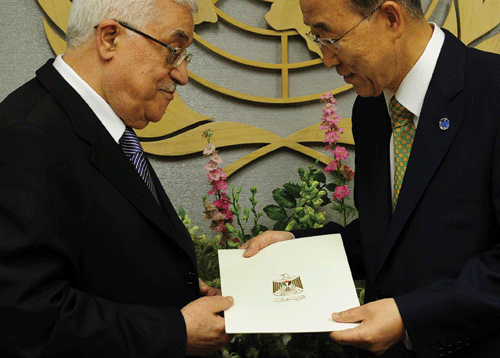
With one well-timed speech before the United Nations General Assembly, Palestinian Authority President Mahmoud Abbas focused global scorn on Israeli Prime Minister Benjamin Netanyahu while causing American President Barack Obama to undermine himself on the world stage. Equally importantly, Abbas partially resuscitated his reputation among Palestinians and regional powers, thus ratcheting up pressure on Hamas in Gaza.

The series of Arab uprisings changed Abbas’s relationships with the Americans, the Egyptians, the Israelis and others in different ways. But it also changed his relationship with his own people.

The waves of popular action against tyrannical regimes like the Palestinian Authority shocked Abbas into reaction. The PA’s heavy-handedness quickly stirred into action in much the same way as other security regimes throughout the region. Repressive, Mubarak-like tactics were quickly employed to quell small protests in the first part of the year, but these were only stopgap measures. Wilier than Mubarak, Abbas sought to win political approval for his leadership among disaffected Palestinians. It is still unclear whether he has succeeded, but his speech at the UN in September was met with approval by many, as the jubilant demonstrations on his return to Ramallah demonstrated.

In the zero-sum Palestinian political environment, his gains corresponded to Hamas’s loss. That loss has been compounded by Syria’s increased isolation (Syria is a patron of the Islamic movement). 

For the Israelis, too, the move could not have occurred at a worse time. Netanyahu’s abrasive personal style has combined with objectively poor decision-making to produce a nadir in the country’s relationship with European, Asian and Arab states. International opprobrium has jumped dramatically in recent years, catalyzed by events such as the 2009 assault on Gaza, which killed 1,400 Palestinians, 300 of whom were children, and the Israeli commando raid on the Mavi Marmara that left eight Turks and one American dead.

The marathon diplomatic battle that occurred in the run-up to Abbas’s UN submission saw the Israelis desperately lobby global capitals to follow the Netanyahu line. The unpalatability of the pro-occupation argument combined with residual ill will from the Gaza and flotilla assaults to produce a mammoth Israeli diplomatic failure at the UN. It is worth noting, however,that Netanyahu’s pugnacious speech at the international forum was positively received at home; barring some unforeseen event, he will likely remain in control in Israel. Obama was a bigger loser than his Israeli counterpart. While Netanyahu played up the threat of global isolation to corral domestic support, Obama found himself publicly vilified from both sides in his own country.

The presidential election season is in full swing in America, and Obama — whose approval rating is less than 50 percent — has been scrambling wildly to court the Israel lobby. It was with his own imminent electoral contest in mind that he entered the UN chambers. And it was with his own reelection in mind that he propounded the Israeli government’s talking points. But his placation strategy has not worked. Regardless of his pandering, Obama simply cannot convince the Israeli lobby that he is their man. His speech did little to change the common perception that he is weak on Israel.

On top of this, his speech worked to alienate important UN member states. France, for instance, was clearly alienated from the rightwing Zionist position. Without making a complete break from the American stance, Nicolas Sarkozy indicated that the status quo was untenable and that it was time to “change the method” of pursuing peace. Likewise, the Saudis have publicly pronounced their intent to break from US policies in the region if the Americans veto Palestinian attempts at official statehood status.

It is too early to assess the full impact of Palestine’s statehood bid, and many questions remain unanswered. Will the Israelis react meaningfully to increased global pressure and isolation? And could the Europeans edge America out to take a more forceful role in adjudicating the conflict?

What is clear is that the move is a catalyst for genuine change. For many Palestinians, this revision of the status quo will be welcome.

AHMED MOOR is a contributor to Al Jazeera English and is a Master in Public Policy
candidate at Harvard Universitys Kennedy School of Government

October 3, 2011 0 comments
0 FacebookTwitterPinterestEmail
Editorial

He who can bleed the most

by Yasser Akkaoui October 3, 2011
written by Yasser Akkaoui

In different ways, both the Syrian people who are rising up against the regime of President Bashar al-Assad, as well as the regime itself, are pushing the limits of their own mortality.

Protests that began in March have spread across the country, but still they have not gathered the critical force necessary to topple the regime. The regime’s brutal attempts to suppress the demonstrations have sent the death toll multiplying into the thousands, and the numbers of arrested into the tens of thousands. For every protester martyred, the regime has bullets for 10 more; if this trajectory is maintained, the protest movement will literally die.

On the other hand, the government is watching the economy evaporate. Expenses have soared, with billions of dollars spent on populist subsidy programs, keeping the Syrian pound afloat and funding the massive deployment of army and militiamen, while revenue has precipitously fallen, with multiple billions lost in capital flight, in vanishing trade and taxes, and in tightening sanctions. When the EU embargo against purchasing Syrian oil exports hits next month, it will wipe away at least a quarter more of the government’s remaining revenue. Assad is losing the ability to fund his grip on power; if this trajectory is maintained, his regime will collapse.

As with all pivotal moments in history, it is often the events that were impossible to foretell — the so-called “black swans” — that irretrievably alter the outcome in one direction or the other.   

Barring blind luck swooping in for either side, however, this will remain a war of attrition, and the winner will be he who can bleed the most.

October 3, 2011 0 comments
0 FacebookTwitterPinterestEmail
Comment

Yemen’s incipient civil war

by Farea al-Muslimi October 3, 2011
written by Farea al-Muslimi

The most horrifying week yet of the eight-month uprising in Yemen began on September 18. The terror and fear the people of Sanaa experienced was described by some as the worst since the civil war in 1994, with more than 80 civilians killed and hundreds more injured. In the areas surrounding Change Square — the heart of the protest movement against obstinate President Ali Abdullah Saleh — snipers fanned out on building tops, shooting randomly at sporadic intervals throughout the day and night. Those involved in the protests were shot, as were those who happened to live in the areas nearby. The sound of bombs exploding punctuated the muezzins’ call to prayers in Sanaa mosques, empty as never before. Those who failed to leave before the clashes intensified remained inside their homes for days, trying to survive with whatever supplies they had rather than risk venturing outside.

The clashes started when the protesters tried to enlarge the four-kilometer stretch they have occupied in Sanaa and expand to another nearby street. As protesters began to set up tents, security forces and Republican Guards opened fire. In less than an hour, more than 20 protesters had been killed. Later on, the First Armed Division, a powerful battalion of defected soldiers loyal to the uprising, returned fire. Fighting spread to the Al Hasba neighborhood, the stronghold of the powerful tribal leader Sadeq al-Ahmar. The neighborhood endured heavy clashes between Ahmar and Saleh’s forces only a few months ago; many homes remain abandoned after residents fled.

The tension in Sanaa ratcheted up a notch when Saleh made a sudden surprise return to the country on September 23, after three months in Saudi Arabia recovering from a bomb attack on the presidential palace mosque. Upon the announcement of Saleh’s arrival, celebratory gunfire from his supporters rang out around Sanaa, as demonstrators were being fired upon in Change Square.

Saleh still holds support from several different quarters.  He enjoys staunch military backing from the Republican Guards, which are led by his son, and similar support from the security forces led by his nephew, and neither lack firepower, in part due to American contributions intended to fight extremists like Al Qaeda. Then there are the corrupt network of stakeholders who will lose their patronage should Saleh go and the tribes who still support Saleh out of a historical enmity towards the Ahmars. But while pockets of support remain, Saleh’s majority lies in arms, not in popular sentiment. His return was a spark to the powder keg. His stubbornness amidst the chaos was a declaration of war. On September 26, while Yemen was celebrating its 49th anniversary of the 1962 revolution that overthrew the ruling Hamidaddin family, Saleh delivered a speech that for Yemenis contained nothing new. He reiterated his calls for dialogue and for an early presidential election, as he had disingenuously suggested on multiple occasions, while emphasizing that the vice president, not Saleh himself, sign the Gulf Cooperation Council initiative of a transfer of power.

The speech was seen by some as a stall tactic before all-out civil war, but it is not clear what the distinction between war and the current scenario is. It seems the line has already been crossed. Without an intensification of international pressure, particularly from within the GCC (Saudi Arabia’s hospitality and leeway in allowing Saleh to rally his supporters from the kingdom shows the tepid regional pressure on him), Saleh will lead Yemen to hell — indeed, it is already at the gates. But if so baited, the millions of Yemeni youth in the squares who have been demanding change peacefully could erupt like a volcano if their legitimate demands for the immediate departure of Saleh and his regime are not met.

Late last month, while Yemenis on the ground fought for the political future of their country, herds of NGO workers and embassy staff were lining up at Sanaa Airport with the very few Yemenis who can afford to leave the country. Yemen is among the most heavily armed countries on earth, with more than 68 million weapons — almost three arms for every man, woman and child. Yemenis have amazed the world over the last eight months with their peaceful protest. But their patience has run dry.

FAREA AL-MUSLIMI is a Yemeni activist
and writer for Almasdar


October 3, 2011 0 comments
0 FacebookTwitterPinterestEmail
Comment

The next pharaoh

by Josh Wood October 3, 2011
written by Josh Wood

In Cairo these days, asking random people on the street about the shortcomings of the ruling military-led transitional government often elicits the same reactions that asking about former President Hosni Mubarak andvhis cronies did not too long ago: people tense up and their eyes dart around before they quickly excuse themselves.

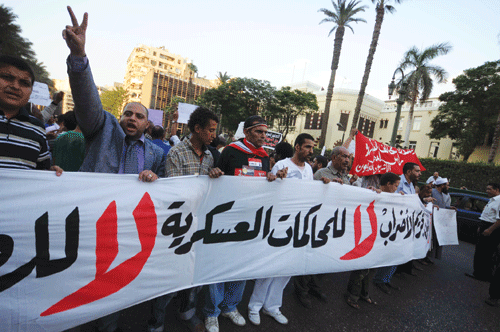
Such reactions and paranoia are not completely unwarranted. As the Supreme Council of the Armed Forces, headed by Field Marshal MohammedTantawi, faces increasing dissent, it has cracked down on freedom of speech and freedom of the press. For Egyptians, speaking out against those in power is again a dangerous venture.

“The problem is not freedom of speech, but freedom after the speech,” says Hafez al-Mirazi, the former Washington bureau chief for Al Jazeera and currently the head of the Kamal Adham Center for Journalism Training and Research at the American University of Cairo. “So you can say what you want, but the problem is going to be the consequences of what you say.”

This proved the case for Maikel Nabil Sanad, a young Egyptian blogger who was sentenced to three years in prison for posting criticism online about the way the military council was running the country. According to rights groups, he began a hunger strike in August and even refused liquids before his health deteriorated and he was hospitalized.

In August, 26-year-old Asmaa Mahfouz was arrested for criticizing the council of military officers on Twitter and was only released on a $3,300 bail following international pressure.

Criticism of the new government on social networking sites in Egypt is rampant. Though it would be hard to imagine the government pursuing everybody who voices dissent online, these cases were designed to intimidate, to make others think twice before voicing their opinions.

After protesters stormed Israel’s embassy in Cairo on September 9 and clashed with security forces through the night, the government added new provisions to the country’s feared Emergency Law. It had previously committed to repeal the law. Under Mubarak, the Emergency Law — which has been in place continuously since the 1981 assassination of Anwar Sadat — was one of the regime’s key tools of repression. One item on the amended Emergency Law now bans the spreading of “false news, statements or rumors”, of which the government has thus far had a fairly liberal — or conservative, depending on one’s outlook — definition. Amnesty International has labeled the revamped Emergency Law as the “biggest threat to rights” in post-revolution Egypt.

Days after the Israeli embassy raid, Al Jazeera’s offices around Cairo were raided. Al Jazeera Arabic and English were allowed to remain open, but their Egyptian affiliate Al Jazeera Mubasher was shut down for a discrepancy in its paperwork. The government, which allowed new television stations to open in Egypt relatively freely after Mubarak’s fall, is now looking to keep cameras out. They have put a freeze on new satellite stations opening and halted live broadcasts of the Mubarak trial.

As Egypt moves towards eight months without Mubarak, the freedoms that millions demonstrated and fought for in Tahrir Square are being rescinded, in many cases using the same tactics employed by the old regime. Many Egyptians are still quick to stress that the country continues to be in the early stages of the post-Mubarak era and there is an optimism that the hangover will subside with time, and immediately after the revolution, Egypt did look like a new place. But now, if you turn your head away from the burned-out skeleton of the Nile-side National Democratic Party headquarters and the occasional Friday protests, there are many signs that point to the Egypt of old reasserting itself. Perhaps one of the most visible is the country’s state-run media outlets, Mubarak’s private cheering section and propaganda outlet when he was in power.

“Any time you look at the newspaper it’s very similar [to before the revolution]” says Mirazi. “You just replace Mubarak’s name with Field Marshal Tantawi.”

JOSH WOOD is a contributor for
The International Herald Tribune
and Esquire Magazine


October 3, 2011 0 comments
0 FacebookTwitterPinterestEmail
Comment

Follow the money

by Peter Grimsditch October 3, 2011
written by Peter Grimsditch

It is a headline writer’s dream: “Ambassador expelled”; “Trade with Israel suspended”; “Prime Minister to visit Gaza”; “Turkish navy to patrol eastern Mediterranean”. The reality is much less Hollywood.

The Israeli ambassador to Turkey was not in the country anyway, conveniently and with “foresight” avoiding the embarrassment of television cameras capturing him skulking away. The trade suspension was rapidly qualified as government-to-government — a fraction of the $3 billion plus annual total. The Turkish navy is unlikely to provide the Israelis with another opportunity to demonstrate their military prowess with a 1967 Liberty-style attack. And Prime Minister Recep Tayyip Erdogan’s Gaza trip was always politically unrealistic, however much he personally may have wanted to go.

More significant than any of this is that private sector commercial relations between the two countries is growing, not declining. Never let rhetoric interfere with the sacred duty of making money. Even as Economy Minister Zafer Caglayan was solemnly declaring that trade ties with Israel were being downgraded to second secretary level, he was truthfully admitting that “there has not been much change in bilateral trade relations yet”. In short, if you want to know what is really going on in this world, follow the money. Verbal and political warfare between the two countries began with Erdogan’s walkout at the 2009 World Economic Forum in Davos and came to a head following the Israeli slaughter in May 2010 of eight Turks and an American of Turkish origin aboard an aid flotilla. Now check out the cash flow since then.

In the first half of this year, Israeli exports to Turkey shot up by 39 percent to $950 million. Trade in the opposite direction rose by 16 percent, to just more than $1 billion, and by the end of the year the two-way volume is expected to surpass $4 billion. Of course, there are sound reasons — on both sides — for wanting to maintain the exchanges.

Turkey has been suffering from the economic malaise in Europe, the main market for its exports, and suffered financial body blows from the uprisings in Libya and Syria. For its part, Israel was hurt by economic turmoil in the United States, its main customer.

Erdogan and Caglayan have both said Turkey’s quarrel is with the Israeli government, not individuals or businesses. Israeli Premier Benjamin Netanyahu was exporting his own complementary statement. The political crisis “is not our choice”, he said. “We respect the Turkish people and their heritage.” Not to mention their money. And their cheap holiday resorts.

The number of Israeli visitors to Turkey fell through the floor last year, dropping by around two thirds to 109,600. Tourists are not made of the same stern stuff as business people, and some Israelis took delight in flaunting figures to the northwest and pointing out how much they were hurting the Turkish tourist industry. That Turkey’s overall tourism numbers went up anyway, even given the missing Israelis, was not included in the gloating. Regardless, the Israelis are coming back. Perhaps encouraged by a favorable exchange rate as much as the facilities, the July and August figures rocketed from around 94,000 in 2010 to 166,000 this year, according to the Israeli Airports Authority. Tourism and trade operate on different dynamics of course. Tourist numbers can drop suddenly and build up again fairly quickly. Trade relations are established over a much longer period, and equally take a good while to wind down. Economic relations between Egypt and Israel had developed a rising momentum when Netanyahu became Israeli prime minister for the first time. It took just more than a year of his hardline policies before there were visible signs of decline.

In the longer term — and short of Middle East peace — Turkey is more important to Israel than the other way around. Erdogan’s relentless drive to enhance his country’s influence and strength took him to Egypt last month, where he forecast a rise in mutual trade to $10 billion over the next few years, as well as to Libya to restore the large and lucrative Turkish contracts that the revolution put in abeyance. Then there is always the US. Francisco Sanchez, the undersecretary of state for trade and commerce, said in Ankara last month the US aimed to triple trade with Turkey over the next five to six years. That would make it worth $45 billion, dwarfing the figure with Israel. And, after all, why deal with the monkey when you can trade with the organ grinder?

PETER GRIMSDITCH is Executive’s
Turkey correspondent


October 3, 2011 0 comments
0 FacebookTwitterPinterestEmail
  • 1
  • …
  • 361
  • 362
  • 363
  • 364
  • 365
  • …
  • 686

Latest Cover

About us

Since its first edition emerged on the newsstands in 1999, Executive Magazine has been dedicated to providing its readers with the most up-to-date local and regional business news. Executive is a monthly business magazine that offers readers in-depth analyses on the Lebanese world of commerce, covering all the major sectors – from banking, finance, and insurance to technology, tourism, hospitality, media, and retail.

  • Donate
  • Our Purpose
  • Contact Us

Sign up for our newsletter

    • Facebook
    • Twitter
    • Instagram
    • Linkedin
    • Youtube
    Executive Magazine
    • ISSUES
      • Current Issue
      • Past issues
    • BUSINESS
    • ECONOMICS & POLICY
    • OPINION
    • SPECIAL REPORTS
    • EXECUTIVE TALKS
    • MOVEMENTS
      • Change the image
      • Cannes lions
      • Transparency & accountability
      • ECONOMIC ROADMAP
      • Say No to Corruption
      • The Lebanon media development initiative
      • LPSN Policy Asks
      • Advocating the preservation of deposits
    • JOIN US
      • Join our movement
      • Attend our events
      • Receive updates
      • Connect with us
    • DONATE