• Donate
  • Our Purpose
  • Contact Us
Executive Magazine
  • ISSUES
    • Current Issue
    • Past issues
  • BUSINESS
  • ECONOMICS & POLICY
  • OPINION
  • SPECIAL REPORTS
  • EXECUTIVE TALKS
  • MOVEMENTS
    • Change the image
    • Cannes lions
    • Transparency & accountability
    • ECONOMIC ROADMAP
    • Say No to Corruption
    • The Lebanon media development initiative
    • LPSN Policy Asks
    • Advocating the preservation of deposits
  • JOIN US
    • Join our movement
    • Attend our events
    • Receive updates
    • Connect with us
  • DONATE
Banking & Finance

Lebanese capital markets

by Executive Editors September 18, 2011
written by Executive Editors

BLOM Stock Index (BSI)

Weighted effective yield of eurobonds

Equity update

The slump in global equity markets, along with the new issue of $1.2 billion of Lebanese Sovereign debt on July 28, steered investor interest towards the Lebanese Eurobond market. Hence, the BLOM Stock Index (BSI) hovered between a lower level of 1,301 points and an upper level of 1,343 points between July 15 and August 12, 2011, before closing near its lowest level of 1,305 points. During the aforementioned period, the BSI shed 1.1 percent, further lowering its year-to-date performance to a negative 11.5 percent. As for the activity on the Beirut Stock Exchange (BSE), it improved over the same period, as the daily average volume per month reached 153,424 shares, valued at $1.74 million, compared to 120,568 shares worth $1.56 million over the preceding four weeks between June 17 and July 15.

On a comparative scale, the BSI managed to outperform the S&P Pan Arab Composite LargeMidCap Index and the Morgan Stanley Emerging Index (MSCI), which were largely affected by concerns of a double-dip recession in the United States and continuing fears over a potential downgrade of French debt following S&P’s downgrade of the US Sovereign. The former lost 15 percent to settle at 107, while the latter fell 12.8 percent to 989.

With respect to the real estate sector, it dominated the four-week period of trades on the BSE, accounting for around 62.5 percent of the total value traded. Solidere stocks Class A and B rallied during the first week, adding 6.6 percent each, breaching its resistance level of $17, before reversing the trend throughout the next three weeks. Nevertheless, Solidere A and B managed to end the four-week period on a positive note, closing at $16.7 each on August 12.

On the other hand, despite the robust first-half financial results, most traded banking stocks ended on a negative note. BLOM stocks, GDR and listed, lost 1.5 percent and 5.08 percent, respectively, to close at $8.55 and $8.03. With respect to Audi Bank, its GDR and listed stocks fell as well by a respective 2.2 percent and 1.3 percent to settle at $7.19 and $6.88. Bank of Beirut followed suit as its listed stock declined 0.52 percent to $19, and its preferred Class E stock decreased 0.58 percent to $25.60. BEMO stock also ended in the red at $2.74, 0.72 percent lower than its previous close on July 15. As for Byblos Bank, its common stock fell 4.6 percent to $1.66, while its preferred stocks 2008 and 2009 rose 0.4 percent and 0.5 percent, respectively, to align at $100.5.

In the industrial sector, cement manufacturer, Holcim, saw its stock surge by 3% to 16.49, while Ciment Blancs B fell 3.3% to $2.97, its lowest level since mid-June.

Eurobond bulletin

The Eurobond market maintained its upward trend between July 15 and August 12, as investors’ appetites were lifted by the successful issuance (four times oversubscribed) of a $1.2 billion double tranche bond that was lead managed by BLOMINVEST Bank and Citigroup. Hence, the BLOM Bond Index (BBI) added 0.38 percent to settle at 110.9. Accordingly, the portfolio-weighted yield fell by 9 basis points (bps) to 4.91 percent, while the spread against the US benchmark yield widened 37bps to 411bps as investor demand for US Treasury Bonds increased following the plunge in global equity markets. Lebanon’s credit default swap (CDS) for 5 years increased to 361-391 bps, compared to 340-367 bps on July 15. In regional markets, Dubai and Saudi Arabia CDS were quoted at 350-365 bps and 105-111 bps, respectively.

September 18, 2011 0 comments
0 FacebookTwitterPinterestEmail
Banking & Finance

Bankers In the hot seat

by Executive Editors September 18, 2011
written by Executive Editors

With the global economic recovery from the 2008 financial crisis stalled, wealth managers and high net worth individuals are wary of yet another credit crunch — and they would rather not make the same mistakes twice. Executive recently sat down with local and global players in the private banking industry to discuss the worldwide shift in wealth management industry dynamics and the changes in the client-private banker relationship post-2008, the unique challenges that relationship managers face in the Middle East and North Africa region, as well as the assessment and management of clients’ risk appetites in the region as a younger, more diversified generation of investors has emerged.

1 What mistakes did wealth managers, private bankers and clients make prior to the financial crisis in 2008? What lessons have they learned, if any?

Jean Riachi, chairman at FFA Private Bank: The [last] three years… were only the outcome of a decade of poor financial market performances. Unfortunately, for everybody the last decade was a lost decade due to many reasons. First, valuations in the market were very high, and second, there was no growth engine in the major economies to boost earnings enough to justify the level of capital gains and growth in the prices of stocks in global markets that we witnessed in the 1990s and in the 1980s. And still, in everybody’s mind, a good performance is a double-digit performance, and private bankers have struggled to achieve such performances sometimes by taking excessive risk, and very often by taking risks that were not obvious. So in a way it is the people’s expectations of high returns on their portfolios that have pushed banks, private banks and investment bankers to try to be creative in terms of their product offerings. And this, of course, ended up with a disaster in 2008. Today I wouldn’t say that everybody has learned the lessons.

Georges Abboud, head of private banking at BlomInvest Bank: The main lesson was on transparency on the kinds of instruments that customers were buying. People did not understand where they were putting their money. After 2008 they wanted to know exactly where they were investing. So we have to go into detail about every fund we want to invest into, each structured product — you need to know the underlying assets that are behind the product and this takes a lot of time to explain to the clients. They want to know everything. 

Reto Bartel, senior representative at UBS AG Representative Office Beirut: The recent financial crisis shook proponents of the classical investment approach out of their comfort zone. Investors perhaps believed they were in control, but in reality they were at the mercy of the markets. Credit markets failed to function and equity investors saw portfolio values decline to an extent previously deemed impossible. What went wrong? Was it just the market or did investors not fully appreciate the downside of their investment strategy? We think it was probably a mixture of both.

Raed el-Khoury, managing partner at Cedrus Invest Bank: I don’t think they learned a lot. [As for] lessons, mainly they have to really look into the risk. What are they selling to their clients? What are the embedded risks in every product? The profile of the bankers at that time before the crisis was focused on selling products. They didn’t look at the context of the client as a whole. There was wrong selling in many instances in the sense that bankers did not explain to the client the risks embedded in the product.

Selim Chami, director of investment banking group at BSEC: The bankers don’t care about learning; they want to make money. If a client comes and says I have this subprime securitization transaction I’m working on, and I have this much tranching, and I’m Goldman Sachs or Lehman Brothers and I have 100 transactions queued in line, and I need you to give me a rating as soon as possible, they will negotiate the fees and the ratings and they will push for something that they’re expecting. Unconsciously, a manager at a rating agency has all this reasoning. They go to higher management and say there are some things that are not looking too good, and there’s something that they didn’t really look into, for example the impact of the economic outlook, but they consider themselves to have done their job. You have a mass of people thinking like this. They start thinking about fees and budgets and that half-a-million-dollar bonus at the end of the year.

2 How has the client-private banker relationship changed after 2008, if at all?

Reto Bartel, senior representative at UBS AG Representative Office Beirut: The last decades witnessed the development of new economic theories on investor behavior which UBS uses in order to enlighten clients about the “do’s” and “don’ts” of investing. The behavioral view appeals to private investors since it captures familiar patterns of behavior we experience when dealing with real-life investment decisions. We also note that our clients have become more sophisticated, on average, not least due to the rapid increase of available information on economic developments and financial markets, as well as views and recommendations on market developments. An increasing number of clients like to talk about specific topics or are looking for a sparring partner willing to challenge their own investment theses.

Heiner Weber, head of Geneva branch at Falcon Private Bank: If the private banker has learnt his lessons from the past financial crisis, and the client has not, the dialogue would be very difficult and the results would not be as good. So private banking is really a teamwork between client and banker.

Nael Raad, managing director at Al Ahli Investment Group: In these types of markets you have to be much more transparent and much closer to your clients, monitoring their investments and attending to their needs. But you have to be closer in these volatile markets because trust is very important, especially nowadays, especially after the 2008 crash. It became more about the relationship. The client wants to know about the banker and the banker nowadays wants to tell him more about the product and tell him more about the risks involved. It’s a mutual thing.

3 Many of those in the wealth management industry are talking of a shift from universal big banks to smaller investment boutiques and family offices. To what extent is that statement true?

Daniel Diemers, principal at Booz and Company: Overall, the Gulf region is an attractive market for private bankers, and the region’s quick recovery from the financial crisis — especially compared to some Western markets — increases its allure. Not surprisingly, we expect competition to heat up over the next few years as local and regional players upgrade offerings and the global players — the incumbent private banking powerhouses — reassert themselves to defend and pursue market share. Banks need to find the right strategic positioning and stake their claim quickly. In this highly competitive environment, smaller banks will surely find their niche, as they have in the past. But we don’t see any major shift in the fundamental economics of the wealth management business model that would favor smaller players over the bigger ones.

Jean Riachi, chairman at FFA Private Bank: I believe that when you are smaller, you can take better care of your clients. I understand that most of the private banks, the global ones, have problems in terms of their profitability and they’re trying to cut their cost. I can tell you that we are not doing this because we will sacrifice part of our profitability to invest in people. But maybe this is a stand that you can have when you are a small private bank. But for sure the industry in general needs some kind of reengineering, and expectations should be lowered at the level of the banks’ profitability, at the level of the clients and the profits and the performances of the portfolios.

Georges Abboud, head of private banking at BlomInvest Bank: It is true that a lot of family offices opened after 2008 and even before. There are lots of reasons; one of them is regulations. They are so tough that the bankers cannot do whatever they used to do before. When you have your own family offices it is easier to go around some of the regulations. The drawback is that when you have a small firm — an investment company — the bank has to make money to live, to make profits, so you have to invest a lot of your clients’ money, which creates a conflict of interest there. 

4 Private bankers in the Middle East have many critics. Some say they still lack the expertise and talent that is needed to do proper wealth management. What is your take on such criticism?

Jean Riachi, chairman at FFA Private Bank: I would say that it’s a question of organizational structure. For example, in our bank, a private banker takes care only of the relationship with the client, but he’s backed by a team of asset managers, capital market specialists and real estate specialists, which means that he never manages an account on his own. Actually, he’s never allowed to manage an account. And when people come and want to give us a discretionary portfolio to be managed, the private banker will not be involved in managing it at all. Now, when it is an account managed on an advisory basis, private bankers are not the ones who decide what kind of strategies or products they are going to push. And here there are two things that are important in my view in the organizational structure: first, you have to be independent, which means that you need to not have products that you need to push; and second, of course, everybody here is pushed to explain to the clients and convince them that diversification is very important.

Raed el-Khoury, managing partner at Cedrus Invest Bank: Private bankers used to be relationship managers rather than investment advisors [and] product sellers. They would get ideas from the banks they work with and then they would go and sell them blindly to the clients. Bankers need to be investment advisors to their clients. And clients are asking [for] more and more of that, and they’re differentiating between private bankers. Our approach is, we need to introduce more — and I’m not saying that it’s not there — to the Lebanese market the concept of wealth management, whereby we would look at the profile of the client, the whole spectrum of what is needed from our clients and investors. Our private bankers would be knowledgeable bankers, not just people who go socializing and sell products. They would be able to look at the risk profile of the client, detect the risks involved in each product they would be selling, and have their opinion in what they want and do not want to propose to their clients, because, after all, this is the added value of the bankers.

5 How much would you intervene to manage a client’s risk appetite, especially when it is in excess?

Georges Abboud, head of private banking at BlomInvest Bank: You have to differentiate between the very sophisticated client who has been trading for a long time and has made money and lost money and gone through it for the past 20 years. He knows the cycles; you cannot stop him. But some people, they hear something on the news about how some companies’ shares are at their lowest level ever and they come and ask to put $500,000 into it and also ask for a loan of another $500,000 to invest in it. I’m not doing my job if I don’t stop this massacre.

Nada Safa, executive manager at Audi Saradar Private Bank: You have people as part of their portfolio, who like to speculate on currencies all day long. As a private banker you have to know how to calm the game. This is a speculator at the end of the day but you don’t want him to cross the line because he will lose money. It’s your job to be a therapist at the same time and understand his profile. This takes maturity and experience. And with time bankers know how to choose their clients. Some private bankers don’t want to deal with speculative accounts, they want big wealthy customers, dormant clients. You have exotic private bankers who have different portfolios, different client profiles. This is tough but if you have enough experience you can follow that. But at the end of the day it is your job to temper, to keep your client balanced.

Stephen Evans, head of Standard Chartered Private Bank for Europe, Middle East Africa and the Americas: I have to tell you that one of the most important qualities of a private banker is the ability to stand up and say no to a client, [to tell them] ‘I don’t think this is right for you’. And interestingly, in my experience, clients who have experienced that speak very highly of the banker, because they respect him. This is a testament to a good banker.

6 What factors play into a client’s propensity to take risk?

Georges Abboud, head of private banking at BlomInvest Bank: It is very important to think first about preserving your capital. And then you look at the needs of the client. If you have someone retired, he is not working anymore. He can’t afford to lose anything. So you will look for something in which he cannot lose. If someone has a stream of income and has money to play with then you can take some risk into equities or hedge funds.

Khalid Zeidan, head of MedSecurities Investment: The Lebanese love that [risky trading] because it moves quickly and it is very highly leveraged so he picks up the phone and he brags to his friend, “I bought this and I sold that and I made $3,000, $5,000 and $10,000, and I did that yesterday”, and then in one night he loses $100,000. He goes back to his wife and says “sorry honey, you’re not going to get that car.”

Nada Safa, executive manager at Audi Saradar Private Bank: The females I manage don’t like to take risk. You would be surprised to know there are many women in the market who manage their own wealth, especially in Saudi Arabia. They are very smart, they know what they want and they have their own wealth to manage. There is a whole niche market for this in the region and it is growing. There are more women working in private banking because… in the region women feel more comfortable building this relationship with another woman. But they don’t like risk and they are good investors. They go into funds, real estate and especially gold.

Mohammed al-Hamidi, managing director at AM Financials: Usually, the second generation will spend the money, not make the money. So definitely the second generation, usually when they come from high net worth families, they are more educated. What I know is that usually a younger person would take more risk, especially when the older person made the money. So that’s why some second generation high net worth individuals will take the money and make multiples of it and some will lose it.

Heiner Weber, head of Geneva branch at Falcon Private Bank: Many of the sons went through financial studies so they are all aware of the latest academic news on investment and they often have a more academic approach to investment. That’s for sure. Second, they are often more active because young people’s time horizons are shorter and they are extremely well connected via the Internet.

Nael Raad, managing director at Al Ahli Investment Group: The younger generation is looking more into investments: they’re more educated. They want to know exactly what it’s all about; they have the background, the education. I find that the older generation worked more on the gut feeling but the younger generation is more methodical, definitely. But at the same time it’s not all one stereotype.

Raed el-Khoury, managing partner at Cedrus Invest Bank: It’s normal to involve the heirs in the investment process, especially as they will be in charge of the future wealth. It can be more dynamic because of the younger spirit. So we see it as an opportunity to become more dynamic in the investment decision-making process. But here comes our role to really stress our conservative approach. Definitely, they’re knowledgeable, exposed, educated and open-minded but at the same time they lack maturity. And this, they will acquire and they’re definitely on the right track but they need help, they need guidance. Somebody that understands their concerns, their parents’ concerns, and can bridge the gap.

September 18, 2011 0 comments
0 FacebookTwitterPinterestEmail
Banking & Finance

For your information

by Executive Editors September 18, 2011
written by Executive Editors

Regulating the markets

Having been put on the backburner for the past five years, a draft law to regulate capital markets and insider trading was finally approved by Lebanon’s parliament early last month. Lebanese investors and brokers had urged previous governments to pass the law, a move which would allow for more transparency and activity on the Beirut Stock Exchange, according to Lebanese bankers. The law stipulates that an independent commission, dubbed “The National Council for Financial Markets in Lebanon”, headed by Central Bank Governor Riad Salameh, overlook and regulate both Lebanese market trading activities and participants. According to BDL, the regulatory agency will consist of seven members, five of which will be private entities, and will be an independent watchdog both in policies and functions, similar to the United States Securities and Exchange Commission. As of Executive going to print, the government had not set a timeframe for the implementation of the capital market law.

Kafalat demand shrinks

Loans extended to small and medium-sized companies under the guarantee of Kafalat Corporation dropped year-on-year 7.5 percent through July 2011, totaling $93.3 million for the first seven months of the year, down from $100.9 million during the same period a year earlier, according to figures released by the country’s state-sponsored credit guarantee scheme. The aggregate number of loan guarantees by Kafalat up until July 2011 reached 691, an 18.9 percent annual decrease from 852 a year earlier, indicating an enduring unfavorable business sentiment in the country due to domestic and regional instability. The average value per guarantee reached $134,992 for the same period, increasing by 14 percent from the previous year’s average of $118,413. The industry sector took the bulk of extended guarantees for the first seven months of 2011, constituting 41 percent of the total, followed closely by agriculture at 38.2 percent, tourism at 17.8 percent, specialized technologies at 1.7 percent and handicrafts at 1.3 percent.

Plastic pressure in Syria

Visa and MasterCard have blocked all credit cards issued by Syrian banks, in compliance with US sanctions imposed on the Syrian regime in the face of violence against protestors across the country. News of the ban first broke when Syrian visitors to the United Arab Emirates were sent SMS messages informing them that their credit cards were no longer valid. In response to an executive order issued on August 18 by the United States Treasury department prohibiting “the exportation, re-exportation, sale, or supply, directly or indirectly, from the United States, or by a United States person, wherever located, of any services to Syria,” MasterCard started blocking all transactions originating in Syria and all MasterCard transactions on accounts issued in the country. Visa also announced the suspension of its payment card activity in Syria under the recent US sanctions, stating it is “required by law to comply with the US Department of the Treasury financial sanctions against Syria.” Meanwhile, Adib Mayala, governor of the central bank of Syria, announced that Syria stopped dealing with the US dollar and switched to the euro, a decision made effective as of August 23.

Banks feel the stress

Lebanon was one of 28 countries whose banking sector fell under the “low strength” category of the Fitch Ratings’ Banking System Indicator (BSI), the agency’s annual risk assessment survey that includes 86 banking systems in advanced and emerging economies. Excluding potential support from shareholders and governments, the BSI measures banking systems’ intrinsic strength and quality, along with their systemic weakness. On a scale of “A” to “E”, from high to low quality, Lebanon came under the “D” category. Lebanon was also among eight banking systems that the ratings agency judged to have a high level of potential vulnerability, according to Fitch’s Macro-Prudential Indicator (MPI), which tries to determine the build-up of stress in banking systems. Lebanon was the only country to witness a decline in its MPI classification.

A trio of tech kick-starts

Lebanese business incubator Berytech announced a $1.05 million investment in three technology startup companies at a conference in early August, raising the number of its equity participations to eight since May 2009. Headed by young entrepreneur Hind Hobeika, “ButterflEye”, a company that has engineered swimming goggles that measure swimmers’ heart rates in real time via infrared technology, was the first to receive $100,000 of funding. Berytech also poured $600,000 into “Yalla play”, an online gaming platform founded by young businessmen Mahmoud Hajo and Karim Saddik, whose notoriety comes from the three-dimensional card game tarneeb.com. Berytech’s third investment went into “Wext”, a provider of a multi-platform web-texting software offering an instant messaging service adaptable to all mobile phones and all types of Internet connections. The Beirut-based seed capital fund Berytech has some $6 million under management, offering financing and consultancy services to young entrepreneurs in the technology field.

DP World profits surge

DP World, a Dubai World subsidiary, reported a 298 percent increase in first-half profits to $741 million [AED2.72 billion], buoyed by strong volume growth and a one-time gain from the partial disposal of its Australian terminals. The ports operator brought in $460 million [AED1.69 billion] from the monetization of 75 percent of DP World’s Australia terminals through a strategic partnership with Citi Infrastructure Investors. The world’s third largest ports operator rode a wave of global economic recovery during the first part of the year, supported by growth in newly-penetrated emerging markets of Latin America and Africa. As a result, gross volumes grew 11 percent year-on-year driving up revenues 3 percent to $1.5 billion [AED5.5 billion].  DP World also increased its cash and bank balances by 63.5 percent to $4.1 billion [AED15.1 billion], most likely in preparation for settling $3 billion [AED11 billion] of debt which will mature in October 2012.

Tourists flashing more cash

Total tourist spending in Lebanon increased 13 percent for the first seven months of 2011, relative to the same period of the previous year, according to figures released by Global Blue, the VAT refund operator for international shoppers. The majority of spenders in Lebanon were Arabs, making up 56 percent of total tourist spending in the country. By country of origin, nationals from Saudi Arabia accounted for 21 percent of overall tourist expenditures in Lebanon, followed by United Arab Emirates tourists at 11 percent, Kuwaiti nationals at 10 percent, Syrian visitors at 8 percent and Egyptian travelers at 6 percent. Fashion and clothing captured around 70 percent of total tourist shopping, watches 10 percent, and perfumes and cosmetics 5 percent. Beirut shops attracted 84 percent of total visitor spending in Lebanon, while the Metn, Keserwan and Baabda areas took away 12 percent, 2 percent and 1 percent of total spending, respectively.

Capital Trust buys into First National Bank

A Capital Trust Group private equity fund, the Euromena II, has acquired a 7 percent stake in Lebanese First National Bank, a deal valued at some $20.5 million. The stake is equivalent to 930,000 shares of the bank, making the FNB share price around $22. Press releases by both parties said that the transaction was aimed primarily at boosting FNB’s already accelerating growth, as the bank recorded balance sheet and customer deposits in March 2011 of $2.55 billion and $2.1 billion, respectively, while loans and advances amounted to $681.2 million for the same period. The Euromena II fund was launched back in June 2008 by Capital Trust Group with an initial capital ranging between $200 million and $250 million, and was the third generation fund — Menavest and Euromena I funds being the first two — for the global investment group aimed at investing in high growth companies in the Middle East and North Africa region, while excluding real estate and infrastructure projects. The Euromena I fund, which was set up in 2006 with $63 million in capital, had acquired a stake in Intercontinental Bank of Lebanon in January 2008, contributing to the bank’s $20 million capital increase at the time.

September 18, 2011 0 comments
0 FacebookTwitterPinterestEmail
Feature

Game over

by Sam Tarling September 18, 2011
written by Sam Tarling

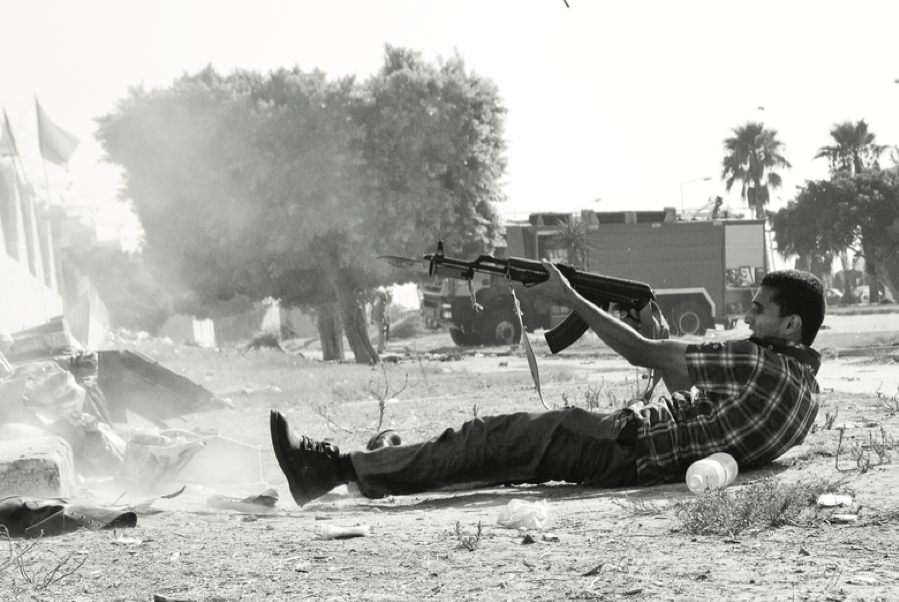
In the days following the libyan rebels’ push into tripoli, stubborn resistance by loyalist fighters continued in various areas of the capital. With the final battles raging and the fall of the city imminent, Executive was at the front lines documenting the fierce firefights, the surrender of soldiers and the casualties of war

1) After rebels routed loyalist forces during a day of skirmishes in the neighborhood of Abu Salim, one resident celebrates by ripping up a picturenof the fallen Libyan dictator Muammar al-Qadhafi with his teeth

2) A rebel patrol hunts for loyalist forces on the streets of Abu Salim, a staunchly pro-Qadhafi area that saw heavy house-to-house fighting after rebels took the city

3) A rebel soldier aims and fires through an opening in a wall at a loyalist gunman who, from a position in a residential building overlooking the Qadhafi compound of Bab Al Aziziya, had the rebels pinned

4) Rebel soldiers argue over the fate of a captured Qadhafi loyalist

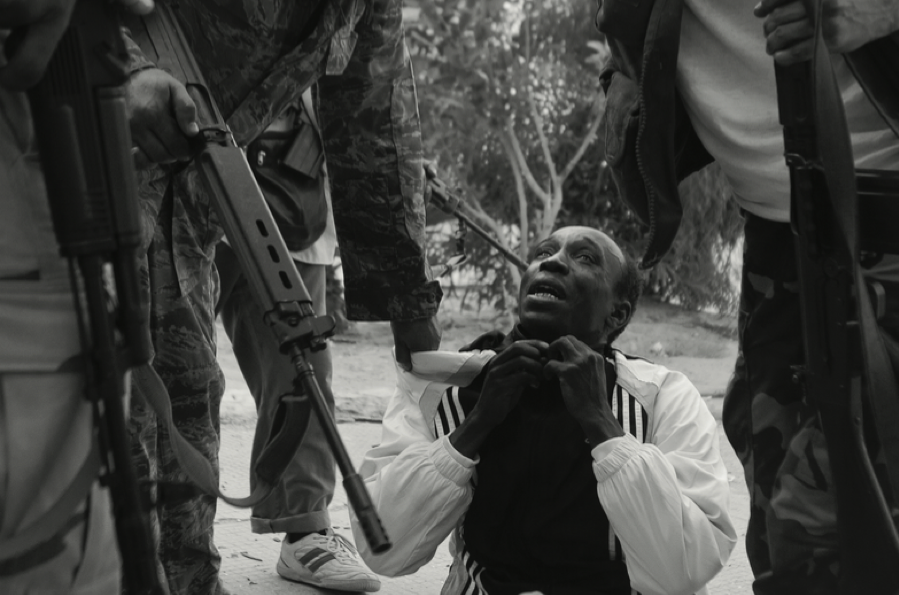
5&6) A Qadhafi fighter pleads with his rebel captors before being struck in the head with a rifle butt 

7) A terrified resident is reassured by rebels who, after a vicious assault, had just captured four loyalist troops from her building 

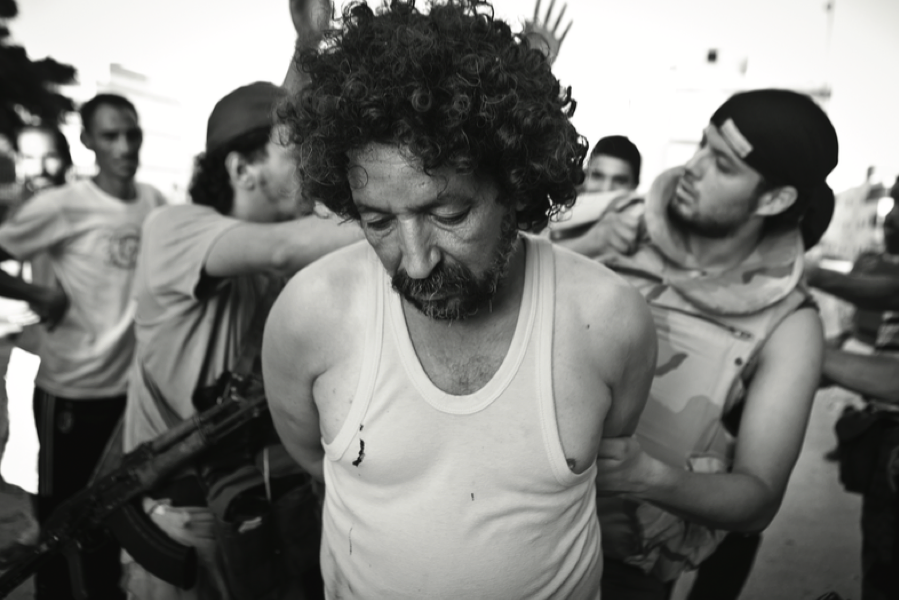
8) A loyalist soldier has his hands tied behind his back after surrendering to rebel forces. With the discovery of what appeared to be executed loyalist prisoners, the rebel leadership urged fighters not to abuse detainees. However, with little coordination between the various rebel groups, the fate of their captives was far from assured. Executive saw one captive being shot in the leg and others being beaten, though most of those seen captured by rebel forces appeared to be treated humanely

9) A loyalist soldier is interrogated by rebel troops minutes after he and several of his comrades surrendered amid heavy fighting in Abu Salim

10) Rebels take cover from sniper fire inside a guard post at the Qadhafi compound of Bab Al Aziziya 

11) Opposition soldiers fire at loyalist gunmen in a residential area of the Abu Salim neighborhood in Tripoli 

12) Some rebel divisions have taken to wearing uniforms and have developed formal structures of command, though for the most part remain loosely organized and use an informal assortment of arms and apparel 

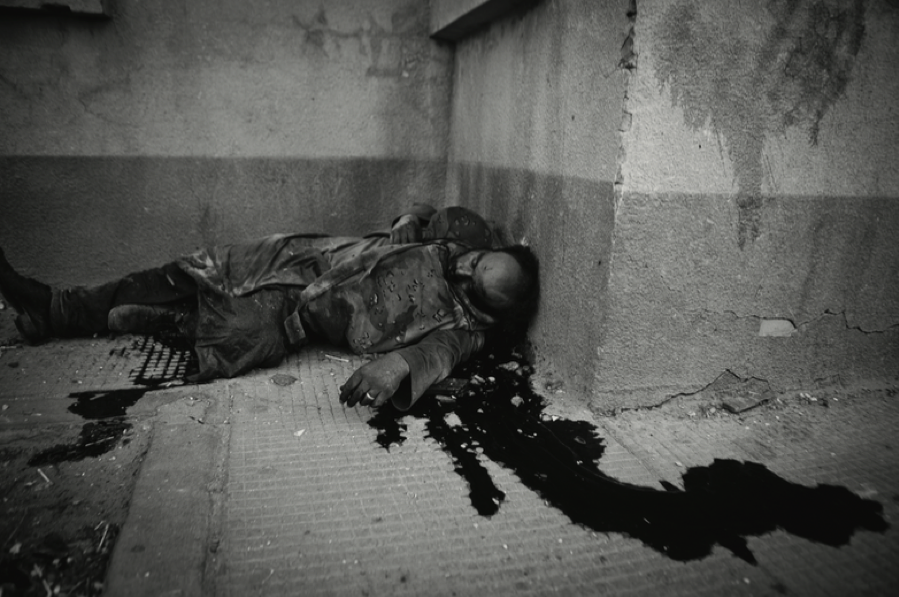
13) The body of a soldier lies dead in a corner after heavy fighting in Abu Salim

14) A rebel fighter escorts an Abu Salim resident from his home. Given the urban nature of the warfare and that fighters were often informally dressed, distinguishing civilians from soldiers was often difficult

15) A family flees after rebel troops surrounded their building in Abu Salim. As loyalist gunmen took up positions in residential housing blocks, civilians found themselves in the middle of heavy exchanges of fire from rifles, anti-aircraft weapons and rocket propelled grenades

16) Rebels dash toward the outer wall of the Bab Al Aziziya compound, keeping low to avoid Qadhafi gunmen who had been firing at them

17) Leaving no stone unturned, rebels search a giant stuffed bear found in the Bab Al Aziziya compound

18) Rebel soldiers patrol the streets of Abu Salim near sunset after a day of heavy house-to-house fighting 

19) Children collect bullet shell casings in what was formely called Green Square in Tripoli, now renamed Martyrs’ Square. The square saw little actual fighting but much celebratory gunfire 

20) As fighting ceased and quiet descended with the night, a resident walked through Tripoli’s old city, El Madina El Kadima

September 18, 2011 0 comments
0 FacebookTwitterPinterestEmail
Feature

Oil’s return from turmoil

by Executive Editors September 18, 2011
written by Executive Editors

As Libyan rebel fighters began routing government forces and advancing on the capital city of Tripoli in August, international oil and gas companies with interests in Libya (including five European and five North American hydrocarbon multinationals) began aggressively vying for the resumption or possible expansion of their roles in the country.

Italian oil firm, Eni, Libya’s most significant partner in hydrocarbons, said it expects a sub-Mediterranean gas pipeline between Libya and Italy to resume operations by mid-October. The company signed a memorandum with the National Transitional Council (NTC) — the rebels’ de facto government based in the eastern city of Benghazi — by which “Eni and NTC are committed to creating the conditions for a rapid and complete recovery of Eni’s activities in Libya and to doing all that is necessary to restart operations on the Greenstream pipeline, bringing gas from the Libyan coast to Italy”, the Italian company said in an August 29 press statement. The full restoration of oil output and exports, however, will be enormously complicated. Three factors will determine the speed of recovery of Libyan oil and gas production.

First, damages to the existing facilities will need to be examined and capacities restored. According to statements from NTC and Libyan oil officials at the end of August, direct conflict damages from the past six months to facilities have been limited and repairs have already begun. However, the restoration of facilities also includes dealing with the impacts of the shutdown process and inactivity of oil fields and pipelines.  

Second, oil sector workers will have to return to their jobs, which will require a rapprochement between the National Oil Company (NOC) and the NTC, as well as the return of foreign companies and their staff, which is heavily contingent upon an improvement in the security situation. The third and most crucial precondition for resumption of Libya’s oil economy, therefore, is a return to stability and internal security in the country. Reliable security structures have to be in place before the restoration of hydrocarbon facilities and the redeployment of the workforce can be meaningfully expected.

The nitty-gritty of Libyan oil

The oil and gas industry accounts for about 25 percent of Libyan gross domestic product, 80 percent of government revenues, and approximately 95 percent of export earnings. The 2011 BP Statistical Review of World Energy ranks the country as having the 11th largest oil reserves in the world, at 46.4 billion barrels, though it had been ranked at 19th in terms of production, at 1.6 million barrels per day, before the revolution. The equivalent figures for Libya’s natural gas reserves put it at 15th largest in the world at 1.5 trillion cubic meters, with its annual production at 32nd globally, with 15.9 billion cubic meters per year (cum/yr).

The sector is dominated by the NOC, which exploits and exports the country’s hydrocarbon reserves — both onshore and offshore — via a number of wholly-owned subsidiaries and international oil companies licensed by special agreements. The company owns the country’s refining and oil and gas-processing facilities, which include refineries at Mersa El Brega, Zawiya, Ras Lanuf, Tobruk and Sarir; the Ras Lanuf petrochemical complex and gas-processing plant is the country’s largest, also producing ammonia, urea, methanol, ethylene and low and high-density polyethylene.

Before the revolution, the NOC refined close to 380,000 barrels per day of the country’s crude oil in its refineries, with approximately 60 percent of the refined product output being exported. Libya’s oil and gas is sent to Europe, the country’s biggest export market, both by sea and a 540-kilometer, 11-billion cum/yr capacity subsea pipeline, dubbed ‘Greenstream’, across the  the Mediterranean to Gela in Sicily.

Within the country, Libya has a network of more than 8,700 km of onshore oil, gas and product pipelines.  Following the current unrest, most of the country’s oil and gas production and refinery capacity has been shut down. While refineries can be relatively easily restarted, damage notwithstanding, the crude oil pipeline network will have problems in starting up due to the waxy nature of the high-quality and relatively ‘light’ crude oil the Libyan oilfields produce. Once flow has halted for any appreciable time, the wax separates out and gradually blocks the pipeline. This material, similar to candle-wax, then becomes difficult to remove in order to restart the system, and it is foreseen that a considerable investment in technology and effort will be required to bring the system back to full operating capacity.

Looking ahead

UK-based energy and mining consultants Wood Mackenzie said in an August 25 statement that it expects resumption of full oil production capacities in Libya to require 36 months from “from whenever the current crisis reaches a resolution.” According to the analysts, the recovery of oil production capacities is likely to take longer for the mature Sirte basin in eastern Libya but will be faster in the newer Murzuk and Pelagian Shelf basins of western Libya.

For the longer term, “Libya has the potential to produce up to 3 million barrels per day of oil and become a major gas exporter through partnering with the international industry,” Wood Mackenzie noted, with the caveat that this future remains “on hold until military operations are concluded.”

September 18, 2011 0 comments
0 FacebookTwitterPinterestEmail
Feature

The fall of Tripoli

by Executive Editors September 18, 2011
written by Executive Editors

Tuesday, August 23 

Abdallah slides his finger across the map of Tripoli. “They’re still fighting here, in Abu Salim. And in Bab Al Aziziya, of course: that’s Qadhafi’s stronghold. And over there, around the airport. Oh, and I was just talking to a friend in Sidi Khalifa yesterday; she said there was heavy shooting in her neighborhood.”

It has been three days since rebels entered Tripoli but intense fighting persists in the capital, while outside of it Qadhafi soldiers continue to stalk Western Libya. At the Tunisian border, nearly every car is heading out of the war-torn country. Apart from a Red Cross truck and a few dozen journalists busy filming each other, only a few Libyans are heading the other way. One of these is Abdallah, who says that, after having been involved in the Egyptian revolution, he would not miss this one for the world: “It’s my country now. I want to be there when Tripoli falls.”

In Nalut, the first city on the road from Tunisia, the shelling ended more than a month ago but schools and businesses are still closed. The few open shops have half-empty shelves and petrol is in short supply — a liter now costs $2.50, whereas before the war it was cheaper than water. Like the capital, this city is still living the war and so are its people.

“There must be war,” affirms Khamis Birgig, a 35-year-old rebel who garnishes every other sentence with a “boom-boom!” and skillfully maneuvers the gearshift with what remains of his right arm. “Just a few more days and we’ll be rid of Qadhafi,” he says, as the car heads towards the capital.

Khamis clearly took some psychological hits when he lost his right arm, eye and part of his knee to a Qadhafi rocket early in the uprising, though he does not seem overly fazed about his physical disabilities: he can still shoot with his good arm and is confident that when the new government arrives his sacrifices will be rewarded. “They will respect human rights and take care of me. But first we have to catch Qadhafi, so that we can put him in front of the international court, where he has to tell the world what he has done.”

Khamis, like most of the rebels, speaks about freedom and democracy when asked why he rose up. But when pressed, out come the complaints about a lack of work, income and opportunities. “Under Qadhafi there was nothing,” he says. “Just poverty.”

With the sun setting over the Libyan desert, Khamis is asked how long the ride will be. “I have no idea,” he replies cheerfully to Executive. “It depends on whether or not we run into Qadhafi soldiers.” He looks to the side with his one eye, points to the Kalashnikov on the seat and smiles hopefully. “Boom-boom!”

Wednesday, August 24

The capital of a disintegrating state is a strange place to be. Since the rebels entered Tripoli a few days ago, the city has been alternating between sounds of celebration and the booms of Qadhafi soldiers’ last-ditch efforts to stave off their own impending demise. Car horns honk incessantly while bored rebels light up the night sky with tracer fire. The streets are strewn with the burnt-out wreckage of cars and dumpsters, improvised roadblocks set up by the new authorities, most of whom are younger than 20.

Some residents have a hard time getting used to the new status quo. In one incident in the neighborhood of Dahra, young fighters pounce on a taxi driver after he takes exception, with a swing, to their demands to open the trunk. As the struggling man is dragged away from his car, one rebel lands a punch squarely on his face before elderly residents intervene and the driver is allowed to leave. “Idiot. Should have opened the boot when I told him to,” the boxing rebel shrugs, before turning his attention to the next car.

Incidents like this one are rife within the city, but thus far the local councils secretly put in place to take over the day-to-day running of the city after Qadhafi’s departure have done well: looting has been kept to a minimum and, apart from the occasional resident happily jogging through Qadhafi’s former stronghold with a painting under his arm, very little plundering has been reported. No stores ransacked of flatscreen televisions, no looting of abandoned homes. But their control is slipping.

“No government, so no water,” says a smiling teenager to a foreign journalist scavenging the city for food and drink. A few days after the rebels all but took over the city, it has begun to break down. A lack of milk, vegetables and petrol may be manageable for the moment, but with drinking water increasingly scarce and tap water and electricity on the cusp of running out, one cannot help but wonder how long until the residents of Tripoli start pining for the good old days.

Thursday, August 25

“Watch out, sniper!” yells a rebel, before a deafening firefight explodes in the streets of Abu Salim. Through the black smoke tears a truck with thundering anti-aircraft guns on the back. From the besieged building, snipers open fire on the rebels. A wooden garden door is shredded on impact. Two rebels drop while their comrades in full sprint empty their Kalashnikovs at the flashes from the building down the road. The sharp smell of cordite and burning asbestos drifts over the streets. While the rest of the city has been enjoying relative calm, rebel fighters have been trying to clear this working-class neighborhood of the remaining Qadhafi loyalists for several days now. When a rumor that Qadhafi may be hiding in one of the buildings starts to buzz, Abu Salim turns into a full-fledged war zone.

After the dust settles, three bloodied corpses lie on the streets: two rebels, one loyalist. No Qadhafi. The deposed dictator’s location is still a mystery, and the search continues.

“When we finally get Qadhafi, the resistance will die out by itself,” says 25-year-old Abdallah Masoud, still shaking from narrowly escaping a sniper’s volley. “But as long as he’s free, the fighting will continue.”

In a few days, Abu Salim will be cleared of Qadhafi loyalists, while the fighting will go on in other neighborhoods. Some parts of Libya, notably the cities Sirte and Sabha, are still under Qadhafi control.

But a return of the dictator is now out of the question. It is “game over” for him, says Majid Fituri, a 47-year-old rebel leader from Misrata, while wandering around the rubble of Qadhafi’s former stronghold of Bab Al Aziziya.

He looks back at the ruins behind the famous statue of the clenched fist crushing an American fighter jet. Qadhafi left intact the concrete skeleton of the building, destroyed by American bombs in 1986, to serve as a reminder of the West’s wickedness. 

“Look at that,” Fituri says. “That used to be a museum in the form of a ruined building: a propaganda tool for Qadhafi.” He turns around and smiles. “Now, it’s just another ruined building.”

September 18, 2011 0 comments
0 FacebookTwitterPinterestEmail
Editorial

The fortunes of upheaval

by Yasser Akkaoui September 18, 2011
written by Yasser Akkaoui

The Libyan rebel forces’ rout of government troops from Tripoli last month heralded a pivotal moment in history, with the toppling of Muammar al-Qadhafi’s regime marking the third North African autocrat to fall to popular uprisings this year. Even while the security situation remains perilous, world powers and multinational companies are climbing over each other for a chance to reap their slice of the spoils of war: Libya’s fabulous resource wealth of oil and gas.

The Libyan revolution and its impact on global energy prices have been among the factors playing into the economic turmoil of late, where the sovereign debt crises in the United States and Eurozone have raised fears of a double-dip recession, sending markets into a flailing panic and rendering them near untradeable at times. In this environment, protecting one’s wealth becomes an anxious business. Executive has sought out the brightest minds in the business, locally, regionally and globally, for their take on how to navigate the storm.

Much of the world’s attention this month will also be focused on the 10-year anniversary of the September 11, 2001 terrorist attacks in New York and Washington. How much does this event, and the reactions it was used to justify, still impact the world we live in today? And is the so-called ‘clash of civilizations’ as clear-cut as its proponents would have us believe?

Despite all the turmoil, however, one must not forget to always look for opportunity. Perhaps that is a thought to ponder as one cruises what just recently became a long, open highway from the Gaza border to the doorstep of Algeria.

September 18, 2011 0 comments
0 FacebookTwitterPinterestEmail
Economics & Policy

Rebalancing the equation

by Thomas Schellen September 3, 2011
written by Thomas Schellen

Events following the September 11, 2001 terrorist attacks in New York and Washington on the global stage involved wars and fundamental challenges to the established political and economic frameworks. While the ability to draw direct correlations between a past event and present challenges dissipates over time, now, a decade after the event, 9/11 must be acknowledged as a turning point in contemporary history for the immense changes it precipitated in the United States, the Arab world and the global order.  

Did 9/11 succeeded in sparking a conflict between Muslim and Western civilizations? From an American vantage point the clash of civilizations is not a given, according James Zogby, the president of the Arab American Institute and senior analyst at Zogby International, the pollster firm founded by his brother John. “The majority opinion in America [on Arabs] is not as bad as people think it to be. Our polling indicates that,” he told Executive.  

According to Zogby, public opinion in the United States trends toward a balanced view on Arab issues. “Elderly, white, born-again Christians are very pro-Israel, and decidedly so, but African American, Asian and Hispanic — who after all are about a third of the population — as well as young and educated people are more pro-balance and pro-peace,” he said.

What issue is most important for the US to address in order to improve ties with the Arab World?

Issue most important for US to address

Questions were asked in spring 2011, Source: Arab Attitudes 2011 survey by Zogby International for Arab American Institute Foundation

Ahmed Younis, senior analyst with Gallup, also notes that the polling organization’s surveys have found that the Western perception that religiously observant Muslims nurse anti-American sentiments runs counter to the actual trend: “What we find in the data for Muslims globally is that the more religious you are and the more regularly you attend the mosque, the more likely you are to say that you are ready for engagement with the West and to say that the conflict with the West is not inevitable.”

“What 9/11 did do in the minds of people in the West and in Muslim-majority societies was to have them enter the process of exploring if the conflict [between Muslim and Western worlds] is inevitable or if there is readiness for the two groups to engage,” he added.

Repondents with positive view of the US (%)

Respondents with positive view of US

Source: Arab American Institute Foundation/Zogby International

The increased American interest in understanding Muslim and Arab cultures has been tangible since 9/11, confirmed Lara Alameh, executive director of the Safadi Foundation USA, a civil society organization that aims to further economic development and job creation in Lebanon and other Arab countries. “I think some prejudices have increased [post 9/11] but at the same time there has been a huge interest,” she said, illustrating from her personal experience that, when graduating in 2001 from a university in Washington, DC, she was “one of about two people with a major in Middle Eastern studies. If you look at the graduating classes of Middle Eastern studies at the same university now, you have hundreds [of graduates].” Alameh added that she is being increasingly approached by young Americans who want to travel to Lebanon for employment or internship opportunities.

Where things went wrong

In parallel to the growth of interest, prejudice and discrimination against Arab-Americans — who account for about 1 percent of the US population — is a growing concern within the national culture. According to Younis, a recent Gallup poll found that a majority of American Muslims said that they experience discrimination and prejudice regularly. “They have a perception that the average American discriminates against Muslims,” he said, but noted black and Asian Muslims generally do not experience more prejudice than other non-Muslim members of the same race.

Whether the taste of a  McDonalds meal has helped or hindered  US-Arab relations remains a subject of debate

Evidence of Americans’ split perceptions of Arabs and Muslims is as far reaching as ever. From initiatives to ban “Islamic law” on state levels to anti-Arab rants in the media and blogosphere, the tensions are clear and the divisions evident. One telling case was when the embassy of the United Arab Emirates in Washington last month donated funding for computers to the children of the town of Joplin, Missouri, which had been devastated by a May 22 tornado. In response to the announcement, online ‘opinionators’ in the southern town immediately questioned whether the community had sold out to that “country that brought us the 9/11 hijackers”, and produced other slander —which was then quickly rebuked by other members of the community.      

According to Zogby, the views of Arab issues in the US are indeed strained by a partisan split but the researcher attributed this less to the original terror attacks and more to the response of the American leadership of the time: “The Bush administration fed this nascent conflict and gave it life and made it real. The war in Iraq and the way Afghanistan was handled and the neglect and reckless approach to the Israeli Palestinian situation dug very deep holes between America and the Arab world.”

More recently, the strain on American–Arab relations within the US seems largely due to Republican politicians and their supporters fueling attacks against a Democratic president through fomenting fear of, and anger toward, Muslims — indeed the extent of their success was evident in the political fire-storm that was ignited by the popularized assertion that President Barack Obama is actually a Muslim in Christian guise.

Economic Realities

It is an open debate as to what degree economic relations can be the foundations for peace, though it has often been documented how economic interests have historically been the motives for war. This notwithstanding, the strengthening of mutually beneficial business ties between Arab countries and the US has a great potential for changing both realities and perceptions.

Of all Arab countries, only Saudi Arabia is a major actor —regularly one of America’s top 10 or 15 trade partners in the monthly US import statistics — when it comes to Arab economic dealings with the United States. Saudi export performance to the US, however, is hugely distorted by the dominant role of petroleum, as is the case for Kuwait, the second GCC member state with a large trade surplus vis-à-vis the US in 2010. Of combined deliveries to the US worth almost $37 billion in 2010 from Saudi Arabia and Kuwait, non-oil exports accounted for less than 3 percent of total value.

Moreover, it is only oil that the US is buying from the Arab world in significant quantities. A country like Qatar, whose international trade revenue is based on liquefied natural gas production, currently does not even reach an annual export volume of $1 billion to the US.American exports

The impact of purpose-designed incentives has also been noticeable, though on a small scale. The prime example here is Jordan, whose exports to the US ballooned at the start of the century as result of Jordanian-Israelico-production in exportable goods in special economic zones, instituted as a reward for Jordan’s peace treaty with Israel. 

But while the billion-dollar annual shipments of goods from Jordan to the United States has not maintained growth momentum through the second half of the last decade, the Israeli-American trade story is a demonstration of an economically successful interaction for a country in the Eastern Mediterranean. Since 1994, the US trade balance with Israel has been skewed in Israel’s favor each and every year.

According to the office of the US Trade Representative, Israel has established a solid role as supplier of several categories of machinery to the US ($3.7 billion in 2010), pharmaceutical products ($5.2billion) and of diamonds and precious stones ($7.9 billion). Perhaps also telling is the difficulty in finding a Palestinian export to the US of note.

Imports to the US from Israel from January 2010 through June 2011 amounted to six times the value of goods imported in the same period from Israel’s direct Arab neighbor states, namely Egypt, Jordan, Syria and Lebanon. While this ratio, from an Arab perspective, represents something of an improvement when compared with the period of 1996 to 2000 — when annual Israeli exports to America were roughly 12 times the size of the same four Arab countries — it was almost unchanged when compared with the skew in favor of Israel between 2000 and 2005.

Even without discussing the selective offering of American military hardware, the imbalance of positive and mutually profitable business ties between the US and Arab countries and the US and Israel, is as deeply engrained as it is massive.   

While politics and culture play a role in the absence of real trade development between Arab countries and America, it would be futile, faulty and self-defeating for advocates of Arab trade expansion to attribute the miserable performance only to factors of identity and affinity. As Gallup’s Ahmed Younis pointed out, the Arab problem is much more direct and practical. “In order to trade, you must have the capacity to create something that the market on the other side of the divide is interested in consuming. The primary challenge [is] in creating a trade balance that brings about equality and respect in Muslim-Western relations — the primary obstacle is that most Muslim majority societies are not producing anything that they can trade,” he said.

Younis added that the middle-income Arab countries are crucial for developing genuine trade. In his recommendation, “there must be the entrance of multi-national companies and the ability of governments in the region and around the world to help catalyze the development of small-to-medium-size enterprises that serve as supply chains for these multinational corporations.”

A slowly expanding pattern in the promulgation of local bases in Arab countries for such economic relations with the multinationals of the world has been created by entrepreneurship initiatives. Fostered by a variety of civil society entities, government programs and capitalist ventures, entrepreneurship drives are a part of the post-9/11 decade in the Arab world that have, to a large part, been motivated by the ideology of modern business empowerment rather than by political considerations. However, according to the Safadi Foundation’s Alameh, policy makers in Washington still rely on “old thinking” about the Middle East. “The main interests — oil, Israeli security and containing Iraq/Iran have not changed in the post-9/11 context. What has changed is the rhetoric, the language used with the people, but actual strategies I don’t think have changed much,” she said.

The 10th anniversary of 9/11, then, will pass as inequitable trade relations remain between countries such as Lebanon and the US. According to Tarek Sadi, the Lebanon managing director of Endeavor, a global entrepreneurship organization headquartered in the US, for entrepreneurs in the Middle East “selling to America is an important part of their plans.” Viable growth of trade, however, should be seen as a policy for the next 10 years.

Experts contend that the Arab governments and elites of today are still ill equipped for managing and driving entrepreneurship programs and rely on foreign expertise even where funding of programs can be achieved with ease from local sources in the region. However, with research showing that the desire to start one’s own business is up to 10 times higher among young Arabs of today than among the same age group in Western societies, policies and initiatives in favor of entrepreneurship would go a long way towards treating economic disenfranchisement.

Still a way to go

According to the findings of a Gallup poll of Muslims in the Arab world, being exposed to cultural disrespect is one of three main grievances they hold against the West. The perception of being disrespected, when analyzed more closely, is tied to absence of “fairness and equity of engagement”. Muslims, says Younis, ask: “Why is it that the freedom that you consider inalienable to you, your government is not making available to me and my country?’ In order to reverse that perception of disrespect, to reverse the perception of inequity, America and western countries need to play a role in bringing about those things that Muslims see globally as good in America and good for their own societies, and those things that they want for their own societies.”

September 3, 2011 0 comments
0 FacebookTwitterPinterestEmail
Comment

Egypt’s great divide

by Daniel Williams September 3, 2011
written by Daniel Williams

In this Nile River town in Upper Egypt, a pious and politically active Islamist group is handing out pamphlets that warn of what it claims are the dangers of a secular state.

“Gay marriage! Alcohol! Nude beaches!” the fliers fearfully predict.

The pamphlets represent an extreme end of post-Mubarak Egypt’s intense debate over the country’s political future. On one side stand some Islamists who contend that, as Egypt is a majority Muslim country, basic citizen rights and duties are enshrined in the tenets of Islam. Any other path, they assert, takes Egypt to perdition.

On the other side are Egyptians who assert that the key guarantor of all citizen rights is the “civil state," whose rules trump religious doctrines. Religious minorities — chiefly Coptic Christians — also favor a civil state, while agreeing with Muslims who want their own religious authorities to deal with personal status issues like marriage and divorce.

In response to months of campaigning by liberal politicians, on August 10, Deputy Prime Minister Ali al-Selmy endorsed a proposal to decrees upra-constitutional principles that would guide the creation of a new constitution, to be written after November parliamentary elections. Selmy’s outline included what he called the foundation of a “civil democratic state.”

Islamists, including the Muslim Brotherhood, the oldest and largest Islamic political organization, say this would short-circuit a democratic process in which a new elected parliament would establish the procedure for drafting the constitution. Islamists also say such guidelines would open the way to a political order hostile to religion, and they are threatening street protests.

These debates and mutual suspicions are not new, but after the ouster of President Hosni Mubarak, activists initially shunted aside such differences. For instance, none of the major non-Islamist parties advocate cancelling Article 2 of the old constitution, which declares the principles of Islam as the main source of the country’s legislation.

The debate assumed a striking manifestation when Salafists — a term referring to pious Muslims who contend that believers must strictly follow the example of early Muslims — entered Tahrir Square, the Cairo epicenter of Egypt’s democratic uprising, and called for an Islamic state. “The people demand the laws of Allah,’’ they chanted, a sharp revision of the earlier, unified Tahrir call, “The people demand the end of the regime.”

A key peril in the divide is the chance that one side or the other will feel betrayed by Egypt’s new democratic order. Under Mubarak, many Islamists were imprisoned without charge and tortured for their political activity. Both before and since his downfall the Muslim Brotherhood has campaigned against torture and arbitrary arrest. Islamists understandably want their new-found freedom of political participation to be permanent and distrust liberal politicians, some of whom tolerated Mubarak’s exclusion of Islamists.

Liberal Egyptians worry that statements by various Islamists that Christians and women should not be president of Egypt foreshadow an Iranian-style political and cultural repression in the name of religion. They want individual liberty guarantees, including freedom of expression, and minority and women’s equality. According to an account published on August 28 in the Masry Al Youm newspaper, the proposed pre-constitutional text includes the phrase: “Discrimination on basis of gender, race, language, religion,wealth or social status is prohibited.”

Such a guarantee would be an excellent way for Egypt to start meeting international standards on equality it has signed up to. Human rights are not the monopoly of secularists or Islamists. The protections against torture and arbitrary detention that Islamists campaign for are also fundamental.

Islamist and non-Islamist thought each constitute traditional elements of Egypt’s political soul and similar divisions are at play in Tunisia and undoubtedly will arise in Libya. Failure to reach accommodation brings another risk; already some liberals are appealing to military authorities to bridge political divides, prolonging rule by the opaque and authoritarian Supreme Council of the Armed Forces.

The dangers of this approach include continuing military trials of demonstrators and other critics, and arbitrary banning of strikes and demonstrations. Neither Islamists nor their opponents should want that kind of future. Rather, Egypt’s future requires structures and institutions that will guarantee basic rights — including freedom from torture and arbitrary detention, the right of all to practice their religion, and freedom from discrimination, including by gender or religion — regardless of who is inpower.

DANIEL WILLIAMS is a senior researcher at Human Rights Watch
 

September 3, 2011 0 comments
0 FacebookTwitterPinterestEmail
Comment

The fortunes of upheaval

by Yasser Akkaoui September 3, 2011
written by Yasser Akkaoui

The Libyan rebel forces’ rout of government troops from Tripoli last month heralded a pivotal moment in history, with the toppling of Muammar al-Qadhafi’s regime marking the third North African autocrat to fall to popular uprisings this year. Even while the security situation remains perilous, world powers and multinational companies are climbing over each other for a chance to reap their slice of the spoils of war: Libya’s fabulous resource wealth of oil and gas.

The Libyan revolution and its impact on global energy prices have been among the factors playing into the economic turmoil of late, where the sovereign debt crises in the United States and Eurozone have raised fears of a double-dip recession, sending markets into a flailing panic and rendering them near untradeable at times. In this environment, protecting one’s wealth becomes an anxious business. Executive has sought out the brightest minds in the business, locally, regionally and globally, for their take on how to navigate the storm.

Much of the world’s attention this month will also be focused on the 10-year anniversary of the September 11, 2001 terrorist attacks in New York and Washington. How much does this event, and the reactions it was used to justify, still impact the world we live in today? And is the so-called ‘clash of civilizations’ as clear-cut as its proponents would have us believe?

Despite all the turmoil, however, one must not forget to always look for opportunity. Perhaps that is a thought to ponder as one cruises what just recently became a long, open highway from the Gaza border to the doorstep of Algeria.

September 3, 2011 0 comments
0 FacebookTwitterPinterestEmail
  • 1
  • …
  • 363
  • 364
  • 365
  • 366
  • 367
  • …
  • 686

Latest Cover

About us

Since its first edition emerged on the newsstands in 1999, Executive Magazine has been dedicated to providing its readers with the most up-to-date local and regional business news. Executive is a monthly business magazine that offers readers in-depth analyses on the Lebanese world of commerce, covering all the major sectors – from banking, finance, and insurance to technology, tourism, hospitality, media, and retail.

  • Donate
  • Our Purpose
  • Contact Us

Sign up for our newsletter

    • Facebook
    • Twitter
    • Instagram
    • Linkedin
    • Youtube
    Executive Magazine
    • ISSUES
      • Current Issue
      • Past issues
    • BUSINESS
    • ECONOMICS & POLICY
    • OPINION
    • SPECIAL REPORTS
    • EXECUTIVE TALKS
    • MOVEMENTS
      • Change the image
      • Cannes lions
      • Transparency & accountability
      • ECONOMIC ROADMAP
      • Say No to Corruption
      • The Lebanon media development initiative
      • LPSN Policy Asks
      • Advocating the preservation of deposits
    • JOIN US
      • Join our movement
      • Attend our events
      • Receive updates
      • Connect with us
    • DONATE