• Donate
  • Our Purpose
  • Contact Us
Executive Magazine
  • ISSUES
    • Current Issue
    • Past issues
  • BUSINESS
  • ECONOMICS & POLICY
  • OPINION
  • SPECIAL REPORTS
  • EXECUTIVE TALKS
  • MOVEMENTS
    • Change the image
    • Cannes lions
    • Transparency & accountability
    • ECONOMIC ROADMAP
    • Say No to Corruption
    • The Lebanon media development initiative
    • LPSN Policy Asks
    • Advocating the preservation of deposits
  • JOIN US
    • Join our movement
    • Attend our events
    • Receive updates
    • Connect with us
  • DONATE
Finance

Treachery and trickery await online

by Executive Staff November 3, 2011
written by Executive Staff

The lure of an easy buck is tempting for many, and as online trading becomes ever more accessible in Lebanon there are many who are ready to put their savings on the table. As with everything that seems too good to be true, however, the pitfalls are plentiful and inexperienced traders will quickly find themselves prey to the sharks of the market.

The number of online brokerages in Lebanon has been steadily swelling in recent years, with four launched in 2011 alone. Banque du Liban (BDL), Lebanon’s central bank, has 13 registered financial brokers, of which nine have online services. Also offering online trading platforms are many of  Lebanon’s other financial institutions, including the major banks.

What online brokers offer investors is easy access to the financial markets and the opportunity to trade a wide variety of securities from anywhere in the world, through a desktop, laptop or smartphone.

“Everyone can have access to the markets and trade all types of financial instruments for as low as $500,” says Walid Abousleiman, chairman of Aksys Capital, referring to the standard minimum deposit required to open an online account. 

Mohammed al-Hamidi, managing director at AM Financials, says that for average Lebanese people without a large capital base to invest from, online trading can be a tempting way to make money.

Aiding the surge in online brokerage is the rapidly expanding access to Internet across the region. “When you look at the percentage of Internet penetration in various countries in the Middle East, all are on the rise and Lebanon is no exception,” says Karim Farra, chairman of Amana Capital. “The concept was proven elsewhere, with online brokers in the United States and in Europe flourishing, so there was less risk for online brokers in Lebanon as we are not reinventing the wheel.”

Size of the market

The foreign exchange market is the world’s largest, with an average daily turnover of $4 trillion as of April 2010, 20 percent higher than in 2007, according to a report by the Bank for International Settlements. The report reveals that the growth of foreign exchange trading is partly attributed to increased trading by retail investors, who account for $150 billion of the average daily trade total, or 4 percent of the forex market.

Taking into account the population of the Middle East and North Africa (MENA), its trading history and Internet penetration, as well as the lopsided market share of the US, United Kingdom and Japan, Farra estimates that just 1.25 percent of total global foreign exchange trades are carried out in the MENA, equating to $1.8 billion per day, or $470 billion per year.

“The potential for the MENA region is clearly there as we have to play catch up in market share to claim our rightful 5 percent share,” says Farra.

An interesting perspective put forth by Henri Chaoul, general manager of Master Capital Group, is that the significant amount of liquidity sitting idle in Lebanese banks has contributed to the increase in the number of online brokers. According to Chaoul, Lebanese banks hold between $20 billion and $25 billion of ‘risk capital’ — money investors are willing to play the markets with.

“Banks have been very slow to react and provide products for [the excess liquidity]; as a result, finance companies have mushroomed because they want to take that opportunity,” he says. However, Chaoul is concerned about the lack of development concerning the financial products offered: “You don’t get any degree of sophistication. For instance, there is hardly any asset management.”

Jamil Barrage, head of asset management at financial institution Levantum, agrees on the lack of sophistication in the market. He says he tries to offer clients long-term investment advice, but encounters many who prefer much shorter horizons.

“‘Should I buy gold? I want to make a quick buck’,” says Barrage, mimicking these clients. “Their mentality is geared towards instant gratification and trading and they want to win now.”

Every online broker Executive spoke to for this article said the vast majority of traders in Lebanon, and the wider MENA region, are speculators, looking to make a quick buck rather than invest for the long-term.

“They gamble and they like it,” says Chaoul. “The more you gamble, the bigger your bet is and the higher the risk that you lose. Think about the casino. When was the last time you went to the casino and made money?”

Online brokers note that the average retail investor lacks market experience and so tends to lose money, while experienced traders generate better returns as they perform in-depth analysis of the securities traded and have superior market awareness.

A leverage-powered casino

In Lebanon, clients are typically offered 1:100 leverage on forex, meaning that for every $1 deposited the client can trade up to $100. This significantly raises the risk of being wiped out quickly.

Say a trader wants to buy euros and sell dollars. He opens an account with $5,000 and his broker gives him 1:100 leverage, so he can trade up to $500,000. If the euro/dollar exchange rate stands at 1.36, he can buy €368,000; if it falls to 1.345, his €368,000 is now worth $495,000, meaning he has lost $5,000 — or his entire investment — for just a 1 percent change in the euro/dollar.

“If you take on too much leverage with a small account, you cannot hold positions, you are obliged to [exit],” says Marwan Riachi, senior financial consultant at Berytus Capital.

The US imposed rules last year to reduce leverage at US Forex brokers to 1:50 on major currency pairs and 1:20 on minor currency pairs. No such regulation exists in Lebanon and some online brokers offer leverage up to 1:400. According to Rayan el-Annan, chief executive officer of Royal Forex Trading, “stricter leverage rules, like in the US, would be very good in general to protect people from assuming more risk than they can handle.”

Given that clients are frequently wiped out, online brokers have to constantly be on the lookout for new ones. “Online brokerage is a very inefficient business model as you have to constantly get new customers,” says Chaoul. “If you are living in the US or Western Europe, there are plentiful amounts of clients. The problem here is that the number is limited.”

The darker side

Among the reasons for the rapid rise in online brokerage is that it has proven lucrative, but revenues do not stem from commissions alone.

It is a popularly cited statistic in the brokerage industry that 90 percent of retail investors lose their money; many online brokers in fact count on this to fatten their pockets.

The role of an online broker is to execute trades for clients in exchange for a commission. A widely understood practice in Lebanon, however, is for brokers to place their clients’ orders on their books and not send them to the exchange. These brokers are betting that the majority of their clients will lose their deposited capital, which is a form of market making prohibited by the BDL.

“What is happening in Lebanon is mind-boggling,” says Barrage, who describes an encounter he says he had with a salesman. “He asked us how many of our customers make money. When we said, ‘just a few’, he replied, ‘You see how much money you could have made if you had taken all these positions onto your books.’”

“It is the Wild Wild West,” he adds.

According to Chaoul, some online brokers will say “X is a stupid trader so we won’t send their trades to the market as we expect him to lose; so we will trade against him and hold the trade on our books.” In this case, when the trader loses money, the broker does not just take the commission on the trade, he takes the entire amount initially deposited by the client for the trade. The risk is that the trader makes money, in which case the broker will have to pay him from his own account. If they face a smart trader, then they will send the order to the market.

Rawad Halawi, head of Halawi Investment Trust — which focuses mainly on South Lebanon — says his firm faces competition from several unregulated online brokers, which offer very low commission fees.

“They must be winning something. They are relying on the loss of the client — that’s the source of their income so that’s why they can lower their commissions. They are killing the market,” he says.

Holding traders’ positions on their books is not the only shady business online brokers are up to. When a trader buys a contract of gold from his broker, that broker is meant to place that order with the appropriate exchange, which will require a margin from the broker as a buffer. For instance, the current margin required by the Chicago Mercantile Exchange for a contract of gold is $11,475, and that is a fixed amount required from any investor who wants to buy a contract of gold.

In Lebanon, some brokers are ignoring the margin requirements of the exchanges and asking for lower margins to induce the clients to buy. “If the exchange requires a margin of $6,000, they will give it to you for a margin of $1,000 and they will not send it to the market,” says Chaoul. “At best it is deceptive marketing, and at worst it is fraud, and it is happening all the time.”

What is not generally realized is that when a client buys a future contract on the popular platform MetaTrader4, which is used by the vast majority of brokers in Lebanon, the order goes to the broker and not directly to the exchange, meaning the broker is doing the execution.

According to Nusseima Taleb from BDL’s legal department, the central bank is aware of these issues and is trying to curb them: “We require reports from brokers and we monitor them onsite. If they are not abiding by the law, we take the necessary measures. If their breach is serious, we can close them down.”

When asked about plans for issuing a license for market making, she replied that “it is just talks for now,” and that there are no concrete plans to issue such licenses as yet.

Looking ahead

“Online brokerage in the Middle East is still in its infancy and it is going to grow tremendously,” says Hamidi.

The number of online brokers setting up shop is a reflection of the expectation of growth in this industry, and while the ease of access to the financial markets is a step in the right direction — allowing investors in Lebanon and the MENA to have the same investment opportunities available in other parts of the world — traders should tread with care to avoid pitfalls in the perilous world of online trading.


Sidebar: Picking an online broker

With the rise in the Middle East of brokerage firms dedicated to online trading, Executive helps you ask the right questions when choosing your online broker.

What service do you need?
Online brokers differ in the amount of services they provide. So to decide which type of service you need, think about how experienced you are as a trader. If you have significant experience, you can go for an execution only brokerage. If you are not experienced enough, you will need a full service broker who will offer investment recommendations. Keep in mind that these services are usually not offered to small accounts and when offered, they come at a fee, sometimes embedded in the commissions. It is highly recommended to take courses related to financial securities before starting to trade. 

What securities do you want to trade?
Online brokers also differ in the amount of securities offered. Some brokers are specialized in particular securities while others offer several types. Deciding which ones to trade should be based on your understanding of the security and also on your risk appetite. For instance, trading future contracts is much riskier than trading equities. A typical future contract would provide you with a 1:100 leverage, meaning that if you open an account with $1,000, you can trade with up to $100,000. Equities, on the other hand, typically offer a 2:1 leverage.

What trading platform is offered?
Some brokers offer their own proprietary trading platform but most commonly they offer a third party platform such as MetaTrader4, JT Trader and CQG Trader. It is essential to become familiar with the platform before starting to trade. Most online brokers provide demo accounts so that you can practice before going live. Some also offer platforms for your smartphones and tablets — a feature worth taking into account if you expect to trade on the go.

What are the rates on different securities?
Online brokers charge different commissions for the various securities they offer. In most cases, these rates vary depending on the volume traded. You will need to ask what rate you will be charged based on the volume you expect to trade. Also make sure you ask about the “hidden” fees as some brokers might charge fees for closure of an account, an inactive account or the transfer of funds out of the account.

What is the minimum deposit required to trade?
When deciding to open an account, you need to ask what is the minimum deposit required. For trading of futures, in most cases there will be a margin requirement set by the exchange that online brokers abide by. For trading foreign exchange and equities, online brokers will usually require a minimum deposit to open an account; nowadays, this can be as low as $500.

Who are the correspondents?
Online brokers use correspondents, financial institutions that have access to markets and place trades on behalf of the brokers. Make sure to ask who the correspondents used are. The higher the rating of the correspondent, the more you can be assured that your money will not evaporate.

How good is their reputation?
Before deciding on an online broker, ask around. As there are still no professional reviews of online brokerages in the Middle East, you need to rely on word of mouth. Also try calling the customer service of the brokerage to check how quickly they respond, check if they have live chat and if their response is efficient and helpful. Visit the broker personally before you open an online account to make sure it feels right.

With the rise of Internet penetration throughout the Middle East and the ease of accessibility to trading financial instruments, online brokers have been mushrooming. Gaining an understanding of the various securities and making an informed decision on which online broker to choose is fundamental in order to reduce the risk of losing your investment.

November 3, 2011 0 comments
0 FacebookTwitterPinterestEmail
Comment

Lost in translation

by Gareth Smith November 3, 2011
written by Gareth Smith

Admiral Michael G. Mullen, outgoing chairman of the United States Joint Chiefs of Staff, in September warned of a lack of communication with Tehran. “We are not talking… so we don’t understand each other,” he said. “If something happens… it’s virtually assured we won’t get it right.”

Admiral Mullen’s idea of a “hotline” to avoid an accidental flare-up was played down in Washington and rejected by senior Iranian commanders, despite its common sense assertion: In the absence of understanding, messages are invariably misinterpreted.  One theory over the alleged plot to blow up Adel al-Jubeir, Saudi Arabia’s Washington ambassador, came from American journalist Gareth Porter: That Tehran was “sending a message” as to how it might respond if attacked. Quite how complex this message sending becomes is illustrated when Porter notes that undercover American agents’ sting operation against Mansour Arbabsiar — the Iranian-American facing criminal charges in the case — may also have constituted entrapment. The truth lies hidden somewhere in the smoke, fog and noise of US-Iranian relations.

US Secretary of State Hillary Clinton warned Iran in a CNN interview it would be “badly miscalculating” if it believed the US military withdrawal from Iraq, announced last month by President Obama, was evidence of diminishing US military commitment in the region.  She had a point. While Washington is to withdraw almost all its troops from Iraq by the end of the year — the current level of 45,000 is already well down from a peak of 166,000 during the “surge” of 2007 — it still has 100,000 in Afghanistan and a considerable presence in the Persian Gulf, especially with the Fifth Fleet based in Bahrain.

Yet Washington wants more sanctions. The mantra is familiar. They will, said Clinton, “send a strong message to Iran and further isolate it from the international community.”

Hence David Cohen, undersecretary at the US Treasury, has been lobbying in Europe. As well as the alleged assassination plot, he cited two reports: One due this month from the International Atomic Energy Agency, which is expected to criticize Iran for inadequate explanations over its nuclear program, and another published last month by the United Nations special rapporteur on human rights in Iran.

Cohen raised the option of sanctioning Iran’s central bank. This is probably too radical a step for Europeans worried that freezing Tehran out of the global financial system could jeopardize its oil sales and send energy prices up, but they might follow the US in imposing sanctions against Iran Air and the port company, Tidewater Middle East. Washington has accused the two of carrying “illicit shipments” and defense supplies. While the US has long argued that both sanctions and its military build-up in the Persian Gulf “send a message” to Iran to end its nuclear program, Tehran believes Washington’s real aim is the overthrow of the Islamic Republic. Iranian politicians see sanctions as an alternative to talking, as coercion designed to force Iranian compliance.

The US message, linked to implicit or explicit threats, has been sent around the world. Washington has made it clear that countries and businesses trading with Iran may face severe penalties, especially through banking, and has targeted Tehran’s gasoline imports and crude oil sales, encouraging Tehran to curb gasoline consumption and increase refining.

With oil, Iran remains confident of finding buyers. But sanctions have had a deeper effect in keeping Iran’s gas underground. Despite reserves of 30 trillion cubic meters (m3) — surpassed only by Russia — Iran is a net gas importer, with an output of just 138.5 billion m3 last year.

Extracting and exporting gas requires advanced technology, especially in the most versatile means of transportation, liquefaction, and Iran’s joint projects with international majors floundered as companies like Total and Shell eventually decided they could no longer ignore Washington’s strong messages of disapproval.

Naturally, Iranian officials are loath to admit sanctions have hampered the country’s economy in case they communicate any weakening of the country’s resilience. They have no desire to send out the wrong signals.

Ayatollah Ali Khamenei, the supreme leader, seems to have opted to label Western pressures as conspiracies and to wait for problems to pass. In reaction to the US furor over the alleged bomb plot he said: “The way to success is not to retreat from the enemy, not even one step.”


GARETH SMYTH has reported from around the Middle East for almost two decades and was formerly the Financial Times correspondent in Tehran

November 3, 2011 0 comments
0 FacebookTwitterPinterestEmail
Comment

Jasmine in bloom

by Amna Guellali November 3, 2011
written by Amna Guellali

Judging by the long queues at the polling stations, the elections for Tunisia’s Constituent Assembly on October 23 were an enormous success. People of all ages and walks of life, most voting for the first time in free, transparent and competitive elections, came en masse, steeped in emotion and with a new sense of dignity. Many patiently endured hours of waiting to experience democracy.

Two days after this historic moment, Tunisian streets are animated by debates over how to interpret the results.

The Constituent Assembly is tasked with writing a new constitution, drafting laws necessary for the transitional period and appointing a new interim government. A daunting challenge will be to reach agreement on how to incorporate into the state’s fundamental legal document the uprising’s ethos, with its aspirations for justice, dignity and freedom.

In elaborating the new constitution, the assembly should uphold international norms of human rights and create strong safeguards against backsliding into repressive rule. The first of these safeguards should be to remove the qualifying language and exceptions to exercising the rights to freedom of opinion, expression, press, assembly, association and movement that in the previous constitution eviscerated these rights of their content.

A second responsibility of the assembly is to revise the laws that the former president, Zine el-Abidine Ben Ali, and his government used to crush any genuine opposition, undermine judicial independence and limit political participation. While the interim government revised some of these laws during the past year ­—- such as the political parties law, the press code, and the law on associations —- more needs to be done to purge the country’s laws of all the repressive provisions that can be used to violate the rights of citizens.

The ability of the Constituent Assembly to incorporate human rights protections into the constitution and laws will depend on the dynamics among the various political forces that Tunisians elected to serve in that body.

While the good results of Al Nahdha came as no surprise, other outcomes were unexpected. The first of these was the failure of the Progressive Democratic Party and the coalition known as the Modernist Democratic Pole to gain traction — likely due to their inability to unite in a strong coalition, and a backlash against their secularist discourse. By contrast, the Congress for the Republic and Ettakattol, two modernist parties that did not rule out allying with Al Nahdha, did better than expected. Another surprise came from the almost unknown Popular Petition party, led by Hashmi Hamdi, which gained numerous seats in inland cities such as Sidi Bouzid and in the coastal cities of Sousse and Sfax.

The elections made clear the strength of the Islamist movement on the Tunisian political scene. We will soon see if it remains true to its campaign pledges to respect public freedoms and human rights.

Since Ben Ali was ousted, Al Nahdha has made significant efforts to dispel the suspicion that behind a veneer of moderation it has extremist and intolerant tendencies. Al Nahdha’s political platform, published September 13, abounds in references to democracy, human rights, respect for dignity and tolerance, and the party does not officially advocate applying or using Sharia as a source of law. In public speeches, its leaders have repeatedly stated that they will not seek to roll back Tunisia’s personal status code, perhaps the most progressive in the Muslim Arab world.

But even today, there are contradictions in the discourse of Al Nahdha leaders that make some skeptical about its professed attachment to human rights. While the party includes “freedom of expression” in its general program, it has qualified that right in some of its public positions. When protests erupted on October 9 against Nessma TV after it aired Persepolis, an animated feature film that includes a scene in which God is personified, Al Nahdha issued a communiqué that condemned attacks on the sanctity of Islamic principles and contended that a distinction should be made between freedom of expression and attacks on sacred beliefs.

Across the political spectrum, Tunisians hailed their election as fair. Nonetheless, more than a few are concerned by the configuration of the Constituent Assembly, with a plurality held by Al Nahdha and the strong showing of Popular Petition. Whether they serve in the ruling majority or not, the political parties should not forget, in the gambit of alliances and coalitions, that the struggle for dignity that set off the revolution nine months earlier was no fluke. The Constituent Assembly will exist only for a short interim phase and is expected to adopt a new Constitution one year after convening.

Tunisia is about to have real politics for the first time. Its parties should not squander this opportunity to profoundly remodel the legal and political system to embody the aspirations of Tunisians.


AMNA GUELLALI is the Tunisia researcher for Human Rights Watch

November 3, 2011 0 comments
0 FacebookTwitterPinterestEmail
Comment

Rein in the ratings agencies

by Paul Cochrane November 3, 2011
written by Paul Cochrane

Why should we take credit ratings agencies seriously anymore? It is a question that has growing currency globally, and one that would not have been asked several years ago, certainly not by those in the financial sector. Yet in these turbulent economic times I have heard corporate bankers, private traders, insurance brokers and compliance officers rant about how the credit ratings agencies (CRAs) have gotten out of control.

People are starting to question why the CRAs’ “opinions” — for that is what their ratings are — should wield such power in the global markets given their prominent role in instigating the financial collapse. Subsequent moves over the past year have further escalated the crisis, such as downgrading Greece, Portugal and Italy in the midst of the European sovereign debt debacle.

The CRAs raising ire are the three majors in the United States, Moody’s, Standard & Poor’s (S&P) and Fitch, not the 70-plus other CRAs that operate on a much smaller scale worldwide. Indeed when China’s Dagong, the only non-Western sovereign CRA, downgraded the US in 2010 to “AA” status it hardly registered, especially compared to when S&P did the same (to “AA+”) a year later.

In particular, the problem is the way the three CRAs work to assess the risk of debt-based securities and other structured financial products: CRAs are paid by clients to “objectively” rate these same clients. But there is a clear conflict of interest here. As US Senator Charles Schumer remarked to the Senate Committee on Banking, Housing and Urban Affairs in 2008, this is comparable to “allowing students to pay for their grades,” for naturally, everyone wants to receive a higher rating. CRAs bestowed “AAA” ratings — the highest possible — on the bulk of the $3.2 trillion in mortgage-backed securities issued by banks during the build up of the housing bubble, despite the risky nature of bundling together what is known as ‘collateralized debt obligations’, while watching their profits double to $6 billion between 2002 and 2007. When the bubble burst the following year and the big three CRAs were asked during US government investigations why they kept these securities rated so highly, all three stated: “it’s an opinion.”

Among the core issues here is that these opinions — the downgrade on the debt of sovereign debt or unrealistically high appraisals of toxic assets — are a type of self-fulfilling mantra: a poor asset wrapped in the gloss of a high rating will attract people to invest in it, making it worth more. This warps a market and can cause havoc, as we continue to see. Credit ratings are also used to anticipate future credit worthiness, but CRAs cannot predict the future no matter how good the data at their fingertips, and especially not if they are inherently in a conflict of interest.

So what is the solution to curb the powers of the CRAs? The US Dodd-Frank Act, the financial overhaul law enacted in 2010, and the Securities and Exchange Commission (SEC) have proposed policies to crack down on the CRAs, but they do not go far enough, with pressure from the well-lined pockets of the CRAs and Wall Street lobbying for significant concessions.

A more radical — and simple — solution was proposed by economist David Raboy at a Congressional Oversight Panel in 2009. Raboy suggested creating an independent clearinghouse that would receive rating applications from securities issuers and allocate each assignment to a ratings agency in a random fashion, with payment dependent on the complexity of the securities involved. Accurate ratings would ensure assignment of further cases. This model could be applied nationally or even at an international level, such as for sovereign ratings. Another solution is to scrap the CRAs all together. After all, the stock markets are devoid of ratings, with investors getting by on research from firms and banks to make decisions. If neither of these solutions is adopted — which seems likely unless the ongoing protests of the Occupy Wall Street movement pick up momentum for greater change in economic policy — then one must hope that the SEC can effectively rein in the CRAs through tougher regulation.

In a world with properly functioning markets, however, it is likely CRAs would have already rated themselves out of business, with their lost credibility leaving the services they offer akin to stirring gossip and spreading rumor.


PAUL COCHRANE is the Middle East correspondent for International News Services

November 3, 2011 0 comments
0 FacebookTwitterPinterestEmail
Society

Executive Insight – The style and substance of Steve Jobs

by Line Tabet, Zeina Loutfi & Ramsay G. Najjar November 3, 2011
written by Line Tabet, Zeina Loutfi & Ramsay G. Najjar

Steve Jobs is being mourned the world over, not just as a revolutionary inventor and talismanic chief executive officer, but also as an iconic personal brand and a globally-recognized leader who touched the lives of everyone, not simply the Apple fan or the tech community. Jobs is praised for his creative genius, for changing the way we communicate and interact and for turning Apple from a fruit into an international brand spoken in all languages across the globe. If we scour through the deluge of articles and blogs recently written in tribute to Jobs, we see recurring references to him as a visionary leader and dreamer, with one article even echoing George Bernard Shaw by labeling him “an entrepreneur who dreamed things that never were and asked ‘why not?’” Although the visionary aspect of Jobs’ legacy will continue to be studied and lauded for decades to come, what is even more striking was his uncanny ability to actually turn his visions into concrete reality through his unflagging persistence and passion. It is the combination of dreamer and achiever, a man of style and substance, which makes him stand out in history. 

Clearly, these dualities are incarnated in Apple’s products that marry design with technology. But as experts in communication, what really makes us stop and think is how he also applied these dualities, combining content with form. For most companies, style, design and form are means to an end, which is to maximize sales of their products. But for Jobs, these assets had a different meaning. He understood that these dichotomies, dreamer and achiever, design and technology, content and form, were the key words that should lead his strategic thinking, as they would turn Apple into the successful company it is today.

To the point

On the product front the adjectives that come to mind are innovative, pioneering and revolutionary but also beautiful, easy to use, simple and sleek. Jobs revolutionized the technological industry, reinventing the concept of personal computing and rendering it accessible to all. This was done by turning computers into designs while creating a great experience for users.

Steve Jobs worked religiously on upholding both the content and form of Apple’s communication. He recognized that during times of tough competition and struggle over market share, strong and creative ideas are needed and original content is critical to attracting and retaining customers. Jobs learned this the hard way from his mistakes at Apple and NeXT Computer.

As such, when he rejoined Apple in 1997 he made sure to make communication his top priority. Jobs started by developing a new branding platform with two syllable words for consumer products: the iPod, iPhone, iMac and iPad. There have been many speculations as to what the letter “I” signifies, with different theories including Internet, innovation, inspiration and individual. Jobs personally oversaw the taglines used to market and promote Apple and its products, including iconic slogans such as “Think Different”, “iThink, therefore iMac” and “It’s small. It talks. And it’s in color.”

The effectiveness of Apple advertising can be summarized in two words: simplicity and clarity. You would be hard-pressed to find lengthy press releases announcing new developments.  Instead they employed short and impactful messages devoid of technical jargon and sweeping numbers. This was applied throughout Apple’s many events, where presentations were punctuated with short sentences rather than bulleted PowerPoint documents, sometimes even resorting to imagery instead of words.

In fact, every Apple-related message was carefully written to convey the positioning of the company and allow customers to identify with its corporate culture based on innovation, passion and style. ‘Innovation’ because Steve Jobs’ purpose was not to sell products to customers, but rather experiences, something which translated into his messages. For Jobs, the iPod was “1,000 songs in your pocket”, the iPod Touch, “the funniest iPod ever” and the iPhone “the Internet in your pocket”. ‘Passion’ because Jobs believed that everyone should live to do something one loved and successfully achieve one’s dreams and as such would punctuate his sentences with words like ‘gorgeous’, ‘amazing’ and ‘fantastic’ when describing Apple products and services. ‘Style’ because Steve Jobs brought aesthetics to the heart of design, stating: “That’s not what we think design is. It’s not just what it looks like and feels like. Design is how it works.”

Another characteristic of Jobs’ communication was that he communicated solely about Apple, revealing little about himself. Nevertheless people dissected his messages in attempts to learn more about the man behind the logo. This was another carefully planned strategy to maintain an aura of mystery around him, not only reinforcing the perception of him as a visionary guru but also allowing each person to project his or her own ideas onto him and identify with him, with Apple and with its products. The video of his 2005 commencement speech at Stanford is a favorite on YouTube, which gave us a rare insight into the personal side of Steve Jobs, from Steve Jobs.

Hear what I say

As powerful as the substance and content is, it is only as impactful as the form or channel through which it is conveyed; in Jobs’ case that was his live performances. Jobs undoubtedly had talent and performance skills and knew how to leverage them. He made his live performances the most anticipated events in the tech year. The secrecy that surrounded his persona was extended to his products, creating anticipation among Apple fans who avidly waited for his performance. Each product launch was turned into a concert, whose rock star was Steve Jobs, a CEO full of energy and enthusiasm ready to introduce visionary products.

Among the more memorable moments were the envelope that was shown on the screen featuring the MacBook Air and Jobs reciting Bob Dylan’s “The Times They Are A-Changing” lyrics wearing a bow tie as he unveiled the Mac in 1984. The key success factor of these seemingly spontaneous shows was the perfectly coordinated build-up and weeks of rehearsal, which made these announcements a hit and demonstrated Jobs’ obsession with details and perfection. These timely performances, each of which had a specific purpose, were preceded by small pre-planned leaks, circulating information to raise curiosity and create drama. That said, Apple also bet on old school advertising with $420 million spent in 2010 on billboards, TV and online ads, all of which followed the rule of simple and clear messaging, with young people dancing and holding iPods or using the iPhone and iPad.

When it comes down to it, there is no secret recipe for successful communication. The equation is simple: content and form go hand-in-hand and no part of the equation should be favored over the other. Unfortunately, it is not something that companies and brands in our part of the world seem to have understood, with many still betting on the ability of flashy slogans and costly campaigns to make up for a lack of substance and content to back it up. From real estate to telecom, we have seen a myriad of regional companies put up impressive campaigns and creative visuals which have left us wondering: what is the real message, what do they stand for, what are they promising and can they deliver on it? These questions have remained unanswered and these companies have floundered in the aftermath of the global financial crisis. It is clear that in communication as in everything else, it is all about style and substance. Steve Jobs certainly understood that, and he will be missed sorely, not only for revolutionizing the technology industry but for setting the bar so high that it will be tough for anyone to follow suit.

November 3, 2011 0 comments
0 FacebookTwitterPinterestEmail
Comment

Prisoners to politics

by Ahmed Moor November 3, 2011
written by Ahmed Moor

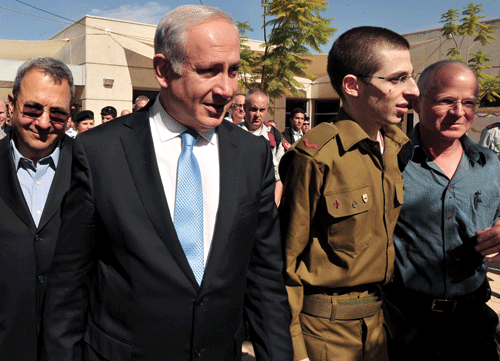
The prisoner exchange between Hamas and the Israeli government came at the only time it could; when the interests of both sides were aligned. In a sense, the actions of Mahmoud Abbas at the United Nations (UN) in September precipitated the deal. Both Hamas and the Netanyahu government sought to bolster their domestic popularity in its wake; something they managed with different degrees of success. The exchange — still unconcluded as October came to a close — has the potential to have an impact beyond its immediate implications, particularly for Palestinian reconciliation and the Gaza siege. 

In June 2006 Hamas conducted a raid in which they killed two Israeli soldiers and captured one. The party’s stated intent was to gain enough leverage to compel Israel into conducting a prisoner swap for some of the roughly 8,000 Palestinians held in Israeli jails, many of whom are political prisoners.

On October 18, Hamas and Israel completed the first stage of that swap. When the two-stage swap is concluded, 1027 Palestinians and one Israeli will have been liberated. It is significant that the exchange happened now and not years ago when the two sides appeared to be close to a deal. The gap between them was likely bridged by a mutual deterioration in their political situations.

Abbas — probably unknowingly — was the common denominator between the two adversaries. His appearance at the UN successfully undermined Benjamin Netanyahu and, to a lesser extent, Hamas. The call for an independent Palestinian state resonated so deeply and widely in the international community that both the Israeli government and the Islamic movement were forced onto the defensive. Hamas has also become increasingly sensitive as its patron Syria has been marginalized. Both parties sought to boost their support among their constituencies and the high-visibility, high-impact strategy of securing the release of prisoners was the best way to do that. Hamas gained more from the deal but Netanyahu also experienced a bump in the polls. Furthermore, whether  it was intended or not, the exchange had the added effect of undermining Abbas in two ways.

Firstly, Hamas demonstrated to the Palestinians that it could produce results: the release of Palestinian prisoners. Abbas by contrast seemed only capable of producing political theater. Further, Netanyahu made a massive concession to the extremists in his cabinet so as to gain their support for the deal.  He agreed to the establishment of a  new settlement which will consolidate the Israeli occupation of East Jerusalem, thus accelerating the erosion of Abbas’ credibility.

Aware of how weak the prisoner exchange with Hamas has made Abbas look, members of the Israeli government are now talking of attempting to bolster his public image by releasing more prisoners. However, hardliners led by Israeli Foreign Minister Avigdor Lieberman have protested loudly against any such move.

The political consequences of the prisoner exchange for the Palestinians are still unclear. It is likely that Hamas’ insistence upon the release of prisoners from all of the political factions earned the movement’s leadership goodwill among rank-and-file Fatah partisans. It may also work to thaw the hardened edges that have developed between the two factions in recent years, which would make a genuine reconciliation among the Palestinians possible.

Equally significant is the unprecedented degree of cooperation between Hamas and Israel. While not approaching anything like mutual recognition, the level of contact required for coordinating the exchange may provide the basis for future agreements on the scope of the Israeli siege on Gaza. Indeed, there have already been calls from both sides for the removal of the blockade — which was tightened punitively when Hamas captured the Israeli soldier.

The gains made by Hamas are also reflected on a regional level. According to recent media reports, Khaled Meshaal, Hamas’ political leader, may be meeting with Jordan’s King Abdullah soon. Observers believe that the organization is currently exploring the possibility of establishing political bureaus in Cairo and Amman.

Both Hamas and Israel have gained from the prisoner exchange. The Netanyahu government has improved its approval ratings while the Islamic party has reinvigorated its base and bolstered its reputation. What remains to be seen is whether the Hamas leadership is able to leverage the goodwill generated by the deal to weaken the siege on the Gaza Strip and achieve genuine reconciliation with Fatah.


AHMED MOOR is a contributor to Al Jazeera English and is a Master in Public Policy candidate at Harvard University’s Kennedy School of Government

November 3, 2011 0 comments
0 FacebookTwitterPinterestEmail
Economics & Policy

For your information

by Executive Editors October 24, 2011
written by Executive Editors

Low growth, higher debt

The prospects of a second-half economic rebound appear dimmer than ever as Lebanon rounds out the third quarter, with predictions for gross domestic product (GDP) growth in 2011 from several economic institutions looking grim. According to the Economist Intelligence Unit (EIU), the country’s economy will expand by just 1.3 percent, representing a drastic drop in anticipated growth, from 4.6 percent in April. The EIU maintained its 3.6 percent GDP growth outlook for 2012. The agency cited several reasons for the revision, including the usual political instability in the country and elsewhere in the region. The report stated that while it believed reforms would occur due to relative accord within the cabinet, they would be slow to take effect as corruption, patronage and an over-bloated public sector prevent further economic growth. Barclays Capital also predicted economic growth in 2011 to come in at just 1.8 percent because of spillover effects from the Syrian uprising and a weakening services sector. Barclays said that the deficit this year should stay at around 7.6 percent of GDP, but a 15 percent expected increase in expenditures next year will have a harrowing effect on debt dynamics as the predicted deficit widens to 8.5 percent. The International Monetary Fund  (IMF) also weighed in with a projected growth figure of 1.5 percent, granting Lebanon the honor of the 16th slowest growth rate in the world. The IMF said that in the region Lebanon would come ahead of just Egypt and Tunisia in growth rates. Standard Chartered Bank also revised its previous 3 percent growth forecast downward to 1.5 percent.

Lebanon a little less risky

Lebanon has marginally improved its risk profile, if only in comparison to the rest of the Middle East. According to Euromoney magazine, Lebanon ranked 82nd out of 184 countries in terms of its risk profile and 11th out of 20 in the region. The rank is a 10-spot improvement on the June 2011 global rankings and represents the biggest leap in the region. The rankings were based on six weighted indicators: political risks (30 percent), economic performance (30 percent), access to bank finance and capital markets (10 percent), debt indicators (10 percent), credit ratings (10 percent) and a structural assessment (10 percent). Political risk declined by 1.3 percent since June, while Lebanon’s access to bank finance and capital markets rating increased by a whopping 288.7 percent.

Sharpening the stats

In an attempt to partially rectify the endemic lack of credible and timely data, the Central Administration for Statistics (CAS), Lebanon’s public bureau of statistics, is launching a new project that will form the basis of economic projections for some time to come. Last month the CAS announced that it will launch the National Household Budget Survey for 2011, the first such poll since 2004. The survey will cover a sampling of 4,000 households in cooperation with the World Bank and will quantify several elements related to the social, economic and demographic development in the country. The results will help assess poverty levels and provide a basis for updating the weights on different products used in the compilation of the consumer price index, the main indicator of inflation. Moreover, the survey will give a more accurate and timely reading on labor and unemployment levels.

Subsidy deal staves off strike

A nationwide strike by public transport sector workers was called off last month after a late-night deal to implement a subsidy for the drivers, which was agreed to during the previous cabinet’s term but never implemented. The subsidy will be doled out once a month and will cover the equivalent of 12.5 jerry cans (1 jerry can = 20 liters) of gas to around 40,000 licensed taxi drivers, as well as to an undisclosed number of truck drivers. The subsidy will provide taxi drivers with a total of LL470,000 ($311.77) per month, and truck drivers will receive LL350,000 ($232.17) over the next three months. The move comes after a reduction on the gasoline excise duty by LL5000 ($3.30) in February to a total of LL4,530 [$3.02] per jerry can.

EEZ finally rubber stamped

After a long wait, the Lebanese government is one step closer to future offshore oil and gas exploration. Last month the cabinet signed off on the borders of Lebanon’s exclusive economic zone in the Mediterranean Sea, which was ratified by Parliament in August. The declared border puts the country at odds with Israel after the latter declared a different border demarcation earlier this year. The cabinet decision follows an agreement between Tel Aviv and Nicosia that adopted “Point 1” as the ending point for Israel’s proposed border with Lebanon, which starts in Ras Naqoura and ends 133 kilometers off the coast at an angle of 291 degrees. Lebanon also signed an agreement with Cyprus adopting “Point 1” but never ratified it in Parliament. The new law proposes an end point around 17 kilometers southwest of “Point 1”, which corresponds to Israel’s existing northernmost contract blocs — areas where oil and gas companies can come to explore and extract hydrocarbon resources. The difference of opinion has resulted in a disputed area of some 854 square kilometers and has fueled fears of potential conflict.

Improving irrigation

The ongoing issues over a lack of irrigation in Lebanon’s rural areas will be addressed after an agreement between the ministries of agriculture, energy and water, the United Nations Food and Agriculture Organization and the Italian government was inked last month. The agreement will see $370 million provided by the Italian government go towards the rehabilitation of outdated water networks. The project seeks to deliver water to about 15,000 hectares (150 square kilometers) over the next five years. Irrigation accounts for around 60 percent of Lebanon’s water demand.

EDL hemorrhages ever more

Transfers from the treasury to Electricité du Liban during the first half of the year came in at $684 million, a 22 percent increase on the first half of 2010, according to the finance ministry. The increase in transfers, said the ministry, is due to higher prices for fuel and increased payments to the Egyptian Natural Gas Holding Company (EGAS) for natural gas delivered via pipeline. Payments to Lebanon’s two fuel providers, the Kuwait Petroleum Corporation (KPC) and Algerian energy conglomerate Sonatrach, totaled $620 million, constituting 90.6 percent of payments, while $36.4 million, or 5.3 percent of payment, went to EGAS, with debt servicing accounting for the rest. According to the Finance Ministry, average oil prices increased for the first half of 2011 by 14 percent, along with a 10 percent increase in the quantity of imports.

Striking for a higher lowest pay

As a general strike planned for October 12, called for by the General Labor Confederation (GLC), Lebanon’s largest union, looms on the horizon, a report released by the consulting and actuarial firm Muhanna and Co outlined the effects of increasing the minimum wage to the GLC’s proposed LL1,250,000 [$829.18] per month from its current level of LL500,000 [$333.3]. The report outlined the potential consequences the increase could have on different sectors of the economy and found that the increase would raise labor costs the most in agriculture, with a projected 99 percent increase, though operating expenditure in the sector would rise just 15 percent. Other sectors would also be hit by rising labor and operating costs, such as banking and insurance (24 percent and 12 percent, respectively), construction (72 percent and 15 percent), education and health (72 percent and 36 percent), energy and water (32 percent and 2 percent), industry (67 percent and 11 percent), market services (49 percent and 29 percent), trade (64 percent and 26 percent) and transport and communication (44 percent and 9 percent). The report proposed that the minimum wage should be raised to 150 percent of the poverty line, or LL750,000 ($497.51) per month. The labor ministry has formed a committee to study the effects of a minimum wage increase while, as Executive went to print, negotiations with the GLC to avert the strike were ongoing. 

October 24, 2011 0 comments
0 FacebookTwitterPinterestEmail
Real estate

For your information

by Executive Editors October 24, 2011
written by Executive Editors

In District//S, size does matter

The developer behind the 22-building residential and retail community District//S in Beirut’s Saifi area has launched a new initiative to satisfy those looking for pied-à-terres in the city in September. The launch, at Lebanon’s DREAM exhibition in the Beirut International Exhibition and Leisure Center, unveiled the plan for 20 one and two-bedroom studios. The studio apartments will be fully furnished and serviced (cleaning, laundry, concierge service, gym access), with the local interior design firm Nabil Dada and Associates offering four schemes. All of the studios, ranging from 65 to 160 square meters, will be offered within one five-story building of District//S, according to Estates co-founder Anthony el-Khoury.  Namir Cortas, chief executive officer of Saifi Modern, owner of District//S and co-founder of Estates, told Executive that there could be more than 20 studios if there is more demand in the future. The price differential of the studios is about $1,500 more per square meter than the $7,000 per sqm starting price of other apartments in the development. “The price differential is our estimated cost for furnishing them and equipping them,” said Cortas. Studio construction is expected to be complete within four years, in line with the rest of the project.

DREAM goes green

London-based green-building consultancy firm, G, has partnered with 45 buildings in Lebanon to lead them to Leadership in Energy and Environmental Design (LEED) certification. Nader Nakib, chief executive officer of G, told Executive at the DREAM exhibition in Beirut that for the first time investing in green technology in Lebanon is worth it for developers. “The cost of going green for a first level certification is around 2 percent extra of the construction cost,” he said, adding “but the central bank subsidy allows for up to 45 percent of the construction cost at almost zero percent interest fee.” G is the LEED consultant for a number of developments in Lebanon, including Audi Plaza, Beirut Terraces, Beirut Waterfront, Beirut Harbor, Saifi 178, Verdun Hights, the ESCWA Building and most recently Saifi Gardens. In the District//S residential community, G will ensure rainwater collection techniques, the use of recycled material where possible and the use of environmentally friendly gases for ventilation and air conditioning systems. 

Real Estate branches out

Jouzour Loubnan, an environmental non-governmental organization working towards the restoration of Lebanese woodland, is partnering with both private developers and government municipalities to continue planting trees in Lebanon on government land.  Raoul Nehme, president of the organization, told Executive at the DREAM exhibition that, in addition to 38,000 trees already planted since 2007, the group hopes its partnership with developers like Estates and HAR Properties will mean an additional 35,000 trees planted this year alone. The programs with real estate developers, launched two months ago, mean that “for every meter squared built and sold, one meter squared of new forest area will be planted,” Nehme said. The 2011 budget for the group is $400,000 based on an average cost of $10 per tree planted. Phillippe Tabet, chief executive officer of HAR Properties, the developer behind the AYA building in Mar Mikhael and UPark building in Ashrafieh, said at the exhibition that HAR’s contract with Jouzour does not directly help sales but is still part of the group’s “dedication” to green building.

Rejuvenating Iraq’s housing stock

Iraq has the biggest shortage of affordable housing in the Middle East and North Africa (MENA) region after Egypt, with about a million homes needed to bridge the gap, according to a September Jones Lang LaSalle report for the MENA region entitled “Why Affordable Housing Matters”. The National Investment Commission in Iraq is to construct 1 million affordable houses, and up to 430,000 of them are expected to be completed by the end of the first quarter of 2012, according to the report.  In related news, Faleh al-Ammiri, under secretary of the Iraqi Ministry of Housing and Construction, told Gulf News in a September 16 interview that the National Housing Plan currently includes 30 projects where units are to be sold to nationals at cost price or below. He added that financing for real estate is still in its infancy: “We look forward to a time when the private banking system takes part in financing investment projects and the limited housing projects with the cooperation of the state’s ministries,” he said.

Jordan’s unpaid builders

Local contractors are owed $282 million by developers and public sector institutions, President of the Jordan Construction Contractors’ Association Ahmad Tarawneh claimed in September. Tarawneh told The Jordan Times that the gap would force contractors to lay off staff if payment is not received in the short term. He highlighted major Turkish developer GAMA, which is carrying out the Disi Water Conveyance Project, but claimed that other projects like Andalucia and Abdali Urban Regeneration Project also failed to pay local firms. “For the past two years, developers have been promising to pay their financial obligations to contractors, but nothing happened,” he said. In a September 12 statement to Construction Week Online, Yahya Kisbi, Jordanian minister of public works and housing, disputed the figures claiming the government only owes local contractors $70.6 million, with the Ministry of Planning and Internal Cooperations owing $29.6 million. In related news, an official at the Central Bank of Jordan told The Jordan Times in a September 13 article that the loans extended to the property sector reached 2.2 billion Jordanian dinars ($3.09 billion) by the end of July, or 12 percent of the overall deposits at local banks. Commenting on the figures, President of the Housing Investors Society Zuhair Omari said that the availability of this cash at the banks, coupled with the improved lending policies in the local banking sector, should galvanize the property market in the final quarter.

Riding the wave in Oman

Consolidated Contractors Company Oman, a subsidiary of CCC group, headquartered in Athens, has won the contracting tender to build the Omagine mixed-use development of residences, educational buildings, hotels and theme park along Muscat’s waterfront near Seeb Al Hail in Oman. The total cost of the project is $2.59 billion, which will see the US-based Omagine Inc. developers create an integrated touristic and residential area on more than 1 million square meters that will complement the upcoming The Wave touristic marina and retail center in the capital. A total of 2000 homes will be built around a marina, which will have an array of hotels and resorts ranging from three-star to five-star. The centerpiece of the development includes a cultural theme park that will feature exhibition buildings and an open-air amphitheatre. According to the Oman Daily Observer in a September 17 article, Omagine’s equity holding in the project is 60 percent, while newly formalized shareholders include the Office of Royal Court Affairs (25 percent), Consolidated Contractors Company SA (10 percent) and Consolidated Contractors Co Oman LLC (5 percent). CCC boasts a 120,000-strong workforce in the region and is already commissioned to several other projects in Oman.

October 24, 2011 0 comments
0 FacebookTwitterPinterestEmail
Banking & Finance

Lebanese capital markets

by Executive Editors October 24, 2011
written by Executive Editors

BLOM Stock Index (BSI)

Weighted effective yield of Eurobonds

Equity update

Persistent political unrest in the region and volatility in the international markets continued to have a negative impact on the Beirut Stock Exchange (BSE). The BLOM Stock Index (BSI), Lebanon’s equity gauge, followed a downward path between August 16 and September 16, 2011, to hit a 27-month low of 1,244 points. The BSI was down 4.7 percent on the previous month, extending its year-to-date retreat to 15.7 percent. The BSE witnessed a daily average volume per month of 182,811 shares, worth $1.71 million, during the four-week period of August 16 to September 16, as compared to 153,424 shares, valued at $1.74 million, over the preceding four-week period.

When compared to regional equity markets, the BSI underperformed the S&P Pan Arab Composite LargeMidCap Index and the Morgan Stanley Emerging Markets Index. The former inched up 0.3 percent to 107.3 points and the latter slipped 2.6 percent to 963.7 points as investors remained wary. 

During the period, banking stocks dominated on the BSE, accounting for 64 percent of the total value traded. BLOM Bank’s stocks witnessed a mixed performance, with its Global Depository Receipts (GDR) falling 4.4 percent to settle at $8.17 while BLOM listed stock advanced 2 percent to $8.19. Audi Bank’s GDR and listed stocks fell, with the former declining 5.2 percent to $6.82 and the latter falling 9.9 percent to $6.2, hitting their lowest level since the 10 to 1 split became effective in May 2010. Byblos Bank’s common stock retreated as well, inching down 0.6 percent to $1.65, whereas Bank BEMO stocks slipped by 6.2 percent to an all-time low of $2.57. Bank of Beirut’s  common stock reached a peak of $20 on September 9 before ending at $19.26 on September 16, still 1.4 percent higher than its close on August 12. With regard to preferred stocks, Byblos preferred 2008 and 2009 lost 0.5 percent each to align at $100, while Bank of Beirut preferred D and E declined by 1.6 percent each to stand at $26. BLOM preferred 2011 rose 1.1 percent to close at $10.11.

Real estate leader Solidere saw its market dominance decline. Solidere A and B stocks tumbled an average of 9 percent to a 28-month low of $15.15 and $15.30, respectively.

In the industrial sector, cement manufacturer Holcim’s stock reached its highest level since October 2008, peaking at $17.88 on September 8 before settling at $16.70, 1.3 percent higher than its close the month before. Ciment Blanc Class B hit its highest level since March 1998, touching $3.25, before declining to $3.07, though still up 3.4 percent from August 12, whereas Ciment Blanc Class N rallied 11 percent to $1.72.

Rasamny Younis Motor Company stocks fell 7.4 percent to a one-year low of $2.50. 

Eurobond bulletin

The Lebanese Eurobond market has been volatile over the month. The market witnessed some selloffs on long-term maturities, especially on the 2021 issue between the middle and end of August before it rebounded, boosted by higher demand from local investors on the long end of the curve. Thus, the BLOM Bond Index rose 0.3 percent to reach 111.24 points. Consequently, the portfolio weighted yield fell by 14 basis points (bps) to 4.8 percent, while the spread against the United States benchmark yield widened 7 bps to 404 bps. Lebanon’s five-year credit default swaps (CDS) — which vary positively with the country’s default risk — reached 395-425 bps compared to 361-391 bps on August 12. Comparatively, in regional markets, Dubai and Saudi Arabia CDS were quoted at 415-430 bps and 111-113 bps, respectively.

October 24, 2011 0 comments
0 FacebookTwitterPinterestEmail
Banking & Finance

Financial quotes of the month

by Executive Editors October 24, 2011
written by Executive Editors
Josef Ackermann, CEO of Deutsche Bank

“We should resign ourselves to the fact that the ‘new normality’ is characterized by volatility and uncertainty”

Mohammad Safadi, Finance Minister of Lebanon

“Looking forward it’s gloomy and at best, the economies will not perform. Far Eastern economies and third-world economies like Lebanon will keep on growing, but not as fast”

Sheikh Mohammed Bin Rashid al-Maktoum, ruler of Dubai

“Dubai is well”

Georges Soros, billionaire investorV

“The German public still thinks that it has a choice about whether to support the euro or to abandon it. That is a mistake”

Mohammad Jleilati, Syrian Minister of Finance, on the GDP growth of Syria

“Now, it will be around one percent, because of the events… maybe between one to two percent”

Angela Merkel, German chancellor

“We’re facing a challenge which one can call historic. If the euro fails, then Europe will fail”

Mohamad al-Jasser, Saudi Arabia’s central bank governor on the future of the common GCC currency

“The economic situation in our countries is excellent and nothing is delaying the currency”

Riad Salameh, Lebanon’s central bank governor

“Lebanon is immune to what is happening in Syria or worldwide because of the model we have, which is a highly liquid, prudent approach to credit and low leverage”

Jacek Rostowski, Poland’s finance minister

“The risk of all sorts of authoritarian political movements, and therefore even war, in the long horizon, rises”

October 24, 2011 0 comments
0 FacebookTwitterPinterestEmail
  • 1
  • …
  • 359
  • 360
  • 361
  • 362
  • 363
  • …
  • 686

Latest Cover

About us

Since its first edition emerged on the newsstands in 1999, Executive Magazine has been dedicated to providing its readers with the most up-to-date local and regional business news. Executive is a monthly business magazine that offers readers in-depth analyses on the Lebanese world of commerce, covering all the major sectors – from banking, finance, and insurance to technology, tourism, hospitality, media, and retail.

  • Donate
  • Our Purpose
  • Contact Us

Sign up for our newsletter

    • Facebook
    • Twitter
    • Instagram
    • Linkedin
    • Youtube
    Executive Magazine
    • ISSUES
      • Current Issue
      • Past issues
    • BUSINESS
    • ECONOMICS & POLICY
    • OPINION
    • SPECIAL REPORTS
    • EXECUTIVE TALKS
    • MOVEMENTS
      • Change the image
      • Cannes lions
      • Transparency & accountability
      • ECONOMIC ROADMAP
      • Say No to Corruption
      • The Lebanon media development initiative
      • LPSN Policy Asks
      • Advocating the preservation of deposits
    • JOIN US
      • Join our movement
      • Attend our events
      • Receive updates
      • Connect with us
    • DONATE