• Donate
  • Our Purpose
  • Contact Us
Executive Magazine
  • ISSUES
    • Current Issue
    • Past issues
  • BUSINESS
  • ECONOMICS & POLICY
  • OPINION
  • SPECIAL REPORTS
  • EXECUTIVE TALKS
  • MOVEMENTS
    • Change the image
    • Cannes lions
    • Transparency & accountability
    • ECONOMIC ROADMAP
    • Say No to Corruption
    • The Lebanon media development initiative
    • LPSN Policy Asks
    • Advocating the preservation of deposits
  • JOIN US
    • Join our movement
    • Attend our events
    • Receive updates
    • Connect with us
  • DONATE
Banking & Finance

For your information

by Executive Editors September 18, 2011
written by Executive Editors

Regulating the markets

Having been put on the backburner for the past five years, a draft law to regulate capital markets and insider trading was finally approved by Lebanon’s parliament early last month. Lebanese investors and brokers had urged previous governments to pass the law, a move which would allow for more transparency and activity on the Beirut Stock Exchange, according to Lebanese bankers. The law stipulates that an independent commission, dubbed “The National Council for Financial Markets in Lebanon”, headed by Central Bank Governor Riad Salameh, overlook and regulate both Lebanese market trading activities and participants. According to BDL, the regulatory agency will consist of seven members, five of which will be private entities, and will be an independent watchdog both in policies and functions, similar to the United States Securities and Exchange Commission. As of Executive going to print, the government had not set a timeframe for the implementation of the capital market law.

Kafalat demand shrinks

Loans extended to small and medium-sized companies under the guarantee of Kafalat Corporation dropped year-on-year 7.5 percent through July 2011, totaling $93.3 million for the first seven months of the year, down from $100.9 million during the same period a year earlier, according to figures released by the country’s state-sponsored credit guarantee scheme. The aggregate number of loan guarantees by Kafalat up until July 2011 reached 691, an 18.9 percent annual decrease from 852 a year earlier, indicating an enduring unfavorable business sentiment in the country due to domestic and regional instability. The average value per guarantee reached $134,992 for the same period, increasing by 14 percent from the previous year’s average of $118,413. The industry sector took the bulk of extended guarantees for the first seven months of 2011, constituting 41 percent of the total, followed closely by agriculture at 38.2 percent, tourism at 17.8 percent, specialized technologies at 1.7 percent and handicrafts at 1.3 percent.

Plastic pressure in Syria

Visa and MasterCard have blocked all credit cards issued by Syrian banks, in compliance with US sanctions imposed on the Syrian regime in the face of violence against protestors across the country. News of the ban first broke when Syrian visitors to the United Arab Emirates were sent SMS messages informing them that their credit cards were no longer valid. In response to an executive order issued on August 18 by the United States Treasury department prohibiting “the exportation, re-exportation, sale, or supply, directly or indirectly, from the United States, or by a United States person, wherever located, of any services to Syria,” MasterCard started blocking all transactions originating in Syria and all MasterCard transactions on accounts issued in the country. Visa also announced the suspension of its payment card activity in Syria under the recent US sanctions, stating it is “required by law to comply with the US Department of the Treasury financial sanctions against Syria.” Meanwhile, Adib Mayala, governor of the central bank of Syria, announced that Syria stopped dealing with the US dollar and switched to the euro, a decision made effective as of August 23.

Banks feel the stress

Lebanon was one of 28 countries whose banking sector fell under the “low strength” category of the Fitch Ratings’ Banking System Indicator (BSI), the agency’s annual risk assessment survey that includes 86 banking systems in advanced and emerging economies. Excluding potential support from shareholders and governments, the BSI measures banking systems’ intrinsic strength and quality, along with their systemic weakness. On a scale of “A” to “E”, from high to low quality, Lebanon came under the “D” category. Lebanon was also among eight banking systems that the ratings agency judged to have a high level of potential vulnerability, according to Fitch’s Macro-Prudential Indicator (MPI), which tries to determine the build-up of stress in banking systems. Lebanon was the only country to witness a decline in its MPI classification.

A trio of tech kick-starts

Lebanese business incubator Berytech announced a $1.05 million investment in three technology startup companies at a conference in early August, raising the number of its equity participations to eight since May 2009. Headed by young entrepreneur Hind Hobeika, “ButterflEye”, a company that has engineered swimming goggles that measure swimmers’ heart rates in real time via infrared technology, was the first to receive $100,000 of funding. Berytech also poured $600,000 into “Yalla play”, an online gaming platform founded by young businessmen Mahmoud Hajo and Karim Saddik, whose notoriety comes from the three-dimensional card game tarneeb.com. Berytech’s third investment went into “Wext”, a provider of a multi-platform web-texting software offering an instant messaging service adaptable to all mobile phones and all types of Internet connections. The Beirut-based seed capital fund Berytech has some $6 million under management, offering financing and consultancy services to young entrepreneurs in the technology field.

DP World profits surge

DP World, a Dubai World subsidiary, reported a 298 percent increase in first-half profits to $741 million [AED2.72 billion], buoyed by strong volume growth and a one-time gain from the partial disposal of its Australian terminals. The ports operator brought in $460 million [AED1.69 billion] from the monetization of 75 percent of DP World’s Australia terminals through a strategic partnership with Citi Infrastructure Investors. The world’s third largest ports operator rode a wave of global economic recovery during the first part of the year, supported by growth in newly-penetrated emerging markets of Latin America and Africa. As a result, gross volumes grew 11 percent year-on-year driving up revenues 3 percent to $1.5 billion [AED5.5 billion].  DP World also increased its cash and bank balances by 63.5 percent to $4.1 billion [AED15.1 billion], most likely in preparation for settling $3 billion [AED11 billion] of debt which will mature in October 2012.

Tourists flashing more cash

Total tourist spending in Lebanon increased 13 percent for the first seven months of 2011, relative to the same period of the previous year, according to figures released by Global Blue, the VAT refund operator for international shoppers. The majority of spenders in Lebanon were Arabs, making up 56 percent of total tourist spending in the country. By country of origin, nationals from Saudi Arabia accounted for 21 percent of overall tourist expenditures in Lebanon, followed by United Arab Emirates tourists at 11 percent, Kuwaiti nationals at 10 percent, Syrian visitors at 8 percent and Egyptian travelers at 6 percent. Fashion and clothing captured around 70 percent of total tourist shopping, watches 10 percent, and perfumes and cosmetics 5 percent. Beirut shops attracted 84 percent of total visitor spending in Lebanon, while the Metn, Keserwan and Baabda areas took away 12 percent, 2 percent and 1 percent of total spending, respectively.

Capital Trust buys into First National Bank

A Capital Trust Group private equity fund, the Euromena II, has acquired a 7 percent stake in Lebanese First National Bank, a deal valued at some $20.5 million. The stake is equivalent to 930,000 shares of the bank, making the FNB share price around $22. Press releases by both parties said that the transaction was aimed primarily at boosting FNB’s already accelerating growth, as the bank recorded balance sheet and customer deposits in March 2011 of $2.55 billion and $2.1 billion, respectively, while loans and advances amounted to $681.2 million for the same period. The Euromena II fund was launched back in June 2008 by Capital Trust Group with an initial capital ranging between $200 million and $250 million, and was the third generation fund — Menavest and Euromena I funds being the first two — for the global investment group aimed at investing in high growth companies in the Middle East and North Africa region, while excluding real estate and infrastructure projects. The Euromena I fund, which was set up in 2006 with $63 million in capital, had acquired a stake in Intercontinental Bank of Lebanon in January 2008, contributing to the bank’s $20 million capital increase at the time.

September 18, 2011 0 comments
0 FacebookTwitterPinterestEmail
Feature

Game over

by Sam Tarling September 18, 2011
written by Sam Tarling

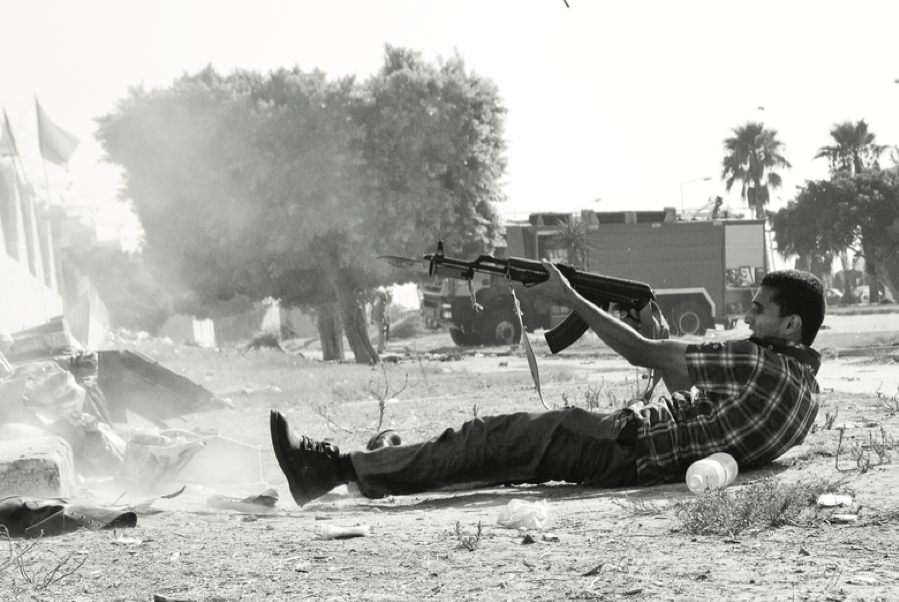
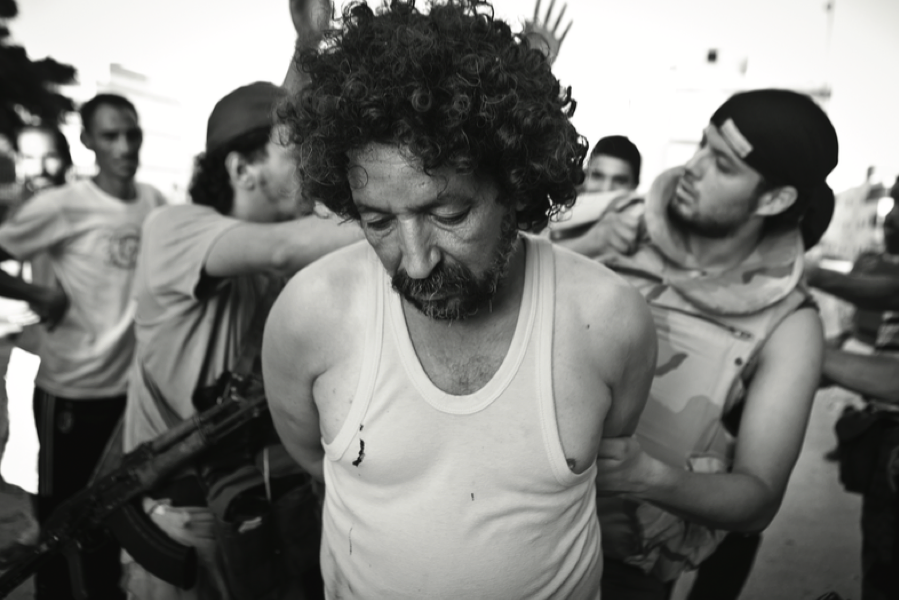
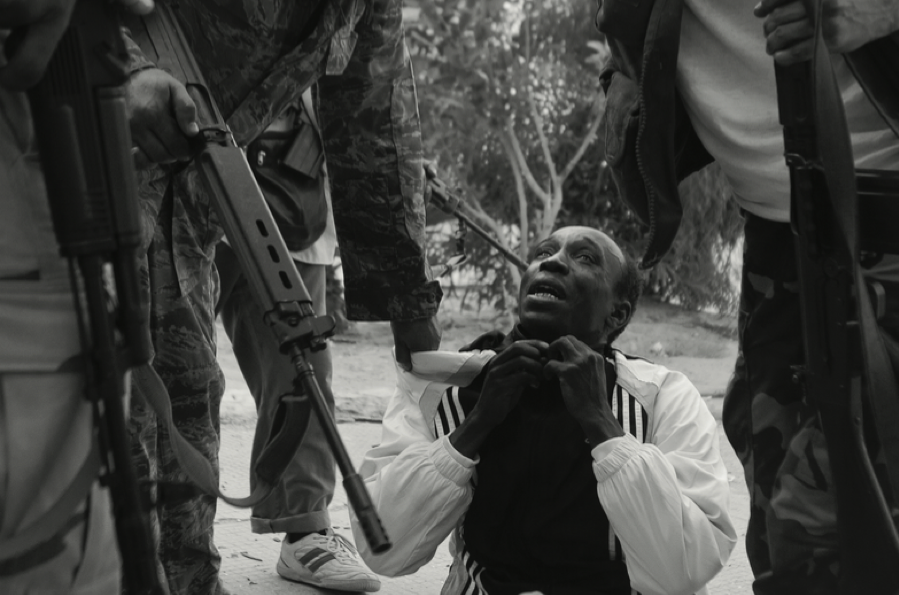
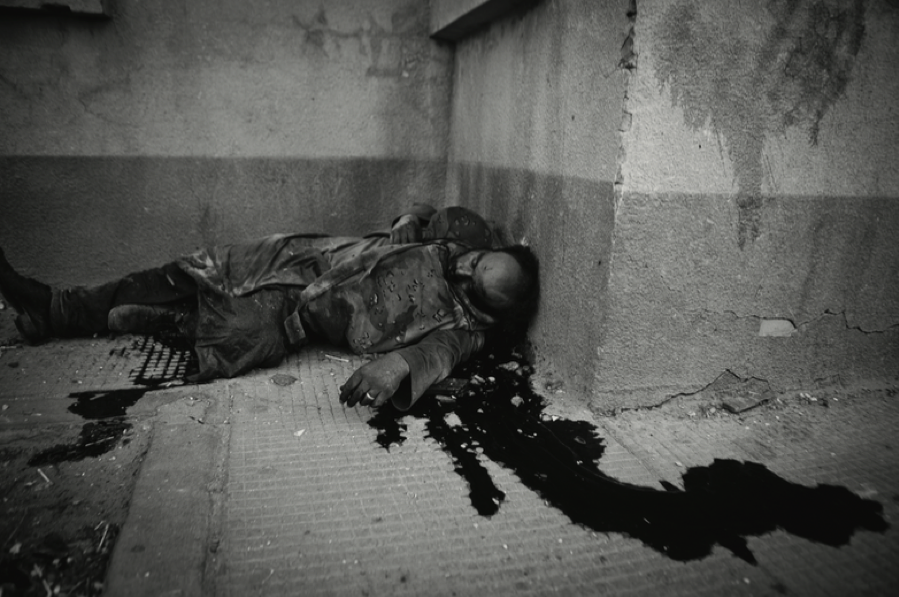
In the days following the libyan rebels’ push into tripoli, stubborn resistance by loyalist fighters continued in various areas of the capital. With the final battles raging and the fall of the city imminent, Executive was at the front lines documenting the fierce firefights, the surrender of soldiers and the casualties of war

1) After rebels routed loyalist forces during a day of skirmishes in the neighborhood of Abu Salim, one resident celebrates by ripping up a picturenof the fallen Libyan dictator Muammar al-Qadhafi with his teeth

2) A rebel patrol hunts for loyalist forces on the streets of Abu Salim, a staunchly pro-Qadhafi area that saw heavy house-to-house fighting after rebels took the city

3) A rebel soldier aims and fires through an opening in a wall at a loyalist gunman who, from a position in a residential building overlooking the Qadhafi compound of Bab Al Aziziya, had the rebels pinned

4) Rebel soldiers argue over the fate of a captured Qadhafi loyalist

5&6) A Qadhafi fighter pleads with his rebel captors before being struck in the head with a rifle butt 

7) A terrified resident is reassured by rebels who, after a vicious assault, had just captured four loyalist troops from her building 

8) A loyalist soldier has his hands tied behind his back after surrendering to rebel forces. With the discovery of what appeared to be executed loyalist prisoners, the rebel leadership urged fighters not to abuse detainees. However, with little coordination between the various rebel groups, the fate of their captives was far from assured. Executive saw one captive being shot in the leg and others being beaten, though most of those seen captured by rebel forces appeared to be treated humanely

9) A loyalist soldier is interrogated by rebel troops minutes after he and several of his comrades surrendered amid heavy fighting in Abu Salim

10) Rebels take cover from sniper fire inside a guard post at the Qadhafi compound of Bab Al Aziziya 

11) Opposition soldiers fire at loyalist gunmen in a residential area of the Abu Salim neighborhood in Tripoli 

12) Some rebel divisions have taken to wearing uniforms and have developed formal structures of command, though for the most part remain loosely organized and use an informal assortment of arms and apparel 

13) The body of a soldier lies dead in a corner after heavy fighting in Abu Salim

14) A rebel fighter escorts an Abu Salim resident from his home. Given the urban nature of the warfare and that fighters were often informally dressed, distinguishing civilians from soldiers was often difficult

15) A family flees after rebel troops surrounded their building in Abu Salim. As loyalist gunmen took up positions in residential housing blocks, civilians found themselves in the middle of heavy exchanges of fire from rifles, anti-aircraft weapons and rocket propelled grenades

16) Rebels dash toward the outer wall of the Bab Al Aziziya compound, keeping low to avoid Qadhafi gunmen who had been firing at them

17) Leaving no stone unturned, rebels search a giant stuffed bear found in the Bab Al Aziziya compound

18) Rebel soldiers patrol the streets of Abu Salim near sunset after a day of heavy house-to-house fighting 

19) Children collect bullet shell casings in what was formely called Green Square in Tripoli, now renamed Martyrs’ Square. The square saw little actual fighting but much celebratory gunfire 

20) As fighting ceased and quiet descended with the night, a resident walked through Tripoli’s old city, El Madina El Kadima

September 18, 2011 0 comments
0 FacebookTwitterPinterestEmail
Feature

Oil’s return from turmoil

by Executive Editors September 18, 2011
written by Executive Editors

As Libyan rebel fighters began routing government forces and advancing on the capital city of Tripoli in August, international oil and gas companies with interests in Libya (including five European and five North American hydrocarbon multinationals) began aggressively vying for the resumption or possible expansion of their roles in the country.

Italian oil firm, Eni, Libya’s most significant partner in hydrocarbons, said it expects a sub-Mediterranean gas pipeline between Libya and Italy to resume operations by mid-October. The company signed a memorandum with the National Transitional Council (NTC) — the rebels’ de facto government based in the eastern city of Benghazi — by which “Eni and NTC are committed to creating the conditions for a rapid and complete recovery of Eni’s activities in Libya and to doing all that is necessary to restart operations on the Greenstream pipeline, bringing gas from the Libyan coast to Italy”, the Italian company said in an August 29 press statement. The full restoration of oil output and exports, however, will be enormously complicated. Three factors will determine the speed of recovery of Libyan oil and gas production.

First, damages to the existing facilities will need to be examined and capacities restored. According to statements from NTC and Libyan oil officials at the end of August, direct conflict damages from the past six months to facilities have been limited and repairs have already begun. However, the restoration of facilities also includes dealing with the impacts of the shutdown process and inactivity of oil fields and pipelines.  

Second, oil sector workers will have to return to their jobs, which will require a rapprochement between the National Oil Company (NOC) and the NTC, as well as the return of foreign companies and their staff, which is heavily contingent upon an improvement in the security situation. The third and most crucial precondition for resumption of Libya’s oil economy, therefore, is a return to stability and internal security in the country. Reliable security structures have to be in place before the restoration of hydrocarbon facilities and the redeployment of the workforce can be meaningfully expected.

The nitty-gritty of Libyan oil

The oil and gas industry accounts for about 25 percent of Libyan gross domestic product, 80 percent of government revenues, and approximately 95 percent of export earnings. The 2011 BP Statistical Review of World Energy ranks the country as having the 11th largest oil reserves in the world, at 46.4 billion barrels, though it had been ranked at 19th in terms of production, at 1.6 million barrels per day, before the revolution. The equivalent figures for Libya’s natural gas reserves put it at 15th largest in the world at 1.5 trillion cubic meters, with its annual production at 32nd globally, with 15.9 billion cubic meters per year (cum/yr).

The sector is dominated by the NOC, which exploits and exports the country’s hydrocarbon reserves — both onshore and offshore — via a number of wholly-owned subsidiaries and international oil companies licensed by special agreements. The company owns the country’s refining and oil and gas-processing facilities, which include refineries at Mersa El Brega, Zawiya, Ras Lanuf, Tobruk and Sarir; the Ras Lanuf petrochemical complex and gas-processing plant is the country’s largest, also producing ammonia, urea, methanol, ethylene and low and high-density polyethylene.

Before the revolution, the NOC refined close to 380,000 barrels per day of the country’s crude oil in its refineries, with approximately 60 percent of the refined product output being exported. Libya’s oil and gas is sent to Europe, the country’s biggest export market, both by sea and a 540-kilometer, 11-billion cum/yr capacity subsea pipeline, dubbed ‘Greenstream’, across the  the Mediterranean to Gela in Sicily.

Within the country, Libya has a network of more than 8,700 km of onshore oil, gas and product pipelines.  Following the current unrest, most of the country’s oil and gas production and refinery capacity has been shut down. While refineries can be relatively easily restarted, damage notwithstanding, the crude oil pipeline network will have problems in starting up due to the waxy nature of the high-quality and relatively ‘light’ crude oil the Libyan oilfields produce. Once flow has halted for any appreciable time, the wax separates out and gradually blocks the pipeline. This material, similar to candle-wax, then becomes difficult to remove in order to restart the system, and it is foreseen that a considerable investment in technology and effort will be required to bring the system back to full operating capacity.

Looking ahead

UK-based energy and mining consultants Wood Mackenzie said in an August 25 statement that it expects resumption of full oil production capacities in Libya to require 36 months from “from whenever the current crisis reaches a resolution.” According to the analysts, the recovery of oil production capacities is likely to take longer for the mature Sirte basin in eastern Libya but will be faster in the newer Murzuk and Pelagian Shelf basins of western Libya.

For the longer term, “Libya has the potential to produce up to 3 million barrels per day of oil and become a major gas exporter through partnering with the international industry,” Wood Mackenzie noted, with the caveat that this future remains “on hold until military operations are concluded.”

September 18, 2011 0 comments
0 FacebookTwitterPinterestEmail
Feature

The fall of Tripoli

by Executive Editors September 18, 2011
written by Executive Editors

Tuesday, August 23 

Abdallah slides his finger across the map of Tripoli. “They’re still fighting here, in Abu Salim. And in Bab Al Aziziya, of course: that’s Qadhafi’s stronghold. And over there, around the airport. Oh, and I was just talking to a friend in Sidi Khalifa yesterday; she said there was heavy shooting in her neighborhood.”

It has been three days since rebels entered Tripoli but intense fighting persists in the capital, while outside of it Qadhafi soldiers continue to stalk Western Libya. At the Tunisian border, nearly every car is heading out of the war-torn country. Apart from a Red Cross truck and a few dozen journalists busy filming each other, only a few Libyans are heading the other way. One of these is Abdallah, who says that, after having been involved in the Egyptian revolution, he would not miss this one for the world: “It’s my country now. I want to be there when Tripoli falls.”

In Nalut, the first city on the road from Tunisia, the shelling ended more than a month ago but schools and businesses are still closed. The few open shops have half-empty shelves and petrol is in short supply — a liter now costs $2.50, whereas before the war it was cheaper than water. Like the capital, this city is still living the war and so are its people.

“There must be war,” affirms Khamis Birgig, a 35-year-old rebel who garnishes every other sentence with a “boom-boom!” and skillfully maneuvers the gearshift with what remains of his right arm. “Just a few more days and we’ll be rid of Qadhafi,” he says, as the car heads towards the capital.

Khamis clearly took some psychological hits when he lost his right arm, eye and part of his knee to a Qadhafi rocket early in the uprising, though he does not seem overly fazed about his physical disabilities: he can still shoot with his good arm and is confident that when the new government arrives his sacrifices will be rewarded. “They will respect human rights and take care of me. But first we have to catch Qadhafi, so that we can put him in front of the international court, where he has to tell the world what he has done.”

Khamis, like most of the rebels, speaks about freedom and democracy when asked why he rose up. But when pressed, out come the complaints about a lack of work, income and opportunities. “Under Qadhafi there was nothing,” he says. “Just poverty.”

With the sun setting over the Libyan desert, Khamis is asked how long the ride will be. “I have no idea,” he replies cheerfully to Executive. “It depends on whether or not we run into Qadhafi soldiers.” He looks to the side with his one eye, points to the Kalashnikov on the seat and smiles hopefully. “Boom-boom!”

Wednesday, August 24

The capital of a disintegrating state is a strange place to be. Since the rebels entered Tripoli a few days ago, the city has been alternating between sounds of celebration and the booms of Qadhafi soldiers’ last-ditch efforts to stave off their own impending demise. Car horns honk incessantly while bored rebels light up the night sky with tracer fire. The streets are strewn with the burnt-out wreckage of cars and dumpsters, improvised roadblocks set up by the new authorities, most of whom are younger than 20.

Some residents have a hard time getting used to the new status quo. In one incident in the neighborhood of Dahra, young fighters pounce on a taxi driver after he takes exception, with a swing, to their demands to open the trunk. As the struggling man is dragged away from his car, one rebel lands a punch squarely on his face before elderly residents intervene and the driver is allowed to leave. “Idiot. Should have opened the boot when I told him to,” the boxing rebel shrugs, before turning his attention to the next car.

Incidents like this one are rife within the city, but thus far the local councils secretly put in place to take over the day-to-day running of the city after Qadhafi’s departure have done well: looting has been kept to a minimum and, apart from the occasional resident happily jogging through Qadhafi’s former stronghold with a painting under his arm, very little plundering has been reported. No stores ransacked of flatscreen televisions, no looting of abandoned homes. But their control is slipping.

“No government, so no water,” says a smiling teenager to a foreign journalist scavenging the city for food and drink. A few days after the rebels all but took over the city, it has begun to break down. A lack of milk, vegetables and petrol may be manageable for the moment, but with drinking water increasingly scarce and tap water and electricity on the cusp of running out, one cannot help but wonder how long until the residents of Tripoli start pining for the good old days.

Thursday, August 25

“Watch out, sniper!” yells a rebel, before a deafening firefight explodes in the streets of Abu Salim. Through the black smoke tears a truck with thundering anti-aircraft guns on the back. From the besieged building, snipers open fire on the rebels. A wooden garden door is shredded on impact. Two rebels drop while their comrades in full sprint empty their Kalashnikovs at the flashes from the building down the road. The sharp smell of cordite and burning asbestos drifts over the streets. While the rest of the city has been enjoying relative calm, rebel fighters have been trying to clear this working-class neighborhood of the remaining Qadhafi loyalists for several days now. When a rumor that Qadhafi may be hiding in one of the buildings starts to buzz, Abu Salim turns into a full-fledged war zone.

After the dust settles, three bloodied corpses lie on the streets: two rebels, one loyalist. No Qadhafi. The deposed dictator’s location is still a mystery, and the search continues.

“When we finally get Qadhafi, the resistance will die out by itself,” says 25-year-old Abdallah Masoud, still shaking from narrowly escaping a sniper’s volley. “But as long as he’s free, the fighting will continue.”

In a few days, Abu Salim will be cleared of Qadhafi loyalists, while the fighting will go on in other neighborhoods. Some parts of Libya, notably the cities Sirte and Sabha, are still under Qadhafi control.

But a return of the dictator is now out of the question. It is “game over” for him, says Majid Fituri, a 47-year-old rebel leader from Misrata, while wandering around the rubble of Qadhafi’s former stronghold of Bab Al Aziziya.

He looks back at the ruins behind the famous statue of the clenched fist crushing an American fighter jet. Qadhafi left intact the concrete skeleton of the building, destroyed by American bombs in 1986, to serve as a reminder of the West’s wickedness. 

“Look at that,” Fituri says. “That used to be a museum in the form of a ruined building: a propaganda tool for Qadhafi.” He turns around and smiles. “Now, it’s just another ruined building.”

September 18, 2011 0 comments
0 FacebookTwitterPinterestEmail
Editorial

The fortunes of upheaval

by Yasser Akkaoui September 18, 2011
written by Yasser Akkaoui

The Libyan rebel forces’ rout of government troops from Tripoli last month heralded a pivotal moment in history, with the toppling of Muammar al-Qadhafi’s regime marking the third North African autocrat to fall to popular uprisings this year. Even while the security situation remains perilous, world powers and multinational companies are climbing over each other for a chance to reap their slice of the spoils of war: Libya’s fabulous resource wealth of oil and gas.

The Libyan revolution and its impact on global energy prices have been among the factors playing into the economic turmoil of late, where the sovereign debt crises in the United States and Eurozone have raised fears of a double-dip recession, sending markets into a flailing panic and rendering them near untradeable at times. In this environment, protecting one’s wealth becomes an anxious business. Executive has sought out the brightest minds in the business, locally, regionally and globally, for their take on how to navigate the storm.

Much of the world’s attention this month will also be focused on the 10-year anniversary of the September 11, 2001 terrorist attacks in New York and Washington. How much does this event, and the reactions it was used to justify, still impact the world we live in today? And is the so-called ‘clash of civilizations’ as clear-cut as its proponents would have us believe?

Despite all the turmoil, however, one must not forget to always look for opportunity. Perhaps that is a thought to ponder as one cruises what just recently became a long, open highway from the Gaza border to the doorstep of Algeria.

September 18, 2011 0 comments
0 FacebookTwitterPinterestEmail
Comment

Little evidence at the end of the line

by Nicholas Blanford September 3, 2011
written by Nicholas Blanford

If Daniel Bellemare, the prosecutor for the Special Tribunal for Lebanon, is planning to base his case against the four Hezbollah members indicted for the assassination of Rafik Hariri solely on the telecommunications evidence contained within the indictment, the actual trials, should they occur, could be over in a very short time. As it is, the indictment acknowledged that the case against the accused is built “in large part on circumstantial evidence”. Indeed, at a certain level it must be tempting for Sayyed Hassan Nasrallah, Hezbollah’s secretary-general, to dispatch the four accused to the Netherlands with a good team of lawyers in the belief that they can beat the rap. After six years of investigations, we could be forgiven for expecting more than telecom analysis to support an indictment that has polarized Lebanese society more deeply than at any other time since the end of the civil war and still threatens further political turmoil. As it stands, the centerpieces of the indictment are five covert and overt mobile networks related to the assassination the prosecution says it discerned and color-coded from the millions of phone calls made each day in Lebanon.

It was widely expected that telecom analysis would play apart in the prosecution’s case; as long ago as October 2005 the cell phone networks used by the perpetrators of the assassination were made public in the first report of the United Nations commission charged with investigating the crime.

Regardless of whether Bellemare has more evidence to hand out or not, there are a couple of questions to ask regarding the contents of the indictment. First of all, the indictment acknowledges that the perpetrators were aware that at any given time their locations could be traced by the process of co-location — using mobile phone signals to triangulate the position of an individual. That, the indictment claims, is why the assassination team’s “red” network of color-coded phones was activated in Tripoli a month before the murder, an area where few Shiites live and home to Sunni Islamists on whom the accused planned to pin the blame for Hariri’s murder.

Yet, if the perpetrators were aware of this technological tracking system, why did they then continue to carry other color-coded phones along with their regular phones while going about their daily business? It was the proximity of their regular phones to the color-coded ones that apparently led to the identification of the alleged perpetrators. During the wave of assassinations of prominent anti-Syrian figures following Hariri’s death, people under potential threat routinely removed batteries and SIM cards from their cell phones before leaving home so that they could not be traced. Hezbollah’s signals intelligence and electronic warfare capabilities are highly advanced and its technicians thoroughly trained. It is inconceivable that the organization would have been unaware that a cell phone can still be tracked even when not in use.

The second, and more pressing, question is why Hezbollah would want Hariri dead in the first place. Certainly, Hezbollah and Hariri were poles apart politically, each having different visions of a future Lebanon. Hariri was a pragmatist, was well accustomed to the necessity for compromise and was not on a moral crusade to oust Syria from Lebanon or disarm Hezbollah. Hariri was willing to accept an armed Hezbollah and respect Syria’s interests in Lebanon so long as he was given free rein to run daily Lebanese affairs as prime minister.

In the months before his death, Hariri and Nasrallah struck up a close and secret friendship — one which even Hariri’s advisors still maintain was genuine — and they met at least once a week in secret. They had much in common, both being devout Muslims, originating from south Lebanon, sharing a strong sense of humor, and even both having lost their eldest sons.

Nasrallah must have not only realized that Hariri was not a threat to Hezbollah and Syria, but he could in fact be exploited as an asset. After all, Hariri’s friendship with Jacques Chirac, the then French president, helped keep Hezbollah’s name off the European Union list of terrorist organizations compiled in January 2005.

More importantly, Hezbollah did not possess the leeway to independently undertake an assassination of such strategic import. If there was Hezbollah involvement in the Hariri assassination, the orders came from elsewhere. That begs the question that if it has taken six years for the tribunal to accuse four men, two of whom supposedly played a minor, ancillary role, how much longer will it take for the tribunal to identify those whodecided that Hariri must go?

Nicholas Blanford is the Beirut-based correspondent for The Christian Science Monitor and The Times of London


September 3, 2011 0 comments
0 FacebookTwitterPinterestEmail
Society

Western media flaws only highlight our own

by Youmna el Asma, Zeina Loutfi & Ramsay G. Najjar September 3, 2011
written by Youmna el Asma, Zeina Loutfi & Ramsay G. Najjar

The attacks perpetrated by Anders Behring Breivik in Norway on July 22 had the unintended effect of unveiling bias and prejudice in the Western media, and sparked worldwide debates about the role and responsibility of the press. The incident also raises important questions about the lessons that we can extract in our bid to harness our regional media’s power as an agent of positive change and a reflection of the aspirations and values of the people.

In the hours immediately following the massacre, the false assumptions and speculation as to the perpetrator revealed a significant lack of rigor and objectivity by some major news outlets. When the truth was out — that the massacres were not carried out by Islamic terrorists but in fact by an anti-Islamic Norwegian one — Middle Eastern journalists were quick to pour scorn on the mistakes made by the foreign media, seizing the opportunity to point out all the faults in coverage. It would seem that they forgot for a moment that our own media industry still has a long way to go before being able to brag about values like objectivity and truthfulness.

Lazy assumptions

Some of the most influential broadcasters undoubtedly were too quick to jump to conclusions, favoring the Islamist and Al Qaeda route without any reliable facts. Looking back at the earliest hours after the attacks, most media directly assumed the terrorist attacks were linked to Islamic organizations and attempted to rationalize every new piece of information by integrating it into the Islamist hypothesis. For instance, an American commentator accounted for the fact that the killer was a “blonde Norwegian male” by deducing that Islamic terrorist organizations had probably moved to “a new level” by recruiting natives. Moreover, the foreign media’s choice of experts commenting on the event provided the grounds for erroneous interpretation; most specialized in researching Al Qaeda, Salafis and other Islamist extremists, thus automatically directing the media analysis towards the Islamist theory without any shred of evidence.

In fact, the Norway attacks could have been a chance for the international media to rectify the strong prejudice against Islam and Arabs that it has played a role in fostering since the 9/11 attacks in New York and Washington DC. Instead, it reinforced a false perception that continues to influence local and international politics around the world. In their reluctance to use the word “terrorist” once the man’s identity was discovered, the media helped perpetuate the idea that terrorism and Islam are often mutually inclusive, and to some extent interchangeable. The word terrorism, or its derivatives, was ubiquitously absent in the majority of the mainstream media’s coverage the day following the attacks, whereas some broadcasters used it only to reassure the audience that “it seems like this is not linked to any international terrorist organizations” and is “not Islamic-terror related”.

In addition, the media’s propensity for sensationalism, and its desire to fill airtime, was prevalent in the headlines used to cover the attacks. The headline that ran in the British tabloid The Sun — ‘Al Qaeda’ Massacre: Norway’s 9/11 — clearly has absolutely no relation to the reality but was immediately chosen as a convenient sound bite that would resonate with audiences, and a captivating branded product that could easily be “sold”.

Moreover, instead of focusing on the human aspect — the  young victims and their stories — the media chose to focus on the perpetrator and his ideology, inadvertently shifting the debate to the topic of immigration and integration, and thus somehow rationalize his horrendous act. The end result, while yet to fully unfold, seems to indicate that Breivik succeeded in what he set out to do,which was to sound the alarm bells over an issue that Europe has been grappling with for generations.

Our own failings

Returning to the media in the MENA region, which were given the rare opportunity to look down on their Western counterparts, the Norway attacks provide an opportunity to assess our own limitations. It is important to remember that our media is still far from performing its role effectively or living up to people’s expectations in terms of objectivity, editorial integrity and ‘fair and balanced’ reporting. The truth remains that, whereas many of the faults the foreign media committed in their coverage were caused by the race for the headline and the urge to fill the 24/7 airtime, the ones committed by our own media are mostly driven by the specific agendas of the media outlets ’financial backers.

One of the many examples is in the coverage of certain campaigns and elections in the region for which media entities are often quick, and more than willing, to announce winners even before official (if not credible) results are in. They often disseminate unfounded information, use sensationalism in their reporting through violent language and fear mongering, and reveal a clear lack of objectivity whether in the amount of airtime given to specific political parties or candidates, or in the partiality of the reporting of certain facts. Moreover, whenever there are security breaches or incidents, some of the media in the region are always ready to point fingers at specific parties, simply because it suits the agenda or interests of the government, politician, or “deep pocket” behind the media outlet.

And most recently the coverage of the Arab Spring has revealed the extent of the partiality in regional media outlets. Whether in the choice to cover, or to not cover, certain demonstrations and political events, or by taking sides between the opposition and the regime, media institutions have clearly failed to play their role as providers of unbiased information.The myth trumpeted by some media channels in the region that they abide by the highest industry standards when it comes to objectively showing both sides of the story, free from propaganda or self-serving interests has to a large degree been shattered in 2011.

For the media to truly reflect the high level of professionalism and integrity of many of its journalists, it should re-examine its practices and instate self-regulatory boundaries that prevent information from becoming a tool for public opinion manipulation. The media has a moral obligation to shun sensationalism that puts a shade on the human and social aspects of events and often directs the debate towards unconstructive dimensions. And it has a duty to avoid speculation and discriminatory discourse that further reinforces prejudices, as a step towards becoming a uniting, rather than a dividing, force.

Accepting responsibility

It is a fact that the media is no longer simply a medium to relay the news. It has a responsibility to use its reach and influence to educate and break down barriers enacted out of prejudice. Remaining faithful to these imperatives would most certainly set the media in the region on the right track; only then would it be in a position to criticize the western media for its shortcomings.

The western media’s coverage of the Norway attacks should serve as a lesson to MENA outlets on the power they have in shaping opinions and debates, and on their responsibility to not turn such power into propaganda. Then again, many would argue that putting the onus on the media, knowing the political climate and the industry’s dependence on advertising revenues and/or political and financial backing, is asking too much. Knowing this, what it all boils down to is that most regional media should free themselves from the shackles of political and financial servitude. Only with such freedom comes the ability to be objective and free of prejudice. Following the incredible societal achievements of the past months, one can only hope that the time has come for the media in the region to show some courage by looking closer into how they operate and re-examining their own system of values.

September 3, 2011 0 comments
0 FacebookTwitterPinterestEmail
Finance

Executive Insight – Value over quality

by Natacha Tannous September 3, 2011
written by Natacha Tannous

Fear and panic drove the markets through most of August causing more than $4 trillion in wealth destruction, while policymakers responded with “soft patches” and short-term solutions to what are structural and fundamental sovereign-debt problems on either side of the Atlantic.

During the week of August 8 the S&P500 — best single gauge of the United States equities market — went on a roller coaster ride, closing consecutively at -6.7 percent, +4.7 percent, -4.4 percent, +4.6percent, and +0.5 percent. While choppy and erratic, both American and European equity markets began a four-week downward near the end of July, with the heightened risk of a recession prompting investors to dump risky assets and seek safety in the Swissie (CHF), gold and in long-dated US Treasuries, in other words, there has been a general flight-to-quality.

Thus, the concern today is how to trade equity and foreign exchange markets, and hedge against potential event risks until the politicians and central bankers provide durable solutions to exit their debt conundrums and correct economic imbalances.

Approaches to equity and FX

Nouriel Roubini, also known as “Dr. Doom” for having predicted the 2008 financial crisis, recently told me that he assigned a “50 percent probability to a double-dip scenario… Or possibly more.”

For investors sharing this “doom and gloom” view, outright put options on US or European indices would make sense, if not shorting the indices directly. Since implied volatility hasn’t reached the 2008 and real crisis levels, protection is still cheap and below fair price if you calculate that the worst is yet to come. The put protection provides an attractive way to limit the downside, or potential losses, to the put premium if you happen to be wrong. If such structure is not affordable, an investor could play the correlation card — given that in times of global meltdown correlation tend stowards one, meaning the markets move in sync — and buy a best-of-put on a global basket where the index that will fall the least will still drop considerably in broad-based sell-offs.

Turmoil in the S&P

Turmoil in the S&P 500

Source: Standard & Poor’s

In the world of foreign exchange, investing in quality assets would protect from event risks, with possibilities including buying a barrier option for a targeted move in the USD-CHF rate, or play the Norwegian NOK if investors fear interventions from the Swiss National Bank (SNB) to control the appreciation of the Swissie.

The second group of investors — the bears — assign a lower probability of dramatic worsening of the sovereign crisis, but still believes that uncertainty will dominate markets. Even the fixed income markets in the Eurozone are pricing in a deeper debt crisis with Italian and Spanish 10-year yields flirting between 6 and 6.5 percent — that is until the European Central Bank decided to resume bond purchases — and more alarming, the Greek 2-year yield hitting 46.6 percent on August 25.

“Markets won’t give the benefit of the doubt [to theEurozone] until the results of policies to correct imbalances in public and private sector balance sheets as well as current accounts, and the new policy infrastructure, are visible,” highlights Mark Wall, managing director and co-head of European Economics at Deutsche Bank. “It is a ‘muddle through’ and as such markets don’t like it.” With this bearish view, buying (bear) put spreads on indices, for example, is a better alternative to outright puts —given the cheaper structure — as investors are willing to limit the upside, or potential gain, below the first strike.

A third and quite diverse group — the bulls — argues that the market has allegedly discounted the turmoil in the US or potential selective default in the Eurozone, with policymakers close to providing solutions; the more extreme ones even believe that ‘everything is a buy at current levels’. These investors are betting on this rally starting soon — and on a more inflationary world — and would rather buy call options on indices, for example, staking their money on the upside. Once again, this group covers a large spectrum and is quite hybrid, as being bullish does not necessarily entail being bullish on all markets.

If an investor bets on a faster resolution to economic imbalances in the US on the basis that the US has better fiscal tools at its disposal to solve the debt crisis, one could combine longs in the S&P 500 with shorts in E-STOXX50. This view can also be played through the FX market, and particularly the euro-dollar.

“As the ECB begins to aggressively accumulate Eurozone bonds— out of necessity — and overall risk appetite grows disappointed with any stimulus from the Fed, the euro-dollar is likely to make its way towards the $1.40 figure,” explains Ashraf Laidi, chief executive officer of Intermarket Strategy Ltd and author of Currency Trading & Intermarket Analysis. “The most important support remains $1.37, a break of which would flood the gates towards further downside.”

Last but not least, a growing group — the ‘risk off’ investors — would rather sit-and-wait. These investors do not wish to actively trade in these markets given the excessive uncertainty and irrationality; they prefer to dump investments across a spectrum of assets and sit on their cash, with the idea that “being flat is the new high.”

Taking a view

Looking at the divergence in trends between the end of July and what seems like a start of rally in equities and correction in quality assets during the last week of August heading into ‘Jackson Hole’ — the annual US Federal Reserve (Fed) symposium — it would seem that the irrationality of markets was more due to panic, a lack of liquidity (with many investors on holiday), day trading and market positioning, rather than to sensible trends. Either way, it seems that markets are largely untradeable, at least until we get more clarity from policymakers.

And yet, the investor has to do something, but what? Is ‘off risk’ the only logical option? The reality is, liquidity has been poor this summer and volatility high, so the investor can make the same amount of money with less notional than in a low volatility environment.

Thus in order to work out how much to put in, the real questions should be: What opportunity does the investor seek and how much does he want to make? Does the investor want a ‘high risk/high reward’ portfolio —investing in the banking sector like Warren Buffett’s recent $5 billion bet on Bank of America — or a portfolio with lower volatility, such as one with investments in the utilities sector?

Whether a sector, single-stock or asset class approach, investors must take a view, but one in search of what has been oversold and depressed, or conversely overbought and overvalued,  rather than rushing into safe haven currencies, gold or US Treasuries. In short, it is more sensible to bet on assets trading under or above ‘fair value’ rather than invest blindly in ‘safety’ — value over quality.

NATACHA TANNOUS is EXECUTIVE’s financial correspondent

September 3, 2011 0 comments
0 FacebookTwitterPinterestEmail
Real Estate

Q&A – Fadi Antonios

by Rayya Salem September 3, 2011
written by Rayya Salem

Fadi Antonios presides over a network of industrial enterprises in the United Arab Emirates and has growing interests in Lebanese real estate. Through his development company, Antonios Projects, he is the sole owner and developer behind what will be Lebanon’s tallest tower, the 50-story Sama Beirut, currently under construction in Ashrafieh, where it will offer luxury retail space, offices and residences. Executive recently got the scoop on the project and on Antonios’ future plans for his home city.

Since the construction contract alone is well over $100 million for Sama Beirut, is it not risky to self-finance the entire project?

My father used to say, ‘In real estate, never take a partner; it’s like [having a] wife, you don’t take a partner.” [laughs] If you can realize your project without banking facilities it is better and less risky… Now we have a bridge loan [a guarantee from the bank in case of a financial shortfall]… but we don’t have any problems with financing. I always work by myself [without partners].

Besides that, I am working on a much bigger project. It will be a gated community, which will have close to 60 buildings in a prime location in Beirut and will have all internal facilities, security at the gates and a club for the families.

I am also starting an office building in Beirut, near Université Saint Joseph, where there is a need for “clever offices”. I bought the plot, which is close to 2,000 square meters, and we are now working on the drawings and architecture. Again, it is all being financed by myself.

To date, what is your total investment in Lebanon?

Quite a lot. I think investing in Lebanon in real estate is still the safest and most interesting place. Especially that we are Lebanese and we know the mentality, the people. It is much easier to navigate the construction field [in Lebanon] than anywhere else in the world.

The construction contract awarded to MAN Enterprise was more than $100 million whenannounced in June. Was this the original budget?  

Yes, but the construction budget has increased more than 50percent.

We didn’t expand floors but it is due to the improvements,choice of material, high technology and the devaluation of the US dollar.

How does Sama Beirut use solar water heating techniques?

We tried to use solar energy to produce basic electrical needs. Unfortunately the photovoltaic technology is still very expensive and it did not pay to invest in it. For the hot water, that is a much simpler technology and it’s enough to provide hot water for 24 hours without burning fuel… Fuel for boilers and maintenance of systems is getting more expensive. With solar, it’s a free system and maintenance is cheap.

In the UAE,developers have traditionally applied a mix of British and US fire safety standards, but the rules are currently being standardized, as some new residential buildings reach over 100 stories. What about in Sama Beirut?

Here we can use the service floors [every 10 floors] and we also have fire-proof elevators in addition to fire safety plans and installations. We are applying fire safety [techniques] that are a mix of the French and American systems.

Lebanese engineers are really the best, I would say. I enjoy working with these engineers and architects. I always use Gregory Gatzerelia for all my private residences… For Sama Beirut, we considered international contractors before choosing MAN Enterprise. [The deciding factor] was not price, it was experience in mastering Lebanese construction, rules and regulations — its name and its realizations are the best buildings in Beirut.

September 3, 2011 0 comments
0 FacebookTwitterPinterestEmail
Comment

Nokia’s got your number

by Paul Cochrane September 3, 2011
written by Paul Cochrane

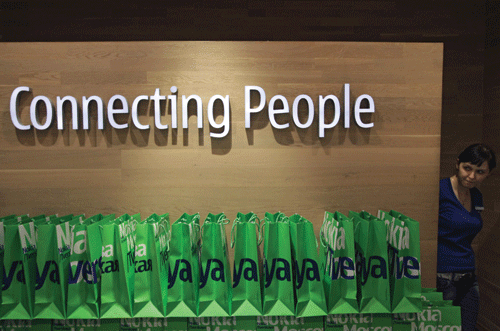
Nokia’s brand image is of two hands — one a child’s and one adult — reaching towards each other with the slogan: “Connecting People”; a nice image for a mobile phone manufacturer and service provider. But in a dozen countries in the Middle East and North Africa (MENA), the Finnish mobile phonegiant’s joint subsidiary with the German company Siemens, Nokia Siemens Network (NSN), has been connecting people in a way that consumers were not expecting: with the mukhabarat, or secret police.

Dozens of pro-democracy activists arrested in Bahrain by mukhabarat following the uprising that began in February were presented with transcripts of text messages and phone calls that they had made. Detainees were puzzled as to how their communications had been intercepted and were being used as evidence against them. They were not aware of the monitoring systems that 12 countries in the MENA, according to a report by Bloomberg published last month, had bought software from NSN and its subsidiary, Trovicor, that enables governments to intercept phone calls, emails and text messages. Such surveillance software also allows the powers that be to create disinformation by changing the contents of written communications and to scan phone networks through voice-recognition and keyword-search software, in addition to remotely activating laptop webcams and microphones on mobile phones, according to Wired magazine.

The Bloomberg exposé of the usage of such technologies in Bahrain is a first during the MENA uprisings of this year. That websites were being monitored was well known, and people in Syria, Libya, Egypt, Yemen and elsewhere have long been wary of what they said on the phone in case of a third, unwanted listener. But the level of interception and its usage by secret police is a concern not only for activists, protesters and the like but also for the very privacy of all people.

Furthermore, it is not an issue confined to Bahrain or the MENA. This follows the phone hacking scandal in Britain in July that reached the highest echelons of the police force, the offices of the prime minister as well as dozens of print publications, and add to this the news of Google’s cozy relations with not only Washington DC but also Beijing. This all comes on top of the revelations over the last decade about the joint American-British global surveillance system Echelon.

Such phone hacking and monitoring is a growing concern reminiscent of George Orwell’s dystopian novel 1984, which depicts a society under the hyper-surveillance of “Big Brother”. The arguments given for such surveillance software in the hands of the state are acceptable when it comes to tracking terrorists, organized criminals and other deemed baddies, but, as always, it is how such technology is used, for what purpose and how you classify a “bad guy”. Inflicting human rights abuses on Bahraini activists for what they wrote and said via their mobile phone is not a shining example of what Trovicor calls in its website: “Making the world a safer place.” Safer for the Bahraini ruling elite perhaps, but not for its citizens.

Telling in the unveiling of Bahrain’s usage of Trovicor’s systems is the fact that it will most likely not cause the same outcry as when NSN was hauled over the coals in 2009 in the United States for providing the same technology to the Iranian government to snoop on protesters in the wake of the disputed presidential elections. What has become very clear this year in the region is that there are halal and haram revolutions, depending on the country’s relations with the US. Bahrain is of course in the latter category.

Conversely, Tehran’s usage of Trovicor’s systems and a “Noto Nokia” international boycott for its indirect role in human rights abuses resulted in NSN selling Trovicor to Germany’s Perusa Partners Fund in 2009, although management, staff and equipment have remained largely the same. Meanwhile, NSN sales teams have been instrumental in the continued roll out of the service in the MENA.

By connecting and informing protestors and by distributing news and video updates from the streets, technology and social media have been key components in the successes of some of the uprisings throughout the region. Unfortunately, these same mediums are being used as a tool of autocracy. Just as governments should be held accountable for repressing their people, so too should corporations who facilitate such brutality.

PAUL COCHRANE is the Middle East correspondent for International News Services


September 3, 2011 0 comments
0 FacebookTwitterPinterestEmail
  • 1
  • …
  • 365
  • 366
  • 367
  • 368
  • 369
  • …
  • 708

Latest Cover

About us

Since its first edition emerged on the newsstands in 1999, Executive Magazine has been dedicated to providing its readers with the most up-to-date local and regional business news. Executive is a monthly business magazine that offers readers in-depth analyses on the Lebanese world of commerce, covering all the major sectors – from banking, finance, and insurance to technology, tourism, hospitality, media, and retail.

  • Donate
  • Our Purpose
  • Contact Us

Sign up for our newsletter

    • Facebook
    • Twitter
    • Instagram
    • Linkedin
    • Youtube
    Executive Magazine
    • ISSUES
      • Current Issue
      • Past issues
    • BUSINESS
    • ECONOMICS & POLICY
    • OPINION
    • SPECIAL REPORTS
    • EXECUTIVE TALKS
    • MOVEMENTS
      • Change the image
      • Cannes lions
      • Transparency & accountability
      • ECONOMIC ROADMAP
      • Say No to Corruption
      • The Lebanon media development initiative
      • LPSN Policy Asks
      • Advocating the preservation of deposits
    • JOIN US
      • Join our movement
      • Attend our events
      • Receive updates
      • Connect with us
    • DONATE