• Donate
  • Our Purpose
  • Contact Us
Executive Magazine
  • ISSUES
    • Current Issue
    • Past issues
  • BUSINESS
  • ECONOMICS & POLICY
  • OPINION
  • SPECIAL REPORTS
  • EXECUTIVE TALKS
  • MOVEMENTS
    • Change the image
    • Cannes lions
    • Transparency & accountability
    • ECONOMIC ROADMAP
    • Say No to Corruption
    • The Lebanon media development initiative
    • LPSN Policy Asks
    • Advocating the preservation of deposits
  • JOIN US
    • Join our movement
    • Attend our events
    • Receive updates
    • Connect with us
  • DONATE
Society

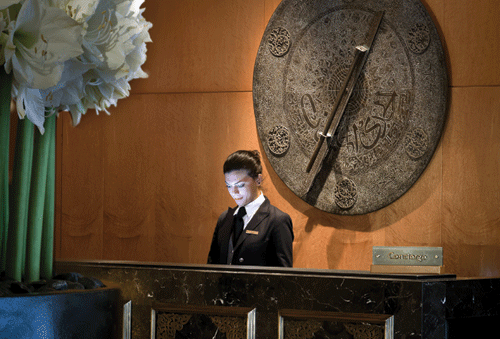
Hospitality: Where everything is possible

by Zak Brophy July 3, 2011
written by Zak Brophy


The job of a concierge in a five-star hotel is a portal into the stratospheric world of the super rich, a front-row view of how the ultra well-heeled live. Sometimes it is amusing, sometimes shocking and sometimes downright weird.

When paying top buck for service, guests can, and often do, expect everything on a platter. “I cannot say no to any request. Everything is possible, as long as it is legal,” said Reda Chaiban, senior head concierge at the Habtoor Metropolitan.

Chaiban exudes a genuine passion for his job. Having spent his working life striving to be at the top of his game, he sees himself as someone who can organize just about anything. “A concierge’s contacts are his toolbox. He needs to know everyone in town so he can fix any request,” he explained. 

Organizing a spot at the top table in town or a day out on a mega yacht is routine business for Chaiban, but sometimes he really has to go the extra mile to keep the guests happy. On five separate occasions a returning female guest has had him fly over from France one of the most desired hairdressers in the world. “Like I said, nothing is impossible,” he joked. But what about requests from guests with more illicit designs in mind for their stay in Beirut?

Walking on the wild side

 Chaiban was adamant that none of the staff at the five star hotels would get involved with organizing drugs or prostitutes for visitors.  However, the lines of distinction can become a little blurred.   A concierge from another five-star hotel told Executive, on condition of anonymity, that “there is normally someone in the hotel that knows someone outside who can arrange these things, but it is true we don’t fix it ourselves.” It’s a simple case of passing on a phone number.

The same concierge spoke about a party of men who booked the penthouse at a cost of more than $20,000 per night to throw private parties. “Every night they would bring between 30 to 40 prostitutes, and even if they didn’t sleep with them they would pay them several hundred dollars just for coming,” he said. “People pay up to $5,000 a night for a prostitute; some will pay more for a virgin,” he added.

Official policy is to inform the police if staff members are aware of illegal activity going on in the hotel. But the anonymous concierge smirked at this suggestion. “Even if we suspect illegal things are going on in people’s rooms, we don’t get involved. Quite simply it’s none of our business,” he said.

There is a prince from Saudi Arabia who is infamous amongst Beirut’s hotel staff for his outlandish requests, which have earned him the soubriquet “The Golden Boy”. A receptionist, again speaking anonymously, explained how the prince always books the same penthouse at one of Beirut’s most prestigious hotels. “He has all the windows blacked out, the whole floor carpeted in sheep’s fur and he will only wash in Perrier water or laban,” he said.

Tips are what makes the often-demanding job worth it and are an integral part of the hotel staff’s income. “If I told you how much I earn you would cry,” lamented a senior concierge at a high-end boutique hotel. “But in a good month in high season I can take $12,000 in tips,” he added with a wry smile. Tips don’t always come as notes greasing palms either. “The tips can come as gifts such as perfume, an iPad or an iPhone. Sometimes the guests come to see you as a friend so they want to give you a gift,” said Roxanne, a concierge at the Four Seasons.


July 3, 2011 0 comments
0 FacebookTwitterPinterestEmail
Society

Homes: A full house of assets

by Rayya Salem July 3, 2011
written by Rayya Salem


With a few Lebanese names solidified on the regional stage of furniture design, Lebanon is becoming more aware of furniture as an art form and investment. Executive spoke with some of the country’s biggest players in the field to discover where Lebanese designers are in the maturing world of Arab furniture design.

Art that you sit on

American University of Beirut graduate and London-based designer, Zaha Hadid, made a series of 24 chairs for international architecture and design firm Sawaya & Moroni, the prices for which start at $150,000. This price tag may come as a shock, but Gregory Gatserelia, founder of Beirut-based Gatserelia Design, urges customers to look at the pieces as assets.

“It’s not money paid, it’s money invested,” he says. “So I tell my clients that art is money well invested if you have a good consultant.” Gatserelia just opened SMO Gallery in Beirut to showcase his favorite collections, which include a couch and table of his own design.

Gatserelia says that the creative Lebanese crowd is becoming more and more interested in attending art galleries and shows and they are more aware of certain “collector pieces” or newly available pieces at galleries and showrooms. He works on behalf of clients to acquire those items. Gatserelia’s main business remains interior and architecture design, mostly of Middle East and North African residential and commercial projects, and he is now commissioned to work on the architecture and interiors of the 200 villas in the upcoming Nikki Resorts in Croatia.

“We just commissioned Ross Lovegrove to design a set of suspension lights and a dining room table that is molded into one unique piece, to be installed in a client’s Sursock residence. It’s molded in fiber-carbon through a technology we can’t master here in Lebanon,” he says.

The exclusivity of the piece (only two were made alongside the original) will allow the owner to ask “three or four times” the piece’s original cost, if and when he sells it. 

Despite investment considerations, Gatserelia is careful to keep ‘passion’ as a main ingredient in the art collection process, even though anything that’s properly marketed can be made into an investment item.

“If I see that [someone] is not interested [in the quality of the art], [I will] never get rid of a piece to a person who doesn’t appreciate it, just because [they] have the money.”

A particular soft spot shows for his favorite pieces: “I have pieces [a set of stools] designed by Bernard Khoury that I consider more valuable than all my pieces combined.”


It’s all about the name

With few competitors in the field of Lebanese furniture design, Nada Debs, chief executive officer of design company East & East, has carved out a profitable niche for herself after originally starting out as an interior designer.

Debs’s uniquely Middle Eastern outlook makes her pieces instantly recognizable — a plus that has helped her build her brand since she returned to Lebanon from London. Debs is most known for the “arabesque modern Arabic style” throughout her hand-made furniture lines.

Her company’s name represents the combination of Far Eastern sensibility and Middle Eastern details. The popular mix allows for shipments all over the world, with 40 percent of her products sold abroad, mostly in the Gulf.

“Our customers from the West see our pieces as exotic and authentic, whereas our Middle Eastern customers like the craftsmanship element and handmade detail, which reflect our culture and emotional belonging to the region. Even in the [Gulf Cooperation Council], people who originally liked the whole contemporary Italian look now prefer more subtle furniture and warm colors,” said Debs.

Her limited edition series, ‘Middle East Bling Bling’, included pieces, such as an arabesque chair and a chrome pebble table, infused with mother of pearl. Price-tags for tables in this line begin at $60,000.

Though she admits that many people think her work is overpriced, rising costs of labor and materials leave her with little room to maneuver.

“In the Arab world, labor isn’t cheap like in China. Import taxes make the price 30 percent more, as pieces are made with imported wood, brass and chrome,” she says.

But customers still save on local brands when compared to importing European-made products, which are more expensive, even if they are machine-made. But that won’t be the case for long, it seems. “Definitely, people are more interested in local craftsmanship, not commercial pieces,” says Debs. The proof is in the numbers, as revenues for Debs have grown about 10 times since she started a decade ago, she says.

But it is the corporate deals and special orders that keep her name rapidly circulating in a region that has a sweet tooth for known, often foreign, brands.

As an example of her growing regional prominence, 700 small pieces, such as vases and candleholders, were shipped off to a Middle Eastern royal family last year, and similar bulk orders are popular among Middle Eastern companies who distribute the items among employees as end-of-year gifts.

Recently the Museum of Modern Art in Qatar purchased a “concrete carpet,” which will be exhibited as an art installation and will be part of their permanent collection.

Entrepreneurship organization Endeavor Lebanon, whose London International Selection panel of six judges chose Nada Debs (and another Lebanese business) out of companies from 8 countries, sees potential in Debs and plans to make her company a globally recognizable brand.


July 3, 2011 0 comments
0 FacebookTwitterPinterestEmail
Society

Q&A – Fady Chams

by Rayya Salem July 3, 2011
written by Rayya Salem

After starting out on the Cannes interior design circuit, Prospect Design International’s Managing Director, Fady Chams set up the second branch of the boutique design firm in Dubai in 2005. The firm’s work has been ogled by the eyes of the jet set, with a portfolio that includes the VIP Room in Saint Tropez, to world-famous Movida and Maddox in London, to the iconic art deco Sass Café in Monaco. Closer to home, Prospect left their mark on Beirut’s La Plage beach and Palais nightclub. Though the firm has worked on high-end projects from Casa Blanca to Kazakhstan, the Middle East’s highly hospitable climate remains the focus for their well-secured niche within the interior furnishings market.

How did you become a high-profile interior design company so quickly, designing interiors of exclusive high-end clubs and restaurants in Monaco, London, France, and the like?

My brother Sami, after having worked with Ralph Lauren Interiors and many other brands in the south of France, set up Prospect Design in Cannes in 1996. Several friends asked him to design restaurant interiors, which became very successful, and we became specialists in that domain of hospitality design. We were thinking to open Prospect Design in Beirut but security and investment-related factors didn’t allow us to do that.

Do you position yourself as designers in the luxury segment?

Not necessarily. We do high-end and we can provide a mid-end French classical Provence house, which is rich in natural materials, [such as] French antique wood, without having necessarily the highest technology and the expensive marble and so on.

Wasn’t Palais the biggest budget project in hospitality at the time?

No, not at all. To tell you, it was approximately half a million dollars, which is acceptable when you consider they already had the services, electrical, mechanical, air conditioning and so on. There is big competition in Beirut, especially for [design in] hospitality. Now, we have a lot of private clients for residences… and hope to design a boutique hotel but that is all related to the political and security situation.

When you compare the market for luxury hospitality design in Beirut with the regional market, do you see major differences?

In Beirut there are no limits compared to the rest of the Middle East. You can open a restaurant and club wherever you want and you are allowed to sell alcohol and open from very early until very late. In Dubai, [if you are a restaurant that sells alcohol] you have to be in a hotel, which affects our design.

What makes it so demanding to work on a luxury restaurant?

You cannot just design a very nice restaurant [based purely on aesthetics]. When it comes to operations you have a lot of problems with the lighting, the seating or the circulation around the tables. Also, going for a contemporary style or a classical style will definitely last much longer than something futuristic with a lot of LED lighting and changing colors.

Did the economic downturn impact your business?

Yes and no. Back in 2008, some clients started to freeze their spending. But we do not have a lot of overhead… Before the crisis in Dubai, we were approached by maybe 20 people a week; 90 percent of them were…wasting our time. Now, if we get approached by four clients, three of them are very serious and have the funds.

What was the most expensive project you ever worked on?

There were some private residences… that included an indoor swimming pool, a nightclub, a basement tennis court, you name it. In hospitality, it is a business with projections and a feasibility study and goals to meet. They don’t care if I put a gold-plated part in the ceiling or something that looks like a gold-plated part. But the private client would want gold-plated.

How did your strategy develop to combine luxury items with mid-range items in your designs of hospitality spaces?

It comes naturally since in most projects no one has an open budget; we are therefore quite skilled in mixing-and-matching a very expensive sofa with a less expensive table and a chandelier that is not a Swarovski one…to create a unique design. If you want a wall covering, I can find you five similar coverings at very different prices.


July 3, 2011 0 comments
0 FacebookTwitterPinterestEmail
Economics & Policy

Redialing discord?

by Sami Halabi July 3, 2011
written by Sami Halabi

To describe Lebanon’s telecommunications sector as politicized would be an understatement on par with saying the summer of 2006 was eventful, or that Hezbollah and Israel enjoy a good game of tag from time to time. Since its heyday atop the pyramid of Arab telecommunication industries in the early to mid-1990s, the sector has become little more than a wounded lamb at the mercy of the packs of hyenas roaming Lebanon’s political plains. Today the sector has the dubious distinction of having the slowest average Internet speed in the world and the highest prices for those same services in the Middle East.

“We are lacking so many basic things and the entire root cause of our despair is the governance of the sector,” said Riad Bahsoun, telecom expert at the International Telecommunications Union (ITU) –– the arm of the United Nations that deals with information communications technology. “It’s the domination of politics over performance. It’s the subjection of intelligence to force and collective interests to individual will. This is called tyranny and despotic governance.”

This high-handedness was on full display in May, when the lack of reform and the hyper-politicized decision-making in the sector culminated in an embarrassing encounter between Charbel Nahas, then the telecom minister allied with the March 8 coalition, and hundreds of members of the security forces, who prevented the minister’s team from entering one of the ministry’s buildings in the Adlieh district to dismantle a non-commercial cellular network that had been operating in parallel to the country’s two commercial operators.

Submarine cables coming to and from Lebanon

The confrontation apparently came about when Abdulmenaim Youssef, who is allied with the opposition March 14 coalition and heads Lebanon’s incumbent fixed-line public operator OGERO, requested that the head of the Internal Security Forces (ISF), Ashraf Rifi, who is also allied with the opposition, guard OGERO’s property from the ministry’s prying eyes.

OGERO was created in 1972 and controls the country’s fixed-line services as well as its current Internet infrastructure. It acts under the “supervision of the telecom ministry”. However, it is also financially and administratively independent, in accordance with the law that created it, and answers to the directorate general of operations and maintenance at the ministry, which has also been headed by Youssef since 2007.

Immediately after the Adlieh incident, the political mudslinging began. The convoluted arrangement over who had authority to see, dismantle, own and operate the network descended into quarrelsome disputes over the constitutionality of the move, the civilian rule of the security forces, wiretapping, illegal phone lines and so on, until the issue finally faded into the background. Lebanon emerged from the fracas minus one favorably regarded and technocratic interior minister (Ziad Baroud, who resigned following the incident) and no further along the path to reform.

Legal arguments aside, the cellular phone network Nahas was attempting to confiscate from OGERO was given to the Lebanese government as a gift in 2007 by the Chinese government, through the multinational telecommunications company Huawei. At the time, Lebanon was preparing to liberalize the telecommunications market and introduce Liban Telecom, a legally mandated government-owned body with a corporate framework that would eventually replace OGERO and take on most of its assets. The gift provided the Chinese with an opportunity to enter the market as it was opening up and to prove that its companies were capable of running a high quality network. At the time, the technicalities of the donation were negotiated by OGERO under Youssef’s purview was director general of the company.

According to ITU’s Bahsoun, when questions were raised about whether the network should be monitored by the Telecom Regulatory Authority(TRA), Youssef said that it would be used solely for testing purposes and hence, as a non-commercial network, it would be overseen by himself and not the TRA. Youssef did not respond to repeated requests for comment.

The gift, however, did not arrive until 2009, when the current Energy Minister Gebran Bassil was heading up the telecommunications ministry and plans to set up Liban Telecom had effectively been scrapped due to political wrangling. By this time a row had erupted regarding a new wiretapping law that would take authority over such issues away from the Information Branch of the ISF and split it between the ministries of justice, telecommunications and the interior. In 2007, after the network had been pledged, the interior minster put in a request to the Council of Ministers, Lebanon’s cabinet, to allow the Information Branch to use the network for intelligence purposes. The permission was denied.

“In my opinion this was rejected in turn by the Information Branch,” said Bahsoun, though he stressed that he could not confirm such information. “The Information Branch probably decided to [use it] anyway without formal legal coverage,” he added.

Whether or not the network was used for intelligence purposes will likely be an ongoing source of bickering among Lebanon’s politicians, but the capabilities for such an operation were certainly there. The network was widely reported to have a capacity of 50,000 lines that could have been employed outside the two existing cellular networks. Speaking to the Lebanese Broadcasting Corporation last month, opposition Future Movement Member of Parliament Ghazi Youssef said the network contains a total of only 15operational lines.


“They say that the OGERO equipment is made up of 62 base stations [part of the cell phone network which handles communications between phones and the network] in addition to the core; the intelligence system that manages all of this is there,” said Imad Tarabay, secretary general of the Lebanese Telecom Association (LTA), which represents Lebanon’s private-sector data and Internet providers.

According to Bahsoun, a staunch opponent of Minister Nahas, this equipment was consolidated at some point at building in Adliyeh and this allowed for a more powerful network which he suspects played a part in uncovering some of the Israeli spy networks in the country over the past several years.

“If this network is operating 15 lines, why does it need 400 people to protect it?” he asked rhetorically, referring to the reported number of security forces present at the building when Minister Nahas tried to enter. “The truth is that the Information Branch could not accept in any way the minister of telecommunications or a team apart from theirs to inspect the equipment.”

3G connection

What ultimately emerged from the fiasco is that even if the minister was attempting to lift the lid on any alleged wrongdoing, he was also trying to speed up the implementation of the contentious 3G mobile Internet projects that he launched last January after the cabinet had collapsed, in conjunction with mobile operators Alfa and mtc.

As Executive reported in March, there have been numerous unanswered questions over the legality of the 3G project, due to the fact that it was launched while a caretaker government was in place, and neither the legally required licenses nor frequencies from the TRA and the cabinet have been granted to the companies that will conduct it. Moreover, the prospect of a faster, better service being provided by the public sector, without private sector access to the market, has fueled a campaign against the plan, spearheaded by Tarabay, chief executive of the private sector company Cedar comand distributor of the Mobi wireless Internet service. Tarabay co-owns the company with the son of opposition MP and former Telecommunications Minister Marwan Hamade, and contends that Nahas is attempting to nationalize the telecommunications sector.

He says he has prepared legal files against the telecommunications ministry and is prepared to submit them to the Shura council, Lebanon’s highest court. This comes after an unsuccessful attempt at arbitration through the TRA that, perhaps predictably, did not take action against the ministry it depends on for financing; the TRA spent several months this year without the money to pay its employees.  The TRA also did not respond to repeated requests for an interview.

Most of the controversy surrounding the legality of 3G stems from two contentious issues. The first is telecom Law 431, which states that licenses and frequencies must come from the cabinet and the TRA respectively. Second is unfair competition as a result of exorbitant tax discrepancies between public and private service providers, which would likely come about if the project moves forward.

With regards to Law 431, former Telecommunications Minister Nahas’s response has always been the law is not applicable, ostensibly because it has not yet been implemented in its entirety. His position got a boost last month when he announced that he had seen a Shura council decision stating that the law had been “suspended” because of Article 51, which states that “all applicable[previous] legal or regulatory provisions remain effective until the enforcement” of the law itself. Translation: the law and all the institutions created under its jurisdiction, such as the TRA and Liban Telecom, would also be technically suspended. As Executive went to print the ruling had not yet been made public.

“Law 431 is applicable and being implemented,” insisted Imad Hoballah, acting chairman of the TRA, at a press conference intended to respond to the minister’s statements last month. Hoballah went on to describe the licenses and frequencies that the TRA had given out over its four-year term, though he admitted that these had been handed out before the Shura council decision. Previously, the Shura council has ruled against the ministry and in favor of the TRA but there is speculation this ruling could be particularly pernicious for the TRA.

“We respect the decisions of the Shura council and we will follow them,” Hoballah said, insisting that the decision does not negate the entire law. Asked what the TRA would do if the telecommunications ministry issued 3G frequencies that the regulatory agency is legally mandated to allocate, he declined to comment, saying only that if the telecommunications ministry decides to go ahead without allowing the private sector to participate, “no one can stand in its way.”

“Fundamentally, the TRA has eight months left,” contended Antoine Boustani, an advisor to Minister Nahas, speaking to Executive last month. Boustani’s position, like that of Nahas, is that because the law that created the TRA is not fully implemented, “it’s already obsolete”.

“We don’t decide to implement the law; the Council of Ministers decides. We are moving forward on the basis of the authority of the ministry. When they say they want to implement the law [in full] we are ready,” he said, denying that the ministry officially seeks to shut down the TRA.

“I’m not stopping until I get my rights,” Tarabay snapped back defiantly, adding that he will file court cases against the ministry but is waiting to see the Shura council decision to “fine tune” his lawsuit in line with the status of Law 431. 

But according to Boustani, Tarabay will soon have little to complain about. Last month he told Executive that the ministry plans on leveling the playing field between the private sector and public sector by decreasing the taxes on the former by “50 to 55 percent.” Asked whether the private sector will be allowed to enter the market, he said “byiswa” — an Arabic word suggesting that something on this front could happen and would be a positive — though he couldn’t confirm or deny it. “We will ask for it [in thecabinet]; we don’t have a problem,” he said, adding that such a request “isliberalization, not privatization.” 

He also said that a long-awaited policy statement that waspromised by the minister one year after he took office would soon be issued.The issue has become a major talking point for opponents of Nahas, includingthe TRA, who say that he has no policy and works according to his own whims.Nahas’s response has always been that the ministry’s policy is a matter of“practice not paper.”

Of course, Boustani is not an advisor to the newly appointedTelecommunications Minister Nicholas Sehnaoui, but the latter is widely seen asNahas’s protégé and has already stated that he will follow the same course asthe previous minister. If he adopts Nahas’s purported policy — which Boustaniconfirms is “almost done” — and makes it public, it would mean that the sectorwill have a general set of rules mandated by the ministry under Law 431 for thefirst time since former Minister Gebran Bassil was in office from 2008-09. Thiswould be significant, as it would provide an indication of the minister’sintentions vis-à-vis the many contentious issues in the sector.

Money to make

Bickering aside, the ministry has been pressing on with the3G project, as have both Alfa and mtc. The attempted takeover of the telecomequipment by Charbel Nahas in May can be seen as part of this aggressive pushby the ministry to make the 3G project a fact on the ground as quickly aspossible, before legal issues potentially complicate such plans.

According to Bahsoun and Tarabay, the equipment at Adlieh can technically be upgraded and used as part of the 3G rollout currently being undertaken by Huawei and mtc. Huawei won the contract to build the new network for Mobile Interim Company 2, the state-owned cellular telecom company managed by mtc. The Chinese company’s winning bid was valued at $25.6 million (not including a $2.7 million control center that will be built by Nokia), $10.6 million less than their counterpart Ericsson, who won the 3G contract at Mobile Interim Company 1, the state-owned cellular telecom company managed by Alfa. Both Bahsoun and Tarabay estimate the value of the third network’s equipment, once upgraded, to be around $10 million, (thus making up the difference between the two bids).

Both Alfa and mtc stand to benefit greatly from the 3G project, on top of the revenues they already garner from the talkative Lebanese who pay 58 percent in taxes on all telephone services. Zain’s mtc, for instance, has increased their net earnings from $22.1 million in 2008 to $46.1million under their current management contracts. In January, under the caretaker government, Minister Nahas renewed their contracts for a year.

“We extended 12 months when the minister thought that if these two companies are going to go into the 3G project they need security. They said they need more than two to three months to do such things,” said Boustani.

India-Middle East-Western Europe III

So with the two companies locked in a yearly contract, the Shura council ostensibly on the ministry’s side with respect to Law 431, the TRA hobbled and toothless and Tarabay’s cases needing some time to come to fruition, there seems to be little stopping the 3G project from materializing sometime around the end of the summer. Except for one hitch.

In 2007 Lebanon entered an international consortium to construct a submarine fiber-optic cable from Europe to India —

called the India-Middle East-Western Europe 3 (IMEWE3). Lebanon has already invested some $53 million into the construction of the underwater sea cable to carry traffic and unclog the international bottleneck Lebanon has long suffered.

“Capacity has to be met at all levels,” said Ghassan Hasbani, chief executive of the International Operations group of Saudi Telecom Company (STC), which is part of the consortium and is using the cable. “If you have a high speed local connection network and clogged capacity on your international gateway, then access to international content becomes very slow. These have to come together and the more connectivity there is in the country the better the prospects of lower pricing, of routing for traffic, and the better accessibility you have to the rest of the Internet globally.”

According to a source from the consortium, who asked for anonymity because he was not authorized to speak to the press, the contract between Lebanon and the consortium was signed by “OGERO Telecom”, which is not the official name of OGERO. At the time, the creation of Liban Telecom seemed imminent due to political consensus under the Saniora government and then Telecommunications Minister Marwan Hamade. Director General Youssef and the minister were ensconced on the same side of the political fence, enabling them to lay the groundwork for their political camp’s control of the sector. By December of last year the cable was ready to go and all other member countries of the consortium had started to use it. But by then the political stars of the telecommunications ministry were anything but aligned.

Engineers at Alfa have already confirmed that the 3G project will need IMEWE3 to function. Currently Lebanon’s international connection is through the Cadmos cable connecting the country to Cyprus, through which Boustani admitted a bottleneck would occur if there was a large amount of traffic as would be the case if 3G were introduced. The Cadmos cable also leaves Lebanon at the mercy of Cyprus for international bandwidth.  This is ominous as trouble has been brewing between the two countries over a maritime economic zone agreement between Cyprus and Israel.

Official data is not available, but most estimates are that Lebanon is currently using 2.5 gigabits (Gb) of legal bandwidth. However, Boustani says that the Cadmos cable has 40 Gb available for use after its recent upgrade. IMEWE3 has an initial 30 Gb and can be updated to 1.4 terabits. Thus, according to Hoballah, Lebanon is currently blocking 97 percent of its international bandwidth.

In order to activate the IMEWE3 cable it is necessary to log onto the consortium’s system with a secret code, which according to a consortium source is something only Youssef has the details of.  Again Youssef did not respond to repeated requests for comment.

“We paid a total of some $53 million and we are not using[it] because one person [Youssef] says ‘I don’t want to’ and the collective interest becomes subject to one person,” said the ITU’s Bahsoun.

According to Boustani, the ministry sent a commencement order to OGERO to oversee the project and has since asked for the ownership of the IMEWE3 to be transferred back to the ministry; this is what Youssef has refused to do. “There were some people who were supporting him politically. It used to be former Prime Minister Fouad Saniora but I don’t think today that Saniora will cover him. We hope that this government will lift this political cover so we can work,” he said.

What will also need to occur is the negotiation of an agreement with a European operator to purchase capacity in order to transfer information from Marseille, France (where the cable ends), so that traffic to and from the rest of the world via Europe can come into the cable. The going price for such traffic is about $2 per megabit per second (Mbps) per month, which means that 10Gb of capacity would cost some $20,000 per month. Given that the cellular network alone generates some $3 million each day in Lebanon, this is a relatively trifling sum.

If Lebanon wants full redundancy, in case the European side is cut, they can also negotiate the same contract in India, at the cable’s other pole. Such negotiations take about a month to complete but again this would need to go through Youssef’s office at the ministry as long as he maintains control of the post of director general. Nonetheless, Boustani says the ministry is in direct contact with France Telecom discussing such an agreement.  

Since it was Youssef who negotiated and carried out theIMEWE3 project with the consortium, when the telecommunications minister contacted its management committee to try and wrest control of the cable, the consortium became predictably confused. In the end they decided to take a “hands off” approach, according to the source. Of course the fog of Lebanese laws, their seemingly inconsistent application, and the autonomy of public institutions, especially OGERO, has not helped.

“Youssef sent a letter to the consortium telling them not to hand [it] over to the minister, and he does not have the right to do so,” said Boustani.  He would not comment on whether the ministry would take legal action as a result.

Even if the consortium is convinced to transfer control, the procedure stipulates that when OGERO hands control of the cable over to the ministry it initially does so through the Directorate of Operations and Maintenance, whose head stamps the handover and transfers the asset to the minister’s office. As Youssef himself holds that post, there seems to be scant chance of that happening.

According to Boustani, at the meeting of Arab telecommunications ministers held in Beirut last month the ministry received important political backing that he thinks will see the IMEWE3 handover soon, although this could not be independently verified.  This would not solve Lebanon’s Internet woes outright, however. “Even if IMEWE3 is activated, what use will it have if the ministry of telecommunications sells the international E1 line [2 Mbps] to [private sector] service providers for $3,000, while costs on them is less than $30?” asked Tarabay.

“The Internet cost to the consumer will remain high,” he said, unless the price of E1 falls and Internet Service Providers (ISPs) have access to the bandwidth. Lowering prices requires a decree to be issued by the cabinet because the sector is still not liberalized as per Law 431. Bandwidth will then need to be handed out by the ministry under the directorate general of operations and maintenance — again Youssef’s office.

But while Youssef may be a major roadblock to better Internet, other projects will also need to be completed to see the sector reach an acceptable global standard. According to Jean Gebran, projects director at Consolidated Engineering and Trading Company (CET), the Court of Accounts, the government’s public sector auditor, gave final approval in May to a project to construct the telecommunications ministry’s $40 million fiber-optic backbone throughout the country. CET and Alcatel will carry out the project, which has already begun in the South and the Bekaa valley. It is expected to take 16 to 24 months to complete, according to Gebran.

Furthermore, the ‘last mile’ connection from the fiber to homes will also need to be completed. But in the short-term, even without these projects, 3G service can technically run and allow speeds in the range of 21Mbps, compared to the current average of 0.1, even if this may kill private sector participation in the sector.

Time for action

With a new cabinet and a new minster that are both technically on the same side, there is some renewed hope amongst those in the sector that the coming period will be less fraught with conflict. A government of a single color may be more willing to see off some of the old opposition guard (starting with Youssef), but who they choose as a replacement is entirely another matter, and what the market will look like after any reshuffle of institutions, laws and people may just end up resulting in the same stagnation that has plagued the industry for over 15 years.

“It is very difficult if you ride a donkey to reach a high summit, even if you choose the direction,” said Bahsoun, referring to Lebanon’s telecom policy decision makers. “It’s impossible to reach it if you let the donkey choose the way. However, if you carry the donkey you will die. We are still carrying donkeys and paying for their food.”

But today one side of the political divide can no longer blame the other for obstructing policy implementation. “You don’t have two sides anymore so you don’t have anyone to delay,” said Boustani. Thus, there are no more excuses.


July 3, 2011 0 comments
0 FacebookTwitterPinterestEmail
Society

Is that a no. 9?

by Paul Cochrane July 3, 2011
written by Paul Cochrane

Demand for cigars is so strong that the sector is inundated with counterfeits. An estimated two thirds of cigars smoked in Lebanon are “fake”, with a Honduran, Dominican or Nicaraguan stogie attempting to pass itself off as the crème de la crème of smokes, the Cuban cigar.  It is not easy to notice the difference until one sparks up, as the counterfeiters are pros, switching the paper ring around the cigar for a Cuban brand and using real or counterfeit boxes.

The situation has become such a concern to the legitimate sector that leading distributor, La Casa del Habano, owned by Phoenicia Trading, spent $50,000 this year on a billboard and media awareness campaign to inform consumers about fake cigars, particularly the Cohiba brand.

“The Cohiba Behike is the most expensive and the most popular right now,” said Wael Zeidan, executive manager at Phoenicia Trading. “We classify consumers of fakes into two segments — one, a consumer that knows it is a fake Cuban but smokes it to show off and doesn’t care. The second is a beginner that is easily bluffed, so we focus on him.”

To ensure that fake Cubans are not being put in boxes as the container empties — a classic scam to bump the price of a $2 cigar up to, say, $30 — Phoenicia has undercover employees that go in to check for fakes at its 300 wholesale customers. They are also opening a new outlet to better distribute Cubans from its current five stores.

While Honduras and the Dominican Republic do produce high quality cigars, primarily for the American market due to the trade embargo with Cuba since 1962, such brands are more expensive in Lebanon than Cuban cigars. Hence the fake Cubans are lower quality and normally machine made. One to watch out for is the Cohiba Siglo no.9, as real Cohibas only go up to size six. “It’s so big, it’s crazy,” said Zeidan.

Cohiba is the number one brand around the world, and in Lebanon this is no exception. Top sellers are the Robusto size (50-54 ring gauge), which is ideal for a half hour to one-hour smoke. Cigarillos — the small, lean cigar just a centimeter longer than a cigarette — are also becoming more popular, with Phoenicia Trading bringing out its own brand, Phoenicio.

“Demand for cigarillos is starting to grow, and women are increasingly smoking cigarillos,” said Zeidan. As cigars have a somewhat “old man” reputation, every month Phoenicia holds a breakfast cigar event for women in Ashrafieh, and has introduced cigarettes into Casa del Habano “to get youngsters into the shop and to find out about cigars,” said Zeidan. Pushing sales further are the cigar lounges at some of the capital’s leading hotels. At Le Gray, cigar nights are coupled with tastings of single malt whiskeys. And awareness of cigars is rising, said Paul Atallah, wine and bar manager at Le Gray.

“Some 80 percent of people know what they’re smoking. The rest, it’s just to show off that they are cigar smokers while swallowing the smoke,” he said. “But the culture has changed, and we’re seeing more people go for [brands] Partagas and Hoyo instead of Cohiba; this shows a change in awareness.” Most of the hotel’s cigar aficionados are guests from out of town but it is increasingly attracting non-guests to come to enjoy a cigar, sip an Armagnac and relax.

The economic downturn in the country has affected sales but the 400 percent rise in people smoking cigars since 1980 has provided a loyal customer base. “People get used to smoking cigars, and they continue to buy them,” said Zeidan. Indeed, big spenders are still out there. On a recent Saturday at La Casa del Habano in downtown, a customer bought a whopping five boxes of Cohibas as well as several packs of cigarillos.


July 3, 2011 0 comments
0 FacebookTwitterPinterestEmail
Finance

On the spot – HSBC’s Simon Cooper

by Executive Staff June 26, 2011
written by Executive Staff

Simon Cooper is deputy chairman at HSBC Bank Middle East and North Africa (MENA). He recently sat down with Executive to discuss the effect of the regional unrest on business and investment in the MENA region, as well as growth opportunities for the future.

June 26, 2011 0 comments
0 FacebookTwitterPinterestEmail
Society

Lebanon Tourism Special Report

by Executive Staff June 26, 2011
written by Executive Staff

As the traditional source of tourist dollars dries up from the Gulf, Lebanon must look within if it is to maintain the momentum of this key driver of the country’s economy. Executive takes a quick trip to the beaches of Lebanon’s southern city of Sour, via the crusader castle and ancient souks of the historic city of Saida

June 26, 2011 0 comments
0 FacebookTwitterPinterestEmail
Editorial

Arabs and advocacy

by Yasser Akkaoui June 4, 2011
written by Yasser Akkaoui

Search Amazon for books on lobbying and advocacy and you will find more than 9,000 on the subject. It does not take 60 years to understand the American system of checks and balances. All you need is a cause, conviction and the tenacity to keep pushing your message until it is heard and repeated by congressmen, senators, the media, influential personalities and the president. Mobilize networks of mutually-interested individuals to muster electoral money and resources for candidates that supports your cause, and, voila! Welcome to influence.

To have the world’s strongest economic power as an ally, learn the local vernacular and the ideological concepts that resonate. A little bit of democracy and a whole lot of fiery advocacy for a few decades or so should earn the leaders of your cause a regular spot to speak at congress and, if you’ve manage to scare the politicians enough about their dependence on you for reelection, expect them to jump to their feet and offer 29 standing ovations for a 45-minute speech.

This is the prism through which the Middle East and North Africa needs to assess Obama’s ‘Arab Spring’ speech, in which he outlined a new era of America engagement within the region; undoubtedly he supports the concept of Arab democracy, but this will extend only so far as it does not conflict with his reelection, and at the moment it is not the Arab lobby whom he feels beholden.

For Arabs to ever be the primary consideration and beneficiaries of American policy in the MENA, they must create an energized and expansive lobbying network — not just in Washington, but in every major US state. Then, perhaps, when another American president unveils a new US policy direction for the Arab World, it will be to the Arab American Political Action Committee that he offers his justifications.

For this we would need real leaders, and leaders we have none.    

June 4, 2011 0 comments
0 FacebookTwitterPinterestEmail
Economics & Policy

The GCC expands

by Fabio Scacciavillani June 4, 2011
written by Fabio Scacciavillani

The ‘Arab Spring’ is yielding some unexpected and exotic political fruits. The proposal to accept Jordan and Morocco into the Gulf Cooperation Council is certainly among the most intriguing, and it was followed almost immediately by Palestine’s request to join.

GCC Secretary General Abdul Latif al-Zayani announced that the current six members (Saudi Arabia, Kuwait, United Arab Emirates, Qatar, Bahrain and Oman) would welcome Jordan and Morocco into the bloc, saying that meetings “to complete procedures” are to be initiated soon.

Given the swift response by an institution not known for the timeliness of its decision-making process, it is likely that there were earlier discussions on this matter at the highest level (although Kuwait, Oman and Qatar reportedly expressed reservations about the move, preferring a limited membership, like that of Iraq and Yemen, confined to cultural and sporting events).

Previously, Jordan had shown interest in joining the bloc, but its requests had been politely turned down. Yemen’s request for membership has stalled for years but the country, though currently embroiled in political unrest, hopes to join by 2016. On the other side of the region, Morocco has apparently been invited to join.

This development could mark the coming of age of an international forum with ambitions to be a sort of Arabian version of the European Union, but which has been marred by a weak institutional framework and erratic procedures. Created in 1981 as a bulwark against a perceived threat from Iran, the GCC’s original agreement was ambitious in scope and covered vital areas with the potential to reshape and modernize the economies of the Gulf, while fostering a common foreign and security policy in a region endemically at risk of destabilizing crises. These included:

  • Harmonizing regulations in economy, finance, trade, customs, tourism, legislation and administration
  • Promoting scientific and technical progress in industry, mining, agriculture, water and livestock
  • Establishing scientific research centers
  • Setting up joint ventures
  • Establishing a unified military presence (the Peninsula Shield Force)
  • Encouraging cooperation of the private sector
  • Strengthening ties between populations
  • Establishing a common currency by 2010

Within the GCC framework the six countries have undoubtedly made some progress, for example in creating a Customs Union, in freeing the movement of citizens (but not of foreign residents), in establishing a joint military force (which was deployed recently in Bahrain), in cross-border investments and capital movements and in a number of other minor fields.

However, there are two fundamental differences between the GCC and the European Union. First and foremost, the members of the EU have transferred national powers to EU institutions. The most visible, influential and famous of these is the European Central Bank, which exercises its monetary authority in full independence from any political interference, as enshrined in the Amsterdam Treaty.

In several additional key areas member states have devolved their functions to the EU Commission or other supranational bodies: international trade, antitrust legislation, agriculture policy and visa regulation. The EU Commission issues directives through a  common legal charter, which can span virtually any field, to which all national legislation must adhere.

In case of controversy or lack of compliance with a directive, the European Court of Justice can rule to force national governments to conform to EU legal provisions. Often pieces of national legislation are struck down by the EU Courts, which in some cases can even overturn the verdicts of national Tribunals.

Furthermore, one of the main achievements of the EU, the single market, allows for goods and other services to be traded freely across the EU and removes customs and passport controls between most member countries. One can travel from the Arctic to the Mediterranean without encountering a single frontier post. In essence the EU is a super-state with institutions that exercise powers even against the will of national governments, an elected Parliament and a body of laws and principles (the so called acquis communautaire), which is valid for all citizens and all the 27 countries. More recently the EU has adopted a Constitutional Treaty that establishes the fundamental principles guiding its actions and the decision-making rules.

By contrast, so far the GCC has been mostly a permanent structure of regional diplomacy, facilitating the exchange of views at the highest level. The implementation of decisions made by the GCC is the responsibility of national governments, not of common, independent institutions. The only (limited) exception is the Monetary Council, which is the precursor of the Gulf Central Bank to be established when, or if, the GCC issues a common currency. This will be the first genuinely independent supranational institution in the Arab world. But the plans for the monetary union, which was supposed to go into effect at the beginning of 2010, are proceeding slowly, with two countries (Oman and the UAE) out of six having declared their intention not to join.

The accession of the Jordanian and Moroccan monarchies to the GCC could help inject new life into the integration project and would mark a historic step forward, so long as it is conducive to an institutional framework modeled on the EU, with a devolution of powers at GCC level.

A major goal could be the establishment of a true single market, styled on the EU, with completely free movement of capital, goods and labor, plus an antitrust authority with pervasive powers.

At present, border controls, trade barriers and protectionist measures among GCC members are still very much in place (even to transfer a used vehicle between two countries requires a dose of patience and money which could be put to better use). This hampers the development of industries and economic activity that could create the several million jobs needed to absorb an increasing youth population, which, as recent events clearly show, is ever more restless and impatient.

On the other hand, the proposed enlargement might turn out to be just a political card played on an increasingly shaky table. It could very well be that the GCC’s newfound hospitality is intended to raise the six nations’ profile in the region and is more of an internal security pact by which member states would intervene in the case of internal unrest. If this is the case, the GCC would merely gain a front row seat to events unfolding in Algeria and Syria (as it already has in Yemen).

But for the GCC to limit itself to merely preserving the political status quo of its member states would be a missed opportunity: United States President Obama delivered a major policy speech on the Middle East last month, which foreshadows an unprecedented involvement in the region outside the security arena, and a clear indication — underlined by the explicit mention of the pre-1967 borders between Israel and Palestine as a natural negotiation platform — that the wind has dramatically changed.

The enlargement of the GCC could either constitute a myopic move for preserving the status quo (and another form of diplomatic jostling) or the means to address the roots of the economic malaise in the region by following a cooperative approach along the lines of the EU. The next few months will tell.

FABIO SCACCIAVILLANI is chief economist at the Oman Investment Fund

June 4, 2011 0 comments
0 FacebookTwitterPinterestEmail
Economics & Policy

An accelerating descent

by Executive Editors June 4, 2011
written by Executive Editors

The failure of a government to actually govern can be overlooked, and even ignored, when a country’s economy somehow manages to independently cook up growth, as Lebanon’s has, churning out annual increases of gross domestic product in the range of 7 percent for half a decade. During these years many seemed to regard the economy’s continued subscription to miraculous performance as assured by God while the fundamentals needed to sustain this growth, such as infrastructure, were rotting beneath their feet.  

Today, however, the boardrooms’ belief that Lebanon’s soaring growth is immune to the laws of gravity that apply to the rest of the world has disappeared, as first quarter results for 2011 clearly show that the country is entering an economic downturn. And now — with the fiscal forecast inclement and a government necessary to navigate the storm — it becomes painfully apparent how the intransigence of the competing political camps has left the Lebanese on a quickly sinking ship. Lebanon’s sectarian political divisions and the grinding stalemates they produce are at the root of the vast majority of the nation’s tangled shortcomings.

Executive does not pretend to have the formula to resolve the impasse and get a government formed and functioning again. Instead, the following report examines the most critical issues facing the economy, and if those whose responsibility it is to govern do manage to form a government that is actually empowered to enact and follow through on policy and reforms, what some of these should be in order to cushion the current fall and restart growth.

Counting in the dark

Typically, the International Monetary Fund issues its annual forecasts for the Lebanese economy around October, but this year it waited an extra six months to come out with a figure of just 2.5 percent real growth for 2011, down from an estimated 7.5 percent last year, signaling the end of the country’s economic honeymoon. The finance ministry has also signed off on the 2.5 percent estimate.

At a press conference last month, IMF Resident Representative in Lebanon Eric Mottu explained to Executive that the estimate took into account that, even if a cabinet was formed by the second half of the year, it would not be enough to cover the losses incurred during the first half of the year. The IMF’s growth projection for Lebanon is much lower than the fund’s regional estimate of 4.1 percent. However, not everyone agrees with them.

“The IMF have been wrong a number of times in their predictions,” said Marwan Iskandar, economist and chairman of Banque de Crédit National, before predicting that growth would be between 4 and 5 percent. “They used to tell us five or six years ago to reduce the burden of public debt because otherwise we [would be] in dire straits, and then they changed their tune to reducing the debt-to-GDP ratio,” he said.

One reason for things being better than the predictions could be Lebanon’s sizeable informal economy, which is not factored into IMF statistics. Iskandar said that staff at the fund’s sister organization, the World Bank, told him that they estimate the ‘informal’ economy to be around 30 to 35 percent of the size of the formal economy, though World Bank officials have denied to Executive making such assertions.

“They don’t want to say it publicly because it would make what they are saying irrelevant,” said Iskandar. “It would make the public debt something close to the [size of the] economy.”  Currently Lebanon’s debt-to-GDP ratio is widely believed to be somewhere over 130 percent. Jad Chaaban, acting president of the Lebanese Economics Association and professor of economics at the American University of Beirut explained that developing countries usually have an informal economy at about 20 to 30 percent and Lebanon was “above average.”

“The problem is we are not [even] measuring the formal economy,” he said.

Indeed, to make an accurate forecast one would need to know the base from which that forecast is being made. As Executive went to print official GDP figures were only available for 2009, which saw 8.5 percent real GDP growth. Because economies naturally evolve between periods of positive and negative growth or contraction, until the end of last year Lebanon’s economy appeared to be experiencing what economists call a “soft landing”, a pseudonym for the graphical representation of cyclical economic slowdown resembling a plane coming into land; if the IMF and the finance ministry are now to be believed, it looks instead like the country is going into a nose-dive.

“The IMF uses official government figures and they don’t contest them,” said Nasib Ghobril, head of economic research at Byblos Bank. “It might be optimistic; we still don’t know.”

The level of uncertainty has fueled speculation and has understandably resulted in a lack of confidence in the system. Reforms purportedly underway include a program, aided by the European Union, at the Central Administration for Statistics (CAS) to transfer the job of comprising national accounts away from the prime minister’s office and to the CAS. Yet how long that will take is anyone’s guess. In the meantime “it’s all a walk in the dark,” said Chaaban.

Without accurate and timely statistics, especially during times of political transition, those with an interest in using the economic situation to their own advantage — and there are many — have the upper hand. “People who want to make the numbers look bad, lower GDP growth and those who want to make things look good, make the numbers high. GDP growth becomes a signal for confidence in government and the country; same goes for the banks and financial sector,” said Chaaban.

Thus it is hardly surprising that public officials and the media from across the political spectrum have been eager to comment on the economic situation without having any real indication of just how bad things are, or could become. Those on the side of the recently deposed March 14 coalition have been quick to point out that March 8’s stalled efforts to form a cabinet have destroyed the economy, while the latter camp has accused the former of over-reacting to make the situation look worse that it actually is.

In fact, both camps are relying on the same scattered indicators that economists have come to depend on when trying to gauge Lebanon’s performance, due to a lack of national accounts which are themselves “the best available estimates”, according the CAS’s document explaining the national accounts reform program.

Adding to the hodgepodge of numbers and forecasts, the International Institute of Finance (IIF) — a global association of financial institutions — estimated that growth in Lebanon would reach 4 percent at the unveiling of their Middle East regional overview forecast in Beirut on May 15. When questioned by Executive about why the estimate was so different from the IMF’s, Garbis Iradian, deputy director of the Africa Middle East Department of the IIF, said the forecast was “probably optimistic” and assumed there would be cabinet in place in “a few months.”

Lebanon’s central bank is currently well positioned to defend the lira, at least in the near-term

The debt: the elephant in the room

So while there are scant reliable means to measure the latter half of the debt-to-GDP ratio, there is ample documentation regarding the former, and it is soaring; currently the Lebanese public debt is pegged at $52.6 billion. In the first quarter alone the deficit rose almost $1.1 billion, nearly double that of the corresponding quarter in 2010, taking the primary balance from surplus to deficit. Revenues are also dropping, particularly in excise taxes on gasoline and property taxes, which are expected to fall by 57 and 17 percent, respectively, according the IIF’s forecasts, given a slowdown in construction and cuts to the gasoline excise tax this year.

This has caused jitters about the government’s ability to finance the debt, and if real fears caught on in the market then borrowing to continue funding public services would become more costly, which could in turn erode confidence to the point that the currency’s stability would be put in question, though Banque du Liban (BDL), Lebanon’s central bank, is currently well positioned to defend the lira, at least in the near-term.

Additionally, the previous government’s mantra — that the debt was sustainable due to a decreasing debt-to-GDP ratio — has now gone out the window.

“The economy is not growing as fast; when it was growing strong, we saw a big improvement in debt-to-GDP,” said Saad Azhari, chairman and general manager of BLOM Bank. “Now I don’t think we can see this improvement because of the situation. We hope that [it] does not last long and we can have again stronger growth.”

Freddie Baz, chief financial officer and strategy director at Bank Audi, remarked: “If at 185 [debt-to-GDP ratio] we were not really concerned about the ultimate outcomes, its not at 130 or 140 that we will start being concerned.”

The relationship between the banks and the debt has seen worse days and even with the current economic downturn, and the expected rise in debt-to-GDP, Lebanese government debt still appears marketable, though at a somewhat more costly rate.

Last month the government rolled over $1 billion in Eurobonds in two tranches: the first for $650 million expiring in 2019 with a yield of 6 percent, and the second valued at $350 million maturing in 2022 and carrying a yield of 6.475 percent. The last Eurobond rollover in November 2010 carried yields carrying a weighted coupon average of 5.44 percent and an average time-to-maturity of 9.21 years, the lowest ever, indicating new upward pressure on debt financing. 

“It’s not us who decide the government will pay 6 or 7 or 8 percent, it’s the market,” said BLOM Bank’s Azhari.

Even if private demand for government debt dries up, it is likely that the BDL would itself step in as it has done in the past to buy up debt and keep the market stable. “Their goal is to ensure stability so they do what is needed. But this is something the IMF is totally opposed to and it’s a burden on the central bank’s income statement, which no one sees except the IMF,” said Ghobril.

“They will do it and of course this is not the best way,” added Iskandar. “It is the most inflationary way but under duress it is the one way to [keep] the government running.” 

At present BDL does not release its total holdings of government debt but instead a number of different figures that include vague statements such as “claims on the public sector”, which do not represent the actual debt. According to the Association of Banks in Lebanon, treasury bill holdings of the central bank, which it also issues, stood at $9.67 billion or 18.4 percent of the total debt at the end of the first quarter. Using a crude method of subtracting the central bank’s foreign currency holdings from its foreign assets, one can get an idea of the bank’s Eurobond holdings, or debt in foreign currencies, which came to a further $1.9 billion, bringing the total to $11.57 billion by the first quarter of 2011.

The governor’s office of the central bank did not respond to requests to disclose the total holdings of the bank’s public debt.

Another method used by economists is to assume that the “securities portfolio” of the central bank is comprised of only Lebanese debt, which would mean they hold $10.3 billion of public dues.  “The whole way it is managed is ridiculous,” said Chaaban. “We are selling ourselves. The banks are over exposed so the central bank buys T-Bills from their own portfolio but where does the money come from? From the [commercial] banks’ 15 percent required deposits! You are buying from yourself and giving from one pocket to the other.”

“The whole way it is managed is ridiculous…You are buying from yourself and giving from one pocket to the other”

Subsidies — popular but pricey

Compounding the debt problem has been the recent debacle over gasoline prices, which hit a historic high of 37,300 lira ($24.74) last month for one jerrycan (20 liters) of gasoline, even after a tax cut that will cost an estimated 1 percent of GDP, according to the IMF.

Last month the finance minister announced that a “temporary solution” was found one day before public transport workers were planning a major nationwide strike over the price of gasoline. The agreement between the finance ministry and the drivers is set to cost the government a further $15 million each month, for which it will take out another loan to finance the subsidy.

Proposals to cap the price at a level more acceptable to all consumers were deemed too expensive by the finance ministry, something many economists and consumer rights groups dispute.

“In all cases it is having an effect on the fiscal revenue, so at least do something tangible. Now you are not winning on any side,” said Ghobril, adding that even though this would eventually increase the amount of public debt, that was somewhat “more long term.”

“If revenues are going to fall at least let the citizens benefit,” he said.

Inflation picks up steam

Realistically, there are no short-term solutions to the debt or the deficit, but these are not what impacts their day-to-day lives. Headed in the opposite direction of GDP figures, inflation rates are expected to rise from 4.8 percent last year to 6.5 percent this year, according to the finance ministry.

Even this may be an underestimate as the figures which go into determining the Consumer Price Index, the CAS’ major indicator of inflation, only go back to December 2007, meaning that it does not cover price fluctuations of even one full economic cycle. Then there is the difference between what people feel in terms of rising prices and what the actual overall inflation rate is.

“An index [shows] an average, which is not necessarily indicative,” said Chaaban.

Still, the CPI published by the private Consultation and Research Institute showed an increase in March alone of 1.33 percent, and increased 1.95 percent in the first quarter of the year, well on pace to surpass the 6.5 percent full-year estimate.

According to most estimates, some 70 percent of the price increases come from import inflation — the increase in the price of imported goods. What’s more, during the first three months of the year the trade deficit increased 8 percent to $3.6 billion, due to a drop in exports of 7 percent and a rise in imports of 4 percent to total $4.5 billion.

The bill for “mineral fuels and oil” was 8 percent higher due to an average oil price of $105 per barrel during the first quarter compared to $76 per barrel last year. Trying to bring the price of oil down internationally is impossible for Lebanon but what is possible is to address the cartel that imports oil into the country.

“If you are a retailer and the material price is increasing you cannot really reflect this change to the consumer unless you are a monopolist. That’s why the [price of] gasoline has been rising because there is a cartel of importers,” said Chaaban. “We call this asymmetric price transmission because if the prices of imports rise you throw it out on the consumer, but if prices fall you don’t necessarily do so because your margin decreases.” But dismantling the oil-importing cartel will be complicated, as political heavyweights own the energy companies that operate the port and distribution, according to Iskandar.

Another option to decrease real inflation would be to de-peg the lira from the dollar and re-peg to a basket of currencies in line with the composition of imports, instead of the current practice where the central bank buys and sells US dollars in the market to keep the currency steady.

“Because the central bank has so much in reserves they don’t want to change the model now because no one feels the heat to do so,” explained Chaaban.

During the first quarter, some 30 percent of imports came from countries using the Euro, 8 percent from China and only 12 percent from the United States. The exchange rate between the dollar and the euro also remained relatively high. “When the price of the euro goes up 40 percent and we import 30 percent of goods in that currency then the cost of business goes up 12 percent,” said Iskandar.

“The [price of] gasoline has been rising because there is a cartel of importers”

Instead of governance

So with the first quarter of 2011 summoning the horsemen of the apocalypse to ride down on Lebanon’s economy, how have the policymakers reacted? Well, last month Lebanon’s caretaker Finance Minister Raya Hassan, a member of the March 14 camp, made a comment that shook confidence in the country even further, saying that her ministry may be unable to pay public sector salaries due to the refusal of Telecom Minister Charbel Nahas, from the March 8 coalition, to transfer the remaining telecom revenues in his ministry’s account at the central bank to the treasury’s account.

In the past, revenues from the telecom sector — one of the few cash cows of Lebanon’s public sector — were transferred every month, providing the finance ministry with a steady cash flow to make payments to its two top expenditure items: the local banks who hold the majority of the public debt and public sector salaries.

Now, under the pretext that the money will be squandered and that the amount is in dollars, not lira, the telecom minister decided that he will not transfer the money to the treasury, which the finance ministry controls, citing the legal principle that a part of the money from cell phone revenues must go to the ‘Independent Municipal Fund’ to be distributed to different municipalities according to the amount of telephone calls made from their respective jurisdictions.

In any case, only the finance ministry can distribute these funds, so the money looks like it will be staying put until perhaps another finance minister closer to March 8 is in place. (In the first quarter transfers to municipalities decreased from $5 million to $4.5 million.)

The telecom revenues issue has highlighted the long-stated but yet unabated problem of not having a single account for the government at the central bank, which allows each ministry to work independently of central finances. This also creates a situation where municipalities rarely get the dues they are owed and public finances are left exposed to political debacles. So when Hassan said that if the situation continues the government would not be able to pay public sector salaries or retirement dues, panic ensued.

“The statement by the minister of finance was very unwarranted and inaccurate. This is absolute hogwash,” said Iskandar, a generally pro-March 14 economist. “Most of the public policy is political instead of being tied to objectives that serve the economy at large.” 

Eventually, the central bank governor said he would pay the salaries and the finance minister clarified that the scenario would not come to pass.

“The central bank is not going to pay [the salaries] but [Governor Riad Salameh] said it to reassure people,” added Ghobril. “It would be the equivalent of the government defaulting.”

Nonetheless, this does not take away from the fact that, on paper at least, the economic downturn is hitting public finances hard.

According to the IIF’s Iradian, if the telecom revenues were transferred to the treasury then the deficit in 2010 would have fallen from 7.5 percent to 5.5 percent. In any case “from an accounting perspective [the money] is not lost,” said Chaaban.

Securing growth

Even while the deficit increases and public debt mounts, there are some alternatives to dealing with the debt while at the same time implementing key infrastructure projects in areas such as water, electricity, roads and telecommunications, to create a framework for economic growth.

On average Lebanon spent only 2 percent of its GDP on government investment between 2003 and 2009, a figure well below many other countries in the region, including Syria, which spent 10.1 percent during the same period, according to the IIF.

For starters long-awaited public-private partnership (PPP) projects could be implemented, but only after a law is passed in parliament, which requires the formation of a government.

That law will have to be good enough to define the risks and obligations of both the public and private sectors. Even then it might not be enough. “In the current political climate no one is going to be believe a PPP law or any other law,” said Ghobril.

Supposing enough confidence is built after a government is in place, banks will also have to be interested, and perhaps incentivized, to finance such schemes for them to work. But since banks in Lebanon are usually more interested in short term profits to stay safe, the idea has not rubbed off well on everyone.

“I don’t think it’s a function of the banks to really take part of those PPPs; it’s not our business,” said Azhari “Since our sources of funding are short-term deposits, we should really fund the working capital, because those types of project are usually very long-term lending and this is not a function for a commercial bank.”

But as the banking sector’s deposit-to-loan ratios have grown to rates that place them well out of the range of most reasonable risks, there are some in the industry who may take the plunge of dealing with the government directly.

“We are risk takers, our duty is to buy risk; this is what we do [as] bankers,” said Audi’s Baz in relation to PPP projects. “Provided those projects are economically viable we don’t have a negative position — but don’t ask us, please, to finance non-viable projects which you know as a government are not viable because you want us to do political lending.”

Another option is to securitize public infrastructure projects, which would also develop the currently minute capital markets in the country. A securitization law already exists for this purpose so in theory the process is already one step ahead of PPP. However, even the law itself is not clear according to Chaaban, who noted that there was still uncertainty regarding the policy on reselling such securities, and issues relating to timeframes have yet to be ironed out.

“With its sectarian administrative structure and facilities, [Lebanon] is not destined to be a modern country”

The need for government to govern

It is evident that if confidence is to return to Lebanon’s economy, reforms implemented or mitigation measures exercised, then a cabinet will need to be formed. As Executive went to print, the country had been four months without a government and still the different political parties appeared no closer to a resolution over how to divide the cabinet posts.

“It is time to do so many things different but this country, with its sectarian administrative structure and facilities, is not destined to be a modern country,” said Iskandar. “It can be a place where people dance, play musical events, a university destination or maybe even technological nation one day; but as a society, it cannot be an advanced one.”

June 4, 2011 0 comments
0 FacebookTwitterPinterestEmail
  • 1
  • …
  • 374
  • 375
  • 376
  • 377
  • 378
  • …
  • 696

Latest Cover

About us

Since its first edition emerged on the newsstands in 1999, Executive Magazine has been dedicated to providing its readers with the most up-to-date local and regional business news. Executive is a monthly business magazine that offers readers in-depth analyses on the Lebanese world of commerce, covering all the major sectors – from banking, finance, and insurance to technology, tourism, hospitality, media, and retail.

  • Donate
  • Our Purpose
  • Contact Us

Sign up for our newsletter

    • Facebook
    • Twitter
    • Instagram
    • Linkedin
    • Youtube
    Executive Magazine
    • ISSUES
      • Current Issue
      • Past issues
    • BUSINESS
    • ECONOMICS & POLICY
    • OPINION
    • SPECIAL REPORTS
    • EXECUTIVE TALKS
    • MOVEMENTS
      • Change the image
      • Cannes lions
      • Transparency & accountability
      • ECONOMIC ROADMAP
      • Say No to Corruption
      • The Lebanon media development initiative
      • LPSN Policy Asks
      • Advocating the preservation of deposits
    • JOIN US
      • Join our movement
      • Attend our events
      • Receive updates
      • Connect with us
    • DONATE