• Donate
  • Our Purpose
  • Contact Us
Executive Magazine
  • ISSUES
    • Current Issue
    • Past issues
  • BUSINESS
  • ECONOMICS & POLICY
  • OPINION
  • SPECIAL REPORTS
  • EXECUTIVE TALKS
  • MOVEMENTS
    • Change the image
    • Cannes lions
    • Transparency & accountability
    • ECONOMIC ROADMAP
    • Say No to Corruption
    • The Lebanon media development initiative
    • LPSN Policy Asks
    • Advocating the preservation of deposits
  • JOIN US
    • Join our movement
    • Attend our events
    • Receive updates
    • Connect with us
  • DONATE
Comment

The unarmed intifada

by Nicholas Blanford June 3, 2011
written by Nicholas Blanford

There has been a suggestion that a “third intifada” is imminent following the deadly border incidents on May 15, when Israeli troops fired live rounds into demonstrators commemorating the Nakba (or “catastrophe”) anniversary in south Lebanon and in the Golan Heights, with eight confirmed deaths and well more than 100 wounded.

There has been talk for several months of launching a fresh drive for Palestinian emancipation, with a focus this time on the rights of the Palestinian refugees expelled from their homeland in 1948 and 1967. The first intifada between 1988 and 1993 was associated with stone-throwing children and the second between 2000 and 2005 with suicide bombers. The third could adopt the tactic of mobilizing mass marches of unarmed Palestinians to the borders of Israel, including from the West Bank.

This would present a serious dilemma for the Israeli army, which knows how to deal with armed aggressors and unarmed individuals but, as history shows, is unprepared to deal with large crowds of unarmed civilians.

The May 15 marches in Maroun Al Ras on Lebanon’s southern border and opposite Majdal Shams in the Golan Heights, and Israel’s deadly —and characteristically disproportionate — use of live ammunition against unarmed protestors, diverted attention, albeit briefly, from the crisis in Syria. The increasingly beleaguered Syrian president, Bashar al-Assad, would be wise to recognize the value of mounting future marches against the Golan Heights in the coming weeks.

There is no shortage of willing volunteers. The Palestinians would enthusiastically volunteer for such marches; so would the descendants of the roughly 120,000 Syrians driven from their villages on the Golan in the 1967Arab-Israeli war. As for the Lebanon front, there is little to prevent further mass Palestinian marches to the southern border.

The threat of breeches along the Lebanon-Israel border by a crowd of Palestinians is a nightmare scenario for the Israelis. Even with the relatively small breech in the Golan on May 15, one enterprising Palestinian made it all the way to his ancestral home of Jaffa before turning himself in to the police.

There have been previous gatherings of Palestinians at the Lebanon-Israel border fence. In October 2000, a crowd of Palestinians gathered at Marwahine in the western sector of the border to protest Israel’s crackdown on the nascent Al Aqsa intifada. Four of them were shot dead by Israeli soldiers when they tried to scramble over the fence. Shortly afterwards, Hezbollah launched its operation to kidnap three Israeli soldiers from the Shebaa Farms in the eastern sector, confirming that the Palestinian protest was intended to divert the attention of Israeli military commanders. Perhaps the most effective target for a civilian march along Lebanon’s southern border is not the original boundary with Palestine, but the Shebaa Farms.

The Shebaa Farms is not sovereign Israeli territory; it is internationally recognized as occupied Arab land. It is unpopulated except for Israeli troops deployed in seven hilltop outposts, most of them beside the Blue Line. There are three potential points of access for large crowds looking to infiltrate the farms — the Shebaa Pond gate at the northern end, the Hassan Gate in the middle and via the road from the Arslan family estate at Majidiyah in the south. Israeli frontline outposts, including Rowsat Allam and Jabal  Summaqa, overlooking Kfar Shuba and Ramta above the Bastara farmstead, could beblockaded by crowds deployed on the military roads connecting the outposts.

The Israelis would face three unpalatable choices. They could attempt to physically prevent the crowds from crossing the Blue Line by shooting at them, evacuate troops in the frontline posts before the access roads are cut by the civilian marchers, or leave the troops in the outposts and resort to a diplomatic means of ending the crisis. 

Such a march would require a high degree of prior planning and coordination and it would risk a confrontation with the United Nations Interim Force in Lebanon (UNIFIL), which is mandated to preserve the integrity of the Blue Line. But if the Lebanese state approves the march — or at least fails to prevent it from occurring — then UNIFIL will be in a bind. It too will not want to stand in the way of thousands of determined and angry marchers and would probably step aside. The tactic of civilians marching into occupied territory hastened the withdrawal of Israeli troops from south Lebanon in 2000. One wonders whether a similar tactic would work with the Shebaa Farms.

Nicholas Blanford is the Beirut-based correspondent for The Christian Science Monitor and The Times of London


June 3, 2011 0 comments
0 FacebookTwitterPinterestEmail
Comment

Fatally missing the point

by Lauren Williams June 3, 2011
written by Lauren Williams


Many questions have been raised following the May 15 “Nakba” border incidents in southern Lebanon which left six demonstrators confirmed dead. But so far they haven’t been the right ones.

International coverage of the day was a predictable whitewash. The security of Israel’s borders was debated — with the United Kingdom’s the Independent claiming Israel was “reeling” after the border breach at the Golan Heights — followed by news that Israel would be filing a complaint against Lebanon and Syria to the UN Security Council. Speculation abounded about the launch of a third intifada, complete with bogeyman reminders of mass mobilization and suicide bombers. The simultaneous killing by Syrian snipers of a woman attempting to flee the country into the northern Lebanon village of Wadi Khaled prompted a spate of finger-pointing that Syria and Hezbollah had choreographed the Nakba event to divert attention from unrest at home, somehow hijacking the Palestinian cause for their own advantage.

Syria and Hezbollah did indeed supply buses that drove tens of thousands of people to the border. Yellow-capped Hezbollah medics and security personnel were on hand at the Maroun Al Ras park and later Hezbollah Secretary General Hassan Nasrallah praised protesters for their honor. But every person protesting on the day was there of their own volition.

Domestically, the focus was on the security arrangements on the day. Questions have emerged about why the Lebanese Army, working with the United Nations Interim Force in Lebanon (UNIFIL), were deployed north of Maroun Al Ras, at Fatima Gate. UNIFIL, which defines its mandate as monitoring the cessation of hostilities in southern Lebanon in support of the Lebanese Armed Forces and ensuring humanitarian access to civilian populations, were nowhere to be seen, though UNIFIL deputy spokesperson Andrea Tenenti told Executive that they had provided aerial observation upon request and had helped to coordinate blockades at the base of the hill, according to their mandate.  These are important concerns but they should not overshadow the principal issue — Israeli soldiers shot and killed at least a half dozen demonstrators, and yet it seems everyone is to blame for this loss of life except Israel.

Late last month Mounib Masri, a 23-year-old American University of Beirut student was in intensive care at the American University Hospital in Hamra, recovering from a gun-shot wound to his lower back. One of more than 100 wounded, he had surgery to remove his spleen, one kidney and fragments of bullet around his spinal cord. Like most of the 40,000-odd men and women that day, which included young and old, secular and religious, Lebanese and Palestinian, Masri took the winding bus route to the border hills to show his support for the right of Palestinians to return home after 63 years in exile. Like most of those stationed on what became the macabre viewing platform overlooking the valley, alongside ice-cream vans and plastic chairs set out for prayers and speeches, the ringing out of machine-gun fire and the five-hour pattern of bloodied bodies arriving up the hill on stretchers was shockingly at odds with his expectations for the day.

Masri, in deciding to head down the valley to the technical border fence, certainly didn’t expect to end up with a bullet in his spine. There was never any chance of Masri, or any of the protesters, getting over two sets of electrified barbed wire fences, and the rocks thrown from the Lebanese side of the border were no match for the returning bullets, shot at close enough range that the Israeli soldiers, protected in their full military garb and helmets, could look most of their victims in the eye before pulling the trigger — those that were facing them, that is.

The most important issue — lost in discussion about security arrangements, border security and the character of the Arab Spring — is that of the unnecessary force and criminal disregard for human life that has become so characteristic of the Israeli Army that we take it for granted. Protests are scheduled to take place again at Maroun Al Ras on June 5, on the anniversary of the outbreak of the 1967 Six-Day War. Organizers say events will not become violent; let us hope they are right, although that is easier to say than ensure given that it is the Israelis who decide whether or not to pull the trigger.

Lauren Williams is a freelance correspondent for The Guardian


June 3, 2011 0 comments
0 FacebookTwitterPinterestEmail
Comment

An alternative to Assad

by Rami Nakhle June 3, 2011
written by Rami Nakhle

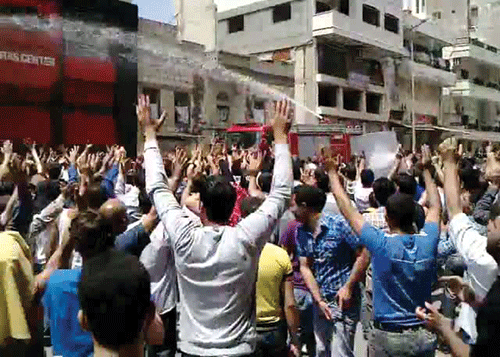
On the surface, the status quo of recent months in Syria continues; each Friday tens of thousands of protesters throughout the country face live ammunition from security forces, widespread detention persists and entire towns are still being put under siege by the army. People are now starting to find mass graves.

While the situation in the streets remains largely consistent, behind the scenes the organizational structure of a grassroots political movement is beginning to take shape. Syrian President Bashar al-Assad, like his father before him, has always relied on the mantra that for Syria it is either “us or chaos”, and this principle has been put into full effect in recent months. What this mentality asserts is that without a strong-handed leader the many sects that make up the country’s population will fight to fill a power vacuum, with bloody results.

But recent developments in Syria suggest the possibility of an ordered, inclusive and participatory alternative to dictatorship.

Though revolts continue to be largely decentralized, and not centered on Damascus or any other major city, individual communities throughout Syria have developed opposition councils, or Local Coordination Committees. These groups were informally established weeks into the uprising and have overtime developed into an extensive organizational network. On the ground they coordinate protests, organize members and provide valuable information to the outside world about what is happening inside Syria.

They seek to give a voice to the people in the streets, the people who have been tortured and those who remain in prison. In a country that methodically seeks to disempower civil society, the formation of these organizations is a critical step, especially as they are now beginning to communicate and organize among each other. They have formed an umbrella group, the Local Coordinating Committees of Syria (LCC Syria), consisting of 15 LCCs from Daraa to Deir El Zor, to better synchronize their activities and develop a platform beyond the local level.

On May 15, LCC Syria issued a statement declaring the conditions under which the opposition would negotiate with the regime, among them the cessation of violence against protesters and the release of political prisoners. Ultimately, this organizing effort could create the foundation for a lasting and deep democracy, where citizens have empowered themselves to make their demands heard.

In another sign of increasing political organization, on May 31 supporters of the Syrian opposition were invited to participate in a meeting in Turkey in order to discuss plans for a transitional council and to further coordinate activities. As of this writing on May 26, many opposition groups were expected to come together, including the Damascus Declaration. Although those on the ground in Syria will most likely have been unable to attend, various other participants will hopefully have represented the LCCs’ demands. Ideally, the agenda will have been set, not by politicians, but by those who are actually seeing what’s happening in the streets. 

While these are small steps toward building a foundation for democracy, they are important reminders of the true nature of the movement, which is neither sectarian nor violent. On May 20 in Talbisah, a town just outside of Homs, 15,000 demonstrated (the largest gathering of this Friday), an event organized by the local LCC, including local Christians and Alawites, who are said have the most to lose from Assad’s departure. That same day there were protests in 50 towns and cities around Syria.

The regime doesn’t have the manpower to cut off all of these focal points. In Banias, 20,000 soldiers occupied a town of 40,000 people. After 15 days of occupation, the army withdrew, and the next Friday 3,000people in Banias took to the streets in protest — even people who had been severely injured while in security custody. These acts, while certainly preventing many from demonstrating, out of understandable fear for their lives, only serve to further politicize the Syrian people. The general population has been engaged and, most terrifying for Assad, increasingly they have a political outlet for their demands.

RAMI NAKHLE is a prominent Syrian human rights cyber activist, until recently working under the pseudonym Malath Aumran


June 3, 2011 0 comments
0 FacebookTwitterPinterestEmail
Comment

Mubarak’s fallen foreign policy

by Jonathan Wright June 3, 2011
written by Jonathan Wright

The staff at the Israeli embassy in Cairo must be feeling a little uncomfortable these days. In the heated atmosphere of post-revolutionary Egypt, few people in the city are willing to talk to them and diplomats sometimes have trouble even reaching the embassy building due to the frequent clashes outside between riot police and pro-Palestinian protesters.

On top of their short-term logistical difficulties, the Israelis are facing the increasingly apparent medium-term reality of the Egyptian government abandoning the cozy arrangements that have prevailed on the border between Egypt and Gaza for the last several years — in many ways the operational centerpiece of the Israeli-Egyptian relationship. Former President Hosni Mubarak, who remains in hospital in the Red Sea resort of Sharm El Sheikh, worked closely with Israel and the United States to isolate Gaza and put pressure on the Palestinian Islamist group Hamas to accept Israeli conditions for peace talks. That meant giving the Israelis a de facto veto over the goods and people going in and out of the impoverished coastal strip, which was under Egyptian control from 1948 until 1967.

Mubarak’s policy, which flew in the face of Egyptian public opinion, was hard to sustain even when he was in control of the country. Several leading members of the ruling military council have been skeptical about the wisdom of his approach, and the post-revolutionary government had promised to reopen the border as of the end of last month and bring an end to the blockade that began in earnest when Hamas defeated the rival Fatah movement in Gaza in 2007. If Egypt did indeed fulfill that promise, a new era in the foreign policy of the Arab world’s most populous country will have truly begun.

This shift is a natural outcome of the uprising that drove Mubarak from office on February 11 after 18 days of protests throughout the country. Free at last to assemble and express their opinions, large numbers of Egyptians from the main political groups — leftists, Islamists and liberals — have set their minds to ensuring that the new government does fulfill that pledge. Thousands were out on the streets of Cairo in commemoration of the Palestinian Nakba (or “catastrophe”) on May 15, and a major battle broke out that night when protesters tried to break through the cordon of police around the Israeli embassy. Unlike the demonstrations in Lebanon and Syria, no one could claim that the protesters were acting on anyone else’s behalf. The police repelled them with tear gas and rubber bullets, but the protesters made their point — to the Egyptian government, to Israel and to those who naively enthused in January and February that the Egyptian revolutionaries paid little attention to the Israeli-Palestinian conflict.

The Egyptian government, which has already succeeded in one respect where Mubarak failed — to mediate reconciliation between Hamas and Fatah —knows it will not be easy. Reopening the Gaza border could drag Egypt into conflict with Israel and with the United States government, which gives Egypt $1.4 billion each year, mainly as a reward for protecting Israel’s southern flank.

Cairo is anxious to ensure diplomatic cover for its change in policy by bringing Fatah and the European Union into the new arrangements for the Gaza border, in the hope that this might offset US and Israeli displeasure. In the wider, tumultuous Middle East, Egypt’s new rulers are feeling their way tentatively, mulling the possibility of better relations with Iran, which Mubarak always kept at a distance. But they are wary of any regional commitments at a time when no one knows who will still be in power at the end of the year.

The government’s last-minute nomination of Foreign Minister Nabilel-Arabi as secretary-general of the Arab League, rather than old-regime politician Mustafa el-Fiki, has saved the position for Egypt and given a morale boost to the post-revolutionary foreign ministry. But a struggle now looms over who will replace Arabi. The military council, which has the final say, could choose someone with the same Arab nationalist tendencies, reinforcing a shift in Egyptian policy toward the Arab center. But the pool of candidates, probably all of them current or former Egyptian diplomats, is heavily weighted towards the more conservative segment of the Egyptian establishment.

After parliamentary elections, scheduled for September, foreign policy changes are inevitable. None of the most vocal political forces will defend Mubarak’s geopolitical alignment without reservation. They say instead that they will have to listen to the will of the people.


Jonathan Wright is managing editor of Arab Media and Society


June 3, 2011 0 comments
0 FacebookTwitterPinterestEmail
Comment

Saleh spurs unlikely unity

by Farea al-Muslimi June 3, 2011
written by Farea al-Muslimi

Millions of Yemenis went to the streets on May 22 in different provinces around the country to celebrate the anniversary of the 1990 national unification. The carnival atmosphere along 60th street in Sanaa differed from previous years; instead of photos of President Ali Abdullah Saleh, people paraded placards of the protesters killed since demonstrations began in February to demand the end of his three-decade reign.

National unity has experienced its fair share of stress since Yemen’s 1994 civil war, after which a victorious Saleh began to purge the army of southern officers through forced early retirements, at the same time deploying northern officers loyal to him through family and patronage networks to the south of the country.

Southerners blame Saleh’s regime for the endemic mismanagement and corruption associated with their oil; 80 percent of Yemen’s hydrocarbon wealth is in the south, accounting for the lion’s share of government revenues — facts which have helped fuel even greater resentment toward Saleh as southerners complain of a chronic lack of investment in basic infrastructure and development projects, and their exclusion from government employment.

The president had largely ignored such grievances until rebel movements began to call for secession and staged monthly protests in different southern provinces in 2004 and 2005. Clashes between the police and protesters have resulted in the death and injury of hundreds in the south over the last few years. Furthermore, seeing southern Sudan separate itself from the north in 2010 provided inspiration for southern Yemenis. Indeed, until recently an outright rebellion in the south seemed imminent. Before the anti-Saleh revolt spread to Sana’a it appeared that only Solomon’s wisdom could keep the north and south together, but since then the scene has changed dramatically across Yemen.

Engaging the south politically and economically has become apriority for the opposition movement in order to preserve the unity of the country. Residents of the southern city of Aden went out to protest in various squares in a display of solidarity for Yemenis attacked in Sana’a by security forces, and vice versa. Thus, a sense of unity between north and south is more prevalent than ever before; leaders of southern movements have announced that they no longer desire secession from the north, just a separation from Saleh’s regime. On May 22, Secretary General of the Southern Movement Abdullahal-Nakhibi, told the press, “The youth revolution made us rethink our calls for secession; our enemy was Saleh who abused the unification and excluded all partners.” A year before, such a statement would have been impossible.

But there is still a long way for Yemenis to go to create a stable and equitable state. The success of the opposition movement will highly depend on its ability to solve the southern issue, the biggest and most significant challenge Yemen has faced through the last two decades. The scene at the unification day parade in Sana’a, of a military officer who had sided with the demonstrators handing a Yemeni youth the nation’s flag, was a symbol of the transformation of Yemen from a military system to a civil one, but the images from the capital in the days that followed were less hopeful; by May 25 dozens had been killed in clashes between pro-government soldiers and tribal forces, particularly from the powerful pro-opposition Al Ahmar tribe. These battles raise questions about the stability of the opposition’s unity and whether or not it can hold under duress.

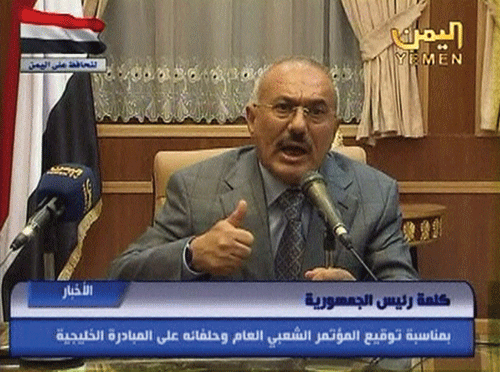
Transformation toward a parliamentary system has been the talk around Yemen, and the new constitution put together by the youth movement makes it clear that a decentralization of government is the basis for its implementation. But with Saleh continually reneging on the initiatives presented by the Gulf Cooperation Council to begin a transfer of power, the democratic momentum risks becoming bogged down in the mire of tribal warfare. On May 22, after a dramatic about-face by which the president at the very last moment abandoned an agreement to step down, he accused the opposition movement of “dragging us to a civil war”.

Saleh’s stubborn refusal to heed the demands of the demonstrators has accomplished in months what decades in power could not: the ideological unity of north and south. At the same time, if he does not step down soon, he may likely fulfill his own his prophecy.  

FAREA AL-MUSLIMI is a Yemeni activist and writer for Almasdar


June 3, 2011 0 comments
0 FacebookTwitterPinterestEmail
Comment

Ahmadinejad’s lost magic

by Gareth Smith June 3, 2011
written by Gareth Smith

Rumors of sorcery in the environs of Iranian President Mahmoud Ahmadinejad have reached such a high pitch that leading members of his entourage have had to deny them. Some Iranian media outlets even quoted the president as saying that those alleging “the influence of fortune-tellers and jinn on government were telling jokes.”

In fact, the matter is deadly serious. Ayatollah Mohammad Taqi Mesbah-Yazdi was quoted as being “more than 90 percent certain that he (Ahmadinejad) has been put under a spell… I do not know if it is hypnotism… or relations with yogis. But there is something wrong.”

Senior clerics have long disliked Ahmadinejad and see opportunity in his soured relations with Ayatollah Ali Khamenei, the supreme leader. Hence, a dispute with the leader over ministerial appointments has set off a wider spat. Khamenei in April reinstated Heydar Moslehi as the intelligence minister after Ahmadinejad had forced him to resign. While the president had little choice but to accept the directive, he subsequently refused to attend cabinet meetings for a week, then in May removed three ministers as part of a scheme to reorganize ministries. In assuming the sensitive oil ministry himself, Ahmadinejad further enraged his many critics and in a matter of days the Guardian Council — which can block legislation it deems unconstitutional — had overruled the president, deeming his move “illegal”.

Ahmadinejad came to the presidency in 2005 as an outsider to Iran’s political class after a skillful campaign that hamstrung his main rival, Akbar Hashemi Rafsanjani, who had strong support within the establishment. The new president had a popular touch rooted in his lowly father’s simple Quranic classes. Here was a man who talked to millions of Iranians in simple language and understood their beliefs and practices. Yet many aspects of popular religion in Iran are frowned on by senior clerics, whose standing is based on Islamic law and who disparage “superstition”.

When Ahmadinejad was elected, many wrong-footed analysts said he was a creature of the Revolutionary Guards (although his membership has never been established). But the discrete talk in Iran was of his religious beliefs, and particularly of his relationship with the 12th Imam. For Khamenei, the new president was a double-edged sword. On one side, he had won a landslide election victory pledging a return to the egalitarian values of the 1979 Islamic Revolution, in the process steamrolling two reformist candidates along with Rafsanjani. But on the other side, Ahmadinejad’s populism was unpredictable. His statements on Israel delighted the Persian, Arab and Muslim “street”, but they disturbed pragmatists in Tehran seeking a hardheaded calculation of national interest. His management of government also alienated a wide range of conservatives close to Khamenei.

By endorsing Ahmadinejad’s 2009 disputed election victory, Khamenei put more wind in the president’s sails. Buoyed by this support, Ahmadinejad and his close ally and relative by marriage, Esfandiar Rahim Mashaei, have tried to create a political bloc that might outlast the 2013 presidential election, when Ahmadinejad’s second term expires and he must stand down.

Senior clerics detest Mashaei, another figure of humble origins and one who has stressed Iranian nationalism even at the expense of Islam. Mashaei is at the root of tension between the president and leader; in 2009 Ahmadinejad was overruled by the supreme leader when he tried to appoint Mashaei as first vice-president. Instead he made Mashaei chief of staff, a post from which he recently stepped down, perhaps to prepare for parliamentary elections next year.

It was Mashaei’s tense relations with Heydar Moslehi that led to the April sacking of the intelligence minister and he has also been at the center of allegations that the Ahmadinejad camp has diverted oil revenue into election campaign coffers. At the brink before, Ahmadinejad has always pulled back from confronting Khamenei, and in a televised interview in mid-May he praised the leader as a just father, both to himself and the nation. Perhaps the president knows that, with or without the use of sorcery, this would be a confrontation he could not win.

Gareth Smyth has reported from around the Middle East for almost two decades and was formerly the Financial Times correspondent in Tehran


June 3, 2011 0 comments
0 FacebookTwitterPinterestEmail
Comment

A fall from grace

by Fabio Scacciavillani June 3, 2011
written by Fabio Scacciavillani


Dominique Strauss-Kahn, otherwise known as DSK, had flirted with the title of being the second most powerful man in the world after United States President Barack Obama in the aftermath of the 2008 Lehman Brothers demise. Such accolades will be scarce moving forward, however, with the now-former managing director of the International Monetary Fund arraigned on charges of rape in a New York court last month.

His supporters assert that his resignation is not an admission of guilt, but rather to shield the IMF from the fallout of the scandal while he clears his name from the ignominy, though his departure wil lstill have a profound impact on the organization.

After DSK took up the reins in 2007, the IMF had reverted to its heydays in the 1990s, an era when it played a critical role in managing the ‘de-sovietization’ of Eastern Europe and Central Asia, the reform wave in Latin America (despite the fiasco in Argentina) and the opening of capital markets —one of the pillars of what is nowadays called ‘globalization’.

By contrast the two predecessors of DSK are remembered most for their stolid management, their lack of vision and a dreary decade during which the IMF had been marginalized, demoralized and ignominiously downsized. But under DSK stewardship, the IMF confidently regained center stage in top policy circles and on finance markets. It engineered a rapid and effective response to the financial crisis, taking up monumental responsibilities when national governments were mostly scared or hapless to act. Billions of dollars were deployed over the main fronts opened by the freeze in credit markets worldwide to help central banks avoid a financial meltdown and economic collapse.

Nowhere was the IMF intervention more crucial than in the Eurozone. Despite stubborn denials by the European Union authorities and the European Central Bank (ECB) regarding member states’ need for IMF support —which in the view of haughty politicians in the ‘Old Continent’ was only intended for developing countries — Greece capitulated and negotiated a loan in exchange for austerity measures. DSK ensured that European public opinion, foremost in France, perceived that his institution and his personal involvement had saved Greece from a humiliating default. So with an eye to the primaries of the Socialist Party, which could have paved his way to the French Presidency, DSK used his role to strengthen his credentials as a competent economist and an effective decision maker. The successive IMF interventions in Ireland, and recently in Portugal, reinforced his standing; in fact before his arrest he was the frontrunner for the Elysée.

For the Greeks it was a stroke of luck to have at the helm of the IMF a figure with a keen interest in his future political career, and therefore a particular tendency to appease the left-leaning public opinion. The terms of the loans granted to Greece were relatively lax, hard questions were shoveled under the rug and the review of the progress to meet the targets of the stabilization plan lacked the steely determination displayed elsewhere. The plan was too lenient and in fact now Greece is asking for further support, which in any case is unlikely to prevent an eventual default, or a debt restructuring, as many politely call it.

Against this background the downfall of DSK came at a critical juncture. With Greece in need of further support, a benevolent attitude from the IMF was paramount in the strategy by the EU and the ECB to delay the hard choices on new governance in the currency union and reforms of the fiscal framework to share the burden of unsustainable sovereign debts in peripheral countries.

Worse for the Old Continent, emerging markets, primarily China, are less inclined to honor the unwritten agreement that the IMF managing director be European and the World Bank president an American. With their share of global GDP on par with that of developed economies, emerging markets feel they can field a candidate. If that were to happen, after the embarrassing epilogue of DSK’s tenure, the air on the Northern Mediterranean shores would be much chillier this summer.

FABIO SCACCIAVILLANI is chief economist at the Oman Investment Fund


June 3, 2011 0 comments
0 FacebookTwitterPinterestEmail
Comment

The great nuclear silence

by Peter Speetjens June 3, 2011
written by Peter Speetjens

Obsessed with all things ‘now’ and ‘today’, the media are distinguished by a hopelessly short memory. Yesterday is ages ago, and anything that occurred last month might as well have happened in 1837, or not at all. When the news is no longer new the circus leaves town and a deep silence sets in. This is what happened after Japan’s March 11 earthquake and tsunami triggered a nuclear meltdown at Fukushima plant.

Following a fast and furious frenzy of media coverage, Fukushima’s fate and victims have disappeared from the radar, apart from on one day, May 20, when Masataka Shimizu resigned as President of the Tokyo Electric Power Company (Tepco), which owns the Fukushima plant, as it reported a net annual loss of $15 billion. Meanwhile, it remains to be seen how much Tepco will have to pay in compensation. Due to the radiation leaked into the atmosphere, some 50,000 families were forced to leave their homes, while more than 10 million liters of water contaminated with radioactive particles leaked into the sea. The financial and physical damage to human and marine life is hard to determine. The company itself has yet to issue an estimate, but analysts have indicated the total sum could amount to $125 billion. No wonder Tepco’s share price has fallen by 80 percent since March.

Meanwhile, the Japanese authorities have established a fund with which Tepco can compensate the victims. The company is obliged to pay back the government as soon as it returns to its profitable ways. Not known is what will happen were the firm to go bankrupt. Helped by a powerful lobby and PR machine, promoters of the nuclear option like to paint a safe and carefree picture of cheap, affordable energy. It’s true that, once up and running, nuclear power plants produce relatively cheap electricity. 

However, the cost of such unforeseen disasters as Chernobyl and Fukushima are not part of the calculations. Nor is a reliable estimate of the cost of nuclear decommissioning. The average lifespan of the world’s more than 450 nuclear plants is some 30 to 40 years, although many function well beyond their expiry date.  Once a nuclear plant is no longer safe to operate, it should be dismantled, while the site on which it stood should be decontaminated. Unfortunately, the nuclear industry has very little experience in decommissioning.

American nuclear power plants today reckon with an estimated decommissioning cost of some $325 million per reactor, and that is likely being optimistic. In France, the cost of decommissioning the relatively small Brennilis facility, which was only operational from 1967 till 1979, today amounts to some $650 million, no less than 20 times the amount initially estimated. Hence the reason why the big clean-up, like that of four other nuclear sites in France, has been postponed indefinitely. In Britain, the Nuclear Decommissioning Authority has altered its cost estimates several times and currently predicts a price tag of $100 billion for cleaning 19 nuclear sites.

While the Fukushima drama has triggered an intense debate over nuclear power in Europe, most Arab countries continue as if nothing has happened. Abu Dhabi remains determined to build four nuclear power plants on its shore, Riyadh recently signed a nuclear research agreement with China and Jordan is set to announce on June 30 the winning bid for building its first reactor. As none of these countries is particularly known for its free and critical media, the region’s nuclear future is largely determined in silence. There is one exception: Israel.

While the Israeli authorities recently shelved plans to invest in nuclear power generation, journalists, MPs and nuclear experts — for the first time ever — dared call for more openness regarding Israel’s, and the region’s, only nuclear facility at Dimona. They want to know if the ultra-secret, nearly-60-year-old military facility is still safe and where its waste is buried. And so they should: while the inland, desert facility is unlikely to be hit by a tsunami, it is situated only 30 kilometers south of the earthquake-prone Great African Rift.

But on the other hand, why worry? After all, the last big quake to hit the Galilee occurred in 1837, so long ago that it might as well have never really happened at all.

PETER SPEETJENS is a Beirut-based journalist


June 3, 2011 0 comments
0 FacebookTwitterPinterestEmail
Comment

Boon time for mercenaries

by Paul Cochrane June 3, 2011
written by Paul Cochrane

The wars in Afghanistan and Iraq are supposedly winding down, Osama Bin Laden is dead, and the so-called ‘Arab Spring’ is eroding the iron-fisted regimes that have for so long held sway over the Middle East and North Africa (MENA). For private military contractors (PMCs) — a polite name for professional mercenaries — such developments might be considered a harbinger of tough times. But business is better than ever in Iraq and Afghanistan, and the suppression of internal revolts throughout the MENA is presenting new opportunities for this multi-billion dollar industry.

Last month details emerged that the infamous founder of Blackwater, Erik Prince, was forming an 800-strong secret army for the United Arab Emirates, for a price tag of $529 million. Prince moved to the UAE after Blackwater, later renamed Xe Services, faced legal problems in the United States, notably in a case against four Blackwater operatives accused of killing 17 Iraqi civilians in Baghdad in 2007, which has recently been reopened.

Reflex Responses, Prince’s new venture in conjunction with a 51 percent Emirati stake, features South African and Latin American mercenaries, the latter brought into the UAE disguised as construction workers, according to the New York Times, hired to protect under-construction nuclear power plants and oil infrastructure from terrorist attacks, and to “put down internal revolts” and “unrest in crowded labor camps.”

What is curious is the UAE’s need for Prince’s firm, as the country already ranked 16th worldwide in 2010 for military expenditure, at $15.74 billion, or 7.3 percent of gross domestic product, according to the Stockholm International Peace Research Institute. If such a high cost for the conventional military cannot guarantee security, but a half billion dollar private force can, it puts into question the rationale for such a high defense budget. Furthermore, it sheds doubt on the UAE’s belief in the Gulf Cooperation Council — dominated by Saudi Arabia — to come to its aid to squash an uprising, as happened when GCC forces rolled into Bahrain this year.

The UAE is clearly worried about instability amid uprisings nearby and has taken a page out of other government manuals by resorting to guns for hire. In March, it was reported that up to 1,000 Pakistani troops had been recruited to serve in the Bahrain National Guard to put down the uprising, as local troops could not be relied upon. In Saudi Arabia, which recently signed a $60 billion arms deal with the US, Associated Press reported that a top secret project is underway with the US Central Command supervising and training a 35,000-strong Saudi force to protect oil infrastructure and, presumably, to crush any unrest. Reports also abound of Muammar al-Qadhafi using mercenaries in his ongoing war against the rebels in Libya.

Last year in Iraq, security was the second most common service provided by contractors to the US government, accounting for approximately 13,000 personnel, or 18 percent of all contractors, according to a recent report by the Congressional Research Service. But while US troop levels have dropped in Iraq since 2008, along with support service contracts as a result, PMCs actually increased by 39 percent, or 3,500 personnel, by the end of last year.

The US Department of Defense does not give a breakdown of contractor services in Afghanistan, but contracts have soared over the past five years, from $2 billion in 2005, to $11.8 billion for some 87,000 contractors in 2010. It appears as though demand for PMCs will remain high so long as governments carry out policies unpopular in the eyes of the public. After all, mercenaries are useful assets to perform tasks that might strain the loyalty of a country’s regular armed forces. Indeed, Reflex Responses will reportedly not hire Muslim mercenaries given that, in the words of Prince, “They could not be counted on to kill fellow Muslims.”

The regional spike in demand for mercenaries and private armies speaks volumes about the insecurities of the UAE and Saudi Arabia. More chillingly, it raises concerns about the destiny of the ‘Arab Spring’ when governments resort to such forces to quell revolt.

PAUL COCHRANE is the Middle East
correspondent for International News Services

June 3, 2011 0 comments
0 FacebookTwitterPinterestEmail
Economics & Policy

Executive Insight – Booz & Co.

by Ulrich Koegler & Ivan Jakovljevic June 3, 2011
written by Ulrich Koegler & Ivan Jakovljevic

ULRICH KÖGLER is a partner and IVAN JAKOVLJEVIC a senior associate at Booz & Company

In an age when email and digital social media dominate the present and future of communications, traditional postal systems are losing their role as the primary means of communication.

Yet, postal systems remain a vital way to reach people, even in the age of instant communication. What postal systems lack in speed they make up for in other benefits. They offer a way for citizens, especially those in rural areas, to better communicate with each other and their communities; a way for companies and merchants to reach their target audiences with direct mail, e-commerce deliveries and, perhaps most important to governments, a way to locate citizens in an emergency, get them essential services and documents and help them transfer money safely.

These benefits, while balanced among citizens, businesses and governments, nevertheless will not be available in emerging markets in general — and in the Middle East and North Africa (MENA) region in particular — without significant new investment and efforts by government leaders. Therefore it is critical for the benefits to be significant enough to justify investment and activity.

Because the region has only in recent decades witnessed stable population patterns common to Organization for Economic Cooperation and Development nations, postal systems in the MENA region are significantly smaller, less utilized and more costly than their counterparts in developed markets. Unfortunately, this has limited their potential and that of MENA countries to serve citizens, local and international businesses and governments.

Reaping the Benefits

There are numerous advantages to a strong postal system — one being the introduction of standardized addresses. An address system that makes the best possible use of modern Global Positioning Systems/geo-mapping technologies allows for both the unique identification of citizens as well as the ability to reach a destination in the shortest possible time. As such, an address system also offers important benefits for emergency responders, such as medical, police and fire services.

Meanwhile, governments seeking to interact more closely with their citizens can use postal addresses to locate and engage them regularly. When a government is able to reach its people it can efficiently deliver income support, information on public health and other essential services. This ability is vital to the success of many government services, especially in rural areas.

Those populations least likely to access government services in person or through electronic channels — the low income, sick, elderly or rural groups — are most in need of such access; therefore, a modern postal system is a valuable way to close any service gaps. Illustratively, the local post office is becoming a place where one can renew a driver’s license, pay utility bills, apply for various government documents or collect a pension check. 

A game plan for postal systems

Regional governments looking to further strengthen their postal systems have focused on four major areas for improvement: an address system to support national emergency and security services; data warehousing to provide governments and businesses access to essential socio-demographic information; a “last mile” delivery system to complement e-government services and e-commerce; and a system for postal money remittances to provide an inexpensive and traceable means to transfer money.

In addition to letting emergency responders — such as medical, police and fire services —  reach homes and businesses more easily, the unique identification of individuals through their mailing address can be part of a more comprehensive citizen and resident database that captures critical information. For instance, such a database might link addresses to medical history to allow ambulance attendants to respond more quickly and knowledgeably, note a history of domestic violence complaints that can prepare police for what they might face, or enable security forces to screen for potential security threats.


Last-mile delivery systems are another essential element in e-government and e-commerce services. For example, while e-government services can permit routine applications and renewals of key government licenses and documents, such as passports and birth certificates, citizens still need to take delivery. A postal system allows the government to ship those documents directly to people’s homes, rather than to make citizens stand in line in government offices that may be difficult to reach.

Globally leading postal operators have also deployed digital documents, such as secure letters, digital marketing and digital secure identification — a service that gives postal operators a strong footing to operate in the digital age.

Finally, postal systems can be a conduit for money transfers. Such use is not uncommon: in many markets, the post office is the primary place to conduct such transactions.

Moving more aggressively toward such a system would allow governments to track money transfers more efficiently, help security agencies tackle terrorism and reduce narcotics trafficking, money laundering and tax evasion. Postal remittances can be a more secure alternative to informal money transfer schemes (such as hawala), which have been linked to the financing used in the 9/11 terrorist attacks.

Other nations that have sought to improve national postal systems have developed some sophisticated capabilities. For example, Singapore introduced a postal address system that enables sequential sorting of mail items based on the shortest delivery route.

Many nations have developed postal banking systems that provide basic financial services to customers far from national banking centers. Development of all those service capabilities will require initial investments well beyond the capacity of national postal operators. Their current small scale and low revenue base will simply not allow for a comprehensive overhaul of postal infrastructure.

But due to the fact that these services have significant mid-term revenue potential, and the potential for a profound socio-economic impact, governments should take the lead in making sure that the MENA region has a full spectrum of opportunities for citizens to receive information and services.  

June 3, 2011 0 comments
0 FacebookTwitterPinterestEmail
  • 1
  • …
  • 376
  • 377
  • 378
  • 379
  • 380
  • …
  • 686

Latest Cover

About us

Since its first edition emerged on the newsstands in 1999, Executive Magazine has been dedicated to providing its readers with the most up-to-date local and regional business news. Executive is a monthly business magazine that offers readers in-depth analyses on the Lebanese world of commerce, covering all the major sectors – from banking, finance, and insurance to technology, tourism, hospitality, media, and retail.

  • Donate
  • Our Purpose
  • Contact Us

Sign up for our newsletter

[contact-form-7 id=”27812″ title=”FooterSubscription”]

  • Facebook
  • Twitter
  • Instagram
  • Linkedin
  • Youtube
Executive Magazine
  • ISSUES
    • Current Issue
    • Past issues
  • BUSINESS
  • ECONOMICS & POLICY
  • OPINION
  • SPECIAL REPORTS
  • EXECUTIVE TALKS
  • MOVEMENTS
    • Change the image
    • Cannes lions
    • Transparency & accountability
    • ECONOMIC ROADMAP
    • Say No to Corruption
    • The Lebanon media development initiative
    • LPSN Policy Asks
    • Advocating the preservation of deposits
  • JOIN US
    • Join our movement
    • Attend our events
    • Receive updates
    • Connect with us
  • DONATE