• Donate
  • Our Purpose
  • Contact Us
Executive Magazine
  • ISSUES
    • Current Issue
    • Past issues
  • BUSINESS
  • ECONOMICS & POLICY
  • OPINION
  • SPECIAL REPORTS
  • EXECUTIVE TALKS
  • MOVEMENTS
    • Change the image
    • Cannes lions
    • Transparency & accountability
    • ECONOMIC ROADMAP
    • Say No to Corruption
    • The Lebanon media development initiative
    • LPSN Policy Asks
    • Advocating the preservation of deposits
  • JOIN US
    • Join our movement
    • Attend our events
    • Receive updates
    • Connect with us
  • DONATE
Real estateSpecial Report

Under destruction

by Executive Editors April 3, 2011
written by Executive Editors

Beirut’s architectural heritage is disappearing at an alarming rate due to skyrocketing land prices, shortsighted zoning, a lack of urban planning, a limited availability of empty plots and a dearth of government policy.

Illegal demolitions and efforts to destroy a house gradually over time are only marginally penalized while building codes and zoning laws simply add incentive to demolish. As a result, many fear that Beirut — once a glamourous destination oozing charm for the cosmopolitan jet set — is well on its way to becoming a chaotic city of shadowed streets and skyscrapers, lacking a congruent sense of history and identity.

The Ministry of Culture has been trying to find a solution for nearly a decade, but while some ground has been gained, far more has been lost. A 2007 draft law that merged the urgent need to preserve architectural heritage with private property interests was formed over the course of several years of intensive study, but it remains stalled in parliament while the situation on the street is fast deteriorating. As law-makers fail to grasp the important link between heritage and national identity, tourism, education and the economy, the skyline surges ever upward during a period of rapid urban growth.

The only legislation in Lebanon designed to protect the country’s heritage is severely outdated. The 1933 heritage preservation law, inherited from the French mandate era, only addresses structures constructed before 1700, which excludes Beirut’s mansions and villas built during the French mandate and Ottoman era, as well as its more contemporary architectural gems. A survey conducted in Clemenceau just 10 months ago for a private client by architectural urban planning consultancy group URBI revealed that approximately 50 percent of the area’s historical buildings are gone — the definition of ‘historical’ is difficult to pin down, but generally it applies to buildings ‘relevant to the Lebanese collective memory.’

A public record of how many buildings still remain across Beirut is not available, but of the 1,016 heritage buildings classified by a government study in 1995, experts estimate that 250 to 300 are left.

Many activists have lost hope, but there are still a few passionate pragmatists who believe it is possible to find a solution that serves both private and public interests. To formulate a solution that honors both sides of the divide requires understanding of how the city reached its present point, whose interests are at stake and how cultural heritage can be preserved in a way that considers private property rights and the progress of the economy.

[You can] make your profit off of the historical character of the district rather than a sea view

FAR too far

“When you want to protect an area, typically you set the FAR [floor-to-area ratio] equal to existing buildings, or less,” said Habib Debs, owner of URBI, an architectural and urban planning consultancy. “In Beirut, it is too late to do that.” FAR is at the heart of Beirut’s heritage problem. It determines exactly how much is allowed be built on a plot in a specific area. A FAR ratio of 1 means that on a plot size of 1,000 square meters (sqm), a developer could build one floor over the full surface of the land, two floors of 500 sqm each if only 50 percent of the plot were developed, and so on. FAR determines how high the exploitation factor is, and this determines the land’s market value.

Typically, in most cities of the world that have historic quarters, the FAR is set between 0.5 and 2. In Cairo and Istanbul, as in Paris and other European cities with historic quarters to preserve, the FAR is low in the old center and rises toward the periphery, concentrating towers in specific areas. In American cities that were built on flat open lands, the opposite is true. FAR is set high in the center and low at the periphery.

In the 1930’s, the French mandate set rules governing street alignment and the maximum height of buildings allowed in both Damascus and Beirut. The rules followed a model of urban planning common in countries across Europe, North Africa and the Mediterranean Middle East, following a deliberate strategy to prevent tall buildings from overshadowing a city’s historical areas.

The critical point where Lebanon’s urban planning went disastrously wrong was in the 1950’s, when the public authority opted to change the regulations inherited from the French mandate era. Michel Ecochard, a Chicago-educated urban planner, arbitrarily changed the zoning to follow the model of an American city. Ignoring Lebanon’s rich past and the fact that American cities rarely have low-level historical centers to respect, this modification set Beirut off on an illogical path that didn’t fully realize itself until the city’s developers began having the capital, knowledge and technology to build ‘up.’

Perhaps somewhat symbolically, the first two towers to grace Beirut, Burj al Murr and Burj Rizk, were both used as platforms for snipers firing onto the city throughout the civil war.

After the war, developers began merging plots to maximize the building height and profits. This new strategy resulted in higher towers with luxurious sea views. “We tried to point out that this is not the only strategy that makes a good profit,” said URBI’s Debs. “In a historic area, instead of merging plots to build high, you can construct a lower building with a wider surface area on each plot and make your profit off of the historical character of the district rather than a sea view that can only be guaranteed until the next tower pops up,” he added.

Land prices around the world are usually higher in heritage areas, making historic property a valuable resource. Ironically, in a city that had so many buildings spanning numerous architectural periods, their destruction has erased not only social, educational and cultural assets, but economic ones as well.

In 1995, Minister of Culture Michel Edde put together three commissions aimed at solving the heritage dilemma by studying different conservation aspects: economic, legal and architectural. At his request, a protection list of historical buildings was drafted. In all, 1,016 heritage buildings were counted, but only about 500 were kept on the list, because the aim of the study was to preserve heritage quarters, where there were clusters of historical buildings rather than isolated ones. After Edde’s term, the initiative fell off the rails. Prime Minister Rafiq Hariri bowed to private sector pressure and requested the list of buildings be reduced by half.

When the architectural commission, which had continued working under its own will, refused to revise the list on principle, the private company Khatib & Alami was commissioned to the task in 1998. The resulting study whittled the list down to 459 buildings; this remains a compass for the Ministry of Culture until today. A 1999 directive based on the study classified buildings according to a letter system of A, B, C, D and E, with “A” buildings being the most untouchable due to their high heritage value, and “D” and “E” buildings being easy to remove from the list and demolish. The list of buildings has never officially been made public.

Throughout the decades, Beirut’s zoning was modified numerous times. “Each time it was modified to allow more construction, more density, higher FAR… and it was always in the interest of the developers, owners and investors and never in the interest of the common good,” said Debs.

The building code was modified again as recently as 2005, resulting in a 20 to 25 percent increase in FAR, according to the estimations of Fadlallah Dagher, a renowned Lebanese architect and a long-time advocate for architectural heritage preservation. Although the change was presented as a way to build thicker walls for insulation and wider stairwells and elevators, the visible result on the market since 2005 shows markedly larger and taller buildings.

“[The change to the building code] was voted on by Parliament, but it was unofficially written by developers,” said Dagher. “We have a lot of politicians who deal in development, and this is key to understanding why, for more than 15 years, the government has shown no real interest in [creating] a master plan for the city,” he added. Ostensibly, that is why Parliament’s bi-partisan finance and budget committee has shot down a tax on vacant properties and has yet to approve increases in proposed capital gains and sales taxes on property.

 It does not help matters that successive cabinets  have not appointed a full-time head of the Director General of Urbanism (DGU) since 2006. Acting directors are appointed by ministers, and are thus accountable only to their boss and not to the general public.

Recent attempts to reign in zoning over specific areas, such as Gemmayze, have thus predictably failed. The DGU commissioned a study of Gemmayze in 2005 to survey the quarter’s remaining heritage buildings and determine what type of urban planning to apply to the area. Claiming a lack of funds, the DGU never commissioned a private company to execute the study. A circular that aimed at setting building heights to twice the width of the street, enforcing a building’s required distance from the sidewalk and forbidding plot merging was issued but never enforced. Building permits continue to be granted in Gemmayze and towers continue to rise, casting long shadows over the quarter’s future.

“[Property owners] beg for advice on how to get their building de-listed, or to simply just get rid of it”

A web of interests

Many developers and property owners in Beirut do not see in terms of houses but in terms of land. Given that high FARs of 4 and 5 are common in historic areas such as Gemmayze, Ashrafieh, Ain El Mreisseh, Zoqaq El Blat and Clemenceau, a heritage house simply gets in the way for most property owners.

“They regret having a palace, but I can understand them,” said Guillaume Boudisseau, a consultant at RAMCO Real Estate Advisers. “Regardless of how beautiful it may be, it does not translate into any tangible economic value.”

As a real estate consultant, he has seen many property owners who are intent on selling their plot at the same price per square meter as the nearest plot that stands empty. “I tell them that they have to adjust their price to the reality of having a house on it,” Boudisseau said, “but they insist on having an estimate of the empty land value; they beg for advice on how to get their building de-listed, or to simply just get rid of it.”

Some owners also grapple with old tenants paying frozen pre-1975 rent prices as a result of another policy quagmire, the 1992 Rent Act, which allows tenants to pay pre-Civil War prices on leases signed before 1975. Given next-to-nothing rents, buildings often fall into disrepair as landlords lack funds or the incentive to maintain their assets. Because owners cannot evict tenants without lengthy and costly legal proceedings, a developer who is willing to take this burden off their hands by buying the building and land is a dream come true.

For tenants, of course, it is more like a nightmare. Their sole recourse is to petition for the Ministry of Culture to intervene if the building is of any arguable historical or cultural value. As private property rights are prioritized over the public use of land in Lebanon, owners have the right to demand that the government compensate them should it rule that they cannot demolish their house to make a hefty profit like their neighbor.

Owners who wish to maintain their houses also face disincentives. Steep inheritance taxes make an old house a heavy burden to cast on one’s family. It is not even possible to donate the structure freely, as donations of private property are highly taxed. There are also licensing fees for renovation and municipal taxes to pay. Regardless of any good intentions, owners do not have preservation options that make financial sense. Instead of being rewarded for having a classified heritage house that is of great value to the nation’s culture and identity, they are penalized.

As for developers, increasing land values also decrease incentives for preservation. “Six or seven years ago it was still possible to buy an old building at $700 to $800 per square meter, renovate it up to modern standards for about $1,000 per square meter and then sell it off at a substantial profit,” said Karim Bassil, founder of BREI real estate developers. “Now, you can’t buy something historical for less than $2,000 to $2,500 per square meter, making pure renovation work financially illogical.”

Other developers argue that there is no clarity concerning heritage. “They keep on changing the policies and procedures,” said Housam Batal, owner of Premium Properties. Claiming to be unaware of the public outrage his company provoked when it demolished two art deco houses — one of which belonged to painter Aida Marini, famous for her renderings of Beirut during its golden age — to build the Sursock Yards, Batal insisted that he had no idea the buildings were of any cultural value. “They were two ugly, concrete buildings. The government should define specific elements and standards of ‘heritage’ so that we know what constitutes heritage and what does not,” he said. “We are demanding this as developers.”

While many developers frequently argue that because the Khatib & Alami study is not public there are no official guidelines for determining whether a house is classified or not before they purchase the lot, the Ministry of Culture points out that if it were to release the study listing classified houses, it could endanger many buildings; those listed in the “D” and “E” categories can be easily de-classified. Also, it is not difficult to find out if the building is classified or not. “They can always ask the Ministry of Culture… and then they will know the answer,” said caretaker Minister of Culture Salim Warde. 

On the municipal level, recent efforts have been made to cooperate with the Ministry of Culture on demolition permits and to purchase some of the city’s old houses. However, neither the municipality nor the ministry has sufficient funds to buy a large enough number of buildings to make a real impact.

The municipality did manage to save the 19th century mansions belonging to Lebanese luminaries Fayrouz and Bechara El-Khoury — both in Zoqaq El Blat — but two further houses of immense heritage value near Burj al Murr remain “out of budget,” according to Bouchra Itani, chairwoman of the municipality’s new Cultural Heritage Commission that was founded last year.

Although the Commission’s five members — described by Itani as a computer engineer, lawyer, businessman, writer and information technology engineer — are municipality staff, Itani hopes that a commission can be formed in the near future that includes heritage experts and members of cultural movements. “The municipality does not have enough resources for now,” Itani said. “And we cannot stop people from exercising their right to build as long as they are within the law.”

Legal limbo

To date, Lebanon is the only country in the Arab world without a modern heritage preservation law, even though its adoption is just a vote away. The first draft law arrived in Parliament four years ago, with an aim to fairly address the interests of all stakeholders. Proposed by former Minister of Culture Tarek Mitri in 2007 after carrying out extensive case studies, the draft law carefully outlined three major forms of incentive for architectural heritage preservation: compensation, fiscal measures and state support. The law detailed solutions to balance the interests of all stakeholders, including the private sector.

In the draft law’s present form, compensation to owners is dealt with through a method known as the transfer of development rights (TDR). Because land without a heritage structure on it has a high value in the market, TDR would allow the owner to transfer, or sell, 75 percent of the current value of the built-up area he theoretically could build on his land to a developer in another area. The developer would be able to add these additional square meters to his building, beyond the zoning limit to increase his FAR. This mechanism — which has been applied with success in Europe to save historical areas and in the US to create value for depressed areas — allows the owner to benefit financially from selling the virtual built-up area on his lot without losing the house or the property.

To provide incentive to renovate the house, possible fiscal measures in the law include a waiver of inheritance and rent taxes and a fixed period of exemption from municipal and building taxes. Renovation licenses would be waived, and a renovation fund set up by the government would be available to assist owners. Two percent of licensing fees for construction would be funneled back into the fund, with a new committee appointed to direct renovations.

The law regroups buildings by area, with an intention to preserve not individual buildings, but heritage clusters.

The law ran into political trouble, however, and was among 74 proposed pieces of legislation during the period between 2006 and 2008 that were quashed when Speaker Nabih Berri refused to convene Parliament and considered any law that was proposed during the period the product of an illegitimate government.

Late in 2008, the Minister of Culture at the time, Tammam Salam, was contacted by Berri with an inquiry about what could be done to resolve a problem facing one of his partisans who had purchased a property with a classified house on it and wanted it demolished. Salam took the opportunity to explain the draft law to Berri.

On his own initiative, Berri proposed having a member of Parliament from his March 8 coalition extract and re-launch the law from the legislative branch; Salam secured then-Prime Minister Fouad Siniora’s agreement and MP Ali Hassan Khalil reintroduced the law in Parliament. When Salam finished his term, it was still being discussed. In 2011, the law is still sitting in Parliament, waiting to be voted on. Caretaker Minister of Culture Salim Warde worked steadily to get it approved, until the government collapsed this January.

“There are people who don’t want the law to be passed,” Warde admitted to Executive. “But the problem is that [it] is misunderstood. It’s very fair; of that I am certain.” According to Nabil De Freige, an MP in support of the legislation, “a lot of owners don’t want this law because they think they will lose money, but they are wrong. They don’t trust the government, but if [it] is applied as intended, it is a just law that represents the best interest of everyone,” he explained. “We are running out of time to save our heritage. This law is the only practical solution.”

As a successful businessman himself, Warde has worked hard to make the law as considerate of the private sector as it is of patrimony. He has prepared modifications to it that he said “will make [it] even more fair for everyone,” but declined to comment further.

Responding to the impending crisis on the ground while the draft law wallowed in Parliament, the Ministry of Culture under Salim Warde, together with the Ministry of Interior and in cooperation with the Municipality of Beirut, took a major step in 2009 in granting the Ministry of Culture the power to veto demolition permits. Warde told Executive that as of February 2011, the demolition of 84 buildings had been halted. The ministry also set up a hotline (01 612299) to report buildings under threat of demolition.

These moves initially prompted some anger from developers, but many are now either biding their time and hoping that the next minister will be more lenient, or finding ways of coping with the new regulation method by incorporating old buildings fully or partially into their architectural layout. If they cannot destroy it, they build around it or on top of it, as there is no master plan for the city outside of Solidere in downtown.

“No matter how financially attractive the alternatives, destroying the whole building was not an option for us”

Hybrid hopes

“There are no incentives to preserve an old, unlisted building; the easiest and cheapest thing to do in the past was to just knock it down,” said Karim Saade, General Manager of Greenstone, a local development firm that brands itself with “responsible development.”

 In 2005, Greenstone began preparing a pioneering project, L’Armonial, on a plot of land in Ashrafieh that had an art nouveau building on it from the 1920s. Feeling it was their responsibility to find a solution that allowed for its preservation rather than its destruction, they devised a plan to merge the “L”-shaped facade of the building with a modern tower.

Preserving the facade cost at least $1 million, but compared to the cost of the entire project Saade felt it reasonable. “No matter how financially attractive the alternatives, destroying the whole building was not an option for us,” he reaffirmed.

Today, due to the recent demolition freeze, other developers have begun seeing such hybrid alternatives as the only solution to being able to build anything at all. The Aya Tower project in Mar Mikhael by Har Properties is a clear example. The developer initially intended to create a modern tower after demolishing three historical buildings: the Cinema Vendome and two old houses. After the demolition of the cinema provoked the ire of both civil society and the media, Philippe Tabet, vice president and general manager of Har Properties, recalled that “Minister Warde requested another solution.”

This involved finding a way to integrate the first third of the two remaining buildings into the tower, which is easier and more cost effective to do than preserving only the facade. The other two-thirds would be demolished. To his surprise, Tabet discovered that incorporating the older structures into the project was not as difficult, nor as costly, as he had assumed. The architects found a solution in just three months, it was still possible to dig deep for multiple levels of underground parking, and additional costs were but a fraction of the overall funding of the project. With a little creative planning, a small part of the area’s heritage was preserved.

“A modern project puts the house on display,” said Ziad Akl, architect of the controversial MENA Capital Ibrahim Sursock Residences project that includes two towers rising up in what used to be the garden around the famous Villa Linda Sursock. Akl reasons that building a tower around the house is better than demolishing it completely. Nonetheless, the project provoked strong criticism.

In what is an apparent conflict of interest, Akl is also a member of the Superior Council of Urbanism (Conseil Superieur de l’Urbanisme), which serves the DGU and is meant to regulate urban planning, a practice that strives to preserve coherent urban form to promote order in city planning. In defense of the idea to build towers around heritage houses in low-rise areas, Akl said “an incredible sense of disorder is part of what makes Beirut what it is.”

Despite the fact that he is consulting with Ziad Akl on a heritage project on May Ziede Street, long-time proponent of heritage projects, MP Walid Joumblatt, described the Ibrahim Sursock Residences to Executive as “an aberration.”

“People are tempted by profit more than preservation,” he said. “We have a government that is made up of businessmen, capitalists and developers.”

‘Old new’ is the new new

However, profit and heritage are not mutually exclusive, and market forces are beginning to adjust to the shock caused by the sharp decrease in the supply of old houses over the last six years. “Nostalgia has been created by the destruction, and whenever something is disappearing, you want it,” said Saade. “The trend is on.”

In Greenstone’s project, living in the heritage part of L’Armonial will carry a price premium, with a first floor apartment in the old part of the building costing more than an apartment in the tower. Confirming a possible trend, real estate broker Century21 stated that since last year the agency has experienced a significant increase in calls from buyers interested in purchasing or renting historical houses that are either renovated or in need of light renovation.

“It seems to be a growing segment of demand,” confirmed Radwan Sleiman, marketing and sales manager with Century 21 property brokers. Other developments are also beginning to go up in what has been coined an “old new” style.

“There is a demand for this style,” said Tanya Naamani, Marketing and Sales Director of Noor Gardens, which is erecting a low-rise French mandate style building in Solidere with a prestigious British architect. “The type of living this architecture accommodates is more about family and community, which reflects Lebanese culture,” Naamani said. “It’s a lifestyle choice.”

On the other end of the spectrum is the solution to serve public demand for heritage through commercial space. Some companies such as IBL, Bank Audi and Quantum Group have chosen to renovate Beirut villas for use as corporate offices.

While such benevolent sponsors are hard to come by, Bassim Halaby, chairman and chief executive officer of the developer Benchmark, has another idea. “Investment in preserving these cultural landmarks could be incentivized through the concept of linkage,” he said.

 In the US, where Halaby worked for many years, large companies sponsor cultural venues, such as museums, and in return get their name added to the structure for a number of years. “If we sponsor turning an old house into a museum, for example, it becomes the Benchmark Museum,” he explained. “There is a deficiency of land being used for cultural spaces in Beirut, and this could help solve the problem.”

Although the private sector is often demonized by civil society groups, profit motives could help to protect heritage. “People need to feel ownership of something to take care of it,” said Halaby. “Think of the ‘mybar’ idea,” he suggested, referring to a recent project where shares, and profits, of a bar and restaurant are distributed among stakeholders who put down a minimum of $2,000. “Why not apply that to cultural real estate? Instead of investors, get shareholders.”

Following the mybar logic, an old house would be converted into a public venue such as a gallery, hotel, restaurant or bar, and any profit would be shared between investors. Tabet from Har Properties, now a supporter of preserving heritage in the city, took the idea a step further. “Why not create a REIT [Real Estate Investment Trust] for cultural heritage houses?” he suggested, as a REIT would sell on the stock market like a security. A REIT composed of a group of heritage houses used for commercial purposes is a radical idea, but possible applications of the idea are worthy of exploration.

“Nostalgia has been created by the destruction… The trend is on”

Power of the people

There is a prevailing misconception in the real estate sector that the Lebanese public does not care about heritage. But the truth is that while there is an emerging segment of affluent Lebanese who are willing to pay a high price to protect and own their own piece of the past, the majority of Lebanese demanding the preservation of their country’s cultural heritage are everyday people without the means to purchase a luxury apartment. These people wish to share Beirut’s cultural icons, and they are not to be overlooked as stakeholders in the issue.

“Despite the efforts of so many ministers of culture and the media, the law is not drawing enough public support to make it a priority,” said former Minister of Culture Tarek Mitri. “If parliamentarians know that a law is important to the people, they will prioritize it,” he added, urging civil society to press the issue. Although many citizens are frustrated with the powerful reach of certain people in the private sector to block political action on issues of national concern, the past does provide a glimpse of civil society’s potential to make a difference.

In the 1990s the Association for Protecting Natural Sites and Old Buildings, commonly known as APSAD (L’Association pour la Protection des Sites et Anciennes Demeures), managed to stop the complete destruction of Beirut’s old downtown. “They destroyed 90 percent of the historical buildings in the city center and restored only 10 percent, after pressure from civil society,” said Lady Yvonne Sursock Cochrane, founder of APSAD.

The group reached out internationally to gain support for stopping the destruction of Beirut’s historical center.

“As a result of our efforts, a German film crew came and made a shocking documentary about the destruction of heritage that Solidere was doing, and [Rafiq] Hariri was not pleased with the negative publicity,” Cochrane said. According to her account, the media coverage is what prompted Hariri to preserve the 10 percent of historical buildings remaining in the Beirut Central District at that time. “He did a book about the preserved buildings, “Beirut Reborn.” He sent me a personal copy, with a note, ‘Are you happy now?’” she recalled.

In 2006, civil society activists protested 10 new tower projects in the area of Gemmayze. They formed a petition and collected 5,000 signatures, which Mitri presented to then-Prime Minister Fouad Siniora, who blocked the permits to build. Gemmayze was to be put under study to decide the type of development to be permitted from an urban planning perspective. Unfortunately, the July 2006 War broke the rhythm of the civil society effort, causing it to fail. Naturally, the war shifted civil society priorities to larger humanitarian issues, and the tower permits were signed once the attention had been turned elsewhere.

Today, new civil society groups are sprouting up in the city to protest the destruction of heritage. Save Beirut Heritage and the Association for the Protection of the Lebanese Heritage have been founded over the last year and a half and are collaborating with each other, using social media like Facebook and Youtube to reach out to supporters.

“There needs to be a more organized effort at staging civil actions that express the people’s disapproval of what is happening,” said BREI’s Bassil, who is happy to see so many young people interested in the issue, but is still waiting to see a professional movement that reaches effectively across all generations.

APSAD’s Sursock-Cochrane is concerned that the new groups “are not organized enough,” but she has invested her hopes in the stamina of the young generation to carry the issue forward in what she strongly suggests should be a united front. “The problem is that if each one wants to be the head of a small organization, there are too many… and the power is divided,” she said. “If everyone would work together, we could do more.”

According to Warde, even if he does not retain his post at the ministry after the formation of a new government, he will not stop trying to protect heritage buildings and applying pressure for new and effective legislation. “This momentum is reaching the masses,” he said. “I believe civil action can make a change. Whether I am in the ministry or not, I will continue this fight.”

With a logical law ready and waiting in Parliament, civil society must organize and push for a vote and, should it pass, its proper implementation. However, given the lessons of the past, turbulent political circumstances make vigilance all the more necessary.

Without the law’s passage, it is a choice between, at best, a city of hybrid structures that blends the old with the new, or at worst a graveyard of towers. Those responsible for making this choice are not only within the government but are also the citizens who  grant that government its power. No one can be blamed for the loss of heritage more than the Lebanese people, who have either not cared enough to stop it or who have given up hope.

No matter who they are — developers, politicians, owners, architects, investors and even activists — many have allowed this destruction by taking the easy way out, prioritizing their short-term individual interests over a truly national cause.

Diagnosing the architectural heritage issue as the symptom of a greater disease, Salam, the former culture minister, summarized: “Unfortunately, Lebanese people are very aggressive and ambitious on an individual level, but rarely on a collective level. If we go on like this… we will never advance anywhere.”

April 3, 2011 0 comments
0 FacebookTwitterPinterestEmail
Real estate

For your information

by Executive Editors April 3, 2011
written by Executive Editors

Construction glides steadily

Construction work is resuming its upward arch after a slow start in January, shooting up 26.6 percent in February to 1.16 million square meters, registering a total of 2.07 million square meters of construction area authorized by building permits in the first two months of 2011. The most recent February figures, from the Order of Engineers in Beirut and Tripoli, show an 11.5 percent increase in the construction area authorized by permits relative to February of 2010, but the total amount of permits jumped almost 20 percent in comparison to the same period last year. The zone receiving the most construction activity remains Mount Lebanon, for which 682 permits were authorized in February, followed by the South and Bekaa regions. Construction area covered by permits up until February signifies 17 percent growth in comparison to the area covered by permits at this time in 2010. Some however see permits issued as a flawed indicator of the overall health of the real estate and construction sectors as this does not account for cancelled or stalled projects.

Syria hopes to build in billions

Syria will tender $8.4 billion in projects in the second quarter of 2011, a government official announced in the early March. Yasser al-Sibai, general manager of Syria’s Real Estate Development and Investment Commission, Syria’s property industry regulator, told Bloomberg that the commission was in the process of finalizing the tender books for a dozen separate projects totaling 12 million square meters. “We invite more investors to establish companies in Syria and participate in the tendering process, which will be announced in some two months,” said al-Sibai to Bloomberg. “Newly established companies are advised to merge in order to meet our development plans.” The commission has been in existence since 2008, but did not license the country’s first privately owned real estate developer until 2010. Syria has now licensed 24 private developers. Sibai said Syria requires 570,000 new housing units by 2015. But investor response to the to-be-tendered developments (which are set to provide 118,000 units) has been slow, with 35 percent of the investors being non-locals, mostly from the Gulf and a few from Turkey and Iran. An international arbitrator, Kamal Malas, suggested to Bloomberg that Syria’s operating conditions are lacking some of the basic needs for stable operations. “More stability in laws, a clearer vision on behalf of the government, better trained labor force and deeper coordination between authorities are among the issues,” said Malas. It is also unclear how the current unrest sweeping Syria will impact further investments.

MENA construction trillions

A total of $4.3 trillion will be spent on construction in the Middle East and North Africa by 2020, according to a new PricewaterhouseCoopers (PwC) forecast. This estimation represents 80 percent growth over the next decade. In their new report, “Global Construction 2020,” released in March, PwC forecasts global construction spending will grow to reach $12 trillion, experiencing 67 percent growth in the second decade of the 21st century. Jonathan Hook, engineering and construction global leader at PwC, said in a press release announcing the report: “The scale of projected [global] growth in construction output of 67 percent over the next decade from $7.2 trillion to $12 trillion represents a growth of 5.2 percent per annum, outpacing global gross domestic product growth.” According to Hook, the construction industry represents 11 percent of overall global GDP. The report says that Saudi Arabia and Qatar are the MENA growth hot-spots, given KSA’s young population and Qatar’s aggressive government spending in connection with the 2022 World Cup. “Particular emphasis will be placed on social and affordable housing to meet the needs of the growing indigenous populations,” wrote Mohammad Damash, PwC’s real estate, construction and engineering leader for the region in the report. PwC also noted Egypt as a place to look for steady growth. With large public debts, Egypt has passed a law allowing private investment in traditionally publicly funded infrastructure, but recent events may delay this development. Qatar and Algeria will finance most construction from oil and gas exports, the report noted. Squatting chez Qadhafi

A small group of protestors has moved into Saif al-Islam Qadhafi’s home in Hampstead, which is a village within the London borough of Camden renowned for having the largest population of millionaire inhabitants within its boundaries than any other area of Britain. The group, “Topple the Tyrants,” put banners on top of the house with the words “Revolution” and “out of Libya, out of London.” They claimed to the press to be acting “in solidarity with the people of Libya, the people of Cairo, the people of Saudi Arabia.” When asked how many members “Topple the Tyrants” has, group spokesman Montgomery Jones said to reporters: “We’re not doing numbers.” The group has no Libyan members but claims to have “Middle Eastern” membership. A printed announcement proclaiming the group’s squatter’s rights is taped to the $16 million brick house. Though the house is technically owned by a Cayman Islands-registered holding company, the protestors claimed to have received an anonymous tip revealing its location and owner. In the group’s official statement of its intentions, a member who first climbed out of a second story window and down a tree, said: “We do not trust the British government to properly seize the Libyan government’s corrupt and stolen assets so we have decided to take matters into our own hands. The British government only recently stopped actively helping to train the Libyan regime in crowd control techniques… as well as training the regime in repression, British corporations are also guilty of providing the same weapons that are now being used by Qadhafi against the Libyan people.

Beirut offices climb rankings, again

Yet again, Beirut’s office space has moved up in rank in Cushman and Wakefield’s annual survey of office property prices. Beirut was ranked the 28th most expensive in the world and third in the region in the 2011 survey, up from 31st place globally and fourth regionally in 2010. The survey takes into account office space in 68 locations, ranking them based on rent, taxes and expected service charges. Just ahead of Beirut on the list were Warsaw, Dublin and Athens, while Beirut proved more expensive than Tel Aviv, Brussels and Vancouver. The report mentioned that rents in Beirut Central District (BCD) were stable in 2010, as opposed to a decline in other regional markets and the skyrocketing increase in BCD prices in the previous few years. In fact, the region was a global minority as only 16 of the 42 countries covered by the survey saw declining office rents while three saw stable rents.

Out of Libya, on to Iraq

Ay Yıldızlar Construction of Turkey is dropping all of its projects in Libya in favor of aggressive expansion into Iraq. The Turkish company stands to lose $15 million due from the Libyan authorities, according to Construction Week, and has now agreed to partner with Iraqi Cihan Group to build 62,000 residences in the northern Iraqi city of Erbil. The company stopped work on 13 separate projects in several Libyan cities, including Benghazi and Tripoli. The so-called “mega-project” in Erbil will begin with 15,000 residences with total costs of $250 million, said Muhammet Tuysuz, coordinator of administrative management and technical affairs for Ay Yıldızlar. “The negotiations took nearly two years for this mega-project, which will include smart-apartments and one-floor luxury properties,” said Tuysuz, as reported by Construction Week. This initial project will be followed by a second phase resulting in 42,000 residences, also in Erbil. Cihan Group is an Iraqi holding company whose areas of operation include textiles, plastic, paper, trade, automobiles and investment banking. “The total cost will be paid by our Iraqi partner Cihan Group and Ay Yıldızlar Construction will deal with the construction of the project,” said Tuysuz. Iraqi Housing and Municipalities Minister Muhammad Sahib al-Daraji said that Iraq will require two million new residences in the coming four years.

April 3, 2011 0 comments
0 FacebookTwitterPinterestEmail
Banking & Finance

Money matters bulletin

by Executive Editors April 3, 2011
written by Executive Editors

Regional stock market indices

Regional currency rates

France Telecom, Agility to acquire stake in Iraq’s Korek

France Telecom agreed with Kuwaiti logistics group Agility to acquire a 44 percent stake in Iraqi mobile operator Korek Telecom, as part of the French group’s strategy to expand its presence in emerging markets. The two groups will form a joint venture with Agility to take 54 percent of the stake. France Telecom will pay $245 million for a 20 percent indirect stake in Korek and will extend a $185 million loan to the company. Moreover, it will have an option to increase its indirect stake in Korek to 27 percent in 2014. Agility will contribute its existing convertible debt and inject $50 million in exchange for a 24 percent indirect stake in Korek Telecom. The company will also provide a $100 million four-year shareholder loan to the Iraqi operator to decrease its debt, pay for its license and improve networks and service.

Abu Dhabi’s Guggenheim

Abu Dhabi’s Tourism Development & Investment Company (TDIC) received on March 20 bids from contractors for the construction of its Guggenheim Abu Dhabi museum. The project is expected to cost more than $800 million and to be completed by 2013. The new Guggenheim will be bigger than the ones in New York, Venice, Bilbao, Berlin and Las Vegas. The museum, designed by US architect Frank Gehry, will be built on Saadiyat Island, just 500 meters off the coast of Abu Dhabi, and will cover a total area of 30,000 square meters. Saadiyat Island, a $27 billion art and culture project, includes the $500 million Louvre Abu Dhabi Museum designed by Jean Nouvel, the Sheikh Zayed National Museum, luxury resorts, golf clubs and private villas.

GCC insurance growth

Across the region, insurance premiums should double to more than $27 billion over the next five years, according to Qatar’s Finance Minister Yousuf Hussein. The minister, who was addressing an audience at “MultaQa Qatar 2011,” a conference dedicated to the insurance and reinsurance industries, added that the average growth rate in the region’s insurance sector stood at 28 percent between 2005 and 2010. The penetration rate of insurance premiums nevertheless remained relatively low at 1.9 percent, compared to a global average of 7 percent. This shows that the sector has high growth potential, added Minister Hussein, projecting Qatar’s gross domestic product growth to exceed 18 percent if oil prices average above $70 to $75 this year.

April 3, 2011 0 comments
0 FacebookTwitterPinterestEmail
Banking & Finance

Regional equity markets

by Executive Editors April 3, 2011
written by Executive Editors

Beirut SE  

Current year high: 1,180.99    Current year low: 923.19

>  Review period: Closed March 24 at 934.33 points                             Period Change: -0.28%

Beirut stocks inked an 18-month low on March 14, following a large demonstration in Beirut demanding Hezbollah’s disarmament. It also didn’t help that Premier-designate Najib Mikati remained unable to form a government. Still, stocks rebounded in the second half of the month following confirmations that no other banks in Lebanon would be targeted by the US Treasury Department following the merger of LCB and SGBL. Performance was mixed on the BSE, with Bank Audi ticking up 5.5% as Solidere and Byblos closed 2% and 2.1% lower, respectively.

Amman SE  

Current year high: 2,648.36                Current year low: 2,149.11

> Review period: Closed March 24 at 2,182.48 points                      Period Change: -3.1%

In the absence of any notable supporting news, ASE stocks continued their trip south driven partly by political uncertainty as fresh protests in Jordan demanded reforms. The banking sector shed 2.7% during the review period, although Arab Bank, the exchange’s largest stock by market capitalization, inched up 0.2%. Other sectors were also weak, with mining and extraction down 3.5%, including a 2.4% decline by Arab Potash.

Abu Dhabi Exchange  

Current year high: 2,925.42                Current year low: 2,471.70

>  Review period: Closed March 24 at 2,632.95 points                     Period Change: 1.7%

A recovery in the real estate and construction sectors led the positive showing of the ADX during the review period, as Aldar and RAK Properties rose 12.3% and 14.3%, respectively. Some of the positive news that supported the upward trend in March came from Taqa which positively surprised markets with a 460% increase in 2010 profits on higher oil and gas prices. In addition, UNB announced a 10% dividend while NBAD approved a 30% cash dividend, reflecting confidence in the banking sector’s prospects.

Dubai FM  

Current year high: 1,859.96                Current year low: 1,352.24

>  Review period: Closed March 23 at 1,552.81 points         Period Change: 10%

Stocks on the DFM staged a massive comeback in March, after Saudi authorities confirmed that the political and security situation was under control and appeased markets by buying stock through state-run pension funds and announcing large welfare spending plans. A boost also came when Arabtec postponed plans to raise capital, sending the builder’s shares up 25.3% during the review period. Investors found renewed confidence in the UAE’s political establishment and were buoyed by several earnings and dividend postings at Dubai Islamic Bank and Du, among others.

Kuwait SE  

Current year high: 7,575.00                Current year low: 6,134.60

>  Review period: Closed March 24 at 6,285 points              Period Change: -3%

The quick quashing of dissent in Saudi Arabia only marginally supported stocks on the KSE as pessimistic investors quickly booked their gains on continued fears of political unrest in the Gulf. A wave of negative sentiment set in as many companies failed to submit their financial statements and were suspended from trading. However, the government offered some glimpses of hope by launching the long-awaited Capital Markets Authority.

Saudi Arabia SE  

Current year high: 6,929.40                Current year low: 5,323.27

>  Review period: Closed March 23 at 6,362.42 points                     Period Change: 7.1%

Investors went home March 2 bitten by a cold 15% decline in one week, but by March 12, a roaring 18.3% spike had restored the warmth to Tadawul, the region’s largest stock exchange. Positive comments by the Finance Minister, who called stocks tempting, sparked the rebound, but it was effectively the announcement of massive additional government spending worth an estimated $150 billion that overshadowed any possible political risk from demonstrations.

Muscat SM  

Current year high: 7,027.32                Current year low: 6,058.11

>  Review period: Closed March 24 at 6,402.17 points                     Period Change: 4.2%

Political tensions and a grim outlook for equities, coupled with some strong earnings news, were a recipe for jittery trading on the MSM. Kuwait-based Global estimated that MSM-listed firms saw their profits dip 17.8% in 2010, with Omani banks and petrochemicals coming out on top. As part of the strong performance, BankDhofar, the third-largest listed company, saw a record growth of 31% in 2010 profits, but rose only 3.2% during the review period. Several finance services stocks lost ground during the period, including Bank Sohar, down 9.8% since March 1.

Bahrain Bourse  

Current year high: 1,605.98                Current year low: 1,361.19

>  Review period: Closed March 24 at 1,422.57 points                     Period Change: -0.6%

Although out of sync with spiking neighboring exchanges, BB stocks remained steady considering the developing security situation in the country. GCC countries sent some 1,500 Saudi-led troops to Bahrain, widening the circle of political and civil confrontation. To make things worse, S&P downgraded counterpart ratings on several banks including AUB and Arab Bank, citing risk of additional pressure on the sovereign. On the bright side, the GCC decided to establish a $20 billion fund to finance development projects in Bahrain and Oman.

Qatar SE  

Current year high: 9,242.63                Current year low: 6,647.18

>  Review period: Closed March 24 at 8,307.85 points                     Period Change: 4.7%

Like other Gulf exchanges, the QSE regained its lost ground following positive news from Saudi Arabia, but Qatari firms had plenty to offer too. Several listed companies, including Mawashi, Zad and Qatar General Insurance reported strong 2010 results and estimates showed 34 of 43 listed companies collectively declared some $3.02 billion for the year. It was business as usual, with several acquisition announcements and virtually no impact from regional unrest. Heavyweights Industries Qatar and QNB were up 5.3% and 4.6% respectively during the review period.

Tunis SE  

Current year high: 5,681.39                Current year low: 4,058.53

>  Review period: Closed March 24 at 4,459.48 points                     Period Change: 9.9%

Stocks gained momentum on the Tunis stock exchange after trading resumed on March 7 following one week of suspension. Still, S&P downgraded the country’s sovereign credit rating, but affirmed the credit ratings of five Tunisian banks, restoring confidence in the sector despite a negative outlook. Tunisia continued to take solid steps toward establishing a democracy in the country with a first round of elections scheduled for July, but political and economic uncertainty remain. Some stocks advanced steadily, including Carthage Cement at 12.7% during the review period.

Casablanca SE  

Current year high: 13,397.47              Current year low: 11,331.57

>  Review period: Closed March 24 at 12,581.71 points       Period Change: -1.7%

A surprising increase in February was followed by a minor decline in early March, then stocks drifted through the rest of the month without a clear direction, and without any noticeable impact from the NATO-led military campaign on Libya. Casablanca and other cities hosted large rallies calling for reform, with little impact on market performance thus far, as the US hailed Morocco’s king’s pledge for reforms. Banking stocks gave back 1.2% during the review period with Attijariwafa Bank retreating 2.4%.

Egypt SE  

Current year high: 7,603.04                Current year low: 5,647.00

>  Review period: Closed March 24 at 4,951 points                  Period Change: -12.3%

The EGX resumed trading on the exchange on March 23 two days ahead of a deadline that could have seen the market removed from MSCI’s Emerging Markets Index. The freedom to sell cost shareholders a 9% decline by the end of the first trading session with investors seeking to escape a steep plunge that reflected the sharp drops in Egyptian stock GDRs on the LSE seen since late Jan. But the second day brought some hope with 97 companies increasing in value compared to only 44 decliners. 

April 3, 2011 0 comments
0 FacebookTwitterPinterestEmail
Banking & Finance

For your information

by Executive Editors April 3, 2011
written by Executive Editors

Life’s good in insurance

Lebanon’s life insurance industry should see significant growth in the coming four years, says Business Monitor International (BMI). Between 2011 and 2015 the independent research and analysis firm expects double-digit growth for Lebanon’s life insurance market, as well as those of other Middle Eastern countries. The underdeveloped nature of the regional insurance market has kept growth estimates high for years. BMI estimates that Lebanon’s insurance premiums totaled $1.26 billion last year, with non-life premiums amounting to $859.7 million and life premiums $399.3 million. Further, the company extrapolates that by 2015, premiums will total $2.1 billion with $1.4 billion in non-life and $691.4 million in life premiums. BMI’s report further predicts that the penetration of life insurance should increase to $155.63 per capita by 2015, from $95.28 per capita in 2011. The BMI report touted the success of companies like MedGulf and Arabia Insurance, which have expanded into multiple countries in the Middle East.

Lebanese commercial bank deposits fall

Lebanese commercial bank deposits witnessed a 1 percent month-on-month decrease in January 2011, according the latest figures from Banque du Liban, Lebanon’s central bank. Deposits totaled $106.13 billion in the first month of 2011, dropping from $1.08 billion at end-2010, compared to a $225 million growth over the same period a year earlier. Withdrawals by non-residents, amounting to $779 million, accounted for most of the decrease in deposits, while residents’ deposits fell by $297 million. The dollarization rate increased 2.1 percent since end-2010, as significant local currency withdrawals of $2.55 billion offset an increase of $1.48 billion in foreign currency deposits. Lebanese banks’ overall consolidated balance sheet also contracted by 0.4 percent in January 2011, as deposits made up 82.7 percent of the balance sheet. The contraction was also accompanied by a 1.1 percent expansion in lending activity. Loans grew by $377 million in the first month of 2011 as those extended to non-residents rose by $616 million. Meanwhile, a $239 million drop in loans granted to residents reflected a prevailing wait-and-see mood amongst Lebanese consumers and investors, amid escalated political tensions in the country and in the region.

Multi-billion dollar Etisalat-Zain deal falls through

Abu-Dhabi based Etisalat has scrapped plans to acquire a 46 percent stake in Kuwaiti telecom company Zain, estimated at $12 billion. Etisalat’s statement on March 19 mentioned due diligence results, political turmoil, disagreement among Zain shareholders and new Kuwaiti bylaws binding offers as reasons behind the company’s decision. The deal has been beset with obstacles since talks were initiated in November 2010. In late February 2011, National Investments Company ended its commitment as the deal’s architect after Zain had rejected three bids for a stake in its Saudi Arabia unit, valued at $750 million. The sale of the 25 percent stake was a term for the merger as regulatory authorities prohibited Etisalat from concurrently owning its Saudi affiliate Mobily and Zain KSA. At the time, Etisalat reiterated interest in the deal, offering a maximum of $6.11 per Zain Group share. On March 13, Zain’s board accepted a joint offer by Kingdom Holding and Bahrain Telecom Company (Batelco) for its Saudi assets, reviving hope for the separate deal with Etisalat. The offer is worth a total of $5 billion, out of which Kingdom and Batelco will pay $950 million in cash, and cover $3.8 billion of debt. Zain KSA will pay for the remaining $250 million. Both Kingdom and Batelco are still committed to buying Zain’s Saudi operations. All three were slated to sign a preliminary contract, including a breakup fee, at the end of March.

BDL cleans up

Established for anti-money laundering purposes by Banque du Liban (BDL), Lebanon’s central bank, the Special Investigation Commission (SIC) issued its 2010 annual report this month. The report revealed 254 suspected money-laundering cases, out of which 65.3 percent were local and 34.7 percent were referred from abroad. The results indicate a 25.7 percent increase in alleged dirty money cases since 2009, and a record since 2003, when 272 cases were suspected. Out of the 189 cases investigated by the SIC, 119 were referred to judicial authorities while 70 cases did not fall under the framework of Law 318, the anti-money laundering law. Accordingly, BDL lifted banking secrecy on 23 cases, 21 of which were domestic. Forgery accounted for 21.16 percent of the investigated cases, followed by terrorism and financing of terrorism at 12.7 percent, trade of narcotics at 4.23 percent, organized crime at 1.59 percent and embezzlement of private funds and illegal arms trading, at 0.53 percent each. The remaining 56 percent were not categorized. Local sources, financial investigative units as well as the United Nations and foreign embassies provided a combined 103 names for 22 cases related to terrorism. Institutions including commercial banks, insurance companies, brokerage firms and financial institutions were also examined by the SIC to monitor compliance with Law 318.

Big banks investigated over LIBOR Rate

American, Japanese and British authorities are focusing on major international banks as part of an investigation into the manipulation of the London Interbank Offered Rate (LIBOR) during the 2008 financial crisis. Japanese and US regulators have subpoenaed Barclays, UBS, Citigroup and Bank of America, while WestLB has also received requests for information. Swiss UBS’s 2010 annual report shed light on the investigation, disclosing that the US Securities and Exchange Commission (SEC), the US Commodity Futures Trading Commission (CFTC) and the Japanese Financial Services Authority (FSA), had subpoenaed the bank. Regulators are probing into whether UBS and other major borrower banks have colluded to set their interbank rates too low during the financial crisis to comfort spooked investors and downplay their borrowing costs. LIBOR is calculated by Thompson Reuters for the British Bankers’ Association (BBA), pooling interest rates that banks expect to charge or pay each other for dollar and other currency loans, and calculating their average. The rate is considered a global benchmark rate to price derivatives and financial instruments, and is referred to by more than $350 trillion worth of financial products worldwide. Data reviewed by regulators initially lead to the investigation, signaling a divergence between banks’ low offered rates and their high credit risks during the financial crisis.

Port profits surge, Dubai World reaches debt deal

Dubai World, which announced in November 2009 a standstill on nearly $24 billion in debt, said on March 23 that a final agreement has been signed with almost 80 creditors to restructure its debt, now totaling close to $25 billion. The agreement divides Dubai World’s bank debt into two tranches, with $4.4 billion to be repaid over a five-year period and the remaining $10.3 billion over eight years, with a fixed interest rate of 2.4 percent, described by Bloomberg as “below market.” The remaining debt, owed to the Dubai government, will be converted into equity. On the same day, DP World, a ports operator subsidiary of Dubai World, said its 2010 profits rose 35 percent to $450 million, driven by volume growth in the second half of the year and cost controls. This year is also shaping up nicely for one of Dubai World’s largest holdings, according to DP World executives. “In the first two months of 2011 we have seen 12 percent volume growth across our consolidated portfolio with further margin improvement from the full year 2010,” disclosed DP World’s CEO Mohammed Sharaf.

QIIB to buy out Islamic Bank of Britain

Qatar International Islamic Bank (QIIB), a Qatar-based sharia-compliant bank, announced on March 17 that the bank is undergoing negotiations to complete the purchase of a minority stake in the Islamic Bank of Britain (IBB) with assets of $350 million. QIIB, which boasted assets of $5 billion at the end of 2010, already holds a 80.95 percent stake in the British Islamic lender, and is offering one pence per share for the remainder in a deal that values the IBB at $40.9 million. According to QIIB, the board of directors of IBB has already approved the terms of the offer, although it represents a 70 percent discount on the British bank’s market price. The IBB’s official website listed Qatar’s Sheikh Thani bin Abdulla with a 6.44 percent equity stake as a shareholder and the bulk of the remaining 12 percent in public hands. QIIB’s growth is expected to accelerate following the Qatari central bank’s decision to prohibit Islamic banking branches at conventional lenders by the end of 2011. Earlier in March, QIIB received approval from its shareholders to issue sukuk (Islamic bonds) to boost capital if needed, giving the bank more capacity to potentially acquire Islamic assets from conventional counterparts.

Egypt’s banks get bumped 

Moody’s Investor Services, a global credit ratings agency, on March 21 downgraded by one notch from Ba3 to B1 the foreign-currency deposit ratings of Egyptian state-owned banks National Bank of Egypt, Banque Misr, Banque du Caire, as well as privately-owned Commercial International Bank, and Bank of Alexandria.  Local-currency deposit ratings for the three state-owned banks were also dropped two notches, from Ba1 to Ba3, and by one notch to Ba2 for Commercial International Bank. Exposure to lower-rated government debt along with deteriorating economic conditions prompted a decline in the standalone credit strength of the affected banks. Furthermore, the ratings agency pointed out that the downgrade of Egypt’s sovereign rating limits the country’s capacity to support its banking system. But the government is taking action to bolster its financial position. According to an EFG-Hermes report, Egyptian Finance Minister Samir Radwan told Egypt’s Al Mal newspaper that the country has requested a $5 billion loan from the International Monetary Fund.

April 3, 2011 0 comments
0 FacebookTwitterPinterestEmail
Economics & Policy

Art with no admirers

by Saria Francis April 3, 2011
written by Saria Francis

Tourism, that perennial contributor to Lebanon’s coffers, could be heading for a dry spell. The deteriorating domestic political situation coupled with widespread regional unrest has made for an arid start to the year, and things aren’t looking up for the rest of 2011.

“The closer we get to summer without a government, the more the tourism sector will be negatively affected since tourists won’t wait until the last moment to [decide] where to go,” said Marwan Mikhael, head of research at BLOMInvest Bank. 

Tourism’s direct contribution to Lebanon’s economy amounts to some 10 percent of annual gross domestic product; including indirect contributions (profits of tourism spent in other sectors of the economy), tourism amounts to around one third of the country’s economic output, according to the World Travel and Tourism Council (WTTC). Some 205,000 tourists came to Lebanon in the first two months of 2011, a drop of 12.7 percent from the 235,000 who arrived in the same month last year, Lebanon’s best to date.

“The number of tourists is declining even more due to several factors: political instability and what’s happening in the region,” Mikhael said. “Even though Lebanon is shielded from what’s happening — we won’t have the same revolution or unrest — tourists will be afraid anyhow.”

The effects of a less-than-stellar tourism season on economic output were palpable during the last economic trough after the 2006 war with Israel literally sent tourists fleeing; that year GDP growth reached just 0.6 percent. It since rebounded to peak at 9.3 percent in 2008 and dropped to 8.5 in 2009, the last year for which official GDP figures are available from the national accounts due to a lack of accurate and timely statistics.

Most estimates for 2010 suggested a 7.5 percent growth rate, with the decline sliding into 2011 as the coincident indicator, an average of eight weighted economic indicators published monthly basis by Banque du Liban (BDL), Lebanon’s central bank, fell 4.7 percent from November to January. Barclays Capital and Standard Chartered have revised their 2011 Lebanese GDP forecasts down to 5.5 percent, while BDL Governor Riad Salameh told the press he expected economic growth to slow to 5 percent.

Falling earnings and rising costs

Barclays Capital also indicated that the higher oil prices would increase the price of transfers to Electricité du Liban, which, combined with the government’s recent decision to lower gasoline import taxes by 57 percent, would chip away some 1.5 percent of GDP; these, among other factors, led Barclays to forecast an increase in the budget deficit to 8.2 percent of GDP this year from last year’s 7.5 percent. Standard Chartered expects the fiscal deficit to widen to 9.5 percent of GDP. Lebanon’s total debt topped $52.29 billion in January, up from $51.65 a year earlier, with domestic banks holding roughly 60 percent.

More bad news came as the Economist Intelligence Unit predicted Lebanon’s trade deficit to hit an all-time high this year of $13.75 billion. The country’s Higher Customs Council showed a $550 million year-to-year increase in Lebanon’s balance-of-trade deficit in the first two months of 2011, to $2.35 billion through February. Total exports fell 8.24 percent over the same period to $601 million, with a 20.24 percent jump in imports to $2.95 billion. Export decline will likely continue as Egypt, one of Lebanon’s main export markets, contracts.

Remittances, at an $8.2 billion all-time high last year according to the World Bank, are expected to decrease as regional unrest impacts Lebanese working abroad — particularly in Bahrain. The remittance decline may be mitigated somewhat, according to BLOMInvest’s Mikhael, by higher oil prices leading to increased earnings for Lebanese working in hydrocarbon exporting states.

Another pillar of Lebanon’s economy, the banking sector, saw the $128.92-billion consolidated balance sheet of commercial banks shed over $580.07 million in January. The dollarization rate of deposits is rising again, at 64.38 percent in January 2011, up from 63 percent a year earlier, indicating less faith in the local currency. Loans in the sector were still rising, however, with $30.08 billion in the market as of January, up from $24.66 billion a year earlier. 

The property sector is also slowing: in the first two months of 2011, sales transactions fell 18.7 percent year-on-year to 10,630, which included a 26.4 percent decrease in sales to foreigners. A report by The General Directorate of Land Registry and Cadastre shows that despite this dip, the total value of sales was only down 1.1 percent in comparison to this time last year.

Despite these poor indicators, Standard Chartered expects the Lebanese economy to demonstrate its distinctive flexibility. According to them, the economy’s basic structures ought to remain stable thanks to continued confidence in its banking system, and in the central bank’s ability to preserve the American dollar peg and follow an International Monetary Fund-accepted approach toward reducing the public debt-to-GDP ratio.

April 3, 2011 0 comments
0 FacebookTwitterPinterestEmail
Comment

A smiling police state

by Lauren Williams April 3, 2011
written by Lauren Williams


Until late February Syria had remained, much to the bewilderment of headline-hungry newspaper editors, immune to revolutionary revolt.

When Tunisian-inspired unrest began rippling across the region, the regime had moved quickly to prevent the wave from rolling up on Syrian shores. The sophisticated public relations campaign was two-fold: international media was coveted to convey democratic, happy ideals of transparency and secularism; domestically, details of financial appeasement packages were heavily promoted.

First came the news that Syria was effectively reversing its decade-long policy of gradually cutting costly subsidies, announcing a $250 million dollar handout package to “combat poverty.” Then came an exquisitely placed interview in the Wall Street Journal with Bashar al-Assad — no local or Arabic media outlet has ever been granted such a privilege — where the president pledged a host of progressive reforms, including holding municipality elections and media liberties. (Many swiftly became suspicious of the lifting of the ban on Facebook and other networking sites, seeing it as designed for intelligence services to keep a closer watch on users.)

The Syrian government has recognized for some time that it was suffering somewhat of an image crisis, and last year employed German-based Keybrand PR agency to “re-brand” the government. Syrian Ali Mahmoud, who runs the agency, told local press the regime’s image was “a mess and they know it.”

Thus the stony-faced images of the president covering walls and billboards have been getting a face-lift, while long-lens paparazzi-style shots of the President sharing an intimate moment with his wife, Asma al-Assad, in Paris were leaked from the presidential palace to local media.

The Syrian state appears to have clocked on to something important; improving a regime’s international image is crucial to keeping one’s own house in order. Acceptance in Western circles gives anyone thinking of raising alarms over anti-democratic principles considerably less potency.

But there’s a problem. Those same newspapers used to peddle these messages keep catching on to unfortunate incidents, ramming home pervasive stereotypes that Syria is a closed and oppressive state with a brutal, feared and endemic secret police.

The case of 19-year-old blogger Tal al-Mallouhi, who was sentenced to five years in prison by a closed state security court on charges of espionage after being detained for nine months, made headlines. As did peaceful protesters beaten by secret service agents after staging vigils in support of protesters in Egypt and Libya.

Equally ineffective is expelling foreign journalists from the country and interrogating their professional contacts, given that Journalists have a habit of writing about it.

If there was one thing that oppressive regimes should learn from recent revolts, it is the power of the press. Brutal secret intelligence agents operating with apparent impunity cannot be kept secret anymore. But old habits die hard: since the first significant protests broke out in Syria in, of all places, the Southern city of Deraa, the state has reverted to its tried and tested means, opening fire on protesters, killing at least 61 and attempting to “secure” the area from the eyes and ears of the outside world while publicly claiming the protesters are a small group engaging in “acts of sabotage.” No one is buying that anymore. Killing your own people is a red line that has the ability to turn even the most politically apathetic or blind supporter (as Syrians are often labeled) into an opponent.

More social policy reform carrots followed those particular sticks, with a reduction in the length of compulsory military service, an announcement of the release of underage prisoners, dissolution of cabinet and rumors of an end to emergency law. But those carrots look damningly apologetic for a regime desperately trying to promote itself as a democratic ideal in the face of the unavoidable evidence.

Intriguingly, the Syrian state seemed to be aware of the problem. In January the British Syrian Society (BSS), which is headed by the First Lady’s father, Fawas Akhras, working with the Syrian ministries of tourism and the interior, launched a pilot project to “put a friendly face on Syrian policing” and change the perception of Syrian police from a “force” to a “service.” But If the Syrian state wants to fix its image problem, the challenge is to unravel a complex apparatus of fear and habit that infiltrates every level of society. The state has recognized the power of the media.

Now the question is whether it is ready, or able, to relinquish such control. But perhaps it is too little, too late.

Lauren Williams is a correspondent for The Guardian and is the former managing editor of Forward Magazine in Syria


April 3, 2011 0 comments
0 FacebookTwitterPinterestEmail
Finance

An arranged marriage

by Paul Cochrane April 3, 2011
written by Paul Cochrane


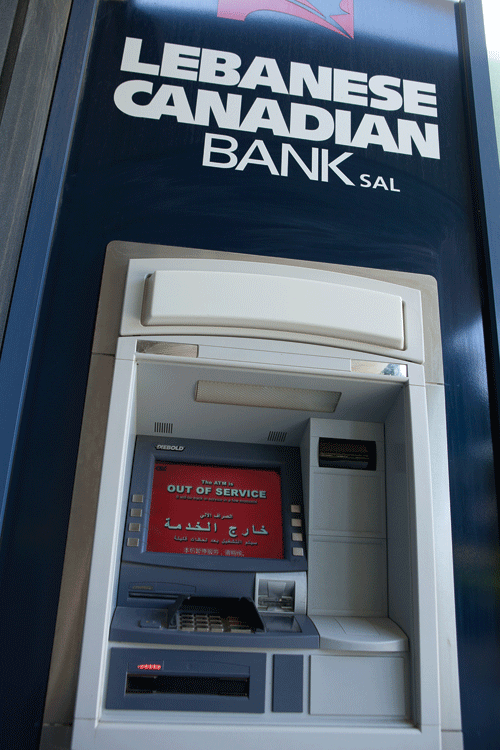
The United States Department of the Treasury’s designation in early February of Lebanese Canadian Bank (LCB) as a “financial institution of prime money laundering concern” hit the bank like a missile strike. And, as so often is the case with American ‘operations’ in the region, the collateral damage was high.

Immediately blacklisted the world over and unable to deal in US dollars, LCB was “crippled,” in the words of a source close to Banque du Liban (BDL), Lebanon’s central bank. The Lebanese banking sector went into damage control mode, concerned it could be part of a wider targeting of the industry, with the designation the worst blow to the sector’s reputation since 2000, when Lebanon was placed on the Non-Cooperative Countries and Territories list of the Financial Action Task Force (FATF), a Paris-based inter-governmental body set up to promote the adoption of anti-money laundering and counter-terrorist financing regulations (it was taken off the list in 2002).

The governor of BDL, Riad Salameh, flew to Washington to discuss the charges, where the US reassured him that the measure was not politically motivated, despite LCB’s alleged connection with Hezbollah, which the US designates as a terrorist organization. Nor, he was told, was it related to the fact that Lebanon’s next government will be led by the Hezbollah-backed March 8 coalition.

“The designation of LCB made people scared,” said the source close to BDL. “The Treasury assured BDL that they didn’t target the Lebanese banking sector and said Lebanon is a friendly nation. The US says it is not a political act but the timing of the designation is a bit precarious. I personally believe politics was involved. [But] I’m not saying the evidence is unfounded — the US has promised to provide information — as there is no smoke without fire.”

Rumors began to circulate that three to four other Lebanese banks were in the sights of the Treasury’s Financial Crimes Enforcement Network (FinCEN). “This is a completely unfounded rumor, and Salameh said this publicly. He told us that during the meeting [in Washington] this was not mentioned,” said Makram Sader, Secretary General of the Association of Banks in Lebanon (ABL). LCB’s designation came as a surprise to the ABL. “It is a specific case but really surprised us as Lebanon is dealing with the world through a large network and with over 250 correspondent banks,” he said.

The designation drove LCB’s reputation into the gutter and stimulated a limited run on the bank by depositors. The designation is just a first step before further action against the bank is taken, with LCB allowed, under US law, 60 days to appeal, which they are doing as the management have denied any wrong doing.

But the damage has already been done; to stave off a crippling run on the bank, LCB had to act fast. “LCB’s shareholders decided to sell, as they couldn’t deal in US dollars, which killed the bank. It wasn’t a decision by the US or BDL,” said the source.

With BDL against the acquisition or merger of any of the top three Alpha banks — Bank Audi, BLOM Bank or Byblos Bank — with LCB, for fear that it would create a ‘super-bank’ and kill competition in the market, four other banks sought LCB assets and liabilities. Société Générale de Banque au Liban (SGBL) made the winning offer and, as Executive went to print, SGBL and LCB representatives were in Paris, along with members of BDL and SGBL’s part shareholder, French bank Société Générale, to hammer out a deal. The consolidation will boost SGBL from the 10th largest bank in Lebanon to fifth.

The charges

In the words of US Treasury publication The Federal Register, “FinCEN has reason to believe that LCB has been routinely used by drug traffickers and money launderers operating in various countries in Central and South America, Europe, Africa and the Middle East; that Hezbollah derived financial support from the criminal activities of this network; and that LCB managers are complicit in the network’s money laundering activities.” In the notice, FinCEN lays out a case stating Lebanese-Colombian citizen Ayman Joumaa, who was named a “specially designated narcotics trafficker under the Foreign Narcotics Kingpin Designations Act on January 26, laundered “as much as $200 million a month” from cocaine sales. The proceeds were ‘cleaned’ through foreign exchange houses linked to Lebanon, LCB and its Gambian subsidiary Prime Bank, as well as through Trade Based Money Laundering (TBML) activities involving used car dealers in the US and the trading of consumer goods.

FinCEN then laid out LCB’s connection in rather unclear language and dubious math: “With respect to the exchanges and companies related to Ayman Joumaa, numerous instances indicate that substantial amounts of illicit funds may have passed through LCB. Since January 2006, hundreds of records with a cumulative equivalent value of $66.4 million identified a Lebanese bank that originated the transfer; approximately half of those were originated by LCB, for a cumulative equivalent value of $66.2 million, or 94 percent, thus, indicating that LCB probably is the favored bank for these exchange houses, particularly in the context of illicit banking activity.”FinCEN did not reply to queries by Executive asking how, if $66.4 million is the total and LCB was the origin of half the transfers, this is equal to $66.2 million, or how the latter figure is 94 percent of $66.4 million.

With the BDL still to carry out an internal investigation, as it does not yet have the full American report, the details are still vague regarding the accusations of LCB’s possible money laundering activity or knowingly acting as a financial conduit for Hezbollah. The language within the designation (“may have”, “believed to be” or “probably”) is an indication of its ambiguity.

The bank has also been suspected through what is legally referred to as “guilt by association,” with LCB managers accused of having ties with Iranian officials through Hezbollah’s Tehran-based envoy Abdallah Safieddine. The bank is also implicated via a Lebanese shareholder in LCB subsidiary Prime Bank who is “known to be a supporter of Hezbollah.”An indication of the political motivations of the designation is the discrepancy between the punishments of LCB and Jordan-based Arab Bank, which was forced to pay $24 million in 2005 for allegedly inadequate controls against money laundering at its New York branch. “Why wasn’t LCB fined? They wanted the bank closed. It’s a wake up call for the Lebanese banking sector and the threat posed by Hezbollah,” said a senior compliance officer (CO) at a Lebanese bank who requested anonymity. “The US has the power to sanction a bank anytime and put anyone away. We’re helpless here and need to be very careful to protect the banking sector. I’d give up a suspicious customer, even if it lost millions to protect the bank.”

Collateral damage?

LCB is not the only financial institution to have been shaken by FinCEN’s designation; all Lebanese banks and foreign exchange houses’ relations with the US have been affected.

“The effect from American banks was bad, by two banks in particular; we were not allowed to send from a Lebanese exchange house to an exchange house anywhere via the US. They don’t want any payments from banks related to the exchange dealers. It has created panic and is putting exchange dealers out of business,” said the CO. “The US banks also don’t want us to deal with used car dealers. But they cannot penalize other banks for what happened or consider all transfers as suspicious,” the CO added. “Deal with us or not, period. The banking sector is not loose and American banks shouldn’t be scared of Lebanese banks; banks are cooperating and closing accounts with exchange dealers, even good exchange dealers.”

The FinCEN links LCB and Joumaa to foreign exchange dealers in Lebanon. But those interviewed denied involvement. “We don’t know Joumaa. We’re a Category A listed exchange company and don’t know him,” said a manager of Hassan Ayash Exchange in Beirut. “This designation against us is not right, from A to Z. I will of course appeal with a lawyer and provide all the documentation and transfer records.” Another exchange manager noted: “Hezbollah doesn’t need the money; it gets it from Iran. So why would they use my exchange? And if I have to close my company [because of the designation], Hezbollah will not look after me.”

Joumaa is also linked to Elissa Holding, based in downtown Beirut, which owns Phenicia Shipping, the Elissa Exchange bureau in Sarafand, near Saida and companies in the Republic of Congo and Benin. The Elissa Holding manager, who was not at the holding’s office on a visit by Executive, did not answer further calls. The US also labeled Caesar’s Park Hotel in Beirut, next door to Hassan Ayash Exchange, as a meeting point for money launderers and a front company.

Jalal Joumaa, general manager of Caesar’s Park Hotel, declined to comment on the issue or on whether he would appeal. The exchange houses, Elissa Holding and the hotel are still operating, with no apparent action taken against them by the Lebanese authorities.

Upgrading the law

Ayman Joumaa was publicly designated as a drug kingpin in late January, two weeks before LCB was labeled a prime money laundering concern; this ought to have set off warning bells at LCB’s compliance department, at exchange houses and with Lebanese regulators. If the FinCEN report is to be believed and Joumaa has links to LCB that stretch back to 2006, what it would suggest is that there are certain weaknesses in Lebanon’s anti-money laundering (AML) regime.

The BDL has said that, in line with recent US requests and following a mutual evaluation of the country’s AML regulations in 2009 by FATF’s regional body, MENA-FATF, it will upgrade procedures. Current proposed laws include cross-border cash regulations, declarations and disclosures, and the addition of another 10 predicate offenses to the current seven.

“The procedures also have to be more explicit on terrorist financing, as according to MENA-FATF they are not clear,” said the source close to BDL.

Lebanon is also being pushed to ratify the United Nation’s International Convention for the Suppression of the Financing of Terrorism (1999). That it has not shows there “is no political commitment, and this sheds doubt on how committed the government is to the whole process,” said the source.

The ABL, however, said it has been in favor of signing the convention since 2000. “Reputational risk is important to us and we will double and review the procedures, as the authorities are doing. And we will try to push and accelerate the introduction of new laws and regulations to fill all the gaps,” said Sader.

The designation of LCB has certainly been a wake-up call for Lebanese banks and how the sector is regulated. “Banks have learned a lesson, for example closing exchange bureaus because they believe, [as do I], that it has a lot of risk,” said the source. As to LCB’s guilt and whether the designation was a carefully timed political move, only time will tell. According to Sader, “LCB’s appeal could take months or years.”


April 3, 2011 1 comment
0 FacebookTwitterPinterestEmail
Comment

Secularism’s time to shine

by Sami Halabi April 3, 2011
written by Sami Halabi


During the rain and overcast last month, one would have been forgiven for thinking the masses of Lebanese reciting slogans skyward about independence, resistance, justice, arms, tribunals, truth and stability had been duped into believing that their approach to social and political discourse would make the sun come out and the sky turn blue. Instead, however, many Lebanese would do well to regard each day that passes as an opportunity lost to the dreary sectarian bickering of our politicians — the same ones we fought so ardently to elect.

That we Lebanese have mixed up our priorities is nothing new but that does not make it any less relevant or painful to watch. Foreigners marvel at how we put up with governments and parties that have, literally, no stated socio-economic policies, but instead spout vague dogmatic principles that change with the tide. And yet still, we wait for the call from our zaim to cast a ballot or carry a placard.  Thankfully, events in the region have put things in perspective. No longer can we claim to be the vanguard of freedom and democracy in the Middle East. Indeed, the Lebanese pale into the shadows of apathy behind the uprisings of our Arab brethren elsewhere demanding free societies that value equality over political patronage and sectarian entitlement.

Of course, there are those who will make the excuse that Hezbollah’s weapons are the problem, but it’s not the weapons themselves that prevented previous governments from forming a national labor strategy to absorb the 15,000 graduates each year — many of whom eventually leave the country — or prevented us from reforming our public sector to properly provide basic services such as electricity, water and telecommunications. Rather, it is the constant employment of these weapons in the politics of fear that has led us to this point. The situation will persist as long as the discourse remains in its present absolutist form: that arms should only be under the purview of the state or that the weapons — with their ambiguous size, location and uses — provide better security than a national army subject to regional and international pressures and commitments.

While both of these arguments hold some merit, neither honestly portrays the whole picture. What neither side is willing to admit is that there is a solution to the problem that they effectively evade.

Israel is not the only reason that Hezbollah’s weapons continue to exist outside of sovereign authority. The history of the south and its majority Shia inhabitants is wrapped with mistrust of the state due to decades of disregard from the central government in Beirut, dominated by the Sunni and Maronite powers. The divide is not only over arms, but also provision of public services; the sectarian overlords who hold influence over that provision have used it to underpin their politics of “fearing the other,” thus conscripting loyalty within their community and preserving the status quo.

But over the last two months cries for toppling the sectarian regime have risen in Lebanon, with thousands marching through the streets in protest last month. While expression of this secular vein is not in itself new, its current manifestation is within, and propelled by, a regional context demanding of substantive change rather than a cosmetic rearrangement of the existing power structure. Those who benefit from Lebanon’s current social construct know their power would be threatened if reforms toward a secular system gained momentum, and that in a society built on the principle of equality the emotive force of their sectarian sloganeering would be rendered mute. Even the issue of Hezbollah’s arms would be tempered, as the associated paranoia over them would lose its confessional dimension.

For this movement toward change to gain critical mass, it will need to convince the skeptics, many of whom also support the end of the sectarian system but are wary of any new movement being co-opted by either side of the current religious and political divide. There are many other factors that will also determine the movement’s success, but one thing needs to be recognized: now is an historic opportunity to wake the Lebanese consciousness, for us to stop baying like sheep for leaders who only perpetuate our problems and to cast them from their thrones as we march toward a solution together.

Sami Halabi is deputy editor of EXECUTIVE Magazine


April 3, 2011 0 comments
0 FacebookTwitterPinterestEmail
Finance

Equities in times of upheaval

by Thomas Schellen April 3, 2011
written by Thomas Schellen

When the Egyptian Stock Exchange (EGX) finally resumed trading on March 23, six weeks after the resignation of President Hosni Mubarak, officials were pragmatic about the day’s 8.9 percent drop in the EGX 30 index. The gain of freedom far outweighed the economic cost of the revolution, interim EGX Chairman Mohammed Abdel-Salam told reporters.

It did not come as much of a surprise that Egypt’s benchmark index nosedived in the first 30 minutes of trading after the market’s revolutionary hiatus since January 24. A great deal has happened in those two months, during which the EGX lost just short of 40 sessions.

During the period of market closure in Cairo, the only evidentiary indications of how investors felt about Egyptian equities came from the trade of Global Depository Receipts (GDRs) of Egyptian stocks on the London Stock Exchange (LSE), where the handful of actively traded Egyptian GDRs dropped mightily.

Of 10 Egyptian GDRs on the LSE, six were active during the EGX closure, and four of those six are the country’s strongest companies by market capitalization. All six dropped between January 9 and March 21 — one telecom GDR and two financial stocks fell more than 30 percent apiece, Orascom Construction Industries and Orascom Telecom Holding lost 26 percent and 15 percent, respectively, but a cement scrip closed the period only 2 percent weaker.

Commercial International Bank (Egypt)

At the same time, five other LSE-listed Arab GDRs with trading activity during this revolutionary period fell on both their home markets and, pronouncedly, on the LSE. Only one Arab GDR, of Lebanon-based Byblos Bank, gained on the LSE over the period.   

In short, the Arab stocks with the guts to venture into international markets have not fared well  during the revolutions. The benchmark indices of the Egyptian bourse and the Tunisian Stock Exchange (TSE), the countries hailed most for their roles in the “Arab Spring,” on March 29 closed 24 percent and 15 percent down when compared with the start of 2011, placing them at the tail end of global stock market performances in the year to date. Moreover (and partly explaining the incomparably poor performance of EGX and TSE), the exchanges of Egypt, Tunisia, Libya and Bahrain combined lost out on more than 90 trading sessions in the first quarter of 2011, with the young Libyan Exchange likely to be in limbo for many more weeks.

Investor behavior on Kuwait Stock Exchange
(January 1 to February 28, 2011)

Investor behavior on Kuwait Stock Exchange


Investor behavior on Saudi Stock Exchange
(February 2011)Investor behavior on Saudi Stock Exchange

Gulf Cooperation Council exchanges at the turn of February to March appeared bound for forbidding territory. Selling pressure drove the Saudi Stock Exchange (SSE) and Dubai Financial Market (DFM) benchmark indices to multi-year lows in the first few days of March, almost as though wealthy corporations and individuals had been spooked en masse by the prospect of radical change in power structures across the region.

Then, the whole mystifying decline went into reverse. The SSE’s Tadawul All-Share Index clawed back almost 10 percent in March to close the March 29 session within 2 percent of its index recording at the beginning of 2011. The DFM index gained 15 percent from March 3 to March 29. 

When viewing performance of the most active Egyptian GDR on the London Stock Exchange, Commercial International Bank (CIB), in step with the popular unrest and political changes in the Middle East and North Africa this past quarter, it seems likely enough that the developments of politics and stocks were linked in obvious interactions. The ouster of Tunisian president Ben Ali, the day of rage on Tahrir Square, and the intensification of protests in the GCC at the end of February all meshed with periods of drops in the CIB price on the LSE, whereas Mubarak’s resignation was followed by a gain in the stock’s price.

Flight impulses are instinctual survival tools of a vulnerable being, and this quarter reminds us that the investor is as susceptible as any other. The intuitive response to first quarter disasters in 2011 was to sell. As the prime example of panic reaction, the Nikkei 225 descended 20 percent in the week of March 13, although the impact of the March 11 earthquake on Japanese gross domestic product was quickly estimated to be closer to 2 percent, not 20. By market opening on March 30, the Nikkei was still down over 9 percent when compared with the close on March 10, the evening before the triple catastrophe struck Japan.

Market analysts and investment advisors responded to the panic selling on the Tokyo bourse with reminders that the Kobe earthquake in 1995 caused a similar downside pressure on the Nikkei but that the market was back up to pre-disaster levels within less than a year.

This illuminates the challenge, and perhaps the importance, of Arab markets in these times of social change. Arab markets, for one thing, have been growing at an impressive rate but they have not commanded all that much global attention. This is evident in the fact that global stocks barely fluttered when the Egyptian market dropped on March 24. Index fluctuations of Arab exchanges have not visibly impacted global equity markets in the past, or present, whereas such impacts were easily generated by crises and even one-day hiccups of American, European, Japanese and also Chinese stock markets in recent years.  

Secondly, the experience of Arab stock markets in the epoch of revolution is something incommensurable. There have been many revolutions of many different colors (from orange to jasmine) in the modern era, however, the larger and more significant revolutions have taken place in countries before they had active stock markets.

The biggest sea change of our age, the end of the Soviet era in 1989 (to which many have compared the Arab Spring of 2011), was the bankruptcy of a centrally planned economy. The Soviet Empire had weapons and many resources, but no stock markets. Every revolution and democratization of that period between 1989 and 1991 thus was a point of departure from grey markets into the regulated freedoms of a financial economy with stock markets.

Political cycles and confrontations are of course known to impact bourses. The global wars of the 20th century, World War I and World War II, and other military conflicts before them, have paralyzed stock markets for their duration of armed confrontation. Singular events, from terrorist attacks to tsunamis, are also noted for the influences they have exerted upon equity markets.

But officials at the World Federation of Exchanges —  which represents the majority of the world’s stock market operators — could not recall examples or studies regarding the interplay of stock markets and revolutions. There seems to be no paradigm of stock market behaviors in past revolutions that one could use to reference and compare the trends of Arab markets against as this region is undergoing its grassroots uprising. 

Disconnected from reality

It may not write a big chapter in world equity markets history, but Arab bourse trends in the past quarter have not so far exhibited behaviors that journalism’s simple tools of logic and analytics could correlate with the storms of revolutionary change. Careful analysis of the index flows and the events of the Arab Spring might yet provide insights into the role of equity markets in times of revolt; its connects and the disconnects. 

Countries in the GCC with protests reported in February and March were of course Bahrain and Oman, along with one shorter period of mostly aborted demonstrations in Saudi Arabia. However, the GCC equity market with the biggest drop in the first quarter of 2011 was the Kuwait Stock Exchange, down 9.1 percent year-to-date by March 29 market close.

The Bahrain Bourse (BB), freshly renamed from Bahrain Stock Exchange, was closed for minimal periods even as protesters were targeting the financial district of the capital Manama, where the exchange has its base. After the forceful breakup of demonstrations on March 18, the bourse’s benchmark index approached the end of the first quarter in 2011 with a number of gaining sessions and its March 29 close was minimally down versus the start of the year.

While daily average turnover was 49.8 percent down in first quarter 2011 when compared with the same quarter in 2010, there were no immediate compelling correlations between the expansion and suppression of protests and the BB index movements throughout February and March. 


All the while, international analysts have diagnosed from the upheavals significant detriments to the kingdom’s business aspirations to attract or even retain foreign companies; the Economist Intelligence Unit forecasted last month that political unrest in Bahrain would persist over the coming four years.

In Oman, a country with a surprise peak of discontent at the end of February, the Muscat Securities Market (MSM) close on March 29 was 6.2 percent down from the start of 2011. Curiously, while the relatively isolated first eruptions of fiery protests in Oman were reported in the media in the last few days of February, the MSM index’s most pronounced drop in the period began earlier, on February 14.

The MSM general index’s two-week slide by more than 12 percent ended on February 28 and the market, apparently oversold, rebounded 4.2 percent on March 1 and ended the month with a positive balance even as protests, while not quite escalating, did not abate either. During the period, the MSM average daily trading volume was actually higher than in the first quarter of 2010.

It might be easier to link MENA equity movements during this period to the perceptions — dominated by international media — of the Arab upheavals if the role of international investors in Arab markets were more mature. But while statistics by the Kuwaiti and Saudi bourses show that most investor categories — retail, funds and corporate — acted as net sellers in recent months, the actual dominance of Saudi retail investors in the SSE trading volume, for example, is more than 80 percent and the engagement of non-Arab investors is less than 2 percent, according to the exchange.

Jordan’s Amman Stock Exchange has a high share of foreign stock ownership but this reflects mainly the participation of Gulf-based investors in the Jordanian market, which slumped almost 10 percent in the first quarter, with a rather consistent downtrend. Only the EGX foreign ownership ratio of stocks is sizeable at just less than 24 percent of active shares, according to Reuters.

Arab stock exchanges mirror the political economy of the time, and the role of regional equity markets in supporting the needs and dynamics of the region’s economic restructuring will be interesting to follow in coming years. Yet in times when the economic fundamentals are quivering, with no surety as to their direction, it seems advisable to inquire about the trends within the numbers and ratios – known as technical analysis.

Whereas EGX trading records in the second week of the market’s reopening showed gains, prompting officials to ooze confidence, Paris-based technical analyst Julien Nebenzahl, chief executive officer of Day by Day, a trading firm and consultancy, said shortly after the market’s reopening that the Cairo bourse held further downside potential, because the index had broken an important support level. 

Also in the SSE, the region’s largest market, Nebenzahl told Executive by phone “there is no real opportunity, technically speaking,” but added that the TASI also was not poised to drop.

But good news is expected from the UAE markets, where some bearish targets have been met, and the second half of 2011 could see a positive trend to the upside. The best market to invest in across the Middle East in this period, according to Nebenzahl, is the Casablanca Stock Exchange in Morocco. “It is still bullish at any time,” said Nebenzahl, who emphasized that in his field of technical analysis the only thing that matters are numbers and proven behavior patterns. In other words, personal opinions about political events are not relevant.

The fascinating question about cycles and trends, both economic and political, is why they are so consistent, and which have not been discovered yet. According to Nebenzahl, a known political and consequential power cycle with the rather long amplitude of 100 years is coming to bear in the recent developments in Tunisia, Egypt and elsewhere in the region. 

According to this cycle, America’s power as the world’s leading entity should have started to diminish beginning around the year 2000. Because the global leadership of the United States is weakening, Nebenzahl said, “in conclusion of this period, we’ll see troubles in many countries,” and pressure changes, such as are emerging in the Arab world, are “typical results.”

April 3, 2011 0 comments
0 FacebookTwitterPinterestEmail
  • 1
  • …
  • 384
  • 385
  • 386
  • 387
  • 388
  • …
  • 708

Latest Cover

About us

Since its first edition emerged on the newsstands in 1999, Executive Magazine has been dedicated to providing its readers with the most up-to-date local and regional business news. Executive is a monthly business magazine that offers readers in-depth analyses on the Lebanese world of commerce, covering all the major sectors – from banking, finance, and insurance to technology, tourism, hospitality, media, and retail.

  • Donate
  • Our Purpose
  • Contact Us

Sign up for our newsletter

    • Facebook
    • Twitter
    • Instagram
    • Linkedin
    • Youtube
    Executive Magazine
    • ISSUES
      • Current Issue
      • Past issues
    • BUSINESS
    • ECONOMICS & POLICY
    • OPINION
    • SPECIAL REPORTS
    • EXECUTIVE TALKS
    • MOVEMENTS
      • Change the image
      • Cannes lions
      • Transparency & accountability
      • ECONOMIC ROADMAP
      • Say No to Corruption
      • The Lebanon media development initiative
      • LPSN Policy Asks
      • Advocating the preservation of deposits
    • JOIN US
      • Join our movement
      • Attend our events
      • Receive updates
      • Connect with us
    • DONATE