• Donate
  • Our Purpose
  • Contact Us
Executive Magazine
  • ISSUES
    • Current Issue
    • Past issues
  • BUSINESS
  • ECONOMICS & POLICY
  • OPINION
  • SPECIAL REPORTS
  • EXECUTIVE TALKS
  • MOVEMENTS
    • Change the image
    • Cannes lions
    • Transparency & accountability
    • ECONOMIC ROADMAP
    • Say No to Corruption
    • The Lebanon media development initiative
    • LPSN Policy Asks
    • Advocating the preservation of deposits
  • JOIN US
    • Join our movement
    • Attend our events
    • Receive updates
    • Connect with us
  • DONATE
Comment

“Old media” the unsung avenger

by Jonathan Wright April 3, 2011
written by Jonathan Wright


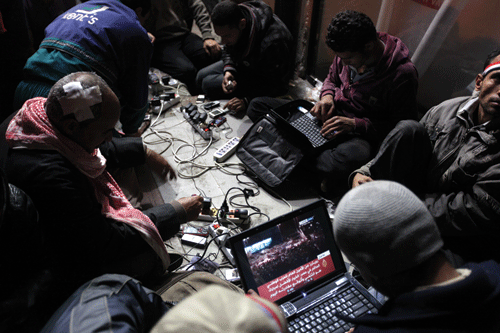
“The revolution will not be televised”, sang Gil Scott-Heron in a 1970s proto-rap number in the wake of the United States civil rights movement. But when revolution broke out in Egypt in January, it was not only televised, it was tweeted, Facebooked, YouTubed, linked by email and splashed on the front page of newspapers at home and abroad.

Those far away in Europe and the United States, perhaps seeking to assert a Western contribution to the popular uprising, dubbed it another Facebook or Twitter revolution, as they had with Tunisia a few weeks earlier. Others emphasized the role of the Qatari satellite news channel Al Jazeera, which amplified the voices of the Egyptians protesting on the streets, carrying their words of defiance into living rooms and coffee shops across the Arab world.

Media academics are now picking through the electronic trail that the revolutionaries left behind them, trying to work out who was in touch with whom and which media was decisive in mobilizing the masses and winning over international public opinion. They should not ignore the old-technology media, which evolved incredibly in the latter years of Hosni Mubarak’s long reign. When he took office in 1981, the Egyptian state still had an iron grip on all information, through the three flagship mass-circulation daily newspapers nationalized in 1960 and the state broadcasting service, which monopolized television and dominated the radio airwaves. Alternative media in those days meant Radio Monte Carlo, the BBC and Voice Of America’s Arabic services, and a few weekly newspapers run by small opposition parties that were poorly produced and riddled with turgid rhetoric by polemicists. Egyptians with enough spare cash could buy foreign newspapers and magazines, which arrived several days late.

The media began to change in earnest around the turn of the millennium, as the price of satellite dishes and receivers dropped and Arab countries launched more satellites offering hundreds of television channels. Commercial interests, especially in Saudi Arabia and the Gulf, drove the boom and most of the fare on offer was popular culture, plus a heavy dose of Islamic televangelism. But news and current affairs found a niche too, especially after the September 11 attacks on the United States and the subsequent invasions of Afghanistan and Iraq. At about the same time, again under commercial pressures, the Egyptian government allowed independent satellite broadcasters to set up shop in Cairo. Their late-night talk shows, which delved deeper and deeper into the country’s internal affairs, stole millions of viewers from state television.

Egyptian businessmen were also pressing for licenses for independent newspapers, and the Mubarak regime relented, apparently confident that it had the country firmly under its thumb; the government’s attitude became one of indifference. Editor Ibrahim Eissa in al-Dostour and novelist Alaa el-Aswany in el-Shorouk attacked Mubarak and his family relentlessly week after week, usually without serious repercussions. In retrospect, Mubarak and his retinue may be regretting their tolerance. Independent media and the Internet, which the Egyptian government very rarely tried to censor, slowly eroded the prestige of the president and the people around him. State media lost its audience, depriving the government of what was traditionally a valuable propaganda tool.

Facebook clearly played its part too, especially in the last few years, creating online communities that rapidly evolved into solidarity on the street in the first few days of the uprising. But at one of the crucial moments of the revolution, a domestic television station helped to keep the protest movement alive. Millions watched talk show host Mona el-Shazli’s February 7 interview with Google executive and Internet activist Wael Ghonim on the evening he emerged from 11 days in detention. Ghonim put a modern human face on the young revolutionaries, whom the government had alternately dismissed as foreign agents or rabid Islamists. On February 12, the day after Mubarak lost power, even the state newspaper Al Ahram had to abandon the man it had loyally served for 30 years. “The People Overthrow the Regime” was the triumphal banner headline, a classic in the annals of turncoat journalism.

Today state media is in limbo, kept on life support by the inertia of the ruling military council, which has been reluctant to tamper with such longstanding institutions. But short of an improbable counter-revolution, it’s hard to imagine that any future Egyptian government will try to put the media genie back in the bottle.

Jonathan Wright is managing editor of Arab Media and Society


April 3, 2011 0 comments
0 FacebookTwitterPinterestEmail
Economics & Policy

Art with no admirers

by Saria Francis April 3, 2011
written by Saria Francis

Tourism, that perennial contributor to Lebanon’s coffers, could be heading for a dry spell. The deteriorating domestic political situation coupled with widespread regional unrest has made for an arid start to the year, and things aren’t looking up for the rest of 2011.

“The closer we get to summer without a government, the more the tourism sector will be negatively affected since tourists won’t wait until the last moment to [decide] where to go,” said Marwan Mikhael, head of research at BLOMInvest Bank. 

Tourism’s direct contribution to Lebanon’s economy amounts to some 10 percent of annual gross domestic product; including indirect contributions (profits of tourism spent in other sectors of the economy), tourism amounts to around one third of the country’s economic output, according to the World Travel and Tourism Council (WTTC). Some 205,000 tourists came to Lebanon in the first two months of 2011, a drop of 12.7 percent from the 235,000 who arrived in the same month last year, Lebanon’s best to date.

“The number of tourists is declining even more due to several factors: political instability and what’s happening in the region,” Mikhael said. “Even though Lebanon is shielded from what’s happening — we won’t have the same revolution or unrest — tourists will be afraid anyhow.”

The effects of a less-than-stellar tourism season on economic output were palpable during the last economic trough after the 2006 war with Israel literally sent tourists fleeing; that year GDP growth reached just 0.6 percent. It since rebounded to peak at 9.3 percent in 2008 and dropped to 8.5 in 2009, the last year for which official GDP figures are available from the national accounts due to a lack of accurate and timely statistics.

Most estimates for 2010 suggested a 7.5 percent growth rate, with the decline sliding into 2011 as the coincident indicator, an average of eight weighted economic indicators published monthly basis by Banque du Liban (BDL), Lebanon’s central bank, fell 4.7 percent from November to January. Barclays Capital and Standard Chartered have revised their 2011 Lebanese GDP forecasts down to 5.5 percent, while BDL Governor Riad Salameh told the press he expected economic growth to slow to 5 percent.

Falling earnings and rising costs

Barclays Capital also indicated that the higher oil prices would increase the price of transfers to Electricité du Liban, which, combined with the government’s recent decision to lower gasoline import taxes by 57 percent, would chip away some 1.5 percent of GDP; these, among other factors, led Barclays to forecast an increase in the budget deficit to 8.2 percent of GDP this year from last year’s 7.5 percent. Standard Chartered expects the fiscal deficit to widen to 9.5 percent of GDP. Lebanon’s total debt topped $52.29 billion in January, up from $51.65 a year earlier, with domestic banks holding roughly 60 percent.

More bad news came as the Economist Intelligence Unit predicted Lebanon’s trade deficit to hit an all-time high this year of $13.75 billion. The country’s Higher Customs Council showed a $550 million year-to-year increase in Lebanon’s balance-of-trade deficit in the first two months of 2011, to $2.35 billion through February. Total exports fell 8.24 percent over the same period to $601 million, with a 20.24 percent jump in imports to $2.95 billion. Export decline will likely continue as Egypt, one of Lebanon’s main export markets, contracts.

Remittances, at an $8.2 billion all-time high last year according to the World Bank, are expected to decrease as regional unrest impacts Lebanese working abroad — particularly in Bahrain. The remittance decline may be mitigated somewhat, according to BLOMInvest’s Mikhael, by higher oil prices leading to increased earnings for Lebanese working in hydrocarbon exporting states.

Another pillar of Lebanon’s economy, the banking sector, saw the $128.92-billion consolidated balance sheet of commercial banks shed over $580.07 million in January. The dollarization rate of deposits is rising again, at 64.38 percent in January 2011, up from 63 percent a year earlier, indicating less faith in the local currency. Loans in the sector were still rising, however, with $30.08 billion in the market as of January, up from $24.66 billion a year earlier. 

The property sector is also slowing: in the first two months of 2011, sales transactions fell 18.7 percent year-on-year to 10,630, which included a 26.4 percent decrease in sales to foreigners. A report by The General Directorate of Land Registry and Cadastre shows that despite this dip, the total value of sales was only down 1.1 percent in comparison to this time last year.

Despite these poor indicators, Standard Chartered expects the Lebanese economy to demonstrate its distinctive flexibility. According to them, the economy’s basic structures ought to remain stable thanks to continued confidence in its banking system, and in the central bank’s ability to preserve the American dollar peg and follow an International Monetary Fund-accepted approach toward reducing the public debt-to-GDP ratio.

April 3, 2011 0 comments
0 FacebookTwitterPinterestEmail
Comment

A smiling police state

by Lauren Williams April 3, 2011
written by Lauren Williams


Until late February Syria had remained, much to the bewilderment of headline-hungry newspaper editors, immune to revolutionary revolt.

When Tunisian-inspired unrest began rippling across the region, the regime had moved quickly to prevent the wave from rolling up on Syrian shores. The sophisticated public relations campaign was two-fold: international media was coveted to convey democratic, happy ideals of transparency and secularism; domestically, details of financial appeasement packages were heavily promoted.

First came the news that Syria was effectively reversing its decade-long policy of gradually cutting costly subsidies, announcing a $250 million dollar handout package to “combat poverty.” Then came an exquisitely placed interview in the Wall Street Journal with Bashar al-Assad — no local or Arabic media outlet has ever been granted such a privilege — where the president pledged a host of progressive reforms, including holding municipality elections and media liberties. (Many swiftly became suspicious of the lifting of the ban on Facebook and other networking sites, seeing it as designed for intelligence services to keep a closer watch on users.)

The Syrian government has recognized for some time that it was suffering somewhat of an image crisis, and last year employed German-based Keybrand PR agency to “re-brand” the government. Syrian Ali Mahmoud, who runs the agency, told local press the regime’s image was “a mess and they know it.”

Thus the stony-faced images of the president covering walls and billboards have been getting a face-lift, while long-lens paparazzi-style shots of the President sharing an intimate moment with his wife, Asma al-Assad, in Paris were leaked from the presidential palace to local media.

The Syrian state appears to have clocked on to something important; improving a regime’s international image is crucial to keeping one’s own house in order. Acceptance in Western circles gives anyone thinking of raising alarms over anti-democratic principles considerably less potency.

But there’s a problem. Those same newspapers used to peddle these messages keep catching on to unfortunate incidents, ramming home pervasive stereotypes that Syria is a closed and oppressive state with a brutal, feared and endemic secret police.

The case of 19-year-old blogger Tal al-Mallouhi, who was sentenced to five years in prison by a closed state security court on charges of espionage after being detained for nine months, made headlines. As did peaceful protesters beaten by secret service agents after staging vigils in support of protesters in Egypt and Libya.

Equally ineffective is expelling foreign journalists from the country and interrogating their professional contacts, given that Journalists have a habit of writing about it.

If there was one thing that oppressive regimes should learn from recent revolts, it is the power of the press. Brutal secret intelligence agents operating with apparent impunity cannot be kept secret anymore. But old habits die hard: since the first significant protests broke out in Syria in, of all places, the Southern city of Deraa, the state has reverted to its tried and tested means, opening fire on protesters, killing at least 61 and attempting to “secure” the area from the eyes and ears of the outside world while publicly claiming the protesters are a small group engaging in “acts of sabotage.” No one is buying that anymore. Killing your own people is a red line that has the ability to turn even the most politically apathetic or blind supporter (as Syrians are often labeled) into an opponent.

More social policy reform carrots followed those particular sticks, with a reduction in the length of compulsory military service, an announcement of the release of underage prisoners, dissolution of cabinet and rumors of an end to emergency law. But those carrots look damningly apologetic for a regime desperately trying to promote itself as a democratic ideal in the face of the unavoidable evidence.

Intriguingly, the Syrian state seemed to be aware of the problem. In January the British Syrian Society (BSS), which is headed by the First Lady’s father, Fawas Akhras, working with the Syrian ministries of tourism and the interior, launched a pilot project to “put a friendly face on Syrian policing” and change the perception of Syrian police from a “force” to a “service.” But If the Syrian state wants to fix its image problem, the challenge is to unravel a complex apparatus of fear and habit that infiltrates every level of society. The state has recognized the power of the media.

Now the question is whether it is ready, or able, to relinquish such control. But perhaps it is too little, too late.

Lauren Williams is a correspondent for The Guardian and is the former managing editor of Forward Magazine in Syria


April 3, 2011 0 comments
0 FacebookTwitterPinterestEmail
Finance

An arranged marriage

by Paul Cochrane April 3, 2011
written by Paul Cochrane


The United States Department of the Treasury’s designation in early February of Lebanese Canadian Bank (LCB) as a “financial institution of prime money laundering concern” hit the bank like a missile strike. And, as so often is the case with American ‘operations’ in the region, the collateral damage was high.

Immediately blacklisted the world over and unable to deal in US dollars, LCB was “crippled,” in the words of a source close to Banque du Liban (BDL), Lebanon’s central bank. The Lebanese banking sector went into damage control mode, concerned it could be part of a wider targeting of the industry, with the designation the worst blow to the sector’s reputation since 2000, when Lebanon was placed on the Non-Cooperative Countries and Territories list of the Financial Action Task Force (FATF), a Paris-based inter-governmental body set up to promote the adoption of anti-money laundering and counter-terrorist financing regulations (it was taken off the list in 2002).

The governor of BDL, Riad Salameh, flew to Washington to discuss the charges, where the US reassured him that the measure was not politically motivated, despite LCB’s alleged connection with Hezbollah, which the US designates as a terrorist organization. Nor, he was told, was it related to the fact that Lebanon’s next government will be led by the Hezbollah-backed March 8 coalition.

“The designation of LCB made people scared,” said the source close to BDL. “The Treasury assured BDL that they didn’t target the Lebanese banking sector and said Lebanon is a friendly nation. The US says it is not a political act but the timing of the designation is a bit precarious. I personally believe politics was involved. [But] I’m not saying the evidence is unfounded — the US has promised to provide information — as there is no smoke without fire.”

Rumors began to circulate that three to four other Lebanese banks were in the sights of the Treasury’s Financial Crimes Enforcement Network (FinCEN). “This is a completely unfounded rumor, and Salameh said this publicly. He told us that during the meeting [in Washington] this was not mentioned,” said Makram Sader, Secretary General of the Association of Banks in Lebanon (ABL). LCB’s designation came as a surprise to the ABL. “It is a specific case but really surprised us as Lebanon is dealing with the world through a large network and with over 250 correspondent banks,” he said.

The designation drove LCB’s reputation into the gutter and stimulated a limited run on the bank by depositors. The designation is just a first step before further action against the bank is taken, with LCB allowed, under US law, 60 days to appeal, which they are doing as the management have denied any wrong doing.

But the damage has already been done; to stave off a crippling run on the bank, LCB had to act fast. “LCB’s shareholders decided to sell, as they couldn’t deal in US dollars, which killed the bank. It wasn’t a decision by the US or BDL,” said the source.

With BDL against the acquisition or merger of any of the top three Alpha banks — Bank Audi, BLOM Bank or Byblos Bank — with LCB, for fear that it would create a ‘super-bank’ and kill competition in the market, four other banks sought LCB assets and liabilities. Société Générale de Banque au Liban (SGBL) made the winning offer and, as Executive went to print, SGBL and LCB representatives were in Paris, along with members of BDL and SGBL’s part shareholder, French bank Société Générale, to hammer out a deal. The consolidation will boost SGBL from the 10th largest bank in Lebanon to fifth.

The charges

In the words of US Treasury publication The Federal Register, “FinCEN has reason to believe that LCB has been routinely used by drug traffickers and money launderers operating in various countries in Central and South America, Europe, Africa and the Middle East; that Hezbollah derived financial support from the criminal activities of this network; and that LCB managers are complicit in the network’s money laundering activities.” In the notice, FinCEN lays out a case stating Lebanese-Colombian citizen Ayman Joumaa, who was named a “specially designated narcotics trafficker under the Foreign Narcotics Kingpin Designations Act on January 26, laundered “as much as $200 million a month” from cocaine sales. The proceeds were ‘cleaned’ through foreign exchange houses linked to Lebanon, LCB and its Gambian subsidiary Prime Bank, as well as through Trade Based Money Laundering (TBML) activities involving used car dealers in the US and the trading of consumer goods.

FinCEN then laid out LCB’s connection in rather unclear language and dubious math: “With respect to the exchanges and companies related to Ayman Joumaa, numerous instances indicate that substantial amounts of illicit funds may have passed through LCB. Since January 2006, hundreds of records with a cumulative equivalent value of $66.4 million identified a Lebanese bank that originated the transfer; approximately half of those were originated by LCB, for a cumulative equivalent value of $66.2 million, or 94 percent, thus, indicating that LCB probably is the favored bank for these exchange houses, particularly in the context of illicit banking activity.”FinCEN did not reply to queries by Executive asking how, if $66.4 million is the total and LCB was the origin of half the transfers, this is equal to $66.2 million, or how the latter figure is 94 percent of $66.4 million.

With the BDL still to carry out an internal investigation, as it does not yet have the full American report, the details are still vague regarding the accusations of LCB’s possible money laundering activity or knowingly acting as a financial conduit for Hezbollah. The language within the designation (“may have”, “believed to be” or “probably”) is an indication of its ambiguity.

The bank has also been suspected through what is legally referred to as “guilt by association,” with LCB managers accused of having ties with Iranian officials through Hezbollah’s Tehran-based envoy Abdallah Safieddine. The bank is also implicated via a Lebanese shareholder in LCB subsidiary Prime Bank who is “known to be a supporter of Hezbollah.”An indication of the political motivations of the designation is the discrepancy between the punishments of LCB and Jordan-based Arab Bank, which was forced to pay $24 million in 2005 for allegedly inadequate controls against money laundering at its New York branch. “Why wasn’t LCB fined? They wanted the bank closed. It’s a wake up call for the Lebanese banking sector and the threat posed by Hezbollah,” said a senior compliance officer (CO) at a Lebanese bank who requested anonymity. “The US has the power to sanction a bank anytime and put anyone away. We’re helpless here and need to be very careful to protect the banking sector. I’d give up a suspicious customer, even if it lost millions to protect the bank.”

Collateral damage?

LCB is not the only financial institution to have been shaken by FinCEN’s designation; all Lebanese banks and foreign exchange houses’ relations with the US have been affected.

“The effect from American banks was bad, by two banks in particular; we were not allowed to send from a Lebanese exchange house to an exchange house anywhere via the US. They don’t want any payments from banks related to the exchange dealers. It has created panic and is putting exchange dealers out of business,” said the CO. “The US banks also don’t want us to deal with used car dealers. But they cannot penalize other banks for what happened or consider all transfers as suspicious,” the CO added. “Deal with us or not, period. The banking sector is not loose and American banks shouldn’t be scared of Lebanese banks; banks are cooperating and closing accounts with exchange dealers, even good exchange dealers.”

The FinCEN links LCB and Joumaa to foreign exchange dealers in Lebanon. But those interviewed denied involvement. “We don’t know Joumaa. We’re a Category A listed exchange company and don’t know him,” said a manager of Hassan Ayash Exchange in Beirut. “This designation against us is not right, from A to Z. I will of course appeal with a lawyer and provide all the documentation and transfer records.” Another exchange manager noted: “Hezbollah doesn’t need the money; it gets it from Iran. So why would they use my exchange? And if I have to close my company [because of the designation], Hezbollah will not look after me.”

Joumaa is also linked to Elissa Holding, based in downtown Beirut, which owns Phenicia Shipping, the Elissa Exchange bureau in Sarafand, near Saida and companies in the Republic of Congo and Benin. The Elissa Holding manager, who was not at the holding’s office on a visit by Executive, did not answer further calls. The US also labeled Caesar’s Park Hotel in Beirut, next door to Hassan Ayash Exchange, as a meeting point for money launderers and a front company.

Jalal Joumaa, general manager of Caesar’s Park Hotel, declined to comment on the issue or on whether he would appeal. The exchange houses, Elissa Holding and the hotel are still operating, with no apparent action taken against them by the Lebanese authorities.

Upgrading the law

Ayman Joumaa was publicly designated as a drug kingpin in late January, two weeks before LCB was labeled a prime money laundering concern; this ought to have set off warning bells at LCB’s compliance department, at exchange houses and with Lebanese regulators. If the FinCEN report is to be believed and Joumaa has links to LCB that stretch back to 2006, what it would suggest is that there are certain weaknesses in Lebanon’s anti-money laundering (AML) regime.

The BDL has said that, in line with recent US requests and following a mutual evaluation of the country’s AML regulations in 2009 by FATF’s regional body, MENA-FATF, it will upgrade procedures. Current proposed laws include cross-border cash regulations, declarations and disclosures, and the addition of another 10 predicate offenses to the current seven.

“The procedures also have to be more explicit on terrorist financing, as according to MENA-FATF they are not clear,” said the source close to BDL.

Lebanon is also being pushed to ratify the United Nation’s International Convention for the Suppression of the Financing of Terrorism (1999). That it has not shows there “is no political commitment, and this sheds doubt on how committed the government is to the whole process,” said the source.

The ABL, however, said it has been in favor of signing the convention since 2000. “Reputational risk is important to us and we will double and review the procedures, as the authorities are doing. And we will try to push and accelerate the introduction of new laws and regulations to fill all the gaps,” said Sader.

The designation of LCB has certainly been a wake-up call for Lebanese banks and how the sector is regulated. “Banks have learned a lesson, for example closing exchange bureaus because they believe, [as do I], that it has a lot of risk,” said the source. As to LCB’s guilt and whether the designation was a carefully timed political move, only time will tell. According to Sader, “LCB’s appeal could take months or years.”


April 3, 2011 1 comment
0 FacebookTwitterPinterestEmail
Comment

Secularism’s time to shine

by Sami Halabi April 3, 2011
written by Sami Halabi


During the rain and overcast last month, one would have been forgiven for thinking the masses of Lebanese reciting slogans skyward about independence, resistance, justice, arms, tribunals, truth and stability had been duped into believing that their approach to social and political discourse would make the sun come out and the sky turn blue. Instead, however, many Lebanese would do well to regard each day that passes as an opportunity lost to the dreary sectarian bickering of our politicians — the same ones we fought so ardently to elect.

That we Lebanese have mixed up our priorities is nothing new but that does not make it any less relevant or painful to watch. Foreigners marvel at how we put up with governments and parties that have, literally, no stated socio-economic policies, but instead spout vague dogmatic principles that change with the tide. And yet still, we wait for the call from our zaim to cast a ballot or carry a placard.  Thankfully, events in the region have put things in perspective. No longer can we claim to be the vanguard of freedom and democracy in the Middle East. Indeed, the Lebanese pale into the shadows of apathy behind the uprisings of our Arab brethren elsewhere demanding free societies that value equality over political patronage and sectarian entitlement.

Of course, there are those who will make the excuse that Hezbollah’s weapons are the problem, but it’s not the weapons themselves that prevented previous governments from forming a national labor strategy to absorb the 15,000 graduates each year — many of whom eventually leave the country — or prevented us from reforming our public sector to properly provide basic services such as electricity, water and telecommunications. Rather, it is the constant employment of these weapons in the politics of fear that has led us to this point. The situation will persist as long as the discourse remains in its present absolutist form: that arms should only be under the purview of the state or that the weapons — with their ambiguous size, location and uses — provide better security than a national army subject to regional and international pressures and commitments.

While both of these arguments hold some merit, neither honestly portrays the whole picture. What neither side is willing to admit is that there is a solution to the problem that they effectively evade.

Israel is not the only reason that Hezbollah’s weapons continue to exist outside of sovereign authority. The history of the south and its majority Shia inhabitants is wrapped with mistrust of the state due to decades of disregard from the central government in Beirut, dominated by the Sunni and Maronite powers. The divide is not only over arms, but also provision of public services; the sectarian overlords who hold influence over that provision have used it to underpin their politics of “fearing the other,” thus conscripting loyalty within their community and preserving the status quo.

But over the last two months cries for toppling the sectarian regime have risen in Lebanon, with thousands marching through the streets in protest last month. While expression of this secular vein is not in itself new, its current manifestation is within, and propelled by, a regional context demanding of substantive change rather than a cosmetic rearrangement of the existing power structure. Those who benefit from Lebanon’s current social construct know their power would be threatened if reforms toward a secular system gained momentum, and that in a society built on the principle of equality the emotive force of their sectarian sloganeering would be rendered mute. Even the issue of Hezbollah’s arms would be tempered, as the associated paranoia over them would lose its confessional dimension.

For this movement toward change to gain critical mass, it will need to convince the skeptics, many of whom also support the end of the sectarian system but are wary of any new movement being co-opted by either side of the current religious and political divide. There are many other factors that will also determine the movement’s success, but one thing needs to be recognized: now is an historic opportunity to wake the Lebanese consciousness, for us to stop baying like sheep for leaders who only perpetuate our problems and to cast them from their thrones as we march toward a solution together.

Sami Halabi is deputy editor of EXECUTIVE Magazine


April 3, 2011 0 comments
0 FacebookTwitterPinterestEmail
Finance

Equities in times of upheaval

by Thomas Schellen April 3, 2011
written by Thomas Schellen

When the Egyptian Stock Exchange (EGX) finally resumed trading on March 23, six weeks after the resignation of President Hosni Mubarak, officials were pragmatic about the day’s 8.9 percent drop in the EGX 30 index. The gain of freedom far outweighed the economic cost of the revolution, interim EGX Chairman Mohammed Abdel-Salam told reporters.

It did not come as much of a surprise that Egypt’s benchmark index nosedived in the first 30 minutes of trading after the market’s revolutionary hiatus since January 24. A great deal has happened in those two months, during which the EGX lost just short of 40 sessions.

During the period of market closure in Cairo, the only evidentiary indications of how investors felt about Egyptian equities came from the trade of Global Depository Receipts (GDRs) of Egyptian stocks on the London Stock Exchange (LSE), where the handful of actively traded Egyptian GDRs dropped mightily.

Of 10 Egyptian GDRs on the LSE, six were active during the EGX closure, and four of those six are the country’s strongest companies by market capitalization. All six dropped between January 9 and March 21 — one telecom GDR and two financial stocks fell more than 30 percent apiece, Orascom Construction Industries and Orascom Telecom Holding lost 26 percent and 15 percent, respectively, but a cement scrip closed the period only 2 percent weaker.

Commercial International Bank (Egypt)

At the same time, five other LSE-listed Arab GDRs with trading activity during this revolutionary period fell on both their home markets and, pronouncedly, on the LSE. Only one Arab GDR, of Lebanon-based Byblos Bank, gained on the LSE over the period.   

In short, the Arab stocks with the guts to venture into international markets have not fared well  during the revolutions. The benchmark indices of the Egyptian bourse and the Tunisian Stock Exchange (TSE), the countries hailed most for their roles in the “Arab Spring,” on March 29 closed 24 percent and 15 percent down when compared with the start of 2011, placing them at the tail end of global stock market performances in the year to date. Moreover (and partly explaining the incomparably poor performance of EGX and TSE), the exchanges of Egypt, Tunisia, Libya and Bahrain combined lost out on more than 90 trading sessions in the first quarter of 2011, with the young Libyan Exchange likely to be in limbo for many more weeks.

Investor behavior on Kuwait Stock Exchange
(January 1 to February 28, 2011)

Investor behavior on Kuwait Stock Exchange


Investor behavior on Saudi Stock Exchange
(February 2011)Investor behavior on Saudi Stock Exchange

Gulf Cooperation Council exchanges at the turn of February to March appeared bound for forbidding territory. Selling pressure drove the Saudi Stock Exchange (SSE) and Dubai Financial Market (DFM) benchmark indices to multi-year lows in the first few days of March, almost as though wealthy corporations and individuals had been spooked en masse by the prospect of radical change in power structures across the region.

Then, the whole mystifying decline went into reverse. The SSE’s Tadawul All-Share Index clawed back almost 10 percent in March to close the March 29 session within 2 percent of its index recording at the beginning of 2011. The DFM index gained 15 percent from March 3 to March 29. 

When viewing performance of the most active Egyptian GDR on the London Stock Exchange, Commercial International Bank (CIB), in step with the popular unrest and political changes in the Middle East and North Africa this past quarter, it seems likely enough that the developments of politics and stocks were linked in obvious interactions. The ouster of Tunisian president Ben Ali, the day of rage on Tahrir Square, and the intensification of protests in the GCC at the end of February all meshed with periods of drops in the CIB price on the LSE, whereas Mubarak’s resignation was followed by a gain in the stock’s price.

Flight impulses are instinctual survival tools of a vulnerable being, and this quarter reminds us that the investor is as susceptible as any other. The intuitive response to first quarter disasters in 2011 was to sell. As the prime example of panic reaction, the Nikkei 225 descended 20 percent in the week of March 13, although the impact of the March 11 earthquake on Japanese gross domestic product was quickly estimated to be closer to 2 percent, not 20. By market opening on March 30, the Nikkei was still down over 9 percent when compared with the close on March 10, the evening before the triple catastrophe struck Japan.

Market analysts and investment advisors responded to the panic selling on the Tokyo bourse with reminders that the Kobe earthquake in 1995 caused a similar downside pressure on the Nikkei but that the market was back up to pre-disaster levels within less than a year.

This illuminates the challenge, and perhaps the importance, of Arab markets in these times of social change. Arab markets, for one thing, have been growing at an impressive rate but they have not commanded all that much global attention. This is evident in the fact that global stocks barely fluttered when the Egyptian market dropped on March 24. Index fluctuations of Arab exchanges have not visibly impacted global equity markets in the past, or present, whereas such impacts were easily generated by crises and even one-day hiccups of American, European, Japanese and also Chinese stock markets in recent years.  

Secondly, the experience of Arab stock markets in the epoch of revolution is something incommensurable. There have been many revolutions of many different colors (from orange to jasmine) in the modern era, however, the larger and more significant revolutions have taken place in countries before they had active stock markets.

The biggest sea change of our age, the end of the Soviet era in 1989 (to which many have compared the Arab Spring of 2011), was the bankruptcy of a centrally planned economy. The Soviet Empire had weapons and many resources, but no stock markets. Every revolution and democratization of that period between 1989 and 1991 thus was a point of departure from grey markets into the regulated freedoms of a financial economy with stock markets.

Political cycles and confrontations are of course known to impact bourses. The global wars of the 20th century, World War I and World War II, and other military conflicts before them, have paralyzed stock markets for their duration of armed confrontation. Singular events, from terrorist attacks to tsunamis, are also noted for the influences they have exerted upon equity markets.

But officials at the World Federation of Exchanges —  which represents the majority of the world’s stock market operators — could not recall examples or studies regarding the interplay of stock markets and revolutions. There seems to be no paradigm of stock market behaviors in past revolutions that one could use to reference and compare the trends of Arab markets against as this region is undergoing its grassroots uprising. 

Disconnected from reality

It may not write a big chapter in world equity markets history, but Arab bourse trends in the past quarter have not so far exhibited behaviors that journalism’s simple tools of logic and analytics could correlate with the storms of revolutionary change. Careful analysis of the index flows and the events of the Arab Spring might yet provide insights into the role of equity markets in times of revolt; its connects and the disconnects. 

Countries in the GCC with protests reported in February and March were of course Bahrain and Oman, along with one shorter period of mostly aborted demonstrations in Saudi Arabia. However, the GCC equity market with the biggest drop in the first quarter of 2011 was the Kuwait Stock Exchange, down 9.1 percent year-to-date by March 29 market close.

The Bahrain Bourse (BB), freshly renamed from Bahrain Stock Exchange, was closed for minimal periods even as protesters were targeting the financial district of the capital Manama, where the exchange has its base. After the forceful breakup of demonstrations on March 18, the bourse’s benchmark index approached the end of the first quarter in 2011 with a number of gaining sessions and its March 29 close was minimally down versus the start of the year.

While daily average turnover was 49.8 percent down in first quarter 2011 when compared with the same quarter in 2010, there were no immediate compelling correlations between the expansion and suppression of protests and the BB index movements throughout February and March. 


All the while, international analysts have diagnosed from the upheavals significant detriments to the kingdom’s business aspirations to attract or even retain foreign companies; the Economist Intelligence Unit forecasted last month that political unrest in Bahrain would persist over the coming four years.

In Oman, a country with a surprise peak of discontent at the end of February, the Muscat Securities Market (MSM) close on March 29 was 6.2 percent down from the start of 2011. Curiously, while the relatively isolated first eruptions of fiery protests in Oman were reported in the media in the last few days of February, the MSM index’s most pronounced drop in the period began earlier, on February 14.

The MSM general index’s two-week slide by more than 12 percent ended on February 28 and the market, apparently oversold, rebounded 4.2 percent on March 1 and ended the month with a positive balance even as protests, while not quite escalating, did not abate either. During the period, the MSM average daily trading volume was actually higher than in the first quarter of 2010.

It might be easier to link MENA equity movements during this period to the perceptions — dominated by international media — of the Arab upheavals if the role of international investors in Arab markets were more mature. But while statistics by the Kuwaiti and Saudi bourses show that most investor categories — retail, funds and corporate — acted as net sellers in recent months, the actual dominance of Saudi retail investors in the SSE trading volume, for example, is more than 80 percent and the engagement of non-Arab investors is less than 2 percent, according to the exchange.

Jordan’s Amman Stock Exchange has a high share of foreign stock ownership but this reflects mainly the participation of Gulf-based investors in the Jordanian market, which slumped almost 10 percent in the first quarter, with a rather consistent downtrend. Only the EGX foreign ownership ratio of stocks is sizeable at just less than 24 percent of active shares, according to Reuters.

Arab stock exchanges mirror the political economy of the time, and the role of regional equity markets in supporting the needs and dynamics of the region’s economic restructuring will be interesting to follow in coming years. Yet in times when the economic fundamentals are quivering, with no surety as to their direction, it seems advisable to inquire about the trends within the numbers and ratios – known as technical analysis.

Whereas EGX trading records in the second week of the market’s reopening showed gains, prompting officials to ooze confidence, Paris-based technical analyst Julien Nebenzahl, chief executive officer of Day by Day, a trading firm and consultancy, said shortly after the market’s reopening that the Cairo bourse held further downside potential, because the index had broken an important support level. 

Also in the SSE, the region’s largest market, Nebenzahl told Executive by phone “there is no real opportunity, technically speaking,” but added that the TASI also was not poised to drop.

But good news is expected from the UAE markets, where some bearish targets have been met, and the second half of 2011 could see a positive trend to the upside. The best market to invest in across the Middle East in this period, according to Nebenzahl, is the Casablanca Stock Exchange in Morocco. “It is still bullish at any time,” said Nebenzahl, who emphasized that in his field of technical analysis the only thing that matters are numbers and proven behavior patterns. In other words, personal opinions about political events are not relevant.

The fascinating question about cycles and trends, both economic and political, is why they are so consistent, and which have not been discovered yet. According to Nebenzahl, a known political and consequential power cycle with the rather long amplitude of 100 years is coming to bear in the recent developments in Tunisia, Egypt and elsewhere in the region. 

According to this cycle, America’s power as the world’s leading entity should have started to diminish beginning around the year 2000. Because the global leadership of the United States is weakening, Nebenzahl said, “in conclusion of this period, we’ll see troubles in many countries,” and pressure changes, such as are emerging in the Arab world, are “typical results.”

April 3, 2011 0 comments
0 FacebookTwitterPinterestEmail
Comment

Western silence is complicity in Yemen

by Farea al-Muslimi April 3, 2011
written by Farea al-Muslimi


The massacre the Yemeni regime committed against civilian protesters on March 18 was horrific, a true act of tyranny by President Ali Abdullah Saleh. Gunmen opened fire from rooftops on a demonstration in the capital of Sanaa, resulting in at least 50 confirmed deaths, a strong affirmation that the president’s regime was not going to bow to anti-government demands anytime soon.

On this day, and since unrest first began to mount several months ago, Saleh’s crimes have been buffered by a silent accomplice: the international community.

On March 21, a large contingent of the Yemeni army joined the protesters in their demands, prompting a flood of diplomatic and high-level governmental resignations throughout the country and at embassies around the world. Remarkably, one of these defections was on the part of Ali Mohsenal-Ahmar, the President’s half brother and the leader of the military campaigns against the Shia Houthi movement in the North.

Despite the proverbial writing seemingly on the wall, the international world for the most part remained silent, with only one exception— French Foreign Minister Alain Juppe, who said on March 21: “We estimate today that the departure of President Saleh is unavoidable.”

During the Tunisian and Egyptian revolutions, Western leaders were also very slow to react, toeing the line before putting their weight behind populist movements once their momentum appeared unstoppable. This may yet occur in Yemen. But as of late March, the specter of Al Qaeda and a ‘failed state‘ in the Persian Gulf seems to have their tongues tied.

To combat Al Qaeda, the United States has promised $300 million in military and security aid this year, but currently a portion of that assistance is being diverted to help suppress this popular revolt; on March 12 embarrassing photographs surfaced in the media of American-made tear gas canisters used against protesters. This is not the first time that Saleh has used such funds for purposes unrelated to the fight against Islamic extremism; as an October 2010 Foreign Policy article details, the money has also helped fund the suppression of a separatist movement in the south, which Saleh disingenuously alleges is led by Al Qaeda.

The US has pledged $125 million per year in non-military aid to the country for development projects as well. As extremism is often a by-product of poverty, these efforts are welcome, but their effectiveness is diluted by chronic mismanagement and siphoning of funds by the Saleh regime. Yemen ranked 154 out of 180 countries in Transparency International’s 2009 Corruption Perceptions Index and has long been adept at preventing financial resources from spreading among the people. While these efforts to assist Yemen’s economy are correct in spirit, they ignore the crucial point: so long as Saleh, or an equally corrupt and unpopular alternative is in power, no progress will be made in the fight against Al Qaeda or against the poverty that shelters it.

While it is difficult to compute the importance of public opinion in international affairs, Western leaders are doing themselves no favors by unconditionally supporting their strong man. The September 11, 2001attacks and subsequent plots should have reinforced the notion that military force often emboldens ideology. Apparently, the “hearts and minds” strategy of Iraq and Afghanistan doesn’t come into play in Yemen.

On March 13, United States Ambassador to Yemen Gerald Feierstein asked rhetorically, “If Saleh leaves now, what will Yemenis do? His departure is not the solution”. This is a gross underestimation of the Yemeni people’s will. Such a statement, together with impotent calls for “restraint” from Hillary Clinton following the March 18 events, are unlikely to be forgotten.

In Egypt, the final thread holding up the Mubarak regime was US support, without which Mubarak conceded (though not without suspense). For President Saleh, that thread is more of an umbilical cord, and somebody should have fetched the scissors by now.                                                          

Farea Al-Muslimi is a Yemeni activist and writer for Almasdar


April 3, 2011 0 comments
0 FacebookTwitterPinterestEmail
Banking & Finance

Money matters bulletin

by Executive Editors March 28, 2011
written by Executive Editors

Regional stock market indices

Regional currency rates

UAE developers down at end 2010

Real estate firms in the United Arab Emirates suffered from poor earnings results in the fourth quarter of 2010. Abu Dhabi-based Aldar Properties reported a net loss of $3 billion in the quarter, accounting for its overall $3.07 billion loss for the year. Sorouh Real Estate, Abu Dhabi’s second largest developer by market value, also posted a net loss of $54.18 million compared to a net profit of $7.65 million a year earlier, as its revenues for the last quarter of 2010 fell 51 percent to $58.26 million. Moving to Dubai, Emaar Properties, UAE’s biggest developer by market value, registered a 62 percent decline in net income during the fourth quarter of 2010 to $74.6 million, down from $196.03 million a year earlier. Union Properties’ fourth quarter net loss increased as well, climbing fivefold to $211.8 million compared to a loss of $40.29 million registered in the same period last year, due to losses on property valuations.

Saudi oil production to rise 15.4 percent by 2020

Saudi Arabia’s government stated that local oil production increased significantly during December 2010 to a two–year high of 8.365 million barrels-per-day (bpd), recording a 1.3 percent increase since November. Separately, Business Monitor International (BMI) forecasted a 15.4 percent rise in Saudi oil production between 2010 and 2020, with output reaching 11.4 million bpd by 2020. BMI also expects oil consumption in the Kingdom to increase 40.1 percent during the same period, to 3.91 million bpd. In the near term, BMI believes local oil demand will climb from an estimated 2.79 million bpd in 2010 to 3.38 million per day in 2015, accounting for 38.8 percent of the Middle East’s regional oil demand.

The region’s idiosyncratic unemployment enigma

The number of unemployed in the Arab world is forecasted to reach 19 million by 2020, according to Kuwait-based think tank, Arab Planning Institute (API). The Middle East and North Africa region has been suffering from sluggish labor markets for some time, despite the fact that the workforce is generally young and shows 3.5 percent growth per year, relative to an average 3.1 percent population growth since the 1980s. This favorable employment dynamic has, however, not been used to benefit the region’s development and most MENA countries still lag behind in female employment rates, with less than 40 percent of women eligible for work employed in the labor force. North African countries, however, generally score better in this category, as up to 65 percent of the female population is in the labor force. Another factor contributing to high unemployment in the Arab world is the few job opportunities available for the educated. For instance, up to 50 percent of the unemployed in Tunisia and 44 percent in Morocco have secondary and tertiary degrees, according to API. Under these conditions, a large percentage of people eligible for work become discouraged, excluding themselves from the labor force. Unemployment rates in MENA countries are thus somewhat skewed and expected to remain in the range of 11 to 15 percent over the next decade.      

March 28, 2011 0 comments
0 FacebookTwitterPinterestEmail
Banking & Finance

Regional equity markets

by Executive Editors March 28, 2011
written by Executive Editors

Beirut SE  

Current year high: 1,180.99    Current year low: 935.56

>  Review period: Closed Feb 28 at 936.99 Points                Period Change: -5.3%

More turmoil in the region, no cabinet and a real surprise in the United States going after a (non-listed) Lebanese bank for money laundering in a manner reminiscent of a B-movie: February was a month of few positives for Lebanese stock market investors. However, the BSE’s year-to-date performance of minus 3.6% is not too depressing, given the circumstances. Of the three largest stocks, developer Solidere closed the month in the mid $18s, Bank Audi came in at $7.11 and BLOM Bank at $9.14.

Amman SE 

 Current year high: 2,648.36                Current year low: 2,223.30

> Review period: Closed Feb 28 at 2251.73 Points               Period Change: -5.1%

With Libya and Yemen attracting the caravans of revolution-watching media, Jordan in February was not in the front row of international speculations over its future. The Amman Stock Exchange did not have an easy month, however. In the February review period, all sector indices pushed lower in tandem with the ASE general index, which is down 6% for 2011 so far. According to local media, a handful of investors took their cue from the popular protest handbook and staged a sit-in demanding dismissal of the head of the Jordan Securities Commission.

Abu Dhabi Exchange  

Current year high: 2,931.67                Current year low: 2,471.70

> Review period: Closed Feb 28 at 2,588.90 Points              Period Change: 0.1%

The richer emirate in the UAE was the only market in the GCC that did not drop in February. When seen across sectors, performance on the ADX was mixed; telecommunications ended the review period 4.3% higher while banking weakened 2.9%. But the real estate index suffered badly, dropping 19.9% and construction fell 12.2%. RAK Properties, Aldar Properties and Sorouh Real Estate all suffered double-digit share price losses, as did three financial stocks and Abu Dhabi Ship Building Co. Market cap leader Etisalat gained 3.9% but showed no progress on buying Zain.  

Dubai FM  

Current year high: 1,880.62                Current year low: 1,470.70

> Review period: Closed Feb 28 at 1410.70 Points               Period Change: -8.1%

Even directly after the Dubai World debt trauma, the DFM index did not slump as low as it did at the end of February 2011. With rampant talk of contagions from regional crisis spots, all DFM sector indices tended negative, with transport dropping 12% and real estate 13.3%. Utilities was the worst underperforming sector on the DFM for the review period, down 19.6%. Banking was a brighter spot, weakening only 1.8%. Market volatility in February reached 26.7%. On the year, the DFM index had given up 13.5% by Feb 28 close.

Kuwait SE  

Current year high: 7,575.00                Current year low: 6,319.70

> Review period: Closed Feb 24 at 6,481.10 Points  Period Change: -5.5%

The KSE benchmark index turned totally south in February. The regular market’s sector indices dropped on all fronts, led down by the investment index (-7.9%) and the industrial index (-7.7%). Bahrain’s Arab Insurance Group, which is cross-listed on the KSE, was also here a top gainer, up 21.1%. Shares in Mena Holding, a real estate firm with subsidiaries and projects in Egypt, lost more than 53%. The trading month in Kuwait was truncated Feb 24 as the country celebrated its 50th Independence Day.

Saudi Arabia SE  

Current year high: 6,929.40                Current year low: 5,538.72

> Review period: Closed Feb 28 at 5,941.63 Points              Period Change: -6.5%

Until Feb 14, the SASE Index stood firm but then the TASI fell nearly 700 points to the end of the month. For the year to date, this translated into a fall of 10.3%, the second worst year-to-date Gulf market performance after Dubai. Telecommunications and banking indices showed the weakest sector performances, falling 9.9% and 9% respectively. King Abdullah’s return from hospitalization abroad and his announcement of economic measures toward the end of the month had no visible positive impact.

Muscat SM  

Current year high: 7,027.32                Current year low: 6,058.11

> Review period: Closed Feb 28 at 6,142.42 Points                  Period Change: -10.2%

The MSM fell victim to political unrest and showed the worst drop of all GCC markets in February, wiping out the modest gains from January. Notably, the bourse’s average daily turnover was slightly higher than last month but losing stocks vastly outnumbered gainers. Volatility was substantial, at 21.5%. Within the MSM’s shock-induced downturn the banking sector fared worst, closing the month 18.6% lower. While there were no surprise gainers, investors in poultry specialist A’Saffa Food showed the biggest scare as the scrip fell 28.5%.

Bahrain Bourse  

Current year high: 1,605.98                Current year low: 1,361.19

> Review period: Closed Feb 28 at 1,430.77 Points              Period Change: -1.2%

It is an irony that will not escape careful observers: while Bahrain is being viewed as the GCC member with the greatest exposure to political protests and internal dissonance in Feb 2011, the BB remains the GCC exchange to drop the least in the year to date, at -0.1%. Even in February, market losses remained modest. However, turnover for the month fell about two thirds from January. Arab Insurance Group was the period’s best gainer, up 17.1%. Inovest, a real estate investment firm, slipped 39.6%.

Qatar SE  

Current year high: 9,242.63                Current year low: 6,647.18

> Review period: Closed Feb 28 at 7932.84 Points               Period Change: -9.3%

Like Saudi Arabia, Qatar was not a scene of unrest in February but like the TASI, the QSE Index took a steep downturn in the middle of the month, save for a brief respite on Feb 24. Owing to a share-price surge in early February, Masraf Al Rayan closed the month 8.5% up but the month’s unsuspected best gainer was Qatar Oman Investment Company. The bilateral company, with stake holdings by the two governments, gained 9%. Barwa Real Estate and National Leasing Holding Co underperformed the market with respective losses of 20.8% and 25.6%.

Tunis SE  

Current year high: 5,681.39                Current year low: 4,058.53

> Review period: Closed Sept 23 at 4,058.53 Points                            Period Change: -10.86%

The price of real freedom is never too high and even if the benchmark Tunindex of the TSE closed February 28 down 22.2% since the start of 2011 and 29.6% down from its year high in October 2010, it is far too early to open a cost-benefit calculation on the changes Tunisians initiated in January. The TSE, which had been closed for half a month until Jan 31, could easily have tumbled worse in Feb and there seems to be no historic benchmark for an average post-revolutionary stock market performance.    

Casablanca SE  

Current year high: 13,397.47              Current year low: 10,938.64

> Review period: Closed Feb 28 at 12,805.81 Points                              Period Change: 1.72%

Isn’t Casablanca in revolutionary North Africa? Political prospects on the region notwithstanding, Morocco’s benchmark MASI ended the review period with an upswing that made February into a typical V-month for its investors. The index lost 500 points in the third week of the month and regained them in the fourth. No trouble on the real estate front, it seemed, where Groupe Addoha climbed 5.9%.

Egypt SE  

Current year high: 7,603.04                Current year low: 5,647.00

> Review period: Closed at 5,467.00 Points (Jan 27)                        Period Change: N/A

The only events of record in the EGX during the month of February were postponements; there were several announcements that the bourse would reopen shortly, only to be rescinded before their implementation. The market, which recorded its last session close to date on January 27, has been shuttered for more than 20 regular sessions. The central bank kept pressure on the Egyptian Pound in check throughout Feb and banks returned to serving customers, but with increased controls on transfers.

March 28, 2011 0 comments
0 FacebookTwitterPinterestEmail
AdvertisingSpecial Report

Cooperate to elevate

by Executive Editors March 28, 2011
written by Executive Editors

Over the years I’ve come to the conclusion that the ad industry has endured a lot of finger-pointing but not enough autopsy; a tendency for mudslinging instead of progress through cooperation.

Our region lags behind on so many practices prevalent in more mature and sophisticated markets, the per capita ad spending remains to be among the lowest across the globe and the level of confidence among marketers that advertising relates to growth remains timid.

However, the interesting aspect of this region is in its opportunities: it sits conveniently at the cross-roads of the rising East and the experienced West, with strong economic capabilities and young dynamic populations. Furthermore, the longer term positive effects of the current political change sweeping key Arab states will bring with it better governance, healthier business environments and hopefully a fairer distribution of wealth.

This begs the question of whether the advertising industry, with all its disciplines, will be able to lead and contribute to the process of change or will this industry remain hostage to the transactional cage built by lingering practices of the 1980s and the rising power of procurement, thereby leading to another “lost decade”?

Crafting the answer is the equal responsibility of all stakeholders.

The recent developments in data mining technology, as well as the transfer of frameworks from the science of operations research, has proven beyond a doubt that advertising can and will affect growth — and not just in consumer packaged-goods industries.

Concurrently, agency networks for the past few years have been showing solid commitment to the region by increasing equity holding in the local entities that carried their trademarks. That can only be good news, because if anything it means a “system upgrade” in various ways:

• Upgrade of agency services by transferring learning and experiences from mature markets while offering multinational corporations the ability to sync local activities with global.

• Upgrade of the financial practices and corporate governance, ushering-in higher levels of accountability with the implementation of global best-practice and tools.

• Upgrade of the terms that govern a client-agency relationship, ensuring a fine balance between trading strength and ideas that deliver business solutions.

As the agency reform takes shape it is acting as a catalyst for change. In order for it to take full swing, it requires an embrace from the other side of the spectrum: the marketing community. For advertising to contribute to growth it has to be measured; the good news is that agencies have developed the know-how to do that. Now it’s up to the marketers to increase investment in measuring every aspect of their activities and develop a much greater confidence in entrusting their agencies with access to such gems.

Eventually as we move toward an environment of “advertising that works,” marketers will want to measure value and not just efficiencies. The practice of advertising will become more focused on business results and less focused on the mundane marketing and advertising key performance indicators.

More importantly, when selecting their agency partners, marketers would want to differentiate between those that only offer a transactional solution and those that are capable of contributing to growth — this is key to the success of the partnership, as agencies that understand and contribute to growth cannot survive or operate on remuneration schemes prevalent in a trading/procurement environment that is focused on driving efficiencies in paid media.

Against all odds, and despite the fact that the industry still suffers from underdevelopment on a number of fronts, this region has always been credited for being entrepreneurial. In fact we’ve seen over the years many a high-profile marketer willing to experiment in unchartered territories.

In avoiding the fate of the “lost decade,” the advertising industry, with the participation of all its stakeholders, has the golden opportunity of experimenting with a reformed relationship that focuses on growth as the basis for all conversations.

If this proves to be successful — and it will — it carries the potential of being a global best practice exported out of this region.

SHADI KANDIL is managing director of OMD UAE

March 28, 2011 0 comments
0 FacebookTwitterPinterestEmail
  • 1
  • …
  • 384
  • 385
  • 386
  • 387
  • 388
  • …
  • 686

Latest Cover

About us

Since its first edition emerged on the newsstands in 1999, Executive Magazine has been dedicated to providing its readers with the most up-to-date local and regional business news. Executive is a monthly business magazine that offers readers in-depth analyses on the Lebanese world of commerce, covering all the major sectors – from banking, finance, and insurance to technology, tourism, hospitality, media, and retail.

  • Donate
  • Our Purpose
  • Contact Us

Sign up for our newsletter

    • Facebook
    • Twitter
    • Instagram
    • Linkedin
    • Youtube
    Executive Magazine
    • ISSUES
      • Current Issue
      • Past issues
    • BUSINESS
    • ECONOMICS & POLICY
    • OPINION
    • SPECIAL REPORTS
    • EXECUTIVE TALKS
    • MOVEMENTS
      • Change the image
      • Cannes lions
      • Transparency & accountability
      • ECONOMIC ROADMAP
      • Say No to Corruption
      • The Lebanon media development initiative
      • LPSN Policy Asks
      • Advocating the preservation of deposits
    • JOIN US
      • Join our movement
      • Attend our events
      • Receive updates
      • Connect with us
    • DONATE