• Donate
  • Our Purpose
  • Contact Us
Executive Magazine
  • ISSUES
    • Current Issue
    • Past issues
  • BUSINESS
  • ECONOMICS & POLICY
  • OPINION
  • SPECIAL REPORTS
  • EXECUTIVE TALKS
  • MOVEMENTS
    • Change the image
    • Cannes lions
    • Transparency & accountability
    • ECONOMIC ROADMAP
    • Say No to Corruption
    • The Lebanon media development initiative
    • LPSN Policy Asks
    • Advocating the preservation of deposits
  • JOIN US
    • Join our movement
    • Attend our events
    • Receive updates
    • Connect with us
  • DONATE
Comment

Time to rethink a nuclear Middle East

by Paul Cochrane April 3, 2011
written by Paul Cochrane

Three days after an earthquake measuring 9.0 on the Richter scale critically damaged Japan’s Fukushima Daiichi nuclear power plant (NPP), the president of South Korea and the crown prince of Abu Dhabi attended a ground-breaking ceremony of the Braka NPP in the United Arab Emirates; it is the first of four to be built under a $20 billion contract inked in 2009 between the Emirates Nuclear Energy Corporation and a consortium of South Korean and American companies.

The inauguration celebration could hardly have been more inopportune. In the course of a week the incident at the Fukushima NPP went from being rated four on the International Atomic Energy Agency’s (IAEA) International Nuclear and Radiological Event Scale, “an accident with local consequences,” to level five, “an accident with wider consequences.” The Fukushima disaster is the only level five rating since the Three Mile Island meltdown in the United States in 1979. There has only been one level seven, the highest rating, in Chernobyl in 1986, which, according to research by New York’s Academy of Sciences published last year, resulted in the deaths of 985,000 people from cancer and related diseases.

The global “nuclear renaissance” touted just a few years ago seems far less secure, a fact reflected in investor sentiment: uranium prices on the spot market following the Japanese calamity plunged 27 percent to $50 per pound as countries started reconsidering the construction of new NPPs.

If there were ever a time to rethink nuclear power it is now, certainly before the dozen Middle Eastern and North African countries that have signed nuclear cooperation agreements start building NPPs. And the risks need to be seriously assessed, not just in terms of security, the logistics of storing spent fuel for thousands of years and so on, but also in terms of earthquake risk.

The Middle East is chock full of tectonic plates, with the Arabian plate in the middle flanked by the Eurasian, African and Indian plates. One of the most seismically active continental regions on earth is just across the sea from the United Arab Emirates, the Zagros Thrust in Iran. Of equal concern is the fact that modern systems to measure seismic activity have only recently been introduced in Saudi Arabia and Oman, while the UAE set one up just this year.

While there is little chance of a tsunami, an earthquake of a magnitude of 5.1 shook the emirate of Fujairah in 2002, and repeated seismic activity in the locality suggests that other, more sizable earthquakes are likely in the future. “When?” is of course the question, and the world can only hope that those building NPPs will do so with the worst-case scenario in mind; the Fukushima NPP was built at a time when the thought of it having to withstand a 9.0 magnitude earthquake was considered unlikely.

Braka was chosen as the site for the UAE’s first NPP as it is “an area with a very low probability of earthquakes — what is called low seismicity,” Ambassador Hamad al-Kaabi, UAE Permanent Representative to the IAEA, told the press after the Fukushima disaster. Yet it is not just unexpected earthquakes that are a concern when it comes to nuclear power. Transparency has been a major issue in the nuclear industry globally; in a 2008 US diplomatic cable released by WikiLeaks, a Japanese politician said the country’s Ministry of Economy, Trade and Industry, the department responsible for nuclear energy, has been “covering up nuclear accidents and obscuring the true costs and problems associated with the nuclear industry.”

The UAE hardly has a sterling reputation for transparency and accountability — think back to how the Dubai debt imbroglio was handled in 2009. If the Japanese, with 54 nuclear reactors, cannot be relied upon to be transparent, can we be sure the UAE will be?

Let us hope the UAE’s decision to go ahead with nuclear power, just as news of Fukushima’s fallout was dominating headlines, will not be retold through history as the epitomic example of a warning unheeded.


Paul Cochrane is the Middle East correspondent for International News Services


April 3, 2011 0 comments
0 FacebookTwitterPinterestEmail
Comment

Dialogue of the deaf

by Peter Grimsditch April 3, 2011
written by Peter Grimsditch


The clash between journalists and the establishment in Turkey has descended into a dialogue of the deaf. The ruling Justice and Development Party (AKP) is noted for its dedicated acquiescence to George W. Bush’s philosophy that the press is either “for us, or against us.” On the other side of this Mexican standoff is an equally dedicated press — though printing credible stories with detailed evidence to support the narrative is not necessarily part of that dedication.

As the battle now stands, dozens of journalists are in jail, accused of taking part in a vast conspiracy — dubbed the Ergenekon case — to overthrow the government. The mere fact that they have been accused is enough for organizations like Amnesty International to declare that the government is guilty of a low blow and is intent on curbing press freedom; the possibility that some of them may actually have something to answer for does not arise.

An impartial referee would do well to remember that the accused are journalists, not paragons of virtue who can do no wrong. In March the government introduced a draft bill purportedly to protect journalists from prosecution over articles related to judicial investigations. Foul play again, according to Ercan Ipekçi, a spokesman for the Freedom for Journalists Platform, who says the law would effectively ban journalists from reporting on judicial investigations altogether. Well, not quite. 

The preamble to the draft law talks of a “clarification about the circumstances in which reporting on investigations would break the law,” meaning press campaigns demanding the release of suspects detained by the police would be illegal.

“This is a retreat from the current situation and is thus unacceptable,” said Ipekçi. Journalists might not like to admit it, but it is not their function to represent a defendant or to put up the arguments of a lawyer seeking a dismissal of the charges, in this or any other case.

Turkish journalists ought to have no interest in prejudicing the cases of those under arrest, so why would they want to try a case in print ahead of an actual hearing? Whether or not journalists should divulge early on the discovery of supposedly manufactured evidence underpinning the charges is a moot point; in a well-ordered system there is recourse for lawyers to present such findings to a judge for a timely ruling on alleged skulduggery by the police or prosecutors.

The Turkish judicial system is in a state of flux and reform, however, and defense lawyers in the Ergenekon case have not been able to follow this path. Even if the journalists do provide the only forum in which to raise issues of official impropriety, they do not earn many plaudits for persistence. Among the failings of a press that, with exceptions, frequently prevents detail from getting in the way of telling a good story, is that it has yet to learn the virtues of doggedly pursuing its investigations until it gets a result.

There have been many stories in the past few months alleging faked “evidence” adduced against some of the Ergenekon suspects. Yet once the initial flurry of excitement inherent in exposing such alleged corruption had subsided, there were few attempts to follow up and force the issue to a conclusion. Yesterday’s good story is tomorrow’s lining on the floor of the birdcage.

There may well be serious doubts about the freedom of the press in Turkey — certainly the AKP in general, and Prime Minister Recep Tayyip Erdogan in particular, are very sensitive to criticism and shower the press with a confetti of writs — but interfering in judicial trials is not the battleground on which to fight.

The answer is that if a complementary set of laws safeguarding defendants’ rights were in place, these questions of interfering in the judicial process wouldn’t arise. In the developed world, for the most part, there is a time limit for detaining suspects without charging them and subsequently providing defense lawyers with copies of the evidence against those who do face trial. But in Turkey, under certain circumstances, a suspect can be held in jail for up to 10 years without facing a charge. 

The government’s real sin may be its procrastination in reforming a judicial system still emerging from the dark ages. Instead of introducing contempt of court legislation, it might be better engaged in creating a judicial system that ought not to be held in contempt.

Peter Grimsditch is Executive’s Istanbul correspondent


April 3, 2011 0 comments
0 FacebookTwitterPinterestEmail
Comment

Returning to tyranny

by Samer Muscati April 3, 2011
written by Samer Muscati

Eight years have passed since the United States-led invasion ended Saddam Hussein’s totalitarian reign and promised Iraq a democratically elected alternative respectful of its citizens’ rights.

Today, Iraqis are still waiting. The country is at a crossroads: either Iraq will embrace due process and take human rights protection seriously or it will risk reverting back to a police state. Recent developments are ominous.

Protests sweeping the Middle East have motivated thousands of Iraqis from all walks of life to demonstrate in cities across the country. They are making more modest demands than their regime-change-seeking neighbors; for now, they are content in calling for an end to a chronic lack of basic services and widespread corruption. But the democratically elected Iraqi government has reacted to these protests in much the same way as its despotic counterparts around the region.

While authorities in Erbil and Baghdad profess the right of citizens to take to the streets, in practice both governments have brutally suppressed protesters and journalists covering the events. Since February 16 security forces have killed at least 17 protesters across Iraq and injured more than 250. Thugs acting with tacit official approval stabbed peaceful protesters in Baghdad, while their Sulaymaniyah counterparts beat demonstrators and set their tents on fire. Security forces and their proxies in Kurdistan and Baghdad have raided media outlets and the offices of a prominent press freedom group, confiscating or destroying equipment and documents. They have attacked, arrested and threatened dozens of journalists, smashed cameras and confiscated memory cards.

Media workers are unsafe even away from the protests. After the nationwide February 25 protests, security forces arrested four journalists at a Baghdad restaurant, blindfolded and beat them and threatened them with torture during their subsequent interrogation. This latest crackdown does not come as a surprise to many Iraqis, especially minority groups and detainees, whose rights are routinely violated with impunity.

Iraq has made some progress by pulling itself away from the widespread civil strife that engulfed the country in 2006 and 2007. But there has been a price for this success: the central and regional governments have consolidated their power and rejected challenges to their authority, often with violence.

As journalists try to cover daily news of any kind they find themselves contending with emboldened Iraqi and Kurdish security forces and their image-conscious central and regional political leaders. The journalists face harassment, intimidation, arrest and often physical assault by state or political party security forces, and senior politicians are quick to sue journalists and their publications over unflattering articles. Impunity for some of the worst crimes have become all too common and cover-ups the norm.

Secret prisons are back

In February, Human Rights Watch uncovered a secret detention site in Baghdad, run by elite security forces answering to Prime Minister Nouri al-Maliki’s military office. At two other Baghdad facilities over the past year, forces belonging to two brigades outside the Defense Ministry’s chain of command have tortured, with complete impunity, detainees accused of terrorism. The prime minister also directly controls the Counter-Terrorism Service, which is subject to neither ministerial nor legislative oversight.

Iraqi authorities should hold these security forces accountable, along with the commanders who gave the orders or who looked away from the abuses their subalterns were committing. Iraqi leaders owe it to their citizens, who have endured enormous trauma through decades of political strife, wars, tyranny, sanctions and corruption that have destroyed much of their faith in effective governance. The United States and the United Kingdom claim to have created a society based on the rule of law and respect for human rights, while training security forces to respect those basic rights. But the response of those forces to recent demonstrations shows a different reality. Fundamental change is needed.

Iraq’s long transition to a democratic society largely depends on whether its central and regional governments will take actions matching their rhetoric and end the environment of impunity, protect human rights and hold accountable those who violate them.


Samer Muscati is a Middle East and North Africa researcher for Human Rights Watch


April 3, 2011 0 comments
0 FacebookTwitterPinterestEmail
Comment

Calming Bahrain’s two seas

by Mohamed El-Moctar April 3, 2011
written by Mohamed El-Moctar


The military intervention in Bahrain by the Gulf Cooperation Council is most likely to further divide the country along sectarian lines and force the Bahraini crisis to spill over to the rest of the region. We have already heard the echoes from Iran, Iraq, Lebanon and elsewhere. The GCC military intervention is likely to be remembered as a miscalculated step, and it might bring about the very results that it is trying to prevent: the legitimizing of Iranian interference, the transformation of the Bahraini crisis from a political to a geopolitical problem, from a local disagreement to a regional standoff. Most immediately, the GCC interference is widening the gap between Bahraini Sunnis and Shia. 

Every Arab dictator has said that his country is not Tunisia, or Egypt. These declarations have in some cases proved self-delusions, as we have seen in Libya and Yemen. In Bahrain, however, the argument seems to be true. The sectarian divide has made the Bahrainis’ appeal for political reform risky and unpredictable. Unlike the Tunisian and Egyptian revolutions that brought people from the entire social spectrum together against the dictatorship, the Bahraini ‘revolution’ was born divisive.

While the Shia majority is determined more than ever to have more political and social equality, the Sunnis are adopting the monarchy as their political capital and their ultimate shield against potential Shia hegemony. Both sides have a legitimate point: the Bahraini Shia deserve long due equity, while the fear on the part of Bahraini Sunnis is grounded in the misfortunes of the Iraqi Sunnis. The GCC countries would have done better by facilitating a political compromise in Bahrain that provides more fairness to the Shia without victimizing the Sunnis.

Neither a genuine democracy with this deep a sectarian divide nor a British-style monarchy is possible, so long as the Sunnis fear that their hegemony will be replaced by one of a Shia variety. What is feasible in the short term is some sort of power sharing agreement and greater social justice. Bahrain can follow the Lebanese constitutional model, without necessarily making it constitutional: A Shia prime minister, for example, working side-by-side with the Sunni king, a more inclusive government that gives the Shia half of the cabinet, an elected parliament and so on. Moreover, affirmative action measures in the poor Shia areas are a must. These are possible steps that would defuse the unrest in Bahrain in the short term, and open the door for a constitutional monarchy in the long term.

The worst scenario is to make Bahrain a battlefield between Iran and Saudi Arabia — two countries divided by deep ideological hatred and geopolitical competition. There have been news reports on a discreet Turkish effort to solve the crisis in Bahrain. Turkish Prime Minister Recep Erdogan’s recent allusions to Bahrain in his speeches support the credibility of these reports. If this Turkish initiative is confirmed it would indeed be good news. Turkey has strong relations with the main regional and international players on the Bahraini scene: Iran, Saudi Arabia and the United States, and the Turks can be seen as honest brokers by the Bahraini Sunni and Shia alike.

Among the GCC countries, Qatar is also very active diplomatically, and not divided along a Sunni-Shia line. Like the Turks, the Qataris’ strong relation with Americans, Saudis and Iranians — even with Lebanon’s Hezbollah — is leverage that can allow them to play a constructive role in Bahrain. A Qatari-Turkish initiative that brings regional and international players on board can save Bahrain from its deep crisis. But this effort must be founded on the fact that change in Bahrain is inevitable.

Two principles should rule this change: offering the Bahraini Shia a fair share of the political capital and economic welfare, and reassuring the Bahraini Sunnis that they will not be victims of the coming change in the way the Iraqi Sunnis were following the American-led invasion. With these two principles in mind, the future of Bahrain can be built on a solid foundation, without sectarian fractures and foreign interferences.   

Mohamed El-Moctar is a research coordinator at the Qatar Foundation


April 3, 2011 0 comments
0 FacebookTwitterPinterestEmail
Banking & Finance

Money matters bulletin

by Executive Editors March 28, 2011
written by Executive Editors

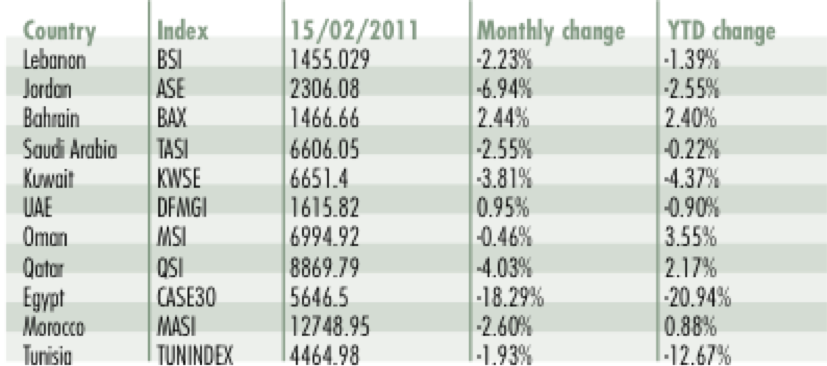
Regional stock market indices

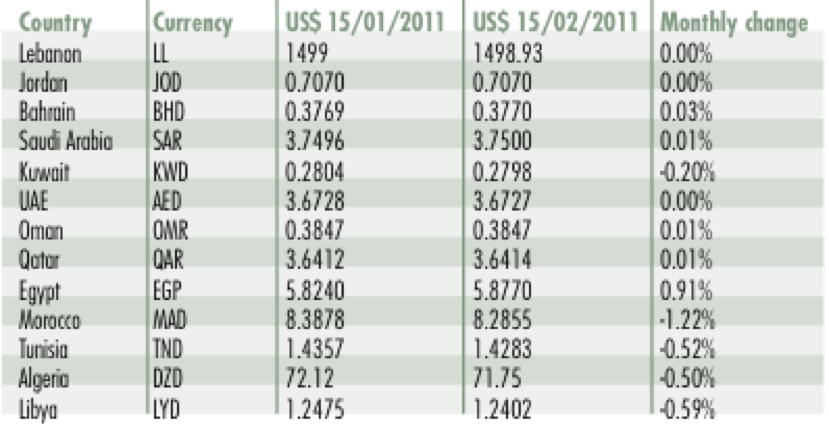
Regional currency rates

UAE developers down at end 2010

Real estate firms in the United Arab Emirates suffered from poor earnings results in the fourth quarter of 2010. Abu Dhabi-based Aldar Properties reported a net loss of $3 billion in the quarter, accounting for its overall $3.07 billion loss for the year. Sorouh Real Estate, Abu Dhabi’s second largest developer by market value, also posted a net loss of $54.18 million compared to a net profit of $7.65 million a year earlier, as its revenues for the last quarter of 2010 fell 51 percent to $58.26 million. Moving to Dubai, Emaar Properties, UAE’s biggest developer by market value, registered a 62 percent decline in net income during the fourth quarter of 2010 to $74.6 million, down from $196.03 million a year earlier. Union Properties’ fourth quarter net loss increased as well, climbing fivefold to $211.8 million compared to a loss of $40.29 million registered in the same period last year, due to losses on property valuations.

Saudi oil production to rise 15.4 percent by 2020

Saudi Arabia’s government stated that local oil production increased significantly during December 2010 to a two–year high of 8.365 million barrels-per-day (bpd), recording a 1.3 percent increase since November. Separately, Business Monitor International (BMI) forecasted a 15.4 percent rise in Saudi oil production between 2010 and 2020, with output reaching 11.4 million bpd by 2020. BMI also expects oil consumption in the Kingdom to increase 40.1 percent during the same period, to 3.91 million bpd. In the near term, BMI believes local oil demand will climb from an estimated 2.79 million bpd in 2010 to 3.38 million per day in 2015, accounting for 38.8 percent of the Middle East’s regional oil demand.

The region’s idiosyncratic unemployment enigma

The number of unemployed in the Arab world is forecasted to reach 19 million by 2020, according to Kuwait-based think tank, Arab Planning Institute (API). The Middle East and North Africa region has been suffering from sluggish labor markets for some time, despite the fact that the workforce is generally young and shows 3.5 percent growth per year, relative to an average 3.1 percent population growth since the 1980s. This favorable employment dynamic has, however, not been used to benefit the region’s development and most MENA countries still lag behind in female employment rates, with less than 40 percent of women eligible for work employed in the labor force. North African countries, however, generally score better in this category, as up to 65 percent of the female population is in the labor force. Another factor contributing to high unemployment in the Arab world is the few job opportunities available for the educated. For instance, up to 50 percent of the unemployed in Tunisia and 44 percent in Morocco have secondary and tertiary degrees, according to API. Under these conditions, a large percentage of people eligible for work become discouraged, excluding themselves from the labor force. Unemployment rates in MENA countries are thus somewhat skewed and expected to remain in the range of 11 to 15 percent over the next decade.      

March 28, 2011 0 comments
0 FacebookTwitterPinterestEmail
Banking & Finance

Regional equity markets

by Executive Editors March 28, 2011
written by Executive Editors

Beirut SE  

Current year high: 1,180.99    Current year low: 935.56

>  Review period: Closed Feb 28 at 936.99 Points                Period Change: -5.3%

More turmoil in the region, no cabinet and a real surprise in the United States going after a (non-listed) Lebanese bank for money laundering in a manner reminiscent of a B-movie: February was a month of few positives for Lebanese stock market investors. However, the BSE’s year-to-date performance of minus 3.6% is not too depressing, given the circumstances. Of the three largest stocks, developer Solidere closed the month in the mid $18s, Bank Audi came in at $7.11 and BLOM Bank at $9.14.

Amman SE 

 Current year high: 2,648.36                Current year low: 2,223.30

> Review period: Closed Feb 28 at 2251.73 Points               Period Change: -5.1%

With Libya and Yemen attracting the caravans of revolution-watching media, Jordan in February was not in the front row of international speculations over its future. The Amman Stock Exchange did not have an easy month, however. In the February review period, all sector indices pushed lower in tandem with the ASE general index, which is down 6% for 2011 so far. According to local media, a handful of investors took their cue from the popular protest handbook and staged a sit-in demanding dismissal of the head of the Jordan Securities Commission.

Abu Dhabi Exchange  

Current year high: 2,931.67                Current year low: 2,471.70

> Review period: Closed Feb 28 at 2,588.90 Points              Period Change: 0.1%

The richer emirate in the UAE was the only market in the GCC that did not drop in February. When seen across sectors, performance on the ADX was mixed; telecommunications ended the review period 4.3% higher while banking weakened 2.9%. But the real estate index suffered badly, dropping 19.9% and construction fell 12.2%. RAK Properties, Aldar Properties and Sorouh Real Estate all suffered double-digit share price losses, as did three financial stocks and Abu Dhabi Ship Building Co. Market cap leader Etisalat gained 3.9% but showed no progress on buying Zain.  

Dubai FM  

Current year high: 1,880.62                Current year low: 1,470.70

> Review period: Closed Feb 28 at 1410.70 Points               Period Change: -8.1%

Even directly after the Dubai World debt trauma, the DFM index did not slump as low as it did at the end of February 2011. With rampant talk of contagions from regional crisis spots, all DFM sector indices tended negative, with transport dropping 12% and real estate 13.3%. Utilities was the worst underperforming sector on the DFM for the review period, down 19.6%. Banking was a brighter spot, weakening only 1.8%. Market volatility in February reached 26.7%. On the year, the DFM index had given up 13.5% by Feb 28 close.

Kuwait SE  

Current year high: 7,575.00                Current year low: 6,319.70

> Review period: Closed Feb 24 at 6,481.10 Points  Period Change: -5.5%

The KSE benchmark index turned totally south in February. The regular market’s sector indices dropped on all fronts, led down by the investment index (-7.9%) and the industrial index (-7.7%). Bahrain’s Arab Insurance Group, which is cross-listed on the KSE, was also here a top gainer, up 21.1%. Shares in Mena Holding, a real estate firm with subsidiaries and projects in Egypt, lost more than 53%. The trading month in Kuwait was truncated Feb 24 as the country celebrated its 50th Independence Day.

Saudi Arabia SE  

Current year high: 6,929.40                Current year low: 5,538.72

> Review period: Closed Feb 28 at 5,941.63 Points              Period Change: -6.5%

Until Feb 14, the SASE Index stood firm but then the TASI fell nearly 700 points to the end of the month. For the year to date, this translated into a fall of 10.3%, the second worst year-to-date Gulf market performance after Dubai. Telecommunications and banking indices showed the weakest sector performances, falling 9.9% and 9% respectively. King Abdullah’s return from hospitalization abroad and his announcement of economic measures toward the end of the month had no visible positive impact.

Muscat SM  

Current year high: 7,027.32                Current year low: 6,058.11

> Review period: Closed Feb 28 at 6,142.42 Points                  Period Change: -10.2%

The MSM fell victim to political unrest and showed the worst drop of all GCC markets in February, wiping out the modest gains from January. Notably, the bourse’s average daily turnover was slightly higher than last month but losing stocks vastly outnumbered gainers. Volatility was substantial, at 21.5%. Within the MSM’s shock-induced downturn the banking sector fared worst, closing the month 18.6% lower. While there were no surprise gainers, investors in poultry specialist A’Saffa Food showed the biggest scare as the scrip fell 28.5%.

Bahrain Bourse  

Current year high: 1,605.98                Current year low: 1,361.19

> Review period: Closed Feb 28 at 1,430.77 Points              Period Change: -1.2%

It is an irony that will not escape careful observers: while Bahrain is being viewed as the GCC member with the greatest exposure to political protests and internal dissonance in Feb 2011, the BB remains the GCC exchange to drop the least in the year to date, at -0.1%. Even in February, market losses remained modest. However, turnover for the month fell about two thirds from January. Arab Insurance Group was the period’s best gainer, up 17.1%. Inovest, a real estate investment firm, slipped 39.6%.

Qatar SE  

Current year high: 9,242.63                Current year low: 6,647.18

> Review period: Closed Feb 28 at 7932.84 Points               Period Change: -9.3%

Like Saudi Arabia, Qatar was not a scene of unrest in February but like the TASI, the QSE Index took a steep downturn in the middle of the month, save for a brief respite on Feb 24. Owing to a share-price surge in early February, Masraf Al Rayan closed the month 8.5% up but the month’s unsuspected best gainer was Qatar Oman Investment Company. The bilateral company, with stake holdings by the two governments, gained 9%. Barwa Real Estate and National Leasing Holding Co underperformed the market with respective losses of 20.8% and 25.6%.

Tunis SE  

Current year high: 5,681.39                Current year low: 4,058.53

> Review period: Closed Sept 23 at 4,058.53 Points                            Period Change: -10.86%

The price of real freedom is never too high and even if the benchmark Tunindex of the TSE closed February 28 down 22.2% since the start of 2011 and 29.6% down from its year high in October 2010, it is far too early to open a cost-benefit calculation on the changes Tunisians initiated in January. The TSE, which had been closed for half a month until Jan 31, could easily have tumbled worse in Feb and there seems to be no historic benchmark for an average post-revolutionary stock market performance.    

Casablanca SE  

Current year high: 13,397.47              Current year low: 10,938.64

> Review period: Closed Feb 28 at 12,805.81 Points                              Period Change: 1.72%

Isn’t Casablanca in revolutionary North Africa? Political prospects on the region notwithstanding, Morocco’s benchmark MASI ended the review period with an upswing that made February into a typical V-month for its investors. The index lost 500 points in the third week of the month and regained them in the fourth. No trouble on the real estate front, it seemed, where Groupe Addoha climbed 5.9%.

Egypt SE  

Current year high: 7,603.04                Current year low: 5,647.00

> Review period: Closed at 5,467.00 Points (Jan 27)                        Period Change: N/A

The only events of record in the EGX during the month of February were postponements; there were several announcements that the bourse would reopen shortly, only to be rescinded before their implementation. The market, which recorded its last session close to date on January 27, has been shuttered for more than 20 regular sessions. The central bank kept pressure on the Egyptian Pound in check throughout Feb and banks returned to serving customers, but with increased controls on transfers.

March 28, 2011 0 comments
0 FacebookTwitterPinterestEmail
AdvertisingSpecial Report

Cooperate to elevate

by Executive Editors March 28, 2011
written by Executive Editors

Over the years I’ve come to the conclusion that the ad industry has endured a lot of finger-pointing but not enough autopsy; a tendency for mudslinging instead of progress through cooperation.

Our region lags behind on so many practices prevalent in more mature and sophisticated markets, the per capita ad spending remains to be among the lowest across the globe and the level of confidence among marketers that advertising relates to growth remains timid.

However, the interesting aspect of this region is in its opportunities: it sits conveniently at the cross-roads of the rising East and the experienced West, with strong economic capabilities and young dynamic populations. Furthermore, the longer term positive effects of the current political change sweeping key Arab states will bring with it better governance, healthier business environments and hopefully a fairer distribution of wealth.

This begs the question of whether the advertising industry, with all its disciplines, will be able to lead and contribute to the process of change or will this industry remain hostage to the transactional cage built by lingering practices of the 1980s and the rising power of procurement, thereby leading to another “lost decade”?

Crafting the answer is the equal responsibility of all stakeholders.

The recent developments in data mining technology, as well as the transfer of frameworks from the science of operations research, has proven beyond a doubt that advertising can and will affect growth — and not just in consumer packaged-goods industries.

Concurrently, agency networks for the past few years have been showing solid commitment to the region by increasing equity holding in the local entities that carried their trademarks. That can only be good news, because if anything it means a “system upgrade” in various ways:

• Upgrade of agency services by transferring learning and experiences from mature markets while offering multinational corporations the ability to sync local activities with global.

• Upgrade of the financial practices and corporate governance, ushering-in higher levels of accountability with the implementation of global best-practice and tools.

• Upgrade of the terms that govern a client-agency relationship, ensuring a fine balance between trading strength and ideas that deliver business solutions.

As the agency reform takes shape it is acting as a catalyst for change. In order for it to take full swing, it requires an embrace from the other side of the spectrum: the marketing community. For advertising to contribute to growth it has to be measured; the good news is that agencies have developed the know-how to do that. Now it’s up to the marketers to increase investment in measuring every aspect of their activities and develop a much greater confidence in entrusting their agencies with access to such gems.

Eventually as we move toward an environment of “advertising that works,” marketers will want to measure value and not just efficiencies. The practice of advertising will become more focused on business results and less focused on the mundane marketing and advertising key performance indicators.

More importantly, when selecting their agency partners, marketers would want to differentiate between those that only offer a transactional solution and those that are capable of contributing to growth — this is key to the success of the partnership, as agencies that understand and contribute to growth cannot survive or operate on remuneration schemes prevalent in a trading/procurement environment that is focused on driving efficiencies in paid media.

Against all odds, and despite the fact that the industry still suffers from underdevelopment on a number of fronts, this region has always been credited for being entrepreneurial. In fact we’ve seen over the years many a high-profile marketer willing to experiment in unchartered territories.

In avoiding the fate of the “lost decade,” the advertising industry, with the participation of all its stakeholders, has the golden opportunity of experimenting with a reformed relationship that focuses on growth as the basis for all conversations.

If this proves to be successful — and it will — it carries the potential of being a global best practice exported out of this region.

SHADI KANDIL is managing director of OMD UAE

March 28, 2011 0 comments
0 FacebookTwitterPinterestEmail
Economics & Policy

Finance ministries must rise to the challenge

by Executive Editors March 27, 2011
written by Executive Editors

Nabih Maroun is a partner, Jihad Azour a senior executive advisor and Mazen Ramsay Najjar a principal at Booz & Company

The global financial crisis may be in the rearview mirror but it’s not yet out of sight. This is particularly true for emerging markets. The BRIC economies (Brazil, Russia, India and China) have returned to warp-speed growth, yet they remain susceptible to external shocks that could threaten their economic expansion and erode their fiscal foundations.

Russia is vulnerable to swings in the price of oil, Brazil to commodity prices and India and China to global demand. China faces additional challenges from potential changes in exchange policy, which could have ramifications for its trade position. All four countries are facing massive capital inflows and overheating, with monetary policies not effectively aligned with fiscal policies. Also, they lack standardized, consistent public statistical data, which renders their economies largely opaque to outsiders.

The emerging economies of the Arab Gulf are in a similar situation; they are strong but with key vulnerabilities. Wealth from natural resources has sheltered these countries from the worst of the financial crisis and, unlike most developed economies, they have maintained fiscal surpluses.

However, the Gulf countries have made significant overseas investments in recent years through government related entities or sovereign wealth funds, which have exposed them to contingent risks arising from the crisis, and have yet to figure out an approach for managing those assets.

These countries also suffer from a lack of transparent economic statistics that would allow an independent evaluation of their economic and fiscal situations, particularly those related to state-owned enterprises, which represent in many cases the bulk of their economies. They also have public sectors that are top-heavy and less productive than they could be.

Good governance

Finance ministries have a key role to play in addressing the challenges emerging in the post-crisis period. Yet, as in other parts of the world, the finance ministries in these emerging markets now have a vastly expanded slate of responsibilities. They still retain their traditional role of public finance management, by controlling taxes and spending at the national level, but finance ministries now must also oversee the sizable assets that many countries had to buy in order to stabilize their economies, such as banks, securities and manufacturers. They are increasingly responsible for economic management — ensuring that the national economy is enjoying healthy growth in the face of a weak global recovery — while preserving the stability of their financial sectors.

In conjunction, they must enhance accountability and transparency measures in order to boost confidence in their countries’ economic stewardship and to strengthen their fiscal credibility. In short, finance ministries must do more, and address more complex issues, than at any time in recent economic history.

Finance ministries in emerging markets have taken some noteworthy steps to address their fiscal and economic vulnerabilities head-on.

India centralized its public debt in 2009 in a newly created debt office.  Brazil consolidated its debt and liquidity management functions, amended its fiscal law and opened its budget to public scrutiny. China updated its budget management law (though questions remain about the quality of its economic data). In the Gulf, the United Arab Emirates, Saudi Arabia and Kuwait have all taken steps to streamline their public sectors, by outsourcing certain non-core government functions, restructuring some municipal agencies and privatizing others.

The UAE has strengthened its debt management and risk-management functions and established stabilization funds and facilities. Qatar is reviewing its regulation and supervision framework for the financial sector and Kuwait recently introduced risk assessment and early-warning capabilities to safeguard the stability of its banking sector.

Although these are laudable measures, their degree of success has been marginal because they represent isolated steps taken by ministries that continue to operate within the same setup they employed before the crisis.

Instead, finance ministries need to make more sweeping, fundamental reforms in their institutional setup and operational capabilities. There is no one-size-fits-all approach to reform of this scope and magnitude. Instead, priorities will vary widely, depending on the fiscal and economic situation in each country.

In that light, the finance ministries in BRIC countries have three clear imperatives. First, they must quantify and mitigate contingent risks within their economies, such as swings in commodity prices, currency fluctuations, private demand and financial exposure, among others. Second, these countries must make their economic systems more transparent. This requires accepting independent opinions — such as those of parliament, specialized agencies, or markets — on economic targets and fiscal and expenditure projections. Third, BRIC finance ministries must better coordinate fiscal and monetary policies. Without such coordination, they will continue to experience volatile economic swings, often requiring corrective measures with high costs.

Gulf priorities

The imperatives for finance ministries in the emerging countries of the Arab Gulf are significantly different. Their greatest priority is to develop institutional capabilities in the management of modern budgets, public debt and state-owned assets — in some cases by using talent and techniques borrowed from the corporate world.

In addition, these ministries should implement more rigorous and transparent economic statistics, which will significantly improve the quality of policymaking and encourage accountability. They must also continue to improve the productivity of government operations. 

These reforms will not be easy to implement, but finance ministries have few alternatives. More important than any single policy measure, they must rethink their overall operating and institutional models and develop new capabilities that are more in line with their expanded slate of responsibilities. Only by developing the right set of instruments for fiscal, debt, and asset management, along with risk prevention tools, will they be able to navigate the post-crisis economy, signal a clear commitment to economic stability and allow their countries to truly thrive.

Finance ministries need to make more,sweeping, fundamental reforms in their institutional setup

March 27, 2011 0 comments
0 FacebookTwitterPinterestEmail
AutomotiveSpecial Report

Samir Homsi

by Executive Editors March 27, 2011
written by Executive Editors

Samir Homsi, president of the Automobile Importers Association, the industry representative of car dealerships in Lebanon, recently sat down with Executive to discuss possible alternatives to conventional gas-fueled vehicles.

  • What do you think of the Ministry of Energy and Water’s proposal for compressed natural gas (CNG) vehicles?

There has been a lot of talk to make new rules, which we need badly. The subject of what to use as fuel has been discussed by the association and also in the parliament with [head of the Parliamentary Energy and Public Works Committee, Mohammad] Qabbani there was a lengthy discussion of what kind of fuel should be used. Our opinion is that while the use of [CNG] cars may be economically beneficial to the user it will be a dangerous alternative, especially in Lebanon. In France — the pioneers — they were using [CNG] fuel in cars but today we see the French getting out of that by using Euro 4 and Euro 5 standard gasoline instead. At any rate, our opinion is to use cleaner gasoline. Obviously our gasoline should be better quality and [we] should import better gasoline with less sulfur for modern vehicles with high Euro-grade standards.

  • Iran, India, Pakistan and Egypt have all adopted CNG. Why not here?

We need to check with what Europe is using. We do not need to copy Egypt or anyone else. For CNG there have to be re-filling stations, but what about being stationed in the middle of Beirut? In Europe they are outside of the cities, far from houses and living places. Can you imagine this in Ashrafieh?

  • What is your stance on the proposed law to allow for the importation of hybrid vehicles?

Hybrids are definitely the future; we expect within two years to have at least half of the members of the association importing hybrids. They are very expensive now and should be less expensive in two years because battery costs will go down slightly. This is where the Ministry of Finance had a good idea for the environment to reduce taxes on four-cylinder hybrid cars.

  • Do you think the government should financially assist consumers to trade in old pollutive vehicles for newer, more fuel-efficient cars?

Part of the plan is to do what Europe is doing but it is not in the government’s budget to pay for cars to be scrapped, as the United States has also done during a certain period. This could be done here with aid from Europe and was proposed directly by us and they were ready to participate in the program. We had a meeting a long time ago with the finance minister and together said, ‘Why don’t we do this with the European Commission?’ It also could be done by asking for aid from USAID [United States Agency for International Development].

  • Do you think the proposed law to allow for the import of environmentally friendly diesel should be expanded to include private vehicles?

I am for the import of clean diesel but not for passenger cars or taxis. The new law is conditional on the proper distribution of diesel, as otherwise, in one year, cancer rates would be up, you will have hell and not see Beirut from any point due to the smog.

  • What more can be done to rein in pollutive vehicles?

I have recommended to [now caretaker] Interior Minister Ziad Baroud, as he took a very positive step to limit accidents and speeding with radars, to also have the same system applied to photograph polluting cars and give them fines. Implementation of force on roads is practically nil so maybe an alternative is to have cameras.

  • Catalytic converters removed from used cars before importation to Lebanon is one cause of unnecessary fuel emissions. What do you think of this legal requirement?

The law that a catalytic converter should be removed before import should end. I’m not sure how this stupid law came into effect.

March 27, 2011 0 comments
0 FacebookTwitterPinterestEmail
Finance

Banking Special Report, 2011

by Executive Staff March 26, 2011
written by Executive Staff

A word with leading Lebanese banking luminaries: Bank Audi’s Chief Financial Officer Freddie Baz, Byblos Bank’s General Manager François Bassil and Saad Azhari, chairman of BLOM Bank discuss the state of the country’s banking sector amid a gloomy economic outlook

March 26, 2011 0 comments
0 FacebookTwitterPinterestEmail
  • 1
  • …
  • 385
  • 386
  • 387
  • 388
  • 389
  • …
  • 696

Latest Cover

About us

Since its first edition emerged on the newsstands in 1999, Executive Magazine has been dedicated to providing its readers with the most up-to-date local and regional business news. Executive is a monthly business magazine that offers readers in-depth analyses on the Lebanese world of commerce, covering all the major sectors – from banking, finance, and insurance to technology, tourism, hospitality, media, and retail.

  • Donate
  • Our Purpose
  • Contact Us

Sign up for our newsletter

    • Facebook
    • Twitter
    • Instagram
    • Linkedin
    • Youtube
    Executive Magazine
    • ISSUES
      • Current Issue
      • Past issues
    • BUSINESS
    • ECONOMICS & POLICY
    • OPINION
    • SPECIAL REPORTS
    • EXECUTIVE TALKS
    • MOVEMENTS
      • Change the image
      • Cannes lions
      • Transparency & accountability
      • ECONOMIC ROADMAP
      • Say No to Corruption
      • The Lebanon media development initiative
      • LPSN Policy Asks
      • Advocating the preservation of deposits
    • JOIN US
      • Join our movement
      • Attend our events
      • Receive updates
      • Connect with us
    • DONATE