• Donate
  • Our Purpose
  • Contact Us
Executive Magazine
  • ISSUES
    • Current Issue
    • Past issues
  • BUSINESS
  • ECONOMICS & POLICY
  • OPINION
  • SPECIAL REPORTS
  • EXECUTIVE TALKS
  • MOVEMENTS
    • Change the image
    • Cannes lions
    • Transparency & accountability
    • ECONOMIC ROADMAP
    • Say No to Corruption
    • The Lebanon media development initiative
    • LPSN Policy Asks
    • Advocating the preservation of deposits
  • JOIN US
    • Join our movement
    • Attend our events
    • Receive updates
    • Connect with us
  • DONATE
Banking & Finance

Regional equity markets

by Executive Editors April 3, 2011
written by Executive Editors

Beirut SE  

Current year high: 1,180.99    Current year low: 923.19

>  Review period: Closed March 24 at 934.33 points                             Period Change: -0.28%

Beirut stocks inked an 18-month low on March 14, following a large demonstration in Beirut demanding Hezbollah’s disarmament. It also didn’t help that Premier-designate Najib Mikati remained unable to form a government. Still, stocks rebounded in the second half of the month following confirmations that no other banks in Lebanon would be targeted by the US Treasury Department following the merger of LCB and SGBL. Performance was mixed on the BSE, with Bank Audi ticking up 5.5% as Solidere and Byblos closed 2% and 2.1% lower, respectively.

Amman SE  

Current year high: 2,648.36                Current year low: 2,149.11

> Review period: Closed March 24 at 2,182.48 points                      Period Change: -3.1%

In the absence of any notable supporting news, ASE stocks continued their trip south driven partly by political uncertainty as fresh protests in Jordan demanded reforms. The banking sector shed 2.7% during the review period, although Arab Bank, the exchange’s largest stock by market capitalization, inched up 0.2%. Other sectors were also weak, with mining and extraction down 3.5%, including a 2.4% decline by Arab Potash.

Abu Dhabi Exchange  

Current year high: 2,925.42                Current year low: 2,471.70

>  Review period: Closed March 24 at 2,632.95 points                     Period Change: 1.7%

A recovery in the real estate and construction sectors led the positive showing of the ADX during the review period, as Aldar and RAK Properties rose 12.3% and 14.3%, respectively. Some of the positive news that supported the upward trend in March came from Taqa which positively surprised markets with a 460% increase in 2010 profits on higher oil and gas prices. In addition, UNB announced a 10% dividend while NBAD approved a 30% cash dividend, reflecting confidence in the banking sector’s prospects.

Dubai FM  

Current year high: 1,859.96                Current year low: 1,352.24

>  Review period: Closed March 23 at 1,552.81 points         Period Change: 10%

Stocks on the DFM staged a massive comeback in March, after Saudi authorities confirmed that the political and security situation was under control and appeased markets by buying stock through state-run pension funds and announcing large welfare spending plans. A boost also came when Arabtec postponed plans to raise capital, sending the builder’s shares up 25.3% during the review period. Investors found renewed confidence in the UAE’s political establishment and were buoyed by several earnings and dividend postings at Dubai Islamic Bank and Du, among others.

Kuwait SE  

Current year high: 7,575.00                Current year low: 6,134.60

>  Review period: Closed March 24 at 6,285 points              Period Change: -3%

The quick quashing of dissent in Saudi Arabia only marginally supported stocks on the KSE as pessimistic investors quickly booked their gains on continued fears of political unrest in the Gulf. A wave of negative sentiment set in as many companies failed to submit their financial statements and were suspended from trading. However, the government offered some glimpses of hope by launching the long-awaited Capital Markets Authority.

Saudi Arabia SE  

Current year high: 6,929.40                Current year low: 5,323.27

>  Review period: Closed March 23 at 6,362.42 points                     Period Change: 7.1%

Investors went home March 2 bitten by a cold 15% decline in one week, but by March 12, a roaring 18.3% spike had restored the warmth to Tadawul, the region’s largest stock exchange. Positive comments by the Finance Minister, who called stocks tempting, sparked the rebound, but it was effectively the announcement of massive additional government spending worth an estimated $150 billion that overshadowed any possible political risk from demonstrations.

Muscat SM  

Current year high: 7,027.32                Current year low: 6,058.11

>  Review period: Closed March 24 at 6,402.17 points                     Period Change: 4.2%

Political tensions and a grim outlook for equities, coupled with some strong earnings news, were a recipe for jittery trading on the MSM. Kuwait-based Global estimated that MSM-listed firms saw their profits dip 17.8% in 2010, with Omani banks and petrochemicals coming out on top. As part of the strong performance, BankDhofar, the third-largest listed company, saw a record growth of 31% in 2010 profits, but rose only 3.2% during the review period. Several finance services stocks lost ground during the period, including Bank Sohar, down 9.8% since March 1.

Bahrain Bourse  

Current year high: 1,605.98                Current year low: 1,361.19

>  Review period: Closed March 24 at 1,422.57 points                     Period Change: -0.6%

Although out of sync with spiking neighboring exchanges, BB stocks remained steady considering the developing security situation in the country. GCC countries sent some 1,500 Saudi-led troops to Bahrain, widening the circle of political and civil confrontation. To make things worse, S&P downgraded counterpart ratings on several banks including AUB and Arab Bank, citing risk of additional pressure on the sovereign. On the bright side, the GCC decided to establish a $20 billion fund to finance development projects in Bahrain and Oman.

Qatar SE  

Current year high: 9,242.63                Current year low: 6,647.18

>  Review period: Closed March 24 at 8,307.85 points                     Period Change: 4.7%

Like other Gulf exchanges, the QSE regained its lost ground following positive news from Saudi Arabia, but Qatari firms had plenty to offer too. Several listed companies, including Mawashi, Zad and Qatar General Insurance reported strong 2010 results and estimates showed 34 of 43 listed companies collectively declared some $3.02 billion for the year. It was business as usual, with several acquisition announcements and virtually no impact from regional unrest. Heavyweights Industries Qatar and QNB were up 5.3% and 4.6% respectively during the review period.

Tunis SE  

Current year high: 5,681.39                Current year low: 4,058.53

>  Review period: Closed March 24 at 4,459.48 points                     Period Change: 9.9%

Stocks gained momentum on the Tunis stock exchange after trading resumed on March 7 following one week of suspension. Still, S&P downgraded the country’s sovereign credit rating, but affirmed the credit ratings of five Tunisian banks, restoring confidence in the sector despite a negative outlook. Tunisia continued to take solid steps toward establishing a democracy in the country with a first round of elections scheduled for July, but political and economic uncertainty remain. Some stocks advanced steadily, including Carthage Cement at 12.7% during the review period.

Casablanca SE  

Current year high: 13,397.47              Current year low: 11,331.57

>  Review period: Closed March 24 at 12,581.71 points       Period Change: -1.7%

A surprising increase in February was followed by a minor decline in early March, then stocks drifted through the rest of the month without a clear direction, and without any noticeable impact from the NATO-led military campaign on Libya. Casablanca and other cities hosted large rallies calling for reform, with little impact on market performance thus far, as the US hailed Morocco’s king’s pledge for reforms. Banking stocks gave back 1.2% during the review period with Attijariwafa Bank retreating 2.4%.

Egypt SE  

Current year high: 7,603.04                Current year low: 5,647.00

>  Review period: Closed March 24 at 4,951 points                  Period Change: -12.3%

The EGX resumed trading on the exchange on March 23 two days ahead of a deadline that could have seen the market removed from MSCI’s Emerging Markets Index. The freedom to sell cost shareholders a 9% decline by the end of the first trading session with investors seeking to escape a steep plunge that reflected the sharp drops in Egyptian stock GDRs on the LSE seen since late Jan. But the second day brought some hope with 97 companies increasing in value compared to only 44 decliners. 
April 3, 2011 0 comments
0 FacebookTwitterPinterestEmail
Banking & Finance

For your information

by Executive Editors April 3, 2011
written by Executive Editors

Life’s good in insurance

Lebanon’s life insurance industry should see significant growth in the coming four years, says Business Monitor International (BMI). Between 2011 and 2015 the independent research and analysis firm expects double-digit growth for Lebanon’s life insurance market, as well as those of other Middle Eastern countries. The underdeveloped nature of the regional insurance market has kept growth estimates high for years. BMI estimates that Lebanon’s insurance premiums totaled $1.26 billion last year, with non-life premiums amounting to $859.7 million and life premiums $399.3 million. Further, the company extrapolates that by 2015, premiums will total $2.1 billion with $1.4 billion in non-life and $691.4 million in life premiums. BMI’s report further predicts that the penetration of life insurance should increase to $155.63 per capita by 2015, from $95.28 per capita in 2011. The BMI report touted the success of companies like MedGulf and Arabia Insurance, which have expanded into multiple countries in the Middle East.

Lebanese commercial bank deposits fall

Lebanese commercial bank deposits witnessed a 1 percent month-on-month decrease in January 2011, according the latest figures from Banque du Liban, Lebanon’s central bank. Deposits totaled $106.13 billion in the first month of 2011, dropping from $1.08 billion at end-2010, compared to a $225 million growth over the same period a year earlier. Withdrawals by non-residents, amounting to $779 million, accounted for most of the decrease in deposits, while residents’ deposits fell by $297 million. The dollarization rate increased 2.1 percent since end-2010, as significant local currency withdrawals of $2.55 billion offset an increase of $1.48 billion in foreign currency deposits. Lebanese banks’ overall consolidated balance sheet also contracted by 0.4 percent in January 2011, as deposits made up 82.7 percent of the balance sheet. The contraction was also accompanied by a 1.1 percent expansion in lending activity. Loans grew by $377 million in the first month of 2011 as those extended to non-residents rose by $616 million. Meanwhile, a $239 million drop in loans granted to residents reflected a prevailing wait-and-see mood amongst Lebanese consumers and investors, amid escalated political tensions in the country and in the region.

Multi-billion dollar Etisalat-Zain deal falls through

Abu-Dhabi based Etisalat has scrapped plans to acquire a 46 percent stake in Kuwaiti telecom company Zain, estimated at $12 billion. Etisalat’s statement on March 19 mentioned due diligence results, political turmoil, disagreement among Zain shareholders and new Kuwaiti bylaws binding offers as reasons behind the company’s decision. The deal has been beset with obstacles since talks were initiated in November 2010. In late February 2011, National Investments Company ended its commitment as the deal’s architect after Zain had rejected three bids for a stake in its Saudi Arabia unit, valued at $750 million. The sale of the 25 percent stake was a term for the merger as regulatory authorities prohibited Etisalat from concurrently owning its Saudi affiliate Mobily and Zain KSA. At the time, Etisalat reiterated interest in the deal, offering a maximum of $6.11 per Zain Group share. On March 13, Zain’s board accepted a joint offer by Kingdom Holding and Bahrain Telecom Company (Batelco) for its Saudi assets, reviving hope for the separate deal with Etisalat. The offer is worth a total of $5 billion, out of which Kingdom and Batelco will pay $950 million in cash, and cover $3.8 billion of debt. Zain KSA will pay for the remaining $250 million. Both Kingdom and Batelco are still committed to buying Zain’s Saudi operations. All three were slated to sign a preliminary contract, including a breakup fee, at the end of March.

BDL cleans up

Established for anti-money laundering purposes by Banque du Liban (BDL), Lebanon’s central bank, the Special Investigation Commission (SIC) issued its 2010 annual report this month. The report revealed 254 suspected money-laundering cases, out of which 65.3 percent were local and 34.7 percent were referred from abroad. The results indicate a 25.7 percent increase in alleged dirty money cases since 2009, and a record since 2003, when 272 cases were suspected. Out of the 189 cases investigated by the SIC, 119 were referred to judicial authorities while 70 cases did not fall under the framework of Law 318, the anti-money laundering law. Accordingly, BDL lifted banking secrecy on 23 cases, 21 of which were domestic. Forgery accounted for 21.16 percent of the investigated cases, followed by terrorism and financing of terrorism at 12.7 percent, trade of narcotics at 4.23 percent, organized crime at 1.59 percent and embezzlement of private funds and illegal arms trading, at 0.53 percent each. The remaining 56 percent were not categorized. Local sources, financial investigative units as well as the United Nations and foreign embassies provided a combined 103 names for 22 cases related to terrorism. Institutions including commercial banks, insurance companies, brokerage firms and financial institutions were also examined by the SIC to monitor compliance with Law 318.

Big banks investigated over LIBOR Rate

American, Japanese and British authorities are focusing on major international banks as part of an investigation into the manipulation of the London Interbank Offered Rate (LIBOR) during the 2008 financial crisis. Japanese and US regulators have subpoenaed Barclays, UBS, Citigroup and Bank of America, while WestLB has also received requests for information. Swiss UBS’s 2010 annual report shed light on the investigation, disclosing that the US Securities and Exchange Commission (SEC), the US Commodity Futures Trading Commission (CFTC) and the Japanese Financial Services Authority (FSA), had subpoenaed the bank. Regulators are probing into whether UBS and other major borrower banks have colluded to set their interbank rates too low during the financial crisis to comfort spooked investors and downplay their borrowing costs. LIBOR is calculated by Thompson Reuters for the British Bankers’ Association (BBA), pooling interest rates that banks expect to charge or pay each other for dollar and other currency loans, and calculating their average. The rate is considered a global benchmark rate to price derivatives and financial instruments, and is referred to by more than $350 trillion worth of financial products worldwide. Data reviewed by regulators initially lead to the investigation, signaling a divergence between banks’ low offered rates and their high credit risks during the financial crisis.

Port profits surge, Dubai World reaches debt deal

Dubai World, which announced in November 2009 a standstill on nearly $24 billion in debt, said on March 23 that a final agreement has been signed with almost 80 creditors to restructure its debt, now totaling close to $25 billion. The agreement divides Dubai World’s bank debt into two tranches, with $4.4 billion to be repaid over a five-year period and the remaining $10.3 billion over eight years, with a fixed interest rate of 2.4 percent, described by Bloomberg as “below market.” The remaining debt, owed to the Dubai government, will be converted into equity. On the same day, DP World, a ports operator subsidiary of Dubai World, said its 2010 profits rose 35 percent to $450 million, driven by volume growth in the second half of the year and cost controls. This year is also shaping up nicely for one of Dubai World’s largest holdings, according to DP World executives. “In the first two months of 2011 we have seen 12 percent volume growth across our consolidated portfolio with further margin improvement from the full year 2010,” disclosed DP World’s CEO Mohammed Sharaf.

QIIB to buy out Islamic Bank of Britain

Qatar International Islamic Bank (QIIB), a Qatar-based sharia-compliant bank, announced on March 17 that the bank is undergoing negotiations to complete the purchase of a minority stake in the Islamic Bank of Britain (IBB) with assets of $350 million. QIIB, which boasted assets of $5 billion at the end of 2010, already holds a 80.95 percent stake in the British Islamic lender, and is offering one pence per share for the remainder in a deal that values the IBB at $40.9 million. According to QIIB, the board of directors of IBB has already approved the terms of the offer, although it represents a 70 percent discount on the British bank’s market price. The IBB’s official website listed Qatar’s Sheikh Thani bin Abdulla with a 6.44 percent equity stake as a shareholder and the bulk of the remaining 12 percent in public hands. QIIB’s growth is expected to accelerate following the Qatari central bank’s decision to prohibit Islamic banking branches at conventional lenders by the end of 2011. Earlier in March, QIIB received approval from its shareholders to issue sukuk (Islamic bonds) to boost capital if needed, giving the bank more capacity to potentially acquire Islamic assets from conventional counterparts.

Egypt’s banks get bumped 

Moody’s Investor Services, a global credit ratings agency, on March 21 downgraded by one notch from Ba3 to B1 the foreign-currency deposit ratings of Egyptian state-owned banks National Bank of Egypt, Banque Misr, Banque du Caire, as well as privately-owned Commercial International Bank, and Bank of Alexandria.  Local-currency deposit ratings for the three state-owned banks were also dropped two notches, from Ba1 to Ba3, and by one notch to Ba2 for Commercial International Bank. Exposure to lower-rated government debt along with deteriorating economic conditions prompted a decline in the standalone credit strength of the affected banks. Furthermore, the ratings agency pointed out that the downgrade of Egypt’s sovereign rating limits the country’s capacity to support its banking system. But the government is taking action to bolster its financial position. According to an EFG-Hermes report, Egyptian Finance Minister Samir Radwan told Egypt’s Al Mal newspaper that the country has requested a $5 billion loan from the International Monetary Fund.

April 3, 2011 0 comments
0 FacebookTwitterPinterestEmail
Comment

Resistance on the high seas

by Nicholas Blanford April 3, 2011
written by Nicholas Blanford

The stakes are growing in the looming confrontation between Lebanon and Israel over the suspected existence of massive fossil fuel deposits in the eastern Mediterranean. The delight in Israel at the recent discovery of two large gas fields off its northern coastline has given way to concerns that it could provide the pretext for a new war with Hezbollah.

That anxiety has hardened with the uncertainties regarding Israel’s arrangement to purchase Egyptian gas following the collapse of Hosni Mubarak’s regime and calls in Cairo to annul the agreement. The upshot is that the potential oil and gas wealth in the eastern Mediterranean could provide an economic windfall for the countries in the area — Lebanon, Israel, Syria and Cyprus — but it also represents a colossal security headache.

The two gas fields off the northern Israel coast — Tamar and Leviathan — contain an estimated 237.8 billion cubic meters and 453 billion cubic meters, respectively, sufficient to satisfy Israel’s energy needs for the next half century. Last year, the United States Geological Survey estimated that the Levantine Basin Province, which encompasses parts of Israel, Lebanon, Syria and Cyprus, could contain as much as 122 trillion cubic feet of gas and 1.7 billion barrels of recoverable oil.

Key to the tensions between Lebanon and Israel over the gas deposits is that their joint maritime border has never been delineated. Beirut has asked the United Nations to help mark a temporary sea boundary between Lebanon and Israel, a maritime equivalent of the “Blue Line” established by the UN in 2000, which corresponds to Lebanon’s southern land border. The UN has agreed to assist and the Israelis are studying the proposal. But the UN faces a potentially thankless task. The demarcation of the Blue Line 11 years ago was mired in mutual distrust and wrangling with neither the Lebanese nor the Israelis willing to concede an inch of territory to the other. Without goodwill from both sides, the maritime boundary could be even more difficult to define given the complicated geography of the coastline. Some have described the dispute over the gas fields along the Lebanon-Israel border as another “Shebaa Farms” — a source of manufactured tension with Israel.

But one European diplomat in Beirut said that parallels between the Shebaa Farms and the off-shore gas fields are misplaced. “Forget the Shebaa Farms,” the diplomat said, “the Lebanese are not being difficult [over the maritime boundary], because they have real economic interests here. Unless there is a pragmatic arrangement you could have a confrontation.” It is perhaps no surprise then that the sudden interest in the potential fossil fuel wealth off the Israeli and Lebanese coastline has turned the Mediterranean into a potential new theater of conflict between the Israelis and Hezbollah.

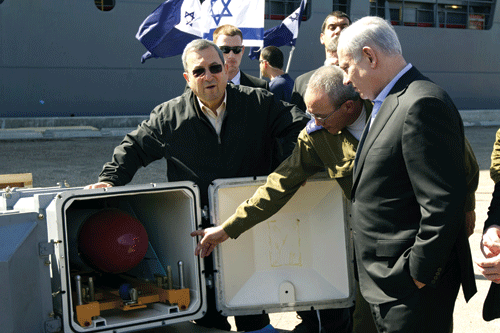
Hezbollah’s ability to target shipping — and possibly offshore oil and gas platforms — was demonstrated in the month-long war with Israel in 2006 when the militants came close to sinking an Israeli naval vessel with an Iranian version of the Chinese C-802 missile. Hezbollah fighters have since hinted that they have acquired larger anti-ship missiles, double the 72-mile range of the C-802 variant. Last year, Hezbollah Secretary General Sayyed Hassan Nasrallah warned that his organization now possesses the ability to target shipping along the entire length of Israel’s coastline. In January, Israeli Prime Minister Benjamin Netanyahu described the offshore gas fields as a “strategic objective that Israel’s enemies will try to undermine,” and vowed that “Israel will defend its resources.”

In February, the Israeli navy reportedly presented to the government a maritime security plan costing up to $70 million to defend the gas fields. Upping the ante even further, Nasrallah promised in March that if Israel threatens future Lebanese plans to tap its oil and gas reserves, “only the Resistance would force Israel and the world to respect Lebanon’s right.”

Then there is the recent passage of two Iranian navy vessels through the Suez Canal into the Mediterranean and the Israeli navy’s subsequent discovery in March of a smuggled consignment of arms and ammunition, including six C-704 anti-ship missiles believed destined for Hamas in the Gaza Strip. The missiles, though smaller than the C-802, could target Israeli shipping off Gaza as well as Israel’s Yam Tethys oil rig off the coast of Ashkelon. The oil and gas fields off the Lebanese and Israeli coasts look set not only to become a potential long-term source of wealth — but also a source of conflict in the years ahead.

Nicholas Blanford is the Beirut-based correspondent for The Christian Science Monitor and The Times of London


April 3, 2011 0 comments
0 FacebookTwitterPinterestEmail
Comment

Time to rethink a nuclear Middle East

by Paul Cochrane April 3, 2011
written by Paul Cochrane

Three days after an earthquake measuring 9.0 on the Richter scale critically damaged Japan’s Fukushima Daiichi nuclear power plant (NPP), the president of South Korea and the crown prince of Abu Dhabi attended a ground-breaking ceremony of the Braka NPP in the United Arab Emirates; it is the first of four to be built under a $20 billion contract inked in 2009 between the Emirates Nuclear Energy Corporation and a consortium of South Korean and American companies.

The inauguration celebration could hardly have been more inopportune. In the course of a week the incident at the Fukushima NPP went from being rated four on the International Atomic Energy Agency’s (IAEA) International Nuclear and Radiological Event Scale, “an accident with local consequences,” to level five, “an accident with wider consequences.” The Fukushima disaster is the only level five rating since the Three Mile Island meltdown in the United States in 1979. There has only been one level seven, the highest rating, in Chernobyl in 1986, which, according to research by New York’s Academy of Sciences published last year, resulted in the deaths of 985,000 people from cancer and related diseases.

The global “nuclear renaissance” touted just a few years ago seems far less secure, a fact reflected in investor sentiment: uranium prices on the spot market following the Japanese calamity plunged 27 percent to $50 per pound as countries started reconsidering the construction of new NPPs.

If there were ever a time to rethink nuclear power it is now, certainly before the dozen Middle Eastern and North African countries that have signed nuclear cooperation agreements start building NPPs. And the risks need to be seriously assessed, not just in terms of security, the logistics of storing spent fuel for thousands of years and so on, but also in terms of earthquake risk.

The Middle East is chock full of tectonic plates, with the Arabian plate in the middle flanked by the Eurasian, African and Indian plates. One of the most seismically active continental regions on earth is just across the sea from the United Arab Emirates, the Zagros Thrust in Iran. Of equal concern is the fact that modern systems to measure seismic activity have only recently been introduced in Saudi Arabia and Oman, while the UAE set one up just this year.

While there is little chance of a tsunami, an earthquake of a magnitude of 5.1 shook the emirate of Fujairah in 2002, and repeated seismic activity in the locality suggests that other, more sizable earthquakes are likely in the future. “When?” is of course the question, and the world can only hope that those building NPPs will do so with the worst-case scenario in mind; the Fukushima NPP was built at a time when the thought of it having to withstand a 9.0 magnitude earthquake was considered unlikely.

Braka was chosen as the site for the UAE’s first NPP as it is “an area with a very low probability of earthquakes — what is called low seismicity,” Ambassador Hamad al-Kaabi, UAE Permanent Representative to the IAEA, told the press after the Fukushima disaster. Yet it is not just unexpected earthquakes that are a concern when it comes to nuclear power. Transparency has been a major issue in the nuclear industry globally; in a 2008 US diplomatic cable released by WikiLeaks, a Japanese politician said the country’s Ministry of Economy, Trade and Industry, the department responsible for nuclear energy, has been “covering up nuclear accidents and obscuring the true costs and problems associated with the nuclear industry.”

The UAE hardly has a sterling reputation for transparency and accountability — think back to how the Dubai debt imbroglio was handled in 2009. If the Japanese, with 54 nuclear reactors, cannot be relied upon to be transparent, can we be sure the UAE will be?

Let us hope the UAE’s decision to go ahead with nuclear power, just as news of Fukushima’s fallout was dominating headlines, will not be retold through history as the epitomic example of a warning unheeded.


Paul Cochrane is the Middle East correspondent for International News Services


April 3, 2011 0 comments
0 FacebookTwitterPinterestEmail
Comment

Dialogue of the deaf

by Peter Grimsditch April 3, 2011
written by Peter Grimsditch


The clash between journalists and the establishment in Turkey has descended into a dialogue of the deaf. The ruling Justice and Development Party (AKP) is noted for its dedicated acquiescence to George W. Bush’s philosophy that the press is either “for us, or against us.” On the other side of this Mexican standoff is an equally dedicated press — though printing credible stories with detailed evidence to support the narrative is not necessarily part of that dedication.

As the battle now stands, dozens of journalists are in jail, accused of taking part in a vast conspiracy — dubbed the Ergenekon case — to overthrow the government. The mere fact that they have been accused is enough for organizations like Amnesty International to declare that the government is guilty of a low blow and is intent on curbing press freedom; the possibility that some of them may actually have something to answer for does not arise.

An impartial referee would do well to remember that the accused are journalists, not paragons of virtue who can do no wrong. In March the government introduced a draft bill purportedly to protect journalists from prosecution over articles related to judicial investigations. Foul play again, according to Ercan Ipekçi, a spokesman for the Freedom for Journalists Platform, who says the law would effectively ban journalists from reporting on judicial investigations altogether. Well, not quite. 

The preamble to the draft law talks of a “clarification about the circumstances in which reporting on investigations would break the law,” meaning press campaigns demanding the release of suspects detained by the police would be illegal.

“This is a retreat from the current situation and is thus unacceptable,” said Ipekçi. Journalists might not like to admit it, but it is not their function to represent a defendant or to put up the arguments of a lawyer seeking a dismissal of the charges, in this or any other case.

Turkish journalists ought to have no interest in prejudicing the cases of those under arrest, so why would they want to try a case in print ahead of an actual hearing? Whether or not journalists should divulge early on the discovery of supposedly manufactured evidence underpinning the charges is a moot point; in a well-ordered system there is recourse for lawyers to present such findings to a judge for a timely ruling on alleged skulduggery by the police or prosecutors.

The Turkish judicial system is in a state of flux and reform, however, and defense lawyers in the Ergenekon case have not been able to follow this path. Even if the journalists do provide the only forum in which to raise issues of official impropriety, they do not earn many plaudits for persistence. Among the failings of a press that, with exceptions, frequently prevents detail from getting in the way of telling a good story, is that it has yet to learn the virtues of doggedly pursuing its investigations until it gets a result.

There have been many stories in the past few months alleging faked “evidence” adduced against some of the Ergenekon suspects. Yet once the initial flurry of excitement inherent in exposing such alleged corruption had subsided, there were few attempts to follow up and force the issue to a conclusion. Yesterday’s good story is tomorrow’s lining on the floor of the birdcage.

There may well be serious doubts about the freedom of the press in Turkey — certainly the AKP in general, and Prime Minister Recep Tayyip Erdogan in particular, are very sensitive to criticism and shower the press with a confetti of writs — but interfering in judicial trials is not the battleground on which to fight.

The answer is that if a complementary set of laws safeguarding defendants’ rights were in place, these questions of interfering in the judicial process wouldn’t arise. In the developed world, for the most part, there is a time limit for detaining suspects without charging them and subsequently providing defense lawyers with copies of the evidence against those who do face trial. But in Turkey, under certain circumstances, a suspect can be held in jail for up to 10 years without facing a charge. 

The government’s real sin may be its procrastination in reforming a judicial system still emerging from the dark ages. Instead of introducing contempt of court legislation, it might be better engaged in creating a judicial system that ought not to be held in contempt.

Peter Grimsditch is Executive’s Istanbul correspondent


April 3, 2011 0 comments
0 FacebookTwitterPinterestEmail
Comment

Returning to tyranny

by Samer Muscati April 3, 2011
written by Samer Muscati

Eight years have passed since the United States-led invasion ended Saddam Hussein’s totalitarian reign and promised Iraq a democratically elected alternative respectful of its citizens’ rights.

Today, Iraqis are still waiting. The country is at a crossroads: either Iraq will embrace due process and take human rights protection seriously or it will risk reverting back to a police state. Recent developments are ominous.

Protests sweeping the Middle East have motivated thousands of Iraqis from all walks of life to demonstrate in cities across the country. They are making more modest demands than their regime-change-seeking neighbors; for now, they are content in calling for an end to a chronic lack of basic services and widespread corruption. But the democratically elected Iraqi government has reacted to these protests in much the same way as its despotic counterparts around the region.

While authorities in Erbil and Baghdad profess the right of citizens to take to the streets, in practice both governments have brutally suppressed protesters and journalists covering the events. Since February 16 security forces have killed at least 17 protesters across Iraq and injured more than 250. Thugs acting with tacit official approval stabbed peaceful protesters in Baghdad, while their Sulaymaniyah counterparts beat demonstrators and set their tents on fire. Security forces and their proxies in Kurdistan and Baghdad have raided media outlets and the offices of a prominent press freedom group, confiscating or destroying equipment and documents. They have attacked, arrested and threatened dozens of journalists, smashed cameras and confiscated memory cards.

Media workers are unsafe even away from the protests. After the nationwide February 25 protests, security forces arrested four journalists at a Baghdad restaurant, blindfolded and beat them and threatened them with torture during their subsequent interrogation. This latest crackdown does not come as a surprise to many Iraqis, especially minority groups and detainees, whose rights are routinely violated with impunity.

Iraq has made some progress by pulling itself away from the widespread civil strife that engulfed the country in 2006 and 2007. But there has been a price for this success: the central and regional governments have consolidated their power and rejected challenges to their authority, often with violence.

As journalists try to cover daily news of any kind they find themselves contending with emboldened Iraqi and Kurdish security forces and their image-conscious central and regional political leaders. The journalists face harassment, intimidation, arrest and often physical assault by state or political party security forces, and senior politicians are quick to sue journalists and their publications over unflattering articles. Impunity for some of the worst crimes have become all too common and cover-ups the norm.

Secret prisons are back

In February, Human Rights Watch uncovered a secret detention site in Baghdad, run by elite security forces answering to Prime Minister Nouri al-Maliki’s military office. At two other Baghdad facilities over the past year, forces belonging to two brigades outside the Defense Ministry’s chain of command have tortured, with complete impunity, detainees accused of terrorism. The prime minister also directly controls the Counter-Terrorism Service, which is subject to neither ministerial nor legislative oversight.

Iraqi authorities should hold these security forces accountable, along with the commanders who gave the orders or who looked away from the abuses their subalterns were committing. Iraqi leaders owe it to their citizens, who have endured enormous trauma through decades of political strife, wars, tyranny, sanctions and corruption that have destroyed much of their faith in effective governance. The United States and the United Kingdom claim to have created a society based on the rule of law and respect for human rights, while training security forces to respect those basic rights. But the response of those forces to recent demonstrations shows a different reality. Fundamental change is needed.

Iraq’s long transition to a democratic society largely depends on whether its central and regional governments will take actions matching their rhetoric and end the environment of impunity, protect human rights and hold accountable those who violate them.


Samer Muscati is a Middle East and North Africa researcher for Human Rights Watch


April 3, 2011 0 comments
0 FacebookTwitterPinterestEmail
Comment

Calming Bahrain’s two seas

by Mohamed El-Moctar April 3, 2011
written by Mohamed El-Moctar


The military intervention in Bahrain by the Gulf Cooperation Council is most likely to further divide the country along sectarian lines and force the Bahraini crisis to spill over to the rest of the region. We have already heard the echoes from Iran, Iraq, Lebanon and elsewhere. The GCC military intervention is likely to be remembered as a miscalculated step, and it might bring about the very results that it is trying to prevent: the legitimizing of Iranian interference, the transformation of the Bahraini crisis from a political to a geopolitical problem, from a local disagreement to a regional standoff. Most immediately, the GCC interference is widening the gap between Bahraini Sunnis and Shia. 

Every Arab dictator has said that his country is not Tunisia, or Egypt. These declarations have in some cases proved self-delusions, as we have seen in Libya and Yemen. In Bahrain, however, the argument seems to be true. The sectarian divide has made the Bahrainis’ appeal for political reform risky and unpredictable. Unlike the Tunisian and Egyptian revolutions that brought people from the entire social spectrum together against the dictatorship, the Bahraini ‘revolution’ was born divisive.

While the Shia majority is determined more than ever to have more political and social equality, the Sunnis are adopting the monarchy as their political capital and their ultimate shield against potential Shia hegemony. Both sides have a legitimate point: the Bahraini Shia deserve long due equity, while the fear on the part of Bahraini Sunnis is grounded in the misfortunes of the Iraqi Sunnis. The GCC countries would have done better by facilitating a political compromise in Bahrain that provides more fairness to the Shia without victimizing the Sunnis.

Neither a genuine democracy with this deep a sectarian divide nor a British-style monarchy is possible, so long as the Sunnis fear that their hegemony will be replaced by one of a Shia variety. What is feasible in the short term is some sort of power sharing agreement and greater social justice. Bahrain can follow the Lebanese constitutional model, without necessarily making it constitutional: A Shia prime minister, for example, working side-by-side with the Sunni king, a more inclusive government that gives the Shia half of the cabinet, an elected parliament and so on. Moreover, affirmative action measures in the poor Shia areas are a must. These are possible steps that would defuse the unrest in Bahrain in the short term, and open the door for a constitutional monarchy in the long term.

The worst scenario is to make Bahrain a battlefield between Iran and Saudi Arabia — two countries divided by deep ideological hatred and geopolitical competition. There have been news reports on a discreet Turkish effort to solve the crisis in Bahrain. Turkish Prime Minister Recep Erdogan’s recent allusions to Bahrain in his speeches support the credibility of these reports. If this Turkish initiative is confirmed it would indeed be good news. Turkey has strong relations with the main regional and international players on the Bahraini scene: Iran, Saudi Arabia and the United States, and the Turks can be seen as honest brokers by the Bahraini Sunni and Shia alike.

Among the GCC countries, Qatar is also very active diplomatically, and not divided along a Sunni-Shia line. Like the Turks, the Qataris’ strong relation with Americans, Saudis and Iranians — even with Lebanon’s Hezbollah — is leverage that can allow them to play a constructive role in Bahrain. A Qatari-Turkish initiative that brings regional and international players on board can save Bahrain from its deep crisis. But this effort must be founded on the fact that change in Bahrain is inevitable.

Two principles should rule this change: offering the Bahraini Shia a fair share of the political capital and economic welfare, and reassuring the Bahraini Sunnis that they will not be victims of the coming change in the way the Iraqi Sunnis were following the American-led invasion. With these two principles in mind, the future of Bahrain can be built on a solid foundation, without sectarian fractures and foreign interferences.   

Mohamed El-Moctar is a research coordinator at the Qatar Foundation


April 3, 2011 0 comments
0 FacebookTwitterPinterestEmail
Economics & Policy

Pricey prospect for pipe dreams

by Sami Halabi April 3, 2011
written by Sami Halabi

The rectangular glass walls of Fathi Chatila’s office inHamra make visitors feel much like they are in an aquarium without water; perhaps that is appropriate for a hydro-geologist concerned with Lebanon’swater woes. Chatila, also the editor-in-chief of Arab Water World magazine, has been leading a campaign aimed at changing the heavily-indebted Lebanese government’s expensive water ways since 1996. His efforts thus far have been somewhat in vain; since the 1970s, the focus in upgrading Lebanon’s decrepit water infrastructure has been on large-scale projects that require more long-term funding, not less.

For a fiscally stable country this is a viable option, but Lebanon is anything but; it currently maintains a public debt around one-and-a-half times its annual economic output. The country loses 1.8 percent of its gross domestic product — or around $433 million — per year from the cost of inaction on water infrastructure, according to the World Bank. That figure doesn’t include the estimated $87 million spent annually by the Lebanese on private water due to the lack of a clean and reliable supply at the tap. Despite these financial burdens, the most recent plan to improve Lebanon’s water distribution capabilities, which appears close to adoption, is by no means an exception to the rule of expensive tastes.

In December of last year the World Bank gave its first nod of approval to Lebanon’s water sector regarding what those at the bank call the Greater Beirut Water Supply Project (GBWSP), also known as the Awali Project.

Ultimately, the project plans to provide constant water supply to Baabda, Aley, parts of Metn and the Mount Lebanon region, as well as to an estimated 350,000 low-income residents of Southern Beirut’s suburbs. The total cost of the project would come to approximately $370 million, of which the World Bank would put up $200 million in loans, the Beirut and Mount Lebanon Water Establishment (BMLWE) some $140 million and the Lebanese government the rest.

In a country where the areas outside the capital city are often neglected by public services — such as proper roads and electricity — water infrastructure is the rural revenge on city folk. On average, residents of the city suffer the most during the summer season, when average water supply reaches just three hours per day, if that. The water deficit in 2008 was measured at between 40 to 50 million cubic meters (MCM) per year by the Councilfor Development and Reconstruction (CDR), a financially autonomous public institution, accountable only to the cabinet, which plans and implements development projects. Furthermore, the BMLWE estimates that by 2025 the deficit will rise to 100 MCM.

In the short term, the GBWSP seeks to provide 24-hour supply to the areas that have suffered most. The project plans to take 50 MCM of water from the Qaraoun reservoir in the Western Bekaa — one of only two surface water storage structures built in the country since the 1960s — fed by the Litani River. The water will then be rerouted to the Awali river, treated and then conveyed to Greater Beirut, where, according the Ministry of Energy and Water (MoEW), a new network is currently being built that will distribute it to consumers whose homes are to be fitted with new meters.

In total, 200,000 new meters will be installed as part of a pilot project to reshape Lebanon’s water tariff structure. Currently, households are charged a flat fee depending on location (from $156.5 in Beirut and Mount Lebanon to $117.4 in the Bekaa). This will give way to a volume trictariff in these areas, initially at a rate of $0.39 per cubic meter of water, before increasing to a level that allows water establishments to break even in their operational and maintenance costs, according to the MoEW’s draft National Water Sector Strategy. It should be noted that none of this will be possible without a cabinet decision to change tariffs and, as of Executive going to press, no cabinet had been formed.

Hitch in the road

The GBWSP seemed to be going smoothly until last month when the World Bank announced that it would “expand a study already in process on water quality issues to cover water availability and costs,” after a report was submitted to the bank’s board of executive directors by the Inspection Panel, a “bottom-up” accountability and recourse mechanism of the World Bank that allows residents to file complaints to the board. It was hydro-geologist Chatila who authored the initial 21-page complaint signed by around 50 residents of Greater Beirut and submitted to the panel last November under the title, “Presenting a Much Better Project: Damour Dam.”

“If they accept the panel’s report or not, there is a crime that is going to happen against the residents of Beirut and the country,” says Chatila, in reference to the GBWSP. “It makes no sense that the water of the Damour River, [which] is just a short distance from Beirut and is clean and cheaper, is not brought to the city.”

Chatila has been lobbying the government to implement the proposed Damour river dam since 1996, he says, when he conducted his own study on the feasibility of placing a dam some two kilometers east of the juncture where the Damour meets the Al Hammam River, which he then submitted to the relevant water authorities.

The idea of using the water in the Damour River to supply Greater Beirut was first rejected in 1970 when the Lebanese cabinet decided instead on the plan that has since  become the GBWSP, which would operate from April to October: the dry season. The decision came as a result of studies carried out by the Ministry of Energy and Water and the Litani River Authority, which stated that only 5 MCM (as opposed to Qaraoun’s 50 MCM) could be stored by a dam on the Damour River and called for the idea to be scrapped.

Again in 1998 the Ministry of Energy and Water reaffirmed this position in a letter sent to Chatila stating that after consulting with international experts, including those from Électricité de France and the United Nations Food and Agriculture Organization (FAO). It stated that “the geological formations are highly fissured and the solutions are very expensive and complicated, and even impossible, hence we decided to neglect it.”

After following up on the matter with FAO hydro-geologist Alain Guerre, Chatila claims he was told that the studies were only done at a location in the Beiteddine village of Al Samkaniyeh, not at the location much further downstream where he had performed his own research. Despite this, Chatila says he managed to lobby the cabinet, which eventually issued a decree on September 1, 1999, to compile the conditions for carrying out a feasibility study at the Damour river and to launch a tender a month later.

On September 8 the cabinet asked the CDR to commission Guerre and Chatila to work on the project. Chatila then claims that on September 25 Guerre received a phone call from Lebanon informing him that his life would be in danger if he came to Beirut. Guerre then sent an email to Chatila saying he would not be able to come to Lebanon for personal reasons. Guerre did not respond to a request to comment for this story.  

Later that same September, CDR commissioned Peter Rae of Harza Engineering, now Montgomery Watson Harza (MWH), to carry out a preliminary report, which was submitted in November 1999 and stated that a dam on the Damour river could store 63 MCM at a cost of $90 million, or 90 MCM at a cost $140 million, but two years would be needed for complete feasibility to be covered. According to Chatila, the CDR called in another firm by the name of Water Engineering, which considered the geological formations in the Damour River and the hydro-geological conditions prevailing in the area “ideal” for the formation of a reservoir.

Another CDR-commissioned study was then performed by Harza Engineering, which found that a 60 MCM dam was technically feasible.  In 2005, a war of words erupted in the press between Chatila and then president of the CDR Al Fadel Shalak, after which Chatila claimed he was physically forced out of the CDR offices.

In 2007 the CDR again asked Liban Consult to carry out feasibility studies on building a dam at the Damour River. Liban Consult announced in 2009 that it was possible to store 42 MCM for a cost of $90 million. “I will not question the results of the studies reached by Liban Consult for the Damour Dam, although I know that such results were pre-determined by CDR even before the feasibility studies took place,” reads the complaint letter authored by Chatila. “I will nevertheless accept all that has been mentioned by Liban Consult… although this study does not reflect the real storage conditions at the Damour river… The dam site I have located… will store over 90 MCM at a very low rate.” The CDR, the World Bank and Montgomery Watson Harza did not respond to repeated requests for comment.

“Damour is a viable option to look at and I don’t think it has been given a chance,” says Nadim Farajallah, professor of hydrology and water resources at the American University of Beirut (AUB).

What now?

Despite the fact that a cabinet decision to conduct a full feasibility study has been overlooked for years, the Damour dam project has not been written off entirely, as it was in the 1970s. The dam was included in the government’s 10-year water storage project, which expired last year, and the MoEW’s current draft National Water Sector Strategy, at a cost of $150 million to store 39 MCM. As for the GBWSP, the MoEW, which is tasked with executing the project, does not seem fazed by the latest concerns raised by the World Bank’s top decision-makers. 

“There are no implications on the project; as far as we are concerned we are moving and there is a board decision to grant this money,” says Randa Nimer, advisor to the Minister of Energy and Water. “If they decide to stop the funding, then fine, we will find another donor. At the end of the day let’s agree on one thing, this is not charity; we are paying interest.”

According to Nimer, the reason the ministry is pressing ahead is that, despite what potential other options such as Damour might hold, the GBWSP is the only project for Beirut that is ready to go; the potential alternatives don’t havea final design or funding lined up. “For Damour, the World Bank wanted a sophisticated environmental assessment, and it was not ready and would take at least a year.”

Initially, the ministry was looking at integrating the Damour project with the GBWSP but found that there would be no place to treatthe Damour water before it converged with water from Lake Qaraoun, which wouldalready be treated at Ouardaniyeh, explains Nimer. “With Damour you need to have your conveyor with raw water, treat it somewhere near Hazmieh and then distribute,” she says. As a result the projects will have to be done separately.

Nimer says she “refuses” to accept the premise that Damour should be compared to the GBWSP because, at the end of the day, Beirut will need the GBWSP, the Damour dam, as well as dams at Bisri and Janah, so whether the cost per cubic meter for one is greater than the other should not be a major concern [see table].

Moreover, she explains that the conveyor being built for the GBWSP will have a capacity of 150 MCM to take water from the planned Bisri dam, and adds that Damour is planning to be integrated with the Janah dam, which will bring somewhere from 30 to 40 MCM on its own. “If I need water for Beirut, from Awali, Damour and Bisri, you cannot tell me Damour is $2 [per cubic meter(CM)] and Awali is $3 [per CM], so don’t do Awali,” she says hypothetically. All of them are projects that the MoEW is “going to implement in the next five to 10 years so [let’s] not compare prices between these. This is what is available and what I can do to bring water to Beirut.”

Not just cost

But the objections of Chatila and the Greater Beirut residents do not stop at merely cost and timing. Many of the opponents of the GBWSP cite the historically bad water quality of Qaraoun reservoir and the upper Litani River as the main reason they do not want the water. Residents around the Qaraoun in the West Bekaa have refused to use its water, opting instead to spend some $50 million under the auspices of the Council for the South, another public, financially autonomous body, to bring water from the low-lying Zarqa spring to their areas.

Arif Dia, professor of hydrobiology at the Lebanese University and a specialist in water contamination, has conducted studies on the Qaraoun, Litani, Awali and Damour rivers. He confirms that the waters of the Qaraoun are problematic. “I did a biological study and really life cannot exist in the Qaraoun. It’s scary how dirty it is,” he says. “The Damour’s water is safer for sure. Between all of the rivers it’s the best.”

Chatila claims that the water from the Qaraoun contains trace elements and heavy metal remnants of carcinogenic minerals such as zinc and lead bromide, which cannot be treated. However, both Dia and AUB’s Farajallah deny this.  “You can remove anything from water; they drink from the Thames, don’t they?” said Farajallah. “But the more you treat the more you pay. If you have the money you have the solution.”

Dia adds: “You need advanced technology, and I doubt that this exists in Lebanon… You know, these issues need a lot of care and are delicate and I am doubtful we have the capability.”

According to Nimer, beginning in April of last year the ministry began conducting weekly tests on the water at several locations of the project, including the Qaraoun reservoir for 11 months, and cross-checked these results with those from the Litani River Authority once a month. “The result is that the water is good and does not contain carcinogenic materials,” she said.“When the panel came and started raising the issue of water quality because [of] Chatila… the World Bank requested that we conduct further analysis… We had a team who went there, collected samples and sent them to the environmentl aboratory of AUB,” she added, saying that the samples would be ready by the end of March and others would be taken a month later to cross check. “That will be it because with the heavy metals you don’t do tests regularly, because either you have them or you don’t. I am not paying any more money on that issue.”

Whether or not the water is suitable for consumption or cost-effective treatment is one thing, but what’s certain is that the organs of the Lebanese government have not been able to identify the most cost-effective methods of managing the country’s water, in this case or in any other.

As a result the people have suffered, while millions of dollars have been paid to consultants for projects that were never started. Whether the GBWSP will suffer the same fate is a question of both time and money, but it alone will by no means solve the country’s chronic water problems.

For that to happen, Lebanon will need a cabinet to make a decision to pass a national water sector strategy, and it will have to stay in office long enough to implement it with its associated laws. Given the track record of ineffective cabinets and parliaments, the ambitions of the Lebanese water sector could very well end up washed out to sea, just like the valuable water in its rivers.

April 3, 2011 0 comments
0 FacebookTwitterPinterestEmail
Comment

“Old media” the unsung avenger

by Jonathan Wright April 3, 2011
written by Jonathan Wright


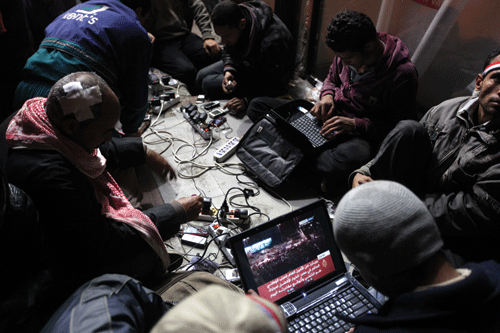
“The revolution will not be televised”, sang Gil Scott-Heron in a 1970s proto-rap number in the wake of the United States civil rights movement. But when revolution broke out in Egypt in January, it was not only televised, it was tweeted, Facebooked, YouTubed, linked by email and splashed on the front page of newspapers at home and abroad.

Those far away in Europe and the United States, perhaps seeking to assert a Western contribution to the popular uprising, dubbed it another Facebook or Twitter revolution, as they had with Tunisia a few weeks earlier. Others emphasized the role of the Qatari satellite news channel Al Jazeera, which amplified the voices of the Egyptians protesting on the streets, carrying their words of defiance into living rooms and coffee shops across the Arab world.

Media academics are now picking through the electronic trail that the revolutionaries left behind them, trying to work out who was in touch with whom and which media was decisive in mobilizing the masses and winning over international public opinion. They should not ignore the old-technology media, which evolved incredibly in the latter years of Hosni Mubarak’s long reign. When he took office in 1981, the Egyptian state still had an iron grip on all information, through the three flagship mass-circulation daily newspapers nationalized in 1960 and the state broadcasting service, which monopolized television and dominated the radio airwaves. Alternative media in those days meant Radio Monte Carlo, the BBC and Voice Of America’s Arabic services, and a few weekly newspapers run by small opposition parties that were poorly produced and riddled with turgid rhetoric by polemicists. Egyptians with enough spare cash could buy foreign newspapers and magazines, which arrived several days late.

The media began to change in earnest around the turn of the millennium, as the price of satellite dishes and receivers dropped and Arab countries launched more satellites offering hundreds of television channels. Commercial interests, especially in Saudi Arabia and the Gulf, drove the boom and most of the fare on offer was popular culture, plus a heavy dose of Islamic televangelism. But news and current affairs found a niche too, especially after the September 11 attacks on the United States and the subsequent invasions of Afghanistan and Iraq. At about the same time, again under commercial pressures, the Egyptian government allowed independent satellite broadcasters to set up shop in Cairo. Their late-night talk shows, which delved deeper and deeper into the country’s internal affairs, stole millions of viewers from state television.

Egyptian businessmen were also pressing for licenses for independent newspapers, and the Mubarak regime relented, apparently confident that it had the country firmly under its thumb; the government’s attitude became one of indifference. Editor Ibrahim Eissa in al-Dostour and novelist Alaa el-Aswany in el-Shorouk attacked Mubarak and his family relentlessly week after week, usually without serious repercussions. In retrospect, Mubarak and his retinue may be regretting their tolerance. Independent media and the Internet, which the Egyptian government very rarely tried to censor, slowly eroded the prestige of the president and the people around him. State media lost its audience, depriving the government of what was traditionally a valuable propaganda tool.

Facebook clearly played its part too, especially in the last few years, creating online communities that rapidly evolved into solidarity on the street in the first few days of the uprising. But at one of the crucial moments of the revolution, a domestic television station helped to keep the protest movement alive. Millions watched talk show host Mona el-Shazli’s February 7 interview with Google executive and Internet activist Wael Ghonim on the evening he emerged from 11 days in detention. Ghonim put a modern human face on the young revolutionaries, whom the government had alternately dismissed as foreign agents or rabid Islamists. On February 12, the day after Mubarak lost power, even the state newspaper Al Ahram had to abandon the man it had loyally served for 30 years. “The People Overthrow the Regime” was the triumphal banner headline, a classic in the annals of turncoat journalism.

Today state media is in limbo, kept on life support by the inertia of the ruling military council, which has been reluctant to tamper with such longstanding institutions. But short of an improbable counter-revolution, it’s hard to imagine that any future Egyptian government will try to put the media genie back in the bottle.

Jonathan Wright is managing editor of Arab Media and Society


April 3, 2011 0 comments
0 FacebookTwitterPinterestEmail
Economics & Policy

Art with no admirers

by Saria Francis April 3, 2011
written by Saria Francis

Tourism, that perennial contributor to Lebanon’s coffers, could be heading for a dry spell. The deteriorating domestic political situation coupled with widespread regional unrest has made for an arid start to the year, and things aren’t looking up for the rest of 2011.

“The closer we get to summer without a government, the more the tourism sector will be negatively affected since tourists won’t wait until the last moment to [decide] where to go,” said Marwan Mikhael, head of research at BLOMInvest Bank. 

Tourism’s direct contribution to Lebanon’s economy amounts to some 10 percent of annual gross domestic product; including indirect contributions (profits of tourism spent in other sectors of the economy), tourism amounts to around one third of the country’s economic output, according to the World Travel and Tourism Council (WTTC). Some 205,000 tourists came to Lebanon in the first two months of 2011, a drop of 12.7 percent from the 235,000 who arrived in the same month last year, Lebanon’s best to date.

“The number of tourists is declining even more due to several factors: political instability and what’s happening in the region,” Mikhael said. “Even though Lebanon is shielded from what’s happening — we won’t have the same revolution or unrest — tourists will be afraid anyhow.”

The effects of a less-than-stellar tourism season on economic output were palpable during the last economic trough after the 2006 war with Israel literally sent tourists fleeing; that year GDP growth reached just 0.6 percent. It since rebounded to peak at 9.3 percent in 2008 and dropped to 8.5 in 2009, the last year for which official GDP figures are available from the national accounts due to a lack of accurate and timely statistics.

Most estimates for 2010 suggested a 7.5 percent growth rate, with the decline sliding into 2011 as the coincident indicator, an average of eight weighted economic indicators published monthly basis by Banque du Liban (BDL), Lebanon’s central bank, fell 4.7 percent from November to January. Barclays Capital and Standard Chartered have revised their 2011 Lebanese GDP forecasts down to 5.5 percent, while BDL Governor Riad Salameh told the press he expected economic growth to slow to 5 percent.

Falling earnings and rising costs

Barclays Capital also indicated that the higher oil prices would increase the price of transfers to Electricité du Liban, which, combined with the government’s recent decision to lower gasoline import taxes by 57 percent, would chip away some 1.5 percent of GDP; these, among other factors, led Barclays to forecast an increase in the budget deficit to 8.2 percent of GDP this year from last year’s 7.5 percent. Standard Chartered expects the fiscal deficit to widen to 9.5 percent of GDP. Lebanon’s total debt topped $52.29 billion in January, up from $51.65 a year earlier, with domestic banks holding roughly 60 percent.

More bad news came as the Economist Intelligence Unit predicted Lebanon’s trade deficit to hit an all-time high this year of $13.75 billion. The country’s Higher Customs Council showed a $550 million year-to-year increase in Lebanon’s balance-of-trade deficit in the first two months of 2011, to $2.35 billion through February. Total exports fell 8.24 percent over the same period to $601 million, with a 20.24 percent jump in imports to $2.95 billion. Export decline will likely continue as Egypt, one of Lebanon’s main export markets, contracts.

Remittances, at an $8.2 billion all-time high last year according to the World Bank, are expected to decrease as regional unrest impacts Lebanese working abroad — particularly in Bahrain. The remittance decline may be mitigated somewhat, according to BLOMInvest’s Mikhael, by higher oil prices leading to increased earnings for Lebanese working in hydrocarbon exporting states.

Another pillar of Lebanon’s economy, the banking sector, saw the $128.92-billion consolidated balance sheet of commercial banks shed over $580.07 million in January. The dollarization rate of deposits is rising again, at 64.38 percent in January 2011, up from 63 percent a year earlier, indicating less faith in the local currency. Loans in the sector were still rising, however, with $30.08 billion in the market as of January, up from $24.66 billion a year earlier. 

The property sector is also slowing: in the first two months of 2011, sales transactions fell 18.7 percent year-on-year to 10,630, which included a 26.4 percent decrease in sales to foreigners. A report by The General Directorate of Land Registry and Cadastre shows that despite this dip, the total value of sales was only down 1.1 percent in comparison to this time last year.

Despite these poor indicators, Standard Chartered expects the Lebanese economy to demonstrate its distinctive flexibility. According to them, the economy’s basic structures ought to remain stable thanks to continued confidence in its banking system, and in the central bank’s ability to preserve the American dollar peg and follow an International Monetary Fund-accepted approach toward reducing the public debt-to-GDP ratio.

April 3, 2011 0 comments
0 FacebookTwitterPinterestEmail
  • 1
  • …
  • 383
  • 384
  • 385
  • 386
  • 387
  • …
  • 696

Latest Cover

About us

Since its first edition emerged on the newsstands in 1999, Executive Magazine has been dedicated to providing its readers with the most up-to-date local and regional business news. Executive is a monthly business magazine that offers readers in-depth analyses on the Lebanese world of commerce, covering all the major sectors – from banking, finance, and insurance to technology, tourism, hospitality, media, and retail.

  • Donate
  • Our Purpose
  • Contact Us

Sign up for our newsletter

    • Facebook
    • Twitter
    • Instagram
    • Linkedin
    • Youtube
    Executive Magazine
    • ISSUES
      • Current Issue
      • Past issues
    • BUSINESS
    • ECONOMICS & POLICY
    • OPINION
    • SPECIAL REPORTS
    • EXECUTIVE TALKS
    • MOVEMENTS
      • Change the image
      • Cannes lions
      • Transparency & accountability
      • ECONOMIC ROADMAP
      • Say No to Corruption
      • The Lebanon media development initiative
      • LPSN Policy Asks
      • Advocating the preservation of deposits
    • JOIN US
      • Join our movement
      • Attend our events
      • Receive updates
      • Connect with us
    • DONATE