• Donate
  • Our Purpose
  • Contact Us
Executive Magazine
  • ISSUES
    • Current Issue
    • Past issues
  • BUSINESS
  • ECONOMICS & POLICY
  • OPINION
  • SPECIAL REPORTS
  • EXECUTIVE TALKS
  • MOVEMENTS
    • Change the image
    • Cannes lions
    • Transparency & accountability
    • ECONOMIC ROADMAP
    • Say No to Corruption
    • The Lebanon media development initiative
    • LPSN Policy Asks
    • Advocating the preservation of deposits
  • JOIN US
    • Join our movement
    • Attend our events
    • Receive updates
    • Connect with us
  • DONATE
Real Estate

A room for two

by Rayya Salem February 3, 2011
written by Rayya Salem


The demand for medium-to-small apartments in Beirut and its suburbs is on the rise. This is particularly true in the more affordable suburbs such as Yarze, Fanar and Dbayeh on the outskirts of town and the more central neighbour hoods of Ras El Nabaa and Barbour. The process of looking for a home of realistic size and amenities confirms the Lebanese proverb: “It’s not what you know, it’s who you know and how hard can you twist their arm.”

In this report, Executive takes the hypothetical example of a young, professional couple looking for a home to start their new family. Even for the well-to-do, finding a decent place to live in Beirut’s pricey market can be arduous; we assume our couple together brings in $6,000 a month — placing them in the top five percentile of household income earners — and then look at the options they have and the challenges they face.

Re sales

Our new buyers would do well to swallow their pride and consider opting for resale rather than for an apartment in a new development. When buying an old apartment (more than 20years old) in Gemmayze or Ashrafieh you can expect to pay $1,500 to $2,500 per square meter (sqm), according to Walid Moussa, chief executive officer of PBM brokers. By comparison, prices start at $4,100 per sqm for space in Byblos Real Estate Investment’s (BREI) upcoming Convivium VI building in Gemmayze.

However, should our couple be planning to shop around on the resale market, they should be aware of extra renovation costs: Antoine Abou Rizk, manager of Lebanon Real Estate, said that although a used 140 sqm apartment in Rmeil had an attractive asking price of$260,000, renovation alone could cost up to $350,000.

 Location, location, location

New or old, location is everything when it comes to real estate prices. Go from Rmeil to Dekwani-MarRoukouz and a similar-sized unfurnished used apartment of 150 sqm drops to around $205,000, according to Plus Brokers‘ Michel Ghosn.

Badawi Group has 250 sqm apartments available in an upcoming housing project in Zouk Mikhael, five minutes from the highway to Beirut. Currently, the price stands at around$1,300 per square meter before rising 5 percent at the next construction stage, making it around $325,000 at base price. According to George Badawi, construction costs of around $525 per sqm (not including land price) are not as high as luxury developments being built in Beirut, but nonetheless owners will have amenities such as security, a garden, a swimming pool and underground parking.


Saving money by moving out of town has its drawbacks, of course. It means a lengthy commute for those working in Beirut and frequent wrangling with the city’s infamous gridlock. With gas costs rising, the drive to work might make a bigger dent in your savings than expected; transport should generally absorb 5 percent of your income, but in reality it’s much higher in Lebanon if you drive more than two hours each way to work, according to Mohammad Chamseddine of Information International.

Keep it small

Like Paris, London, New York and even Dubai, many couples or first-time home purchasers opt to live in studios, which are more and more prevalent in Beirut due to the increasing demand from the “eat, sleep, work” crowd who have very little time to spend at home.

If our couple fancy a pad in the city center, $350,000 will buy a 77-sqm apartment on the fifth floor of BREI ‘s Gemmayze Convivium VI.

However, if they want a bit more space to breathe, an FFA Real Estate project launching in Badaro in two months will include 80-sqm apartments with starting prices that hover around$2,900 per square meter ($232,000 for a first floor 80-sqm unit). Mireille Korab Abi Nasr, FFA Real Estate’s marketing and sales director, says the firm has received more than 120 inquiries from interested parties about these units.

Although small studios maybe cramped, they can provide a great way to afford a down payment on a bigger property. Jad Zgheib of JSK brokers suggests an initial investment in small apartments(as small as 40-sqm studios) as they are always in demand and can then be sold easily, especially around university areas. “You should expect a capital gain of 10 to 15 percent yearly,” he said.

To broker or not to broker

Zgheib says brokers can make all the difference by putting together special deals that cater to the particular circumstances of buyers and sellers: “I had a couple who had$180,000 to spend on a home but didn’t have the 20 percent cash down payment. At the same time, I knew a guy who had his eye on a home under construction in Metn that needed two years to finish. He decided to sell his existing current residence in Dbayeh to this couple and rent it from them for two years until his new home [was] finished. So the $600 monthly rent payments over this period substituted as the down payment.”

A broker can also typically help to negotiate the asking price down 10 percent if he has brought more than one buyer to a certain project. Zgheib said he got one of his clients to gather friends to buy three apartments in one building in Mazraat Yachook. They got a10 percent discount off the asking price and ended up paying $300,000 each instead of $330,000 for 200-sqm apartments that are a short distance from the Bekfaya highway.

Though negotiations typically top out at 10 percent, one can certainly give an extra tug if the building is old or if there is no parking assigned.  However, the 2.5 percent brokers fee can be daunting to some. If you choose to go it alone you risk overlooking certain information that a broker may provide, but there are a handful of websites that can help you get in touch directly with the owners of property.

One such site, Aradeek.com, founded by Waleed Khoury, is updated daily and even allowed sellers to list their properties for free during the month of January. Now more than ever is the time to negotiate on housing prices, given the tumultuous political environment. But those buying small houses have less leverage, especially when buying from a developer who has not based his financing on bank loans and is not in a hurry to pay them back. Walid Moussa suggests buying off-plan, as it is often more negotiable.

Paying for it all

Information International’s Chamseddine says while 20 to 25 thousand Lebanese need home loans each year, but only 10,000 households receive them. Iskan and other publicly subsidized loans tend to offer customers better rates, though not everyone qualifies(maximum household income per month to apply is $3,333) and there is a cap on the loan amount, which was recently raised from $120,000 to $180,000.

Going the commercial route, and assuming our couple gets a loan that covers 80 percent financing and allows at least 20 years to pay back the loan and interest, they are looking at a home within the $350,000 to $400,000 range, depending on how much cash they have saved to pay the 20 percent down payment that is usually required. Most home loan interest rates start out near 3.75 percent and slowly increase, up to as high as 8 percent after the first year. That determines your monthly payment, which, as a rule of thumb, should not exceed a third of your income. Brokers say that most banks are now offering loans to purchase apartments under construction or in the planning stages by making deals with the developers to finish their projects within a certain time frame.

Antoine Chamoun, general manager of Bank of Beirut Invest, says that the bank has been involved in financing loans for off-plan homes for about a year and a half, and is working with seven developers to provide loans for those who want to purchase off-plan homes.

The $500,000 ceiling offered in Bank of Beirut’s “BDL loan” — a loan offered by commercial banks partly subsidized by the central bank — is for a primary residence that cannot be sold for seven years. Banque Libano-Francais tied up deals with Plus Properties to finance home loans for the upcoming Plus Towers in downtown and Fanar Residencein the Metn area, while CIBCO is developing 120 and 150 sqm apartments that fit our budget range of $350,000 in their upcoming Sky Tower in New Doha, Aramoun, with off-plan loans provided by Bank Audi and BLOM Bank.

Not only will our couple be paying less in total by going off-plan, the down payment is also spread over alonger period of time, instead of paid all at once.

Abou Rizk says one advantage of having a broker, especially if buying off-plan construction, is that he can make sure that when our couple pays the gradual installments every few months, the contractor has actually reached the agreed upon stages of construction, and they are not just paying to watch time pass.


February 3, 2011 0 comments
0 FacebookTwitterPinterestEmail
Economics & Policy

Q&A – Joseph Stiglitz

by Ahmed Moor February 3, 2011
written by Ahmed Moor

Joseph Stiglitz is a Nobel laureate who received the prize in 2001 for his work in economics. He held the post of senior vice president and chief economist at the World Bank from 1997 until 2000, when he resigned over professional disagreements regarding the bank’s policies. He served as the chair of former United States President Bill Clinton’s Council of Economic Advisors from 1995 to 1997, and was also on the Intergovernmental Panel on Climate Change at that time. Stiglitz is currently a professor at Columbia University and is the chair of Columbia University’s Committee on Global Thought. While attending a conference in Cairo last month put on by management consultancy firm Booz & Company, Stiglitz sat down with Executive for an exclusive one-on-one about the evolving role of global financial institutions such as the World Bank and the International Monetary Fund.

The IMF and the World Bank were accessories to the global recession. Should we remain confident in their ability to promote development?

Clearly some of the policies that they had recommended in terms of regulation and liberalization were exactly the kind that led to the crisis and to its rapid spread abroad. The question is: Have they learned the lesson? Have they changed the models?

I think that the crisis has been obviously traumatic, not only for economies but for economists and [it has led to] a reexamination of a lot of beliefs. I think there have been significant changes, for instance, at the IMF at the top. One example is if you look at some of the policies that they employed in response to the crisis; they’re very different than those in 1997 and 1998.

[The leadership is] much more tolerant of deficits and stimulus policies and much more accepting of capital controls. That’s a total change from before. Philosophically, when [IMF Managing Director] Strauss Kahn says that the measure of recovery is whether employment gets back to normal… before they never talked about employment. The IMF has changed dramatically. The question on many people’s minds is: how deep into the institution is it? If they got a head from the old school, would the institution revert to the old ways? No one really knows the answer.

What do you think of the view that these institutions are implements of American foreign policy?

I think there’s ambiguity as always in political life. I know the World Bank much better [than the IMF]. Most of the people in the World Bank, people that I knew, were very much committed to promoting development. Much of what is going on is concerned with education, health and poverty.

In fact, I think the World Bank has been among the strongest institutions raising the awareness of the issue of poverty around the world. At the same time, you can look at what the IMF did in the 1997-98 crisis and say that was very much a reflection of the United States’ financial orthodoxy.

And if you look at the bailouts in general, they’ve been as much a bailout of American and European banks as they were of the countries. In many of the cases the countries would have been better off [without the bailouts] because in many of the cases they were private borrowers and the IMF effectively encouraged them to take those loans onto those books. It was the citizens of the countries bailing out bad lending by American and European banks. That was not in the interest of the countries. It was in the interest of American financial institutions.

Does that discredit the institutions?

These are international institutions where the governance is complex and not always fully transparent. The IMF — where the US isn’t the only country with veto power,  the G7 have the majority of votes, and the governance resides in the central banks and finance ministries which are closely linked to the financial sectors — you’re going to see the IMF be elective of the interests of the financial institutions in the richest countries. I think that’s inevitable.

I think though, at the same time, these institutions know they have to maintain global legitimacy to be effective. So they can’t just do what would only be in the interest of the financial institutions.

Is linking aid to human rights a good decision economically?

There is an economic aspect to it, to the extent that these institutions — like the World Bank — are funded by taxpayers, who are going to say: “We don’t want to give money if we think it is going to support values that we disagree with in a very strong way. We accept a wide range of behavior but there are certain things that we feel strongly about.” In a sense you have to see this as democratic accountability.

But the second point is that, broadly, more open societies are going to grow better. If you have a good education, people are going to start questioning — and you need a good education system to grow. A good education system is going to lead people to feel sensitive about the issues of human rights, almost inevitably. And then when you see that what is going on in your country is not consistent with that; you have the risk [that talented people will leave].

From the point of view of the World Bank there’s another issue though. Even if you think that the government is not democratic, I think there’s a moral obligation to figure out how you can deliver money to the poorest people in a way that doesn’t strengthen the government. You look at people in a country where they have a corrupt and a bad government in many ways, you say, “They’re already suffering. Should I punish them and make sure they don’t have a future by not providing support for the education of their children?”

My view was that we ought to figure out ways of delivering education [and] health services to the poor people in these countries in ways that don’t strengthen the government. In many countries, the World Bank has figured out how to do that.

What do you think of the top-down model of economic development practiced by authoritarian regimes, both in the region and China specifically?

First, in the case of China, there is actually wide participation in the formulation of the development agenda, so you cannot describe China as a top-down authoritarian regime. You cannot describe it as a democratic regime,  but the fact is that there is very wide consultation in the formulation of their development strategy… Successful development strategies almost inevitably have to have a buy-in. Our societies are too complex to have anybody run the whole thing. Therefore you have to have a broad consensus about what are the right things to do.

In what ways does the democracy deficit in the region impact economic growth?

Let me get back to China for a moment. There are some people who argue that the reason that China has taken the strategy it has taken is in fact because the only legitimacy they have is growth. They don’t have legitimacy from a democratic electoral process. So they have to justify themselves by saying, “We have been successful in producing growth.” This is not a defense of not having elections. I think democratic openness is becoming increasingly important in dynamic societies where you have to be open to the world.

Does the developed world have a responsibility to take for protecting the environment? Should the developing world reign in industrialization to curb greenhouse emissions?

The 1992 Rio Convention gave the framework that I think is the right one, which is, the incremental cost associated with reducing greenhouse gasses should be borne by the advanced industrial countries as a matter of ethics. And you might say it’s not just that the advanced industrial countries have already [contributed] their fair share of the global [emissions]… it’s that to ask the poorest people to lower their standard of living so the US can maintain its profligate lifestyle seems unconscionable. I think that one of the reasons for the failure of Copenhagen was that there was less of an articulation of notions of fairness. It got down to mechanics and I think there ought to be more open discussion of “What are the ethical implications of this?”

February 3, 2011 0 comments
0 FacebookTwitterPinterestEmail
Economics & Policy

Oil Law: Missing the tide

by Sami Halabi February 3, 2011
written by Sami Halabi


Oil has been interchangeably called “black gold” and the “devil’s excrement,” having both enriched the coffers of nations and pit them at war; it creates the capital for investment yet often destroys the development of other sectors in an economy.  It is perhaps fitting then, that Lebanese politicians have recently found renewed impetus to squabble with each other over how to pry open the lid of this cursed treasure under the sea floor off our shores.  

Lebanon’s slick history

The idea is not novel to those who have been following it. Oil and gas prospectors have long suspected the presence of hydrocarbons in the country, and there was a time when Lebanon had a proficient energy production industry.

Before the outbreak of the 1975-1990civil war, Lebanon used to refine oil in both Tripoli and Zahrani, suppliedeither by ship or overland via the old Trans-Arabian pipeline, which still runs from Qaisumah in Saudi Arabia to Zahrani. Supplies were then refined and even exported.

“We could regain our position as a major strategic transit country, like we used to be

before the 1970s, but we are not going to be Qatar or Saudi,” says Roudi Baroudi, independent energy consultant and Secretary General of the World Energy Council’s  (WEC) Lebanon Member Committee.

Today, however, Lebanon’s oil and gas infrastructure lies in tatters, with the country unable to coverits own energy needs, much less regain its position as a strategic oil and gas nation. What’s more, in comparison to its neighbors, Lebanon is far behind in terms of its progress in oil and gas exploration and production.

“Our real problem is that we are very slow and we are late; everybody is ahead of us,” says Mohamad Kabbani, head of the Parliamentary Committee for Public Works, Transport, Energy and Water and a member of parliament (MP) allied with the former Prime Minister Saad Hariri.

Lebanon has already drilled seven onshore exploration wells and is currently considering options to perform surveys again. It was former Prime Minister Rafiq Hariri’s government that shifted the focus to exploring the offshore area in the early 2000s. Since then, a number of seismic surveys have taken place off the coast of the country, and the results have piqued the interests of international oil companies (IOCs). The latest was conducted by the Norwegian firm PGS, which has recently concluded a full two-dimensional survey of Lebanon’s Exclusive Economic Zone (EEZ) — an area 200 miles (370.4 nautical kilo meters) from the borders of a nation in which it can legally extract natural resources as per the United Nations Convention on the Law of the Sea.

According to Cesar AbuKhalil, advisor to the caretaker Minister of Energy and Water (MoEW) Gebran Bassil, who is part of the opposition Free Patriotic Movement, Lebanon has two-dimensional seismic data covering 23,500 square kilo meters and 3,500kilometers of three-dimensional seismic data. It also has an operational ‘data room’ where survey results can be viewed and analyzed, which is an essential condition for launching a bidding round. The information costs seismic companies tens of millions of dollars to acquire, which they then hope to turnaround and sell to oil companies, with revenue from the sale shared with the Lebanese government.

The Lebanese treasury has already benefited from its sale along with the companies that have performed the surveys. More than 10 IOCs and national oil companies (NOCs) have bought data from the ministry and they are asking for more, says Abu Khalil, who added that no single company had all the seismic data. Baroudi estimates that if the entire offshore area of the country were licensed out, each portion in which companies are licensed to operate would require an investment between $3million and $6 million to perform 3-dimensional surveys.  

However, it remains to be seen whether these data purchases indicate genuine interest or are just efforts to keep the libraries of various IOCs and NOCs up to date.

Lebanon’s offshore area is part of the Syrian Arc, a geological structure of the earth that runs from Tadmor in Syria to Egypt and contains similar geological structures throughout. Lebanon is also part of the Levantine Basin, another structure located mostly beneath the waters of Lebanon, Israel, Cyprus and Syria. The government-run United States Geological Survey estimates that the basin contains some 1.7billion barrels of recoverable oil and 3.45 trillion cubic meters of recoverable gas. That becomes more significant when considered with the fact that the offshore Nile Delta region of Egypt has had an 85 percent exploration success rate, according to Baroudi.

But the more recent findings offshore of Haifa, straddling the Lebanese and Cypriot maritime border, are the ones that have raised the greatest interest of prospectors, and the greatest concern among Lebanese.

The law

For all the promise the Lebanese offshore area holds, IOCs and NOCs have been loath in the past to seriously consider any foray into the country due to the absence of high-level regulation or legislation to protect potential investments. That changed last August when Lebanon’s parliament voted unanimously to pass legislation allowing for offshore exploration and production.  The law had been lying dormant in parliament since the early part of last decade, unable to reach the floor due to a lack of political consensus and various conflicts among Lebanon’s political factions. At the behest of the Speaker of Parliament Nabih Berri — without whom no draft laws can come to the floor — the law was pushed through in a matter of days.

The borders

The reason for such haste was not only the backlog of legislation, but concern regarding activities south of the border. In January 2009, a joint United States-Israeli exploration group led by the US firm Noble Energy struck gold when they found a large natural gas deposit, dubbed Tamar, estimated at some 142 billion cubic meters (BCM) some 90kilometers off the coast of Haifa and just south of the Lebanese border. A few months later the group made another find in the Dalit field, estimated to be about 10 percent the size of the Tamar find. Such monumental discoveries could turn Israel into an energy exporter, a prospect that whipped the usually sluggish Lebanese parliament into action.

But passing a law will hardly be sufficient to bring the country up to speed with the rest of the region, let alone make it an attractive destination for IOCs and NOCs to invest in exploration. For starters, Lebanon has not set its maritime borders with any of its neighbors. Back in 2007, Lebanon and Cyprus did agree on the delineation of their maritime borders, a necessary measure given the overlap of their EEZs. But the agreement is now stuck at the prime minister’s office, which has not sent it on to the Parliament to be ratified for fear of angering Turkey — which does not recognize the Cypriot government — according to Future Movement MPK abbani. 

Turkey is now a key mediator in efforts to resolve Lebanon’s political crisis after its cabinet collapsed last month. However, Lebanon not formalizing its borders with Cyprus means that royalties from any resources found in common fields — which the MoEW’s Abu Khalil suspects exist given the seismic data from companies that have operated in both countries — that extend to Lebanese and Cypriot waters cannot be divided between the two states as would be common practice according to the UN Law of the Sea, which both Lebanon and Cyprus have ratified. The prime minister’s office did not respond to Executive’s request for comment.

Cyprus is currently in the exploration phase after the success of its first bidding round and is expecting to contract areas that could contain common fields with Lebanon in the second half of this year, according to press reports. Cyprus has already awarded Noble Energy the rights to explore a 1,250-square-mile contract area bordering Israeli-claimed waters and formalized its borders with Israel in December of last year.

Syria — which already launched an unsuccessful exploration bidding round to attract interested companies and looks to be preparing for a second round this year — and Lebanon have not formally delineated their border, but Kabbani claims that “we can solve it with Syrians; it’s not a problem.”

But that is unlikely to assuage the fears of the IOCs and NOCs that will need to invest up to $250million per block in design and development, with between $500 million and $600million of foreign direct investment to actually build the infrastructure needed, according to the WEC’s Baroudi. Just in the exploration phase, he estimates companies will need to invest as much as $100 million, and a further$500 million individually or through joint ventures. Nonetheless, Baroudi believes that when all is said and done, Lebanon could bring in $3 billion per year in net earnings.

A regulator of sorts

Of course the revenues will have to be shared between the Lebanese government and the oil companies. According to the exploration law, each contract block will have to be bid on by a consortium of at least three companies under a production sharing agreement. Following a proposal by the energy minister, based on the opinion of “The Administrative Board for the Petroleum Sector,” the cabinet will decree the terms of the agreements for each block.

The administrative board itself will have to be appointed by the cabinet following a proposal by the minister. It will act as both regulator and consultant to the minister while also being under his purview. Kabbani explains that this structure was a focal point of the negotiation process to pass the law, whereby his party sought to water down the minister’s authority over the sector.

Having the board appointed by the Council of Ministers also implies that it will be subject to the sectarian trade-off of members, as are all administrative boards in Lebanon. That effectively means that if the sector is to be regulated according to best practices, and decisions are to be taken in a streamlined fashion, the cabinet, minister and board will all have to agree. At the time of this writing, there is no functioning cabinet, the backlog of decisions and appointments to be made numbers more than 300 and Lebanon is in the midst of a full-blown political crisis.  

The Ministry of Energy and Water
</p>
									            </div>
        </div>

		            <div class=

February 3, 2011 0 comments
0 FacebookTwitterPinterestEmail
Finance

Something wrong under the hood

by Emma Cosgrove February 3, 2011
written by Emma Cosgrove


Car accidents in Lebanon increase, on average, 12 to 15 percent every year according to KunHadi, an organization dedicated to road safety education. The group says that on New Year’s Eve 2010 alone, there were 24 car crashes in Lebanon resulting in 28injuries and two fatalities.  The numbers scream for a robust and active insurance sector but instead Lebanon’s automotive insurance system is far behind global standards.

Its insurance industry is still the leader in the region, even after Swiss Re’s “World Insurance Report2009” said that insurance penetration as a percentage of gross domestic product had dropped from 3.4 percent in 2008 to 3.1 percent in 2009. Estimates suggest that the industry has probably reached $1 billion in premiums.

But Fateh Beckdache, general manager of BLOM Bank’s Arope Insurance, warns that any premiums growth in 2010is due to inflation and not growth. Without a financial crisis on which to blame the slowdown, less than stellar estimates for this year’s insurance financials suggest that there is something wrong under the hood. In fact, there are many idiosyncrasies within the Lebanese insurance industry that have caused a chain reaction of corner cutting and frustration on top of tumbling profitability.

The contract

Six month to one-year policies are the bread and butter of most Western auto-insurers, wherein the onus of continuation is mostly on the driver. Centralization of accidentin formation means that your crashes follow you wherever you go, making it less likely that a driver will find a more favorable rate by switching companies after a claim. In Lebanon, however, the lack of a centralized database for driving records of the insured reverses this dynamic, causing a shift in power within the driver-insurer relationship. Policies reaching up to five years are not uncommon and premiums do not rise when claims come in.

“This is very bad for the market. I don’t know why we can’t have a Centrale de Risk,” says Joseph Nasnas, chairman and chief executive officer of AXA Middle East. Insurers know that when a client submits a claim, if their premiums go up, they can easily move to another company and obtain the former rate, if not a discounted one as a reward for switching companies. Because of this, there is no disincentive to makes mall claims.

The accident

Massive claims for every little dent and scratch have caused the industry to search for disincentives. And since an overhaul of premium structure is impossible without a centralized information system, last year the industry attempted to improve the situation using a simpler tool: a deductible.


The members of the Association of Insurance Companies in Lebanon (ACAL) resolved to instate a $100deductible on claims as a group, in order to dissuade small claims and keep the playing field level among the companies. Association decisions, however, have no enforcement mechanism, leaving it up to respective companies to decide whether or not to follow its recommendations. Beckdache, who has put the deductible into effect, says that it has been very effective, estimating that it has improved Arope’s profitability by 20 percent.

“Some people used to come every month to repair their car. Now they don’t do it any more,” he says.“These are small things that make a lot of differences.”

Other companies have chosen to apply the change on a graduating scale. At AXA, Nasnas has no deductible for the first accident, but a deductible is in effect for the second, which then grows with each successive accident.

Abraham Matossian,  ACAL president and chairman and CEO of Al Mashrek Insurance and Reinsurance, however, says that he has not put the deductible into action at his company, claiming that it is not necessary as his business is going smoothly.

The numbers

This all adds up to an industry struggling to improve its profitability. The deductible, though a positive step, cannot completely heal what is ailing the sector as a whole given other glaring deficiencies, like the reserve requirement structure developed by the Insurance Control Commission (ICC), the regulator for the industry.

With GDP on a steady upward course in 2010, there are systemic, and not environmental, factors that have squeezed Lebanon’s auto insurers into a profitability jam and caused them to seek outside help to persuade the ICC to change a recent ruling that they say is stifling their operations.

In 2009, the ICC raised the reserve requirement for Lebanese companies. The ICC uses a premium deficiency reserve model to determine how much cash a company must have at any given time. It uses a company’s history to determine how many claims can be expected in the following year relative to the number of policies it has on January 1, not taking into account the fact that many policies straddle the end of the fiscal year or as is often the case in Lebanon, far exceed it. For example, if a policy begins in September it will be in effect well beyond the end of the economic year.

But Jeffrey Courchene, a principal at Milliman actuary who was commissioned by the association to evaluate Lebanon’s reserve system, told Executive that this is not always the most sensitive model. “The observed profitability in recent accident years is only a proxy for the expected probability in the unearned premium. Recent improvements in price level or portfolio management will be at best only partially reflected in the results of recent accident years, although they can have a significant impact on the assessment of profitability,” he says. “The new regulatory PDR (premium deficiency reserve) formula does not allow companies to fully reflect improvements they may have made in order to improve their premium adequacy. Contracts with longer effective periods, such as five year motor policies written by banks are especially impacted by this.”

Courchene recommends a more reactive and individualized alternative; a “principles-based” approach, which takes a more nuanced, holistic approach toward quantifying risk and is growing in popularity. “There is a worldwide trend towards principles-based regulation and accounting.” But this strategy requires more elbow grease from the regulator, something seemingly in short supply at the ICC, which still hasn’t published any figures from 2008; with this in mind, implementation of a new strategy looks unlikely.

Rumblings

In the face of waning profitability, some industry players suggest that there is some precarious accounting going on as well, giving the sector a more successful outlook than it deserves. Some suggest, for example, that long-term policies, which have been “written” but not “earned,” are recorded as revenue all at once on balance sheets. This kind of fraud would certainly create a cash flow problem in the very short term but Matossian claims that if you are smart you can make a lot of money this way.

Beckdache, however, says that this kind of behavior would be impossible to sustain and thus doubts that it is in practice. “If this happens, the first year I would make a lot of money. The second year I would start bleeding. In three or four years I would go bankrupt,” he explains.

Nasnas says that without proper industry statistics there is no way to know one way or the other. “We don’t have any official figures letting us analyze the market trends. So I wouldn’t be able to know.”

But Matossian confirmed to Executive that it does occur in the local market. Further bad practices, which are not uncommon, involve “dumping,”  cheap policies at the Lebanese border — insurance is mandatory for vehicles coming into the country  —or at the Mechanique car inspections to customers who suddenly find themselves in need of the required quick-fix coverage,  which the ‘companies’ are unlikely to honor. These practices are what caused the Ministry of Economy and Trade to shut down the American Underwriters Group in 2010.

So what?           

Why should Lebanese drivers care if Lebanon’s insurance industry is a disorganized impersonation of a mature insurance market? The current system keeps premiums low and compulsory coverage even lower, making the reasons difficult to see from the perspective of one’s bank statement. But the reasons are out there on the road.

Mandatory insurance beyond third-party bodily harm and an insurance system that incentivizes good driving are the private sector’s means to improve the safety of Lebanon’s roads, a task made more urgent by last year’s accident statistics.


February 3, 2011 0 comments
0 FacebookTwitterPinterestEmail
Comment

Hide-and-seek in Helmand

by Adam Pletts February 3, 2011
written by Adam Pletts


The conversation between Captain Allen McBroom of the Marines’ 3rd Light Armored Reconnaissance and a villager from San Banadar in Afghanistan’s Southern Helmand Province was floundering. McBroom was fishing for information about improvised explosive devises (IEDs) planted in the area, but to every question the villager replied with the same flat denial of knowing anything. Just as the conversation was drawing to a close an explosion tore through the morning air: an IED blowing up some 200 meters down the road.

Over the coming days this scene, of Marines’ questions being met with villagers declining to comment, was repeated time and again in what resembled a rather dangerous game of ‘hide and seek’ between the United States military and the Taliban, with both attempting to leverage the locals. Roughly a dozen IEDs were being found daily; pressure plate devices buried in the road designed to detonate as the victim passes over, and therefore utterly indiscriminate.

Some villagers must have known the location of the IEDs and warned the others, given that no locals had been harmed by the explosive devices that were scattered around the outskirts of the village and along the main thoroughfares leading to it. In one location different sets of motorbike tracks had all veered far to the fringes of the road, around the exact point where the Marines found a 70 pound IED and detonated it in a controlled explosion, leaving a crater eight feet deep and 20feet wide.

On the surface, at least, there was plenty of support for the demining. One farmer told the Marines, “We’re scared to go out with our animals, [the IEDs] are meant for us, not for you.” Despite this, nobody in this village, unlike others the Marines had visited, was willing to offer information on the IEDs, even though this often included are ward equivalent to more than what the average local made in a month.

One reason was because of the Taliban operatives in their midst. The Marines monitor Taliban communications on wide band receivers that have a maximum range of only 800 meters. After an IED was discovered by Marines, their Afghan translator heard “chatter” of disappointment on the lines. He then volunteered that the worst thing he had personally heard was in the next village to the north, when someone said over the line: “If you get a chance, shoot the translator in the mouth.”

The Marines estimated there were only some 20 Taliban in the immediate vicinity of these villages, which is why Lieutenant Colonel Kenneth Kassner, in charge of the coalition’s most southerly conflict area in Afghanistan, warned his men: “Don’t go looking for the 10-footTaliban.” That said, the Taliban’s IEDs have taken their toll; the most recent Marine casualty in Southern Helmand Province was Corporal Eric Tolbert, killed by an IED in late December some 10 kilo meters south of San Banadar.

The villagers’ reluctance to support the Marines in their attempts to locate the IEDs is not necessarily an indication of their sympathies but of their fears. While some may support the insurgency, many had bitter experiences under Taliban rule and would be happy to see proper government control established in this area, where currently next to none exists. Despite this, they are terrified of being seen taking sides with the US forces, to the point that they wouldn’t accept the smallest of gifts for fear that “if they [the Taliban] find out we’ve accepted a radio we will be in big trouble.”

Of course, the Taliban would have found out, since they were there. It is a murky game, each side watching the other; the Marines from their patrols and from a balloon above their main base which can see out some 40 kilo meters, and the Taliban from their positions on the ground, often blended among the villagers who are caught in the middle and whose every move stirs the suspicions of one, or both, of the warring parties.

ADAM PLETTS is a freelance journalist embedded with coalition forces in Afghanistan 


February 3, 2011 0 comments
0 FacebookTwitterPinterestEmail
Finance

Q&A – Saad Mered

by Emma Cosgrove February 3, 2011
written by Emma Cosgrove


Saad Mered is the Middle East chief executive officer of Zurich Insurance Company and now holds the reigns at Compagnie Libanaise D’Assurances (CLA), after Zurich Insurance completed the acquisition in the fourth quarter of 2010. He recently gave EXECUTIVE his thoughts on the local market and why Zurich Insurance is breaking into the Middle East.

Why did you feel that Lebanon was the next country to add to your Middle East presence?

Compagnie LibanaiseD’Assurances is headquartered in Lebanon and has branch operations in the United Arab Emirates, Oman and Kuwait. So, for us, the acquisition is much more than adding another country to our Middle East presence. Our strategic aim is to be the leading multinational insurer in the Middle East; the acquisition of CLA is a key stepping-stone towards realizing this goal.

What is your assessment of the maturity of the Lebanese insurance sector and market?

Lebanon has one of the highest insurance density and penetration rates in the region. In Middle Eastern terms, its insurance industry is well established and Lebanon has long been recognized as a pool for insurance talent — this is reflected in the fact that there are a disproportionate number of insurance executives in the region that are of Lebanese origin. We hope to leverage and add to this talent pool.

What are the biggest challenges facing the Lebanese insurance sector?

With the heightened regulatory scrutiny that the Lebanese regulator has recently shown, the local market will need to adapt to a new environment, which we believe would benefit the sector overall. As in many markets the main challenge is also one of awareness: getting people and businesses to understand why insurance is, or rather should be, so important to them. For example, if a family was to suffer a fire or flood, the financial consequences could be devastating. People think about the big things like houses and cars and overlook the costs of replacing the small things such as clothes, children’s toys and other household contents.

The Lebanese insurance sector is known to be one of the least transparent sectors of the local economy. Do you feel that this is a hindrance to its success?

Whilst we can’t comment on behalf of the Lebanese regulator or the local insurance association, the Middle East insurance market in general is developing rapidly, and we fully support the need for a transparent and accountable sector as it continues to grow and mature.

What was your impression of the relevant regulatory bodies during your acquisition? Which regulators did you work with in this transaction?

We worked with the Lebanese regulator and also the regulatory bodies in Oman, the UAE and Kuwait.  We maintain a good and positive relationship with them. 


February 3, 2011 0 comments
0 FacebookTwitterPinterestEmail
Comment

Untying Istanbul’s Gordian gridlock

by Peter Grimsditch February 3, 2011
written by Peter Grimsditch


About the only phrase guaranteed to cross Istanbul’s linguistic barriers is “trafik problem,” the despondent opening line of many taxi drivers. For some, it provides the excuse to take a circuitous and more expensive route. Yet the city’s congestion problems place it in a premier league that includes such places as Manhattan, Mumbai, Moscow… and the coastal highway heading north from Beirut on a Friday after work.

Solutions are not easy, not least because the Turkish metropolis is in an earthquake prone area. They are also, of course, expensive. However, a rash of projects to get the city on the move has been announced in the past few months. Simplest among them would be a greater use of the Bosphorus to transport commuters who want to travel up or down one side rather than cross it, as around one million people do every day on either ferries or motor transport over one of the two bridges.

Reminiscent of similar ideas to connect Jounieh and Byblos with Beirut, its success will doubtless depend on feeder road transport to distribute the commuters to the exact places they want to go. When he introduced the service last December, the Mayor of Istanbul, Kadir Topba?, said: “People will prefer these two routes to avoid traffic jams on both sides of the strait and have a more comfortable trip.” Indeed they will, much more so than when he took the controls of a tram on New Year’s Eve to launch an enhanced service there as well.

The first dozen new trams began running on that day, increasing the frequency of services between Kabata?, close to the city center, and Zeytinburnu, in the direction of Ataturk Airport. The route passes through the packed and now mainly pedestrianized Sultanahmet district, which contains Topkapi Palace and the Blue Mosque.

“Due to the lack of trams, commuters were experiencing hardships. By providing 37 new low-lying cars furnished with advanced technology and air-conditioning, we will smooth the commute,” said Topba?, before piloting one of the shiny new units. His driving skills proved to be less accomplished than his administrative abilities in trying to solve congestion. Topba? applied the brakes too sharply, causing his passengers from the local press corps to fall on the floor. Although the grumbling reporters complained of a few bruises, the greater injury was possibly to the mayor’s pride.

The $96.1 million cost of the trams is but petty cash compared with the mega-projects to build a third bridge across the Bosphorus, as well as a remarkable tunnel to carry both vehicles and high-speed trains. Tenders for the bridge project, estimated to cost around $6 billion, are scheduled to go out this month.

Even with the prospect of “losing” 20,000 vehicles transiting Istanbul every day, not everyone is happy.  The site for the new bridge will mean devastating areas of forest on the banks of the Bosphorus, especially on the Anatolian side, and has already led to an increase in property speculation on the grounds that neighboring green areas will be opened up for development.

An assurance from Mehmet Cahit Turhan, who oversees the General Directorate of Highways, that an environmental impact assessment would be carried out before construction got under way, failed to convince the critics. “This will be carried out by the company that wins the tender,” Turhan said. As one columnist wryly observed, this is tantamount to asking a wolf to guard sheep.

In engineering terms, the most remarkable project has to be the Marmaray, a tunnel under the Bosphorus. It will be five kilo meters long and run up to 60 meters below ground. Since the location is in a high-risk earthquake zone, it will be constructed to withstand shocks of up to nine on the Richter scale. Stations and infrastructure are being built underneath newly unearthed historical sites that show Istanbul to have been inhabited 8,500 years ago, more than three times as long as previously thought. Scheduled for completion in less than five years, the tunnel will be designed for both vehicles and a high-speed rail link to bring commuters into the city.

“The Marmaray is a huge, extremely complex and exciting project — I can’t think of any challenge this project lacks,” says Jens Peter Henrichsen, project manager from Avrasyaconsult, the joint venture preparing the project and overseeing construction. It’s not yet clear if those challenges are thought to include the Mayor of Istanbul operating the first train through it.

PETER GRIMSDITCH is EXECUTIVE’S Istanbul correspondent


February 3, 2011 0 comments
0 FacebookTwitterPinterestEmail
Finance

Euro vs. dollar in 2011

by Natacha Tannous February 3, 2011
written by Natacha Tannous


Finding the answer to the euro/dollar exchange rate equation is like evaluating two sides of the same coin. The question is, which one will land face up, and when? The answer, however, is dividing the brightest and most influential financial minds around the world into two camps with radically different forecasts for the year ahead.

A depreciating greenback?

Aside from being a medium of exchange, the dollar is a safe haven through United States Treasuries, a unit of account for commodities and trades, an anchor for pegging currencies and a carry trade currency. With such numerous functions, the future of the reserve currency is not only important for the US economy; it is also an essential element for both developed and emerging markets.

Today, the US needs to address the low prospects for economic growth, a weak labor market and a depressed housing sector. However, to tackle these three issues, Uncle Sam decided to engage in unprecedented monetary expansion (namely low rates and quantitative easing) as well as fiscal leniency through a tax deal that will widen its current account deficit, thus indirectly depreciating the US dollar.

Additionally, the amount of liquidity injected into markets is partly flowing out of the country into other markets or into dollar-denominated assets such as hard commodities, which is catching the US in a “liquidity trap.” Indeed, such outflow of liquidity undermines what the measure is actually trying to do, to the extent that the beneficiary of the long-awaited growth may even become the Canadian and Mexican economies and their respective currencies, to the detriment of the US dollar.

Lastly, there is an increase in commodity prices and US equity markets predicted for this year, which are, in effect, inversely correlated to the US dollar.

A European domino effect

Europe’s outstanding debt and debt servicing uncertainties are major issues for the monetary union. In 2011, instead of bailing out Greece’s pensions or Ireland’s banking system, the Eurozone might need to rescue Portugal, Spain, Italy or even Belgium. Furthermore, given the large upcoming Spanish and Portuguese maturities in the second quarter, debt rollover risks will not be contained, especially as refinancing gets more expensive.

Moreover, as if debt-related issues were not enough trouble, the Eurozone also faces a two-speed economic recuperation internally, which is challenging from a monetary standpoint because the European Central Bank (ECB) rate, at 1 percent, is too low for countries experiencing solid growth like Germany and too high for Europe’s ‘peripherals’ — Portugal, Ireland, Italy, Greece and Spain — who have acquired the unflattering acronym “PIIGS.”

Today, the Eurozone is stuck in a difficult situation, with limited tools, because the European Central Bank can only tackle its problems using monetary policy since the Eurozone is not fiscally integrated.

“Unknown” unknowns

Adding to the “known” unknowns described above, additional unpredictable events and tail risks have yet to be priced into the currency equation. Among possible ‘black swans,’ three potential scenarios would undoubtedly weigh negatively on the US dollar.

“For many decades, the US benefited from having the reserve currency and a robust Treasury market, but we need to get our fiscal house in order,” explained Neel Kashkari, Managing Director and Head of New Investment Initiatives at PIMCO, in an interview with Bloomberg. “If we wait until we have an acute fiscal crisis the way it is happening in Europe, it could take years or decades to restore confidence.”

Secondly, as the US struggles to balance short-term priorities with long-term realities, there is also potential for a double-dip recession by 2012, especially given the historical median of expansionary periods, lasting 30 months on average, in the last three decades.

Lastly, given worries about the outlook for the US, and with China holding some $2.85 trillion in reserves, Chinese President Hu Jintao is actively seeking to promote a global yuan and change the current international currency system.

Across the pond, tail risks that would depress the euro include Eurozone sovereign restructuring — a more sophisticated synonym for “default” — which could entail haircuts for bondholders, as well as an unlikely but not impossible euro breakup.

Erratic and choppy fluctuations

“A lot of downside risks were already priced in the euro,” explains Daniel Brehon, foreign exchange (FX) strategist at Deutsche Bank, “whereas none of the upside risks such as the Eurozone finance ministers meeting, a potential issuance of Eurobonds, or mechanisms whereby Germany would step in, were priced in.”

Thus, these internal euro-supportive forces as well as other external forces such as Asian demand for Eurozone debt and investors’ positioning (since the market was widely shorting the euro via ‘stop-losses’) have helped the euro appreciate in January and might contribute to a euro rally until the news is digested.

Some fear the economies of Portugal, Spain, Italy or even Belgium could suffer similar fates as Greece, upsetting the value of the euro this year

“However, the situation is not resolved. The meeting of the Eurozone finance ministers lacked progress on expanding the size and scope of the European Financial Stability Facility (EFSF), and thus the elements of pressure in the peripheral debt markets will again intensify,” explains Robert Lynch, head of G10 FX strategy at HSBC. “Hence, we are more comfortable with a euro/dollar at 1.25 for the first quarter than at 1.35.”

As for year-end, there are two distinct schools of thought. The first one argues that effective solutions to the Eurozone crisis along with structural imbalances in the US will strengthen the euro and weaken the US dollar in the long-term. This school forecasts the rate to trade up to 1.50 on the back of growing fears of the American current-account deficit, unresolved unemployment issues and a mortgage funding gap. Moreover, structural outflows to other markets, diversification from the US dollar due to overweight exposure and the questioning of the US dollar’s status as a safe haven currency, would also weigh down on the buck.

Euro/dollar exchange rate forecasts

The second school of thought emphasizes the potential for greater disappointment on the Eurozone side. “Not only does Europe need to tackle the debt issue, but it also needs to restructure the banks given how undercapitalized they are; they ideally need something such as a European TARP [Troubled Asset Relief Program],” says Gabriel de Kock, head of US FX strategy at Morgan Stanley.

As the debt will then look artificially inflated, a higher risk premium will be attached to it;  rates would increase, which will cause the euro to sell off. Moreover, the second school believes that the US dollar will perform well on the back of good figures in the second half of 2011, predicting in some cases that US inflation might peak, which would cause policy tightening and ultimately be US dollar positive. “Although there currently is optimism in the Eurozone market, the euro/dollar will be choppy throughout the year, but a choppy downward trend,” insists Brian Kim, FX strategist at UBS.

So what now?

A popular strategy would be to short euros in the first quarter when the upswing seen at the end of January decelerates, but initiate a long euro/dollar position when it hits the mid-to-low 1.20s, since consensus remains generally higher than 1.25 in the long-term.

However, given the erratic FX outlook, with brokers forecasting the rate trading anywhere between 1.20 and 1.50 at year-end, it might make sense to look at hedging, using options or forwards, in order to manage risk or to bet on volatility trades (volatility arbitrage).

If directional investors think that the current implied volatility of options is lower than their forecast for the future realized volatility, then they should “long” the volatility; in other words, buy an option and delta-hedge it.

Finally, with a choppy rate and expensive standard options strategies, euro-bearish investors might also prefer to look at cheaper options by either selling euro/dollar spot and buying a cheap digital out-of-the-money call option or even venture into more exotic strategies, such as window knock-ins. But directional investors beware: this is just one side of the coin.

NATACHA TANNOUS is EXECUTIVE’S financial correspondent


February 3, 2011 0 comments
0 FacebookTwitterPinterestEmail
Comment

Democracy going to the dogs

by Peter Speetjens February 3, 2011
written by Peter Speetjens


Israel is often heralded as the only democracy in the Middle East, which unfortunately says more about the deplorable state of people power in the region than about the liberal character of the Jewish state. According to the Economist Intelligence Unit (EIU) 2010Democracy Index, there are worldwide only 26 “full democracies.”

Defined as a “flawed democracy” at rank 37, Israel is the region’s leading representative — it should be noted however, that the index does not take into consideration Israel’s military rule of the West Bank or its stranglehold of Gaza.  When a house is demolished in East Jerusalem or the security wall cuts off an orchard or garden, a Palestinian owner can only file a complaint at a hardly-impartial Israeli military court; if the index took this sort of thing into account, Israel would rank considerably lower.

The 2009 Press Freedom Index by Reporters Without Borders (RWB) does distinguish between Israeli practices internally and externally. Internally, it is ranked 93rd, behind countries like Kuwait (60), Lebanon (61) and the UAE (86). Externally, it is ranked 150th,mainly due to its military offensive against the Gaza Strip during which both foreign and Israeli media were denied access.

“Israel has begun to use the same methods internally as it does outside its own territory,” RWB warned. Journalists have been arrested and imprisoned within Israel and military censorship continues to pose a threat. There is an agreement between the military censor and the editors of newspapers that, when it comes to sensitive issues, all stories must go through the former.

Meanwhile, recent initiatives by Israel’s coalition government of religionists, “Russians” and right-wing nationalists will do little to improve the country’s democratic standing. On January 5, the Israeli Knesset voted for a plan, initiated by the Yisrael Beitenu Party (YBP) of Foreign Minister Avigdor Lieberman, to investigate the work and funding of domestic and foreign human rights groups. The bill accuses local rights groups of damaging the Israeli military by “branding IDF soldiers and commanders as war criminals.” Among the targeted groups are the Israeli Peace Now movement, the Public Committee Against Torture in Israel and Breaking the Silence, an organization that publishes anonymous accounts by Israeli soldiers stationed in the occupied territories.

“Movements on the extreme left have proven they are some of the people who would like to see the State of Israel destroyed,” said Israeli Member of Parliament Michael Ben Ari. “They are betraying the state and therefore there is no escape from taking steps against them. We will reveal they are funded by enemy states and we will put them on the same line with Hezbollah.”

Yet despite such unnerving statements, there are still indications that Israel is miles ahead of most countries in the region. “Persecution and attempts at silencing will not stop us,” stated the Israeli human rights watchdog B’Tselem defiantly. “In a democracy, criticism of the government is not only legitimate — it is essential.”

Under the slogan “Demonstration(since it’s still possible) for democracy,” thousands of people on January 15marched the streets of Tel Aviv in protest against the Knesset decision. Try doing that anywhere else in the region (apart from Beirut) and arrest, imprisonment and possibly torture will be coming your way. After all, the EIU index ranks Lebanon (86), Palestine (93) and Iraq (111) as “hybrid democracies.” A synonym for hybrid is “mongrel”: the offspring of two different breeds of dogs.

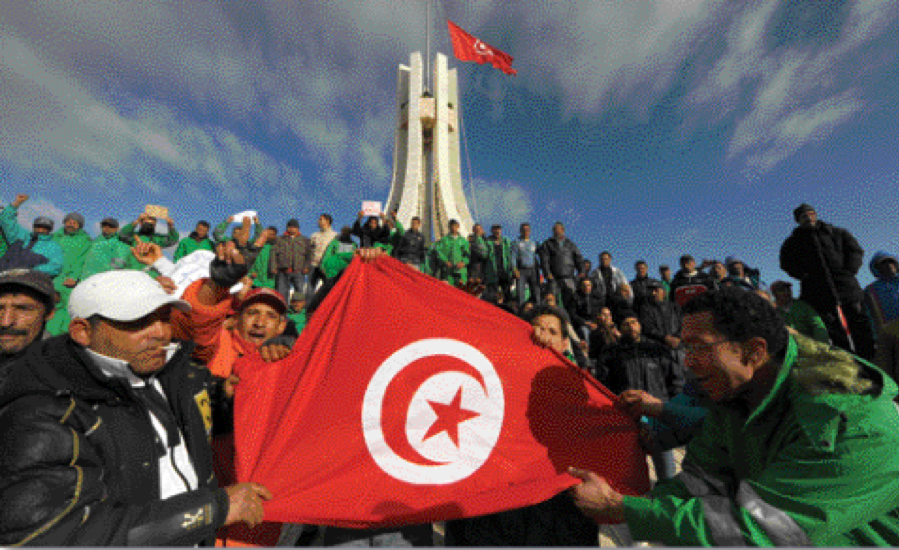
All other countries in the region, including Tunisia (144), are simply categorized as “authoritarian regimes.”  The index warns that democracy worldwide is in decline, as “autocrats have… learned how better to protect themselves.” Another key factor is “the delegitimization of much of the democracy-promotion agenda, which has been associated with military intervention and unpopular wars in Afghanistan and Iraq. A combination of double standards in foreign policy and growing infringements of civil liberties has led to charges of hypocrisy against Western states.” 

Let us not forget that both western and Arab leaders, until recently, praised Tunisia for being such a beacon of stability and loyal partner in the fight against extremism. In such a climate, it is a sad conclusion that Israel, while hardly a model, is the region’s democratic torchbearer — at least if you’re lucky enough to hold citizenship.

PETER SPEETJENS is a Beirut-based journalist


February 3, 2011 0 comments
0 FacebookTwitterPinterestEmail
Society

The ‘Butterfly Effect’

by Thomas Schellen February 2, 2011
written by Thomas Schellen

In one example of the damage to Japan
</p>
									            </div>
        </div>

		            <div class=

February 2, 2011 0 comments
0 FacebookTwitterPinterestEmail
  • 1
  • …
  • 392
  • 393
  • 394
  • 395
  • 396
  • …
  • 686

Latest Cover

About us

Since its first edition emerged on the newsstands in 1999, Executive Magazine has been dedicated to providing its readers with the most up-to-date local and regional business news. Executive is a monthly business magazine that offers readers in-depth analyses on the Lebanese world of commerce, covering all the major sectors – from banking, finance, and insurance to technology, tourism, hospitality, media, and retail.

  • Donate
  • Our Purpose
  • Contact Us

Sign up for our newsletter

    • Facebook
    • Twitter
    • Instagram
    • Linkedin
    • Youtube
    Executive Magazine
    • ISSUES
      • Current Issue
      • Past issues
    • BUSINESS
    • ECONOMICS & POLICY
    • OPINION
    • SPECIAL REPORTS
    • EXECUTIVE TALKS
    • MOVEMENTS
      • Change the image
      • Cannes lions
      • Transparency & accountability
      • ECONOMIC ROADMAP
      • Say No to Corruption
      • The Lebanon media development initiative
      • LPSN Policy Asks
      • Advocating the preservation of deposits
    • JOIN US
      • Join our movement
      • Attend our events
      • Receive updates
      • Connect with us
    • DONATE