• Donate
  • Our Purpose
  • Contact Us
Executive Magazine
  • ISSUES
    • Current Issue
    • Past issues
  • BUSINESS
  • ECONOMICS & POLICY
  • OPINION
  • SPECIAL REPORTS
  • EXECUTIVE TALKS
  • MOVEMENTS
    • Change the image
    • Cannes lions
    • Transparency & accountability
    • ECONOMIC ROADMAP
    • Say No to Corruption
    • The Lebanon media development initiative
    • LPSN Policy Asks
    • Advocating the preservation of deposits
  • JOIN US
    • Join our movement
    • Attend our events
    • Receive updates
    • Connect with us
  • DONATE
Comment

Baghdad’s enduring nightmare

by Alice Fordham October 3, 2010
written by Alice Fordham

On wide, high-definition screens, images flash up for two seconds at a time: flayed skulls, charred limbs, disemboweled torsos, heads bloated and bulging around taped-up eyes. Men and women sitting in plastic seats flinch as they squint at the real-life horror show, trying to identify husbands, cousins and friends. This is the Baghdad morgue, where the grim body count of the last seven years has been a daily reality, where bodies were piled up and lay unclaimed by terrified families before being driven to vast graveyards with numbered plots.

As American-led troops battled resistance and then civil war, this building and its 50 employees dealt with the consequences. In 2006 and 2007, the morgue received 150 corpses a day. Today, although the stream of dead has slowed to a trickle, the morgue remains a nightmarish reminder of the fighting’s lingering effects as people come to hunt through the photographs of some 20,000 bodies which remain unidentified.

Abu Issam, 47, from the capital’s New Baghdad neighborhood, was looking for his cousin, a 60-year-old man who was kidnapped from his home by men in three cars in January 2006. As corpse followed corpse on the screen, he said, "I look at these pictures and say to myself, ’what is the guilt of these people?’"

Meanwhile, officially, the war is grinding to a halt. On September 1, United States combat operations in Iraq were declared over and, with some fanfare, Operation New Dawn began, a mission of advice and assistance with less than 50,000 American soldiers on the ground.

Media attention has begun to drift from Iraq; the pyrotechnics of Pakistan and Afghanistan are now more interesting than the rumbling violence in Baghdad. But in a country where people are still mourning for disappeared loved ones, divisions and grievances run deep and there is not yet a clear victor in the messy endgame to the war.

Since the end of combat, American soldiers supporting Iraqi colleagues have found themselves in lethal shoot-outs and open fighting in Baghdad, Diyala and Fallujah. Two American soldiers were shot dead on September 8 in Salaheddin by a man in an Iraqi Army uniform who was among the men they had been training.

Other troubles still plague Iraq. Hundreds of people die violently every month and, more than half a year after elections, there is no sign of a government being formed. The divisions between Sunni and Shia, which Iraqis insist were negligible before the 2003 US-led invasion, are still being deepened by violence and politics. There are frequent assassinations among the largely Sunni militias which defected during the American troop surge. The Iraqiya party, which campaigned on a platform of secularism, is likely to be overpowered in government by a coalition of religious Shia parties, alienating the Sunni voters who largely backed Iraqiya.

The infrastructural impact of the invasion lingers. Electricity production has never reached pre-war levels, which were not high, and after a scalding summer marked by riots, the electricity minister was forced to resign. Bureaucracy and bribery dog municipal functions of the state and the police are corrupt and brutal. Minorities are still targets. Christians are associated with the hated occupiers and during the scandal surrounding the planned Koran-burning in Florida, every church in Baghdad was threatened.

The best-case scenario for Iraq going forward is the rather modest one laid out by Barack Obama, in which violence is at a manageable level and there is some semblance of democratic rule. But the ingredients are all there for a deterioration, and if a government doesn’t emerge or there is a serious attack on a religious site, for example, the decline could be swift and have a wide-ranging fallout.

Some American soldiers feel frustrated at the perception in the US that the war is finished. Lieutenant-Colonel Donald Brown commands the infantry division whose two soldiers were shot. After attending the “very emotional” memorial service for the two who were killed, Lt-Col Brown said that his wife and family had felt this kind of danger was unlikely since combat operations ended.

“This sort of event was only in the back of their mind until the events of the last few days clearly codified that this is still a very dangerous place,” he said. A sharp personal reminder that on the ground, the war ain’t over yet.


October 3, 2010 0 comments
0 FacebookTwitterPinterestEmail
Comment

The art of crime

by Peter Speetjens October 3, 2010
written by Peter Speetjens

The recent theft of a $50 million Van Gogh painting from the Mahmoud Khalil Museum in Cairo is hardly an isolated case. As art prices continue to skyrocket, the underworld is rapidly developing a taste for culture, turning art theft into a global business worth some $6 billion annually, according to the FBI. Only last May, for example, four modernist masterpieces, including a Picasso and Matisse, were stolen in Paris, while in 2008 a Cezanne and Monet were lifted from a Zurich museum. Meanwhile, thousands of Iraqi antiquities remain unaccounted for and Christian icons vanish on an almost daily rate, mainly in countries of the former Soviet Union.

That said, the way in which the Van Gogh still life “Vase with Flowers” was taken from the Cairo museum seemed like scene from the latest Adel Imam flick that could be called “Only in Egypt.” After all, where else can one enter a museum in broad daylight, move a couch under the desired painting, cut the canvas from its frame, and walk out without being spotted by either guards or cameras?

A museum employee admitted that the museum’s alarm system and most of the 49 security cameras had not been working for a while. “The museum officials were looking for spare parts but hadn’t managed to find them,” he told Agence France-Presse. The affair becomes all the more humiliating knowing that the same painting was stolen from the same museum in 1978 only to pop up two years later in Kuwait.

Admittedly, the theft of four paintings with a combined value of $130 million from the Paris Museum of Modern Art in May was nearly as embarrassing. Here too, the alarm system was out of order, as the museum was awaiting spare parts.

The security cameras however, did work. They recorded how a lone hooded thief broke a window around midnight, climbed in, cut the canvasses from their frames and left. Pity that the museum guards for some reason failed to look at their screens and only the next morning spotted the empty frames.

Yet even working cameras and guards that are awake can do desperately little against the threat of violence, which seems the underworld’s favorite modus operandi. In Zurich, for example, three men armed with automatic weapons stormed into the E.G. Buhrle Foundation, grabbed four paintings with a value of some $163 million and fled minutes later in a waiting car. Similar armed robberies have taken place in Rio de Janeiro, Sao Paolo, Stockholm and Boston, where two thieves disguised as policemen entered the Isabella Stewart Gardner Museum in 1990 and stole some $500 million worth of art. The stunt is still known as the biggest art heist in history.

It should be noted that the stolen Van Goghs and Picassos are only the tip of the iceberg. Most thefts do not concern classic masterpieces and hence fail to write headlines. Furthermore, while stealing a work of art is one thing, selling it is quite another. The problem is that an art work is a unique piece. There is only one “Guernica,” only one “Vase with Flowers.” Consequently, it is impossible to simply offer the works on the market, especially since both the FBI and Interpol established art crime departments that, among other things, maintain a database of stolen works. Instead, as in an ordinary kidnapping case, art thieves will often try to obtain a ransom.

According to Interpol, the theft of cultural objects affects the whole world, but the two countries most affected are France and Italy. The organization furthermore notes that the illicit trade is sustained by demand from the arts market, the opening of borders and political instability in certain countries. The latter especially refers to the situation in Iraq and Afghanistan, as looting has always been an intrinsic part of war. From the National Museum of Iraq alone some 7,000 to 10,000 artifacts remain missing, after the US army failed to protect the country’s leading cultural institution during the invasion.

In general, the future for stolen antiquities and art works looks bleak. Julian Radcliffe of The Art Loss Register estimates that only 15 percent of stolen art works are recovered within a period of 20 years. Hence, it may take a bit longer this time around before Van Gogh’s “Vase with Flowers” makes its way back to Cairo.

October 3, 2010 0 comments
0 FacebookTwitterPinterestEmail
Society

Musical Movements

by Emma Cosgrove October 3, 2010
written by Emma Cosgrove

Watches. “You either love them or you don’t care,” said Ronan Keating, sitting back on an overstuffed armchair in the library of IWC Schaffhausen’s new downtown boutique.

Keating cares. In fact, he gushes, unable to tame his passion for luxury watches. An Irish pop star and a former member of the 1990s boy band Boyzone, Keating is one of IWC’s many celebrity endorsers. He and Chief Executive Officer George Kern came to Beirut to open the brand’s new boutique in Beirut Souks on August 26, where the singer explained how he and Kern travel the world opening IWC boutiques.

“I’m like a kid in a candy store. This is something I have a passion for and I love watches,” he said. His prominent presence throughout the opening event highlighted the importance brands place on selecting an appropriate celebrity endorser; the right choice can lend credibility to a brand or even make it a household name, but the wrong one can sully its reputation.

At first Keating might seem like an odd choice; while he is not a completely unrecognizable figure outside the British Isles, his fame is somewhat localized to that northwestern edge of Europe. But IWC says it has a different strategy than other brands when it comes to its celebrity “family.”

“George didn’t have to convince us and start waving money in front of us, it’s not about that with the brand,” said Keating. “It’s a passion that we all share together.” Invited to become a brand representative when Kern saw him performing on Swiss television wearing an IWC watch, Keating is just one of many big names recruited to represent the brand in recent years. Other celebrities wrapping IWC around their wrists include Australian actress Cate Blanchett, French actor Jean Reno, French footballer Zenidine Zidane, Australian model Elle Macpherson and American actor Kevin Spacey.

Celebrity endorsements, the cornerstone of luxury watch advertising, can cost millions. The values of individual contracts are kept under lock and key and often vary greatly from company to company, star to star, but they rarely come cheap. Keating then, having recently been present at IWC’s openings in Kuala Lumpur and Vietnam, represents a significant strategic investment.

Building a brand is a complicated process, said Kern. “Millions of elements come together — advertizing, PR strategy, corporate social responsibility strategy, the way you decorate or the way you design stores.” When all the elements present at the boutique’s launch in Beirut Souks are scrutinized together, Keating’s presence  fits like a gear in a precisely tuned timepiece.

The opening featured the usual fare of hors d’oevres, champagne and branded miniature cakes. But after the ribbon cutting with Kern, Keating and members of the Atamian family, IWC’s Lebanese partners, Keating played a short, lighthearted acoustic set. Suddenly, the boutique’s styling, the utilitarian elegance of the watches and the music all blended with a melodic harmony.

Sure, the casual asides Keating tossed to the crowd during his set to profess his undying enchantment for IWC watches may have seemed a little over-the-top, but Keating’s limited local star power meant that he could walk through the crowd without needing security and without the usual surrounding wall of photographers. He shook hands and met actual people.

Perhaps it is an uncommon choice to use a lesser-known celebrity to keep the vibe light where a big name would shut down the show and hog all the attention. But ditching superstar power in favor of brand unity is certainly a bold move.


October 3, 2010 0 comments
0 FacebookTwitterPinterestEmail
Society

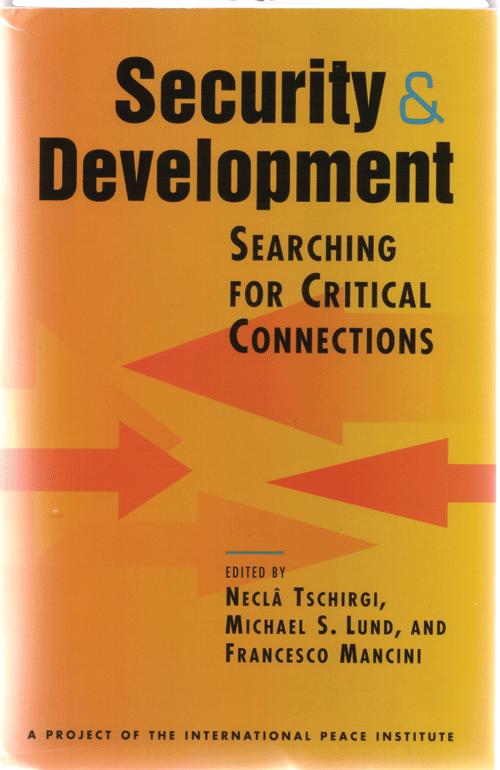
“Security and Development”

by Executive Staff October 3, 2010
written by Executive Staff

The New York-based International Peace Institute’s recently published “Security and Development: Searching for Critical Connections” is a scholarly work of valuable insight for the Middle East.

Edited by Neclâ Tschirgi, professor at the University of San Diego and former vice-president of the Institute, along with two other experts in the field, ‘Security and Development’ goes beyond rhetoric to examine the shortcomings of conflict prevention. The book begins with the point that often, underdevelopment and insecurity correlate — with higher levels of development meaning a lower likelihood of internal violent conflict.

After World War II, developed countries were overwhelmingly spared the ravages of military violence, while in the last several decades, most poor countries have suffered warfare — especially those that are home to the poorest billion of the world’s population, living in some 58 nations whose combined gross domestic product is less than that of metropolitan Chicago. After four lucid introductory chapters, the book illustrates such points in seven country case studies on the interplay between security and development in poorer states.

Awash with both insecurity and underdevelopment, the Middle East is seen by many in the West as the origin of much international terrorism, and close to 10 years since the September 11, 2001 attacks, the region is generally less secure; concurrently much of it still does not enjoy sustainable growth. This makes Arab countries the target of both security measures and development efforts, but the results have been far from satisfactory, as illustrated in the case study: “The Security Paradox in Unified Yemen.”

Defining the “security paradox” as the process whereby a country’s “internal insecurity is exacerbated by attempts to obtain international security,” the chapter’s authors Laurent Bonnefoy and Renaud Detalle paint a bleak but convincing picture of a state that is becoming more insecure as the West wages its war on terror inside Yemen.

Yemeni society is fraught with disaffection. Currently, Yemen suffers further as local and international security forces fight alleged terrorists on its soil; some of these people are “villains” that need to be dealt with (with or without Western involvement) but the net result of such antiterrorism efforts is destabilizing.

Internal stability suffers each time innocent bystanders are hit in attacks on terrorists, or targeted due to poor intelligence. Yet another mode of destabilization is the mass flight of people from an area reckoned to be a Western target, with lives and livelihoods disrupted. At the same time, despite much aid, Yemen is not developing. Unless strictly monitored and controlled, aid money can often compound local problems by abetting corruption and fueling nepotistic power structures.

As emphasized in the pithy final chapter, whatever the solution to this paradox, rigorous skeptical analysis of the sort found in ‘Security and Development’ offers a healthy antidote to ill-considered gung-ho antiterrorism operations coupled with lavish aid, which may actually end up making both the US and the global south, including the Middle East, less secure in the long run.

Though not necessarily for the lay reader, this carefully researched book should nevertheless interest regional security experts and practitioners whose Western colleagues are throwing vast amounts of money and force at problems such as those of Yemen, and other parts of the Middle East, with dubious results.

October 3, 2010 0 comments
0 FacebookTwitterPinterestEmail
Society

lacking a green shine

by Josh Wood October 3, 2010
written by Josh Wood

A quick glance at Lebanon’s smog-choked roads reveals that hybrid cars and green technology are yet to be embraced by the country’s drivers.

The vehicles are still a bit of a novelty in the West, accounting for a market share of only 0.5 percent in Western Europe and 2.8 percent in the United States in 2008 according to Polk, a firm that researches trends in the global automobile market. In Lebanon, the number of hybrid cars on the road is even lower.  But things may be changing soon.

In Lebanon’s proposed budget for 2010, a clause was included that would waive import tariffs on hybrid cars entering Lebanon. Currently, import tariffs and the 10 percent value added tax (VAT) on new vehicles can result in buyers in Lebanon spending up to 50 percent more than the market value of the car outside of Lebanon.

The Lebanese Ministry of Finance and the Ministry of Environment pushed for these fees to be lifted to help Lebanon’s environment. The World Bank has reported that environmental deterioration — primarily caused by pollution caused by transportation — costs Lebanon more than $560 million per year. While the government nets a significant income from taxes on imported vehicles, some people are starting to think that the resulting damage is too high.

The finance and environment ministries further suggested that Lebanon’s 20,000 or so aging and smog-belching taxis could be replaced with hybrid or green technology vehicles.

Additionally, stringent reductions on carbon dioxide (CO2) emissions for cars in Europe (where the majority of cars in Lebanon’s lucrative secondhand market come from) could also mean greener car imports in the coming years. The European Commission has mandated that by 2015 manufacturers’ cars in Europe must have a fleet-wide average of 130 grams per kilometer (g/km) of CO2 emissions or lower. If they fail to comply, manufacturers will face fines per car — a costly venture.

As these cars become more and more commonplace across Europe, they should filter down into the Lebanese secondhand car market. As manufacturers make their marques ever greener to appease the new European Commission regulations, environmentally friendly cars will inevitably become an ever more familiar sight in Lebanon’s showrooms in years to come.

Rare and pricey

One of the major problems facing the development of the hybrid market in Lebanon currently is that not every car manufacturer makes hybrids and out of those that do, not all export to Lebanon. “If they produce, we’ll import,” said Henry Nawar, a sales manager at Autostars, the Daihatsu and Subaru dealership in Lebanon. “I’ll be the first one to have one of our hybrid or electrical car products.”

 The Toyota Prius — the world’s most well-known hybrid car, having sold over 1.8 million units since it first went into production in Japan in 1997 — is currently available on a limited basis at Boustany United Machineries Company (BUMC), the sole dealer of Toyota and Lexus vehicles in Lebanon.

 But with the price of new cars in Lebanon already excessive compared to many other parts of the world thanks to the high tariffs, few people are willing to pay even more to have a clean conscience about the environment and a few more kilometers per gallon.

In Lebanon, the Prius retails at about $60,000 including import taxes — far higher than the $22,800 to $28,000 price tags found in the US.   

“The price is not a commercial price,” said Salim Haddad, general manager for Marketing Communication and Advertising, the advertising firm that handles public relations for BUMC.  If tariffs are dropped or lowered, Toyota’s range of hybrid vehicles should become more affordable and make models such as the Prius more alluring to the average consumer, not just those with unflinching environmental ethics and the thick wallets to pay for them.

Clean Luxury

The cost of hybrid cars in Lebanon today puts them primarily in the range of luxury car buyers, yet many of these hybrids lack the flash and power that their non-hybrid model equivalents have. Still, the market is starting to see some luxury hybrid models; if the tariffs are waived, these cars could offer a chance to be stylishly eco-friendly at a cheaper price.

Take Porsche’s Cayenne S Hybrid SUV. The 2011 model comes loaded with a 333 horsepower V-6 engine and gets 24 miles per gallon. It looks exactly the same as any other Cayenne, save for a small “hybrid” marking on its rear.

Currently, the hybrid version of the Cayenne sells for about $137,000 in Lebanon including VAT, according to Charles Tarazi, an owning partner of Porsche Lebanon. This price is about 7 to 8 percent higher than a non-hybrid Cayenne.

Minus the import tariffs, however, and the hybrid could end up a good deal cheaper than a normal Cayenne and boost its market share. So far though, sales on the Cayenne S Hybrid haven’t been great. “We’re getting a few to test the market, but so far [there has been] nothing positive,” said Tarazi.

BUMC has started to offer the Lexus LS 600h, a luxury saloon that emits 218 g/km of CO2 while achieving 30.4 miles per gallon and reaching speeds of up to 250 kilometers per hour. Yet, as with the other hybrids offered by BUMC, the LS 600h is only available on a special basis and has yet to go mainstream in Lebanon. A handful of other luxury car manufacturers have entered the hybrid market, though it is not known when or if these will be made available in Lebanon.

Will it Work?

As the 2010 budget is still stuck in the country’s bureaucratic maze it is too soon to confidently say whether hybrid (and other green technology) cars will see growth in Lebanon or not; members of the automotive industry in the country agree that the clause in the budget is key.

However, it’s worth noting that elsewhere in the region, efforts to promote green cars have met some success. In Jordan, the government issued a partial reduction on taxes on hybrid vehicles earlier this year and offered additional benefits for customers who want to trade in their non-hybrid car as part of the purchase. According to the Jordan Times, Jordan has imported 9,000 hybrid vehicles so far this year and customers trading in their traditional cars for hybrids have been able to save up to $5,600.

In Egypt, many cars in Cairo’s massive fleet of taxis have gone green, utilizing compressed natural gas as a cheaper and cleaner alternative to gasoline. Similar efforts have been made with cabs in the United Arab Emirates.

Still, in Lebanon as it stands today, “there’s been zero support from the government for hybrid cars for private use,” said Tarazi.

But some are optimistic things will change.

“It has a future and it has potential,” said Haddad. “The environmentally-friendly mentality is gaining [here]. We can’t really measure it because it hasn’t been commercialized yet, but we feel there is potential.”

As hybrids and other green cars have yet to feature on the Lebanese radar, few people in the country outside of the automobile industry are conscious of the potential environmental and cash-saving benefits they could bring to prospective buyers. 

Consumers will need to be made aware of the advantages of going green if we are to see more than a trickle of hybrids rolling down the streets of Lebanon, but the first step is lifting the tariffs. Thus, the country’s environmentally friendly future, as so much else, hangs on the fate of the 2010 budget.

October 3, 2010 0 comments
0 FacebookTwitterPinterestEmail
Economics & Policy

2010 MENA World Economic Forum

by Sami Halabi October 3, 2010
written by Sami Halabi


From October 26 to 28 leaders and decision makers from around the Middle East and North Africa will descend on Marrakech for the 2010 World Economic Forum (WEF) on the MENA. The theme of the conference is “Purpose, Resilience and Prosperity.” To get an idea of what will be on the agenda; Executive had a chat with the World Economic Forum’s Middle East and North Africa Senior Director Sherif el-Diwany to get his insights on the issues affecting regional development.

E  The WEF Competitiveness Index shows wide disparities between oil producing nations and non-oil producing nations in the Middle East. What is the root of this problem and can the difference ever be made up as long as oil continues to provide the bulk of the region’s wealth?

One has to point out the fact that the Gulf states — but not all oil rich countries because you have Libya and Algeria at a different level — have actually gone through two booms and busts before, in the 1970s to 1980s and the recent crisis. The final one was an indication that the second time around they learned the lessons better than the first time. As a result of that, when we looked at the various indices such as infrastructure, healthcare and productivity, quite substantial investments have been made in these improvements, which brings them up the ladder of the index. Some countries that had been ahead in the region because of human resources costs,  like Egypt, have made a number of tight adjustments over the past couple of years which have brought them, not exactly in line with global [labor] prices, but relatively higher than it used to be five or 10 years ago. This means that if there is no commensurate or simultaneous increase in productivity — which comes from education — to match the increase in the costs of labor, then obviously competitiveness suffers and this was the case in some of the countries. Education seems to be the most powerful explanatory variable in where countries stand in the Arab world on the competitiveness index.

E  Do you think oil producing nations are willing to diversify away from oil as much as Dubai has, or do you think it is too important for them as a percentage of GDP?

There is not one single country in the Gulf that will not confirm to you or to me that diversification is an important strategic objective for them for the next five years, a decade, or more. The challenge is how do you realize that? The markets now have become so global and you have new players that have enormous weight in the global economy, size-wise and also in terms of productivity and quality. To be able to diversify an economy you must look at yourself within a global perspective and [find out] what lever you have to pull to bring you into the global market where you can compete.

Diversification also cannot be geared toward the domestic market; it has to be geared toward the global market. Abu Dhabi is trying to position itself in technology, but if you ask me it is a long shot. It is quite an interesting strategy when you use the capital you have and make strategic acquisitions around the world and you own important players in the global market with the understanding that this creates a diversified economy.

How do you actually imagine that this investment will come back to the national GDP? In a way that this will offset the bias toward oil as a share of domestic economy? It is not clear yet and one thing I was told when I asked this question is that you will have a home to the managerial and technological talent that will then shape the future of the industry and become a knowledge-based economy; it makes perfect sense. But how do you attract those people to your country, how much innovation or research capacity can you have in the country? Not every country can have this, and not any single player in the world actually has a monopoly on such capacities — they have some of it and they integrate with others around the world.

It remains to be seen if the United Arab Emirates can link itself globally, to leverage itself using strategic investments but it’s a very important story to watch.

E  The Gulf Cooperation Council has once again failed to impose common measures on customs and a monetary union looks as unlikely as ever. Do you think the MENA should now look to bilateral agreements instead of multilateral ones and be realistic about it?

It is imperative that the Gulf states’ regional integration plan be realized at some point — the sooner the better. Given what you just described: the obstacles, the delays, the unexpected disagreements by certain countries on how they want to move forward on a monetary union and movement of goods, it may take time.

To look at history internationally and to learn how such building of regional integration took place, then one obviously points to Europe. The two heavyweights of Europe, Germany and France, were the beginning of the… union as it is today. If this scenario takes place in the Gulf states, one can imagine an alliance between, for example, Abu Dhabi and Riyadh, where this becomes the anchor of the future GCC union when it comes around. Obviously, this will have to be done with the explicit intention that this is a point of departure to then open up to others, who will come on board and proactively seek the enlargement of this nucleus bilateral agreement. I think it is an important way to consider seriously as an alternative for this current, extended, non-fruition of the union.

E  What is the effectiveness of the WEF conference beyond being a networking site for the rich and powerful?

The next stage of development and reform has to be ‘multi-stakeholder.’ This is where the WEF comes in because we have members from the region and all over the world that have a certain approach to their business model and strategies, within the framework of enlightened self interest through helping governments, media, labor unions and all players in the game to improve and understand their point of view, while doing the same themselves.

During the crisis we had the highest attendance ever of government and business leaders in Davos because every single decision maker from every part of the world, who knows what is happening to the world, wants to know who is thinking what.

All these players have leaders — those leaders and institutions have a certain philosophy and approach. So if you and I do not know how we are going to react to the problem, the chances are that we will both take longer to get out of it than if we can align and calibrate.

E  There have been piecemeal efforts to address the issue of corruption and governance in the region through the UN and some regional parliamentary-based groups but little on the ground has changed. Do you think this is possible to address as long as most Arab countries remain autocratic or don’t have a broad-based inclusive approach to their residents?

The most important country in the Arab world that can actually set the pace of progress on that particular point is Saudi Arabia. There is explicit attention and outreach to those segments of the Saudi society excluded in one way or another, either by mistake or bad design, in the development process of the last three or four decades. There are also very significant developments on the status of women. You can see in Saudi Arabia that the current king is giving this issue a healthy degree of attention and navigating through the cultural sensitivities and the social consensus in terms of how things should be done to push it in the right direction.

The consensus in a society that is pointing toward women being unequal or denied certain rights or access to certain privileges, such as protection and opportunity in terms of economic development, is different than a society that is actually empowering their entire population and providing equal opportunities for progress, education and self fulfillment of women and men on equal footing. The type of leadership in that society is different than one where this does not exist.

October 3, 2010 0 comments
0 FacebookTwitterPinterestEmail
Finance

Balance sheet blues

by Natacha Tannous October 1, 2010
written by Natacha Tannous

Running the gauntlet that is Gulf finances these days, Emirati bank balance sheets are being battered; double-teamed by deteriorating asset quality and non-performing loans. Fortunately for them, however, the fight is effectively rigged, as both the government and the Central Bank of the United Arab Emirates have readied their checkbooks to pay up whatever it takes to keep the banks from going down.  

Asset quality deterioration

A major blight on statements has been Dubai World exposure; UAE banks hold 45 percent of the up-to $26 billion of outstanding debt, of which Emirates National Bank of Dubai (ENBD) and Abu Dhabi Commercial Bank (ADCB) have the highest shares (see estimated exposure table).

As Executive reported in March, even if Dubai World offered full debt repayments, the net present value would only amount to 62.1 cents on the dollar (with a five-year extension at a 10 percent discount).

However, a pledge by the Dubai government on March 25 to “support proposals with significant financial resources” and inject fresh funds of $9.5 billion through the Dubai Financial Support Fund, has eased the Dubai World situation and will lower the discount rate for the debt proposal.  This now entails a higher net present value for the “100 percent principal repayment through the issuance of two tranches of new debt with a five and eight year maturities,” said the Dubai government.

This could avoid additional provision charges but will not help healthy balance sheets show up at UAE banks.

“Problems at Dubai-based banks will not end after the restructuring of Dubai World, with the economy of the Emirate almost in a standstill,” says Marcel Kfoury, senior trader for the Middle East and North Africa region at Nomura Holdings in London. “The default rate on the consumer side will just rise further, adding to an already deteriorating loan-book, as more contractors fail on their obligations.”

UAE banks were already suffering from retail loan portfolios and real estate exposure via lending books, subsidiaries or direct investments in properties. First Gulf Bank (FGB) is the most exposed bank in this matter, as it had in December 2009 a real estate portfolio of $1.6 billion, the market value of which has undoubtedly decreased. With the current oversupply situation, particularly in Dubai, the banks are now left with vacant and non-cash flowing real estate projects that have lost 50 percent of their value; approximately one third of aggregate projects have been postponed or even cancelled.

UAE
</p>
									            </div>
        </div>

		            <div class=

October 1, 2010 0 comments
0 FacebookTwitterPinterestEmail
Comment

Time to boycott failure

by Yasser Akkaoui October 1, 2010
written by Yasser Akkaoui

It is a measure of how far Lebanon has come in recent years that a new roof is being placed on the synagogue in the Beirut Central District. It is also a reflection of Lebanon’s unique multi-faith make-up and the country’s tolerance for all religions.

But tolerance alone does not make a strong state.

It is no secret that today Israeli companies are outsmarting the Arab boycott, a concept so archaic and so self-defeating it stopped having any real meaning decades ago. Israeli manufacturers are re-branding and re-labeling their products to compete in the new and vibrant Arab markets.

Furthermore, Israel has set itself up as a shop front for global manufacturing, attracting some of the world’s biggest brands to their industrial parks. The upshot is that, while the Arab world tears itself apart, Intel — to take just one example — churns out Israeli-made processors destined for a global market.

And yet while Arab regimes would deny us the right to buy those same processors, they are also denying us the chance to move forward and compete in the name of a strategic ideal they call the Arab boycott.

The real Arab boycott should be one that stops us from denying ourselves the right to take our place in the community of nations that make up the new globalized economy. It should involve us making an effort to produce and compete on an equal level.

Contrary to popular belief, the strategic goal of the Zionist state is to place an emphasis on economic dominance. It is as much economic as military or political leverage that drives Arab-Israeli negotiations. After all, the victor is the nation that can achieve economic sustainability.

The Arab world, and the countries of the Levant in particular, need to understand the essential connection between the state, the public sector and the welfare of the people. Without this economic angle, a state can never succeed; indeed it can never be a state.

Lebanon is a case in point. The private sector has the talent and it has the will. The state now needs to hitch this potential to its creaking wagon so that it can start competing with Israel at its own game. Lebanon needs to start empowering, competing and attracting foreign investment.
It is that simple.

Yasser Akkaoui
Editor-in-chief


October 1, 2010 0 comments
0 FacebookTwitterPinterestEmail
Economics & Policy

The peninsula of protectionism

by Paul Cochrane October 1, 2010
written by Paul Cochrane


Qatar’s “open market” is “committed to free trade” and“warmly welcomes foreign investors” to help diversify the economy, according tothe Ministry of Business and Trade’s Investment Promotion Department’s latestreport, “Rise With Qatar”. In other words, very much standard fare forinvestment promotion boards around the world.

Despite the rhetoric, while Qatar’s major spending spree oninfrastructure and hydrocarbon projects are certainly generating much interestand opportunities, away from such sectors the options for private investors arerather restricted. 

“Opportunities are limited to high level projects like roadsand railways, and while local players can’t do it all there is a need to createspace for private companies to develop,” said Narayanan Ramachandran, head ofadvisory for Bahrain and Qatar at consultancy firm KPMG. “The challenge is thatthe percentage of private activity needs to increase. Government andquasi-government sectors dominate so the private sector needs to grow.”

The Qatar Exchange (QE) is still off-limits to foreigners —Gulf Cooperation Council citizens are entitled to 25 percent of shares in afirm — while setting up a business has a $55,000 [AED 202,015] price tag, 100percent foreign ownership is restricted to specific sectors, other venturesrequire 51 percent ownership by a Qatari national, and bankruptcy laws arevague. Even purchasing property, confined to 18 areas for foreigners, does notgrant much security, with only a few ownership deeds having been issued and theresidency permit that comes with a property “just an open-ended tourist visa,”as one analyst put it.

“Qatar seems first world but in reality [it is] not thatopen. From the outside, Qatar looks like a good and free market, but to buy anythingyou have to go to this or that guy with the experience and the connections.There are many monopolies to contend with,” added the analyst.

Hopes that foreign investors would have greater access tothe market were dashed in early May when the Advisory Council opposed agovernment proposal to allow non-Qataris to invest in exclusive dealershipsselling foreign goods and services. “Any move to permit non-Qatari capital inexclusive dealerships would gravely endanger Qatari businessmen,” the AdvisoryCouncil said in Qatari daily The Peninsula.


The move was criticized anonymously in the press as ensuringthe existence of monopolies and curtailing competition, with the ruling pushedforward by several prominent local businessmen that are members of the council.

Sectors where foreign investors can have 100 percentownership are restricted to “priority sectors,” namely business consultingtechnical services; IT; cultural, sports and leisure services; distributionservices; agriculture; manufacturing; health; tourism; development;exploitation of natural resources; energy and mining.

“The government increased this year the number of sectorsthat can be invested in — over 49 percent — for foreigners. The authoritiesknow the restrictions are not helpful for encouraging investment, but they needto bring the local constituency along with them over time,” said AndrewWingfield, a partner at international law firm Simmons and Simmons in Doha.

Despite the seemingly broad swathe of investmentopportunities now on offer in Qatar, barriers to new foreign businesses arestill  considerable.

Limited liability companies (LLCs) that want to set up inthe country are required to have a paid-up capital of QR200,000 [$54,913 orAED201,695].

“That is expensive, even before you open the business’sdoor, but the rationale is that it stops the fly-by-nights and [ensures] thebusinesses that come here will be serious,” said Wingfield. “But for LLCs toborrow from local banks, the Qatar Central Bank (QCB) will not allow lendingunless shareholders give a guarantee. Such a requirement is not mandatory inmany other jurisdictions but it is in Qatar. It could be said to be a veryprudent move to protect the banks, but it is another hurdle to investment.”

The message being put out is that companies have to bewilling to pay to get in on the action. While this flies in the face of thecountry’s propounded open market, it reflects a protectionist approach, whichis not necessarily a bad thing if well regulated and transparent. Indeed, it isa policy widely used by developing countries to build up their economies, asSouth Korea has done and is still doing, albeit primarily to protect theindustrial and manufacturing sectors.

“There is a degree of protectionism on one side, but thereis the intent by the government to open up sectors to be competitive that werenot,” said Anil Khurana, director of Operational Strategy and Private Equity atmanagement consultants PRTM. “For instance, on the automotive side, the primeminister said in the future there will be no exclusive dealerships and therewill be competition.”
 

Yet while the economy is set to open up more, currently GCCcompanies are not being given preferential treatment, despite the supposedtenets of the Gulf common market that allow for the free movement of GCCcompanies and citizens. “There is a new law to allow GCC companies to set upbranches in Qatar, but we’ve not seen the law yet. That should help business asat the moment they need a subsidiary,” said Wingfield.

That said, there are some 289 Saudi Arabian companies inQatar and later this year a trade delegation comprising more than 100businessmen from the kingdom is slated to visit Doha to scope out thepossibilities of joint ventures, bag infrastructure contracts related to theWorld Cup and discuss the establishment of a joint Saudi-Qatari bank. GivenQatar and Saudi Arabia’s recent political rapprochement, this could signalpreferential tenders to Saudi companies, said an investment analystoff-the-record.

Regulatory constraints

On top of the high entry requirements for businesses, theQCB in April implemented stricter regulations on Qatari banks’ retail lendingto help reduce leverage in the retail segment. Personal loans were capped atQR2 million [$549,000 or AED2 million] for Qataris and QR400,000 [$109,000 orAED 400,357] for expatriates, limited to 72 months and 48 months respectively,and equated monthly installments  are not to exceed 75 percent of a Qatari’s monthly income or 50 percentof an expatriate. In the short-term such a move will restrict retail lendingand impact on banks margins, but in the long-run it is expected to improveasset quality and prevent the level of defaults that abounded in the wake ofthe financial crisis.

“The limit on lending to individual customers and thecapping of interest rates will clearly have an impact on the banks. These aregoing to impact the volume of growth the banks can procure, and obviouslyimpact our rate of profitability,” said Commercial Bank Chief Executive OfficerAndy Stevens to the Gulf Times following the QCB’s decision.

QCB’s orders came just months after a harder impact on theQatari banks, when in February the central bank ordered 16 commercial banks towind down their Islamic banking units by the end of the year. QCB justified themove by citing the difficulty to regulate the two financial sectors, with theconventional banks having to abide by Basel requirements while the Islamicbanks are following guidelines issued by the Malaysia-based Islamic FinancialServices Board.

While the move will benefit the country’s three dedicatedIslamic banks, it is being viewed in a negative light by international lendersin the advent that other regional central banks follow suit. It has also sentmixed signals to the banking sector while raising concerns over QCB’sregulatory abilities as it stated it got “mixed up” in monitoring both bankingsectors.

And while the ruling was to be expected, it was doneovernight without consulting the banks. “It had been discussed by [QCB] for thepast three years, but the timing and speed with which it happened was notexpected by the banks,” said Ramachandran. “Whether the directive will beachieved by the end of 2011 is still too early to tell.”

The directive had particular sting for HSBC’s Islamicbanking unit, Amanah, which was set up just seven months prior to theannouncement and prompted the global bank to seek a “workable solution” withQCB.

A further issue in the financial market is that the centralbank has not created a single integrated regulatory body to oversee all bankingand financial services in the country, which was intended to bring in the QatarFinancial Center (QFC) under the same regulator as QCB.

QFC was established in 2005 to attract internationalfinancial institutions to Doha that were to operate separately from local banksand be independently regulated by the QFC Authority (QFCA), which is based onbest practices in international financial centers such as London and New York.The intention to unify the framework was announced in July 2007, but four yearson it has yet to be implemented.

“One challenge in the market is the integration of theregulatory framework of the QCB with the QFC, but we are not aware of thetime-line,” said Ramachandran. “And while the QFC has certainly attractedservice providers, the question now is the strategic thinking of overallregulations and the differences between the local players regulated by the QCBand the banks by QFC.

“I also think the QFC has to do wider business than justQatar (if it wants to be a regional financial hub), as it is looking first atthe local market. Qatar has to consider how to get that regulatory frameworkright and attract more regional players. So far, QFC’s framework is to bring inestablished players with a certain pedigree and not for new financialinstitutions.”

The financial viability of the QFCA has also beenquestioned, with the body not including their balance sheet in the 2010 reviewfollowing reports that the QFC relied on state funding and was not breakingeven.

With Qatar dragging its feet on the unified regulatoryauthority, some consider that Doha has missed the boat in terms of attractingmore financial service providers, particularly over the past few months whenDoha had the chance to poach players away from the established financial centerof Manama amid the political unrest in Bahrain, and before that from Dubai inthe wake of its debt crisis. As law firm Clyde and Co. noted about the benefitsof the establishment of a unified regulator: “Such a move is likely to benefitinternational financial institutions in doing business within the region. It isalso likely to give Qatari institutions a competitive advantage in the mediumterm as those businesses adapt to a more competitive international regulatoryenvironment.”

October 1, 2010 0 comments
0 FacebookTwitterPinterestEmail
Finance

Regional equity markets

by Executive Editors September 23, 2010
written by Executive Editors

Beirut SE  

Current year high: 1,200.49    Current year low: 977.55

>  Review period: Closed Aug 24 at 984.24 Points               Period Change: -2.6%

After 18 weeks of rarely interrupted drops, the MSCI Lebanon index moved below the 1,000 points line on Aug 9. The dip below a psychologically alarming watershed was probably balanced by the fact that the locally better-known BLOM Stock Index (BSI) uses another methodology and display format and showed a close in the 1440 range on Aug 24. However, neither format camouflages the unsightly reality that the BSE is down quite a bit year to date, 7% according to BSI and 11.8% according MSCI Lebanon. Good H1 results by listed banks could not mitigate the cries of alarm.

Amman SE  

Current year high: 2,693.91                Current year low: 2,223.30

> Review period: Closed Aug 24 at 2,269.47 Points             Period Change: -1.7%

The Amman Stock Exchange is now close on the heels of the Dubai Financial Market, moving steadily south when everyone wants to go north. Down 11.4% for the year-to-date at session close on Aug 24, the ASE general index movements in August included a new 12-month low at 2,223.30 points on Aug 17. Sector indices performed a little better than the benchmark index but also flashed predominantly red. Banking, which was the most volatile sector on the ASE in the review period, was the only sector that closed the period with a gain (2%).  

Abu Dhabi SM  

Current year high: 3,239.74                Current year low: 2,467.04

> Review period: Closed Aug 24 at 2,502.93 Points             Period Change: -1.7%

The overall performance of the Abu Dhabi Securities Market in August 2010 was a bit better than suggested by the negative index value on the month. The market actually recovered some ground during Ramadan after the index slumped on Aug 12 to just within a hair’s breadth of the 12-month low seen last December. The real estate sub-index was temporarily down more than 10% intra-month and energy and real estate sectors were the period’s underperformers. Sharp drops in the trading volume and price of Aabar Investment were seen after the delisting company ended its buy-back offer. 

Dubai FM  

Current year high: 2,373.37                Current year low: 1,461.80

> Review period: Closed Aug 24 at 1493.96 Points              Period Change: -1.3%

Lack of information and lack of confidence were among reasons cited in reviews of the Dubai Financial Market’s continuing calamity of index underperformance and escaping investors, even in a month that Nasdaq Dubai started “outsourcing” its share trading to the DFM platform. Trading volumes on DFM fell in several sessions after Aug 11 to serious lows, below 40 million shares per day. Materials and transport were underperforming sectors for the review period; stocks in the red included Arabtec, Air Arabia, and Shuaa Capital, down 5.7%, 6.2% and 13.2%, respectively.  

Kuwait SE  

Current year high: 7,964.30                Current year low: 6,319.70

> Review period: Closed Aug 24 at 6682.10 Points              Period Change: 0.4%

After recovering from year lows that hit the Kuwait Stock Exchange in early July, August arrived in true summer fashion: volumes relaxed at the start of the month and index lay flat like it was sunbathing at the beach. Sideways trading ruled for the benchmark index and most sectors. Banking, however, was an exception. The sector index enjoyed three sessions with comparatively strong gains during the review period and the sector was the KSE’s outperformer in August.

Saudi Arabia SE  

Current year high: 6,929.40                Current year low: 5,617.31

> Review period: Closed Aug 24 at 6,018.27 Points             Period Change: -4.0%

Pressure on oil prices, pressures on petrochemicals, negative imprints from dour moods on global markets: recording its steepest fall since May, the Saudi Stock Exchange was not in good form in the review period. Compared to its peers, the Tadawul index flailed under the strongest downturn of all GCC bourses last month. All sectors were engulfed in the down-wind, from insurance and banking to agriculture and construction. 

Muscat SM  

Current year high: 6,933.75                Current year low: 5,968.36

> Review period: Closed Aug 24 at 6,293.27 Points             Period Change: 0.0%

Investors on the Muscat Stock Exchange seemed to be caught in a wave model of tender market flux that makes the index graph look calm and somewhat pretty but does not facilitate too much in terms of gains. The industry index achieved a slight gain in the review period but the other two sector indices, services & insurance and banking & investment, ticked lower. For the year to date, MSM market performance ranked second in the GCC after Qatar but still stood 1.2% in the red. 

Bahrain SE  

Current year high: 1,605.98                Current year low: 1,361.19

> Review period: Closed Aug 24 at 1,424.27 Points             Period Change: 2.2%

A slow but steady flow of upward index movements put the Bahrain Stock Exchange into second place for gainers in the Gulf during the August review period. Commercial banking stocks drove the index higher, especially toward the end of the review period. Large volumes have never quite been the ‘in thing’ on the BSE; in August of 2010 this meant that the water in the trading cup didn’t evaporate quite as visibly as in the larger GCC exchanges. Compared with the start of the year, the BSE is a bearish but bearable 2.3% down.

Doha SM  

Current year high: 7,801.33                Current year low: 6,502.93

> Review period: Closed Aug 24 at 7,200.55 Points             Period Change: 2.4%

For the start of Ramadan, volumes on the Qatar Stock Exchange were fittingly subdued and index values were regressive. But in the second week of the period dedicated to charity by the faithful, the QSE benchmark index moved up and added about 180 points between Aug 16 and 24. Stock trading in services was notable on volume and the sector index advanced range bound to the general index. The month’s best performer, the QSE closed Aug 24 as the sole GCC bourse with a year-to-date gain.   

Tunis SE  

Current year high: 5,279.90                Current year low: 3,717.15

> Review period: Closed Aug 24 at 5,269.69 Points             Period Change: 3.7%

Tunisian equity markets seem to be chasing fairy tale status. The Tunindex not only was the best gainer in MENA in the review period, with a lead of 1.3 percentage points over the next comer, trading in the slow month of August also added no less than 10 new record closes from Aug 2 to 24. Market cap leader Poulina weakened 1.5% but the country’s two top banking stocks, BIAT and BT, gained 3.7% and 8.9%, respectively. 

Casablanca SE  

Current year high: 12,457.59              Current year low: 9,997.56

> Review period: Closed Aug 24 at 11,604.34 Points                       Period Change: -1.5%

Whereas the Casablanca Stock Exchange’s MASI weakened in the review period, the index is still a solid 12.5 up from the start of 2010. Of market heavyweights, top scrip Maroc Telecom dropped 2.3% while Attijariwafa Bank added less than 1% to its share price. The middle of August saw the delisting of newly consolidated stocks SNI and ONA. Analysts suggested that the move freed liquidity for investors in the short term and would benefit the Moroccan exchange in the long term. 

Egypt CASE  

Current year high: 7,603.04                Current year low: 5,850.00

> Review period: Closed Aug 24 at 6507.00 Points              Period Change: 2.3%

The “enough” bell appears to have rung out in Cairo as the market has taken further steps on its journey from ‘oversold’ to ‘buying’. From its year low in early July, the EGX 30 index had climbed about 650 points by the Aug 24 session close. Chart-topping gainers were oil refiner AMOC and developer Palm Springs, up 15.7% and 10.6%, respectively. Market heavies OCI and OTH were up 6.4% and 6.3%, but the Orascom affiliate Mobinil performed better still with a 9.5% gain.

September 23, 2010 0 comments
0 FacebookTwitterPinterestEmail
  • 1
  • …
  • 405
  • 406
  • 407
  • 408
  • 409
  • …
  • 685

Latest Cover

About us

Since its first edition emerged on the newsstands in 1999, Executive Magazine has been dedicated to providing its readers with the most up-to-date local and regional business news. Executive is a monthly business magazine that offers readers in-depth analyses on the Lebanese world of commerce, covering all the major sectors – from banking, finance, and insurance to technology, tourism, hospitality, media, and retail.

  • Donate
  • Our Purpose
  • Contact Us

Sign up for our newsletter

[contact-form-7 id=”27812″ title=”FooterSubscription”]

  • Facebook
  • Twitter
  • Instagram
  • Linkedin
  • Youtube
Executive Magazine
  • ISSUES
    • Current Issue
    • Past issues
  • BUSINESS
  • ECONOMICS & POLICY
  • OPINION
  • SPECIAL REPORTS
  • EXECUTIVE TALKS
  • MOVEMENTS
    • Change the image
    • Cannes lions
    • Transparency & accountability
    • ECONOMIC ROADMAP
    • Say No to Corruption
    • The Lebanon media development initiative
    • LPSN Policy Asks
    • Advocating the preservation of deposits
  • JOIN US
    • Join our movement
    • Attend our events
    • Receive updates
    • Connect with us
  • DONATE