• Donate
  • Our Purpose
  • Contact Us
Executive Magazine
  • ISSUES
    • Current Issue
    • Past issues
  • BUSINESS
  • ECONOMICS & POLICY
  • OPINION
  • SPECIAL REPORTS
  • EXECUTIVE TALKS
  • MOVEMENTS
    • Change the image
    • Cannes lions
    • Transparency & accountability
    • ECONOMIC ROADMAP
    • Say No to Corruption
    • The Lebanon media development initiative
    • LPSN Policy Asks
    • Advocating the preservation of deposits
  • JOIN US
    • Join our movement
    • Attend our events
    • Receive updates
    • Connect with us
  • DONATE
Finance

Healthy growth or a warped market?

by Emma Cosgrove October 3, 2010
written by Emma Cosgrove

Buildings go up and banks earn profits; it’s a simple fact of life in any reasonably functioning economy. Both the banking and the real estate industries would most probably prefer the public not see exactly how those two things go together. Some, such as Fadlo Choueiri, head of corporate finance and economic research at Credit Libanais, argue that the link is limited. “The way things differ between Lebanon and the region and the United States when we are talking about real estate development is that new real estate projects are not financed though banks,” he said.

Relative to other markets, this is partially true. Banque du Liban (BDL), Lebanon’s central bank, limits commercial bank financing available to real estate developers to a greater extent than other central banks, and property purchases are often equity financed. For incentivized Lebanese lira lending, only 60 percent of the value of the land may be loaned, according to Antoine Chamoun, general manager of Bank of Beirut Invest. Dollar lending is not capped, though Chamoun insists that 100 percent financing is never given.

However, what a developer may build on top of that land can be financed as much as the banks deem appropriate, based on cash flow analysis, which often includes a high dependence on off-plan sales.  The truth is that the real estate sector is a big part of the Lebanese economy and is therefore a driving force behind the banking sector.

“It is not true that developers are not leveraged,” said Nassib Ghobril, head of economic research at Byblos Bank. “Some of them are using their money; some of them are using part of their money. They do have loans from banks. It doesn’t mean that they are overleveraged, but it doesn’t mean that they are leverage free.”

Since banks’ published balance sheets are not broken down far enough to find out, Executive set out to go beyond the rhetoric and find out the real extent of real estate lending — a difficult task when the financial power players are trying their best to ride out the wave of the real estate boom for as long as possible.

“There are banks who directly have real estate affiliates who are building and directing projects. So what do you expect them to say? Everything is rosy, everything is nice… you end up living in a fantasy land,” said Ghobril.

According to a sector breakdown of aggregate bank lending provided by BDL, when all relevant cogs of the real estate machine are combined, the total comes to about 36 percent of the banks’ private sector loan portfolio. This is a significant amount and a much higher portion than many bankers have said publicly in the past. And so with a significant amount of bank lending tied up in an industry that has proven to be a ticking time bomb in other parts of the world, it is essential to understand where Lebanon’s real estate market is going and how the banks could be affected.

Market Adjustment

In a market like Lebanon’s where lending to the private sector is relatively low, credit conscientiously provided can be a positive force for economic growth. But one man’s growth is another’s exposure, and the real estate market in Lebanon is not what it was a year ago. Prices have increased 250 percent since 2005 due to what Ghobril says is a combination of positive forces that is unlikely to ever come together again. Political stability, rampant speculation between 2007 and 2008, strong expat demand and market crashes elsewhere in the region have made for seemingly insatiable demand in the last three years.  But “the pace of demand has slowed already and everybody is talking about it,” said Choueiri. Large luxury apartments have become so expensive that experts say developers will need to adjust their plans in order to stay on top of market trends.

“For developers who are looking to pursue their operations and their developments as if nothing has happened, this is a risky endeavor,” Choueiri added. After such astronomical price growth in only a few years, Lebanon is at a potentially precarious point and is less of a failsafe investment than it used to be.

“You no longer have this gap where the market here is undervalued and attractive compared to the rest of the region or the world,” said Ghobril. “In fact if you look at the actual indicators of the sector, the gross rental yield, the price to rent ratios, you see that valuation of apartments in Beirut have become higher than the rest of the region.”

According to The Economist, for a 120 square meter apartment gross rental yield has declined to reach about 4 percent, while the price to rent ratio — the number of years you need to rent an apartment to recover the cost you bought it at — for an apartment that size is currently 24 years, the highest in the region.

Further, Ghobril says that the indicators that do exist in Lebanon are insufficient and often misleading. For example, the number of construction permits issued is often used as an indicator of sector health, but the number of permits cancelled is not published.

He adds that Lebanon’s real estate market cannot be properly assessed without statistics such as the time it takes to sell an apartment, population growth and round trip costs for the person investing and divesting.

Fuel to the flames

In an effort to soak up excess local currency liquidity and spur lending, BDL lifted reserve requirements on loans for primary housing in June 2009 and has extended the incentive until June of 2011. This is where the two sectors become incontrovertibly tied. At first glance, the measure appears to be a success. Housing loans reached $3.1 billion at the end of March, increasing by $750 million since the introduction of the circular.

But there is growing disagreement as to whether the measure was a prudent one in the first place, though it has obviously achieved its objectives. The difference in opinion seems to be based on a preference for short or long-term thinking.  The circular allowed banks to drop mortgage rates to new lows, with most hovering around 5 percent and some currently available below 4 percent for the first year. At rates this low, if inflation is factored in, the interest effectively disappears.

Bank of Beirut’s Chamoun says that the popularity of these loans is evidence of growing rather than fading demand.

“The number of demands [for loans] and loans granted since 2000 has been always increasing… that means demand is still going up,” said Chamoun.

But the availability of financing is one of the many factors pushing prices up. This is not a problem as long as the facility is still available and cheap mortgages abound. But if and when the facility ends, and banks are forced to raise their rates, Lebanon will be left with expensive mortgages and expensive property. And this is where the disagreement comes in. 

Chamoun says that the good the facility has done for ordinary Lebanese citizens outweighs the future risk.  “It’s better for me to be able to buy an apartment even with a higher price than not to have the possibility to buy any apartment,” he says.  But Ghobril is more wary. As Chamoun admits, “prices are going by [the elevator] and our income is taking the stairs.” This, Ghobril says, is why after the circular expires in July 2011, it should not be extended.

So, we’re left with rising prices and an ever-growing dependence of banks on real estate market-dependent revenue. This is not to say that Lebanon is headed toward anything close to a Dubai-style bust. Only time will tell whether prices will retain their lofty position, as most believe. But this summer has shown that real estate in Lebanon, and especially Beirut, cannot keep climbing in value and sales forever. As gravity kicks in it is important to understand not only the forces at work in the real estate sector, but also how they can affect the keepers of our cash.  
October 3, 2010 0 comments
0 FacebookTwitterPinterestEmail
Business

Microsoft

by Executive Staff October 3, 2010
written by Executive Staff

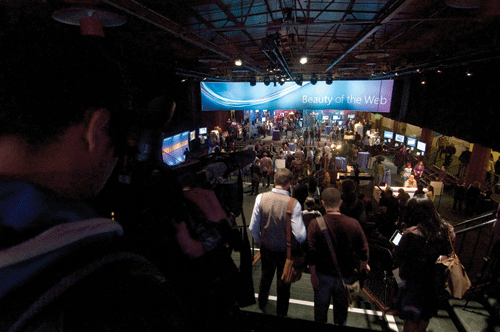
Vahe Torossian is the corporate vice president of the Worldwide Small and Midmarket Solutions and Partners group at Microsoft

October 3, 2010 0 comments
0 FacebookTwitterPinterestEmail
Comment

Dark days are upon us

by Paul Cochrane October 3, 2010
written by Paul Cochrane

It’s been a long hot summer. Temperatures hit all-time highs and Ramadan demand put power grids under serious strain across the Middle East. Few countries were spared as power outages hit Kuwait, Saudi Arabia, Bahrain, Sharjah, Yemen, Iraq, Lebanon, Syria and Egypt. But in those places suffering from power cuts, people seemed largely unaware of the rest of the region’s electricity woes.

While Lebanese carried out their daily litany of complaints about blackouts, damning and blasting the government, many were surprised when I told them that Sharjah had such an electricity deficiency that residents were sleeping in air conditioned cars to avoid baking in concrete apartment blocks. It was so hot in the emirate that hospitals were inundated with cases of heat stroke and a construction worker died from heat exhaustion.

 In Damascus, residents hot under the collar due to a lack of air conditioning knew of Lebanon’s long-term electricity conundrum, but were unaware that Saudi Arabia and Kuwait — those rich Gulf countries where many Syrians seek work — were also having blackouts. With an 8 percent annual deficit, the situation was so bad in Saudi Arabia that school children were passing out while taking exams and airplanes were grounded. Kuwait’s network hit 99 percent of capacity.

Power shortages in the region’s poorer, more corrupt and war ravaged countries — Iraq, Yemen, Lebanon — are daily occurrences and are not unexpected, but why are they happening in the energy-rich Gulf?

The problem is that peak demand occurs every summer at the same time across the region. Populations growing in size and affluence means more air-conditioners — and industrial activity is increasing. All of this, coupled with exceedingly low electricity tariffs and an incredible lack of forward-planning has resulted in a major shortage of megawatts (MW). And without the modern day wonder of air conditioning, the region, particularly the Gulf, is not a place conducive to working or living as the mercury rises.

Thomas Edison, one of the inventors of the light bulb, once said: “I shall make electricity so cheap that only the rich can afford to burn candles.” In much of the Middle East, Edison’s saying has been translated as: “We shall make electricity so cheap everyone uses too much of it, and only the rich can afford to run generators.” Lebanon is a case in point, with power “provider” Electricité du Liban to generate $800 million in bills this year, while the Lebanese will spend $1.76 billion on running generators.

But there is hope that such electricity shortages will be abated, with the cuts prompting such furor among the people that governments have been forced to invest in more power production.  The Gulf countries are to spend an estimated $200 billion on power plants, Lebanon some $4.7 billion, Iraq up to $10 billion. Everywhere else there are plans for upgrades and new plants. Renewable energy and nuclear power are also in the pipeline, as is the $560 billion Desertec solar power project in North Africa. And if other solar power initiatives get underway in the rest of the Middle East and North Africa, the region will be able to produce up to 470,000 MW of sustainable electricity by 2050, according to research by the German Aerospace Center.

While such initiatives are laudable, practical solutions to the current shortages need to be implemented. It takes around three years to build a conventional power plant, and once output is increased, there is usually a corresponding rise in demand as people use more electricity. It’s a vicious cycle.

Before these projects get underway, thinking about how to lower overall consumption across the region should be part of every national power plan. Can we really call a ski slope in a mall in the desert an efficient use of electricity? Do empty office blocks have to be lit up like Christmas trees in the middle of the night? And when the whole of Lebanon lacks electricity, did the Maronite Church have to erect the world’s largest illuminated cross at Qanat Bekish in Mount Lebanon, a 240 foot high construction lit by a staggering 1,800 spotlights?

If temperatures are as high again next year and such wanton waste of electricity continues, power cuts are likely to be worse. In the meantime, higher tariffs to encourage people to use power more wisely would help to ensure more people are sleeping in their houses rather than their cars this time next year.

October 3, 2010 0 comments
0 FacebookTwitterPinterestEmail
Comment

Baghdad’s enduring nightmare

by Alice Fordham October 3, 2010
written by Alice Fordham

On wide, high-definition screens, images flash up for two seconds at a time: flayed skulls, charred limbs, disemboweled torsos, heads bloated and bulging around taped-up eyes. Men and women sitting in plastic seats flinch as they squint at the real-life horror show, trying to identify husbands, cousins and friends. This is the Baghdad morgue, where the grim body count of the last seven years has been a daily reality, where bodies were piled up and lay unclaimed by terrified families before being driven to vast graveyards with numbered plots.

As American-led troops battled resistance and then civil war, this building and its 50 employees dealt with the consequences. In 2006 and 2007, the morgue received 150 corpses a day. Today, although the stream of dead has slowed to a trickle, the morgue remains a nightmarish reminder of the fighting’s lingering effects as people come to hunt through the photographs of some 20,000 bodies which remain unidentified.

Abu Issam, 47, from the capital’s New Baghdad neighborhood, was looking for his cousin, a 60-year-old man who was kidnapped from his home by men in three cars in January 2006. As corpse followed corpse on the screen, he said, "I look at these pictures and say to myself, ’what is the guilt of these people?’"

Meanwhile, officially, the war is grinding to a halt. On September 1, United States combat operations in Iraq were declared over and, with some fanfare, Operation New Dawn began, a mission of advice and assistance with less than 50,000 American soldiers on the ground.

Media attention has begun to drift from Iraq; the pyrotechnics of Pakistan and Afghanistan are now more interesting than the rumbling violence in Baghdad. But in a country where people are still mourning for disappeared loved ones, divisions and grievances run deep and there is not yet a clear victor in the messy endgame to the war.

Since the end of combat, American soldiers supporting Iraqi colleagues have found themselves in lethal shoot-outs and open fighting in Baghdad, Diyala and Fallujah. Two American soldiers were shot dead on September 8 in Salaheddin by a man in an Iraqi Army uniform who was among the men they had been training.

Other troubles still plague Iraq. Hundreds of people die violently every month and, more than half a year after elections, there is no sign of a government being formed. The divisions between Sunni and Shia, which Iraqis insist were negligible before the 2003 US-led invasion, are still being deepened by violence and politics. There are frequent assassinations among the largely Sunni militias which defected during the American troop surge. The Iraqiya party, which campaigned on a platform of secularism, is likely to be overpowered in government by a coalition of religious Shia parties, alienating the Sunni voters who largely backed Iraqiya.

The infrastructural impact of the invasion lingers. Electricity production has never reached pre-war levels, which were not high, and after a scalding summer marked by riots, the electricity minister was forced to resign. Bureaucracy and bribery dog municipal functions of the state and the police are corrupt and brutal. Minorities are still targets. Christians are associated with the hated occupiers and during the scandal surrounding the planned Koran-burning in Florida, every church in Baghdad was threatened.

The best-case scenario for Iraq going forward is the rather modest one laid out by Barack Obama, in which violence is at a manageable level and there is some semblance of democratic rule. But the ingredients are all there for a deterioration, and if a government doesn’t emerge or there is a serious attack on a religious site, for example, the decline could be swift and have a wide-ranging fallout.

Some American soldiers feel frustrated at the perception in the US that the war is finished. Lieutenant-Colonel Donald Brown commands the infantry division whose two soldiers were shot. After attending the “very emotional” memorial service for the two who were killed, Lt-Col Brown said that his wife and family had felt this kind of danger was unlikely since combat operations ended.

“This sort of event was only in the back of their mind until the events of the last few days clearly codified that this is still a very dangerous place,” he said. A sharp personal reminder that on the ground, the war ain’t over yet.


October 3, 2010 0 comments
0 FacebookTwitterPinterestEmail
Comment

The art of crime

by Peter Speetjens October 3, 2010
written by Peter Speetjens

The recent theft of a $50 million Van Gogh painting from the Mahmoud Khalil Museum in Cairo is hardly an isolated case. As art prices continue to skyrocket, the underworld is rapidly developing a taste for culture, turning art theft into a global business worth some $6 billion annually, according to the FBI. Only last May, for example, four modernist masterpieces, including a Picasso and Matisse, were stolen in Paris, while in 2008 a Cezanne and Monet were lifted from a Zurich museum. Meanwhile, thousands of Iraqi antiquities remain unaccounted for and Christian icons vanish on an almost daily rate, mainly in countries of the former Soviet Union.

That said, the way in which the Van Gogh still life “Vase with Flowers” was taken from the Cairo museum seemed like scene from the latest Adel Imam flick that could be called “Only in Egypt.” After all, where else can one enter a museum in broad daylight, move a couch under the desired painting, cut the canvas from its frame, and walk out without being spotted by either guards or cameras?

A museum employee admitted that the museum’s alarm system and most of the 49 security cameras had not been working for a while. “The museum officials were looking for spare parts but hadn’t managed to find them,” he told Agence France-Presse. The affair becomes all the more humiliating knowing that the same painting was stolen from the same museum in 1978 only to pop up two years later in Kuwait.

Admittedly, the theft of four paintings with a combined value of $130 million from the Paris Museum of Modern Art in May was nearly as embarrassing. Here too, the alarm system was out of order, as the museum was awaiting spare parts.

The security cameras however, did work. They recorded how a lone hooded thief broke a window around midnight, climbed in, cut the canvasses from their frames and left. Pity that the museum guards for some reason failed to look at their screens and only the next morning spotted the empty frames.

Yet even working cameras and guards that are awake can do desperately little against the threat of violence, which seems the underworld’s favorite modus operandi. In Zurich, for example, three men armed with automatic weapons stormed into the E.G. Buhrle Foundation, grabbed four paintings with a value of some $163 million and fled minutes later in a waiting car. Similar armed robberies have taken place in Rio de Janeiro, Sao Paolo, Stockholm and Boston, where two thieves disguised as policemen entered the Isabella Stewart Gardner Museum in 1990 and stole some $500 million worth of art. The stunt is still known as the biggest art heist in history.

It should be noted that the stolen Van Goghs and Picassos are only the tip of the iceberg. Most thefts do not concern classic masterpieces and hence fail to write headlines. Furthermore, while stealing a work of art is one thing, selling it is quite another. The problem is that an art work is a unique piece. There is only one “Guernica,” only one “Vase with Flowers.” Consequently, it is impossible to simply offer the works on the market, especially since both the FBI and Interpol established art crime departments that, among other things, maintain a database of stolen works. Instead, as in an ordinary kidnapping case, art thieves will often try to obtain a ransom.

According to Interpol, the theft of cultural objects affects the whole world, but the two countries most affected are France and Italy. The organization furthermore notes that the illicit trade is sustained by demand from the arts market, the opening of borders and political instability in certain countries. The latter especially refers to the situation in Iraq and Afghanistan, as looting has always been an intrinsic part of war. From the National Museum of Iraq alone some 7,000 to 10,000 artifacts remain missing, after the US army failed to protect the country’s leading cultural institution during the invasion.

In general, the future for stolen antiquities and art works looks bleak. Julian Radcliffe of The Art Loss Register estimates that only 15 percent of stolen art works are recovered within a period of 20 years. Hence, it may take a bit longer this time around before Van Gogh’s “Vase with Flowers” makes its way back to Cairo.

October 3, 2010 0 comments
0 FacebookTwitterPinterestEmail
Finance

Balance sheet blues

by Natacha Tannous October 1, 2010
written by Natacha Tannous

Running the gauntlet that is Gulf finances these days, Emirati bank balance sheets are being battered; double-teamed by deteriorating asset quality and non-performing loans. Fortunately for them, however, the fight is effectively rigged, as both the government and the Central Bank of the United Arab Emirates have readied their checkbooks to pay up whatever it takes to keep the banks from going down.  

Asset quality deterioration

A major blight on statements has been Dubai World exposure; UAE banks hold 45 percent of the up-to $26 billion of outstanding debt, of which Emirates National Bank of Dubai (ENBD) and Abu Dhabi Commercial Bank (ADCB) have the highest shares (see estimated exposure table).

As Executive reported in March, even if Dubai World offered full debt repayments, the net present value would only amount to 62.1 cents on the dollar (with a five-year extension at a 10 percent discount).

However, a pledge by the Dubai government on March 25 to “support proposals with significant financial resources” and inject fresh funds of $9.5 billion through the Dubai Financial Support Fund, has eased the Dubai World situation and will lower the discount rate for the debt proposal.  This now entails a higher net present value for the “100 percent principal repayment through the issuance of two tranches of new debt with a five and eight year maturities,” said the Dubai government.

This could avoid additional provision charges but will not help healthy balance sheets show up at UAE banks.

“Problems at Dubai-based banks will not end after the restructuring of Dubai World, with the economy of the Emirate almost in a standstill,” says Marcel Kfoury, senior trader for the Middle East and North Africa region at Nomura Holdings in London. “The default rate on the consumer side will just rise further, adding to an already deteriorating loan-book, as more contractors fail on their obligations.”

UAE banks were already suffering from retail loan portfolios and real estate exposure via lending books, subsidiaries or direct investments in properties. First Gulf Bank (FGB) is the most exposed bank in this matter, as it had in December 2009 a real estate portfolio of $1.6 billion, the market value of which has undoubtedly decreased. With the current oversupply situation, particularly in Dubai, the banks are now left with vacant and non-cash flowing real estate projects that have lost 50 percent of their value; approximately one third of aggregate projects have been postponed or even cancelled.

UAE
</p>
									            </div>
        </div>

		            <div class=

October 1, 2010 0 comments
0 FacebookTwitterPinterestEmail
Comment

Time to boycott failure

by Yasser Akkaoui October 1, 2010
written by Yasser Akkaoui

It is a measure of how far Lebanon has come in recent years that a new roof is being placed on the synagogue in the Beirut Central District. It is also a reflection of Lebanon’s unique multi-faith make-up and the country’s tolerance for all religions.

But tolerance alone does not make a strong state.

It is no secret that today Israeli companies are outsmarting the Arab boycott, a concept so archaic and so self-defeating it stopped having any real meaning decades ago. Israeli manufacturers are re-branding and re-labeling their products to compete in the new and vibrant Arab markets.

Furthermore, Israel has set itself up as a shop front for global manufacturing, attracting some of the world’s biggest brands to their industrial parks. The upshot is that, while the Arab world tears itself apart, Intel — to take just one example — churns out Israeli-made processors destined for a global market.

And yet while Arab regimes would deny us the right to buy those same processors, they are also denying us the chance to move forward and compete in the name of a strategic ideal they call the Arab boycott.

The real Arab boycott should be one that stops us from denying ourselves the right to take our place in the community of nations that make up the new globalized economy. It should involve us making an effort to produce and compete on an equal level.

Contrary to popular belief, the strategic goal of the Zionist state is to place an emphasis on economic dominance. It is as much economic as military or political leverage that drives Arab-Israeli negotiations. After all, the victor is the nation that can achieve economic sustainability.

The Arab world, and the countries of the Levant in particular, need to understand the essential connection between the state, the public sector and the welfare of the people. Without this economic angle, a state can never succeed; indeed it can never be a state.

Lebanon is a case in point. The private sector has the talent and it has the will. The state now needs to hitch this potential to its creaking wagon so that it can start competing with Israel at its own game. Lebanon needs to start empowering, competing and attracting foreign investment.
It is that simple.

Yasser Akkaoui
Editor-in-chief


October 1, 2010 0 comments
0 FacebookTwitterPinterestEmail
Economics & Policy

The peninsula of protectionism

by Paul Cochrane October 1, 2010
written by Paul Cochrane


Qatar’s “open market” is “committed to free trade” and“warmly welcomes foreign investors” to help diversify the economy, according tothe Ministry of Business and Trade’s Investment Promotion Department’s latestreport, “Rise With Qatar”. In other words, very much standard fare forinvestment promotion boards around the world.

Despite the rhetoric, while Qatar’s major spending spree oninfrastructure and hydrocarbon projects are certainly generating much interestand opportunities, away from such sectors the options for private investors arerather restricted. 

“Opportunities are limited to high level projects like roadsand railways, and while local players can’t do it all there is a need to createspace for private companies to develop,” said Narayanan Ramachandran, head ofadvisory for Bahrain and Qatar at consultancy firm KPMG. “The challenge is thatthe percentage of private activity needs to increase. Government andquasi-government sectors dominate so the private sector needs to grow.”

The Qatar Exchange (QE) is still off-limits to foreigners —Gulf Cooperation Council citizens are entitled to 25 percent of shares in afirm — while setting up a business has a $55,000 [AED 202,015] price tag, 100percent foreign ownership is restricted to specific sectors, other venturesrequire 51 percent ownership by a Qatari national, and bankruptcy laws arevague. Even purchasing property, confined to 18 areas for foreigners, does notgrant much security, with only a few ownership deeds having been issued and theresidency permit that comes with a property “just an open-ended tourist visa,”as one analyst put it.

“Qatar seems first world but in reality [it is] not thatopen. From the outside, Qatar looks like a good and free market, but to buy anythingyou have to go to this or that guy with the experience and the connections.There are many monopolies to contend with,” added the analyst.

Hopes that foreign investors would have greater access tothe market were dashed in early May when the Advisory Council opposed agovernment proposal to allow non-Qataris to invest in exclusive dealershipsselling foreign goods and services. “Any move to permit non-Qatari capital inexclusive dealerships would gravely endanger Qatari businessmen,” the AdvisoryCouncil said in Qatari daily The Peninsula.


The move was criticized anonymously in the press as ensuringthe existence of monopolies and curtailing competition, with the ruling pushedforward by several prominent local businessmen that are members of the council.

Sectors where foreign investors can have 100 percentownership are restricted to “priority sectors,” namely business consultingtechnical services; IT; cultural, sports and leisure services; distributionservices; agriculture; manufacturing; health; tourism; development;exploitation of natural resources; energy and mining.

“The government increased this year the number of sectorsthat can be invested in — over 49 percent — for foreigners. The authoritiesknow the restrictions are not helpful for encouraging investment, but they needto bring the local constituency along with them over time,” said AndrewWingfield, a partner at international law firm Simmons and Simmons in Doha.

Despite the seemingly broad swathe of investmentopportunities now on offer in Qatar, barriers to new foreign businesses arestill  considerable.

Limited liability companies (LLCs) that want to set up inthe country are required to have a paid-up capital of QR200,000 [$54,913 orAED201,695].

“That is expensive, even before you open the business’sdoor, but the rationale is that it stops the fly-by-nights and [ensures] thebusinesses that come here will be serious,” said Wingfield. “But for LLCs toborrow from local banks, the Qatar Central Bank (QCB) will not allow lendingunless shareholders give a guarantee. Such a requirement is not mandatory inmany other jurisdictions but it is in Qatar. It could be said to be a veryprudent move to protect the banks, but it is another hurdle to investment.”

The message being put out is that companies have to bewilling to pay to get in on the action. While this flies in the face of thecountry’s propounded open market, it reflects a protectionist approach, whichis not necessarily a bad thing if well regulated and transparent. Indeed, it isa policy widely used by developing countries to build up their economies, asSouth Korea has done and is still doing, albeit primarily to protect theindustrial and manufacturing sectors.

“There is a degree of protectionism on one side, but thereis the intent by the government to open up sectors to be competitive that werenot,” said Anil Khurana, director of Operational Strategy and Private Equity atmanagement consultants PRTM. “For instance, on the automotive side, the primeminister said in the future there will be no exclusive dealerships and therewill be competition.”
 

Yet while the economy is set to open up more, currently GCCcompanies are not being given preferential treatment, despite the supposedtenets of the Gulf common market that allow for the free movement of GCCcompanies and citizens. “There is a new law to allow GCC companies to set upbranches in Qatar, but we’ve not seen the law yet. That should help business asat the moment they need a subsidiary,” said Wingfield.

That said, there are some 289 Saudi Arabian companies inQatar and later this year a trade delegation comprising more than 100businessmen from the kingdom is slated to visit Doha to scope out thepossibilities of joint ventures, bag infrastructure contracts related to theWorld Cup and discuss the establishment of a joint Saudi-Qatari bank. GivenQatar and Saudi Arabia’s recent political rapprochement, this could signalpreferential tenders to Saudi companies, said an investment analystoff-the-record.

Regulatory constraints

On top of the high entry requirements for businesses, theQCB in April implemented stricter regulations on Qatari banks’ retail lendingto help reduce leverage in the retail segment. Personal loans were capped atQR2 million [$549,000 or AED2 million] for Qataris and QR400,000 [$109,000 orAED 400,357] for expatriates, limited to 72 months and 48 months respectively,and equated monthly installments  are not to exceed 75 percent of a Qatari’s monthly income or 50 percentof an expatriate. In the short-term such a move will restrict retail lendingand impact on banks margins, but in the long-run it is expected to improveasset quality and prevent the level of defaults that abounded in the wake ofthe financial crisis.

“The limit on lending to individual customers and thecapping of interest rates will clearly have an impact on the banks. These aregoing to impact the volume of growth the banks can procure, and obviouslyimpact our rate of profitability,” said Commercial Bank Chief Executive OfficerAndy Stevens to the Gulf Times following the QCB’s decision.

QCB’s orders came just months after a harder impact on theQatari banks, when in February the central bank ordered 16 commercial banks towind down their Islamic banking units by the end of the year. QCB justified themove by citing the difficulty to regulate the two financial sectors, with theconventional banks having to abide by Basel requirements while the Islamicbanks are following guidelines issued by the Malaysia-based Islamic FinancialServices Board.

While the move will benefit the country’s three dedicatedIslamic banks, it is being viewed in a negative light by international lendersin the advent that other regional central banks follow suit. It has also sentmixed signals to the banking sector while raising concerns over QCB’sregulatory abilities as it stated it got “mixed up” in monitoring both bankingsectors.

And while the ruling was to be expected, it was doneovernight without consulting the banks. “It had been discussed by [QCB] for thepast three years, but the timing and speed with which it happened was notexpected by the banks,” said Ramachandran. “Whether the directive will beachieved by the end of 2011 is still too early to tell.”

The directive had particular sting for HSBC’s Islamicbanking unit, Amanah, which was set up just seven months prior to theannouncement and prompted the global bank to seek a “workable solution” withQCB.

A further issue in the financial market is that the centralbank has not created a single integrated regulatory body to oversee all bankingand financial services in the country, which was intended to bring in the QatarFinancial Center (QFC) under the same regulator as QCB.

QFC was established in 2005 to attract internationalfinancial institutions to Doha that were to operate separately from local banksand be independently regulated by the QFC Authority (QFCA), which is based onbest practices in international financial centers such as London and New York.The intention to unify the framework was announced in July 2007, but four yearson it has yet to be implemented.

“One challenge in the market is the integration of theregulatory framework of the QCB with the QFC, but we are not aware of thetime-line,” said Ramachandran. “And while the QFC has certainly attractedservice providers, the question now is the strategic thinking of overallregulations and the differences between the local players regulated by the QCBand the banks by QFC.

“I also think the QFC has to do wider business than justQatar (if it wants to be a regional financial hub), as it is looking first atthe local market. Qatar has to consider how to get that regulatory frameworkright and attract more regional players. So far, QFC’s framework is to bring inestablished players with a certain pedigree and not for new financialinstitutions.”

The financial viability of the QFCA has also beenquestioned, with the body not including their balance sheet in the 2010 reviewfollowing reports that the QFC relied on state funding and was not breakingeven.

With Qatar dragging its feet on the unified regulatoryauthority, some consider that Doha has missed the boat in terms of attractingmore financial service providers, particularly over the past few months whenDoha had the chance to poach players away from the established financial centerof Manama amid the political unrest in Bahrain, and before that from Dubai inthe wake of its debt crisis. As law firm Clyde and Co. noted about the benefitsof the establishment of a unified regulator: “Such a move is likely to benefitinternational financial institutions in doing business within the region. It isalso likely to give Qatari institutions a competitive advantage in the mediumterm as those businesses adapt to a more competitive international regulatoryenvironment.”

October 1, 2010 0 comments
0 FacebookTwitterPinterestEmail
Finance

Regional equity markets

by Executive Editors September 23, 2010
written by Executive Editors

Beirut SE  

Current year high: 1,200.49    Current year low: 977.55

>  Review period: Closed Aug 24 at 984.24 Points               Period Change: -2.6%

After 18 weeks of rarely interrupted drops, the MSCI Lebanon index moved below the 1,000 points line on Aug 9. The dip below a psychologically alarming watershed was probably balanced by the fact that the locally better-known BLOM Stock Index (BSI) uses another methodology and display format and showed a close in the 1440 range on Aug 24. However, neither format camouflages the unsightly reality that the BSE is down quite a bit year to date, 7% according to BSI and 11.8% according MSCI Lebanon. Good H1 results by listed banks could not mitigate the cries of alarm.

Amman SE  

Current year high: 2,693.91                Current year low: 2,223.30

> Review period: Closed Aug 24 at 2,269.47 Points             Period Change: -1.7%

The Amman Stock Exchange is now close on the heels of the Dubai Financial Market, moving steadily south when everyone wants to go north. Down 11.4% for the year-to-date at session close on Aug 24, the ASE general index movements in August included a new 12-month low at 2,223.30 points on Aug 17. Sector indices performed a little better than the benchmark index but also flashed predominantly red. Banking, which was the most volatile sector on the ASE in the review period, was the only sector that closed the period with a gain (2%).  

Abu Dhabi SM  

Current year high: 3,239.74                Current year low: 2,467.04

> Review period: Closed Aug 24 at 2,502.93 Points             Period Change: -1.7%

The overall performance of the Abu Dhabi Securities Market in August 2010 was a bit better than suggested by the negative index value on the month. The market actually recovered some ground during Ramadan after the index slumped on Aug 12 to just within a hair’s breadth of the 12-month low seen last December. The real estate sub-index was temporarily down more than 10% intra-month and energy and real estate sectors were the period’s underperformers. Sharp drops in the trading volume and price of Aabar Investment were seen after the delisting company ended its buy-back offer. 

Dubai FM  

Current year high: 2,373.37                Current year low: 1,461.80

> Review period: Closed Aug 24 at 1493.96 Points              Period Change: -1.3%

Lack of information and lack of confidence were among reasons cited in reviews of the Dubai Financial Market’s continuing calamity of index underperformance and escaping investors, even in a month that Nasdaq Dubai started “outsourcing” its share trading to the DFM platform. Trading volumes on DFM fell in several sessions after Aug 11 to serious lows, below 40 million shares per day. Materials and transport were underperforming sectors for the review period; stocks in the red included Arabtec, Air Arabia, and Shuaa Capital, down 5.7%, 6.2% and 13.2%, respectively.  

Kuwait SE  

Current year high: 7,964.30                Current year low: 6,319.70

> Review period: Closed Aug 24 at 6682.10 Points              Period Change: 0.4%

After recovering from year lows that hit the Kuwait Stock Exchange in early July, August arrived in true summer fashion: volumes relaxed at the start of the month and index lay flat like it was sunbathing at the beach. Sideways trading ruled for the benchmark index and most sectors. Banking, however, was an exception. The sector index enjoyed three sessions with comparatively strong gains during the review period and the sector was the KSE’s outperformer in August.

Saudi Arabia SE  

Current year high: 6,929.40                Current year low: 5,617.31

> Review period: Closed Aug 24 at 6,018.27 Points             Period Change: -4.0%

Pressure on oil prices, pressures on petrochemicals, negative imprints from dour moods on global markets: recording its steepest fall since May, the Saudi Stock Exchange was not in good form in the review period. Compared to its peers, the Tadawul index flailed under the strongest downturn of all GCC bourses last month. All sectors were engulfed in the down-wind, from insurance and banking to agriculture and construction. 

Muscat SM  

Current year high: 6,933.75                Current year low: 5,968.36

> Review period: Closed Aug 24 at 6,293.27 Points             Period Change: 0.0%

Investors on the Muscat Stock Exchange seemed to be caught in a wave model of tender market flux that makes the index graph look calm and somewhat pretty but does not facilitate too much in terms of gains. The industry index achieved a slight gain in the review period but the other two sector indices, services & insurance and banking & investment, ticked lower. For the year to date, MSM market performance ranked second in the GCC after Qatar but still stood 1.2% in the red. 

Bahrain SE  

Current year high: 1,605.98                Current year low: 1,361.19

> Review period: Closed Aug 24 at 1,424.27 Points             Period Change: 2.2%

A slow but steady flow of upward index movements put the Bahrain Stock Exchange into second place for gainers in the Gulf during the August review period. Commercial banking stocks drove the index higher, especially toward the end of the review period. Large volumes have never quite been the ‘in thing’ on the BSE; in August of 2010 this meant that the water in the trading cup didn’t evaporate quite as visibly as in the larger GCC exchanges. Compared with the start of the year, the BSE is a bearish but bearable 2.3% down.

Doha SM  

Current year high: 7,801.33                Current year low: 6,502.93

> Review period: Closed Aug 24 at 7,200.55 Points             Period Change: 2.4%

For the start of Ramadan, volumes on the Qatar Stock Exchange were fittingly subdued and index values were regressive. But in the second week of the period dedicated to charity by the faithful, the QSE benchmark index moved up and added about 180 points between Aug 16 and 24. Stock trading in services was notable on volume and the sector index advanced range bound to the general index. The month’s best performer, the QSE closed Aug 24 as the sole GCC bourse with a year-to-date gain.   

Tunis SE  

Current year high: 5,279.90                Current year low: 3,717.15

> Review period: Closed Aug 24 at 5,269.69 Points             Period Change: 3.7%

Tunisian equity markets seem to be chasing fairy tale status. The Tunindex not only was the best gainer in MENA in the review period, with a lead of 1.3 percentage points over the next comer, trading in the slow month of August also added no less than 10 new record closes from Aug 2 to 24. Market cap leader Poulina weakened 1.5% but the country’s two top banking stocks, BIAT and BT, gained 3.7% and 8.9%, respectively. 

Casablanca SE  

Current year high: 12,457.59              Current year low: 9,997.56

> Review period: Closed Aug 24 at 11,604.34 Points                       Period Change: -1.5%

Whereas the Casablanca Stock Exchange’s MASI weakened in the review period, the index is still a solid 12.5 up from the start of 2010. Of market heavyweights, top scrip Maroc Telecom dropped 2.3% while Attijariwafa Bank added less than 1% to its share price. The middle of August saw the delisting of newly consolidated stocks SNI and ONA. Analysts suggested that the move freed liquidity for investors in the short term and would benefit the Moroccan exchange in the long term. 

Egypt CASE  

Current year high: 7,603.04                Current year low: 5,850.00

> Review period: Closed Aug 24 at 6507.00 Points              Period Change: 2.3%

The “enough” bell appears to have rung out in Cairo as the market has taken further steps on its journey from ‘oversold’ to ‘buying’. From its year low in early July, the EGX 30 index had climbed about 650 points by the Aug 24 session close. Chart-topping gainers were oil refiner AMOC and developer Palm Springs, up 15.7% and 10.6%, respectively. Market heavies OCI and OTH were up 6.4% and 6.3%, but the Orascom affiliate Mobinil performed better still with a 9.5% gain.

September 23, 2010 0 comments
0 FacebookTwitterPinterestEmail
Economics & Policy

Quality over quantity

by Executive Editors September 23, 2010
written by Executive Editors

Merger and acquisition (M&A) activity in Middle Eastern markets has opened windows for economic and financial activity this year, while doors have been shutting on listed equity and new public offerings.

Reaching $30.5 billion, the cumulative value of mergers and acquisitions and private investment deals completed from January through to the end of July 2010 in the Middle East and North Africa was up 14 percent from the transactions in the same period of 2009, according to the Dealflow Monitor by the Regional Press Network. 

The number of completed transactions in the first seven months of 2010 showed an 8 percent drop from a year ago to 270, indicating that values per transaction have been tending higher.

The takeover expected to set the record for highest value this year was completed in June, through the sale of African assets of Kuwaiti telecommunications firm Zain Group to India’s Bharti Airtel for $9.1 billion. However, with a total of 440 deals having been announced this year to date across the MENA region, the list of merger discussions and pending deals promises another round of financial opportunities after the end of Ramadan and summer vacations.  Banks and financial companies, such as insurers and investment firms, accounted for 20 percent of targeted companies for investment and takeover deals. Other sectors of significance as buy-in targets were manufacturing, oil and gas, utilities, real estate, and telecommunications.

The rate of increase, and the sector trends in deal making in the first seven months of 2010 confirm trends of a new regional boom in merger markets that started to take shape in 2009.   

Most MENA countries have been attracting sizeable interest, with only Sudan, Syria, Tunisia, and Yemen missing out on the gold rush. Besides a continued wave of small and medium-sized transactions in the third and fourth quarters of 2010, some mega deals could still come about.

As the Zain Africa sale has changed the profile of the region’s telecommunications operators, the pull effect of big transactions on corporate peers in the same sector has led Arab operators to initiate several negotiations in the second quarter, which did not result in actual deals. This notwithstanding, the telecoms sector continues to be a candidate for potentially large deals in the remainder of 2010, as Egyptian telecoms tycoon Naguib Sawiris appears to be dead set on changing the ownership structure and market position of his assets.

In late August, rumors surfaced in international media that Sawiris has been talking to Russian telecoms firm VimpelCom about merging his Orascom and Wind assets into VimpelCom, in a deal estimated to be worth around $6 billion.

The Middle East can further benefit from an improved climate for mergers in international markets. A recent example of how a merger discussion by world-leading companies can impact regional firms was the bid of BHP Billington for a Canadian potash miner, as news of the negotiations boosted share prices of mining companies in Jordan.  One longed-for marriage of two (almost) equals that many financial market players believe would act as a catalyst for new vigor in the United Arab Emirates market would be a joining of the Dubai Financial Market and the Abu Dhabi Stock Exchange. ADX and DFM were said to be in negotiations earlier this year but no concrete signals for this much wanted union have yet been made public. 

September 23, 2010 0 comments
0 FacebookTwitterPinterestEmail
  • 1
  • …
  • 406
  • 407
  • 408
  • 409
  • 410
  • …
  • 696

Latest Cover

About us

Since its first edition emerged on the newsstands in 1999, Executive Magazine has been dedicated to providing its readers with the most up-to-date local and regional business news. Executive is a monthly business magazine that offers readers in-depth analyses on the Lebanese world of commerce, covering all the major sectors – from banking, finance, and insurance to technology, tourism, hospitality, media, and retail.

  • Donate
  • Our Purpose
  • Contact Us

Sign up for our newsletter

    • Facebook
    • Twitter
    • Instagram
    • Linkedin
    • Youtube
    Executive Magazine
    • ISSUES
      • Current Issue
      • Past issues
    • BUSINESS
    • ECONOMICS & POLICY
    • OPINION
    • SPECIAL REPORTS
    • EXECUTIVE TALKS
    • MOVEMENTS
      • Change the image
      • Cannes lions
      • Transparency & accountability
      • ECONOMIC ROADMAP
      • Say No to Corruption
      • The Lebanon media development initiative
      • LPSN Policy Asks
      • Advocating the preservation of deposits
    • JOIN US
      • Join our movement
      • Attend our events
      • Receive updates
      • Connect with us
    • DONATE