• Donate
  • Our Purpose
  • Contact Us
Executive Magazine
  • ISSUES
    • Current Issue
    • Past issues
  • BUSINESS
  • ECONOMICS & POLICY
  • OPINION
  • SPECIAL REPORTS
  • EXECUTIVE TALKS
  • MOVEMENTS
    • Change the image
    • Cannes lions
    • Transparency & accountability
    • ECONOMIC ROADMAP
    • Say No to Corruption
    • The Lebanon media development initiative
    • LPSN Policy Asks
    • Advocating the preservation of deposits
  • JOIN US
    • Join our movement
    • Attend our events
    • Receive updates
    • Connect with us
  • DONATE
Comment

When peace is the target

by Nicholas Blanford October 23, 2010
written by Nicholas Blanford

Two separate editorials on the same day in the Israeli press last month underlined the confusion that informs analysis on Syria’s intentions regarding the resumption of peace negotiations with Israel.

The right-wing Jerusalem Post castigated Syria for its “derisive” response to attempts by the Obama administration to engage with Damascus after the years of isolation under George W. Bush. A day after George Mitchell, the United States Middle East envoy, met with President Bashar al-Assad in Damascus to further hopes of a resumption of Israeli-Syrian accord, Russia confirmed it would honor its agreement to supply Syria with P-800 Yakhont anti-ship missiles. The Jerusalem Post surmised that the missiles would probably end up in Hezbollah’s hands, enabling it to fulfill General Secretary Hassan Nasrallah’s vow in May to target shipping along Israel’s entire coastline.

In fact, Hezbollah probably already has acquired anti-ship missiles larger than the Iranian Noor/C-802 system it used in 2006 to disable an Israeli warship off the Beirut coast. Iran produces a longer-range version of the Noor called the Raad, which could theoretically hit Israeli shipping off the coast of southern Israel from launch sites as far north of the border as Beirut.

The Jerusalem Post also noted that Assad “made it clear with whom his loyalties lie” when he met with Mahmoud Ahmadinejad as the Iranian president stopped briefly in Damascus a day after Mitchell’s visit.

“It has become abundantly clear that the Obama administration’s attempt to ‘engage’ Syria… has been a resounding failure,” the Post said. In contrast, the liberal Haaretz newspaper interpreted Ahmadinejad’s visit to Damascus as showing his “fear that Syria will weaken its strategic relationship with the Iranians.”

Haaretz blamed Israeli Prime Minister Benjamin Netanyahu for the lack of progress on the Syria-Israeli track and urged him to heed the advice of the Israeli military establishment, including Defense Minister Ehud Barak, and accept Assad’s offer to resume talks. The conflicting viewpoints of these two Israeli newspapers may have earned a smile of satisfaction in Damascus. The Syrian regime is a master at fence-straddling, turning what normally would be a tactical ploy into a permanent strategy. Playing all sides at once ensures a degree of relevance and a steady queue of regional and international envoys knocking on Assad’s door. Critics of Syria insist that the regime’s ambiguity disguises an insincerity over its commitment to a peace deal with Israel. Peace would alter the geo-strategic environment of the region and compel Syria to make some hard decisions, such as reconfiguring its relationship with Iran and, therefore, also with Hezbollah.

There may or may not be some truth in such analyses, but we will not know because successive Israeli governments in the past decade have shown almost no interest in forcing Damascus to make those hard choices by pursuing peace. The last meaningful negotiations between Syria and Israel were in early 2000. Even then, Barak, the prime minister at the time, who enjoyed a broad mandate to pursue peace and the active support of the Clinton administration, got cold feet and could not bring himself to offer what he knew Hafez al-Assad wanted — the return of the Israeli-occupied Golan Heights to Syria — fearing it would not be accepted in Israel. No successive Israeli prime minister has shown any genuine interest in resuming talks with Damascus. Why would they? The border with Syria has been quiet since 1973.

The US is incapable of compelling Israel to talk to the Syrians if the Israelis are not interested. Given Israel’s succession of frail government coalitions, no prime minister is willing to risk his job for the sake of peace with Syria. Israeli leaders already have to contend with an increasingly militaristic and violent settler movement in the West Bank, so why antagonize the settlers in the Golan Heights as well?

I was once told an anecdote that well illustrates Israel’s reluctance to change the status quo with Syria. During a meeting of the Israeli cabinet in 2004, then Foreign Minister Silvan Shalom recommended attacking Syria and changing the regime. Ariel Sharon, the then prime minister, shook his head and said that that was a very bad idea.

“If we did that one of two things would happen,” he said. “Either we get the Muslim Brotherhood running Damascus or we get a democracy, and then we would have to make peace with it.”

Nicholas Blanford is the Beirut-based correspondent for The Christian Science Monitor and The Times of London

October 23, 2010 0 comments
0 FacebookTwitterPinterestEmail
Editorial

Real estate reality check

by Yasser Akkaoui October 23, 2010
written by Yasser Akkaoui

The good news for the Beirut property market is that the dangerous bubble everyone said would form has not. The reasons are straightforward: the two-years between the 2006 summer war and the June 2008 Doha Agreement, a period that was punctuated by the March 8 downtown sit-in and a spate of political assassinations, saw the property market hit rock bottom. Many Lebanese sold up and left, faced with a future filled with uncertainty and plagued by security concerns.

Post-Doha, Lebanon had guarantees and political consensus. It had a new president and within a year held successful elections. Almost overnight, Lebanon became a safe haven for capital fleeing the Gulf Cooperation Council in financial disarray, seeking property and land as well as investment opportunities in the tourism and retail sectors. At the same time prices on the global commodities market rose, leading to a hike in the cost of building materials and the price of oil needed to ship them. These factors, and the new found demand from returning Lebanese, gave the impression that the market was growing at an unsustainable pace. The reality was that it had come from the depths and was merely adjusting to new market forces.

The market has now peaked. With the cost of construction materials and the price of land unlikely to fall, demand for big apartments has stalled for five consecutive months and developers are reacting to the demand for smaller apartments. In short, the market is finding its new comfort zone.

Optimists predict a mild correction, and developers that entered the market early and bought land before prices exploded will enjoy a larger margin of maneuver.

The real concern is that many of the residential and commercial units that were bought as investments are unlikely to perform as well as they should. The Lebanese lira is currently offering an average of 5.7 percent on deposits, a rate of return that most new properties will be unable to achieve in the rental market. In fact, landlords will be lucky to get half that in the current climate. They will have to take what they can get unless they want inflation to eat into a non-performing asset.

Prices won’t come down dramatically, so for Lebanon’s property market to genuinely perform in line with local spending power, it is incumbent on the state to create a blueprint for general prosperity. Until Lebanese incomes rise to meet housing prices, domestic demand will never be able to keep Lebanon’s property market where it deserves to be.

The market has adjusted; now it’s Lebanon’s turn to do the same.

October 23, 2010 0 comments
0 FacebookTwitterPinterestEmail
Society

Musical Movements

by Emma Cosgrove October 3, 2010
written by Emma Cosgrove

Watches. “You either love them or you don’t care,” said Ronan Keating, sitting back on an overstuffed armchair in the library of IWC Schaffhausen’s new downtown boutique.

Keating cares. In fact, he gushes, unable to tame his passion for luxury watches. An Irish pop star and a former member of the 1990s boy band Boyzone, Keating is one of IWC’s many celebrity endorsers. He and Chief Executive Officer George Kern came to Beirut to open the brand’s new boutique in Beirut Souks on August 26, where the singer explained how he and Kern travel the world opening IWC boutiques.

“I’m like a kid in a candy store. This is something I have a passion for and I love watches,” he said. His prominent presence throughout the opening event highlighted the importance brands place on selecting an appropriate celebrity endorser; the right choice can lend credibility to a brand or even make it a household name, but the wrong one can sully its reputation.

At first Keating might seem like an odd choice; while he is not a completely unrecognizable figure outside the British Isles, his fame is somewhat localized to that northwestern edge of Europe. But IWC says it has a different strategy than other brands when it comes to its celebrity “family.”

“George didn’t have to convince us and start waving money in front of us, it’s not about that with the brand,” said Keating. “It’s a passion that we all share together.” Invited to become a brand representative when Kern saw him performing on Swiss television wearing an IWC watch, Keating is just one of many big names recruited to represent the brand in recent years. Other celebrities wrapping IWC around their wrists include Australian actress Cate Blanchett, French actor Jean Reno, French footballer Zenidine Zidane, Australian model Elle Macpherson and American actor Kevin Spacey.

Celebrity endorsements, the cornerstone of luxury watch advertising, can cost millions. The values of individual contracts are kept under lock and key and often vary greatly from company to company, star to star, but they rarely come cheap. Keating then, having recently been present at IWC’s openings in Kuala Lumpur and Vietnam, represents a significant strategic investment.

Building a brand is a complicated process, said Kern. “Millions of elements come together — advertizing, PR strategy, corporate social responsibility strategy, the way you decorate or the way you design stores.” When all the elements present at the boutique’s launch in Beirut Souks are scrutinized together, Keating’s presence  fits like a gear in a precisely tuned timepiece.

The opening featured the usual fare of hors d’oevres, champagne and branded miniature cakes. But after the ribbon cutting with Kern, Keating and members of the Atamian family, IWC’s Lebanese partners, Keating played a short, lighthearted acoustic set. Suddenly, the boutique’s styling, the utilitarian elegance of the watches and the music all blended with a melodic harmony.

Sure, the casual asides Keating tossed to the crowd during his set to profess his undying enchantment for IWC watches may have seemed a little over-the-top, but Keating’s limited local star power meant that he could walk through the crowd without needing security and without the usual surrounding wall of photographers. He shook hands and met actual people.

Perhaps it is an uncommon choice to use a lesser-known celebrity to keep the vibe light where a big name would shut down the show and hog all the attention. But ditching superstar power in favor of brand unity is certainly a bold move.


October 3, 2010 0 comments
0 FacebookTwitterPinterestEmail
Society

“Security and Development”

by Executive Staff October 3, 2010
written by Executive Staff

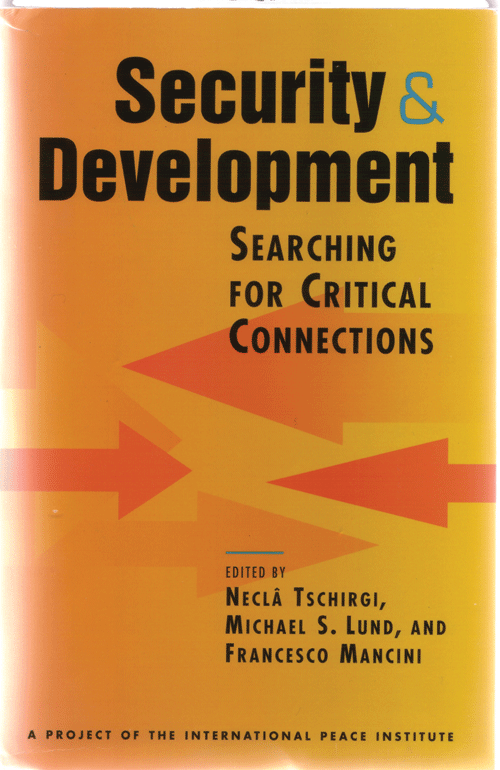
The New York-based International Peace Institute’s recently published “Security and Development: Searching for Critical Connections” is a scholarly work of valuable insight for the Middle East.

Edited by Neclâ Tschirgi, professor at the University of San Diego and former vice-president of the Institute, along with two other experts in the field, ‘Security and Development’ goes beyond rhetoric to examine the shortcomings of conflict prevention. The book begins with the point that often, underdevelopment and insecurity correlate — with higher levels of development meaning a lower likelihood of internal violent conflict.

After World War II, developed countries were overwhelmingly spared the ravages of military violence, while in the last several decades, most poor countries have suffered warfare — especially those that are home to the poorest billion of the world’s population, living in some 58 nations whose combined gross domestic product is less than that of metropolitan Chicago. After four lucid introductory chapters, the book illustrates such points in seven country case studies on the interplay between security and development in poorer states.

Awash with both insecurity and underdevelopment, the Middle East is seen by many in the West as the origin of much international terrorism, and close to 10 years since the September 11, 2001 attacks, the region is generally less secure; concurrently much of it still does not enjoy sustainable growth. This makes Arab countries the target of both security measures and development efforts, but the results have been far from satisfactory, as illustrated in the case study: “The Security Paradox in Unified Yemen.”

Defining the “security paradox” as the process whereby a country’s “internal insecurity is exacerbated by attempts to obtain international security,” the chapter’s authors Laurent Bonnefoy and Renaud Detalle paint a bleak but convincing picture of a state that is becoming more insecure as the West wages its war on terror inside Yemen.

Yemeni society is fraught with disaffection. Currently, Yemen suffers further as local and international security forces fight alleged terrorists on its soil; some of these people are “villains” that need to be dealt with (with or without Western involvement) but the net result of such antiterrorism efforts is destabilizing.

Internal stability suffers each time innocent bystanders are hit in attacks on terrorists, or targeted due to poor intelligence. Yet another mode of destabilization is the mass flight of people from an area reckoned to be a Western target, with lives and livelihoods disrupted. At the same time, despite much aid, Yemen is not developing. Unless strictly monitored and controlled, aid money can often compound local problems by abetting corruption and fueling nepotistic power structures.

As emphasized in the pithy final chapter, whatever the solution to this paradox, rigorous skeptical analysis of the sort found in ‘Security and Development’ offers a healthy antidote to ill-considered gung-ho antiterrorism operations coupled with lavish aid, which may actually end up making both the US and the global south, including the Middle East, less secure in the long run.

Though not necessarily for the lay reader, this carefully researched book should nevertheless interest regional security experts and practitioners whose Western colleagues are throwing vast amounts of money and force at problems such as those of Yemen, and other parts of the Middle East, with dubious results.

October 3, 2010 0 comments
0 FacebookTwitterPinterestEmail
Society

lacking a green shine

by Josh Wood October 3, 2010
written by Josh Wood

A quick glance at Lebanon’s smog-choked roads reveals that hybrid cars and green technology are yet to be embraced by the country’s drivers.

The vehicles are still a bit of a novelty in the West, accounting for a market share of only 0.5 percent in Western Europe and 2.8 percent in the United States in 2008 according to Polk, a firm that researches trends in the global automobile market. In Lebanon, the number of hybrid cars on the road is even lower.  But things may be changing soon.

In Lebanon’s proposed budget for 2010, a clause was included that would waive import tariffs on hybrid cars entering Lebanon. Currently, import tariffs and the 10 percent value added tax (VAT) on new vehicles can result in buyers in Lebanon spending up to 50 percent more than the market value of the car outside of Lebanon.

The Lebanese Ministry of Finance and the Ministry of Environment pushed for these fees to be lifted to help Lebanon’s environment. The World Bank has reported that environmental deterioration — primarily caused by pollution caused by transportation — costs Lebanon more than $560 million per year. While the government nets a significant income from taxes on imported vehicles, some people are starting to think that the resulting damage is too high.

The finance and environment ministries further suggested that Lebanon’s 20,000 or so aging and smog-belching taxis could be replaced with hybrid or green technology vehicles.

Additionally, stringent reductions on carbon dioxide (CO2) emissions for cars in Europe (where the majority of cars in Lebanon’s lucrative secondhand market come from) could also mean greener car imports in the coming years. The European Commission has mandated that by 2015 manufacturers’ cars in Europe must have a fleet-wide average of 130 grams per kilometer (g/km) of CO2 emissions or lower. If they fail to comply, manufacturers will face fines per car — a costly venture.

As these cars become more and more commonplace across Europe, they should filter down into the Lebanese secondhand car market. As manufacturers make their marques ever greener to appease the new European Commission regulations, environmentally friendly cars will inevitably become an ever more familiar sight in Lebanon’s showrooms in years to come.

Rare and pricey

One of the major problems facing the development of the hybrid market in Lebanon currently is that not every car manufacturer makes hybrids and out of those that do, not all export to Lebanon. “If they produce, we’ll import,” said Henry Nawar, a sales manager at Autostars, the Daihatsu and Subaru dealership in Lebanon. “I’ll be the first one to have one of our hybrid or electrical car products.”

 The Toyota Prius — the world’s most well-known hybrid car, having sold over 1.8 million units since it first went into production in Japan in 1997 — is currently available on a limited basis at Boustany United Machineries Company (BUMC), the sole dealer of Toyota and Lexus vehicles in Lebanon.

 But with the price of new cars in Lebanon already excessive compared to many other parts of the world thanks to the high tariffs, few people are willing to pay even more to have a clean conscience about the environment and a few more kilometers per gallon.

In Lebanon, the Prius retails at about $60,000 including import taxes — far higher than the $22,800 to $28,000 price tags found in the US.   

“The price is not a commercial price,” said Salim Haddad, general manager for Marketing Communication and Advertising, the advertising firm that handles public relations for BUMC.  If tariffs are dropped or lowered, Toyota’s range of hybrid vehicles should become more affordable and make models such as the Prius more alluring to the average consumer, not just those with unflinching environmental ethics and the thick wallets to pay for them.

Clean Luxury

The cost of hybrid cars in Lebanon today puts them primarily in the range of luxury car buyers, yet many of these hybrids lack the flash and power that their non-hybrid model equivalents have. Still, the market is starting to see some luxury hybrid models; if the tariffs are waived, these cars could offer a chance to be stylishly eco-friendly at a cheaper price.

Take Porsche’s Cayenne S Hybrid SUV. The 2011 model comes loaded with a 333 horsepower V-6 engine and gets 24 miles per gallon. It looks exactly the same as any other Cayenne, save for a small “hybrid” marking on its rear.

Currently, the hybrid version of the Cayenne sells for about $137,000 in Lebanon including VAT, according to Charles Tarazi, an owning partner of Porsche Lebanon. This price is about 7 to 8 percent higher than a non-hybrid Cayenne.

Minus the import tariffs, however, and the hybrid could end up a good deal cheaper than a normal Cayenne and boost its market share. So far though, sales on the Cayenne S Hybrid haven’t been great. “We’re getting a few to test the market, but so far [there has been] nothing positive,” said Tarazi.

BUMC has started to offer the Lexus LS 600h, a luxury saloon that emits 218 g/km of CO2 while achieving 30.4 miles per gallon and reaching speeds of up to 250 kilometers per hour. Yet, as with the other hybrids offered by BUMC, the LS 600h is only available on a special basis and has yet to go mainstream in Lebanon. A handful of other luxury car manufacturers have entered the hybrid market, though it is not known when or if these will be made available in Lebanon.

Will it Work?

As the 2010 budget is still stuck in the country’s bureaucratic maze it is too soon to confidently say whether hybrid (and other green technology) cars will see growth in Lebanon or not; members of the automotive industry in the country agree that the clause in the budget is key.

However, it’s worth noting that elsewhere in the region, efforts to promote green cars have met some success. In Jordan, the government issued a partial reduction on taxes on hybrid vehicles earlier this year and offered additional benefits for customers who want to trade in their non-hybrid car as part of the purchase. According to the Jordan Times, Jordan has imported 9,000 hybrid vehicles so far this year and customers trading in their traditional cars for hybrids have been able to save up to $5,600.

In Egypt, many cars in Cairo’s massive fleet of taxis have gone green, utilizing compressed natural gas as a cheaper and cleaner alternative to gasoline. Similar efforts have been made with cabs in the United Arab Emirates.

Still, in Lebanon as it stands today, “there’s been zero support from the government for hybrid cars for private use,” said Tarazi.

But some are optimistic things will change.

“It has a future and it has potential,” said Haddad. “The environmentally-friendly mentality is gaining [here]. We can’t really measure it because it hasn’t been commercialized yet, but we feel there is potential.”

As hybrids and other green cars have yet to feature on the Lebanese radar, few people in the country outside of the automobile industry are conscious of the potential environmental and cash-saving benefits they could bring to prospective buyers. 

Consumers will need to be made aware of the advantages of going green if we are to see more than a trickle of hybrids rolling down the streets of Lebanon, but the first step is lifting the tariffs. Thus, the country’s environmentally friendly future, as so much else, hangs on the fate of the 2010 budget.

October 3, 2010 0 comments
0 FacebookTwitterPinterestEmail
Economics & Policy

2010 MENA World Economic Forum

by Sami Halabi October 3, 2010
written by Sami Halabi


From October 26 to 28 leaders and decision makers from around the Middle East and North Africa will descend on Marrakech for the 2010 World Economic Forum (WEF) on the MENA. The theme of the conference is “Purpose, Resilience and Prosperity.” To get an idea of what will be on the agenda; Executive had a chat with the World Economic Forum’s Middle East and North Africa Senior Director Sherif el-Diwany to get his insights on the issues affecting regional development.

E  The WEF Competitiveness Index shows wide disparities between oil producing nations and non-oil producing nations in the Middle East. What is the root of this problem and can the difference ever be made up as long as oil continues to provide the bulk of the region’s wealth?

One has to point out the fact that the Gulf states — but not all oil rich countries because you have Libya and Algeria at a different level — have actually gone through two booms and busts before, in the 1970s to 1980s and the recent crisis. The final one was an indication that the second time around they learned the lessons better than the first time. As a result of that, when we looked at the various indices such as infrastructure, healthcare and productivity, quite substantial investments have been made in these improvements, which brings them up the ladder of the index. Some countries that had been ahead in the region because of human resources costs,  like Egypt, have made a number of tight adjustments over the past couple of years which have brought them, not exactly in line with global [labor] prices, but relatively higher than it used to be five or 10 years ago. This means that if there is no commensurate or simultaneous increase in productivity — which comes from education — to match the increase in the costs of labor, then obviously competitiveness suffers and this was the case in some of the countries. Education seems to be the most powerful explanatory variable in where countries stand in the Arab world on the competitiveness index.

E  Do you think oil producing nations are willing to diversify away from oil as much as Dubai has, or do you think it is too important for them as a percentage of GDP?

There is not one single country in the Gulf that will not confirm to you or to me that diversification is an important strategic objective for them for the next five years, a decade, or more. The challenge is how do you realize that? The markets now have become so global and you have new players that have enormous weight in the global economy, size-wise and also in terms of productivity and quality. To be able to diversify an economy you must look at yourself within a global perspective and [find out] what lever you have to pull to bring you into the global market where you can compete.

Diversification also cannot be geared toward the domestic market; it has to be geared toward the global market. Abu Dhabi is trying to position itself in technology, but if you ask me it is a long shot. It is quite an interesting strategy when you use the capital you have and make strategic acquisitions around the world and you own important players in the global market with the understanding that this creates a diversified economy.

How do you actually imagine that this investment will come back to the national GDP? In a way that this will offset the bias toward oil as a share of domestic economy? It is not clear yet and one thing I was told when I asked this question is that you will have a home to the managerial and technological talent that will then shape the future of the industry and become a knowledge-based economy; it makes perfect sense. But how do you attract those people to your country, how much innovation or research capacity can you have in the country? Not every country can have this, and not any single player in the world actually has a monopoly on such capacities — they have some of it and they integrate with others around the world.

It remains to be seen if the United Arab Emirates can link itself globally, to leverage itself using strategic investments but it’s a very important story to watch.

E  The Gulf Cooperation Council has once again failed to impose common measures on customs and a monetary union looks as unlikely as ever. Do you think the MENA should now look to bilateral agreements instead of multilateral ones and be realistic about it?

It is imperative that the Gulf states’ regional integration plan be realized at some point — the sooner the better. Given what you just described: the obstacles, the delays, the unexpected disagreements by certain countries on how they want to move forward on a monetary union and movement of goods, it may take time.

To look at history internationally and to learn how such building of regional integration took place, then one obviously points to Europe. The two heavyweights of Europe, Germany and France, were the beginning of the… union as it is today. If this scenario takes place in the Gulf states, one can imagine an alliance between, for example, Abu Dhabi and Riyadh, where this becomes the anchor of the future GCC union when it comes around. Obviously, this will have to be done with the explicit intention that this is a point of departure to then open up to others, who will come on board and proactively seek the enlargement of this nucleus bilateral agreement. I think it is an important way to consider seriously as an alternative for this current, extended, non-fruition of the union.

E  What is the effectiveness of the WEF conference beyond being a networking site for the rich and powerful?

The next stage of development and reform has to be ‘multi-stakeholder.’ This is where the WEF comes in because we have members from the region and all over the world that have a certain approach to their business model and strategies, within the framework of enlightened self interest through helping governments, media, labor unions and all players in the game to improve and understand their point of view, while doing the same themselves.

During the crisis we had the highest attendance ever of government and business leaders in Davos because every single decision maker from every part of the world, who knows what is happening to the world, wants to know who is thinking what.

All these players have leaders — those leaders and institutions have a certain philosophy and approach. So if you and I do not know how we are going to react to the problem, the chances are that we will both take longer to get out of it than if we can align and calibrate.

E  There have been piecemeal efforts to address the issue of corruption and governance in the region through the UN and some regional parliamentary-based groups but little on the ground has changed. Do you think this is possible to address as long as most Arab countries remain autocratic or don’t have a broad-based inclusive approach to their residents?

The most important country in the Arab world that can actually set the pace of progress on that particular point is Saudi Arabia. There is explicit attention and outreach to those segments of the Saudi society excluded in one way or another, either by mistake or bad design, in the development process of the last three or four decades. There are also very significant developments on the status of women. You can see in Saudi Arabia that the current king is giving this issue a healthy degree of attention and navigating through the cultural sensitivities and the social consensus in terms of how things should be done to push it in the right direction.

The consensus in a society that is pointing toward women being unequal or denied certain rights or access to certain privileges, such as protection and opportunity in terms of economic development, is different than a society that is actually empowering their entire population and providing equal opportunities for progress, education and self fulfillment of women and men on equal footing. The type of leadership in that society is different than one where this does not exist.

October 3, 2010 0 comments
0 FacebookTwitterPinterestEmail
Economics & Policy

Breaking ground

by Ahmed Moor October 3, 2010
written by Ahmed Moor

Blame for missing the submission deadline for the 2010 budget is still being tossed around between the finance ministry and the opposition. To avoid a similar situation next year, Finance Minister Rayya Hassan last month made good on a promise to put forward the 2011 budget for cabinet’s submission to Parliament in October ahead of the constitutional deadline, something she considers “a major achievement.”

The 2011 budget grew out of many of the assumptions and data used for the 2010 submission.  It also includes targets for countrywide development plans and total deficit reduction, with the overriding objectives being development of core infrastructure to boost economic growth; increased access to, and quality of, social services, education and healthcare; identifying and honoring all payments in arrears; increased tax efficiency; strengthened security; and, in the absence of actual debt reduction, controlling the debt-to-GDP growth rate and reducing the deficit. 

In a first for Lebanon’s post war annual budgets, debt servicing will fall from 23.4 percent of the total budget in 2011 to 20.6 percent in 2013. Figures released by the ministry predict that debt servicing in 2011 will be $3.851 billion, down from $4.067 billion in 2010.  

The total 2011 budget size is $13.182 billion, up from $13.025 billion in 2010. Government revenue is expected to rise from $8.587 billion in 2010 to $9.574 billion in 2011.  Correspondingly, the deficit will shrink from $4.439 billion in 2010 to $3.608 billion in 2011 (a reduction of 19 percent), if the underlying budgetary assumptions hold. 

The 2011 budget also carries provisions for building a new 700 megawatt gas-powered electricity generation plant. Notably, there will be no increase in the value-added tax even though Hassan had previously hinted that she would impose one in the 2011 budget. As an alternative, a more efficient tax collection regime is being developed to capture lost revenue. Moreover, the ministry will enact a 1 percent increase in capital gains tax while imposing a 5 percent one-time tax on fixed-asset and real estate revaluations conducted by companies. Furthermore, penalties on taxes and fees will be reduced by 90 percent to encourage the payment of taxes in arrears. 

The budget was submitted to the cabinet on September 23 where it was debated and its discussion postponed until the next cabinet session. The following day, Charbel Nahas, minister of telecommunications and an economist in the opposition, held a press conference where he criticized the government’s financial strategy in the period after the onset of the global financial crisis, citing an increasing primary surplus due to growing revenues from taxes and capital inflows but no tangible difference in the management of public finances. 

“When the government debates the budget it cannot act like this is not happening,” said Nahas, adding that a planned increase in capital gains tax should be foregone in favor of a tax on real estate profits to bring in $99.5 million dollars per year, as well as an increase in the tax on deposits in banks, something that the finance minister also proposed in the 2010 budget.

 
Editor’s note: Text replaced Oct 27, 2010, 8:44 pm


October 3, 2010 0 comments
0 FacebookTwitterPinterestEmail
Economics & Policy

Propping up the State

by Sami Halabi October 3, 2010
written by Sami Halabi

During the civil war, when the residents of Lebanon would give directions, they could always rely on one landmark from which to guide visitors to their homes — the mountain of garbage that had built up in each neighborhood over the years of violence and absence of a functioning state. Today those mountains may be gone, but other remnants of those terrible years are still as pungent as the stench of rotting trash.

After the war ended, Lebanon’s public institutions were literally in a shambles. “We used to go to general directors of ministries and they would say to us, ‘before you talk to me about computers there is the window that needs fixing because the employees are freezing’,” says Nasser Israoui, project manager of United Nations Development Program (UNDP) at the Office of the Minister of State for Administrative Reform (OMSAR). 

Recognizing the dire need for reform, in 1992 an agreement was made between the Government of Lebanon and the UNDP to begin a joint partnership at the finance ministry, aimed at reforming the institution. The agreement was the start of what became known as the ‘UNDP program.’

As Executive went to press the program consisted of 67 projects, and is now influential across ministries and public administrations throughout Lebanon. Their activities range from clearing mines to drafting laws, effectively creating “a different executive arm that could provide policy formulation as well as policy implementation in key ministries,” says Hassan Krayem, policy specialist and portfolio manager of the governance program at the UNDP.

The expansion of the projects began at the Office of the Minister for Administrative Reform (OMSAR), which itself was created as a result of a needs assessment study of public administrations carried out in the mid-1990s by the Lebanese government with money from various donors.

At the time, in order to channel donor money for reforms, a UNDP unit was established at OMSAR. “It was supposed to play the role of a catalyst; this was the plan,” says Israoui, who doubles as the director of the technical cooperation unit at OMSAR. “Unfortunately, this did not take place.”

Ffat and dysfunctional government

Since the UNDP unit which today comprises around 40 percent of OMSAR’s staff — was created, the organizational structures at most ministries have not been made more efficient. Of the 18 new organizational structures proposed to ministries by OMSAR, only the environment and sports ministries have implemented them.


The problem is that OMSAR has tiny teeth, if any. Unlike the other ministries, it was not created by any law but exists only as a legal entity through a vote of confidence it received from parliament and the budget it receives from the finance ministry. It cannot impose reform policies on public administrations nor can it, for instance, actually enter into ministries to review staff performance and then recommend they be promoted or fired. The only way OMSAR can effectively push through reform is if the minister, currently Hezbollah Member of Parliament Mohamad Fneish, takes the case to the cabinet that then, with a two-thirds majority, can impose reform on public institutions. That scenario has yet to occur.

Without new organizational structures, ministries are subject to the haphazard dictates of whichever minister happens to be on the top of the pyramid — and there have been many, given the amount of times the cabinet has been reshuffled since the civil war. What this also means is that a review of salary structures is impossible, which has been identified by every person Executive interviewed for this article as one of, if not the largest, hurdle to civil service reform.

The lack of a proper organizational structure has also resulted in a bizarre situation in which ministries are bloated and over-staffed and yet, at the same time, chronically understaffed in key positions, and therefore they cannot fulfill the basic functions of their mandate. This does not look to be changing anytime soon because of the government’s apparent, yet unwritten, policy of halting new hires in public administration, with the exception of the security services and the army.

“You know that further employment is [essentially] not allowed,” says Israoui. “There is some but it is limited.”

According to a source at the UNDP who spoke on condition of anonymity, in the Lebanese civil service there are three levels of employees: those within the organizational structure, contracted employees and temporary workers. The first two categories are subject to the authority of the Civil Service Board (CSB), which regulates public sector employment and is independent of any ministry, including the labor ministry, but reports to the prime minister’s office. The temps, however, are not regulated by the CSB and are appointed by the ministry.

The issue is that, more often than not, the number of contractual workers and temps exceeds those required by the departments.  This, in effect, results in staff employed at the ministries and in public administration without a position, receiving salaries paid for by the people who in turn suffer from inefficient public services.

It’s an open secret that these ‘workers’ — many of whom do not do the jobs they were hired for — are often little more than political appointments, turning civil service bodies into patronage departments. For instance, the latest plan to reform the electricity sector in Lebanon noted that Electricité du Liban, the state-owned electricity company, “employs around 2,000 contractual and daily workers, many of whom are political appointees and unqualified workers.”

“If you want to recruit an effective team that can implement reforms, new policies and can speed up the delivery of services and so on… in the structure of the current state you need civil service reform, a new salary scale, new ethics and probably it will take years,” says Krayem with a half sigh.

Karim Makdisi, associate director of the Issam Fares Institute for Public Policy (IFI) and assistant professor of political science at the American University of Beirut, suggests that Lebanon’s political class needs to be pragmatic about getting rid of the ineffectual workers they themselves hired.

“Between yourselves,” he says, as if speaking to the political patrons, “pay these guys off in a lump sum. If someone has been in a ministry for 10 years and was a political appointment, and they are not coming to the office, either fire them or figure it out.”

“It’s more than patronage; its control, its power,” Makdisi adds. “If you are [Prime Minister Saad] Hariri or [Parliamentary Speaker Nabih] Berri you come and you say ‘when you work for me, in or out of government, you are my guy, you are not a Lebanese government employee.’ As long as you have that mentality, all the reform business is nonsensical.”

The other civil service

Until the government gets its act together, the UNDP projects are continuing to do much of its work. The stated purpose of the projects is to fill specific gaps at the various ministries and public administrations, build their capacities, then pull out and let the government bodies do the work themselves. As yet they have not had the opportunity to pull out, effectively creating a counter-bureaucracy that circumvents the malfunctioning public institutions.

“We try to make sure that what we are providing [in terms of staff] is not available and could not be available because of the lack of civil service reform and the salary scale,” says Krayem, adding that “99 percent” of their staff is Lebanese, unlike most countries the UNDP works in. Though not universally true, UNDP staff tend to meet the qualifications of the high-level advisory positions they fill, and demand corresponding salaries. 

As part of some of its projects, the UNDP ends up providing basic services to the public instead of the ministries or municipalities doing so. In collaboration with the Council for Development and Reconstruction (CDR), headed by current Future Movement MP Samir el-Jisr, (which itself does much of the work the public works ministry should be responsible for), the UNDP has commissioned pavement repairs, purchased septic trucks, built storm water conduits and rehabilitated public parks.

According to the IFI’s Makdisi, when Rafiq Hariri came to power in the early 1990s he “consciously” created a counter-bureaucracy with teams of advisors and quasi-government institutions including the CDR and Solidere, to circumvent the inefficient and patronage-based state structure, but also to consolidate power.

“The logic at the time was too much red tape and too much Syrian influence and ‘I’m a businessman and just want to do my thing’. What happened over time is they replaced these teams with UNDP,” he says. “The creation of counter-bureaucracies has its logic up to a point. The problem is that at best, you are talking about a transitory period within which you are training your people so that they can take over within a plan. Those of us who cared to know at the time knew that it was not going to happen, and it didn’t.” The CDR was not available for comment.

“These UNDP projects have been criticized many times as parallel administrations,” says Mazen Hanna, economic adviser to the prime minister, who did not reject the idea outright but suggested that such criticism is politically motivated rather than rooted in actual opposition to the UNDP projects. “Most of the ministers that criticized UNDP projects did not criticize them when they became ministers. In the absence of a civil service reform overhaul the need for UNDP projects will always remain.”

Some of the projects that are ongoing are partnered with opposition ministers, but many — if not all — of the project documents are missing the opposition minister’s signature. This was the case with the “Country Energy Efficiency and Renewable Energy Demonstration Project for the Recovery of Lebanon” (CEDRO), that would in theory be signed by the opposition energy minister, but instead carries the signatures of only the UNDP and the CDR. In this case, the energy ministry is categorized under “other partners.”

What’s more, the financial scales are heavily tipped toward the projects in the ministries controlled by the ministers from the parliamentary majority, as well as the CDR. The most expensive project the UNDP carries out is at the finance ministry and is budgeted at $18.5 million, followed by a project aimed at increasing decentralization and strengthening strategic partnerships between municipalities of the North and the South, budgeted at $11 million through CDR, with another project at the Ministry of Economics and Trade rounding out the top three at $8.7 million.

How the deal works

Today, in order to start a UNDP program in a public administration, an agreement has to be made between the UNDP and the public body on what is to be done, how long the project will take, and who will pay for it. Depending on the public institution, the project must “reflect the policy of the national coordinator who is either the minister or eventually the CDR,” says Samir Nahas, senior economist at the UNDP project in the office of the prime minister.

Funding for projects comes from three sources: the government, international donors, and the UNDP itself. The amount of money spent has seen exponential growth, increasing by 4.6 times since 2004 and last year reaching $39.1 million. Of late the lion’s share of the money spent has come from “international donors,” who contributed $34.3 million last year.

The UNDP’s breakdown of the money individual government bodies have “committed” to projects since 2004 shows the Ministry of Finance has spent $20.50 million, the Ministry of Telecoms has spent $5.9 million, the Office of the Prime Minister spent some $3.1 million, CDR has $1.8 million, and the Ministry of Agriculture $100,000, totaling $31.4 million. But separate UNDP data for government contributions since 2004 pegs it at $27.7 million — a discrepancy of $3.7 million.

The reason for this, Krayem explains, is that much of the funding from ministries and government bodies comes through a maze of separate bilateral agreements with donors that are then funneled to the UNDP programs. Hence, figuring out how much the government is allocating from the national budget is nearly impossible to do without going into the books of every ministry to find out where all their donor money is coming from and going to.

Still, a closer look at the donor list reveals a strong connection between some UNDP projects and the prime minister’s private business interests. Solidere, for example, contributed $120,000 to the UNDP this year. Krayem explains that the money was an in-kind contribution for an environmental campaign, and as such insists that there is no conflict of interest. The “Institutional Support to the Ministry of Environment,” project began this year under Future Movement Minister Mohamad Rahal.

“Political affiliation is none of our business; we work with Berri or Hariri,” says Krayem who stressed that the UNDP is “apolitical, but not naive.”

…but for how long?

Politics aside, there is little doubt that Lebanon has benefited greatly from the expansion of UNDP projects. At the moment many of the projects are being evaluated to see whether they will be renewed, extended, changed or discarded at the end of the year. The projects include those at the finance ministry, the Ministry of Economics and Trade, poverty reduction at the ministry of social affairs, support to mine affected communities, support to the Lebanese parliament, strengthening the electoral process in Lebanon, and improving the performance of the justice ministry, among others.

While Hanna says it is unlikely UNDP projects will ever become larger than their affiliated public institutions, he believes that they will continue to grow at the same pace they have since 2004. Krayem disagrees, noting that thanks to the country’s economic growth and increasing per capita income, Lebanon could soon graduate to the UN designation of ‘net contributing country’ (NCC), which would make it ineligible for certain levels of developmental support. The UN press office in New York, however, said Lebanon’s case was “far from decided.”

“The argument has been made and sold to the UN that the developmental needs of Lebanon are not affected by the GDP growth because there are imbalances such as regional imbalances and so on,” says Hanna. Makdisi also agrees that the transition to NCC will have no effect. “We have a class of political elite who are very adept at building royal palaces and begging for money from abroad,” he quips.

Conditional love

“The problem is that the system is malignant and the UNDP are doing the minimum to keep it afloat and give it a certain respectability,” says Makdisi. Hanna adds: “You have this patient [Lebanon’s civil service], thank god you have this doctor because without this doctor this patient will die.” 

One way to force the issue forward would be for the UNDP to offer further assistance on a conditional basis, but Nahas says it is not the UNDP’s job to impose reform on the government. “We cannot intervene if there is a director general or a staff that is not performing, this is their duty,” Krayem adds.

Without that reform the ministries and public administration bodies continue to work without a system to measure their output or effectiveness. Only the environment ministry and the public works ministry have taken on pilot programs to implement systems similar to the Key Performance Indicators used by the UNDP.

Ministries also do not have human resources (HR) departments, although a law has been proposed by OMSAR to implement HR departments in all ministries. As such, the only way that their performance can be evaluated is by the various ministers and heads of administrations. This runs contrary to the constitutional principle of administrative decentralization enshrined in the Taef Accord.

More fundamentally, what the Taef Accords also proposed was the implementation of a process to abolish political sectarianism. This has yet to happen and the ongoing sectarian division of the government hampers the creation of open, effective governing bodies.

“As long as I have Shia, Maronite, Sunni, Greek Orthodox and all the politicians and their interests, that’s it — you have a system that is essentially dysfunctional,” says Krayem. “You cannot imagine that your children will live in this system. But this is what I thought when I was young and I’m sure my father thought the same when he was young too.” 

October 3, 2010 0 comments
0 FacebookTwitterPinterestEmail
Economics & Policy

Profits over principles

by Sami Halabi October 3, 2010
written by Sami Halabi


Summer in the Middle East is typically a time when life slows down;  business deals are put off until everyone has finished their vacations and the weather has cooled off. So in August when Credit Suisse issued a statement that it was embarking on a $1 billion-plus fund “with a small group of Credit Suisse’s key shareholders,” it perhaps thought that no one would notice.

Not so. Almost immediately the Israeli press picked up on the announcement and began to report that the Jewish state’s economic prowess had once again managed to circumvent the Arab boycott. The reason being that Credit Suisse’s largest shareholders are the Qatari government’s sovereign wealth fund, the Qatar Investment Authority (QIA) and the Saudi Olayan Group, who own 8.9 percent and 6.6 percent of Credit Suisse respectively, alongside Koor Industries (3.24 percent owners) — part of influential Israeli businessman Nochi Dankner’s empire.

Then it was the Western press’ turn to jump on the bandwagon with Reuters reporting that Koor’s parent company, Dankner’s IDB Group, would put up $250 million through its subsidiaries Koor and Cal Insurance — each contributing $125 million — to be matched by an equal contributions from “Credit Suisse and two of the bank’s largest shareholders.”

A sensitive issue

The QIA and the Olayan Group did not respond to Executive’s repeated requests for comment, while Credit Suisse said that they “don’t disclose or comment on the parties.” The query apparently raised some eyebrows, as several days after the request was made Executive was contacted by Credit Suisse’s Middle Eastern Public Relations contractor to confirm if it intended to cover the story.

“At a time when Israel is not exactly popular around the world, particularly the Arab world, the agreement by two large investment companies from the Gulf states to cooperate with an Israeli group is no trivial matter. It can even be assumed that they will come under fire for it,” wrote Israeli columnist Irit Avissar in business newspaper Globes on the day the announcement was made. “For the Saudis this is less worrying. There it’s a matter of a private body that can always use the Qatar government as a fig leaf for the approval of an investment alongside an Israeli company. The participation of Qatar, however, has real significance, because that is a matter of a sovereign fund of a very rich and important Arab country.”

The fact that the announcement came at a time when Israel and the Palestinian Authority were debating whether to re-engage in direct peace negotiations has prompted some to suggest that the impetus for the deal was a political sweetener for the Israeli’s via the Qataris.  “[Qatar’s] role in the peace process is to lubricate and the only thing they have to lubricate with is money and increasing normalization by trying to incentivize the Israelis,” said Karim Makdisi, professor of political studies and associate director of the Issam Fares Institute for Public Policy at the American University of Beirut. “It’s like a woman lifting her skirt and showing you her leg saying: ‘Come on board, and you are going to get a lot of pleasure out of this.’”

It is difficult to gauge whether the move is in line with the QIA’s previous investment strategy because, given that the fund is considered one of the world’s less transparent SWFs, few people are really sure what that strategy is. According to the Linaburg-Maduell Transparency Index developed by the United States-based think tank the Sovereign Wealth Fund Institute, the QIA features on the lower half of the index with a score of 5 out of 10.

“The exact execution of the investment strategy of the QIA is very opaque,” said Sven Behrendt, Associate Scholar at the Carnegie Middle East Center. “There is no information about the strategic asset allocation, like other SWFs publish. Therefore one can only refer to anecdotal evidence.”

Profits over politics

According to Ashby Monk, co-director of the Oxford SWF Project, what that anecdotal evidence suggests is that pure economics rather than political considerations were the impetus for the deal. “I think the QIA saw a unique and compelling investment opportunity, and they took it,” he said. “I really doubt that the QIA is being used as a pawn in some sort of financial diplomacy.”

Monk explained that because the QIA, Olayan and IDB are all major stakeholders in Credit Suisse, it would most likely mean they received better terms and will sit on any investment committee that will make decisions regarding where to place capital.

That would mean that representatives of a Qatari state-owned agency, a Saudi company (albeit based in Greece), and representatives of an Israeli conglomerate will be sitting around the same table mulling investments. It’s not hard to imagine this not going over well with the Arab public, given the ongoing occupation of Palestinian lands.

At the same time, a number of non-Arab SWFs, such as the Norwegian Government Pension Fund, have excluded Israeli companies from their portfolios in response to their actions in the occupied territories.

“What is ironic is that you have an increasingly active global society that is just beginning [to boycott the occupation],” said Makdisi. “This [deal] is the opposite. The Arabs are saying to the Israelis: ‘Come join us in the middle and we will be your main markets, your main buyers of technology and at the same time we will have a common initiative to fight terrorism and the whole Iran/Hezbollah/Shia issue.’”

October 3, 2010 0 comments
0 FacebookTwitterPinterestEmail
Finance

Executive insight – Warring bankers line up on Basel III battle lines

by Fabio Scacciavillani October 3, 2010
written by Fabio Scacciavillani

More than three years after the start of the financial crisis and two years after the default of Lehman Brothers, the world economy is still struggling to climb back from the depth of the latest Great Recession.

The summer of 2010 has seen probably the quickest recovery pace since late 2008, thanks to the rebound in manufacturing, the resilience of China (and other Asian economies) and the fiscal stimuli enacted in early 2009, but the forecasts for the rest of the year are less upbeat.

One of the areas of major concern is the state of the banking sector. Until recently, the measures to tackle the aftermath of the crisis have been limited to unprecedented injections of money by taxpayers and liquidity from central banks (which also comes from taxpayers, just under a different heading).

Despite this, plans to revamp prudential regulations and buttress the pillars of the world’s financial architecture had remained on the drawing board. But on September 12, the Group of Governors and Heads of Supervision — the oversight body of the Basel Committee on Banking Supervision in charge of establishing the framework of international financial regulations — achieved a major breakthrough in a long and thorny negotiation round, announcing a substantial increase in banks’ capital requirements, even above the levels preliminarily agreed to in July.

The announcement was cheered by markets as quite positive for financial stocks, especially those banks seen as well capitalized, not least because the reforms will not be introduced immediately. In fact, the implementation by member countries of the Bank of International Settlements (BIS) is due to start on January 1, 2013, although national laws and regulations must be in place before that date, and the minimum common equity and tier 1 capital requirements will be phased in gradually between January 2013 and January 2015. All in all, that is more than five years of transition, a horizon hardly in line with the bombastic rhetoric on swift and draconian actions heard from politicians and regulators after the quasi meltdown of the international financial system and the trillions of dollars spent to rescue major banks.

Buffer boost

The BIS reforms will increase the minimum common equity from 2 to 4.5 percent of the banks’ risk-weighted assets (RWA). In addition, banks will be required to hold a capital conservation buffer of 2.5 percent to withstand potential losses during periods of stress, bringing the total common equity requirements to 7 percent. Tier 1 capital (i.e. including liquid financial instruments) will be increased from 4 to 6 percent of RWA (hence to 8.5 percent if one includes the conservation buffer) while total capital will reach 8.5 percent of RWA (or 10.5 percent with the buffer).

Although compliance with these ratios is due by 2015, in January 2013 the process will start with new mandatory minimum requirement ratios: 3.5 percent common equity/RWA; 4.5 percent tier 1 capital/RWA, and 8.0 percent total capital/RWA.

While banks will be able to use the conservation buffer during downturns, as their regulatory capital ratios approach the lower threshold, their dividend payments will be increasingly restricted. An additional countercyclical buffer up to 2.5 percent of common equity or other fully loss-absorbing capital (for example convertible bonds) will be left to the discretion of national authorities.

The purpose of the countercyclical buffer is to underpin macro-prudential stability, because risk piles up during booms, but materializes during recessions — hence the need to devise a mechanism for reining in the banking sector’s excessive credit growth in good times and sustain lending to the enterprises during bad times. Finally, systemically important banks will be subject to stricter loss-absorbing capacity beyond the standards announced, but specific measures are still being debated and were undergoing a consultative process as Executive went to print.

A sense of déjà vu

The new regulatory framework is certainly a step in the right direction, although given the harsh lessons from the crisis it could have been more ambitious. One can be forgiven for suspecting that the boost to banks’ shares was not only a sign of relief for the delayed implementation of the new prudential parameters, but also an acknowledgement that the new rules are not as strict as feared by bank executives. Nevertheless, it is likely that national authorities will go beyond the BIS standards (which set merely a minimum common criterion), especially in Europe.

Rather than being the final word, the agreement reached at the Basel Committee on Banking Supervision represents merely the initial salvo in a battle that will be fought on many fronts: accounting rules for financial instruments, definition of risk weights, powers of inspection by supervisors, countercyclical buffers and so on. Unfortunately there is never a simple receipt for ensuring the stability of financial institutions.

It is a recurrent problem and it dates back to the dawn of modern finance (and arguably earlier). For example, the Austrian economist Ludwig von Mises, writing in 1928 about the monetary policy of the Bank of England during the 19th century, observed:

“It was usually considered especially important to shield the banks that expanded circulation credit from the consequences of their conduct. One of the chief tasks of the central banks of issue was to jump into this breach. It was also considered the duty of those other banks that, thanks to foresight, had succeeded in preserving their solvency, even in the general crisis, to help fellow banks in difficulty.”

Some 10 years later, Von Mises’ colleague and friend Friedrich von Hayek  commenting on the Peel Act, a law forbidding the extension of bank credit in England through banknotes (but not through deposits), observed that each time there was a financial crisis the Peel Act was suspended. From these episodes he drew a damning conclusion:

“The fundamental dilemma of all central banking policy has hardly ever been really faced: the only effective means by which a central bank can control an expansion of the generally used media of circulation is by making it clear in advance that it will not provide the cash (in the narrower sense) which will be required in consequence of such expansion, but at the same time it is recognized as the paramount duty of a central bank to provide that cash once the expansion of bank deposits has actually occurred and the public begins to demand that they should be converted into notes or gold.”

Does it sound familiar? It should, because it is exactly what happened in the aftermath of the financial tsunami in the fall of 2008 and is still happening today with quantitative easing and other creative ways of describing money printing by central banks.

Indeed, like the Peel Act, the articles of the Amsterdam Treaty forbidding the European Central Bank to monetize the public and private debts have been suspended (or thrown to the bushes). Hence, it is not surprising that the gold price is setting new records.


October 3, 2010 0 comments
0 FacebookTwitterPinterestEmail
  • 1
  • …
  • 405
  • 406
  • 407
  • 408
  • 409
  • …
  • 696

Latest Cover

About us

Since its first edition emerged on the newsstands in 1999, Executive Magazine has been dedicated to providing its readers with the most up-to-date local and regional business news. Executive is a monthly business magazine that offers readers in-depth analyses on the Lebanese world of commerce, covering all the major sectors – from banking, finance, and insurance to technology, tourism, hospitality, media, and retail.

  • Donate
  • Our Purpose
  • Contact Us

Sign up for our newsletter

    • Facebook
    • Twitter
    • Instagram
    • Linkedin
    • Youtube
    Executive Magazine
    • ISSUES
      • Current Issue
      • Past issues
    • BUSINESS
    • ECONOMICS & POLICY
    • OPINION
    • SPECIAL REPORTS
    • EXECUTIVE TALKS
    • MOVEMENTS
      • Change the image
      • Cannes lions
      • Transparency & accountability
      • ECONOMIC ROADMAP
      • Say No to Corruption
      • The Lebanon media development initiative
      • LPSN Policy Asks
      • Advocating the preservation of deposits
    • JOIN US
      • Join our movement
      • Attend our events
      • Receive updates
      • Connect with us
    • DONATE