• Donate
  • Our Purpose
  • Contact Us
Executive Magazine
  • ISSUES
    • Current Issue
    • Past issues
  • BUSINESS
  • ECONOMICS & POLICY
  • OPINION
  • SPECIAL REPORTS
  • EXECUTIVE TALKS
  • MOVEMENTS
    • Change the image
    • Cannes lions
    • Transparency & accountability
    • ECONOMIC ROADMAP
    • Say No to Corruption
    • The Lebanon media development initiative
    • LPSN Policy Asks
    • Advocating the preservation of deposits
  • JOIN US
    • Join our movement
    • Attend our events
    • Receive updates
    • Connect with us
  • DONATE
Society

The New Italian Stallion

by Nadim Mehanna June 1, 2010
written by Nadim Mehanna

Whenever an automaker departs significantly from its own standards and norms, it raises certain questions about the maker, the marque, and the industry as a whole.

Manufacturers — and sport and luxury car manufacturers in particular — invest millions of dollars in creating “attitudes” consistent with their products, and for these attitudes to stick, it is important that any car manufactured under their marque be recognizable down to the smallest detail. Customer loyalty depends on consistency. Radical innovation, even if it means radical improvement, is always something of a gamble.

So what do we make of the Ferrari 458 Italia? The Italia is, in the company’s own words, “a completely new car from every point of view,” and demonstrates both the company’s experience in Formula One (F1) racing and increasing global awareness of acceptable levels of fuel consumption and carbon dioxide emissions.

The F1 influence is apparent from without as well as within the car: the bodywork is compact and aerodynamic, favoring elegant simplicity and light-weight materials, though some may find the Italia’s rounded rump less appealing than its predecessors, the 430, as Ferrari has halved the stoplights from four down to two, while also trimming the tailpipes to three. From the driver’s seat though, the parallels are unmistakable, as the steering wheel and dashboard both hew strongly to racing lines.

Under the hood, a new 4499 cc V8 employs the low piston compression height characteristic of racing engines. Capable of 570 CVs at 9000 rpm, the Italia has the highest power output we’ve seen not only in its range, but in the history of the company as well. However, equipped with a seven-speed dual-clutch transmission, the Italia may leave the fundamentalist Ferraristas longing for the more raw F1 sequential gearbox.

With all that power, you’d expect fuel consumption to be egregious — sports cars have largely ignored the current auto market trend toward increasing fuel efficiency and lowering emissions. Instead, they’ve enjoyed riding high above the storm on the checkbooks of their clients.

The Italia, however, is one of the first to make a serious stab at fuel economy, largely by fine-tuning its component parts to utilize light-weight materials and reduce internal friction. Thus, despite the fact that its engine is significantly more powerful than any other in its class, the Italia produces only 320 grams per kilometer of CO2 – another benchmark for the maker and something of a novelty within its segment. 

This shows that growing environmental awareness has reached even the upper echelons of the auto industry.  More interesting is what the Italia can tell us about Ferrari itself, as a company, a brand and an image.

In many of Ferrari’s recent models — the California being a prime example — the company has added versatility to provide customers practicality as well as performance in a bid to enter new territory for the speed-centric superbrand.

 The Italia, on the other hand, is sporty to the 10th degree, entirely focused on the driving experience. Ferrari is, at its core, Italian. That it would name its new model Italia is, in effect, an affirmation that Ferrari’s finest qualities are encapsulated here. Though a step forward in terms of handling, power and fuel efficiency, the Italia is also a reversion to Ferrari’s core principles. Whatever differences from the past it displays can be taken as signposts to the company’s future — the Italia is Ferrari’s new flag-bearer. 

NADIM MEHANNA is an automotive engineer and the pioneer of motoring on Middle Eastern television since 1992
June 1, 2010 0 comments
0 FacebookTwitterPinterestEmail
Society

Football and politics: fair play?

by Rany Kassab, Zeina Loutfi & Ramsay G. Najjar June 1, 2010
written by Rany Kassab, Zeina Loutfi & Ramsay G. Najjar

June. The grip of football fever will soon engulf the globe as all eyes turn to South Africa, the host nation of one of the biggest events on the planet: FIFA’s World Cup 2010.

Whether one supports the mighty Spanish, the spectacular Brazilians, the creative Dutch or the resilient Germans, emotions always run high; the results can make or break a country’s morale.

The popularity of the game is such that it transcends borders, language barriers and social classes. What was once regarded as the common man’s sport of choice has become a multi-billion dollar business controlled by a few men (it is still largely a man’s world) who yield the power to assign lucrative broadcasting rights and grant countries the privilege to host an event capable of attracting hundreds of thousands of spectators and scores of companies vying for a piece of the pie.

The popularity of football and its mass appeal means that it often draws public figures and politicians, eager to be associated with a game steeped in nationalistic fervor, competitiveness and outright machismo.

Ratings by association

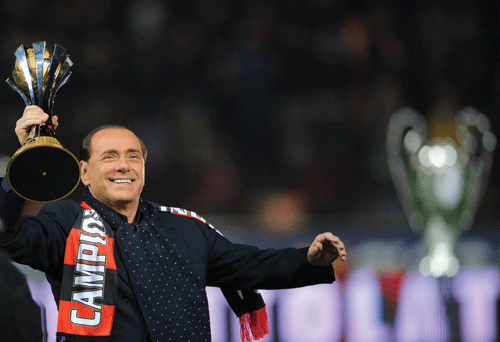
While politicians such as Henry Kissinger and Silvio Berlusconi are known to be genuine fans of the game, most others are often advised by their communication consultants to attend key matches, on the proven premise that the jubilation that accompanies a national team’s win will translate into higher approval ratings for the politician, while turning him into some sort of lucky charm for fans (especially when considering the level of superstition in the game).

The power of football is undeniable. It can lift a nation’s spirit, unite people from diverse backgrounds and even help overcome racism and social prejudice. When the French won the World Cup in 1998, one poll showed that more people would have voted for Zinedine Zidane for the presidency than they would have for any other political candidate, despite his origins and background. While this might have been somewhat influenced by the euphoria that surrounded the win, it nevertheless shows the potential gains that could be achieved by leveraging the cult status of the sport.

The universal language of football, and its ability to surpass differences, was probably best illustrated on Christmas Eve 1915, when German and British soldiers came out of their trenches, after weeks of fierce fighting, for one improvised game of football, which, while it may not have influenced the course of the war, showed how the love of the game can bring down barriers.

Closer to home, the game on April 13th that brought politicians representing both sides of Lebanon’s political divide together for a symbolic football match, illustrated – besides the less than perfect physical fitness of our representatives – the ability of football to serve as a common denominator and a medium to communicate key messages away from rhetorical discourse or political debates, which often fail to reach their intended audience.

Historically, football, and sport in general, has always been used as a means for political showboating and to rally constituents on nationalistic grounds. In 1980, the “Miracle on Ice” victory by the American Hockey team over the Russians became a symbol of American triumph and superiority at the height of the cold war, thanks to a well-crafted communication strategy. The event galvanized Americans and lifted their spirits and feelings of national pride following the debacles of Vietnam and the takeover of the American embassy in Tehran.

The dark side

That said, despite all the good that it can bring, football can sometimes be a source of division and an excuse to fuel sectarian and sometimes racial prejudice for pure political gain.

A few years back, France’s Jean-Marie Le Pen criticized the French national team for fielding an entire squad featuring “non-native” Frenchmen, in an attempt to solidify his role as the protector of “French Identity.” In 2002, Le Pen was a runner-up to elected President Jacques Chirac, with 18 percent of the total popular vote.

Similarly, the much publicized World Cup qualifying game between Egypt and Algeria was a chance for the leadership in both countries to show restraint and call for calm, but instead they took the opportunity to play on the heightened emotions of football fans to bolster their own domestic credibility and nationalist credentials.

Talking the talk

At the end of the day, what seals the sometimes-unnatural bond between football and politics is communication, and politicians’ desire to project a certain image of themselves to voters and opinion leaders.

In that sense, football becomes a communication channel and its lingo part of politicians’ lexicon, adding to the military jargon of speeches and discourse to portray leadership attributes and unflinching confidence.

Incidentally, a close look at the industry terminology reveals the similarities between the worlds of football and communication; target, audience, defensive, offensive, goals, and strategy are terms used regularly in both fields.

Whoever wins the World Cup, we can be sure that the game will continue to grow and expand its reach and popularity, provided that we do not turn it into a sport that is within the reach of only a fortunate few who can afford entrance fees to the stadiums or subscriptions to cable channels.

Football, the most democratic sport in the larger sense of the term, is the game of the masses, which is arguably its forte.

For this reason, the role of professional soccer’s governing bodies and the political establishment should be, first and foremost, to ensure that the sport remains accessible to everyone, and to leverage and channel its popularity in the right direction.

June 1, 2010 0 comments
0 FacebookTwitterPinterestEmail
Economics & Policy

Eastern expansion

by Andrew Horncastle & Georges Haines June 1, 2010
written by Andrew Horncastle & Georges Haines

As their North American and European competitors recover from the economic crisis, Middle Eastern chemical companies are facing new opportunities and new challenges.

They are continuing to build on their cost advantage in basic petrochemicals, which has made them formidable challengers in the global industry. They are also beginning to invest in more specialized chemicals to further strengthen their overall position and create more industrialized, diversified economies in their countries. However, as they expand into new chemicals, their cost advantage diminishes and they will have to be selective about their approaches to growth and develop new capabilities to compete successfully.

Cashing in on the crisis

As the global chemicals industry begins to pick up the pieces and recover, it is finding itself in a post-crisis landscape that looks significantly alien. Middle Eastern companies have capitalized on a cost advantage of 30 percent to 90 percent in natural gas-based feedstock — the raw material necessary for producing basic petrochemicals. As a result, regional companies will nearly double their share of global capacity from 2008 to 2013 (from 11 percent to 19 percent for ethylene and 7 percent to 14 percent for polypropylene). Additionally, Middle East chemical companies are well positioned logistically to serve Asian markets, which are currently growing faster than those in North America and Europe.

With these advantages, chemical companies in the Middle East are expected to emerge from the crisis in good shape, despite the fact that global demand for chemicals has dropped while supply has expanded.

To date, companies in the region have focused on basic commodity chemicals based on natural gas feedstock, such as fertilizers and plastics; these are relatively straightforward to manage and highly profitable. Indeed, Middle East firms have such a strong cost advantage in manufacturing these products that Western companies, including Borealis, ExxonMobil Chemicals and Dow, have partnered with regional forms in order to benefit from these advantages.

But with the gap between demand for gas and available supply widening in the region and pressure from governments to diversify economies and create jobs, chemical companies are investigating the possibility of expanding into a broader product portfolio that encompasses oil-based (e.g., naphtha) feedstock.

However, the cost advantage that Middle East companies enjoy with natural gas reduces significantly when moving to naphtha feedstock.

In addition, these products are more complex to manufacture, require greater interaction with customers to provide the necessary technical and applications support, and demand new capabilities for Middle Eastern companies to manage the diversified portfolios and complicated supply chains. 

To determine their path forward, Middle East chemical companies need to look at two elements: the competition and their own capabilities.

In terms of competition, North American and European companies are likely to be more aggressive in defending their territory in specialty chemicals — where their innovation capacity is a strong source of competitive advantage — than in basic chemicals. However, a lot of specialty segments are commoditizing rapidly and Middle Eastern companies are finding opportunities to put down stakes — particularly as Western companies divest businesses to clean up their balance sheets or adjust to their growth strategies and, in doing so, seek to sell or establish joint ventures for their businesses that could significantly benefit from integration with Middle Eastern players.

Earning and learning

In these cases, it will fall to the Middle Eastern firms to make sure that they truly capture knowledge from these partnerships, thus building their own capacity to develop a high-value and diversified product portfolio, rather than simply acting as the purveyors of inexpensive feedstock. In particular, regional companies should consider where else they might be able to build a competitive advantage, such as using their regional proximity to Asia and Europe to better serve those markets.

Saudi Arabia and the United Arab Emirates have both started to move into new chemical products and are making significant investments in integrated petrochemical and specialty chemical projects.

But the move is not without challenges. They must carefully choose those products that meet their profitability targets, yet at the same time balance government requirements for diversification and job creation in order to receive the feedstock they require. In addition, they need to further develop their technology and management capabilities to handle the diverse array of products. Marketing these products will also be more complex, as companies will need to work much more closely with customers to meet their needs; this requires them to place supporting infrastructure directly in Asia and Europe, where there is a demand for these products.

In order to overcome these challenges, Middle Eastern companies should focus first on just a small number of new products to allow for a learning curve, then build a sustainable, competitive position. They should continue to use acquisitions and joint ventures with Western and Asian companies to make use of existing technology, market access and management experience, as well as capabilities, in order to be competitive. In doing so, it is important for Middle Eastern chemical firms to have a clear strategic intent toward acquisitions or joint ventures and vital that they capture the integration benefits of such arrangements.

Forging the future

As the crisis recedes, companies in the Middle East will continue to shape the chemical industry by further increasing their footprint across products and regions, as they build on their relative advantages. As a result, they will be a main driver in the transformation of the chemicals industry by actively pursuing acquisitions and forging new alliances.

June 1, 2010 0 comments
0 FacebookTwitterPinterestEmail
Economics & Policy

Deals by the dozen

by Executive Staff June 1, 2010
written by Executive Staff

Nine new merger and acquisition (M&A) plans with potential worth of well over $12.4 billion have been announced by companies in the Middle East and North Africa (MENA), according to Regional Press Network (RPN)’s DealFlow Monitor.

The largest imminent M&A transaction is a sale of telecommunications assets by Egypt’s Orascom Telecom Holdings to South African MTN. 

Gulf Cooperation Council countries are expected to return to the pre-crisis boom times in M&As, projected to reach $25 billion this year and up to $100 billion in 2011, according to the GCC M&A Barometer survey conducted by Zawya and M Communications.

The GCC M&A Barometer surveyed 27 investment banks, which highlighted telecommunications and financial services as two industries in the Middle East that will see more consolidations. The majority of M&As are expected to take place within the GCC, with Saudi Arabia leading the United Arab Emirates, followed by Qatar. Some 85 percent of bankers expect mid-market transactions to dominate the M&A market this year.

The new projects announced in the one-month period between mid April and mid May of this year, have pushed the known portfolio of major business partnership deals in the region — acquisitions, mergers, joint ventures, venture capital participations, strategic and financial investments — to more than 940 deals with an aggregate value of $142.6 billion, since January 2009, according to the RPN’s DealFlow Monitor.

Telecommunications transactions represent the largest slice of the pie in this period, at $32.3 billion, followed by deals in financial services, at $25.6 billion.

Oil and gas investments rank third, with a value of $19.9 billion. The three sectors account for 60 percent of deals recorded by RPN Dealflow since January 2009.

A recent report by Ernest & Young found that M&A deals announced in the Middle East and North Africa dropped by 67 percent in value to $34 billion in 2009, down from $102 billion in 2008.

The largest transaction recorded in the past 16 months was concluded with a definite sales agreement in March when India’s Bharti Airtel acquired mobile communications network assets from Kuwait’s Zain Group in a $10.7 billion deal. As a comparatively large deal, the Zain IPO accounted for 48 percent of all telecom M&As recorded between Jan 2009 and end of March 2010.

The biggest deal cancellation over the same period was the $1.7 billion fire sale of Dubai construction leader Arabtec to Abu Dhabi’s Aabar Investments, which was called off in mid April.

The two companies said the cancellation was in mutual agreement, despite the suddenness and dearth of information involved, which was matched only by the suddenness and dearth of information involved in the initial bombshell announcement in January. 

One in every four M&A deals of just over 200 deals tracked by RPN Dealflow between January 1 and April 15 of this year involved a partner outside of the MENA region (inclusive of Turkey) but most of these deals related to assets located within MENA.

Analysts say that outbound M&A activities by cash-heavy Arab Sovereign Wealth Funds and private wealth aggregators will proceed with more scrutiny and inbound flows will witness the increasing appetite of international players for slices of MENA economic activities.

Dynamics of M&A in one sector often get a stimulus from a major deal closing, as demonstrated when Zain’s telecoms sale to Bharti was quickly followed by MTN and Orascom disclosing that they entered discussions for an MTN takeover of Orascom’s Algerian unit, Djezzy.

June 1, 2010 0 comments
0 FacebookTwitterPinterestEmail
Economics & Policy

How peace pays

by Josh Wood June 1, 2010
written by Josh Wood

For the past 32 years, UNIFIL — the United Nations Interim Force in Lebanon — has been a thread in the fabric of life in Lebanon. While most mentions of UNIFIL relate to Lebanon’s numerous conflicts with its southern neighbor and violations of the UN-mandated Blue Line that ostensibly marks the border with Israel, there is another face to the peacekeeping mission: its economic impact.

Over the past year alone, UNIFIL spent $32 million on contracts with local Lebanese firms, according to UNIFIL spokesperson Andrea Tenenti. UNIFIL’s nearly 13,000-strong military force and civilian staff also pump millions of dollars into the local economy through privately purchased goods and services – and the mission says that it is the largest single employer of Lebanese citizens in the south. In addition, in an effort to improve its public image, the mission invests millions of dollars every year in building infrastructure for local communities and offering direct aid to the population of South Lebanon, which is among the poorest areas of the country, having endured the 22-year-long Israeli occupation.

While UNIFIL is by no means an economic savior for the south, it is certainly a crutch. Its continued presence has provided a steady stream of income for the local economy for more than three decades, with the amount of money being spent soaring in recent years as troop numbers have grown. After Israel’s 2006 war on Lebanon UNIFIL rapidly began increasing its personnel numbers, from less than 2,000 before the hostilities to around 11,500 military personnel by the end of 2006.

These new troops were not cheap: UNIFIL’s 2006 to 2007 total budget topped $495 million, a 543 percent rise from the $91 million spent a year earlier.  For 2009 to 2010, the appropriated budget reached nearly $590 million.

The procurement spending spree

Most of UNIFIL’s budget is given to countries that contribute troops to the mission, money sent to cover the salaries of soldiers. While the Lebanese economy sees some of this money later through troops’ private spending, it is UNIFIL’s procurement budget for goods and services which offers the largest cash injection into the Lebanese economy.

Items on UNIFIL’s yearly procurement budget include everything from condoms to laptop computers — estimated to cost UNIFIL $136,763 and $138,500 respectively, in 2009. The most costly this year — and nearly every year — is food rations to feed UNIFIL staff and soldiers, with an estimated tab of $18.2 million.

In filling its procurement needs UNIFIL turns to companies around the world, but has, over time, shown a preference for awarding contracts to Lebanese businesses.

“As a rule, [UNIFIL] generally tries to buy most things from Lebanon — if you can find it here of course,” said Timur Goksel, a longtime UNIFIL spokesman who now teaches at the American University of Beirut.

This year, 160 Lebanese vendors and firms were awarded roughly $33 million (40 percent) of the total anticipated procurement budget of $82 million, according to Executive’s calculations.

While UNIFIL was unable to produce similar statistics for most other years, in 2007 UNIFIL spokeswoman Yasmina Bouziane told the international media that the mission was set to spend $36 million of its $90 million spending budget in Lebanon — again about 40 percent. In October 2006, shortly after the Israel-Hezbollah ceasefire, UNIFIL’s acting Chief Administrative Officer Jean-Pierre Ducharme said UNIFIL had spent $40 million on Lebanese contracts that year and that 60 percent of its total procurement budget over the last three years had been spent locally.

The largest contract with a Lebanese company has been an exclusive deal with Medco to supply fuel for UNIFIL jeeps, armored personnel carriers, helicopters and other vehicles, as well as generators. Since 2006, these contracts have totaled $50.7 million, with contracts signed in 2007 alone running at $22 million.

With UNIFIL’s increased demand for new bases and extra space on existing bases to accommodate its mushrooming numbers, Lebanese construction firms have also benefited.

The largest construction contracts UNIFIL has disclosed have been with Hanna Khoury and Brothers Company ($9.3 million), Dalal Steel Industries (at least $3.2 million), Maroun Assaf ($1.5 million) and Daher Contracting ($1.1 million).

UNIFIL’s Miguel de Cervantes base near Marjayoun — considered “the best UN base in the world” by many UNIFIL personnel — was little more than a campground in 2006. Marwan Dalal from Dalal Steel Industries said that his company provided 90 percent of the steel and prefabricated buildings used on the $16 million base, which was primarily built using prefabricated structures.

Major goods procured by UNIFIL in 2008

Major goods procured by UNIFIL in 2008 - Lebanon

Major services procured by UNIFIL in 2008

Major goods procured by UNIFIL in 2008 - Lebanon

Dalal added that the company had been responsible for similar amounts of work at other UNIFIL bases and positions.

Besides working with UNIFIL, Dalal Steel has also maintained contracts with American forces in Iraq and Afghanistan, the Lebanese Armed Forces, as well as with other UN missions across the world. While not disclosing exactly how much the company makes per year, Dalal said that contracts with UNIFIL could account for up to 20 percent of the company’s yearly business.

While arranging construction and procuring petroleum require fairly large contracts, UNIFIL also maintains smaller contracts — covering everything from gardening to mobile phones — with more than 150 other Lebanese firms.

Local jobs for local people

UNIFIL claims that its 800 or so full-time local staff make it the largest single employer of Lebanese in the area. Many more Lebanese also work with the peacekeepers on a temporary basis.

UNIFIL’s permanent local staff members are attracted by comparatively high salaries, jobs that have room for professional development and the opportunity to eventually take their career outside of Lebanon.

“Most of the Lebanese who started off with UNIFIL in the early years have now become permanent UN staff members all over the world,” said Goksel.

About 140 of UNIFIL’s permanent local staff are translators. Amal Kahawaji, a translator with UNIFIL’s Indonesian battalion, said that translators are paid about $2,000 per month – an attractive sum for young Lebanese university graduates whose average starting salary on entering the workforce is usually much lower.

For contractual workers, the jobs are also welcome but they do not reap the benefits of full-time UNIFIL staff.

Several cleaners from One World (a company working exclusively with UNIFIL providing cleaning, maintenance and landscaping services) on the Miguel de Cervantes Base said that they didn’t feel that their $500 per month salary was fair compensation for the work they were doing. However, the women, all from the surrounding villages, said that they were still lucky to have the jobs as work was scarce in the area.

All in all, former UNIFIL spokesman Goksel estimated that around 2,000 families in South Lebanon rely on UNIFIL for their livelihood.

Yoga and reconstruction

While contracts between UNIFIL and Lebanese firms clearly represent the most significant economic contribution of the peacekeeping mission, direct commitment of UNIFIL money and resources to local communities in the South also has a major impact on the area.

Civil Military Cooperation (CIMIC) projects are aimed at capturing the ‘hearts and minds’ of local residents and improving the public’s perception of UNIFIL.

“Quick Impact Projects” are the most common CIMIC operation. These small-scale projects cost up to $25,000 a piece and are primarily aimed at reconstruction and infrastructure building.  Examples of such projects include building sports facilities in villages and renovating schools.

The UN funds $500,000 worth of these projects a year — enough money for 30 projects in 2009.  Individual troop contributing countries, however, fund the majority of the projects. In 2009, Italy led the field, completing 112 projects worth $2.1 million. The Korean contingent completed 25 projects, totaling $1.3 million.

UNIFIL also provides a host of other activities within the local communities, from clearing unexploded ordnance to hosting free health clinics and even Yoga and Taekwondo classes, organized by the Indian and Korean contingents respectively.

Last year, UNIFIL’s clinics and medical teams treated more than 40,000 local patients, and since the beginning of 2005, a total of 150,000 people have received such treatment.

While Yoga might not have the same tangible benefits as other contributions such as free healthcare, UNIFIL stands by these endeavors, saying that they improve the quality of life for residents. Educational courses, such as language and computer classes, also help build skills to boost residents future job prospects.

A home away from home

On the tree-lined roads leading up to UNIFIL’s Miguel de Cervantes base near Marjayoun, Spanish flags fly outside of shops and locals greet foreigners with a friendly “hola, como estas?” At the Mirage Bar, camouflage-clad men drink $2 Almaza beers while their comrades scope out the prices of Hezbollah souvenir items and electronics next door.

This scene — repeated in permutations across South Lebanon — is a direct result of combining foreign troops with comparatively high disposable incomes and entrepreneurially minded members of the local population.

“If every soldier spends just $1, it will be very good for the economy,” said Jallal Ramal, who runs the PX (military jargon for an on-base store) at UNIFIL position 8-33 on the Lebanese-Israeli frontier.

While it is difficult to calculate exactly how much money UNIFIL soldiers and civilian staff regularly spend in the local economies of southern Lebanon, it is certainly far higher than Ramal’s $1.

Countries that contribute troops are given $1,028 per month per soldier by the UN. Additionally, the UN directly pays soldiers $1.28 per day for serving in Lebanon. As this wage is well below the standard salaries offered in some — especially Western — troop contributing countries, some contingents’ home countries subsidize this pay quite heavily. 

Other, poorer countries pay their soldiers directly out of the UN-provided stipend, though not necessarily always the full $1,028 per month.

Neither the diplomatic missions of most troop contributing countries nor UNIFIL headquarters in Naqoura were willing to comment on troop salaries for the various contingents, making it difficult to ascertain exact troop spending across the board.

However, Lieutenant Colonel Mar Guslin of the Indonesian battalion estimated that each soldier in his unit spent a minimum of $100 per month in the local economy. 

With around 1,000 troops stationed on the battalion’s Adchit Al Qusayr base, this would equate to at least $1.2 million spent on consumer goods and services in the surrounding villages each year.

Salaries for Spanish soldiers are much higher. Including the UNIFIL stipends and subsidized pay from the Spanish government, soldiers’ salaries start at 3,500 euros ($3,954) per month, according to Colonel Rafael Ropero Bolivar, a liaison officer at the Spanish embassy in Beirut. 

Pay grades go all the way up to 8,000 euros ($9,866) per month for Spanish generals serving in Lebanon.

With much more disposable income than other contingents, it is reasonable to assume that troops from European countries spend money more freely in the local economy.

While admitting it is difficult to calculate exactly how much cash a soldier might splash, Lieutenant Colonel Ismael Muro, a public information officer for the Spanish contingent, said that the average soldier might spend between $200 and $330 per month, with some spending up to $670 monthly.

By the lower-end estimates Muro supplied Executive with, annual local spending by the 1,076-strong Spanish contingent would be more than $3 million.

The presence of peacekeepers with money to burn has spurred a growth in shops, restaurants and services that cater exclusively to UNIFIL. 

“I don’t have any local customers,” said Khaled Nahra, the owner of Casa Elias, a large gift shop near Marjayoun that sells everything from blue beret-wearing stuffed animals to hard liquor and ninja throwing-stars to its peacekeeping clients.

In some of the predominantly Shiite Muslim southern towns, such as Naqoura, market demand has outweighed Islamic conservatism, with shops and restaurants selling alcohol for soldiers.

As stores catering to UNIFIL across the south expand their warehouses and the mission’s gargantuan headquarters in Naqoura sprawls even further in a flurry of construction, it is apparent that the word “interim” has lost its meaning.

With troops entrenched in the south for the foreseeable future, companies, communities and families in the area can look forward to continued economic benefit from the restive reputation of the land south of the Litani.

June 1, 2010 0 comments
0 FacebookTwitterPinterestEmail
Real Estate

Q&A – Mark Sleiman

by Nada Nohra June 1, 2010
written by Nada Nohra

Creative Solution for Housing is a Lebanese real estate advisory and consultancy firm. Established in 2009, the company aims to introduce a ‘pay as you grow’ housing loan scheme for aspiring home-owners with limited incomes.

Executive sat with Mark Sleiman, the company’s managing director, to discuss the new scheme and Lebanon’s lending market.   

E  What is ‘pay as you grow’?

We are trying to become the middle point between the real estate developers, the buyers and the banks, and to service all three from a financial and a real estate perspective.

The ‘pay as you grow’ scheme is different from the conventional housing loan, because payments adapt to income over time. People’s income increases, so it makes sense that the payment rises in line with their income.

It exists in the United States but in a very different way. We changed the financial formulas that they use and we registered the concept as intellectual property.

I find the buyer the appropriate property within his budget and I manage the financing with the bank. We are reaching a new market which could not afford to buy houses before.

E   Has introducing a new concept to the market been challenging?

When buyers are committing to paying double what they are paying now in 10 years time, it is a big commitment. [The challenge is that] you have to first educate people about this type of product, which takes time.  

E  Are their special requirements to obtain the loan that differ from conventional requirements?

[The requirement] depends on the bank. This is only a loan repayment concept. We give [banks] a method of calculating payments based on interest and growth in income. The rest is all based on the bank.

E in Lebanon income does not grow with inflation, so how will you calculate the increase in payments?

We took all the numbers available at the Central Administration of Statistics and we realized that we have 4 to 4.5 percent growth in yearly income on average. We capped this growth to 3 percent. The person whose income today is $1,600, we consider that in 15 years it will be $2,400. It is very conservative but we don’t want to take the risk.

It is hard to calculate the numbers [but] you can predict the minimum. This product is not for everyone, there is a profile for the [right kind of] buyer, what he studied and where he is working.

E  If the buyer’s circumstances change, will the plan change?

We can refinance, reschedule, or give him more money. The basic point is flexibility.

E  Lending is becoming increasingly available. Will this affect demand and prices?

Yes, but the demand [we are targeting] already exists. In Lebanon [there is demand for] between 50,000 and 70,000 apartments per year. There are around 25,000 marriages per year, 7,000 divorces; all these create a certain housing demand. What we are trying to do is give that demand access to the supply… to target the real demand, not the speculators or investors, but those who have a real need for housing.

E  Do you think there should be regulations to stop price hikes?

You cannot do that in a free economy. I think rents will increase substantially, as it is the only alternative to buying. When rents rise, [property prices] will drop. Maybe not in prime areas like Achrafieh, but it could do, for example, in Metn or Keserwan.

What is scary is that the leverage ratio is increasing. The banks are financing up to 95 percent of the [cost of a] house, and some banks even 100 percent, depending on the person. This is what is dangerous and is what caused the financial crash abroad.

June 1, 2010 0 comments
0 FacebookTwitterPinterestEmail
Real Estate

Eating away at the edges

by Nada Nohra June 1, 2010
written by Nada Nohra

“Buy land, they’re not making it anymore,” said the American author and humorist Mark Twain. Following Twain’s advice in a small country like Lebanon makes sense, as both the country’s geography and booming real estate sector have pushed quality plot prices to a premium.

That Lebanese can buy land in Lebanon is a fairly uncontentious issue; allowing or restricting foreign ownership in the country is, however, highly controversial. The issue has created a schism in the political arena between those who lobby for an open economy to attract investment, and those who want to fight speculation and preserve Lebanon’s identity.

The Maronite patriarchy, among the opponents of unfettered foreign ownership, recently issued a 175-page report entitled “Niyyel elli baad aandu marqad aanze bi Libnen,” which, roughly translated, means: “Anyone who has enough space in Lebanon for a goat to lay down should count themselves lucky.”

The report questions the accuracy of current land ownership data and proposes amendments to the current law. On the other hand, market experts Executive spoke to said that unless foreigners can pack their land in their luggage and head to the airport, there is nothing to worry about.

“A lot of people are making it sound a lot scarier than it is,” said Karim Makarem, director at Ramco real estate advisors. “I think it is very political and I think that what you will hear in general is a lot of scaremongers, depending on their political affiliations.”

The law

The foreign ownership law was issued back in 1969 and last amended in 2001. It states that any individual without the nationality of an “internationally acknowledged country” is forbidden to own real estate in Lebanon, thus preventing Palestinian ownership.

Moreover, it says that no foreigner can own more than 3,000 square meters of land suitable for construction or of a built-up area — replacing the previous ceiling of 5,000 square meters — unless approved by a special decree signed by the Council of Ministers, Lebanon’s Cabinet.

Both Father Camille Zaidan, director general at the Maronite Center for Research and Development, and Mohamad Chamseddine, policy research analyst at research firm Information International, said that it was easy to obtain a special decree. However, due to political disagreements and rising awareness of the issue, the number of decrees granted has lately decreased.

“In the last five months, only two decrees have been issued,” said Zaidan. 

Ramco’s Makarem added that “it is easy if you are somebody particularly important in the Arab world… It used to be more common pre-2005, but since then we have seen less.”

The law also stipulates that foreign ownership of land should not exceed 3 percent of the total area of each qadaa, or district. The current law also allows for 10 percent foreign ownership. The cap applies to land ownership by companies which are majority-owned by foreigners, in whose case only 50 percent of land owned by the firm is considered under the restriction. The General Directorate of Land Registry and Cadastre (GDLRC) is required by the law to update these numbers every six months and stop foreign land registration when the maximum is reached. As Executive went to print, the last time the figures were issued was July 2009.

The owner also has to develop the land within five years of the purchase, a deadline which can be extended once by the Council of Ministers. The Lebanese Company for the Development and Reconstruction of Beirut Central District (Solidere), a publicly traded company, is considered a special case and was allowed to freely purchase land for 25 years (starting 2001), but cannot sell to foreigners unless it is in accordance with the law.

The problem

The effectiveness of the law in controlling and monitoring foreign ownership of real estate in Lebanon is questionable. A major concern are large, unsurveyed swaths of Lebanon not recorded at the GDLRC. Paperwork for the sale of unsurveyed land is handled at the office of the local mokhtar (mayor or governor) and is not reported to the GDLRC. Consequently, there are no central recordings of sales to foreigners in these areas. Chamseddine explained that the largest unsurveyed areas are in the Bekaa Valley, Mount Lebanon and South Lebanon.

“Regardless of the restrictions and the laws we issue to limit foreign ownership, the numbers will not be specific since there are hundreds of areas which are yet to be surveyed,” said Zaidan. 

The report issued by the Maronite research center includes numbers from the Ministry of Finance stating that in 2007, 51 percent of Lebanon had yet to be subject to a final survey. However, according to Chamseddine, around 30 percent of Lebanon is currently unsurveyed, as in recent years the government has hired private firms to conduct the surveys, which are expected to be finished within 4 years.

Also of concern, says Zaidan, are foreign-owned companies registered in Lebanon that own land and foreign-funded Lebanese who purchase real estate. In either case, effective control of the land is not in Lebanese hands. Quantifying these numbers is difficult however, as on paper at least, it is all Lebanese owned.

“A Lebanese came to negotiate with a close friend of mine in order to help him buy 600,000 square meters of land in Baabda for a foreigner,” said Zaidan as an example.

“There is a certain number [of people purchasing property in this way], but how much… no one knows,” said Georges Chehwane, chairman of Plus Properties.

Officially, when foreign land ownership in a qadaa hits its limit, foreigners will only be able to buy from each other. However, the concern is that the official numbers vastly understate the foreign ownership, given the unrecorded sales. 

“After the research that we have done, I am convinced that in Baabda they’ve already trespassed the three percent, and Beirut is definitely more than 6.51 percent,” said Zaidan.

Does it really matter?

Opinions diverge on whether to implement stricter restrictions on foreign ownership, or allow the free market to exercise its power over the sector.

Zaidan says he is worried that high foreign demand is fueling speculation and inflation. He adds that middle class Lebanese can no longer afford property in Beirut and are being pushed out of the city, as wages are not rising in accordance with inflation. According to Ramco real estate advisor’s research department, residential property prices in Beirut have increased some 120 percent on the lower end and, on average, 150 percent for high-end property in the last five years.

 “The main question is: Where are we heading?” Zaidan said. “We are entering into a social crisis that has no solution.”

He suggested that the foreign ownership issue should be monitored through better documentation, with more legal restrictions on the purchase of real estate by non-Lebanese. 

On the other hand, advocates of a free market say that the foreign purchasing in Lebanon is still a very small percentage of the total, and is thus too insignificant to have an impact on the real estate sector.

Elie Harb, president of Coldwell Banker, said that the laws restricting foreign ownership should be repealed; arguing that it only represents some 2 percent of the real estate market. Both Harb and Makarem also said that many foreigners are currently selling their land or apartments, and sales to foreigners have gone down, mainly due to the financial crisis.

“The day we put up rules to ban foreign ownership we are going to scare many investors,” said Makarem. “So I think those consequences outweigh the consequences of allowing foreign ownership.”

George Sioufi, chief operating officer of GRE properties, said that he also encourages foreign ownership of properties. He is concerned that it might hurt the market if international owners start selling their properties.

“It is true that a year and a half has passed since the financial crisis started, but what if they are leaving Lebanon as their last resort?” he said. 

Building ahead

As it stands, with some 30 percent of Lebanon not surveyed, a foreign ownership law that is easily skirted, in addition to politicization, has made it nearly impossible to ascertain exactly how much of the country is owned by foreigners.

In the future, it remains to be seen whether the Lebanese authorities will answer the conservative call to implement stricter control, or if they will adopt a more liberal approach which, some experts say, is healthier for the future of the real estate market and the economy as a whole. 

June 1, 2010 0 comments
0 FacebookTwitterPinterestEmail
Economics & Policy

Q&A – Paul Griffiths

by Paul Cochrane June 1, 2010
written by Paul Cochrane

DubaiAirports Chief Executive Officer Paul Griffiths currently oversees operationsat Dubai International while at the same time coordinating the launch of DubaiWorld Central-Al Maktoum International (DWC), which is slated to be the world’slargest passenger and cargo hub. He sat down with Executive to discuss thecompany’s activities.

E   Dubai International became thethird busiest airport in the world this year. The expectation is that it willbe the busiest by 2020, but could you reach the top spot before that date?

Basedon our growth projections, this is entirely possible. The busiest airport forinternational passenger traffic currently is London Heathrow with around 60million per annum, whereas we will reach 46 million this year and 52 million bythe end of 2011. As you know, recent proposals for a third runway have beenshot down, which significantly constrains Heathrow’s future capacity. Paris,Frankfurt, Hong Kong and Amsterdam also face capacity constraints, althoughthey are less severe and have slower growth rates. All told, we believe we canget to the top spot within the next several years.

E   What challenges are you facing tohandle such exponential growth in passenger and freight traffic?

Theprovision of timely and efficient capacity, both in terms of infrastructure andairspace, is a top priority. We have aggressive plans in place to boostcapacity at Dubai International from the current 60 million passengers per yearto 90 million by 2018 and to complete the world’s largest airport at [DWC], bythe midpoint of the next decade for 160 million passengers. Our goal is tostreamline processes and implement technologies that allow us to do this asefficiently as possible.

E   While Dubai International is thebase of carrier Emirates, what are you doing to attract more airlines?

Dubai’sopen skies policy combined with top-flight infrastructure provided atcompetitive rates has served us well to date. With 130 airlines offeringservices to 220 destinations on six continents, we already provide consumerswith a compelling range of options. That said, we are always looking to growthose numbers and do so primarily through direct and ongoing consultation withexisting and prospective client airlines.

E   DWC began cargo operationsrecently. Did this have any affect on Dubai Airport’s freight operations? Ifnot, why is that the case?

Thetwo operations are complimentary. They provide attractive options to our clientairlines whose commercial and operational requirements often vary. To date we have19 cargo airlines signed up to operate at the new airport. We expect thatnumber to increase in the years ahead as slot availability for cargo freightersdiminishes and air freight volumes reach capacity limits at DubaiInternational.

E   The Strategic Plan 2015 is forDubai to be the region’s aviation hub. What role will Dubai Airport play inthis plan, given the development of DWC? What will happen to DubaiInternational when DWC is fully operational?

Ithink it’s safe to say we are already the region’s aviation hub and haveestablished Dubai as a leading global aviation hub. The next step in thejourney is to fully develop Dubai International’s capacity and cement itsposition as the number one international hub by the end of the decade. DWC willtake us to the next level serving as the world’s largest airport with room for160 million passengers and 12 million tons of freight when it is completed atsome point in the mid-2020s. It is too early to say what will happen to DubaiInternational at that point.


June 1, 2010 0 comments
0 FacebookTwitterPinterestEmail
Economics & Policy

The world isn’t sinking

by Natacha Tannous June 1, 2010
written by Natacha Tannous

After four months of anxious waiting, the Government of Dubai, along with government-owned conglomerate Dubai World and real estate subsidiary Nakheel, released official statements on March 25 regarding the restructuring of billions of dollars in debt and the reorganization of both companies.


The emirate stated that it intends to support the debt restructuring plans of Dubai World and Nakheel “with significant financial resources, including…up to $9.5 billion in new funding,” according to the statement by Sheikh Ahmed bin Saeed al-Maktoum, chairman of the Dubai Supreme Fiscal Committee. Acting on behalf of the government, the Dubai Financial Support Fund (DFSF) will allocate $1.5 billion to Dubai World and $8 billion to Nakheel, of which $5.7 billion stems from unused Abu Dhabi loan proceeds. The remainder will come from internal governmental resources.

Restructuring and reactions

Dubai World’s $23.5 billion of outstanding debt is broken down between $14.2 billion in external debt (including United Arab Emirate banks) and $9.3 billion owed to the Government of Dubai through the DFSF. Given the sheer size of the tab, there were many turmoil-filled scenarios that had circulated through the Gulf financial world before the debt restructuring announcements — which have been greeted with a general sigh of relief.

Three key takeaways from these announcements were: First, the DFSF capital injection of $1.5 billion will be used to fund Dubai World’s working capital and interest payments on its restructured debt. Second, the Dubai government will equitize $8.9 billion out of its $9.3 billion debt outstanding, and such restructuring – meaning the capital injection plus the equitization “will allow Dubai World to focus on its core holdings and to manage and realize full value from its assets,” stated the Government of Dubai. Finally, the 97 non-DFSF creditors — of whom Emrati and United Kingdom banks own the lions share of the debt — will see their $14.2 billion claim fully restructured with a haircut on the principle, through the issuance of new debt into two tranches of five and eight-year maturities.

The announcements were well received by the markets, bringing down the cost of insuring Dubai’s debt. This is most clearly exemplified by Dubai’s five-year credit default swap spread dropping 14 percent, sliding from 420 basis points to 360 basis points. To crunch a few numbers, with the current 6.5 percent discount rate — as opposed to February’s 10 percent — and a 50 percent principal repayment in five years and the other half in eight years, the net present value is 67 cents on the dollar; much less of a hit than creditors had initially feared.

Nakheel restructuring and the real estate sector

The DFSF capital injection of $8 billion will be used to fund Nakheel’s operations and to terminate its current outstanding debt. Moreover, the government will also “recapitalize Nakheel through the equitization of the Government’s $1.2 billion claim.”

Even if the terms of the announced deals vary according to the type of creditor, all Nakheel debt holders will receive full repayment — when, however, is another question, as most maturities are as yet unclear. The schedule of Nakheel sukuk Islamic bond holders is set though, and should be fully repaid on their 2010 and 2011 maturity dates.

The bottom line
$9.5 billion in fresh funds to be injected by the Dubai government
$1.5 billion into Dubai World
$8.0 billion into Nakheel
Of which:
$5.7 billion is from unused Abu Dhabi loan proceeds
$3.8 billion is from internal Dubai government resources Dubai World’s $23.5 billion debt breakdown:
$9.3 billion owed to the Government of Dubai (of which $8.9 billion will be equitized)
$14.2 billion owed to external creditors, who should receive full repayment via new debt, in tranches of five and eight year maturities


Since Nakheel developments amount to a substantial amount of the pending projects in Dubai, the proposal “will have a significant direct impact on the construction and real estate sectors and the wider economy,” stated Sheikh Ahmad.

Challenges remain

The announcements bring some much-needed positive sentiments back to the market. However, “the restructuring process is expected to take several months to implement,” highlighted Sheikh Ahmed, and the high capital injection and governmental equity share might decrease the potential support for other struggling government-related entities. Furthermore, the financial support increases UAE government exposure to Dubai World: a situation not as welcomed by creditors as a government guarantee would have been. Finally, even if Nakheel’s restructuring proposal helps investors regain confidence in the real estate sector, the oversupply of product built and near completion remains.

June 1, 2010 0 comments
0 FacebookTwitterPinterestEmail
Real Estate

Waking the sleepers

by Rayya Salem June 1, 2010
written by Rayya Salem

Grandiose visions of splendor have dissipated for Dubai’s developers after a sobering couple of years spent rethinking their payment schemes and trying to re-galvanize investor confidence. Now they are left with an array of unfinished projects, many of which are currently dormant.


“Not many projects have been restarted except the Nakheel ones,” says Charles Neil, chief executive officer of Landmark Advisory, a division of Landmark Properties. “Most of the ones that are stalled will remain stalled.”

Neil adds that it was the combination of the financial crisis and many developers’ lack of experience that led to the huge swaths of unfinished projects scattered throughout the emirate. Certain areas like Business Bay and Dubai Marina have a concentration of unfinished work, though some slow and cautious crane activity recently restarted. In June 2010, Proleads, a construction consultant, said $5 billion worth of Dubai projects were stalled, some of which had never physically started construction. More recent data published in The National suggests that more than a fifth of Dubai’s projects are postponed or have been cancelled completely.

According to Fadi Moussalli, regional director at Jones Lang LaSalle in Dubai: “Some projects went beyond the point of no return; depending on the project’s financing [or re-financing], how much was sold and how much of the down payment has been paid in cash, a developer may reach a conclusion that it would be less costly to re-launch building [work] rather than do nothing because of the liabilities on that building.”

Dubai World’s property arm, Nakheel, repaid $930 million to creditors as early as September of last year, announcing a mighty revival of construction on eight of their stalled projects (see chart). Though priority was given to Al Furjan and Jumeirah Park villas, Nakheel, in a November 12 announcement, only mentioned reactivating the first phases of construction. That means Arabtec, the construction company assigned to Al Furjan, is back on payroll but will complete only 800 units out of the 4,000 originally planned by the first quarter of 2012, after it had halted work in January 2010.

Pauling Middle East and Al Huda Contracting Company will both go back to stacking up villas in Jumeirah Park, but Al Huda will only deliver 289 out of the 2,764 villas originally planned by the fourth quarter of 2011. In response to investor frustration over Nakheel’s delivery delays, Chairman Ali Rashed Lootah said in February that about half of the company’s liabilities to buyers were swapped for these and other units to be completed in the next two years.

Landmark Advisory’s Neil believes most developers have opted to downsize their projects: “For people who put down payments on five villas, their deposits will all go towards one villa; that’s how they consolidate.”

The cost of stalled projects

A project’s revival will be driven by its uniqueness, its location and “the possibility of securing an anchor tenant, if that’s relevant” said Mark Fraser, partner at Dubai law firm Taylor Wessing, who believes that “it’s not just Nakheel that will be resuscitating projects.” Areas other than Business Bay, Dubai Marina (where Abyaar and Omniyat are trying to restart projects) and Jumeirah are seeing re-construction, such as the tourism mega-project in Dubailand, City of Arabia, which is being developed by Dubai Properties.

The biggest issue for developers is reeling in their contractors. “If you renegotiate with the appointed contractor, there are certain running costs in addition to remobilization costs for the stalled projects,” said Rizwan Shaikhani, managing director of Shaikhani Contracting. “If you appoint a new contractor, he’s got big liability concerns because he has no idea how it was built by the other contractor and has to go through complicated legal formalities and project details to ensure nothing has been overlooked.”

Any delays pose structural concerns, as exposed projects are subject to Dubai’s harsh environment. When slabs under the foundation are exposed to high temperatures for years it can cause a defect, posing a legal headache for the old and new contractor as well as safety concerns for the owner and future residents. The United Arab Emirates’ civil code does not specifically address who is at fault in such a situation, but, as Fraser asserts, “Given the potential liabilities that a contractor can face under the UAE civil code, he is going to implement exhaustive surveys to manage such risks.”

For example, exposure to salt and humidity in porous concrete can alter its composition after a year or two, depending on its quality, according to Tanmay Biswas, an engineer at Meinhardt Dubai who spoke at a June 2010 conference in Dubai about the risks of re-constructing stalled projects. Exposed pumps, electrical cablings, rebar and steel also need to be protected from the elements, but owners and consultants often spar over who should pay the maintenance fees when a project has been stalled, according to Biswas.

Anyone in business knows that time is money. But for Dubai’s half-built structures, time is more costly than elsewhere because the climate weighs heavily on the cost of re-starting construction. According to Taylor Wessing’s Fraser,    when Thailand was finally bouncing back from the 1997 Asian financial crisis some five years ago, half-built developments that had been stalled for six or seven years were resuscitated. Contractors weren’t particularly concerned about degraded materials because of Thailand’s wet tropical climate.

“[Dubai] is obviously different because of salt and heat issues, but you could still resuscitate a building 3-5 years after, if a reputable survey company, either local or international, has carried out a comprehensive examination of the building,” said Fraser.

Oversupply

Given the oversupply across all sectors in Dubai and the resulting negotiating power of the tenant shopping around for the best deals, one of the prickliest thorns for developers is not reconstruction but rather trying to fill the units after they are finished.

Dubai Pearl shining up a treat
Pearl Dubai FZ Chief Executive Officer Santhosh Joseph seems to have weathered the financial storm better than most. In a February email to Executive, Joseph said that fundraising was underway for phase one of the Dubai Pearl – a 1.86 million square meter ‘city-within-a-city.’ “A total of 3 million man hours have been spent since work started and over 70,000 cubic-meters of concrete has been poured on what is one of the largest construction projects still being developed in the UAE,” he said.
 
It has been a long road for the project since it was conceived in 2003. Pearl Dubai FZ, a consortium headed by Abu Dhabi’s Al Fahim group, took control of the project in 2007 after its previous owners had to give up on it due to financial concerns. In November 2008, the UAE’s largest construction group, Al Habtoor-Leighton, bagged the $2.4 billion main construction contract, the largest deal in the region at the time.
 
The initial phase will cost $2.5 billion to build, but construction “[has] never stalled and remains on schedule” since starting in March 2010, though it was earlier announced that construction would begin in January 2009 after structures were demolished on-site during the enabling works phase in September of 2008. Most probably because of the change of ownership and drastic “revival plan” that called for a $6 billion project instead of the originally planned $800 million project on the cards, the project was “stalled” for years, according to various local and non-local media outlets.

In 2011, Dubai’s total housing stock will see an increase of 25,000 new units, bringing the total number to around 335,000, according to Jones Lang LaSalle’s fourth quarter 2010 report released in January, adding that the value of transactions dropped 65 percent in the year leading up to the third quarter of 2010. Reports issued last month say properties such as Jumeirah Lakes Towers are still empty, as is half of Dubai Marina, where 36 crane sites are actively humming along.

Jones Lang LaSalle’s Moussalli said, “It’s very tough to fill a building with over 100 units when tenants are dictating [the market].”

Landmark Advisory’s Neil adds to the gloomy mix: “I think the investors don’t have a lot of confidence that these projects will be completed on schedule. For example, we [Landmark Properties] get some of these houses on the secondary market.

Buyers are not interested because there’s plenty of choice to buy something ready and functioning and because you have no idea when they will be completed.” There are also problems such as a lack of utilities connections and infrastructure in zones like Business Bay, meaning that even if homes are complete, they are still not immediately livable. 

Next target… malls

Developers seem to be turning to Dubai’s greatest pastime, shopping, to grease the cash-flow wheel since it became rusty in the dry financial climate of the last two years. Emaar, the other Dubai-based construction giant often described as Nakheel’s rival, pulled in 24 percent of its 2010 revenue from its retail and hospitality sector, according to its 2010 earnings statement released on February 10. In 2009 it was about nine percent of revenue.

Perhaps that’s why Nakheel is set to expand its Dragon Mart and Ibn Battuta malls in Dubai as soon as the eight priorities it listed in September are brought to fruition, as a serious cash inflow would be more of a priority than finishing work on other stalled projects.

June 1, 2010 0 comments
0 FacebookTwitterPinterestEmail
  • 1
  • …
  • 416
  • 417
  • 418
  • 419
  • 420
  • …
  • 682

Latest Cover

About us

Since its first edition emerged on the newsstands in 1999, Executive Magazine has been dedicated to providing its readers with the most up-to-date local and regional business news. Executive is a monthly business magazine that offers readers in-depth analyses on the Lebanese world of commerce, covering all the major sectors – from banking, finance, and insurance to technology, tourism, hospitality, media, and retail.

  • Donate
  • Our Purpose
  • Contact Us

Sign up for our newsletter

    • Facebook
    • Twitter
    • Instagram
    • Linkedin
    • Youtube
    Executive Magazine
    • ISSUES
      • Current Issue
      • Past issues
    • BUSINESS
    • ECONOMICS & POLICY
    • OPINION
    • SPECIAL REPORTS
    • EXECUTIVE TALKS
    • MOVEMENTS
      • Change the image
      • Cannes lions
      • Transparency & accountability
      • ECONOMIC ROADMAP
      • Say No to Corruption
      • The Lebanon media development initiative
      • LPSN Policy Asks
      • Advocating the preservation of deposits
    • JOIN US
      • Join our movement
      • Attend our events
      • Receive updates
      • Connect with us
    • DONATE