• Donate
  • Our Purpose
  • Contact Us
Executive Magazine
  • ISSUES
    • Current Issue
    • Past issues
  • BUSINESS
  • ECONOMICS & POLICY
  • OPINION
  • SPECIAL REPORTS
  • EXECUTIVE TALKS
  • MOVEMENTS
    • Change the image
    • Cannes lions
    • Transparency & accountability
    • ECONOMIC ROADMAP
    • Say No to Corruption
    • The Lebanon media development initiative
    • LPSN Policy Asks
    • Advocating the preservation of deposits
  • JOIN US
    • Join our movement
    • Attend our events
    • Receive updates
    • Connect with us
  • DONATE
Feature

Surgery and sunshine

by Executive Staff September 26, 2009
written by Executive Staff

Lebanon has long been known as the Switzerland of the Middle East for its banking sector. These days, the Levantine country is claiming another proud nickname.

“Lebanon now has the reputation as being the Brazil of the Middle East,” says Lebanese plastic surgeon Dr. Roger Khoury.

When Khoury founded the Beirut Beauty Clinic 12 years ago, he recalls that less than one percent of his patients came from abroad, compared with 15 percent today.

Other doctors in Lebanon report a similar rise in patients coming from outside the country. They attribute this to high quality healthcare and hospitals, relatively low prices, a liberal health sector free from government oversight, and of course the attraction of Lebanon as a travel destination.

Most of Lebanon’s medical tourists are Lebanese expatriates, with the most popular procedure being rhinoplasty, more commonly known as a ‘nose job’. There are also a growing number of patients who come from the Gulf for the healthcare, and then often stay on for the sun, sea and sand.

“When you come from abroad, you get the complete package — the reception at the airport, the hotel, the clinic and people to help during the recovery period. And everyone loves to visit Beirut,” says Khoury.

Depending on the procedure, a vacation along with medical treatment in Lebanon can cost less than the medical bill alone in a Western country. For example, rhinoplasty in New York City can cost $20,000, while the same procedure in Lebanon typically costs $3,000.

This fact has not been lost on Lebanon’s tourism sector and travel industry — in the Ministry of Tourism’s 2009 Yellow Pages, approximately a quarter of the book includes contact details for Lebanese medical professionals.

Dr. Marina Hajj, medical director at the American University of Beirut Medical Center says, “We have contact with all the carriers and we coordinate with them. It’s booming.”

Middle East Airlines, Lebanon’s national carrier, has a link on its web site about the benefits of medical tourism. Here it boasts that, “health tourism has endless opportunities and benefits, and it ties extremely well into Lebanon’s reputation as a rejuvenating place and a healthy state.”

Lebanon’s place as a healthcare destination dates back more than a hundred years, back when AUB’s hospital was known throughout the Middle East for its medical treatments and its faculty of medicine. The hospital gained acclaim in the mid-20th century for being the first in the region to perform a kidney transplant, as well as open heart surgery. Lebanon’s place as a regional healthcare destination continued until 1975, when the country’s 15-year civil war began. Now, Lebanon has slowly regained its place on the medical tourism map.

“After the war, it took time for us and other institutions to come back,” notes Hajj. “In the late 1990s, we again became a magnet in the region. When medical tourism here restarted, we saw some of the same patients that had been treated before 1975.”

The appeal of a Lebanese scalpel

Whether they are returning patients or longtime Lebanese doctors, many people seem to believe that there is an intrinsic understanding doctors here have with their Arab patients that sets them apart from their colleagues outside the region, be it because of their education or their bedside manners.

Nasri Holloway, a 56-year-old British-born businessman of Lebanese origin, splits his time between Lebanon and his residence in Sierra Leone. But he always returns to Lebanon for medical treatment, even though he has spent most of his life abroad. This summer, he came to the AUB hospital to get a cancerous kidney removed.

Holloway doesn’t think twice about returning to his native country for medical treatment.

“I think the doctors are better here,” he says. “In Europe, doctors tend to be much more automated. I don’t know if they’re not allowed to take risks for legal reasons. They work very much by the book. But the book isn’t always the same for two people.”

Khoury also believes that many Arab patients from abroad choose Lebanon because they feel more comfortable with doctors of the same cultural background.

He recalls one patient who requested the he make an incision for a breast augmentation on the side of her breast right below the armpit. Khoury reminded her that “we’re Mediterranean people, and we like to raise our arms when we dance.” He was able to convince her to get the incisions closer to the center of her breasts.

For other patients, an important aspect of getting a medical procedure done in Lebanon is the privacy of being treated abroad.

Noor, a Kuwaiti who wished not to give her real name, underwent breast augmentation surgery at the Beirut Beauty Clinic while on vacation in Lebanon this summer. For her, the most important issue was privacy.

“If it was in a hospital, I wouldn’t have done it,” she says. “But at the clinic, I had my own room. I’m a veiled woman from Kuwait, so I wanted my privacy.”

Ahmad Zaatari, medical director at Hamoud Hospital in Sidon, agrees that privacy is often a reason for patients getting procedures done away from home — especially when it comes to cosmetic treatment. Zaatari, a plastic surgeon, says, “Sometimes people will request to be treated on a certain floor, worried that someone they know who works at the hospital will see them.”

But as plastic surgery has become less taboo in recent years, so too has the desire for patient secrecy. Zaatari points out that it’s not uncommon to see people walking down the streets of Beirut with nose bandages during their recovery period following rhinoplasty.

“It’s become a status symbol,” he says, referring to post-plastic surgery bandages.

Free-wheeling medicine

From what Zaatari can see, a key reason many people are increasingly choosing to be treated in Lebanon — aside from doctors’ well-known medical expertise and competitive prices — is the country’s relatively liberal medical laws and an absence of a thick government bureaucracy.

For example, with a surplus of doctors, patients report a much shorter waiting period than at most hospitals abroad.

A notable example is kidney transplants. Along with India and Egypt, Lebanon has some of the most liberal laws for kidney transplants in the world. Many of the kidney transplant patients at Hamoud Hospital, one of the largest centers for such operations in Lebanon, come from Syria and Jordan.

Zaatari explains, “In most of the world, the kidney donor has to be related to the patient. Otherwise, people go on a waiting list to receive a kidney from a brain-dead patient. In Lebanon, kidney donors and recipients have to be of the same nationality.”

Still, Zaatari emphasizes that Lebanon’s rules on kidney transplants are not nearly as lax as those in India, and that there are regulations in place to prevent a black market in kidney trade.

Women’s health

Another important part of Lebanon’s liberal medical sector is that of women’s health. Of all the countries in the Middle East, Lebanon has the easiest access to abortion, emergency contraception and birth control. Like many Western countries, birth control and emergency contraception can be bought at pharmacies without a prescription.

Many women also seek gynecological surgical treatment in Lebanon, including hymoplasty, which replaces the barrier in the vagina so women can “regain” their virginity, so as to ensure bleeding on the wedding night.

“I think if Lebanon is coming back as a major tourist destination for Arabs, people say, ‘Let’s get medical services while we’re here,’” says Beirut-based gynecologist Faysal Elkak. “It’s not like anyone’s going to say, ‘I went to Lebanon to get my hymen repaired.’”

Another common request from gynecologists is the “virginity test,” an exam to determine if a woman’s hymen is in place. Elkak refuses to do such tests because, he says, “I respect women’s rights.” Instead, he hopes people will become more educated about women’s health, and learn that the absence or presence of a hymen is not always an indication of sexual activity.

Knowing that much of Lebanon’s medical tourism has to do with cosmetic procedures for women, Elkak says he hopes that the country’s increasing medical tourism market will not mean the “commoditization of healthcare in Lebanon.” He hopes Arab women won’t be pressured by society to undergo surgeries they would not have wanted otherwise — creating a demand for the appearance of Haifa Wehbe, for example. The large-breasted, pouty-lipped Lebanese pop star openly boasts of having undergone more than a dozen cosmetic procedures.

While the Ministry of Tourism is glad to promote its country’s health services, they are well aware of the responsibility of the sector.

“We have to be careful when talking about medical tourism,” says the ministry’s Director General Nada Sardouk Ghandour. “We don’t want to promote it as a product, [or] a culture. It can’t be too commercial, because it’s something delicate and fragile. If someone needs to see a doctor or wants to have plastic surgery, our main concern is the patient’s privacy.”

As for the need to organize Lebanon’s ever-growing medical tourism industry, Ghandour says she hopes the Lebanese government, including the tourism ministry, can work with foreign governments to facilitate their visa and medical requirements.

At the moment, such steps would seem premature, as most of the country’s medical tourists are Lebanese expatriates.

“Hopefully one day there will be real medical tourism — people who come here for healthcare who have nothing to do with Lebanon,” Zaatari says.

September 26, 2009 0 comments
0 FacebookTwitterPinterestEmail
Feature

The Arab boycott of Israel

by Executive Staff September 26, 2009
written by Executive Staff

The Arab League boycott of Israel began in 1951 with the goal of supporting the Palestinians by prohibiting trade and economic relations with the Jewish state, and to penalize countries and companies that do business with Israel.

Although the boycott was enforced for several decades, it has unraveled in recent years due in part to the normalization of relations between Israel, Jordan and Egypt, and the establishment of trade offices in Morocco and Qatar (which were closed during the Gaza conflict of January 2009). The realities of globalization and international trade, and the inability of Arab countries to produce some products like microprocessors and military equipment, have also weakened the Arabs only economic weapon against Israel. As a result, Arab markets are penetrated daily by Israeli products and investments in a variety of legal and illegal ways.

“Obviously we are suffering from the leaking of Israeli products to the Arab world,” said Haisam Bawab, head of Lebanon’s Israeli boycott office at the Ministry of Economics and Trade. “We know it happens and this is why we are trying to increase the supervision [of] such [products].”

How much is unsure

The estimated amount of direct illegal trade in products between Israel and its Arab neighbors is uncertain and varies. Forbes magazine put the figure at $500 million in 1984, equal to $1.3 billion in today’s dollars. In 2004, the Manufacturers Association of Israel estimated Israeli exports to Arab nations and entities amounted to around $192 million. A year later, Infoprod, an Israeli research firm that specializes in regional trade, estimated that the figure amounted to $400 million, around two and a half times Israel’s trade with its official Arab trading partners that year.

Speaking to an American journalist in New York, Doron Peskin, head of research at Infoprod, estimated that total Arab-Israeli trade averaged $780 million per year in 2007 and 2008, including trade with Jordan and Egypt.

Ibrahim Saif, resident scholar and specialist on the political economy of the Middle East at the Carnegie Middle East Center said direct trade “is not that significant.” He estimates this kind of trade amounts to under $100 million a year.

No matter what the amount of illicit trade, not to mention investment from Israel to the Arab world, the fact is that this type of trade does exist and is funneled to the Arab world through a variety of methods. The main passageway for Israeli products to enter Arab markets is through front companies established in countries that have bilateral relations with both Arab nations and Israel, or through Jordan and Egypt which have signed peace deals with Israel. Israeli products are shipped to third parties in these countries, who then remove any markings which would identify the products as being made in Israel and forward the products onto Arab markets.

According to Bawab, the head of the Israeli boycott office, companies set up in Jordan, Egypt, Cyprus and even China are the main culprits of this sort of practice.

“Many Israeli companies have offices abroad and use them for trade with the Arab world,” said Peskin. “I remember, from earlier this year, the big news in Yemen [was] that its Liquid Natural Gas company [Yemen LNG] used software developed by an Israeli firm based in Tel Aviv. This company used its Hong Kong office for trade with Yemen and other Gulf countries.”

Many experts have also identified Turkey as another routing point for Israeli products entering Arab markets.

In order to curb this type of activity, Arab countries rely on “certificate of origin” documents presented to customs officials at trading ports. But, like any official document, these can be fabricated. The fact that international product sourcing regulations vary from country to country makes it difficult to identify component parts of finished products.

“In agricultural produce, for instance, Israel exports to Jordan and there the documents are changed and the products transported to the Gulf markets as Jordanian produce,” said Peskin. “What is the effect of the Arab boycott in this case?”

Last year, the Arabic language newspaper Al Quds Al Arabi reported that it had discovered Israeli investors using Palestinian agents in the occupied West Bank to repackage Israeli potatoes with false certificates of origin in order to sell them as Palestinian produce to Qatar via Jordan. The paper also claimed that a Palestinian investor, who the paper did not name but identified as a minister in a previous government, was offered 25 percent of the profits to re-export Israeli products as Palestinian to the Arab world.

Even with the increased costs of using third parties, the allure of penetrating Arab markets seems natural given the types of products Israel excels at manufacturing.

“From irrigation to security systems, Israel is very well suited to working in the Arab world,” said Hady Amr, director of the Brookings Doha Center, a regional think tank that specializes in socio-economic and geopolitical issues in the Middle East.

Due to the fact that the boycott has substantially weakened over the years, the need for Israel to covertly trade with its Arab neighbors, however, becomes less salient because in many instances Israel can already sell their products in Arab markets.

The levels of boycott

The original text of the Arab League boycott stipulates that member states adhere to a primary boycott (products that originate in Israel), secondary boycott (businesses that operate and manufacture in Israel) and tertiary boycott (a boycott of businesses that have relationships with other businesses trading in Israel). The tertiary boycott has been abandoned — that’s why Pepsi, Coke, Starbucks and other international brands can operate in both Israel and the Arab world — and today only Lebanon and Syria uphold some of the principles of the secondary boycott.

“If you want to impose all the principles of the boycott you wouldn’t have one American or European company in Lebanon or in the Arab countries,” said the Lebanon Boycott Office’s Bawab. “We adhere to the spirit and the principles of the boycott.”

When the secondary boycott is applied, there are still “strategic companies” that each country has the right to exempt if they are seen as necessary to their economies. A premier example is Intel, the global microprocessor manufacturer, who has maintained design and manufacturing plants in Israel since 1974. “All the most important Intel products have a bit of Israel inside,” said Ron Friedman, vice-president and general manager of Intel’s mobile microprocessors group at a press conference in Israel last February.

Intel currently employs more than 5,000 Israelis, and exports from Israel by the company peaked at $2 billion in 2000. Last year the company exported $1.39 billion, down 10 percent from the previous year as a result of the global downturn.

“What we do is we try to convince companies to close their factories in Israel and come to us in the Arab world and we support it,” said Bawab. “But this needs oversight and frankly there is no oversight… from the government[s].”

Many Israeli companies also sell their wares through distributors in the Middle East and simply re-route their products through another office setup in a third country. Orad, an Israeli-based company that manufactures newsroom and broadcasting products, blatantly lists its distributor in Abu Dhabi, Tek Signals, on the company’s website. When Executive called to enquire about the companies products, a Tek Signal’s company representative said: “Orad’s head office is in Israel but another main office is in the United Kingdom.” The representative confirmed that even though the products might be manufactured in Israel “all the shipments come from the UK.” As a result, they said, there wouldn’t be any problem with boycott issues.

Lebanon boycott office head Bawab lamented that there are many instances like this across the region. “There are things we can discover, and when we do we stop them,” Bawab said. “There are some things we cannot discover.”

“The products of Israel’s advanced hi-tech industry are targeting the gulf markets”

In February, the US publication Defense News reported that Abu Dhabi is in talks with a company called ImageSat International, incorporated firm in the Dutch Antilles, to use the company’s EROS B satellite and its high-resolution imagery. According to the article, the emirate already receives images from the satellite’s precursor, EROS A, and both satellites were built by Israel Aerospace Industries (IAI), Israel’s largest defense firm with a controlling interest in Tel Aviv-based ImageSat.

“Of course, the products of Israel’s advanced hi-tech industry are targeting the Gulf markets,” said Peskin.

Regional mail forwarding services have also come under fire for facilitating the shipment of products through third countries. A 2006 article in the right-wing Israeli newspaper The Jerusalem Post claimed that Aramex, a regional delivery service, was facilitating this type of trade through their mail forwarding service.

 An Aramex customer service representative said that there was “logically no handicap” to mail being forwarded from a third country but said she had never come across Israeli products being shipped in this manner. Asma Zein, Aramex’s country director in Lebanon, later contacted Executive to clarify that the service did not allow for products to be shipped from third countries, citing that it is against US law to change the labeling on packages. “We don’t have time… to change any labels in New York. We don’t even check what is written on the box,” said Zein. “As Aramex we [don’t] serve Israel and [Aramex] doesn’t get [products] from Israel, definitely not.” She added that Aramex intends to get the Israeli publication to retract its statement regarding the company’s shipping practices.

Saudi arabia, which joined the World Trade Organization in 2006, said it “would treat all member states equally”

The lists

In order to track companies that are subject to the boycott, the Arab League runs a list that identifies companies as being Israeli, manufacturing in Israel or having “Zionist funds.” One popular way around this is to list an Israeli company on an international stock exchange or to take control of public companies operating in the Arab world.

“If you are talking about public companies then you don’t know who the owners are. You cannot know,” said Bawab.

“We consider that if a company has 51 percent Israeli ownership of shares or Zionist funds, it is blacklisted”

Trade agreement trouble

One of the biggest blows to the effectiveness of the boycott is the decision by many countries in the region to sign onto international trade agreements. Countries that join the World Trade Organization, for instance, are required to drop barriers to trade, as are those that sign free trade agreements with the US. Saudi Arabia, which joined the World Trade Organization in 2006, said it “would treat all member states equally.”

Even though Israel is a full member of the WTO, Saif explained that the Saudis “don’t have to implement [dropping the boycott] because they don’t have a peace treaty [with Israel].”

Asked whether Saudi Arabia still adheres to the boycott Bawab said they do not. Do they still show up to the meetings? “This question I am asking and I am not finding an answer to. It is something political and I don’t have anything to do with it.”

Saudi Arabia has also spearheaded the Arab Peace Plan in 2002 which offers to lift the Arab League boycott of Israel.

Upon signing a free trade agreement with the US, Bahrain also completely dropped the boycott and no longer attends the bi-annual meetings. Tunis and Qatar even allowed Israeli commercial interest offices to open in their countries, only to close them during second the intifada and the Gaza conflict, respectively.

Defense News reported the Israelis operated an “informal and extremely discreet interest office in Abu Dhabi for several years,” but the publication also reported the two countries “chances of developing more open relations are slim to nil.”

The Palestinian Authority ended the boyott after signing the Oslo accords. Mohamad Bbousalaa, director general of the  Central Boycott Office in Damascus, said that only “14 to 15 states” of the 22 member Arab League have attended the bi-annual meetings “for the past 4 years.”

“We consider that if a company has 51 percent Israeli ownership of shares or Zionist funds, it is blacklisted”

Who cares enough to adhere?

When it comes to figuring out how much each country adheres to the boycott, one of the only ways to ascertain the seriousness of boycott adherence is to look at the correspondence between respective countries’ boycott offices. According to Bawab, each country is supposed to identify potential Israeli companies that apply for trade certificates or patents, as well as boats or planes (which have specific rules that apply to them) that land in the respective country’s ports. Each Arab nation will then cross-check the blacklist with the CBO to see if the company, boat or plane is present on the list and relay that information to all other boycott offices.

“I am not seeing anything [correspondence] from Libya, Morocco, Tunis, Algeria, Iraq [or] the Gulf. I get a few from Syria,” said Bawab.

However, Bbousalaa, disagrees. He said that boycott offices are only required to correspond with the central office, and only if it is a “big issue” does the central office forward the correspondence to other offices. Bbousalaa declined requests to provide a copy of any recent correspondences.

The adherence to the boycott is not binding for the members of the Arab League and enforcement is the onus of each member state.

The effectiveness of the boycott also received a battering from the policies of Israel’s, as well as many Arab states’, allies that do not allow their companies to adhere to it. In 1977, the US Congress and President Jimmy Carter, who today calls Israel an apartheid state, made it illegal for US companies to comply with the Arab League boycott of Israel. US companies are obliged to report any requests by Arab nations to adhere to the boycott of Israel to the US Department of Commerce’s Office of Anti-boycott Compliance. The penalties for a failure to do so range from a fine of up to $50,000 per violation or five times the value of the exports in question (whichever is greater), to imprisonment of up to five years, or both.

“The law, which is exceptionally complicated, is the product of strong US-Israeli relations,” said Farhad Alavi, a senior counsel at the Washington-based law offices of RA Kerr and specialist in international trade law. “The US does not want its residents, as well as US citizens outside the US, and companies… to be used as tools to further the anti-Israeli policies of certain countries.”

What ultimately attracts Israeli companies to Arab markets does not seems to be actual trade in products with Arab nations but the investment potential of the Arab states, even despite the effects of the global downturn. “They [Israel] want to invest and they want to have presence,” said Carnegie’s Saif.

But if an Israeli company is not too ambitious, they can invest in Arab markets as long as they do not acquire a majority share. “We consider that if a company has 51 percent Israeli ownership of shares or Zionist funds, it is blacklisted,” said Bawab. He agreed that anything below was not covered by the boycott.

“The Arab Boycott’s practical outcome today is negligible,” claimed Peskin. “It is mainly effective in countries like Syria, Libya and Lebanon, while I think most of the Israeli exporters are targeting the markets of the oil-rich Gulf states.”

But even in countries where the boycott is applied, like Syria, measures have been adopted that remove some of the trade barriers that had been erected since the early 1950s. For instance in June, Syria scrapped the requirement for first-time patent applicants to submit a declaration of compliance with the boycott of Israel.

Boycott requests received by US companies in fiscal year 2007

Source: US Department of Commerce

Instrument of peace

Now that there is a new push for peace in the region, the boycott is again being highlighted by none other than the proponents of this new peace initiative, as an instrument rather than a weapon.

“What I’d like to see is indicators that they [Arab nations] are willing, if Israel makes tough commitments, to also make some hard choices that will allow for an opening of commerce [and] diplomatic exchanges between Israel and its neighbors,” said US President Barack Obama earlier this year. Last month, more than two-thirds of the US Senate signed a letter, endorsed by the American-Israeli Public Affairs Committee, the most powerful pro-Israeli lobbying group in the US, supporting “efforts to encourage Arab states to normalize relations with Israel.

Obama’s administration has also suggested that Arab states allow El Al, Israeli’s national carrier, to use Arab airspace.  Saudi Arabia, one of the US’s strongest allies in the region, has opposed such a plan until the Arab Peace Plan is adopted by Israel.

The concept of dismantling the boycott has also been proposed by Israel’s right-wing Prime Minister Benjamin Netanyahu. He supports the notion of an “economic peace” as a forbearer to political peace despite the fact that he has been reluctant to make “tough commitments,” like freezing settlements or accepting the concept of the Palestinian right of return.

It’s little wonder why Netanyahu, the former chief marketing officer of the Boston Consulting Group, wants to embrace “economic peace.” According to research conducted by the Strategic Foresight Group, a global research and policy advisory group, Israel would have almost doubled its per capita income ($23,000 to $44,000) from 1991 to 2010 and would not have lost $15 billion in tourism revenue from 2000 to 2006 if there had been a resolution to the conflict.

The onus is on Israel

For now the boycott stays in place, despite its numerous holes, and looks set to remain until there is a resolution to the Arab Israeli conflict, and more specifically, a just solution offered to the Palestinians both inside Palstine and in the region.

“If there is progress on the peace process, this is something that definitely will be dropped,” said Carnegie’s Saif. “It has not taken a front seat but if there is progress [on the peace process], you will see that this point will become very significant.”

For there to be any official changes made regarding the boycott, however, there will most likely need to be movement on the Israeli policy front, as opposed to an Arab decision.

“The easy thing for the Arab world to do will be to stay on the course that it has been on, which is to continue to relax the Arab boycott in practice while supporting it in name as long as certain countries can,” said Amr. “The question really is going to be whether Israel is willing to make the compromises it needs to make.”

September 26, 2009 0 comments
0 FacebookTwitterPinterestEmail
Banking

Money Matters by BLOMINVEST Bank

by Executive Staff September 26, 2009
written by Executive Staff

Regional stock market indices

Regional currency rates

South Koreans awarded housing development contracts in Libya

Two South Korean contractors, Sungwon Corporation and Amco, won a $1 billion contract to construct housing units in Libya.  Sungwon Co. signed a $996 million deal with Libyan Investment and Development Company to construct 5,000 residential units, while Amco, a Hyundai motor Co. subsidiary, will build 2,000 domiciles and related infrastructure in the city of Qubbah, as part of a $420 million project developed for the Organization for Development of Administrative Centres. In a related development, following its meeting in Alexandria, the Mediterranean union launched a new regional $1.3 billion infrastructure fund with the aim of developing infrastructure across the region.

Kuwait KPI and China Sinopec to build oil plant

Kuwait Petroleum International (KPI) and the Chinese state refiner, Sinopec, announced the relocation of their $9 billion mega refinery and petrochemical project to Donghai Island near Zhanjiang, in China’s Guangdong province. The plant, which is set to be completed by the end of 2013, will have a crude oil refining capacity of 300,000 barrels per day and ethylene production capacity of 1 million tons per year. The proposed project would become one of the largest Sino-foreign joint ventures in China. It is part of Kuwait’s plans to build strong links with China, regarded as a key future market for oil and gas. Furthermore, it is expected to serve as a driving force for the Gulf state to achieve its China-bound crude oil export target of 500,000 bpd by 2015. KPI will supply 100 percent of the crude to be processed at the plant.

Egypt’s 2009 growth between 3.2% and 4.3%

The International Monetary Fund, Economist Intelligence Unit (EIU) and Moody’s Rating Agency Services have published their relevant economic data on Egypt indicating a 2009/10 growth ranging between 3.2 percent and 4.3 percent. The IMF pointed out that the gross domestic product will grow by 4% in 2009/2010, while inflation will decline to below 10 percent in June 2009. Moreover, the IMF said that despite the lower economic growth rates than previous years, Egypt has weathered the impact of the global financial crisis well. The EIU has made an upward revision to their GDP growth forecast to 4.4 percent in 2008/09, and 4 percent in 2009/10 following better than expected economic data. The EIU specified that the Egyptian government has taken several steps to weather the crisis, while the Central Bank of Egypt has made four interest rate cuts so far and is expected to implement further reductions in 2009 and 2010. Moody’s Ratings estimates real GDP growth exceeded expectations in the first quarter of 2009, at 4.3%, and the expected growth for the year is estimated at 3.2 percent to 4 percent, despite the agency’s downgrade from stable to negative in June 2008.

September 26, 2009 0 comments
0 FacebookTwitterPinterestEmail
Banking

For your information

by Executive Staff September 19, 2009
written by Executive Staff

UAE restricts structured products

On August 2nd, the United Arab Emirates’ central bank issued a circular instructing Emirati banks to withdraw from selling structured products.

“Should a bank wish to sell a structured product to its customers, it will have to submit to the central bank a written request with the relevant details and the rationale for asking an exemption to this rule,” stated the notice.

Evidently, the UAE Central Bank made this move in order to avoid future defaults and severe problems. Many banks in the UAE had invested in structured products up through 2008. Once the global financial crisis took hold, banks across the UAE and the GCC faced major liquidity problems. Consequently, the UAE sovereign had to bail out the financial institutions in order for the economy to stay afloat. This recent circular by the UAE Central Bank should improve regulation of local banks, while avoiding any major fallouts that could derive from structured product investments.

Lebanon resilient, but public debt looms

Earlier this year, the International Monetary Fund reported that the Lebanese economy would grow by 4 percent in 2009. Now, the IMF has revised this projection and believes the economy could grow considerably faster than previously thought — even when most emerging economies are still profoundly affected by the global credit crunch.

The IMF was worried about Lebanon’s extreme vulnerability at the start of the global financial crisis in September 2008, as the economy had one of the highest government debt-to-GDP ratios in the world, a large and heavily dollarized banking system (with substantial exposure to the public debt), and its local currency pegged to the US dollar.

With Lebanon’s ongoing deposit inflows, high liquidity levels, strong and conservative banking sector, improved internal security conditions and a small export base, the IMF says these key factors are responsible for the country’s resilience. Yet, the national debt still remains a major issue.

According to Bank Audi, by the end of June 2009 the public deficit stood at $47.3 billion — 160 percent of GDP. This is down from $47.9 billion in May 2009, $48 billion in April and $48.2 billion in March 2009. “This continuous decline has diminished the year-to-date increase to a mere 0.6 percent in the first half of 2009, as compared to 5.8 percent in the same period in 2008.”

However, the IMF warns that Lebanon could still be at risk in the future,  thus, substantial reduction of the country’s debts should be the top priority.  The IMF says this will take many years of continued fiscal regulation and will necessitate solving the problems in the electricity sector.

Emirates’ liquidity up

Liquidity in the UAE banking sector is reportedly on its way to recovery. Published in August, a report by the Dubai Chamber Economist credited the Emirates Interbank Offered Rate (EIBOR) for encouraging liquidity inflows into the banks operating in the UAE. The EIBOR rate currently stands at a low of 3 percent, significantly down from its peak of 4.6 percent in November 2008.

“The significant easing reflects the improvement in market sentiment over the past few months and strong appetite of banks to start lending to each other,” the report said. “Some observers suggest this trend is likely to continue throughout the remainder of this year.”

Speaking to Emirates Business 24/7, Sanjoy Sen, consumer bank head of Middle East at Citibank, noted the recent increased levels of liquidity into the UAE market. “Yes, we see a lot of liquidity entering the market. A lot of investment that was going into the property market is now coming into the bank as deposits.”

“In the past few months we have witnessed funds, which were earlier held abroad, being moved back to the UAE. This is a very healthy trend for this market and consumer confidence has been further boosted by the UAE government’s deposit guarantee scheme that covers all local and foreign banks.”

UAE Central Bank data illustrates the improved conditions. Figures say that banks raised $15.3 billion in cash deposits in just the first six months of 2009, while only lending $3.6 billion during the same period. The loan-to-deposit ratio gap has significantly decreased since the beginning of the year; at the end of January the gap stood at $24.5 billion, while by the end of June this figure had dropped to $12.9 billion.

“This clearly suggests that the gap is narrowing considerably in a short space of time. Overall, the banking sector’s finances are starting to look healthier,” the Dubai Chamber Economist report said.

Lebanese banks solid

August, Bank Audi published a report on the resilience of the Lebanese banking sector, entitled “A Successful Story of Resilience Unscathed by Global Turmoil.”

Based on data from 2008 and the first half of 2009, the report says “Lebanon’s banking sector has witnessed in fact over the past year one of its best performances ever, unscathed by the global financial turmoil.”

From December 2007 to December 2008, domestic banks’ assets grew by 13 percent to $13 billion. Asset growth was mostly driven by customer deposits, which made up $11 billion over those 12 months.

This trend “was extended even further over the first half of 2009, as per preliminary Central Bank statistics,” the report said. “Capital inflows towards Lebanon amounted to above $16 billion in 2008, up by 48 percent relative to the previous year, leaving a large balance of payments surplus of $3.5 billion, a record high for Lebanon.”

Despite all the good news, Bank Audi cautions that in order for domestic banks to remain resilient in the long-term, structural reforms must take place, “to ensure a soft-landing scenario for Lebanon’s public finance conditions that remain worrisome and where the main vulnerability lies.”

Results of BSE listed banks for the first six months of 2009

The results of the first half of the year for the five banks listed on the Beirut Stock Exchange (BSE) are out, proving that the Lebanese banking sector has remained resilient throughout the global crisis.

Combined net profits of Bank Audi, BLOM Bank, Byblos Bank, Banque BEMO and Bank of Beirut increased by 3 percent to $368.1 million in the first half of 2009, up from $357.3 million in the first half of 2008. The banks’ average aggregate net profit growth reached 1.54 percent in the first half of the year.

BLOM recorded the highest growth in net profits with a 5.8 percent increase in the first half of 2009, totaling $138.3 million.

In the first six months of 2009, the average net assets of these banks increased 10 percent from the end of 2008. BEMO witnessed the largest asset growth from the end of 2008 with a 15.6 percent jump.

The listed banks’ deposits rose by 10.9 percent from the end of last year and 17.8 percent from the end of June 2008, reaching $50 billion. BLOM recorded the lowest loan-to-deposit ratio at 21.7 percent for the first six months of the year, compared to 22.7 percent at the end of June 2008. Byblos Bank came in second place for lowest loan-to-deposit ratio of 30.9 percent, versus 32.9 percent it posted at the end of the first half of 2008. Next came Bank of Beirut with a ratio of 31.3 percent for the first half of 2009, versus 35 percent in June of last year.

Bank Audi, Lebanon’s largest bank by total assets, witnessed a 32.4 percent loan-to-deposit ratio in the first half of 2009, versus 35.8 percent at the end of June 2008. Banque BEMO saw the highest loan-to-deposit ratio amongst the listed banks, with a 47.8 percent ratio versus 48.5 percent at the end of June last year.

September 19, 2009 0 comments
0 FacebookTwitterPinterestEmail
Editorial

Time to boycott failure

by Yasser Akkaoui September 19, 2009
written by Yasser Akkaoui

It is a measure of how far Lebanon has come in recent years that a new roof is being placed on the synagogue in the Beirut Central District. It is also a reflection of Lebanon’s unique multi-faith make-up and the country’s tolerance for all religions.

But tolerance alone does not make a strong state.

It is no secret that today Israeli companies are outsmarting the Arab boycott, a concept so archaic and so self-defeating it stopped having any real meaning decades ago. Israeli manufacturers are re-branding and re-labeling their products to compete in the new and vibrant Arab markets.

Furthermore, Israel has set itself up as a shop front for global manufacturing, attracting some of the world’s biggest brands to their industrial parks. The upshot is that, while the Arab world tears itself apart, Intel — to take just one example — churns out Israeli-made processors destined for a global market.

And yet while Arab regimes would deny us the right to buy those same processors, they are also denying us the chance to move forward and compete in the name of a strategic ideal they call the Arab boycott.

The real Arab boycott should be one that stops us from denying ourselves the right to take our place in the community of nations that make up the new globalized economy. It should involve us making an effort to produce and compete on an equal level.

Contrary to popular belief, the strategic goal of the Zionist state is to place an emphasis on economic dominance. It is as much economic as military or political leverage that drives Arab-Israeli negotiations. After all, the victor is the nation that can achieve economic sustainability.

The Arab world, and the countries of the Levant in particular, need to understand the essential connection between the state, the public sector and the welfare of the people. Without this economic angle, a state can never succeed; indeed it can never be a state.

Lebanon is a case in point. The private sector has the talent and it has the will. The state now needs to hitch this potential to its creaking wagon so that it can start competing with Israel at its own game. Lebanon needs to start empowering, competing and attracting foreign investment.

It is that simple.

September 19, 2009 0 comments
0 FacebookTwitterPinterestEmail
Banking

Bank of Beirut – Salim G. Sfeir (Q&A)

by Soraya Darghous September 3, 2009
written by Soraya Darghous

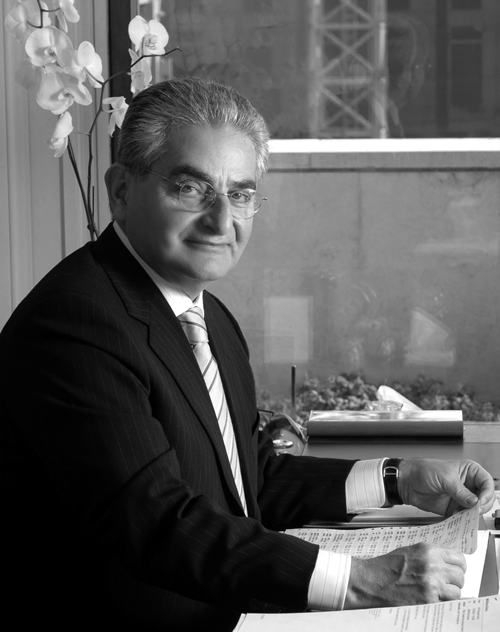
Salim G. Sfeir has been chairman and general manager of Bank of Beirut since 1993. He spoke with Executive about Bank of Beirut’s plan to open 14 new branches — 13 in Lebanon and one in Germany.

E How will the new branches fit with your bank’s strategy?
This is a plan that we would like to accomplish within the next six months. Our objective is to get it finished as soon as possible. But I think we won’t be ready by the end of this year. We should be ready by March 2010. We are starting with seven new branches. While we’re working on the first seven branches, we’ll be working on the second round of branches. What’s difficult is not the construction of the branches themselves; what’s difficult is finding the location that fits our objective. We do not want to go into areas that are already very well served by our competition. We would like to be located in areas where we can assist those who have not yet attracted the banking system.

E In which areas will you open new branches?
Right now we’ve decided to open three branches in Beirut, three branches in the South, three branches in the Metn area and three others in the Keserwan area. Now our challenge is to find places where we could better serve the societies that are not being served by the actual banking system.

E Did you feel that there was a high demand, both inside and outside of Lebanon, for more branches?
There is a high social demand. Why should an individual travel tens of kilometers to reach the closest branch to his house? The objective is more socially oriented than anything else.

E What was the strategy of opening a new branch in Germany?
As you know, we are already present in London and it is our European hub. But we felt we need to compliment the London office by   having more [of] a presence in Europe. London will remain our hub, but London will be more efficient if it has some other locations in Europe. We started with Germany because as you know, Germany is the wealthiest European country.

E What kind of banking will the new branch in Germany focus on? What kind of clients will you be catering to?
In Europe, we are focusing mainly on trade finance. From Europe we are serving the needs of the Lebanese diaspora in the Middle East and in Africa. Usually their needs are very diversified geographically and in terms of products.

E What about the branches in Lebanon? What kind of banking services will they provide?
Our branches in Lebanon are currently focusing mainly on retail business. They are serving our corporate customers and we are focusing on serving, from the branches, our corporate customers. But in fact our market penetration and retail needs more branches than the corporates.

E How much does a new branch cost? How many people will be employed at each branch?
The cost depends on the market; the number of people within the branch depends on the market. It really depends on the population density, wherever the branch is located. For example, if you open a branch in Hamra, you need more people than if you open a branch in the mountains. The minimum that you need to open a small branch is four to five people. The maximum is the sky.

We would like the new branches to reflect the image and the objectives of the bank. As you know, our slogan at Bank of Beirut is “banking beyond borders.” By this we mean that we do our best to serve all the needs of our customers, and the borders are in fact the needs of our customers; it’s not a geographic border. The needs of our customers are so diversified that we try to equip ourselves in the best way possible to best serve the needs of these people who have entrusted Bank of Beirut.

E In your opinion, what are the top issues and concerns for Lebanese banks in 2009?
The political stability in the country. This is the top issue that concerns everybody in the financial sector. We need political stability to best serve the present needs of the country and to prepare the future for our children. I am not very versed in politics, but my concern is to see political stability in this country.
 
E Recently, the International Monetary Fund noted that the top priority for Lebanese banks should be dealing with the public debt. What is your take on this? Should it be a top priority?
I haven’t seen any Lebanese bankers who are concerned about the public debt. We are more concerned with the efficiency of the public sector. When we make the public sector more efficient, the debt issue will be solved.

E  At the start of the financial crisis, some analysts were worried that foreign remittances into commercial banks would be negatively affected, as many of the Lebanese diaspora were reportedly losing their jobs abroad. Now that we’re well into the second half of the year, to what extent is this true?
I have some concerns about the economists, because they are never realistic! They are always worried; the economists shouldn’t worry. They should be more optimistic than they are.

Lebanon has many resources, first and foremost is its  resourceful citizens both here and abroad. If you assess the wealth of our diaspora overseas per capita, I think we are [some] of the wealthiest people in this world, because the Lebanese are creative, ambitious and have the courage to achieve. The economists should look at the qualities of the Lebanese businessman and not worry about whether Lebanese in the diaspora are losing their jobs or not.

E What has your institution learned from the international financial crisis? How have you applied these lessons to your long-term operations?
We have learned that the financial sector has to always be very, very, very liquid. The problem that our neighboring countries had was  a lack of liquidity. They were overstretched. The banks were overstretched. But the Lebanese banking system has learned what to do, not from the crisis, but because we survived 15 years of civil war. Our wish is to continue to have the country not just survive but prosper, no matter what challenges are thrown its way.  I think we have shown we can do that given Lebanon’s peformance during the financial crisis.

September 3, 2009 0 comments
0 FacebookTwitterPinterestEmail
Comment

Phoenicia‘s forgotten treasures

by Nicholas Blanford September 3, 2009
written by Nicholas Blanford

With his snow white Old Testament-style beard, floppy hat and intense, inquisitive gaze, Patrick McGovern cuts an unlikely figure for someone likened to Indiana Jones.

But rather than snatching mysterious ancient relics from Amazonian head hunters and avaricious Nazis, McGovern’s archaeological specialty is of a far more convivial nature. As scientific director of the Biomolecular Archaeology Laboratory for Cuisine, Fermented Beverages and Health at the University of Pennsylvania Museum in Philadelphia, he explores the roots of ancient alcohol production, and is recognized as the world’s leading expert in what is a relatively new field of science.

Lebanon, of course, is dripping with ancient history. We are all familiar with the Baalbek temples, the Phoenician port of Byblos, the Umayyad palace in Anjar, the Roman hippodrome in Tyre and the Crusader castles that dot the Levantine landscape. But a recent two-day tour around Lebanon with McGovern illustrated the richness of Lebanon’s archaeological past, and underlined how it often goes unnoticed, unappreciated or is squandered through neglect or indifference.

We began in Baalbek, where McGovern wanted to examine the carvings on the massive entrance to the Temple of Bacchus, the Roman god of wine, for evidence of poppies believed to have been added to ancient wines.

“There are no texts that say they added opium to wine, but the association of wine and poppies suggests that there might be something to it,” McGovern said.

Certainly, the carvings of poppies, along with sheaves of barley and vine leaves, are unmistakable on the sides of the temple’s entrance. McGovern has identified compounds from the residues of ancient wines to find the herbs and spices used as flavorings. An analysis of a consignment of 700 jars of Palestinian wine delivered to the Egyptian King Scorpion I in 3150 BC showed traces of coriander, mint and cumin.

From Baalbek, we headed to Sidon and the Phoenician temple of Eshmun. At first glance, the site is a jumble of stone blocks smothered in shrubbery and weeds. But with McGovern as my guide, details began to emerge. Carved from solid rock “in the Egyptian style” was the throne of Astarte, the Canaanite goddess of fertility. On either side were two easily missed carved sphinxes. The throne was positioned above conduits that fed the waters of a natural spring into a limpid pool lined with pungent flowers and green weeds. It was here that the Phoenicians would come for healing, buying flavored wine and herbs from the shops of apothecaries lining the narrow lane leading to the pool.

McGovern wanted to visit another well-known site in Sidon: the “Murex hill,” a man-made mound consisting of countless millions of shells from the eponymous sea snail, cultivated by the Phoenicians.

Finding the location of the hill was easy enough. Half of it is covered by a cemetery. As for the other half, a caretaker at the cemetery told us: “It’s gone.”
Gone?
“Yes, they dug it out about 10 years ago,” he said.

The seaward side of the hill had been removed to make way for a building, the foundations of which had been completed, but further work had ended sometime ago judging from the rust on the steel rebar poking out from the concrete. Behind the structure was a cliff of crumbling dirt and weeds some 50 meters high. On drawing closer, however, we suddenly realized we were looking at countless white murex shells. McGovern picked one up and explained how the Phoenicians would get pigment from the snail by extracting a gland that, on exposure to sunlight, turned intense purple. It took 10,000 murex shells to make just one gram of the coveted dye. “This is one of the largest known Phoenician garbage dumps ever discovered and it has never been excavated,” McGovern said.

We drove from Sidon to Sarafand, site of ancient Sarepta, “one of the best preserved Phoenician sites that has ever been excavated in the homeland of the Phoenicians,” said McGovern.

It had been 35 years since McGovern was last in Sarafand, working on a dig by the beach. His memory was hazy, and it took an older local who remembered the “archaeologique” to show us the former dig site. There was no evidence it had ever existed, however, smothered as it was by a thicket of bamboos and banana groves. Again, it took McGovern’s historical eye to transform what appeared to be a typical Lebanese beach into an important Phoenician harbor.
 

The flat sloped rock children fished and dived from was a Phoenician causeway. Even the flattish red pebbles that littered the beach were relics of the past — not stones, but Iron Age pottery shards.

Sarepta’s modern-day inhabitants seemed to have no knowledge of the historical importance of their surroundings, and the Lebanese authorities have shown no apparent interest in resuming the excavations that ended with the outbreak of the civil war in 1975.

“Being here gives you a sense of how fleeting time is,” McGovern reflected. “We put in a lot of effort here and it seemed so interesting and absorbing at the time. But no one seems to care anymore.”

Nicholas Blanford is the Beirut-based correspondent for The Christian Science Monitor and The Times of London

September 3, 2009 0 comments
0 FacebookTwitterPinterestEmail
Comment

Serve but don’t swim

by sean lee September 3, 2009
written by sean lee

There is an apocryphal story that has circulated around Beirut in various versions and goes something like this: a Filipina woman is swimming in the pool of an elegant private club. The Lebanese staff frantically tell her to get out, since domestic workers aren’t allowed in the pool. The story’s denouement comes when it is revealed that the Filipina woman is the wife of the ambassador — not a maid. 

Someone unfamiliar with regional folkways could be excused for not understanding the story. But for those living in Lebanon, or in Cairo or Dubai, certain nationalities have become code for specific professions: Slavic nations produce prostitutes, Egyptians are doormen and Syrians manual laborers — while Ethiopian, Sri Lankan and Filipina women are invariably domestic workers. So ingrained are these stereotypes that the most common word for a maid in Lebanon is “Sri Lankan.”

The story about the wife of the ambassador of the Philippines reveals a mixture of racism and classism that is difficult to parse, because the two are so inextricably intertwined. The swimmer is somehow excused for being Filipina, since her husband’s rank trumps his ethnic and national origins. I’ve heard similar stories of Americans or Europeans barred from nightclubs or swimming pools, or otherwise submitted to petty humiliations, because of the color of their skin or their ethnic origins, only to have the situation rectified by flashing a western passport. But finally, they are the lucky ones; they can escape the worst of the discrimination by simply producing western papers.

Human Rights Watch has gone so far as to quantify the discrimination suffered by foreign domestic workers in Lebanon. According to a study carried out by senior researcher Nadim Houry, 17 out of 27 beach resorts polled put restrictions on African and Asian domestic workers, ranging from prohibiting them from swimming at all to restricting access to the swimming pool.

Curious to know which places didn’t allow domestic workers in the pool, I made some calls posing as a father who’d like to bring his kids and their nanny, and then posted the results on my blog.  Here is a sampling of the results.

Eddé Sands (Byblos): Entrance is free for nannies, and according to the woman I spoke to, there is no problem for them to swim in either the pool or the sea.
Cyan (Kaslik): Under no circumstances are domestic workers allowed to swim, even if they pay full admission.  

Riviera Hotel (Beirut): Admission for nannies is apparently free, but they cannot swim in either the pool or the sea. When I asked if they could swim if they pay an entrance fee, I was told that it wasn’t a problem.

Laguava Resort (Rmeileh): Even if a domestic worker pays for entry as a normal guest, she cannot swim in the pool for adults, only in the “family pool” for children and the sea.   
Bamboo Bay (Jiyeh): If a domestic worker pays, she can use the facilities like any other paying guests. 

Jiyeh Marina (Jiyeh): For admission purposes, nannies are “considered as children,” and are allowed to swim “if they have a swimsuit,” but according to the woman I spoke to, “we prefer them not to.”

The BBC recently found similar discrimination at the Sporting Club, one of Beirut’s best known beach clubs, where the club’s manager acknowledged that “from a foreigner’s point of view,” his club was practicing discrimination. He defended the practice, explaining that he would have complaints from customers and lose business if he allowed domestic workers to enjoy the facilities like everyone else. Western foreigners, on the other hand, are more than welcome at Sporting Club.

Recreational swimming has a prominent place in the history of the American civil rights movement. In 1948, Strom Thurmond ran for president on an explicitly segregationist platform: “I wanna tell you, ladies and gentlemen, that there’s not enough troops in the army to force the Southern people to break down segregation and admit the nigra race into our theaters, into our swimming pools, into our homes, and into our churches,” Thurmond said in one campaign speech. 

Given the rampant discrimination in all aspects of domestic workers’ lives, getting worked up about swimming pools may seem a bit frivolous. But in Lebanon, like the segregated American south, the pool is but a symbol of larger injustice. Migrant workers are not considered equal with Lebanese under the country’s law.  They are in some cases abused with no legal recourse. For the huge role they play in Lebanon, migrant laborors deserve better. 

 
The buses in Lebanon are not segregated, so it would be misplaced to call for action like the 1955 bus boycott led by Martin Luther King Jr. And after all, with so many domestic workers denied the right to even leave the house, it’s hard to imagine how a boycott led by migrant workers would have much of an effect. Beaches with racist entrance policies, on the other hand, might be a good place to start for the rest of us.

SEAN LEE is an instructor at the English department at the American University of Beirut

September 3, 2009 0 comments
0 FacebookTwitterPinterestEmail
Comment

Obama’s healthcare woes

by Claude Salhani September 3, 2009
written by Claude Salhani

When it comes to politics, Americans, much like everyone else, are terrible ingrates. People tend to forget how bad things were under the old regime and remember only the positive, sweeping the negative aspects into the forgotten corners of their memory.

Indeed, it was just a matter of time before the honeymoon President Barack Obama enjoyed started coming to an end. If the president’s ratings in the rest of the world are still somewhat solid, his star is no longer shining as brightly in the US as it was when he entered the White House last January.

Just eight months into his presidency, the man who turned out to be one of the most popular presidents ever in the United States upon his election is now starting to see his ratings fall.

One must add that this is really through no fault of his own. When Obama entered the White House last January, replacing one of the most unpopular presidents in US history, people expected the impossible, and they expected it right away. But that’s not how politics work.

The expectations people had of this young president were astronomical, bordering on miraculous. They expected him to fix the economy, which was in a global recession and sliding faster than Bush’s popularity. Obama inherited a country with probably the worst financial crisis since the Great Depression rocked the nation following the stock market crash of 1929.

People expected Obama to end two highly unpopular wars –– one in Iraq and one in Afghanistan. Then of course there is the invisible war, the one still being fought in the shadows, the ‘War on Terror’, as President Bush liked to call it. An indication of how disinterested the American public is in the wars in Iraq and Afghanistan can be gauged through the lack of front-page articles on those two conflicts in the American press. Days can go by without either country making it onto page one.

Obama inherited the housing crunch brought about by the subprime mortgage crisis, triggered by a dramatic rise in mortgage delinquencies and foreclosures in the United States; that, in turn, had a negative impact on the world’s economy.

There was the climbing price of gas, which passed $3.70 per gallon for the American consumer before Bush left the White House (it was $1.45 when Bush took over from Clinton). But what perhaps contributed to Obama’s rapidly decreasing popularity, at least in the US, was his decision to take on the poisoned arrow of health care reform.

The reform of the American health care system has traditionally been the kiss of political death for anyone who dared touch it and its praetorian guard, the legions of lobbyists who protect their turf on Capitol Hill with the same zest with which Roman legions defended ancient Rome.

It was health care reform that brought the ire of the conservative movement in the US against current Secretary of State Hillary Clinton when she was the first lady, and when her husband President Bill Clinton gave her the impossible task of setting up universal health coverage for Americans, which remains the only industrialized country in the world without universal coverage for all its citizens.

As if that were not enough, there is another kiss of death for American politicians who dare to venture there: Middle East politics. Here again, there exists an uncanny expectation that Obama will wave his magic wand and the sea of animosity dividing the Middle East protagonists will suddenly allow a passage towards a peaceful solution to the six-decade conflict.

As of July, for the first time since his election, Obama’s popularity fell below the 50 percent mark, according to an ABC NEWS-Washington Post poll. The health care industry in the US is a huge business and the drug manufacturers spend millions of dollars every year lobbying Congress so that senators and congressmen and women will vote like they are supposed to vote; meaning, to maintain the complex and archaic system of healthcare currently in effect.

The trouble with the current system is that it does not make sense. The US spends more than any other nation on healthcare, yet 47 million people have no health coverage (from a population of 300 million). And all that money doesn’t buy American citizens much bang for their buck: the World Health Organization ranks the US healthcare system at 37 out of 191 countries surveyed.

America does have some of the best hospitals, doctors, and yes, healthcare in the world. Unfortunately, not everyone can see those great doctors and go to those great hospitals. And the system’s biggest problem is that healthcare is usually arranged through one’s employer, and so an employee (and his or her family) loses health care coverage if he or she loses his or her job.

But Obama could not begin solving the above-mentioned problems without the participation of all parties concerned. After all, he is President Obama, not Saint Obama. He accomplished the impossible soon after assuming the presidency: gas is down to around $2.35 a gallon and the economy has stopped sliding and is actually pick up.
Miracles however, take a little longer.

Claude Salhani is editor of the Middle East Times and a political analyst in Washington

September 3, 2009 0 comments
0 FacebookTwitterPinterestEmail
Comment

An embargo that shouldn’t fly

by Executive Staff September 3, 2009
written by Executive Staff

Sanctions are one of those political issues that can make amiable dinner conversation turn unpleasant, as the battle lines are drawn down the table between those for and against.

 Sanctions have certainly had mixed success, starting with the first recorded case of a trade embargo some 2,400 years ago between Athens and neighboring Megara. The embargo failed, sparking war.

Sanctions have never worked since then, argue some. “That is too reductionist,” may come the reply, while others prefer to pick-and-mix examples from embargoes through the ages to argue their case. The more pragmatic approach would be to not ask whether sanctions “work,” but to consider when and under what circumstances.

Sanctions that are meant to oust a dictator but result in the deaths of thousands of innocent civilians — Iraq for instance — can be considered counter-productive. Sanctions preventing a particularly nasty regime from getting hold of, say, chemical weapons, on the other hand, would appear desirable and effective.

In a report on the effectiveness of sanctions by the Washington-based Institute for International Economics, out of 211 cases from World War I until the year 2000, only 38 percent were successful.

Applying sanctions on the aviation sector can fall under the questionable effectiveness category. Impeding a country’s access to military aviation parts is understandable, but for commercial aircraft it ranks as dangerous. In the Middle East, this applies to Iran and until July, Syria, when the United States ended sanctions on the export of goods to the Syrian aviation industry. Sanctions were first imposed against Syria in 1979 and tightened in 2004 under the Bush administration.

Aviation sanctions have long been considered a risk to air safety, with airlines that own American and European manufactured aircraft (Boeing and Airbus) unable to purchase spare parts and navigation equipment, or to upgrade technology in line with international safety standards. A report prepared for the United Nations’ International Civil Aviation Organization has made this clear.

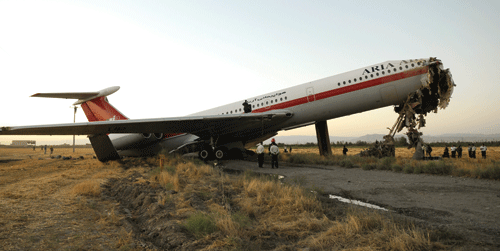
The danger sanctions pose to aircraft and passengers was underscored in July when two Iranian commercial planes crashed within 10 days of each other, killing 184 people. Iran claims the sanctions were to blame, and foreign ministry spokesman Hassan Qashqavi said the Western aviation sanctions in place since 1979 “signify a violation of human rights.”

While no Western lives were lost in the two crashes, it may only be a matter of time before citizens of the primary imposer of sanctions, the US, also become collateral damage, whether onboard a doomed aircraft, or while picnicking below when a badly serviced plane drops out of the sky.

As Flight Commander General Hazim al-Khadra, director general of the Syrian Civil Aviation Authority, told me in Damascus a few years ago: “Sanctions are a big problem because US aviation interferes with the aviation industry, the spare parts for commercial airlines in particular, which maintain the safety of passengers. And these passengers aren’t only Syrians, but also Europeans, Americans and Asians.”

Perhaps there would have to be the rather ironic situation of a plane that lacked the spare parts or proper guidance systems accidentally crashing into a US embassy or military facility, for Washington to truly wake up to the hazards of unsafe aircraft.

After all, it is curious that the Air France jet that crashed en route from Rio de Janeiro to Paris and the US Airways plane that ditched into the Hudson River in New York earlier this year garnered extensive media reports about aircraft safety, yet the aviation sanctions against Syria and Iran have not. Unsafe aircraft flying around the world are not safe for anyone, whether on the ground or in the air.

The US decision to end the sanctions against the Syrian aviation sector — which has rapidly opened up in recent years to include a handful of private airlines — is a step in the right direction. But the sanctions against Iran, and its aviation sector, continue. It even looks like the sanctions are going to be tightened further, with America proposing to ban Iranian airplanes from landing in Western airports, along with banning insurance on trade deals with Iran and the imposition of sanctions on any company that trades with the Islamic Republic.

While the heightened sanctions are meant to put further pressure on the Islamic Republic to change it ways, the policy should be scrutinized. The sanctions related to the curbing of Iran’s nuclear aspirations and funding to groups like Hamas and Hezbollah are a political minefield, with strong arguments from both sides of the political spectrum as to whether such a policy is working. Civil aviation however should be in a special category. It should be a human right for people — civilians — to be able to fly safely.

PAUL COCHRANE is the Middle East correspondent for the International News Services
 

September 3, 2009 0 comments
0 FacebookTwitterPinterestEmail
  • 1
  • …
  • 451
  • 452
  • 453
  • 454
  • 455
  • …
  • 688

Latest Cover

About us

Since its first edition emerged on the newsstands in 1999, Executive Magazine has been dedicated to providing its readers with the most up-to-date local and regional business news. Executive is a monthly business magazine that offers readers in-depth analyses on the Lebanese world of commerce, covering all the major sectors – from banking, finance, and insurance to technology, tourism, hospitality, media, and retail.

  • Donate
  • Our Purpose
  • Contact Us

Sign up for our newsletter

    • Facebook
    • Twitter
    • Instagram
    • Linkedin
    • Youtube
    Executive Magazine
    • ISSUES
      • Current Issue
      • Past issues
    • BUSINESS
    • ECONOMICS & POLICY
    • OPINION
    • SPECIAL REPORTS
    • EXECUTIVE TALKS
    • MOVEMENTS
      • Change the image
      • Cannes lions
      • Transparency & accountability
      • ECONOMIC ROADMAP
      • Say No to Corruption
      • The Lebanon media development initiative
      • LPSN Policy Asks
      • Advocating the preservation of deposits
    • JOIN US
      • Join our movement
      • Attend our events
      • Receive updates
      • Connect with us
    • DONATE