• Donate
  • Our Purpose
  • Contact Us
Executive Magazine
  • ISSUES
    • Current Issue
    • Past issues
  • BUSINESS
  • ECONOMICS & POLICY
  • OPINION
  • SPECIAL REPORTS
  • EXECUTIVE TALKS
  • MOVEMENTS
    • Change the image
    • Cannes lions
    • Transparency & accountability
    • ECONOMIC ROADMAP
    • Say No to Corruption
    • The Lebanon media development initiative
    • LPSN Policy Asks
    • Advocating the preservation of deposits
  • JOIN US
    • Join our movement
    • Attend our events
    • Receive updates
    • Connect with us
  • DONATE
Real estate

UAE – Investors vs. developers

by Nada Nohra September 3, 2009
written by Nada Nohra

Property disputes between real estate developers and investors in the United Arab Emirates have increased since the financial crisis crippled the country’s property market. Dubai’s property court has already recorded 833 dispute cases in the first six months of this year.

Analysts told Executive they believe numerous cases have not reached the courts yet, and with the continuing recession, the number is likely to increase in the coming months.

Little or no confidence 
The rise in the number of disputes stems mainly from Dubai’s property values decreasing and the sudden lack of credit and investors, which caused many projects to be put on hold or canceled. As a result, investors’ confidence in the market plunged and they started questioning if the projects would actually be delivered.

Jim Delkousis, partner and the head of mitigation and arbitration at the law firm DLA Piper, said these disputes are a catch 22: Investors claim that developments are not being built quickly enough and thus withhold further payments. On the other hand, developers say they will have to stop building due to investors’ payment defaults.

Nick Clayson, real estate partner at the international legal practice firm Norton Rose agrees, adding that there may be other parties involved who could slow the progress of construction and make the issue even more complicated.

“Some of the reasons why the properties are not being finished are because of disputes between building contractors and developers,” he said.
Investor confidence is also lower when dealing with developers who are delivering their first project, as they have no track record and are more likely to fail.

“Now that times are more difficult, a number of purchasers and investors are asking themselves if the developers are capable of completing their developments as they have little or no history to back them,” said Delkousis. Still, to know who to blame, each case has to be considered separately.

Investor groups
As investors started to worry about the completion of projects, they formed investor groups, putting themselves in a stronger position against developers. Clayson said that even though they can take no legal action as a group, they can discuss the issue and agree on taking the same steps.

One example is the 100 investors who own more than 200 apartments in the Abu Dhabi Tameer Towers that formed an investor group because they were concerned about the progress of the $1.64 billion project.

“Three CEOs in 15 months, cancelation of contracts, sacking of over half of its staff and no progress on site initiated our concern,” said one of the Tameer investors who didn’t want to be named because of the legal proceedings. 

Since the group was formed, the 100 individuals stopped making payments, explains the investor. He adds that they do not wish to discredit Tameer in any way, but have put forward a series of questions that they would like to see answered.
“We put these questions through ‘The National’ (newspaper) but they never got answered — Tameer wishes to deal individually and not with a group,” he said.

Tameer was unavailable to comment about the issue. Frederico Tauber, the company’s president, told Arabian Business in May that he would be glad to talk with concerned investors, but the company will not be able to return the money invested. He also said that some investors thought the project was canceled, which he said was a “misunderstanding.” In July, Tauber also told Arabian Business they had approached investors trying to understand their concerns, but some were reluctant to come forward. The Tameer investor said the company did not promise the group anything.

“They did say that they would work with all individuals to solve their payment issues and concerns — [a] divide and conquer strategy we feel, [as] individuals have less power compared to a collective group,” the investor said.

He also added that work on the site at the Tameer Towers has been progressing since August, but not to the extent that was promised. 
“Our way forward — well we are still evaluating this as a group — we have some good leads through some of the group’s members which we are looking into,” the investor said.

Lack of transparency
The recession is the main reason behind these disputes, but certainly not the only one. Another important factor that is negatively effecting the market is the lack of transparency between investors and developers.
“The communication is not as good as it should be, investors do not always know what is happening and they are not being kept fully informed by the developers,” said Delkousis.
The blame does not fall only on developers, since some companies might be very transparent and have offered solutions, given the current market situation. Some investors might also be “closing their minds to discussing the issue of delays, payments and things like that with developers,” said Clayson. 

Property court
The Dubai Property Court started functioning in September 2008. Delkousis draws a paralell between the courts and the issue of transparency, saying that investors are not being able to derive any guidance for their own case because most of the cases are private, confidential and run in Arabic.

It is expected that the number of property disputes will increase further, since some investors and developers are waiting to see what the next step of the other party will be. On the other hand, some cases might not even reach court. Clayson says that it would be much better for everyone to negotiate rather than go through the demanding process. Some developers might not even continue pursuing end-users who surely have no money left.

“It can be very time consuming and costly. They might be happy enough to accept that they will not get their money… [and] walk away,” said Clayson.

What about the laws?
One of the most important laws that is supposed to back investors is the escrow law, which came into effect on June 28, 2007. It applies to developers selling units off-plan and stipulates that payments by investors should be put into a special escrow account, which will be used solely for the designated project.

Delkousis said that having an escrow account is better for the purchaser, but it doesn’t make disputes easier to solve. “Investors and developers are fighting to see who is entitled to the money in the escrow [which] will depend on many things, including which party breached the contract,” he said.

Clayson said that a problem with the escrow law is that developers have been able to use the payments to pay for the land, thus leaving no money for construction and for refund if the project is canceled.

“Going forward, the escrow law now does not allow land payments to be made, that is my understanding from having spoken to the land department,” said Clayson. He added that the law should be taken one step further, and not used until the project is completed. Therefore in the case of any dispute, investors will be able to take their money back.

Going forward
The more investors hear about projects not being delivered, the more they are nervous about their  money, and the more disputes arise. So far, the market has not begun to settle down.
“I think it is safe to say that the [number of] cases is still increasing,” said Delkousis.

Clayson said investors and developers should understand that they are entering into a long-term deal, so due-diligence is necessary to ensure both parties can deliver. From the regulatory point of view, he said that the way for the market to recover is first to have a consistent legal regime. 

“Investors should be able to make their investment decisions knowing that the law is certain and will be applied fairly and consistently. That’s what the aim should be so that the market will recover,” he said.

September 3, 2009 0 comments
0 FacebookTwitterPinterestEmail
Real estate

Lebanon – Home on a mountain

by Nada Nohra September 3, 2009
written by Nada Nohra

In the next eight to 10 years the map of Lebanon will include a completely new village. BeitMisk, the new residential community located in the northern Metn region, is one of many newly-launched projects which affirm the country’s increasing attractiveness for real estate investment.

BeitMisk will cover 655,000 square meters and include apartment buildings, villas, penthouses, a country club, gardens, recreational areas and retail, offering its residents and visitors a home away from the cities’ pollution and traffic.

The $800 million project is unique in many aspects. The developers say the new village will use renewable energy and have environmentally friendly wastewater treatment facilities. Sustainable and green building materials will be used in construction, and some 70 percent of the development will be green space. BeitMisk will also blend historical and modern structures. Work is underway, construction has started and so have sales.

The BeitMisk project is owned by Renaissance Holding, of which the majority shareholder is Georges Zard Abou Jaoude — who is also the chairman of the Lebanese-Canadian Bank. It is 60 percent financed by Abou Jaoude himself and 40 percent by Banque Libano-Française (BLF). Emaar Lebanon, part of Emaar International Development — a subsidiary of the Dubai-based Emaar Properties — is the developer, while the Lebanese architectural company Erga Group did the architectural studies.

Building sustainability
BeitMisk is not as cutting edge as Abou Dhabi’s Masdar City, but it will include several green-building and sustainable initiatives.

“We will be very close to the LEED [Leadership in Energy and Environmental Design] standards,” says Nabil Zard Abou Jaoude, chairman of Renaissance holding and managing director of Emaar Lebanon, who spoke with Executive on behalf of Renaissance. He  explains that buildings will have double-insulated walls, excellent insulation for the roofs, and will use solar energy to decrease electricity consumption.

“It is not a marketing tool, but when you go into high specs, you are automatically very close to LEED,” says Nabil Abou Jaoude.
Anthony Sfeir, BeitMisk’s project coordinator at Erga Group, explains that the plumbing system, for example, will be separated into grey and black water, of which the grey will be recycled and used for irrigation. The project will also have a sewage treatment plant, where all the wastewater will be recycled and reused. “We will not be dumping waste effluent; we are treating everything,” he says.

Construction and sales break ground
So far, the only building constructed at BeitMisk has been the sales office, which will later be turned into a country club. In mid-July, sales began for the first phase of the project, which will see the construction of nine buildings with 72 apartments. Four of the buildings have traditional designs and five are modern, according to Nabil Abou Jaoude. He says that so far, some 32 percent of the units have been sold.

“It is better than expected,” he says, adding that he expects 80 percent of the units will be sold by year’s end. “I thought that just for the first two to three days, we will have some people interested and then only two to three clients per day… but we have a lot of potential clients.”

According to Georges Abou Jaoude, apartments start selling at $1,650 per square-meter, while townhouses start at $2,100. The prices of villas have not been determined yet since they need to be specifically designed before pricing. Apartments offered range between 177 and 330 square-meters, according to the sales office.

“These prices are launching prices; I expect them to go a little bit higher later on,” says Georges Abou Jaoude, adding that the target buyers are basically Lebanese. He expects only around 8 percent of the project will be sold to foreigners.

Construction of the first phase is expected to start at the end of the year, after all the permits have been obtained, irrespective of the units sold. Each phase is supposed to take up to two years.

“The first $100 million is already there, and the financing of the first and the second phases is already secured,” says Georges Abou Jaoude.

A sentimental value
Nabil Abou Jaoude say Renaissance is lucky to have found such beautiful land where they can develop a whole new town. The Northern Metn also holds sentimental value for the family since its roots come from that area.

Georges Abou Jaoude, formerly an architect before becoming a banker, also carries high hopes for this project.
“I want [Beit Misk to be] the most beautiful village in Lebanon, and maybe in the world.” 

Environmental concerns
But with many of Lebanon’s high mountains already spoiled by poorly planned development and half built concrete homes and apartment buildings, is the unspoiled upper Metn really a place to build a suburban neighborhood?

 
BeitMisk may be advertised as environmentally friendly, but the fact that construction will destroy a part of the forest did not render environmentalists very enthusiastic. Wael Hmaidan, executive director of IndyAct, a league of independent environmental, social and cultural activists, says that BeitMisk will destroy the natural habitat and the ecosystem of a big part of the mountain forest.

“There will be plantations rather than a forest ecosystem. You cannot compare it. The dynamics are different,” Hmaidan says. “A tree does more than give oxygen. It is a habitat, a house and an eco-system.” 

Garaved Kazanjian from Greenpeace agrees with Hmaidan. He says that the organization does not support these projects, but has no capacity to pursue every development that threatens what is left of the Lebanese natural wealth.

For the same reason, Hmaidan says that campaigning against any single development is a lost cause. What should be done is to reform planning policies in Lebanon so developments would not be allowed if they threaten the sustainability of Lebanese forests. “We can continue like this until we don’t have a single forest in Lebanon,” Hmaidan says. “Or we can create urban planning and a system to benefit all levels of society.”

Georges Abou Jaoude says the BeitMisk project will blend with the local area’s environment. “We will be planting 200,000 trees in the development and a little bit around it,” he says, adding that only some 25 percent of the project will be built-up area.
 
A small walk around
So far, only the master plan of the project has been designed. The construction will be divided into phases, each being a neighborhood, and each phase will have its own final design. Buildings, villas and townhouses will be surrounded by gardens and plantations, while biking and walking paths will also surround the whole project.

“People will be able to see many views as they are walking. At one point they are looking at Beirut, then the sea, then they will be looking at the mountain to their right as they are walking,” says Georges Abou Jaoude.

Most of the buildings will have three floors; only apartment buildings will have four floors. Villas will be provided with two to three parking spaces each, and two for every apartment building — even visitors will be provided with public parking spaces. Roads will also be designed to minimize cross-town traffic.

“The project has been designed by Erga, so there is a traffic engineer who worked on that,” says Nabil Abou Jaoude.
BeitMisk will also be divided into two parts. The upper part, which includes the villas and the townhouses, will become a closed community — although that decision is not final, says Nabil Abou Jaoude.

September 3, 2009 0 comments
0 FacebookTwitterPinterestEmail
Real estate

Lebanon – Sama Beirut

by Nada Nohra September 3, 2009
written by Nada Nohra

Beirut will soon have a new tallest building. Called ‘Sama Beirut,’ developers have already broken ground on the 50-story luxury residential tower in the Sodeco area. Launched in mid-August by Sama developer Antonios Projects, it is expected to be completed by 2014. The tower will rise from a 5,000 square meter plot, of which the actual building will occupy 1,200 square meters, leaving the rest for a private garden.

Tower specifications
Sama Beirut will be 200 meters high, with six underground floors used for storage and parking for 560 cars. An underground floor will also have a gym with private access for the tower’s residences. Six shops will be divided between the ground and the first floor. Offices will be situated on the third and the eighth floors.

The tower will host 58 apartments of various sizes, ranging from 300 to 1,500 square meters, as well as duplexes and a penthouse. Apartments start at the 9th floor and have a private entrance from Elias Sarkis Avenue. Part of the land belonging to the development will also be used to enlarge the road, with the aim of decreasing traffic. It will also utilize green technology.

“We have a beautiful sun in Lebanon, and we will be using it as much as possible,” says Fady Antonios, chairman of Antonios Projects. He explains that the tower will use solar energy for water heating, thus saving a substantial amount of electricity. Antonios says the tower will be more than 250 meters above sea level, thus higher than the city smog.

“The tower will be taking the fresh air from the top and feeding the whole building,” explains Antonios.  Waste water will also be treated and reused for irrigating the large garden.

“We have other features like the insulation of the building which will be of very high standards, so it will need less heating and less cooling… We have all the electromechanical requirements of the LEED (Leadership in Energy and Environmental Design) certification.”

Antonios says that one of the reasons why he chose the Sodeco area is its strategic location.
“You are five minutes from Solidere and very close to the airport. You are close to the main access of Beirut,  [be it] towards the north, the south, or to the mountain. It is a very quiet area. It is very well located and the people love to be in Achrafieh.”

The other reason why Antonios chose the Sodeco area is rather sentimental. “I come from that area and I love it. I attended school there.”
But some weren’t so happy to see the new tower’s plans.

Beirut’s tallest tower in Ashrafieh?
The new skyscraper is exciting news to real estate investors and wealthy buyers, but it is not the case for heritage activists who think that Sama Beirut is one of the many misplaced developments that will ruin the historical cluster still present in the Sodeco area, like Monot and Abdel Wahab Al Englizi street.
 

“It is on the edge of one very important cluster,” says Mona Hallak, an architect and a member of the Association for Protecting Natural Sites and Old Buildings in Lebanon (APSAD).
Hallak adds that due to a lack of  proper urban planning to prohibit building towers in historic areas, Beirut will lose its historic neighborhoods in a few years.

“Now we have [a tower] at the edge of a heritage cluster. In two years we will have it in the middle of the cluster,” Hallak says.
Fady Antonios says that he had the possibility to build six identical small buildings which would be cheaper, but instead chose to use only 20 percent of the land and leave 80 percent for gardens and greenery.

“On the contrary, the tower leaving all this space will bring all the historical buildings into relief, since they will not be hidden by just concrete blocks.”

Wael Hmaidan, executive director of IndyAct, a league of independent environmental, social and cultural activists, agrees with Hallak saying, “we are definitely against it.”
“We need to understand the value of old architecture,” Hmaidan says, explaining that Lebanon’s comparative advantage to places like Dubai is its old architecture, moderate climate and social life — not high-rise towers.

Hallak says that high rise towers need to have more open space to breath. “This… is not a place for a tower. Nobody will notice how bad it will be until it is done and there will be no sun in that area,” she says.

Both Hallak and Hmaidan say that the only solution for keeping heritage clusters from being ruined is to have a proper urban plan. Currently, to get approval to build a tower, the permit has to be reviewed by the directorate general of urban planning for the purpose of stopping random urbanization. But so far, Hallak says, all proposed towers have been approved. “If you are approving all towers, why are you reviewing them in the first place?” she adds. 

There are also no public meetings to discuss the construction with the nearby businesses and property owners before the towers are approved.

A downbeat first reaction
Others had a similarly negative reaction to Sama Beirut. Massad Fares, whose company Prime Consult is managing Sama’s marketing and sales, said Minister of Interior Ziad Baroud was not very enthusiastic when he was first asked to sponsor the launching of the tower. He even mentioned so in the launching ceremony, where he said that he was shocked at first by the news and not very supportive, but then changed his mind when he saw the green surrounding Sama Beirut.

“We sat with him and showed him what we are doing and how we took from our land to enlarge the road and the green space that we kept — it increases the value of all its surroundings,” explains Fares. “Instead of building concrete, we are going to build a high, beautiful tower and put it in a nice environment.”

Sales have started
All the construction permits have been approved and sales have begun for apartments and offices in the building.

“We have a waiting list,” says Fares. Until now, Fares says that the interest came from only Lebanese people, either residing in Lebanon or abroad.

“It doesn’t mean that there will be no Gulf people, but so far, we only have Lebanese buyers.”
Apartment prices range from $5,000 per square-meter to $15,000. Offices are priced around $4,000 per square meters, while shops go for up to $11,000. Offices and shops are not only offered for sale, but also for rent.

“The good thing about this portfolio and this client for us is that he is financially sound and not pushing to sell,” says Fares.


September 3, 2009 0 comments
0 FacebookTwitterPinterestEmail
Banking

GCC – The Saad-Algosaibi disaster

by Executive Staff September 3, 2009
written by Executive Staff

The veil of secrecy shrouding the scandal involving two financial titans — Saad Group and Ahmad Hamad Algosaibi & Brothers Company — has regional financiers fearing untold billions of dollars in further losses.

Both conglomerates are owned and run by two families once considered among the wealthiest and most well respected, not just in Saudi Arabia, but the entire Middle East. The sole surviving son of the founder of the Algosaibi group, Sulaiman Algosaibi, was ranked number 368 by Forbes in 2008 on its list of world billionaires. The owner of Saad Group, Maan al-Sanea — of Kuwaiti origin — is married to one of Algosaibi’s daughters. Both companies could borrow hundreds of millions and even billions of dollars based on reputation alone.

Currently, the details of cross-ownership between Algosaibi and Saad are unclear. So far, the only confirmed crossover that has emerged is the role of Money Exchange, a foreign remittance handling company owned by the Algosaibi conglomerate. Apparently, Algosaibi put Sanea in charge of Money Exchange, based in the United States. Now Algosaibi is suing Sanea in New York on charges of embezzling $10 billion through Money Exchange’s operations.

Media reports say that both Saad Group and Algosaibi Group owe billions of dollars in debt to regional and international firms. Estimates from various sources range from $9 billion to $22 billion, but the actual amount is unknown. Dow Jones reported that the two firms’ total syndicated debt amounts to $7.42 billion, spread over 88 international banks. Dow Jones also said that lenders outside the region hold $4.88 billion of this debt, meaning GCC banks and holding companies’ exposure is around $2.54 billion.

Standard Chartered Bank, however, said Saudi banks’ exposure alone is some $5 billion. The lack of transparent information has kicked the rumor mill into full swing, thus creating much uncertainty throughout the region’s financial sector.

Nassib Ghobril, head of the economic research and analysis department at Byblos Bank in Lebanon, said that because banks are not releasing enough data about how much exposure they have to these groups, lenders are taking a step back.

“Right now, this situation is creating a lot of uncertainty, making banks even more careful in terms of lending,” he said.
Mahin Dissanayake, associate director of the financial institutions group at Fitch Ratings in Dubai, said the lack of information is largely due to confidentiality agreements. Yet, the “basic information is still unclear. We do not know what the background of this dispute is.”

Clear as mud
The absence of transparency in the Middle East is a major obstacle to finding the root of the problem, especially due to the family-oriented nature of this issue. EFG-Hermes research pointed out that the “initial lack of public communication by [Saad Group and Algosaibi Group] led to a degree of panic.”

The firms’ troubles first emerged in May of this year when both companies apparently ran into severe liquidity problems amidst the global credit crunch. Unfortunately, four months later, the picture is not much clearer and is now more complicated than ever.

At the end of May, the Saudi Arabian Monetary Agency instructed banks in the kingdom to freeze all Saad Group accounts. Soon after, the central bank froze Sanea’s personal accounts. After Algosaibi filed a lawsuit against Sanea in New York’s Supreme Court for embezzlement, US authorities had his accounts in the Cayman Islands frozen, which were valued at some $9.2 billion.

“It’s still not clear even in the Gulf — that’s why there isn’t enough information,” Ghobril said. “This is creating a lot of uncertainty in the GCC, specifically in the banking sector.”

What is certain though is the impact the scandal has had on the regional banking system. Speaking on condition of anonymity due to the sensitivity of the subject, a senior banker with inside knowledge of the crisis said, “There isn’t a single bank that was not involved in lending to these guys, internally and internationally. In order for you to get a meeting with Maan al-Sanea, you basically have to lend him $60 to $100 million. If you want him to invest $1 million in something, he will ask you to lend him $9 million. And people did it, because he was making all of these banks a lot of money,” the banker said.

“The Algosaibi family was happy, because Sanea was paying them X-hundreds of millions in dividends every year,” the banker added. “They were happy with the way things were going, until whatever happened happened and now they are in trouble. There was a lot of smoke before the shit hit the fan.”

With the unfolding circumstances, transparency is taking a top spot on the region’s priority list. Due to the excessive lending based on reputation alone, accountability is under serious scrutiny. “Now,” said Ghobril, “there will be a decline in name-lending, leading to a systematic due diligence approach. These are two of the biggest groups in the Gulf, not only in Saudi Arabia. Now they’ve ended up with liquidity problems and in default. There will be more calls for transparency altogether.”

Credit rating agency Standard & Poor’s released a special survey at the end of July on the issue, highlighting the imperative need for transparency and accountability in GCC banking.
“Corporate transparency and public communication is, in general, limited,” the authors wrote. “Public communication following the discovery at the Saad and Algosaibi groups has been minimal, including from the regulators.”

The private ownership structure of the conglomerates makes it even more difficult to discover the truth.

“The family ownership of certain GCC banks and corporate groups creates, at least in theory, specific risks that may be difficult to assess, including succession risk, key man risk, related party exposure and contagion risk,” the survey said. “Overall, we believe that these family ownership structures are a negative credit factor. Corporate governance and transparency in the Gulf is, in general, relatively poor and needs to be enhanced.”

Bahrain
The trouble for Algosaibi group first materialized in Bahrain, where the company’s wholly owned bank, The International Bank Corporation (TIBC), defaulted on its loans. These loans amounted to $2.2 billion, according to EFG-Hermes. After TIBC’s defaults came to light, it was downgraded by numerous credit rating agencies, “before ratings were withdrawn altogether,” noted EFG-Hermes. At the beginning of June, it became clear that another Bahrain-based institution, Awal Bank — fully owned by Saad Group — had neglected creditors and was also in need of restructuring its obligations.

EFG-Hermes said that, “Both banks are likely to have faced erosion in the value of their assets, although Algosaibi Group has also hinted at financial irregularities at TIBC. While there is no formal relationship between the two groups, the shareholders are closely related.”
In July, Bahrain’s central bank took control of both Awal and TIBC. The central bank appointed law firms to administer operations for both financial institutions. Trowers and Hamlins will be in charge of TIBC while Charles Russell LLP will take care of Awal Bank.

In an attempt to soften the blow, on August 6, the governor of Bahrain’s central bank, Rasheed al-Maraj, insisted to Al Arabiya television that the exposure of TIBC and Awal Bank would not affect the country’s banking sector as a whole. “I want to make clear… that the damages from these two banks are very limited and there is no systemic risk to the banking sector in Bahrain,” he said.

However, EFG-Hermes reported that the “spill-over to the banking sector has been swift, setting off a wave of lenders seeking reassurance from the groups about their outstanding obligations.”

Saudi Arabia 
HSBC estimated that Saudi banks’ lending exposure to both Algosaibi and Saad Group could be anywhere between $4 billion and $7 billion. On August 26, Standard Chartered Bank said Saudi banks’ combined exposure to both groups amounts to some $5 billion. Victor Lohle, credit analyst at Standard Chartered, noted that no Saudi bank has ever failed, as the sovereign has always been there to save the day — especially since numerous government agencies have stakes in several Saudi banks.

But EFG-Hermes reported that, “None of the banks in Saudi Arabia have disclosed their exposure to the two business groups. Given that both groups were considered top quality credit in the country, we tend to believe that almost all the banks would have exposure to both or one of the two groups. However, given the lack of disclosure by the banks, it is difficult to determine which banks have the highest exposure. Emirates Business 24/7 reported that Samba Financial Group has syndicated exposure of $300 million (1.2 percent of total loans) to Saad Group. However, the bank has not verified this.”

Kuwait
Like Saudi Arabia, Kuwaiti banks and the central bank have yet to release any statements or disclosures regarding exposure to the Saudi groups. At the beginning of June, Kuwaiti press reported that the central bank requested that banks freeze all accounts of Algosaibi and Saad Group. Later on, however, Saad Group contested such reports. EFG-Hermes said that various Kuwaiti newspapers estimate that total local bank exposure to the groups ranges between $750 million and $1.14 billion.

United Arab Emirates
The UAE’s central bank governor, Sultan bin Nasser al-Suwaidi, suggested that UAE banks have rather “significant” exposure to both groups. Quoting unnamed sources, Emirates Business 24/7 reported that syndicated and bilateral exposures of UAE banks is around $3 billion. According to EFG-Hermes, “The principle exposures listed are [Abu Dhabi Commercial Bank] ($435 million), Mashreqbank ($210 million), [First Gulf Bank] ($55 million), [National Bank of Abu Dhabi] ($7 million).” The research hub is also concerned that Abu Dhabi Islamic Bank has yet to release the details of its exposure.

A Dubai-based financial analyst, who spoke on condition of anonymity due to confidentiality agreements, said that the UAE government told banks with exposure to Algosaibi or Saad Group that they “must provide up to 50 percent for Algosaibi and 75 percent for Saad Group exposure.”

In July and August, the UAE Central Bank arranged meetings with its domestic banks regarding the Algosaibi and Saad crisis. During both gatherings, banks were advised to freeze credit lines to the Saudi groups, and cover all exposure to the firms. A third meeting at the end of August drew more than 100 bankers, creditors, lawyers and accountants together in Dubai to discuss the latest developments. Unfortunately, the talks reached a stalemate.

A lawyer who attended the meeting told Reuters that the crisis “may take years to solve.”
Mashreqbank, the fourth largest bank in the UAE by current market capital, was the first to announce its exposure. In July, the bank filed a lawsuit in the New York Supreme Court against Algosaibi, claiming $225 million in defaulted loans. Algosaibi then filed a counter-claim against Mashreqbank accusing it of helping and abetting fraud executed by Saad Group. In response, Mashreqbank claims the allegations are “completely without merit.”

In an attempt to kick-start a formal solution process, Algosaibi held a meeting with lenders in the UAE at the end of August. Attended by bankers and creditors, Algosaibi reportedly proposed a unilateral scheme to resolve the crisis. The conglomerate said it would only honor debts that originated from “genuine borrowings” supported by “genuine” documentation and procedures, implying it would not take responsibility for the loans taken without the proper paperwork and solely based on the name-lending trend.

Algosaibi also notified the UAE bankers that other kinds of borrowing on its books with inauthentic signatures had occurred, and thus they claim they are not accountable for repayment. More precisely, the group said they are “not willing to settle” these debts. Bankers told Emirates Business 24/7 that a solution would be found only once an agreement is reached between Algosaibi and Saad. They also informed the news agency that Saudi authorities “are planning to set up a committee” that is specifically designed to resolve the issue.

The unnamed senior banker placed the blame on the chairman of Saad Group, Sanea, not Algosaibi. “In all fairness, the Algosaibi family did not do anything wrong. Their biggest mistake was giving a free hand to Maan al-Sanea to run their affairs [with Money Exchange]. He basically brought this whole thing down,” the banker said.

“Maan Al-Sanea and others know how to talk to the international market and these international banks and get them on their side. They understand the inclination and greed for profit of these European banks, and they use it — that’s how any intelligent businessman would do it,” the banker said.

Oman and Qatar
Oman and Qatar have been surprisingly transparent relative to their GCC brethren; only they have released detailed exposure to date.

Qatar Nation Bank and Qatar Islamic Bank both reported no material exposure to either Algosaibi or Saad Group. Commercial Bank of Qatar, however, has “declined to disclose any information, although this may change following [second quarter 2009] results,” said EFG-Hermes.

Oman has responded surprisingly quickly to the issue, with the central bank directing all Omani banks to report their exposures immediately. “Bank Muscat, which has the biggest exposure to the two groups among Omani banks, announced that it has direct exposure of $130 million and a $45 million [exposure] through its Bahrain-based subsidiary, Bank Muscat International. National Bank of Oman announced that it had inter-bank exposure of approximately $17 million to the Bahrain-based TIBC and Awal Bank.” EFG-Hermes also said that the rest of Omani banks reported no exposure to either group.

Speculation
The only clear thing about the Algosaibi and Saad Group mess is the uncertainty of it all. How both companies got into so much trouble together is not so black and white; they are related through family ties, but operationally Saad Group claims to have no ties to Algosaibi whatsoever. It seems the problems between the two companies may have started from an internal family dispute, but this is not confirmed.

Recently, Saad Group admitted it was going through a liquidity squeeze, while suggesting that rumors regarding the group were derived from “a private family issue,” which they said they were working towards solving. At this point it’s become an issue that is clearly not as simple as a little family spat.

Unfortunately, the road to recovery for investor sentiment in the Middle East has now taken a back seat. EFG-Hermes said that “investor sentiment for banks in the region is likely to remain weak owing to the lack of disclosures by banks relating to their exposures to the two business groups, as well as the lack of details on the possible restructuring of the loans.”

With so many banks not disclosing information of their exposure to the groups and regional governments downplaying and keeping quiet on the situation, every lead only results in a dead-end. Transparency has now become the linchpin of this problem, with bankers, analysts, lawyers and investors across the region calling for the implementation of transparency reforms.

Ghobril said the “lack of disclosure and communication about this is a major problem, because it affects investor confidence, investor sentiment, banks and their future lending.”

What’s worse is that the governments around the region are likely to remain hushed about their domestic banks’ exposures. EFG-Hermes said, “A further difficulty for estimating the impact on banks is that it is highly likely that the central banks will exercise significant discretion in determining any losses and reporting of those losses.”

The name lending practice and lack of transparency cannot remain, said the senior banker.
“It has to change,” he said. “The pain is not only being felt in the Saudi and Middle Eastern private sectors, but also the sovereign. The sovereigns have had to fork out billions of dollars in order for them to get their act together. From here onwards, the rules of the game will have to change, but it will take a lot of time.”

“It’s not going to work [on name lending] anymore. The Algosaibi family will get out of this, but they will get out owing the Saudi government a hell of a lot and being very scrutinized by the system and their peers,” the banker said.

Dissanayake said this problem will continue well into 2010, especially for banks around the region. “Our initial reaction was that the dispute would be resolved between the two parties. I think the market expected that as well. That was essentially the best-case scenario, but things have changed now. At the moment, we’re looking at a long, drawn out legal battle with more creditors likely to take legal action.”

The banking insider familiar with the Algosaibi and Saad Group turmoil believes that the “unwinding of this whole mess will take many, many, many years.”


September 3, 2009 0 comments
0 FacebookTwitterPinterestEmail
Banking

Bank of Beirut – Salim G. Sfeir (Q&A)

by Soraya Darghous September 3, 2009
written by Soraya Darghous

Salim G. Sfeir has been chairman and general manager of Bank of Beirut since 1993. He spoke with Executive about Bank of Beirut’s plan to open 14 new branches — 13 in Lebanon and one in Germany.

E How will the new branches fit with your bank’s strategy?
This is a plan that we would like to accomplish within the next six months. Our objective is to get it finished as soon as possible. But I think we won’t be ready by the end of this year. We should be ready by March 2010. We are starting with seven new branches. While we’re working on the first seven branches, we’ll be working on the second round of branches. What’s difficult is not the construction of the branches themselves; what’s difficult is finding the location that fits our objective. We do not want to go into areas that are already very well served by our competition. We would like to be located in areas where we can assist those who have not yet attracted the banking system.

E In which areas will you open new branches?
Right now we’ve decided to open three branches in Beirut, three branches in the South, three branches in the Metn area and three others in the Keserwan area. Now our challenge is to find places where we could better serve the societies that are not being served by the actual banking system.

E Did you feel that there was a high demand, both inside and outside of Lebanon, for more branches?
There is a high social demand. Why should an individual travel tens of kilometers to reach the closest branch to his house? The objective is more socially oriented than anything else.

E What was the strategy of opening a new branch in Germany?
As you know, we are already present in London and it is our European hub. But we felt we need to compliment the London office by   having more [of] a presence in Europe. London will remain our hub, but London will be more efficient if it has some other locations in Europe. We started with Germany because as you know, Germany is the wealthiest European country.

E What kind of banking will the new branch in Germany focus on? What kind of clients will you be catering to?
In Europe, we are focusing mainly on trade finance. From Europe we are serving the needs of the Lebanese diaspora in the Middle East and in Africa. Usually their needs are very diversified geographically and in terms of products.

E What about the branches in Lebanon? What kind of banking services will they provide?
Our branches in Lebanon are currently focusing mainly on retail business. They are serving our corporate customers and we are focusing on serving, from the branches, our corporate customers. But in fact our market penetration and retail needs more branches than the corporates.

E How much does a new branch cost? How many people will be employed at each branch?
The cost depends on the market; the number of people within the branch depends on the market. It really depends on the population density, wherever the branch is located. For example, if you open a branch in Hamra, you need more people than if you open a branch in the mountains. The minimum that you need to open a small branch is four to five people. The maximum is the sky.

We would like the new branches to reflect the image and the objectives of the bank. As you know, our slogan at Bank of Beirut is “banking beyond borders.” By this we mean that we do our best to serve all the needs of our customers, and the borders are in fact the needs of our customers; it’s not a geographic border. The needs of our customers are so diversified that we try to equip ourselves in the best way possible to best serve the needs of these people who have entrusted Bank of Beirut.

E In your opinion, what are the top issues and concerns for Lebanese banks in 2009?
The political stability in the country. This is the top issue that concerns everybody in the financial sector. We need political stability to best serve the present needs of the country and to prepare the future for our children. I am not very versed in politics, but my concern is to see political stability in this country.
 
E Recently, the International Monetary Fund noted that the top priority for Lebanese banks should be dealing with the public debt. What is your take on this? Should it be a top priority?
I haven’t seen any Lebanese bankers who are concerned about the public debt. We are more concerned with the efficiency of the public sector. When we make the public sector more efficient, the debt issue will be solved.

E  At the start of the financial crisis, some analysts were worried that foreign remittances into commercial banks would be negatively affected, as many of the Lebanese diaspora were reportedly losing their jobs abroad. Now that we’re well into the second half of the year, to what extent is this true?
I have some concerns about the economists, because they are never realistic! They are always worried; the economists shouldn’t worry. They should be more optimistic than they are.

Lebanon has many resources, first and foremost is its  resourceful citizens both here and abroad. If you assess the wealth of our diaspora overseas per capita, I think we are [some] of the wealthiest people in this world, because the Lebanese are creative, ambitious and have the courage to achieve. The economists should look at the qualities of the Lebanese businessman and not worry about whether Lebanese in the diaspora are losing their jobs or not.

E What has your institution learned from the international financial crisis? How have you applied these lessons to your long-term operations?
We have learned that the financial sector has to always be very, very, very liquid. The problem that our neighboring countries had was  a lack of liquidity. They were overstretched. The banks were overstretched. But the Lebanese banking system has learned what to do, not from the crisis, but because we survived 15 years of civil war. Our wish is to continue to have the country not just survive but prosper, no matter what challenges are thrown its way.  I think we have shown we can do that given Lebanon’s peformance during the financial crisis.

September 3, 2009 0 comments
0 FacebookTwitterPinterestEmail
Comment

Phoenicia‘s forgotten treasures

by Nicholas Blanford September 3, 2009
written by Nicholas Blanford

With his snow white Old Testament-style beard, floppy hat and intense, inquisitive gaze, Patrick McGovern cuts an unlikely figure for someone likened to Indiana Jones.

But rather than snatching mysterious ancient relics from Amazonian head hunters and avaricious Nazis, McGovern’s archaeological specialty is of a far more convivial nature. As scientific director of the Biomolecular Archaeology Laboratory for Cuisine, Fermented Beverages and Health at the University of Pennsylvania Museum in Philadelphia, he explores the roots of ancient alcohol production, and is recognized as the world’s leading expert in what is a relatively new field of science.

Lebanon, of course, is dripping with ancient history. We are all familiar with the Baalbek temples, the Phoenician port of Byblos, the Umayyad palace in Anjar, the Roman hippodrome in Tyre and the Crusader castles that dot the Levantine landscape. But a recent two-day tour around Lebanon with McGovern illustrated the richness of Lebanon’s archaeological past, and underlined how it often goes unnoticed, unappreciated or is squandered through neglect or indifference.

We began in Baalbek, where McGovern wanted to examine the carvings on the massive entrance to the Temple of Bacchus, the Roman god of wine, for evidence of poppies believed to have been added to ancient wines.

“There are no texts that say they added opium to wine, but the association of wine and poppies suggests that there might be something to it,” McGovern said.

Certainly, the carvings of poppies, along with sheaves of barley and vine leaves, are unmistakable on the sides of the temple’s entrance. McGovern has identified compounds from the residues of ancient wines to find the herbs and spices used as flavorings. An analysis of a consignment of 700 jars of Palestinian wine delivered to the Egyptian King Scorpion I in 3150 BC showed traces of coriander, mint and cumin.

From Baalbek, we headed to Sidon and the Phoenician temple of Eshmun. At first glance, the site is a jumble of stone blocks smothered in shrubbery and weeds. But with McGovern as my guide, details began to emerge. Carved from solid rock “in the Egyptian style” was the throne of Astarte, the Canaanite goddess of fertility. On either side were two easily missed carved sphinxes. The throne was positioned above conduits that fed the waters of a natural spring into a limpid pool lined with pungent flowers and green weeds. It was here that the Phoenicians would come for healing, buying flavored wine and herbs from the shops of apothecaries lining the narrow lane leading to the pool.

McGovern wanted to visit another well-known site in Sidon: the “Murex hill,” a man-made mound consisting of countless millions of shells from the eponymous sea snail, cultivated by the Phoenicians.

Finding the location of the hill was easy enough. Half of it is covered by a cemetery. As for the other half, a caretaker at the cemetery told us: “It’s gone.”
Gone?
“Yes, they dug it out about 10 years ago,” he said.

The seaward side of the hill had been removed to make way for a building, the foundations of which had been completed, but further work had ended sometime ago judging from the rust on the steel rebar poking out from the concrete. Behind the structure was a cliff of crumbling dirt and weeds some 50 meters high. On drawing closer, however, we suddenly realized we were looking at countless white murex shells. McGovern picked one up and explained how the Phoenicians would get pigment from the snail by extracting a gland that, on exposure to sunlight, turned intense purple. It took 10,000 murex shells to make just one gram of the coveted dye. “This is one of the largest known Phoenician garbage dumps ever discovered and it has never been excavated,” McGovern said.

We drove from Sidon to Sarafand, site of ancient Sarepta, “one of the best preserved Phoenician sites that has ever been excavated in the homeland of the Phoenicians,” said McGovern.

It had been 35 years since McGovern was last in Sarafand, working on a dig by the beach. His memory was hazy, and it took an older local who remembered the “archaeologique” to show us the former dig site. There was no evidence it had ever existed, however, smothered as it was by a thicket of bamboos and banana groves. Again, it took McGovern’s historical eye to transform what appeared to be a typical Lebanese beach into an important Phoenician harbor.
 

The flat sloped rock children fished and dived from was a Phoenician causeway. Even the flattish red pebbles that littered the beach were relics of the past — not stones, but Iron Age pottery shards.

Sarepta’s modern-day inhabitants seemed to have no knowledge of the historical importance of their surroundings, and the Lebanese authorities have shown no apparent interest in resuming the excavations that ended with the outbreak of the civil war in 1975.

“Being here gives you a sense of how fleeting time is,” McGovern reflected. “We put in a lot of effort here and it seemed so interesting and absorbing at the time. But no one seems to care anymore.”

Nicholas Blanford is the Beirut-based correspondent for The Christian Science Monitor and The Times of London

September 3, 2009 0 comments
0 FacebookTwitterPinterestEmail
Economics & Policy

The single currency conundrum

by Chitro Majumdar September 1, 2009
written by Chitro Majumdar

The mountain of bad debt still on the books of the United States banking system and now emerging in the European banking system, as well as the furious monetization of dubious assets undertaken by the Federal Reserve and European Central Banks, is coming back to haunt us.


The Greek crisis is a direct result of an insane policy of artificially low interest rates which allowed the reckless fiscal extravagance of an entire nation to continue unchecked. Such profligacy left Greece’s terms of trade stagnating since the advent of the euro and perpetuated tax evasion — estimated at more than 30 percent of tax revenues — taking gross government debt to 115 percent of the country’s $352 billion economy.

Exacerbating this were debatable accounting practices and Goldman Sachs-engineered financial tricks that led the credit default swaps (CDS) spreads to 450 basis points.

To mitigate the impact of the Greek crisis on other European nations, the European Monetary Union (EMU) took the seemingly paradoxical step of issuing a gigantic package of almost 1 trillion euro in further debt.  This being debt, rather than the bank equity offered in the United States’ TARP program, it does not provide the benefit of the money multiplier, due to the fractional banking system. This has had the net effect of weakening the euro and spreading the contagion throughout Europe, thanks to the immediate widening of CDS spreads for some “Club Med” countries, which then extended outright to France and Germany.

As the Greek fiasco spreads, we should not forget the Gulf Cooperation Council nations, which have in recent years entered serious talks on establishing a single currency. This new currency, with its proposed US dollar peg, will now be subject to a thorough, critical revision.

Through the introduction of a single currency the GCC would provide a broader platform for economic integration and promote the non-oil sector, which could supply a more balanced mix of revenues and more distributed job opportunities to grow the region’s economy. Also, a single currency would decrease the transactional cost involved in bilateral exchange between the region’s countries. As the degree of economic integration increased, the non-oil sector would help offset foreign exchange costs, reduce accounting expenditure and other costs firms incur when operating in more than one GCC country.

However, the first lesson we can draw from the euro crisis is that a monetary union without fiscal and inevitably political unification may fail under the stress of crisis. A common currency fosters an artificial convergence of interest rates to the lowest denominator, and allows countries to defer addressing productivity disparities and fiscal imbalances, until a crisis forces a painful realignment of the fiscally weaker. A common currency imposes currency rigidity that precludes the possibility of engineering fast International Monetary Fund-type interventions, such as a dramatic devaluation to jump start growth.

So how would a single GCC currency impact the region should a crisis threaten macroeconomic stability?

Most GCC countries currently maintain considerable surpluses — collectively 26 percent of GDP in 2008 — and therefore need not issue debt. Until oil revenues constitute less than 50 percent of GDP, however, the proposed new currency will inevitably be linked to oil prices. After 2008, which saw oil peak at above $100 a barrel then plunge briefly to $30, possible volatility could be uncomfortable to say the least.       

As an April 2010 Jadwa Investment report rightly noted, Greece’s high budget deficit had been largely based on its ability to draw on Eurozone membership to borrow cheaply abroad. However, the bank said a comparable scenario was unlikely in the GCC due to the similarity of the Gulf nations’ oil-based economies, meaning imbalances between nations were less likely.

As we can see from the ongoing euro crisis, a regional common currency can be a double-edged sword. As such, the architects of a GCC monetary union will have to evaluate and incorporate lessons from the euro’s woes, and carefully consider if the next logical step — a fiscal and political union — is a wise choice for the future.


September 1, 2009 0 comments
0 FacebookTwitterPinterestEmail
Money Matters

Money Matters by BLOMINVEST Bank

by Executive Staff August 28, 2009
written by Executive Staff

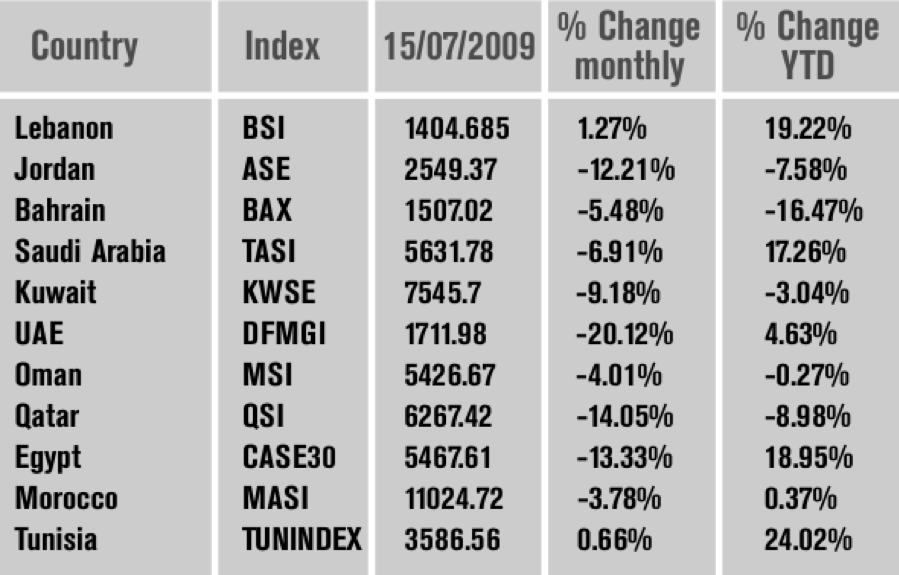
Regional stock market indices

Regional currency rates

Trade Bank of Iraq to issue $10 billon in credit

The Trade Bank of Iraq (TBI) aims to issue $10 billion in letters of credit in 2009. This represents an increase of 11.11 percent on 2008, amid increased private sector activity. Most of the bank’s business will remain in the public sector, with the addition of issuing around $1.8 billion in letters of credit to the private sector. In 2008, TBI’s net profit rose 41 percent to reach $359.3 million with a net operating income that rose 51 percent to reach $447.1 million. However, this profit will most likely remain flat this year as a result of the global economic crisis. The bank plans to enhance its domestic retail activities by opening five more branches in Iraq and three more branches abroad, in the United Kingdom, Turkey and Lebanon. It will also seek help from international investment banks in order to structure an Iraqi investment fund to finance tourism, infrastructure and industrial projects in the country.

ADNOC and Conoco Phillips deal

ADNOC (Abu Dhabi National Oil Company) and Conoco Phillips (US) signed a final agreement to invest in a $10 billion project known as the SGD (Shah Gas Development). The two companies signed the joint venture and field-entry agreement to create a new company with an ownership that will be split 60:40 between ADNOC and Conoco Phillips, respectively. This new venture aims to develop ‘sour’ or sulphur-rich gas reserves at the Shah gas field in the south of the emirate, and build processing and transportation infrastructure for 540 million cubic feet of gas alongside liquid sulphur pipelines and an export terminal at Ruwais. US company Fluor completed the front-end engineering and design for the scheme in March and documents for the construction phase of the project in June have been released. The Shah Gas Development project is one of the largest energy infrastructure developments to be approved in the Middle East in 2009.

Algerian expansionary policy

As oil and gas prices remain below their 2008 highs, Algeria expects its government revenue to fall sharply in 2009. Nevertheless, the Algerian government will still maintain an expansionary fiscal policy in order to boost economic activity in the country. The 2009 budget has been set at $72 billion, up from $68.5 billion in the supplementary 2008 budget, and revenue is projected at $39.19 billion, of which $16.7 billion is in tax receipts. As oil prices recover further along with the global economy, Algeria’s central budget deficit is forecasted at 2.4 percent of GDP in 2009 (compared to an estimated surplus of 9 percent of GDP in 2008). Real GDP growth is expected at 3.3 percent for 2009 and economic growth is anticipated to accelerate in 2010 thanks to a slight recovery in export markets. Average inflation is expected to fall sharply to 4.3 percent in 2009. As for the currency, Banque d’Algérie (BdA) will still maintain a managed float of the Algerian dinar in order to strengthen it. Additionally, rising oil prices are likely to continue to fuel the economy and trade surplus is expected to grow to $20.6 billion for the year.

August 28, 2009 0 comments
0 FacebookTwitterPinterestEmail
Executive EducationSpecial Report

Learning for the corporate world

by Executive Staff August 28, 2009
written by Executive Staff

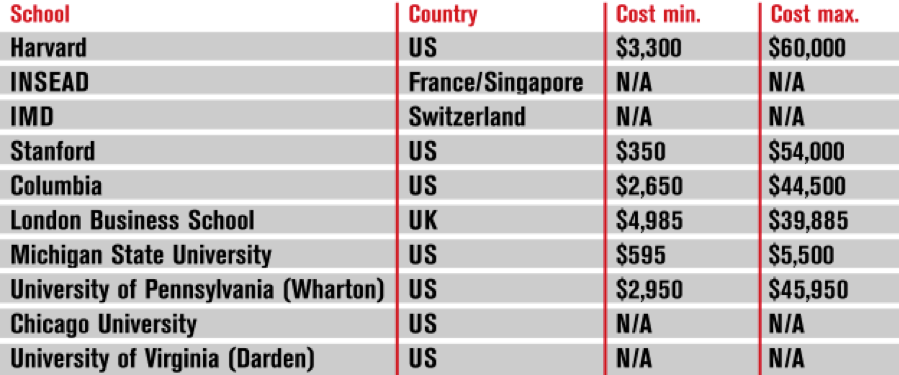
Top 10 international executive education programs

Source: BusinessWeek

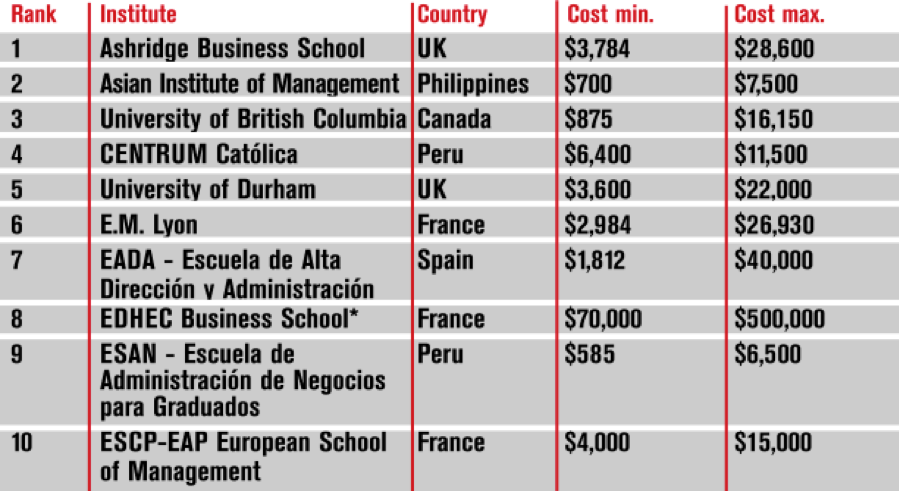
Top 10 non-US executive education programs

*Custom program
Source: BusinessWeek

At an executive managerial level, it isn’t easy to make long-term commitments unrelated to work. Executive education programs are tailored to those who want to continue their education but are unable to spare a year or two obtaining an Executive Master’s Business Administration (EMBA), or executive master’s degree in business administration. While no degrees are issued upon completion of executive training courses, participants receive accredited certificates. With shorter, smaller classes, executive education courses come in two forms: open enrollment and customized courses.

Business schools around the world have created tailor-made executive education courses for companies aiming to enhance their employees’ skills. Harvard Business School, the world’s top executive education provider, works with companies to develop specially designed courses to fit the organization’s needs. Training courses benefit the individual employee as well as the entire company, according to Harvard.

Open enrollment courses are also valuable, as employees acquire skills on a personal need basis and then apply the knowledge in their working environment. For example, ‘Achieving Outstanding Performance’ is a five-day course offered by INSEAD. This course is for senior managers in companies focusing on initiatives to enhance its staff’s performance.

Another course offered by INSEAD is the “Family Enterprise Challenge.” This four-day course is “an overview of the latest thinking and best practices on a wide range of family enterprise topics, using real family business cases.” With many small to medium-sized enterprises and family-owned businesses in the Middle East, this class is ideal for regional executives. Other institutions offer numerous topics ranging from “advanced strategic management” at International Institute for Management Development in Switzerland to classes on “interpersonal dynamics for high-performance executives” at Stanford and “wealth management” at Wharton.

Lighter on the pocket and softer on time away from the office, executive education is an alternative to a long-term EMBA in today’s competitive and rigorous global business circumstances.

August 28, 2009 0 comments
0 FacebookTwitterPinterestEmail
Executive EducationSpecial Report

How the successful push further ahead

by Executive Staff August 28, 2009
written by Executive Staff

Fine-tuning your professional skills may be your best bet to retain a position or get a promotion. If you are a middle to senior manager with 10 to 15 years of managerial experience, the executive masters of business administration (EMBA) is for you.

Unlike the specific MBA, where students choose a particular specialization in business administration, the EMBA covers a wider range of skills, and does not explicitly focus on one issue. Instead, the EMBA provides executives with the breadth and depth of business management skills they need to boost their career. MBA programs are full-time programs, whereas EMBA degrees offer more flexible scheduling. Once an individual has reached a senior management position, they have the ability to take a few working days off to travel and focus on their studies every month, especially since companies are aware of the benefits its employees are gaining. Completing an EMBA gives executives significant leverage over their peers and competitors. Candidates for the EMBA are fast-paced, hard-working individuals, who are unquestionably devoted to their careers.           

Outside of the United States, the EMBA is quite a new concept; it has only appeared in the rest of the world within the last decade. The American University of Beirut (AUB) introduced its EMBA program in February 2004, and has since graduated 90 executive students. International programs, such as the London Business School and INSEAD — both of which opened campuses in Dubai — have larger clusters of students, as these programs have been around slightly longer. The limited awareness of EMBA programs is starting to change, as more globally renowned institutions are transplanting their programs into the Middle East while regional universities are starting to pick up the pace.

Top 20 international EMBA schools

Source: BusinessWeek

Do you fit the profile?

EMBA students in the region and around the world are largely mid-level executives who are ready to climb the next rung on the ladder, and senior executives wanting to sharpen their skills.

Edward Buckingham, director of EMBA programs at INSEAD, outlines the different kinds of individuals who frequently participate in an EMBA. First, there are the specialists. This group includes doctors, lawyers, engineers, accountants, architects and the like, who have already matured in their specific careers. At some point, these specialists become so good at their job that they are asked to lead a department.

“Very often, [specialists] haven’t had the chance to do an MBA earlier, so they need the training to take on more responsibilities,” say Buckingham.

Riad Dimechkie, director of the EMBA program at AUB’s Olayan School of Business, says experts are those seeking to widen the scope of their business knowledge.

“[These students] are often functional experts, so they have expertise in sales, accounting, information technology and they want more breadth, they want to know something about the more functional areas so that they can deal with them at a strategic level,” he says. “Or, they are getting ready to be promoted and want to learn about the functions they don’t know about firsthand.”

Dimechkie notes the specialists joining an EMBA program bring a lot of industry knowledge with them, whether it be in banking, law, finance or other major industries.

“They already have another career but they want to understand more about businesses with which they have some kind of relationship,” he says. “[For example,] if a lawyer deals with business people, they will want to have a better sense of business strategy and business accounting. Medical doctors may want to start up their own practice, or have shares in a business they want to oversee.”

The second group of EMBA students, according to Buckingham, are entrepreneurs. Such individuals have built-up their own company within the last five to 10 years and did not have the time to do a full-time MBA program.

“They shoulder an enormous amount of responsibility for their organization and community,” he says. This group also includes owners of small and medium-sized enterprises and family-owned businesses.

Dimechkie and Buckingham similarly highlight a final group of executive students, known as ‘the generalists.’ According to Dimechkie, this group is usually made up of general managers (GMs).

“These could be people who inherited a business or who were promoted to being a GM. All of a sudden they’re going from a GM to dealing with lawyers, bankers, insurance, hiring people, etc…  so they too need the breadth,” he says. “They also need more depth, because many of them come from non-business backgrounds and they are tired of managing by trial and error and want some fundamental analytical tools, conceptual frameworks, and more to better make decisions and most importantly, to be more confident in the decisions they make.”

Buckingham says generalists are often managers in multinational corporations or large companies.

“They have a lot of social capital within their company, around five to 10 years of experience within the same company. They are committed to a path and want to develop themselves,” he says. 

Many specialists need E.M.B.A. training to take on more responsibility in their careers

The learning curve

EMBA programs around the region allow participants to engage with one another in safe surroundings. Executive students are given the opportunity to test business ideas, concepts, frameworks, proposals and strategies with their classmates who come from a variety of cultural and career backgrounds. The classroom enables executives to interact with one another and experiment with different ideas without feeling insecure, says Dimechkie.

“Executives get to really enjoy the opportunity to share and bounce their ideas off of other people with similar or different backgrounds, because it’s a safe environment,” he says. “They don’t get the chance to do that in their own company, as they’re afraid to take chances because they want to be consistent with past behavior patterns or because they don’t want to be judged.”

Kevin Dunseath, director of the EMBA program at London Business School in Dubai, believes that executive students learn an unparalleled amount of information during the course.

“Our students will learn at least as much from one another as they will from the professors,” he says. “The professors have around 20 years of teaching experience, but in the class you’re going to have 800 years of combined work experience, from a huge variety of professional backgrounds.”

The dynamics of an EMBA classroom provides an edge for students. Dimechkie says that teachers are the facilitators of learning, as they manage the class without directly lecturing its students.

“The really clever professors are the ones that use the invisible hand; they’re intervening at the right time to push the discussion in a certain direction or to emphasize a point,” he says, adding that EMBA participants acquire knowledge in a different way than young students do.

“Executives learn in a much different way than [undergraduate] students do,” says Dimechkie. “They don’t learn by sitting and listening to lectures. They learn by doing, [just as they’ve been] learning while they’re on the job for the last 20 years. They learn by reflecting on what they’ve done and seeing if it was the right way to do it or not.”

Because students must be employed full-time during the program, what is learned in the classroom can be immediately applied in the workplace.

E.M.B.A. Programs build an extremely powerful, influential and well-connected network of people

Added value

Most EMBA programs meet every three to four weeks, for two to three day block sessions. No matter what program one chooses, classes are extremely diverse as executives fly from all around the world to participate in the top-notch courses. With so much diversity around, executives get to network with each other during and after the program.

“By the end of the program, [participants] would have built up an extremely powerful, influential, very well-connected network of people,” says Dunseath.

Dimechkie also highlights the networking opportunity that EMBA programs create.

“It’s very important for people to [get the chance to network] in the region, because they are the people they’re going to be working and connecting with for the rest of their lives,” he says. “[Executive students] tend to develop very close and strong relationships with each other, and very often go into business ventures together.”

Executives around the world gain a tremendous amount of leverage over their peers in their company, as each month they return to the office from the program with new ideas. Alumni of EMBA programs gain the ability to quickly analyze complex business issues, and quickly make decisions about them. Dimechkie explains the mixture of rigor and relevance common in an EMBA program.

“[The executive students] need the relevance to apply what they’re learning, quickly. The idea is to quickly take those concepts [from class] and struggle and wrestle with them and try to apply them in the real world,” he says.

It is key to note that EMBA programs are not tailor-made to regional issues or economies. The point of such an executive degree is for students to learn and apply knowledge at a global level, thus providing alumni with the most universal and cutting edge business tools around.

Executive students are taught comprehension of overall business functions, from human resources to balancing the organization’s books. EMBA programs also teach leadership skills, demonstrating how to manage large groups from the most senior level.

Corporate sponsorship

Many companies in the world sponsor senior employees seeking an EMBA. Corporations view sponsoring higher education as a retention strategy, with some asking their employees to promise to remain with the company for a certain amount of time upon completion of the corporate sponsored degree.

“Companies use the EMBA as a risk management tool for people to get the training they need and to get feedback on how to progress further,” says INSEAD’s Buckingham.

Since the global financial crisis took hold, many companies simply do not have the means to fund such pricey programs.

“Companies that send people tend to send them less during times of crisis, as one of the first things they want to save is expenses on training,” says Dimechkie. “If a company is laying people off, to turn around and spend $50,000 on one person doesn’t look that great within the company.”

The flipside of the financial turmoil is that it lures eligible candidates to ameliorate their knowledge and skills, and think about returning to education. Since last year, London Business School has witnessed a 20 percent increase in its applications. Still, corporate funding is not always available. Many students pay from their own pockets, if need be.

“One difference that we’ve noticed in the last 12 months is that fewer companies are willing or able to provide corporate sponsorship,” says Dunseath. “But, we are confident that as business confidence builds up in the coming months, we’ll attract more corporate sponsorship again.” 

Obstacles for women

Around the MENA region, and the world generally, few women are enrolling in EMBA programs.

“There are fewer women in upper-middle and top management in the Arab world than there are men,” Dimechkie says. “Also, the average age group of participants [in the AUB EMBA] is around 40 years old. At that age, women usually have young families so it’s hard for them to constantly leave and participate in such a rigorous program.”

He wishes there were more women in the program, and like his peers in the region, makes continuous efforts to encourage top female executives to enroll.

“Once, we had 15 percent, which is still way too low… but the program is very expensive for people in [the region], so we’re trying to make a scholarship for women specifically,” he says.

International universities also face this obstacle. Dunseath estimates that only 10 to 20 percent of participants at the London Business School in Dubai are female. Buckingham says the INSEAD program in Beijing has around 27 percent women enrolled, while the Fontainebleau program has a class  composition which is approximately 17 percent female.

“We recognize that this is part of a larger problem,” says Buckingham. “It’s difficult for women to balance career and home life. There’s another problem o­­f companies who are not so open minded about hiring women with children, as they’re worried that their loyalties will lie with the family and not the company.”

EMBA programs in the Middle East

* Tentative: expected to be launched in fall 2010
Source: Executive Magazine

Movin’ on up

Career advancement is one of the possible rewards upon completion of one’s EMBA. Graduates may receive salary increases, promotions, or may have the pleasure of being headhunted for higher positions in another company. It’s a two-way street though; Dimechkie says just because a EMBA candidate has been “in a pressure cooker for 20 months” doesn’t mean they will automatically receive the related perks.

Conversely, companies must make an effort toward recognizing their hard-working employees.

“Companies need to recognize that people are making huge investments in themselves — while also sacrificing their family time and social life — and if you don’t watch them or give them opportunities to grow, you might lose them,” says Dimechkie. “It’s the executives’ responsibility to make an impact, but also the companies’ responsibility to give them opportunities to expand.”

Of the AUB EMBA graduates, around 70 percent are either promoted within their company or are recruited by other companies at more senior levels. Alumni of the London Business School’s Dubai program double their salary within three years of completing the program. But Buckingham say what’s most interesting is how EMBA alumni’s careers are reoriented and redeveloped after the program.

Ultimately, no matter how much money one spends or how prestigious the institution, the onus lies in the hands of the EMBA participant.

“Just because you’re working hard and getting an education, if you don’t make an impact in the organization you’re in, they are not going to promote you or give you a higher salary,” says Dimechkie. “Somehow, you have to figure out a way to make an impact. Once they get noticed, they get promoted.”

August 28, 2009 0 comments
0 FacebookTwitterPinterestEmail
  • 1
  • …
  • 453
  • 454
  • 455
  • 456
  • 457
  • …
  • 696

Latest Cover

About us

Since its first edition emerged on the newsstands in 1999, Executive Magazine has been dedicated to providing its readers with the most up-to-date local and regional business news. Executive is a monthly business magazine that offers readers in-depth analyses on the Lebanese world of commerce, covering all the major sectors – from banking, finance, and insurance to technology, tourism, hospitality, media, and retail.

  • Donate
  • Our Purpose
  • Contact Us

Sign up for our newsletter

    • Facebook
    • Twitter
    • Instagram
    • Linkedin
    • Youtube
    Executive Magazine
    • ISSUES
      • Current Issue
      • Past issues
    • BUSINESS
    • ECONOMICS & POLICY
    • OPINION
    • SPECIAL REPORTS
    • EXECUTIVE TALKS
    • MOVEMENTS
      • Change the image
      • Cannes lions
      • Transparency & accountability
      • ECONOMIC ROADMAP
      • Say No to Corruption
      • The Lebanon media development initiative
      • LPSN Policy Asks
      • Advocating the preservation of deposits
    • JOIN US
      • Join our movement
      • Attend our events
      • Receive updates
      • Connect with us
    • DONATE