• Donate
  • Our Purpose
  • Contact Us
Executive Magazine
  • ISSUES
    • Current Issue
    • Past issues
  • BUSINESS
  • ECONOMICS & POLICY
  • OPINION
  • SPECIAL REPORTS
  • EXECUTIVE TALKS
  • MOVEMENTS
    • Change the image
    • Cannes lions
    • Transparency & accountability
    • ECONOMIC ROADMAP
    • Say No to Corruption
    • The Lebanon media development initiative
    • LPSN Policy Asks
    • Advocating the preservation of deposits
  • JOIN US
    • Join our movement
    • Attend our events
    • Receive updates
    • Connect with us
  • DONATE
Lebanon

Reconstruction – The Jewish revival

by Executive Staff July 1, 2009
written by Executive Staff

The dilapidated structure of the Magen Avraham synagogue is nearly all that remains of the Jewish presence in Lebanon. A once vibrant community that numbered in the tens of thousands is now almost non-existent. The few Jews that remain in Lebanon live as discreetly as possible. A new project to raise $1 million, launched by the Lebanese Jewish Community Council to restore the Magen Avraham synagogue in downtown Beirut, holds the possibility of bringing back the community’s presence. Those behind the renovation plan want to reestablish Magen Avraham as a functioning synagogue, and they’ve raised hopes that an overt Jewish presence in Beirut and the Mount Lebanon environs — which has Jewish history that may stretch back as far as 3,000 years — can emerge again.

The Magen Avraham synagogue  — the name means “Abraham’s Shield” — was built in 1926 in what was the Jewish quarter of Wadi Abu Jamil in downtown Beirut. The grandness of the synagogue plans meant that a great deal of money needed to be raised. The Lebanese Jewish Community Council, just after World War I, managed to raise some funds for its construction, but it was considerably less that what was needed for the ambitious project.
While the community kept a very distinct Lebanese identity, the majority were also part of the transnational Sephardi Jewish community. The Sephardi Jews originally came from the Iberian Peninsula (Spain and Portugal) and North Africa and, despite their early geographical dispersal, kept a distinct identity and liturgy separate from the Jews of Eastern European descent, the Ashkenazi, and the Jews who remained in the Middle East, called Mizrahi Jews. Thus, the Lebanese Jews used this Sephradi Jewish network to raise funds for the synagogue. The community appealed to Moise Abraham Sassoon from Calcutta, who donated money toward the completion of the Magen Avraham synagogue, while the land was donated by Raphael Levy Stambouli. Sassoon would dedicate the synagogue to his father.
The synagogue was designed by architect Bindo Manham and was built in the imposing symmetrical style of the Renaissance. When completed the synagogue would be declared the grandest in the Middle East and secured Wadi Abu Jamil as the focal point for the Lebanese Jewish community. Jacques Baghdadi, who grew up in Wadi Abu Jamil and left when he was 18 (in 1970) to the United States, described to Executive what it was like living in the Jewish quarter of Beirut.
“It was very cliquey; it was like living in one big family,” he said. “We had two schools and everyone went to the two schools… so it was a very cocooned area and I have very fond memories of the community there.”

The wider community

Despite the fact that the Jewish community was “cocooned” in Wadi Abu Jamil, there is a historical Jewish presence in other areas of Beirut as well.  One noticeable trace of the once thriving community is the  Beth Elamen cemetery just off Sodeco square that, similar to the synagogue, is in disrepair and overgrown with trees and weeds. According to Georges Zeidan, who wrote an article on the history of the Jewish cemetery in Beirut in French, entitled “Histoire du Cimetière Juif à Beyrouth,” the first Jew was buried in the cemetery in 1829. Now the gravestones lie in tatters.
The Jewish community also had a presence in other parts of Lebanon.
“The first significant wave of Jews to Lebanon came in 1710 when a significant number of Andalusian Jews fled from the Spanish inquisition to the safety of the Chouf mountains,” Kirsten Schulze wrote in her book “The Jews of Lebanon: Between Coexistence and Conflict.”
In Miziara, a village in the mountains above Tripoli in northern Lebanon, Diab Doudib, in his 70s, said Jews had once lived there. “If you look at the patterns of the olive trees, that is not our way, but the Jewish way of planting. They were here a long time ago, but there are no Jews here now,” he said.


Family
Origins
Contribution in Lebanon
Where they are now

Safra

Jacob E. Safra was a banker from Aleppo who fled to Beirut when

the Ottoman empire

disintegrated.

Safra opened the J. E. Safra bank in Beirut in 1920. The bank would become  the bank of choice for the Lebanese Jewish community. Edmond Safra, the son of Jacob, was born in Beirut in 1932. The Safra family moved to Brazil in 1952, where Edmond Safra built on his father’s business to accumulate personal wealth of $2.5 billion. Joseph Safra, the son of Edmond, now runs the Safra group and was listed as the fourth richest South American by Forbes, with an estimated wealth of $8.8 billion.

Zilkha

Originally from Baghdad

Credited with bringing modern banking to the Middle East and formed a central part of the commercial and finance activites in Wadi Abu Jamil. The family was among the wave of Syrian and Iraqi refugees that moved to Lebanon in the 1940s.

83 year old Ezra Zilkha inherited Zilkha & sons, a private investment company, from his father Khedouri Zilkha. The family moved to New York in the 1950s. By the 1980s, Ezra was listed on the Forbes 400. Ezra now concentrates on philanthropy and is a board member of the Council on Foreign Relations and a Brookings Institution trustee.

Tarab

Originally from Damascus

A prominent business family in Wadi Abu Jmiel who founded the Talmud Torah Selim Tarab school. The school was located behined the Magen Avraham synagogue and
was demolished in April 2008.

Isaac Tarrab was killed in 1986 in Beirut by The Organization of the Oppressed People on Earth. His son, David Tarrab, emigrated to the US, and now lives in New Jersey where he works as a pediatric dentist. His brother is an attorney in New York.

 Deir al-Qamr was the location of one of the first concentrations of  Lebanese Jews. The Chouf village is still home to the oldest synagogue in Lebanon, but like most of the remnants of the Lebanese Jewish presence, the synagogue is in a ruined state. From the Chouf, the Lebanese Jewish community spread to Saida and Tripoli as they increasingly moved toward commercial hubs.
This migration would ultimately lead the community to Beirut and Wadi Abu Jamil, as the city was becoming an ever-more dominant trading hub at the beginning of the 20th century.
Lebanese Jews would rise to prominence around the world for their business acumen, although unfortunately not in Lebanon. “Being Lebanese and Jewish was a real winner when it came to trade and banking,” George Lati, a Lebanese Jew who left Lebanon when he was a teenager and immigrated to the US, told Executive.
The Latis are a famous banking family whose members still own property in Beirut and exemplify the business success of the Lebanese Jewish community.
“Italy saw an export resurgence in the 1970s thanks to Lebanese Jews [who emigrated] as well as Hong Kong, Mexico, Brazil, Panama, USA [and] Canada, where there were all successful Lebanese Jewish businesses,” he said.
Most famous of all the Levantine Jewish families was the Safra family. The Jacob Safra Bank was a central banking institution in Beirut for many of the Sephardi Jewish families of Lebanon and Syria. Safra’s son, Edmond Safra, was born in Beirut and earned a reputation for being one of the outstanding figures in 20th century banking, and died a billionaire.  The Safra family would move from Lebanon to Italy in 1949, just after Israel declared statehood. Although the Safra family left Lebanon when Israel was created, this was not typical of Lebanese Jews.
“Lebanon was the only Arab country in which the number of Jews increased after the first Arab-Israeli war,” Schulze wrote.
Lebanese Jews were highly integrated into Lebanese society and became the only Jewish community in the Middle East to be constitutionally protected in the proclamation of Greater Lebanon in 1920. Even after the first Arab-Israeli war, the tradition of sharing religious festivals continued.
“In 1951, during the Passover celebration, the president of the Jewish community Joseph Attie held a reception at Magen Avraham synagogue which was attended by Lebanese Prime Minister Sami as-Solh, Abdallah Yafi, Rachid Beydoun, Joseph Chader, Habib Abi Chahla, Charles Helou, Pierre Gemayel and the Maronite Archbishop of Beirut,” Schulze wrote.

The disappearance

A gradual exodus of Jews began with the internal strife in Lebanon in 1958. Jacques Baghdadi, a Lebanese Jew who left the country in 1970, described to Executive how tensions increased after the Six Day War.
“We never felt the threat like in Syria and Iraq. We never felt oppressed, but after the Six Day War you felt in the air a certain bothering feeling,” he said.  “Even though we were born Lebanese, you felt not welcome… so [the Lebanese Jewish community] left… and it was like a sixth [sense]; sure enough the civil war broke [out].”
The decisive moment was the Israeli invasion and occupation of Lebanon in 1982, which was effectively the beginning of the end of the Jewish presence in Lebanon. Robert Fisk, a British foreign correspondent who lived in Beirut during the civil war, wrote in his book “Pity the Nation,” that “incredibly, the Israeli shells even blew part of the roof off the city’s synagogue in Wadi Abu Jamil, where the remnants of Beirut’s tiny Jewish community still lived… The last 10 families to worship there padlocked the door after the Israeli shells came through the roof.”
The Israeli invasion of 1982 left the Lebanese Jewish community particularly exposed to the vicious violence that would occur post-invasion. Wadi Abu Jamil was the scene of fierce fighting, and was first occupied by the Palestine Liberation Organization and then the Amal Movement. The Amal logo is still on the walls of the synagogue to this day, along with torn pictures of the late Amal leader Musa Sadr. Former Associated Press bureau chief Terry Anderson, who was kidnapped in 1985 and held for six years, was reportedly taken into the Wadi Abu Jamil area.
Between 1984 and 1987, 11 leading members of the Jewish community were kidnapped and killed by a militant Shiite Islamic organization called “Organization of the Oppressed of the Earth,” according to Schulze and news reports from the time. The terminal decline of the community began, as did the underground nature of the remaining Jews.
Fred Kanter, whose great-grandfather was a rabbi at the Alliance School in Beirut (a Jewish school system founded and funded by the Rothschild family), articulated the fear of those few Jews who did remain.
“I was in touch with a young Jewish man in Beirut who photographed the gravestone of my grandfather,” Kanter told Executive by email. “When a Jewish friend went to visit Beirut, he was afraid to be seen meeting a Jewish person from the West.”
Executive contacted a number of Jews still residing in Lebanon, but none were willing to talk about the community, even anonymously.
Of those that have left the country, many in the Lebanese Jewish community have maintained a strong cohesion. Jacques Baghdadi said that despite leaving Lebanon nearly 40 years ago, he is still in contact with the Lebanese Jews who he grew up with in Wadi Abu Jamil.
“We see each other in synagogues… there are two big synagogues [in Brooklyn] that are especially for Lebanese Jews… the Lebanese by nature are very clannish people and we hang out with all Lebanese — Christians or Muslims — it doesn’t matter here.”
A testament to the strength of Lebanese Jewish identity is the Maghan Avraham synagogue in Montreal that was set up by Lebanese Jewish immigrants.
The Internet, and particularly social networking sites like Facebook, have also enabled Lebanese Jews to maintain contact. Most recently, the official Lebanese Jewish Community Council website (www.thejewsoflebanonproject.org) has been launched that now gives an official public face to the community. The website was also set up to help raise funds for reconstuction of the Magen Avraham synagogue.
 
Community revival

“Those who don’t have a past don’t have a future,” Isaac Arazi, president of the Lebanese Jewish Community Council, is quoted as saying on the website’s welcome page — ostensibly linking the renovation of the Magen Avraham synagogue to the reconstruction of a Jewish presence in the country.
“It pains me immensely that I have to pass by [Magen Avraham] every day without being able to enter,” wrote one anonymous Lebanese Jew on the website. “If only to view the destruction, to say a prayer (even though I do not know how to say prayers), to stand there and imagine and visualize what the 1940s, 1950s and 1960s were like.”
Mira Elmann and other Lebanese Jews are already discussing how the synagogue will function once it has been renovated.
“The Magen Avraham synagogue will only succeed as a place of worship for the Orthodox Jews. Services must be with an Orthodox Rabbi,” she wrote in an email.
Elmann, a Lebanese Jew who left Lebanon in October of 1968, believes that if the reconstruction of the synagogue is achieved, the Lebanese Jewish community may even come back.
“The only way the Jews will ever return to Beirut would be because of the renovation of the synagogue,” she said. “The Lebanese Jewish community of the Diaspora is looking forward for the day to go back to the new Wadi Abu Jamil.”
Yet, it is unclear whether the synagogue will be rebuilt soon or not, as Executive was unable to interview the head of the Lebanese Jewish Community Council, Isaac Arazi.
An article in Israel’s Haaretz newspaper on May 27 said the renovation of the synagogue was about to start. The article, entitled “Beirut shul [synagogue] to be refurbished, and even Hezbollah’s on board” stated:
“The ruined main synagogue in central Beirut is due to be renovated in the coming weeks, after an agreement between various religious denominations and permission from the Lebanese government, planning authorities and even Hezbollah.”
 
Déjà vu?

If the Haaretz article is accurate, then the reconstruction of the synagogue, and Lebanon’s Jewish community, could come soon. There is good reason for skepticism, however, as it is not the first time a newspaper announced the imminent refurbishment of Magen Avraham.
Haaretz reported that Solidere was to donate $150,000, but cited unnamed sources regarding $200,000 more that had been raised through private donations.
Nabil Rached, Solidere’s press officer, confirmed Solidere’s contribution, but would not say whether reconstruction would actually take place.
“The [financial] contribution is an old decision taken by Solidere for the restoration of each one of the religious buildings in the Beirut City Center,” Rached said. “But the restoration of each religious building is done by its respective community. So it is not a Solidere project.”
Angus Gavin, the planning advisor for Solidere, also refused to comment on the renovation of the synagogue but added that it’s “about time [the synagogue] is reconstructed.”
A Bloomberg article in September 2008 also claimed that $240,000 had been raised, quoting the Lebanese Jewish Community Council President Arazi. Unconfirmed reports  suggested the Safra Foundation put up $100,000 of this money with another unnamed Swiss bank. Arazi refused to name where the money came from, while the Safra foundation has also declined to comment.
Whether the Lebanese Jewish community has been able to obtain the $200,000 that Haaretz reported, or the other funds for the restoration, is doubted by some in the community.
George Lati is among those who throw cold water on the idea: “There just has not been the interest in the community financially to be able to raise the money; the money has not been raised.”
 
History repeating

Like in the early 1920s, when the original synagogue was constructed with the financial assistance of the larger community of Sephardi Jews, a similar approach may be underway regarding the rebuilding. Regardless of whether the Lebanese Jewish community actually has the money now or not, the community council appears determined to see that the reconstruction of the synagogue eventually does take place.
“The plans to renovate the Magen Avraham synagogue are already underway,” the website states.
The community council seems convinced that as long as the Maghan Avraham synagogue remains in its current dilapidated state, so too will the status of Lebanon’s 18th sect.
Jacques Baghdadi told Executive that while the return of Lebanon’s Jewish community is not yet at hand, there is no reason why in the long run the community cannot reestablish.
“There was a time of Jewish persecution in Spain and again you have a Jewish population in Spain, the same in Italy and Portugal… history repeats itself, people come back.”

(Editor’s note: This is the first in a series of articles profiling Arab Jewish communities Executive will publish in the coming months.)

July 1, 2009 0 comments
0 FacebookTwitterPinterestEmail
Companies & Strategies

Brandcell – Joe Ayoub (Q&A)

by Executive Staff July 1, 2009
written by Executive Staff

Aveteran of the communications and marketing field with over 25 years of experience, Joe Ayoub successfully managed Proctor & Gamble’s brand communications for years before taking on the task of managing and restructuring the Intermarkets Agency Network’s offices in Kuwait and Lebanon. He then founded Spidermonkey Communications in 1999 in partnership with the WPP group. Ayoub recognized the need for Levant-based companies to adopt the concept of strategic guidance, and created BrandCell consultancy in 2008 to develop key local and regional clients’ branding strategies in the service, retail and media sectors. Executive recently sat down with Ayoub to get his views on strategic branding strategies in the Levant region.

E Can you explain your conception of ‘strategic branding’ being used or abused in the Levant?
Branding as a philosophy is nothing new. But people use the name for a zillion different descriptions: from describing a corporate identity logo to delivering a complete brand strategy. Unfortunately in the Middle East and in Lebanon specifically, the understanding of the importance of strategic branding, as opposed to design branding, is extremely low, even though the impact of having a good brand strategy is extremely high. This we have seen in the West when it comes to names like Starbucks or Apple. You see that they have crafted a strategy around their brand and they consistently try to improve it and deliver on it time and time again. In Lebanon that delivery, when we are talking about the service industry, is extremely erratic. There is no consistency. Not because the people are not up to it or not qualified, but they don’t have a sort of ‘brand guideline’ to follow that will ensure the right ‘key messages’ that they have to communicate day in and day out to their customer, are being done in a very consistent way which over time, will build this effect.

E Why do you think there has been reluctance in the region to embrace the concept of strategic branding as central to a marketing strategy, and instead focus on disparate messages similar to those we witnessed during Lebanon’s recent elections?
The issue is not that they are reluctant; the issue is that they don’t understand it. This is a role that someone, a consultancy or a specialized agency, is supposed to educate its clients about. The election issue is a very good example of how you see the segregation of incoherent messages within an extremely short period of time.
You see the difference when you look at the West if you followed Obama’s campaign or Sarkozy’s campaign. They take one message and they keep hammering it home over and over. They are adamant to remain focused on a particular point because their strategy is that this is the weak point of their opponent and they have to hit at it. In Lebanon they tend to react to things. If one party launches a slogan or a key message, all they care about is how they are going to respond to this. So they are distracted by their own strategy and the same extends to businesses. If someone claims something about his product and I sell a similar product, I tend to think: ‘There must me something good about this, let me do it. Why should I bother and strategize and dig for my own benefit? Let me consider that we are in the same category and benchmark.’

E What would you advise entrepreneurs in the region to do in order to reap the benefits of strategic branding?
Unfortunately, you cannot teach an old dog new tricks and it costs much more to fix something that is broken or radically wrong than to do it right from the beginning. Entrepreneurs normally don’t have a lot of money because they are starting afresh and have scarce resources. But at the same time, they have the opportunity to do things right as long as they focus on bringing something new to the table. Today, entrepreneurs have to clearly define what business they want to be in.
Even if they are in Information Technology and they want to sell computer solutions, [strategic] branding will help them define whether they are in the business of selling software, hardware, total solutions, supplying material or whether they are a niche brand or a mass market brand. They need to define their territory clearly and then they need to define how they want to position themselves within the competitive landscape and, most importantly, how they are going to translate this into their daily work.

E So what should they focus on?
Entrepreneurs have an important asset they can bank on — their personalities. I really encourage entrepreneurs to put their personal branding up front. They probably don’t have a lot of money. But if they have a charismatic personality, a clear sense of purpose for their company and a long term vision, then they should communicate it. We all know Richard Branson. What sells the Virgin brand more than Richard Branson? What sells Apple’s brand more than Steve Jobs or the stories people circulate about him on a daily basis in the news? Entrepreneurship by definition is a very personalized business and [entrepreneurs] should not be afraid, if they have all these qualities, to brand themselves first.

E In markets where branding is fully developed we have seen brands such as Starbucks employ methods such as store clustering and below-market price cutting to push out smaller niche companies, small to medium enterprises and start-ups and thus  limit avenues for entrepreneurship. What do you think about this argument, and how can you preserve the ability of new businesses to enter the market space and at the same time push
branding to the limit?

In a free market economy you have to accept the laws of this free market. You have to accept the laws of supply and demand and, at the same time, that the best man wins. This is a cycle. Before Starbucks there were others that were famous. Probably the small private neighborhood coffee shop and then Starbucks came and standardized the whole thing. In five or 10 years we might see that standardization is no longer en vogue and probably more authentic local neighborhood touches will become extremely important once again. Branding doesn’t come out of the blue. Branding is a natural reflection of what consumerism is all about. It is about understanding the psychological needs of consumers. Branding is like a human being. A brand is born, it is young, it reaches a maturity stage after a period of growth, and then it could reach a decline or death stage. So we have to look at the brand as a human being. We give it a name, we give it packaging or a dressing like you dress a child; you give it certain values the same way you educate your children, and then you put it on the market as an adult. Then it has to perform. Either it will perform or it will underperform and be left out of the market. If their customers start to feel that Starbucks is overdoing it and it is in a monopoly stage, it will be the customer who will stop it first. No law or anti-trust law can do as much as the veto power of the customer and we have to trust our customer. What will dictate things is the consumer’s own perception of what is right and what is wrong in the free market economy. Whenever you do something out-of-line, the verdict will come from the customer. So managing your brand is like managing your children; you have to really make sure that it behaves, [that] it is constantly polite, constantly performing in its environment, and it’s up to you to manage it properly.

July 1, 2009 0 comments
0 FacebookTwitterPinterestEmail
Lebanon

Energy – Like oil and water

by Sami Halabi July 1, 2009
written by Sami Halabi

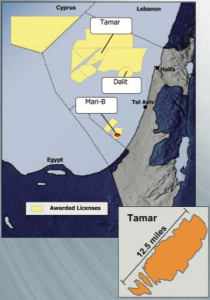
There’s an old saying in the oil industry: “Oil is like a wild animal. Whoever captures it has it.” The late American oil magnate, Jean Paul Getty, may have been talking about the oil and gas market of the 1950s, but his words continue to ring true. Ever since a joint US-Israeli exploration group headed by Texas-based Noble Energy discovered a large natural gas deposit at Tamar (90 kilometers off the coast of Haifa) in January, the proverbial animal has been officially let out of its cage in the Eastern Mediterranean.

Analysts estimate reserves at Tamar of around 142 billion cubic meters (BCM), valued at around $3.6 billion, with a $1.5 billion extraction cost. The discovery has been heralded by Noble’s Chairman and Chief Executive Officer Charles Davidson as possibly “the largest discovery in the company’s history.” For a company like Noble that boasts assets of more than $12 billion, that’s no passing phrase.
A few months after the initial discovery, Noble found another deposit of gas at Dalit, 13 kilometers east of Tamar. That discovery is expected to yield reserves of around 14 BCM, or around 10 percent of the Tamar find. Noble declined to comment on the finds and Executive is legally forbidden to correspond with Noble’s Israeli partners.
The amount of gas present in the two fields could potentially serve Israel’s gas demand for a decade, or even longer.
“We are witnessing an historic moment in Israel’s energy market,” Israeli Infrastructure Minister Binyamin Ben Eliezer said at the time of the Tamar find.

Noble Energy’s operations in Israel and Cyprus

Source: Noble Energy.

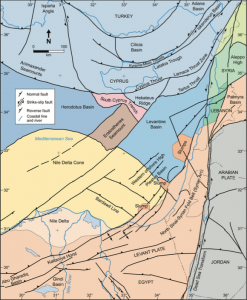
Tectonic structure of the Eastern Mediterranean

Source: Noble Energy.

A thorny relationship

At present Israel depends on Egyptian gas exports to run its power plants. The agreement for Egypt to supply Israel with a constant stream of gas comes under a clause of the Camp David accords, signed in 1979, and stipulates that the two parties will set a fixed price for each million thermal units (MMBTU), the standard unit of measurement for commercial gas exports, which corresponds to around 28 cubic meters of gas. The export of Egyptian gas to Israel has been the cause of much controversy in Egypt where anti-Israeli public sentiment is pervasive 30 years after the two countries’ leaders signed a peace treaty.
The issue of Egyptian gas exports to Israel remains a thorn in the side of both governments; politically for the Egyptians and in terms of energy planning for the Israelis. Hence, while energy independence for Israel would constitute a negative for Egypt’s current account, it could also translate into some much needed wiggle room for Egypt’s autocractic government.
“The opposition parties are always questioning the wisdom of supplying Israel with gas,” says Ibrahim Saif, resident scholar specializing in the political economy of the Middle East at the Carnegie Middle East Center. “Egypt is [always] trying to downplay that subject because there is a sentiment in Egypt that is against supplying Israel with gas.”

How much do they really have?

While Israel’s estimated gas reserves seem promising, they are still just that, estimates. The numbers currently available only indicate a ‘geological reserve’ based on seismic surveys conducted from above the seabed. The fields still have to undergo an appraisal phase to ascertain how large the ‘proven reserve’ is and exactly how much of the gas can actually be extracted.
“The initial discovery does not provide a clear picture as to the structure of the field. You need a year until it becomes a proven reserve and only part of it can be extracted,” said Ziad Arbahe, a Syrian energy consultant.
Arbahe explained that commonly only 30 to 40 percent of a geological reserve can be extracted. There have been rare cases where up to 50 percent has been extracted, but this usually requires that a company inject water into a field, increasing operational costs and often damaging the field itself.
“In general, when there is a find, countries and companies are optimistic about the amount. But when you start to produce… the initial estimation is usually much higher than the actual amount,” Arbahe adds.

On the Lebanese side…

The recent discoveries have “caused a flurry of interest in the Lebanese offshore area,” says Charles Harmer, executive vice president of multi-client services at Spectrum Geo, the company that previously performed preliminary seismic surveys for the Lebanese government between 2000 and 2007.
Fawaz Mourad, the regional representative of Petroleum Geo-Services (PGS), agrees. His company  and Spectrum Geo have both conducted seismic surveys in Lebanon’s offshore area, which is part of the “Levantine basin.”
The Levantine basin is the underwater geological structure that is located beneath the territorial waters of Lebanon, Israel, Cyprus and Syria. The basin itself has “similar structures and formations” in both Israeli and Lebanese waters which makes “offshore Lebanon even more interesting and more prospective,” says Mourad.
Lebanese oil and gas exploration began in the late 1960’s and early to mid-1970’s with the drilling of several wells across the country. Then, like many things in Lebanon at the time, exploration came to a grinding halt when Lebanon’s civil war began in 1975. After the war, Syria and Lebanon formed the “Committee of Cooperation between Lebanon and Syria for Oil Exploration in Lebanon,” which lasted until Syrian troops pulled out of Lebanon in 2005 after the assassination of the former Prime Minister Rafiq Hariri.
“The order from [current Syrian] president Assad’s father was to help Lebanon by all means possible, even for free, to get oil out of Lebanese ground,” says Ali Haidar, a former member of the committee and current petroleum studies professor in Beirut. “There were some favorable interpretations of this behavior on some Lebanese sides and on others there were unfavorable [interpretations].”
During the run-up to Lebanon’s parliamentary elections, Nabih Berri, the country’s speaker of parliament and member of the current opposition, stressed the importance of “encouraging the exploration of [oil and gas] prospects in all the Lebanese territories,” ostensibly referring to the continuation of onshore exploration.
However, little headway has been made in Lebanon since pre-war drilling, despite the fact that Lebanon is part of the same geological structure where proven gas deposits have been found in Syria “only 40 kilometers from the Lebanese border,” says Haidar. Today, Lebanon’s old wells still sit idle and efforts to resume exploration have been “postponed” according to a senior executive at Lebanon’s Ministry of Energy and Water.
Ghazi Youssef, a member of Lebanon’s new ruling parliamentary coalition who used to manage the oil and gas file as an advisor to former Prime Minister Rafiq Hariri in the earlier part of this decade, is nonetheless pessimistic about the prospects of oil and gas aground in Lebanon. He says that the issue of exploring these wells should be put on a “back burner” because “all the reports I have seen in the past do not really show the possibility of a major find [onshore]. It’s mostly tar and other residue but not hydrocarbons. Things point more to the offshore fields than they do onshore.”

Move to water

Indeed, since 2000 the focus of the Lebanese government and international oil and survey companies has been on offshore exploration. In 2002, the Lebanese government entered into an agreement with Spectrum Geo to perform a two-dimensional seismic survey off the coast of Lebanon to supplement a survey completed in 2000, which did not require government permission “because of the location and the fact that there was no previous work in the area,” says Harmer. Two-dimensional seismic surveys are used to identify breaks and possible traps in geological formations where there is a high possibility that oil or gas may be present.
The agreement gave Spectrum Geo the right to gather data off the Lebanese coast at its own cost and to later sell the data to prospective oil companies on a licensing basis. The Lebanese government would then receive a percentage of the license agreement and get a copy of the final data.
“We had to try to sell it as many times as we could to cover our costs and then make a profit on it,”says Harmer.
The agreement itself, however, ended in 2007, and the government says Spectrum Geo has requested another five year agreement with the Lebanese state.
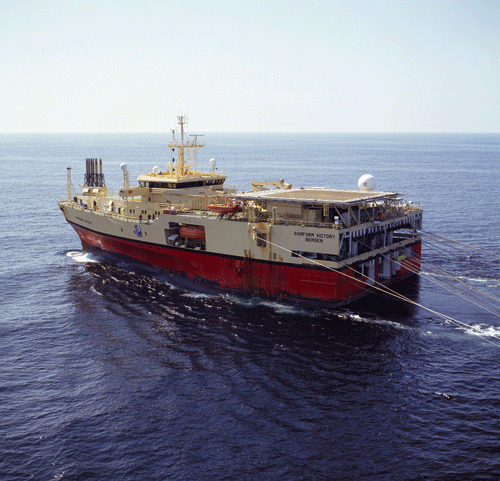
In both 2006 and 2007, the government commissioned another Norwegian survey company, Petroleum Geo-Services (PGS), to perform three-dimensional seismic surveys off the coast of Lebanon. Three-dimensional studies subject geological formations to sets of waves which then ‘bounce back’ off these structures to provide a clearer view below a surface.
But several experts have questioned the manner in which the three-dimensional studies were conducted. “Normally when you have such a huge possibility… you do a lot more than this,” says Haidar. Harmer of Spectrum agrees. “It is very unusual to shoot a [three-dimensional seismic survey] like that. I still don’t understand why they have shot those.”
Mourad of PGS, however, insists that the data acquired was “comprehensive” and that “there is enough data to allow the companies to drill. They don’t need to do more 3-D surveys. So if a bid-round takes place over the areas which are covered by the 3-D survey, then the oil companies are able to drill immediately, thus saving a lot of time,” he says.
According to Sarkis Hlaiss, general manager and head of Lebanon’s gas and oil installations committee at the Ministry of Energy and Water, the main reason that a more extensive survey was not done is that the Lebanese government and PGS are currently performing another two-dimensional survey on Lebanon’s Exclusive Economic Zone (EEZ), which was only delimited — the process by which a country defines its borders — in May by a committee at the energy and water ministry. A source at the United Nations, who spoke on condition of anonymity, said that the issue of border demarcation between Lebanon and Israel has yet to be officially resolved by the UN and stressed that maritime borders would only be addressed once the border delimitation on the ground has been completed. PGS insists that the issue is inconsequential.
“Even if they haven’t officially delimited it, it doesn’t mean that it is disputed. There is no dispute,” said Mourad.
In any case, most experts agree that it is premature to consider the possibility of common resources before all the results of Lebanon’s seismic surveys are completed to ascertain if there are fields shared with Israel. The results of the survey are expected to become available within four to five months.
“By the end of September we will have the complete data in two-dimensions and three-dimensions from PGS,” says Hlaiss.
The new survey will employ seismic technology developed by PGS that enables seismic waves to overcome the distortions caused by layers of salt present across the Levantine Basin. The results of the survey will provide data that is much clearer and more useful to prospective oil companies and the Lebanese government, who can negotiate better if a bidding round ever materializes.

Dollars for data

According to Mourad, PGS has invested “tens of millions of dollars” to acquire data off the Lebanese coast. The company “hopes to recover its investment by selling the data” to oil companies looking to enter any Lebanese oil and gas market, once the government starts a bidding round and offers licenses to companies to start drilling offshore.

“PGS has not sold any data for the simple reason that companies, when they own data, need to know that they can do something with it, like participate in a bid round,” said Mourad.
But in order to open up a bidding round, Lebanon would need to have a law that dictates the terms and obligations of both the Lebanese government and prospective oil companies — something the Lebanese government has been dragging its feet on for decades.
“Until now we don’t have a law, it’s a disaster,” says Hlaiss. All the countries of the Eastern Mediterranean who have access to the Levantine Basin have legislation that apportions their maritime territory into blocs, ready for sale to prospective oil companies looking to explore their offshore prospects. Cyprus opened its first bidding session in 2007, as did Syria.
Fortunately for Lebanon, they have some friends in high places within the oil and gas industry. Since 2007 the Norwegian Agency for Development Co-operation (NORAD), as part of its ‘Oil for Development’ program, has been assisting the Lebanese energy ministry to draft a new law to the tune of “several million dollars to start putting legislation in place [and] actually start a bid round,” says one oil and gas industry executive who spoke on condition of anonymity.
Martin Yettervik, counselor at the Norwegian Embassy in Lebanon, says that the program is about institution building as opposed to drilling and is aimed at helping the Lebanese avoid the pitfalls of an energy dependent economy.
“For any country that is new to petroleum, it is important to take into account the economic effect of the petroleum economy, because it is different from other kinds of economic factors,” says Yettervik. “There are examples around the world where, when the petroleum economy dominates, it is to the detriment of the other fields in the country.”
Countries such as Nigeria and Iran have felt the pain of an economy overly dependent on petroleum resources. However the risk to Lebanon is not just economic. The potential for oil and gas revenues to play into Lebanon’s polarized and volatile sectarian political mixture is very real. One look at the electricity or telecommunications situation in the country and an ineffective or politically tainted oil and gas industry could be “another killer,” according to professor Haidar.
Nonetheless, Yettervik insists that the program has not become “a tool for one or another power factor in a country” and that “since the beginning we have seen a trans-political cooperation, even when the country was in the deepest of crisis,” referring to the 18-month political standoff that led to the May 2008 conflict in Lebanon.

Norway’s helping hand

The Oil for Development program is set to carry on until 2011, at the behest of the Lebanese government. In order to expedite the process of drafting the still non-existent law, the Norwegian government has contracted an international law firm to assist the energy ministry with setting up a bidding round and has trained several officials at the ministries of energy and water, and finance and environment. Both Spectrum Geo and PGS’s head offices are located in Norway, but Hlaiss insists that the Norwegian government “didn’t ask for anything in return.”
Yettervik admits that the program “gives the Lebanese authorities familiarity with the Norwegian system,” but insists that any collusion between the Norwegian government and its companies “would be contrary to the spirit of the program.”
The government has confirmed that the new law will allow Lebanon to alter the output of any firm that extract’s oil or gas, which, if done hastily, could damage any potential field and substantially reduce its long term productivity. Moreover, the law will oblige future oil companies to adhere to the Lebanese labor law, which compels them to hire a majority of Lebanese citizens if qualified persons are present in the country.
According to the energy ministry and the Norwegian embassy, the draft exploration law is all but completed. The text, which is still in English, is complete and is in the translation process. Once in the Lebanese Parliament, it will be subject to the scrutiny of the country’s conflicting political interests.
“We are trying to push [the law] through this government,” says one government official who spoke off the record. “If we don’t, and the minister [of energy and water] changes, it will take us another three months to explain to the new minister what we are doing and then who knows [how long it will take].”
MP Youssef expressed his coalition’s desire to depose the current minister, whose party is part of the opposition, but insists that it will not derail the process.
“We believe that when someone comes to power you don’t just take everything and throw it down the drain; there’s continuity. We have to deal with [the law] and try to finish it as soon as possible.”

Sharing with the enemy

Perhaps the most important point to consider in Lebanon’s energy saga may be that if Tamar, Dalit or another field is a common field between Lebanon and Israel then the latter is currently usurping Lebanon’s natural gas.
“Whoever starts before gets the resources because of drainage,” says Haidar, adding that the clock is now ticking down on the Lebanese government’s opportunity to tap this resource before the Israelis do.
Contested borders have always posed a problem in the Middle East, especially when it comes to hydrocarbon resources. The “neutral zone” between Saudi Arabia and Kuwait that was demarcated by the Anglo-Turkish convention in 1913 still exists today. It has been a source of ongoing disputes over maritime borders between Kuwait and Iran for some time, although Kuwait and Saudi Arabia have come to an agreement over how to share the resources present in the area. Lebanon and Israel however remain in a state of war, and Israel still occupies some of Lebanon’s territory. Hence the issue of sharing resources, if indeed they do exist, seems far-fetched at best; more likely, perhaps, is the prospect of further conflict between the countries over energy.
“This is not going to be an easy issue,” says Saif. “If Israel starts to pump and utilize [any common resource], it would be a source of contention and Lebanon will find itself forced to move and to block any Israeli unilateral move.”
Most experts agree that it is highly improbable that the recent finds at Tamar and Dalit constitute a common field because of the distance between the finds and the border area, but that does not preclude the possibility of it being one or that one could exist, given the commonalties between the Lebanese and Israeli areas of the Levantine Basin. Just to make sure Israel is aware of Lebanon’s territorial concerns, the  prime minister’s office has sent a letter to Noble demanding that the company does not encroach upon Lebanese maritime territory, according to a government source who spoke on condition of anonymity.
Even if Lebanon does manage to pass a law, starts the bidding process and brings in the oil companies in to begin drilling, the economic benefits will not be felt until much further down the line. The Tamar field is not expected to produce commercial quantities of gas until at least 2013. One energy consultant offered to bet this journalist $1,000 that commercial quantities would not be extracted before 2015. Moreover, any potential Lebanese field may take even longer enter production.
“In eight years, if we find something, we can actually open the lid and start making some money. Whoever wakes up first gets the money and the resources,” says Haidar.
If the Lebanese don’t wake up soon, they may well find themselves snoozing through yet another regional boom and lose the chance to revive their debt-ridden economy.

July 1, 2009 0 comments
0 FacebookTwitterPinterestEmail
Companies & Strategies

Deyaar Development – Markus Giebel (Q&A)

by Executive Staff July 1, 2009
written by Executive Staff

Markus Giebel is the chief executive officer at Deyaar Development PJSC, one of the region’s biggest real estate companies. Executive Magazine had the pleasure of sitting with Giebel as Deyaar unveiled the recently completed project at Saifi Village II, which is comprised of 72 upscale apartments and penthouses and is located in the Beirut City Center master development.

E This is not the first time you invest in Lebanon. What makes this country, in your opinion, a good destination for real estate investment?
It is the first project that we have completed in Lebanon. Other than that we have a total investment of $200 million in the country. But the first project we completed is the Saifi II, which is a $100 million project. The sad portion of it is that many things got destroyed, and someone had to rebuild it. So there is an intrinsic and real need for real estate. It is a privilege actually to be one of the people who can rebuild, and Solidere does a wonderful job. To be a partner with Solidere and a part of the rebuilding is something anybody can be proud of. The second thing is that if you look at the financial crisis, Lebanon became one of the most attractive places. So historically there is an intrinsic need and if you are looking forward, this country looks very strong. We have real GDP growth, a real growth of 1.6 percent positive. The world is 1.9 percent negative. So there is something which is very intriguing. For us as a developer, we develop in developing countries. There is a developing element of this country so there is an incentive that we like.

E So you think that Lebanon has good market fundamentals?
There are many fundamentals. We come from Dubai; many people from our part of the world love the place here. So there are many people who enjoy the countryside, the people, the food. So there are these elements; the other element is that there is a real demand for real estate.

E The project is 100 percent sold. Who are the people who bought in? Lebanese mostly or foreigners?
There is a complete mix. There is a vacation element of it. People would come a month or two per year. And there is also real demand from Lebanon. Many of them are also Lebanese expatriates. That is exactly one of the areas we cater to. Starting with the new project, there are three elements. There is the vacation element, the expat element, and there is the extrinsic element. That is what makes Lebanon so thriving.

E Which market segment does the project target? What is the price range?
It is an upper-scale development; there is a luxury element to it. There are some penthouses which are pure luxury, and there are also higher mid-end affordable elements in it. It is mid-high. But the penthouses are high-end. The price range doesn’t help you much, because we launched the project in 2007, and prices in 2007 were very different than 2009. In these three years the prices went up. So anyone who bought with us when we launched is a very happy person. People who bought now have higher prices. There is a tremendous increase in prices.

E What added value does the project have? Why should someone buy into this project and not in another project?
If you look at the project, there are many added values. First, there is the master developer Solidere. The company itself brings credibility to any project. And Solidere does a wonderful job. Second, the location of the project. It is overlooking the sea. Another added benefit is the proximity: in five minutes you are everywhere. So there are many elements. But again when you buy a property, it is a very personal thing. For some people, things are very important but I think for most of the people the elements we have covered in our development are appealing. If you like to be in Beirut and you want to have something calm, close to everything, overlooking the ocean, in a master development from a well-known name, then we have a good product.

E At the World Economic Forum this year, you said you will shift focus to emerging markets — is this a part of it?
What happened is that with the crisis, many people have to rethink. We are very strong in Dubai. We have a very strong foundation there. What we do is a pitch-and-catch strategy. We take the best practices we developed in Dubai and they are pitched out into different countries. For example in Lebanon someone catches our best practices and localizes them and implements them. That makes us a little bit stronger than other people because we have this strong foundation. So that is our strategy all along. And we will focus on emerging markets. Why emerging? Because there is no value added in developed countries. What value added do I have in New York? We really go into countries where we can add value, and the developing countries. Lebanon is a different case because in one sense it is developed, and in the other sense it is still in need for some rebuilding and some assistance. So Lebanon is in a very special situation. But we do believe we can deliver a lot of value to the country.

E Are you planning any future investments in Lebanon?
We are now looking. With the first project we were really happy. You always test the market with the first project. If it doesn’t go very well, you reconsider. But the first project went very well, which makes it very easy to go to the next step. We are actively looking for many reasons. One, we know the country much better, we found strong partners and we have a very positive first experience so, yes, we would like to. We look more to our partner  Solidere. It is not an exclusive partnership, but a very strong partnership.

July 1, 2009 0 comments
0 FacebookTwitterPinterestEmail
Lebanon

Architecture – Project Lebanon 2009

by Executive Staff July 1, 2009
written by Executive Staff

Project Lebanon 2009 opened its doors again this year at BIEL Exhibition Center to gather local and international engineers, architects, building materials specialists, investors and other key market players under one roof. Exhibitors came from Italy, Germany, France, Iraq, Switzerland and other countries looking to establish partnerships and enter the Lebanese and regional markets.

“Lebanon is back in business,” said Fadi Jreissati, vice president of operations at IFP Group, Project Lebanon’s organizers. The event’s packed parking lots, entrance queues and the rush on the stands were proof that Jreissati was right.

“We have an 80 percent increase in size,” he said. “We have sold every single meter we have, and if we had known that elections would not have a negative effect on the exhibition, we would have opened the whole tent.”
The fact that the exhibition takes place in June has not helped it much recently. Last year, the conflict in May crippled the show and the parliamentary election this year also made some exhibitors shy away.
“We had a very bad edition last year; the conflict in May affected us very badly,” said Jreissati. “[This year] there are a lot of people who were afraid and did not participate.”

This year’s highlight

For the first time, Project Lebanon is hosting the “Sustainability Week” which includes a series of conferences tackling the issues of green building, sustainable architecture, water and energy conservation, as well as recycling and saving resources. A green pavilion is also included where companies either have new technologies to introduce or are offering consulting services to help implement green initiatives in new and existing buildings.
Since Lebanon is still taking its first steps toward achieving sustainability, the green pavilion at the exhibition attracted considerable attention. Most companies started working in the green field only recently, since this technology was prohibitively expensive to import and the Lebanese market was not welcoming to the idea.

Project Lebanon attendance

  2008 2009 % increase
Number of exhibitors 220 350 59
Number of national pavilions 4 9 125
Number of countries participating 11 23 109

Source: IFP Group

“We started two year ago,” said Mohammed Nasser, electric and power engineer at Somiral Energy, an importer of solar panels. “Before, it was too expensive and not very available. Now, it is more affordable.”
Another company, Schneider Electric, also started working on providing energy efficienct solutions for its customers in the last 24 months, by introducing electrical devices that consume less electricity or switch off automatically in order to save power, and other new technologies. By using these energy-saving products, industries can save up to 20 percent on electricity, while residential houses can save from 10 to 40 percent.
“We are in a world where we have a challenge,” said Julien Feghali, chairman and general manager of Schneider Electric East Mediterranean (SEEM), the Lebanese subsidiary of Schneider Electric. “We want to protect our environment and we have very tough objectives.”

Feghali explained that his company is currently getting positive feedback in Lebanon, which would not have been expected two to three years ago, because the concept was still new. Schneider is also working with the Ministry of Energy and Water, the Lebanese Order of Engineers and the Électricité du  Liban to implement these solutions on the national level.
“The order of engineers has to play their role in terms of standardization. Sometimes you have to [implement] rules and regulations. We should work in the same [way] in Lebanon,” Feghali said.
Jad Bsaibes is a project engineer at Energy Efficiency Group (EEG), a Lebanon-based firm that offers consultancy services for existing buildings in order to find ways to save energy. He said many in Lebanon are open to receiving green technologies and services, but there are still some engineers who do not collaborate.

“Some work with us, and others don’t,” said Bsaibes, whose company is currently working on buildings such as Intercontinental Phoenicia Hotel and Studio Vision.
Michel Tannous, president of Entech Coatings, relocated his company from Canada to Lebanon six months ago, finding the country and the region offered a good opportunity to introduce his new coating technology. With a 25-year guarantee, Tannous explains that his new Entech Coatings Product would keep a building nicely painted for a long time while isolating the outside heat or cold, thus saving a large amount of energy used for heating or cooling.
“Everyone is excited and wants the product,” he said.

It’s not only private companies that were advocating for the use of  green technologies at Project Lebanon, but also Lebanese nongovernmental organizations. For example, the Lebanese Solar Energy Society (LSES) was established in 1980 and aims to convince people to use solar and renewable energy. Other NGOs present at the exhibition were the Lebanon Green Building Council, and the Lebanese Association for Energy Saving and for Environment.
Even though private companies and NGOs are doing their part, there is no doubt that the path to sustainability will be hard, especially due to the lack of regulations backing these initiatives.
“The hardness softens when there is commitment,” said Dr. Sadek Owainati, co-founder of the Emirates Green Building Council. “It is not a one day, but a long-term commitment. It is not one group, but everybody.”

Owainati also emphasized the need to have a national strategy which is realistic and achievable. He also expressed his concern on the lack of urban planning in the city.
From this year on, Sustainability Week and the Green Pavilion will be a integral part of the Project Lebanon exhibition.
“It is definitely not the last time… It is a great start for us and a big success,” said Jreissati from IFP.
“We did a lot and we invested a lot in [Project Lebanon]” he added. “Everybody is so happy, and we are still at the beginning [in terms of] potential. There is so much to do, the event will still grow.”

July 1, 2009 0 comments
0 FacebookTwitterPinterestEmail
Capitalist Culture

Politics – Obama in Cairo

by Michael Young July 1, 2009
written by Michael Young

Barack Obama’s speech in Cairo last month provoked mixed reviews. Some said the US president spent too much time apologizing for American behavior in the Middle East; others said his words were just that, words, needing implementation. The only consensus reached was that Obama had been eloquent, but that somehow reminded us of the old Monty Python sketch where a game contestant fails to summarize Proust in 15 seconds, earning the consolatory words: “A good try though and very nice posture.”

Where Obama came up short most flagrantly was in his inability to define a clear position on political freedom, and how to advance it in the Middle East. In fact the president seemed to want to have his cake and eat it too. For example, in referring to the war in Iraq, Obama stated: “Unlike Afghanistan, Iraq was a war of choice that provoked strong differences in my country and around the world. Although I believe that the Iraqi people are ultimately better off without the tyranny of Saddam Hussein, I also believe that events in Iraq have reminded America of the need to use diplomacy and build international consensus to resolve our problems whenever possible.”

Indeed. But if Iraqis are “ultimately” better off without Saddam Hussein, what does that tell us about US policy when it comes to supporting Middle Eastern democracy and human rights? After all, neither diplomacy nor an international consensus would have ever freed Iraqis from being under Saddam’s thumb. So did the US do the right thing in getting rid of the Baath regime by force? Obama avoided addressing that prickly question.

This fuzziness permeated Obama’s later discussion of democracy in the region. The president pointed out: “So let me be clear: no system of government can or should be imposed upon one nation by any other.” But then he went on to say that this view did not lessen his commitment to governments that reflect the will of the people. Except that “America does not presume to know what is best for everyone.”
But hadn’t Obama just presumed to know that the Iraq war was beneficial for the Iraqi people, since he felt that they are better off without Saddam? Aren’t Iraqis better off without Saddam because the new system they now live under was imposed on them by an American led-invasion? And weren’t Obama’s bromides in favor of democracy and democratization not also statements implying that he presumed to know what was best for everyone?

If so, then why did the US president not just come out and state the obvious: that democracy, openness and pluralism are indeed better for all states, as is respect for human rights. Why did Obama prefer to avoid rocking the boat when it came to autocratic regimes in the region? Not a word was uttered on actual cases of human rights abuses, whether in Egypt, the country hosting him, or in any other part of the Middle East. Clearly, the president, for all his high-flying rhetoric, preferred to fall back on the aversion of political realists to involving the US in the region’s domestic affairs.
Equally interesting was what the president had to say about the Christian Maronite and Coptic minorities.
“Among some Muslims, there is a disturbing tendency to measure one’s own faith by the rejection of another’s,” he said. “The richness of religious diversity must be upheld — whether it is for Maronites in Lebanon or the Copts in Egypt.”

This advice Obama placed under the rubric of “religious freedom.” This was strange, because the problem of minorities in the Arab world is usually more a political than a religious one. What the Copts would like more of is political power, not the freedom to exercise their religion. As for the Maronites, their sense of decline is attached not to the fact that they cannot practice their religion, but that they feel their political power is waning. 
All this leads to a disconcerting conclusion that Obama has few coherent views of political freedom in the Middle East. He overemphasized religion while underemphasizing how the US might address political matters, such as what to do about dictatorial regimes. He also failed to address the absence of democracy in the Middle East in illegitimate states that fail to fulfill the aspirations of their citizens; or what to do about minorities denied political power, both Muslim and non-Muslim.

Obama submerged his Cairo speech in the holy water of religion, but it is freedom, the failure of the Arab state, and the lack of accountability of regional regimes that are more central to the dilemmas the Middle East faces today. In one word, it is about politics, and on this Obama was too busy being polite to his listeners to raise the difficult questions he promised to raise at the start of what, in retrospect, sounded like a puzzling homily.
(Editor’s note: A version of this article first appeared on Harvard’s Middle East Strategy blog)

Michael Young

July 1, 2009 0 comments
0 FacebookTwitterPinterestEmail
Lebanon

Environment – A carbon-neutral car dealer

by Executive Staff July 1, 2009
written by Executive Staff

The Rasamny Younis Motor Company S.A.L (RYMCO) is taking steps to become the country’s most environmentally friendly automotive dealer. In May the company announced it will attempt to reduce its carbon footprint by reducing the amount of emissions it produces as it imports, distributes and sells cars, and by off-setting its remaining emissions.

EcoSecurities is the UK-based company working with RYMCO to identify and offset the auto dealer’s carbon emissions, which they will do through a local company, Sustainable Environmental Solutions (SES). SES will help RYMCO determine how greenhouse gases can be offset with what are known as Verified Emission Reduction units (VERs).

The first step to carbon neutrality is to determine the current emissions produced by RYMCO through its electricity usage, the diesel fuel used by the back-up generator, the staff’s international travel and the company’s own car fleet, said Rachel Mountain, head of global marketing at EcoSecurities.

Where emissions cannot be reduced by RYMCO, they will be off-set by EcoSecurities purchasing VERs on the company’s behalf.
In a voluntary carbon market, VERs are produced by companies who take action to reduce green house gases — by creating solar, wind, biomass or hydroelectric projects — and they are then sold to companies like RYMCO who want to reduce their carbon footprint.
“A VER has the equivalent of 1 ton of CO2 that is generated from the implementation of project(s) that has actually reduced greenhouse gas emissions,” Mountain said.

A VER is not a carbon credit that can then be traded by RYMCO but a mechanism by which EcoSecurities can verify that the auto dealer is carbon neutral — meaning the number of VERs equals the amount of emissions it produces. This certification can then be renewed on a yearly basis. RYMCO is taking the carbon reduction steps because of the nature of the auto industry, said Blanche Baz, public relations advisor for RYMCO.

“Being part of the automobile industry mandates that we take a responsible role for devising strategies to reduce CO2 emissions through increased energy and fuel efficiency,” wrote Charbel Abi Ghanem, RYMCO’s marketing manager, in a press release.
“Though our contribution is considered minute… we are confident that if more companies realize the impact simple measures such as these could have on reducing the harm to our environment, perhaps more of them will apply voluntary emission reduction.”

The corporate shift on the environment

“Environmental sensitivity is taking hold here,” said Sami Nader, economist and professor at Beirut’s St. Joseph University.
Given Lebanon’s fraught political structure, Nader believes companies benefit economically from demonstrating their environmental credentials as it is an issue that appeals across sectarian lines.
“Supporting the green cause does not involve taking any risks,” he said, adding that the message appeals particularly to younger consumers.
The power of the environmental pull is also recognized by the advertising industry, Nader said, which encourages companies to use their environmental credentials to shape their message.
Among the first organizations to approach carbon neutrality in Lebanon were the local offices of international banks, which recognized the appeal it would have with environmentally conscious consumers.

HSBC became Lebanon’s first carbon-neutral bank in 2005 and has continued to raise awareness of climate change, and its green friendly policies, by sponsoring the April HSBC Earth Race.
Bank Med has peppered billboards throughout the country with its own ‘happy planet’ environmental campaign, which features a sapling growing from a pile of money.
Foreign governments have also gotten in on the act. The British Embassy will work with Lebanese municipal governments to help reduce their carbon foot print.
This year the embassy will begin collaborating with EcoSecurities to reduce carbon emissions in three municipalities in South Lebanon, Mount Lebanon and Beirut.

Offsetting or opting out?

Environmentalists are concerned that the practice of offsetting emissions is an inefficient substitute for companies substantially reducing their own emissions.
The practice of offsetting emissions by purchasing carbon credits is popular among companies, and countries who are trying to reduce their emissions in accordance with the Kyoto Protocol.

The environmental benefit of the practice, however, remains unclear.
“Off-setting so far has been a failure,” said Arab Climate Campaign head Wael Hmaidan.
More than 50 percent of global offsetting projects have failed to produce expected emission reductions, Hmaidan said.

“The best thing [RYMCO] could do is  stop selling 4x4s and go to hybrid or small emission [producing] cars,” he said, acknowledging that this may run counter to the company’s economic interests.
“Off-setting as a concept should not be perceived as a solution, as it is not,” he said. “But it is a step in the right direction.”

July 1, 2009 0 comments
0 FacebookTwitterPinterestEmail
Comment

Walid the weathervane

by Nicholas Blanford July 1, 2009
written by Nicholas Blanford

At a Washington Institute for Near East Policy conference in October 2007, Walid Jumblatt was asked by Dennis Ross, now Barack Obama’s point man on Iran, what Washington could do for Lebanon. Jumblatt, with a twinkle in his eye, replied: “If you could send some car bombs to Damascus, why not?”

The audience, few of them sympathetic to the Syrian regime, greeted Jumblatt’s comment with delighted laughter and prolonged applause.
Jumblatt, understanding his audience well, continued: Hezbollah is a “brigade or division of the Iranian Revolutionary Guards that occupy half of Lebanon, paralyzing the economy and facilitating Syrian efforts to kill us.”
It was vintage Jumblatt. Well, 2007 vintage anyway.


Among the leaders of March 14, Jumblatt, the “weathervane,” has typically been first to react to the changing climate: in the past 12 months, he has forged a rapprochement with his traditional Druze rival Talal Arslan in the wake of the May 2008 fighting, toned down his anti-Syrian rhetoric and more recently spoke of Hezbollah’s weapons in the context of a national defense policy.
It culminated in mid-June with a long-awaited meeting with Sayyed Hassan Nasrallah, Hezbollah’s secretary-general, in which the two discussed the need for a comprehensive reconciliation in the country.
The spirit of goodwill settling on Lebanon in the aftermath of the June 7 election largely derives from the rapprochement between Saudi Arabia and Syria in recent months, as both back rival political camps in Lebanon.
Vituperative rhetoric has been scaled down in the Syrian and Saudi media and there have been several low-profile diplomatic exchanges between Damascus and Riyadh.
If the Saudi-Syrian detente holds, it could spell a period of political calm in Lebanon, allowing for a relatively smooth transition from Fouad Siniora’s outgoing government to the new one, likely headed by Saad Hariri. The opposition could well forego their demand for a one-third veto-wielding share in the next government in exchange for guarantees by Hariri on key issues, chiefly Hezbollah’s arms. Hariri has said the fate of Hezbollah’s arms should be left to the national dialogue sessions, where the subject doubtless will be buried.


All this comes at the end of an eight-month wait-and-see period during which several elections, parliamentary and presidential, have been conducted. But the results of those elections have been something of a mixed bag.


The first was the election of Barack Obama as the new United States president. Obama, facing the immediate challenges of a global financial crisis and two wars, initially was not expected to focus much effort on the Middle East. But he has confounded expectations by emphasizing the importance of the Israeli-Palestinian peace process. In his recent address to the Arab world in Cairo he spoke at length on the Israeli-Palestinian conflict. However, he did not mention Syria once, indicating where his preference for progress lies. Indeed, the appointment of Jeffrey Feltman, who was US ambassador to Beirut during the Lebanese-Syrian crisis in 2005, as his main interlocutor with the Syrians was a signal in itself. Yes, Obama is willing to explore dialogue with Syria, but the administration is under no illusions about its success.


But Obama also has to contend with a right-wing government in Israel under the premiership of Benjamin Netanyahu, who took office in March. Netanyahu’s fragile coalition is dependent on the support of hardliners, such as his foreign minister Avigdor Lieberman. The initial test of Obama’s resolve, to many Arabs, lies in his ability to freeze Israeli settlement building on occupied Palestinian territory, and not to allow Netanyahu to fudge the issue with excuses about “natural growth.”


The third key election was in Lebanon, where the continuation of the status quo was confirmed by the March 14 coalition’s victory. Developments in Lebanon tend to be corollaries of developments elsewhere in the region, which is why the outcome of the Iranian presidential election, the last of the big four, is so important.
If Mir Hussein Moussavi had been elected president, it is unlikely that there would have been any significant changes to Iranian foreign policy, especially regarding the Arab world, support for anti-Israel groups and pursuing the nuclear program. The differences between the incumbent, Mahmoud Ahmadinejad, and his reformist challenger were over domestic policies. The importance of the result was one of perception rather than substance.


The US would have preferred to seek engagement with an Iranian government led by a reformist president, rather than someone distinctly lacking in diplomatic tact and widely vilified as a “Holocaust denier.” Ahmadinejad’s re-election will do little to ease the phobias of the Arab Gulf states toward their powerful Iranian neighbor.
So, a US administration committed to an Israeli-Palestinian breakthrough; a right-wing Israeli government squirming to maintain US goodwill while making no meaningful concessions to its Arab neighbors; no change in a Lebanon that is hoping for a period of stability; and an Iran, troubled by internal dissent, but still led by a president who relishes his image of defiance and obduracy.
How will this play out? Perhaps, we should keep an eye on Jumblatt for early hints.

Nicholas Blanford is the Beirut-based correspondent for The Christian Science Monitor and The Times of London

July 1, 2009 0 comments
0 FacebookTwitterPinterestEmail
Money Matters

IPO Watch – The Saudi vanguard

by Executive Staff July 1, 2009
written by Executive Staff

The initial public offering market in June witnessed a continued pickup in activity following an apparent restoration of risk appetite on the part of investors, but IPO announcements were mostly dominated by Saudi companies. The Saudi Capital Market Authority appears to be resigning to IPO pipeline pressure, driven in part by the success of recent offerings such as Weqaya Takaful Insurance and Reinsurance Company’s IPO, which was three times covered.

Weqaya’s shares, which debuted on the Saudi exchange on June 20, soared 288% with heavy volume to $10.36, from an offering price of $2.67.
The largest IPO announcement of the month came from Saudi Steel Pipe, which plans to sell 16 million shares or 31.4% of the company in an IPO scheduled between June 27 and July 3. With shares offered at a price of $6.68 per share, Saudi Steel Pipe expects to raise $107 million, valuing the company at $340 million. GIB Financial Services is the share sale’s lead manager and will have the option to allocate up to 50% of the shares to individual investors, leaving the rest to the institutional buy-side.

Three local insurance companies also received approval from the Capital Market Authority to raise a combined $51.2 million through share offerings. The three insurers — General Cooperative Insurance, Global Cooperative Insurance and Buruj Cooperative Insurance — will offer 40%, 30% and 40% of their shares respectively for $2.67 each. IPO activity in the Saudi kingdom included the approval of Saudi Petrochem’s planned offering of 50% of its shares, and Al Khuraif Group’s announcement that it plans to offer some of its shares, or those of one of its units, to the public.

Saudi Al Mouwasat Medical Services said it plans to sell 7.5 million shares or 30% of the company in an IPO from August 15 to August 21, while healthcare and pharmaceutical company Banaja Holdings will also launch an IPO as it proceeds with its restructuring plans. Furthermore, the Aramco-Total $9.6 billion joint venture in Saudi Arabia, named Satorp, said it plans to sell off 25% of its shares in the refinery in the fourth quarter of 2010.

Still, IPO buzz was not limited to Saudi Arabia. Albaraka, Bahrain’s largest Islamic Bank, announced plans to list its shares on the Damascus Stock Exchange (DSE) by August, comforted by the 15% increase in the Syrian International Islamic Bank’s (SIIB) shares on their first trading day on June 4. Bank of Alexandria, a unit of Intesa Sanpaolo SpA, said it was holding talks with the Egyptian government to sell the state’s 20% stake in an initial public offering worth more than $300 million. The Qatari government also said it expects to take the Qatar Exchange public in the near future, while Dubai-based Noor Islamic Bank said it may offer part of the company to the public within three to four years.

Despite improving market sentiment, several public offerings were delayed until the effects of the global economic crisis have waned. Scotland-based oil and gas engineering firm Proclad Group said it has postponed the planned offering of 30% of the company on the Dubai Financial Market by almost two years to 2013. Burooj Properties, which is fully owned by Abu Dhabi Islamic Bank, also pushed its IPO date from 2010 to 2011 or later, citing the financial crisis as the reason behind the decision. Improving market conditions will also set the date for an IPO by Emirates Steel Industries, a unit of Abu Dhabi Basic Industries, which tied its public offering to the presence of suitable market conditions within one to two years.

In summary, the IPO pipeline remains flooded with delayed offerings pending clearer signs of a fundamental and sustainable recovery in credit flows and economic growth. Still, with Saudi Arabia leading the way in the number and size of public offerings, it is very likely that a cohesion effect could take hold and drive near-term IPO activity. In a new era of lower leverage and limited bank financing, acquisitions and expansion plans will rely in part on capital raised from share offerings. Therefore, IPOs will continue to take advantage of the relative stability in equity markets seen in the last few months, as well as strong investor demand for newly-listed shares. 

July 1, 2009 0 comments
0 FacebookTwitterPinterestEmail
Comment

A government under the gun

by Thanassis Cambanis July 1, 2009
written by Thanassis Cambanis

March 14 can claim a major — and unexpected — victory at the polls, but they’ll have to pay close attention to Lebanon’s real balance of power if they want to avoid miscalculation and overreach. The pathology of sectarianism and Hezbollah’s entrenched military power place far more serious constraints on the prospect for changing Lebanon than electoral politics do.

The results of the June 7 ballot are just one of many factors that determine what Saad Hariri’s coalition can and cannot achieve — maybe even one of the smaller factors. The biggest, on the contrary, is the old rule of force: Hezbollah’s militia.


If the Party of God perceives a threat to the autonomy of its militia, it will do anything, including a military takeover of Beirut, to neutralize the perceived threat. Hezbollah did so in May 2008, and has made clear it would do so again, regardless of the political fallout or cost to the resistance’s legitimacy among Lebanese. It’s also worth keeping in mind that about 850,000 Lebanese voted for Hezbollah and its allies, significantly more than the 720,000 who voted for March 14. Only sectarian gerrymandering translates that popular vote into a parliamentary majority for Saad Hariri’s coalition.


Votes do matter, but brute power matters more. Hezbollah won’t shirk from a confrontation, and it doesn’t have to worry about losing popularity and legitimacy so long as it commands the nearly undivided loyalty of the Lebanese Shiites in the Bekaa Valley, southern Lebanon and Beirut’s southern suburbs. The principle factor that could reduce Hezbollah’s power is Iran. For decades, the Islamic Republic has given Hezbollah a generous operating budget and a steady flow of military training and material, allowing the Party of God to build its own state and act independently of the normal constraints on a Lebanese political party. If Iran cut a grand bargain with the United States (or if Syria, which controls the flow of weapons to Hezbollah, makes a deal with Israel), Hezbollah could suddenly find itself defanged, or at the very least, boxed in.


By a similar token, Hariri and his allies draw considerable power from their links to outside powers — in particular the United States and Saudi Arabia. Neither of March 14’s patrons has demonstrated anything like Iran’s staying power and commitment to its client, in terms of military aid or consistent political cover. In Washington’s case, the sponsorship is particularly shaky; most Lebanese are convinced that anytime Lebanon’s interests conflict with Israel’s, there’s no question that Washington will side with Tel Aviv.


Whatever government emerges from the elections, it’s hard to imagine any substantial effort to disarm Hezbollah, although calls to do so will come from some quarters. The cries for “change and reform” notwithstanding, Lebanon’s political classes of all stripes have far too much vested in a system of patronage and corruption, and it will likely survive unscathed. Finally, it’s nearly impossible to imagine Lebanon’s arcane political system being revamped, with its guarantees of certain powers for certain sects regardless of their actual share of Lebanon’s population. Hence a shrinking Christian minority will wield more government power than a Muslim population twice its size, and the Shiites — Lebanon’s largest group by far — will still be relegated, at least in name, to the most marginal government posts.


The March 14 forces can claim a victory at the polls but they’d be hard pressed to claim a mandate. They won the support of the Sunni, the Druze and around half of the Christians, largely by convincing voters that the other side was worse — not by mobilizing support for a set of political goals. That lack of momentum makes it hard for March 14 to do more than govern in the middle, in pursuit of incremental change, as it has since 2005. Any attempt to radically reshape Lebanese politics, for example by disarming Hezbollah and seeking a peace treaty with Israel, would meet an intransigent and powerful Hezbollah, which at least in the short term will retain the power to bring the Lebanese state to its knees by force, if it so chooses.


When the dust settles, everyone will talk about a “new phase.” Hezbollah politicians already were speaking quietly, before the elections, about a conciliatory approach. Ali Fayyad, just elected to parliament after 14 years at the helm of Hezbollah’s think tank, said his party now had to hunker down and work out the details of its political platform, eschewing confrontation.
“Politics has its own logic,” he said sitting on the porch of his home in Taibe. “When we were a small militant resistance group, we had other issues. We are now the biggest political party and player, with strategic effects in half the region. We will never achieve political reform by civil war or by hegemony.”
Rest assured though that until something radical and unexpected shifts in the regional dynamic, Lebanon will see small changes rather than big ones, and as usual, they’ll be decided by a small group of men sitting around a table — and not at the ballot box.

Thanassis Cambanis is a journalist writing a book about Hezbollah

July 1, 2009 0 comments
0 FacebookTwitterPinterestEmail
  • 1
  • …
  • 461
  • 462
  • 463
  • 464
  • 465
  • …
  • 696

Latest Cover

About us

Since its first edition emerged on the newsstands in 1999, Executive Magazine has been dedicated to providing its readers with the most up-to-date local and regional business news. Executive is a monthly business magazine that offers readers in-depth analyses on the Lebanese world of commerce, covering all the major sectors – from banking, finance, and insurance to technology, tourism, hospitality, media, and retail.

  • Donate
  • Our Purpose
  • Contact Us

Sign up for our newsletter

    • Facebook
    • Twitter
    • Instagram
    • Linkedin
    • Youtube
    Executive Magazine
    • ISSUES
      • Current Issue
      • Past issues
    • BUSINESS
    • ECONOMICS & POLICY
    • OPINION
    • SPECIAL REPORTS
    • EXECUTIVE TALKS
    • MOVEMENTS
      • Change the image
      • Cannes lions
      • Transparency & accountability
      • ECONOMIC ROADMAP
      • Say No to Corruption
      • The Lebanon media development initiative
      • LPSN Policy Asks
      • Advocating the preservation of deposits
    • JOIN US
      • Join our movement
      • Attend our events
      • Receive updates
      • Connect with us
    • DONATE