• Donate
  • Our Purpose
  • Contact Us
Executive Magazine
  • ISSUES
    • Current Issue
    • Past issues
  • BUSINESS
  • ECONOMICS & POLICY
  • OPINION
  • SPECIAL REPORTS
  • EXECUTIVE TALKS
  • MOVEMENTS
    • Change the image
    • Cannes lions
    • Transparency & accountability
    • ECONOMIC ROADMAP
    • Say No to Corruption
    • The Lebanon media development initiative
    • LPSN Policy Asks
    • Advocating the preservation of deposits
  • JOIN US
    • Join our movement
    • Attend our events
    • Receive updates
    • Connect with us
  • DONATE
Finance

Global economic crisis – A six-month tally of woe

by Executive Staff April 3, 2009
written by Executive Staff

In October 2008, Alan Greenspan, the 1987 to 2006 chairman of the US Federal Reserve, testified before congressional leaders in Washington saying “I was shocked when the system broke down, my ideology and model that I always believed in proved me wrong.” He hastened to add that, “the crisis will pass” and that the then proposed $700 billion rescue package “is adequate to serve the needs.” In December 2008, he went on to say that “the global stock market value wiped out this year is $30 trillion, but human nature being what it is, we can count on a market reversal within six months to a year.”

Six months into the crisis, economic reality defies Mr. Greenspan’s assessments and predictions. The lost value in stocks has reached $50 trillion — nearly double his estimate and almost as much as last year’s world global output that is estimated to be $55 trillion.
In the meantime, the initial US rescue package was augmented by one trillion dollars this February, making the current US operation to save its economy more than 10 times bigger in real terms than the Marshall Plan of the late 1940s, which helped the European continent recover from a devastating war by increasing industrial production by 35 percent and restoring agricultural production to its pre-war levels in just four years.

A crisis like no other
This time it may take longer than four years for the world economy to get back to what it was before the crisis, as expectations for recovery are deteriorating by the day. Last November, the International Monetary Fund (IMF) predicted a slow down of the global output growth rate to two percent in 2009, from an average annual growth of five percent in the preceding years. In January, it revised this estimate to “possibly negative.” In economics, it is customary to qualify pessimistic expectations. Last December, the World Bank forecast a positive global growth of one percent, but in March that was revised to negative growth of possibly “up to two percent.” The Bank also expects that as a result of the crisis, global poverty will increase by 100 million, while the International Labor Organization foresees an increase in global unemployment by 50 million.
The ideology that Mr. Greenspan referred to is by now well known. It was practiced in its purest form, especially by the US and the UK. Since 1979, the year President Ronald Reagan was elected in the US and Margaret Thatcher in the UK. It was based on three pillars:
First, too much faith in unregulated markets — and there is a fundamental difference between ‘free markets’ and ‘markets’. Second, too much reliance on interest rates alone to manage the whole economy — at the expense of sensible fiscal policy, especially in the area of social services. Third, too much of a belief that central banks can and should avoid recessions happening on the watch of the government of the day — in defiance of the expected independence of central banks. This led to excessive leverage (debt creation) by financial institutions and unrealistic borrowing by households for housing (mortgages) and current consumption (read: credit cards).
Of course, elected politicians in democracies cannot have it their way unless the electorate is on their side. Both the UK and US have unquestionable democratic processes and educated voters in democracies tend to follow — with spasmodic deviations — what they believe is best for their own interests. The rhetoric that followed the so-called ‘neoconservative’ ideological revolution since the 1980s did just that: it used an array of populist arguments that made the majority of the electorate believe that free markets can best serve their interests and that economic insecurity can become a thing of the past.
Policies supporting this ideology followed suit. Firstly, shares of privatized companies in the UK were offered at low prices and appealed both to the short- sighted and the long-sighted. The short-sighted bought shares to make a quick profit by reselling them. The long- sighted bought them to start building a bigger nest egg as it was felt that returns on investments in stock markets were bound to increase fast.
Second, by offering subprime mortgages that have a high risk of default — one of the culprits of the crisis — house ownership increased (good for the citizens), corporate profits boomed, especially in the construction sector and the financial markets (good for economic growth), while the pressure on governments to fund low- cost social housing decreased (good for the public debt). What could be more appealing than this ‘triple win’?
Third, recommendations for securing the financial stability of the elderly overstated the growth and security of financial investments. Voters were aware that they had smaller families than their parents and that there would be fewer future workers to support their own pensions. In the meantime, they were facing increasing payroll taxes in the form of pension contributions, requirements for staying on longer at work and decreasing levels of pensions. Privately funded pensions based on returns on individual savings accounts invested in financial markets were marketed as another winning alternative and as a fair one. They were expected to provide higher pensions due to the then state-provided social insurance. And their ideological appeal was significant: those who earned and saved more would have a bigger pension than those who earned less — those with less were assumed to be lazy rather than unfortunate.

The model of greed
The rhetoric included many other arguments, but let’s mention just one more. In an interconnected, globalized economy it does not make much difference who saves and who consumes as long as the whole thing balances out. In such a world, over-spending by consumers in some countries — such as the US and the UK — can be the antidote to the thriftiness of other countries, notably China.
All in all, it was an ideology based on what is now widely termed as ‘greed’, though the word seems to be equally, and incorrectly, used both for workers and households who justifiably aspire to a better life in the already high income economies, as well as for financial executives and the 1,300 billionaires that have been created in the last couple of decades. In the words of economist Paul Krugman, the most recent Nobel laureate, it was the ideology of “private good, public bad” that prevented the development of sensible regulation for the expanding financial sector. Lack of regulation created asset inflation over time, which was deflated instantly after the onset of the crisis. The total 2008 financial losses were 40 percent for UK’s FTSE, 45 percent for the European FTSEurofirst, 42 percent for Japan’s Nikkei, 48 percent for Hong Kong’s Hang Seng, 39 percent for the New York’s S&P and 65 percent for China’s stock market.
None of this is surprising. Many people talked about the looming crisis, but strong arguments are not always enough to overcome strong political powers. Some of those in power did listen. For example, during the East Asian financial crisis in 1997, the prescribed rescue packages were criticized for being too based on ideological thinking — some called it the ‘Washington Consensus’. They said it put too much emphasis on fiscal austerity, raising interest rates and privatization. Furthermore, they said, “let the banks fail.” Today, Western economies follow the opposite track. Their recovery plan is based on expansionary fiscal policies, low interest rates and rescuing private companies and banks.
Similarly, soon after the 1997 crisis, the aforementioned Krugman became one of the many critics of the risk management model that replaced the role of regulation in the financial markets and eventually, and predictably, failed to ensure that the inrush of capital created in the financial markets was prudently invested. In 1999, Peter Warburton, a UK economist, published a 350- page book that focused on how the central banks were imperiling the world’s economy. The book’s message is obvious from its title, “Debt and Delusion.” In 2001, Joseph Stiglitz, a US economist who got a 2001 Nobel Prize, explicitly advised the Bank of Iceland what it had to do to avoid becoming the “champion victim” of the crisis. As recently as 2006, Nuriel Roubini, another US economist, earned a similarly unenviable title, “the prophet of doom,” after a lecture he delivered to an uninterested IMF, the international organization in charge of overseeing the global financial system.
Despite the warnings, the ideology crossed political boundaries. The Labor Party in the UK, referred to as “New Labor” after it took power over from the successive conservative administrations between 1979 and 1997, pledged to decrease child poverty by half to 1.7 million children by 2010 and to eradicate it by 2020. It is now estimated that 2.3 million children will still be in poverty in 2010, a discrepancy of 35 percent from the stated target, due to a financing gap of $6.15 billion a year. Let’s put these numbers in context. First, without any new policies to help low-income families — a likely scenario amidst the current crisis — child poverty could rise to 3.1 million by 2020, a number similar to the number of poor children in 1999 when the pledge was made. Second, the Royal Bank of Scotland paid nearly $5.87 billion in bonuses in 2007 and posted $35 billion losses in 2008, the largest corporate loss in the history of the UK. Third, the value of employees’ private pension funds dropped by nearly a third from $810 billion to $579 billion between October 2007 and October 2008. In the US, $2 trillion was wiped out in equity value from 401(k) and individual retirement accounts in the two months following the start of the crisis, nearly half the holdings in those plans.
The time has come to listen. This is already happening. In February, the new US administration under President Barack Obama added $1 trillion to what Mr. Greenspan thought was adequate to rescue the economy. Whether this will be sufficient, and how it will be spent in practice remains to be seen. For example, the faltering American Insurance Group (AIG), once the leading insurer in the world, is to receive $170 billion in rescue funds, but still faces hazards in its $1.6 trillion portfolio of complex derivatives.
This month, British Prime Minister Gordon Brown declared that he takes “full responsibility” for his role in the banking failures that led to the global recession. In the meantime, housing waiting lists have reached record levels, having increased by 55 percent compared to five years ago and they are expected to double by 2011. Some of this increase will be, of course, the result of repossessions and increasing unemployment as well as lower construction activity. However, much is also due to the shortage of social housing, whose availability decreased over time.

The economic gear shift
Probably nothing constitutes a more dramatic admission of change than the criticism of the now opposition conservative shadow housing minister saying, “The [Labor] government’s record on social housing is embarrassing — the average annual number of social rent properties delivered has halved since 1997.” The other main opposition party in the UK, the Liberal Democrats, is no more polite. “The government allowed the bubble in the housing market to get out of hand for many years. We are now seeing the results of that bubble bursting,” they said. Now the government’s target is to build 240,000 new homes each year until 2016, while Gordon Brown admitted that “the economic downturn marks the end of the era of laissez-faire government.”
One cannot but welcome a more balanced approach to managing the economy. The days of the glorification of financial markets as a magic creator of wealth have come to an end. Financial markets are not an end in themselves, but a means that enables the real economy to be more productive. Along with the individual efforts of the US, the UK and other high-income and developing economies, the UN set up a commission of experts chaired by Joseph Stiglitz to put forward “credible and feasible proposals for reforming the international monetary and financial system in the best interest of the international community.” There is also increasing recognition of the importance of multilateralism. Both the IMF and the World Bank are currently looking into governance structures that would increase their effectiveness.
Luckily, the attempt to create a one-sided global ideology failed. Hopefully, the attempt to find shared global solutions will succeed.

PROFESSOR ZAFIRIS TZANNATOS is a Beirut-based economist and was previously advisor to the World Bank and chair of the economics
department at the American University of Beirut

April 3, 2009 0 comments
0 FacebookTwitterPinterestEmail
Executive Insights

The bankers’ duel for deposits

by Julien Faye & Sameer Chishty April 3, 2009
written by Julien Faye & Sameer Chishty

The global financial crisis has hit Gulf banks hard. The catalysts that boosted their growth — high oil prices, a booming real estate market and strong credit ratings — have run out of steam. The challenges now are many. As the region’s equity markets tumbled, so did the banks’ lucrative wealth management services. The likelihood of additional asset write-downs has triggered concerns about banks’ balance sheets. Moreover, Gulf bankers have seen cheap wholesale funding dry up and are reluctant to lend to each other, leading to higher cost of funds and liquidity shortfalls.

The region’s banks are now locked in a battle for the lifeblood of banking — retail deposits. Winning this battle may be a matter of survival. The deposit opportunity is big as Gulf investors keep over 40 percent of their financial wealth in deposits. Deposits are also a low-cost source of funds. They can cost banks as little as one percent of capital versus seven percent for bonds.
To make the most of the deposit opportunity, banks need to focus on four areas: pricing, products, promotions and people.

Pricing — be nimble. 

Banks must urgently deal with how best to price offerings to lure and retain depositors. The big risk is that banks will be dragged into a price war, encouraged by government deposit guarantees. Simply to offer higher rates for deposits will only encourage customers to churn their accounts. Gulf bankers need to ensure the rates they pay on deposit products are aligned with their average cost of funds. They can also be more analytical about gauging how responsive different customer segments are to different rates. Lenders can offer rate-sensitive depositors higher- yielding products. In the UAE, a foreign bank offers a six percent rate of return on a one-year $13,500 deposit. Smart banks will compensate less rate-sensitive customers by emphasizing convenience and benefits. Banks must closely monitor competitors’ moves and act preemptively to retain customers — without triggering a price war. Some banks are converting short-term demand deposits into longer-term holdings. Several local banks are looking at offshore depositors.

Products — innovate.

The most innovative banks develop a deep understanding of customer buying behavior and target product offerings accordingly. By bundling products, for example, banks can offer savings accounts that entitle the holder to a home loan at a preferential rate once the customer accumulates enough assets in his or her deposit account. Watch for Gulf lenders to boost product offerings by highlighting non- price benefits such as a tie-in with an airline where a depositor gets air miles for opening an account. Some banks, like HSBC, have already started innovating. Its new ‘e-saver account’ permits UAE customers to open the account instantly online with no management fees, no minimum balance and a 5.3 percent rate.

Promotion — The right timing.

Smart banks will promote attractive offers when customers are most likely to respond, such as when a customer’s deposits mature. To build awareness of deposit products, they will launch promotional campaigns visible to customers wherever they come in contact with the bank — from branch windows to ATM receipts.

Bankers can also increase deposits by providing incentives to customers with salary accounts to directly deposit a percentage of their earnings each month.

People — Recruit, reward.

With the spotlight on deposits, banks will recruit top talent to staff product management and marketing support for their deposits operation, as well as build high-powered analytical capabilities. They will deploy their new talent to improve the end-to-end customer experience, such as setting up effective application processes. Successful banks will also set up dedicated deposit teams and reward employees who bring in new deposits and cross-sell products to existing customers.

For Gulf banks coping with falling profits, the stakes couldn’t be higher in the battle for deposits. Those banks that are analytical and innovative enough will become the places where much of the Gulf’s money is kept. Or, at least, they will secure their positions in a region that still has strong long-term growth prospects.

Julien Faye leads the financial services practice for Bain & Company in the Middle East and is based in Dubai. Sameer Chishty is a partner in the firm’s financial services practice, based in Hong Kong.

April 3, 2009 0 comments
0 FacebookTwitterPinterestEmail
Finance

IPO Watch – Spring investments

by Executive Staff April 3, 2009
written by Executive Staff

Economists far and near differ widely in their forecasts on when leading financial markets will enter into a new virtuous cycle, but one thing experts do agree on is that the global investment landscape has changed drastically in the past year due to the US-born financial crisis. As companies had to delay or cancel their plans for initial public offerings (IPOs), stock exchanges have been scrambling to drum up IPO business as investors continue to remain cautious and in standby mode.

There have only been three IPOs in the past two months in MENA region, with a total value of $99.15 million. This is not entirely bad when compared to the United States’ one IPO so far this year. Yet the lonesome offering of pediatric nutrition maker Mead Johnson Nutrition Co., a spin-off by drug company Bristol Myers Squibb Co., raked in more than $780 million, which was admittedly leagues larger than the three MENA IPOs combined.
March was void of any IPO subscription offerings — a stark contrast to nine companies that had invited subscribers in the same month a year ago — but there was a bit of consolation as the first quarter in 2009 saw the trading debuts of three companies. Quite remarkably in these shaky times, two of the three newcomers ended their first day up by healthy percentages: Etihad Atheeb, which started trading on March 21, climbed 55 percent and Green Crescent Insurance Co ended its first day on March 26 with a sunny gain of 32 percent, both from the issue price.
Both companies had listing obligations under legislated rules for their specific industries but the mandatory nature of their debuts apparently did not impede investor interest. On the other hand, construction group Drake and Skull International, which had delayed its debut by quite a while, traded 27.5 percent lower on its first day of March 16. The listing environment for the company, whose IPO last July was hugely over-subscribed, was subdued by the real estate and construction sector performance even as the firm had a surprise in store for listing day in the form of announcing a $162 million contract.
It is too early to speculate if March marked a singular low month in primary market activity around the Middle East, but the gains of Etihad Atheeb and Green Crescent in their first sessions at least give room for new hope that things may look up in the second quarter. A positive view can be further supported by the IPO calendar for April, which entails five IPOs. According to the latest data from information provider Zawya, the five IPOs are tempting subscribers with a combined subscription value of over $1 billion. The largest of the five is Vodafone Qatar, part of the Vodafone Group. The telecom provider will offer 40 percent of its shares to the public in an attempt to raise $951.88 million. Subscription will open on April 12 and close on April 26. Afterwards, the company will list on the Doha Securities Market. The IPO will consist of 338,160,000 ordinary shares at $2.75.
Meanwhile in Saudi Arabia, the region’s largest economy, the Saudi Capital Market Authority gave its approval for four insurance firms to float portions of their shares in an IPO from April 18 to April 27. This is the next batch of newly licensed insurance firms in the kingdom and one can expect their public offerings to be calmer than those of the 16 insurers that undertook their IPOs in the 2007 to 2008 period. The shares of these newcomers will hopefully be less prone to wild fluctuations in the first months of trading.
The new Saudi insurance companies include AXA Cooperative Insurance Co. and Wiqaya Takaful Insurance and Reinsurance Co.; each has a capital of $53.3 million and each will offer 40 percent of their shares to the public. Al Rajhi Company for Cooperative Insurance, with a capital of $53 million, will float 30 percent of its shares to raise $16 million. ACE Arabia Cooperative Insurance Co., which has a capital of $26 million, will offer 40 percent of its shares to raise $10 million. All the companies will offer the share at $2.67.
Also in the insurance industry, Bahrain-based Solidarity Group said it has received regulatory approval to establish a $146 million firm called Solidarity Saudi Takaful Co. in Saudi Arabia, with an authorized and paid- up capital of $147.9 million. The new company, which will provide takaful and family takaful services, will float around 40 percent of its shares in an IPO between August and September of 2009. A total of 60 percent of Saudi Takaful’s capital will be raised from contributions by Solidarity and other Saudi founders, with Solidarity holding a major stake.
While enduring the first quarter dry spell in primary action, executives of regional securities markets have busied themselves with discussing potentials and expected easing of listing requirements. Jeff Singer, NASDAQ Dubai chief executive told the press that NASDAQ Dubai “expects companies to resume launching IPOs by the second half of this year.” Singer also spoke of plans to ease listing thresholds to draw more IPOs from local family-owned firms.
“NASDAQ Dubai is in talks with several UAE companies, including some that are government-owned, about IPO listings at the exchange,” Singer said. “We expect to see some activities by the third or fourth quarter of this year, provided the market window opens,” he added. New listing policies would allow companies to list, but offer less than the current mandatory minimum of 25 percent of their shares and reduce the minimum capitalization requirement for companies hoping to list on the exchange.

April 3, 2009 0 comments
0 FacebookTwitterPinterestEmail
Executive Insights

Digital advertises our tomorrow

by Nohad Mouawad & Ramsay G. Najjar April 3, 2009
written by Nohad Mouawad & Ramsay G. Najjar

The future of communication is here in the form of digital signage on buildings, blogs criticizing companies or lauding products, live television shows watched on mobile handsets and online avatar characters used to enter virtual web environments and interact with colleagues, friends and strangers.

This stranger-than-fiction future may not have enveloped the Middle East yet, but in Europe and the US, digital media has been taking over the communication scene with digital ads in doctors’ offices and supermarkets, and people spending the majority of their time acquiring and sending content on the Internet or mobile phones. Ad spend has been burgeoning in this area as companies have discovered this medium’s flexibility and ability to reach their target audiences through channels they are using the most.
The majority of corporations in the Middle East, however, have yet to exploit the potential of this phenomenon, having only dipped their toes into online advertising in the form of banner ads and keyword searches, without a strategy specific to digital communication. These banner ads are an application of traditional advertising campaigns translating the same visuals and messages into another medium.

There are numerous strategic reasons for regional companies to go with the digital media wave, as it can help a company drive home its messages and build stronger relationships with stakeholders, complementing and reinforcing traditional communication campaigns. As Internet penetration and advanced mobile phone technology use grows in the Arab world, organizations must be fast movers, capitalize on opportunity and stay ahead of the trend.
As part of a comprehensive communication strategy, the use of digital media should help companies further reach out to audiences who are bombarded with messages on a regular basis, by grabbing their attention throughout the day and night, as they browse the Internet, use their mobiles or walk down a street. Unlike TV messages requiring focused audience attention, or billboards ads that distract people cruising the highway, much of digital communication is intended to be part of people’s daily activities, including email, Facebook or other social networking accounts, and browsing news and information online.
Making digital media an essential communication strategy component allows organizations to more effectively target audiences. On the web, messages can be placed on websites with related content or that have audiences with a similar demographic to that of the company or brand. The value of demographic data and information about Internet users’ interests and habits can be seen anytime you visit a celebrity gossip site and see ads for clothing targeting females, or type the word ‘coffee’ into a search engine and uncover numerous sponsored links to coffeehouses. This targeting ensures companies get their message across to someone that might be interested in what they have to say.

What’s more, the impact of this media is measurable, as the targeted person can rollover the visuals, click on a link or even purchase the advertised product, allowing organizations to measure the ad’s impact and effectiveness.
Digital media also provides the ideal platform for interactivity between companies and their audiences, bringing their brand or product to life. Many companies today, including Johnson & Johnson, promote their corporations through blogs about their values, the people that work at their organization and even the socially responsible causes they support, showing the more human side of what they do, while giving their stakeholders the chance to provide feedback. Companies have even set up their own YouTube pages offering visitors a glimpse of their latest advertising or public service videos, highlighting the importance of particular issues they support.

Others, like Pepsi, include images and branding of their products throughout popular online games, while Vodafone created its own game that it posted on its website. BMW and Adidas caused a huge buzz amongst young audiences when they created original short films featuring celebrities and their products, which then became ‘viral sensations.’ In the region, Emirates is one example of a company that embeds videos on popular websites, such as an expandable ad featuring footage of its new terminal three.

In the current financial crisis, there is another important benefit of digital media that cannot be ignored: cost efficiency. The lower production and media buying costs of digital communication means that companies will be getting more bang for their dollar when they leverage the interactivity and measurability of digital formats to target their audiences and involve them with their brand. In fact, online ad spend is the only area of advertising spending predicted to grow in Europe and the US in the coming years.

The credit crunch provides regional organizations with a unique opportunity to shake up their communication strategies by adding a much-needed digital component and reaching out to their audiences through the media they are growing to know and love best: websites, email, mobile phones, social networking sites and online video clips among others. Using these tools will give companies the chance to not only target certain groups more effectively but also to measure the impact of their message and elicit direct responses. All of this leads to higher recognition of their brands, better understanding of their messages and even increased sales of their products and services.
When it comes to digital media, the future has already arrived and it is up to companies to start living this present before they become part of the past.

Nohad Mouawad & Ramsay G. Najjar, S2C

April 3, 2009 0 comments
0 FacebookTwitterPinterestEmail
Finance

Islamic banking – Sharia by the books

by Executive Staff April 3, 2009
written by Executive Staff

Islamic banking is regarded as the fastest growing segment in the banking sector with a growth rate of 20 to 30 percent per year recorded over the past decade. With more than 390 Islamic banks in over 75 counties, this segment offers products and services compliant with the sharia that is the backbone of Islamic religious law. As a large percentage of the world’s Muslim population are located in the Middle East and North Africa region (MENA), it is logical that this region accounts for nearly 56 percent of total Islamic banking assets. The top three Islamic banks, Al Rajhi bank (KSA), Kuwait Finance House (Kuwait) and Dubai Islamic Bank (UAE) are all located in the MENA region. Since this sector is still in its early stages of development, with market opportunities yet to be exploited, estimates about the size of the industry still differ.
The International Monetary Fund (IMF) estimates total assets of Islamic banks in the world to be $250 billion and they are expected to reach $1 trillion by 2016. Conversely, McKinsey, a consulting firm, and Euromoney magazine are more optimistic as they expect total assets of Islamic banks to reach $1 trillion and $2 trillion, respectively, as early as 2010. In addition to geographic expansion, Islamic banking is also witnessing expansion in the financial services it offers, including retail banking, insurance and capital market investments.
Contrary to popular belief, Islamic banking does not target Islamic populations only. Non-Muslim customers are also demanding Islamic products and services that offer competitive products. As a result, non-Muslim countries are adopting this new trend and offering Islamic banking services. According to HSBC, more than half the customers for Islamic services in the UK were non-Muslims. It is worth noting that Islamic products and services can be offered either through Islamic windows at conventional banks or through newly established Islamic entities.

Sharia and the global financial crisis
The Islamic banking industry does face some challenges as no Islamic interbank market is present. Moreover, similar to conventional banks, Islamic entities were affected by the drop in equity valuation and Gulf property to which they are exposed. Even though the financial crisis did not affect the Islamic banking industry in particular, the drop in Gulf real estate and oil prices had repercussions on the industry since its sources of funds and liquidity were distressed.
Nonetheless, the impact of the crisis was lower on Islamic banks due to the asset-backed nature of their operations. As a result, the Islamic banking sector will continue to grow. However, it will grow at a pace expected to reach 10-15 percent in 2009, which is slower than its previous rate.

Islamic Banking in the MENA Region
The MENA region holds the largest share of the Islamic banking industry. In the four years leading up to 2007, the industry recorded a compounded annual growth rate (CAGR) of more than 31 percent. Islamic bank assets in the MENA outperformed their conventional counterparts that witnessed a lower CAGR of 24 percent.
Within the region, countries can be divided into two groups: Gulf Cooperation Council (GCC) countries and non-GCC countries that account for 51.4 percent and 48.6 percent of total Islamic assets in the MENA region, respectively. On one hand, the Kingdom of Saudi Arabia (KSA), with strong religious traditions, accounts for 35 percent of total GCC Islamic banking assets, representing 18 percent of the total MENA region. On the other hand, Iran represents 95 percent of total non-GCC Islamic banking assets, equivalent to 46 percent of the total MENA region.
Although the development of Islamic banking is dependent on the establishment of Islamic banking laws in Western countries, consumer demand is the main driver in the Arab world. Nonetheless, government support is still an important aspect as it controls barriers to entry in the industry. Oman for example, does not allow Islamic banking — the sultanate encourages conventional banking products and services. Contrarily, Islamic banking in Saudi Arabia and Bahrain is highly supported by the government, making the latter a regional hub.

Products and services
Despite its recent entry to the market, Islamic banking offers a variety of products and services that correspond to conventional banking sector services and are compliant with the Sharia. Murabaha, mudaraba, takaful, sukuk, ijara and qard hassan are only a few of the Islamic products offered.
The murabaha facility occurs when a lender buys an asset and sells it back to the customer at a higher price. The latter allows the lender (i.e. the bank) to make profit through an agreed mark up in price, without violating Islam’s interdiction on lending with interest. This fixed income loan is only used for the purchase of tangible assets such as real estate or a vehicle.
Mudarabah is another service offered by Islamic entities that allows the bank to finance a business without receiving interest payments. Instead, both parties (the lender and the borrower) share profits made by the business, according to a predetermined ratio. In case of loss, the bank loses its capital, while the borrower forgoes the labor and management provisions.
Takaful is the Islamic substitute for insurance, in the form of a murabaha, mudaraba or as a combination of both. In principle, takaful allows policyholders to pay an amount of money and place it in a single pool. The latter will then be used to aid those in need of assistance.
Sukuk is the Islamic equivalent of a bond. It is a financial certificate that is sold to a lender who rents it back to the original issuer at a higher price. It is worth noting that the issuer is obliged to buy back the certificate at a future date at par value. At that point, the issuer would have borrowed money and the lender would have made a profit margin without the use of interest payments.
Unlike the previously mentioned products, qard hassan does not have a counterpart in Western banking. It is a loan granted on a good will basis. The borrower is only required to repay the original amount of the loan. No profit margin is passed on to the receiver of the loan. However, an extra amount may be paid by the debtor as a token of appreciation.

Growth drivers
The key aspects behind the success of Islamic banking vary widely. The most important of these is the world’s rapidly growing Muslim population, which recorded a higher growth rate (1.9 percent) than that recorded by the total world population (1.2 percent) during the period 2002 to 2006. This represents around 24 percent of the total world population and it is expected to reach 30 percent by the end of 2025. Additionally, the world’s Muslim population is very young. Another major reason behind the rise of Islamic banking is the increasing wealth of Muslim nations. This is due to the discovery of vast oil deposits in the Gulf region accompanied by higher oil prices in previous years. The planet’s oil dependence has helped the region to benefit from abundant liquidity, which in turn has created enormous development opportunities. Projects worth more than $2.91 trillion are either underway or in the pipeline in oil-rich countries.
The acceptance of Islamic banking activities and its demand by non-Muslims has helped the industry overcome geographic and religious barriers. Western countries and non-Muslim populations are attracted to Islamic banking due to its perceived stability. The attractiveness of the profit-loss sharing schemes has also contributed to the wide acceptance of Islamic banking products. Furthermore, the spiritual appeal of the industry, its focus on the Islamic identity, the support granted by governments and its regulatory systems have also contributed to Islamic banking’s growth.

Opportunities and challenges
Like other industries, Islamic banking is faced with many opportunities and challenges. One of the most important challenges for the sector today is the interpretation of the sharia, which differs among countries and the various religious schools due to the lack of a unified Islamic regulatory body. As a result, an Islamic product may be accepted in some parts of the world while it is rejected in others.
However, the most important challenge faced by the Islamic banking sector is the unavailability of experts schooled in both banking and Islamic issues. An Islamic banker must possess a profound knowledge of Islam, in addition to finance. The shortage in experienced and qualified scholars is forcing them to field positions on multiple sharia boards, which in turn increases the risk of a conflict of interest. What is also important is that for an Islamic product to enter the market it ought to be approved by two sharia boards, one at the bank level and the other at the state level.
The financing of the many development projects in the Gulf region represents a growing opportunity for Islamic banking. As most Arab governments encourage Islamic banking practices, an increasing number of sharia-compliant financial institutions have benefited from the financing contracts of these projects. The latter has been made possible through the issuance of sukuk. Some economists believe that the sharia-compliant finance deals will account for more than 25 percent of the total project finance market in the coming years.
In brief, the Islamic banking industry is a fast growing sector that offers an array of opportunities yet to be exploited. Although the MENA region still represents the biggest share of the total Islamic banking sector, Western countries are gearing towards this new trend that presents a unique opportunity to diversify. With a growing market share and a considerable growth rate recorded over the past decade, it is essential for a unified Islamic banking authority to be established. The latter will be charged with standardizing Islamic banking operations and facilitating communication between the different entities, leading to the full exploitation of the sector’s potential.

April 3, 2009 0 comments
0 FacebookTwitterPinterestEmail
Executive Insights

Securing your ship in an economic storm

by Wassim Karkabi April 3, 2009
written by Wassim Karkabi

What was ‘expected to happen’ is really happening. There is no doubt anymore as to whether the world is in recession, crisis, downturn or whatever else you want to call it. There is also no doubt that the Middle East is affected in its own way by this global downturn. Of all the constituents of the Middle East, Dubai is perhaps the most affected. This is a fact of life, despite how well the news covers it up and the most important issue is that it has not yet hit rock bottom.

Some employers will not be affected. If you are one of the lucky ones, then you are an employer who is cash rich, in a high margin business, with leverage so low that it is minimal or a combination of any or all of the above. If not, then you have some tough decisions to make and you need to build a strategy to manage this financial tsunami, and strategy doesn’t mean mission, vision or a three to five-year plan for growth, but a real problem-solving strategy that will get you through this downturn.

We would like to suggest the 3Ms that are key to managing through turbulence: margin, margin and margin. The bottom line is it’s all about your bottom line; the numbers, how well you can crunch them, how well you can sustain them, tighten them, grow them or just maintain them. Research and history show us that companies who purely pursue a defensive strategy will perform a lot worse than those who adopt a more proactive one.

Leadership

Leaders require a new set of competencies in this turbulent time. The key set of skills that existing CEOs possess to drive through this storm is not the same as the one they used in the booming economy. Unfortunately, some CEOs don’t possess the skills, hard or soft, for this adventure sport.

According to Lowell Bryan and Diana Farrell in their article on ‘Leading through uncertainty’, executives need greater flexibility to create strategic and tactical options they can use offensively and defensively as market conditions change; they need a sharper awareness of their own and their competitor’s positions and they need to make their organizations more resilient.

Strategy

This crisis is an opportunity in disguise for companies equipped with leadership that has the know-how to implement an action-program that works during a downturn. In a panic situation, companies, run by human beings, will react in the same way humans do. It’s the ‘fight or flight’ dilemma. The ‘flight’ companies, which have closed down their operations completely or downsized to an ineffective size are well documented.

Then you have the ‘fighter leaders’, and those come in two types. There are those that will flap around grabbing at straws to make ends meet without any particular strategy and others that will build a real and interconnected response to a challenge, an overall approach based on an analysis of a demanding situation, with an articulate viewpoint of the forces at work.

The usual ways of doing business no longer apply and a new action plan is needed to ride this wave. What follows are some areas that need to be immediately addressed to compose an overall strategy for survival and even triumph.

Maintaining the customer experience

The most important pillar of the strategy should be, no matter what, to maintain the customer experience. Companies that manage to do so will become leaders in the market that will emerge after the downturn. Just because you are in a crisis does not mean that your customers will tolerate a lower quality of service or product.

The light still has to turn on when you flip the switch in your home. The food you order still has to taste as good as it did during a booming economy. Similarly the oil that your customer puts in his car has to maintain the car’s engine just as well as it used to, if not better.

Actually, if anything should be done regarding customer experience, it should be to upgrade it. Service towards the customer has to become more flexible, provide more options and alternatives, and most importantly it should take into consideration the fact that your customer is going through the crisis too, hence innovation and added value become key for loyalty in the downturn. Take advantage of this downturn to strengthen your competitive edge. Take business away from competitors at a profit and rethink costs of doing business to deliver a healthier margin that will support you through the crisis.
This crisis will present some opportunities and companies have to examine them closely. If you are cash rich, take advantage of distressed competitors’ assets and buy them at basement prices. Many suppliers are willing to negotiate better terms. Real estate developers around the Middle East who have made enormous sales records during the boom and did not start building, or even those who already started building, can re-issue tenders to suppliers to negotiate lower prices.

Examine carefully what your customer breakpoints are and re-adjust the service level to one that maintains customer experience with negligible attrition, while at the same time offers tremendous savings that can be re-invested in improvements as part of the ongoing problem solving process.

Upgrade the talent pool

While reducing staff and consolidating responsibilities is already a widespread practice, companies should make sure to address the implications this has on the employer brand, it’s internal culture and external reputation towards the larger community. Still, a crisis can offer a tremendous opportunity and — sadly — an excuse for companies to reduce the levels of redundancies, or rather, the duplications that were the initial result of over-hiring which took place across the GCC in anticipation of market demand, opportunities, expected growth and upcoming projects. This will allow companies to rethink their organizational structures and their effectiveness and to rebuild a tougher, more robust organization that is capable of surviving, and even triumphing, in this tough economy while containing a springboard and a model for more balanced growth once the economy begins its turnaround.

Marketing and sales

Marketing and sales executives are now asked to do more with less. What will work in today’s economy is by and large different from the sales and marketing strategies that used to work. For example, cut down on traditional media spending and explore what used to be considered complementary media, such as Internet and social networking, which have in the past few years gained major momentum. Additionally, consumer activation programs and being close to your customers by interacting with them on the ground may offer better results and lower costs than traditional mass media vehicles. Replace your “more-feet-on-the-street” strategy with a more customer-centric frontline, product specialists and industry specific sales managers that can provide more customized and better service, and identify and target new revenue opportunities in specific market sectors. It is also important to focus efforts on serving specific sectors with industry specialists that are capable of identifying and targeting new revenue streams from a specific category of clients across a number of its products. It is crucial to create a map of the market that will identify a new ‘who’ and ‘where’ regarding the remaining profitable customers, the sectors and the geographic locations, mobilizing the most effective sales and marketing vehicles to reach them.

Rethink your learning and development approach

Learning and development is always one of the first budgets to be affected by downturns. Yet it seems that these situations may be the best opportunity to upgrade your already existing talent pool by continuing to invest in training solutions. Companies cutting jobs should carefully maintain and rigorously protect training and development programs, as they are necessary to provide your talent pool with the skills needed to perform redesigned jobs that have bigger responsibilities and a greater span of authority and control. One solution is to replace external trainers with internal ones by offering the opportunity to internal specialists and the company’s senior leaders to participate in your learning programs, while also enhancing their facilitating and coaching skills. This approach can both reduce the cost of training and development tremendously, while at the same time redirecting the content of leadership programs by tying them to decisions and skills affecting the company’s current performance issues.

In short, there is definitely a need for a different set of skills and without those skills some companies may not survive. Here is the upside: this is a classic case of survival of the fittest. Companies that stay afloat during this period will find themselves in a more robust market with less competition and more demand to meet their supply; the ship will be stronger, manned by a tough crew and led by a clear minded strategist at the helm, with a strong vision for growth in the years to come.

Wassim Karkabi is partner and regional practice leader EMEA, Stanton Chase International

April 3, 2009 0 comments
0 FacebookTwitterPinterestEmail
Comment

Dubai abandons reality

by Paul Cochrane April 3, 2009
written by Paul Cochrane

Dubai has been getting a lot of negative coverage in the media lately. One story stands out in particular, i.e. the frequently spouted ‘3,000 cars abandoned at Dubai airport,’ which has been used to suggest the emirate’s economy is sinking into the sand.

It’s a story I’ve had recounted to me from barbers to businessmen, with figures metamorphosing like in a massive game of Chinese whispers, from hundreds of cars left a day to up to 30,000 abandoned.

India’s Daily News & Analysis broke the story, citing 3,000 cars had been abandoned over four months at the Dubai International Airport (DXB) and quoting the director general of airport security.

The story was soon picked up elsewhere, with websites firing off sensational headlines: ‘DXB clogged with cars abandoned by fleeing construction workers,’ and ‘Thousands of luxury cars abandoned at DXB as expats flee debts.’

The curious thing is that within a week of The Times of London carrying the 3,000 figure, and then a local newspaper quoting an anonymous airport security source that “every day more and more cars were found,” and “Christmas was the worst — we found more than two dozen on a single day,” the chief of Dubai’s police force came out with a different figure.

“Only 11 cars have been abandoned at Dubai airport in over a year,” said Lieutenant General Dhahi Khalfan Tamim, before lambasting the media for its reports on the decline of the economy as being “out of proportion.” He went on to say that Dubai still has “a smooth economy and the problems attributed to the emirate both in the local and international media were completely false.”

The original report and the government’s eventual response all happened in the first two months of the year, but I kept hearing stories about dumped cars at the airport when in Dubai in March. Either people had not read the clarification, or no one really believed the police chief’s claim.

So who to believe? We have the press reports on one hand and on the other a statement by a government spokesman that will presumably not be changed. Whether the abandoned cars story is an urban legend or not is now hard to prove.

But what the story does suggest is that if the government is not forthcoming about the gravity of the situation we are left with no choice but to fall back on what the police chief urged the media not to use: anecdotal evidence to gauge how healthy Dubai’s economy really is. There are also economic indicators, but this requires a cross examination of numerous sectors, which is problematic given the nature and secrecy of many institutions and family businesses in Dubai, often unwilling to disclose to business journalists how their business is faring. This is compounded by a dearth of collaborative data amongst players as well as official statistics on economic sectors.

As one industrialist remarked when we talked about Dubai’s economy, “our clients don’t read the news about the sector, we get together to talk and see how we’re really doing.”

Ultimately, all we can do is piecemeal data and anecdotal indicators together. Judging from everything I’ve read, seen and heard, I’ll stick my neck out to say Dubai is in a downturn, despite the government’s spin.

In the first two months of the year the automobile sector declined 45 percent in the UAE, advertising is set to plunge 50 percent in 2009 and economic growth is projected to be between two and four percent, while real estate prices have dipped, construction projects have stopped and banks are not lending like before.

All of this is evident from visibly fewer vehicles on the road — as observed by the head of GM Middle East — and from the huge blank billboards on Sheikh Zayed Road that previously advertised real estate projects.

Conversations with Dubai residents are a further indicator. A plywood distributor’s business was down 90 percent from 2008, from 100 containers a month to only nine; a taxi driver sent 35 to 40 percent less cash home than before; an import/export firm registered a 35 percent decline in orders; a colleague’s flat mate lost her job as a graphic designer.

I even heard of a friend’s relative abandoning his car at the airport. Given such anecdotal evidence, it would be no surprise if people are leaving their cars at DXB or in parking lots elsewhere as jobs are lost.

Denials of Dubai’s economic situation by the government are frankly disingenuous. Dubai needs to face up to the situation so that it may think hard about the direction it wants to take its economy. There are no easy answers, but short-term thinking has to be sidelined, as does the official reticence on the true state of the economy.

After all, stories like abandoned cars at DXB can get out of hand quickly. It is a human fallibility we see time and again, yet it is also understandable given people’s desire to know what’s going on, especially during a crisis.

Paul Cochrane is a Beirut-based journalist

April 3, 2009 0 comments
0 FacebookTwitterPinterestEmail
Executive Insights

Fighting for talent

by Tommy Weir April 3, 2009
written by Tommy Weir

Going into the global financial crisis, the business world was experiencing a massive shift as the markets moved from the West to the East. McKinsey Management Consulting firm stated that, “there was a war for talent.” Companies were growing at rates unheard of in modern business history and they were consistently breaking growth records. Then all of a sudden our attention shifted back to the West as those markets came to a screeching halt. We went from a “war for talent” to a “war on talent.” Many of the companies that were experiencing record growth are now travelling in reverse. And unfortunately, companies are shrinking as their market capitalizations are in a downward spiral. This sudden move leaves a big question looming in my mind, “What will happen after the recovery?” I am not as consumed with when the economic recovery will happen as I am with what will happen when it does. What do you think?

A few facts that were true, are true now, and will be true after the recovery:

• The markets have officially shifted from West to East.

• The majority of explosive global business growth is in the East.

• The majority of the massive downsizing (and layoffs) has been by Euro-American based companies.

• And, there are not enough potential employees in the fast-growth and emerging markets.

So, what is going to happen after the recovery? We are going to experience a talent shift. Not a talent war as McKinsey has been espousing since 1997. I declare that the war is over and it is not coming back. But, unfortunately for business, “talent” has won the war.

With all the layoffs, the shrinking of businesses and the previous “war for talent,” you may be asking, “How can I say that there will not be a continuation of this war and that ‘talent’ has won?”

To understand this, all we have to do is look at the demographics. Here is the reality: only 48 percent of the fast-growth and emerging market population are of working age. Yet they need to provide for all of the needs, business, products and services for the 5,474,500,000 people living in those markets. There is a decreasing pool of working age employees and an increasing demand for business. Workforce availability is a key resource for business growth and speed.

Simply stated, there are not enough potential employees, so they (the talent) win the war. This fact raises the question that we all should be asking, “What is going to happen after the recovery?” There is no debate that the most important corporate resource over the next 20 years will be talent — finding it, keeping it and getting the greatest performance from it. The talent reality is really bad; it is much worse than previously anticipated. And this pain will be a reality for every business. This global shortage of talent is the “after recovery” new crisis.

In the fast-growth and emerging markets, once the recovery takes place, we need to make a talent shift. The fact is that for our businesses to succeed — and probably even to survive — we must address this new crisis head-on. The businesses that are proactive and do this will win.

Next you should be wondering, “What do we need to do to make the talent shift?” Here are seven points to consider:

• Create a talent strategy
• Avoid business colonialism
• Understand emerging market talent
• Look globally for local talent
• Develop workforce skills
• Build a permanent temporary workforce
• Don’t fight in a war that is already over

When you think about making the talent shift, I beg you not to make the disastrous mistake and give it away to the human resources (HR) department. Making the talent shift is not for the HR department. Rather, it is a critical new set of business skills for every leader throughout your entire organization. The more personal effort your executives give to it, the better chance you have of making the shift and succeeding after the recovery.

Tommy Weir, Ph.D., serves as managing director of the EM Leadership Center

April 3, 2009 0 comments
0 FacebookTwitterPinterestEmail
Finance

Standard Chartered Bank, Lebanon – Pik Yee Foong (Q&A)

by Executive Staff April 3, 2009
written by Executive Staff

Appointed chief executive officer of Standard Chartered Bank (SCB) of Lebanon in September 2008, Pik Yee Foong is the only female CEO in the country’s entire banking sector. She is also the first woman to hold such a senior position at SCB in the entire Middle East. Previously, Foong was chief financial officer of SCB Malaysia, with over 20 years of experience in banking, sales, finance, operations, risk management and auditing. Executive recently held a one-on-one interview with the CEO to discuss her insights on 2008 financial performance and what path she expects the global financial crisis to take in the next 12 to 18 months.

E How would you describe Standard Chartered’s 2008 financial performance?
I’m very proud of the group’s strong performance despite a deteriorating macroeconomic environment, particularly in the second half [of the year] and I would like to share with you two headline numbers. First is income growth at 26 percent to approximately $14 billion and an operating profit increase of 13 percent to $4.6 billion. This was achieved under our very strong balance sheet with a very strong capital ratio — we have a total capital ratio of 15 percent and Tier 1 capital ratio of 10 percent, which is much above the minimum requirement. We have strong liquidity with an advances-to-deposits ratio of 75 percent and [we] saw a huge increase in customer deposits, especially in the second half of the year where total increase in deposits was 31 percent. We are also a net lender to the inter-bank market. I think all these indicators and how we managed our balance sheet enabled us to achieve the kind of results that we did.

E Seeing as Standard Chartered was one of the few banks to report profits in 2008, what were your biggest challenges amidst the global financial downturn? How did you overcome them to achieve such
positive results?

I have to admit that we really don’t have a crystal ball — the global uncertainty and the global crisis has hit us along with everyone else worldwide. The challenge for us at Standard Chartered was really to continue delivering to shareholders’ and customers’ expectations, whilst managing the macroeconomic uncertainties. What has supported and continues to support us during these uncertain times is our capital adequacy and the strong liquidity management discipline that we have across the bank, which is underpinned by a disciplined costs and risk management process. I believe that it’s about having a very clear and consistent strategy and most importantly sticking to it. We have and do business in the markets that we know, with products that we fully understand, with customers we know and with whom we want to mature and build relationships. We are well positioned to continue to perform despite current economic uncertainties whilst at the same time, capturing opportunities we see emerging from the turmoil.

E So do you feel more prepared now than pre- global financial crisis?
Yes. We believe that 2009 will continue to be a volatile year and that’s why in the bank we’ve themed it as ‘riding the storm,’ which will continue. However, we believe that with our strong discipline and a clear focus on our strategy we will continue to do what we do well.

E How does it feel to be the only female bank CEO in Lebanon?
I have to say I am very fortunate to be given this opportunity by the bank to come out to the Middle East and Lebanon. We have lots of very strong, capable women leaders in the bank, I’m just one of them. I think that with my experience in so many roles at Standard Chartered and given my passion for traveling and my exposure to living and working in so many countries in Asia (Hong Kong, Singapore, Malaysia) and Australia, and also working in a global role before, has helped put me in a good position to come to the Middle East. I asked for a posting to the Middle East because I see the MENA as the next growth region for the bank.
Our strategic intent is to be the best international bank in Asia, Africa and the Middle East. As the Middle East is one of the bank’s strategic markets, I feel that I’m in the best position, having benefited from the tools and products we’ve established in Asia, now to bring it with me to Lebanon. To benefit this country and this region is a great opportunity for me.

E Where do you see the most potential for growth in the Middle East? Why?
Although we say Middle East, each country operates quite differently. Potential for growth has to be with the population. First, it’s a very young population in the region, especially in Lebanon where 70 percent of the population is under the age of 40. This means it’s about demand for consumer finance. Then there are SMEs — as I’ve seen in Asia, SMEs are always a strong pivot for any government to support because that is the catalyst for growth for your future and growth of the country. Here, around 80 percent of the companies are in the SME category and I feel that has to be the area of growth where Standard Chartered is in a very strong position to partner these companies to grow, to help them take their business to the region or maybe to Asia or Africa. We have the kind of products to support these companies. As for the individuals, with the kind of liquidity and wealth in this country and the MENA region, we see a potential to work with the high-net worth individuals and to help them grow their wealth.

E How would you describe the liquidity situation in the Lebanese banking sector versus the rest of the Levant and the GCC countries?
I’m glad you separate Lebanon from the rest! Lebanon is very different, it’s an exceptional case and very different from the GCC because we’re in a very strong liquidity position here in Lebanon. [Last year was] a good year for Lebanon and for the banks, especially in the second half of the year where the GCC was suffering a liquidity crisis but Lebanon actually had an influx of deposits into the country. The AD [advances to deposits] ratio that the banking industry enjoys is about 33 percent – it’s the kind of phenomena that you would not experience in any other part of the world.
However, whilst I say that we’ve been protected from the global crisis, we are not totally immune from the effects of it going into 2009. I’d like to say that we are better prepared for what we’ve gone through last year and we are quite confident that we can ride the storm in 2009. I think Lebanon may still be affected indirectly from the effects of the recession around the world. Despite our in- house economists’ conservative view, they still project a positive GDP growth for Lebanon, which is a testimony to the strength of Lebanon.

E What is your prediction on the global financial crisis? When do you think the major markets of the global economy will start to recover?
My view, based on what I know, is that 2009 will continue to be a very volatile year. When you talk about seeing change and improvements in the global economies… I think Asia will start to recover first, as the depth of the recession there is probably shallower than in Europe and the US. We’ll probably see an improvement in the economic condition in Asia first in early 2010, then maybe spreading out to Europe and the US later on in 2010. That’s why I say 2009 will continue to be a year of economic uncertainty, so it’s very important to ride out this year. Standard Chartered has had a good momentum so far. We believe we’re in a good, strong position leveraging on our strong discipline on cost and risk management, and having strong liquidity and capital adequacy positions.

E The region will see growth of two to three percent on average, as compared to negative growth globally. Does this mean that the region will see more intense competition among banks who will try to compensate for the losses or the shrinking markets around the world?
It is undoubtedly so. When I was in Asia in December, the talk amongst bankers was already about ‘where should their next area of growth be’ and ‘where should they be investing.’ So I have no doubt that every bank will be thinking more strategically. Standard Chartered is one that welcomes competition, we have survived the competition all these years — we’ve been in Asia for 150 years and in the Middle East for 89. We believe for any bank to survive, you need to have a very core competency and very strong knowledge of the markets that you want to be in.

April 3, 2009 0 comments
0 FacebookTwitterPinterestEmail
GCC

Private equity – The new playing field

by Executive Staff April 3, 2009
written by Executive Staff

Family offices are by nature conservative, but in recent years they have stepped out of their mold and began to invest in several asset classes including private equity (PE). This change in tack has earned them much profit over the past few years but it has also exposed them to the recent financial turbulence. In the past, family offices have been reluctant to embrace PE because of both cultural and structural preconceived notions about ownership. But these notions have largely been set aside in recent years by the promise of expansion and high return on investments (ROIs).

That said, with valuations at all time lows, it’s no wonder that regional institutional investors remain reluctant to move capital as their primary concern now is to preserve or liquidate their portfolios. This is especially the case for family conglomerates that are reported to own between 70 and 90 percent of all businesses in the GCC and to control assets of around $3 trillion, according to most estimates.

“I think that family conglomerates have been hit very hard and that it will take them time to find their bearings again,” says Yahya Jalil, senior executive officer and head of private equity at The National Investor in Dubai.

Thus regional family conglomerates will increasingly have to look to PE as a source of much needed liquidity in an increasingly illiquid world.

“Finance for some regional family groups will become more of an issue because banking lines may have been withdrawn or reduced and there is an inability to pursue other sources of financing, such as IPOs, due to current market conditions,” says Robert Hall, head of transaction services Middle East & South Asia at KPMG.

In addition to being short of liquidity, many family offices took on business lines during the upturn that were not their core competency. Now that things are on the downturn, many family offices will look to PE to trim the excess weight they put on when there were many businesses, not to mention the opportunity to resolve or preempt family feuds.

“Family groups in the region usually have anywhere from, say, 10 to 30 different lines of business. If they can’t push forward on all of those at the same speed due to lack of financing, they may have to sell some and PE will be the ideal partner to step in and help,” says Hall.

Ammar Al Khudairy, managing director & CEO of Amwal Al- Khaleej Investment Co, adds that “Taking care of succession through PE is definitely one of the core motivating factors and one of the core deal sources for PE firms.”

Although regional family offices may look to PE for funding, they will almost certainly cease to be active PE investors for some time to come.

“[Family conglomerates] can take a wait-and-see approach for a very long time because cash is king. Today, it’s not how much return you can make on your money, it’s whether you can return your money,” says Al Khudairy.

“People are no longer focused on capital growth, they are focused on capital preservation.”

Sovereign Wealth

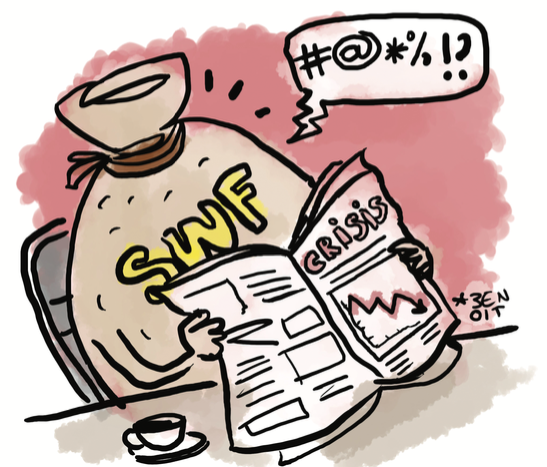
With family offices sitting this one out, the question on everyone’s minds is what will the regional PE industry’s other big slugger, the sovereign wealth funds (SWFs), role be in the current downturn? SWF investment has been largely focused on acquisitions in the Western financial sector, propelling them into the limelight. Over $14 billion were invested by regional SWFs in Western financial intuitions over the course of 2007, of which $7.5 billion (a 4.9 percent stake) was invested in Citigroup by ADIA, Abu Dhabi’s SWF, valued at more than $850 billion. Not to be outdone, the Kuwait Investment Authority, Kuwait’s SWF valued at approximately $250 billion, invested $10 billion in Western financial institutions, including a $3 billion investment in Citigroup and a $2 billion investment in Merrill Lynch. Also in 2008, the Qatar Investment Authority, valued at around $50 billion, invested a further $5 billion in Barclays. According to Thomson Financial, SWF acquisitions in January 2008 accounted for 28 percent of the total merger and acquisition activity in the United States.
The valuations of Gulf SWFs should be regarded as the educated guesses of outsiders rather than firm numbers from accountants inside the institutions.

Indeed, it is the opacity inherent in most aspects of SWFs operations that has been difficult for Western markets to accept. Almost immediately after the SWF investments listed above, commentators and governments began to demand that SWFs more clearly explain their intentions to the world. The hysteria, however, turned out to be short lived when the value of the stocks that the SWFs invested in — namely Citi and Merrill — plummeted and it became evident that the SWFs had bit off more than they could chew.

“These guys [SWFs] are even more traumatized than family offices because they did some very high profile deals and one of the downsides of doing high profile deals is that people keep talking to you about them if they go sour,” says Al-Khudairy. “High profile deals are a double edged sword. I don’t think anyone is going to forget the hosing they took on some of these assets.”
Without a doubt, SWFs will now have to take stock of their losses to figure out the next step. Last month Hussain Al Abdullah, executive director of the QIA, told reporters in Dubai that the fund had lost less than 20 percent of its value in 2008 and that it has decided to suspend buying activity for a total of six months. Many of the other SWFs are also expected to follow suit even though, not surprisingly, they have not advertised it yet.

“In the short term the damage has been so great that [SWFs] want to sit down and take a breather; they are really not thinking of going to their investment committees with anything right now,” explains Al Khudairy.

Whether it’s six months or longer, the region’s SWFs will eventually have to start investing again.

“There is a lot of soul searching going on in the SWFs and many are asking themselves what asset classes they should be investing in,” says Jurgen Heppe, managing director of direct investment at Istithmar World. Once they are done looking in the mirror, the overarching sense is that the SWF petrodollar will begin to look inwards. Western markets are expected to take much longer to recover and they have proven themselves not to be the financial havens of investment they were once heralded to be.

However, for the time being the SWFs are not widely expected to be the silver bullet that will pull the regional PE industry out of its slump, simply because regional governments have other short-term priorities.

“The added impetus for SWFs to invest in PE in the region is the imperative of their host governments to support regional projects and businesses that are close to home, which will help sustain economic productivity in the short term,” says James Tanner, head of placement and relationship management at Investcorp.

Thus there is room for positive developments at the region’s PE firms. “There is likely to be increased pressure on [SWFs] from the rulers to look inwards and to at least make some investment within the region in terms of PE type investments,” says Hall. Others in the industry are even more optimistic about the paradigm shift in the investment outlook for regional SWFs.

“In the medium to long term there is going to be a significant upturn in the amount of money SWFs will be investing within the region,” says Al-Khudairy. “It’s going to be a boom for sure.”

Before PE firms start to queue up at the doors of the region’s SWFs, they would do well to consider the change in focus of sovereign capital and macroeconomic trends. Having established that SWFs will now look to the region to place their vast pools of capital, and knowing that their investments are long term in nature, it is obvious which sectors will benefit.

“A number of sectors in the region have shown resilience and proved countercyclical, such as infrastructure, agriculture, healthcare, and to a certain extent FMCG and telecoms,” says Rami Bazzi, senior executive officer at Injazat Capital.

Heppe adds that “all of the defensive sectors look appealing, however, the reason they are defensive is because they are stable and hence they will not be beneficiaries of a cyclical upturn in the way that other sectors were. Secondly, returns in [defensive] sectors take a long time to mature and that is why the money went elsewhere previously — so they will benefit.”

Never the same again

Whether it’s family offices, SWFs or high net-worth individuals, the nature of institutional investment is undergoing a radical change. The age of short-term flipping is over and investors are looking for areas that will give them solid and reliable returns.

“We cannot assume that there is just a shortage of liquidity and it will pass then we will be back to business as usual when it comes to fundraising,” says Hisham El Khazindar, managing director and co-founder of Citadel Capital.

“Just as this crisis fundamentally affects hedge funds and investment banks it will also affect the PE industry and the way PE fundraises and operates.”
That change will manifest itself in a more sober market that looks more towards expertise than the haphazard investment we have seen in the past three years.

“The market here was growing so quickly and the economy seemed so robust and very few of the people who were raising funds around the region had any sort of track record to run on,” says Benjamin Newland, partner at King & Spalding. “Investors were not investing based on manager performance histories but based on the narrative, connections or the identity of other shareholders and the sponsor [sic].”

As investor’s attitudes change, PE firms must also adjust their pitches and tactics to meet the challenges and new realities of the market.


April 3, 2009 0 comments
0 FacebookTwitterPinterestEmail
  • 1
  • …
  • 475
  • 476
  • 477
  • 478
  • 479
  • …
  • 686

Latest Cover

About us

Since its first edition emerged on the newsstands in 1999, Executive Magazine has been dedicated to providing its readers with the most up-to-date local and regional business news. Executive is a monthly business magazine that offers readers in-depth analyses on the Lebanese world of commerce, covering all the major sectors – from banking, finance, and insurance to technology, tourism, hospitality, media, and retail.

  • Donate
  • Our Purpose
  • Contact Us

Sign up for our newsletter

[contact-form-7 id=”27812″ title=”FooterSubscription”]

  • Facebook
  • Twitter
  • Instagram
  • Linkedin
  • Youtube
Executive Magazine
  • ISSUES
    • Current Issue
    • Past issues
  • BUSINESS
  • ECONOMICS & POLICY
  • OPINION
  • SPECIAL REPORTS
  • EXECUTIVE TALKS
  • MOVEMENTS
    • Change the image
    • Cannes lions
    • Transparency & accountability
    • ECONOMIC ROADMAP
    • Say No to Corruption
    • The Lebanon media development initiative
    • LPSN Policy Asks
    • Advocating the preservation of deposits
  • JOIN US
    • Join our movement
    • Attend our events
    • Receive updates
    • Connect with us
  • DONATE