• Donate
  • Our Purpose
  • Contact Us
Executive Magazine
  • ISSUES
    • Current Issue
    • Past issues
  • BUSINESS
  • ECONOMICS & POLICY
  • OPINION
  • SPECIAL REPORTS
  • EXECUTIVE TALKS
  • MOVEMENTS
    • Change the image
    • Cannes lions
    • Transparency & accountability
    • ECONOMIC ROADMAP
    • Say No to Corruption
    • The Lebanon media development initiative
    • LPSN Policy Asks
    • Advocating the preservation of deposits
  • JOIN US
    • Join our movement
    • Attend our events
    • Receive updates
    • Connect with us
  • DONATE
GCC

Antoine Drean & Jean Aboumrad – Q&A

by Executive Staff March 3, 2009
written by Executive Staff

Founded in 1992 as continental Europe’s first independent private equity placement agent, to date Triago has raised more than 130 funds and transferred more than 800 secondary positions. Today, Triago enjoys a presence on six continents operating out of their offices in New York, Paris and recently Dubai, which was inaugurated in 2007. Executive sat down with chairman and CEO Antoine Dréan and managing director Middle East Jean Aboumrad to get an insider’s view on what’s happening in the private equity market in the region and around the world.

E Are private equity (PE) firms having difficulty finding investors, given current financial conditions, and is it becoming harder to find investors for venture capital or growth capital?

Dréan — Yes, in big letters, even though it is not mission impossible. There are about 1,000 active investors in this asset class worldwide and probably two-thirds of them are on the sidelines waiting for better times, broke or with no cash for PE because they are already way above their ratios. That’s two-thirds, but there is one third that is fully ready to work. They are obviously a bit more cautious, they take more time, they look under every rock to make sure that there are no traps, but they still put money out. We have been through some ups and downs but we always find money because we look at where it is has gone. [The money] used to be in the US and Europe, then it used to be here and now it’s probably less from here and more from the US again and from Asia.

E What prospects exist for your investors, given what is happening in the region?

Aboumrad — The current trend in the region today is that you have the usual investors and usual suspects who used to commit a lot of money to this asset class, namely the sovereign wealth funds (SWFs) and the pension funds in all of the countries of the region. These guys still have funds allocated for PE and they will still commit. The other chunk of money that used to invest in this space was more family offices. Now families are much more cautious. They have put all their investment programs on hold. Some of them don’t have money anymore so they cannot invest. Others will still have liquidity but they are just more cautious. In terms of numbers, the amounts invested by the SWFs can very easily cover the amount [of money in family conglomerates] because families put less sizeable amounts than SWFs. So in the PE space there is still money but probably less than last year. Also, there is still money in the Middle East, the US and even in Asia. Now definitely buyout and large buyout, which was trendy last year and the year before, is basically finished because there is no leverage anymore. This will become buyout without leverage or even de-leveraged buyout.

So money will move more into growth capital or other capital like distress, mezzanine, and restructuring, and focus on more niche strategies and less typical buyout funds.

E You have been in the region since 1993, but did not open your Dubai office until 2007. Why did you wait so long?

Dréan — It’s difficult to know for certain when exactly in the cycle you are entering a space, but what is important is to start and this is what we did. In effect, 2007 was also a good year for the PE secondary market. In 2004 we added the secondary business. Most of what we thought we would do here when we setup shop in 2007 was on the primary side, but in fact we were almost 100 percent wrong. We are now funding a lot of sellers even in this region. People here now face some stress and some of them are very anxious. They are saying, ‘all my illiquid stuff, all the investments that are not really poor or those that I have doubts about, I am selling’. So we are seeing a lot of secondary business coming our way. In 2007 we were already thinking ‘well, this is too good to be true’ and that the party would be over at some point. Where it would come from and when, no one really knew.

E What has been your greatest challenge in the MENA market since you started operating in the region?

Aboumrad — First, covering the entire space that the region offers has been a challenge. Second, in order to invest in the PE space investors have to be mature investors. Most of the SWFs and pension funds have staff for that. Most of the families in the region, however, who have a lot of wealth and had already invested in this asset class, did not really know what was going on. In Europe, it is easier to speak with specialists in this area or with families and institutions who have their asset allocation [in place]. Here, people were much more opportunistic. There was a kind of raising awareness, which wasn’t that easy. In the past couple of years PE has become very trendy. If you called investors and ask them to invest in this space they never said ‘no’. Now there is less money and you have to dig to find it, so we are having more and more business. In a sense the situation is actually better for us.

Dréan — We are actually profiting from this mess.

E What do you see happening with PE in the Levant?

Aboumrad — We have a lot of relationships in Lebanon. In Syria we do as well, but so far the Syrians haven’t yet entered this asset class. Financial institutions are quite young there and in terms of Syrian investors, if they cover this asset class, they do it from abroad and it’s never done from Syria. In Jordan and Egypt we know mostly general partners (GPs) but the biggest amount of energy and time spent is in the GCC because the money is there.

E How will you manage things going forward in terms of which funds you adopt?

Dréan — We have to look at fund managers and their history, track record and where they are coming from. Almost every fund manager has one or two poor assets that they try to hide a little bit. Today we would not be interested in a leveraged buyout (LBO) fund because they are having a hard time managing what they already have. The most difficult part of this asset class is that the past is not a guarantee for the future. Some fund managers were superstars for 10 years and then their business disappeared. They will still be able to raise money because some investors only look in the rear view mirror and say, ‘wow, these guys were great so they must be great forever’, and that is sometimes a big mistake.

E What is happening to LBOs now that the regional economy is on a downward slope?

Aboumrad — There was a lot of financial engineering in the leveraged component of the buyout, firstly in the leverage itself and especially in the securitization of this debt. Western banks were very eager to give a lot of money. They knew how to do it and they knew how to sell it afterwards so as not to have it on their balance sheets. This is what actually pushed them to give out more money and what created the bubble we have now. In this region, we didn’t have this level of sophistication. There was more obvious lending and this is why local banks and all the syndicated loans that were given were not as sophisticated or aggressive as those in the West. Going forward there is a lot less leverage everywhere. Most of the new strategies and funds that are going to be raised now, and most of the deals that should be done in the region, will focus more on growth capital and restructuring because those strategies require less leverage, if any, than the usual buyout.

E What do you think the future holds for the secondary market in the region now that investors are so eager to liquidate their holdings?

Aboumrad — Now the secondary market is extremely important, especially investing in PE and illiquid assets. When an investor invests in the [primary] PE market, the lockup period is typically 10 or 12 years and there is no easy way to get out of this investment. Nowadays, most of the investors who invested in this asset class are looking for liquidity options because either they don’t have a choice or for strategic reasons. There is not a lot of awareness in the region about this market in particular. Most of the time, we have discussions with investors who don’t really know that the secondary market exists or how we manage it. Sellers do not usually give out this information and agents cannot because of non-disclosure agreements. The only information that you have in this market is information given by the buyers and it is in their interest to say that they are buying very cheaply. So when we speak with investors and raise the secondary option they say that they are not that distressed. We tell them that in reality the situation is not that distressed and the deals being done are not that distressed anyway. It is a discount market nowadays. Six months ago it was more of a premium market, but it’s still not as depressed as one might think.

Dréan — It’s a very inefficient market. It usually deals with one and the same asset and on the same day with only two parties. [The asset] will go for $0.20 on the dollar to $0.80 on the dollar. So if you know how to sell private equity you will get $0.60 to $0.80; if you don’t you will get very poor prices and there won’t be a chance to go back.

March 3, 2009 0 comments
0 FacebookTwitterPinterestEmail
GCC

A parking lot like no other

by Executive Staff March 3, 2009
written by Executive Staff

Developers in the Gulf have been building high-rise towers, luxury developments and artificial islands, mainly targeting high-income individuals. Yet this time, the Qatari real estate conglomerate Barwa is planning to build the world’s biggest truck park with an eye to the less fortunate construction worker. With its $750 million project the “Truck Park,” Barwa Al Baraha, a subsidiary of Barwa Real Estate, aims to secure decent housing for laborers and truck drivers who were eaten by the inflation sweeping the country. The project will include a 676,000 square meter truck parking lot able to accommodate the trucks of roughly 4,200 long distance truck drivers. The company will nominate the development for the Guinness Book of World Records as the world’s biggest truck park. The project will also include accommodation for 53,000 people, dining halls and workout facilities. Barwa has also launched its Barwa Housing Program for middle and low income tenants who are carefully selected according to criteria, such as their salaries and number of children, in order to be eligible for low cost two or three-bedroom flats.

March 3, 2009 0 comments
0 FacebookTwitterPinterestEmail
GCC

Opportunity in Dubai’s crisis

by Executive Staff March 3, 2009
written by Executive Staff

Dubai has been the Middle East’s business hub and an attractive destination for international investors since its doors were opened to foreign entrepreneurs. Thanks to its free-market economy and developed infrastructure, the emirate witnessed a continuous inflow of investors who chose to benefit from its appealing operating conditions and promising growth.

Although the high operating costs — including office rents and wages — did not keep new businesses from opening in Dubai, they were a concern for entrepreneurs who struggled in some cases to find a suitable office with affordable rent, or talented employees expecting reasonable salaries. With the international financial crisis hitting the region, these costs have now come down, making it less expensive for new entrepreneurs to settle in the emirate.

Office space

When starting a business in Dubai, finding a suitable place for office space is essential since it greatly affects the company’s customer base and operations. In the last few years, one of the main problems that new companies faced was the shortage of office space, since demand was on a steady increase while supply failed to keep pace.

“Definitely rents were very high before [the crisis began]. They were a huge component in the cost of a business, and one of the major factors when determining where to have your office space,” explains Camilla D’Abdo, general manager of D’pr/D’event.

The freehold areas witnessed a greater increase in rents mainly due to their attractiveness and strategic locations. Rose Marie Kilzi, leasing director for Great Properties, says “the rates are usually a bit more expensive [in the free zone] because the business owner is not required to have a local sponsor in order to operate the business. While this is a great incentive, it is a bit more expensive for business owners, especially when market prices — whether in the free zone or outside — are so expensive.” Kilzi also notes that in the last couple of years, rents doubled, while some locations “even saw hikes of about three times the original price.”

With the financial crisis in full swing, companies have begun downsizing or even closing down, while at the same time the supply of new offices continues to increase. These two effects have forced office rents to drop, making it less expensive for new businesses to settle in Dubai. Landmark Advisory, a real estate consultancy, announced that prices of commercial real estate in Dubai have fallen by almost 30 percent already and they are expected to reconcile at 35 to 40 percent below their peak during the third quarter of 2008. Additionally, the company reported that commercial rents are expected to drop by 30 to 35 percent.

The ball is currently in the tenant’s court, hence businesses are capable of finding offices in Dubai’s prime locations with affordable rents. Hala Abou Nader Kassis, owner of Agate Engineering Consultants, says “the landlords or the sales representatives who still have our application are calling us to offer the chance to rent a space that we applied for and could not rent because of the high rate. Currently we expect to move from our location to a better one, with wider space and a better price too.”

Kilzi echoes Kassis, explaining that, “we were almost never able to find office space available on Seikh Zayed Road. Only this week, we have received requests from owners to lease out about 10 [different offices] there.”

Wages

Before companies started to lay-off their staff and freeze their hiring strategies, high wages in Dubai were making it problematic for new businesses with limited capital to open. One of the reasons for the wage hike was the expensive accommodation for which employers had to compensate. Furthermore, Dr. Uwe Forgber, director of Conject Dubai, a leading provider of management software for the real estate and construction industry, says “Dubai is a busy [human resources] market with people who are ready to change jobs just for some more percent of salary. This makes choosing the right people difficult as you never know if they are money driven or really interested in what the company is doing.”

It was also easier for large companies who started their businesses or opened their branch more than five years ago, since prices of residential properties were still affordable, which induced them to buy property to accommodate employees at reasonable prices. Davinder Reo, co-founder of Duplays, a full-service sports portal, opened his business in March 2008. “We came at a time where housing was so expensive, it was unaffordable for us to buy a three bedroom apartment to accommodate three people.”

Similarly to rents, wages are also coming down since people who are in need of a job are settling for less in fear of being rejected or remaining unemployed. Employers say wages have decreased up to 25 percent, making it easier for new businesses to attract talented employees. Eric Raes, general manager of Makateb holding, notes that “it was always hard to find talented [employees] …nowadays, new businesses and established ones will find the process of hiring people easier as top talents are now willing to negotiate and settle for a lower salary range. However, these lower wages should be accompanied with a reasonable package that allows the candidate non-monetary benefits like training programs and personality/skills development sessions.”

Bureaucracy

New entrepreneurs also have to decide whether to settle in one of the free zones or outside. One of the main differences lies in the sponsorship system, which is applicable to companies setting-up outside the designated free zones. The sponsor must be a UAE national and be at least 51 percent owner of the company. Moreover, the sponsor will require a fee and/or a percentage of the profit. Additionally, outside the free zone area, an office space and a rental contract should also be arranged prior to applying for a license.

Subsequently, a license should be applied for at the Dubai Economic Department (DED) — unless indicated otherwise in exceptional cases — for which different rules are set for different types of businesses. Three types of licenses exist: commercial licenses, professional licenses and industrial licenses.

Different investors had different experiences in setting up their businesses. While some considered it easy, others struggled.

“Getting a license is a real challenge, it took us about three months,” says Reo. He used the help of the local sponsor who guided them through the procedure. Forgber says “setting up a company was more difficult than advertised by the Tecom Free Zone. But all-in-all the people were and are really helpful and friendly. We finally managed to found the company after overcoming some obstacles.”

Others found the process easy and straightforward. D’Abdo says “the time for getting a license can range, but it is not going to take a couple of months. Getting a license… has never been a difficult task and we have not faced any obstacles. It is very straightforward.”

It is much harder for investors who are managing their paperwork themselves without guidance or past experience. This explains the popularity of business advisors who help with the process. DED is currently trying to facilitate the licensing procedure by making most of its services available online, meaning investors can perform most of the process at home. “Wherever possible, we are also working with other government departments that enable investors to set up businesses with more ease. If all the paperwork is in place, it is only a matter of hours before any investor can get a business license and roll out the enterprise,” asserts Mohammed Shael, chief business registration and licensing officer at the DED.

More importantly, in late 2007 DED launched nine e-services on its website, “which are specifically created to boost efficiency of operation and enhance productivity,” claims Shael. These e-services are to help potential entrepreneurs find information about starting up new businesses in Dubai. The service is available in both Arabic and English.

New businesses

Despite the challenging conditions the global economy is currently facing, it seems new entrepreneurs have not shied away from Dubai and still consider it an attractive investment destination. DED announced that 3,503 licenses were issued in the fourth quarter of 2008, up by 3.3 percent compared to the same period in 2007. Furthermore, 429 new licenses were given out during the first two weeks of 2009, in addition to 50 Intilaq licenses to UAE nationals enabling them to set up home-based businesses. Eighty percent of the new licenses were trade-focused commercial licenses, while professional licenses made up just under 20 percent, leaving the rest for tourism and industry.

Anil Mampilly, business development manager at EMN Chartered, attributes the increase of licenses to the fact that many companies are relocating to Dubai, finding it less expensive than other countries. “We have branches in different countries and we are currently receiving calls in our UK and Russia offices from people saying they decided to relocate their business to the UAE, mainly because it is less expensive and also because of the tax incentives. [They are coming] not only to Dubai but also to Sharjah and Ras Al Khaimah,” explains Mampilly.

Looking forward

Although office rents and wages are not the only factors entrepreneurs consider before opening a business, they are definitely among the more important. “Being able to hire good staff for lower salaries and finding a suitable office space at lower prices make this period a good time for investment,” states Raes.

Although the international economic conditions might not be very encouraging for investment, Dubai could now represent an attractive opportunity for those who are willing to invest for the long run.

March 3, 2009 0 comments
0 FacebookTwitterPinterestEmail
GCC

Dubai’s development delays

by Executive Staff March 3, 2009
written by Executive Staff
Source: MEED
March 3, 2009 0 comments
0 FacebookTwitterPinterestEmail
GCC

The empty lanes of realty

by Executive Staff March 3, 2009
written by Executive Staff

Since July 2008, stock prices of real estate companies have plunged continuously. This is especially true in the UAE where investors fled the stock market due to bad expectations, the need for liquidity to cover losses in foreign markets, or because they were simply following the crowd. Yazan Abdeen, portfolio manager equities at ING Investment Management thinks “markets are smart in their nature. They have the ability to discount future expectations and the fears of investors.” In this case, investors began to expect the burst of a real estate bubble that would result in a plunge in property prices and lower valuations for real estate companies. “Regardless of the size of the company, I think that the market was taking into consideration some trends of action will take place that will yield in the deleveraging that has happened to these companies,” says Abdeen.

At first, investors started to sell their real estate stocks irrespective of the company’s fundamentals, relying solely on the sector’s outlook and the overall macroeconomic situation. However, since concerns started to emerge about the financial status of these companies due to tighter liquidity and expectations of weaker earnings results, doubts about their fundamentals have grown. “Progressively, it would appear that people began to question the fundamentals and the overall features of some of the [real estate] companies in tighter liquidity conditions,” explains Sana Kapadia, vice president of equity research at EFG-Hermes. “What started as a more technical sell off [seems] to have become a questioning of long-term sustainability,” she adds.

Emaar’s stock price

Emaar properties’ stocks for last half year

Source: Zawya Dow Jones

Emaar properties, the largest property developer in the region hit its lowest share value of $0.48 on February 3 and as Executive went to print, stood at $0.75 after the Dubai government launched a $20 billion sovereign bond program to ease liquidity conditions. At the same time, other real estate companies in Dubai, like Union Properties and Deyaar, stood at $0.23 and $0.15, respectively. Even though these companies have witnessed a small increase in their stock prices, likely due to the $20 billion bond program, it is still too soon to tell if this indicates a trend toward market recovery

Since the beginning of the crisis, Emaar stocks have been the most affected in the sector as they have lost more than 80 percent of their value in 2008 and around 37 percent in the last three months. Thomas Schellen, publishing editor at Zawya Dow Jones, explains that even though Emaar’s stock price has suffered the greatest loss, that does not necessarily indicate that it has worse market fundamentals than other companies in the UAE or the region. In Schellen’s view, Dubai was the worst hit by the crisis because the relative importance of its the real estate sector in the economy is higher than in other GCC countries. Consequently, Emaar, being the biggest company on Dubai’s financial market and with a high trading activity, was affected the most. Kapadia also believes that the impact on Dubai’s stock market is more significant since “a distinction continues to be made between Dubai and Abu Dhabi, with more risk being perceived in Dubai companies in the property market… the property market crash [is] expected to be much worse in Dubai than Abu Dhabi.”

Emaar’s financial situation

On February 12, Emaar released the long awaited 2008 fourth quarter report announcing a 54 percent decrease in net profit, mainly blamed on the $480 million write-down in its US subsidiary John Laing Homes, which weighed down the company’s net profit. Emaar recorded a net operating profit of $1.519 billion in 2008, 15 percent lower than its net profit of $1.79 billion in 2007. It also announced that its revenue dropped by 10 percent, from $4.865 billion in 2007 to $4.360 billion in 2008. A week after the report was released, Emaar announced that it will not be paying a dividend in 2008.

Additionally, it seems that liquidity problems at Emaar are starting to emerge since the company revealed in January its plan to secure financing by raising up to $4 billion through Eurobonds and Islamic sukuk. It has announced the establishment of a $2 billion Euro Medium Term Note (EMTN) program and a simultaneous sharia-compliant $2 billion sukuk program, already listed on the London Stock Exchange. These programs are issued “as a part of the company’s global growth strategy,” said Emaar in a statement.

U.A.E. Property prices have fallen 40 percent and are expected to drop 20 percent more in 2009

Emaar’s possible downgrading

In mid-December 2008, Standard and Poor’s (S&P) rating service revised its outlook for the company from stable to negative, while keeping its ‘A-’ long-term corporate credit ratings. “A prolonged downturn could negatively impact our view of Emaar’s business risk, and it could also lead to deterioration of Emaar’s currently healthy financial position,” said S&P’s credit analyst Alf Stenqivist in a recent press release. Even though Emaar’s rating is still high, the fact that S&P’s outlook was downgraded is not a positive sign for the company. Moreover, Moody’s Investor Service said at the beginning of February that it is reviewing six leading Dubai companies, including Emaar, for rating downgrades due to Dubai’s macroeconomic outlook. Moody’s anticipates that the downgrade would be lowered by not more than two notches, still leaving these companies with investment grade ratings. Schellen explains, “the outlook forecast might influence negotiations between the debt issuer and the bond buyers. The bond buyers might demand a higher yield because the outlook is negative, but unless the actual rating changes, it is unlikely that there is going to be any change in the direct interest situation.”

Abdeen explains that the share prices of a company do not affect its operations from a financial perspective. “The movement of the share price is neither loss nor gain for the company. The price does not affect its performance,” but there is very much a link between the company’s performance and its share price. Therefore, any bad news for Emaar or the market in general might affect the company’s share performance.

Property prices

The fact that property prices are still on a downward trend — especially in Dubai — and that projects are being shelved, is not improving the confidence of investors who would rather stay out until the market starts to show some signs of recovery. Analysts at the UAE investment bank Shuaa Capital said in mid-January that property prices have fallen 40 percent so far and are expected to lose an additional 20 percent by the end of 2009. Collier International’s analysts were more optimistic since their fourth quarter House Price Index (HPI) revealed a drop of only eight percent in Dubai between October and December of last year. “If you come to the market here and see what is happening, [Collier’s numbers] are underestimated. I know that some major places in Dubai, like the Burj Dubai area, have gone back to the price of the third quarter of 2007. It seems they have dropped around 45 percent,” says Abdeen.

Forging into the future

Abdeen believes that any company should now have four key factors in mind to withstand the difficulties in 2009. These four elements are “visibility, profitability, proof of cash flow generation and lack of high leverage — you need these four pillars to stand, and if you have them, you will be immune,” he adds.

Kapadia believes “this is the time for companies to have strong corporate governance and corporate communication.” Everyone knows these are difficult times and companies are struggling to deal with changing market dynamics. Therefore, “if a company communicates and discusses how it is dealing with the current market challenges, it would help people believe that management is focused on dealing with the new dynamics,” she explains.

 With the current chaos in the UAE real estate market, it seems that Emaar and others have a lot to do to revive investor’s confidence in their company, as well as the market in general. People are starting to suspect that Emaar is currently facing much more trouble than expected and they would rather stay out of the stock, even if it is priced at half a dollar. “I think there is high risk-averseness and a general desire not to spend on any kind of investment right now. Even if the stock may look cheap on P/E [price to earning ratio] basis, the earning is in question, given limited visibility regarding how the current cycle will play out,” explains Kapadia. “It has become challenging for companies to maintain the sustainability of their earnings.”

It certainly seems people are not expecting any improvements in the short run, however, with the fast changing market conditions and the complexity of the market mechanism, experts agree that the stock markets are very volatile and only a wait-and-see strategy should be adopted at this time. “Right now it would be pretty stupid for an analyst to claim that he or she knows what is going to happen in 2009 and what the scenario is most likely to look like,” concludes Schellen.

“Visibility, profitability, proof of cash flow generation and lack of high leverage — you need these four pillars to stand”

March 3, 2009 0 comments
0 FacebookTwitterPinterestEmail
Comment

Last call for peace

by Claude Salhani March 3, 2009
written by Claude Salhani

Now that the initial euphoria behind President Barack Obama’s Middle East peace initiative is settling into the reality of the region’s intransigence, a different picture is beginning to emerge, and it is none too bright.

What darkens the horizon is the fear that if President Obama’s efforts — spearheaded by veteran negotiator George Mitchell — do not meet success, the backlash may be disastrous for the region, for US foreign policy and for the Obama presidency.
For once there is a president in the White House who is truly dedicated to the peace process because he understands the impact that peace in the Middle East has on US national security. As well, the president believes that solving the longstanding Israeli-Palestinian dispute will impact positively on addressing other grievances in the region. While settling the 61-year old dispute is not going to solve all the region’s problems, a comprehensive peace treaty between Israel and the Arab world will go a long way in bringing stability to the troubled region.
However, even if Obama is set on seeing peace in the Middle East, principal actors in the region seem less convinced that peace can be achieved at this point.
There are two reasons Obama’s initiative may fail.
First is Israel’s intransigence to cede on issues such as the settlements. This issue may become even more of a stumbling block now that Israeli President Shimon Peres has called on the right-wing Benyamin Netanyahu to form a government. Netanyahu has allied himself to the far right wing Avigdor Lieberman of the Yisrael Beiteinu — Israel Our Homeland Party — whom some consider to hold fascist tendencies not unlike those shared by Jean-Marie Le Pen’s National Front in France, the late Joerg Haider’s Freedom Party in Austria or Belgium’s Vlaams Blok. Netanyahu is against returning any land captured by Israel and very much in favor of keeping and expanding the settlements. A flexibility on the part of “Bibi” will depend directly on how much pressure Washington applies.
Now add Lieberman’s desire to expel Arabs en-masse and his views of Palestinians, whom ironically, as says Daniel Levy, a senior fellow at the Century Foundation and the New America Foundation, have been in this land far longer than Lieberman, an immigrant from Moldova. The ultra-rightist Avigdor Lieberman, far more so than Netanyahu, wants to see the settlements expanded.
Yet there is still room for optimism. History has shown us that it has always been the most hard-line Israeli prime ministers who have moved ahead in the peace process with the Arabs. Menahem Begin, considered one of the most conservative of Israel’s prime ministers, signed the Camp David peace accords with Egypt and returned the Sinai Peninsula in exchange for recognition by Egypt and the establishment of diplomatic relations.
And Ariel Sharon, the architect of the invasion of Lebanon in 1982, as prime minister withdrew from the Gaza Strip.
The second reason why the future of the peace talks is in jeopardy is Arab inability to reach a consensus before coming to the negotiating table. Inter-Arab squabbling, between Syria on the one hand and Egypt and Saudi Arabia on the other, does little to help the overall Arab cause.
Several high-ranking Arab diplomats in Washington have voiced their opinion that the differences between various Arab countries remain a cause of great concern.
Already Hamas, who has been at the forefront of the dispute with Israel in recent weeks, has been saying it might seek to form a new front independent of the Palestine Liberation Organization (PLO).
Many diplomats and observers agree that President Obama’s peace initiative may very well be the last chance to settle the Middle East dispute. Failure at this point will guarantee decades of more conflict and violence. And if the past helps us predict the future in any small way, we can reach the following conclusions: with each passing decade since conflict began in the Middle East, the level of violence has grown exponentially and the issues have become more complex.
To miss this opportunity for peace would be regrettable to say the least. However, history will judge today’s leaders, and so will their children, especially if they are condemned to fight yet another war.

Claude Salhani is editor of the Middle East Times and a political editor in Washington, DC.

March 3, 2009 0 comments
0 FacebookTwitterPinterestEmail
Comment

Defective democracy

by Norbert Schiller March 3, 2009
written by Norbert Schiller

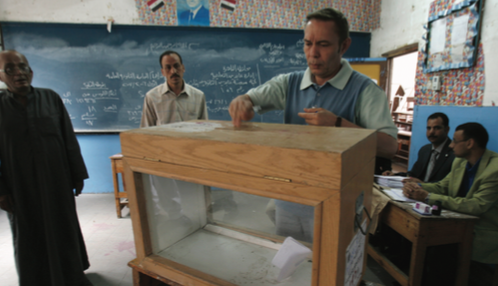
Over the past quarter century, I have witnessed countless presidential and parliamentary elections in the Middle East and North Africa. I cannot remember one that went off without voter intimidation, violence or vote rigging. In fact, every time an election is announced it almost seems as though the country holding it is preparing for war. The military is mobilized and placed on high alert; buildings housing radio and television stations as well as government offices become armed fortresses and a feeling of doom grips the nation.

As a journalist, I have had rough times covering elections in the region. I have been arrested by police on multiple occasions. In one well documented case, during the 2000 parliamentary elections in Egypt, I was beaten up and had all my photographic equipment smashed to pieces. Thugs, or ‘baltaguiya’, hired by Egypt’s ruling National Democratic Party (NDP), accosted me as I was leaving a polling station in the center of Cairo and threw me to the ground, while taking all my equipment from me. If this had happened in a dark alley it would be one thing, but the attack took place in broad daylight right in front of roughly two-dozen armed police there to protect the polling station. After getting up, I called for the policemen’s help. But all I got from the senior officer on the scene was a denial that any such attack had occurred.
Since I moved to the Middle East, there have been seven presidential elections in the United States. Each president that has come to power during this period, except for Obama, has either served the maximum two terms or was defeated after his first four years in office. Over the last 25 years, elections in the US have been free of violence, intimidation and vote rigging. The only major hiccup occurred in 2000, when votes in Florida had to be recounted by hand because of irregularities with the vote counting machines. In the end, the problem was settled in a civil manner by the Supreme Court.
Presidential elections in the US have almost a festive mood about them. They come every four years like clockwork just before Thanksgiving and right in step with the holiday season. When it’s all over there is a period of reconciliation when all Americans — Democrats, Republicans and Independents — unite knowing full well that the system put in place by the founding fathers over 200 years ago, is still alive and well.
In most instances, elections in the Arab world are anything but festive, and elections for the highest office have proven to be nothing but a farce. Of the 22 member nations in the Arab League there are eight monarchies that don’t even pretend to be democratic. When it comes to the appointment of the highest office, they just appoint the next of kin to the throne. Then there are the so-called democracies. Egypt’s Mohammed Hosni Mubarak has been in office for almost 30 years, since Anwar Sadat was assassinated in 1981. The vast majority of Egyptians have known no other head of state. Sure, he has held countless referendums, many of which I covered, but the outcome of these referendums has always been the same. Take the 2005 election, the only time in Egypt’s history that a presidential election was contested by another candidate. In the end, Mubarak took 88.6 percent of the votes and the challenger, Ayman Nour, not only lost the election but was sentenced to five years in jail for supposedly “forging powers of attorney” to secure the formation of the his political party, al-Ghad — a charge he vehemently denies. Last month, he was mysteriously released after serving three years.
In many Arab countries, democracy equals a referendum, a mechanism used by autocratic regimes to appease Western calls for democratic reforms. In reality, a referendum is nothing more than an approval rating, which rarely dips below 90 percent. Besides Egypt, referendums are popular practice in Syria, Tunisia, and Yemen.
Algeria experimented with the democratic process, but when the FIS (Front Islamique du Salut) was set to win a parliamentary majority in 1992, the military stepped in and annulled the election. The military’s action sent the country into chaos and civil war for the better part of the decade, killing an estimated 100,000 people.
Lebanon knows a thing or two about chaos and when elections are held there is always a lingering fear that the country will disintegrate once again into civil war. The next elections are scheduled for June 2009 and since they were announced almost six months ago, it is as if lines are already being drawn. Chances are that nothing major will happen, but if the fragile sectarian balance is altered, nobody knows what may happen.
America’s presidential electoral system is imperfect, but it has been tested for more than 200 years. A valid complaint is how a country with such a diverse population can have only two major political parties. Despite this flaw, with every new administration there is a major change in policy that has worldwide repercussions. Let’s all hope this new administration will repair the damage done by the last and once again shine the light on the democratic process. As one friend so appropriately put it, “not an abomination, rather an Obama nation!”

Norbert schiller is a Dubai-based photo-journalist and writer

March 3, 2009 0 comments
0 FacebookTwitterPinterestEmail
Executive Insights

Value creation within the pale of crisis

by Mahmoud El Ali March 3, 2009
written by Mahmoud El Ali

The spillover of the current financial crisis into the main economy is fast raising the specter of a global recession. A natural reaction is for companies to batten down their hatches in anticipation of the coming storm. But natural reactions are not always the ideal ones. Companies that cut investments and headcount in previous recessions have found to their cost that they could not respond to the upturn when better times came.
It is the brave and the leaders who take advantage of temporary downturns to invest, retool and regroup. It is the Warren Buffets, who start buying when the market is down, that will emerge stronger.
In October, research firm Gartner revised its 2009 global IT spending growth forecast from 5.8 percent to 2.3 percent but also maintained that, despite reduced growth, recession in IT spending is unlikely. The research firm noted that the industry has remained fundamentally strong, with replacement cycles in emerging regions and technology shifts, such as renewed interest in cloud computing, helping to sustain the industry through the tough times.
One could argue that delaying IT and networking investment until an upturn is the most logical move in this age of uncertainty, but enterprises could — and should — see this period as an opportunity to pursue IT expansion. Organizations should be searching for higher value solutions to help them drive efficiency now while they prepare for better days. Now is the time to leverage the availability of more cost-effective equipment and support.
If anything, the current financial crisis is helping to usher in the next cycle of networking that research firm IDC calls “flight to value,” a phase when customers re- evaluate their IT and working investments based on a number of factors, including technological pervasiveness, flexibility, sustainability and pricing.

Linking the value chain
Such re-evaluation will inevitably take us back to fundamentals, and that is to the basic IT infrastructure, or what could be termed as ‘infostructure.’ That infostructure is the corporate network that today has become the central nervous system for enterprises. However, much has changed in this past decade. The corporate network today links not just its software and hardware, but also its ‘heartware’ — employees, customers, partners, distributors and other stakeholders. By linking the creators of value, the network becomes the company’s own value chain. Indeed, it would not be an exaggeration if we were to say that ‘the network is the company’.

Network value creation
Viewing the corporate network as the company’s central nervous system can create a paradigm shift from the network as a cost center to the network as a mission- critical creator of value. Organizations are discovering the economic advantages of converging their various communications systems into a single network infrastructure. They are deploying IP telephony and increasingly, video over IP on their networks, thus saving on the costs of maintaining two separate network infrastructures. Others are deploying video over IP as a backbone for their security surveillance systems. ‘One network, many services’ has become the new clarion call.

Beyond cost savings
Perilous times such as these invite critical re- examinations of investment portfolios. IT investments will not be excluded. As mentioned earlier, such re-evaluations must include IT not as a cost center but as a creator of business value. It’s not just about cost savings. The ‘flight to value’ should not be confined to acquiring lower-cost alternatives. Rather, this is a good opportunity to look at how much each investment dollar can be stretched. Companies can translate the lower costs they enjoy on a network upgrade into a bigger redundant network. By acquiring additional network switches on the same budget, they can create a redundant network and ensure uninterrupted operations for their business activities.
Another important aspect of IT investments is long-term investment protection, which often relates to the issue of open systems and standards. Most network solutions today are open, but it can be argued that some are more open than others. A network infrastructure that creates interoperability problems with other vendors’ equipment, or one that locks you in with one vendor, cannot be considered open. It is also an investment that may not be fully protected. A truly open network architecture must enable and support other third-party solutions, as well as the development of open-system plug-ins. Investment protection must also include future-proofing your network infrastructure to support new and emerging services. Again, the full support of industry standards, as well as the vendor’s active involvement in the development of those standards, will be critical in protecting your network investments for the long term. These are hard but interesting times for many companies, but for discerning managers this is an excellent opportunity to create new value from your network investments.

Mahmoud El Ali is general manager, Middle East and North Africa for 3Com

March 3, 2009 0 comments
0 FacebookTwitterPinterestEmail
Executive Insights

Dialing into customer-centricity in telecom expansion

by Hilal Halaoui & Adel Belcaid March 3, 2009
written by Hilal Halaoui & Adel Belcaid

Over the last few years, Middle Eastern governments have significantly opened up their telecommunications markets and broken up the monopolies of their state-owned, historic operators. Spectrum licenses were awarded at record prices and the new entrants engaged in head-to-head competition with the incumbents. As a result, mobile penetration soared and rapidly exceeded the psychological limit of 100 percent in many markets. In Saudi Arabia, for instance, mobile penetration was hovering around 30 percent in 2003. In 2008, it quadrupled to 120 percent according to Booz & Company analysis. While this spectacular growth brought countless benefits and choices to the end-users, it does mean today that mobile subscriber acquisition in the mainstream market has become a more difficult challenge. Thus, to achieve the growth and returns their shareholders have come to expect, leading Middle Eastern mobile operators have essentially pursued a two-pronged approach: on the one hand, they want to maximize the value capture from their domestic markets and defend their positions; on the other hand, those who can afford to are seeking additional growth in foreign, less penetrated markets.

While international expansion comes with an evident load of challenges that several Middle Eastern players are facing for the first time, maximizing value capture in the domestic market is, perhaps unexpectedly, no less challenging. It requires mobile operators to pursue, also for the first time, smaller niche segments, which typically crave customized value propositions and are usually ill-served by the generic, one-size-fits-all offerings that prevail in the mainstream markets.

Answering the call
Successfully pursuing niche segments is no small task for most operators in the region. It requires major discontinuities in just about every aspect of their business: strategy, branding, technology, organization structure, human resources, corporate culture… no area is spared! But mobile operators will find comfort in convergence, which comes with just the right toolkit to make them relevant to niche markets, at least from a technology point of view. Indeed, the convergence of media, fixed and mobile communications is making it possible for mobile operators to keep growing through customized value propositions targeting different customer segments. Mobile content is witnessing exponential growth and technology innovations, such as IMS (IP Multimedia System), promise superior and unprecedented user experiences centered around convergence. These game- changing technology developments are disruptive enough to not only bring niches within “business-case-proof” reach of mobile operators, but also to re-invent the mass market game and effectively turn it into a long tail of niches and segments, each with their own needs and wants and each with their own willingness to pay.
This is nothing short of a revolution in the mobile communications space and could mean a vast blue ocean of opportunities for players able to take advantage of them and augers well for the industry as a whole. Indeed, mobile operators stand to reap the benefits of price discrimination, service bundling and content differentiation, and the move away from cut-throat price competition that is characteristic of a mature or declining industry.
To make the most of this technology-driven opportunity and durably rejuvenate their domestic markets, regional mobile operators must first develop strategies aimed to firmly and unequivocally embrace convergence and its ‘customer first’ corollary. Their strategic intent should be to further their customer intimacy and understanding, to leverage the new technology-driven capabilities of convergence to come up with pertinent and multi-platform offerings that customers are willing to pay for. They should aim to provide integrated, end-to-end solutions that grow their shares of the customer wallet and reduce churn by increasing switching costs to customers. Next and foremost, regional mobile operators need to embark in major organization restructurings, moving away from product-centric organization and towards customer-centric structures. They should organize around well-defined customer segments while preserving any scale or scope advantages they might be deriving from their legacy structures.
A notable example of such restructuring is the Saudi Telecom Company (STC), who was among the first industry heavyweights to embark in a major structural transformation sparked by its FORWARD corporate strategy. At the heart of the FORWARD strategy lies the customer, whether an individual, a small business or a large corporation. To execute its ambitious corporate strategy, STC adopted a customer-centric structure that centered around four business units: personal, home, enterprise and wholesale, each of which is focused on a broad segment of the market and has profit and loss responsibility. These market-facing units are all supported by horizontal functions such as network and shared services. Concurrently, and to support the structural transformation and durably instilled in the minds of customers and employees alike, STC conducted a major re-branding exercise that aimed at affirming its new customer-centric direction and signaling to all stake-holders the completion of its 10-year long transformation from a public ministry of the Saudi government to an agile, market-oriented telecom heavyweight.

A corporate lifestyle choice
But customer-centricity does not stop at level one of a mobile operator’s organization structure. On the contrary, it can go far into levels two, three and beyond. Functions such as marketing, sales and customer care can be entirely structured around customer segments with product teams virtually absent. Customer-centricity can also turn into a corporate “lifestyle” as far as organization structure is concerned, with customer-centric inter-BU processes and one-stop-shop windows between downstream and upstream units.
In sum, customer-centricity clearly comes in different shades and shapes and the key organizational question for any mobile operator CEO should be: How customer-centric does my structure need to be? To answer this question, mobile operators need to understand the markets they operate in, including the mass and niche components. They also need to understand their capabilities, existing and envisioned. In the former, they should have a very good understanding of market segmentation and assess the appetite of each segment for service and product customization. In the latter, they should assess their ability to offer integrated solutions and accurately address the customization needs of their target segments. In both, they should strike the right balance between supply and demand and come up with an organizational structure that is tailored with just the right dose of a customer-centricity and realism to implement it.

Hilal halaoui is a principal and ADEL BELCAID an associate at Booz & Company

March 3, 2009 0 comments
0 FacebookTwitterPinterestEmail
Executive Insights

Buoyed by innovation, telecoms are 2009‘s smart investment

by Uwe Neumann March 3, 2009
written by Uwe Neumann

The telecoms industry seems well equipped to deal with the crisis. As turnover is primarily generated by innovations, the industry is fairly resistant to fluctuations in business. Therefore, investors who want to protect themselves could be interested in adding telecom companies shares to their portfolio.

This New Year’s Eve, a record-breaking 360 million SMS messages were sent in France. That was over 30 percent more SMS messages than the previous New Year’s Eve. The telecoms operators seem to be barely feeling the effects of the recession. In fact, over the last few months, telecoms shares have demonstrated a relatively strong resistance to the turbulent stock market. While the wider European market suffered a loss in value of almost 30 percent since October 2008, the European telecoms sector fell by a modest 10 percent. Clearly the telecoms industry is not completely immune to the effects of an economic downturn, however, the negative influences will have less of an impact on turnover and margin development than they will in many other sectors. We have come to this conclusion for the following reasons:

Turnover is driven by innovation
There are two main elements that influence turnover when it comes to telecoms companies: client growth and turnover per customer in cellular phone and fixed line/broadband/internet sectors. Both elements have continued to grow over the last 10 years despite economic cycles and despite the fact that they are influenced by sector-specific factors such as regulation, price development, competition and market penetration. We expect these sector-specific influences to remain prevalent in the future as there is currently no firm evidence to suggest that the effect of the recession on income is causing clients to change the way they use their phones or changing the dynamic of customer growth. In fact, turnover will be even more driven by innovations. The success of Apple’s new 3G iPhone shows that clients are prepared to pay more per month for these innovative products than ever before — regardless of the financial crisis and economic downturn. Turnover trends are therefore more likely to be driven by the anticipation and implementation of a technological innovation (broadband and mobile internet) than periods of economic downturn.

Margins are likely to remain fairly stable
One of the main concerns for investors is margin development, which pessimists believe will suffer during the financial crisis and economic downturn due to increasing financing costs for investments and rising operating costs. However, we believe that the cost structure of telecoms companies is more flexible than people think. For example, a decline in customer growth leads to a reduction in marketing and acquisition costs. Less money is spent on mobile phone subsidies, which frees up operating margins to some extent. Over the last two years, many companies have also implemented cost reduction programs which will really start to pay off in 2009. Future investments can be delayed without risking a negative impact on daily business. Last but by no means least, we must mention baseline effects that no longer have an impact on operating margins due to the declining effects of administered tariff reductions — this includes tariff reductions resulting from roaming or termination fees, for example. Companies, therefore, have a sufficient safety net to absorb losses in turnover and keep their margins stable.

Steady cash flow and sound balance sheets
The aforementioned factors indicate that telecoms companies can keep cash flow generated by their operations at a fairly steady level. Based on current estimates for turnover, margins and cash flow between 2008 and 2011, the return forecast remains fairly stable even though growth in turnover seems to be fairly sluggish for the sector as a whole. Taking into account the low level of debt typically accrued by the telecoms industry in the past, the risk of refinancing is relatively minor. On average, the earnings before interest and taxes (EBIT) generated by the European telecoms industry cover its current interest expense more than five times over. These attributes are a major attraction to investors during a recession, which suggests that the industry will continue to outperform the market. Careful investors should therefore incorporate telecoms shares into their portfolio during the 2009 investment year.

Uwe Neumann is an equity analyst at Credit Suisse

March 3, 2009 0 comments
0 FacebookTwitterPinterestEmail
  • 1
  • …
  • 479
  • 480
  • 481
  • 482
  • 483
  • …
  • 688

Latest Cover

About us

Since its first edition emerged on the newsstands in 1999, Executive Magazine has been dedicated to providing its readers with the most up-to-date local and regional business news. Executive is a monthly business magazine that offers readers in-depth analyses on the Lebanese world of commerce, covering all the major sectors – from banking, finance, and insurance to technology, tourism, hospitality, media, and retail.

  • Donate
  • Our Purpose
  • Contact Us

Sign up for our newsletter

    • Facebook
    • Twitter
    • Instagram
    • Linkedin
    • Youtube
    Executive Magazine
    • ISSUES
      • Current Issue
      • Past issues
    • BUSINESS
    • ECONOMICS & POLICY
    • OPINION
    • SPECIAL REPORTS
    • EXECUTIVE TALKS
    • MOVEMENTS
      • Change the image
      • Cannes lions
      • Transparency & accountability
      • ECONOMIC ROADMAP
      • Say No to Corruption
      • The Lebanon media development initiative
      • LPSN Policy Asks
      • Advocating the preservation of deposits
    • JOIN US
      • Join our movement
      • Attend our events
      • Receive updates
      • Connect with us
    • DONATE