• Donate
  • Our Purpose
  • Contact Us
Executive Magazine
  • ISSUES
    • Current Issue
    • Past issues
  • BUSINESS
  • ECONOMICS & POLICY
  • OPINION
  • SPECIAL REPORTS
  • EXECUTIVE TALKS
  • MOVEMENTS
    • Change the image
    • Cannes lions
    • Transparency & accountability
    • ECONOMIC ROADMAP
    • Say No to Corruption
    • The Lebanon media development initiative
    • LPSN Policy Asks
    • Advocating the preservation of deposits
  • JOIN US
    • Join our movement
    • Attend our events
    • Receive updates
    • Connect with us
  • DONATE
Comment

Near death of a star

by Paul Cochrane March 3, 2009
written by Paul Cochrane

In late January I was asked to look into the closure of the Daily Star, Lebanon’s only English language daily. But discussions to financially prop up the paper were going on behind closed doors, so without a shareholder to quote, the story, as they say, was dead in the water. It also looked as if ‘the DS’ could be as well, and that this commentary might have been a eulogy of sorts.

On January 14, the DS was ordered to cease operations following a court order requested by Standard Chartered Bank over a loan of some $700,000. The presses were at a stand still, staff were on leave until further notice and the website frozen on the date the plug was pulled. It took until February 2 for the paper to raise the cash to get back on the newsstands.
To the hacks, editorial staff and interns that have spent time at the Gemmayze offices — of which I am one — the closure was but another episode in the drama of the DS.
As the old hands can readily recall, the newspaper has had many ups and downs, from the deal with the International Herald Tribune (IHT) that gave the DS a much needed boost in the early 2000s, to the unification of the Lebanon and regional editions, to the downsizing of the paper’s staff in 2005, when it shrank from occupying two floors of Marine Tower to only one. Then there was the ill-fated plan to gain a bigger slice of the regional market by moving to Dubai — I was even asked if I would be willing to make the move, it was supposedly that certain — and the loss of the IHT alliance in 2006.
Older staff still working at the paper were pragmatic following the shutdown, feeling the causes would be rectified as so many times before when the paper was in dire straits. Former staff were somewhat nostalgic — they certainly let each other know about the closure –— but were equally not surprised when recalling the financial constraints and lack of dynamism and morale in the newsroom itself.
The discontinuation of the DS did not bring about any schadenfreude though, but rather hand-wringing. For despite all of the paper’s shortcomings — notably reduced pagination and a heavier reliance over the years on the wire services and intern writers to churn out content — readers bemoaned the loss.
There was talk of what news options were left to English-speakers in Lebanon and for readers abroad interested in this perpetually problematic country. For Lebanon is extremely limited when it comes to daily news coverage in English, confined to a handful of mostly partisan websites, such as nowlebanon.com, which is linked to March 14, naharnet.com, equally pro-March 14, and almanar.com.lb, linked to Hizbullah.
Although no details were forthcoming about the re-financing of the DS, the fact that it is not openly sponsored by any political group and regularly has Lebanon’s two opposing camps breathing down its neck, makes the Star’s position in Beirut a much needed one.
Sure there is a need for less wire copy and more original content, as well as an overhaul of the opinion page, which more often than not reflects the ideas of those outside the region than in it — running counter to what anecdotal evidence suggests, that people want another perspective on Middle Eastern issues than what the Western mainstream media offers. The website also needs to be seriously revamped in keeping with the shifts in the media environment.
But these constraints appear to be acknowledged by the DS, as stated in a ‘We’re back’ announcement: ‘Expect to see some changes in format and style over the coming months as this newspaper tries to revitalize.’ That has, however, been heard before, so let’s hope some real change is afoot to boost readership and not lose the DS, again.
Media coverage of Lebanon aside, the loss of the DS would have deprived the world of a journalistic incubator for the numerous reporters, editorial staff, photographers and graphic designers that have passed through the Star since it was re-launched in 1996. From my time there and before, former DS staff have gone on to work for Britain’s Financial Times, The Economist, The Guardian, The Independent, and for Reuters; The Los Angeles Times, The Washington Post, The New York Times, Christian Science Monitor, Newsweek and Time; Germany’s Frankfurter Allgemeine Zeitung; Belgium’s De Standaard; Canada’s Globe and Mail; the UAE’s The National and The Gulf Times; Australia’s The Age; and on television with Al Arabiya, Al Jazeera, Future, and ABC.
The aforementioned are clearly some of the biggest names in global media, and a fact the Star’s management can take pride in. It is also another reason why it’s good to have the Daily Star back in print.

PAUL COCHRANE is a Beirut-based journalist. He worked at The Daily Star from 2002 until 2005.

March 3, 2009 0 comments
0 FacebookTwitterPinterestEmail
Comment

The costs of our conflicts

by Riad Al-Khouri March 3, 2009
written by Riad Al-Khouri

The very high cost of rebuilding Gaza and other regional disasters is on people’s minds in the Middle East and beyond. Whether we are talking about the havoc wreaked by Israel’s summer war in 2006 against Lebanon, the more recent Nahr al-Bared conflict there, or numerous other episodes during the past few decades of large-scale fighting, there is no shortage in the region of massive destruction caused by war. Of course, the first and biggest cost in conflict is the incalculable loss of a human life, and there is no yardstick to measure this. With so many people in the region suffering, it may seem callous to discuss the economic costs of conflict. Yet, these are enormous and go well beyond budgetary outlays, so quantifying things might be a good way to wake everybody up to the enormity of our problems. Done properly, this will hopefully show decision-makers and the average person alike that war is a bad idea, if only because it is so expensive.

In that vein, a major project called ‘The Cost of Conflict in the Middle East’ has recently come to fruition with the publication of a report launched at the United Nations in Geneva. This initiative by the Strategic Foresight Group (SFG) think tank of Mumbai involves an innovative approach to engage people of the Middle East in collaboratively assessing future risks, at a time of failure of negotiation to find lasting solutions to the conflict.
The initiative has attracted interest from various regional and international actors, including the ruling party of Turkey, which hosted the project’s planning workshop in March 2008 in Antalya to define the parameters of the project. This was followed by a scenario-building event convened in Zurich in August and co-hosted by the Department of Foreign Affairs of the Government of Switzerland. Norway and Qatar also supported the exercise.
The Cost of Conflict in the Middle East project aims to quantify the numerous costs incurred by the region due to protracted conflict and to encourage public opinion to reflect on this. Researchers worked on developing a number of parameters to outline these costs, especially since the first event held in Turkey. The aim of the second workshop was to develop a “conflict escalation ladder” and a “peace building ladder,” outlining war and peace scenarios, with opinion makers and heads of think tanks from the countries of the region, as well as Europe and beyond.
The report produced from this exercise is now available in a comprehensive volume rich in graphics. After a preface by Sundeep Waslekar president of SFG, and an introduction by Swiss Ambassador Thomas Greminger, the book discusses multiple aspects of the cost of Middle East conflict since the early 1990s, including its $12 trillion “opportunity cost.” The latter expression is one used by economists to indicate “what could have been,” in this case, how much richer the region would have been without conflict. More precisely, this amount is the increment the Middle East would have earned from 1991 to 2010 (in 2006 dollar terms) under peace.
The past year also saw the unveiling of other efforts to measure the costs of fighting in the region — an especially notable one being by Linda Bilmes and Joseph Stiglitz, whose book The Three Trillion Dollar War estimated the economic cost of the current Iraq war to America at $3 trillion and the costs to the rest of the world to be another $3 trillion — in effect a $6 trillion conflict.
This is far more than the US government’s initial estimates and this is the first war in American history that has not demanded some sacrifice from citizens through higher taxation. Instead, the cost is being passed on to future generations. Yet, the largest cost has been borne by Iraq. Apart from the many people killed, unemployment is rampant, having soared to 60 percent a couple of years ago. Out of Iraq’s total population of around 28 million, two million have fled the country, creating additional costs for neighboring economies.
Like the Iraqi conflict, for which the US taxpayer will pay and the Iraqi people are paying, the war in Gaza has hit the population there directly and will also have an outside financial impact. As regards to the latter, the American people are involved through massive support for Israel, but the treasuries of European and Arab countries alike will also be footing bills. However, in the present world economic crisis, this is becoming less affordable, and efforts by SFG and others will hopefully wake people up to this expensive state of affairs.

Riad al Khouri is senior fellow of the William Davidson Institute at the University of Michigan in Ann Arbor

March 3, 2009 0 comments
0 FacebookTwitterPinterestEmail
Comment

India‘s fatwa against terrorism

by Peter Speetjens March 3, 2009
written by Peter Speetjens

The multiple bomb attacks on Bombay last November were but the latest in a series of terrorist attacks that rocked India during the second half of 2008. In total, five cities were targeted killing over 200 people. While almost daily the Indian media launch yet another story “proving” that the hand of Pakistan is behind it all, most experts do not believe that either country can afford do be drawn into a war. There is a growing fear, however, that Indian Muslims may be drawn into the conflict.
The Bombay attacks have been claimed by the Lashkar-e- Toiba (LeT), an Islamist organization based in Pakistan that fights for the “liberation” of Kashmir and has close links with the Pakistani military intelligence (ISI). The consensus among Indian security agencies is that the series of attacks required such a level of training, coordination and funding that it could never have been pulled off without the support of Pakistan.
“Most terrorist attacks in India are executed with the help of Pakistan,” says Animesh Shroul, a scholar at the Institute of Conflict Management in Delhi. “Pakistan cannot fight India directly. It needs proxies. The aim is to create a climate of political and economic chaos, which ultimately would force India into negotiations over disputed Kashmir.”
Bombay is of course the economic engine of India. In addition, India’s tourist sector has taken a hit. Captain Alok Bansal of the Institute of Defense Studies and Analyzes believes there is a second, more fundamental reason for Pakistan to disrupt communal harmony in India. “A successful pluralistic India is a negation of the very reason for Pakistan to exist as a safe haven for Muslims on the subcontinent,” he says. “Pakistan, like Israel, is a state based on religion. It needs an outside enemy to keep its ranks closed inside.”
Although the perpetrators of the Bombay bombings arrived by boat from Pakistan, most experts believe they could not have operated without some sort of Indian help. People tend to forget that India is home to the second largest Muslim population in the world. It is feared that Pakistan and terrorist groups such as Al Qaeda may aim to incite some of India’s 140 million Muslims.
The main suspect to have offered “a hand” in the Bombay attacks is the Indian Mujahideen (IM), which claimed responsibility for the four attacks that preceded Bombay. A violent off-shoot of the banned Students Islamic Movement of India, IM believes jihad is the only option to improve the socio-political situation of Indian Muslims.
“If the Muslims are terrorized, the Hindus can never live in peace,” stated an IM e-mail posted after the Delhi bombing last October. The 13-page letter also called upon the youth of Gujarat to join their ranks. In 2002, a Hindu mob killed some 2,000 Muslims in the western state of Gujarat. It is widely believed that the state’s right-wing Hindu authorities were (partly) involved in the massacre, yet no one was arrested. Until today, many of the bloodbath’s survivors live as refugees in their own country.
Gujarat remains a serous stain on the image of India being a tolerant nation, while it serves as a main battle cry for Indian Muslims. In sharp contrast with the quite sensational tone of the Indian media, both Shroul and Bansal believe that IM is a relatively small group.
“It is possible that some Indian Muslim youth are involved in terrorist activities,” says Dr. Zafurul-Islam Khan, editor of The Milli Gazette. “Their motive is not Kashmir, but revenge for what happened in Gujarat and other places. Some of them may have been used by the ISI, but these claims have so far never been proven.”
India could prove a fertile ground for extremist organizations to find new recruits. According to a 2006 government study, Muslims are economically worse off than any other community on the Indian subcontinent. While they make up some 14 percent of the population, less than five percent enjoy higher education or have a government job. In fact, the report concluded that many Muslims in India are worse off than Dalits — the untouchables.
It seems, however, that the older generation of Indian Muslims stands in the way of a rapid radicalization of Indian Muslim youth. Aware of the delicate position of Indian Muslims in light of the recent terrorist attacks, roughly 2,000 Muslim clerics of the Jamaat Ulama-e-Hind (JUH) in November 2008, mounted a “peace train” to Hyderabad where they met with some 4,000 other clerics to ratify a fatwa against terrorism, which had been issued earlier in 2008.
With some 10 million members, the JUH is arguably India’s leading Muslim organization. “Please do not use issues of justice or discrimination with our plea against terrorism, and our plea for communal harmony,” JUH President Maulana Qari Usman told Tehulka Magazine. “They are different stories.”
In issuing the world’s first fatwa against terrorism, the Indian Muslim community proved it is more than able to speak with its own distinct voice, one that deserves to be heard elsewhere around the world.

Peter Speetjens is a Beirut-based journalist


March 3, 2009 0 comments
0 FacebookTwitterPinterestEmail
Comment

Last call for peace

by Claude Salhani March 3, 2009
written by Claude Salhani

Now that the initial euphoria behind President Barack Obama’s Middle East peace initiative is settling into the reality of the region’s intransigence, a different picture is beginning to emerge, and it is none too bright.

What darkens the horizon is the fear that if President Obama’s efforts — spearheaded by veteran negotiator George Mitchell — do not meet success, the backlash may be disastrous for the region, for US foreign policy and for the Obama presidency.
For once there is a president in the White House who is truly dedicated to the peace process because he understands the impact that peace in the Middle East has on US national security. As well, the president believes that solving the longstanding Israeli-Palestinian dispute will impact positively on addressing other grievances in the region. While settling the 61-year old dispute is not going to solve all the region’s problems, a comprehensive peace treaty between Israel and the Arab world will go a long way in bringing stability to the troubled region.
However, even if Obama is set on seeing peace in the Middle East, principal actors in the region seem less convinced that peace can be achieved at this point.
There are two reasons Obama’s initiative may fail.
First is Israel’s intransigence to cede on issues such as the settlements. This issue may become even more of a stumbling block now that Israeli President Shimon Peres has called on the right-wing Benyamin Netanyahu to form a government. Netanyahu has allied himself to the far right wing Avigdor Lieberman of the Yisrael Beiteinu — Israel Our Homeland Party — whom some consider to hold fascist tendencies not unlike those shared by Jean-Marie Le Pen’s National Front in France, the late Joerg Haider’s Freedom Party in Austria or Belgium’s Vlaams Blok. Netanyahu is against returning any land captured by Israel and very much in favor of keeping and expanding the settlements. A flexibility on the part of “Bibi” will depend directly on how much pressure Washington applies.
Now add Lieberman’s desire to expel Arabs en-masse and his views of Palestinians, whom ironically, as says Daniel Levy, a senior fellow at the Century Foundation and the New America Foundation, have been in this land far longer than Lieberman, an immigrant from Moldova. The ultra-rightist Avigdor Lieberman, far more so than Netanyahu, wants to see the settlements expanded.
Yet there is still room for optimism. History has shown us that it has always been the most hard-line Israeli prime ministers who have moved ahead in the peace process with the Arabs. Menahem Begin, considered one of the most conservative of Israel’s prime ministers, signed the Camp David peace accords with Egypt and returned the Sinai Peninsula in exchange for recognition by Egypt and the establishment of diplomatic relations.
And Ariel Sharon, the architect of the invasion of Lebanon in 1982, as prime minister withdrew from the Gaza Strip.
The second reason why the future of the peace talks is in jeopardy is Arab inability to reach a consensus before coming to the negotiating table. Inter-Arab squabbling, between Syria on the one hand and Egypt and Saudi Arabia on the other, does little to help the overall Arab cause.
Several high-ranking Arab diplomats in Washington have voiced their opinion that the differences between various Arab countries remain a cause of great concern.
Already Hamas, who has been at the forefront of the dispute with Israel in recent weeks, has been saying it might seek to form a new front independent of the Palestine Liberation Organization (PLO).
Many diplomats and observers agree that President Obama’s peace initiative may very well be the last chance to settle the Middle East dispute. Failure at this point will guarantee decades of more conflict and violence. And if the past helps us predict the future in any small way, we can reach the following conclusions: with each passing decade since conflict began in the Middle East, the level of violence has grown exponentially and the issues have become more complex.
To miss this opportunity for peace would be regrettable to say the least. However, history will judge today’s leaders, and so will their children, especially if they are condemned to fight yet another war.

Claude Salhani is editor of the Middle East Times and a political editor in Washington, DC.

March 3, 2009 0 comments
0 FacebookTwitterPinterestEmail
Comment

Defective democracy

by Norbert Schiller March 3, 2009
written by Norbert Schiller

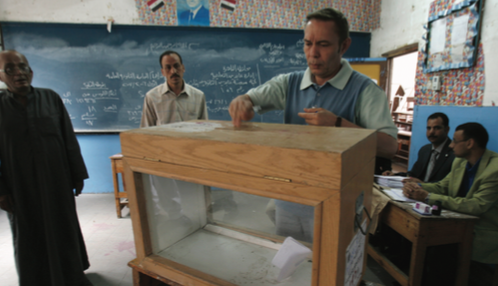
Over the past quarter century, I have witnessed countless presidential and parliamentary elections in the Middle East and North Africa. I cannot remember one that went off without voter intimidation, violence or vote rigging. In fact, every time an election is announced it almost seems as though the country holding it is preparing for war. The military is mobilized and placed on high alert; buildings housing radio and television stations as well as government offices become armed fortresses and a feeling of doom grips the nation.

As a journalist, I have had rough times covering elections in the region. I have been arrested by police on multiple occasions. In one well documented case, during the 2000 parliamentary elections in Egypt, I was beaten up and had all my photographic equipment smashed to pieces. Thugs, or ‘baltaguiya’, hired by Egypt’s ruling National Democratic Party (NDP), accosted me as I was leaving a polling station in the center of Cairo and threw me to the ground, while taking all my equipment from me. If this had happened in a dark alley it would be one thing, but the attack took place in broad daylight right in front of roughly two-dozen armed police there to protect the polling station. After getting up, I called for the policemen’s help. But all I got from the senior officer on the scene was a denial that any such attack had occurred.
Since I moved to the Middle East, there have been seven presidential elections in the United States. Each president that has come to power during this period, except for Obama, has either served the maximum two terms or was defeated after his first four years in office. Over the last 25 years, elections in the US have been free of violence, intimidation and vote rigging. The only major hiccup occurred in 2000, when votes in Florida had to be recounted by hand because of irregularities with the vote counting machines. In the end, the problem was settled in a civil manner by the Supreme Court.
Presidential elections in the US have almost a festive mood about them. They come every four years like clockwork just before Thanksgiving and right in step with the holiday season. When it’s all over there is a period of reconciliation when all Americans — Democrats, Republicans and Independents — unite knowing full well that the system put in place by the founding fathers over 200 years ago, is still alive and well.
In most instances, elections in the Arab world are anything but festive, and elections for the highest office have proven to be nothing but a farce. Of the 22 member nations in the Arab League there are eight monarchies that don’t even pretend to be democratic. When it comes to the appointment of the highest office, they just appoint the next of kin to the throne. Then there are the so-called democracies. Egypt’s Mohammed Hosni Mubarak has been in office for almost 30 years, since Anwar Sadat was assassinated in 1981. The vast majority of Egyptians have known no other head of state. Sure, he has held countless referendums, many of which I covered, but the outcome of these referendums has always been the same. Take the 2005 election, the only time in Egypt’s history that a presidential election was contested by another candidate. In the end, Mubarak took 88.6 percent of the votes and the challenger, Ayman Nour, not only lost the election but was sentenced to five years in jail for supposedly “forging powers of attorney” to secure the formation of the his political party, al-Ghad — a charge he vehemently denies. Last month, he was mysteriously released after serving three years.
In many Arab countries, democracy equals a referendum, a mechanism used by autocratic regimes to appease Western calls for democratic reforms. In reality, a referendum is nothing more than an approval rating, which rarely dips below 90 percent. Besides Egypt, referendums are popular practice in Syria, Tunisia, and Yemen.
Algeria experimented with the democratic process, but when the FIS (Front Islamique du Salut) was set to win a parliamentary majority in 1992, the military stepped in and annulled the election. The military’s action sent the country into chaos and civil war for the better part of the decade, killing an estimated 100,000 people.
Lebanon knows a thing or two about chaos and when elections are held there is always a lingering fear that the country will disintegrate once again into civil war. The next elections are scheduled for June 2009 and since they were announced almost six months ago, it is as if lines are already being drawn. Chances are that nothing major will happen, but if the fragile sectarian balance is altered, nobody knows what may happen.
America’s presidential electoral system is imperfect, but it has been tested for more than 200 years. A valid complaint is how a country with such a diverse population can have only two major political parties. Despite this flaw, with every new administration there is a major change in policy that has worldwide repercussions. Let’s all hope this new administration will repair the damage done by the last and once again shine the light on the democratic process. As one friend so appropriately put it, “not an abomination, rather an Obama nation!”

Norbert schiller is a Dubai-based photo-journalist and writer

March 3, 2009 0 comments
0 FacebookTwitterPinterestEmail
Economics & Policy

Expat largesse

by Austin Mackell March 1, 2009
written by Austin Mackell


During the first quarter of 2009, Lebanon braced itself for a steep fall in remittances. The logic held that the global financial crisis would severely affect remittance inflows from outside the country,  as Lebanese working abroad saw their own budgets tighten. The Lebanese government even prepared its 2009 budget proposal, which was never ratified, “on a very strict assumption of a 20 percent decrease in the level of remittances,” according to Lebanon’s Minister of Economics and Trade Mohammad Safadi.

It was a reasonable fear since, according to the International Monetary Fund, 70 percent of Lebanon’s remittance inflows are from the Gulf Cooperation Council and the United States, both of which were badly exposed to the crisis.

A few months into 2009, however, a less gloomy picture emerged with the IMF predicting a drop in remittances of 12 to 15 percent. Today the picture has brightened further, with Safadi saying that the predicted decline “has not yet materialized,” and pointing out that Standard & Poor’s ratings agency, who had expressed concerns that a fall in remittances could hurt Lebanon’s ability to pay its debts, had actually improved Lebanon’s credit rating.

In fact, in November 2009 the World Bank released its updated figures predicting that Lebanon would only experience a 2.5 percent drop, from $7.18 billion to $7 billion in remittance inflows for the year as a whole.

Projecting in the dark

The numbers are even more significant considering Lebanon’s remittance to gross domestic product ratio has also dropped, from 24.8 percent of GDP, using official figures, to a projected 21.4 percent, according to data provided by the World Bank, the IMF and Bank Audi.

The decrease can be attributed to the IMF’s forecast that Lebanon’s GDP will grow by 7 percent to reach $32.7 billion by the end of 2009. It should be noted, however, that many debate the methodology used to calculate Lebanon’s GDP [see page 58]. The Economist Intelligence Unit, for instance, expects Lebanon’s GDP to grow at a rate of 5.1 percent to reach a total of $30.2 billion by the end of 2009, resulting in markedly different figures.

Nassib Ghobril, head of research and analysis at Byblos Bank, is quick to point out the inexact nature of such predictions. “[At this stage] they’re not even forecasts, they’re expectations,” he says. “It’s very difficult to put your finger on a forecast given the lack of regular data… there simply are no figures since the end of 2008, and that’s exactly where we need greater transparency from the authorities.”

Ghobril frequently bemoans this lack of information.

“There are no remittance figures from local authorities here,” he says. “In Jordan,  we have figures on remittances every month.”

Ghobril sees this lack of information as a major problem given how important remittances are to the economy, and he advocates that it be addressed immediately.

When contacted by Executive, the Banque du Liban, Lebanon’s central bank, said that they publish remittance results quarterly on their website. However, as Executive went to press, no data for 2009 had been published.

Not yet a science

The significance of remittances to development and world capital flows only became a fashionable part of economic calculations in the last decade, so even the figures that are released are somewhat questionable. 


“The calculation of remittances is not a science yet,” says Ghobril. He points out that there are major methodological issues not yet settled. For example, the World Bank includes deposits (as opposed to transfers) of less than $10,000 made by expatriates into Lebanese banks in its calculations of remittances, despite the fact that in many cases these expatriates may simply be taking advantage of Lebanese banks’ high interest rates to maximize their savings and not directly contributing to actual economic activity.

The decision to include these deposits was part of a shift in the World Bank’s method for calculating remittances in 2003.

That year the World Bank reported that Lebanon received around around $4.7 billion in remittances, nearly doubling the 2002 figure of $2.5 billion — a jump Ghobril asserts was more a result of the change in methodology than an actual increase.

There has not been major methodological change since then, however, meaning that the growth from $4.7 billion in 2004 to $7.18 billion last year can be regarded as an authentic increase. The IMF also recently suggested including remittances in Lebanon’s GDP, which would significantly improve its debt-to-GDP ratio.

Uncertain inflows

As around $1.4 billion per month continue to flow into Lebanon’s banking sector from abroad, many believe that remittances must be doing well. It is also possible though that, in these uncertain economic times, a significant amount of this money is arriving from investors who have turned to Lebanon’s trusted banking sector as a safehaven to stash their cash, rather than true remittances, which would be Lebanese sending money home to be spent.

Kamal Hamdan, economist and managing director of the Consultation and Research Institute, says that a significant though unknown part of this year’s figure can be attributed to the liquidation of fixed and non-fixed assets from non-resident Lebanese.

“You liquidate once and for all so I don’t know if this $7 billion is a sign of strength or rather an ultimatum,” says Hamdan. He expects, however, that remittances will remain relatively steady in terms of their ratio to GDP “because a decrease of a few percentage points is not enough to affect its weight with respect to GDP.”  

Another (and perhaps more meaningful) indicator that remittances can be expected to stay fairly stable is the lack of an influx of returning expatriates, tens of thousands of whom were predicted to return home as a result of the crisis — though in Hamdan’s view, the absence of repatriation figures constitutes “the worst example of the lack of accurate data.”

There was “no reversal of the brain drain phenomenon witnessed so far, despite the fact that local demand for skilled labor has been rising,” says Safadi. 

While this return of talented expats would have presented positive opportunities, the fact that it hasn’t occurred also has a positive dynamic, as it means that those who have lost their jobs have likely taken up other employment, or moved from city to city or country to country seeking work in markets where wages are high and from which they can continue to send remittances.“We didn’t see thousands of Lebanese returning here, so that means they’re still working somewhere,” says Ghobril. 

Perhaps the strongest indicator of the continued strength of remittances, however, is data coming from the remittance sending countries. Saudi central bank data estimates that total remittances — to all countries — from Saudi Arabia reached $15 billion in the first eight months of 2009, an increase of 12 percent compared to 2008.

While this growth, probably fueled by the kingdom’s massive development plan, is a slowdown from the 26.7 percent growth in remittances that took place between 2007 and 2008, it certainly paints a brighter picture than many predicted when the financial crisis first kicked off. 

Resilient but not immune

Other Gulf states have also dug into their remarkably deep pockets and ploughed ahead with their own long-term strategies for infrastructure development. This was reflected in the IMF’s Regional Economic Outlook report for October 2009, which said that counter-cyclical government spending had helped protect economies in the Middle East from the worst effects of the global economic downturn.

Overall, according to the World Bank’s latest data, outward remittance flows from the Gulf have dropped only 3 percent this year relative to last year. Remittances from the Gulf to other countries in the Middle East have dropped from $34 billion to $32.2 billion, according to data from the World Bank, IMF and Bank Audi, and the IMF outlook report predicts that remittances will stabilize at $34 billion next year and grow to $36 billion in 2011.

However, there are negative signs as well. In Jordan, (where data on remittances is more readily available than in Lebanon) there has been a decline of 6 percent in remittance inflows, and Egypt, the biggest recipient of remittances in the region, has announced a decline of 8.8 percent.There are reasons to believe that remittances from the US may have suffered a more serious decline, with remittances to Mexico having dropped 15 percent year-on-year in the year to August, as reported by The Wall Street Journal.

With the region expecting to have a better year in 2010 and the US officially out of a recession, there is reason to be optimistic.

However, as Ghobirl says: “There is no way not to be effected…The Lebanese economy has shown that it is insulated from the crisis but not isolated. It is resilient but not immune.”

March 1, 2009 0 comments
0 FacebookTwitterPinterestEmail
Business

Sayfco Holding

by Nada Nohra March 1, 2009
written by Nada Nohra

Cache Yerevanian, chairman of Sayfco Holding

Good news for middle income house seekers searching for affordable apartments: Sayfco Holding, the Lebanon-based high-end real estate developer is going back to its roots, said Chahe Yerevanian, Sayfco’s chairman. After having abandoned the middle income market for many years, the company is planning to launch  a new housing project in Jdeideh (Metn) this month for mid-range budgets.

‘Abraj Jdeideh’ will feature five 15-storey towers and will include apartments ranging from 122 square meters, which will be priced at $140,000, to 166 square meters — priced at $180,000. Sayfco is not planning to stop developing luxurious housing projects, but is now entering a new market, which is projected to be healthier in the forthcoming years.

“Luxury [demand] will stop for a while because of the economic crisis. The prices [of high-end apartments] will never go down, but I think luxury will stop having a quick turnover,” said Yerevanian. Sayfco has finalized the plans and is waiting for the permits to come through in order to launch the project. Construction will start by the end of this year or beginning 2010 and will take around two years.

From politics to real estate

Even though Sayfco has not been involved in middle-income housing for some years now, this segment was the sole target of the company when it was first created. Ara Yerevanian, Chahe’s father, took the challenge upon himself, when he was elected a member of the Lebanese parliament in the 1950s, to provide housing for the middle income market, something which the government failed to do. He established ‘Ara Yerevanian Establishment’ and began building 200 to 300-unit residential developments,  priced at around $30,000 per unit. When the Lebanese Civil War began, the family immigrated to Canada and started conducting its business there until they returned in 1995. The company was then renamed Ara Yerevanian & Sons. In 2000, Chahe took over the leadership of the company and started targeting Gulf Cooperation Council  (GCC) clients, while also entering higher market segments.

“I foresaw that the luxury market is going to have a boom, so instead of building apartments for $100,000 to $150,000, we went up to half a million and from there we went to Clouds [Faqra Club]— 11 villas for $5 million each,” said Yerevanian.

In 2004, Ara Yerevanian & Sons was substituted with Sayfco Holding and all its subsidiaries were created: Sayfco Development, Sayfco Brokerage, Sayfco Financing, Marina Hills, Villa des Roches and Ahlam Lands. This move was the first step to restructuring Sayfco and turning it into a corporate entity, rather than a family business.

“I believe family businesses do not last more than two generations… once the kids and the cousins meet, and the wives come in, the company is gone,” said Yerevanian. Therefore, potentially, the management of Sayfco will be separated from its ownership and when Yerevanian retires, a non-family member may take his place. “This is how I see the future of Sayfco,” said Yerevanian.

Sayfco Holding
</p>
									            </div>
        </div>

		            <div class=

March 1, 2009 0 comments
0 FacebookTwitterPinterestEmail
Comment

Strengthened by sanctions

by Gareth Smith March 1, 2009
written by Gareth Smith

When Iran introduced gasoline rationing in 2007, Ehud Olmert, then Israeli prime minister, said the torching of some Tehran gas stations showed “economic sanctions are working increasingly well.” Threats to blockade Tehran’s gasoline imports brought rebellious Iranians to the streets and the Islamic Republic to its knees. But the more things change, the more they stay the same. Since 2007, there have been two more rounds of United Nations sanctions, far tighter United States sanctions and a European Union ban on investment in Iran’s energy sector. 

And yet Iran’s nuclear program is further advanced, Mahmoud Ahmadinejad is still president and Ayatollah Ali Khamenei is still the supreme leader.

Iran’s reformists have long pointed out that sanctions strengthen the very people they are supposedly designed to undermine, enhancing the role of the state and its various agencies. US President Barack Obama was elected with a pledge to “engage” Iran, but once in office strengthened the sanctions regime developed under President George W. Bush, on the grounds it may push Iran to abandon its nuclear program. Many Obama supporters say this is the only alternative to military action — hence those who back sanctions need to show they are “working” or come up with new ideas for sanctions that will “work” better.

The saga of gasoline imports shows the pattern all too well. It was fear of sanctions — rather than, say, the chronic air pollution in Tehran — that led Ahmadinejad’s government to introduce gasoline rationing in 2007. Politicians had long dragged their feet over increasing the price of fuel from a subsidized price of 9 cents a liter, despite a consequent demand for gasoline that Iran’s own refineries were unable to supply.

When rationing was introduced in 2007, the allocation of cheap petrol was 100 liters a week, with motorists paying a higher price for any extra. The ration stayed at this level for three years, but was reduced to 80 liters at the beginning of the current Iranian year (in March) and to 60 liters in June, despite the usually higher consumption of the summer holiday period. During the summer, oil minister Masoud Mir-Kazemi put production at 44.5 million liters per day and imports at 20 million liters.

At the time of rationing, consumption was 75 million liters per day and appears to have fallen 14 percent to 64.5 million, while imports — 35 million liters daily back in 2007 — have fallen from 47 percent of consumption to 31 percent. A report in August from the Paris-based International Energy Agency forecast a 75 percent fall in the cost of Iran’s gasoline imports within five years, partly through opening new refineries and curbs in consumption. Incrediblely, the National Iranian Oil Company announced at the end of last month that a sudden 40 percent jump in domestic production had allowed the country to actually begin exporting gasoline, having covered domestic demand.

As production has increased and consumption has fallen, the sources of supply that have made up the difference have also shifted. Oil traders such as Glencore, Trafigura and Vitol, and companies such as Total and Shell began to end gasoline sales earlier this year as talk of sanctions increased. But the gap left by Western companies has been filled by Turkish refiner Tupras and state-owned Chinese companies including Sinopec.

Chinese companies have supplied around half of Iran’s gasoline imports in recent months, and there have even been reports that the Russian oil giant Lukoil, despite its substantial US retail operation, has resumed sales to Iran in a partnership with China’s Zhuhai Zhenrong. All this despite Lloyd’s of London — which has 15 to 20 percent of world marine insurance — announcing in July it would not insure or reinsure gasoline shipments to Iran. Iran’s trading partners and neighbors lack sympathy with the American approach, arguing sanctions should relate solely to Tehran’s nuclear and missile programs. The new UN measures passed in June blocked assets of individuals and entities allegedly involved in proliferation, whereas EU and US sanctions go much further. Washington’s financial sanctions seek to block from the US market not just Iranian businesses but third parties with significant dealings in Iran’s energy and financial sectors.

Widespread resentment at the US approach aids Iran’s search for partners willing to continue or expand trade. As one Iranian economist recently told me: “I actually believe Ahmadinejad likes sanctions. They help make him the underdog, standing up for his country’s rights against a superpower behaving unfairly.”

March 1, 2009 0 comments
0 FacebookTwitterPinterestEmail
Economics & Policy

Shaking up the system

by Sami Halabi March 1, 2009
written by Sami Halabi

Until recently, thelabor laws of the United Arab Emirates seemed as stationary as the tectonicplates under the Arabian Gulf. Those plates seldom shift, but when they do the result is earth shattering.

The new laborregulations in the UAE may not be as dramatic, but they do have the potentialto shake up the country’s antiquated employment market.

The regulations came inlate December in the form of a ministerial decree, an edict from the laborministry that is not actually a piece of legislation. As Executive went topress, an official document had not been posted by the labor ministry, but theminister of labor had made radio and press announcements.

Perhaps the mostsignificant reform is that workers looking to change jobs will no longer need a“no-objection certificate” (NOC) from their former employer, without whichworkers were previously barred from taking up new employment for a ‘coolingoff’ period of six months.

But this regulation doesnot apply equally to all; a classification system has been put in place tocategorize workers according to their qualifications. Those with universitydegrees or a management position can move to new jobs without the NOC, buteveryone else must remain in their jobs for two years (as opposed to theprevious three-year validity of labor cards) before they may change theiremployer.

The measure to reducethe duration of labor cards to two years is expected to save private sectoremployers $184 million in costs incurred by the defaulted contracts of the 70percent of employees that left before the three-year period. According to arecent poll of workers in the UAE by Bayt.com, a recruitment and job researchcompany, 24 percent of workers stay in their position for a period of two yearsand only 21 percent stay for all three.  

“The recent UAE Ministryof Labor announcements are set to give more freedom to employees to switch jobswithout the previously… imposed six months ban and the required no-objectionletters from employers,” said Amer Zureikat, vice president of sales atBayt.com. “We see this as an attempt to not only attract more talent to thecountry but also to promote flexibility and transparency at the workplace —which was deemed ‘very’ important by 72 percent of UAE participants in a recentBayt.com poll.”

Local jobs for localpeople

That added flexibilitymight well be stymied, however, by the inclusion of another regulation in thereforms that seeks to increase the level of UAE nationals in the private sectorto 15 percent. Currently the private sector workforce is less than 1 percentEmirati, with most locals preferring to be employed in the public sector, whichin 2008 saw a low of 54.5 percent of employees being Emirati, reaching to 60.9percent in April 2010, according to recently released official figures. It hadbeen reported that the 15 percent target was to be hit by July, but officialsfrom the International Labor Organization (ILO) told Executive this was not thecase.

Other reforms includelowering the minimum working age to 16, while imposing tough regulations onwhich type of work can be practiced by minors. Expats are also now allowed toofficially take on a second part-time job or part-time work, which applies topeople with spouse visas as well. Six-month work visas are also to become parfor the course.

While the internationallabor community has lauded these measures, the UAE still has much more to do tofall in line with international standards. According to the ILO, the countrystill does not have any legal representation in the form of unions orcollectives, and these regulations are not expected to cover the tens ofthousands of workers in the free zones.

UAE labor law alsoleaves out domestic labor, which therefore excludes an estimated 300,000 to500,000 domestic workers.

If these issues, alongwith the kafeel, or guarantor, system are reformed in the future, perhaps thenthe changes really could be viewed as a tectonic shift in policy as opposed toan aftershock from the financial crisis.  


March 1, 2009 0 comments
0 FacebookTwitterPinterestEmail
Financial Indicators

Global economic data

by Executive Staff February 22, 2009
written by Executive Staff

CLIs signal deep slowdown in OECD area and major non-OECD member economiesn OECD Composite Leading Indicators (CLIs) for November 2008 point to deep slowdowns in the major seven economies and in major non-OECD member economies, particularly China, India and Russia. The following outlines the extent of these slowdowns:

  • The CLI for the OECD area decreased 1.3 points in November 2008 and was 7.3 points lower than in November 2007.
  • The CLI for the United States fell 1.7 point in November, 8.7 points lower than a year ago.
  • The Euro area’s CLI dropped 1.1 points in November, and was 7.6 points lower than a year ago.
  • In November, the CLI for Japan decreased 1.6 points, and was 5.5 points lower than a year ago.
  • The CLI for the United Kingdom fell 0.6 points in November 2008 and was 6.7 points lower than a year ago.
  • The CLI for Canada fell 1.2 points in November and was 6.1 points lower than a year ago.
  • For France, the CLI decreased 0.8 point in November and was 5.7 points lower than a year ago.
  • The CLI for Germany fell  2.0 points in November and was 10.7 points lower than a year ago.
  • For Italy, the CLI fell 0.2 point in November and stood 5.0 points lower than a year ago.
  • The CLI for China decreased 3.1 points in November 2008 and was 12.9 points lower than a year ago.
  • The CLI for India fell  1.2 point in November 2008 and was 7.6 points lower than in November 2007.
  • The CLI for Russia decreased 4.3 points in November and was 13.8 points lower than a year ago.
  • In November 2008 the CLI for Brazil dropped 1.1 point and was 2.9 points lower than a year ago.

Strong slowdown in the OECD area

Strong slowdown in the United States

Strong slowdown in the Euro area

Strong slowdown in China

Strong slowdown in the United Kingdom

Strong slowdown in Canada

Strong slowdown in France

Strong slowdown in Germany

Strong slowdown in Italy

Strong slowdown in Japan

Strong slowdown in India

Strong slowdown in Russia

Downturn in Brazil

  • The above graphs show each country’s growth cycle outlook based on the CLI, which attempts to indicate turning points in economic activity approximately six months in advance. Shaded areas represent observed growth cycle downswings (measured from peak to trough) in the reference series (economic activity).
February 22, 2009 0 comments
0 FacebookTwitterPinterestEmail
  • 1
  • …
  • 481
  • 482
  • 483
  • 484
  • 485
  • …
  • 688

Latest Cover

About us

Since its first edition emerged on the newsstands in 1999, Executive Magazine has been dedicated to providing its readers with the most up-to-date local and regional business news. Executive is a monthly business magazine that offers readers in-depth analyses on the Lebanese world of commerce, covering all the major sectors – from banking, finance, and insurance to technology, tourism, hospitality, media, and retail.

  • Donate
  • Our Purpose
  • Contact Us

Sign up for our newsletter

    • Facebook
    • Twitter
    • Instagram
    • Linkedin
    • Youtube
    Executive Magazine
    • ISSUES
      • Current Issue
      • Past issues
    • BUSINESS
    • ECONOMICS & POLICY
    • OPINION
    • SPECIAL REPORTS
    • EXECUTIVE TALKS
    • MOVEMENTS
      • Change the image
      • Cannes lions
      • Transparency & accountability
      • ECONOMIC ROADMAP
      • Say No to Corruption
      • The Lebanon media development initiative
      • LPSN Policy Asks
      • Advocating the preservation of deposits
    • JOIN US
      • Join our movement
      • Attend our events
      • Receive updates
      • Connect with us
    • DONATE