• Donate
  • Our Purpose
  • Contact Us
Executive Magazine
  • ISSUES
    • Current Issue
    • Past issues
  • BUSINESS
  • ECONOMICS & POLICY
  • OPINION
  • SPECIAL REPORTS
  • EXECUTIVE TALKS
  • MOVEMENTS
    • Change the image
    • Cannes lions
    • Transparency & accountability
    • ECONOMIC ROADMAP
    • Say No to Corruption
    • The Lebanon media development initiative
    • LPSN Policy Asks
    • Advocating the preservation of deposits
  • JOIN US
    • Join our movement
    • Attend our events
    • Receive updates
    • Connect with us
  • DONATE
By Invitation

Lebanon – Saade wineries

by Executive Staff February 3, 2008
written by Executive Staff

A new winery is taking shape in the Bekaa valley. Owners of Wild Discovery travel agency, Karim and Sandro Saadé have engaged in this new venture, after launching “Domaine de Bargylus” in Syria in 2004.

“We intend to produce the first real Syrian wine: a high-end product positioned internationally, targeting the Syrian Diaspora and seducing Syrian consumers,” said Karim. He reckons that the Syrian project might prove to be a more challenging one, as it requires nurturing a nascent wine culture.

The Saadé venture is not the first of its kind. Over the years, the family’s mercantile past morphed into the Johnny R. Saadé Group, also known for its international shipping company CMA (Compagnie Maritime d’Affrêtement). The group currently includes a tourism arm and a real estate company, the winery project being the most recent addition to its core activities. The two young brothers have succeeded in carving a name for themselves in the tourism sector with Wild Discovery, the group’s first Lebanese venture that also operates in Syria and Dubai, with almost 100 employees. Founded in 1997, with its head offices in Beirut, Wild Discovery boasts a regional network of travel agencies, offering services ranging from ticket issuance to comprehensive holiday packages. The Saadé company’s second arm is Greenstones, a real estate company currently developing a project in Beirut’s picturesque Abdel Wahab Al-Inglizi Street.
 

Two new wine ventures

The third and most recent project includes two vineyards in northwestern Syria and the Bekaa Valley. Bargylus, the Syrian estate, is located in Jebel al-Ansariyeh, in antiquity known as Mount Bargylus. On the outskirts of Lattakia, the port city on the Mediterranean it comprises 20 hectares of argilo-calcareous soil. The Lebanese estate is situated in the widely-recognized wine region of the Bekaa Valley, near the villages of Kefraya and Tell-

Denoub, covering 50 hectares.

Sandro Saadé recounts the brothers’ passionate love story with wine that began in 1997. “We initially considered investing in a Bordeaux châteaux,” he recalled. Instead, the brothers decided to jump-start their own winery project in Syria, where their family originated. The Domaine de Bargylus came to life in Lattakia in 2003. “Besides the common history we share with the Lattakia region, we opted for this particular location because of its excellent soil and weather conditions, after extensive testing and analysis.” In 2004, the brothers decided to replicate the winery project in Lebanon on a grander scale.

According to Sandro, “Both projects are completely different. After all, we are discussing two types of wines born from very particular and special terroirs. The Syrian Domaine de Bargylus will be available for sale in the next few months, while our Lebanese brand, which has yet to be named, will be released in 2009. Both will boast a wine of premium quality and will be positioned on the higher end of the product spectrum.” His brother Karim insists, however, that they will share the same concern for quality control processes.

Both vineyards have planted different cépages (grape varieties) such as Cabernet Sauvignon, Merlot, Syrah, Sauvignon Blanc and Chardonnay. However, the percentages will vary from one winery to the other, allowing the brothers to adapt the vines to regional climate and soil conditions. In addition, production processes will be closely monitored with the help of a French consultant, Stephane Derenancourt.

The Johny R Saadé family, which fully owns the Syrian Domaine de Bargylus and the Saadé Lebanese winery, has invested over $25 million into the project already. The Syrian part is estimated at $4 million while the Lebanese project will eventually require as much as $25 million on its own. The Syrian Domaine de Bargylus will, on its 20 hectares of land, employ around 20 people on a permanent basis, while the Lebanese project is going to employ some 50 people for the time being. “Naturally, these figures do not account for seasonal workers who will evidently contribute to our operations. In addition to its original winery structure, the Lebanon venture will also integrate two other complementary projects, namely a wine museum and a boutique hotel with 30 to 35 rooms,” explained Karim.

For the Saadé brothers, the main rationale behind the wine museum is the added value it will bring to the wine industry in Lebanon, one that can be further complemented by the creation of a “Route du Vin” — a wine tour — of the Bekaa, which will help integrate further the Bekaa valley into the overall Lebanese tourist map.

As Sandro pointed out, “Both projects have been in the pipeline for quite some time. Contrary to popular belief, the wine industry does not generate quick money but is built on a long-term and well-planned approach. This particular sector offers huge potential in Lebanon.”

Targeting the high-end consumers

Both wines produced by the Saadé brothers will target high-end consumers and be marketed away from the traditional supermarket distribution network. “Our wines will be available in restaurants, hotels and specialty stores. We are not relying on the local market, but focusing more on developing a European and international one,” Sandro said. The Saadé brothers are targeting French wine aficionados as they believe France is key in opening the doors of European markets.

While both wineries will include the usual state of the art machineries and equipment as well as the use of stainless steel tanks imported from France, Sandro pointed out that, “we will focus principally on production processes and more particularly on the quality of the grapes used.”

In the end, he knows that despite Lebanon’s wine culture, marketing Lebanese wines might not be an easy task. The young entrepreneur believes that given the relatively small quantity exported by Lebanon, any mishap will affect the industry as a whole and badly reflect on it. An entity that will accredit producers and grant them an equivalent of the French AOC, which late last year the Lebanese government has decided to establish, will provide Lebanese wines with a greater credibility on international markets and facilitate the export process. “Each Lebanese wine is distinctive in its own way. We fully intend on capitalizing on our wine culture to introduce our brands to the world.”


February 3, 2008 0 comments
0 FacebookTwitterPinterestEmail
Banking & Finance

Hedge funds – Riding the bull.

by Executive Staff February 3, 2008
written by Executive Staff

The Middle East is a well-established routine milk run for international managers of funds and sophisticated financial vehicles. Investable wealth and a regional community of high net worth individuals made for attractions that representatives of international investment houses would eagerly compete for.

Of course, gallant Arab investors have for many years been welcomed also as holders of corporate stakes, be it as buyers into European car makers and chemicals manufacturers in the 1970s, or as rescuers of ventures in distress, such as Paris Disney or Citigroup in the 1990s. In this sense, new international acquisitions by state-backed Arab entities and sovereign wealth funds — one of the most recent being the takeover of 51.4% of New York-based Och-Ziff Capital Management by Dubai International Capital — continue a successful tradition.

Stock markets in the Gulf region and North Africa did not appear to be fully transparent and, until a few years ago, were largely underpowered. Legal regulations on foreign investments were prohibitive in some markets, dubious in others. Foreign funds operators had little expertise and market information was tough to come by, not to speak of other barriers to entry.

Nowadays, however, with economic burdens hanging over the US and other developed markets and investors in search of new safe havens, investments into the Middle East have growing appeal for hedge fund managers based in London and, one suspects, places like Geneva and New York. Executive learned from managers of two major hedge fund groups in London that they are quite bullish on the region which is increasingly covered under Europe, Middle East, and Africa (EMEA) funds.

The Middle East: a natural hedge 

The emerging market fund house Baring Asset Management, which manages around $4 billion in EMEA equities both long only and alternatives, has been active in Middle Eastern markets and set up its hedge fund in November 2005. Paul Graham, director in Baring’s alternative business, is very positive on the region’s stock markets, whose performance during the fourth quarter of 2007 he found compelling. “In the third quarter of 2007, Gulf countries put in some very strong returns (when global equity markets were really struggling) so in that sense they are a great hedge. Their intra-correlations remain quite low, particularly when compared to other emerging markets in the EMEA universe where correlations to developed markets have become disturbingly high; the Gulf states have decoupled as it were.”

Graham considers the Middle East very much to be a burgeoning market but still at the very early stages of development. “In five years time, the markets will have changed but it’s a slow process — they’re very deliberate and very slow,” he said.

While this development is important and should not be rushed, it leaves little in the way of current trading opportunities. “The EMEA focused hedge fund environment is still a growing universe and the derivative instruments in these markets are very shallow,” Graham said. “The Baring EMEA Absolute Return Fund takes exposure on an opportunistic basis because quite frankly we can only take exposure to the blue chip names in the more developed markets like Kuwait, UAE, Qatar, Bahrain and Saudi [Arabia].”

Kuwaiti financial services lure hedge funds 

Other more nimble hedge fund managers are attracted to the region from an investment perspective and not just as a hedge. Marina Akopian, co-fund manager at Hexam’s EMEA Absolute Return hedge fund that is part of the massive Resolution Asset Management, is very bullish on the region this year. “For us, if you’re talking relative to other markets it’s a clear overweight this year with very strong fundamental reasons attached — oil prices will remain high, strong economic growth will continue and although the region is facing challenges to diversify we think they’re doing it quite well,” she said. Hexam EMEA Absolute Return Fund was set up in August 2006 and is a 50/50 joint venture between Resolution Asset Management and six fund managers headed by Akopian. Currently it manages $25 million and allocates 12% of its fund to the Middle East.

The country exhibiting the strongest GDP growth in 2007 was Qatar (14.2%) and is strongly favored by Akopian, but she also sees opportunities in Kuwait. GDP growth in these countries is translating into the domestic economy. It is a very similar story to what has been seen in Russia recently: the transfer of oil revenues into a domestic consumption and infrastructure boom which will benefit stocks in financial services, construction and telecoms.

And it is perhaps the financial stocks that are most attractive to Akopian but only in certain countries in the Middle East. This year she sees more opportunities in Qatar and Kuwait than in the likes of Lebanon and Jordan. As she explained, “It’s more of a bottom up approach translated into the companies I can find on the stock market. Although GDP growth in Jordan is very healthy (6% in 2007) and things are stabilizing on the economic front, bottom up I don’t see the same interesting companies I can see in Kuwait.”

Of those opportunities in Kuwait Akopian is most drawn to financial services, since a large part of the credit facilities that Kuwaiti residents use are going into this sector, like consumer loans and the purchase of securities.

The outlook, however, is not entirely positive. As Gulf markets have been plagued by inflationary pressures which many Western analysts do not see going away any time soon, currency pegs and interest rate decisions by central banks in the region are on the watch list. Also of note, Arab stock markets last month appeared to be less uncoupled from international trends than desirable from a pure hedge point of view.

There is no question that the interest of hedge funds and asset managers has been awakened by strong developments in Kuwait and other countries with increasing economic diversification. According to a report published by Cerulli Associates, total managed assets in the Middle East at the end of 2007 amounted to more than $1.6 billion. The report focused on Saudi Arabia, Kuwait, Bahrain, Qatar, Oman, the UAE and Egypt. Most notable in the report was its forecast for mutual fund growth, which it predicted to expand by $100 billion in five years to $200 billion. Hedge funds are not the ones to miss an opportunity and their interest will be roused further when see more diversified and deeper markets in which to trade.


February 3, 2008 0 comments
0 FacebookTwitterPinterestEmail
Banking & Finance

IPO Watch – Enthusiasm remains

by Executive Staff February 3, 2008
written by Executive Staff

Companies based in the Middle East and North Africa raised close to $15 billion in 2007 through initial public offerings (IPO), according to statistics from Zawya Investor. This equals almost 6% of the global IPO market which raised around $255 billion by the end of November 2007. According to a report published by Ernst & Young in early December, this IPO performance for the incomplete year already has surpassed the previous full-year record of $246 billion set in 2006. Analysts say it is good news because it shows a new spirit of innovation in the region and a continued momentum by local companies to become global players.

But wait, what about fears of a recession in the US and a global slowdown, uncontrollable swings on global stock markets and tightening credit conditions across the world. Would this perhaps create a sense of pessimism about the year ahead for the Middle East IPO market? The nervousness of investors showed in reported requests to postpone the trading debut of PetroRabigh, the Saudi petrochemicals joint venture between Saudi Aramco and Japan’s Sumitomo Chemical Co. A $1.2 billion IPO for 25% of the company was covered 3.48 times by demand in early January, especially from retail investors who subscribed at an issue price of $5.60 per share.

As petrochemical stocks suffered in the Saudi Stock Exchange market scare on January 20 to 22, Saudi media wrote of requests by retail investors who asked to delay the start of trading because they feared losses if the stock came in on negative sentiment — but when PetroRabigh shares started trading as originally scheduled on January 27, they opened at $11.50 and closed the first day at $13.90.

Given that the outlook for the largest stock markets remains jittery and whole choruses of US economic experts are singing opposing chants on the are-we-in-recession question, it would be unfair to ask for a consensus on the IPO expectations in Arab countries during 2008. There are reassuring signs such as the PetroRabigh story but there also are justifiable reasons to see the IPO mill grinding slower than some might think. In a massive hint at the length of time which some of the highly touted IPOs of state-owned corporate gems could take, the chairman of UAE carrier Emirates Airlines, Sheikh Ahmed bin Saeed al-Maktoum, said in an interview that a flotation should be expected up to two years after government approval of partial privatization through IPO. Last autumn, media reports quoted top managers at the airline that a huge Emirates IPO would happen in the first quarter of 2008.

Some regional research houses and market experts continue to support an optimistic outlook and claim that 2008 is set to be another record year citing a flurry of new IPO announcements in January which flooded the halls of the region’s stock markets — generating excitement not just for local investors but also for foreign ones.

Saudi Arabia, which boasts the region’s largest stock market, through the Saudi Capital Market Authority (CMA), announced two new IPOs with a combined value of $4.5 billion. Inma Bank, the country’s Islamic development bank, will be offering a whopping 1.05 billion shares or 70% of its capital in an IPO between April 7 and 16. With Samba Financial Group as the lead manager, the share price will be set at $2.67 for a total value of $2.80 billion.

CMA also announced that Zain Saudi Arabia, a subsidiary of Kuwait’s biggest mobile operator, Zain Group, will float 700 million shares or 50% of the company’s capital to the public from February 9 to 18. Share price will be set at $2.67 for a total value of $1.86 billion.

Meanwhile, the UAE had promised more IPO action for 2008. But in January, only two announcements were made. The first being Damas, the UAE’s largest jewelry chain, said it has confirmed plans to launch an $272 million IPO in the first half of 2008. Although the venue of the listing has not been confirmed, sources say the company will list on the Dubai Financial Market and possibly a dual listing on a foreign exchange as well. The second firm is DEPA United Group, which said it will launch a $500 million IPO in the second quarter of 2008. The joint lead managers for the interiors contracting company are Morgan Stanley and UBS. The company is expected to list on the DIFX.

Moving to the North Africa, the number of scheduled IPOs in Morocco for 2008 is expected to be around 10 on the Casablanca Stock Exchange, according to BMCE Capital Bourse. One of the largest rumored so far is the Chaabi Lil IskaneChaabi Lil Iskane real estate firm which is expected in the second quarter of 2008. Another potential for second half of 2008 is Delta Holding while Credit Agricole Morroco, will float its shares at the end of 2008.

Whether the region’s stock markets can ride out the storm of a global slowdown and a US recession is a question on the minds of many investors. The answer isn’t clear, but given the unprecedented high oil prices and economic liberalization across the region, substantial growth in all major sectors and unheard of interest in the region by foreign investors, observers who spoke to Executive said that local stock markets in general and the IPO market in particular, will continue to flourish in 2008. They claim that the turbulence in the US markets has not dampened the enthusiasm or the development drive in the region. The say that even if oil prices drop by $20 in 2008 the MENA region will continue to experience significant economic growth for many years to come.


February 3, 2008 0 comments
0 FacebookTwitterPinterestEmail
By Invitation

Authoritarian CEOs are out, inclusive CEOs are in

by Bahjat el-Darwiche & Rabih Abouchakra February 3, 2008
written by Bahjat el-Darwiche & Rabih Abouchakra
CEOs today must work cooperatively with a variety of stakeholders, including proactive boards, involved investors and other vocal constituencies.

There has been a dramatic shift over the past decade in the role of the CEO in corporations across the globe. The time of the “authoritarian” CEO, who roamed the corporate landscape not so long ago, has passed, as we enter the era of the “inclusive” chief executive officer.

Whereas Authoritarian CEOs answered only to themselves, the power of today’s CEO is not as absolute: Boards of directors are becoming more critical and more closely involved in setting strategy, and are far more likely to insist that CEOs deliver acceptable shareholder returns and demonstrate ethical conduct. Boards are increasingly prepared to replace CEOs in anticipation of disappointing future performance, instead of merely as punishment for poor past performance. At the same time, large shareholders like private equity firms are taking a more active role in decisions that were once the sole purview of the CEO.

The emergence of this more demanding environment has accelerated CEO turnover. Our recent studies reveal that annual turnover of blue chips’ CEOs across the globe increased by 59% between 1995 and 2006. In those same years, performance-related turnover — cases in which CEOs were fired or pushed out — increased threefold. Whereas, in 1995, only one in eight departing CEOs was forced from office, last year, nearly one in three left involuntarily.

This new era will require new skill sets and impose new responsibilities on both chief executives and board members. Today’s inclusive CEOs must be willing to engage in dialogue with investors, employees, and government; to surround themselves with managers and advisors who complement their own capabilities; and to maintain transparency in their communications about financial results and compensation.
Boards are adapting 

The last decade has witnessed two fundamental shifts in the ways corporate boards address CEO selection and oversight: Boards are becoming less tolerant of poor performance, and they are increasingly splitting the roles of CEO and chairman.

Our research shows that CEOs who deliver below-average returns to investors don’t remain in office for long. Last year, a CEO in North America who delivered above-average returns to investors was almost twice as likely as one delivering sub-par returns to remain CEO for more than seven years. In contrast, in 1995, CEOs who delivered substandard returns to investors were just as likely to achieve long tenure — a perverse situation that reflected the durability of the Authoritarian CEO. The Middle East is catching-up fast with global CEO turnover rates as rapid-growing economies are bringing new pressures to corporate management and governance in the region.

The other major trend has been in governance, with both a shift toward separation of the roles of chairman and CEO and a shift toward chairmen who haven’t previously served as a company’s CEO. Splitting the roles of CEO and chairman while the former CEO stays on as chairman is a bad idea for three reasons: First, knowing that the former CEO will remain involved as chairman sometimes leads the board to embrace a candidate who was a great number two, but who’s unlikely to become an effective CEO; second, most chairmen who were CEOs protect their protégés, reducing the likelihood that the new CEO will be fired for poor performance; and third, some chairmen who weren’t really ready to give up their executive responsibilities go to the opposite extreme, firing their successor at the first sign of trouble and reassuming the chief executive position.

Inclusiveness, engagement, and involvement 

With the board of directors more deeply engaged and owners actively involved in governance and strategy, inclusiveness is the most critical new attribute for the CEO, starting with the ability to take into account the concerns and suggestions of investors, employees, and government. Given the unrelenting pace of change in global business today, stakeholders may see threats and opportunities sooner than the board and management team do. Listening to stakeholders increases the likelihood that a company will act quickly and effectively.

Transparency about results is another indispensable element of inclusiveness. Several CEOs have been dismissed in the last few years because of inadequate transparency — with regard to both the board and shareholders — about their compensation.

Including board members in the development of strategy — not merely asking them to approve a strategy developed by management — is the best way to gain the board’s confidence and buy-in. It’s an effort well worth making: Board backing is invaluable to CEOs who may face investor challenges while waiting to see if a new strategy will pay off.

The board of directors, in turn, must embrace deeper engagement. Because of intensifying global competition and ever-higher expectations about corporate performance, companies now need the board of directors to proactively offer suggestions, to debate threats and opportunities, to push back aggressively if management is heading in the wrong direction, and to make informed judgments.

Deep engagement requires directors to participate in dialogues with customers, channel partners, suppliers, and employees — not different in concept from the traditional role of the ideal director, but completely different from the usual practice. These dialogues in turn require directors to devote time beyond the quarterly board meetings, probably earning compensation greater than what they receive today.

Involved investors are also becoming the norm. Authoritarian CEOs survived because investors weren’t actively involved in the governance of publicly traded corporations, limiting themselves to selling off stock when they lost confidence in a company’s CEO. Today’s involved investors include not only members of family-controlled businesses, but also private equity buyout firms, raiders, and hedge funds that take a stronger hand in the actual running of the companies they’ve invested in.

New era challenges

Going forward, boards of directors will need to encourage constructive disagreement and debate, abandoning consensus habit as a vestige of the authoritarian age. They must also be proactive in grooming and retaining a sufficient bench of candidates for the chief executive position, and be creative and adaptable in searching for outside CEO candidates when necessary. In addition, they’ll have to address such new-era governance challenges as balancing the interests of active institutional shareholders — hedge funds and buyout firms, for example — against those of other investors.

This new age of corporate governance is still taking shape, with many of the rules of the new era still unclear and some probably yet to be written. What is clear is that all the constituencies interested in the health and welfare of the corporation — CEOs, boards of directors, investors, consultants, regulators, legislators, and the business press — should say goodbye to the era of the authoritarian CEO and prepare for change.

Bahjat El-Darwiche and Rabih Abouchakra are principals at Booz Allen Hamilton

February 3, 2008 0 comments
0 FacebookTwitterPinterestEmail
By Invitation

Global footprints of sovereign wealth

by John Defterios February 3, 2008
written by John Defterios

The last month will likely go down in the financial record books as the one which redefined how the world looks at sovereign wealth funds (SWFs). It is also part of a bigger geo-economic shift underway, which lends itself to the East-East moniker, meaning the wealth and trade belt from the Middle East to China.

While we have been covering the power of these government funds, where they are seeking to make a mark and the new emerging players within this space, it is only now that these funds are flashing on the global radar.

It is challenging to get hard figures on the total government investment funds under management, but there are a handful of Western banks attempting to do so. Standard Chartered Bank places the value at around $2.2 trillion dollars. I personally think this is off the mark since the Abu Dhabi Investment Authority may have more than half that amount itself.
SWFs — Big & Getting Bigger 

$2-3 trillion dollars in assets

$10-15 trillion dollars by 2015

Bigger than private equity

(source: Standard Chartered, Morgan Stanley)

More eye-popping clearly is the path ahead. If oil stays in the range of $60-$80 a barrel over the next five years, the amount will surge to $10-$15 trillion. To provide some context, the current sum is already bigger than the global private equity pool, which made all the headlines in the past two years with record buyouts.

Is this a new phenomenon? Certainly not. The Kuwait Investment Authority (KIA) can trace its roots back to 1953; the Abu Dhabi Investment Authority (ADIA) to the mid-

1960s. While they traditionally deployed assets in government bonds and currencies, that trend has changed over the past five years and accelerated in the last six months.

Chris Wheeler, banking analyst at Bear Sterns, points to global wealth surveys to illustrate the point that liquidity from record oil prices has to find a home. “A lot of excess funds are being generated which the SWFs are having to invest somewhere and they are finding interesting opportunities in difficult times in the banking sector.” Wheeler, like many others, believes the often talked about recession in the US will lead them to more bargains in other sectors.

This must sound familiar. Saudi Prince Al-Waleed bin Talal bought stakes in Citigroup back in 1991 at the equivalent of $2.75 a share. Even at the mid-twenty range it is today, he is (excuse the cliché) smiling all the way to the bank. He obviously thinks this latest downturn created a similar opportunity and so did others who jumped in this week. They are not traders, but investors who hold their stakes for years, sometimes decades.

Like the financial markets, which create buyers and sellers, this market and story will continue to evolve. One of the newer players on the scene, the Qatar Investment Authority, will re-emerge after its participation in the bid for UK supermarket giant J. Sainsbury, and Mubadala of Abu Dhabi has recently put itself on the map with its stake in investment banker The Carlyle Group.

G-8 Wish List

Invest on commercial grounds

Respect national transparency rules

Compete with private sector fairly

(source: OECD, IMF)

As the old and new sovereign funds begin to compete for Western assets, G8 countries are attempting to establish investment standards for all this capital. The US Treasury Department has lobbied to have the OECD, the Paris based think tank for industrialized nations, and the International Monetary Fund in Washington put forth guidelines for best practices and greater transparency.

That effort gathered momentum a few months ago, but the calls for concrete action have faded away, as the need for capital infusions on Wall Street rose rapidly.

The World Economic Forum in Davos provides a good opportunity not only for us to talk to the Middle Eastern and Far Eastern players making waves in global financial markets, but also to those who are trying to regulate their actions.

John Defterios is the presenter of CNN’s Market Place Middle East.

February 3, 2008 0 comments
0 FacebookTwitterPinterestEmail
By Invitation

Cheer up – the Arabian real economy steams ahead

by Imad Ghandour February 3, 2008
written by Imad Ghandour

As I am writing these words, stock markets around the world are witnessing one of the most dramatic free falls in their history. The subprime problem is now snowballing to become a global recession. Banks are hesitant to even lend to each other. Central bankers are panicking. The Federal Reserve dropped its benchmark discount rate by 0.75% — the largest single drop in seven years.

Despite the talk of gloom and doom, I am cheerful. 

The markets back in 2000 were hit by the burst of the technology bubble, and then in 2001, they were slammed again by the 9/11 attacks. Thereafter, economic growth slowed considerably. But for private equity, investments made after 2001 yielded excellent returns. As valuations plummeted from their 2000 highs, private equity players in US and Europe were able to close deals post-2001 at bargain prices. The graph below shows CalPers (the largest investor in private equity funds) returns on its private equity portfolio by fund closing year (also known as “Vintage Year”).

Arabia will not be insulated from the black clouds that will be downing on the world financial markets over the next months and years. The reaction from the regional stock markets on Monday, January 21, confirms that Arabia is not as decoupled from the global economy as some people like to think. Even the super-insulated Saudi stock market, Tadawul, dropped by more than 20% over the course of several days.

Yet the Arabian real economy will continue to steam ahead despite hiccups in some sectors. The financial sector will be affected by the global turmoil, but less so than other regions in the world. Real estate may also be affected as global, and even regional, financing sources dry up. Transportation and logistics growth will also slow down as growth of transit shipments and passengers from east to west will be influenced by the probable recession in the US and Europe.

The biggest question will be to what extent oil prices will drop in the wake of a global recession, and consequently, whether oil may drop below $50 a barrel. Oil prices are the biggest determinant of Arabia’s economic growth. Psychologically, they form a leading indicator of GCC economic outlook. They are the main source for financing governments, which are still the main economic drivers for the economy as a whole. Fortunately, GCC governments have accumulated huge reserves, and they will be able to easily weather any short-term drop in oil revenues.

Going back to private equity, the next few months will be difficult for all financial players. But as private equiteers come to grips with the consequences of the downturn, and as new realities settle in, the playground for private equity players in the region will be even greener. On one hand, as a result of dropping oil prices, stock markets’ downturn, and gloomy global economic prospects, valuations will be beaten down to reasonable levels. The market will shift to become more balanced, after being under the mercy of the sellers. Secondly, liquidity, although not easily accessible, will not evaporate. Whatever the severity of the global recession, the region still exports daily $700 million to $1 billion worth of oil. Furthermore, governments’ reserves will continue to trickle down to the rest of the economy — sustaining corporate profits and public investments. Last but not least, global funds will realize that growth in Arabia is more robust than in other regions, and hence, the theory of “Arabia is negatively correlated with the rest of the world” will translate into a shift towards further investment by global institutional investors in Arabia’s stock markets and funds. But this will probably happen after the recession settles in.

Be ready for a tumultuous 2008. Remember: Luck favors the prepared and the courageous.

Imad Ghandour is the chairman of the Information & Statistics Committee Gulf Venture Capital Association.

February 3, 2008 0 comments
0 FacebookTwitterPinterestEmail
Capitalist Culture

The American Empire – Contemplating isolation.

by Michael Young February 3, 2008
written by Michael Young

One of the more interesting subtexts of the presidential campaign in the United States has been the debate over whether the nation should withdraw from most of its foreign entanglements. The issue has not been at the center of voters’ concerns, however it has hit a nerve among them, because the proposal comes at a time when the US is bogged down in Iraq and is uncertain about its role internationally.

The candidate who has gotten the most mileage out of this is the libertarian Republican Ron Paul. He has situated his foreign policy aims between the twin goalposts of the ideas expressed by America’s Founding Fathers and a defense of state sovereignty. As his campaign website explains: “Both [Thomas] Jefferson and [George] Washington warned us about entangling ourselves in the affairs of other nations. Today, we have troops in 130 countries. We are spread so thin that we have too few troops defending America […] We can continue to fund and fight no-win police actions around the globe, or we can refocus on securing America and bring the troops home. […] Under no circumstances should the US again go to war as the result of a resolution that comes from an unelected, foreign body, such as the United Nations.”

Paul’s “republican fundamentalism” — the partial return to the principles of the republic of the late 18th century — is hardly new. Partly that’s because the Founding Fathers sought to achieve the right balance between liberty and stability, and that discussion is ongoing in a country where state power has reached troubling levels. Foreign entanglements, the early leaders of the republic felt, would not only force the US to pursue the more authoritarian (and implicitly more corrupt) ways of “old Europe”; it would, in effect, oblige Americans to behave like a continent from which separation had been a major factor in forging the US national identity.

Much like the Europeans, the US participated in the race for empire at the end of the 1800s and into the early 1900s. With the US the strongest world power after World War II, the republic’s internationalists (after an initial period of American retreat) defended extended American participation in world affairs. That logic was used to justify the open-ended, global commitment to fighting Soviet power that developed into an international cold war.

Whatever one thinks of American “republican fundamentalists”, and they have long served a valuable role in defining the necessary limits to state power on issues of domestic civil liberties, it’s not clear how realistic their views are when applied to the world today. There is also something remarkably self-centered in their advocacy of liberty at home next to their abandonment of that principle — behind a wall of sovereignty — overseas.

The Middle East is the ideal place to test the theory of American retreat from foreign entanglements. One can make a good case, for example, that advancing democracy by force is a mistake, and that argument has been often used to condemn the Bush administration’s policies in Iraq. Yet at the same time, it is true to say that Arab authoritarianism has been one of the most significant reasons for the expansion of militant Islam — in some cases, as 9/11 showed, a militant Islam that can wreak havoc against the US. If so, doesn’t American respect for the sovereignty of its Arab partners risk provoking blowback against the American homeland?

Paul’s campaign argues: “Too often we give foreign aid and intervene on behalf of governments that are despised. Then, we become despised.” That’s true. But it’s equally true that the US is often despised for not intervening. One could paper the sky with articles written by Arab critics of the US who unfailingly urge Washington to resolve everything from the Arab-Israeli conflict to Arab economic underdevelopment. It’s a case of America being damned if it does and damned if it doesn’t, and the republican fundamentalists have few real solutions to that conundrum.

There is also the matter of stability. Could the international system absorb the shock of a significant American retreat? What would happen in the Korean peninsula if the US pulled its soldiers out? Or Afghanistan? Or Iraq? What would happen if America’s refusal to “get involved” led to actions with a negative impact on global markets and the international financial system? As historians have long recognized, throughout history empires, good or bad, have helped stabilize the international system. As the Scottish historian Niall Ferguson has argued, the US is an empire, whether Americans like it or not, and must embrace its role as defender of a stable liberal political and economic international system, much as the British Empire did during the 1800s.

Not surprisingly, Ferguson is advising John McCain, Paul’s rival for the Republican nomination. That only shows the diversity of opinion within the same political party and how the destiny of the US continues to be a source of considerable national disagreement.

Michael young

February 3, 2008 0 comments
0 FacebookTwitterPinterestEmail
Comment

Trousers down, arms up!

by Paul Cochrane February 3, 2008
written by Paul Cochrane
Over the last few months work and pleasure have taken me from India via the Middle East to Europe and onto North America. That’s a lot of flying, and a lot of security checks.

Out of all the airport security I encountered, it was Western airport security — unsurprisingly — that was the most invasive. It was also the most pointless, despite the rhetoric that it supposedly makes us “feel safer” and that it is necessary to thwart the terrorist threat by having to queue for hours, then shuffle through the metal detector in your socks while holding up your belt-less trousers — after, of course, quaffing whatever drink you accidentally had in your bag.

The biggest irony is that the Middle East (bar Jordan), that hotbed of terrorism and conflict, is one of the easiest regions on earth to pass through airport security. Equally puzzling is why, after nail clippers and a can of shaving cream are removed from my hand luggage in Europe and the States, I can waltz onto the plane with a glass bottle of duty free whiskey — nay hard to smash the bottle of booze and stab someone with, if one was so inclined.

Then there is the idiocy of some of the items given onboard — metal cutlery that could be turned into what the prison community calls a “shiv,” as well a set of headphones that could easily be used as a garrotting wire.

After all, what’s the point of taking away nail clippers? Threaten the stewardess with the forcible clipping away of her finely manicured nails? “Open the cockpit or her nails geddit!”

As a friend once remarked, the most dangerous thing a passenger has is their hands and legs — the limbs of a well-trained martial artist for instance. A ballpoint pen is equally dangerous, as the mob film Casino graphically illustrated when a man is repeatedly stabbed in the neck with a writing instrument.

A vivid imagination as well as Hollywood can give a wannabe killer a lot of ideas, but that is not the point. The point is that there are innumerable ways to kill someone and provoke terror, and there is not much even the tightest security can prevent — just ask a warden at a maximum-security prison about his experiences.

That said, security is of course necessary, but to what degree?

As the head of Lebanon’s Civil Aviation Authority, Hamdi Chaouk, told me, “Technology is so advanced they don’t need to do this, stripping and removing shoes. The EU has not been able to compromise on what people need and security. Who can tell me this security has done something?”

Well, unfortunately, no one can. A team at the Harvard School of Public Health recently found no evidence that X-raying carry-on luggage prevents hijackings or attacks. They also found no evidence that making passengers take off their shoes and confiscating small items prevented any incidents. In fact, of the 13 million seized items by the United State’s Transportation Security Administration last year, most of the prohibited items were nail clippers and cigarette lighters, not guns or explosives tucked inside someone’s socks.

So why all the inconvenience to get on a plane? (While not on a bus or a train?)

It strikes me that the billions of dollars now being spent on security is a great way of making money and creating jobs. Indeed, at New York’s JFK International Airport, seven people were needed to process one line, from the X-ray machine to the pat-down, to the swabbing of laptops. Furthermore, the cosmetics and water bottling sectors (as well as the nail-clipper industry) must be rubbing their hands with glee due to the increased sales that result from the need to replace everything removed from passengers.

But let’s not be flippant. Security is no laughing matter. It’s a $59 billion a year business that by 2015 is set to treble worldwide to $178 billion, according to industry tracker Homeland Security Research. And that prediction is all dependent on another grandiose 9/11 terrorist style attack not happening. If a major attack occurs in the United States, Europe or Japan the security market will increase twelve-fold by 2015 to $730 billion, with the USA accounting for 42% of that expenditure.

That’s good news for the security sector. But the saying “one man’s gain is another man’s loss” is also applicable here. Although some undoubtedly profit from the whole security rigmarole, a report has estimated that for every 624 million passengers that each spend two hours a year waiting in line, the annual loss to the economy is some $32 billion. Furthermore, additional security expenditure means costs are passed down to passengers. It’s no surprise then that people are opting to travel by car, train, boat and bus instead, which is not good news for the airline sector, already hit by rising fuel prices.

So for the benefit of everyone, it should seem a no-brainer that airport security should be taken much more seriously, not for the time consuming joke it currently is.

PAUL COCHRANE is a freelance journalist based in Beirut. For his next trip to Europe or the States he is mulling the option of going by sea.

February 3, 2008 0 comments
0 FacebookTwitterPinterestEmail
Financial Indicators

Regional equity markets

by Executive Staff February 2, 2008
written by Executive Staff

Beirut SE: Blom  (1 month)

Current Year High: 1,526.31  Current Year Low: 1,168.36

The Beirut Stock Exchange (BSE) weakened on local conditions in January, as Blom Bank’s BSI closed at 1,462.74 points on Jan. 25, representing a 3.1% drop week-on-week and a 2.6% retreat since the start of 2008. With futile political talks, another presidential election postponement, an assassination, orchestrated strikes and threats of more of the same, the panic moods and recession mongering elsewhere could not be much of a dampener for the hearty investors who were active on the BSE, although the index shed a few percentage points during the bad days. Overall, the picture for the BSE is as clear as the country’s political situation. Solidere implemented the withdrawal of its shares from the Kuwait Stock Exchange at the start of the year, where the cross-listed Solidere stock had been inactive for months. Effective Jan. 25, additional 4 million shares of Bank of Beirut started trading on the Lebanese bourse.

Amman SE  (1 month)

Current Year High: 8,289.34  Current Year Low: 5,560.56

The Amman Stock Exchange’s (ASE) four month long rally stopped in its tracks on a cold January weekend. The ASE Index, which ascended from 7,519.25 points on Dec. 30 to 8,239.34 points on Jan. 17, fell back and closed at 7,671.26 points on Jan 24. The strong participation of regional investors, inflation fears following the latest US prime interest rate cut, impact of the global market pessimism, but also profit taking were named as reasons for the ASE’s drop after mid-January. Arab Bank, Jordan Electric Power, and Jordan Petroleum Refinery were the most active stocks in the week ended Jan 24. Notable losers in the scare week included Jordan Telecom as well as the Jordanian affiliate of French bank Societe Generale which created its own epicenter of financial turmoil through a record fraud and write-down announcement.

Abu Dhabi SM  (1 month)

Current Year High: 4,930.39  Current Year Low: 2,839.16

The Abu Dhabi Securities Market (ADSM) floundered under the panic attack of mid-January after a 350 point rise in the first half of the month. The fall by nearly 400 points in the three bad days was followed by a 280-point rise in the next two days as the ADSM index closed at 4,581.54 points on Jan. 24. Whereas the real estate sub-index is still the ADSM’s bar for strongest performer and the insurance index the weakest under a 12-month view, the month of January staged a counter show with the real estate sector along with energy stocks underperforming the general index and the insurance index in positive territory on Jan. 24 when compared with the beginning of the month. Although real estate stock Aldar was one of the three worst decliners during the crisis and saw uneven share price developments in the aftermath of the panic, it bears recalling that, only days earlier, analysts unsurprisingly named the real estate sector as one with potential resilience and good growth prospects in 2008.

Dubai FM  (1 month)

Current Year High: 6,291.87  Current Year Low: 3,658.13

The Dubai Financial Market Index moved from 6,000.98 points on Dec. 30 through significant gains and sharp falls. The downturn on the DFM accelerated from a drop of 3% Jan. 20 to losses of 5.3% Jan. 21 and 6.2% on Jan. 22 before a bounce back that allowed the market to close at 5,602.34 points on Jan. 24. Given that cautious analysts had been wondering out loud if the DFM would see a bit of correction after the market ran hot in the fourth quarter of 2007 and that foreign institutional investors after mid-January reportedly shifted out of positions in GCC stocks for portfolio reasons, the notion of the DFM regressing from earlier highs should not have been shocking. But there was that suddenness and scope of fluctuations. Emaar Properties bounced around like a ball of quicksilver, down one day and up 11.1% the next. DFM Co, the bourse operator whose 2007 profit exceeded company and analyst forecasts, yo-yoed limit down and almost 15% up.

Kuwait SE  (1 month)

Current Year High: 13,436.20            Current Year Low: 9,584.50

As the Kuwait Stock Exchange Index closed at 13,260.50 points on Jan. 24, brokers on the KSE could snugly opine that the KSE suffered less than regional peers in the January scare. The dip of Jan. 20 was visible but mild and compared with Dec. 30 the month saw an index gain by over 750 points. Market cap leader Zain, which increased in early January after having traded sideways in December with a close of KWD 3.820 on Dec. 31, was affected by selling pressure after mid-January and closed at KWD 4 on Jan. 24. Kuwait Finance House, the KSE’s number two by market cap gave an impressive performance rising from KWD 2.880 on Dec. 30 to KWD 3.260 on Jan. 24; KFH reported that its net profit in 2007 reached $1 billion and was 70% improved on 2006. NBK had a more mixed month as the stock from Jan. 16 to 24 gave up more than half of gains it accomplished in the first half of January. The bank reported $ 1 billion in 2007 net profit, up 14% on 2006.

Saudi Arabia SE  (1 month)

Current Year High: 11,895.47            Current Year Low: 6,861.80

The Saudi Stock Exchange (SSE) started the year in high gear after profit taking and portfolio adjustments had taken the Tadawul index 750 points lower in the last days of 2007. From 10,842.24 points at the start of January, the SSE moved up over 1,000 points to a peak of 11,895.47 on Jan. 12. But the global recession scare hit the SSE with a vengeance. From Jan. 20–22, the index tumbled over 2,215 points, or almost 20%. This scary Sunday, mad Monday, and terrible Tuesday made the market feel the limitations of investor confidence in unprecedented ways before calming to close at 9,360.44 points on Jan. 23. SABIC shares saw their heaviest trading in over a year on Jan. 23, the day after the carnage, but despite limit-up intra-day quotations closed at SAR 161 unchanged to Jan 22 — 26% below the stock’s year high reached only 10 days earlier.

Muscat SM  (1 month)

Current Year High: 9,854.02  Current Year Low: 5,532.64

The Muscat Securities Market entered 2008 on a windy road that started at 8,936.81 points on Dec. 30 and terminated at 9,087.43 points on Jan. 24. The index reached a 12-month high of 9,854.02 points on Jan. 6. While the market showed no panic on Jan. 20 and 21, it did drop by 8.3% on Jan. 22. Brisk buying in the weakened price environment ensued on Jan. 23, with a significant boost turnover and index gains of 2.8%. While industrial stocks did better than other sectors in the first days of January, banking took the lead in mid-month and the services sector had a slight upper hand by close on Jan. 24. Oman Holdings International, which had traded on a flat line in the first part of January, jumped 7.9% on Jan. 21.

Bahrain SE  (1 month)

Current Year High: 2,821.79  Current Year Low: 2,106.70

Indices on the smallish Bahrain Stock Exchange (BSE) largely stayed their course in January, flattening out with the start of the second trading week in 2008. The main index moved up to close at 2,794.30 on Jan. 24 from 2,733.54 points on Dec. 30. The largest listed bank by market cap, Ahli United, moved from BHD 1.4 on Dec 30 to BHD 1.35 on Jan. 24. The stock of Ithmaar Bank jumped close to 10% in the fourth January week; the bank issued new shares and bonus shares as it concluded a merger transaction by share swap with Shamil Bank which delisted as part of the process but will continue to operate as Islamic brand. In their last board meeting of 2007, BSE management extended the daily main trading session from two to three hours per day, effective Jan. 13, saying that the move aims at increasing trading activity. 

Doha SM: Qatar  (1 month)

Current Year High: 10,718.78            Current Year Low: 5,944.03

In Doha, the bourse checked a two-year high of 10,718.39 points on Jan. 16 in a climb of over 1,000 points from Dec. 30 but the market came crashing to 9,151.93 by Jan. 22 before getting a notch up to its close at 9,500.37 points on Jan. 24. The down days engulfed major players including Industries Qatar and large banks. The banking and industry sector indices closed Jan. 24 with a marginal minus and small plus, respectively, when compared with the start of January, but the services sector fared less well and the insurance sub-index underperformed, reporting in more than 25% lower on Jan. 24 than at the start of the year. Barwa Real Estate, which in recent weeks has received a license for a London subsidiary and shortly thereafter also announced a 25% rights issue, became a 20% partner in a $4 billion real estate project in London. Qatar Islamic Bank, Qatar National Bank, and QInvest each also took 20% stakes.

Tunis SE  (1 month)

Current Year High: 2,712.33  Current Year Low: 2,436.94

The Tunindex opened 2008 at 2,614.07 points and closed the reviewed period at 2,678.18 points on January 25. During the month, the financial services and financial companies sub-indices performed on the upper side of the market’s spectrum while the industrial and consumer goods sectors converged on the market’s lower performing side. Some volatility set in already around January 14 and index losses in resonance to the regional market panic were concentrated on January 22 with a 30-point drop. 

Casablanca SE All Shares  (1 month)

Current Year High: 13,892.65            Current Year Low: 10,207.24

The Casablanca All Shares Index rallied by nearly 1,200 points in the first three trading weeks of 2008, advancing from 12,694.07 points at the end of December to 13,892.65 points on Jan. 17. It dropped 515 points by the following Tuesday and recovered 340 points in the next three sessions to close at 13,715.49 points on Jan. 25. With a gain of over 8% since the start of 2008, the Casablanca Stock Exchange was the strongest gainer among the 12 MENA stock markets under coverage here. The Moroccan bourse last year has benefited from limited availability of alternatives to local investors. It also expanded its reach by the number but not the combined value of 2007 initial public offerings; its 10 IPOs followed Saudi Arabia and Jordan in terms of numbers.

Cairo SE: Hermes  (1 month)

Current Year High: 97,993.63            Current Year Low: 57,013.49

After having climbed straight up for more than a month, the Cairo and Alexandria Stock Exchanges Hermes Index retreated from a Jan. 13 record high of 97,993.63 points; it dived over 12% by Jan. 22 and closed with some renewed gains at 88,873.74 points on Jan. 24. Share price losses during the scare period were distributed widely, with telecoms companies losing close to 10% week-on-week and some leading companies in real estate, construction, finance, and manufacturing also recording sizeable share price losses. Index gains in early January were attributed to retail investor buying of small and medium caps whereas post the January crisis institutional investors were said to be bargain hunting. The Egyptian bourse already in 2007 displayed greater sensitivity than other Arab stock exchanges to international market swings.

February 2, 2008 0 comments
0 FacebookTwitterPinterestEmail
Banking & Finance

Money Matters by BLOMINVEST Bank

by Executive Staff February 2, 2008
written by Executive Staff

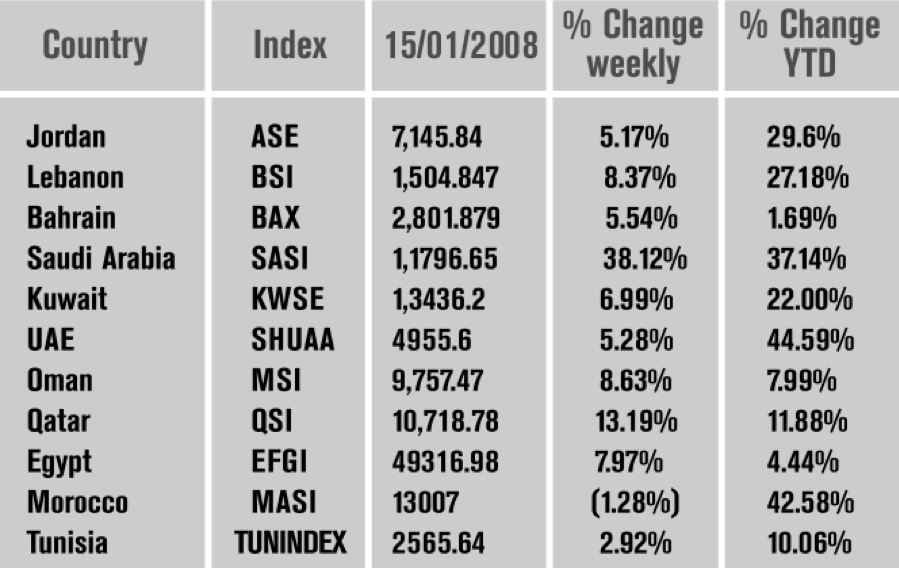
Regional stock market indices

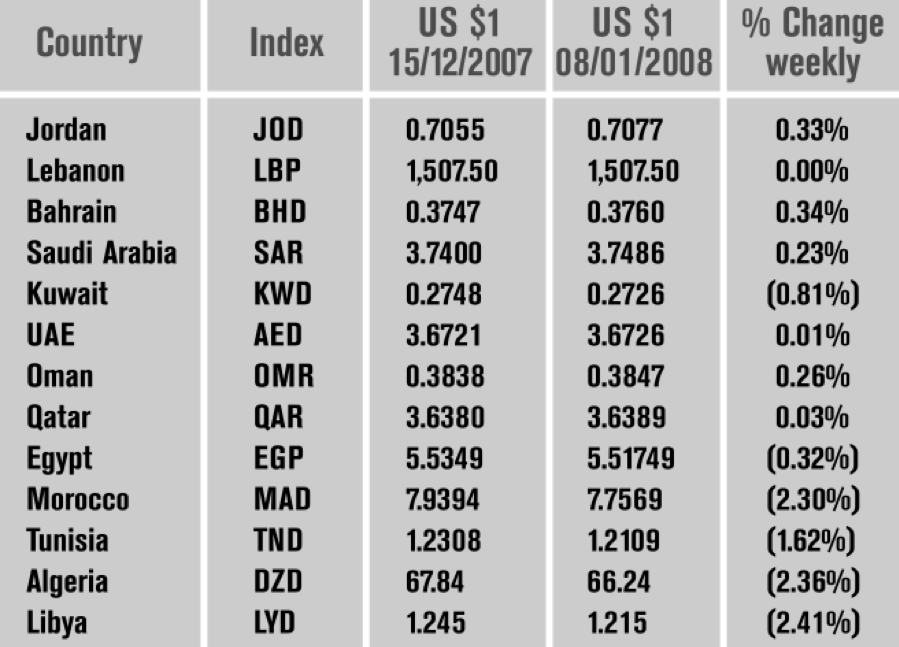
Regional currency rates

United Arab Emirates buys French nuclear reactors

The United Arab Emirates will be signing agreements with French companies Areva, Total and Suez to build two third-generation nuclear plants for civilian use. The deal comes during French president Nicolas Sarkozy’s visit to the region. UAE authorities who have been in talks with Areva confirmed their preference to sell their oil, which is trading at close to $100/barrel, rather than use it for electricity production. Areva has already signed power transmission agreements worth $1.15 billion with Qatar. The Gulf Cooperation Council is also in talks with the UN Atomic Energy about developing a joint nuclear energy program.

Saudi National Bank recommends diversification from the dollar

Saudi Arabia’s largest state bank, National Commercial Bank (NCB), urged the government to reduce the kingdom’s exposure to the dollar by diversifying government investments across asset types, countries and currencies to hedge against the weakening dollar and subsequent reduction of US interest rates. The NCB has called for the freeing of the Saudi Riyal’s steady exchange rate at 3.75 from the US dollar peg. Surplus revenues from oil exports are partly managed by the Saudi Arabia Monetary Agency (SAMA), which holds $285 billion in foreign assets. Saudi Arabia is under growing pressure to severe its dollar peg policy as part of its monetary union partners’ measures to reduce their exposure to the dollar as Kuwait did last year.

Egypt maintains positive balance of payments despite growth in imports

In its latest assessment for Egypt’s current accounts, the Middle East Monitor has revised downward its forecast of 2% of GDP in FY06/07 to 1.1% of GDP for FY07/08. This was due to a 24.3% increase in total imports coupled with rising oil prices and consumer appetite. However, continuous growth in total  exports (19.3%) and 44% in non-oil exports,  in addition to higher revenues from Suez Canal and tourism and workers’ remittances, seem to limit the decline in the country’s balance of payments. Egypt’s diversification of its export destination help cushion its export activity where 40% of goods go to Europe, 31% to the US, 12.4% to the Middle East and 13.5% to Asia. The same applies to Egypt’s FDI inflows where 42% come from the US, 36% from the EU and 30% from the Middle East. All of these factors help reduce instability in the Egyptian economy.

February 2, 2008 0 comments
0 FacebookTwitterPinterestEmail
  • 1
  • …
  • 547
  • 548
  • 549
  • 550
  • 551
  • …
  • 696

Latest Cover

About us

Since its first edition emerged on the newsstands in 1999, Executive Magazine has been dedicated to providing its readers with the most up-to-date local and regional business news. Executive is a monthly business magazine that offers readers in-depth analyses on the Lebanese world of commerce, covering all the major sectors – from banking, finance, and insurance to technology, tourism, hospitality, media, and retail.

  • Donate
  • Our Purpose
  • Contact Us

Sign up for our newsletter

    • Facebook
    • Twitter
    • Instagram
    • Linkedin
    • Youtube
    Executive Magazine
    • ISSUES
      • Current Issue
      • Past issues
    • BUSINESS
    • ECONOMICS & POLICY
    • OPINION
    • SPECIAL REPORTS
    • EXECUTIVE TALKS
    • MOVEMENTS
      • Change the image
      • Cannes lions
      • Transparency & accountability
      • ECONOMIC ROADMAP
      • Say No to Corruption
      • The Lebanon media development initiative
      • LPSN Policy Asks
      • Advocating the preservation of deposits
    • JOIN US
      • Join our movement
      • Attend our events
      • Receive updates
      • Connect with us
    • DONATE