• Donate
  • Our Purpose
  • Contact Us
Executive Magazine
  • ISSUES
    • Current Issue
    • Past issues
  • BUSINESS
  • ECONOMICS & POLICY
  • OPINION
  • SPECIAL REPORTS
  • EXECUTIVE TALKS
  • MOVEMENTS
    • Change the image
    • Cannes lions
    • Transparency & accountability
    • ECONOMIC ROADMAP
    • Say No to Corruption
    • The Lebanon media development initiative
    • LPSN Policy Asks
    • Advocating the preservation of deposits
  • JOIN US
    • Join our movement
    • Attend our events
    • Receive updates
    • Connect with us
  • DONATE
By Invitation

A random blip or a future trend?

by Imad Ghandour December 1, 2007
written by Imad Ghandour

Zawya Private Equity Monitor released last month its statistics for investments and fund raising for the first nine months of 2007.

Problems in fund raising?

The funds raised in the first nine months have increased by 20% from $1.9 billion in 2006 to $2.3 billion in 2007. Great news — at first glance.

However, the $2.3 billion includes $1.2 billion raised by Abraaj’s Infrastructure and Growth Capital Fund, and conceals the untold truth that many funds are struggling to raise money. The easy money days of 2005 and 2006 seem to be over.

Despite headline news of oil hitting $100 a barrel and the excess liquidity in the region, many private equity houses are unable to close their funds. A leading regional private equity firm that was successful in raising several funds and has billions of dollars under management have closed its latest fund only a third of its target of $1 billion. Another regional investment bank, targeting $150 million, have barely reached a third of that amount after one year of fund raising. Only two of many stories.

New comers to the business sailed even worse than the rest. I now have a long list of funds that were announced in 2005 and 2006 and have still not closed. Chances are, they will never close.

I was not sure if this is a result of a glut in the liquidity flow, a pause for investors to think if private equity works, or actually a reasonable evolution of the industry. Liquidity may have shrank in the first few months of this year as interest rates rose (this is now being reversed) and oil prices dropped in the first quarter to around $50 (that now seems as the distant past). You can also argue that investors have poured billions in 2005 and 2006, and now they wanted to see some returns before pumping more cash in new funds.

The fact is, those funds that have established a track record, like HSBC Private Equity, found no problem raising another fund despite the (mildly) adverse conditions. Investors are not shy from investing, but they are betting on funds with solid track records.

Signs of a maturing industry? Let’s see the last quarter of the year before we make a final judgment.

Jordan — a role model

UAE has consistently — at least since Zawya and GVCA has started to compile these statistics in 2005 — been ranked as the prime destination for private equity investment. No surprises here. UAE houses 75% of all private equity fund managers, so it is easy for fund managers to invest in the neighbor next door. UAE is also the second largest economy in the region, and one of the most competitive (I am now lost with a dozen competitiveness indexes being churned out every year).

I was surprised (again) to find Jordan being ranked number two. The only explanation I have found so far is that Jordan is one of the most stable and open economies. Despite its small size, Jordan is offering real opportunities for private equity.

I was surprised (again) to find Saudi Arabia sharing the fourth place with Bahrain. The largest economy in the Middle East is outdone by UAE, Jordan, Egypt, and Bahrain. Not a surprise based on the same analysis above. Despite its vast potential and immense number of opportunities, private equity investors are not excited to invest in the opaque kingdom.

A wake up call for the investment promotion agencies that vigorously publicize their country’s competitiveness: private equity investment is probably the best reliable measure of how attractive any economy is to private capital. This category of investors will diligently and objectively balance the risks, obstacles, laws, growth, rewards, etc., in every economy and investment opportunity. They are the only one of those “competitive index publishers” who put their money where their mouth is. Food for thought for the region’s governments.

Imad Ghandour is Head of Strategy& Research, Gulf Capital and Board Member of theGulf Venture Capital Association.


December 1, 2007 0 comments
0 FacebookTwitterPinterestEmail
Capitalist Culture

Freedom – Into oblivion

by Michael Young December 1, 2007
written by Michael Young

Just when it seemed that things couldn’t get worse for capitalist culture in the Middle East, we now have to absorb the backward blow of a dismal 2007. The region is more than ever trapped in enmity, pushing the advance of free minds and markets further into oblivion; Lebanon is facing a sustained threat to what remains of the 2005 Independence Intifada, with the increasing likelihood that Syria will re-impose some form of hegemony in the coming years; and 2008 is looking very much like it will only exacerbate the tensions of this past year.

So much for your Christmas cheer. Complicating matters is the price of oil. It’s moving inexorably upwards, helping the likes of Iran, Russia, and others who have a vested interest in seeing the United States remove itself from Iraq and downgrade its power in the region. Whatever the merits or demerits of such ambitions, they are sure to make Washington angrier and more frustrated than it already is in the Middle East, so that some form of conflict is likelier. And where there is conflict, liberty withers.

As one observer put it so well, while crises in much of the world tend to unblock situations and create new opportunities, those in the Middle East only make things worse. The tectonic plates of the region lock further, so that the probable outcome is a major new earthquake.

Everywhere, on one side of the regional divide or the other, the matter of liberty is being ignored. If the Middle East is facing a new cold war, as the New York Times columnist Thomas Friedman has argued, then on one side of this partition you have Iran, Syria, Hizbullah and Hamas; on the other you have the mostly Sunni-led Arab states, particularly Saudi Arabia, Egypt, and Jordan, backed by the United States. While all the parties disagree on quite a lot of things, the net impact of their degenerating struggle, and an unmentioned point of agreement between them, is that now is not the time to allow democrats to be empowered, or even to allow civil society to display new vitality.

In Iran, for example, where society presents the greatest opportunity for a liberal breakthrough in the region, the prospect of a war between the US and Iran can only be nefarious for liberty. Not only would most Iranians probably rally to the side of their state, no matter how oppressive, a conflict would give that state even greater means to control the society.

In Syria, the issue of liberty is not even being seriously discussed. President Bashar al-Assad has stifled civil society much as his father did, and the brief “Damascus spring” is a distant memory. The regime is bolstered by an improving economic situation, thanks to Iraqi refugee money, Arab investments, and Iranian funding. Syria remains vulnerable, however, as its oil reserves are almost finished and investment moods can quickly change. But for the moment Assad is stronger than he has been in years, and his people are torn between apathy toward a system that forever seems to be going nowhere and fear of what the regime’s departure might bring. Worse, the international community refuses to create new options by working on strengthening Syria’s democratic forces. It accepts the idea that it’s either Assad or chaos, and in so doing fortifies the regime.

In fact, Assad has shown just how far he is willing to go by trying to return to Lebanon in one way or another. The Syrians, in coordination with an undemocratic Hizbullah, have provoked chaos in Lebanon in order to turn themselves into the inevitable interlocutor on the country’s future. When France recently engaged Syria on the Lebanese presidential election, that strategy seemed to be working. A liberal space was opened up in Lebanon in 2005. Is it about to be closed again because of Western foolishness?

On the other side, too, liberty is largely a figment of the imagination. The Egyptian president, Hosni Mubarak, is focused on his own succession, particularly ensuring that his son takes over power. There can be no democracy when the prevailing vision is of a republican monarchy. And the regime is hitting out everywhere, with even youthful bloggers being tossed into jail and tortured. Saudi Arabia is little better, with its participatory system in congenital lockdown. What freedom there is happens behind closed doors, with the regime alarmed by a rising Iran and an Iraq that might at any moment destabilize the kingdom.

One can go on. 2005 was supposed to be the year of grand democratic transformation in the Middle East. Partly it was; but it was also a trigger that autocratic regimes in the region needed to circle the wagons and ensure that liberty would be suffocated in the egg. Free minds are flat-lining in the region, and that’s not going to change anytime soon.


December 1, 2007 0 comments
0 FacebookTwitterPinterestEmail
Comment

Greater Middle East in 2008

by Claude Salhani December 1, 2007
written by Claude Salhani

It’s that time of year again and there is little to rejoice about as 2007 draws to a close. The Middle East crisis, for decades confined mostly to the countries bordering Israel, has spread to include what the Bush administration calls the “Greater Middle East” with Turkey and Pakistan dragged into the fray.

Pessimism is the order of the year. The situation, many observers believe, will get worse before getting even worse. The Bush administration’s hope to sow democracy throughout the region has shifted into reverse gear. But then again, this is the Middle East where miracles have been known to happen. That reverse gear can just easily shift into first.

Weeks shy of scheduled elections Pakistan’s President Pervez Musharraf, a major US ally in the “war on terrorism” decided in early November that his country could do without democratic institutions and declared a state of emergency. The general, it was hoped, would keep his military uniform tucked away in his closet and run as a civilian in the elections, one of the demands of the opposition, instead came out of the closet wearing full battledress fatigues. But perhaps US pressure sometimes comes through. Musharraf did end up shedding his uniform, but only after appointing a close ally to replace him.

Musharraf, who has received about $10 billion from the US, said he was placing his country’s interests above everything else. That includes Bush’s hopes to see democracy spread. Instead, I predict that free and fair democratic elections in Pakistan are unlikely to take place in the immediate future. Pro al-Qaida Islamist groups will increase violence hoping to overthrow Musharraf and create the first nuclear powered Islamist state. That is assuming Iran doesn’t beat them to it. Musharraf’s battle with the country’s judiciary is likely to escalate before the turbulence shaking Pakistan’s political climate settles down. And the lawyers may win.

An easy prediction is the war in Iraq. Despite claims that some provinces are getting better, the conflict will outlast the Bush administration. As George W. rides off into the sunset from Washington for his ranch in Crawford, Texas, he will leave to his successor (a Democrat, in all probability Hillary Clinton) a legacy more muddled, more complex and more volatile than ever before. Turkey will become militarily involved as it pursues Kurdish separatists into Iraq.

On the economic and home fronts Bush’s legacy fares no better with oil nearing $100 a barrel and the housing market in shambles as a result of the financial debacle over the sub-prime mortgages which forced two CEOs — Charles Prince of Citigroup and Stan O’Neal of Merrill Lynch — to resign. New York City-based Citigroup may soon layoff as many as 45,000 jobs as a result of the sub-prime crisis. Citigroup employs about 320,000 people and manages roughly 200 million customers worldwide. The company lost about $6.5 billion in the sub-prime affair.

Prince’s departure came only a week after the resignation of O’Neal, the head of Merrill Lynch, one of the world’s best known investment banks. Merrill Lynch, too, is said to be caught up in the sub-prime loans business.

Relations between the United States and Iran will remain frozen, if we are lucky. A last-minute effort by the Bush administration to destroy Iran’s nuclear capability is not to be ruled out. If that were to happen a new wave of jihadi violence can be expected.

For Israel and Palestine, the revived road map for peace in the Middle East led to the Annapolis mega-peace conference which brought close to 50 countries and organizations, including for the first time, 16 Arab countries, among them Saudi Arabia and Syria together with Israel.

As predicted by numerous analysts, the Annapolis conference in and of itself failed to produce any immediate results. Instead, the Israelis and Palestinians promised to “continue pushing towards peace.” In political parlance that’s the equivalent of “the check is in the mail.” If indeed nothing concrete comes out of Annapolis and the follow-up meetings at the White House, the Bush administration can well be blamed for failing to apply pressure when it was needed most. The most dangerous consequences of a failed attempt at peace-making at this stage is likely to give birth to a renewal of violence in the region. If the year 2008 does not usher in a peaceful agreements between Israeli and Palestinians, it could see the beginning of Intifada III.

In Lebanon, the political scene remains so muddled — and with it the economic development of the country — that even the bravest of political scientists fear making predictions other than to say that the next 365 days are unlikely to see a resolution of the crisis. Lebanon may have a new president, this one less dependent on Damascus, though the pressure from the Syrian neighbor is unlikely to abate. The country’s future will remain intricately tied to Syria’s.
 

December 1, 2007 0 comments
0 FacebookTwitterPinterestEmail
Comment

Teeing off in Kashmir

by Paul Cochrane December 1, 2007
written by Paul Cochrane

Teeing off at the Royal Springs Golf Club in Srinagar, Kashmir, it was not hard to see what would attract Arab golf enthusiasts looking for a slightly more adventurous destination.

The mountainous backdrop, the trees in autumnal reds and oranges, Dal Lake behind, and a course designed by golf architect great Robert Trent Jones, all make the club the best in India.

But the problem at the club is the lack of players, and that is not due to the exceedingly low green fees ($20), club hire ($5) or caddie service ($2). It is “because of the situation” said manager Rafiq Azad, sounding not unlike a Lebanese businessman.

Azad was referring to Jammu and Kashmir’s 60-year struggle for independence, and the militants — largely Pakistani-backed but now dwindling in number and popularity — that have waged a 20-year insurgency against the Indian state.

The ongoing situation in Kashmir has destroyed lives, acted as a catalyst for emigration, generated tensions between Delhi and Islamabad, and is costing the Indian state some $7 million a day to station one million troops there.

This is all the more tragic as Kashmir was once a popular tourist destination, famed for its mountains, lakes, flowers and skiing, and called locally the “second Switzerland” — all comparable to that so-called “Switzerland of the Middle East,” Lebanon.

Azad said he wants to attract Gulf Arabs to play at the club, but until there is more investment, an international airport opens, and people feel it is safe to go to Kashmir again, this northern part of India will remain wanting. Even from Indian investment.

The big money is being made elsewhere in the world’s second largest growing economy, just as it is by Lebanon’s (and indeed, the Levant’s) cousins in the Gulf. That is where the Indian-Arab relationship is blossoming, in recent decades rekindling an ancient mercantile relationship, with India signing bilateral protection agreements with nearly all the GCC countries.

As India’s economy is growing at over 9% a year, it is not surprising Indian exports to the GCC are surging, up 17% from 2005’s $14 billion to $16.7 billion last year. And if India signs a FTA with the GCC, two-way trade could reach $40 billion by 2010.

With such a booming economy, India’s 50 million middle class have increasingly more rupees in their pockets, a demographic that Lebanese luxury retailer Aishti is rumored to be wanting to move in on, and Dubai’s Emaar already has.

The economic outlook is apparently bullish, with the middle class expected to surge to 40% of the population, to 587 million, by 2025, according to a McKinsey Global Institute (MGI) study, due in part to a growing 16-64 years old age range, from 700 million in 2005 to 950 million in 2025, and household income tripling in the next two decades to bring India up from the 12th largest consumer economy globally to fifth position.

This may come to be, but a lot will have to change to alter recent government statistics that state that 92% of the population are informal workers, and some 836 million (77%) of Indians live on less than 20 rupees ($0.50) a day. As for the 10 million Kashmiris in India, a viable solution to the situation is needed between Delhi, Islamabad, and Beijing (which controls 10% of Kashmir), as well as divisions among the Kashmiris — a bit like Lebanon’s situation with all and sunder poking their noses in. Indeed, Saudi Arabia’s Wahhabi influence has spread to Kashmir, there is widespread support for Iran (and Hassan Nasrallah) among the 20% of the population that are Shia, and Israel is reportedly seeking to gain a foothold as well, according to academics at Kashmir University.

But as this is the festive season, let’s be optimistic. The McKinsey’s figures might not be pie-in-the-sky forecasts and political and economic realities can be overcome. All Indians will get a slice of the economic pie, Kashmiri golf clubs will have membership waiting lists, and peace will come to all men in the troubled North India region and the beleaguered Middle East.

It might also be worth my teeing off from Beirut’s golf course as an act of solidarity, but perhaps in the new year, regardless of the “situation.”


December 1, 2007 0 comments
0 FacebookTwitterPinterestEmail
Comment

Who will you be (with) this holiday season?

by Rana Hanna December 1, 2007
written by Rana Hanna

As a new year begins and we all search to reinvent ourselves, here are a few ideas for those wishing to find out who they really are, and even who they may want to be.

For those who wish to know the past before moving on to the future, you can now can trace your ancestry using genetic genealogy and find out if you are closer to Claudia Schiffer or a monkey. The DNA Ancestry Project, offered by Genebase Systems, allows us to trace our origins based on mutations in our DNA. According to the project info, DNA tests have proven that we all shared a common ancestor anytime between 50,000 and 200,000 years ago. As people migrated out of Africa, genetic mutations occurred in their DNA. As these mutations cemented in the generations that passed, each mutation in our genes today can be linked to a specific time and place in history. By sending a sample of your DNA, obtained through a saliva sample on a cotton swab (provided in the special participation kit on sale for $119) certain mutations that are predominant in certain areas will determine where you come from. Check it out on www.dnaancestryproject.com.

Closer to the monkey? No problem. Just reinvent yourself as an Avatar and make a new start on Second Life, a virtual community populated by Avatars. If you’re not already, you can reinvent yourself as a tall, blue-eyed blonde, find work and buy property. With over 2 million residents, life in Second Life (or SL as it is commonly known) is replete with shopping sites, discotheques, parks and even a red-light district. There are many real-life companies that have set up offices in Second Life, including CNN, Reuters, Cisco, Toyota and Starwood Hotels and Resorts. The government of Sweden even opened an embassy there. SL is a complex system with its own economy (it has its own currency, the Linden Dollar), laws, rules and regulations so if you do decide to reinvent yourself, make sure you have a lot of time on your hands. (www.secondlife.com)

But if you decide to stay in present day reality, then like most of us, you will probably be sending holiday greetings to all your friends on Facebook.

Facebook, like MySpace, Frienster and LinkedIn (a network of professionals with degrees of separation), is one of the many social and professional networking sites that allow people to get in touch and stay connected, one of the many marvels of the internet that have made us more and more dependent on our machinery and the cyber world.

On these sites, you can post up your pictures and tell people as little or as much as you like about yourself. Where you are, what you’re doing, your state of mind and even what you’re eating.

Facebook is about popularity. It is not so much who you are, but who you know, and how many people you know that matters. Facebook has introduced a new concept to friendship: the Facebook friend. A Facebook friend is someone whose news you only know through Facebook because you simply don’t have time (or maybe don’t want to) catch up with in reality. But there’s another type of friend introduced by Facebook: The long lost childhood friend. But here’s the catch: You’ve found your long lost friends. Now what? After exchanging greetings, sending pictures that you wish you could retouch and summarizing the last 30 years of your life in three lines (trust me, it can be done), where do you go from here? I have found it difficult to keep in touch with my childhood friends because I can’t face the momentous task of catching up. A few months ago I found a friend I hadn’t seen in 24 years. We exchanged phone numbers and we’re still waiting to have lunch! (Makes you wonder why you lost touch in the first place).

Never before have people been as connected as they are now. Virtually at least. But as we stare at our screens and “touch someone”, do we realize how disconnected we have actually become from reality and the people around us? How dependent we have become on our cyber life? Here’s a test you can do to test how dependent you are on your internet connection: stay at home or office for one hour and switch your connection off. Give yourself 10 points for not minding, 5 points if you looked longingly at your laptop and 0 points if you freaked out.


December 1, 2007 0 comments
0 FacebookTwitterPinterestEmail
Comment

Tehran’s domestic battles begin

by Gareth Smith December 1, 2007
written by Gareth Smith

Western media reaction to last month’s International Atomic Energy Agency (IAEA) report on Iran’s nuclear program sounded chillingly like the beat of war drums. Even supposedly reputable outlets seized on the line — from British spin doctors — that Iran had “failed to come clean.” In fact, the report recognized that Iran had improved its cooperation with the IAEA, in line with a decision Tehran took in August despite growing western belligerence.

The US and British-led plan is undermining the pragmatists in Tehran. Hence, last month’s announcement of spying charges against Hossein Mousavian, the former Iranian security official who played a leading role in nuclear negotiations with the Europeans.

I found Mousavian an urbane and intelligent man when I interviewed him several times in 2004 and 2005. He was one of the three Iranians leading talks with the European Union. That was a time when Iran suspended key parts of its program and when some European diplomats spoke privately of a compromise in which Iran would keep at least some uranium enrichment capacity.

The charges against Mousavian — which include passing secrets to the British embassy — have all the hallmarks of being political. The fundamentalists who criticized the talks back in 2003-5 have taken over more and more levers of government power since the election in 2005 of Mahmoud Ahmadinejad to the presidency.

But Mousavian is part of an older trend of Iranian officials who have paid a price of working for an agreement with the West and then failing to deliver tangible benefits in a compromise that recognizes Iran’s “rights”.

Ali Larijani, secretary of the Supreme National Security Council, resigned (or was pushed to do so) in October after the failure of his dual strategy of talking to Javier Solana, the EU foreign policy chief, and improving cooperation with the IAEA. The dialogue with Solana was undermined by opponents at home and in Europe.

Gordon Brown, the British prime minister who at first distanced himself from the Middle East policies of his predecessor Tony Blair, made a speech at the London Lord Mayor’s banquet last month that president Bush must have enjoyed. Brown warned Tehran it had a choice between “confrontation with the international community leading to a tightening of sanctions” and “a transformed relationship with the world…if it changes its approach and ends its support for terrorism.”

Western proponents of tougher sanctions and — “if necessary” — military force against Iran argue that harsh treatment will change the behavior of the regime in Tehran. They say existing sanctions are already biting, despite the country’s record oil revenue, which rose by 13.6% to $54 billion last Iranian year (ending March 2007).

Certainly, the international energy majors with existing Iranian interests are pausing. Royal Dutch Shell, Total, OMV and Repsol are all holding off commitments on investment after their agreements in principle over developing Iran’s massive gas reserves — the world’s second largest. Iran has given the companies until June 2008 to decide. But it insists both its gas and oil reserves can be developed if necessary through Iranian companies cooperating with east Asian companies, and some small European companies willing to take risks that may offer huge long-term benefits.

The warming up of the domestic political battles in Tehran also reflects a build up to parliamentary elections due in March. Iranian politics have changed in many ways since the last poll, in February 2004, saw a relatively unified conservative camp win a comfortable majority in a quiet election after many leading reformists were disqualified.

Critics of Ahmadinejad — including both reformists and conservative pragmatists allied to former President Akbar Hashemi Rafsanjani — were encouraged by their performance in December’s local council elections. But in all likelihood, conservatives will retain their parliamentary majority — even if reduced — and maintain their advantage as Iran moves towards the 2009 presidential election.

However, the political pendulum swings in Iran, the western expectation that internal Iranian politics can work in its favor is misguided.

First, the track record is terrible. Consider Bush’s botched intervention in the 2005 presidential election, when his message that the poll “ignored the basic requirements of democracy,” presumably designed to help a boycott campaign led by right-wing exiles, was followed by a high turnout.

Secondly, it is far from clear who the West would like in power in Tehran. Many Washington neo-conservatives, like their Israeli allies, were delighted with Ahmadinejad’s election win, believing to would bring confrontation nearer, and have done nothing to disguise their glee at the propaganda opportunities he has presented them, particularly in remarks about the Jewish holocaust.

But there are still some Europeans who believe an agreement is possible, because they realize, especially after Iraq, what the alternative might be.


December 1, 2007 0 comments
0 FacebookTwitterPinterestEmail
Comment

Stand-up and laugh

by Paula Schmitt December 1, 2007
written by Paula Schmitt

The Egyptian American comedian Ahmed Ahmed says in his stand-up show that, because there is a supposed terrorist also called Ahmed Ahmed, his name is in a most-wanted list. That makes air travel a unique — if not, horrible — experience. But one cannot but laugh when he tells of his ordeal: “I always know who the air marshal is on the plane. He is the guy reading People Magazine upside down and looking right at me.” After googling his own name and finding out that indeed there seems to be a terrorist called Ahmed Ahmed, the comedian wonders if the other Ahmed is in the Arab world going through the same identity mix-up: “I swear I am not a comedian, I am a terrorist!”

These and other stories are told by the Axis of Evil, a stand up comedy group formed by Ahmed, Aron Kader (whose father is Palestinian and mother is an American Mormon), Maz Jobrani (Iranian-American) and Dean Obeidallah (Palestinian-American). Of all places, the Axis’s first performance happened where the expression Axis of Evil has a whole different connotation: Washington, D.C. Since then, November 2005, they have been touring America using humor as a weapon against prejudice. Now, after full-house performances throughout the US, the Axis is touring the Middle East with a mission that is as necessary as destroying prejudice: helping make the Arabs laugh at themselves.

In America, the Axis of Evil Comedy Tour has been welcomed with raving reviews by the likes of CNN, Time, National Public Radio, and Newsweek. Along with the laughter, the group aims at promoting a shift in cultural perceptions. “We don’t want to be defined any longer by the worst examples in our community. There are a few terrorists and they define all of us,” said Ahmed in an interview on CNN.

But the paradigms are changing already. A lot has happened since 9/11, when Dean Obeidallah followed the suggestion of a club owner and dropped his Arab surname, performing under his middle name instead, Dean Joseph. Now, the group has become so popular and is so successful in defying prejudice that one of the Axis’s show in the US was sponsored by one of the main targets of the jokes: the FBI. With some of the officers attending one of the performances, Ahmed looks at them, sitting close to the stage, and tells the audience “It’s so nice to be standing in front of the FBI and not be handcuffed.”

In his routine, Ahmed reminds the audience that after 9/11, hate crimes against Middle Easterners increased by 1,000%, but that still leaves them in fourth place among hate crime victims — behind blacks, gays and Jews. “I just want to be number one in something,” he joked. United in prejudice, but with the wisdom to transform pain into pleasure, the ethnic comedians are more important in healing and unifying than they are given credit for. Quoting a colleague who is a rabbi, Ahmed says “you can’t hate anybody when you are laughing with them.”

But do Arabs easily laugh at themselves? Kader has one line aimed at the more uptight, imitating a fictitious Arab who insists he does indeed have a sense of humor: “Whoever says we don’t have a sense of humor, I will kill you and burn your flag.” But it takes a lot of high self-esteem and intellectual freedom to laugh at oneself. The only practicing Muslim in the group, Ahmed jokes that “you know you’re a Muslim when you drink, gamble and have sex but you won’t eat pork.”

Comedy is about stereotypes. As a Brazilian, I know my country has them in abundance and I was genuinely offended when my government threatened to sue the producers of the Simpsons cartoon, after one episode showed the Simpson family travelling to Rio to find out what happened to the money they were donating to a boy living in a slum. On the same trip, the Simpsons watch TeleBoobies, a show in which semi-naked girls entertain Brazilian children, while the Brazilian public transport system is depicted as one long conga line. Sadly, even our president at the time made the surreal comment that the cartoon “brought a distorted vision of Brazilian reality.”

Since when does comedy have the duty to reproduce reality? What some suspect, though, is that the president was offended not by the distortion, but precisely by the small bits that didn’t distort our reality all that much. After the embarrassing, irrelevant dispute, Homer Simpson made his retribution in style. In a later episode, he is the proud owner of a monkey. And he asks his friend to be careful with the animal, as it was a present from Brazil, and whose pedigree is very important, since “this monkey is the cousin of the tourism minister.” Kudos.
 

December 1, 2007 0 comments
0 FacebookTwitterPinterestEmail
Comment

Hardliner city

by Andrew Tabler December 1, 2007
written by Andrew Tabler

Until recently, Syria bucked the age-old political dictum that regimes under intense external pressure halt domestic reforms until the coast is clear. The country’s 10th Five Year Plan, approved a year after Syrians were named suspects in the murder of the late Lebanese Prime Minister Rafik Hariri, introduced a slew of economic and social reforms designed to transform Syria from a state-dominated and socialist system to one involving greater domestic freedoms and a partnership with the country’s vibrant private sector. While liberalization in Syria’s finance, forex and trading regimes continue to unfold, Israel’s bombing of an alleged Syrian “nuclear” facility on September 6th has triggered the widest crackdown since the dark-days of the 1980s on Western influence in Syria and the ways its people communicate with the outside world.

The first signs came in mid-September when the Syrian government announced that names of all schools, businesses and shops must be in Arabic ahead of Damascus’ serving as the 2008 Arab Cultural Capital. As businesses with western names like KFC and Shrimpy prepared to change their marquees, foreign schools and universities were ordered to integrate Syrian curriculum into their hitherto Western teaching models. Even Arab European University — one of the darlings of Syria’s European-supported reform process — was forced to drop the term “European” in favor of “International”.

Internet speeds throughout the country then slowed to a trickle in late September without reason. Rumors filled the Syrian capital that a Finnish firm supplied technology to Syrian authorities to more closely monitor internet traffic in the country. Suddenly added to the list of banned opposition websites and blogs were such popular services such as Facebook and even some functions of Google news. The new software is rumored to allow complete tracking of individual e-mail accounts inside and outside of Syria.

Syrian “reformers” ran for cover. Deputy Prime Minister for Economic Affairs Abdullah Dardari — Syria’s reform guru and author (with German assistance) of the Five Year Plan — recently stopped meeting foreign media without prior permission from Syria’s Ministry of Information. As President Assad’s right hand of reform, Dardari is under intense criticism by pundits and economists for everything for fiddling with the economic numbers to his stark warnings that Syria must cut its annual $7 billion subsidies bill or risk a fiscal crisis of major proportions. While Dardari insists that Syrian oil production is plummeting at a rate of 11% and therefore the state must accelerate efforts to make up the difference through taxation, his critics say the high price of oil will keep the budget deficit in check. The subsequent announcement by his rival, Finance Minister Mohammed al-Hussein, that the 2008 budget deficit would be in excess of $3.8 billion, down from a $5.86 billion only five years ago, failed to stem the tide of calls for Dardari’s head in a much-anticipated cabinet change. Neither did the regime’s midnight hike of gasoline prices by 20% two weeks ago and to be followed by a 20% hike next year. Diesel is still only $0.14 a liter, however, ensuring that a steady supply of smuggled fuel will continue to make its way to Lebanon, Turkey and Jordan where it fetches nearly five times the price.

But who’s counting anyway. Dardari’s effort to launch an “Executive Plan” to monitor the Five Year Plan and actually see if Syria was meeting its targets was quietly shelved late last summer for unknown reasons. The regime’s preference to fly blind in reform followed the state’s closure earlier this year of the renowned media coverage monitor IPSOS-STAT’s Damascus offices. Syria might have plenty of new private sector newspapers, magazines and radio stations, but no one knows exactly who listens to them and how they compete with their hard-line state-owned competitors.

Rollbacks in Syrian reform this autumn are the latest chapter in a two-year hiatus in political and social legislation. In his acceptance speech to a second seven-year term as Syrian President Bashar al-Assad said Syria has been in a “battle with destiny” (presumably with Israel and the US) and therefore has not had time to follow up on changes to the political parties, emergency and NGO laws promised in the 2005 Baath Party conference. The latter law, rumored to be on the verge of passage last September, is now expected next year.

So why is the regime letting private sector banks, insurance companies, foreign exchange house and trading companies flourish? Some people say it’s due to the state’s fiscal problems. But a closer look shows that, ironically, Syria’s pullout from Lebanon in April 2005 was perhaps the most powerful impetus for reform during Assad’s first term. Strained ties with Lebanon forced the state to implement long-dormant legislation to allow Syria’s private sector to do what Syrians long contracted Lebanese to do for them. In the bizarre world of Syrian reform, Friedrich Nietzsche’s quote “that which does not kill us makes us stronger” has never rang more true.
 

December 1, 2007 0 comments
0 FacebookTwitterPinterestEmail
Editorial

A different focus

by Yasser Akkaoui December 1, 2007
written by Yasser Akkaoui

This year’s Executive Facts and Forecasts has picked three nations in the MENA region that it believes best represents its economic heartbeat: an emerging Sudan, a thrusting UAE and a Lebanon that is in transition but which has potential in abundance.

One of the exciting stories of the past years has been the resurgence of Sudan from decades of political conflict and war, enabling the country to truly access its natural resources — such as oil and sugar — and use these to develop a burgeoning economy. The result has been double-digit growth that has propelled Sudan into the limelight and made it attractive to investors seeking to diversify their emerging markets portfolio.

The UAE (and the rest of the GCC for that matter) had another record year and will continue to set new economic benchmarks. Those who believe that the oil boom is past its peak had better think again. This is not a flash-in-the-pan correction similar to what was experienced in the 70s; black gold will maintain its robustness to fund even greater projects and fuel prosperity throughout the region and beyond. But this success is not just down to increased oil revenues; they have merely helped implement a remarkable vision that has seen assets used to create sustainable economic development and transform a region into throbbing modern metropolis

Lebanon, being the regional barometer that it is, must thank its lucky stars that the political crisis that has plagued the little Mediterranean nation since mid-2006 happened during the current oil boom. The economic development in the GCC has allowed Lebanese talent to be absorbed into, and contribute to, the dream and brand Lebanon was able to diversify and become less reliant on an ailing and limited local economy. The good news is that the election of a new president at the end of 2007 should herald at least three years of calm and allow Lebanon to once again take its place as the most elegant boutique in the regional mall.

What we at Executive hope to showcase in this annual issue is that, despite the tag of instability that is so often attached to the region, the Middle East and North Africa is filled with credible and sustainable opportunities with the vision and talent to make them happen.


December 1, 2007 0 comments
0 FacebookTwitterPinterestEmail
Financial Indicators

by Executive Contributor November 20, 2007
written by Executive Contributor

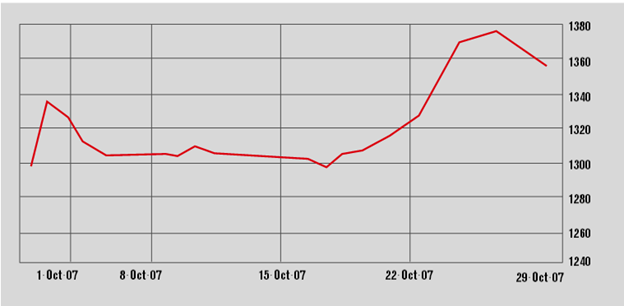
 The Beirut Stock Exchange closed its fourth trading week in October with the year’s best index showing as the BLOM stock index reached 1373.636 points on Oct 26. Banking shares were the force behind the upwelling of optimism; the market buzz centered on talk of an acquisition offer for BLOM Bank. The bank’s GDR shares closed at $90.70 on Oct 26, its listed shares at $77.10. Bank Audi also pulled up, its GDRs reached $71.65 and its listed shares, $68. With some hopes emanating from political talks, Solidere also firmed further and closed at around $19 on Oct 26. Total value of shares traded on the BSE in the third quarter of 2007 was $257.4 million. A new run at auctioning two mobile phone operator licenses for the two existing cellular networks is scheduled for February, with distant hopes for broadening the activities on the BSE by listing part of the government’s stakes in the two operators. 

Beirut SE: Blom  (1 month)

Current Year High: 1,526.31         Current Year Low: 1,168.36

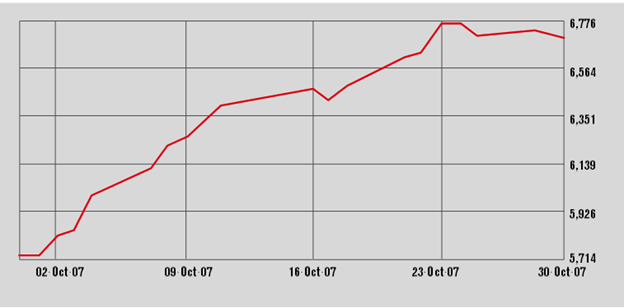
 The Amman Stock Exchange was the region’s Ramadan racer. It slowly rose from months of slumber in the mid-5000s at the beginning of the fasting period. In October, the ASE Index pulled up in a steep ascent to close at 6,713.02 points on Oct 25, its 17.3% gain for the month measuring near the top in the MENA region. Arab Bank, the bulky force behind many ASE developments, rallied by 29% between Oct 1 and Oct 25. It was the first time since February that the bank’s stock was quoted above JD 27 ($ 38.14) and the climb came ahead of its quarterly results announcement, in which the bank disclosed a 15.6% increase in net profit for the first nine months of 2007. After banking, the industrial, financial services and insurance sectors moved up on the ASE in the week to Oct 25. Noteworthy in the real estate sector was the IPO announcement by Damac Jordan for Real Estate Development with subscription in late October and early November. 

Amman SE  (1 month)

Current Year High: 6,764.93         Current Year Low: 5,267.27

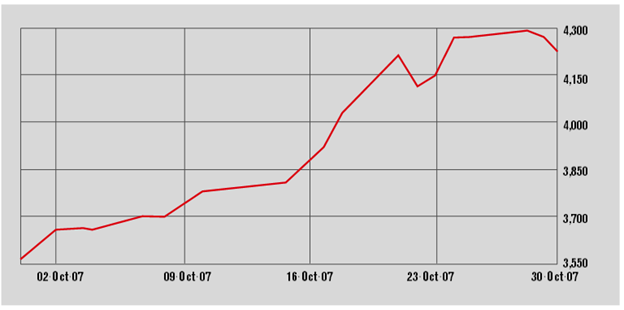
The Abu Dhabi Securities Market displayed an even better mood than the Dubai bourse as far as fasting induced index gains. It soared 12% after Eid to close at 4,269.4 points on Oct 25, bringing its gains for the month to 22.2% and to 42% since the start of 2007. During Ramadan, Abu Dhabi’s key real estate stocks ALDAR and Sorouh set the pace for bullishness on the ADSM but banking and energy values also went strong. Energy company Taqa gained 17% from Oct 1 to Oct 25; banks First Gulf and NBAD moved up 25% each. Etisalat, which traded up just over 25% during the period, attracted attention on rumors that it would open its share ownership to foreign investors but denied late in the month that it would takAbu Dhabi SM  (1 month)

Current Year High: 4,291.22         Current Year Low: 2,839.16

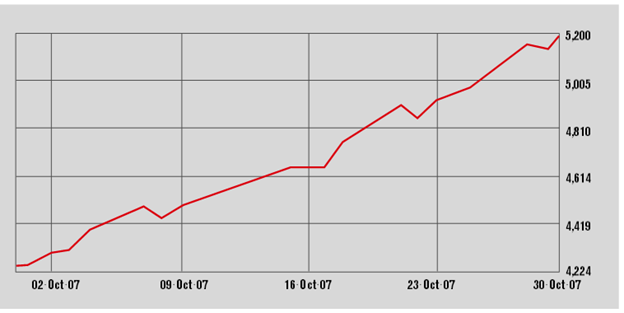
 Fasting is good for the soul and it also looks to clear the mind with leanings for optimistic investment decisions nowhere in the GCC more than on the UAE bourses. The index moved to 4969.82 points on Oct 25, up about 17% from the first of the month. No more Mr. Sluggish, the Dubai Financial Market appears to have determined in introspection and even the weight of still lackluster Emaar with an unexciting third-quarter profit statement could not hold the DFM down. Between Oct 1 and 25, Deyaar (up 15%), Arabtec (up 22%), Air Arabia (up 24%), DFM Co (up 33%), and Amlak Finance (up 39%) were among the stocks that drove the positive market sentiment. While the end of the month saw some expected profit taking, analysts started talking about the index scaling the 5,000 points and further by end of 2007.

Dubai FM  (1 month)

Current Year High: 5,192.29         Current Year Low: 3,658.13

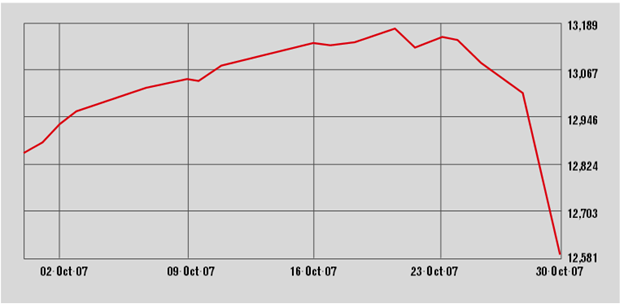
The Kuwait Stock Exchange embraced a new valuation level as its index closed above 13,000 points Oct 7 and stayed in record territory by its close of 13,096.4 points October 25. In peer comparison, however, the KSE paid a modest price for having been the year’s top artist in escaping from the hesitancy that held the UAE and Saudi markets in its grip in the second and third quarters during which the northern exchange soared ahead. In the one-month period from Sep 25 to Oct 25, the KSE index advanced by just under 2% while four of its neighbors took flight with increases above 10%. But since mid-October, the ratio of market cap to GDP in Kuwait exceeds two to one, far above this ratio in other GCC countries. The bourse’s oversight authorities made new attempts at increasing transparency by toughing up regulations in October but the initiative met with a backlash of criticism from major market players. Kuwait’s capital markets draft law is still under discussion in parliamentary committees.   

Kuwait SE  (1 month)

Current Year High: 13,175.20       Current Year Low: 9,164.30

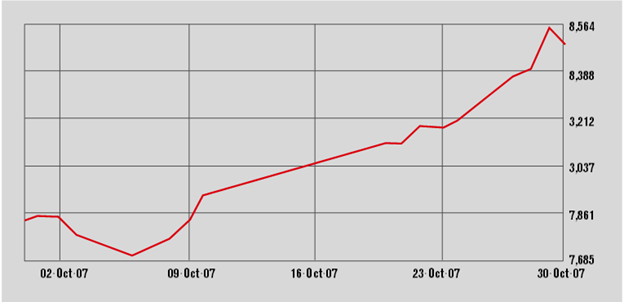
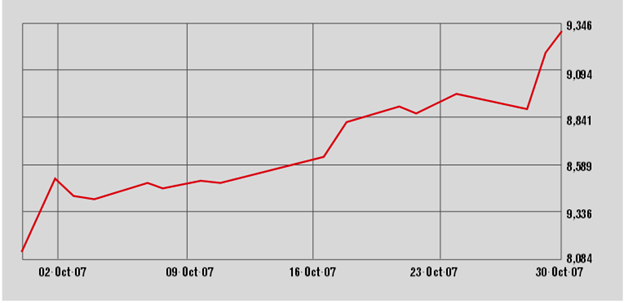
 The Tadawul Index on the Saudi Stock Exchange closed at 8,364.51 points on Oct 27, an improvement of 517 points for the month. In its year-to-date performance, the gap between the SSE and GCC peers last month widened in favor of the latter, however, as the Tasi is trailing neighboring indices by between 12 and 37 percentage points. Analysts named banking and electricity as two sectors that contributed significantly to the subdued development. STC, seen as telecoms underperformer, closed Oct 27 up 4.2% on the month but third-quarter and nine-month results couldn’t impress even as the state-controlled company announced the third 12.5% quarterly dividend for 2007. The SSE led the region as far as time off for the Eid celebrations with closure from Oct 11 until Oct 20 but the exchange used the period to switch to a new trading system with wider capacities that debuted successfully on Oct 21.  

Saudi Arabia SE  (1 month)

Current Year High: 9,717.89         Current Year Low: 6,861.80

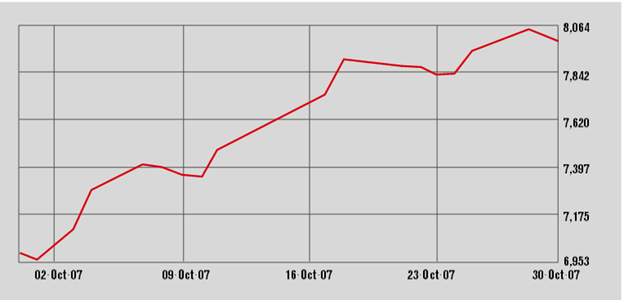
 The Muscat Securities Market rose 13.1% in October to a close of 7,942.94, a new record high. The market is up 42.3% since the start of the year. According to research by a Kuwaiti investment firm, the Omani market last month reached a price to earnings ratio of 15.50, behind Kuwait (20.20) and Qatar (19) but ahead of Saudi Arabia (15.40), the UAE (14.60) and Bahrain (13.70). BankMuscat, the sultanate’s largest bank, traded sideways with a 1.3% gain for the month; however, it reported a 40.7% increase in its nine-month profit. Debutant Galfar Engineering shot up 67% in its first two days of trading Oct 24 and 25. Telecoms operator Omantel, for which a partial sale of the government’s 70% stake to a strategic investor is expected in 2008, soared by 43.5% upon news of the planned sale. The UAE’s Etisalat is said to be among the companies interested in the stake. 

Muscat SM  (1 month)

Current Year High: 8,051.92         Current Year Low: 5,399.29

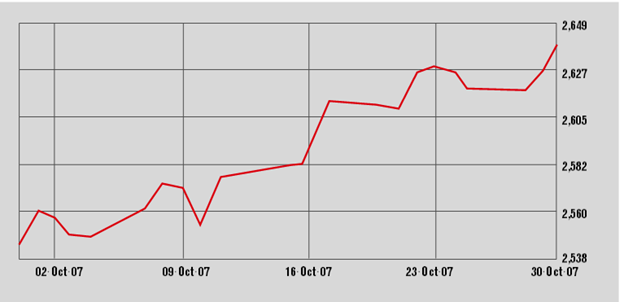
 The Bahrain Stock Exchange index closed at 2,615.85 points on Oct 25, its 2.8% rise on the month making it October’s second slowest index gainer after the Kuwaiti bourse and, after it was overtaken by the Dubai Financial Market, dropped to being the year’s second worst performer after the Saudi Stock Exchange. Banking stock played a mixed role, with a diverse showing of positive and negative profit growth in the third quarter. Gulf Finance House, which showed a 49.4% improvement in third-quarter profit, rose 12% from Oct 1 to Oct 25. Bank of Bahrain and Kuwait, which undertook a 15% rights issue on Oct 16, dropped 12% during the period. Telecoms firm Batelco closed 7% higher compared with the start of the month after retreating from a year high the stock reached on Oct 17. Newcomer Seef Properties, in its third month of trading, climbed 15% in October.  

Bahrain SE  (1 month)

Current Year High: 2,642.85         Current Year Low: 2,106.70

 The Doha Securities Market was also in full upswing in October. It started the month with a 200-point jump and closed on Oct 25 at 8,947.7 points, representing a 13.6% index increase over 30 days. Among the winners: Industries Qatar closed Oct 25 up by 17.5% compared with Sep 30; Al Khalij Bank advanced 22%, Rayan Bank 25%. Third quarter earnings were strong to exceptional for a number of companies, including Rayan Bank and also Nakilat which gained 27.5% while Q-Ship traded up 11% but reported a 56% drop in third-quarter profit on Oct 25. Also down in third-quarter profit (by 16%) was Salam International, which had a 22.5% rally till Oct 23 before profit taking set in. A rise of Gulf Warehousing Company stock accelerated after the firm on Oct 17 announced a return to profitability in 2007; the stock doubled in price in October. The DSM became a correspondent member of the World Federation of Exchanges, an international trade organization of securities markets. 

Doha SM: Qatar  (1 month)

Current Year High: 9,331.88         Current Year Low: 5,825.80

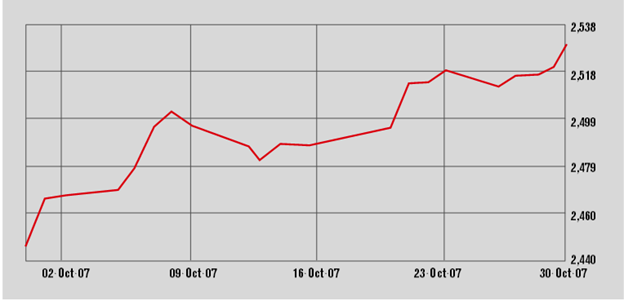
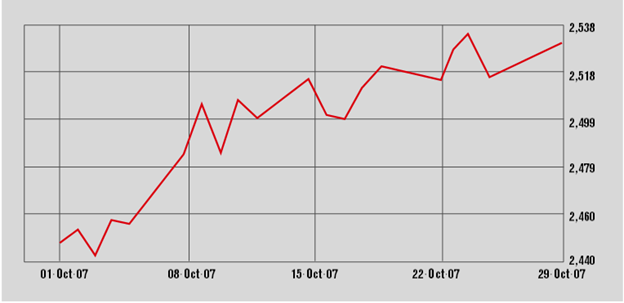
The Tunisian bourse closed at 2,532.49 points October 26, up 2.6% from its index reading of 2,468.27 on October 1. It was 8.64% up from the start of the year. Market heavyweight SFBT advanced over 5% in the course of the month. Banque de Tunisie, the bourse’s number two firm by market cap, gained 4.3% between Oct 1 and its close on Oct 26. Tunisair stayed on a slope and closed the month down by more than 12%.

Tunis SE  (1 month)

Current Year High: 2,712.33         Current Year Low: 2,294.38

 The Casablanca Exchange stayed its mellowing course with a 2.3% gain to 13,184.17 points on Oct 26. Year-to-date, the index is up 39%. In terms of price to earnings ratios, the Moroccan bourse is in a steam bath with PE of more than 28 times, above Egypt’s 19 times and above anything in the GCC but its protected status continues to be fending off correction impulses. Market aing 21% of total market cap, moved at the rate of the index, while leading bank Attijariwafa Bank closed Oct 26 with a very slight drop when compared with the first of the month. Atlanta Insurance started trading on the exchange Oct 16 aCasablanca SE All Shares  (1 month)

Current Year High: 13,506.29       Current Year Low: 8,431.06nd moved from its IPO price of MAD 1,200 ($152.7) the share to MAD 2,078 on October 26.  

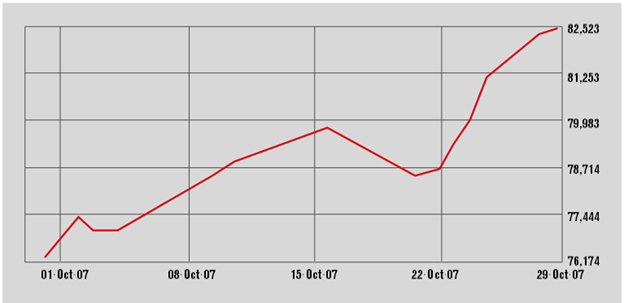
  The Hermes Index of the Cairo & Alexandria Stock Exchanges vaulted over the 80,000 points line late October in post-Ramadan trading and closed at a record 81,062.75 points on Oct 25 on a single day jump by 1,200 points. Between Oct 1 and 25, Suez Cement pushed up 25% to a new year high; financial holding EFG Hermes moved up over 10% to a 17-month peak while Telecom Egypt moved to 20-month highs toward the end of the month. Real estate firm Sodic attracted buyers and continued to rise in October, adding 11%. Orascom Telecom rose 8%; Orascom Construction traded sideways but could announce it was awarded a $109 million contract to build Egypt’s first integrated solar power plant. On Oct 25 Egyptian authorities said the country’s new NILEX bourse for small cap stock (capital range $90,000 to $4.5 million) is assuming operations with modest first-year listing goals.

Cairo SE: Hermes  (1 month)

Current Year High: 82,439.79       Current Year Low: 55,853.97

November 20, 2007 0 comments
0 FacebookTwitterPinterestEmail
  • 1
  • …
  • 553
  • 554
  • 555
  • 556
  • 557
  • …
  • 688

Latest Cover

About us

Since its first edition emerged on the newsstands in 1999, Executive Magazine has been dedicated to providing its readers with the most up-to-date local and regional business news. Executive is a monthly business magazine that offers readers in-depth analyses on the Lebanese world of commerce, covering all the major sectors – from banking, finance, and insurance to technology, tourism, hospitality, media, and retail.

  • Donate
  • Our Purpose
  • Contact Us

Sign up for our newsletter

    • Facebook
    • Twitter
    • Instagram
    • Linkedin
    • Youtube
    Executive Magazine
    • ISSUES
      • Current Issue
      • Past issues
    • BUSINESS
    • ECONOMICS & POLICY
    • OPINION
    • SPECIAL REPORTS
    • EXECUTIVE TALKS
    • MOVEMENTS
      • Change the image
      • Cannes lions
      • Transparency & accountability
      • ECONOMIC ROADMAP
      • Say No to Corruption
      • The Lebanon media development initiative
      • LPSN Policy Asks
      • Advocating the preservation of deposits
    • JOIN US
      • Join our movement
      • Attend our events
      • Receive updates
      • Connect with us
    • DONATE