• Donate
  • Our Purpose
  • Contact Us
Executive Magazine
  • ISSUES
    • Current Issue
    • Past issues
  • BUSINESS
  • ECONOMICS & POLICY
  • OPINION
  • SPECIAL REPORTS
  • EXECUTIVE TALKS
  • MOVEMENTS
    • Change the image
    • Cannes lions
    • Transparency & accountability
    • ECONOMIC ROADMAP
    • Say No to Corruption
    • The Lebanon media development initiative
    • LPSN Policy Asks
    • Advocating the preservation of deposits
  • JOIN US
    • Join our movement
    • Attend our events
    • Receive updates
    • Connect with us
  • DONATE
Comment

Time for change

by Lysandra Ohrstrom June 1, 2007
written by Lysandra Ohrstrom

On May 8, Minister of Economy and Trade Sami Haddad said he would submit a bill to the cabinet to streamline the existing business registration process in Lebanon by introducing “one of a series of reform initiatives that will help create a business friendly environment in the country.”

Talk of reform may seem particularly hollow as parliament has not been convened since November, but Haddad said the new system could be in place by the end of the year as it does not require amending existing legislation or introducing any new laws. While the reforms fall well short of the legislative overhaul required for Lebanon to enter the World Trade Organization, if adopted, they will significantly reduce the bureaucratic mess potential entrepreneurs must wade through to set up shop.

The plan will standardize the documentation necessary to register a company and will introduce a uniform payment system, which should reduce the time, cost and complexity of current procedures by 45%, said project manager GeorgesNicolas, who oversaw the program as part of an agreementLebanon signed in 2006 with the International FinanceCorporation (IFC), the private sector arm of the World Bank.

The long-term solutions recommended by the IFC – which include reducing start-up costs and initial capital requirements and abolishing the mandatory use of a notary public, sworn translator, lawyer and auditor – would further cut fees to 80% of the current costs, but may be slow to arrive. Nicolas said that his team also proposed a short-term solution that can be introduced in two or three months because it does require changing laws.

The IFC drafted the new procedures based on the results of a survey of 250 Lebanese companies to determine the regulatory obstacles that businesses have encountered.

The introduction of a single standard document, designed by the IFC, is one of the most important improvements of the proposed procedures, said Nicolas. Currently, the procedure costs $2,000 because each business must hire a lawyer to design individual registration forms. “The second most significant solution is one application, one payment, one interface,” he said.

Under the current system, a business owner must make separate visits to pay fees to the Ministries of Finance,Justice, and Economy and Trade, as well as the NationalSocial Security Fund and the Commercial Registry. The singleIFC document can be submitted to all agencies and prospective entrepreneurs can pay all fees and collect all forms at the nearest Liban Post branch.

Though the IFC says it has “encountered absolutely no resistance” from any parties involved, Nicolas acknowledged that the government anticipates resistance from some parties– like the Lebanese Bar Association (LBA) – to some of the long-term solutions. In the past, the LBA has lobbied against legislation that would reduce the need for legal counsel. But, given the limited scope of the first round of measures, any substantial opposition remains unlikely.Though the current proposal reduces the time to start a company, the costs will remain high. Any change in fees must be included in the state’s budget proposal, which needs parliamentary approval.

Aside from the few parties with a vested interest in maintaining the status-quo, few in the private sector or government are in favor of the current bureaucratic labyrinth. It takes an average of 46 days to incorporate a company in Lebanon, according to the World Bank’s annualEast of Doing Business Survey, which ranked the country 116out of 175. In 70 countries, it costs between 0% to 10% of per capita income to establish a business, while in Lebanon it costs over 100% of the $6,200 per capita income. The IFC’s mapping study, for example, showed that incorporating a joint stock company in Lebanon took between 12 to 49 days, and required 17 to 24 different trips, 21 to 25 separate forms, and cost $3,500 to $4,000 in fees to lawyers, notaries, and various state agencies.

The main regulatory obstacles to starting a business cited by the IFC study were the length of time and number of visits required; high registration fees; the inconvenience of trips and the quality of service provided by state agencies; “complexity”; and the difficulty of preparing documents for submission to the commercial registry.

For the new procedures to take hold, the government still needs to sign a Memorandum of Understanding with LibanPost, train employees in relevant agencies, and CommercialRegistry judges must accept the new application package.While the measures seem relatively uncontroversial, some remain skeptical about the government’s willingness to introduce even limited changes in a politically charged environment.

Lysandra Ohrstrom is a journalist on the Beirut Daily Star and a regular contributor to the Lebanon Examiner­

June 1, 2007 0 comments
0 FacebookTwitterPinterestEmail
Comment

On the A380

by Richard Quest June 1, 2007
written by Richard Quest

It was the sort of invitation most people would avoid at all costs: ‘Please come and spend two hours flying on a plane that seats 550 – and end up where you started.’ But I could barely contain my glee! Of course I accepted. It was a ticket to ride on the Airbus A380 – nicknamed the Superjumbo– over the Pyrénées. I have covered the plane since its conception, but this would be my first chance to experience what flying on board the behemoth was actually like. I was not alone – 200 other international journalists were equally eager for the experience.

First, let me state the obvious. With its twin decks, this plane is big. Very big. In fact, it is enormous. The main deck seats around 350 people, like a Boeing 747. However, upstairs there is room for another 200. That is effectively an A340 on top of a 747! The aircraft is equipped with first class, business class and economy seating. I sit behind the wing in economy. It is a good choice. We lift off – very quietly for a plane of this size – and catch the crosswind.The wings’ ailerons waggle up and down in a demented state as the computers fight to keep the plane stable. It feels like a giant ocean liner on the waves. But then the take-off excitement is over all too quickly and we settle into an amazingly smooth cruise flight. The landing is similar –from the plane’s camera we can see ourselves crabbing towards the airport at Toulouse. Again, we ride the airwaves until we touch down.

So what makes the A380 so special? Is it the two grand staircases? The 15 lavatories? The elevator that can move carts between the decks? Or the fact that it can carry 550tons (considerably more than the 747)? It is all of these things and none of them. It is the fact that a new era of air travel is upon us and no one really knows where it will lead. At the moment the A380 is a flying white whale. With only 166 sold, it is a long way from making Airbus any money.

But Airbus’ chief salesperson says the plane is a‘game-changing aircraft.’ Airbus forecasts the market for very large planes at around 1,600 over the next 20 years and this plane should get at least 800 orders. Since airports are more congested and air travel is growing, demand for more seats between major hubs such as London and Hong Kong, or Singapore and Sydney will grow. That is where the A380comes in. (For the record, Boeing believes the Airbus numbers are all wrong, that the demand will not materialize, the plane will lose money and airlines will opt instead for their revamped 747-8 Intercontinental with a comparatively modest 470 seats.)

If airlines live up to their promises to put bars and lounges on board, the A380 could well become the standard for luxury in the sky. It could change the way people want to fly. Once the aircraft is in service on major oceanic routes, frequent fliers will want to be on board. On the other hand, with so many people on one flight, such irritations as luggage delays and congestion could cause some problems.

So will the A380 be a success? I know the arguments, and I still cannot make up my mind. We do not know yet. Perhaps history is our only guide; 30 years ago, people said exactly the same things about another plane. It was too big. There were too many passengers. To step on board was to tempt fate. That plane was the 747, which went on to sell more than 1,300 for Boeing and became the standard for long-haul flight. Of the A380 experience, I can say, however, that the flight was simply wonderful. To walk up and down the twin staircases, to visit the cockpit, to discover how quiet this plane could be – it was a joy for an aviation geek like me.

Because of Airbus’ appalling delays, this first flight was rescheduled many times. But I did not mind. I have now flown on the biggest passenger plane in the world. Unfortunately,I know it will be a long time before the rest of you get to share the experience. But I have seen the future, and it is big.

Richard Quest anchors CNN’s European morning editions of ‘Business International’, his own monthly interview show, ‘Quest’, and the monthly feature program ‘CNN Business Traveller’.­

June 1, 2007 0 comments
0 FacebookTwitterPinterestEmail
Comment

Human development at last!

by Zafiris Tzannatos June 1, 2007
written by Zafiris Tzannatos

Not many international meetings close in an optimistic mood.The phrases “failed to agree” or “agreed to meet again” are mentioned far too often at the conclusion of such events.But last month’s meeting of the World Economic Forum was a bit different.

Convened in Jordan, the Forum brought together an impressive list of international and regional leaders at a time of economic boom in the Middle East. Bolstered by oil wealth, the region is enjoying a surge of confidence that can lead to an unprecedented change.

But economic confidence alone is not enough. The Forum discussions recognized that, despite the ongoing regional conflicts, a business-led transformation is taking place, one that is hurtling the region into the globalization process. And it was in this light that investing in education and reorienting efforts towards the creation of aK (knowledge)-economy were singled out as two the big“positives” for which to strive.

This recognition of education as a key driver for the future of the Arab world received massive material support from HisHighness, Sheikh Mohammed bin Rashid Al Maktoum, vice-president and prime minister of the United ArabEmirates and ruler of Dubai. He announced, as a personal initiative, the establishment of the $10 billion “Mohammed bin Rashid Al Maktoum Foundation that will be based in theUAE and aim to build a knowledge-based society throughout the region.”

Despite recent – and commendable – advances, the education record of the region remains disappointing. This is only in part due to the neglect of female education. Another reason is that men may not be tempted to study beyond the point that is required for a public sector job. At universities in some GGC states, there is only one male student for every three female students.

Education alone will not solve the problems of unemployment nor will it necessarily accelerate the modernization of the regional economies. The 14% regional unemployment rates quoted at the Forum are not the result of lack of education or jobs – the presence of the many working expatriates attests. Quite simply education is not something that can bear fruit if there are no incentives or a vibrant economy.

Here is where the Foundation can make a difference, that is, in addition to its focus on education, to help clarify theK-economy vision for the region. In simplified terms, there are two polar approaches for the K-economy: the “enclave”approach that basically buys knowledge, technology and human skills from outside while the nationals work for government and have exclusive business licenses or hold work permits for expatriates.

A more dynamic, and more appropriate, approach is to go for an “innovative society”, a vision that would foster and rely more on local entrepreneurs and less on the government to act as the employer of the last resort or protector of monopolies. The innovative society vision encompasses a dynamic (not license holding) entrepreneurial environment, an efficient government, ability to use and capitalize on technological advances, attractive employment opportunities and a good work environment.

The Foundation’s objectives are in line with the creation of the more promising “innovative society” vision. In addition to education, the objectives include broader knowledge development, the establishment of research centers, support for scholars and intellectuals, and leadership programs for young people in government, non-governmental organizations and the private sector.

What needs to receive equal recognition and attention is that, compared to top-down approaches, the private sector has an important role to play in facilitating the evolution of Arab culture and promoting the role of the individual as an innovator and agent in the region’s development.

Within this context, education needs to be made more responsive to the needs of the modern global workplace. It should impart entrepreneurship, create a willingness to learn from failure and tolerate failure in others, as well as instill a sense of meritocracy and “mutual responsibility” between the state and its citizens (instead of the single responsibility of the state towards the citizen).

The Foundation’s endowment has been hailed as “the biggest in the Islamic world”. It therefore presents a unique opportunity to help define a dynamic vision for the region.It can contribute to the reinvention of the whole education system around the highest international standards, not just enclave international schools or changes in the curricula compared to the more challenging change of minds. It can help build a vibrant environment for businesses, offer rewards and, in turn, benefit from the productive employment to nationals as well as attract firms and people from allover the world.

Professor Zafiris Tzannatos is advisor to the World Bank and former Chair of the Economics Department at AUB. The views expressed are his own and don’t necessarily represent those of the World Bank.

June 1, 2007 0 comments
0 FacebookTwitterPinterestEmail
Comment

Labor of love for the UAE

by Norbert Schiller June 1, 2007
written by Norbert Schiller

It was recently announced that beginning next year on May1, workers in the United Arab Emirates will be honored liketheir colleagues elsewhere in the world. For until now, theUAE has not recognized Labor Day and it is ironic that acountry so dependent on labor, particularly migrant labor,has never taken the time to thank those whose sweat and hardwork made this tiny patch of sand the economic success it istoday.

On May 1 this year, the UAE Minister of Labor Dr. Ali BinAbdullah Al Ka’abi, no doubt as a prelude to next year’svolte face, made a rare gesture of appreciation,congratulating “all those workers who through dedication andefforts contribute to the economic boom and growth of thiscountry … we aim to provide continuous support for theworkforce in the country by protecting their rights.”

Some would say, “It was about time!” However, let’s nothold our breath. In March 2006, the same ministry announcedthat it was creating a new law permitting the forming oflabor unions by the year’s end. Nothing has so far happened.

All this sudden talk of workers’ rights did not happenovernight by some magnificent epiphany experience by themonarchy. It has taken years of pressure by NGOs, the mostvocal of which has been Mafiwasta (www.mafiwasta.com), whichwants the UAE to sign and adopt the International LaborOrganization’s two core conventions: 87 and 98 “on freedomof association and collective bargaining” respectively,which allow workers to form trade unions and negotiatebetter terms of employment and working conditions.

Despite isolated incidents of industrial action, mainly byconstruction workers, little if anything has been done toadvance the cause of workers in the Emirates, wheretraditionally it has been the investor that the governmenthas pandered to. It has been far worse for domestic staff,many of whom have been physically abused, forced to workwithout pay and have had their identity documentsconfiscated.

And still migrant labor makes up 95% of the UAE work force,with most coming from poor developing countries across Asiaand Africa, and most recently, China to work on the hugeChinese projects. It was only a matter of time beforesomeone said “enough.” In March 2007, 200 workers werebanned from working in the UAE for life after theydemonstrated for better work conditions. The ruling washarsher than normal because the demonstrators were accusedof violence and destroying company property. The workers inquestion received monthly salaries of between $150 to $177,for which they worked upwards of 250 hours and lived incrowded and squalid conditions.

Yes, the shroud that always hid what was not supposed to beseen is being gradually lifted. Twenty years ago, when I wasbased Dubai primarily covering what was known as the “Tankerwar,” one of the conditions that I and other foreignjournalists had to live under was that we were not allowedto report on the royal family and labor unrest. Thenewspapers and television could not even use a Dubaidateline when reporting and instead had to use the vague“Persian Gulf.”

At that time, the UAE was beginning to plan its future anddidn’t need any bad publicity. If you wanted to reportsomething negative, you had to feed the information toanother bureau in another country. Even filming a yachtowned by the royal family from a helicopter (as I found tomy cost when it was grounded by a stern faced official)would lead to trouble with the authorities.

With all the attention paid to the various groundbreakingmarvels that have risen out of this desert and, morerecently, the move by many multinational corporations likeHalliburton to Dubai, it’s no surprise that with all thesuccess there is bound to be more awareness about thesuffering of those who build this magnificent emirate. Ifthe UAE truly wants the world to sit up and take note, it isimportant that government also address the welfare of itsworkers. Happily, it appears that things might be beginningto change.

Norbert Schiller is a photo editor and photographerat large with United Press International (UPI).

June 1, 2007 0 comments
0 FacebookTwitterPinterestEmail
GCC

Kuwait: Tapping into banking gold

by Executive Staff May 31, 2007
written by Executive Staff

Kuwait’s banking industry has risen to new challenges and increased prominence in the past two years as the Gulf’s northernmost emirate was simultaneously tested by its ballooning revenues and by the deflation of the regional stock market bubble. With a handful of commercial and even fewer Islamic banks, the banking sector’s importance is considerably weightier than the number of players might suggest.

A clear indicator for the sector’s growing role in the national economic fabric is the position of banking in the Kuwait Stock Exchange (KSE), where the nine listed Kuwaiti banks account for close to one third of total market capitalization although they make up barely 5% of listed companies.

Banks were at the forefront of the upward trend on KSE this year, which outdid other Gulf equity markets in terms of stable improvements and overall performance. Compared with the 12% gain of the KSE’s general index from the start of the year to mid May, the banking sub-index grew twice as strong, showing an improvement of 24%.

As Safaa Zbib, head of research at Kuwait-based financial firm Bayan Investment told Executive, commercial banks ended the first quarter of 2007 with strong earnings that helped them outperform the other seven sectors on the KSE.

The eight banks that published quarterly financial reports by the end of April, indeed showed their consistent qualities in the first quarter results that (excluding BKME for which no result was available) totaled KD218.3 million – equal to $757.8 million, 28.8% better than in the first quarter of 2006.

Sector leader National Bank of Kuwait (NBK) had the lowest percentage growth with 13.4% but topped the results list in absolute numbers with KD64 million, ahead by almost KD13 million on runner-up Kuwait Finance House, the country’s top Islamic bank.

The banking sector’s share in the KSE market capitalization climbed six percentage points to 31% at the close of the first quarter of 2007, Zbib said. In mid-May, the cumulative market cap of the eight stood at nearly $54 billion, with NBK and KFH accounting for more than $32 billion between them.

Also noteworthy, KFH had considerably narrowed the valuation distance to sector leader NBK to less than $400 million from more than $3.5 billion at the end of 2006. KFH caught up with NBK’s market value through a combined bonus shares and rights issue for 40% of its capital this spring. NBK on its part executed a 5% bonus issue but also extended again a share buyback program for 10% of its stock, which went into a third six-month round in May.

Successful strategies

NBK told Executive in a written statement that it credited the fast growing economy’s hunger for loans, investment, and core banking services on both the retail and corporate levels as lead factors in its success. The bank’s successful strategy enabled it “to deepen our market penetration both in terms of customer acquisition and providing our customers with a wider scope of service offerings.”

Zbib said the banking sector’s strong development in the past few years was partly due to the opening up of the Islamic banking sector in 2004. Until then, Kuwait Finance House held a government-enforced monopoly on Kuwait’s sharia-compliant banking market. After the central bank lifted prohibitions against the creation of new Islamic banks, Boubyan Bank entered the field, raising $260.7 million in its IPO and one specialized bank, Kuwait Real Estate Bank, switched to sharia-compliance. However, numbers prove that allowing the entry of new Islamic banks did not harm the profits at KFH, to the contrary.

Oil, being the life juice of the Kuwaiti economy, also figured in the growth spurt of the banking sector. The banks’ performance both for the quarter and the past few years come on the back of loans to finance large oil and gas projects, said Mihir Marfatia, a financial analyst with Kuwait’s Global Investment House.

The banks’ total assets grew 29% to $97.6 billion in 2006 from $75.7 billion in 2005, not including Kuwait Real Estate Bank, for which 2006 figures are not available.

Commercial banks have also indirectly impacted the market through providing a means for economic growth and diversification, said Jan Randolph, an analyst with US-based Global Insights, which studies Gulf Cooperation Council (GCC) markets. Randolph told Executive that banks in Kuwait act as vehicles for development in the economy, supporting the development of other sectors.

With their consistent earnings growth, Kuwaiti banking stocks became attractive investments, according to Zbib.  “The banking sector in general is a steady sector – and not risky,” she said.

Although banks are an important source for the upward share price momentum that the KSE experienced this year, they did not influence the market through big-time share buying. “You won’t see banks impact the Kuwaiti stock market directly,” said the head of research at Oman’s BankMuscat, who did not want to be named.

According to BankMuscat’s research, Kuwait’s banks have fueled the buying of shares on the KSE only through their lending activities, which were dominated by retail lending in 2004, 2005 and 2006.

Keeping close watch

A key factor in the sector’s stability has been the watchful eye of Kuwait’s Central Bank, which monitors commercial banks to ensure they follow international standards, practice transparent corporate disclosures and maintain high capital adequacy levels, said Karim Kamal, who heads the research department at NBK.

“It’s not that there are very strict rules on how to do business, but there’s very strict control and follow-up that doesn’t allow banks to do risky things,” he said. “Because of this, investors see the low-risk aspect of investing in the banking sector. So whenever they feel there are winds of change or a downturn in the stock exchange, they park their money in the relatively safe banking sector.”

In one example of its sector control, the Central Bank stepped in during 2004 by mandating banks to lower their lending ratios from 92% of deposits and follow what was called the 80:20 rule. It stipulated banks could only lend 80% of their deposits, but re-classified deposits to make the rule less restrictive.

While it was not exactly followed, the rule brought lending ratios closer to the 80% mark. The central bank has since increased the ceiling to 88% of deposits, Marfatia said.

The year 2004 was a busy one on the regulatory front as the central bank also opened Kuwait’s banking sector to foreign operators while maintaining restrictions that offered domestic banks protection of their retail business. “While the Central Bank has been granting licenses to international and regional banks in Kuwait, it has been limiting those licenses to one branch, making it impossible for those banks to compete on the retail level,” Kamal said.

The only exception to the rule is the Bank of Kuwait and the Middle East (BKME). It was privatized in 2003 by the Kuwait Investment Authority, which allowed Bahrain’s Ali Ahli United Bank to buy a controlling stake, 67.33%, in BKME (originally a foreign bank that the Kuwaiti state had bought from the British in 1971) and allowed it to keep operating its multiple branches.

But by and large, foreign banks wanting to work in the Kuwaiti market – the first operating license went to BNP Paribas in 2004 – have to focus on the corporate market and on private banking for high net-worth individuals.

After having expanded their local activities in the past few years, Kuwaiti banks are now facing the challenges of taking the leap abroad and become players outside of their borders.

“Our challenge is not on the local scene,” Randa Azar, NBK’s chief economist, told Executive. “It is more related to the regulatory barriers to our ability to execute our regional expansion strategy.”

Some analysts, like Randolph of Global Insights, cautioned that banks in Kuwait and other GCC countries ought to take care to cover themselves against over-concentration of lending to particular sectors, such as real estate, where a fall in asset qualities and investment losses could have devastating consequences for overexposed lenders.

The latest measure of the Kuwaiti authorities, the surprise announcement on May 19 that the dinar will shift from a dollar peg to be tied in the future to a currency basket, may not make regional expansion easier for Kuwaiti banks, as the move enforces doubts on the implementation of a GCC monetary union in 2010. For the moment, though, analysts agree it is too early to say what impact the re-pegging of the dinar will have on the business of Kuwait’s commercial banks.

May 31, 2007 0 comments
0 FacebookTwitterPinterestEmail
Banking & Finance

Money Matters by BLOMINVEST Bank

by Executive Staff May 31, 2007
written by Executive Staff

Regional stock market indices

Regional currency rates

QNB launches representative office in Libya

Qatar National Bank (QNB) launched a representative office in Libya, and that in accordance with the bank’s plan of international expansion. With the Libyan office, QNB’s presence now extends to 15 countries, among which are Oman, Kuwait, Singapore, UAE, UK, France and Switzerland. QNB reported net profits of QAR652.8 million ($179.4 million) in Q1-2007, up 6.7% year-on-year. The bank’s total assets rose 22.1% for the same period to QAR70 billion ($19.2 billion), while loans rose 41.5% to QAR47.2 billion ($13 billion) and customer deposits increased to QAR52.7 billion ($14.5 billion), up 15.8%.

Abu Dhabi’s Aldar to exclusively construct Ferrari theme park

Abu Dhabi-based public joint stock company Aldar Properties signed an exclusive deal with Ferrari to construct the Ferrari Theme Park on Aldar’s Yas Island Project. The theme park will feature attractions, family rides, driving school, virtual simulations and Ferrari brand products retail store. Aldar, established in 2004 and currently employing 200 people, is behind the development of the $40 billion 25 million m2 Yas Island project. The island, which will host Ferrari’s theme park, will also include golf courses, hotels, marinas, polo clubs and apartments etc. The project will be completed by 2014, with the first phase excepted to be done by 2008.

Country profile: Jordan

Jordan Investment Trust PLC (Jordinvest) issued its Jordan Economic Report 2006 explaining that despite the difficult regional environment surrounding Jordan, the country managed to experience high economic growth in 2006, as Jordan established itself “as a secure haven to conduct business.” The country’s GDP registered a growth rate of 6.4% in 2006, down from 7.2% in 2005. Unemployment rate dropped to 13.9% in 2006 accompanied by a rise in inflation rate to 6.25%, up from 3.5% in 2005. This exhibited growth was supported by the Central Bank of Jordan (CBJ) sound monetary policy that kept the dinar’s peg to the dollar. CBJ’s official reserves were at $6.1 billion in 2006. The Amman Stock Exchange witnessed a correction similar to that witnessed by other regional stock markets. Consequently, the Amman Stock Exchange Index closed at 5,518 points in 2006, down 33% year-on-year. The country’s budget deficit improved from 5.3% of GDP in 2005 to 4.4% of 2006 GDP, or some $627 million. According to Jordinvest’s report, Jordan’s external trade (exports and imports) surged by 10% in 2006, pushing the ratio of external trade to GDP (economic openness ratio) to 109%, the second year in a row in which external trade exceeds GDP in Jordan.

May 31, 2007 0 comments
0 FacebookTwitterPinterestEmail
Banking & Finance

Debt vulnerability and risks for solvency

by Executive Staff May 31, 2007
written by Executive Staff

Lebanon’s public debt has been accumulating rapidly over the past decade and a half, making Lebanon one of  the most publicly indebted countries in the globe. Political imperatives and reconstruction needs led to large fiscal deficits and debt  build up. Higher than anticipated costs combined with elusive assumptions on growth and aid kept the overall fiscal deficit at 22% of GDP by 2000, raising  public debt to 151%  of GDP.

Realizing that debt build up could generate solvency concerns, strong fiscal discipline was initiated in 2001 involving freezing expenditure and introducing value added tax (VAT), generating primary surpluses for the first time, and stabilizing the debt rate.

Nevertheless, Public debt by end 2006 reached $40 billion, 178% of GDP. The fundamental question remains: how much solvency risk does this level of debt impose on the Lebanese economy? The peculiarities of public debt as well as that of the Lebanese economy have enabled Lebanon to avert crises even under extreme political stress and turmoil. Large private transfers, limited external market exposure, lower rollover risk, and comfortable reserves have allowed Lebanon to sustain higher public debt than one would otherwise expect.

Lebanon is a very open economy with heavy dependence on transfers from the Lebanese diaspora. Annual private transfers are one of the highest in the world, estimated at over 20% of its GDP. Accounting for these transfers brings down the debt ratio to 140% of disposable income (GDP plus transfers). A rate deemed closer to a sustainable threshold.

External debt exposure

Lebanon’s exposure to external debt, at 15% of the total ($6 billion), by end 2006, is low by emerging market standards, and much lower than that of countries that faced financial crises. Further, nearly half of it is to official creditors with long term maturity. The large central bank reserve cushion  of $13 billion (excluding gold)  can certainly absorb a sudden reverse in sentiment in external private markets.

Another peculiar feature of Lebanon’ debt structure is the successive decline in its market  debt ratio to 60% of total debt in 2006 from 82% in 2000. Market debt to GDP and as well to disposable income has declined to 110% and 88% respectively, perceived as more viable ratios.  The central bank has increased its holding of public debt to 25%; official creditors’ share as well increased to 11%. The counterpart to increased central bank financing has been a rise in commercial banks claims on the central bank, notably in the form of long-term deposit certificates.

The increased intermediation role of the central bank (with a lower default risk) has pacified financial markets at a time of increased political uncertainty. However, this operation has it own cost, weakening the financial strength of the central bank.  Shocks to the financial system, however, can still be  absorbed by its reserve base and swap operations, albeit at a higher cost, as in the case following Hariri’s assassination.

High share of debt holdings for commercial banks

Commercial banks’ share of public debt holding, however, remains high at nearly 50%  and  is closely linked to the stability of the deposit base (banks’ liabilities) and the maturity of public debt. The rollover risk is low owing to the banks’ strong incentive not to jeopardize the financial viability of their main debtor, the government. Their  inter-twined interest, limited exposure to foreign banking, and high liquidity has limited their alternatives.

Lebanese banks continue to experience high liquidity brought about by its ability to attract substantial flows from regional financial markets, making money supply to GDP   (nearly 3 times) one of the highest in the world. Banks on their own can absorb sudden shocks of rapid  deposit withdrawals; their foreign assets are twice non-resident deposits in foreign currencies.

The term structure of Lebanon’s debt maturity structure has improved in recent years. With Paris II (and looking forward to Paris III), long term debt  has risen to three-fourths of total debt by 2006, reducing government exposure to interest rate risk. Nevertheless, compared to many emerging economies, Lebanon’s debt remains burdened by short maturity, $16 billion mature in 2007-08.

Finally, the debt overhang remains serious, raising solvency concerns and the possibility of transmission of shocks between the fiscal and the financial sectors. Serious fiscal adjustment as well as financial sector reform is urgently needed to  reduce the debt burden, diversify debt holding, and reduce the sterilization burden on the central bank.  Solvency risk, however, prompted by external shocks is low with foreign assets of the banking sector standing at $33 billion, 75% of total debt and 150% of debt denominated in foreign currencies.

Dr. Mounir Rached is a senior IMF economist, and a founding member of the Lebanese Economic Association. The views in this article are those of the author and don’t represent those of the IMF

May 31, 2007 0 comments
0 FacebookTwitterPinterestEmail
Financial Indicators

Global economic data

by Executive Staff May 31, 2007
written by Executive Staff

Tourism: hotel nights

Arrivals of non-resident tourists staying in hotels and similar establishments

Average annual growth in percentage, 1998-2005 or latest available period

Source: OECD

Over the period as a whole, the United States recorded the largest number of arrivals in hotels and similar establishments followed by China, France, Italy and Spain. The 9/11 terrorist attacks resulted in sharp falls in arrivals in the United Kingdom, Mexico and the United States but did not noticeably affect arrivals in most other countries. Countries in central and eastern Europe have recorded strong increases in arrivals since 1990. The graph shows annual growth in arrivals of non-residents averaged over the period since 1998. Arrivals declined in Brazil, the United Kingdom, Switzerland, Norway and Greece but grew at 6% per year or more in New Zealand, Iceland, Japan, India, Slovak Republic, Turkey and China. Tourism 2020 Vision is the World Tourism Organization’s (UNWTO) long-term forecast and assessment of the development of tourism up to the first 20 years of the new millennium. It forecasts that international arrivals will reach over 1.56 billion by the year 2020. East Asia and the Pacific, South Asia, the Middle East and Africa are forecasted to record growth at rates of over 5% per year, compared with the world average of 4.1%. The more mature tourism regions, Europe and the Americas, are expected to show lower than average growth rates. Europe will maintain the highest share of world arrivals, although there will be a decline from 60% in 1995 to 46% in 2020.

Trade to GDP ratios

Difference between 2005 and 1992 ratios in percentage points

In 2005, the unweighted average of the trade-to-GDP ratios for all OECD countries was 45% and 51% for the EU15. For the reasons noted above, there were large differences in these ratios across countries. The ratios exceeded 50% for small countries—Austria, Belgium, the Czech Republic, Hungary, Ireland, Luxembourg, the Neth-erlands and the Slovak Republic—but were under 15% for the two largest OECD countries—Japan and the United States. Between 1992 and 2005, trade-to-GDP ratios for the OECD as a whole increased by 13 percentage points, and the EU15 increased by 14 points. Substantial increases in trade-to-GDP ratios were recorded for Luxembourg, Hungary and Belgium.

Households with access to a home computer

Percentage of all households, 2005 or latest available year

Penetration rates are highest in Iceland, Denmark, Japan, Sweden, Korea, the Netherlands, Luxembourg, Norway and the United Kingdom where 70 % or more of households had access to a home computer by 2005. On the other hand, shares in Turkey, Mexico, the Czech Republic and Greece were below 40%. Between 2001 and 2005, the percentages of households with access to a home computer increased particularly sharply in Japan, the United Kingdom and Germany. The picture with regard to Internet access is similar. In Korea, Iceland, the Netherlands, Denmark, Switzerland and Sweden, more than 70% of households had Internet access by 2005. In Turkey, Mexico and the Czech Republic, on the other hand, only about one-fifth or less had Internet access by 2005. Data on Internet access by household composition—with or without dependent children—are available for most OECD countries. In general, they show that households with children were more likely to have Internet access at home in 2004.

Ratio of the inactive population aged 65 and over to the labor force

Percentage

The youngest populations (low shares of population aged 65 or over) are either in countries with high birth rates such as Mexico, Iceland and Turkey or in countries with high immigration, such as Australia, Canada and New Zealand. All these countries will, however, experience significant ageing over the next 50 years. The dependency ratio (right panel of the table) is projected to be close to 50% in Belgium, France, Greece, Hungary, Italy and Japan by 2020. This means that, for each elderly inactive person, there will be only two persons in the labor force. The lowest dependency ratios, under 25%, are projected for Iceland, Korea, Mexico and Turkey. All countries will experience a further sharp increase in the dependency ratio over the period 2020 to 2050.

May 31, 2007 0 comments
0 FacebookTwitterPinterestEmail
Financial Indicators

Regional equity markets

by Executive Staff May 31, 2007
written by Executive Staff

Beirut SE: Blom  (1 month)

Current Year High: 1,598.29       Current Year Low: 1,168.36

 The Beirut Stock Exchange passed through a valley but the BSI closed at 1,209.84 points on April 27, barely seven points lower than on April 2. While the trading floor did not differ from the rest of the country in spending another month waiting for that political thaw, listed companies made some news worth looking at. Solidere sent executives to Egypt for talks with Sixth of October Development & Investment Co. The two companies said in mid April they shortly will sign a contract for developing urban centers in two Sodic properties. Solidere stock nonetheless was under downward pressure in April and traded below $15.25 in the latter part of the month. Banks Audi and Blom announced cash dividends and Bemo announced the listing of 200,000 preferred shares.

Amman SE  (1 month)

Current Year High: 7,407.15       Current Year Low: 5,267.27

The Amman Stock Exchange in April fell back from gains earlier in the year and played to the tune of subdued expectations. The ASE Index returned to the 6,000 points range and closed at 5,969.65 points on April 26. Jordan Telecom Group dropped by about 10% in late April after dividend distribution. According to a report by Al Hayat in early April, the stake of BankMed in Arab Bank has increased to 18%, making the Hariri family’s BankMed the largest shareholder in Arab Bank. In an attempt to stimulate liquidity, the Jordan Securities Commission allowed brokers to carry out margin buys on two additional companies in the primary and 11 firms in the secondary market.

Abu Dhabi SM  (1 month)

Current Year High: 3,833.94       Current Year Low: 2,839.16

 The Abu Dhabi Securities Market entered April by ending a negative trend it had experienced in March with a year-low of 2,839.16 points on April 3 and started moving up again. It closed at 3,066.6 pts on April 26. Shares of Gulf Cement and Union Cement each soared in April with double-digit percentage gains whereas Fujairah Cement saw strong fluctuations. National Bank of Abu Dhabi also gained strongly for most of the month, before dropping somewhat after disclosing 4.7% lower first-quarter profits. Another notable advancer was Aldar Properties. Investor behavior on the ADSM in late April also included repositioning in preparation for the Deyaar IPO on the DFM.

Dubai FM  (1 month)

Current Year High: 5,488.24       Current Year Low: 3,658.13

The Dubai Financial Market moved mostly sideways in April, closing 98 points higher at 3,812.10 pts on April 26 when compared with 3,714.20 pts on April 1. The big announcement for the month was the $883 million initial public offering by Deyaar, the real estate arm of Dubai Islamic Bank. Investors repositioned themselves to participate in the May subscription for Deyaar. With high volumes in their second month of trading, the DFM’s own shares swung up by almost 50% between April 1 and 22 before losing over half their gains by April 26. A review of alleged past share price manipulations by Shuaa Capital in a Kuwaiti deal brought no evidence of wrongdoing, the Emirates Securities and Commodities Authority said after inquiries with the KSE.

Kuwait SE  (1 month)

Current Year High: 10,710.40     Current Year Low: 9,164.30

The Kuwait Stock Exchange was the shining star among the GCC bourses with the most consistent positive performance for the month. The index headed into April after a bit of late-March profit taking at 10,108.7 points and moved up 600 points, or 5.9%, to a 10,710.4 points close on April 25. A number of stocks recorded noteworthy gains but as far as market movers, the month was again in the grip of MTC. The telco had a volume of 532 million traded shares on a single day—two thirds of the day’s total KSE volume—and rose twice by the allowed daily max toward the end of the month. Speculation in the stock rode on expectations that a major block purchase of MTC is in the making.

Saudi Arabia SE  (1 month)

Current Year High: 17,730.96     Current Year Low: 6,916.85

The Saudi Stock Exchange was quite the opposite number to the New York Stock Exchange last month, but only in the mathematical way that where the Dow raced up, the SSE struck out. The rally of the previous month expired on March 25 at 8,620.1 points and, under inclusion of some spectacular one-day drops, the Tadawul Index moved south from there to 7,273.34 points on April 25. Analysts blamed disappointing first-quarter corporate results for the slide that put the SSE back on bearish ground. In a step to give the SSE more worldwide exposure, the World Bank’s International Finance Corporation said it plans to include the SSE in its Global Composite Index very soon.  

Muscat SM  (1 month)

Current Year High: 5,956.46       Current Year Low: 4,657.16

The Muscat Securities Market had the year’s best month so far in April, achieving an increase in its index from 5556.12 points on April 1 to an intermediate peak of 5,918.89 points on April 18 before slowing to 5,848.56 pts on April 26. Oman’s listed companies achieved a combined net profit of $964 million in 2006, up 19.5% from $807 million in 2005, the MSM announced in April. BankMuscat, the sultanate’s largest bank, reported a gain of 44% in its first-quarter net profits for 2007, to $50 million. The bank’s share price improved by 8% in the course of April, while Oman Air, which reversed losses in Q1 2006 to a profit in the first quarter of 2007, advanced by 15% in the same period.

Bahrain SE  (1 month)

Current Year High: 2,251.15       Current Year Low: 1,996.6

The Bahrain Stock Exchange Index sled 50 points between April 1 and 19 before a slight rebound, closing at 2,116.34 points on April 26. The BSE’s index drop of 4.5% since Jan 1 positions the bourse in fifth place out of the seven GCC exchanges for performance, with less fluctuation than most of its cousins. Gulf Finance House moved up temporarily ahead of presenting a new strategic plan. Investment company Esterad weakened throughout April and the drop accelerated after the company announced 43% lower net profit for the first quarter. The Bahraini government, seeking to invigorate the country’s stock market and encourage wider share ownership, launched an initial public offering for 48% of state-owned real estate firm Seef Properties, starting April 26. The offer was sweetened for retail investors through a 12% price discount and 50% deferred payment.

Doha SM: Qatar  (1 month)

Current Year High: 9,142.45       Current Year Low: 5,825.80

The Doha Securities Market is still the region’s most suppressed achiever for 2007 to date, standing 9.67% lower on April 26 compared with the index values on Jan 1. But different to the Saudi Stock Exchange and some of its other neighbors, the DSM moved up last month, by almost 7%, to close at 6,443.48 points on April 26. Nakilat, among the month’s volume leaders, made modest gains in the first half of April but weakened again slightly after announcing 20% higher first-quarter results. Real estate company Barwa made some gains at the end of the month on exceptional first-quarter profits and made news by buying a Paris convention center for $522 million.

Tunis SE  (1 month)

Current Year High: 2,712.33       Current Year Low: 1,880.55

The Tunisian bourse traded sideways, with the Tunindex fluctuating in the 2,600 points range. The index closed at 2,588.20 points on April 26, some 125 points below the historic high it reached on Feb. 9. The share price of chemicals manufacturer ICF added 16%. Somocer, Tunisia’s largest producer of ceramic tiles, was a loser on the Tunisian stock market in April with a 22% drop. Banque de Tunisie, the largest bank on the bourse, traded sideways.

Casablanca SE All Shares  (1 month)

Current Year High: 12,273.26     Current Year Low: 6,563.27

One has to wonder if growth in Casablanca is unstoppable as long as local investors face restraints from placing their wealth in other markets. The Casa All Shares Index moved up 779 points in April to a close at a new year high of 12,276.81 pts on April 27. The market thus was up 29.59% since the start of 2007. Leading bank Attijariwafa Bank gained 20% in April. Shares in LGMC Industries, a canned fish producer, moved up 44% between April 12 and 27. A major new privatization measure bypassed the bourse when the Moroccan government sold its maritime transport firm Comanav on March 30 directly to privately-held French shipping group CMA CGM for $267 million. 

Cairo SE: Hermes  (1 month)

Current Year High: 65,735.76     Current Year Low: 41,965.37

With the North African bourses doing better than the GCC exchanges, the Cairo and Alexandria Exchanges showed decent development in April. The Hermes Index reached a new high for the year at 65,735.76 points on April 17 and closed with upward sentiment at 65,589.25 pts on April 26. Orascom group companies were among the attention getters for the month. Orascom Construction was the best performer among the Orascom siblings, climbing almost 15% in the course of April. Orascom Telecom Holding implemented a 5-for-1 stock split on April 12 and was labeled “strong buy” by analysts. Telecoms firm TE also got a recommendation upgrade to “outperform.” Shares of National Bank for Development crashed from steep heights after the Egyptian government declined to sell its stake to a UAE banking group.

May 31, 2007 0 comments
0 FacebookTwitterPinterestEmail
Special Report

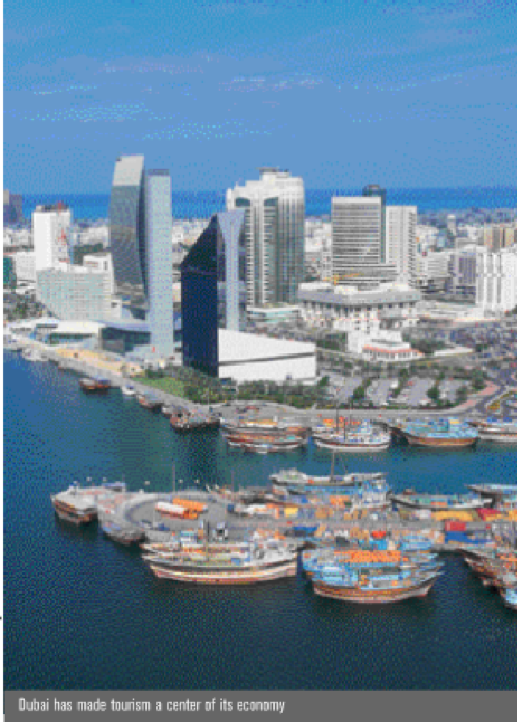
Destination: Dubai: Emirate looks to expand tourism

by Executive Staff May 31, 2007
written by Executive Staff

Bigger, better, taller…under water—Dubai’s hotels are focused on luxury and developers are rushing to one-up any record on the books as the emirate looks to maintain a longstanding policy of economic diversification. Tourism has, and will continue to be, a focus in raising Dubai’s global profile, said Sheikh Mohammed bin Rashid Al-Maktoum, prime minister of the United Arab Emirates and ruler of Dubai, in February when he released the new 8-year Dubai Strategic Plan for economic and social development.

Tourism is one of six strategic areas under the plan which follows upon the previous ten-year plan that started the emirate’s miraculous dash to the frontline of world attention. The name “Dubai” is seemingly synonymous with growth and on peopl’s lips around the world—hardly an accident for a place that has a tourism department with representatives promoting it in 14 foreign countries.

Extravagant hotels, sun-soaked beaches, political stability and shopping are the primary factors drawing increasing numbers of tourists to Dubai, Kenneth Wilson, a professor of economics and director of the policy and research center at Dubai’s Zayed University, told Executive.

“Business and commerce have always been here,” Wilson said. “Visiting for leisure is more recent, and Dubai is leveraging on its natural advantages,” like beaches and beautiful weather.

“Shopping has been a big focus in the last 10 to 15 years pitched at Europeans and people in the Gulf,” Wilson said.

The emirate has long been a trading post, and its souks were supplemented by the first shopping mall in the early 1980s—a construction that soon became a trend. Businesses pay no taxes so all of the shopping is duty free. Malls have become a staple in the city with over 50 currently built and more on the horizon.

In 2006, Dubai saw 1.875 million visitors, a 25% year-on-year increase. in the same year, they spent AED2.57 billion, a year-on-year increase of 50%.

The Dubai Shopping Festival, which drew 3.3 million visitors in 2005 based on the most recent statistics from Dubai’s Department of Economic Development, is a month-long affair started in 1996 featuring giveaways and entertainment like live music. Dubai’s souks, side-street shops and malls lure guests with discounts during the festival.

Shopping, however, is not the only thing Dubai’s malls offer. Mall of the Emirates, owned by the Majid Al Fattaim Group, houses an indoor ski slope, offering Lebanon a regional rival when it comes to skiing in the morning and going for a swim in the afternoon. If that weren’t enough, Emaar Properties is building Dubai Mall, which it bills as “malls within a mall,” on over 500,000 m2 of land and the Ilyas and Mustafa Galadari Group is working on the equally expansive Mall of Arabia. These ventures will include five-star hotels, ice skating rinks, movie theatres and plenty of retail outlets.

Welcome to the hotel Dubai

The hotel industry is thriving on the increase in tourism. Hotel and restaurant revenues accounted, in 2005, for 4.5% of the emirate’s gross domestic product based on the most recent statistics from the UAE’s ministry of economy. In 2006 the hotel industry, which includes hotels and hotel apartments, hosted 6.4 million people, trumpeted the Department of Tourism and Commerce Marketing (DCTM) proudly.

The DCTM’s own success in advancing Dubai from the Arabian Peninsula’s leisure spot to an international destination shows in the fact that residents of the United Kingdom have flocked to Dubai’s hotels in numbers larger than any other nationality from 2002 to 2006, with 687,138 coming that year. The last time the Brits were beaten as the world’s most prolific Dubai travelers was in 2001, by Dubai’s second most common visitor group—Saudi Arabians.

In 2006, the room occupancy rate for hotels in Dubai stood at an average of 82%, said Daniel Hajjar, corporate vice president of sales and marketing for the Rotana Hotels chain, one of the UAE’s leading hotel operators. The good performance of the hospitality sector last year actually marks a dip from 2005’s average occupancy rate of 84.5%. 

This is the first drop in average room occupancy in a decade according to DTCM statistics, but back in 1997 hotels had to make do with occupancy rates of around 65%, full twenty percentage points lower than today, while the room capacities were much smaller than today. Thus, industry managers like Haj-jar are confident today that the hospitality industry will maintain its high performance rates even as the emirate’s number of hotel rooms is expected to more than double in the near term from the current 35,000 rooms.  

Growth from the Top

Dubai’s five-star hotels, like practically everything else there, have been increasing in number over the years. The five-star classification system was applied to all Dubai hotels at the beginning of 1999 and between 2000 and 2005, 14 new ones have opened.

“Dubai has been very, very successful in positioning itself as a high-end travel destination,” said Rohit Talwar, co-founder of think tank Global Futures and Foresights. Talwar and his business partner, David Smith, wrote a report about the future of tourism in the Middle East to be released in early May at the Arabian Travel Market, a major regional industry meet held in Dubai. The report will highlight the economic importance of luxury hotels. “They’re attracting high-end business people, high-end travelers,” Talwar said.

Wilson also sees a link between Dubai’s investment in luxury hotels and its direct foreign investment strategy. “If you’re bringing in wealthy people who can afford that type of holiday, they also have money to invest as well,” he said. “If you build it, they will come.” This works because Dubai is “a sea of calm” in a tumultuous region that is seen as rapidly growing, attracting investors who will see they will get a return on their investment.

Talwar agreed that Dubai has been immensely successful in its branding strategy. “Dubai has been a bit of a model for the region in going out and telling the Dubai story and more countries are looking to follow that model,” he said. Syria is looking to establish tourism offices abroad, and Turkey is targeting the wealthy US visitor by putting more money into marketing overseas, he added.

The Burj al-Arab, one of many Jumeirah Hotels ventures in the emirate, opened its doors in December 1999 claiming to be the tallest building used only as a hotel and sits on its own island of sand and rock dredged from the floor of the Gulf. The next record-breaker, projected to open at the end of this year, is the Crescent Hydropolis Resorts’ Hydropolis Hotel, the first underwater luxury hotel. (The world’s first underwater hotel is the 2-bedroom Jules’ Undersea Lodge off Key Largo, Florida.)

But the strategy for marketing a new hotel or any Dubai experience through a “first in the world” moniker may have to change. “Up until now these grand developments have had time to bask in the glory of being the Burj al-Arab,” for example, but there are so many things coming in the next few years that new developments will have a smaller window of exclusive attention, Talwar said.

 Even with all the hustle-bustle of constant construction and tourists wandering about, Dubai residents, Wilson said, do not seem to mind the intrusion. This could have something to do with the fact that 80% of the emirate’s population is comprised of expatriates. Either way, Wilson said there was, to some extent, segmentation in the market where smaller places only the locals know not responding to the rise in prices that comes with an influx of wealthy tourists.

Most of these guests “are risk adverse. They want to stick with what they’re coming there for,” he said. “They don’t want to go off the beaten track and find these other places. That’s not what they’re there for.”

Ambitious Goals

Dubai’s development goals have been fueled by a desire to free itself from depending on oil revenues. It’s made significant gains on the latter. The contribution of oil revenue to GDP plummeted to 10% in 2000 from 46% in 1975, working its way further down almost every year since. The neighboring emirate of Abu Dhabi has 90% of the UAE’s estimated 97.8 billion barrels of oil, leaving Dubai with little choice but to expand its economic horizon.

Since the 1970s the ruling Maktoum family, whose uninterrupted reign began in 1833, have set their sights on making Dubai a world player. Sheikh Rashid bin Saeed Al Maktoum dredged the Dubai creek (Khor) separating Dubai City from Deira to allow easier access for large trade ships, built two ports and established the first free zone where foreigners can completely own a business, repatriate all of their earnings and not pay import duties. There are currently nine free zones in Dubai with more in the works. Outside the free zones, opening any business require that a UAE national owns 51%.

Under the Dubai Strategic Plan (DSP), the ruling family wants tourism to contribute significantly to the further expansion of GDP, even as the plan’s review of the past five years shows that trade was the largest gainer in contributing to the wealth of Dubai while the share of tourism in GDP actually contracted by 0.8%. In its forecasts, the DSP does not specify what future share of tourism in national production it aims at. The plan expects the total real GDP growth to clip along at 11%, which may seem a lofty goal, but the emirate claims that the plan announced in 2000 for 2010 was realized by 2005, including annual real GDP growth of 13.4% per capita real GDP growth of 6.1%.

To achieve his goals, Sheikh Mohammed said the emirate should focus on the sectors with “strong competitive advantage…that are expected to experience future growth globally. The sectors of strength are tourism, transport, trade, construction and financial services, in addition to the creation of new sectors with sustainable competitive edge.” The ruler of Dubai acknowledged, however, that the tourism sector will face some challenges in the future especially with a focus on “public service excellence.” According to the DSP projections, Dubai needs to add close to 900,000 new workers to achieve its growth targets.

Talwar said through the course of completing the report he co-wrote, he ran into people saying the tourism sector would need 1.6 million new workers. In his view, tourist destinations will need to pay attention to having high staff-to-guest ratios to provide all the necessary services, the quality of environment they create and what new features they add to keep the place fresh. “You can only talk so long about being able to play tennis on the roof of the Burj al-Arab,” he said.

Wilson isn’t too worried about not freshening things up fast enough. Dubai’s rulers are smart. “They don’t sit and rest on their laurels,” he said. “They seek change. The people who run this place are very smart and shrewd.”

The smarts will certainly be needed. While the intra-GCC tourism is a fairly safe bet for continued development of Dubai business, image and fear factors weigh heavy in international tourism. A new surge in tensions surrounding Iran and a longer security crisis in the Persian Gulf could cause British and other European visitors to switch their attention from Dubai to competing destinations in a blink. In this sense, Dubai is very much part of the Middle East, where “tourism will remain a fragile commodity as long as our region remains on the headlines of CNN and BBC,” as Rotana’s Najjar pointed out in a recent presentation on challenges to regional tourism.

Additionally, tourists with a medium to strong spending profile increasingly emphasize issues such as environmental integrity, social justice, and cultural authenticity in their travels, which incidentally also are main points of emphasis in the tourism development policies of the UN World Tourism Organization.

To be the world’s largest shopping mall and safe indoor playground for all ages may well be enough to win a place in the expanding global leisure society where tourism and travel is one of the best faring industries. However, being a single destination, and one that is copied by others nearby, is not the crown of tourism development in an industry where a center of attraction is required to offer more and more niches and activities with lasting appeal in order to capture the hearts and minds of visitors over and over again.

Dubai is making efforts to build a cultural and social scene from scratch and broaden its attractiveness beyond the current buzz the emirate has succeeded in creating. The challenge is far from over. “At the moment that’s still a lot of hype around Dubai, global interest,” Wilson said. “Everyone’s saying it’s interesting, there’s a lot to see, it’s unbelievable, but when it matures, in the next phase of development, what it will look like? That’s a very difficult question to answer.”

May 31, 2007 0 comments
0 FacebookTwitterPinterestEmail
  • 1
  • …
  • 580
  • 581
  • 582
  • 583
  • 584
  • …
  • 696

Latest Cover

About us

Since its first edition emerged on the newsstands in 1999, Executive Magazine has been dedicated to providing its readers with the most up-to-date local and regional business news. Executive is a monthly business magazine that offers readers in-depth analyses on the Lebanese world of commerce, covering all the major sectors – from banking, finance, and insurance to technology, tourism, hospitality, media, and retail.

  • Donate
  • Our Purpose
  • Contact Us

Sign up for our newsletter

    • Facebook
    • Twitter
    • Instagram
    • Linkedin
    • Youtube
    Executive Magazine
    • ISSUES
      • Current Issue
      • Past issues
    • BUSINESS
    • ECONOMICS & POLICY
    • OPINION
    • SPECIAL REPORTS
    • EXECUTIVE TALKS
    • MOVEMENTS
      • Change the image
      • Cannes lions
      • Transparency & accountability
      • ECONOMIC ROADMAP
      • Say No to Corruption
      • The Lebanon media development initiative
      • LPSN Policy Asks
      • Advocating the preservation of deposits
    • JOIN US
      • Join our movement
      • Attend our events
      • Receive updates
      • Connect with us
    • DONATE