• Donate
  • Our Purpose
  • Contact Us
Executive Magazine
  • ISSUES
    • Current Issue
    • Past issues
  • BUSINESS
  • ECONOMICS & POLICY
  • OPINION
  • SPECIAL REPORTS
  • EXECUTIVE TALKS
  • MOVEMENTS
    • Change the image
    • Cannes lions
    • Transparency & accountability
    • ECONOMIC ROADMAP
    • Say No to Corruption
    • The Lebanon media development initiative
    • LPSN Policy Asks
    • Advocating the preservation of deposits
  • JOIN US
    • Join our movement
    • Attend our events
    • Receive updates
    • Connect with us
  • DONATE
Capitalist Culture

Battling Over Beirut

by Michael Young January 1, 2007
written by Michael Young

The nature of the crisis between the government and opposition that began in early December was recognizable thanks to the nature of the battlefield: Beirut’s downtown area, the jewel in the crown of the late Rafik Hariri’s reconstruction program, and premier symbol of the capital’s conceit to be a cosmopolitan business center for the region.

In descending on the city center, managed by the Solidere company, the opposition, led by Hizbullah, sent several messages. For the mainly poor Shiites forming the bulk of the effort to bring down the government of Prime Minister Fouad Seniora, it was partly a class thing: Solidere is as much ours as anybody else’s, the demonstrators seemed to be saying, whether we are poor or not. But the tactic also included a hefty dose of blackmail, with demonstrators warning Seniora that the downtown area, so central to his and Hariri’s efforts to attract capital to Lebanon, was a ready hostage to the country’s political divisions. But the massive sit-in was also, lest we forget, an opportunity for demonstrators to do what everyone else does in the downtown area: enjoy themselves, (for the young men) ogle girls, and be part, if only for a moment, of what Beirut is all about – regardless of the maximalist rhetoric employed by political leaders.

Area of conflict

Recent events were hardly the first fight over the downtown area. When the destroyed old city center was being rebuilt in the early 1990s, publicists and academics were already flicking drying concrete at each other over what the resurrected downtown area should represent. The Hariri vision was not especially subtle, but it was effective: the area was to become a centerpiece for Beirut’s once again becoming the Middle East’s financial crossroads, a luxurious hook to draw in foreign capital and capitalists. The area’s physical attractiveness would project an image of modernity appealing to money-makers all over. At the core of the new city’s efforts would be high-end commerce, banking, but also real estate.

The critics quickly cried foul. What kind of city center was this that disqualified part of the society? Here was an opportunity to use the area as a vector of integration, and instead it was being turned into an exemplar of exclusion. Writing in The Beirut Review in 1992, a notable critic of Hariri’s reconstruction plan, sociologist Nabil Beyhum, lamented: “If the objective of reconstruction is to transcend the Lebanese war, then it must reverse the profound sociological changes caused by the war at the level of service, public transportation, road networks, and cultural and economic activities…. Reconstruction must act to regenerate urban society, serving as an example for society as a whole.” Beyhum had no doubt that Hariri’s ambitions, by blocking out many Lebanese, was failing as a “regenerative” experiment, and as one of conciliation.

In retrospect, Beyhum’s judgment was too severe. The downtown area undoubtedly helped the Lebanese “transcend” their war (even if its recent use has threatened to reverse this). It is indeed a playground mainly for the middle class and the wealthy, a pristine area that has offered much less class diversity than the prewar old city. But oddly enough, this stern benchmark for social integration – that all Lebanese should somehow aspire to feel equally at ease in all areas of the capital – while laudable, is also mildly absurd for anyone who knows how cities function.

Downtown showdown

Social stratification is something all cities face, even those that are quite successfully integrated. Far from being an unfortunate phenomenon, the rise of wealthy areas is a necessary component of any city’s economic and social regeneration. It’s happening in Harlem today, and is what transformed London’s Docklands. As Hariri instinctively realized, a prosperous neighborhood appeals to those who are prosperous, and that’s where investment comes from. It’s also true that Solidere’s plans, while they were haltingly developed, leading to the destruction of attractive buildings eminently salvageable, brought residents back to the downtown area. Before 1975, the old city had become a charming but deteriorating 8:00 am to 6:00 pm hub, where few people lived. Its integration only took place in the daytime, as it does today. After dark, its appeal dissipated.

The real challenge for any city is not bringing wealthier areas down to the level of its poorer inhabitants in the name of doubtful integration; it’s making sure that poorer areas can be brought closer to the standards in higher-income areas. That’s why many demonstrators’ antipathy for the downtown area in December was so paradoxical. Protestors showed their displeasure with what the area represented, but delighted in being able to get their message across amid its posh confines.

Michael Young

January 1, 2007 0 comments
0 FacebookTwitterPinterestEmail
Comment

Smooth as silk

by Riad Al-Khouri January 1, 2007
written by Riad Al-Khouri

The world economy was until recently a cozy club of the countries of the Organization of Economic Co-operation and Development (OECD – a grouping of 30 of the world’s biggest and more prosperous states) and of the multilateral organizations that they largely finance and control, including the World Bank. However, that coziness could now be disappearing, as the role of non-OECD countries in aid, foreign investment, and trade has been expanding over the past few years, with Chinese activity especially notable.

Aid to Africa is a case in point. Total official development assistance (ODA) from the rich European, North American, and Pacific countries that make up the OECD Development Assistance Committee (DAC) to sub-Saharan Africa was about $23 billion in 2005. (Estimates are that 2006 figures will be the same or slightly lower.) Such largesse is of course welcome, but problems sometimes arise when these OECD donors go to Africa and say “do such and such, or else….” Though such ‘advice’ is sometimes reasonable, when political or economic conditions are imposed, the countries receiving assistance comply with difficulty, or at least go through elaborate games pretending to tow the line; otherwise, precious aid could be lost.

Donors from Western and other developed economies abide by certain, more or less, stringent rules and guidelines set by the OECD DAC. Not so non-OECD members, including the Chinese, let Africans take money without accepting any excess baggage in thorny areas such as governance.

Africa’s Silk Road, a book just published by the World Bank on Asia’s new African economic frontier, sums up this new situation by stating that: “China’s economic support to Africa has recently exploded.” In 2002, China officially gave just under $2 billion in development aid to African countries. Since then, official reporting of such figures has ceased, but preliminary estimates from the World Bank suggest that much of China’s official economic aid to Africa to support development of infrastructure is in the form of China Export-Import Bank loan financing and amounted to close to $13 billion in 2003 to 2006 – mainly, in the power, telecom, transport, water and sewerage sectors. At the same time, China is using debt relief to assist Africa, effectively turning loans into grants. The new World Bank book stated: “Since 2000, Beijing has taken significant steps to cancel the debt of 31 African countries. That year, China wrote off $1.2 billion in African debt; in 2003, it forgave another $750 million.” More recently, China’s Africa policy white paper, released in early 2006, foresees additional multi-billion dollar debt relief as part of the country’s economic assistance strategy to Africa, a point it underlined when hosting 48 African countries in Beijing last November at a conference promoting closer co-operation and trade.

The policies of China at home, social stability, industrial investment, and national unity, are more vital to Beijing than political liberalization or the rule of law, so it is unsurprising that the latter aims are downplayed in dealings with Africa. China has cultivated close ties with countries that provide it with commodities and raw materials, regardless of their political records. Recent examples include Sudan and Zimbabwe, which both trounced the threat of international sanctions in part because of Chinese action.

Partly as a result of closer ties with China, African economies generally look better, buoyed by strong demand in China for everything from Zambian copper to gold from South Africa and Angolan oil. This helps to explain African exports to China growing by 48% annually in the past half-decade, compared to 14% during the 1990s, with 10% of Sub-Saharan exports now going to China.

African-Chinese FDI is also rising rapidly, but the volume of such flows is more modest than that of trade. As of mid-2006, the stock of China’s FDI to Africa is estimated at $1.2 billion, with Angola, Nigeria, Mozambique, Sudan, and Zimbabwe accounting for over 80% of the total, and flows to the power sector making up about 40% of all commitments.

China has more or less surpassed Japan, Russia, EU states, and India in terms of economic, military, and political power. This leaves Beijing second only to Washington on the world stage, so China will now enjoy the status of a semi-superpower between America and others, with all the privileges and obligations that implies. Among the latter will be aid, which is still badly needed in Africa and other developing regions. However, the question increasingly posed for the rest of the decade will be: aid on what terms? As the Chinese evolve, with greater wealth and power, their assistance to Africa will also develop, possibly in the direction of more conditionality. Meanwhile, Beijing’s seemingly unencumbered largesse has helped it slip smoothly into Africa – a place in which the West is still struggling.
 

Riad Khoury is an economist, director of MEBA Ltd Amman and a Senior Associate at BNI inc New York  

January 1, 2007 0 comments
0 FacebookTwitterPinterestEmail
Comment

War is not the answer

by Claude Salhani January 1, 2007
written by Claude Salhani

When the current political impasse is resolved and the ongoing restoration of Beirut resumes, the Lebanese government – whichever one ends up being in charge – should turn a cluster of the most distressed remaining buildings from the 1975-1990 civil war into a living museum. To hell with the cost.

Somewhere along the Sodeco-Monot axis would be perfect. It would not require much to get such a project underway. Expropriation and some yellow tape, the kind used by police forces around the world to cordon off crime scenes. Come to think of it, yellow tape with the words “crime scene – do not cross” would be ideal to mark part of what was one of the biggest crimes committed in Lebanon’s brief history.

The Ministry of Education should then make it mandatory for all school children from the earliest grades through to baccalaureate to visit the “Civil War Museum” once every year. These visits should be accompanied by a detailed narrative explaining how the country suffered during a war that left much of Lebanon in a state not very dissimilar to the museum.

The object of such an exercise would be to impound into the minds of the Lebanese from an early age just how senseless the war was – and is – and in so doing hopefully plant the seeds among future generations that, as the song goes, war is not the answer.

But, it’s a message that is finding few takers. First there was last summer’s Israeli-Hizbullah war. In its vapor trail we have seen the rising tensions between the Shiites of Hizbullah and Amal and their Christian allies led by retired General Michel Aoun’s Free Patriotic Movement and the Franjieh-led Northern Alliance on the one hand, and the supporters of former Prime Minister Rafik Hariri – the multi-ethnic March 14 movement – on the other. Lebanon finds itself once again in the midst of a dangerous political crisis, the worst since the end of the 1975 civil war. The assassination of 34 year-old Minister of Industry Pierre Gemayel and the simmering street violence also revives the specter of 1975.

(Memo to the Aounists: I am aware that Aoun is not an “ally” of Hizbullah, and that he only has an MOU – a memorandum of understanding – with the organization. But given the fact that the two groups are united in their opposition to Fouad Seniora’s government, it makes him, well … an ally.)

But war won’t happen. It can’t happen. I, like many Lebanese, was there in 1975. I saw Lebanon destroyed one block at a time, one village at a time. It was the work of a people gone mad, a time when logic was replaced by hatred and fear. It was a time when snipers gunned down innocent men, women and even children simply because they lived on the wrong side of town.

The delicate mosaic that comprises the Lebanese political landscape has much changed since 1975 when the divide was clearly between the mostly Muslim west and the Christians in the east. The global landscape is also different. The cold war is over.

In April 1975 the Christian side was exclusively Christian. The other side, typically referred to as Muslim – but which also included Christians – included leftists, communists, Marxists and Palestinian groups. Today, the schism dividing Lebanese society is more political than sectarian, although traditions are hard to abandon and Lebanese political parties remain mostly ethno-religious. There are Christians and Muslims on both sides, the most notable anomaly is the Christian general (retired.) Aoun, who is MOU-ed to the Shiites of Hizbullah.

The hefty Palestinian resistance as a serious military and political force has also disappeared. Many argue that they have been replaced by Hizbullah as the nation’s catalyst for war, but hopes that Hizbullah’s much vaunted discipline will prevail.

Finally, the Christian militias, who called on both Syria and Israel for assistance when outnumbered and out-gunned by the Muslim-leftist alliance, can no longer call on either country.

One would hope that the Lebanese who were there have no stomach for a second round. We now that know there were no winners then, just as we understand there can be no winners now.
Claude Salhani is an international editor and political analyst at United Press International (UPI)

January 1, 2007 0 comments
0 FacebookTwitterPinterestEmail
Comment

Hariri’s legacy continues

by Nicholas Blanford January 1, 2007
written by Nicholas Blanford

There were few more poignant and telling indicators of the impasse that has befallen Lebanon in the past two years since Rafik Hariri’s assassination than the shuttered shops, restaurants and cafés and empty cobble-stoned streets of the downtown district during this holiday season.

The Solidere-run city center was regarded as the jewel in Hariri’s reconstruction crown, the fulfillment of the former prime minister’s long-standing ambition to restore Beirut’s pre-civil war image as a financial and services entrepot for the Middle East.

But, the legacy Hariri unintentionally bequeathed the nation through his untimely death is not one of a flourishing economy based on tourism and services, but to turn Beirut into the nexus of an ongoing tussle for control of the Middle East, pitting Iran and its allies against the West and its regional partners.

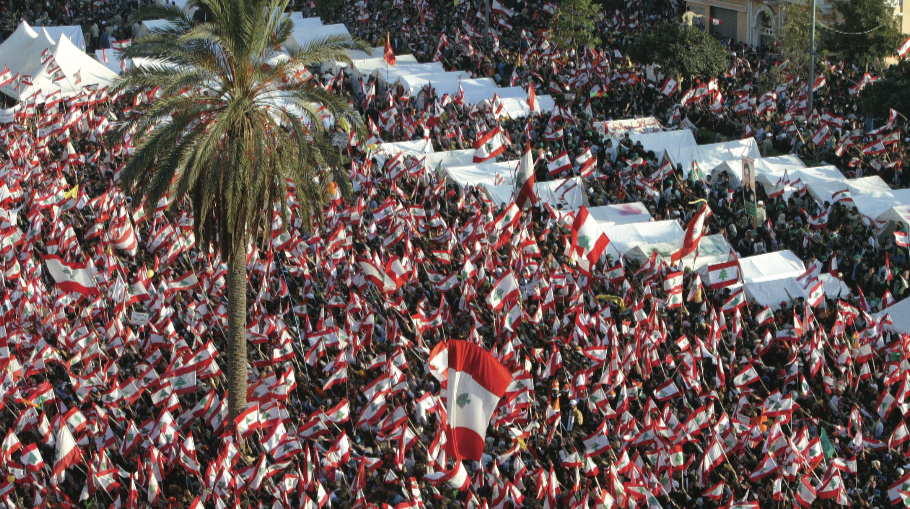
It was clear within hours of the St Valentine’s Day truck bomb that killed Hariri and 22 others in 2005, that Lebanon had been struck by a political earthquake, the shockwaves of which would linger and travel far. His death triggered the mass rallies of the Beirut spring, a cathartic eruption of anger and outrage that led to Syria’s disengagement two months later. The demise of Pax Syriana also meant that Lebanon’s quarreling politicians could no longer resort to the Damascene arbiter, but would have to resolve their own differences.

That inevitably led to deadlock over key issues such as disarming Hizbullah or removing President Emile Lahoud from office. With the Syrians gone, foreign and domestic opponents of Hizbullah redoubled their efforts to have the party disarmed. But, Hizbullah dug in its heels and the party’s new found ally, Nabih Berri, initiated a series of largely futile national dialogue sessions, while Lebanese society became increasingly polarized along sectarian lines.

In the months before his death, Hariri had worked hard on securing a compromise with Sayyed Hassan Nasrallah, Hizbullah’s leader, over the group’s weapons. As long as there was no peace with Israel, Hariri would deflect international pressure to disarm Hizbullah, and in exchange Nasrallah would forego any rash actions that could drag Lebanon into a war with Israel. Hariri understood that Hizbullah was strong enough to resist disarming by force or political persuasion. But he hoped that over time as Hizbullah became more firmly enmeshed in Lebanese politics, it would find that its priority lay with the interests of its Shiite constituents and would no longer heed the siren call of Iran’s clerical rulers.

Hariri’s murder shattered that compromise, however, and although his son Saad attempted to kindle the same warm relationship that his father had enjoyed with Nasrallah, high stakes politics intervened.

While the fate of Hizbullah’s arms was of direct interest to Iran, the United Nations commission tracking Hariri’s killers appeared to pose an existential threat to Syria’s rulers. The commission – the first set up by the UN to investigate a political murder – owes its existence chiefly to the US recognizing that the probe had the potential to bring about a regime change in Damascus with nary a protest from the international community.

The initial progress reports suggested that high-level Syrian officials and their Lebanese allies were behind Hariri’s murder and subsequent reports, although less forthcoming, have indicated no significant change of direction.

The stakes are high. The commission’s mandate expires in June and last month the chief investigator said that the probe was reaching a “sensitive stage”. If indictments are issued against senior Syrian figures it could spell the end of the Assad regime. The administration of US President George W. Bush, contending with disaster in Iraq and uninterested in pushing Israel to resume the Middle East peace process, appears to have recognized the importance of Lebanon in shaping the future direction of the region. The Iraq Survey Group’s recommendation to engage with Iran and Syria is being ignored by the White House. Bush appears to be betting on the UN commission accusing senior Syrian officials to help cripple the recalcitrant regime in Damascus, thus saving him the ignominy of having to approach Assad to help sort out Iraq.

If Assad’s top security lieutenants are indicted and the regime falls as a result, with a new Western-friendly administration taking over, it will have serious repercussions for Iran and Hizbullah, Syria’s principal allies in the anti-Western alliance. Syria plays a crucial role as Iran’s only Arab ally and as the geo-strategic linchpin connecting Iran to its Lebanese protégé, Hizbullah.

The anti-Western alliance will inevitably collapse into its constituent parts without the glue binding them that is Syria. Hizbullah will find itself isolated and struggling to resist calls to disarm, and Iran’s ability to project itself on the Arab-Israeli conflict will be weakened. Iraq and the Palestinians will also feel the effect of a change of regime in Iraq.

The events of this year may yet prove that in death Hariri will have had a far greater impact on the Middle East than he ever could have had in life.
 

Nicholas Blanford is a Beirut-based journalist and author of Killing Mr Lebanon: The Assassination of Rafik Al Harriri and its Impact on the Middle East

January 1, 2007 0 comments
0 FacebookTwitterPinterestEmail
Comment

Learning a thing or two from Qatar

by Norbert Schiller January 1, 2007
written by Norbert Schiller

Twenty years ago, I arrived at an airport in the middle of a desert peninsula in the Persian Gulf. The arrival hall was basic, not one to remember, and the duty free consisted of one room with items piled up on the floor. The passport control officers were unfriendly and the customs agents scrutinized every item of luggage. As I remember, there were only one or two decent hotels and little traffic on the road.

Qatar was engaged in a wasteful, low-intensity war with Bahrain over a few patches of sand in the sea. My first thought was why the Qataris can’t learn a thing or two from Dubai, which was in the birth pangs of a historic economic revolution.

Ten years later, I arrived in Qatar again, this time invited by the ministry of tourism to attend the country’s first ever tourism festival. I was met at the airport by a polite representative from the company hired to showcase Qatar’s tourism potential. The streets were new and had been planted with trees to break the monotony of the desert landscape. The group included a German designer with a posse of stunning Polish models. He told me that this is the new frontier in fashion. “I’m here to get into the market before anyone else,” he confided. I was still not convinced.

A decade later, Qatar launched its latest campaign, one that was seen on television stations around the globe: “Proud Sponsors of the 15th Asian Games … The Games of Your Life.” One would have had to be living in a monastery not to have seen it. I was surprised and impressed by Qatar’s aggressive approach. Then came the phone call asking me to cover the games. Qatar and I were hooking up again.

At the end of November, I once again landed in Doha and like everyone involved with the games – athletes, organizers and journalists – was ushered into a private terminal, greeted by a member of the games’ organizing committee. I was given accreditation, put on a bus and shuttled to an apartment complex, which would be my home for the next 15 days. I was also given meal cards, a locker key and a bagful of souvenirs. Buses to the various sporting venues ran like Swiss (or Japanese) watches and as a photographer, my access to each event was planned with precision.

Never in all my 25 years of covering the Middle East and Africa as a photographer had I seen such meticulous organization. The Qatari’s had retained the international know-how of the people who brought us the Sydney Olympics to ensure these games were the best ever.

Twenty years ago, or even ten years for that matter, I would have never imagined that Qatar, built on a peninsula of sand, could have pulled-off such an extravaganza. During the 15 days a total of 13,000 athletes from 39 countries competed in 45 disciplines. There were 1,700 journalists – 400 of whom were photographers – on the ground, covering the games. The Qataris had also hired hundreds of Indian computer engineers to patiently attend to our technical needs. They worked quickly and efficiently and did not get flustered. It was yet another example of the professionalism that underscored this event and proof of what can be done with vision.

Granted, Qatar had the money to blow and will have made a loss (attendance at most venues over the 15 days was far from bulging). But what a loss-leader! Yes, there were rumors that tickets were purchased well in advance by the ruler and given to students (schools were closed during the games) and guests so that the stands would look full for the TV cameras. Nevertheless, there was energy and a will to make these games the catalyst and benchmark for future sporting events. It’s no secret that Qatar wants to host the Summer Olympic Games in 2016 – even though it might be a tad hot.

Lebanon, my erstwhile home, has been given the honor of hosting the 2009 Asian Winter Games. It offers yet another opportunity for Lebanon to take center stage and showcase its own diversity. But for the Winter Games to be successful, Lebanon will have to put away its divisions and learn a thing or two about unity and brotherhood by watching how athletes from different countries with different beliefs can come together in competition.

As for Qatar, well it knew where its priorities lay. The barren peninsula has become an example of what the Middle East can achieve. Qatar had demonstrated it is a global player. It had arrived. It made its choice and is beat the drum of economic progress. It has chosen investment over conflict and growth over blinkered ideological stagnation.

And don’t write them off as hosts for a summer Olympics. They will surely find a way around the heat.

Norbert Schiller is a photographer/editor. He covered the 2006 Asian Games for UPI

January 1, 2007 0 comments
0 FacebookTwitterPinterestEmail
Comment

Bush’s Middle East mission

by Lee Smith January 1, 2007
written by Lee Smith

As every upper level manager knows, you bring the consultants in to buy you some peace and quiet with the shareholders while you’re deciding whether the buy-out clause in your contract turns out to be more lucrative than the year-end bonus. So why did George W. Bush, the Harvard Business School-educated CEO of the United States of America, let the consultants get all the headlines? After the mid-term elections, all anyone could talk about in Washington was the Baker-Hamilton Iraq Study Group.

Leaks from the ISG provided the press with plenty of cannon fodder, as conservative publications went on the offensive against Baker, the man who handed Lebanon over to Damascus, and let Saddam stay in power to become the symbol of anti-Americanism in the region. White House critics on the other hand called it the end of the Neoconservative project in the Middle East, a return to a “mature” Middle East policy, managed by the Bush family’s long-time fixer. Savvy insiders wondered if the formation of the bi-partisan group was some clever plan of the president’s to make the Democrats equally culpable for the meltdown in Iraq. And everyone wanted to know if the study was likely to become the blueprint for American foreign policy.

In the end of course, it was all much ado about nothing, as Bush acted like a proper CEO and tossed the report in the garbage. Jim Baker shouldn’t give up his day job, one White House wag remarked, putting an end to weeks of speculation: the President still makes American foreign policy. And yet after the Democrats won both houses of Congress, and polls show an American public increasingly dissatisfied with Bush’s Iraq strategy, the major question still lingers: what is this president’s foreign policy?

Bush’s legacy rests entirely on Iraq. The problem is that it is precisely this large Arab state that is preventing the White House from seeing how much the ground has shifted during the last four years, partly due to Iraq itself, but largely just because the region is always highly volatile.

After September 11 the Americans were mad at the Sunnis, especially Saudi Arabia. It was Riyadh after all who had provided, unwittingly or not, much of the staffing and financing for the largest terror attack in history. Part of the idea then behind the invasion of Iraq was to rearrange the regional balance, thereby empowering the Shia. But four years after the fall of Saddam’s regime, the US’ major problem in the region is not Sunni jihadism, but the Islamic Republic of Iran. Tehran is at war with the US, and is fighting American allies, interests and troops throughout the region.

The key to understanding this new regional alignment of course is not Iraq, but Lebanon. Israel’s war against Hizbullah drew the lines very clearly, and now Jerusalem is reportedly offering the Saudis a chance to re-affirm the casual alliance contracted during this past summer. Ehud Olmert intends to meet with Saudi officials to kick-start the moribund peace process. Does that mean that a comprehensive peace deal between the Israelis and Palestinians is finally in the offing? Of course not. The point of the exercise is to take the Palestinian file away from Hamas’ Iranian and Syrian sponsors and return it to the Sunnis.

So, if Israel and the traditional Sunni regimes have lined up under Washington’s umbrella, why doesn’t the US know it? Because of Iraq. If the White House sides with the Sunnis, the Shia will make it impossible for US troops there. And thus, the White House is caught in a strange bind – it knows that pro-Sunni policies in the rest of the Middle East will affect its standing in Iraq, but cannot yet admit it is impossible to detach Iraq policy from a larger strategic vision.

And it’s not just the administration that’s stuck; the Baker Study Group is the clearest manifestation of this confusion about the region. James Baker is as close to the Saudis as any other living American and the Saudis obviously do not want the US to engage Syria and Iran. And here he is putting forth advice – withdrawal from Iraq to leave the Sunnis at the mercy of the Shia, while “talking” with Iran and Syria – which would undermine an ally whose vital interests, at least in this case, are perfectly in line with Washington’s: to maintain the position of the US in the Persian Gulf.

The fact is that the Bush administration, its critics and enemies have greatly misunderstood the nature of American power. Remember that Osama Bin Laden said the US was a “paper tiger” because it was flushed out of Vietnam, Beirut, Somalia, etc., and hence Bush says he will not “cut and run.” So what is next? To prove to an obscurantist fanatic like Bin Laden that it is the earth that revolves around the sun and not the other way around?

It is easy to see how the US has failed in Iraq, and it is equally easy to forget the degree of difficulty involved. In a matter of months, the US brought down two troublesome Middle Eastern regimes, and only a country as rich and powerful, capricious and arrogant as America could afford to believe it was in the interest of the world to democratize these places as well. That 150,000 US troops and scores of American diplomats could not bring Jefferson to the land of the two rivers describes the limits of a missionary vocation, not power. So, what is the point in saving Iraq if it costs Washington the world – or worse, American hegemony in the Persian Gulf? 

Lee Smith is Hudson Institute visiting fellow and reporter on Middle East affairs

January 1, 2007 0 comments
0 FacebookTwitterPinterestEmail
Consumer Society

Regional retail boom counting on luxury

by Executive Staff January 1, 2007
written by Executive Staff

After several years of sluggish turnover, the global luxury industry roared into life in 2006, with worldwide sales reaching a hefty $150 billion. A testament to the industry’s revival is the number of flagship stores spawning around the globe from such über brands as Louis Vuitton, Chanel, Hermes and Gucci.

By 2010, the Middle East luxury market potential is expected to hit the $100 billion mark as Gucci, Chanel et al make headway into the demand-filled region through local franchisers and retailers. Department stores, including Saks Fifth Avenue and Harvey Nichols, are also opening outlets in the region. In Dubai, Harvey Nichols opened a three storey, 12,500 square-meter store in the Mall of the Emirates, their biggest store outside London. With oil revenues and a growing population, the luxury Arab market has a seemingly insatiable appetite.

Global vision

Enter the Middle East Luxury Group (MELG). Established in 2005, the company is hoping to reap the rewards of this exciting market trend, especially when considering that 40% of all haute couture clients are Arabs. The group, which expects yearly sales of $80 million, believes it is revolutionizing the luxury industry.

“What we are actually providing here is a unified concept in luxury, encompassing everything from clothing to eateries, media and hotel businesses, and we are forcing others to keep up with this trend,” explained Elias Abi Khaled, MELG’s CEO.

The man behind MELG, Bahij Abou Hamzi, who made his name in telecom with his Global and Liban Call services, has so far invested $25 million in Beirut through his company. “The owner’s strong network base gave us contracts with popular brand names,” said Abi Khaled.

MELG’s media arm includes Fashion TV Arabia and Avenue, a fashion magazine that is currently preparing its first issue. The luxury retail activity consists of 13 exclusive brands and multi-brand stores, including Gianfranco Ferre, Vicini, IT, M for Missoni, Exte, and Just Cavalli. The group has also dipped its toes in the hospitality sector with the 109 Café.

“The MELG vision is of a global nature, as we treat the various fashion interrelated activities as one, with complementary functions interacting for the benefit of the whole entity,” explained Abi Khaled, adding that the group intends to expand its line of products and services to eventually include a luxury hotel.

At the moment, MELG employs 150 people and is expected to grow by 100 more within a year, an indication of the group’s aggressive expansion plan. Outlets are scheduled to open in Kuwait, UAE and Bahrain within a year, as well as stores scheduled to open in Qatar, KSA, Egypt and Jordan.

Unique approach

“We avoid franchising for obvious profitability concerns,” says Abi Khaled. “Opening our own points of sales underlines our concern for quality. Each outlet conveys the image of the MELG and we control every aspect of the service.”

Boasting a varied product base within its retail activity, MELG had to face conflicting interests in certain markets, where local exclusivity contracts preempted the company’s representation. As a direct consequence, MELG does not carry a uniformed basket of goods over the region. “Certain brands, including Versace Jeans Couture, Galliano, GF Ferre and Plein Sud, are however available through our multi-brand store,” said Abi Khaled, adding that “within the retail line of activity, outlets are all serviced by the Beirut purchasing platform, as it remains, after all, the fashion capital of the Middle East.”

Abi Khaled believes MELG to be currently among the top five luxury retail companies in the country (the group’s competitors are the El Tayyer group, Villa Moda and Chalhoub) but expects the group to eventually be the only one with an effective regional presence in the Middle East and GCC areas.

“Our goal is to establish a regional identity, which is built through a strong presence in most markets in the Levant and GCC areas,” he said. However, because MELG was first launched in Lebanon, the marketing campaign was kept on hold because of political unrest. “For other countries, one main marketing theme is adopted, which takes into consideration local cultural differences and is adapted to each country individually using TV, print and the group’s monthly fashion magazine, as well as other specialized shows and events.
 

January 1, 2007 0 comments
0 FacebookTwitterPinterestEmail
Editorial

Tailoring a dream

by Yasser Akkaoui January 1, 2007
written by Yasser Akkaoui

Qatar can look on its hosting of the recent Asian games as a job well done. But the Genesis of the nation’s rise to prominence from being a Gulf backwater is predicated on a vision in which it deliberately chose to differentiate itself from its glitzy neighbor Dubai and Singapore, with its thick seam of Asian diligence.

Where would be the value-added in duplicating a wining formula? Qatar finally chose education and excellence among its new set of core values. Sport and the locally-initiated Aspire campaign – launched through the prism of the Asian games – represents the latter of these values, while Doha is now a hub for foreign campuses of some of the finest international names in education like Cornell and Carnegie Mellon.

Elsewhere, the GCC real estate boom is in full swing and stretching its network across the region. This presents new challenges to those developers who are used to creating from scratch in desert expanses – a la the compound culture from which it could be argued this formula sprung. The nations of the Levant and North Africa are going concerns and any mega developments will need to embrace the cultural, social and ethnic mores of these countries. Citizens – like the SIMs in the SimCity computer game – cannot be imported like the eager westerners brought into the GCC.

But let us not forget that as the second anniversary of the assassination of Rafic Hariri draws near, that he was the granddaddy of these mega projects. Hariri, like the visionary gulf rulers, was weaned on the GCC experience and was imbued with the idea of developing a dream that he could export to Lebanon. The Beirut Central District, the Dbaye Marina and the now Rafic Hariri International Airport were the examples he set and now his template is being rolled out across Jordan and the UAE.

That Lebanon has fallen behind is more to do with its erractic political dynamic. The governments of North Africa, not to mention Syria and Jordan, can execute these projects because the central government can directly control their implementation, by fast tracking laws that directly affect the economic good.

Sadly, in the Middle East, you still need absolute power to get absolute results.

January 1, 2007 0 comments
0 FacebookTwitterPinterestEmail
RegionUncategorized

Another year Another conflict

by Nicholas Blanford December 28, 2006
written by Nicholas Blanford

If there is one abiding image that symbolized the horrors of the Middle East in 2004, it had to be the harrowing videotaped pictures of doomed hostages in Iraq. The shots of terrified captives pleading for their lives are the antithesis of the optimism expressed by American officials at the beginning of the year that Iraq would become stable with the formal termination of the United States-led occupation in June and creation of an interim Iraqi government. Like other key areas of conflict in the Middle East in 2004, Iraq has dashed even the frailest of expectations.

At the beginning of the year, the Road Map unveiled in Spring 2003 by President George W. Bush was still considered a viable means of charting a peace between Israel and the Palestinians, despite the continued violence in the West Bank and Gaza. Libya announced it was abandoning its weapons of mass destruction program after tiring of its pariah status, setting a strong example to other countries with WMD ambitions, while Syrian President Bashar al-Assad signaled a willingness to resume peace talks with Israel after a four-year hiatus. Elsewhere, a democratic reform initiative from the Bush administration was spurring Arab governments to begin assessing political and social change in their countries.

Saudi Arabia is facing its worst unrest in years with a series of bombings and shootings carried out by Islamic militants seeking to overthrow the royal family.Yet the death in November of Yasser Arafat, the veteran Palestinian leader, spurred a flurry of international diplomatic activity amid hopes of a new beginning for the peace process. But a breakthrough appears remote given the Israeli government’s determination to proceed with a unilateralist agenda and the uncertainty surrounding the emergence of a new Palestinian leadership.

The Syrian-Israeli peace track remains frozen with Sharon clearly reluctant to resume negotiations, particularly at a time when Damascus is subject to a United Nations Security Council resolution and unprecedented international scrutiny. At end of 2004, the carnage in Iraq has developed an ineluctable momentum, which few see ending anytime soon, while Arab governments generally have been hesitant in embracing even minor reforms, despite mounting pressure from the West.

The Iraq debacle

The architects of the US-led invasion of Iraq had harbored ambitions that the overthrow of the Baathist regime and the introduction of democratic rule would engender a domino effect throughout the region, with dictatorships being replaced by budding democracies. The goal may have been noble, but the manner in which it was implemented was grounded in naivety and obtuseness, a fundamental failure to understand the ethnic, social and cultural realities of Iraq.

Early policy decisions, such as the disbandment of the Iraqi army and the de-“Baathification” process as well as questionable military tactics, fueled the budding insurgency in Iraq during the summer and autumn of 2003. From simple hit-and-run guerrilla tactics, the insurgency has evolved over the past year into a fluid multi-dimensional guerrilla war which shows little sign of diminishing despite – or even because of – the measures undertaken by the Iraqi authorities and their American allies.

The formal end of the American-led occupation in June and the hand-over to an interim Iraqi government did nothing to quell the insurgency. Ayad Allawi, the interim prime minister, is known as the “mayor of Baghdad,” an ironic term that still probably overstates the reach of his influence, which by the end of the year barely stretched further than the barricaded Green Zone in the heart of the capital.

Oil exports, the revenues of which were supposed to help fund reconstruction, have been decimated by the near daily attacks against Iraq’s oil infrastructure. US officials predicted before the war that Iraqi oil would generate $50 to $100 million in two to three years. But some 250 attacks since the end of the war have resulted in revenues of only $17 billion. The absence of Iraqi oil from the international market is a significant factor in the soaring oil prices of recent months which have reached in excess of $50 a barrel.

The violence is laying bare the country’s ethnic and sectarian seam lines, provoking concerns that Iraq may eventually splinter into three or more states. The Shiites are the most vocal champions of Iraq’s territorial integrity and have been at the forefront of the call for nationwide elections. Comprising some 60% of the population, the Shiites expect elections to transform their demographic advantage into real power after decades of being marginalized by the minority Sunni elite.

The Kurdish question

That ambition, however, causes unease among the Sunni and Kurdish communities which each represent 20% of the population. Despite Kurdish leaders’ stated allegiance to a united Iraq, separatist sentiments run deep among the Kurds, which the ongoing turmoil in the rest of Iraq is doing nothing to abate. Indeed, the Kurds have been steadily reasserting their authority over the oil-rich city of Kirkuk, home to a volatile ethnic mix of Kurds, Turkmen and Sunni and Shiite Arabs.

The prospect of an independent Kurdistan continues to alarm neighboring Turkey, which has threatened to intervene militarily in such an event. Turkey and northern Iraq’s other neighbors, Syria and Iran, fear that their own sizeable Kurdish communities will begin agitating for greater rights if an independent Kurdish state emerges in Iraq. That concern hardened in March when Syrian Kurds rioted for several days in the Hasake region of north east Syria.

The Sunni minority

The Sunnis, who populate the mainly desert and agricultural heartland, fear marginalization in a future Iraq dominated by Shiites. A key element in neutralizing the insurgency is to encourage the emergence of a new Sunni polity to replace the outlawed Baath party, which can participate in the political process. As it is, the most popular Sunni representative gathering at present is the Muslim Clerics Association, a religio-political group of hard-line Sunni clerics, who are at odds with the interim Iraqi government, oppose the presence of foreign troops in Iraq and have called for a boycott of the nationwide elections scheduled for January 30.

In preparation for the January elections, the US military launched a number of operations in October and November to break the back of the insurgency. But the insurgents have generally avoided a direct confrontation with the Americans, choosing to regroup and stage attacks elsewhere in the time-honored fashion of guerrilla warfare. Under the present circumstances, a military solution to the insurgency appears remote because there are insufficient coalition troop numbers to police the country and the newly formed Iraqi security forces are proving unreliable.

The unrelenting diet of suicide car bomb attacks, kidnappings, roadside ambushes and the brutally effective tactic of beheading hostages has forced aid agencies, charities and foreign businesses to abandon the country, undermining the ability of the international community to help in the reconstruction process.

Although Iraq has become synonymous with the decapitations of foreign hostages, the practice began this year in neighboring Saudi Arabia with the videotaped execution of an American, Paul Johnson, by extremist militants, who have seen to it that Saudi Arabia has been rocked by a wave of kidnappings, shootings and bombings since May 2003. The Saudi security forces have launched a crackdown on the militants, arresting hundreds of suspects, often during bloody shootouts.

The Palestinian-Israeli conflict

For most of the year, peace between Israel and the Palestinians has rarely looked more remote. The much heralded Road Map was essentially ignored by Israel and the Palestinians, while the US was too preoccupied with Iraq and the presidential election to actively coax the two sides back to the peace table.

Sharon, supported by Washington, refused to deal with the Palestinians while Yasser Arafat remained head of the Palestinian Authority. The veteran Palestinian leader was pronounced “irrelevant,” threatened with assassination and confined to his crumbling headquarters in Ramallah. Four years of fighting have left the PA and its security apparatus in tatters and in no position to rein in the numerous autonomous militant groups that have filled the vacuum.  Israel continued its policy of assassinations, killing in March Sheikh Ahmad Yassin, the blind and crippled spiritual leader of the Hamas movement, and a month later Abdel Aziz Rantissi, the head of the Hamas politburo.

The absence of a negotiating partner to suite Sharon’s requirements left him free to pursue his unilateralist agenda of building a concrete barrier separating the West Bank from Israel and preparing for a withdrawal from the Gaza Strip. Sharon’s plan to abandon the Gaza Strip along with four settlements in the northern West Bank has caused considerable controversy in Israel. The right wing strongly opposes any dismembering of Jewish-only settlements. The left wing found themselves in the awkward position of being obliged to support a plan that reduces the level of occupation while still not fully trusting Sharon’s motives.

With his government divided over the plan, Sharon traveled to Washington in April to seek the support of his ally, George W. Bush. The Israeli premier was rewarded with a commitment from Bush that there would be no right of return for millions of Palestinian refugees that Israel could keep some of the settlements in the West Bank and would not have to withdraw to the 1967 “Green Line” border. It was an unprecedented public concession to Israel from an American president, legitimizing the illegal colonization of an occupied land and prejudicing the final status talks in Israel’s favor.

Arafat’s death encouraged speculation of a potential new beginning to the peace process. But given the fragmented nature of the Palestinian polity, the transition to a new leadership could be marked by intra-Palestinian violence, which would delay any resumption of negotiations with Israel.

As for Sharon, he remains committed to his Gaza withdrawal plan and is in no hurry to resume peace talks with the Palestinians. That much was clear from a revealing interview given by Sharon’s senior advisor, Dov Weisglass, to Israel’s Haaretz newspaper in October. Weisglass admitted that the Gaza disengagement plan was “formaldehyde” to freeze the peace process with the Palestinians, “all with a [US] presidential blessing.”

Road to Damascus

Sharon’s reluctance to discuss peace with the Palestinians extends to the Syrian track. From December 2003, Bashar al-Assad has been dropping hints with increasing frequency that he is willing to resume unconditional negotiations with the Israelis. Assad’s interlocutors believe the Syrian president is genuine and Israeli military commanders have recommended taking advantage of Syria’s diplomatic isolation to cut the best possible deal. But Sharon, so far, has refused, saying that Damascus must first curtail its support for militant Palestinian groups and Lebanon’s Hizbullah.

Syria’s bargaining position has rarely been weaker. The US slapped limited sanctions on Damascus at the beginning of the year as part of the Syria Accountability Act, which calls for a Syrian withdrawal from Lebanon, cooperation on stabilizing Iraq, abandoning its alleged WMD program and ending its support for “terrorist” groups. Terminating Syria’s influence over Lebanon was elevated from a fringe issue in Washington to a stated policy goal of the Bush administration in 2004.

Syria’s approval for an extension to Lebanese President Emile Lahoud’s mandate led in September to the US and France co-sponsoring a UN Security Council resolution demanding Damascus cease interfering in Lebanese affairs. Resolution 1559 also demands a withdrawal of Syrian forces from Lebanon, the disarming of Hizbullah and Palestinian militias and the deployment of Lebanese troops to the southern border with Israel.

Damascus has made a greater effort to beef up security measures along its 600-kilometer desert border with Iraq to prevent infiltrators joining the insurgency. But the US has ruled out granting Damascus leeway in Lebanon in exchange for greater cooperation over Iraq.

Diplomacy and democracy

The unrelenting violence in Iraq and the Palestinian territories has overshadowed faltering attempts in early 2004 to promote political, economic and social reform in the Arab world. The Bush administration’s Greater Middle East Initiative, a framework for Arab reform, was widely criticized as an unwarranted meddling in Arab domestic affairs. It was also derided for failing to cite the Arab-Israeli conflict as a root cause for the region’s ills. The adverse reaction of Arab governments led to a revised and diluted version of the initiative being unveiled at the Group of Eight (G-8) summit in June.

Still, Arab regimes felt compelled to address the subject of democracy at the Arab League summit in May. The gathering produced the Tunis Declaration, a lukewarm pledge to promote human rights, freedom of expression, judicial independence and widen the role of women in society. Some countries are tinkering with minor democratic measures: Saudi Arabia is planning to hold its first municipal elections in February, and Kuwait is close to finishing a publications bill abolishing censorship in the local press.

The process of democratizing the Arab world received another boost in December when Arab foreign and finance ministers and G-8 representatives met in Morocco to further the Bush administration’s reform project.

December 28, 2006 0 comments
0 FacebookTwitterPinterestEmail
Financial Indicators

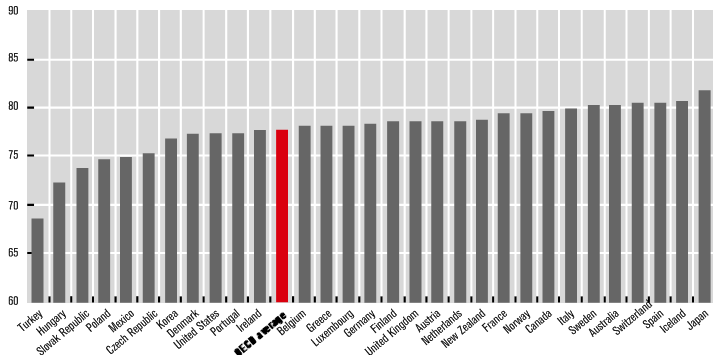
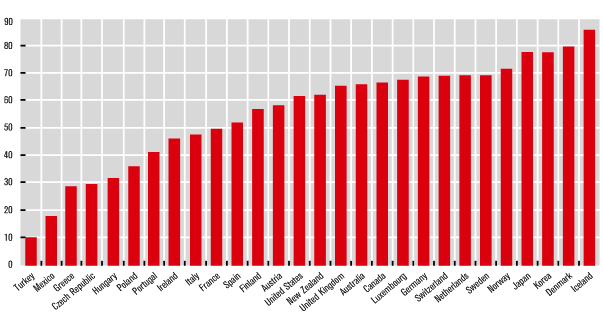
Life expectancy at birth: totalNumber of years, 2003

by Executive Contributor December 20, 2006
written by Executive Contributor

Life expectancy at birth remains one of the most frequently quoted indicators of health status. Gains in life expectancy in OECD countries in recent decades have been due to a number of important factors affecting mortality rates, including rising living standards, improved lifestyle and better education, as well as advances in access to care. Other factors, such as better nutrition, sanitation and housing also played a role, particularly in countries with developing economies. Higher national income is generally associated with higher life expectancy at birth across OECD countries, although the relationship is less pronounced at higher levels of income.

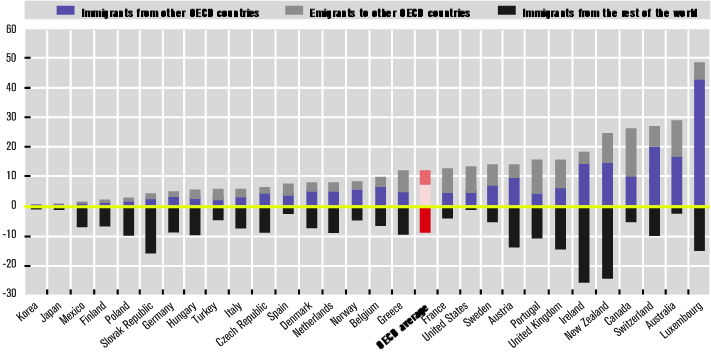
Foreign-born persons with tertiary education
As a percentage of all residents with tertiary education, circa 2000

n In many countries, foreign-born persons represent a significant percentage of persons with tertiary education. Many OECD countries “gain” more than they “lose” from migration of the highly educated. The table shows foreign-born persons with tertiary education living in or from OECD countries as a percentage of the number of residents with tertiary education.

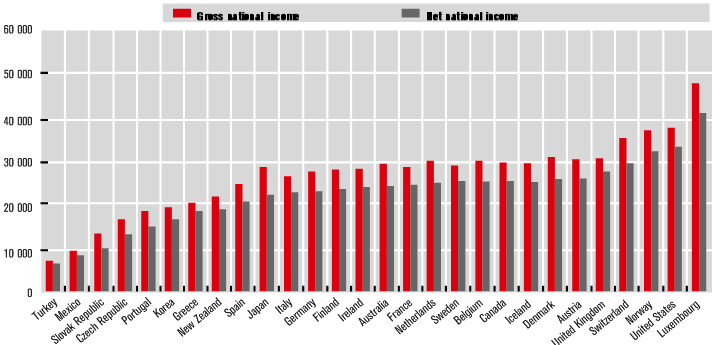
Gross and net national income per capital
US dollars, current prices and PPPs, 2003

Per capita gross national income (GNI) and net national income (NNI) are often preferred by analysts when comparing income levels. GNI is defined as GDP plus net receipts from abroad of wages and salaries and of property income. Guest-workers and other migrant workers who live abroad for twelve months or more are considered to be resident in the country where they are working. Property income from abroad includes interest, dividends and all or part of the retained earnings of foreign enterprises owned fully or in part by residents.

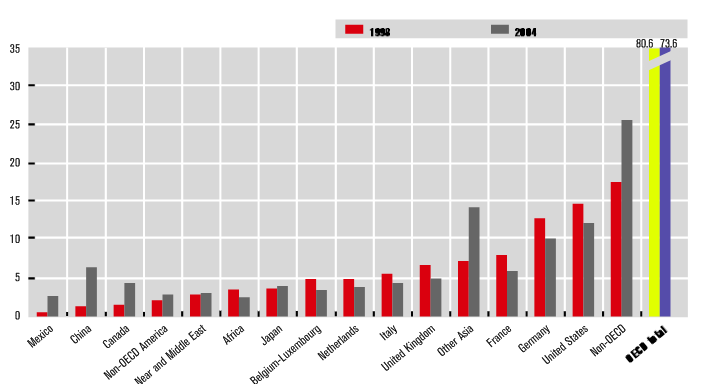
Partner countries and regions of OECD merchandise trade
As a percentage of total OECD merchandise trade

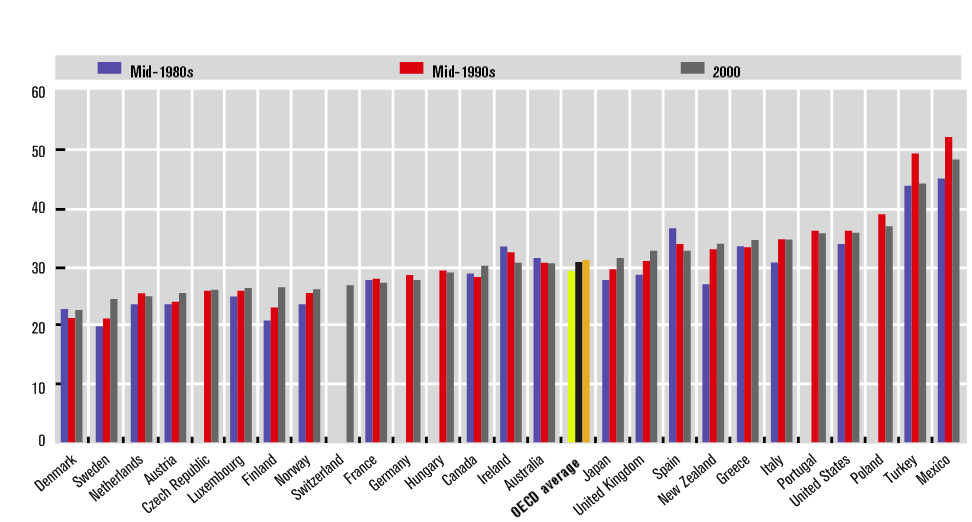
Distribution of household disposable income among individuals
Measure by Gini coefficients

The distribution of incomes within a country is important for two reasons. Inequalities create incentives for people to improve their situation through work, innovation or acquiring new skills. However, crime, poverty and social exclusion are linked to inequalities. Income is defined as household disposable income. It consists of earnings from work, property income such as interest and dividends, and pensions and other social security benefits; income taxes and social security contributions paid by households are deducted. The equality of disposable incomes among individuals ranges from 0 in the case of “perfect equality” (each share of the population gets the same share of income) to 100 in the case of “perfect inequality” (all income goes to the share of the population with the highest income). Household income is adjusted to take account of household size.

Households with access to a home computer
Percentage of all households, 2004 or latest available year

The table shows the number of households that reported having at least one personal computer in working order. The second part of the table shows the percentage of households who reported that they had access to the Internet. In almost all cases, this access is via a personal computer, either using a dial-up, DSL, fiber optic or other broadband access.

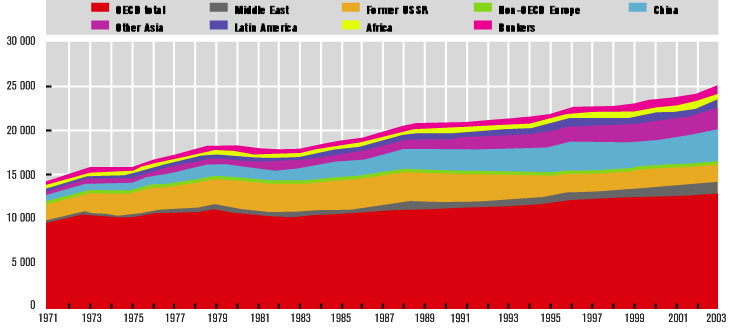
World CO2 emissions from energy use, by region
Million tons

Carbon dioxide (CO2) makes up the largest share of “greenhouse gases.” The table refers to emissions of CO2 from burning oil, coal and gas for energy use. Carbon dioxide also enters the atmosphere from burning wood and waste materials and from some industrial processes such as cement production. Emissions of CO2 from these sources are a relatively small part of global emissions and are not included in these statistics. The Revised 1996 IPCC Guidelines for National Greenhouse Gas Inventories (see below) provide a fuller, technical definition of how CO2 emissions have been estimated for this table.

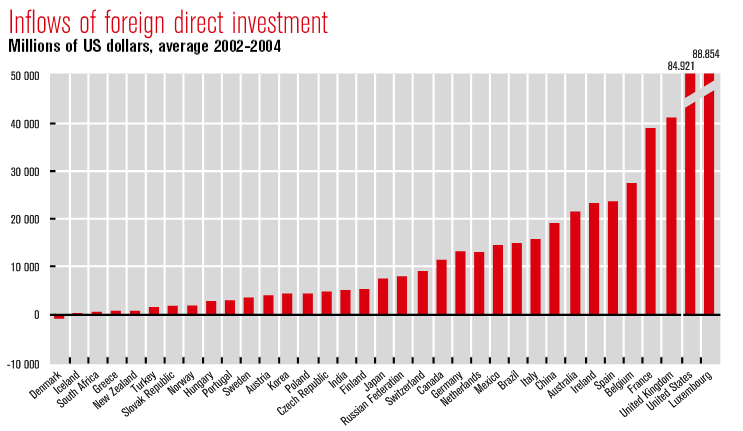
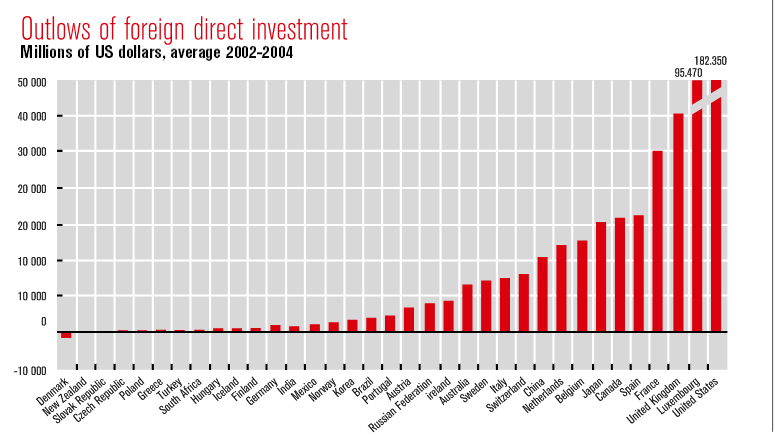
Foreign direct investment (FDI) is a key element in the rapidly evolving process of international economic integration. FDI creates direct, stable and long-lasting links between economies. FDI is an additional source of funding for capital investment. Foreign direct investment (FDI) is defined as investment by a resident entity in one economy with the objective of obtaining a lasting interest in an enterprise resident in another economy. The lasting interest means the existence of a long-term relationship between the direct investor and the enterprise and a significant degree of influence by the direct investor on the management of the direct investment enterprise. Absolute control by the foreign investor is not required, and ownership of 10% of the ordinary shares or voting stock is the criterion used. Inward stocks are the direct investments held by non-residents; outward stocks are the investments held in other economies.

December 20, 2006 0 comments
0 FacebookTwitterPinterestEmail
  • 1
  • …
  • 603
  • 604
  • 605
  • 606
  • 607
  • …
  • 696

Latest Cover

About us

Since its first edition emerged on the newsstands in 1999, Executive Magazine has been dedicated to providing its readers with the most up-to-date local and regional business news. Executive is a monthly business magazine that offers readers in-depth analyses on the Lebanese world of commerce, covering all the major sectors – from banking, finance, and insurance to technology, tourism, hospitality, media, and retail.

  • Donate
  • Our Purpose
  • Contact Us

Sign up for our newsletter

    • Facebook
    • Twitter
    • Instagram
    • Linkedin
    • Youtube
    Executive Magazine
    • ISSUES
      • Current Issue
      • Past issues
    • BUSINESS
    • ECONOMICS & POLICY
    • OPINION
    • SPECIAL REPORTS
    • EXECUTIVE TALKS
    • MOVEMENTS
      • Change the image
      • Cannes lions
      • Transparency & accountability
      • ECONOMIC ROADMAP
      • Say No to Corruption
      • The Lebanon media development initiative
      • LPSN Policy Asks
      • Advocating the preservation of deposits
    • JOIN US
      • Join our movement
      • Attend our events
      • Receive updates
      • Connect with us
    • DONATE