Technically, the only true innovation
comes in a CD shaped as a credit card.
The e-bizCard, compatible with any CD-
ROM, is the latest offering of the French-
based Ebiz Production. However, were the
unusual shape its only selling point, it
would have been passed off as nothing
more than the latest gimmick in data storage.
But Ebiz is using this new gizmo to
attract Lebanese businesses. Production of
the e-bizCards will begin sometime next
fall. Stored in each card will be a listing of
the top 360 businesses in Lebanon. They
will be made available to Lebanon’s
major companies and foreign trade mis-
sions. “It’s one of a three-pronged pro-
motional campaign dubbed First
Lebanon, which aims to bring Lebanese
businesses to the fore in the global mar-
ket,” says Yann Rotil of Ebiz Production.
For a flat fee of $480, a company will get
its logo, contact address and a short com-
pany profile printed on 15,000 e-
bizCards, 5,000 business handbooks
(which will also be distributed free to
CEOs and consultants) and on the
Internet at www.firstlebanon.net for 17
months. Thirty-six commercial sectors,
ranging from airlines to banks to travel
agencies, are represented.
This is not the only compendium of
Lebanese businesses. Sites such as
www.lebanon.com and www.lebanonlinks.com are well established and have
perfectly adequate links. But the novelty
does come with the trilateral approach to
First Lebanon and with Rotil’s insistence
that, thanks to Internet protocols, “any
search on an international engine such as
Yahoo! or Excite with the words ‘busi-
ness in Lebanon’ will yield firstlebanon in
the top ten results.”
So far, 145 companies have signed up
including Demco Steel Industries and
First National Bank. If First Lebanon
proves successful, Ebiz plans to set up sim-
ilar projects in the UAE, Saudi Arabia
and Jordan with the goal of creating a
firstmiddleeast.com. As for the e-
bizCards, they have simply been thrown in
to make the project appear state-of-the-art.
Say it with music
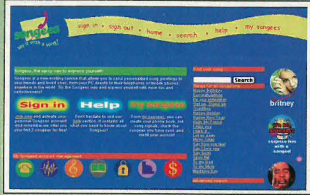
It’s the cyber equivalent of the singing
telegram. Electronic Services has
launched its newest online service,
Songees at www.songees.com. For $1, a
member can send a personalized song
greeting to a fixed or mobile phone anywhere
in the world. Songees, the double e
is simply an attempt to get around registered
domain names, is the brainchild of Adel
Reda, a local entrepreneur who believes
that his service fills a special niche. It is for
all those “Lebanese who want a fun way to
keep in touch with their relatives and
friends abroad,” he says. “It’s the latest
thing after e-greeting cards.” Intracom, a
local ISP that recently sold its database and
dial-up network to Cyberia, operates the site.
Songees’ drawback: you have to use your
credit card to buy $20 worth of credits,
which then have to be used within a year.
Data Management, a local ISP, has
helped another Internet start-up become
equally musical, Karim Saikali’s CD shop,
E-com Lebanon at www.e-comlebanon.com.
But it’s not the first online store to offer
CDs to the average Lebanese surfer. Souk
Loubnan at www.soukloubnan.com and
Soukna at www.soukna.com have each been doing that for the last
four months. What makes
Saikali’s idea novel is that it
adopts an independent database,
turning his site into a
mixture of Amazon and eBay.
Shoppers can create their own
e-shop in Saikali’s virtual mall
to sell or trade their old CDs at
no extra cost. “We hope to
earn from advertising banners,”
says Saikali who, though unwilling to disclose the initial investment,
admits that the break-even point may be
several months away. E-comlebanon.com
recorded a respectable
2,800 visitors in its first month,
but only eight CDs have actually
been sold so far.
According to the slogan on the
company’s welcome page, “customers
can place their orders
from anywhere in the world and
have the CDs delivered inside
Lebanon.” This is no doubt an
effort to encourage expatriate Lebanese
who, having received several birthday
songees from the folks back home, feel
duty-bound to return the favor with the
latest in Western jingles.
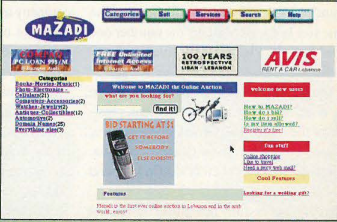
Sold to the lady with IBM
“Do I hear more bids?” Internet users
probably won’t hear those words
while surfing the net. But if it is an auction
they are looking for, they might want to
check out www.mazadi.com. E-Commerce,
a seven-month-old Lebanese
startup specializing in online business ventures,
is promoting the site as the Arab
region’s first online auction arena. It is
modeled after the much larger US-based eBay.com
auction site. Visitors can bid on merchandise
and, for at least the next three
months, can put their own goods up for
auction free of charge.
Johnny El-Hashim, manager of the site
believes www.mazadi.com has great
potential, and he is looking for up to
$500,000 in venture capital funding from
investors who feel that Lebanon has a
bright online future.