• Donate
  • Our Purpose
  • Contact Us
Executive Magazine
  • ISSUES
    • Current Issue
    • Past issues
  • BUSINESS
  • ECONOMICS & POLICY
  • OPINION
  • SPECIAL REPORTS
  • EXECUTIVE TALKS
  • MOVEMENTS
    • Change the image
    • Cannes lions
    • Transparency & accountability
    • ECONOMIC ROADMAP
    • Say No to Corruption
    • The Lebanon media development initiative
    • LPSN Policy Asks
    • Advocating the preservation of deposits
  • JOIN US
    • Join our movement
    • Attend our events
    • Receive updates
    • Connect with us
  • DONATE
For your information

A failing grade

by Robert Tuttle March 15, 2000
written by Robert Tuttle

Remember all the glowing clichés you’ve heard about
Lebanon? A bastion of capitalism within a sea of controlled
economies, a regional hub, the Switzerland of the Middle
East. With relatively low tax rates and banking secrecy, Lebanon
must be one of the freer economies in the Middle East, if not the
world, right? Think again.

The Heritage Foundation and The Wall Street Journal, in their
recently released 2000 Index of Economic Freedom, ranked
Lebanon as number 90 among 160 countries (see chart), placing
it in the “mostly unfree category.” Lebanon found itself even
with such countries as Guyana, Madagascar and Moldova. Even
worse, it scored one point below Mongolia and three points below
Guinea and Ghana, while Fiji, Nigeria and Papua New Guinea
ranked just below Lebanon, tied at number 94. (Ratings are based
on 1998 statistics.)

Conducted annually since 1995, the survey has become something
of a benchmark for measuring the ease of doing business
in a country. Rankings are based on ten
broad factors of economic freedom: trade
policy, the fiscal burden of government,
government intervention in the economy,
monetary policy, capital flows
and foreign investment, banking,
wages and prices, property
rights, regulation and the
black market. Each factor is
scored from one to five and
averaged to determine the final grade. The
higher the score, the greater the government
interference in the economy and the lower the economic
freedom. Hong Kong topped the list of “free”
economies with a score of 1.3. Trailing the pack are repressed
economies like North Korea, which scored five. Lebanon’s score
was 3.2, below average, not only by world standards, but also by
regional standards. Among 17 countries in the Middle East,
Lebanon ranked 11th.

The study showed a direct correlation between the per capita GDP
and the level of economic freedom. “Countries with greater economic
freedom have a faster rate of economic growth and a higher
standard of living,” says Nassib Ghobril, an analyst at Lebanon
Invest. “The study is used by policy makers and investors to
assess the investment climate in a country. If a company were to
set up an office here, obviously it would want more business-friendly
policies. It’s not the country of choice. Why not set up in
Jordan, or the UAE, which is second only to Bahrain?”

Why did Lebanon score so poorly? Ghobril points to three important factors.
First, Lebanon scored a maximum of five on trade policies. High
tariffs and surcharges on imports are the main culprits.
According to IMF statistics, trade taxes account for more than
70% of the total taxes collected by the government. In an attempt
to control the high deficit, the government has increased tariffs over
the past several years. This will make the country’s hopes of joining
the WTO and the Euro-Med agreement difficult, as both deals
would require a general phasing out of trade barriers.

Lebanon has signed free trade agreements with Syria, Egypt and
Kuwait as well as the Arab common market agreement. “But still
overall the tariffs are considered very high,” says Ghobril.

Lebanon also scored five in the “black market” category, largely on
account of its rather porous border with Syria and its thriving
business in unauthorized cable television and pirated software.

Lebanon’s score was also disappointing
– 3.5 – on the fiscal burden of government, which includes income and corporate
taxation plus government expenditures. With a top income
tax rate in 1998 of 10%, Lebanon received a two for taxation. But
that was averaged with a score of five for expenditures, which were
almost 44% of GDP in 1998. Even in some areas where Lebanon
prides itself on openness, the results were disappointing. The
country received a three, “moderate barriers,” for capital flows and
foreign investment. According to the US Department of Commerce,
“Lebanon offers the most liberal investment climate in the Middle
East, with no significant restrictions on foreign investment.” The
report disagrees: “It restricts the amount of real estate a foreigner
may own and needs an efficient investment approval regime.”

It was not all bad news, however. Because of a “low level of
restrictions,” Lebanon received a two for its banking sector and on
prices and wages. As another bright spot, the index showed a modest
improvement from last year, when Lebanon scored 3.25. But
the score for 2000 is still far below its 1997 score of 2.95. And not
everyone agrees with the index’s rating. Kamal Hamdan, an economist
with the Consultation and Research Institute, feels that
Lebanon was under-rated in a number of areas. Trade barriers may
be high by international standards but by regional standards they
are not unusual, he argues. Hamdan also questioned how Lebanon
scored a five for black market, while Nigeria, which he believes has
a far worse problem, scored a three. The five for government expenditures
is also unfair, he says, because the survey calculates the
money spent on debt servicing. “I think Lebanon should be among
the top 30 to 50 countries,” he says. Marwan Iskandar, head of MI
Associates, agrees: “I think that these measures are rather arbitrary.
I would not give much credence to a study like this.”

There are reasons for hope and despair for next year. The “black market”
rating may improve if the new intellectual property rights law,
passed by parliament last spring, is enforced. On the down side, corporate
tax was raised from 10% to 15%, while the top income tax bracket
was increased from 10% to 21%. That could affect next year’s score.

OK, so Lebanon might not be a bastion of capitalism, but at least
it’s a nice place to live, right? Well, actually no, according to another
survey by international consulting firm William M. Mercer. It
ranked Beirut 168th out of 218 cities based on quality of living. The
survey was based on 39 standards including political, economic and
environmental factors, personal safety and health, education, transport
and other public services. Among the notable cities that beat
Beirut were Medellin, Colombia, the cocaine capital of the world,
and Cairo, Egypt, where the smog is so bad that a walk on the Nile
can cause lead poisoning. At the top of the list were Vancouver,
Canada and Zurich, Switzerland. At the bottom: Brazzaville and
Pointe Noire, Congo and Khartoum, Sudan. Well, at least in
Lebanon, we can ski in the morning and swim in the afternoon. Then
again, who would bother?

March 15, 2000 0 comments
0 FacebookTwitterPinterestEmail
For your information

Budget Banter

by Peter willems & Kirsten Vance March 15, 2000
written by Peter willems & Kirsten Vance

The first few days of February are probably not
a time finance minister George Corm would like
to relive. Before his 2000 budget could be
passed through an unruly parliament, Corm
was the target of three sessions of scathing
attacks. With some of the nastiest remarks
struck from the record, Corm was accused of
hallucinating and his policies called failures. The
“Cormic genius” was blamed for slowing economic
growth, increasing unemployment and
precipitating the brain drain.

By Peter Willems and Kirsten Vance

But were these accusations fair? EXECUTIVE spoke with the
finance minister, analysts and economists to discuss the
issues. “It doesn’t matter if the budget deficit comes in a little
above or below the target. It’s still way too high. There’s no reason
to rejoice,” says Nassib Ghobril, an analyst at Lebanon Invest.

Within the 2000 budget, the deficit is targeted at 37%. Last year the
government aimed for the budget deficit to be reduced to 40% and beat
it by hitting 38%. (The government also beat its total deficit expectations
of 44%, coming out with 42%.) “The target this year is still
high, which means they will most likely meet it,” says Ghobril.

Why didn’t the budget come out with a lower target? “On the
expenditure side in 1999, we were able to cut heavily on a lot of allocations,”
says Corm. “This year, knowing that we have had a social
crisis over eight or nine years, we increased allocations for education,
social services and health services sharply. With this we have
only a 37% budget deficit.”

By speculating if the government will hit its target this year, one
has to first look at the revenue side. The government’s plan to bring
in $3.57 billion (an 8% increase compared to last year) was based on
a GDP growth rate of 1.8%. “We know that economic growth was
practically zero in 1999, and what we expect for this year is not any
better,” says economist Elie Yachoui. He may not be far off.

According to The Economist Intelligence Unit’s (EIU) first-quarter
report on Lebanon, the GDP growth rate is forecast at 0.5% for 2000.

Not so, says Corm. “It’s impossible to calculate
the growth rate in Lebanon. Anybody
who says ‘I can calculate it’ is a charlatan. I
will not believe in any growth rate. I have
published the estimates of the IMF that
spent three weeks here in June, and they
know Lebanon. They are specialized in this
country, and they said 2% last year.”

More
specifically, the minister pointed out that
there is no link between economic growth
and tax receipts in Lebanon for now. The tax
system concentrates on the productive sector,
“which is highly concentrated on a few large
taxpayers. The tax system is not diversified.”

An improvement in tax collection, even
with a low growth rate, would have a greater
impact on increasing revenues than strong
economic growth alone, Corm argues.

That leads to another sore point. Freddie
Baz, the advisor to the chairman at Banque
Audi, stresses several important paths that the
government must follow to bring down the
deficit. One is improving tax collection,
instead of raising taxes in a recessionary
environment. It has been estimated that there
is a 70% tax evasion rate. “When I feel that my
tax administration is behaving well for taxpayers, and the taxpayers continue to evade
us by under-reporting profits, then I will take
measures,” says Corm. “But there is corruption
with tax officials; it’s very well known.
I’m moving forward. I’ve taken measures
against four people. But in this country,
progress has to be incremental unless you go
to a military dictatorship, a Pinochet of some
kind, which I’m not a part of.”

Getting tax collectors in line is essential. But
some think that enforcing tax collection is just
as important. “All taxpayers must be equal
in front of the law. We have an army. We have
internal security forces. We can turn to them
to increase collection,” says Yachoui.

Even though improving tax collection
is a slow mover, tax reform is on the cards for
2000, including taxing properties built illegally
on the coast and a turnover-based tax on
corporations. Also to come around in 2001 is
the introduction of VAT, designed to bring in
the sharpest rise in overall tax revenues and
allow the government to reduce customs.

Several economists argue that there is not
enough transparency in Lebanon for VAT to
be effective. “The international experience is that it induces people to become more transparent, especially those
who invest,” says Corm.

There are complaints about the government’s slow pace in privatizing
state enterprises. Some argue that speed is of the essence in order to
take a bite out of the debt. “There are two ways to privatize: Either you
do it the Russian way – selling to the mafia – which our government
won’t do, or we do it according to the best practice,” says Corm. “A
lot of progress has been made. There is the law that has been finished.
It should be approved by the parliament within the next two months.
It took ten years for privatization to be completed in Morocco.”

Privatization should generate between $4 billion and $5 billion by the
end of 2003. But according to Yachoui, if that’s broken down to $1.25
billion between 2000 and 2003, and debt servicing continues at $2.5
billion annually, privatization will not even cover debt servicing, which
devours 45% of government expenditures.

Yachoui stresses that privatization
is not nearly as important as changing the government’s monetary
policy. He believes that because the monetary policy is too tight,
interest rates are too high. If interest rates were reduced, that would help
relieve debt servicing and increase liquidity in the market. Corm also
sees the importance of loosening up the monetary policy.

Also on the side of expenditures, public sector wages account for
33% of expenditures. According to one report, the government has
up to 60,000 redundant employees. The general consensus is that the
bloated public sector must be trimmed, and better now than later. But
Corm argues that reducing staff is a misconception and is not on the
government’s agenda. “The 33% includes the army and those on pensions
who are not active in service. If you reduce the number of civil
servants, they will soon be on a pension. So the impact in terms of
saving on the budget is nil. There’s a lot of talk about this issue, but
it’s told by people who don’t know what they’re talking about.”

But don’t forget: This year’s budget is only one part of the five-year
plan. The government’s objective is to reduce the budget deficit from
11% to 4.5% of GDP and the debt from 130% to 96.3% of GDP, along
with reaching an annual economic growth rate of 5% by 2003. “It’s
a good budget,” says Baz, “but it won’t be a speedy way to reach the
final objective. To reach the final objective in a short period of time,
this is not the way.”

March 15, 2000 0 comments
0 FacebookTwitterPinterestEmail
Editorial

Young and restless

by Executive Staff March 15, 2000
written by Executive Staff

EXECUTIVE is always on the prowl for companies that will open their
doors – and their books. Not easy in Lebanon. It took us six
months to break into Obegi and get the goods. With the younger generation
now at the helm of one of Lebanon’s largest and most successful
businesses, they allowed us to take a close look at the family’s
diverse group of operations. Georges Obegi, 35, heads the consumer
products division (worth $71.8 million in revenues), while his brother
Yordan, 44, runs the chemical side of the business (worth $82 million).
They provided us with details on how they got where they are today
and what’s in store for the future.

Youth also comes into play in the emerging Internet industry. Imad
Tarabay, 27, sold his Internet service provider Lynx to a US multinational
less than a year after starting up. Mergers and acquisitions are
almost non-existent in Lebanon, because old-school tradition still dominates
the business environment.

In Lebanese companies, women are still a rare find in management,
especially in upper managerial positions. Advancement has been made
difficult because of cultural baggage and other barriers. There are hopes
that the next generation will help tip the balance, even if change has so
far been slow.

But successive governments have put Lebanon in a bind. Those leading
the country today must take responsibility for the massive debt and the
unacceptably high deficit to bring the economy back to life. The
younger generation should not have to pay the price.

March 15, 2000 0 comments
0 FacebookTwitterPinterestEmail
Tech Knowledge

Y2Y What’s buggin’ ya now?

by Mira Baz February 28, 2000
written by Mira Baz

The turn of the millennium was overshadowed by what has been dubbed the Y2K bug, or the threat that computers would mistakenly read 00 as 1900 instead of 2000. Its effects promised to be of apocalyptic proportions, ranging from minor computer crashes to global meltdown, wipeouts, and the end of civilization as we know it.

The apocalypse and Y2K became inseparable, to the extent that cult leaders jumped at the opportunity. Their preaching might have come right out of a science fiction piece, the irony of the end of a high-tech century brought about by technology. The creation getting out of hand and destroying its maker. Quite dramatic.

The new year, new century, and new millennium all in one were celebrated with great caution and not much indulgence as a result. Fears of the worst biblical prophecies imaginable sent the superstitious in the United States stocking up on emergency supplies and seeking shelter space.

Instead, nothing happened. Doomsday passed flawlessly in technology worldwide. The world woke up, hung over, to the exact same world of the day before. No significant hardware crashes at the stroke of midnight. No nuclear disasters or demise of the Earth. Not even a complete system crash in some tiny third-world company, except for the minor glitch on Byblos Bank’s homepage indicating that the date was January 1, 2000. Oh, and no apocalypse either.

For the skeptics, the anticlimactic outcome raised some eyebrows. After months of psychological preparedness for the worst, the minor glitches that did later appear were less than satisfactory. But for some, it sparked anger. The Czech president, Vaclav Havel, was reported to have made a threat to expose the United States’ responsibility for the fraud. But those inclined to think that the United States was behind the hoax were reassured halfway into last month. A Y2K-testing mistake caused a Pentagon computer system to malfunction, interrupting the transmission of spy satellites.

Some have dismissed it as a bad practical joke played by the world’s superpower on the rest of the nations. Argentina, whose Y2K expenditure reached $1.5 billion, was on the list compiled by US experts of countries expected to experience a blackout. Angry Argentineans didn’t think too highly of them when lights didn’t even flicker throughout the country. An Australian editor was quoted in The Herald Tribune as saying, “So what was the fuss all about? Can we get a refund?”

Public opinion is now split between those who think the issue was too much hype and resulted in money wastage, and those who don’t. Raymond Khoury, senior IT strategy advisor in the technical cooperation unit at the office of the minister of state for administrative reform (OMSAR), maintains that the reason for the uneventful outcome was due to the preparation. Ali Nahle, head of the IT department at the central bank, agrees. “The reason was general awareness of the problem and measures taken to prevent it. We saw what would have happened had it been ignored,” he adds, adding that during testing, non-Y2K-compliant computers crashed or lost data.

Not a highly computerized country, Lebanon had its advantage after all. “For every mishap there’s a blessing, as the saying goes,” says Khoury. Manual transactions and paperwork not only saved the country loads of money, but also meant that if technical wipeout had taken place, there would have remained the hard copies. Around $50 million in hardware and software upgrades was spent in the banking sector alone, with $650,000 going to the central bank. Middle East Airlines’ Y2K tab was $1.5 million.

The numbers look small when compared to global figures, but they don’t necessarily indicate a lack of awareness and action. Most of the public and private sectors’ computerization began to take off in the early to mid-1990s, when the Y2K issue was first being addressed. OMSAR, which started in 1995, “undertook administrative reform supported by IT,” says Khoury. This is when government offices became automated with the latest, Y2K-compliant technology.

Lebanon’s greatest fortune yet may be the absence of a nuclear plant or oil industry, which may have posed a regional danger. Developed countries were worried that problems in developing ones would have a ripple effect, where system crashes or malfunctions would affect connected systems locally or internationally. The United States issued several global reports on countries most likely to suffer, including Russia, India, and China. Third-world countries were placed at the top of the list due to their backwardness, lack of technical expertise and funds to solve the problem.

But the US-based research firm International Data Corporation (IDC) predicted last year that “some of the most prepared countries in the world will feel the worst effects of Y2K, some of the least prepared won’t feel it at all. This is because the pain inflicted by Y2K computer glitches is a function not only of how much computer downtime the bug will cause, but also how much that downtime matters.” Countries that would most suffer business revenue losses in 2000 due to system failure are Russia and Korea, IDC reported.

In its frenzy, the world will have spent an estimated $300 billion by the year 2001, according to IDC, a third of which is by the United States alone. Some of that amount is thought to have been wasted or overspent, and is attributed in part to companies paying employees overtime to monitor IT systems on New Year’s Eve. IDC estimates total overspending to be $66 billion to $76 billion for $282 billion in expenditures on Y2K remediation between 1995 and 1999 (see tables).

The saga does not end there, however. Hardware is just one aspect of it, but there’s more. IT experts warn against complacency, because next comes the risk of software malfunction. Business software that relies on dates, like accounting and time management, runs the risk of either processing the wrong data or not working at all.

The problem is further propagated by pirated software. So check and double-check all your utility bills for the rest of the year. Several dates have been identified when programs will require monitoring. January 10 (1/10/2000), the first seven-digit date, passed with no trouble locally, while October 10 (10/10/2000) will be the first eight-digit date to watch out for.

The next date to watch out for is February 29, since 2000 is a leap year. Many programmers who worked on the Year 2000 bug were not aware that this was a leap year. Companies will have to watch the first quarter reports and billing dates, since one day may be missing from programs and the last day of February may appear as March 1.

If all or most hardware and software found locally were upgraded in recent years, the Y2K bug could have been a “good” bug in the final analysis. Nahle says: “Y2K forced institutions and people worldwide to upgrade their systems to the latest technologies. A very positive step whose effects will doubtless be felt in the next few years.”

February 28, 2000 0 comments
0 FacebookTwitterPinterestEmail
Money Matters

What happens when the party’s over?

by Peter willems February 28, 2000
written by Peter willems

“There’s a good chance that Lebanese stocks will jump 40% to 60% if there is a peace agreement this year,” proclaims Philip Khoury, vice president at Merrill Lynch in London. Ask a local broker and he’ll say the same. And we’ve already seen some action. With negotiations almost building up steam, Solidere’s A and B shares jumped 40% from their November 1999 lows through January.

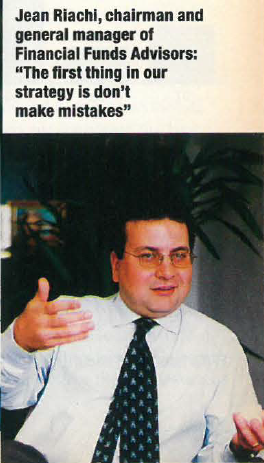
No analyst doubts that Solidere shares will benefit; investors expect more money to come in to gobble up Lebanon’s prime real estate once there is peace, bringing brighter days to the company’s earnings. An increase in Solidere’s shares would lift the entire market as its market cap alone accounts for about 70% of the Beirut Stock Exchange (BSE). Bank shares might follow. “Even though their earnings are not as good as before, price/earnings ratios are at fair levels,” says Jean Riachi, chairman and general manager of Financial Funds Advisors. “You’ll get an increase.”

But once prices reach higher levels and excitement settles down, will peace support stocks for the medium term, pushing prices higher?

Looking at the fundamentals, investors have to consider how much Lebanon’s economy will benefit from peace. According to Marwan Iskandar, a leading economist, the market will get a decent boost from a deal. He believes tourism will improve once Lebanon, Syria and Israel complement each other as destinations. There is a good chance that Lebanon will normalize its economic relations with Israel in a fairly short period, forcing the private sector to become more competitive, and Arab countries will have more freedom to consolidate their economic policies to create a common market. “The most important change will be a boost of confidence. It will give more incentives for foreign investors to come onto the scene in the Middle East, including Lebanon,” says Iskandar.

Others have doubts about how much Lebanon will benefit. Paul Salem, a development and political analyst, thinks many expats will move money back home. “And the agreement could stimulate renewed interest by the US, Europe, and possibly Japan.” But Salem expects foreign direct investment (FDI) to trickle into Lebanon: “This is a very small country; you’re not talking about India or Egypt.”

Ziad Maalouf, vice president at Middle East Capital Group, is wondering if it will even be a trickle. “Why would there be FDI? We have the highest labor cost in the region, the highest price of land, the highest price of raw materials, energy, water and the highest cost of living. Why would anybody want to build a manufacturing plant here?”

Another analyst doubts that Arab nations will liberalize trade. “Harmonizing those relations never got to what it could have been and Israel was not really in that equation. It’s always been politics before economics in the Middle East. They can eventually pull it off, but it will take time.”

As for normalization between Lebanon and Israel, Salem says: “There might be formal clauses related to normalization and trade attached to the peace agreement, but if documents are signed, I don’t think those in Syria and Lebanon will be very open to it, just as we saw in Jordan and Egypt. I’d expect a cold peace at all levels.”

Maalouf draws a parallel between Jordan after peace and what could happen in Lebanon. “Before Jordan signed, you wouldn’t believe how much excitement there was in the market. But stock prices today are close to where they were when peace arrived. The benefits from peace they were hoping for never materialized.” From 1997 to 1999, Jordan’s GDP growth rate dropped from 2.2% to 0.5%. Despite better business opportunities in Lebanon, Maalouf says Jordan was better prepared. “We have to get our house in order.”

Lebanon is in dire need of administrative and fiscal reform. Debt-to-GDP reached 130% at the end of 1999. The deficit was reduced from 43.73% in 1998 to 42.41% in 1999, but missed its target of 40.5%. The Economist Intelligence Unit predicts that Lebanon will have the slowest growth rate in the Middle East this year.

“The peace agreement will not go down to the bottom line right away,” says Salem. “I’m optimistic in a limited, cautious way. You’ll have a country that’s not at war. It’s an essential building block for economic development and important for any investor who’s thinking of investing in Lebanon.”

Investors are still waiting for BSE reform. Riachi says open trading and a regulatory body are essential. “We have to have a real market to see stocks move.” He predicts that after an initial jump in prices, stocks will level off until investors see more positive results. A building block will be a good start, but it’s difficult to predict what will happen after the flurry.

February 28, 2000 0 comments
0 FacebookTwitterPinterestEmail
Money Matters

Quantitative Viewpoint

by Richard Bernstein & Kari Bayer February 28, 2000
written by Richard Bernstein & Kari Bayer

Relative breadth was again very narrow

Perhaps the most influential variable in determining the success or failure of a portfolio manager is the relative breadth of the market. This measure is not the absolute breadth used by technicians, the number of stocks up versus the number of stocks down; it is the percent of the S&P 500 companies that outperform the index. For example, if 300 companies in the S&P 500 outperformed the index in a given year, then the relative breadth would be 60%.

Normally, about 43% of the stocks in the S&P 500 outperform the index during a calendar year, based on data from 1986 to 1999. If we exclude 1998 and 1999, however, that figure rises to 45%. Note that the odds are still skewed against managers. That means that managers had only slightly better than a one-in-four chance of picking an outperforming stock. Multiply those odds by a 25- or 30-stock portfolio, and it becomes quite clear why most managers underperformed in 1998.

In 1999, the relative breadth increased to only 31%. Obviously 1999’s relative breadth was not as narrow as 1998’s, but it was still extraordinarily low. In fact, 1998 and 1999 were the two narrowest years in the last 14 when using our measure of relative breadth.

Little skill needed in 1999 to pick outperforming technology stocks

Although the relative breadth of the overall market was extraordinarily narrow again in 1999, the relative breadth of the Technology sector was extraordinarily high compared to that of various other economic sectors. This means it took very little stock-picking skill to invest in a technology stock that outperformed the S&P 500 during 1999.

Nearly 70% of the stocks in the Technology sector outperformed the S&P 500 during the year. That implies one could have figuratively “thrown a dart” at a universe of Technology stocks to pick a winner for the year, and that the skill needed to pick a winner was relatively small when compared to the skill necessary to pick outperformers in a number of other sectors.

This may explain why there has been a trend among individual investors to shift away from managed funds to self-trading. Individuals have focused primarily on the Technology sector. Our guess is they attribute their success to their superior skill relative to the diversified fund manager rather than to chance. Our guess is also that few compare their performance to Technology indices or Technology funds.

The percent of the companies that outperformed the market in the Basic Industrial sector was the closest to the Technology sector’s, and it was only 51%. Thus, while the probability of picking a stock that outperformed the S&P 500 from the Technology sector was roughly 70%, the best that one could have hoped for in a sector outside of Technology was 50/50.

The probability of picking an outperforming stock was amazingly low in certain sectors. For example, investors looking at Financial or Consumer Cyclical stocks had roughly a four-out-of-five probability of picking up a stock that would underperform the overall market. But investors in Consumer Staples stocks had a 92% probability of picking a loser.

We wrote a report several years ago highlighting that managers were going to have a difficult time outperforming during the second half of the 1990s if the profits cycle continued to decelerate. Market leadership tends to narrow when the profits cycle decelerates because the market becomes extremely “Darwinistic.” Only the fewer and fewer companies that can continue to grow their earnings tend to outperform during such periods, while the performance of the companies whose earnings suffer lags.

That description certainly fits 1998 because the profits cycle decelerated for the fourth straight year. However, that does not help one understand why there was narrow leadership in 1999 because the profits cycle actually re-accelerated. Typically, when that happens, both relative and absolute breadth widen.

We continue to believe that 1999’s narrow leadership was the result of a speculative bubble in the “Nifty 50” and Internet stocks. Both interest rate and earnings fundamentals during the year did not support their outperformance. See “Ignoring the Catalyst,” Quantitative Viewpoint, December 15, 1999. We expect relative breadth to widen in 2000, and expect an increasing number of active managers to outperform their bogeys.

C&Ds and relative strength were the best performers for 1999

If we look at the annual performance of the roughly 45 strategies that we regularly monitor, the best performer for 1999 was our C&D Index, which was up more than 71% for the year. It was the strongest year for lower-quality stocks since 1991, when the C&D Index was up more than 90%.

The second-place finisher for 1999 was our Relative Strength Model, and it was up 64.3%. It should not be surprising to most investors that this particular model performed so well, given the “Nifty 50” environment that was so pervasive during the year.

Third- and fourth-place finishers should also be no surprise: High Five-year Projected Growth (+60.6%) and High Beta (+60.3%). Technology stocks are often characterized as high-growth, high-beta stocks, so it seems natural that these strategies should perform well during a year in which Technology dominated the market’s performance.

The two worst-performing strategies were our A Index and High Dividend Yield. This makes sense given that the A Index typically has the highest dividend yield of any of our proprietary “Quality” Indices. The A Index was down 6.5%, and High Dividend Yield was down 7.7%.

If one negates the “Nifty 50” effect, as our “Quality” Indices do by nature of their equal-weighted construction, then equity market performance in 1999 did indeed reflect that the profits cycle was re-accelerating. Lower-quality stocks handily outperformed higher-quality ones. The constituents of our “Quality” Indices are equal-weighted, and thus, 1999’s “Nifty 50” effect is somewhat negated by their construction, i.e., large-capitalization stocks and small-capitalization stocks have the same influence on the index’s performance.

Thus, our B+ and A- Indices performed relatively poorly despite the fact that many of the “Nifty 50” Technology stocks are contained in those indices.

GARP: growth at a reasonable ridiculous price

The Alpha Surprise Model is a GARP-based, growth at a reasonable price, strategy, and has historically been one of our most popular stock selection strategies. The model has outperformed the S&P 500 ten out of the last 13 years. As a blend of growth and value, it has been able to outperform during “growth” markets and “value” markets.

Given the narrow leadership of the market the past two years, it has become increasingly difficult for our strategy to outperform. It appears that growth at a reasonable price has been replaced by growth at a ridiculous price.

In 1999, our Merrill Lynch vs. Consensus Positive Earnings Surprise Model was up 20.6% compared to the S&P 500, which was up 19.5%. This performance was particularly impressive because we equal-weight the model’s portfolios, and hence the model only had a 31% chance of outperforming the S&P. This model comprises 75% of the Alpha Surprise Model.

The Dividend Discount Model, which comprises the other 25% of the Alpha Surprise Model**,** was up a mere 4.2%. This is not surprising, given that most value-oriented strategies performed poorly during the year.

However, adding just 25% value to an outperforming strategy in a market that does not care about valuation killed the overall Alpha Surprise Model’s performance. The Alpha Surprise Model was up 8.4%, underperforming the S&P 500 by 1,110 basis points.

Further demonstrating the efficacy of our EPS Surprise Model, our Merrill Lynch vs. Consensus Negative Earnings Surprise Model was among our ten worst-performing strategies in 1999. The model was up 3% for the year. However, adding 25% overvaluation or using the bottom S&P 500 companies by Alpha Surprise Model, one would have outperformed our traditional Alpha Surprise Model by 62 basis points.

Searching for overvalued stocks in 1999 appeared to be a good idea. As mentioned, our top-performing strategy last year was our C&D Index. It was up 71.4% and its current portfolio trades at 70 times current-year earnings. Our second-best-performing strategy was our Relative Strength Model. This model was up 64.3% and its portfolio trades at 87 times current-year earnings.

The “Nifty 50” by market capitalization, which we have been underweighting since the end of April, was up 20.1% in 1999 and currently trades at 78 times earnings. In contrast, the “Not-So-Nifty 450” was up only 7.7% in 1999 and trades at a relatively mere 26 times current-year earnings. Based on the performance of our Dividend Discount Model and the “Not-So-Nifty 450,” it actually hurt managers to search for undervalued stocks in 1999. This is an important point for GARP managers who may have underperformed this year.

We expect 2000 to be a better year for active management

As we have repeatedly stated, the more optimistic one is about the rejuvenation and expansion of the global economy, the more one should emphasize active management over passive management of one’s bogey. Active managers have had difficulty outperforming their benchmarks not because they suddenly became idiots, but rather largely because of the global deflation and recession, and the resulting decelerating profits cycles. As stated, market leadership tends to narrow when profits cycles decelerate, and markets become very “Darwinistic.” The narrower the leadership, the lower the probability that an active manager will outperform.

We expect global profits cycles to continue their present upturns. Accordingly, we believe that 2000 will be a better year for active managers. The time to index and constrain tracking error was in 1995. Today, investors should be encouraging managers to deviate from their benchmarks.

February 28, 2000 0 comments
0 FacebookTwitterPinterestEmail
Money Matters

The numbers – issue #10

by Executive Contributor February 28, 2000
written by Executive Contributor

SOLIDERE

Solidere’s GDR found itself the beneficiary of positive investor expectations upon news of the planned resumption of peace talks between the Syrians and the Israelis. Even though the real estate giant faced some unnecessary bureaucratic knots, which resulted in delays on its projects, the GDR was buoyed by prospects of peace talks that might generate capital inflows into the real estate sector. The GDR reinforced vital signs of revival as it inched up steadily from December 15’s close of $6.950 to close on January 12 at $8.475, a 21.90% increase in a one-month period.

BLC

On December 23, Banque Libanaise pour le Commerce held a General Assembly to discuss the merger with the United Bank of Lebanon (UBL).

The Assembly revealed a net loss of $4.3m in 1998, well below the $11.7m profit announced earlier and the $15.9m profit in 1997. The discrepancy between the two was the result of a sharp increase of $16.5m in the provisions for doubtful loans to $24.1m. BLC’s GDR had a very volatile month, falling to $13.25, only to rise back again to $13.35 after the turn of the millennium. On January 6, the GDR hit a low of $12.83.

BLOM

In mid-December, Banque du Liban et d’Outre-Mer SAL announced the launch of a new interactive banking voice response system called ALLOBLOM, a 24-hour-a-day service that facilitates banking transactions and information inquiries. BLOM’s GDR was the main highlight of the month: it soared to $28.5 on the back of strong demand supported by sound fundamentals and good value, with a P/E ratio on expected 1999 earnings of 7.33. With the publishing of its full-year 1999 figures, BLOM is expected to further consolidate its position as Lebanon’s most profitable bank.

AUDI

Bank Audi’s announcement that it was to buy back two-thirds of its outstanding GDRs at $20.75 and the Central Bank’s authorization of this plan were two events, the very first of their kind in Lebanon, to promote a certain degree of liquidity and confidence. Audi’s GDR was subject to an initial rise directly after the bank’s announcement. However, soon afterwards, the GDR retreated back to its static price of $20.3 and then managed to inch up just a little to close finally on January 12 at $20.6.


MOROCCO

Moroccan equities started the new year on a hesitant note, with institutional investors remaining largely on the sidelines. However, investors are looking ahead into the year, when GDP is expected to pick up to around 6% from almost zero growth for 1999. The new five-year plan, recently released by the government**,** is likely to promote more economic diversification, reduce the country’s dependence on the agriculture sector, and tackle the high unemployment level. Achieving higher economic growth will spur more activity on the equity market, while the next phase of the state privatization agenda is likely to boost liquidity levels.

EGYPT

The Egyptian market continued its bull run into the second week of the year, registering further gains on the back of healthy earnings results in the telecom sector and consolidation news in the cement sector. Market leader MobiNil announced that its 1999 fourth quarter (Q4) net profit rose 45% to EGP90.4 million ($26.3 million) from EGP62.5 million in Q3, with full-year results amounting to EGP140.8 million on EGP1.5 billion in revenues. Sentiment on the bourse was also boosted by Suez Cement’s bid to buy a 65% stake in Tora Portland Cement for an amount of EGP1.4 billion, or EGP80 per share. The banking sector was also buoyant, boosted by news that a new law on mortgages was being drafted.

JORDAN

Despite easing monetary policy and lower interest rates on JD deposits, the Amman Stock Exchange continued to suffer from thin liquidity, with prices losing ground in the first two weeks of the year. Equity prices have barely moved since last November, when the market witnessed an extraordinary rise. However, the market is expected to witness an increase in fund flows as valuations reach attractive levels and new privatization deals come to the market. This is expected to be supported by growth in the construction and tourism sectors and new automated trading at the ASE from the second quarter of 2000.

Interest rate differentials between Arab currencies and the dollar on the decline

Historically, there has been a certain spread between domestic and dollar interest rates in Arab countries whose currencies are pegged to the dollar. The spreads fluctuated over time and varied from one country to another depending on economic fundamentals, size of foreign reserves, inflation differential with the US, and markets’ assessment of the risk of devaluation. The availability of such spreads helped preserve the attractiveness of local currencies and provided support to their fixed dollar pegs. Improvement in a country’s economic fundamentals invariably made it possible for the monetary authorities to steer domestic interest rates lower, closer to those on the dollar. However, there is a limit to how much interest rate differentials can be reduced without threatening the fixed dollar peg. A spread is needed to compensate holders of local currency for the higher risk incurred, both actual and perceived, when holding that currency.

Interest rates on the Jordanian dinar (JD) have been maintained at relatively high levels since 1996 to help bolster monetary stability and support the peg to the US dollar that was officially introduced in October 1995 at $1.41 to the JD. However, the slowdown of economic activity in the country, coupled with a strong build-up in foreign reserves, allowed the central bank to shift to an expansionary monetary policy. Rates on three-month certificates of deposit (CDs) assumed a declining trend in 1999, dropping to an average of 6.025% in November, from 9.45% in January. As a result, the differential between three-month Jordanian CDs and three-month US T-bills narrowed from 5.89% in October 1998 to 0.73% in December this year (chart 1). It has become evident now that there is no room left for interest rates on JD deposits to drop further as the spread on US treasuries is now way below the historic 3% level. On the contrary, if, as expected, dollar rates continue to rise, the corresponding JD rates are likely to follow suit.

Interest rates have also been trending lower in Lebanon amidst regained confidence in the Lebanese pound and a noticeable slowdown in economic activity. Rates on three-month Lebanese T-bills declined to 11% by the first week of December last year from an average of 12.7% in 1998, 13.4% in 1997, and 15.2% in 1996. The spread between Lebanese three-month bills and their US counterparts now stands at 5.89%, compared to 7.3% in January 1999 and a high of 20% in September 1995 (chart 2). Not much room is left for short-term interest rates on the Lebanese pound to drop as the spread with corresponding dollar rates is approaching the critical 5% level deemed necessary by market participants to compensate investors for the risk they incur in holding the local currency, given the surging indebtedness of the Lebanese economy.

In Egypt, rates have also followed a downward track over the past few years, albeit at a slower pace than in Lebanon and Jordan. The three-month T-bill rate was lowered from 10.2% in 1996 to 9.8% in 1997, 9.4% in 1998, and 9.1% in June this year. The pressure on the Egyptian pound in the foreign exchange market, particularly in light of the widening external imbalance, saw domestic interest rates edging slightly higher in the past few months. The country’s foreign reserves dropped to $17.5 billion from more than $20 billion at the beginning of the year. If the new government regains credibility in the foreign exchange market and the privatization process picks up momentum, leading to higher levels of foreign direct and portfolio investments, then the spread between Egyptian pound and dollar interest rates has room to tighten further.

Other countries in the region have also witnessed a decline in interest rates. In Morocco, deposit rates dropped from 12.3% in 1994 to 7% by the first week of December 1999. Tunisian rates were down from 8.8% to 5.9% during the same period.

In Gulf countries, domestic interest rates rose in the first quarter of 1999, even though dollar rates were stable. Interest rate differentials between Saudi riyal and dollar deposits rose from a low of 0.35% in January 1998 to a high of 1.95% in March 1999. The widening spreads were a reflection of heightened speculative pressure against the riyal at a time when oil prices were on the decline. With the rise in oil prices later in the year, speculative pressure on the Saudi riyal subsided and by December 1999, Saudi riyal-dollar interest rate differentials shrank to 0.3%. During periods where there is little or no speculation against the Gulf currencies, interest rates on local currency deposits tend to move in tandem with corresponding dollar rates.

February 28, 2000 0 comments
0 FacebookTwitterPinterestEmail
Executive Living

Discover Clos St. Thomas

by Executive Contributor February 28, 2000
written by Executive Contributor

Deep in the Bekaa Valley lies one of Lebanon’s newest vineyards, Clos St. Thomas winery.

More than $4 million has already been injected into the enterprise, but it’s evident that things aren’t finished yet. Giving EXECUTIVE a tour of the place was owner Said Tanios Touma, his three daughters, and winemaker Labib Kallas. Walking around outside, Touma points to a piece of land being prepared for a new vineyard, another earmarked as a garden for picnics, a quaint chapel still under construction, and an unfurnished reception area for banquets. Producing the fine wines is foremost, but Touma’s vision includes making the Clos St. Thomas winery a tourist haven and venue for events such as weddings and baptisms.

Nathalie Touma, the company’s marketing manager, showed me one of the vineyards. “We have about 40,000 plants, and we are planning to expand,” she says. All you can see, however, is bare soil; last year’s crop has long since been harvested and the land won’t be replanted until next month. “We have around 13 types of grapes, including new varieties imported from France,” she adds. The French varieties imported include Cabernet Sauvignon, Cinsault, Carignan, Clairette, Grenache blanc and Grenache rouge.

The next stop is at the winery’s not-yet-finished bistro and shop inside the main building. Here visitors can sit back, sample the wines, and buy their favorite. Four Clos St. Thomas wines are presently available, produced from the 1998 harvest. There is a white, a rosé, and two red wines. One of the red wines, Cuvée des Emirs, sells for $7.50. The other three are all priced at $4.50. Cuvée des Emirs has a subtle vanilla bouquet, and is of a superior quality because it was aged in new French oak barrels for six months. “You can smell oak’s aroma in wine, in its bouquet,” says Kallas, who studied the art of winemaking in Bordeaux. The three other wines were aged in stainless steel vats.

In the cellar, we sampled last year’s harvest, from one huge stainless steel vat to another, distinguishing the fruity notes from the floral or spicy. Most of these wines will be ready for marketing this year, but some will take longer to age and will not be on the market until 2001. The wines aging in the 120 oak barrels lining the cellar floors, being of a superior quality, will not be out in the market for another two years. On top of one of the many huge stones enclosing the cellar is a pile of bottles in which wine is aging. It is a dessert wine that, once ready, must be sold within a year. “We are not going to sell it on the market, only at the winery, because we have a limited quantity of only about 2,000 bottles,” says Nathalie Touma.

This particular wine should be available at the winery’s shop in the summer. “Next year, with the harvest of 1999, we will have three types of red,” says Touma. One learns quickly in this business that patience is indeed a virtue. The winery’s first wines, from the 1998 harvest, were only introduced onto the market two months ago. “We are working now on marketing,” and that, she says, will be difficult.

Along with newcomers Massaya and Wardy, Clos St. Thomas is trying to break into a market dominated by well-established names like Kefraya, Ksara, Musar, and Nakad. Touma isn’t discouraged. “We are confident that we’re going to make it, we’re going to be one of the best wines in Lebanon.”


Preserving the Orient

Shopping for Oriental crafts and antiques in the village of Qalamoun.

Visualizing an Oriental decor for your new home but unsure of where to shop for typical Middle Eastern wares made of brass, copper, and silver? Instead of randomly scouting around Beirut for artisans’ shops, consider a shopping excursion to the northern village of Qalamoun. This small coastal village, 8km south of Tripoli, is famous for artisans who continue to preserve Middle Eastern culture through their crafts. Conveniently located alongside Qalamoun’s single main street are seven artisan shops. Salim Hassoun, owner of Oriental Exhibition, says his father introduced the crafts to Qalamoun more than 50 years ago. Today Hassoun and his six brothers continue the crafts taught to them by their father. In fact, along with a few cousins, the shops are all owned by Hassouns.

Qalamoun is mainly associated with brass- and copperware, with a wide choice of brass and copper urns and flowerpots on offer. In Salah Hassoun’s shop, The Arabian Antique, his two sons sit hunched over, carefully etching verses from the Koran into brass plaques. Typical brass Turkish coffee pots sell well, serving both practical and decorative purposes. Generally, four sizes are available, priced from $20 to $40.

At Oriental Exhibition, the most popular items with customers are silver-plated houseware, such as trays, dessert bowls, water pitchers, ice buckets, platters, and candelabras. These items are all handmade in copper and silver-plated, yet prices on any given item can vary depending on the quantity of silver used. For example, a medium-sized tray with 1,200 microns silver costs $30. The identical tray with 1,800 and 2,500 microns silver costs $45 and $60 respectively. Similarly, a set of 12 silver-plated dessert bowls with saucers costs $150. The same set with more silver costs about $400.

Not to be overlooked is the wide selection of Oriental-style chandeliers hanging in every shop. Prices vary depending on size, workmanship, materials, and age. A small basic design in brass costs about $150. Larger, more elaborately designed chandeliers incorporating other materials such as stained glass and beads cost between $1,500 and $2,500. One of the more outstanding pieces at Oriental Exhibition is priced at a cool $15,000. A grand and intricately designed silver chandelier, Hassoun claims it is 250 years old.

Antique hunters can find other relics of Middle Eastern heritage in the shops in Qalamoun. Look upstairs at The Arabian Antique, where dust has settled on the small treasures on shelves and walls. In Oriental Exhibition stands an exquisite wooden chest, inlaid with ivory and mother of pearl in the typical Levantine design. About 110 years old, the asking price is $2,500. If antique swords are your preference, a few can be found. From atop a cluttered shelf Hassoun retrieved a sword he claims is 350 years old. Its rounded wooden handgrip is elegantly crafted, and its gold-plated sheath elaborately carved. This sword can be yours for $4,500. If the price is beyond your budget, smaller replicas are available for about $75.

At The Oriental Show is another enchanting discovery, an antique phonograph. The shop’s owner, Mahmoud Hassoun, claims that it’s 130 years old and is asking $1,200 for it. A faded stamp bearing a brand name can still be seen on its wooden box. Still resting on the phonograph is a record that Hassoun says is 70 years old. He cranks the machine, which still works, and from the record comes the scratchy sound of a female vocalist singing in Arabic. There is no year on the record’s label to confirm its age, it only indicates that the singer is from Syria and called Bahia al-Biba.

Qalamoun is not known for furniture, but a small selection is available at The Oriental Show. Mahmoud Hassoun creates typical Oriental wooden furniture decorated in a mosaic style. One of his more interesting designs is a coffee and gaming table, fitted with changeable boards for backgammon, chess, and cards. The table comes with two chairs and two small side tables, the complete set costing $950.

If the prices seem steep, don’t be put off. Inexpensive trinkets and souvenir items are also available, from key chains priced under $5 to jewelry boxes and backgammon sets inlaid with typical mosaic designs. Again, prices on jewelry boxes vary depending on materials used, a small box inlaid with plastic is about $8, while the same size inlaid with mother of pearl costs about $35. Don’t expect to see price tags, prices are quoted upon inquiry and are often overpriced, as haggling is anticipated.

Other places to visit if you’re on the lookout for Oriental handicrafts

• Tripoli: Visit the old souks in this northern city for brass and copperware.

• Jbeil: Famed for its historic harbor and archaeological ruins, check out the old souk area for woven and embroidered goods.

• Zouk Mikhael: 14km north of Beirut, stores at the old souk offer a wide selection of embroidered fabrics and tapestries.

• Beiteddine: 50km southeast of Beirut, this village is famed for its palace, but is also noted for weaving and embroidery.

• Sarafand: 19km south of Sidon; after lunching at one of the popular fish restaurants, shop around for blown glass items in different colors.

• Jezzine: 80km south of Beirut; on the edge of the occupied zone, this village is famous for cutlery made of stainless steel and animal horn and inlaid with colored ivory.

• Baalbek: 90km east of Beirut; after visiting the Roman ruins, check out the indigenous carpets.

February 28, 2000 0 comments
0 FacebookTwitterPinterestEmail
Executive Living

The Rover’s Return

by Natacha Tohme February 28, 2000
written by Natacha Tohme

Coming from a former British colony in the Caribbean, this writer naturally has a penchant for anything “Made in England.” So when the decision came to buy a car last year, tradition swayed me, the Rover 200. However, I was soon baffled at the reaction of my friends, who questioned the purchase. How could they not appreciate the craftsmanship, or at the least the reputation, of a distinguished British marque? There was a logical explanation. Since the early 1980s, when Honda bought into Rover and began building its cars, Rover’s identity became entwined with that of the Japanese auto manufacturer. Rover was still marketed and priced as a premium British brand, but its engineering and design were basically identical to that of Honda cars. It proved a failing formula, and Rover’s image and market presence worldwide floundered, save for its sister marques of Land Rover and Range Rover.

Patrick Antonia, marketing manager of Avianco, Rover’s local distributor, says another element contributed to Rover’s decline in Lebanon. In the late 1970s Rover began equipping its cars exclusively with engines that ran on unleaded fuel, unavailable in Lebanon until the early 1990s. “So while others were importing cars, we weren’t. And for about 15 years Rover wasn’t present in the market at all.”

In 1994 Avianco reintroduced Rover into Lebanon. The first units to enter the market were the Honda-conceived cars, such as the Rover 800 and the old 200. They were by all accounts reliable cars, but didn’t exactly sell like hotcakes. Already limited in production, Rover cars cost 25-30% more than comparable Honda models.

“The cars didn’t have the brand value of a Rover yet, so we didn’t have a good tool to successfully launch it into the market,” says Antonia. “We were missing a Rover identity.”

Avianco did see growth, since 1993 its sales jumped from $6 million to $20 million last year, but that has mainly been due to the Land Rover range of 4x4s, spare parts, and service department. If sales were less than satisfactory, it was with cars, a problem not particular to Lebanon.

On the international scene, Rover’s struggling business prompted the BMW Group to buy out Rover in 1994. Originally limiting its involvement to higher management, the group took over completely in 1998 after Rover endured huge losses. After injecting $1.2 billion into vehicle development, upgrading the factory’s production lines and expanding production, BMW introduced the Rover 75, the first in more than 20 years to be designed and engineered entirely in-house.

At last came redemption. Rover 75 has already racked up a couple of prestigious awards from leading auto journals, naming it 1999’s car of the year. Rover 75 is a luxury saloon reminiscent of the Rovers of the past, ushering in the return of a distinctly British premium brand. Aesthetically, it is mesmerizing, with a tasteful touch of chrome, soft leather, and wood giving the car an elegant appeal. Its 2.5-liter V6 engine is smooth and packs a punch, providing 175 horsepower and high torque, while the electronic five-speed gearbox offers several driving modes. It’s priced between $35,900 and $50,000, depending on the options. “At $35,900 you get a well-equipped car with everything but leather,” says Antonia.

Will Rover 75 be the car to reinstate Rover into the market? BMW and Avianco are banking on it. In November they collaborated, along with Fortune Promoseven, on a lavish launch to re-introduce Rover into Lebanon. “The Rover 75 has the brand value needed to re-establish Rover as a premium car manufacturer,” says Antonia. Since then, 15 have been sold. “This is good for a brand that is perceived as ‘new’,” he says, “considering the economy.” Avianco is aiming to sell “30 to 50 cars in the first year, with a 20-30% increase annually.”

Don’t worry about Rover 75 becoming dated any time soon, the model is expected to continue on “for at least five to six years,” says Antonia. Rovers are known for a long life. “The first Range Rover stayed the same for 25 years, they make small modifications without destroying the image of the car. It makes for good resale value.”

This brings us to the inevitable question: The resale value of Rover cars is not considered good, will this hamper sales? Antonia explains that once Rover is recognized as a premium brand, its resale value will increase. “We’re working on recreating its identity to re-establish the car on the market … by 2003 we will have a very good brand image.”

February 28, 2000 0 comments
0 FacebookTwitterPinterestEmail
Money Matters

Profit diversification

by Executive Contributor February 28, 2000
written by Executive Contributor

Lebanon’s heavies in the banking industry are starting to release their 1999 profits, giving hodgepodge results. Bank of Beirut and Banque du Liban et d’Outre-Mer (BLOM) came out with fine performances, earnings up 27% ($18.1 million) and 20% ($70.4 million) respectively. BLOM proved again that its conservative approach to banking can withstand the pressures of the economic slowdown and the tightening of the spreads as interest rates continue to decline. Along with BLOM’s loan-to-deposit ratio being low, its clients are mostly high-net-worth corps, which has brought its doubtful loans down to 6.27%, one of the lowest in the sector. It also aims well at cost control. From 1995 to 1999, its cost-to-income ratio has dropped from 56.8% to 38.3%, again one of the lowest in the banking industry. Additionally, it has the advantage of having the image of being a very safe bank: It is able to attract customers with low deposit rates, which maintain good deposit growth and a healthy spread.

“We are confident that we will achieve better profits this year,” says BLOM’s general manager Samer Azhari. He claims that BLOM’s track record of withstanding the pressure of economic slowdown and the steady drop in interest rates shows that the bank can continue healthy earnings growth.

But the harsh conditions have affected two leading banks. Byblos Bank ended up with its earnings flat ($49.8 million), while Banque Audi’s profits dropped 11.3% ($38.1 million) last year. Audi’s profit decline comes not only from economic pressure but from its aggressive expansion in retail banking and branch network. Audi opened 13 new branches in 1999, reaching 55, and has plans to open 12 more this year, which will put it way ahead of its competitors. “Audi has a strong management team and will benefit long-term,” says Fidus’ deputy general manager Rudy Sayegh. “But there is a price to pay to be the top innovator in products and services and expand rapidly with branches. This will pay off when the economy recovers, but when the economy improves is unclear.”

Reluctant MPT

The Ministry of Post and Telecommunications (MPT) is now the state’s second-largest source of government revenue after customs taxes, reporting $539 million in returns for 1999, a 37% increase over 1998. Largely responsible for the increase is the MPT’s ban on international calls made over the Internet and the tax hike on cellular calls. International calls increased 99% from 1998, bringing in $124 million, while the ministry collected $109.5 million in dues from international telecom firms.

The MPT also sold 110,000 fixed lines last year and restated its right to issue a third license for a cellular operator in 2002. Other plans for the medium term include setting up an independent telecommunications company, Liban Telecom, which will be 25% privatized. The draft law to create Liban Telecom is still in progress, and as yet the listing of the company’s shares is undecided, as well as whether to list the company’s shares on the Beirut Stock Exchange or sell them to a single strategic investor.

The ministry was also unclear on whether it will maintain management or give it over to the private partner. Says Lebanon Invest’s Nassib Ghobril, “Telecom is one of the government’s biggest revenue generators, so it’s a very sensitive and strategic sector.”

On the other hand, the government has also been slow in privatizing losing operations like Middle East Airlines. An analyst claims that the controversy of privatization is that it would result in layoffs of politically affiliated employees.

Upswing

Solidere can breathe a little more easily in 2000. After making losses of $435,000 for the first six months of 1999, the real estate company scraped into the black by year-end. Solidere’s white knight was Selim Kheireddine, chairman of Al-Mawarid Bank, who authorized the last-minute purchase of land and buildings for a reported $10 million in the Beirut Central District, near the site where Banque Audi’s new head offices are being built.

Solidere shareholders also have something to be happy about. After falling to a low of $6 per share in November, anticipation of a peace settlement pushed up Solidere stock 40% by January 24.

But still in disagreement over compensation terms are former BCD property owners and Solidere. In a development that may hinder the former, the government has closed the Concorde offices in Hamra, where the claimants’ cases were previously assessed before the largest and last properties were evaluated in an attempt to cut costs. “It was costing around $210,000 to keep those offices,” says Muhammad Mugraby, the lawyer handling the cases for the claimants. “The move is mainly in the best interests of the government.”

Meanwhile, Solidere reports that it has completed the final phase of the infrastructure work as well as finishing renovation work on 90% of the old buildings in the downtown area. They are continuing advanced work on the Saifi residential project, which they expect to complete by summer of 2000, disclosing that 35% of the units have already been leased. While all work on the second sea defense wall has been completed, the first is still only halfway done, though Solidere expects to finish it by the coming spring. This will make the reclamation of 608,000 m² of land for office and residential space and another 70,000 m² for a public park possible.

Let it slow, let it slow, let it slow

The Economist Intelligence Unit (EIU) recently forecast that the Middle East and North Africa region will have the second highest growth rate (3.5%) in the world due to the increase in oil prices. Its report on Lebanon, of course, has not been so favorable. EIU’s annual World Outlook report expected the Lebanese economy to grow at a low 0.5% rate this year, up from -1% in 1999, making it the slowest growth rate of any Arab country in 2000. Projected growth rates for other countries include Tunisia at 6.5%, Morocco at 6.3%, Egypt at 5.6%, the United Arab Emirates at 3.5%, Kuwait at 2.8%, Jordan at 2.5%, Syria at 2.3%, and Saudi Arabia at 2%.

In tune with Lebanon’s poor growth rate, the country’s vital statistics don’t look good. Government expenditures in 1999 reached $5.608 billion, with just $3.23 billion in revenues. The result is a budget deficit of 42.41% of expenditure, 2% short of the government-budgeted target but marginally lower than the 1998 deficit of 43.73%. The monthly deficit was 33.14% in December, up from 31.4% in November but down from 62.75% in December 1998. Expenditures increased by 6.92% over the previous year, and revenues by 9.41%. On the flip side, revenues from taxes on income and profit rose by 28% following tax hikes in the budget for 1999, while property tax revenues increased by 55%. The Ministry of Finance maintained that the aggregate revenues from direct taxes were 13.3% above expectations.

The M&A treat

Word has it that Jordan National Bank (JNB) will acquire Bank of Lebanon and Kuwait (BLK), a local bank that is owned by Lebanese and Kuwaiti investors. The acquisition would move JNB, already doing business in Lebanon, up to a medium-sized bank with nine branches and total assets of $200 million after absorbing BLK’s $87 million in total assets, which pulled in $1.2 million in earnings in 1998. If the deal is finalized, JNB, based in Amman, Jordan, will follow London-based Standard Chartered, which purchased a local financial institution just recently. In late 1999, Metropolitan Bank was scooped up by Standard, which bought a 75% stake.

But Schroders corporate finance manager Spiro Youakim says this is not the beginning of a wave of foreign banks buying out locals. He points out that Standard Chartered is simply returning, it left Lebanon in the early 80s, and JNB is enlarging its presence in the country, having already developed familiarity with the market. Most foreign banks that have an interest in Lebanon would like to see economic conditions improve before making an attempt to acquire local banks, adds Youakim.

However, most analysts believe that mergers and acquisitions between local banks will accelerate. Lebanon’s economic slowdown has put pressure on banks’ profits, down 3% on average earnings for the first three quarters among 13 leading banks. Interest rates on the way down and stiff competition in a saturated market have put a squeeze on spreads, also putting a dent in the sector’s profitability. “Small banks will not be able to withstand these conditions for a long time,” says Youakim. He expects small to medium-sized banks to be more open to M&As in 2000, and even though the central bank is against larger financial institutions merging in the near future, banks in the top tier will probably negotiate with each other as well.

February 28, 2000 0 comments
0 FacebookTwitterPinterestEmail
  • 1
  • …
  • 695
  • 696
  • 697
  • 698
  • 699

Latest Cover

About us

Since its first edition emerged on the newsstands in 1999, Executive Magazine has been dedicated to providing its readers with the most up-to-date local and regional business news. Executive is a monthly business magazine that offers readers in-depth analyses on the Lebanese world of commerce, covering all the major sectors – from banking, finance, and insurance to technology, tourism, hospitality, media, and retail.

  • Donate
  • Our Purpose
  • Contact Us

Sign up for our newsletter

    • Facebook
    • Twitter
    • Instagram
    • Linkedin
    • Youtube
    Executive Magazine
    • ISSUES
      • Current Issue
      • Past issues
    • BUSINESS
    • ECONOMICS & POLICY
    • OPINION
    • SPECIAL REPORTS
    • EXECUTIVE TALKS
    • MOVEMENTS
      • Change the image
      • Cannes lions
      • Transparency & accountability
      • ECONOMIC ROADMAP
      • Say No to Corruption
      • The Lebanon media development initiative
      • LPSN Policy Asks
      • Advocating the preservation of deposits
    • JOIN US
      • Join our movement
      • Attend our events
      • Receive updates
      • Connect with us
    • DONATE