
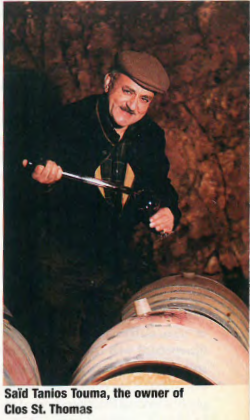
Deep in the Bekaa Valley lies one of Lebanon’s newest vineyards, Clos St. Thomas winery.
More than $4 million has already been injected into the enterprise, but it’s evident that things aren’t finished yet. Giving EXECUTIVE a tour of the place was owner Said Tanios Touma, his three daughters, and winemaker Labib Kallas. Walking around outside, Touma points to a piece of land being prepared for a new vineyard, another earmarked as a garden for picnics, a quaint chapel still under construction, and an unfurnished reception area for banquets. Producing the fine wines is foremost, but Touma’s vision includes making the Clos St. Thomas winery a tourist haven and venue for events such as weddings and baptisms.

Nathalie Touma, the company’s marketing manager, showed me one of the vineyards. “We have about 40,000 plants, and we are planning to expand,” she says. All you can see, however, is bare soil; last year’s crop has long since been harvested and the land won’t be replanted until next month. “We have around 13 types of grapes, including new varieties imported from France,” she adds. The French varieties imported include Cabernet Sauvignon, Cinsault, Carignan, Clairette, Grenache blanc and Grenache rouge.
The next stop is at the winery’s not-yet-finished bistro and shop inside the main building. Here visitors can sit back, sample the wines, and buy their favorite. Four Clos St. Thomas wines are presently available, produced from the 1998 harvest. There is a white, a rosé, and two red wines. One of the red wines, Cuvée des Emirs, sells for $7.50. The other three are all priced at $4.50. Cuvée des Emirs has a subtle vanilla bouquet, and is of a superior quality because it was aged in new French oak barrels for six months. “You can smell oak’s aroma in wine, in its bouquet,” says Kallas, who studied the art of winemaking in Bordeaux. The three other wines were aged in stainless steel vats.
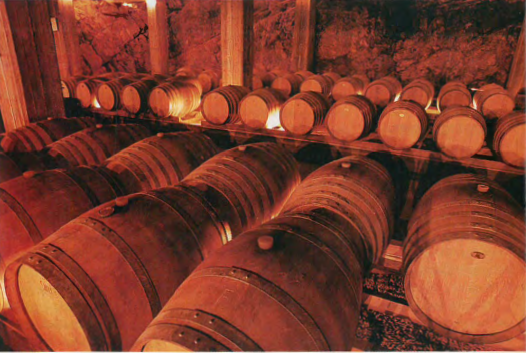
In the cellar, we sampled last year’s harvest, from one huge stainless steel vat to another, distinguishing the fruity notes from the floral or spicy. Most of these wines will be ready for marketing this year, but some will take longer to age and will not be on the market until 2001. The wines aging in the 120 oak barrels lining the cellar floors, being of a superior quality, will not be out in the market for another two years. On top of one of the many huge stones enclosing the cellar is a pile of bottles in which wine is aging. It is a dessert wine that, once ready, must be sold within a year. “We are not going to sell it on the market, only at the winery, because we have a limited quantity of only about 2,000 bottles,” says Nathalie Touma.
This particular wine should be available at the winery’s shop in the summer. “Next year, with the harvest of 1999, we will have three types of red,” says Touma. One learns quickly in this business that patience is indeed a virtue. The winery’s first wines, from the 1998 harvest, were only introduced onto the market two months ago. “We are working now on marketing,” and that, she says, will be difficult.
Along with newcomers Massaya and Wardy, Clos St. Thomas is trying to break into a market dominated by well-established names like Kefraya, Ksara, Musar, and Nakad. Touma isn’t discouraged. “We are confident that we’re going to make it, we’re going to be one of the best wines in Lebanon.”
Preserving the Orient
Shopping for Oriental crafts and antiques in the village of Qalamoun.
Visualizing an Oriental decor for your new home but unsure of where to shop for typical Middle Eastern wares made of brass, copper, and silver? Instead of randomly scouting around Beirut for artisans’ shops, consider a shopping excursion to the northern village of Qalamoun. This small coastal village, 8km south of Tripoli, is famous for artisans who continue to preserve Middle Eastern culture through their crafts. Conveniently located alongside Qalamoun’s single main street are seven artisan shops. Salim Hassoun, owner of Oriental Exhibition, says his father introduced the crafts to Qalamoun more than 50 years ago. Today Hassoun and his six brothers continue the crafts taught to them by their father. In fact, along with a few cousins, the shops are all owned by Hassouns.
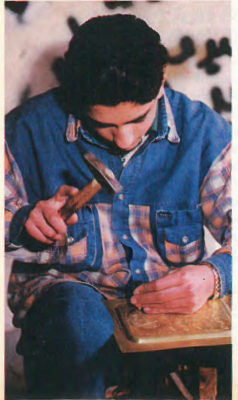
Qalamoun is mainly associated with brass- and copperware, with a wide choice of brass and copper urns and flowerpots on offer. In Salah Hassoun’s shop, The Arabian Antique, his two sons sit hunched over, carefully etching verses from the Koran into brass plaques. Typical brass Turkish coffee pots sell well, serving both practical and decorative purposes. Generally, four sizes are available, priced from $20 to $40.
At Oriental Exhibition, the most popular items with customers are silver-plated houseware, such as trays, dessert bowls, water pitchers, ice buckets, platters, and candelabras. These items are all handmade in copper and silver-plated, yet prices on any given item can vary depending on the quantity of silver used. For example, a medium-sized tray with 1,200 microns silver costs $30. The identical tray with 1,800 and 2,500 microns silver costs $45 and $60 respectively. Similarly, a set of 12 silver-plated dessert bowls with saucers costs $150. The same set with more silver costs about $400.
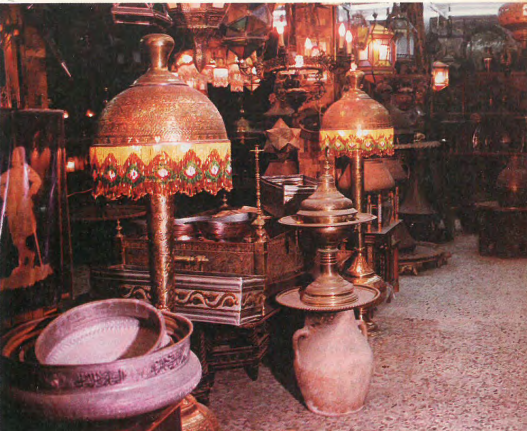
Not to be overlooked is the wide selection of Oriental-style chandeliers hanging in every shop. Prices vary depending on size, workmanship, materials, and age. A small basic design in brass costs about $150. Larger, more elaborately designed chandeliers incorporating other materials such as stained glass and beads cost between $1,500 and $2,500. One of the more outstanding pieces at Oriental Exhibition is priced at a cool $15,000. A grand and intricately designed silver chandelier, Hassoun claims it is 250 years old.
Antique hunters can find other relics of Middle Eastern heritage in the shops in Qalamoun. Look upstairs at The Arabian Antique, where dust has settled on the small treasures on shelves and walls. In Oriental Exhibition stands an exquisite wooden chest, inlaid with ivory and mother of pearl in the typical Levantine design. About 110 years old, the asking price is $2,500. If antique swords are your preference, a few can be found. From atop a cluttered shelf Hassoun retrieved a sword he claims is 350 years old. Its rounded wooden handgrip is elegantly crafted, and its gold-plated sheath elaborately carved. This sword can be yours for $4,500. If the price is beyond your budget, smaller replicas are available for about $75.
At The Oriental Show is another enchanting discovery, an antique phonograph. The shop’s owner, Mahmoud Hassoun, claims that it’s 130 years old and is asking $1,200 for it. A faded stamp bearing a brand name can still be seen on its wooden box. Still resting on the phonograph is a record that Hassoun says is 70 years old. He cranks the machine, which still works, and from the record comes the scratchy sound of a female vocalist singing in Arabic. There is no year on the record’s label to confirm its age, it only indicates that the singer is from Syria and called Bahia al-Biba.
Qalamoun is not known for furniture, but a small selection is available at The Oriental Show. Mahmoud Hassoun creates typical Oriental wooden furniture decorated in a mosaic style. One of his more interesting designs is a coffee and gaming table, fitted with changeable boards for backgammon, chess, and cards. The table comes with two chairs and two small side tables, the complete set costing $950.
If the prices seem steep, don’t be put off. Inexpensive trinkets and souvenir items are also available, from key chains priced under $5 to jewelry boxes and backgammon sets inlaid with typical mosaic designs. Again, prices on jewelry boxes vary depending on materials used, a small box inlaid with plastic is about $8, while the same size inlaid with mother of pearl costs about $35. Don’t expect to see price tags, prices are quoted upon inquiry and are often overpriced, as haggling is anticipated.
Other places to visit if you’re on the lookout for Oriental handicrafts
• Tripoli: Visit the old souks in this northern city for brass and copperware.
• Jbeil: Famed for its historic harbor and archaeological ruins, check out the old souk area for woven and embroidered goods.
• Zouk Mikhael: 14km north of Beirut, stores at the old souk offer a wide selection of embroidered fabrics and tapestries.
• Beiteddine: 50km southeast of Beirut, this village is famed for its palace, but is also noted for weaving and embroidery.
• Sarafand: 19km south of Sidon; after lunching at one of the popular fish restaurants, shop around for blown glass items in different colors.
• Jezzine: 80km south of Beirut; on the edge of the occupied zone, this village is famous for cutlery made of stainless steel and animal horn and inlaid with colored ivory.
• Baalbek: 90km east of Beirut; after visiting the Roman ruins, check out the indigenous carpets.
