The turn of the millennium was overshadowed by what has been dubbed the Y2K bug, or the threat that computers would mistakenly read 00 as 1900 instead of 2000. Its effects promised to be of apocalyptic proportions, ranging from minor computer crashes to global meltdown, wipeouts, and the end of civilization as we know it.
The apocalypse and Y2K became inseparable, to the extent that cult leaders jumped at the opportunity. Their preaching might have come right out of a science fiction piece, the irony of the end of a high-tech century brought about by technology. The creation getting out of hand and destroying its maker. Quite dramatic.
The new year, new century, and new millennium all in one were celebrated with great caution and not much indulgence as a result. Fears of the worst biblical prophecies imaginable sent the superstitious in the United States stocking up on emergency supplies and seeking shelter space.
Instead, nothing happened. Doomsday passed flawlessly in technology worldwide. The world woke up, hung over, to the exact same world of the day before. No significant hardware crashes at the stroke of midnight. No nuclear disasters or demise of the Earth. Not even a complete system crash in some tiny third-world company, except for the minor glitch on Byblos Bank’s homepage indicating that the date was January 1, 2000. Oh, and no apocalypse either.
For the skeptics, the anticlimactic outcome raised some eyebrows. After months of psychological preparedness for the worst, the minor glitches that did later appear were less than satisfactory. But for some, it sparked anger. The Czech president, Vaclav Havel, was reported to have made a threat to expose the United States’ responsibility for the fraud. But those inclined to think that the United States was behind the hoax were reassured halfway into last month. A Y2K-testing mistake caused a Pentagon computer system to malfunction, interrupting the transmission of spy satellites.
Some have dismissed it as a bad practical joke played by the world’s superpower on the rest of the nations. Argentina, whose Y2K expenditure reached $1.5 billion, was on the list compiled by US experts of countries expected to experience a blackout. Angry Argentineans didn’t think too highly of them when lights didn’t even flicker throughout the country. An Australian editor was quoted in The Herald Tribune as saying, “So what was the fuss all about? Can we get a refund?”
Public opinion is now split between those who think the issue was too much hype and resulted in money wastage, and those who don’t. Raymond Khoury, senior IT strategy advisor in the technical cooperation unit at the office of the minister of state for administrative reform (OMSAR), maintains that the reason for the uneventful outcome was due to the preparation. Ali Nahle, head of the IT department at the central bank, agrees. “The reason was general awareness of the problem and measures taken to prevent it. We saw what would have happened had it been ignored,” he adds, adding that during testing, non-Y2K-compliant computers crashed or lost data.
Not a highly computerized country, Lebanon had its advantage after all. “For every mishap there’s a blessing, as the saying goes,” says Khoury. Manual transactions and paperwork not only saved the country loads of money, but also meant that if technical wipeout had taken place, there would have remained the hard copies. Around $50 million in hardware and software upgrades was spent in the banking sector alone, with $650,000 going to the central bank. Middle East Airlines’ Y2K tab was $1.5 million.
The numbers look small when compared to global figures, but they don’t necessarily indicate a lack of awareness and action. Most of the public and private sectors’ computerization began to take off in the early to mid-1990s, when the Y2K issue was first being addressed. OMSAR, which started in 1995, “undertook administrative reform supported by IT,” says Khoury. This is when government offices became automated with the latest, Y2K-compliant technology.
Lebanon’s greatest fortune yet may be the absence of a nuclear plant or oil industry, which may have posed a regional danger. Developed countries were worried that problems in developing ones would have a ripple effect, where system crashes or malfunctions would affect connected systems locally or internationally. The United States issued several global reports on countries most likely to suffer, including Russia, India, and China. Third-world countries were placed at the top of the list due to their backwardness, lack of technical expertise and funds to solve the problem.
But the US-based research firm International Data Corporation (IDC) predicted last year that “some of the most prepared countries in the world will feel the worst effects of Y2K, some of the least prepared won’t feel it at all. This is because the pain inflicted by Y2K computer glitches is a function not only of how much computer downtime the bug will cause, but also how much that downtime matters.” Countries that would most suffer business revenue losses in 2000 due to system failure are Russia and Korea, IDC reported.
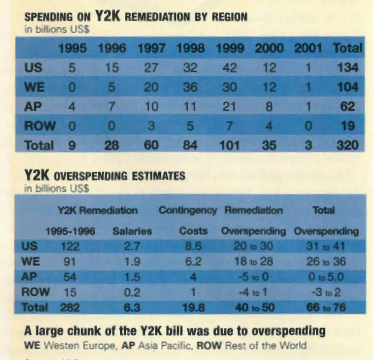
In its frenzy, the world will have spent an estimated $300 billion by the year 2001, according to IDC, a third of which is by the United States alone. Some of that amount is thought to have been wasted or overspent, and is attributed in part to companies paying employees overtime to monitor IT systems on New Year’s Eve. IDC estimates total overspending to be $66 billion to $76 billion for $282 billion in expenditures on Y2K remediation between 1995 and 1999 (see tables).
The saga does not end there, however. Hardware is just one aspect of it, but there’s more. IT experts warn against complacency, because next comes the risk of software malfunction. Business software that relies on dates, like accounting and time management, runs the risk of either processing the wrong data or not working at all.
The problem is further propagated by pirated software. So check and double-check all your utility bills for the rest of the year. Several dates have been identified when programs will require monitoring. January 10 (1/10/2000), the first seven-digit date, passed with no trouble locally, while October 10 (10/10/2000) will be the first eight-digit date to watch out for.
The next date to watch out for is February 29, since 2000 is a leap year. Many programmers who worked on the Year 2000 bug were not aware that this was a leap year. Companies will have to watch the first quarter reports and billing dates, since one day may be missing from programs and the last day of February may appear as March 1.
If all or most hardware and software found locally were upgraded in recent years, the Y2K bug could have been a “good” bug in the final analysis. Nahle says: “Y2K forced institutions and people worldwide to upgrade their systems to the latest technologies. A very positive step whose effects will doubtless be felt in the next few years.”