Most businesses only dream of making millions each year.
So one would think that Cellis and LibanCell, dubbed
“cash cows,” would be content just counting up the earnings
from their build-operate-transfer (BOT) contract that was
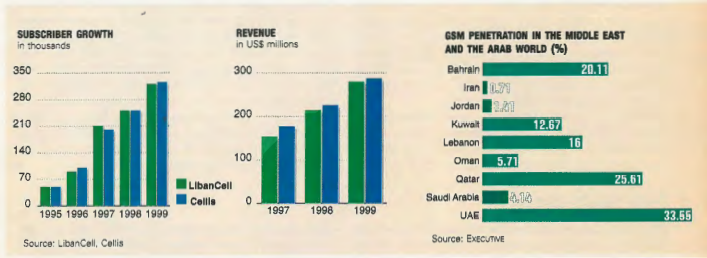
signed with the government over five years ago. Cellis generated
sales of $284 million last year, up from $225 million in 1998 when
it netted close to $37 million in profits. LibanCell made $42 million
in profits from a turnover of $279 million last year. Given the
rarity of such impressive earnings in Lebanon these days, who
wouldn’t want to be running a cellular operation?
But the operators have gripes. That’s because the BOT contract,
though guaranteeing money in the bank, has kept constraints on
growth. The operators are trying to get a license, which would give
them greater freedom in running their business. Ultimately that would
mean a healthier expansion of the market and greater revenues.
The essence of the contract is that the government collects a share
of every cent LibanCell and Cellis make, without investing a
penny. The operators’ networks are the property of the state,
which explains the condition in the BOT specifying the construction
of a network for a minimum of 250,000 users. The government
gets a 20% share of revenues, including those generated from the
connection fee, the monthly subscription and talk-time. In addition,
there’s a 10% municipal tax on each bill and a 6-cent tax per minute,
which was raised by the ministry of post and telecommunications
(MPT) last July. Revenue from international calls and the use of
landlines also go directly to the MPT because of its monopoly. In
total, the government cashes in 40% of all cellular proceeds from
each company, according to LibanCell. That of course is on top of
the 15% corporate tax that firms pay.
To ensure financial gain, the contract dictates the connection fee
at $500, the monthly charge at $25 as well as talk-time rates. It
exempts extra services, such as voice mail and call waiting, from
taxation. The operators argue that fixed prices and taxation
impede the normal growth of the cellular market. Following the tax
hike last year, demand has slowed and talk time has shrunk by about
10%, according to Sima Hafez, the marketing manager of Cellis.
The two companies have the market split down the middle,
give or take a bit, with about 320,000 subscribers each. Hafez
explains: “There’s no difference in terms of pricing [on permanent
lines]. And the [area] coverage, as specified in the contract, is the
same. So definitely we share the same number of subscribers.”
Customers buy whichever cards are available, because prices are
the same. “There’s no rational selection,” says Magda Sacre,
commercial manager for LibanCell.
Neither company is happy with the situation, despite the impressive
financial gains. They want their freedom. “Lebanon is a competitive
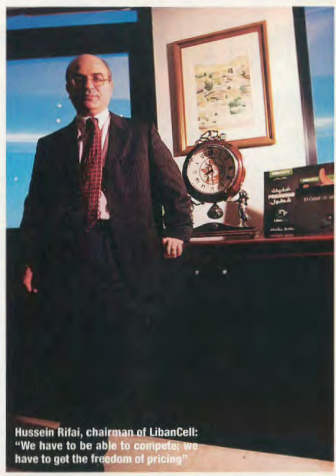
market,” says Hussein Rifai, chairman and general manager
of LibanCell. “We have to be able to compete; we have to get the
freedom of pricing.” Licensing would give them that as well as ownership
of the networks. Salah Bou Raad, chairman and CEO of Cellis,
explains that the government retains ownership of “airwaves,”
which it leases out to operators. He adds that licensing would further
allow the company to float shares on the Beirut Stock Exchange.

Growth has also been hampered by the ongoing fight over the permissible
number of subscribers (see “The government’s thirst for
more,” October 1999). The MPT’s attempt to impose a ceiling of
250,000 is disputed – and already surpassed – by both firms.
Also, a technicality with the numbering system on cellular lines means
the operators will max out their subscriber base at 400,000
each, which is expected to be reached by year-end.
But why all the fuss about licenses now? The answer may lie in
the unforeseen growth of the cellular market. When they were mining
for coal, they didn’t expect to strike gold. “We had to re-think
our investment strategy,” says Rifai. “We didn’t forecast such subscriber
growth and talk time, and so we had to increase our investment quite a lot for the first year.” Both LibanCell and Cellis have
doubled their subscriber bases each year in the first three years (see
graph). The MPT has received over $700 million in the past four
years, already coming close to the $800 million that was initially
projected over ten years.
But the operators claim the market could grow even more in a competitive
environment. The proof is the boom that followed the prepaid
cards. They were first introduced to the market in September
1997 by LibanCell. In just three months, the Premiere cards doubled
LibanCell’s customer base, from 110,000 to 210,000. “They
launched the cards before us at very cheap prices,” Hafez says. “We
were hurt by this offer, and we were losing our customers. We had
to compete. That’s not a duopoly; that’s real competition.” In
December of the same year, Cellis launched its Clic cards to recover
market share. The prepaid cards proved successful, mainly
because they had a wider reach to consumers with limited income.
And that allowed the companies to tap into a new market.
In its fever to bring in funds, the MPT is drawing up plans for a
state-run operator, under the umbrella of privatization. If it does,
the existing operators might get licenses. Otherwise the MPT
would be in breach of the BOT contract that grants exclusivity until
2004, though that could be extended if the agreement is renewed.
The MPT refused to comment on the matter because negotiations
are ongoing. The ministry is considering the options based on its
main objective of pulling in cash, according to one source. Three
meetings have taken place, which are thought to be positive. “All
parties involved want to reach an agreement fast,” says Bou Raad.
A third player would help spur competition. “Will that competition
drastically bring prices down? Competition normally brings
prices down,” Hafez says. “Any normal operator will grab a share
of the market when they enter and then they’ll grow. They might
undercut prices by, say, 10% to get part of the market.” Lower prices
should translate into an increased customer base. Needless to say,
that would benefit customers most. “Increased competition is
always good for the consumer,” says Bassam Yammine, senior manager
of the Corporate Finance Division at Lebanon Invest. “[It
would lead to] possibly lower prices and better services.”
Currently, customers have little choice. They’re the ones who have
full license to complain, really. Take for example the tax hike on
talk time – simply a way to bring in more funds. Compared to the
European average of 150 minutes, talk time in Lebanon is at least
700 minutes a month per person. The equivalent monthly bill for
a subscriber to a permanent line, making local calls only, would be
over $80, excluding taxes and extra services.
Regardless of whether the Lebanese ought to be condemned for having
a mobile phone glued to their ear, the cellular is a worldwide trend
that will continue to grow. Without the constraints of the BOT,
growth could be huge. Rifai estimates a penetration of 35% in the
next five years, a consensus shared by Hafez. She estimates that by 2004,
the number of cellular subscribers will go up to 1.4 million, more than
double the current level, which is roughly 17% of the population.
If privatization and the introduction of a third operator are
delayed, what are the chances of the operators getting licenses when
the contract expires? It’s not clear at this stage. The operators maintain
that licensing would increase government revenues. On the
other hand, the BOT allows the government to increase its share of
revenues to 40% in 2003 and 2004, and to 50% beyond that if
renewed. The MPT might not be eager to loosen the reins on its cash
cows. Unless it draws a good bargain, that is.
Top of Form
Bottom of Form
Two steps ahead
Both LibanCell and Cellis have plans to get into the new trend
sweeping Europe: the merging of Internet and wireless
technologies. Locally, LibanCell might have an advantage
because of its sister company, Internet service provider
TerraNet. “We will definitely have cooperation. We’re working on
providing Internet access to our subscribers,” says Hussein Rifai,
LibanCell chairman and general manager. Cellis, 67% owned by
France Telecom, might be able to bring in Wanadoo, the ISP
subsidiary of the French telecom. Speaking of innovation, both
operators have plans this year for mobile banking (M-banking) and
similar services, especially for their corporate clients.
Wireless Internet has just taken off in Israel. A joint venture,
GoNext, was formed between mobile phone company
Pelephone and Samsung distributor Sunny Electronics with a
$200 million investment. GoNext will enable clients to surf the
Internet in the HTML language and the Wireless Application
Protocol (WAP), especially developed for cellular phones.
Mobile Internet could well take off in Lebanon, as it is expected
to in Europe this year, since the number of cellular users locally
surpasses the number of Internet users by at least six times.
Also, cell phones are cheaper to own than computers. The question
mark remains for access prices.