Home Executive LivingParty on board

Party on board

by Natacha Tohme

Summer is sea season, so what could be better than a
cool Mediterranean cruise? A little pricey perhaps? It
doesn’t have to be. There’s no need for a boat of your
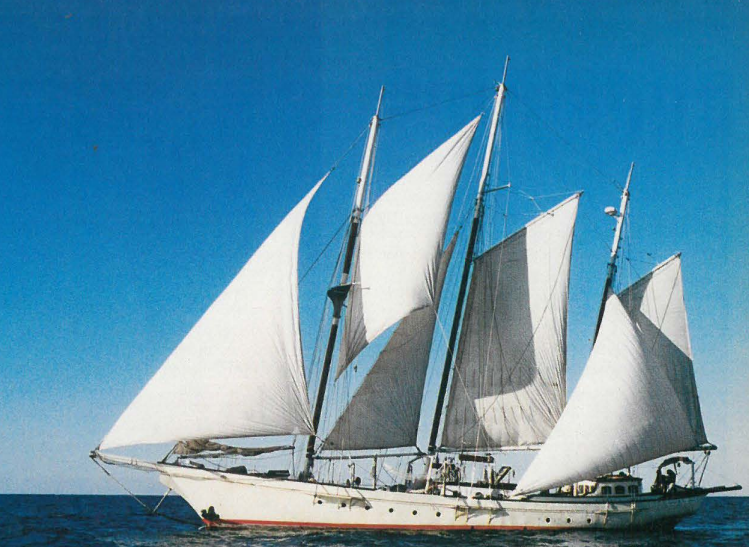
own when the Capitan San Marco, a 35m-long American
Schooner, docked in Dbaye, is available for rent.

The sleek sailboat is owned by Fred and Jacques Fremal,
Belgian twins with an appetite for adventure who sailed to
Lebanon four years ago on a mission to create their own fleet.

They envisioned a commercial enterprise that entailed
building a fleet of Phoenician boats, partly to revive this
bygone maritime civilization (see box). Today the project is
underway and keeps the seafaring twins anchored to
Lebanon. While here, they’ve made a business out of chartering
the Capitan San Marco for parties and weekend
cruises to Cyprus.

Naval architects, the brothers spent ten years building the
Capitan San Marco, which was launched in 1991. “There are
no more than 25 ships like this one in the world,” says Fred
Fremal. The Capitan San Marco is indeed a nautical feat and
continues to attract attention in every port it visits. In fact,
the Fremals have an impressive portfolio of articles written
about their boat. The clippings, in about five different languages,
are from magazines and newspapers from different
corners of the world.

The Capitan San Marco can be chartered for daytime or
sunset cruises, for a maximum of 40 people. Cruises are
priced at $600 for four hours and $900 for six hours from Monday
to Thursday or $900 for four hours and $1,200 for six hours from
Friday to Sunday.

These flat rates do not include entertainment or meals. The
boat has a sound system that can be used at no extra charge, and
customers can bring their own food or pay $10 per person for
a simple meal. For customers wanting organized catering and
entertainment, costs vary. But the Fremals encourage customers
to deal with event managers that regularly work with
them, as they are familiar with what works best on the boat. Why
take the risk of hiring catering companies whose waiters might
get seasick? And certain oily foods, such as pistachios, are not
allowed on the boat, as they ruin the wooden floor when
stamped on.

Weekend cruises to Cyprus are usually available for a maximum
of 12 passengers at $495 per person, including meals.
However, weekend cruises have been suspended while the Fremals
concentrate on building Phoenician boat

Invest in Lebanon’s development by donating to a worthy cause

Chipping in

Discussing Lebanon’s ‘backward state’ makes for
interesting conversation. And while pointing fingers
at the government is not altogether unfounded,
it is, well, typically Lebanese. It’s also ineffective. The
country would gain much more if civil society participated
in its development.

To be fair, a lot of people invest time and money in a number
of social and humanitarian endeavors. Lebanon has many
active non-governmental organizations (NGOs). “More
than 60% of schools and hospitals belong to philanthropic
institutions,” says Abdul Hafiz Elladki, general director of
the Dr. Mohammed Khaled Social Foundations. “And
100% of the orphanages and clinics for the handicapped
belong to NGOs.”

Traditionally NGOs are meant to cover a gap of 20% to
25% of what the government provides and what the people
need. “But the government provides about 5% to 10% of the
need, and we must cover the remaining 90%,” says Elladki. He adds that because of the economic crisis “the number
of people needing our help increased.”

International donors, such as UNDP and USAID, give a
lot of money to NGOs. However, civil society should play
a role in development. Caritas, which is 90% funded by its
European counterparts,
has seen its
funding cut now that
the war is over. Caritas
Europe is encouraging
the organization
to involve the
local community.

What role does the
business community
play? Since the country’s
tax system doesn’t
give incentives to
encourage people to
donate, they must be
morally driven. “70%
of our income is from
donations from the
private sector,” says
Elladki. The Dr.
Mohammed Khaled
Social Foundations
cares for 550 orphans,
has an illiteracy and technical training
program and a medical rehabilitation center caring for the handicapped.
Its annual operational budget is about $5 million.

Many people are skeptical about donating money to NGOs.
How can one be sure that donations aren’t misappropriated?
NGOs that are transparent will benefit. Many reputable ones
are doing good work at either local or national levels.

On the road less traveled

Jawad Adra is an entrepreneur who left Lebanon in 1972
to pursue a career in Saudi Arabia as an executive for a
major contracting firm. After a 22-year absence, he relocated
to Lebanon and established a research firm, Information
International, with Zeina Akar. The two were eventually married.

What Adra didn’t anticipate was the identity crisis for
“having not lived through the war”. The experience proved
a turning point in his life.

“We say we are proud to be Lebanese,” says Adra. “If we
all like this country, why is so much going wrong with it?” Adra
saw three alternatives: join the system, become isolated from
society or emigrate. “I believe we have a bad system,” says
Adra. “It needs to be overhauled, totally restructured.”

Finding solutions to Lebanon’s problems would require
taking a different course, albeit a less traveled one. Adra
believes that advancement is achievable through “a slow,
determined and consistent change in society and in the values
of people**.** It’s a very long road.” Together they established
INMA Social and Cultural Development Association, which
administers community development projects in Koura.

In its first 18 months, the projects were funded entirely by
Adra’s research firm. The first was a public library in Kefraya
, Adra’s hometown. Other projects include a computer training
center and a health clinic. INMA has also planted 5,000
trees in Koura. “We have discovered that if you do several projects
in clusters of villages you can have an impact,” says Adra.

They eventually decided to solicit donors. But, to remain
independent and politically unaffiliated, they applied to
international agencies. USAID gave a $46,000 grant for a
medical laboratory and three computers. The Japanese
embassy gave $30,000 for a dental clinic. The Canadian
embassy gave two $30,000 grants for agro-industry projects.
Adra’s research firm still subsidizes INMA for about $2,000
a month. The couple balks at the suggestion that they
should stop putting money into the NGO. “If you are spending
$2,000 to help communities, why not?” says Zeina.

Magic carpets

Caucasian and Persian treasures will cost you a pretty penny

Hand-woven carpets are likened to works of art. Collectors
will pay large sums of money to own valuable
antique pieces. None are more desired than
Persian and Caucasian carpets.

Persian carpets are identified by their floral designs. But
there are countless types, such as Isfahan, Kashan and
Nain, which are named after the villages where they were
made. They are made of silk, wool or a combination of the
two and are based on either cotton or silk. The tribal rugs
have busy geometrical designs and are made of wool. The
finer the knot, the greater the value. “Whenever it’s a fine
knot, you get a very clear design on the back side,” says Heydar
Maktabi of Hassan Maktabi & Sons. He retrieves a finely
knotted 2m x 1.5m carpet made of wool and based on silk.
It is priced at $10,000.

What determines the value? “For old carpets it’s the rarity
of the piece,” says Maktabi. He reveals a prized antique
carpet, a Kirman Lavar that is over 200 years old and in perfect
condition. The 2m x 3m carpet, which bears two
stamps, has an interesting history. An Iranian governor commissioned
the piece, which has a twin located in the Iranian
museum. Maktabi is asking $250,000.

While antique Persian carpets are valuable, the 20-year US
embargo on Iran crippled demand. Prices are low because
of the devaluation of the Iranian currency. “It’s a very
good time for people to buy carpets,” says Maktabi. Many
can be found for under $2,000.

Caucasian carpets, identified by their bold geometrical
designs, are more in fashion than their Persian counterparts.
This is partly because the designs suit a wide variety of
decors. Today Caucasian carpets are made of synthetic
wool and chemical dyes, mechanically woven and are
priced as low as $200. Since hand-weaving techniques
have all but disappeared, old Caucasian carpets command
high prices. No two carpets are identical. Additionally, old
carpets are made from organic dyes and handspun wool.

Nalbandian Tapis d’Orient has an inventory of about
9,000 old Caucasian carpets. “All the old pieces were collected
by my father and grandfather 35 to 40 years ago,” says
Serge Nalbandian, one of the fifth-generation team now at
the helm of the business. “They used to buy the carpets for $5
and $10 a piece.” Today they are worth $5,000 to $10,000.
There are four main types named after the region where they
are made: Kazak, Karabajh, Chirvan, and Kuba. How is a carpet’s
value determined? “By its age, the rarity of the design,
and the condition of the carpet,” says Nalbandian. He displays
a yellow 140cm x 120cm carpet that is over 100 years old and
priced at $7,000. “For a worthy piece, the average price for an old Caucasian is about $3,000 to $3,500,” he says.

The Nalbandian family reintroduced the tradition to
Armenia two years ago to
attract buyers that cannot
afford such prices and to
revive the hand-weaving
technique. Production is
small, at about 40 to 50
pieces a month. Most are
marketed in the US, but
some are available here.
He displays one that is 2m
x 1m and sells for $1,500.
Its antique counterpart
sells for about $7,000.

While Persian carpets
are valued by the fineness
of the weave, Caucasian
carpets aren’t. “You should
look at their beauty,” says
Nalbandian. His family
heirloom is an antique
worth about $250,000.
Called a ‘Star Kazak’, only
13 exist in the world. “The rarity of ours is that it has all the colors
used in Caucasian carpets in one piece.”

So French

Buying antique tapestries is like
buying paintings by great artists.
Collectors pay up to $250,000 for masterpieces. The tapestry business flourished in France
between the 17th and early 20th century. What determines
a treasure? According to Hratch Nalbandian, it’s a combination
of things. “If the painter
and weaver are known and the
subject is unique, then it’s an
interesting tapestry.”

Tapestries were based on oil
paintings. Aubussun was one
area in France that was famous for
its tapestries. Other notable mills
were located in Gobelins, Felletin,
and Beauvais. Nalbandian’s shop,
Loutfik Nalbandian & Fils, has an
impressive selection of antique
tapestries. He unfolds an 18th
century piece, based on a painting
by Boucher and retrieves a book
detailing its history. The artist’s
series ‘Italian Village Scenes’ was
reproduced into tapestries a number
of times. “But no two pieces are
the same,” says Nalbandian. His
piece was based on a painting,
‘The Gypsy Fortune-teller’. Thirteen tapestries were produced based
on this painting, five of which are
known to be in museums. “And one is in my shop,” says Nalbandian. Once the piece is fully
repaired, his asking price will be about $140,000.

With tapestries, there’s no graspable range for prices:
19th century tapestries cost
$8,500 to $60,000, 18th century
ones go for $10,000 to
$150,000, while those dating
from the 17th century run at
$70,000 to $250,000. The art is
still alive and well, but many
mills relocated to the Far East,
because of the high production
costs in France. Nalbandian
advises first-time buyers
against purchasing at auctions,
because good deals are
usually for damaged tapestries.
Restoration work isn’t
cheap and can cost more than
the purchased price. Nalbandian
has a small workshop
where three women sit
painstakingly mending tapestries.
“You have to appreciate
the art to recreate it again.”

You may also like