

Justifiable or not,
clients often judge a
company by its
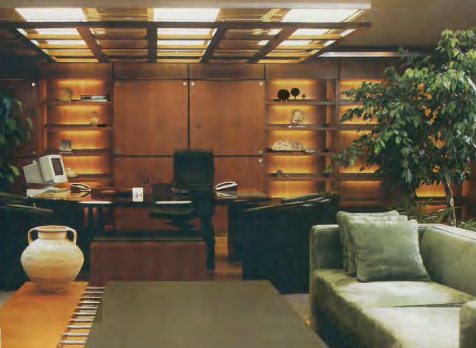
offices. Interior designer
Jean-Louis Mainguy, the
creative genius behind
the interior of BNPI in
Borj al Ghazal, understands
that well. His
office features a superbly
crafted floor-to-ceiling
bookshelf, which, when
slid open, reveals a conference
room. Besides
being visually appealing,
the bookshelf serves two
practical functions: it
provides storage and acts
as a wall dividing the executive office and conference room. The office communicates
professionalism and trust, though Mainguy simply
believes people should be comfortable in their workplace.
Ghalal Mahmoud, interior designer for GM Architectes, says
the first thing he considers when designing an executive office
is what the company sells. Aesthetic designs are suitable for
creative businesses, such as advertising or architectural
firms, while for banks or financial institutions the traditional
English look suggests that a business is long established
and credible. “It says ‘don’t worry about giving us your
money, we’ll take good care of it’,” says Mahmoud.
But the tastes of businesses are changing. In the age of
cyberbanking and tech stocks, financial institutions are
opting for more modern designs, “to show that they understand
the technologies they sell,” says Mahmoud. But a company
must be careful. If the decor is too outlandish, clients
are likely to think, “this company is too crazy for me — I’m
not going to give them my money,” he says. Many firms try
to create balance by combining traditional materials, such
as mahogany wood, with modern materials like stainless
steel. GM Architectes recently designed a Financial Funds Advisors
office in this way. “It’s very modern and high tech,
but at the same time it doesn’t cause clients to panic.”
Another important factor to consider is the personality of
the businessperson who will use the office. Mainguy and
Mahmoud say most clients ask that their offices reflect their
hobbies. Executives interested in ethnic art might request
African sculptures to complement the decor, while a weekend
sailor would likely ask for nautical motifs. Personalized
offices break down barriers and create an open and human
relationship between executives and their clients, even staff.
Women tend to understand this better than men, says
Mainguy. Male executives prefer their offices to have a serious
atmosphere, which is achieved by using geometrical
shapes, dark colors and conservative materials, while
women select softer tones and fabrics. “The personality of
a woman in business is totally different from the old manners
of men,” says Mainguy. “Business is life — it’s not so
serious.” He prefers to use circular forms and brighter colors
to convey a more relaxed atmosphere.
Great, but how much does this fancy decorating cost? “It’s
important to know the size of the space and the budget of the
client, and work within that fixed parameter,” says Mainguy.
Of course, costs rise if certain technical items, such as a proper
lighting system, are not already in place. Either way, there
is a considerable price to pay for a successful image. Executive
desks range between $2,000 and $5,000, and executive leather
chairs cost about $1,000. And that’s just for starters.
No man’s office
Got an important interview with the vice president of a big corporation?
You know, the kind where you must wait patiently in the
lobby until his secretary ushers you into a plush office where the “big
man” stares at you from behind a mahogany desk the size of a dining
room table. Don’t be surprised if, instead, your “big interview” actually
takes place in a very public conference room that the employees
use to meet clients.
In the push for efficiency, more companies are redesigning their workplace
environments. “There’s no hierarchy anymore — the boss with his
big office and the employees assigned cubicles,” says interior designer
Galal Mahmoud. Private offices have been replaced by open workstations.
Instead of being placed in lofty offices, far from the rank and
file, managers are being given desks close to their employees. Rather
than working independently, employees are clustered together in
work groups. The only enclosed areas are “unassigned offices” (a new-age
term for conference rooms), which are equipped with the latest
computer and projection technology. When employees, even managers,
want to see clients, this is where the meeting takes place.
Technology is also having an impact on the 21st century workplace.
The information age is also the age of the virtual office. Gone is the day
of the private desk with the private PC. These days, employees are
given unassigned workplaces, or “free addresses,” which they can use
on a first-come, first-served basis. Employees are provided with all the
tools needed for a paperless office, such as laptops. There are no personal
filing cabinets, but rather central filing systems. Desks aren’t even
equipped with phones. Phone calls are made through laptops. “You
come with your laptop, plug it in and you’re in the system,” says Mahmoud.
“You access all the company information you need through a
plug. The only item that is yours is your laptop and pen.”
