• Donate
  • Our Purpose
  • Contact Us
Executive Magazine
  • ISSUES
    • Current Issue
    • Past issues
  • BUSINESS
  • ECONOMICS & POLICY
  • OPINION
  • SPECIAL REPORTS
  • EXECUTIVE TALKS
  • MOVEMENTS
    • Change the image
    • Cannes lions
    • Transparency & accountability
    • ECONOMIC ROADMAP
    • Say No to Corruption
    • The Lebanon media development initiative
    • LPSN Policy Asks
    • Advocating the preservation of deposits
  • JOIN US
    • Join our movement
    • Attend our events
    • Receive updates
    • Connect with us
  • DONATE
Opinion

LAST MONTH

by Executive Staff June 1, 2016
written by Executive Staff

French foreign minister visits Lebanon

French Foreign Minister Jean-Marc Ayrault arrived in Beirut on July 11 for a two-day visit aimed at resolving the presidential vacuum in Lebanon. Ayrault held talks on the current stalemate in the country with politicians across the political spectrum, including Prime Minister Tammam Salam, Parliament Speaker Nabih Berri, his counterpart Foreign Minister Gebran Bassil, Maronite Patriarch Bechara Rai and a delegation from Hezbollah. The visit comes in the wake of talks Ayrault held in Paris last month with the foreign ministers of Iran and Saudi Arabia, two Middle East regional powers that back opposing candidates for the presidency in Lebanon. Before departing, the French foreign minister also reiterated his country’s commit- ment to helping Lebanon overcome economic, social and security challenges stemming from the war in neighboring Syria. Ayrault’s trip fol- lows an official visit made by French President Francois Hollande to Lebanon in April.

Outcry over police treatment of Syrians in Amchit

The Interior Ministry launched an investigation on July 13 after several photos were released on social media that seemed to show Lebanese police officers humiliating Syrian workers in the north-

ern Lebanese town of Amchit. The photos depicted police on an unknown night searching the group of men, who were forced to lie down on the ground or kneel facing a wall. Massive outcry fol- lowed on social media, with users accusing Lebanon’s security forces of racism, and denouncing the curfews imposed on Syrians by many municipalities in the country. A march took place from Achrafieh to the Interior Ministry headquarters in Hamra on July 19, where around 200 marchers protested against the collective punishment of Syrians residing in the country. Interior Minister Nouhad Machnouk later admitted that some municipalities were overstepping their authority and ordered them to stop the abusive security practices. Lebanon hosts an estimated 1.1 million Syrians across the country and has also witnessed an uptick in hate crimes directed at Syrians following eight suicide bombings that targeted the border town of AlQaa last month.

Rebel-held Aleppo under siege

The Syrian Observatory for Human Rights re- ported on July 17 that Syrian government forces, along with allies from Hezbollah, closed the vital Castello Road leading into Aleppo, effectively putting rebel-held areas of the city under siege. Rebel forces’ attempts to counterattack and reopen the supply route thus far have failed. Fierce fighting in the area continues as goods, medical supplies and food become scarce and prices skyrocket. Approximately 300,000 people are currently living in besieged eastern Aleppo, which was once the country’s most populous city. A top opposition official warned that the rebel- held side of the city now only has three months worth of food supplies to feed the populace and that in response, a system of rationing had been put in place. Siege and starvation have been a common tactic employed by opposing groups in the civil war, with the UN estimating that 600,000 Syrians are currently living in besieged areas.

Terror attack in Nice

On July 14, a man used a truck to plow into a crowd of people celebrating Bastille Day in France’s Nice, killing 84 people. The brutality of the attack on France’s national holiday sent shock waves through the country, which had just recently finished hosting the 2016 European Football Championship under massive security measures. French authorities later said that the driver of the 19-ton truck, Mohamed Lahouaiej Bouhlel, who was shot and killed by police, had been planning the attack for months and was working with at least five accomplices. The attack has led to an extension of the state of emergency in France, which was put in place in reaction to the growing number of terrorist attacks in the country. In the most violent incident, a series of attacks claimed by ISIS rocked Paris on November 13, 2015, killing 130 people in a string of coordinated bombings and shootings around the French capital.

Failed coup further destabilizes Turkey

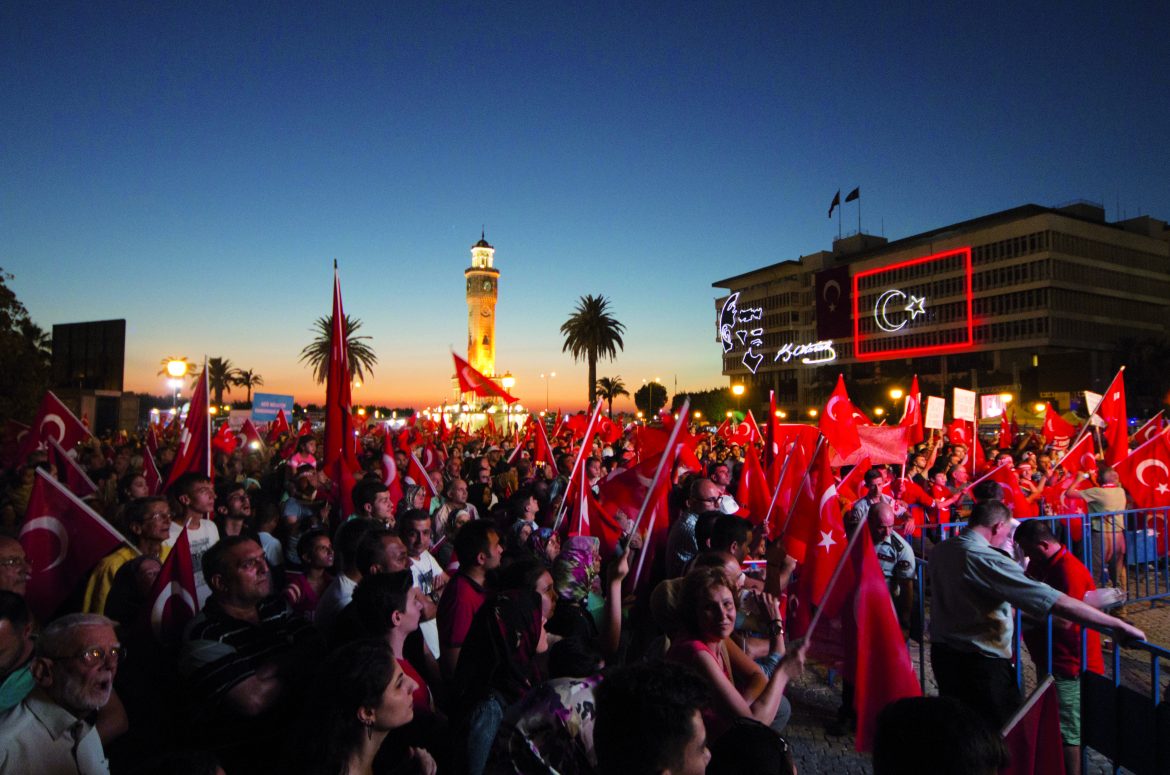
An attempt by elements within the Turkish military and police on July 15 to depose the country’s democratically elected government failed after the country’s president was able to rally the country’s citizens and security forces to put down the uprising. The coup unfolded late at night on July 15 as dissident military units captured vital bridges connecting the European and Asian sides of Istanbul, jets and helicopters bombarded Turkish parliament and the headquarters of the country’s intelligence service in the capital Ankara, and a declaration of martial law and the drafting of a new constitution were declared on Turkish state TV. However, a raid by commandos to capture or kill Turkish President Recep Tayyip Erdogan in the resort town of Marmaris failed. Erdogan, who escaped the villa a reported 30 minutes before the attack, returned on a flight to Istanbul and called on citizens to resist the coup attempt. In the violence that followed, more than 200 people were killed and thou- sands were injured. After the government managed to regain control of the country in the following 48 hours, President Erdogan denounced the coup attempt as a plot by his former ally, US-based Turkish cleric Fethullah Gulen, who runs schools across Turkey and whose followers are thought to number in the millions. In the week following the failed uprising, Turkey’s government has purged thousands from the military and state institutions for alleged links to Gulen and publicly demanded the extradition of the cleric from the US. The reaction by Turkey’s ruling Justice and Development Party has sparked worry in Western governments that Erdogan will use the coup attempt as a pretext to further consolidate his party’s authoritarian control over the state. Turkish officials have suggested that the country may bring back the death penalty, and on July 21, parliament approved a bill that declared a state of emergency in the country and partially suspended Turkey’s participation from the European Convention on Human Rights.

June 1, 2016 0 comments
0 FacebookTwitterPinterestEmail
Economics & PolicyFood security

The fear of an empty plate

by Sami Halabi May 31, 2016
written by Sami Halabi

There is an old Lebanese saying for reassurance in troubled times. For years, comparatively well-off people have told others, especially children, that ‘ma fi hadan bimout min el jou’’ (no one dies of hunger) when they complain excessively. While that may be true for some, five years of a refugee crisis coupled with long-standing structural issues are threatening that age-old adage and the confidence that buoys it.

Unsettling statistics

Food security exists when all people, at all times, have physical and economic access to sufficient, safe and nutritious food that meets their dietary needs and food preferences for an active and healthy life. People may not know it, but Lebanon has entered a new phase of food insecurity and, while malnutrition is not yet a problem, food security has been falling across the country. According to the latest figures from the United Nations, the proportion of Syrian refugees who are food secure has fallen from 32 percent in 2013 to 11 percent in 2015. Out of an estimated 1.5 million Syrian refugees in the country, only 165,000 have stable access to nutritious food.

With poverty rates increasing from around 28 percent in 2004-2005 to around 32 percent by 2013, according to several estimates cited last month by the World Bank Group, there are indications that the Lebanese are also becoming more food insecure. The latest figures from the UN Food and Agriculture Organization show that around 11 percent now cannot access their basic food consumption needs, 31 percent do not have access to healthy food and 49 percent are worried they will not have enough food to feed themselves over the course of the year.

Of course, one only needs to walk into the supermarket to understand why this is happening. In 2008, food inflation rose 18.1 percent. From 2008 to 2013 food prices rose some 45 percent. Obviously this looks bad for a government who is supposed to protect the food security of the country. But instead of using their authority to regulate food prices or creating more job opportunities, the government re-indexed inflation in December 2013 and voila, they now claim that inflation (and food inflation) is in negative territory and prices are falling.

Government inaction

To be fair, global food prices fell by 0.95 percent in 2014 and 0.64 percent in 2015, but that is also related to today’s low oil prices, the relatively strong dollar and stunted economic growth, all of which bode well for inflation. Prices are sticky for the same reason they have always been; we live in a country where price fixing and oligopolies are rife and there is no national economic vision.

Government subsidies on bread production have already proven ineffective and disproportionately beneficial to those with more income, not the poor who need the most support. Lebanon also never really benefited from the fruits of free trade because the World Trade Organization accession was halted once oligopolists realized obligatory competition regulation would run contrary to the moneyed interests that keep prices up and wages stagnant. At the same time, Lebanon threw open its doors to foreign food imports through both bilateral and multilateral trade agreements. Now we are up to 80 percent import dependent for our food, while our agricultural sector is in retreat.

Being physically able to bring in more food over the past years allowed our country to adapt to more than 1.5 million new mouths to feed. Yet, as those mouths become more food insecure and food aid dependent, the government also restricts them from working or possessing assets that can help them feed themselves. Restricting refugee labor is considered a sound policy to the extent that it can protect employment opportunities for unemployed Lebanese citizens. However, requiring refugees to abandon their refugee status and become sponsored migrant workers to perform menial jobs is a narrow-minded and zero-sum proposition when those restrictions increase food insecurity.

Instead of forcing Syrian refugees into informal labor and exposing them to abuse, a more intelligent and humane policy would be to allow them to work alongside Lebanese in agriculture. Permitting refugees to own assets that are used in agricultural production would strengthen food security in the country and produce more jobs for everyone. At the same time, Lebanon needs to stop being complacent about food security. The government must devise an integrated Food and Nutrition Security Strategy which rationalizes trade, market and production against resources and actually implement it.

Lebanon cannot wait for another food price shock to compel the government to act. People have already started to go hungry, and soon they may turn angry.

May 31, 2016 0 comments
1 FacebookTwitterPinterestEmail
CommentOil & Gas

A national oil company for Lebanon?

by Mona Sukkarieh May 25, 2016
written by Mona Sukkarieh

It’s been three years since the nascent oil and gas sector in Lebanon was brought to a complete halt. The relative success of the pre-qualification round in 2013 brought the sector to center stage and contributed to the hype surrounding it. But the pre-qualification round was not followed by a tendering process. Instead, this was put on hold for a variety of both rational and irrational reasons. No licenses were awarded. No exploration was conducted. Not a single discovery was made.

Yet, the oil and gas debate in the country appears to be oblivious to these realities.

Conferences abound, though on a much smaller scale than a couple of years ago, and instead of investments and grandiose ambitions, we are left with capacity building and activism. Nearly every university in the country has launched new majors to prepare the Lebanese youth for work in the country’s petroleum industry. The first batch of graduates will soon enter a market which is completely void of a petroleum industry. But, perhaps the strangest debate in town, the one attracting all the attention in the past weeks and months, is the question of whether or not Lebanon should establish a national oil company (NOC) and when, for the sooner the better.

Taking a step back

Article 6 of the 2010 Offshore Petroleum Resources Law provides for the establishment of an NOC “when necessary and after promising commercial opportunities have been verified.” The law includes a degree of prudence that is welcome, though the article is now being associated with conspiracies alleging that it intends for petroleum activities to favor the private sector at the expense of the nation’s wealth. Calls for establishing an NOC years before any verification is possible is at best questionable and raises fears that the company would face the same crippling challenges most other public institutions in Lebanon have long suffered from: patronage and mass-staffing, at the expense of productivity.

The debate lacks a strategic vision. And, as is the case with public institutions in Lebanon, particularly those operating in a lucrative sector, these are regarded more as tools of political influence rather than  instruments intended to effectively implement a particular policy.

It is not enough to call for the establishment of an NOC at this stage, though it is not a complete anomaly to establish an NOC prior to any oil or gas discovery. But there is a series of questions that must be carefully considered, particularly at the pre-discovery phase.

Crucial questions

What will the NOC’s mandate and objectives be? This could range from the relatively reasonable to the very ambitious, and may require revising the legislative framework, with inevitable interferences and stalling whenever deemed necessary by one or more political sides. Is there a risk of institutional proliferation? The multiplication of institutions all addressing the same issues without a clear division of roles and responsibilities cannot guarantee a sound management and presents the risk of duplication of work. It is also important that ambitions are realistic and match the resources available, so as not to disappoint.

Does it have the capacity to carry out its mandate? It is critical to understand the time and resources needed to develop the required capabilities, and factor in possible hurdles. It is also important to be fully aware of the weaknesses, and resist the urge to brush them off, by, for example, claiming that we can seek the services of the talented Lebanese diaspora. Experience shows that the “Lebanese diaspora” argument is used more frequently than are the actual services of said diaspora.

[pullquote]Maybe what is needed more than a national oil company at this stage is for professionals and specialists in today’s oil and gas industry to set the framework for a national debate[/pullquote]

How large will its workforce be and what will the hiring process look like? In Lebanon, it is very hard to resist clientelistic tendencies and the urge of mass-staffing public institutions. Some of those calling for establishing an NOC at this stage have a poor record in this regard.

What are the resources needed to carry out its role, knowing that it will have limited revenues in the pre-discovery stage? It is critical to understand the financial requirements and have the means to meet them. At the pre-discovery stage, and with little (onshore) to no (offshore) exploration activity, expenses must be kept under control.

What guarantees are the proponents proposing to alleviate fears that this company would not be mismanaged or would not dry up public funds? Following the experience of Electricité du Liban, the Lebanese are traumatized and their fears need to be addressed. If recent experience with Lebanese public companies is an indication, there is a real threat that an NOC would suffer from the same problems plaguing other already established companies. These include mass staffing, at the expense of quality (rendering the overall work less efficient), and possible corrupt practices. Are there any valid reasons to believe the management of this company will be an exception?

A generational conflict?

Finally, it’s worth noting that those that are most active in calling for establishing an NOC all belong to a certain generation that has experienced the past ‘glories’ of nationalization in resource-rich countries. However, today’s context is fundamentally different than that of the 1960s and 1970s. Maybe what is needed more than an NOC at this stage is for professionals and specialists that have a relevant experience in today’s oil and gas industry to set the framework for a national debate.

Establishing a national oil company is not intrinsically a bad idea. But for it to work, the subject deserves to be addressed from all angles and for all the aforementioned questions to be much more carefully considered.

May 25, 2016 0 comments
0 FacebookTwitterPinterestEmail
Real estate

Strategies to survive the real estate sales slump

by Matt Nash May 24, 2016
written by Matt Nash

The disruption was illuminating.

When the knock first came, Georges Chehwane tried not to interrupt his interview with Executive. The matter, however, demanded the chairman of Plus Holding’s attention. A client wanted to buy an apartment in a building Plus Properties is promoting, but needed flexibility in payment scheduling. It wasn’t long before Chehwane was standing, shaking the client’s hand. “Mabrouk,” he said.

“So that’s how it’s done?” Executive asks the man who only moments before was lamenting the slow pace of sales on the local real estate market. “You have to,” he says. Plus Properties is promoting four developments at the moment, in addition to constructing the company’s own projects. Why do developers come to him to market their apartments? Chehwane cites his company’s old-school marketing machine. He doesn’t do digital because he doesn’t see the value in it at the moment. “There’s a lot of competition. Everyone’s going digital.”

For Chahe Yerevanian, chairman of Sayfco Holding, Facebook is a money-maker par excellence. The pride in his voice is clear when he mentions the one-page case study Facebook wrote in 2012 about the $25 million in sales Sayfco generated exclusively from the social networking site for its Crystal Towers project, one of the few developments the company built itself. Yerevanian explains that of the 30 or so projects Sayfco has been involved with since 2004, it directly owned and developed land for only five (and was a partner in the land ownership on an additional two). Yerevanian’s model focuses on being a service provider. For 8 to 10 percent of sales revenue (plus a 30 percent bonus for sales above the pre-arranged target), Sayfco provides landowners with a development concept and markets the project. He claims the model is almost zero risk, but admits only 99 percent of the projects that he took on under that model will be completed. There’s reputational risk, and he says it has made him much more diligent when taking on new clients. He laughs when Executive asks about rumors the company is in financial trouble.

“I’ve heard I’m bankrupt,” he says, jokingly. “Or hiding in Brazil.” The slowdown has hurt, he admits, but insists the company is strong. Like Chehwane, Yerevanian says Sayfco benefited from a Banque du Liban circular from late October 2015 allowing for companies with cashflow problems to restructure their debts. Unlike Chehwane, Yerevanian says the process was painless. (The Plus Holding head contends that the banks are “not being very flexible” and says a union is needed to strengthen the developers’ hand). Aside from the debt restructuring, Yerevanian says he’s currently raising capital to help Sayfco expand into Saudi Arabia and the United Arab Emirates. Yerevanian says that in late 2015, he became Sayfco’s only shareholder after buying out his brothers, amicably. He plans to sell 50 percent of the company to unnamed silent partners for an undisclosed amount. Yerevanian wants Sayfco to be a global name in real estate development. He plans to grow the brand over the next five years and will only then begin thinking of floating a percentage of Sayfco.

Chehwane is similarly focusing on expansion at the moment by building in Cyprus, where he says margins are similar to Lebanon. But he also stresses the importance of diversification. A new member of the Plus Holding family should be coming soon, he says. Time does not allow an in-depth discussion but the project, Green Plus, will be well outside the real estate domain. It’s a hydroponics venture in the United Arab Emirates.

To survive as developers in Lebanon, Chehwane and Yerevanian agree it’s all about delivery these days. Chehwane admits it’s increasingly tough, however, and says he uses barters over cash whenever he can. While the number of real estate transactions is up 25.6 percent in the first two months of 2016 compared to the same period in 2015, a return to the boom days seems a distant possibility.

“Right now, we just need to get the buildings up,” Chehwane says. “It’s in everybody’s interest for projects to be completed.”

May 24, 2016 1 comment
0 FacebookTwitterPinterestEmail
Economics & Policy

Diplomatically speaking

by Thomas Schellen May 20, 2016
written by Thomas Schellen

E  In 2015, Germany experienced a sudden unexpected influx of migrants and refugees in large part due to the Syrian crisis and its effect on host countries, including Lebanon. As Germany has been trying to deal with the large number of people coming in, what will the political impact be and what are the current prospects for Syrians seeking shelter in Germany and elsewhere in Europe?   

Allow me first to express my appreciation for Executive Magazine. It was more or less by coincidence that I came across a copy of the magazine one or two months after I arrived in Lebanon [to take charge of the German embassy in September 2015]. I found a lot of interesting articles and in-depth information, especially [concerning] the oil and gas sector. I was greatly intrigued by this.

When we talk about Germany and the refugee crisis, it is of course an ongoing process and an ongoing story. In the Syrian crisis we were dealing with what you may call a surprise factor. Refugees arrived most notably over the course of the past year when in September 2015 thousands of people were stranded on the German borders and, as our government was faced with these challenges, our chancellor, as you know, decided to open up the borders. It shows us that in today’s interconnected world a crisis can happen in one part of the world and it almost immediately affects us in other parts of the world. One of the lessons to be learned for future crises is that you have to be able to anticipate them and be prepared for what might come toward you by building on previous best practices.

E   What has this surprise migration created in German society?

I think it has brought out the best and the worst in some respects, and that is easy to see and understand. There was an enormous wave and readiness to assist in all quarters of society and there were outpourings of help and sympathy for the refugees. On the other hand, as the situation progressed and the influx increased, there were also concerns over whether Germany would be able to accommodate and integrate such large numbers that are arriving on short notice and all at the same time.

We now have about one million people who have entered Germany and of course not all will be able to stay. We still expect 500,000 to 600,000 people to gain access to Germany over this year. This of course poses a significant challenge but I see some hope on the horizon that eventually the conflict in Syria will come to an end and lead to a situation that will enable Syrian refugees and migrants to return to their country. We believe that a large majority will want to return.

E   How about those refugees who will want to remain in Germany?

The second area we are working on in Germany is the integration of refugees. Integration is a challenge that will not be achieved in a short time, and let us not forget that not everybody who is coming to Germany is from Syria – that is a misperception. But when it comes to Syrians there are a lot of people among them who are qualified and eager to work and who are willing to integrate.

[pullquote]Germany was co-host of the London conference and pledged 2.3 billion euros to improving the living conditions of refugees in the region[/pullquote]

One final point and one that you see here at the embassy is that every morning there are a large number of people who are waiting to have their cases processed; these are mainly people who apply for Familienzusammenführung, or family reunion. We have so far accepted 476,000 persons in Germany who are either refugees under the Geneva Convention or are registered as asylum seekers. People who have gained this status have a legal right for their children and their spouses to come to Germany [and, in hardship cases, their parents]. These people are now applying here for admission to Germany and we expect this to continue for some time because the registrations in Germany are ongoing and because of the decision taken in September of last year. I understand that this embassy will still be very busy until the end of next year processing those cases.

E   But is it correct that this embassy is not an open window for any person arriving from Syria and saying, ‘I am a refugee and want to apply to go to Germany’? People have to have a relation who is already in Germany in order to approach the embassy?    

That is absolutely correct. People have to have this and specifically there is no way of applying for asylum through a German embassy abroad.

E   What about managing expectations in Lebanon that Syrians should go home and dealing with local perceptions that the United Nations and the European Union might want to resettle Syrian refugees in Lebanon?

As I have illustrated to you, Germany is doing a lot to receive refugees and migrants from Syria in the present context. As you raised the issue of Syrians being implanted into Lebanon, which is a topic that is raised very often during political discussions here, let me make it very clear: neither the UN nor Germany nor any other Western donor country that is involved in helping Lebanon does so with the objective of implanting Syrians in Lebanon. And we believe that Syrians themselves don’t want to stay there longer than necessary.

E   Turning to the topic of assistance, it seems clear that the financial commitments made during the Supporting Syria & the Region London conference in February of this year cannot be expected to be disbursed all at once or even as quickly as one might hope for from the perspective of humanitarian assistance and relief. Can you update us on the main points regarding German assistance to Lebanon under the London commitments?

Germany was co-host of the London conference and pledged 2.3 billion euros to improving the living conditions of refugees in the region. That relates to Lebanon, Jordan, Turkey and Iraq. Out of this amount, 330 to 350 million euros will go towards Lebanon in 2016 alone. We have an ongoing discussion with other donors about how best to go about using this money and an implementation mechanism that will allow us to oversee and control this whole process. This involves the UN, donors and the Lebanese side.

On the other hand, we are putting some focus on certain deliverables that we would like to see from the Lebanese side; one of them relates to waiving or significantly reducing the registration fee for refugees and another relates to possibilities for opening the job market for Syrians in Lebanon, because as part of this money we have a special initiative for creating job opportunities for Syrians. For that to be successful you need some openings, notably in the work intensive sectors like agriculture and construction, where there are some difficulties here in Lebanon. These things have to happen in parallel so that the funds can be put to best use and that is what our country and the Lebanese are focusing on.

E   The disbursement period for these funds will be from when to when?

I cannot answer fully when the flows will commence and how they will be implemented. I think $20 million has been made available already with the [International Labour Organization] and other first amounts may have been authorized in other areas, but things will certainly get moving over the next weeks and months. We have to do our part and act as quickly as possible.

E   Lebanon as a country of course has not just entered German awareness since the refugee crisis, even without reminiscing as far back as when Kaiser Wilhelm visited Baalbeck in 1898 and made a statement about those magnificent ruins. When it comes to the development of economic and social relations between the two countries, what are your priorities?

In fact, [when talking about touch points in history] we can even go back to the 12th century when the body of Frederick Barbarossa was buried in various places and his heart was to be taken to Jerusalem, though according to lore it made it only to the town of Tyre and is actually buried in the cathedral, which I visited [in mid-April].

In terms of current economic relations, I think we benefit from the good reputation of our products. A special example is a type of Mercedes car from the 1970s, known as the Strich Acht Mercedes (W 114/115 model series). They feature in every Lebanese film and documentary about the civil war, probably because the trunk was so large that you could transport all kinds of things across the Green Line. These cars are in service until today and have become somewhat synonymous with Lebanon. I actually own a very nice one myself but didn’t bring it to Lebanon.

The love of German products is very much alive in Lebanon and there is a huge network of German company representation here. Lebanon also, until very recently, used to be a springboard for exporting these goods into other countries of the region, to Syria but also to Iraq and the Gulf countries. All of this is in the hands of very competent and clever Lebanese businessmen who again prove that in a situation where the state is notably absent, they can still make their living and the economy flourishes more or less rather independently from the political quagmires.

E   How does this economic relationship look in terms of numbers and potentials?

We have an exchange of about 700 to 800 million euros in trade from Germany to Lebanon. From the German perspective this is not a huge figure but given the size and population of Lebanon, I think it is quite noteworthy and we are number four in the Lebanese import statistics.

[pullquote]The love of German products is very much alive in Lebanon and there is a huge network of German company representation here[/pullquote]

Exports from Lebanon to Germany are only about 40 to 45 million euros per year and mostly agricultural products and there is probably room for improvement. I think we should be more interconnected not just for the exchange of goods but also for services, knowledge about technology, et cetera. An important link in this regard is trade fairs. We have a very unsatisfying level of attendance at the German trade fairs, even the very big ones. Take for example the (biennial) IFAT trade fair for waste management and sewage technology, which is coming up at the end of May. The topic is very important for Lebanon but our visa records showed only two registered visitors from Lebanon [in 2014]. According to our records, we had about 6,500 visitors to German trade fairs from Lebanon [in 2014] and about 90 who attended trade fairs [as exhibitors] with a stand. This can be greatly improved and extended. We will take a hopeful step in this direction now by boosting the capacities of the Lebanese German Business Council (LGBC) to provide information and assistance on business with and in Germany and on trade fairs. This service was offered previously by the embassy when I first worked here about ten years ago [but] was removed due to budget reductions, and inserting such capacities through the LGBC will move us forward.

An important area to mention in current economic activity is the revamping of electricity generation capacity. [One part of this is] through the refurbishing of power stations in Jiyeh and Zouk Mosbeh by a Danish-German consortium in which the German company MAN is providing turbines and I just saw these huge diesel generators, each with 18 cylinders, powering away at full speed in Jiyeh.

E   Have you seen these generators running?

Yes. These [power generation] capacities should go online very soon.

E   Is the embassy able to help specifically with the reputation development of German products in Lebanon when there is increasing global competition for German brands from Korean or Chinese makers?

We offer possibilities to promote our goods and we do that at our annual exhibition on the Day of German Unity [October 3] but I want to add that German cars, for example, don’t compete in the same market segment as Kia. We have Audi, Porsche, Volkswagen, Mercedes-Benz and BMW present here and they are very, very successful. Whether German washing machines face serious competition in Lebanon from other brands, I guess that is the case, but that is a market issue. Coming to our reputation: it builds on the solidity and the value-for-money reputation of our products and on other factors too, such as that we were not a colonial power in this region and that we have a strong cultural presence. Sometimes we don’t advertise ourselves sufficiently so people say what Germany is doing in Lebanon is one of the best kept secrets in Lebanon.

E   Marketing is not always seen as the German forte.

Marketing is important, especially in our day, and we should apply the saying that we have in Germany, which is, ‘Tue Gutes und rede darüber’ [do something good and talk about it].

E   Are you hoping for more marketing of Germany in Lebanon then?

We are taking a first step with the LGBC and I am ready to listen to any proposal from within or outside of the LGBC that takes us further. Another thing that is important is to move the embassy. We are rather removed from central Beirut. Fortunately now, after more than 25 years of relative isolation at what was supposed to be a provisional solution in Rabieh since 1988, I am happy to say that probably by the end of this year we will move into our new premises much closer to downtown Beirut and this should also give more prominence to our presence in the country.

E   There have been aspects of cost-cutting on the German side that impacted the presence, whether it was the Goethe Institute in Tripoli or the LGBC, but there were continual elements such as technical assistance and vocational training programs. Is the greater attention awarded to Lebanon under the current crisis providing some benefits in terms of funding for German presences?

As one of the things you mentioned, we should certainly try to reach out to other regions of the country. Lebanon is a small country and it is therefore not that difficult to look at centers outside of Beirut, notably Tripoli and perhaps Sidon and Tyre.

E   And you have already visited those regions.

The recent visit to the south underscored the importance of developing that region. We should be reaching out there as well. In Tripoli there is now a focal point of the Goethe Institute with the Safadi Foundation but there is room for more. But when it comes to directly assisting Lebanon, let us not forget that Lebanon is not a low income country. The average income is quite high when compared with less or least developed nations. When we talk of helping Lebanon what really needs to be done is to overcome the current political crisis and that is what should put Lebanon again on a good footing. What we have been witnessing is unfortunately a prolongation of the vacuum and the paralysis and a general unwillingness to overcome this. There is no abyss, but the absence of the state and its institutions that are really working in the service of the Lebanese citizen is a great deficit of this country, and I can only repeat what I said on other occasions: you can only help a country to the extent that it is willing and able to help itself.

[pullquote]What really needs to be done is to overcome the current political crisis and that is what should put Lebanon again on a good footing[/pullquote]

E   You used the word unwillingness. Do you think the Lebanese political class have an attitude of unwillingness or are they not even aware of the importance of properly functioning institutions in order to be engaged in international discourse and exchange?

It depends on who you speak with. I think that the primary function of a state to look after the welfare of its citizens is a notion that is not necessarily shared by every Lebanese politician. A very concrete example is the presidential vacuum when, every so often, you hear people tell you that the president of Lebanon traditionally was not chosen by Lebanese but was preordained and chosen by outside countries beforehand – and that right now the situation is so difficult that we need a green light for a solution from Riyadh, from Washington, from Tehran, from who knows who, to agree on a new president and we can’t do anything. At that point I always inject into the discussion that the Lebanese should turn this around and agree on a president first and then the green light will come as well.

E   It seems to me that Germany, back when I was growing up, was mired in geopolitical dependencies larger than those of Lebanon but the issue of sovereignty or the will to elect the people’s representatives in national parliament was not diminished by our geopolitical dependency.

That gives me the opportunity for a closing remark that is very important to me. All of us know that if we look back at our childhood and try to imagine the Germany that we grew up in and compare it to our country today, we must say that our country has undergone an enormous transformation. In this region, we always talk about stability, but the understanding of stability is very often limited to preserving the status quo in the sense of saying al-amn wal istikrar, security and stability, in the sense of having state security and no criminality. However, this is the twenty-first century and we live in an interconnected world. What does stability mean in this context? I think real stability, no longer means this kind of static stability, but rather it has to be some kind of dynamic stability – a stability that allows for the ever-happening transformation and change that takes place in every society. What is key to achieving this notion of dynamic stability is in my view one simple thing: participation in constant discourse in a society. We need a political class that is ready to tackle the challenges of society but is doing this on basis of a participatory dialogue with the population. That is why invigorating the Lebanese Parliament is so important. How can a country function if there is no parliament and no discussions? As societies have to renew themselves all the time, populations have the responsibility to actively participate in challenges that have to be mastered. In Germany there have been so many challenges; we can talk about the refugee crisis, about reunification, about the euro and the European process – all these have been accompanied by heated debates and elections and this for me is the core element for ensuring a degree of stability – and I think the same applies to Lebanon as well. This society is ready and willing to participate in dialogue and discussion of all issues.

May 20, 2016 0 comments
0 FacebookTwitterPinterestEmail
CommentOpinion

Way beyond cars and football

by Thomas Schellen May 19, 2016
written by Thomas Schellen

It means one thing and one thing only when flags of many colors are hoisted on Lebanese balconies: football is imminent. Famed for one of the most consistent and largest shows of fandom for big football nations, the first diehard Lebanese fans of the Nationalmannschaft – a word which the most-watched Arab sport reporters here bark out with three exclamation marks as a mixture of a battle cry and endearment – have already put up German flags on their buildings in April, more than six weeks before the team managed by Joachim Löw will run onto the pitch in Lille for their opening game in Euro 2016.

These expressions of affinity recur with every World and UEFA Cup tournament and are as handy as they are rewarding when one seeks to illustrate the passion for the foreign in everyday Lebanese culture. One of the most attractive foreign identities during tournament seasons is the German one, even more so in tournaments where Brazil is not a contender. And it’s not just the football in its proverbial roundness which evokes such fascinations. More specifically, the affinity hangs together with the admiration for German cars and for living or wanting to live in Germany. When one discloses German nationality in a casual conversation with a Beiruti it is the exception that the Lebanese partner would not refer positively to any one or all three of these purported denominators of shared interest.

As a rule in such conversations, there will be praise of a German-engineered product, of a presumed German quality or virtue, and/or of Germany as destination or model of statehood and societal organization. Talk of the “ugly German” just doesn’t happen and any criticism of country, politics or people is almost frighteningly rare in Lebanese society – and what makes the approval even more poignant is the sharp contrast to the eagerness with which the Lebanese criticize their own state and the vigor with which people from all strata readily and openly agree that the one human being not to trust, ever, is the average Lebanese politician.

Shared concerns

But while it is easy to speculate that romanticized Lebanese views of Germany may include a considerable dose of wishful thinking to compensate for perceptions of defectiveness in their own socioeconomic structures and hopes that are juxtaposed with systemic deficiencies in the organization of the state, getting hung up on the infatuations with German cars and football and the craving for Germanness may also distract from some areas of mutual interest that deserve greater attention.

The secular take on the ‘destiny’ topic is of course the Syrian crisis with its far-reaching implications for European Union member states and for the EU’s entire Eastern Mediterranean neighborhood. As Germany’s ambassador to Lebanon, Martin Huth, emphasizes in an interview with Executive, the arrival of the Syrian refugee crisis in Germany in September 2015 came as a surprise and demonstrated how “in today’s interconnected world a crisis can happen in one part of the world and it almost immediately affects us in other parts of the world” [see Q&A here].

[pullquote]Talk of the “ugly German” just doesn’t happen and any criticism of country, politics or people is almost frightenigly rare in Lebanese society[/pullquote]

According to Huth, the current relationship between Germany and migrants and refugees has the three aspects of humanitarian aid, integration and control of people flows. The former two are a case study for how one should deal with migrants and refugees and the latter is a case study in the volatility of trying solutions to what many perceive as an impossible – or unsolvable – quagmire.   

If not by design or understanding but certainly by default, the crisis has put the German and Lebanese state actors into a joint venture situation of shared concerns. The same truth applies grosso modo to the entire community of European and Mediterranean states but the partnership of necessity between Berlin and Beirut reveals some very interesting behavioral learning potentials. That is to say, opposite characters in a team have to learn to work together.

And what partners dealing with high, albeit different, impacts from the Syrian crisis could be more opposite to one another than Germany, Europe’s economic power player and a key policy influencer, and Lebanon, which combines small size with a minimal role not only in regional policy making but even in governing its own affairs to the point of living in a sorry state of political self-impairment? Immanuel Kant, the German philosopher who defined enlightenment as man’s emergence from self-induced tutelage (selbstverschuldeter Unmündigkeit), would not have approved.

The most oriental of all questions

The European identity has been entwined since antiquity with the cultural DNA that was found in the eastern Mediterranean and the Fertile Crescent. Science, religion and culture of the two regions were linked inextricably and often it was European thinking and behavior that was fertilized from the Orient. Even after the power center of human development shifted to Europe, and during centuries when Eurocentric worldviews dominated historiography, the Orient was a canvas of dreams and a source of ideas. In the slightly more modern parts of history, for about the past 150 years, the Orient – understood from the European vista as the region beginning in the Balkans and stretching clockwise around the Mediterranean and into Asia Minor – became an area of increasing economic and political interests. The issue was known as the oriental question in the Prussian-denominated Deutsche Reich of the later parts of the 19th century, which German-Israeli historian Dan Diner described as the historical episode of the Ottoman Empire’s decay and the impact thereof on European power constellations.

Up to the 1890s, it was a paradigm of German exterior policy to have no stake in the ‘oriental question’, according to a speech by Otto von Bismarck that the entire Orient was ‘not worth the healthy bones of one single Pomeranian grenadier’. However, interests in commercial development, including armament deliveries and banking expansion, were growing and reflected in the establishment of German financial institutions in Palestine and trade depots in, among other places, Beirut. These interests were also evident through the humongous infrastructure project of a railroad between Konya and Basra in the Ottoman Empire (the Baghdad Railway) that traversed Syria and Iraq, with a link to Damascus, and which was implemented on the basis of the German-engineered and funded 1890s Anatolia Railway project between Istanbul and Ankara and on to Konya. As German historian Gregor Schöllgen pointed out, the dream of the development of German interaction with the waning Ottoman Empire in the late 19th century even included ideas of settling German surplus population in Anatolia and Mesopotamia along the transportation artery.

[pullquote]In Lebanon, youfind also the German teachings, technologiesand even theology[/pullquote]

Of course best-laid schemes have a tendency of going awry and the great railroad from Berlin or London to Basra by way of Mesopotamia was not a way to peace but an added trigger to the conflict that became known as World War I. This is of some relevance if one agrees with Diner’s essay from 1995 that the oriental question was playing out in the same spaces as the late-20th century question about the definition of Europe – and, one wants to add, it seems that this definition of two separate spaces and competing identities is still in existence in the 21st century but is neither a religious (Islam vs. Christianity) nor a political or social question but a question about two identities, each of which is multi-tiered.

To quote yet another truism, opposites attract, all the more if there are hidden underlying similarities and affinities. In this context, what German journalist Manfred Lüders wrote in an essay for weekly Die Zeit in 2012 about orient and occident may very well apply to the relationship of Germany and Lebanon. Despite their shared cultural roots in Abrahamic origins, historic exchanges and joint Mediterranean lifestyles, the interaction of occident and orient has become one of “twins who live in enmity”. Lüders also argued, “In the images that both have of the other, each of them discovers the oppressed subconscious portion of the own ego and reacts in fear, through cultural stereotyping.”

This is not to say that common economic ties are of no value. Executive did, in fact, discuss resurging economic activities with Ambassador Huth, and is happy to note that not only will the embassy finally move closer to central Beirut – after a hillside hiatus of several decades – but it is also planning to enhance the interaction of Lebanese and German business, as well as the activities of the German-Lebanese Business Council.

It is, to use the example of German cars, true that vehicles branded in Stuttgart, Ingolstadt or Munich today are not the most sold makes in Lebanon, at a total share of newly licensed passenger cars at about 10 percent for example in the first quarter of 2016. But it is equally true that these makes dominate in the segment of premium cars to the point that more than eight out of ten vehicles sold by importers of premium marques were German. And there is so much more: from Germany to Lebanon there is beer and socks made in North Rhine Westphalia, trees and sweets (for Christmas) from Rhineland Palatine and Bavaria, trucks, reciprocating engines and so on. In Lebanon, you find also the German teachings, technologies and even theology. The open question is if the future will see more of a mutual traffic of goods, services and ideas. But for the moment, while this leaves plenty of room to bring greater rule orientation to traffic in the Lebanese capital and to engineer a boom in adaptiveness of behaviors in Berlin, it gives hope that the wait for the first kickoff at the Euro 2016 tournament next month will be filled with (moments of) Lebanese-German Gemütlichkeit.

May 19, 2016 0 comments
0 FacebookTwitterPinterestEmail
Insurance 2016Special Report

How secured is the Lebanese insurance sector?

by Ibrahim Muhanna May 17, 2016
written by Ibrahim Muhanna

The insurance penetration rate in Lebanon for 2014 was $557 premium per capita or 3.3 percent of GDP and very low for personal lines. Hence, there is much room for growth. However, if the insurance sector continues to grow without enforcing the appropriate solvency adequacy and corporate governance reform, the possibilities of default would certainly increase.

Vulnerabilities of insurers to default are not automatically tied to the size of the company but such risks do increase when insurers lack transparency in their financial disclosures and operate below the size thresholds that commonly define viable providers. The World Bank pointed this out in December 2013 in a technical note on the Lebanese insurance sector. “Small insurers, family owned and operated, might well be more like family brokerage firms in other jurisdictions, with limited risk retention and a focus on simplest low risk products,” said the World Bank’s market and risk-based review, which overall highlighted potentials in the sector and noted the good quality of supervision.

Since the publication of the above mentioned World Bank’s technical note, the Lebanese insurance sector has not seen major changes to its structure – with 50 active companies, there are still more providers than the underlying economy appears to justify, especially when noting that economic growth in the past few years was impeded by external and internal factors. However, the Insurance Control Commission (ICC) as supervisory authority has since that time enabled analysts and market participants to gain a much improved view of sector companies by releasing the revenue accounts in addition to the balance sheet information on a company level in the Annual Sector Reports for 2012, 2013 and 2014.

Finding transparency

On the basis of its own methodology and analysis of Arab insurance companies in the annual Digest Arab Insurance Rating (DAIR) and in the ICC annual reports, the company i.e. Muhanna rating services is now able to shed light on the Lebanese Insurance market in comparison to the insurance sector in the Arab World that is covered in DAIR. We present these findings that are based on the companies’ 2014 audited annual accounts, noting that DAIR has obtained most of the 2015 figures but we have limited the period of comparison to the years 2012-2014 in order to coincide with ICC’s most recent annual report.

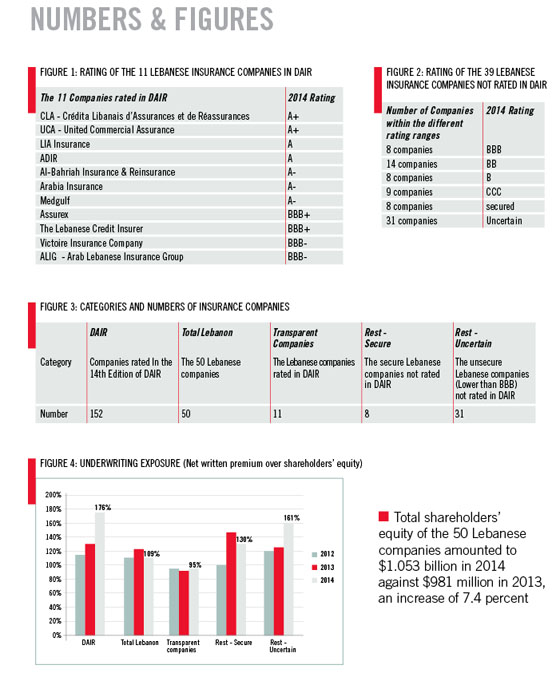
This brief, which was prepared for Executive as an exclusive contribution, covers the 50 Lebanese insurance companies. It is important to note that 11 companies out of the 50 are referred to as “transparent companies” for the purpose of this article (see figure 1), since they voluntarily made their annual audited accounts public well before the ICC started fully disclosing company results with the publication of its annual report in 2013.

In analyzing all the companies in the Lebanese insurance sector, we defined three categories in which companies are clustered for the purpose of this article: transparent, unrated but secure, and unrated and uncertain (see figure 2 for the number of companies in each category).

Although 60 percent of the insurance companies in Lebanon fall within the uncertain range, 80 percent of the insurance coverage in 2014 originated from secured insurance companies as far as their financial strength are concerned. This should give some comfort among the insured. It is worth noting that the largest 10 Lebanese companies dominate the market with a 64 percent market share.

The satisfactory proportion of insurance business by secured companies notwithstanding, the large number of unsecured companies, 31, (see figure 3) – meaning providers which a full rating would place below investment range – brings attention to the importance of introducing transparency among the Lebanese insurance companies. Based on the ICC reports, the i.e. Muhanna rating services has rated the 39 companies which do not voluntarily publish their accounts. However, in the absence of full disclosure of the audited accounts, we have refrained from publishing the results in DAIR. We urge the insurance companies to respond to this concern for transparency and make their complete audited financial statements public, including their income statements, revenue accounts and notes.

Financial Highlights on the insurance companies in Lebanon:

Total shareholders’ equity of the 50 Lebanese companies amounted to $1.053 billion in 2014 against $981 million in 2013, an increase of 7.4 percent. Total Net Premium Written amounted to $1.15 billion in 2014 against $1.1 billion in 2013, an increase of 4.2 percent. As a result, the risk of underwriting exposure measured by net premium written over shareholders’ equity for the Lebanese companies reached 109 percent in 2014, similar to the 110 percent figure in 2012. The rate in Lebanon compares positively with the Arab World average of 176 percent (see figure 4). However, the Arab World average is distorted by the underwriting exposure of four companies with extremely high rates of this risk. If we exclude the four outliers, the Arab World average would stand at 117 percent.

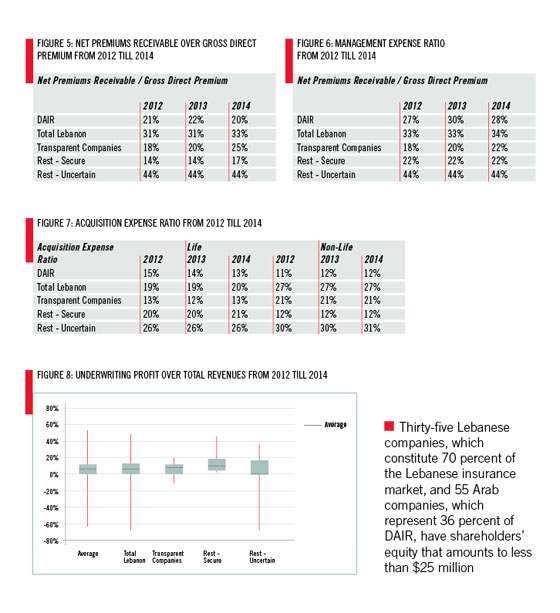
The insurance business is unlike any other business: as the risk expires, the collection of premiums becomes harder. Hence, bad debt or inadmissible assets are common among companies with Premiums Receivable in excess of 30 percent. In this context, it needs to be pointed out that Premiums Receivable for the cluster of companies labeled “Rest – Uncertain” represent 44 percent of Gross Direct Premiums, which is well above the average ratio for the two other company clusters and the sector overall (see figure 5).

While the Management Expense Ratio is reasonably stable over the 3 years, it was noticed that the cluster of companies labeled “Rest – Uncertain” are spending more than double on their Management Expenses when compared with the secure and transparent companies (see figure 6). This could be for two reasons; the first is due to the economy of scale since most of those companies have very small portfolios. The second, since all the companies are family-run insurance companies, the structure of expenses is set by the owner/management.

Although it is imperative to separate the cost of doing life insurance business from the non-life business, the data provided proved difficult to analyze bearing in mind the existence of composite companies. In spite of that, it is clear that the acquisition cost among the non-life companies in the “Rest-Uncertain” cluster is well above the others in Lebanon (figure 7).

Capital vs. equity

The following table sheds some light on why very small insurance companies still exist in the current business environment (figure 8).

The World Bank’s comment on the current insurance solvency position in the insurance sector in Lebanon is to the point: “Solvency margin requirements are out of date and low by international standards. Local and foreign insurers and reinsurers (if any) are subject to the same minimum capital requirements. At 2.25 billion Lebanese Lira ($1.5 million), the absolute minimum is not out of line with international norms or a barrier to entry. An out of date solvency margin requirement at 10 percent of premium is required. As part of the future development of the sector, a more risk based regime should be explored. Initially, this could be developed as a risk assessment tool for the sector and the ICC before it is implemented as a solvency regime under a revised insurance law with appropriate transitional arrangements.”

So, it is not the capital requirements which count but rather the shareholders’ equity. The difference between the policyholders fund and the shareholders fund should be in access of the solvency requirements in order to allow for all the risks associated in calculating the provisions, as well as to allow for the company to grow or to close down. In short, the shareholders of the insurance companies have co-owners i.e. the policyholders.

Thirty-five Lebanese companies, which constitute 70 percent of the Lebanese insurance market, and 55 Arab companies, which represent 36 percent of DAIR, have shareholders’ equity that amounts to less than $25 million. It is unfortunate to note that three Lebanese companies have a negative shareholders’ equity. In addition, 15 Lebanese companies, which represent 30 percent of the Lebanese market, have shareholders’ equity between $25 million and $300 million.

As the World Bank commented, “it is not necessary to reduce the number of insurers to unleash further development,” we were reminded of sector development in one European country, Denmark. Denmark, with a similar population to Lebanon, is home to over double the number of insurance companies, yet it is a solid, well developed and properly managed insurance market. At the same time, consolidation has streamlined the Danish insurance market since the country felt the impacts of the global financial crisis in 2008/2009. Due to the crisis and as a result of the low interest rate environment, the number of insurance companies operating in Denmark declined from 174 at the end of 2008 to 115 in 2013. Compared with best practices and country examples such as Denmark, the Lebanese insurance sector can still cover much ground.

1

2

May 17, 2016 0 comments
0 FacebookTwitterPinterestEmail
Insurance 2016Special Report

Insuring growth

by Thomas Schellen May 16, 2016
written by Thomas Schellen

E   Can you confirm data suggesting that AROPE Insurance maintains a leading role in underwriting comprehensive motor insurance, meaning insurance that covers the risks of owning and operating a car?

Yes, and we are the most profitable company among composite insurers which provide both life and non-life insurance, as per the 2014 Annual Report published by the Insurance Control Commission (ICC) on the Lebanese insurance sector.

E   Would you update us on the company’s results for 2015?

If we talk about consolidated figures, we had $109 million in gross premiums with $19 million in profits. Our shareholders’ equity stood at $126 million. The group is healthy.

E   Did you see any particular changes in your market share?

We can’t tell yet, but I think that we are still leaders in motor insurance and one of the major players in life insurance. Our business is growing across the board, despite what is going on around us. There were some impacts that we had to adjust to in 2015, such as the central bank circulars that mandated borrowers to put down 25 percent of any loan as well as the premium [of insurance related to the loan]. This led to a small regression in our life insurance portfolio but this will be better over the years to come, because the business is now more sustainable.

E   Banks also now have to offer loan customers a choice of five providers for the insurance that secures their loans. How did this innovation impact you?

This is a good thing. Banks have to offer more choices to their clients and for us at AROPE it was a win-win situation, because while other insurance companies are on the list [at our parent bank, BLOM] we are on the lists of other banks.

E   In its recent annual report for 2014, the ICC showed separate but very similar underwriting results for compulsory motor insurance in the two coverage areas of bodily injury, which has been imposed since the early 2000s, and material damages, which is quite new as a requirement under the 2013 traffic law. Are the growth rates aligning?

As you know, the only cover that was compulsory was for bodily injury. One of the articles in the new traffic law mentioned two years ago that insurance against material damages was required and we started to finalize this but there was no decision to go ahead with implementation.

E   So it is still not enforced?

No; all relevant decrees have not yet been issued.

E   You are bank-owned. Is the expansion into other countries driven by BLOM Bank?

As you know, we are in Egypt with life and non-life insurance. We usually follow in BLOM’s footsteps.

E   Apart from risks such as the currency risk, the Egyptian market has a large share of local insurers. How does this work for you?

What you are saying is 100 percent right but to look at it from the other side, before we arrived, there were companies in the market [which invested in Egypt]. Our penetration is good, there is a problem with monopolistic and big properties, which is not our cup of tea. Our strategy is to go toward personal lines – such as life insurance, medical, personal accident, all these policies which we love to sell. And we follow BLOM’s footsteps and we go after their customers.

[pullquote]I think we are still leaders in motor insurance and one of the major players in life insurance. Our business is growing across the board, despite what is going on around us.[/pullquote]

E   Would AROPE aim to become more of a regional company in its profile? Do you have a strategic aim on how much of your business should be generated outside of Lebanon?

We were aiming to have a company that is bigger than the one we have in Lebanon when we entered Egypt. Our business plan was based on personal lines and bancassurance and when the government changed, the central bank stopped bancassurance agreements and it wasn’t until 2014, a year and half ago, that they issued a decree on how to do bancassurance. We applied and waited for the approvals and if I’m not wrong, we started selling the bancassurance [in Egypt] by the end of 2014.

E   Do you have a current target on how much of your revenue you want to generate outside by 2020?

If you asked me this question in 2010, it would have been much easier to answer. It is no secret that we had a lot of ambitions. Now, with everything that is happening around us, you have to be very careful. Play it by ear.

E   We talked some years ago about the role of insurance regulators and the need for a unified MENA market to make it easier to do intra-regional activities. Is this happening?

I can tell you that things are much better now in Lebanon [as far as dealing with regulators], because things are run very smoothly and we have new instructions every few days, which is good as long as they are good instructions.

May 16, 2016 0 comments
0 FacebookTwitterPinterestEmail
Insurance 2016Special Report

Anatomy of an insurance sector

by Thomas Schellen May 13, 2016
written by Thomas Schellen

The Lebanese insurance industry is enigmatic in the sense that numerous companies – 50 – share $1.5 billion in gross premiums but that not one of the companies is listed. For a considerable time – at least in the era of the current insurance law which was updated almost 20 years ago – the country’s insurance sector has also been characterized by a dichotomy between on the one hand being among the largest insurance industries in the Arab world in terms of insurance penetration, meaning the role of insurance in percentage of gross domestic product, and on the other hand being overshadowed by commercial banks in their contribution to jobs and to the economy in general.

Insurance providers count among the pillars of developed economies because of their stewardship of the people’s pension money and thereof resultant long-term investments. This role of institutional investors is largely absent from the Lebanese market as the Insurance Control Commission (ICC) noted in its recently published annual report for the sector.

Additionally, the Lebanese insurance market has seen numerous opportunities for development that have not been utilized. As insurance executives confirm, passing interests in the newer lines of business – whether insurances in case of riots and civil commotion or unrest (which are types of property covers), kidnap and ransom policies, or liability insurance for directors and officers of companies – are specialties that do not gain more than fleeting demand in Lebanese and regional markets.

Some insurance innovations will make their way into the Lebanese market – whether because of the internet of things, the shift of economies (and of economic confrontations) in the digital and cyber security world or because of the issues related to our climate and need of insuring alternative energy generation and preservation.

Life, motor, medical dominate

According to the records published by the ICC, the number of insurance providers which underwrite risks in the six different categories that require licensing under the existing law ranges from 45 in general accident insurance (which includes motor and medical) to 10 in credit and zero in agricultural underwriting. For life insurance, 36 companies are licensed of which all but a handful of firms can act as composite companies that offer non-life coverage alongside their life insurance licenses.

[pullquote]Numerous companies – 50 – share $1.5 billion in gross premiums[/pullquote]

However, for the time being the Lebanese market is still best described in terms of the market shares for the different insurance volume specialties, namely motor and health insurance in the non-life or general sector and life insurance with the varieties of protection only, protection with savings, and unit-linked (with risk participation) lines. Life, motor and medical insurance account for around four in every five dollars in coverage sold by insurance providers in the local market.

It is instructive to see that in the life insurance sector the split between the three sub-specialties is tending toward growth of protection-only policies which, according to the ICC, rose from 9.4 percent to 11.3 percent of total premiums written in the years 2010-2014. Protection-only covers played main roles in bank-induced insurances of loan takers in the retail segment. Over the same time period, the issues of wealth-building insurance through protection-cum-savings contracts stayed comparatively stable, whereas unit-linked products saw both fluctuation and degradation as uptake of such contracts fell to 8.1 percent in 2014, compared with 9.9 percent of the market in 2010.

Demand still limited

From an operational perspective, the demand for life insurance is therefore a reflection of investment needs in the rather limited segment of society where such needs are present and on the other hand the needs and realities of people in the wider Lebanese economy, which in recent years suffered a downturn from the growth of incomes that was seen in the period prior to the outbreak of the Syrian crisis and other crises affecting Lebanon.

This also correlates with the growth concentration in general, or non-life, insurance lines where the five years from 2010 to 2014 saw a shift to medical insurance as the number one category in written premiums, moving ahead of motor insurance where demand for vehicles stayed buoyant but customers often opted for new cars that were less costly in acquisition, upkeep and maintenance, including insurance. Fire insurance saw increases amidst new ministerial scrutiny over policy requirements for enterprises but other branches of general insurance, including professional liability and similar covers, did not witness expansions that would have been intuitive in markets with more developed frameworks and stronger economies.

According to the annual report on the sector, it is now possible to see which companies exactly are leaders in underwriting of the various business lines.

The market is served largely by three types of companies: local firms that associate with international companies, local firms that are owned by local banks and firms that are local and independent. The local firms serve the long tail of the market while firms with regional or international ties often have stronger opportunities for product diversification and size-wise development. The question is what insurance companies are financially secure (see story page 64) and how to encourage greater financial and operational transparency of insurance companies in Lebanon.

May 13, 2016 0 comments
0 FacebookTwitterPinterestEmail
LeadersOpinion

Insuring a healthy economy

by Executive Editors May 13, 2016
written by Executive Editors

Insurance is good for an economy. It is as simple as that. By being insured, that is by dedicating between 3 and 10 percent of their gross domestic product to financial care and protection of life, economic stakeholders in developed countries globally manage risk and prepare for problems arising in any situation – from earthquakes, floods and other natural catastrophes to manmade perils and plain old needs for health care or the accumulation of capitals for times of needs.

In the estimate of Swiss Re Sigma, a research institution affiliated with large global reinsurer Swiss Re, global real premium income is forecast to rise by 4 percent in 2016 and 4.2 percent in 2017, with emerging markets as the main driver. According to Sigma, insurance in the Middle East and North Africa region (MENA) is expected to witness a strong improvement to 8–9 percent premium growth in real terms. The outlook for life insurance in MENA is for insurance to benefit from the region’s “robust economic development and favorable demographics” but the reinsurer also noted that life insurance on a regional level – including Pakistan for the purpose – is low in the region comprising the Middle East, Turkey and Pakistan (METP) at 16 percent of total premiums in the METP region. To realize the potential for growth, stringent and comprehensive regulations as well as utilization of technical tools and Takaful – insurance systems in compliance with Islamic law – are needed.

Since the middle of the last century, the insurance industry in the Middle East has been a part of the equation, taking the much older concept of mutual protection to new heights. Risks change, however, and insurance needs to adapt to new practices – such as digital distribution and cyber insurance – and to new challenges related to issues as diverse as the human impact on climate and the aging of our societies. To address changes and challenges, bright minds in regional insurance have over many years teamed up with international experts in events such as the biennial large conferences of the General Arab Insurance Federation (GAIF).

[pullquote]Lebanon has been a pioneer in the development of insurance services and skills – from actuarial knowledge to underwriting and marketing – in the Middle East[/pullquote]

Lebanon has been a pioneer in the development of insurance services and skills – from actuarial knowledge to underwriting and marketing – in the Middle East. It is the host of GAIF this month. As such, the country plays an integral role in the rollout of services for insurance and in discussions of the challenges that regional insurers should tackle over the coming years. However, GAIF is often also a political event and is exposed to the internal politics of the sector and to the politics of Arab governments. This is reflected in the program and composition of GAIF.

In 2016, for example, Executive has found only a handful of GAIF registered delegates from the largest economy in the MENA region, Saudi Arabia. Out of nearly 1,300 participants who registered one month before the event, only 5 percent were shown as originating in their work identities from the three Gulf countries of Kuwait, Qatar and Saudi Arabia.

Saudi Arabia has just published its vision (2030) to turn the kingdom into, among other things, an economic hub and global investment powerhouse. This vision promises a “tolerant country with Islam as its constitution and moderation as its method” with “healthier employment opportunities for citizens and long-term prosperity for all.”

The future envisioned by Saudi planners – and that is importantly not some foreign product of hapless civil-society people but is based on holy writ and identity and introduced by the royal chairman of the Council for Economic and Development Affairs, Muhammad Bin Salman Bin Abdulaziz Al-Saud – will include increased room for economic development of SMEs and commitment to education, health, housing resources, such as mortgages, and becoming “a leader in competitively managing assets, funding and investment.”

That is good news for insurance, which has an integral role not only in investment, financial markets and risk anticipation but also in all areas where governance and transparency are prioritized. One can take events and conferences such as GAIF as rituals or as possibilities to innovate in an area that is of vital importance for this region, all the more as improvements in insurance profitability in developed markets will remain subdued by pretty much every expectation. Executive stands with the call for improved collaboration in the insurance sector of the Arab world, whether in the area of regulatory stringency or in the development of our products, services and financial markets. All should work together.

May 13, 2016 0 comments
0 FacebookTwitterPinterestEmail
  • 1
  • …
  • 123
  • 124
  • 125
  • 126
  • 127
  • …
  • 685

Latest Cover

About us

Since its first edition emerged on the newsstands in 1999, Executive Magazine has been dedicated to providing its readers with the most up-to-date local and regional business news. Executive is a monthly business magazine that offers readers in-depth analyses on the Lebanese world of commerce, covering all the major sectors – from banking, finance, and insurance to technology, tourism, hospitality, media, and retail.

  • Donate
  • Our Purpose
  • Contact Us

Sign up for our newsletter

[contact-form-7 id=”27812″ title=”FooterSubscription”]

  • Facebook
  • Twitter
  • Instagram
  • Linkedin
  • Youtube
Executive Magazine
  • ISSUES
    • Current Issue
    • Past issues
  • BUSINESS
  • ECONOMICS & POLICY
  • OPINION
  • SPECIAL REPORTS
  • EXECUTIVE TALKS
  • MOVEMENTS
    • Change the image
    • Cannes lions
    • Transparency & accountability
    • ECONOMIC ROADMAP
    • Say No to Corruption
    • The Lebanon media development initiative
    • LPSN Policy Asks
    • Advocating the preservation of deposits
  • JOIN US
    • Join our movement
    • Attend our events
    • Receive updates
    • Connect with us
  • DONATE